The current research aims to explore the lean culture (LC) concept, particularly from the organisational psychology (OPS) perspective and justify its relevance by revealing its relationships with other related organisational concepts reported in the academic literature.
A systematic literature review (SLR) of peer-reviewed journal articles and conference proceedings identified a total of 522 articles, published between 2014 and 2024. It was collected from four databases: Emerald Online, EBSCO, OpenAIRE and Google Scholar. Finally, 63 articles were included for thematic and relational analysis to answer research questions.
The thematic analysis identified the following OPS concepts meaningfully connected to LC: motivation, engagement, empowerment, involvement, teamwork, training and learning, mutual respect, trust, consistency and commitments of leadership, management and employees. The study also revealed that LC directly impacts several organisational concepts, including lean management and manufacturing implementation, management, leadership, organisational culture, academic corruption, positive organisational politics, corporate and supply chain competitiveness and green practices. Additionally, LC positively moderates and mediates the relationship between organisational concepts like lean practice, sustainable performance and operational excellence. These relationships justify the relevance of LC in organisations.
It is hoped that this research will contribute to a deeper understanding of LC by exploring its connection with OPS concepts and analysing its relevance concerning other organisational concepts.
1. Introduction
Lean Production is closely associated with the remarkable success of the Toyota car company, which showcased the efficacy of Lean in enhancing operational effectiveness (Womack and Jones, 2003). Toyota’s Lean Production system, developed by Taiichi Ohno and popularised by James Womack and Daniel Jones, focuses on eliminating waste, improving efficiency, and increasing value creation. This system is founded on both hard and soft lean manufacturing practices. Hard practices emphasise technical and analytical tools, whereas soft practices focus on people and their relationships. Although the success of Lean Production depends on the simultaneous and systematic application of both practices, research revealed that the hard lean practices are more prevalently adopted than their soft counterparts (Larteb et al., 2015). Yet, many organisations subsequently failed to emulate Toyota's success with Lean. Failure is simultaneously encountered during the implementation and sustaining of Lean practices in organisations. At the Lean implementation, the failure rate is reaching a range between 70 and 90% across nearly all industries (Mamoojee-Khatib et al., 2025). Research indicates that fewer than 10% of businesses have success in implementing Lean within one year (Bhasin, 2012; Minh and Kien, 2021). Sustaining Lean is also challenging, and only a few firms adopting it will succeed. Grigg et al. (2020) revealed that after a decade of Lean implementation, 90% of manufacturing industries have failed to sustain Lean practices. For all the high failure rates, culture – the soft lean manufacturing practice – has consistently been cited as a rationale, a contributing element, and a pivotal solution (Bortolotti et al., 2014; Maware and Parsley, 2022; Rodgers et al., 2021; Swarnakar et al., 2020). The cultural dimension significantly influences the success of Lean, surpassing the importance of the Lean tools themselves (Bortolotti et al., 2014). Due to a high adoption failure rate, Lean culture (LC) has been noted to be an underdeveloped concept (Dorval and Jobin, 2020). As a soft practice, LC inherently draws on principles of behavioural psychology, and numerous studies have examined its relationship with specific organisational psychology constructs. However, existing research tends to address these constructs in isolation, and a comprehensive synthesis identifying the most recurrent and influential psychological factors associated with LC remains absent from the literature.
Another topic in the LC research is its relevance, which is also under scrutiny in the academic literature. While some research studies (Salah et al., 2014a; Zulkeflee et al., 2023) confirmed LC's relationship with Lean implementation, yet its connection with other organisational concepts is inconsistently reported. Understanding the relevance of LC in organisations can support exploring LC and reduce the high level of pragmatic ambiguity that characterises LC currently in the scholarly literature (Dorval et al., 2019; Dorval and Jobin, 2022).
While the number of LC publications in academic journals has grown exponentially, efforts to conduct a systematic literature review exploring LC from an organisational psychology perspective and its relevance in organisations have not been made. The present paper aims to fill this gap by longitudinally analysing the last ten years of LC research. Guided by this purpose, this study seeks to (1) enhance our understanding of LC, particularly its relationship with the organisational psychology concepts, and (2) to justify LC's relevance in organisations.
The research questions flow from the research objectives.
What findings can we synthesise from the existing themes and definitions derived from the scholarly literature to enhance our understanding of LC, particularly its relationship with organisational psychology aspects?
What relationships of LC with other relevant organisational concepts are reported in the academic literature that justify the relevance of LC?
Subsequent sections provide background on LC and organisational psychology concepts, outline the methodology, address the research questions by presenting and discussing the SLR findings, and conclude with implications, limitations, and future research directions.
2. Conceptual background
This section presents the theoretical background essential for review, beginning with a definition of LC and its constructs, followed by key concepts from organisational psychology.
2.1 Lean culture
Numerous definitions of LC exist in the literature, although they refer to divergent interpretations. For example, some definitions rely on continuous improvement (Dorval and Jobin, 2022; Zemanová and Slavíčková, 2022), while others include respect for people (Heikkinen, 2024; Vlahos, 2021) or waste reduction (Hassan and Pasha, 2023; Osman et al., 2021). Several others view LC as a culture that is oriented towards learning (Fenner et al., 2023; Gutierrez et al., 2022; Powell and Reke, 2019), but some see LC as an organisational environment that enables employees to use lean tools and techniques actively (Charron et al., 2014; Fadnavis et al., 2020). Additionally, a few recent literature reviews attempted to compile LC definitions and somewhat resemble a specific list of building blocks (Dorval et al., 2019; Osman et al., 2021), found that many of these definitions are complex and “cover most aspects of organisational behaviour, philosophy, thinking, ideologies, decisions, management styles and so on” (Péczely and Liberona, 2018, p. 31). Apparently, the definition of LC in the related literature is not clear-cut; instead, it seems to be used freely by all for all, resulting in diverse interpretations of the concept that make the LC definition challenging to understand. To avoid such inconsistency, the starting point of this reasoning was two seminal books: “Toyota Way” (Liker, 2003) and “Toyota Culture: The Heart and Soul of the Toyota Way” (Liker and Hoseus, 2008). While the former revealed the guiding principles and practices behind Toyota's success, which were built on two pillars, continuous improvement (CI) and respect for people (RP), the latter examined the “human systems” that Toyota has put in place. These two inspiring works reinforced the assertion of the father of the Toyota Production System, Taiichi Ohno (2019), that an organisation must adhere to CI and RP principles to develop a robust and effective LC. Several Lean scholars have subsequently acknowledged the same claim (Gaiardelli and Resta, 2018; Loyd et al., 2020; Martins et al., 2015; Salah and Sayed, 2015; Zarbo, 2012). Continuous Improvement (CI), defined as “the ongoing improvement of products, services, or processes through incremental and breakthrough improvements” (ASQ, 2024, para. 1), continuously strives for excellence, fosters a culture in which all employees engage in suggesting and executing improvements (Walker, 2020), and creates a climate for perpetual learning that welcomes and adapts to change (Liker, 2003). Respect for People (RP), another pillar of Lean Culture (LC), promotes a climate conducive to Continuous Improvement (CI) and is exemplified by a slogan observed in Toyota facilities that emphasises “the attitude that regards people's ability to think the most” (Naydenov, 2019, para. 16). The RP and its connection to CI are fundamentally grounded in behavioural psychology since both pillars are the psychological foundations of the LC, as Reaves (2023) noted by elucidating their psychological dimensions. Therefore, examining LC's relationship with organisational psychology concepts would be beneficial to understand LC.
2.2 Organisational psychology concepts
Organisational psychology (OPS) concepts relate to the behaviour and interaction of individuals in organisational settings, focussing on criteria such as psychological aspects of work, motivation, team dynamics, and leadership. While the field encompasses a broader range of constructs, this review focuses on a selected group of concepts consistently identified in the systematic literature review.
OPS concepts related to the psychological aspects of work encompass the mental and emotional conditions experienced by individuals in the workplace, including factors such as adaptability, consistency, job satisfaction, safety and trust. Adaptability refers to how individuals and organisations respond to change. Individual adaptability reflects a person's inclination to be flexible, open-minded, and responsive to shifting work conditions (Neves and van Dam, 2024), while organisational adaptability denotes the ability of an organisation to adjust its behaviour, structure and systems to survive an unpredictable climate (Salah et al., 2014b). Consistency refers to the ability to maintain reliable and predictable performance, behaviour, and attitude over time (NeuroLaunch, 2024; Schlicht, 2021). Job satisfaction reflects the degree of contentment and fulfilment an employee feels, encompassing both affective and cognitive evaluations of work (Zhu, 2012). Safety is defined as “a state in which hazards and conditions leading to physical, psychological or material harm are controlled to preserve the health and well-being of individuals and the community” (Maurice et al., 2001, p. 2). Trust reflects a psychological state involving the willingness to accept vulnerability based on positive expectations of others' behaviour (Rousseau et al., 1998, p. 395). In an organisational context, „trust is the belief in the integrity, predictability, benevolence, and competence” of others in the workplace (McKnight and Chervany, 2000, p. 828).
OPS concepts related to Motivation refer to the internal and external forces that initiate, direct, and sustain goal-oriented behaviours within organisational contexts, influencing employees' willingness and persistence to perform tasks. Motivation is „a driving force within individuals by which they attempt to achieve some goal to fulfil some need or expectation” (Mullins and Christy, 2013, p. 246). Employee commitment refers to “the relative strength of an individual's identification with and involvement in a particular organisation” (Wang et al., 2010). Engagement is both attitudinal and behavioural, involving commitment, enthusiasm, and focused effort toward organisational goals (Macey and Schneider, 2008, p. 4). Rewards encompass tangible and intangible benefits provided to employees in recognition of their contributions (Antoni et al., 2017).
Team dynamics involve the psychological and behavioural processes that shape how team members interact, collaborate, and influence one another, impacting team cohesion, communication, and performance. Teamwork centres on the dynamics of group interactions and involves adaptive, episodic processes of communication, coordination, and mutual influence toward a shared goal (Salas et al., 2015). Involvement enhances individuals' participation in decisions affecting organisational performance and well-being (Denison, 2001). Mutual respect entails the reciprocal appreciation of each employee's contributions and rights (Grover, 2014). Empowerment gives individuals power and control to accomplish their work meaningfully (Febriana, 2011). Delegation is “the practice of entrusting subordinates with significant responsibilities” and discretion in decision-making (Gerry et al., 2024, p. 37). Training and learning refer to the acquisition and application of knowledge, skills, and affect over time to enhance effectiveness (Kraiger and Ford, 2021).
Leadership is the process of influencing and guiding individuals or groups within an organisation through vision, decision-making, and interpersonal behaviour to achieve common goals. Leadership commitment refers to leaders' dedication to their responsibilities and the well-being of employees (Nasomboon, 2014). Management commitment involves “a strong belief in and acceptance of the organisation's goals and values” and a desire to maintain membership (Karim and Qamruzzaman, 2020).
These constructs represent key psychological dimensions frequently examined in organisational settings, providing a theoretical foundation for the review.
These organisational psychology constructs are frequently discussed in relation to Lean environments, as they underpin the behavioural and relational dynamics necessary for Lean Culture to take root. While their specific roles and interrelationships within Lean Culture vary, understanding these foundational concepts is essential for the systematic analysis presented in the following sections.
3. Research methodology
This study is based on conducting an inductive thematic analysis on data obtained from Templier and Paré's (2015) cumulative type of systematic literature review (SLR), which is considered ideal for answering the research questions due to its methodological rigour, reproducibility, transparency and scientific nature that guarantees the minimised research bias (Cherry et al., 2023). This research design methodically compiles evidence, identifies patterns, and generates new knowledge through six steps (Figure 1).
 The figure displays six boxes in a horizontal row. Each rectangle contains text from left to right as: First box: “(S1) Formulating the problem” Second box: “(S2) Searching the literature” Third box: “(S3) Screening for inclusion” Fourth box: “(S4) Assessing quality” Fifth box: “(S5) Extracting data” Sixth box: “(S6) Analysing, synthesising data” Each box is connected to the box on the right by a right-pointing arrow.
The SLR process steps. Source: Adapted from Templier and Paré (2015)
The figure displays six boxes in a horizontal row. Each rectangle contains text from left to right as: First box: “(S1) Formulating the problem” Second box: “(S2) Searching the literature” Third box: “(S3) Screening for inclusion” Fourth box: “(S4) Assessing quality” Fifth box: “(S5) Extracting data” Sixth box: “(S6) Analysing, synthesising data” Each box is connected to the box on the right by a right-pointing arrow.The SLR process steps. Source: Adapted from Templier and Paré (2015)
(S1) The problem formulation concluded with two research questions in the Introduction section. (S2) The literature search was performed on four electronic databases: Emerald Online, EBSCO, OpenAIRE, and Google Scholar. Databases are iteratively scanned using search strings made of “Lean Culture” keywords combined with the Boolean “AND” connectors with each of the following keywords separately: “organisation”, “psychology”, “continuous improvement”, and “respect for people”.
(S3) Screening for inclusion adhered to the inclusion/exclusion criteria presented in Table 1.
Inclusion/Exclusion criteria
| Topic | Inclusion criteria | Exclusion criteria |
|---|---|---|
| Access | Have access to the full paper | Not having access to the full paper |
| Language | Be written in English | Not written in English |
| Source | Empirical studies, limited to peer-reviewed journal articles and conference papers | Other types of documents (e.g. editorial letters, conceptual papers, reviews, books, theses) |
| Theme | Lean Culture in organisations relative to organisational psychology, continuous improvement, and respect for people | Lean tools (e.g. VSM, seven wastes, 5S) |
| Timespan | Published after 01.05.2014 to 31.12.2024 | Published before 01.05.2014 |
The timespan spans from May 2014 to December 2024, capturing a full decade of relevant research on psychological constructs in Lean Culture, while also reflecting the most recent contributions. The starting point of 2014 was chosen because of a noticeable shift in the literature toward the behavioural and cultural dimensions of Lean from that year onward. The endpoint was extended to include all of 2024, allowing for the inclusion of the most up-to-date findings available at the time of final data collection in early 2025.
Steps (S2), (S3) and (S4), as they were defined by Templier and Paré (2015), overlap the PRISMA method (Figure 2).
 The flowchart is divided into three stages, labeled on the left, from top to bottom as “Identified,” “Screened,” and “Included.” Each stage is further divided into two sections labeled at the top from left to right as “Identification of studies via databases” and “Identification of studies via other methods.” The “Identification of studies via databases” side begins with the first box in the “Identified” section labeled “1st search, Records identified from four Databases (n equals 522).” A rightward arrow from the first box leads to the second box in the same section, labeled “Records removed before screening: Duplicate records removed (n equals 190).” A downward arrow from the first box leads to the third box in the “Screened” section labeled “Records screened (type, date, title and abstract) (n equals 332).” A rightward arrow from the third box leads to the fourth box in the same section, labeled “Records excluded asterisk: Outdated (n equals 66), Wrong type (n equals 68), Irrelevant (n equals 82).” A downward arrow from the third box leads to the fifth box in the same section, labeled “Studies assessed for eligibility (full text and quality) (n equals 116).” A rightward arrow from the fifth box leads to the sixth box in the same section, labeled “Studies excluded: Poor quality (n equals 7), Irrelevant (n equals 56).” A downward arrow from the fifth box leads to the seventh box in the “Included” section, labeled “(n equals 53) studies included from database search.” An upward arrow from the seventh box, “(n equals 53),” leads upward to the “Identification of studies via other methods” section. In this section, the first box in the “Identified” section is labeled “2nd search, (‘Cited by’ in Google Scholar) of n equals 47 included studies. Records identified (n equals 812).” A downward arrow from the first box leads to the second box in the “Screened” section, labeled “Records screened (type, date, title and abstract) (n equals 812).” A rightward arrow from the second box leads to the third box in the same section, labeled “Records excluded asterisk: Wrong type (n equals 174), Outdated (n equals 0), Irrelevant (n equals 625).” A downward arrow from the second box leads to the fourth box in the same section, labeled “Studies assessed for eligibility (full text and quality) (n equals 13).” A rightward arrow from the fourth box leads to the fifth box in the same section, labeled “Studies excluded: Poor quality (n equals 0), Irrelevant (n equals 3).” A downward arrow from the fourth box leads to the sixth box in the “Included” section, labeled “(n equals 10) studies included from ‘cited by’ search.” The seventh box, “(n equals 53) studies included from database search,” from the left “Identification of studies via databases” section, and the sixth box, “(n equals 10) studies included from ‘cited by’ search,” from right “Identification of studies via other methods” section, merge to the last box of the flowchart in the “Included” section, labeled, ” TOTAL number of studies included in the review (n equals 63); Studies used to answer R q 1 (n equals 53), Studies used to answer R q 2 (n equals 14)”.
Paper selection process according to the PRISMA method. Note: * refers to inclusion/exclusion criteria (Table 1). Source: PRISMA flow diagram adapted from Page et al. (2021)
The flowchart is divided into three stages, labeled on the left, from top to bottom as “Identified,” “Screened,” and “Included.” Each stage is further divided into two sections labeled at the top from left to right as “Identification of studies via databases” and “Identification of studies via other methods.” The “Identification of studies via databases” side begins with the first box in the “Identified” section labeled “1st search, Records identified from four Databases (n equals 522).” A rightward arrow from the first box leads to the second box in the same section, labeled “Records removed before screening: Duplicate records removed (n equals 190).” A downward arrow from the first box leads to the third box in the “Screened” section labeled “Records screened (type, date, title and abstract) (n equals 332).” A rightward arrow from the third box leads to the fourth box in the same section, labeled “Records excluded asterisk: Outdated (n equals 66), Wrong type (n equals 68), Irrelevant (n equals 82).” A downward arrow from the third box leads to the fifth box in the same section, labeled “Studies assessed for eligibility (full text and quality) (n equals 116).” A rightward arrow from the fifth box leads to the sixth box in the same section, labeled “Studies excluded: Poor quality (n equals 7), Irrelevant (n equals 56).” A downward arrow from the fifth box leads to the seventh box in the “Included” section, labeled “(n equals 53) studies included from database search.” An upward arrow from the seventh box, “(n equals 53),” leads upward to the “Identification of studies via other methods” section. In this section, the first box in the “Identified” section is labeled “2nd search, (‘Cited by’ in Google Scholar) of n equals 47 included studies. Records identified (n equals 812).” A downward arrow from the first box leads to the second box in the “Screened” section, labeled “Records screened (type, date, title and abstract) (n equals 812).” A rightward arrow from the second box leads to the third box in the same section, labeled “Records excluded asterisk: Wrong type (n equals 174), Outdated (n equals 0), Irrelevant (n equals 625).” A downward arrow from the second box leads to the fourth box in the same section, labeled “Studies assessed for eligibility (full text and quality) (n equals 13).” A rightward arrow from the fourth box leads to the fifth box in the same section, labeled “Studies excluded: Poor quality (n equals 0), Irrelevant (n equals 3).” A downward arrow from the fourth box leads to the sixth box in the “Included” section, labeled “(n equals 10) studies included from ‘cited by’ search.” The seventh box, “(n equals 53) studies included from database search,” from the left “Identification of studies via databases” section, and the sixth box, “(n equals 10) studies included from ‘cited by’ search,” from right “Identification of studies via other methods” section, merge to the last box of the flowchart in the “Included” section, labeled, ” TOTAL number of studies included in the review (n equals 63); Studies used to answer R q 1 (n equals 53), Studies used to answer R q 2 (n equals 14)”.Paper selection process according to the PRISMA method. Note: * refers to inclusion/exclusion criteria (Table 1). Source: PRISMA flow diagram adapted from Page et al. (2021)
The initial database search yielded 522 records, from which 53 empirical studies, limited to peer-reviewed journal articles and conference papers, were included after applying the inclusion/exclusion criteria. A further ten empirical articles were identified through backwards citation tracking using Google Scholar's “cited by” feature, resulting in a final sample of 63 empirical studies ( Appendix, Table A1). In this step, an Excel spreadsheet was used to compile and validate the basic information for the included publications, which comprised the names of the authors, the country of the first author, the research strategy, the method, and the document's base industry; the publication title, the year of publication, and the publisher. (S4) A simple checklist (NSW, 2020) is used to assess the quality of the screened papers. It assessed the degree to which a study employs measures to minimise bias and error and to ensure the publication's design is sufficiently robust for the results to be trustworthy and generalisable (Cherry et al., 2023).
From here, steps (S5)-(S6) are performed twice to address research questions RQ1 and RQ2 consecutively.
In the first run of steps (S5)-(S6), thematic analysis is used to identify and interpret themes in the qualitative data, addressing research question RQ1. Here, the thematic analysis rule of Clarke and Braun (2017) was used, made of five steps: (S5.1) familiarising with data, (S5.2) generating initial codes―reviewing and revising codes, (S5.3) searching for themes and reviewing themes, (S5.4) defining and naming themes, and (S5.5) generating the report.
(S5.1) Reading and rereading the articles helped familiarise the authors with the dataset's content. (S5.2) The coding applied to the entire article, from the introduction to the conclusion. Generating, reviewing and revising the codes, adhered to the seven essential criteria (S5.2.1-S5.2.7) of a code list's evaluation, as Rädiker and Kuckartz suggested (2020, p. 47).
(S5.2.1) Codes are closely related to the research questions as each coded segment refers to at least one of the LC, RP, CI and OPS concepts. (S5.2.2) The codes are exhaustive, as it was ensured that they adequately capture all relevant text sections. (S5.2.3) The codes are selective because they are well distinguished, so it is always clear whether a text segment belongs (or not) to one or another code. When a code has a dual value, a better distinction can be achieved by splitting it into two codes. For instance, to satisfy this criterion, the “Mutual Respect and Trust” code, which contains a twofold value, was split into two distinct codes (“Mutual Respect” and “Trust”) to achieve better distinction. As this rule does not exclude mutual inclusion, more than one code may be applied to a single text section. For instance, the text section “… The second pillar, RP is built on respect (respect each other, make every effort to understand each other, take responsibility and build mutual trust) and teamwork …” (Coetzee et al., 2019, p. 2), was codified with the “Respect for People”, “Mutual Respect”, “Trust”, and “Teamwork” codes simultaneously. (S5.2.4) The codes are well-worded, with names that accurately reflect their intended purpose. For instance, we retained the names of all well-known concepts unchanged. (S5.2.5) The codes (in terms of content and language) are characteristics of their parent category (theme). As this thematic analysis is data-driven, it lacks a pre-existing theoretical framework to indicate the number of involved concepts or their interconnections. However, the concepts were derived from existing theories, thereby retaining characteristics of their parent categories. (S5.2.6) The codes together form a configuration (“gestalt”). This criterion is fulfilled by the code system, which combines related codes into a clear, thematic structure with a sense of connection and coherence. (S5.2.7) The last criterion―” codes are comprehensible to the recipient's criteria” (Rädiker and Kuckartz, 2020, p. 47)―is satisfied by keeping the wording relatively simple and having the study recipients in mind. The coding of the text segments is supported by MAXQDA 24 (VERBI Software, 2024).
Searching, reviewing (S5.3), defining and naming themes (S5.4) followed the data-driven thematic analysis method. With a semantic approach, the themes are identified within the surface meanings of the data, organised to show patterns in semantic content, and summarised for interpretation. Although codes are classified into themes without pre-existing LC's theoretical framework, it is not done in an epistemological vacuum. Accordingly, all codes that belong to a similar semantical subgroup of existing concepts are classified according to a corresponding theme. (S5.5) Collected codes with their frequency of occurrences and themes are reported in the Codebook and Theme register, respectively. These are summarised in the results section.
(S6) Finally, following the contextualism paradigm, an attempt was made to synthesise (in the results section) and interpret (in the discussion section) the significance of the patterns in the epistemological context of organisational psychology and the well-known “Toyota Way 2001” model (Liker and Hoseus, 2008, p. 14). The pattern is based on the code cooccurrence data. The interpretative assumption that cooccurring codes relate to each other is grounded in the idea that language and meaning are structured in patterns. Hence, cognitive proximity within the contextualism paradigm is a clue for researchers to uncover these latent connections. The theme cooccurrence matrix, indicating relations between themes, is tabulated and further graphically analysed in the next section. The discussion converged in answering research question RQ1.
In the second run of steps (S5)-(S6), the relational analysis addresses research question RQ2. In step (S5), fourteen articles elaborated on LC's relations to other organisational concepts were systematically analysed, and the findings were interpreted in the results section. Their discussion converged in answering research question RQ2 in step (S6).
4. Results
4.1 Descriptive data analysis
This subsection provides a descriptive overview of the 63 reviewed articles, comprising 56 peer-reviewed academic journal papers and seven conference proceedings.
Over the past decade, the annual volume of LC publications has experienced steady growth. 65% of the included articles have been published in the last five years, peaking in 2022 (19%) (Figure 3). This indicates an increasing interest in LC research within academic literature.
 The vertical axis of the vertical bar graph ranges from 0 to 12 in increments of 2. The horizontal axis lists the years: “2014,” “2015,” “2016,” “2017,” “2018,” “2019,” “2020,” “2021,” “2022,” “2023,” “2024.” A vertical bar is shown for each year. The legend at the bottom shows that each bar represents the “Number of Publications.” The data from the graph is as follows: 2014: 4. 2015: 1. 2016: 3. 2017: 4. 2018: 4. 2019: 6. 2020: 3. 2021: 7. 2022: 12. 2023: 9. 2024: 10.
Annual number of LC publications. Source: Authors’ own work
The vertical axis of the vertical bar graph ranges from 0 to 12 in increments of 2. The horizontal axis lists the years: “2014,” “2015,” “2016,” “2017,” “2018,” “2019,” “2020,” “2021,” “2022,” “2023,” “2024.” A vertical bar is shown for each year. The legend at the bottom shows that each bar represents the “Number of Publications.” The data from the graph is as follows: 2014: 4. 2015: 1. 2016: 3. 2017: 4. 2018: 4. 2019: 6. 2020: 3. 2021: 7. 2022: 12. 2023: 9. 2024: 10.Annual number of LC publications. Source: Authors’ own work
LC demonstrated substantial global interest within the analysed timespan, with input from 25 nations (Figure 4). The five most productive countries of the first author's affiliation were Malaysia (11%), the USA (11%), South Africa (10%), India (6%), and Nigeria (6%). The order of continents by productivity shows notable variation. Asia (n = 24, 38%), Europe (n = 14, 22%), Africa (n = 13, 21%), America (n = 12, 19%), and Australia (none).
 The vertical axis of the vertical bar graph ranges from 0 to 7 in increments of 1. The horizontal axis lists the countries: “Malaysia,” “U S A,” “South Africa,” “India,” “Nigeria,” “Sri Lanka,” “Canada,” “Egypt,” “Brazil,” “Hungary,” “Indonesia,” “Ireland,” “Pakistan,” “Saudi Arabia,” “Spain,” “Sweden,” “Greece,” “Iran,” “Italy,” ‘Jordan,” “Norway,” “Portugal,” “Romania,” “U K,” “Vietnam.” A vertical bar is shown for each country. A legend at the bottom shows that each bar shows the number of publications. The data from the graph is as follows: Malaysia: 7. U S A: 7. South Africa: 6. India: 4. Nigeria: 4. Sri Lanka: 4. Canada: 3. Egypt: 3. Brazil: 2. Hungary: 2. Indonesia: 2. Ireland: 2. Pakistan: 2. Saudi Arabia: 2. Spain: 2. Sweden: 2. Greece: 1. Iran: 1. Italy: 1. Jordan: 1. Norway: 1. Portugal: 1. Romania: 1. U K: 1. Vietnam: 1.
Number of publications by countries of the first author’s affiliation. Source: Authors’ own work
The vertical axis of the vertical bar graph ranges from 0 to 7 in increments of 1. The horizontal axis lists the countries: “Malaysia,” “U S A,” “South Africa,” “India,” “Nigeria,” “Sri Lanka,” “Canada,” “Egypt,” “Brazil,” “Hungary,” “Indonesia,” “Ireland,” “Pakistan,” “Saudi Arabia,” “Spain,” “Sweden,” “Greece,” “Iran,” “Italy,” ‘Jordan,” “Norway,” “Portugal,” “Romania,” “U K,” “Vietnam.” A vertical bar is shown for each country. A legend at the bottom shows that each bar shows the number of publications. The data from the graph is as follows: Malaysia: 7. U S A: 7. South Africa: 6. India: 4. Nigeria: 4. Sri Lanka: 4. Canada: 3. Egypt: 3. Brazil: 2. Hungary: 2. Indonesia: 2. Ireland: 2. Pakistan: 2. Saudi Arabia: 2. Spain: 2. Sweden: 2. Greece: 1. Iran: 1. Italy: 1. Jordan: 1. Norway: 1. Portugal: 1. Romania: 1. U K: 1. Vietnam: 1.Number of publications by countries of the first author’s affiliation. Source: Authors’ own work
During the reviewed period, as shown in Figure 5, LC was explored in four domains: manufacturing, in 36 papers (57%); services, in 15 papers (24%); general, in ten papers (16%); and energy, in two papers (3%).
 The vertical axis of the bar graph ranges from 0 to 14 in increments of 2. The horizontal axis lists the following categories, with section headers: “MANUFACTURING” containing “Multiple,” “Construction,” “Automotive,” “Wood and Furniture,” “Chemicals,” “Aerospace,” “Agriculture or Food,” “Electrical,” “Fashion,” “Leather,” “Maintenance,” “Metallurgy,” and “SERVICES” which includes “Healthcare,” “Public,” “Education,” “Aerospace,” “I T,” “Wholesale and ellipsis,” and two individual sections including “GENERAL” and “ENERGY. A vertical bar is shown for each category. The legend at the bottom reads “Number of publications.” The data from the graph is as follows: Multiple: 13. Construction: 9. Automotive: 3. Wood and Furniture: 2. Chemicals: 2. Aerospace (manufacturing): 1. Agriculture or Food: 1. Electrical: 1. Fashion: 1. Leather: 1. Maintenance: 1. Metallurgy: 1. Healthcare: 5. Public: 5. Education: 2. Aerospace (services): 1. I T: 1. Wholesale and ellipsis: 1. GENERAL: 10. ENERGY: 2.
Number of publications broken down by research domain and field. Source: Authors’ own work
The vertical axis of the bar graph ranges from 0 to 14 in increments of 2. The horizontal axis lists the following categories, with section headers: “MANUFACTURING” containing “Multiple,” “Construction,” “Automotive,” “Wood and Furniture,” “Chemicals,” “Aerospace,” “Agriculture or Food,” “Electrical,” “Fashion,” “Leather,” “Maintenance,” “Metallurgy,” and “SERVICES” which includes “Healthcare,” “Public,” “Education,” “Aerospace,” “I T,” “Wholesale and ellipsis,” and two individual sections including “GENERAL” and “ENERGY. A vertical bar is shown for each category. The legend at the bottom reads “Number of publications.” The data from the graph is as follows: Multiple: 13. Construction: 9. Automotive: 3. Wood and Furniture: 2. Chemicals: 2. Aerospace (manufacturing): 1. Agriculture or Food: 1. Electrical: 1. Fashion: 1. Leather: 1. Maintenance: 1. Metallurgy: 1. Healthcare: 5. Public: 5. Education: 2. Aerospace (services): 1. I T: 1. Wholesale and ellipsis: 1. GENERAL: 10. ENERGY: 2.Number of publications broken down by research domain and field. Source: Authors’ own work
In the manufacturing domain, many of the articles addressed multiple fields (36%); construction was the second most frequently studied field (25%), followed by automotive (8%). In the service domain, the top three fields were healthcare (33%), public (33%), and education (13%).
In terms of research methods, most articles employed the quantitative method (n = 45, 79%), followed by qualitative (n = 12, 21%) and mixed methods (n = 6, 11%).
4.2 Thematic analysis
This subsection presents the systematic literature review (SLR) results derived from the thematic analysis of the articles studied in relation to research question RQ1. Thematic analysis began with the following twelve clearly expressed organisational psychology concepts that were identified during the reading and rereading step: involvement, teamwork, empowerment, training and learning, mutual respect, trust, delegation, engagement, motivation, leadership commitment, management commitment, and employee commitment. Additionally, three cultural concepts – lean culture, continuous improvement, and respect for people – were selected based on the “Toyota Way 2001” model (Liker and Hoseus, 2008). During the first coding process, these fifteen codes were applied to the entire document set (from the introduction to the conclusion) using the “Text Search and Autocode” function of the MAXQDA 24 (VERBI Software, 2024) software. In the second turn, the entire document set was manually reviewed and recoded to correct the identified segments and codes as necessary. The repeated manual coding revealed five additional codes: adaptability, consistency, safety, job satisfaction, and rewards.
The coding process ended with 20 codes identified in total, which are compiled in a Codebook in Table 2 consisting of four fields: code identifier (CID), code name, code description (a condensed, coding-relevant, operationalised summaries of the concepts), and, in the right column, the number of coded segments with the number of articles (within brackets) from which segments derive.
Codebook
| CID | Name | Description | C.Seg |
|---|---|---|---|
| AD | Adaptability | Flexibility in responding to change at the individual or organisational level | 10(3) |
| CI | Continuous Improvement | Ongoing, incremental or breakthrough enhancements of processes or services | 328(49) |
| CL | Leadership Commitment | Active dedication of leaders to responsibilities and employee well-being | 42(22) |
| CN | Consistency | Sustained and reliable performance or behaviour over time | 29(8) |
| DL | Delegation | Granting decision-making authority and responsibilities to subordinates | 3(3) |
| EC | Employee Commitment | Psychological attachment to and identification with the organisation | 31(5) |
| EG | Engagement | Passionate and energetic involvement in organisational activities | 242(29) |
| EM | Empowerment | Enabling individuals to act with autonomy and purpose | 134(28) |
| IN | Involvement | Employee participation in decisions affecting performance and well-being | 180(37) |
| JS | Job Satisfaction | Affective and cognitive evaluation of job contentment | 1(1) |
| LC | Lean Culture | Culture focused on waste reduction, continuous improvement, and respect for people | 796(56) |
| MC | Management Commitment | Strong alignment with organisational goals and effort to maintain membership | 53(13) |
| MR | Mutual Respect | Reciprocal appreciation of others' contributions and rights | 31(5) |
| MT | Motivation | Inner drive to fulfil needs or expectations | 67(29) |
| RP | Respect for People | Valuing employees’ intellectual contributions and dignity | 46(15) |
| RW | Rewards | Organisational incentives recognising employee performance | 2(2) |
| SF | Safety | Conditions protecting physical and psychological health | 9(6) |
| TW | Teamwork | Collaborative, goal-directed interaction among team members | 137(27) |
| TL | Training and Learning | Acquisition and application of knowledge and skills to improve performance | 97(32) |
| TR | Trust | Confidence in the integrity and intentions of others in the workplace | 119(29) |
The thematic analysis identified, in addition to the Lean Culture Mindset, six organisational psychology themes related to the behaviour and interaction of individuals in an organisational environment. These themes focus on the previously mentioned psychological aspects of work, motivation, team dynamics, and leadership criteria. The themes' names, descriptions and associated codes are presented in Table 3.
Theme register
| Name of theme | Description of theme | Codes (concepts) |
|---|---|---|
| Lean Culture Mindset | Culture, respect, and improvement refer to a way of thinking, a foundational set of interconnected values and practices that guide organisations toward operational excellence | Lean Culture, Continuous Improvement, Respect for People |
| Employee Engagement and Motivation | It encompasses concepts central to understanding what drives employees' dedication, enthusiasm, and loyalty to their work and organisation | Engagement, Job Satisfaction, Motivation, Rewards |
| Interpersonal Relationships and Trust | It is built on trust as an important psychological aspect of work, and the mutual respect and delegation that foster team dynamics. This focus on the quality of social interactions within the workplace emphasises the importance of mutual respect, trust, and effective delegation in fostering a collaborative and participatory organisational culture | Mutual Respect, Trust, Delegation |
| Leadership and Organisational Commitment | It examines the role of leadership at various organisational levels (leaders, managers, employees) in aligning with organisational goals and fostering a cohesive and dedicated workforce | Leadership Commitment, Management Commitment, Employee Commitment |
| Learning and Adaptability | It highlights the significance of continuous learning as a driver of team dynamics, and adaptability as another beneficial psychological aspect of work, which enables employees and organisations to remain competitive and responsive to evolving challenges and opportunities | Training and Learning, Adaptability |
| Organisational Stability and Safety | It is built on the psychological aspects of work that pertain to maintaining a stable, predictable, and safe work environment, which is essential for employee well-being and consistent organisational performance | Consistency, Safety |
| Teamwork and Collaboration | It focuses on team dynamics and fostering cooperative work environments that enhance collective efficacy and organisational success | Teamwork, Involvement, Empowerment |
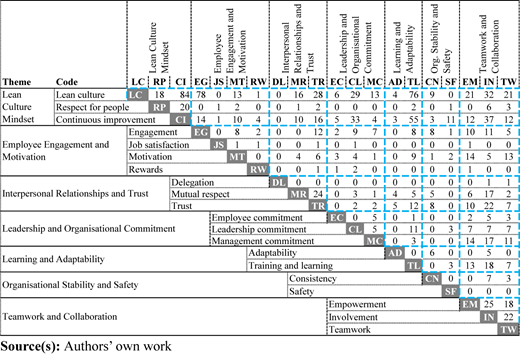
The codes' cooccurrence of Lean Culture Mindset theme concepts with OPS concepts indicated in Table A2 ( Appendix) helps us understand their relationships. The sum of cooccurrences of codes belonging to the same theme, which are cells in intersections of two themes framed by a blue dashed line, gives cooccurrences of themes (Table 4).
Themes cooccurrence matrix
| Cooccurrence of themes | Employee Engagement and motivation | Interpersonal relationships and trust | Leadership and organisational commitment | Learning and adaptability | Organisational stability and safety | Teamwork and collaboration |
|---|---|---|---|---|---|---|
| Lean Culture Mindset | 124 | 73 | 90 | 140 | 24 | 144 |
| Employee Engagement and Motivation | 24 | 30 | 17 | 12 | 60 | |
| Interpersonal Relationships and Trust | 8 | 26 | 13 | 66 | ||
| Leadership and Organisational Commitment | 15 | 3 | 73 | |||
| Learning and Adaptability | 9 | 43 | ||||
| Organisational Stability and Safety | 10 | |||||
The cooccurrence of the Lean Culture Mindset theme with other OPS themes is essential for addressing research question RQ1. Accordingly, the most frequent cognitive proximity of the Lean Culture Mindset theme in the reviewed literature is noticed with the “Teamwork and Collaboration” and “Learning and Adaptability” themes. “Employee Engagement and Motivation”, “Leadership and Organisational Commitment”, and “Interpersonal Relationships and Trust” are the other three themes showing a high occurrence with the Lean Culture Mindset theme, unlike the less cooccurring “Organisational Stability and Safety” theme.
Subsequent paragraphs analyse the links between LC and OPS concepts across themes, with the cooccurrence map in Figure 6 elucidating their relationships within organisations researched in the literature over the past decade. Thick arrows on the map indicate high cooccurrences of 20 or more, whereas thin arrows indicate any cooccurrences of five or more but less than 20.
 The diagram is enclosed within a dashed rectangular border labeled on the left side as “Organisational Psychology concepts.” Inside the diagram, several circles are connected by dashed black and pink lines. A legend on the right side labeled “Legend” shows two line styles: a thick black dashed line labeled “greater than or equal to 20” and a thin solid pink line labeled “greater than or equal to 5.” In the center of the figure, a light-colored rectangle is shown with three circles. The rectangle is labeled “Theme: Lean Culture Mindset.” Inside this rectangle, a circle labeled “L C” is connected to multiple other circles by these lines. To the upper left of “L C,” a circle labeled “C I” is connected to “L C” and other circles. To the upper right of “L C,” a circle labeled “R P” is connected to “L C” and other circles. Several colored circles surround the central circles, grouped into rectangular theme areas. The top left rectangle is labeled “Theme: Employee Engagement and Motivation” and contains circles labeled “J S,” “M T,” “E G,” and “R W.” The top right rectangle is labeled “Theme: Teamwork and Collaboration” and contains circles labeled “E M,” “I N,” and “T W.” The bottom right shaded rectangle is labeled “Theme: Learning and Adaptability” and contains circles labeled “T L” and “A D.” The bottom middle shaded rectangle is labeled “Theme: Interpersonal Relationships and Trust” and contains circles labeled “T R,” “M R,” and “D L.” The bottom left rectangle is labeled “Theme: Leadership and Organisational Commitment” and contains circles labeled “C L,” “M C,” and “E C.” The left rectangle is labeled “Theme: Organisational Stability and Safety” and contains circles labeled “S F” and “C N.” All the themes and circles are interconnected by the black dashed and pink lines extending from “L C” and “C I”.
Cooccurrence map of themes and their coded concepts. Note: Acronyms: AD-Adaptability, CI-Continuous Improvement, CL-Leadership Commitment, CN-Consistency, DL-Delegation, EC-Employee Commitment, EG-Engagement, EM-Empowerment, IN-Involvement, JS-Job Satisfaction, LC-Lean Culture, MC-Management Commitment, MR-Mutual Respect, MT-Motivation, RP-Respect for People, RW-Rewards, SF-Safety, TL-Training and Learning, TR-Trust, TW-Teamwork. Authors’ own work based on cooccurrence data
The diagram is enclosed within a dashed rectangular border labeled on the left side as “Organisational Psychology concepts.” Inside the diagram, several circles are connected by dashed black and pink lines. A legend on the right side labeled “Legend” shows two line styles: a thick black dashed line labeled “greater than or equal to 20” and a thin solid pink line labeled “greater than or equal to 5.” In the center of the figure, a light-colored rectangle is shown with three circles. The rectangle is labeled “Theme: Lean Culture Mindset.” Inside this rectangle, a circle labeled “L C” is connected to multiple other circles by these lines. To the upper left of “L C,” a circle labeled “C I” is connected to “L C” and other circles. To the upper right of “L C,” a circle labeled “R P” is connected to “L C” and other circles. Several colored circles surround the central circles, grouped into rectangular theme areas. The top left rectangle is labeled “Theme: Employee Engagement and Motivation” and contains circles labeled “J S,” “M T,” “E G,” and “R W.” The top right rectangle is labeled “Theme: Teamwork and Collaboration” and contains circles labeled “E M,” “I N,” and “T W.” The bottom right shaded rectangle is labeled “Theme: Learning and Adaptability” and contains circles labeled “T L” and “A D.” The bottom middle shaded rectangle is labeled “Theme: Interpersonal Relationships and Trust” and contains circles labeled “T R,” “M R,” and “D L.” The bottom left rectangle is labeled “Theme: Leadership and Organisational Commitment” and contains circles labeled “C L,” “M C,” and “E C.” The left rectangle is labeled “Theme: Organisational Stability and Safety” and contains circles labeled “S F” and “C N.” All the themes and circles are interconnected by the black dashed and pink lines extending from “L C” and “C I”.Cooccurrence map of themes and their coded concepts. Note: Acronyms: AD-Adaptability, CI-Continuous Improvement, CL-Leadership Commitment, CN-Consistency, DL-Delegation, EC-Employee Commitment, EG-Engagement, EM-Empowerment, IN-Involvement, JS-Job Satisfaction, LC-Lean Culture, MC-Management Commitment, MR-Mutual Respect, MT-Motivation, RP-Respect for People, RW-Rewards, SF-Safety, TL-Training and Learning, TR-Trust, TW-Teamwork. Authors’ own work based on cooccurrence data
The analysis indicates a strong relationship between LC and Continuous Improvement (CI), as evidenced by high cooccurrence (c = 84, see Appendix, Table A2). Oppositely, Respect for People (RP) appears less frequently associated with LC (c = 18) and CI (c = 20), suggesting that RP received relatively less attention in research in the examined period.
Employee Engagement and Motivation. Engagement (c = 78) is closely linked to LC, with studies highlighting its role in sustaining cultural transformation through CI. Leadership engagement, in particular, is crucial for establishing LC, whereas employee Motivation (c = 13) is regarded as vital for creating sustainable LC.
Training and Adaptability. Training (c = 76) is crucial for CI knowledge transfer and LC establishment, while learning promotes a culture of continuous development. Research indicates that training improves employees' ability to contribute to LC, while learning-oriented environments foster long-term cultural transformation.
Teamwork and Collaboration. Involvement (c = 32), Empowerment (c = 21), and Teamwork (c = 21) are found to be essential in LC development, in which employee involvement and empowerment ensure full utilisation of workforce competencies, while teamwork breaks hierarchical structures, fosters workplace collaboration, and supports cultural transformation.
Interpersonal Relationships and Trust. Trust (c = 28) and Mutual Respect (c = 16) are connected to LC but appear less frequently in research. Studies highlight the importance of leadership in cultivating mutual trust and facilitating cultural adoption.
Leadership and Organisational Commitment. Leadership commitment (c = 29) is the most influential factor in ensuring a sustainable LC. Management commitment (c = 13) and Employee commitment (c = 6) further contribute by fostering a shared responsibility for cultural transformation.
Organisational Stability and Safety. The analysis found relatively low cooccurrence between LC and Consistency (c = 9).
These findings underscore the importance of leadership, engagement, and learning in LC adoption, while highlighting the absence of meaningful connections between LC and Safety, Job Satisfaction, and Delegation, with minimal cooccurrence with Adaptability and Rewards concepts.
4.3 Relational analysis
This subsection presents findings that reveal LC's relationships with other concepts in the scholarly literature related to the research question RQ2, as illustrated in Figure 7.
 The diagram shows a central oval labeled “LEAN CULTURE.” Thirteen rectangles are positioned around the oval as follows: upper left “Lean Management Implementation,” middle left “Lean Manufacturing Implementation,” lower left “Operational Excellence,” bottom left “Lean Manufacturing Practice,” lower middle “Process Equipment and Suppliers relationship,” bottom center “Sustainable Performance,” lower right “Total Quality Management and Just in Time,” upper right “Positive Organisational Politics,” middle right “Corporate Competitiveness,” and lower right “Supply Chain Competitiveness,” and bottom right “Green Practice.” Two rectangles are at the top: “Management, Leadership, and Organisational Culture” and “Academic corruption.” Twelve colored arrows extend from the central oval to the surrounding rectangles. An arrow from “Lean Manufacturing Practice” points to the central oval. A rightward arrow from “Process Equipment and Suppliers relationship” points to “Sustainable Performance,” and a leftward arrow from “Total Quality Management and Just in Time” points to “Sustainable Performance.” Arrows representing direct impact (shown in red color) connect from “LEAN CULTURE” to “Lean Management Implementation,” “Lean Manufacturing Implementation,” “Positive Organisational Politics,” “Corporate Competitiveness,” “Supply Chain Competitiveness,” “Green Practice.” “Management, Leadership, and Organisational Culture” and “Academic corruption.” Arrows representing the moderator (shown in blue color) connect from “LEAN CULTURE” to the left and right arrows connecting to “Sustainable Performance.” Arrows representing the mediator (shown in green color) connect from “LEAN CULTURE” to “Operational excellence.” The arrow from “Lean Manufacturing Practice” also represents the mediator.
Relationships of LC with other relevant organisational concepts. Note: Arrows’ colour codes: red-direct impact, blue-moderator, green-mediator. Most studies refer to managerial concepts and not to organisational psychology concepts regarding the effect of the LC. Authors’ own work
The diagram shows a central oval labeled “LEAN CULTURE.” Thirteen rectangles are positioned around the oval as follows: upper left “Lean Management Implementation,” middle left “Lean Manufacturing Implementation,” lower left “Operational Excellence,” bottom left “Lean Manufacturing Practice,” lower middle “Process Equipment and Suppliers relationship,” bottom center “Sustainable Performance,” lower right “Total Quality Management and Just in Time,” upper right “Positive Organisational Politics,” middle right “Corporate Competitiveness,” and lower right “Supply Chain Competitiveness,” and bottom right “Green Practice.” Two rectangles are at the top: “Management, Leadership, and Organisational Culture” and “Academic corruption.” Twelve colored arrows extend from the central oval to the surrounding rectangles. An arrow from “Lean Manufacturing Practice” points to the central oval. A rightward arrow from “Process Equipment and Suppliers relationship” points to “Sustainable Performance,” and a leftward arrow from “Total Quality Management and Just in Time” points to “Sustainable Performance.” Arrows representing direct impact (shown in red color) connect from “LEAN CULTURE” to “Lean Management Implementation,” “Lean Manufacturing Implementation,” “Positive Organisational Politics,” “Corporate Competitiveness,” “Supply Chain Competitiveness,” “Green Practice.” “Management, Leadership, and Organisational Culture” and “Academic corruption.” Arrows representing the moderator (shown in blue color) connect from “LEAN CULTURE” to the left and right arrows connecting to “Sustainable Performance.” Arrows representing the mediator (shown in green color) connect from “LEAN CULTURE” to “Operational excellence.” The arrow from “Lean Manufacturing Practice” also represents the mediator.Relationships of LC with other relevant organisational concepts. Note: Arrows’ colour codes: red-direct impact, blue-moderator, green-mediator. Most studies refer to managerial concepts and not to organisational psychology concepts regarding the effect of the LC. Authors’ own work
Studies (Aripin et al., 2023, 2024) found a significant relationship between LC on the one hand and the implementation of Lean manufacturing and Lean management on the other, at a 5% significance level with standardised β coefficients of 0.244 and 0.221, respectively. As a guideline, standardised β less than 0.2, greater than 0.2 but less than 0.5, and greater than 0.5 should be considered weak, moderate, and strong effects (Fey et al., 2023, pp. 14–15). Another study (Zulkeflee et al., 2023) identified the LC as one of the critical success factors for implementing Lean management in the Malaysian public sector. The LC effect on Lean management implementation showed moderate strength with a standardised β of 0.334. Mahmoudi and Majd (2021) found that LC effectively reduces Academic corruption and positively impacts the formation of a Positive organisational policy. The strength of the significant relationship was 0.416 and 0.389, indicating the moderate effect of LC on Academic corruption and Positive organisational policy, respectively. Khoza et al. (2022) revealed a significant effect that LC has on Supply-chain competitiveness with a standardised β of 0.710. Barclay et al. (2022) explored the criteria for a successful Lean implementation and identified several critical factors directly correlated to a deeply rooted Lean culture. The coefficient of determination for their regression model was R2 = 0.907, indicating a large effect size on the relationship between LC and Lean implementation. As a guideline, effect sizes (f2) of 0.02, 0.15, and 0.35 represent small, medium, and large values, respectively, per Cohen (1988 cited in Sarstedt et al., 2025). The result of a linear regression analysis of Péczely and Liberona (2018) showed that LC has a significant positive effect on Corporate competitiveness with a coefficient of determination of R2 = 0.229, indicating a medium effect size on the LC and Corporate competitiveness relationship. A study by Ali et al. (2023) revealed a link between LC and Green practice with a reported medium effect size of 0.299.
In addition to the above eight quantitative research studies, a few qualitative studies among the reviewed articles do not quantify the strength or significance of relationships but still explore relationships between concepts in meaningful ways. Le et al. (2016) identified conceptual linkages between LC and Lean implementation, highlighting difficulties in succeeding with Lean if organisations focus merely on tools and methods but overlook the culture that appears through the organisation’s management principles, behaviours, and attitudes. Likewise, Ranadewa et al. (2021) encourage maintaining a LC through human capacity building, which enables Lean implementation. Another research demonstrated that LC promotes Management, Leadership, and Organisational Culture since LC is the common denominator of all three notions (Novac and Mihalcea, 2014).
This research also revealed the ability of LC to moderate and mediate relationships between various concepts. Hassan and Pasha (2023) found that LC significantly and positively moderates the relationship between Total Quality Management (β = 0.236) and Just-in-Time (β = 0.108) on the one hand and Sustainable Firm Performance on the other. Iranmanesh et al. (2019) indicated that LC significantly increases the effect of Process and Equipment (β = 0.125) and Supplier Relationships (β = 0.157) on Sustainable Performance. Finally, the study by Haszainul et al. (2024) demonstrated that LC is a mediator with a moderate indirect effect (β = 0.446) that explains the relationship between Lean Manufacturing Practices and Operational Excellence.
5. Discussion
This study synthesises results from academic literature to enhance our understanding of LC and its relationship with organisational psychology concepts.
One of the most substantial findings is the strong cooccurrence of LC with CI, emphasising that LC thrives in organisations committed to continuous improvement. Notably, employee engagement emerged as a critical driver of LC, as workers actively involved in CI initiatives contribute to the long-term sustainability of lean practices (Aripin et al., 2024; Khoza et al., 2022). Nevertheless, the weak association between RP and LC suggests that despite lean principles advocating for respect for people, this concept remains underexplored in the literature. Another crucial insight is the strong link between Training and Learning and LC. While training ensures knowledge transfer for CI (Aripin et al., 2024), and affects the firm's ability to create a strong LC (Alkhoraif et al., 2019; Barclay et al., 2022; Lofty Omar et al., 2024; Waduwawala et al., 2019), learning fosters a culture of adaptability and organisational resilience (Giridhar et al., 2018; Gutierrez et al., 2022). These findings align with previous research, suggesting that a learning-oriented work environment is instrumental in developing a sustainable LC (Pedersen-Rise and Haddud, 2016). Teamwork and collaboration are essential in promoting LC. Employee involvement, empowerment, and teamwork facilitate cultural transformation by flattening hierarchical structures and improving organisational dynamics (Drotz and Poksinska, 2014; Fadnavis et al., 2020). The results indicate that LC is fundamentally embedded in participative work settings where employees own a sense of responsibility regarding continuous improvement efforts (Keramida et al., 2023). The study also found a strong relationship between LC and Leadership Commitment. Leadership commitment is essential for shaping organisational transformation by providing direction, removing communication barriers, and establishing a supportive environment (Maware and Parsley, 2022). Research indicates that for LC to occur, organisations should establish an enabling environment by modelling the behaviours that create mutual trust between leaders and employees (Maware and Parsley, 2022; Pedersen-Rise and Haddud, 2016). However, LC was found to have limited cooccurrence with Organisational Stability and Safety, suggesting that research in this area remains scarce.
The synthesis of thematic analysis findings from the reviewed scholarly literature implies a rather complex view of LC through an organisational psychology lens built on seven themes that can be summarised in the following evidence-based interpretation. The LC to succeed in organisations requires adequate psychological antecedents that include the motivation and engagement of every employee in continuous improvement, demonstrating intensive collaboration via involvement, empowerment, and teamwork, built on mutual respect and trust sustained by continual learning and training, supported by consistent organisational commitment and executed via leadership commitment, management commitment and employee commitment.
The findings highlight the broad relevance of LC across various organisational contexts, reinforcing its significance in academic literature. Several studies establish LC as a key enabler of Lean Manufacturing and Lean Management Implementation, suggesting that a strong LC fosters a sustainable lean transformation across industries, including the public sector (Aripin et al., 2023, 2024; Barclay et al., 2022; Le et al., 2016; Ranadewa et al., 2021; Zulkeflee et al., 2023). This confirms that LC is a fundamental driver of efficiency-oriented organisational strategies.
Beyond lean practices, LC also plays a crucial role in shaping management and organisational culture. As Novac and Mihalcea (2014) argue, LC serves as a common denominator linking management, leadership, and organisational culture, strengthening the overall organisational framework. Moreover, in academic settings, LC is linked to fostering a positive organisational culture and reducing academic corruption, suggesting its role in ethical organisational behaviour (Mahmoudi and Majd, 2021).
LC also shows significant relationships with competitiveness and green initiatives, positively influencing both corporate and supply-chain competitiveness (Khoza et al., 2022; Péczely and Liberona, 2018) and impacting green practice (Ali et al., 2023). These findings indicate that LC extends beyond internal culture-building to shaping organisational sustainability.
Additionally, LC functions as both a moderator and mediator in various organisational relationships. Studies demonstrate its moderating role in enhancing the impact of Total Quality Management and Just-in-Time on sustainable performance (Hassan and Pasha, 2023) and its mediation of the link between lean practices and operational excellence (Haszainul et al., 2024). These findings suggest that LC not only influences organisational outcomes directly but also strengthens the impact of other performance-enhancing strategies.
Overall, LC's extensive relationships justify its relevance in organisational research, positioning it as a critical factor in operational efficiency, leadership, and long-term competitiveness.
6. Conclusion
This research explored the LC concept, particularly from the OPS perspective, and justified its relevance by revealing its relationships with other related organisational concepts reported in the academic literature. Thematic analysis of 63 articles found twelve OPS concepts tightly related to LC. Fourteen articles indicated the relationship between the LC concept and thirteen organisational concepts retrieved through relational analysis. Analysis showed the ability of LC to either positively and directly influence other concepts or significantly moderate and mediate relationships between different concepts, which justifies its relevance in organisations.
6.1 Theoretical contribution
This study offers an original theoretical contribution by advancing the understanding of Lean Culture (LC) through an organisational psychology perspective—a lens that remains underrepresented in existing Lean literature. While prior research has examined LC predominantly from operational and strategic management viewpoints, this study integrates psychological constructs such as motivation, empowerment, learning, and leadership commitment to provide a more holistic understanding of the antecedents and outcomes of LC. By synthesising findings from a thematic and relational analysis of 63 scholarly articles, this research articulates a nuanced conceptualisation of LC as a dynamic cultural construct deeply embedded in psychological processes and employee behaviours.
Furthermore, the study identifies and categorises seven core themes, each reflecting key organisational psychology dimensions that contribute to LC formation and sustainability. These themes provide an evidence-based framework that advances theoretical discourse by bridging the gap between lean management principles and psychological enablers of organisational transformation. In doing so, the study positions LC not merely as a managerial strategy but as an intersubjective phenomenon shaped by collective cognition, affect, and behaviour. This theoretical positioning introduces a novel interdisciplinary nexus between lean thinking and organisational psychology, contributing to both fields by highlighting the bidirectional influence between cultural constructs and psychological mechanisms.
Additionally, the findings concerning LC's mediating and moderating roles in organisational relationships represent an important theoretical development. The identification of LC as an active intervening variable in the dynamics between lean tools and performance outcomes adds a layer of conceptual complexity and explanatory power to existing models of lean implementation and organisational change. These insights lay the groundwork for future theory-building in the domains of culture-performance linkages and psychological infrastructure in lean systems.
6.2 Practical implications
The findings of this study offer several important implications for practitioners involved in organisational development, lean implementation, and workplace psychology. Firstly, they underscore that LC is not solely the product of implementing lean tools or processes but rather the outcome of deeply ingrained psychological conditions within the organisation. Practitioners should, therefore, place greater emphasis on cultivating motivation, engagement, mutual trust, and team cohesion—factors that this study identifies as essential psychological antecedents to an authentic LC.
Secondly, the research highlights the critical role of leadership and employee commitment in sustaining LC. Organisational leaders must model lean-consistent behaviours, establish trust-based communication channels, and actively support learning and development initiatives. This requires a shift from directive leadership styles toward participative and transformational approaches that empower employees to take ownership of continuous improvement initiatives.
Thirdly, organisations seeking to implement or enhance LC should adopt a systemic view of their organisational culture. Rather than approaching LC as an isolated intervention, they should embed it within broader human resource strategies, including training programmes, performance appraisals, and recognition systems that reinforce lean-consistent behaviours and psychological safety.
Finally, the study's findings are particularly valuable for consultants and HR professionals in diverse sectors, including manufacturing, services, education, and the public sector. By understanding the relational pathways through which LC influences competitiveness, sustainability, and even ethical behaviour (e.g. reducing academic corruption), practitioners can more effectively tailor lean strategies to their unique organisational context, thereby increasing the likelihood of sustainable transformation.
6.3 Limitations and future research
The current SLR study has several limitations. First, it is limited in scope due to the restriction of searching only four databases. Access to specific major databases, such as Scopus and Web of Science, was not available during the review; therefore, the search was conducted using alternative, widely used sources, including Google Scholar, Emerald Online, EBSCO, and OpenAIRE. While these platforms offered substantial access to relevant literature, their use may have influenced the breadth and representativeness of the studies identified. Second, the review included only peer-reviewed journal articles and conference papers published in high-quality outlets. Although this ensured scholarly rigour, it may have excluded valuable insights from grey literature, such as industry reports, white papers, or practitioner-authored case studies. Third, the scope of the review was constrained to studies explicitly addressing LC, potentially omitting relevant findings embedded in broader discussions of organisational culture or lean implementation that do not explicitly label them as LC.
Beyond these methodological limitations, a critical challenge emerged from the synthesis of the literature: many of the reviewed studies focus on the benefits and enablers of LC, while relatively few address its practical limitations, barriers, or unintended consequences. This creates a skewed narrative that may overstate the utility of LC without adequately acknowledging the real-world difficulties organisations encounter when attempting to embed LC principles. For instance, the literature tends to underreport the psychological resistance to change, role ambiguity, or fatigue associated with continuous improvement demands. Moreover, despite the lean philosophy's emphasis on respect for people, the weak cooccurrence between LC and Respect for People (RP) in the literature signals a conceptual gap: LC may be idealised as a participative model, but its implementation can be top-down, mechanistic, or inconsistent with human-centred practices in reality. These tensions present significant obstacles for practitioners and merit closer critical scrutiny in future research.
Future studies should aim to address these gaps by exploring not only the drivers of LC but also its organisational and psychological costs, barriers to adoption, and conditions under which it may fail or backfire. Research should also incorporate diverse methodological approaches, including qualitative fieldwork, ethnographic case studies, and mixed-method evaluations, to capture the complex and sometimes contradictory nature of LC in practice. Additionally, a meta-analysis of reviewed quantitative studies could enhance the statistical power of effect estimates, while expanding the dataset to include a wider timespan, more databases (including Scopus and Web of Science), and articles in other languages would improve the comprehensiveness and global relevance of future reviews.
Appendix
Reviewed articles