Explore working-from-home experiences and well-being of older workers in the public sector using an agency theory lens.
Qualitative research design involving semi-structured group interviews with 40 older workers (aged 50+) in the Australian public sector. Data was collected between December 2021 and June 2022, during the post-emergency phase of the COVID-19 pandemic.
Older workers' working-from-home experiences differ in three salient domains: exercising discretion over time and place to achieve work-life balance and manage health conditions; enhanced choice to remain active in the workforce beyond conventional retirement age; and constrained agency regarding location, leading to loneliness and diminished relationship quality. Agency was the differentiating factor between positive and negative experiences, mediating impacts on both hedonic (daily happiness and satisfaction) and eudaimonic (sense of purpose and meaningful relationships) well-being. Multi-level contextual conditions at macro, meso and micro levels determine older workers' ability to exercise agency when working-from-home.
Offering older workers work-from-home flexibility alone is insufficient for enhancing well-being; it requires the cultivation of a sense of agency, and the opportunity to leverage that agency to determine work arrangements that fit their individual circumstances.
Among the first qualitative studies within a public sector context examining the intersection of working-from-home, older workers and well-being through an agency theory lens. We offer a more nuanced understanding of multi-level (macro, meso, micro) conditions shaping older workers' agency and consequent well-being outcomes.
Introduction
Working-from-home became prevalent globally during the COVID-19 pandemic and post the initial emergency period, redefining traditional notions of working (Fischer et al., 2023). In this study, working-from-home refers to work performed from employees' residences rather than organisational premises. It is a form of flexible working, which includes scheduling flexibility (e.g. flexible hours, compressed workweeks), attendance flexibility (e.g. job sharing, part-time work) and spatial flexibility (e.g. remote work, including telework) (Atkinson, 2020). In this article, we examine the spatial dimension, working-from-home, as a key form of flexibility. In Australia, 37% of employees and 60% of managers and professionals worked from home regularly in 2023 (ABS, 2023), compared with 8% who worked one day per week from home pre-pandemic (Productivity Commission, 2021), signalling enduring uptake relative to the pre-COVID baseline.
Despite the rapid growth of working-from-home, little is known about how it affects the well-being of older public sector workers (defined as aged 50+) (AHRI, 2021; APSC, 2021). While a large body of literature links working-from-home to mixed well-being effects (Costa et al., 2024), most studies focus on younger employees and those with caring responsibilities (Craig and Churchill, 2021; Palumbo, 2020). Additionally, the limited studies that have examined public sector employees' working-from-home experiences, have not focused on the experiences of older workers. A significant research gap relates to older workers' experiences when working-from-home and how this impacts their well-being.
Whether working-from-home supports or impedes well-being depends on the extent to which it enables work-life balance, which is shaped by how much control employees have over where they work, their level of job autonomy and workload (Williamson et al., 2021). This underscores the potential significance of agency – where individuals have autonomy, control, and decision-making capacity (Welzel and Inglehart, 2010). We argue that decision-making autonomy over location and timing is particularly relevant for older workers managing health, workload and phased retirement; having an increased sense of agency when working-from-home could lead to improved well-being, contributing to increased retention in organisations. This study applies an agency theory lens to explore older workers' working-from-home experiences to better understand how such arrangements influence their well-being.
Three reasons underscore the importance of this research. First, multi-generational workforces present management challenges as each generation has distinct preferences and values (Weiss and Perry, 2019), including different preferences for working-from-home (Williamson et al., 2021). This necessitates demographic-specific understanding to develop targeted support mechanisms. Second, demographic shifts characterised by a declining birth rate (births in Australia decreased by 4.6% from 2022 to 2023) and a growing ageing population (ABS, 2024) contribute to the global shortage of skilled labour (Farr-Wharton et al., 2023). Early retirement exacerbates the skills shortage – particularly concerning given Australia's average retirement age of 64.8 years and the public sector's defined benefit schemes encouraging early retirement (ABS, 2023). Third, employees aged 50+ comprise 32% of the Australian federal public sector workforce (APSC, 2024). Older workers possess accumulated experiential and tacit institutional knowledge, particularly valuable in the public sector, where institutional memory about policy evolution, stakeholder relationships and procedural nuances is critical for public sector effectiveness (Rashman et al., 2009). Thus, research that will enable better support to encourage older workers to remain working longer adds value.
This article commences with a brief literature review highlighting the research gaps. We then present details of the qualitative method adopted in this study, followed by the findings, discussion, conclusions and contributions. This study contributes to knowledge in two main ways: first, by clarifying how agency channels working-from-home experiences into distinct well-being outcomes for older workers within a public service context; secondly, by identifying multi-level factors that shape older workers' agency.
Working-from-home and employee well-being
Working-from-home has become increasingly prevalent due to technological advancements and changing work paradigms, accelerated by the COVID-19 pandemic (Aksoy et al., 2023). Research demonstrates that working-from-home can provide various well-being benefits (Buick et al., 2024). We follow Grant et al. (2007) in viewing psychological well-being as employees' subjective experiences at work and life, encompassing both hedonic and eudaimonic elements. Hedonic well-being concerns daily experiences of happiness and pleasure (positive affect), and judgements about overall life satisfaction across multiple domains (work, health, recreation, relationships) (Diener et al., 2017), whereas eudaimonic well-being concerns meaning, purpose, growth and quality of relationships (Ryan and Deci, 2001; Ryff et al., 2021). These complementary elements contribute to overall well-being (Ghanbary Vanani et al., 2024).
For public sector organisations, employee well-being is important because it impacts critical organisational outcomes, including service quality and productivity (Giuntoli et al., 2021), which are critical for efficient use of taxpayer resources. Well-being also fosters resilience, discretionary helping behaviours and stronger contributions to organisational initiatives (Borst and Blom, 2021), which are vital for public organisations navigating complex challenges and resource constraints.
Research on working-from-home benefits focuses primarily on hedonic well-being improvements. This is predominantly through flexibility, providing control and scope to tailor the work environment to suit employee preferences. This flexibility is particularly valuable for knowledge workers, who contribute through generating knowledge, problem-solving and critical thinking (Carleton, 2011), as they can engage in complex tasks from their homes with minimal distractions and interruptions (Williamson and Colley, 2022). Additionally, working-from-home reduces commuting stress and saves time (Aksoy et al., 2023). Overall, working-from-home enhances hedonic well-being through providing more autonomy and control, contributing positively to work-life balance (Beckel and Fisher, 2022). However, not all public sector workers hold high autonomy roles, and the generalisability of these benefits varies across different role types.
Working-from-home also presents challenges for both hedonic and eudaimonic well-being. It can impede hedonic well-being through blurring the boundaries between work and personal lives, leading to increased levels of stress and burnout (Palumbo et al., 2022), reducing both life and job satisfaction, which are central to hedonic well-being. Eudaimonic well-being is affected through increased risk of professional and social isolation (Babapour et al., 2021), digital exhaustion (Microsoft, 2021), reduced opportunities for informal communication and collaboration, and lower-quality relationships with colleagues (Miglioretti et al., 2021).
Research into working-from-home experiences in the public sector has yielded mixed results, identifying divergent impacts on well-being. Some research has identified several benefits of working-from-home, including reduced turnover intentions (Choi, 2018), enhanced work engagement (Schade et al., 2021) and higher satisfaction and performance stemming from balancing work and family responsibilities (Fischer et al., 2023). Conversely, some research has found that public servants had negative experiences when working-from-home, including greater professional isolation, diminished organisational commitment (De Vries et al., 2019), reduced interpersonal relationships and informal networking (Mousa and Abdelgaffar, 2020) and work intensification coupled with increased fatigue (Palumbo, 2020).
These negative impacts can be mitigated through providing greater autonomy, choice and control, which are central to hedonic well-being and core features of agency (Welzel and Inglehart, 2010; Bandura, 1997). This indicates the potential importance of agency for the well-being of those working-from-home. This is supported by research demonstrating that employees with greater agency experience higher levels of satisfaction and fulfilment, through being able to maximise opportunities, enabling them to thrive (Welzel and Inglehart, 2010).
In this context, agency refers to individuals' personal capacity to act and exercise control over their circumstances, rather than the principal-agent dynamics of organisational contracts. Agency becomes particularly significant for older workers managing health conditions, fluctuating energy levels, shorter remaining career horizons that heighten the value of tailored work arrangements, and the importance of sustaining meaningful collegial relationships (Vanajan et al., 2019). These age-related factors may also intersect with varying levels of digital confidence and trust in technology when working-from-home (Xu et al., 2024). Understanding these age-related factors creates a foundation for examining how agency theory applies specifically to older public sector workers' working-from-home experiences.
Agency and older workers' well-being: current knowledge and gaps
In this study, agency refers to older public-sector workers' perceived ability to shape when, where and how they work-from-home within organisational and policy boundaries. This conceptualisation draws on three interconnected perspectives that together provide a more nuanced understanding of how agency operates in practice: perceived control of one's actions, and through them, events in the external world (Haggard, 2017); the pursuit of needs to survive and opportunities to thrive (Welzel and Inglehart, 2010) and relational agency whereby choices are co-constructed with others rather than made in isolation (Burkitt, 2016).
While agency is often viewed as an individual phenomenon, agency theories highlight its social context. Sen's agency–capability gap theory focuses not only on what individuals choose, but also on what they would choose if they possessed the capability to choose alternatives to lead the lives they aspire to (Hobson, 2011). Burkitt (2016) suggests agency emerges through emotional connectedness with others, recognising individuals as interdependent and vulnerable, shaped by relationships. Both approaches show how meaningful choice emerges from the intersection of individual aspirations and contextual possibilities (Owens et al., 2022). Supervisors support this by mitigating information asymmetry, enabling employees to make meaningful choices (Kulkarni and Ramamoorthy, 2017). While relationships with supervisors, colleagues and family members shape what choices feel viable and desirable, institutional resources and rules determine which options are feasible, highlighting that individual agency is inherently limited by both relational dynamics and structural constraints (Morell et al., 2020; Wang et al., 2023).
Agency theory is particularly relevant to the public sector context, where institutional constraints create multiple layers of complexity that inhibit individual autonomy (Saunders, 2022). These constraints include red tape (Steijn and Van Der Voet, 2019), data security and privacy rules (Alashwali et al., 2025), industrial regulation around hours and locations (Eurofound, 2022), multilayer approval chains and extensive risk and compliance oversight (Bracci et al., 2021) – all potentially limiting employees' discretion over when, where and how they work-from-home. These constraints became especially significant during COVID-19, when public health mandates determined work arrangements, further limiting individual agency (Wang et al., 2023). Examining how older public sector workers navigate these multiple principal constraints (Bendickson et al., 2016) and exercise agency provides insights into the relationship between structural factors and individual well-being.
This study addresses these gaps through three research questions: (1) How do public sector older workers experience working-from-home, particularly regarding health and work-life balance management, career extension possibilities and relationship quality? (2) How do these experiences relate to their hedonic and eudaimonic well-being? (3) What are the contextual conditions – constraints and enablers – for older workers to leverage their agency when working-from-home, with implications for well-being?
Methods
Research design
This qualitative study adopted an interpretivist approach with a bounded relativist ontology and constructionist epistemology, recognising reality as socially constructed and emphasising participants' subjective experiences within specific contexts (Moon and Blackman, 2014). This approach enabled in-depth exploration of individual perceptions and firsthand experiences (Ellis and Hart, 2023) of working-from-home in the public sector during and post-COVID-19 public health restrictions, providing nuanced depictions of how these experiences related to older workers' well-being and the contextual factors shaping their perceptions of agency.
Semi-structured group interviews captured rich individual perspectives while leveraging participant-generated discussion (Longhurst and Johnston, 2023; Frey and Fontana, 1991). This approach was particularly relevant given participants' varied working-from-home experiences across pandemic phases, which sparked discussion and reflection. The researchers used predetermined questions (see Appendix) but adjusted according to conversation flow, enabling participants to explore issues of importance to them (Osborne and Grant-Smith, 2021). Group interviews were chosen over focus groups to maintain emphasis on individual rather than collective views (Gibbs, 2012). Individual statements constituted the primary analytical unit, with group interaction serving as a catalyst for deeper individual reflection rather than encouraging group consensus.
To examine differences between management and non-management perceptions, separate sessions were conducted with role-specific probes. This enabled comparison across hierarchical levels, while maintaining interpretivist focus on contextual understanding within each group's specific organisational position.
Sample and data collection
This study used data from a larger study on flexible working in an Australian state/territory government, focusing on mature-age employees or older workers over 50 years.
Participants were public servants in knowledge-based roles – including policy development, program management, research, administrative support and various management positions – characterised by tasks performable remotely using information and communication technologies. The sample was drawn from one Australian jurisdiction (out of eight total jurisdictions), consisting of eight Directorates and 27,132 employees, with those over 50 years comprising approximately 25% of the workforce. Three Directorates, totalling 4,671 employees, were purposively selected as they reflected varied working-from-home support levels: Directorate 1 strong, Directorate 2 moderate with some variation, and Directorate 3 limited and inconsistent. This selection followed consultation with the research oversight Working Group members and contextual interviews with HR and OHS managers, revealing differences across the Directorates. Study participants were recruited via Working Group email invitations to those meeting the inclusion criteria (over 50 years, management or non-management level). Interested individuals contacted the research team directly and were subsequently interviewed.
Nine group interviews were undertaken with 40 participants across the three Directorates to establish in-depth understanding of working-from-home experiences of older workers (see Table 1). The first two interviews were co-led by two research team members to ensure consistency in approach; subsequent interviews were conducted individually. Group size varied due to participant availability, with interview lengths ranging from 60 to 90 min. Interviews were organised by employment level: operational (non-management) and management, to explore variations in well-being experiences between groups. Data saturation was reached by the ninth group interview, with similar patterns emerging. In total, 31 managers and nine operational-level employees participated.
Data was collected between December 2021 and June 2022 when the jurisdiction was emerging from extended COVID-19-induced public health restrictions, with most knowledge workers having worked-from-home over the past two years. Although all participants had hybrid work arrangements at the time of data collection, most continued working-from-home to varying degrees. This temporal context is crucial for understanding agency – the shift from mandatory to discretionary working-from-home provides insights into choices participants make when exercising greater agency. Questions explored flexible working experiences within teams and directorates, with this article focusing on working-from-home experiences. All interviews were conducted online via Microsoft Teams.
To protect participants' privacy, quotes from the interviews are represented as respondent number (if more than 2 participants in a group), Directorate number, interview group number (if multiple group interviews were conducted for an employment level in a Directorate) and employment level; for example, Respondent-1, Directorate-2, Group-1, Operational.
Data analysis
Interviews were recorded, transcribed and imported into the qualitative research software NVivo (version 12). Open, axial and selective coding processes were used to identify emergent patterns, themes and relationships with two members of the research team engaged in coding. One member undertook open coding, which was inductive and involved reviewing the data line-by-line and breaking it into discrete parts, assigning codes to capture key aspects of participant accounts (Corbin and Strauss, 2008). Another member independently reviewed the coded material to enhance reliability, and both researchers discussed and reconciled any discrepancies in their interpretations of the data. Both members undertook axial coding to identify similarities and differences across the codes, grouping related data and assigning parent nodes to connect them thematically (Corbin and Strauss, 2008). Both coding processes were inductive, working intensively with the data to establish a comprehensive set of emergent themes (Creswell, 2013). From this, researchers identified common themes in the data relating to working-from-home, including positive experiences due to enhanced work-life balance and the ability to work beyond retirement age. This also included negative experiences due to isolation and feelings of loneliness, and diminished quality of relationships. Before undertaking selective coding, both researchers reflected on, and discussed, possible explanations for the differences between positive and negative experiences. This led to the identification of the ability to exercise agency and associated links with hedonic and eudaimonic well-being. As differences were not evident across the Directorates, the findings were aggregated.
We adhered to three key elements of quality in qualitative research as outlined by Moon et al. (2016): dependability (documented procedures creating a transparent audit trail); confirmability (dual coding reducing bias and enhancing analytical rigor); and transferability (rich contextual descriptions and theoretical links enabling readers to assess the relevance of our conclusions to other contexts).
Findings
Our findings reflect existing research trends identifying both positive and negative well-being implications for older workers who work-from-home. However, we found older workers' experiences differ in three distinct areas: leveraging working-from-home for work/life balance to manage health conditions; intention to extend careers; and potential for increased loneliness, particularly for those living alone and experiencing diminished relationship quality. These themes demonstrate how older workers exercise their agency or not when working-from-home, with agency serving as the key differentiating factor between those experiencing benefits and those reporting challenges, with impacts on their well-being.
Discretion over time and place of work: leveraging working-from-home for work-life balance and health
Participants consistently described using discretion over time and place to structure their day, alternating between work tasks, household tasks, and recuperative activities, to achieve better balance and health. The enhanced flexibility enabled the seamless integration of professional and personal responsibilities, reducing time pressure and associated stress. As an operational-level participant explained:
… we can give ourselves a better life balance. Like, we can be in a meeting for an hour, then do a couple of reports, but in the meantime, your washing is on, and you can have your meal already cooking and that sort of thing. So you're not having the home life separate from the work life. It just merges itself into that 24-hour period and you just are a happier person. (Respondent-1, Directorate-2)
The discretion over time and place of work enabled maintaining healthier routines, which emerged as a significant advantage. Participants explained how working-from-home enabled previously difficult-to-accommodate activities such as taking a lunch break and engaging in regular exercise:
… often I’ll go for a walk during daylight hours, but then work when it’s dark … You just do natural breaks in terms of physical activity … I think my breaks in the office were go for a coffee or you’d do a walk around … I really appreciate that physical breaking up the sitting. (Respondent-2, Directorate-2, Group-2, Management)
These accounts illustrate how enacted discretion (agency) produced hedonic gains through reduced urgency and enhanced satisfaction, while fostering greater environmental mastery, an eudaimonic element of well-being. While this emerged across all hierarchical levels, managers, who typically enjoyed more scheduled control, were particularly likely to describe proactively structuring their days.
While previous research highlights links between working-from-home and improved work-life balance (Buick et al., 2024), the well-being benefits may be more pronounced for older workers. Research shows that older workers spend more time doing household chores (Wong and Almeida, 2013) and returning home from work to do household chores led to mental and physical exhaustion (Rodriguez-Stanley et al., 2020), impeding hedonic well-being.
Additionally, several participants living with chronic health conditions experienced significant benefits from working-from-home. The reduced exposure risks and fatigue made continued participation feasible while enhancing overall well-being perceptions:
By working-from-home, it's been quite accessible for me, especially now that I've been diagnosed with cancer. So it's a lot easier … my health doesn't get compromised … It's a lot more positive for me to work-from-home, definitely. (Respondent-3, Directorate-2, Operational)
This enhanced health management capability reflects research indicating that health considerations become increasingly influential in work decisions as employees age (Kahana et al., 2012). Beyond physical health benefits, participants discussed positive impacts on mental health, contributing to enhanced hedonic well-being: “… I don't have to work my butt off the 14 h in front of this computer anymore. I can have a break and do some other things and interact and then be human … not just a drone” (Respondent-6, Directorate-1, Group-1, Management).
Further, participants discussed how working-from-home eliminated the daily urgency and fatigue associated with traveling to the office. This had a dual impact: first, the removal of the commute-related stress, and secondly, participants used the saved time for health routines, both contributing to enhanced hedonic well-being:
I hated the commute and the rushing, and I actually find now that I do a good hour and a half exercise every morning, I walk the dog and I do an online thing every morning and whereas before I was rush rush rush, I've gotta get to the gym, I've gotta go home and walk the dog or whatever I was gonna do. It was like a real rush … (Respondent-2, Directorate-2, Operational)
These findings demonstrate how working-from-home: (1) enabled older workers to exercise agency in organising their workday, facilitating improved work-life balance (Loretto and Vickerstaff, 2015) and consequently, enhanced hedonic well-being and elements of eudaimonic well-being; (2) afforded older workers greater personal control, associated with enhanced health outcomes (Vanajan et al., 2019) and ultimately, improved hedonic well-being.
Choice to remain active in the workforce
The second domain was potentially working beyond conventional retirement age. Working-from-home altered participants' perceptions of career longevity by expanding their agentic capacity to make meaningful choices about their professional lives. Participants, particularly in operational roles who received lower remuneration, saw working-from-home as making continued employment feasible and attractive, providing them with choice over their workforce participation. This choice to remain active in the workforce reduced financial stress as participants felt better equipped to meet cost-of-living pressures, improving economic situations and enhancing perceived financial security contributing to hedonic well-being (Han et al., 2022). An operational participant commented:
With the ability to work-from-home … I would imagine that the work that I do, I could work well beyond what is considered retirement age. And I would be more than happy to do that … just for financial reasons more than anything else … I see myself continuing to work … this is the perfect scenario for me (Respondent-1, Directorate-2)
Management participants discussed how working-from-home renewed engagement among late-career employees, once commuting was removed and autonomy increased. Participants in operational roles reflected on how working-from-home provided them with expanded geographic and lifestyle choices, along with the choice to remain active in the workforce:
I’ve got two or three people, who are coming up on retirement, who probably were quite jaded with the job … now that they’re working-from-home … I noticed they’re just happier … So they might be available beyond their retirement … (Respondent-4, Directorate-2, Group-1, Management)
It's one of the things that I've been thinking … I've got a little block of land in the country and I want to build a house and move there. I'm thinking, well, if I'm working-from-home, I could work-from-home there … Let's change your thoughts about the future a little bit and in a positive way. Like oh I could keep doing this a bit longer (Operational)
These findings demonstrate how working-from-home enhanced older workers' agency in shaping their future employment. These findings diverge from previous studies, where career advancement concerns often dominate remote work discussions (see for example, Lafkas et al., 2023). Our study participants did not express concerns about visibility and promotion; instead, emphasising health, meaning and purpose, reflecting age-related differences in public service motivation. This links agency (choice over place/time) to hedonic well-being (reduced financial stress) and to eudaimonic well-being (achieving purpose through continued contribution), enhancing overall well-being.
Constrained agency regarding location and associated loneliness and diminished relationship quality
Not all experiences were positive. When older workers' agency regarding work location became constrained, significant well-being challenges emerged, particularly around loneliness and social isolation. The likelihood of a person living alone increases with age (AIHW, 2023) and some participants reflected on how working-from-home contributed to their feelings of loneliness and social isolation:
Because I live alone, [working-from-home is] a bit isolating. So, I get up and go for walks and go way more often to the supermarkets than I probably should, just to see people and you know, walk the dog with the neighbour and stuff like that. (Respondent-5, Directorate-2, Group-3, Management)
It is noteworthy that our data reflects a specific context of limited agency due to COVID-induced requirements to work-from-home alongside public health interventions that restricted social interactions. This constrained agency created a challenging environment where participants could not exercise choice over their work location. While participants who reported loneliness and social isolation acknowledged positive aspects of working-from-home, particularly regarding improved work-life-balance, their overall experience was more mixed, with loneliness emerging as a significant concern.
Our findings highlight the importance of older workers being able to exercise agency in choosing work location. This agency is critical for those at risk of loneliness, especially given older workers' smaller social networks due to the deaths of friends and family and reduced capacity to form new social networks, resulting in a lack of meaningful relationships and hindered eudaimonic well-being (Appau and Churchill, 2020).
Even after the pandemic-related restrictions eased, some participants found that routinised virtual catch-ups lacked authenticity, were inadequate and emotionally unfulfilling:
… I don’t know, I mean, it’s funny, all the virtual stuff, you know, let’s have a virtual morning tea and let’s have a virtual chat … I think everyone went to those things and went, well actually that’s nothing like having morning tea or … having lunch with someone … I think the point is to make something not feel artificial …. (Respondent-6, Directorate-2, Group-3, Management)
… you need that sort of interactive conversation which I found very difficult in the online environment. You're not interacting as you would normally … (Respondent-2, Directorate-2, Operational)
This illustrates how constrained agency regarding location presented challenges for developing and maintaining meaningful relationships, critical for eudaimonic well-being (Anderson and Fowers, 2020). These eudaimonic harms (reduced relatedness and belonging) could spill into hedonic strain (lower daily satisfaction). These accounts underscore the importance of relational agency, which emerges from emotional relatedness to others (Burkitt, 2016), alongside spatial and temporal discretion.
Across themes, we noted pandemic-specific constraints (e.g. mandated working-from-home, restricted social contact) versus durable features (commute elimination, scope to manage daily schedule). Where agency was higher, well-being benefits were greater; where agency was limited, by public health orders for example, risks of isolation and negative impacts on well-being increased.
Discussion
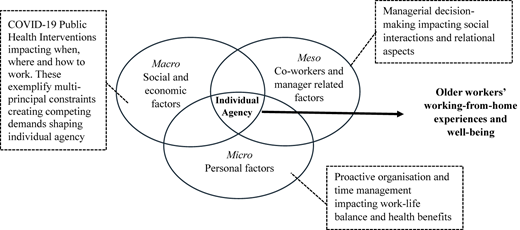
Our findings highlight agency as the mechanism through which working-from-home shapes older workers' well-being. This appeared to be a key factor differentiating those who experienced benefits from those who reported drawbacks. However, individual agency is constrained by what individuals perceive as possible and how they leverage agency within institutional settings. Hobson (2011) argues that individual-level and societal-level resources are nested within institutional settings, making the institutional-level integral when considering older worker agency. In our study, Australian public sector older workers' agency while working-from-home appeared to be affected by three contextual factors at macro, meso, and micro levels. Figure 1 synthesises these multi-level conditions that channel or constrain agency and, consequently, hedonic and eudaimonic well-being.
At the macro-level, COVID-19-induced public health interventions were key contextual factors limiting older workers' agency over when, where and how they worked. This supports the findings of research on COVID-19's impact on individual agency (Wang et al., 2023). A comparable contemporary factor is the growing trend mandating employees return to the office in some sectors (Holmes, 2025; Tilo, 2023). Although the landscape of work has evolved since our data collection period in 2021–2022, mandated office-based working has been implemented in at least one Australian state government (Holmes, 2025), potentially replicating pandemic-time constraints and impeding older workers' agency. These macro-level mandates and rules function as multi-principal constraints (Bendickson et al., 2016) that narrow choices and intensify monitoring, with detrimental impacts, particularly for eudaimonic well-being.
At the meso-level, older workers reporting loneliness and diminished relationship quality appeared to have their agency shaped by managers who did not foster meaningful interaction opportunities. This relates to information asymmetry mitigation in agency theory, where managerial support can bridge gaps between organisational intentions and employee experiences (Kulkarni and Ramamoorthy, 2017). Fostering older workers' relational agency to decide interaction preferences when working-from-home and gaining feedback on existing virtual activities, can improve belongingness, companionship, and self-worth, ultimately enhancing eudaimonic well-being (Anderson and Fowers, 2020).
At the micro-level, some older workers' agency was enhanced by their ability to proactively organise their day and manage time effectively, improving work-life balance and health benefits, representing enacted discretion. This is important for older workers' well-being, given the heightened likelihood of health problems with advancing age (Beckel and Fisher, 2022). Poor physical health negatively impacts older workers' life satisfaction, an enduring component of hedonic well-being (Gana et al., 2013), and can also lead to early retirement (Wilson et al., 2020).
From a public sector effectiveness perspective, older worker well-being and public sector effectiveness are inextricably linked. As the public sector faces an ageing workforce, supporting older workers' well-being through enhanced agency benefits individuals and organisations by retaining experienced personnel, preserving institutional knowledge, reducing recruitment and training costs associated with turnover, and maintaining diversity of perspectives. This highlights the importance of well-designed policies and managerial capability enhancing older worker agency and consequent well-being.
Limitations and future research directions
Given that managers typically have greater discretion, their over-representation (31 versus 9 operational participants) potentially inflates perceived autonomy in our findings. This may explain the prominence of agency and participant emphasis on choice and control. Self-selection may also be biased towards those with stronger opinions.
Treating older workers homogenously may have obscured how health status, caregiving responsibilities, and intersectional identities shape agency experiences. This limitation may explain why some participants thrived while others struggled with similar arrangements – variations we attributed to agency that may also reflect individual differences. Data collection during the pandemic transition likely heightened appreciation for flexibility, potentially inflating career extension aspirations.
Three areas warrant further investigation. First, why were career advancement and visibility concerns, prominent in remote work literature, absent from participants' accounts? Future research should examine whether this reflects age-related priority shifts, public sector culture, or sample characteristics. Second, what explains the variation in social isolation experiences among similar participants? Research examining how personality traits, digital comfort and pre-existing social networks moderate working-from-home outcomes for older workers would clarify this. Third, how sustainable are participants' career extension intentions? Longitudinal studies tracking actual retirement decisions would test whether working-from-home genuinely extends careers or merely shifts intentions.
Conclusion and contributions
This study examined how working-from-home affects Australian public sector older workers' well-being, finding that agency mediates the relationship between working-from-home and well-being outcomes.
We make three theoretical contributions. First, we contribute to agency theory by specifying a health-oriented temporal dimension of agency particularly salient for older workers. Our findings demonstrate older workers exercise agency through temporal flexibility for proactive health management; for example, organising their day to accommodate exercise routines, medical appointments and necessary breaks. This health-oriented temporal agency fills a gap in the agency literature, which has mostly focused on career advancements and productivity-related autonomy (Hughes et al., 2025; Lafkas et al., 2023) over health-preservation as a form of agentic control.
Second, we advance flexible working literature by proposing an agency-centred view operating within multiple constraints. Prior research has examined working-from-home through an access-focused lens, as a benefit employees either have or lack (Atkinson, 2020). Our findings challenge this binary by showing that access alone is insufficient for well-being outcomes. Older workers' ability to leverage working-from-home for enhanced well-being depends on exercising agency within institutional, managerial and social constraints. This extends Sen's agency-capability gap framework by demonstrating how agency operates at multiple levels and how constraints at one level can amplify or mitigate constraints at another. For example, macro-level public health mandates during COVID-19 constrained agency over work location, amplifying the importance of meso-level managerial support for fostering relational agency. This explains why similar arrangements produce divergent well-being outcomes – the critical lever is not the arrangement itself, but the degree of agency employees can exercise within it.
Third, we develop a multi-level framework showing how macro, meso and micro factors shape older workers' agency in working-from-home contexts. Our framework specifies clear boundary conditions: agency's influence on well-being is strongest when supportive factors align across levels and weakest when constraints cascade across levels. This extends Wang et al.’s (2023) work on pandemic-constrained agency by demonstrating these effects persist in post-emergency contexts and interact across levels.
Empirically, we provide qualitative evidence on older public sector workers who have received scant attention despite comprising substantial proportions of public sector workforces. These firsthand accounts from a pivotal transition period in working arrangements enable new lenses to be explored in future research.
Our findings offer several practical implications for public sector organisations seeking to enhance older workers' well-being through working-from-home arrangements. First, transition from access-focused to agency-centred flexible working policies by incorporating choice, control and autonomy as core design principles. For example, replacing prescriptive working-from-home schedules (e.g. mandated office days) with individualised arrangements co-designed by employees and managers. Second, implement age-sensitive managerial training equipping managers with knowledge and skills to support older workers' working-from-home needs. For example, recognising signs of loneliness and facilitating meaningful virtual social interactions. Third, foster relational agency through co-designed interaction rhythms, allowing older workers to determine the rhythm, format and frequency of social interactions rather than having standard activities imposed on them. For example, establishing small group check-ins rather than large team meetings to facilitate deeper connections and creating inter-generational connections, allowing older workers to share accumulated institutional knowledge while building relationships with younger colleagues. Fourth, provide health and ergonomic support for home workspaces, enabling health-oriented temporal agency. For example, offering comprehensive home office ergonomic assessments designed for older workers and ensuring that occupational health services are accessible to those working-from-home through virtual consultations and home visits.
Fostering agency among older workers extends beyond individual well-being, addressing broader public sector challenges: retention amid aging workforces and skill shortages. Our study underscores the pivotal role of agency in shaping older workers' working-from-home experiences, providing valuable insights for organisations seeking to optimise well-being in the evolving landscape of work.