


This study investigates the reactions of public sector organisations to the accountability pressures of online dashboards and the impact of this reactivity on reporting systems. This study explores the concept of “reactivity,” which explains changes in organisational behaviours in reaction to being evaluated, observed or measured.
This study adopts a case study methodology to investigate organisations’ reactivity to an online dashboard within the Italian system of state museums. Data were gathered through a real-time dashboard initiated in 2019, complemented by interviews, participant observations and secondary sources collected over a period of three years.
The results indicate that online dashboards provoke a divergent but coexistent response: competitive reactivity when museums modify their behaviours to improve performance disclosed in the online dashboard, and polyphonic reactivity when museums question the algorithm’s validity and accuracy on the basis of the online dashboard. This finding reveals the emergence of layered accountability, with organisations balancing public expectations and hierarchical standards through manipulation and boycott, thereby giving rise to a decoupled system of measures.
This research contributes to the literature on public sector accountability by highlighting the dual nature of reactivity, both conforming to and resisting the imposed metrics. This study enhances our understanding of the interplay between digital accountability mechanisms and organisational responses, offering insights into the complexities of adapting to real-time, data-driven environments in the public sector.
1. Introduction
In the continuously evolving digital landscape, the public sector has witnessed a profound transformation in the data collection, data analysis and subsequent dissemination of information (Rodríguez Bolívar et al., 2007; Brusca and Martínez, 2016; Cohen et al., 2021, 2023; Agostino et al., 2022a; Nikidehaghani et al., 2023). The challenges for public sector reporting in a digital environment have recently been addressed by public administration and accounting scholars, who have underlined the potential for dialogic, horizontal and multicentric accountability, as well as the blurring of accountability roles and boundaries (e.g. Agostino et al., 2022b). The present study joins the ongoing debate on accountability pressures in digital public sector reporting by focusing on how public sector organisations react to the accountability pressures of a specific type of reporting system enhanced by digital technologies: a real-time dashboard fed with online user-generated data (hereafter referred to as an “online dashboard”). The influence of digital technologies on the reporting system is mainly visible in terms of the frequency of reporting, which is structured in a real-time manner. This means that the report is accessible at any time and from any place by connecting to an online platform. Such a configuration generates significant accountability pressures for public sector organisations that are required to respond and react to online comments and feedback coming from social media platforms (e.g. TripAdvisor, Facebook, X and Instagram) as fast as possible and in a public manner.
Compared to more traditional financial reporting systems, which usually work in an asynchronous way and with audited and certified data (see Cohen et al., 2021), such online dashboards pose severe accountability pressures on organisations. On the one hand, organisations are pressured to react as rapidly as possible. On the other hand, organisations do not have a clear stakeholder on the other side of the platform, but rather a more generic and indefinite “crowd” (Karunakaran et al., 2022). The available literature has recently emphasised the increasing accountability pressures that social media and, more generally, online platforms working in real-time pose on organisations (Busuioc, 2021; Rahman, 2021; Barbe et al., 2023). Such literature provides valuable insights into the relational dynamics between the evaluator and the evaluated in private settings, giving less emphasis to accountability implications in a public sector context. Meanwhile, considering the accountability literature in a digital environment, these studies have mainly focused on explaining the accountability dynamics in the digital realm, proposing reflections on dialogic accountability enhanced by online platforms (e.g. Bellucci and Manetti, 2017; Nikidehaghani et al., 2023). However, they took private organisations as a reference for their study. In comparison, in light of the ongoing digital transformation, accountability dynamics in the public sector domain remain under-investigated (Agostino et al., 2022a, b) This gap is particularly true if we consider the specific item of reactivity to accountability pressures in digital reporting in the public sector realm.
Therefore, the current study fills this gap by addressing the following research questions (RQs):
How do public sector organisations react to the accountability pressures imposed by online dashboards?
How does reactivity impact the online reporting systems of public sector organisations?
This research objective is framed within the notion of reactivity (Espeland and Sauder, 2007), according to which “people change their behaviour in reaction to being evaluated, observed, or measured.” Based on this theoretical framework, different mechanisms can shape reactivity, which, in turn, can provoke different effects to conform to or resist the pressures generated by an online dashboard.
From a methodological perspective, this study relies on a single case study represented by the Italian system of state museums under the General Directorate of Museums of the Ministry of Culture. This Directorate developed an online dashboard that compiles online reputational data for a sample of 100 state museums, thus representing a unique context to investigate the reactivity of public museums to the accountability pressures associated with this online dashboard.
The results reveal two coexisting reactivity types in response to the online dashboard: competitive and polyphonic. Competitive reactivity arises from horizontal accountability pressures, in which museums engage in real-time benchmarking with peers and modify their social media content to improve their public image. This leads to manipulative behaviours (e.g. posting popular content) that enhance engagement metrics, creating a decoupling of official and self-defined Key Performance Indicators (KPIs) to maintain public appeal. In contrast, polyphonic reactivity stems from vertical accountability to the central authority, driven by filtering mechanisms that simplify diverse museum functions into narrow metrics, such as engagement and virality. Museums often boycott these central standards, proposing alternative metrics or algorithmic adjustments that better capture their unique values. These divergent reactivities highlight a complex and layered accountability system, in which museums simultaneously align with and resist imposed metrics, thus reflecting the need for adaptable frameworks that accommodate public engagement and institutional specificity.
This research contributes to the literature on public sector accountability by highlighting the divergent and, at the same time, coexistent appearance of competitive and polyphonic reactivity in response to online dashboards. The presence of these divergent reactivities favours the emergence of different accountability layers, which, in turn, enhance the development of a decoupling system of metrics. As such, the present study enhances our understanding of the interplay between digital accountability mechanisms and organisational responses, offering insights into the complexities of adapting to real-time, data-driven environments in the public sector.
These insights are disclosed in the rest of the paper, which is structured as follows. Section 2 introduces the literature on public sector reporting in a digital environment alongside the theoretical concept of reactivity presented in Section 3. Section 4 on methodology explains the setting of the study and the approach to data collection and analysis. Section 5 presents the results, followed by a discussion in Section 6 of the implications connected with the different reactivity mechanisms identified. Section 7 concludes the paper.
2. Public sector reporting in a digital environment and the emergence of accountability pressures
Public sector reporting has long been a critical aspect of governance, providing transparency, accountability and insights into governmental operations. Traditional reporting mechanisms have served as essential tools for internal decision-making and public scrutiny (Brusca and Martínez, 2016). The literature emphasises the role of public sector reporting in fostering trust and informing citizens, highlighting its integral role in democratic societies (Cohen and Karatzimas, 2015).
However, the advent of digital technologies in recent years has challenged the traditional practices of public sector reporting (Cohen et al., 2021). These challenges are mainly associated with two distinctive features of digital technologies: real-time functioning and the involvement of users. On the one hand, digital technologies work in real time, providing users with immediate access to data and information. For example, the use of digital platforms (e.g. Uber or TripAdvisor) allows immediate access to data. On the other hand, digital technologies, particularly web-based technologies, are characterised by the involvement of users. This means that, unlike in the past, a reporting system taking place in a digital environment includes data generated by users themselves. Therefore, the reporting data are different from the traditional data autonomously collected by organisations. Data in a digital reporting system are online data generated by users, and everyone can access such data in real time from any location, rendering organisations always accountable to the user.
The accountability implications of digital data from online platforms have been widely discussed in the literature, with many studies acknowledging the real-time and user-based features of digital innovation that are associated with reporting practices (e.g. Sicilia et al., 2016). These two distinctive features introduce enhanced accountability pressures in public sector reporting mainly concerning three main aspects: (1) who is producing the data, (2) who is accountable and (3) when the data are produced. The first pressure relates to the unclear identification of the data producer. As digital technologies allow individual users to generate content (often referred to as “user-generated content”), this allows potentially everyone with an online connection to generate and report data. In this respect, some studies have acknowledged the importance of engaging users in the coproduction of services (e.g. Bovaird and Loeffler, 2012; Sicilia et al., 2016; Garlatti et al., 2019), but without emphasising the reporting sphere.
The second pressure relates to the ambiguous identification of who is accountable and for what. This aspect is strictly connected to the previous one and relates to the increasingly blurred difference between the identification of who accounts and who is accounted for. A recent paper by Karunakaran et al. (2022) introduced the concept of “crowd-based accountability” to underline the difficulties in identifying the unclear and unspecified stakeholders that are expected to receive insights from social media-generated reports. This notion has significant implications for public sector reporting, as it is widely recognised that information is differently reported depending on the user doing the reporting. A lack of clarity about the final users renders it difficult to frame the information within a report. The third pressure relates to the continuous frequency at which reports are produced. While traditional reporting systems are based on the idea of delivering a report periodically to identified readers, digital technologies potentially allow a real-time reporting system to be in place, thus providing continuous access to information. The growing literature at the intersection of public sector reporting and technology has underlined the increasing accountability pressures that emerge from digital platform development (Rahman, 2021; Barbe et al., 2023). The present study broadens the current knowledge on the topic by directing attention to the reactivity to accountability pressures generated by a particular type of digital tool: an online dashboard.
An online dashboard is intended as an online reporting system that can be accessed from anywhere and anytime, as it is developed on an online platform. The system is also fed with user-generated data, given that information is derived from data generated by users online on various social media channels, such as X, Facebook, Instagram or TripAdvisor. Thus far, the literature has identified the construction and development of similar online dashboards (e.g. Bolivar et al., 2006; Faber and Budding, 2018; Haug et al., 2023), but there is limited evidence on reactivity to accountability pressures generated by such dashboards. As such, the present study addresses this issue by adopting the theoretical concept of reactivity.
3. Conceptualising reactivity in response to accountability pressures
In this paper, the notion of reactivity is used to explore how public sector organisations react to accountability pressures derived from reporting generated through an online digital platform. Espeland and Sauder (2007) embraced the concept of reactivity to describe “the idea that people change their behavior in reaction to being evaluated, observed, or measured”. According to these authors, the explosion of rankings and measures to render organisations accountable generates a reaction by people who adjust their behaviours accordingly to the measures used in the evaluation. The authors underlined the performative nature of measures in shaping people’s behaviours, stating that “People interpret measurement in diverse and evolving ways, which can change the location and expression of agency. Emphasizing reactivity encourages scholars to make more explicit how actors make discourse meaningful in ways that shape their behavior” (Espeland and Sauder, 2007, p. 7). The expectation is that, by adjusting to the same measure and accountability pressures, organisations will behave similarly and in a convergent way to the measure itself.
Previous research has adopted this notion of reactivity to explain the relationships between individuals and measures in the context of online evaluations. For example, Rahman (2021) used reactivity to study how workers reacted to algorithmic evaluations, finding that they could not perfectly align with the online platform, as they could not fully understand the mechanisms behind the algorithm. Similarly, Barbe et al. (2023) adopted the theoretical framework of reactivity to understand the relationship between customers and online platforms. Another study by Karunakaran et al. (2022) conceptualised the notion of crowd-based accountability, starting from the reactivity that individuals had on online reviews.
In the present study, the notion of reactivity was used to investigate how a public sector organisation responds to accountability pressures generated by online dashboards. Compared to previous studies that used this framework to understand reactions to online platforms, algorithms and measures, this study investigates the public sector perspective. In the public sector context, accountability represents a crucial challenge because of the need for public sector organisations to be accountable to multiple stakeholders (Bovens, 2007). Accountability to multiple forums alongside the real-time dynamics of such an online reporting system significantly emphasises the accountability pressures that these organisations face. Thus, using the theoretical lens of reactivity can enhance our understanding of the reaction of public sector officials to the pressures of being constantly accountable in real time. Specifically, this study relies on the analytical application of reactivity, which introduces the notion of mechanisms and effects, as proposed by Espeland and Sauder (2007).
The concept of mechanisms explains the specific processes or actions organisations employ to respond to pressures created by evaluative measures, such as an online dashboard. Following this perspective, this study distinguishes between competitive and polyphonic reactivity mechanisms. The competitive reactivity mechanism occurs when organisations align their behaviours with evaluative criteria to achieve resistance to or even strategic manipulation of data to present favourable results. As it is based on the idea of conforming to the proposed measures, a competitive reactivity mechanism often creates a predictable response in which entities adjust their activities to better fit the metrics defining success, thereby stabilising the evaluative process (Rahman, 2021). In contrast, polyphonic mechanisms may involve questioning and challenging the validity or fairness of the metrics, leading to diverse reactions across organisations. The present study explores both reactivity mechanisms in relation to the introduction of real-time reporting systems into public sector organisations.
The concept of effects captures the broader, often unintended, consequences of reactivity. These effects may change organisational behaviour as well influence the reporting system itself, potentially leading to a shift in priorities, reallocation of resources or even changes in policy focus. Espeland and Sauder (2007) highlighted how such reactivity can create performative effects, in which the ranking systems begin to shape the social reality they intend to merely observe. In turn, this can lead to the adoption of norms and standards across organisations, reinforcing a cycle wherein evaluative measures continuously reshape organisational behaviours, sometimes in ways that diverge from organisations’ original goals.
This framework on the mechanisms and effects of reactivity is used in connection with the accountability pressures generated by the online dashboard. Here, accountability is considered concerning both horizontal and vertical accountability mechanisms. On the one hand, horizontal accountability refers to the direct relationship between organisations and their stakeholders, such as the public or service beneficiaries, where transparency and information sharing play a key role. Vertical accountability, on the other hand, involves oversight by higher authorities or regulators, ensuring compliance and adherence to broader institutional goals (Pérez-Durán and Grimmelikhuijsen, 2024). When examining museums’ reactions to the digital reporting system, both forms of accountability are crucial. Horizontal accountability pressures, driven by public scrutiny through social media metrics, may encourage museums to adjust their communication strategies, while vertical accountability from central government bodies could push museums to meet formal reporting standards. Understanding this dual accountability dynamic can better explain the polyphonic reactions that museums can adopt in response to the online dashboard.
4. Methodology
From a methodological perspective, the paper relied on a single case study methodology conducted over three years within the Italian cultural sector, with particular reference to the General Directorate of Museums under the Ministry of Culture. The choice of the single case study methodology is grounded in its ability to provide an in-depth understanding of the complex phenomenon of reactivity to accountability pressures within the specific context of public museums. This decision is in line with Yin’s recommendations on case study research, which is considered particularly suitable when addressing the “how” and “why” questions, especially in cases where boundaries between phenomena and context are not clearly evident (Yin, 2009). Focusing on the single case of the General Directorate of Museums has made it possible to explore deeply the nuances of reactivity in response to the accountability pressures generated by the online dashboard. Moreover, the case study methodology allows for a detailed examination of processes and outcomes that might be lost in a broader survey or multiple case studies (Eisenhardt, 1989). The intensive study of this single context also enhances the potential for revealing insights into broader practices and implications in similar public sector settings. It is important to underline that the subject of analysis (Thomas, 2011) is the Italian museum system, specifically the network of state museums managed under the General Directorate of Museums within the Ministry of Culture. This system was chosen as the subject because it employed a centralised cultural institution that implemented digital accountability measures across a diverse set of museums. Being aware that the subject of analysis represents a unique setting that cannot be generalised, the object of analysis (Thomas, 2011), by contrast, is the reactivity to accountability pressures exerted by a real-time digital reporting system. By focusing on reactivity, the present study explores how different types of reactivity emerge in response to varying accountability pressures from the general audience and central authorities. This distinction allows the study to move beyond a mere description of the museum system’s response and, instead, offer insights into the theoretical implications of reactivity under digital accountability conditions. In this way, this work contributes to broader discussions on public sector accountability in digitally mediated environments.
The Museum Directorate has developed an online dashboard to ensure immediate reporting regarding the online reputation of a sample of 100 state museums. The dashboard was made available to both the central government and individual museum directors. In this paper, we refer to the General Directorate of Museums as the “central level”, while state museums are referred to as the “peripheral level”. It is important to emphasise that real-time reporting is available on an online platform, but accessible only through an ID and password. Hence, the 100 museum directors can access the system along with the people from the communication staff of the General Directorate of Museums. The author also had access to the real-time reporting system for the entire duration of the project. The general public could not access such a real-time reporting system.
Data were collected from a variety of sources, including interviews, participant observations and secondary sources. Data from the interviews were collected over three years, during which the author interviewed the same role even more than once to grasp the dynamics of reporting usage over the different years. From the initial implementation of the online reporting system in late 2018 to March 2021, the author engaged closely with actors from both the central government, including the General Director and communication staff of the Museum section of the Italian Ministry of Culture, and the peripheral units, namely, museum directors. Specifically, the personnel interviewed comprised museum directors and their communication staff, as well as the director of the Directorate and his communication staff. In addition to face-to-face and online interviews, phone calls and emails with informants from central and peripheral units represented the available data sources.
The author also gained additional empirical evidence by attending public workshops organised by the Directorate, with the aim of presenting the real-time dashboard to museum directors. In total, the study involved around 76 h of interaction with these actors (Table 1). Whenever possible, the interviews were recorded and then transcribed. When it was not possible, for example, during phone calls or public workshops, notes were taken immediately after the event to register the highest amount of information related to the observed dynamics. Secondary sources, which complemented the insights gained from the interviews, comprised a variety of materials, such as archival documents (e.g. Ministry reforms, service provider contracts, and periodical reports on the insights that emerged from the real-time reporting) and digital footprints (e.g. Ministry’s website, social media platforms, and email correspondences), along with the possibility of accessing the real-time reporting system over the entire period of the analysis.
List of key informants and type of data source collected
| Actor role | Overall duration of interactions [hours] | Type of evidence collected |
|---|---|---|
| Central government level – communication department | 27 | Monthly emails; plenary meetings and events; one-to-one online and face-to-face meetings |
| Central government level – general director | 14 | one-to-one online and face-to-face meetings |
| Museums – communication staff | 24 | Online and on-site meetings; Events of presentation of research as seminars, webinars, and workshops; Online one-to-one in-depth interviews |
| Museums – director | 11 | Online and on-site meetings; Online one-to-one in-depth interviews |
Source(s): Author’s own work
Notably, even though there has been a development phase for the dashboard, this study specifically investigates the usage phase, focusing on the reactivity mechanisms and effects shown by museums in response to the use of the dashboard itself. Further studies could consider a longitudinal perspective on the development of the dashboard.
To conduct the data analysis, the empirical materials were processed using manual textual analysis, which consisted of identifying emergent themes in an open-coded format. This approach facilitated the discovery of overarching theoretical themes, as suggested by Corbin and Strauss (1990). This method also emphasised the identification of competitive and polyphonic forms of reactivity, enhancing the validity and reliability of our findings (Denzin, 1978; Eisenhardt and Graebner, 2007). By triangulating interview insights with theory and other sources, we explored the rational and irrational use of real-time dashboards, the details of which are discussed in subsequent sections.
4.1 Introduction to the online dashboard
The online dashboard, developed in 2018 by the General Directorate of Museums under the Ministry of Culture, was part of a broader cultural reform known as the “Franceschini Reform”. This reform aimed to achieve three main goals: financial autonomy for Italian state museums, performance measurement through national museum accreditation based on expected performance parameters and innovation of the Italian museum system using digital innovation. The development of this reporting system was intended to provide a decision-making tool to museum directors and raise awareness about the importance of measuring audience reception and service performance. Before the 2014 Franceschini Reform, Italian museums primarily viewed their role as conservators of heritage, often overlooking the needs of service users and the importance of designing services to attract and enhance public value. The goal of this reporting system was to offer insights about audiences beyond what could be gleaned from customer satisfaction surveys. This was the idea in the words of the Director of the General Directorate of Museums:
I want to develop a system like the one to buy products on Amazon, where consumers choose a product based on reviews by other users. I’d like to have the same for museums, with visitors selecting which cultural attraction to visit based on reviews by others. But these reviews are not only the ratings on TripAdvisor; [they are] something that include more specific information on museum communication, museum activities, quality of services … pretty much like the different categories we have with hotels.
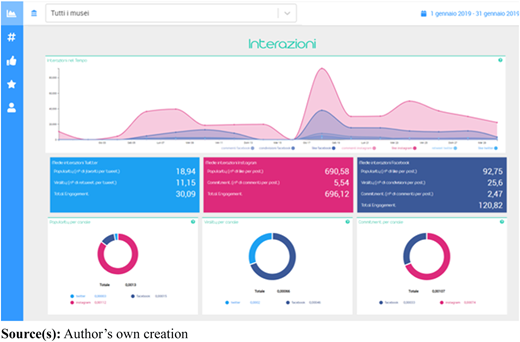
Operationally, the system was characterised by four key features: reliance on user-generated data from social media platforms, such as Facebook, Twitter, Instagram and TripAdvisor; wide-scale application across 100 major Italian state museums; incorporation of numerical and textual indicators; and real-time functionality through an online platform accessible to individual museums.
The first distinctive feature is the online platform’s reliance on user-generated data. The system is fuelled by data generated by the public on social media platforms, such as Facebook, X, Instagram and the TripAdvisor review site. Such data include numerical data related to user interactions on the museums’ official social media pages and textual data from comments and reviews about the museum experience. Aside from the collection of these data, two main typologies of indicators are computed: indicators on social media interactions and indicators on the reputation of the museum and its services. The indicators disclosed on the platform are reported in Table 2.
List of indicators used in the dashboard
| Indicator | Description |
|---|---|
| Reach | Number of social media followers |
| Popularity | Average number of “like” per post |
| Virality | Average number of “share” per post |
| Commitment | Average number of “comments” per post |
| Total engagement | Average number of “share” + “like” + “comments” per post |
Source(s): Author’s own work
The second distinctive feature is that the dashboard collects data from 100 Italian state museums. This means that the dashboard discloses data on the 100 largest Italian state museums, which are diverse in size, collection type and geographical location, but are unified as state museums under the General Directorate of Museums. The report includes major museums, such as the Colosseum and the Uffizi Galleries, as well as smaller institutions, such as the Estense Galleries and Miramare Castle.
The third distinctive feature is the reporting of numerical and textual data. The first group of numerical indicators measures the museum’s ability to engage users on social media, including metrics like virality, popularity or engagement. The second group of textual indicators reflects the public’s perception of their visit experience, using machine learning techniques to assess the positive or negative aspects of the cultural service provided.
The fourth distinctive feature is real-time functioning. The dashboard operates in real time on an online platform accessible to individual museum institutions and the General Directorate of Museums. The Directorate can view data from all 100 surveyed museums, while each museum can only see its own performance over time. With the system’s real-time functionality, the data are thus continuously updated, even with multiple accesses throughout the day. At the end of the development phase, each museum director and his/her staff could access the real-time dashboard, along with the Director and the staff of the General Directorate. The platform is shown in Figure 1.
5. Results
The study’s results presented two different typologies of reactivity: competitive and polyphonic, which were put in place by public museums and the Central Government to the real-time dashboard by underlying the mechanisms, effects and accountability implications.
5.1 Competitive reactivity in the horizontal accountability relationship between museums and the general public
The observation of the horizontal accountability relationships between museums and the general public through the online dashboard supported the identification of a dynamic called “competitive reactivity.” The presence of an online dashboard that disclosed data on social media performances in real time instilled a competitive reactivity at the peripheral level (individual museum institutions), in which museums engaged in real-time benchmarking mechanisms to deal with the online dashboard. It must be emphasised that the Central Government required ensuring accountability and improving performance thanks to a system that operated in real time. This intention is visible from the following quotes:
We need a system that allows us to understand the dimensions of the museum services that satisfy visitors at the most and those that need improvement. With the wide diffusion of social media, we need to base our analysis on feedback from users rather than on customer satisfaction surveys. This is done by major private companies and supports faster and more effective actions based on real-time data provided by users. (Director, Central Government)
The General Directorate of Museums launches a platform to view online public interactions with museums in real time. With the rise of social media and review sites, it’s crucial for museums to gauge user satisfaction and monitor comments to enhance visibility and foster relationships with both actual and potential visitors. The dashboard offers real-time insights into the intensity of interactions between museums and the public, overall perception and feedback on specific services offered. (Website, Central Government)
These quotes emphasise the need to align the behaviours and reactions of museums, pushing them to act in ways that can improve their reputation and their visualisation on the online dashboard. This approach encompasses the phases of data collection and data analysis (thanks to the online dashboard) and subsequent and immediate actions based on emerging real-time insights.
However, from the project’s onset, a competitive reactivity was observed by museums, as the online dashboard became a competitive tool for museums to show off their superior performance to the public. By competitive reactivity, we refer to the process by which public museums change their actions and behaviours to improve the performance assessed and showcased by the online report, hence driving them to conform to the metric. This approach occurred when museums started to adopt strategies to increase the possibility of obtaining more “likes”, “comments” or “shares” by the general public to increase their position in the ranking. For example, when a museum posted a picture of a cat in front of the museum to say “good morning” to visitors, this generated the highest engagement of the month. Similarly, posts connected to popular life events, such as Valentine’s Day, Halloween, or other popular events, were used as strategies to boost museums’ positions in the report, notwithstanding the content of the communication.
The competitive dynamic was further emphasised by the fact that the Central Government published a monthly report summarising the month’s findings. This report included online interactions and visitor experience perceptions. Operationally, a static, historical and data-based report was published monthly on the Central Government website, rendering visible to everyone the top performing museums among all those in the group. In particular, this report highlighted the top three museums distinguished by engagement, popularity, virality and public perception for that month. A snapshot of the monthly report, with particular reference to the top three museums, is shown in Figure 2.
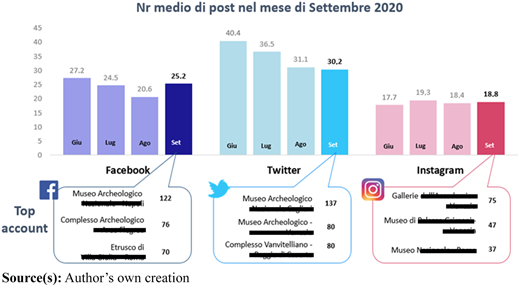
This document was published monthly on the Central Government website, reflecting on the previous month and continually highlighting the project’s innovation. This monthly report further emphasised the competition between museums by disclosing the ranking of the best performers of the month. Here’s an excerpt from the report:
The findings indicate that Italian visitors are more likely to review factors such as the entrance price and comfort of the visit (e.g. air conditioning and heating); non-Italian visitors, on the other hand, tend to review aspects like waiting times/queues and communication and signage. (Extract from the 2019 Annual Report of Italian Museums)
The monthly reports published by the Central Government, highlighting the top three performing museums, fuelled competitive tendencies, with museums aiming to be mentioned in the public report by making it into the top three before the end of each month. This aspect is exemplified by the following quote:
We have launched a new social media campaign and introduced some changes compared with previous online activities. Could you please anticipate us which is our position in the ranking at this moment? (Communication staff personnel, A medium-sized museum)
The abovementioned quote underlined the fact that competitive reactivity mechanisms were evident in both large and small museums. Larger museums felt pressured to perform better than others because they perceived a need to demonstrate their status as the most famous and recognised Italian museums, not just in terms of physical visitors, but also in terms of online activity. Small museums, meanwhile, saw an opportunity to overcome physical barriers by leveraging an online audience, potentially achieving greater results than more well-known museums in the country.
5.2 Polyphonic reactivity in the vertical accountability relationship between museums and the central government
A second dynamic, the so-called polyphonic reactivity, was observed in the vertical accountability relationship between the museums and the Central Government. The reactivity to the accountability pressures of the online dashboard at the peripheral level (i.e. individual museums) differed from that between museums and the Central Government. This study does not map individual museums’ reactivity, but highlights the main dynamics observed at the peripheral system level. The dynamic observed in the accountability relationship between the museums and the Central Government differed from that in a convergent reactivity, with museums showing no desire to conform to the proposed system. Instead, more experimental reactivity dynamics amongst museums were noted, hence the name polyphonic reactivity. This occurred when museums questioned the methodology behind the online reporting system’s construction and data feeding, aiming to boycott the proposed system. The following quotes exemplify this type of reactivity:
Look here [pointing at their computation on social media data]: Our analysis is based on this algorithm and shows that our museum reaches a 4% engagement for this month, while in the published monthly ranking, we are not appearing. Instead, there are museums with less than a 4% ranking. (Head of Communication, A medium-sized museum)
I’d like clarification on the metrics used in the dashboard. While pleased with this result, it doesn’t match the data I see from Facebook insights; for instance, I found posts in December with exponentially higher public engagement than the one you indicated in the monthly report. (Head of Communication, A medium-sized archaeological park)
Similarly, this polyphonic mechanism occurred by museum staff questioning the validity and reliability of the algorithm adopted, as demonstrated by the following quotes:
Regarding your investigations into the social media profiles of the Museums, we wanted to highlight some recent results from the social channels of Archaeological Park [name omitted], which have seen exponential growth in their reach. We thought it would be useful to share this [information] for your updates. (Director, A large archaeological park)
The video about the discovery of [omitted], created by the museum’s communication office and published on November 21st, reached a total coverage of 1.3 million people. This, along with other high-quality content, contributed to the museum’s Facebook page growing from 13,8947 followers on November 1st to 15,1372 by November 30th, marking a nearly 10% increase. (Head of Communication, A large museum)
Moreover, the dynamics and visibility brought about by the monthly report grew stronger over time. In particular, museums previously excluded from the top 100 began requesting to be part of the analysis:
Good morning. I apologise for disturbing you, but I came across a press article with your report on the online reputation and social media performance of Italian museums. Can our museum also be included? (Director, A large museum)
Good morning, is it possible to set up an account on the web platform for the Museums [name omitted]? (Director, A small museum)
This reactivity not only resulted in behaviours that questioned the validity of the system, but also favoured the emergence of ad hoc measurement systems adopted by museums themselves to showcase their results. Parallel to the monthly reports published by the Central Government, museums used social media to post their social media performances based on their own systems of calculation.
Interestingly, we noticed the coexistence of both reactivity dynamics. For example, the same museum reacted in a competitive way by using manipulative strategies to achieve the highest value in the ranking. When the online system detected a higher position in the ranking, the museum used the monthly report to showcase the outstanding result. When this is not the case, the system developed by the museum was used to promote such an achievement. Furthermore, in the relationship between the museums and the Central Government, a polyphonic reactivity was observed, with museums questioning the validity of the proposed measures. These manifestations of reactivity are further discussed in the next section, in connection with this study’s contribution to the existing literature.
6. Discussion
The findings support a discussion of the initial RQs. For RQ1, which is related to how public sector organisations react to the accountability pressures of online dashboards, the results reveal two divergent and simultaneously coexistent reactivity types – competitive and polyphonic – each embodying unique mechanisms, effects and implications for accountability and reporting (Table 3).
Reactivity mechanisms, effect and implications for accountability
| Typology of reactivity | Reactivity mechanism | Reactivity effect | Typology of accountability | Effect on reports |
|---|---|---|---|---|
| Competitive reactivity | Real-time benchmarking | Manipulation | Horizontal accountability relationship between the museum and the general public | Decoupling mechanisms: new KPIs and metrics developed |
| Polyphonic reactivity | Filtering | Boycott | Vertical accountability relationship between the museum and the central level | Decoupling mechanisms: new algorithms and metrics proposed |
Source(s): Author’s own work
Competitive reactivity arises when museums engage in comparison dynamics fuelled by the real-time online reporting system introduced by the Central Government. The digital platform, particularly through monthly rankings of top-performing museums, establishes a framework in which each museum’s performance is publicly displayed, thus enhancing accountability pressures that, in turn, stimulate competitive reactivity. This mechanism, called “real time benchmarking”, encourages large and small museums to aspire to appear in the top rankings. For larger, highly visited museums, appearing at the top of the list is crucial to maintaining their reputation and public standing. Conversely, smaller institutions see this system as an opportunity to showcase their communication efforts and public engagement, demonstrating their relevance and value, notwithstanding their dimension.
The effect of competitive reactivity often manifests as manipulation, in which museums engage in activities specifically designed to optimise the measurement at the basis of the dashboard. A common tactic involves posting highly interactive content, sometimes of a “popular” style, aimed at increasing engagement metrics. These actions reflect the “gaming” phenomenon often seen in reactivity literature (Espeland and Sauder, 2007), where organisations alter their behaviours to meet specific metrics, even in ways that may diverge from their core values.
The analysis of these reactivity mechanisms and their effects supported the investigation of RQ2 regarding the implications of reactivity on the online reporting system. This study’s results show that this reactivity influences the horizontal relationship between museums and the general public, as the public actively observes and indirectly participates in these competition-driven dynamics by reacting to social media posts. The competitive environment shaped by this real-time reporting drives museums to create alternative KPIs and metrics to communicate their performance to the public, especially when results disclosed by real-time reporting are not aligned with their expectations. This approach results in the decoupling of performance measures by museums that develop their own measures separate from official ones as a way to present their achievements to their audiences. These alternative KPIs reflect the museums’ efforts to align their public image with their preferred metrics to appeal to their followers and affirm their position, even though they are external to the official dashboard offered by the Central Government.
Polyphonic reactivity differs in that it reflects a complex accountability dynamic between museums and the central authority, primarily the General Directorate of Museums. The concept of polyphony is used here to underline the emergence of multiple perspectives and interpretations on how performance data should be quantified and reported. The mechanism driving polyphonic reactivity is primarily filtering, wherein selected data from social media interactions are condensed into the engagement and virality indices adopted in the dashboard. However, this compression of data oversimplifies the multifaceted management operations of museums, often reducing their performance to a few social media metrics. As a result, some museums engage in what we refer to as boycotting – a resistance tactic that questions the relevance, fairness and validity of the Directorate’s metrics. Museums at the peripheral level advocate for alternative metrics or suggest modifications to the algorithms governing the dashboard, striving to present a broader picture of their work and impact.
This reactivity influences the vertical accountability relationship between museums and the central authority. The museums’ reluctance to passively accept the Directorate’s evaluative measures illustrates a top-down accountability model, in which the central level imposes standards, yet the peripheral institutions resist, offering contrasting viewpoints on performance measurement. Therefore, polyphonic reactivity promotes decoupling by fostering alternative algorithms and metrics that are distinct from those mandated by the central authority. In particular, museums push for adjustments that would better reflect their activities, achievements and particular contexts, arguing that the centralised metrics do not adequately capture the diversity of museum functions or their specific audiences.
The identification of competitive and polyphonic reactivity, each characterised by distinct mechanisms and effects, has several implications for accountability research in digital reporting environments. The first implication relates to the emergence of divergent and coexistent paths of accountability, while the second relates to the fragility of a real-time reporting system.
6.1 Divergent but coexistent paths of accountability
The first implication relates to the emergence of complex and divergent responses to a digital reporting system that varies according to the demand side of accountability, either at the hierarchical or horizontal level. The study results show that competitive and polyphonic reactivity are not alternative ways of reacting but may occur simultaneously, although stimulating divergent responses. Interestingly, the same online reporting system can simultaneously elicit two divergent reactions: competitive reactivity, which aims to align museum behaviour with public expectations, and polyphonic reactivity, which represents resistance to the imposed standards by the central authority. The coexistence of both forms of reactivity underlines the idea that organisations respond in divergent ways, depending on the specific accountability pressures they face. On the one hand, competitive reactivity stems from horizontal accountability to the public, motivating museums to boost their public image and engagement through competitive metrics. Polyphonic reactivity, on the other hand, is driven by vertical accountability pressures from the central authority, prompting museums to question and propose alternatives to the evaluative criteria set forth by the former.
The finding that these divergent paths can coexist within a single organisation adds depth to the current accountability literature by revealing that online reporting systems not only foster divergent responses but can also produce them at the same time, simultaneously supporting and questioning the metrics adopted for the evaluation. This result prompts further reflection on the implications of such a layered accountability system, which requires organisations to monitor and ensure accountability at three different levels. The first is represented by the social media level, where the museum should post and react in real time to comments and reactions by users. The second layer is represented by the online reporting system, in which museums should monitor in real time the results of the algorithm based on the defined metrics at the third and central level, that is, each museum’s own report, where it discloses its own produced measured. Balancing the accountability at these three layers, which operate in real time, requires careful control of the coherence of the message that is disclosed in each of these layers. Further research could explore the divergence or convergence of the messages disclosed through different layers. Moreover, this layered response suggests that organisations navigate complex digital accountability systems by adopting strategies that conform to and resist imposed metrics, thus reflecting a sophisticated balancing of external pressures. Future research could explore this phenomenon across other sectors or examine the contextual factors that make one path more dominant than the other. Furthermore, understanding whether certain conditions (e.g. the frequency or visibility of reports) influence an organisation’s tendency towards competitive or polyphonic reactivity could facilitate the development of more adaptive accountability systems.
6.2 Fragility of real-time reporting systems
The second implication pertains to the inherent instability and fragility of real-time digital reporting systems. The constant flux in metrics and rankings within these systems means that an institution’s position can vary daily and that metrics are either accepted or contested, depending on the organisation’s standing at any given moment. This fluidity challenges the notion of objectivity in performance assessment, as it shows that real-time systems do not merely record outcomes, but actively shape organisational behaviours. Moreover, even the image disclosed by an organisation constantly changes such that the same museum can be differently perceived based on the accountability system considered. This is especially true when a museum looks at the online dashboard and discloses a certain image and performance, which may differ from the image and data disclosed on its own channels. The findings suggest that, in environments where accountability pressures are high, real-time systems may drive organisations to alternate between gaming the system to improve rankings and questioning the very metrics that assess their performance. In turn, such behaviours can give rise to a continuous varying representation of the organisation that is quantified and measured differently, moving from one reporting system to another.
This fragility is further underscored by the decoupling mechanisms observed in both reactivity types, which illustrate a transformation in reporting practices. For competitive reactivity, decoupling occurs as museums create their KPIs to present to the public, effectively bypassing or modifying official, centralised metrics. In polyphonic reactivity, decoupling is seen in the push for alternative algorithms and measures to critique centralised assessments. This finding aligns with Espeland and Sauder’s (2007) concept of performative effects, in which the system designed for accountability ends up reshaping the social and organisational reality it intends to measure.
Future studies could investigate how such performative effects influence long-term accountability practices, particularly the sustainability and reliability of real-time metrics in digitally driven public sectors. Understanding the conditions under which real-time systems are perceived as fair or credible would provide practical insights into the development of more resilient and trustworthy digital accountability frameworks.
The abovementioned implications all underscore the need for adaptable digital accountability systems that acknowledge the inherent tensions in real-time reporting. By recognising the divergent paths of competitive and polyphonic reactivity, accountability frameworks can better support public institutions in navigating the complex pressures of digital transparency, thus enhancing the reliability and perceived legitimacy of performance metrics.
7. Conclusions
This study investigates how public sector organisations respond to the real-time accountability pressures generated by online reporting systems. Building on the theoretical lens of reactivity (Espeland and Sauder, 2007), this paper identifies two distinct reactivity types – competitive and polyphonic – each driven by unique mechanisms while producing different effects and carrying specific implications for accountability and reporting in the digital age. In particular, the findings indicate that real-time digital reporting systems provoke complex responses rather than singular reactions, mainly because accountability pressures vary depending on the stakeholder group to which museums are accountable. Competitive reactivity emerges from the horizontal accountability relationship between museums and the public and is spurred by “real-time benchmarking” as institutions seek to maintain or improve their rankings. In turn, this competitive mechanism encourages museums to optimise engagement metrics by tailoring their social media content to meet public expectations, often through popular, high-interaction posts. These behaviours reflect the “gaming” effect seen in the literature, in which organisations strategically adjust their actions to align with specific metrics (Cohen et al., 2021; Rahman, 2021).
Conversely, polyphonic reactivity arises from the vertical accountability dynamic between museums and the central authority. The filtering mechanism underlies this reactivity type, as data from social media interactions are aggregated and simplified into indices, such as engagement or virality. In response, museums advocate alternative metrics and propose adjustments to the dashboard’s algorithm, questioning its adequacy in capturing their unique contributions to the industry. As institutions contest the system’s narrow performance metrics, their polyphonic reaction manifests in a boycott of the imposed evaluative criteria, thereby reflecting findings from previous research on accountability tensions within hierarchical systems (Agostino et al., 2022a). The results highlight the importance of understanding reactivity not just as a single outcome, but as a complex, multidirectional response shaped by the diverse pressures of real-time digital environments.
This study contributes to the digital accountability literature by uncovering the nuanced ways in which public organisations navigate real-time reporting pressures. Previous studies have mostly presented reactivity as either a conforming or resisting response to external evaluation. In comparison, the present study contributes to this debate by acknowledging that public organisations can simultaneously exhibit both. The coexistence of competitive and polyphonic reactivities highlights how digital platforms can create a form of “layered accountability”, in which responses are shaped by varied pressures from hierarchical and public stakeholders (Karunakaran et al., 2022). This finding thus expands on recent research (Bovaird and Loeffler, 2012; Cohen et al., 2023) that examines how public sector accountability is evolving in the digital realm, moving beyond traditional periodic reporting to a more dynamic, multidirectional form of accountability.
This study also provides some contributions to practitioners, particularly those designing or managing real-time reporting systems, who should consider these dual dynamics when implementing digital accountability frameworks. While such systems aim to increase transparency and responsiveness, they can also prompt strategic manipulations of metrics that may detract from an organisation’s core objectives (Brusca and Martínez, 2016). To address this potential issue, policymakers could introduce mechanisms that balance real-time feedback with periodic adjustments to minimise gaming behaviours while simultaneously allowing space for institutional feedback. Additionally, polyphonic reactivity highlights the need for flexibility in centralised reporting systems. Rather than rigidly enforcing standard metrics, institutions could be given the option of integrating customised KPIs that reflect their particular contexts and objectives (Bellucci and Manetti, 2017).
Moreover, these findings contribute to the understanding of performative effects in digital accountability, as proposed by Espeland and Sauder (2007). Real-time digital systems do not merely assess but actively reshape organisational behaviour, fostering competitive and polyphonic reactivity that leads institutions to recalibrate what is reported and valued. The decoupling effect we have observed – in which institutions adopt alternative KPIs in competitive reactivity and propose new algorithms in polyphonic reactivity – underscores the performative role of digital reporting in continuously redefining accountability standards (Sicilia et al., 2016; Barbe et al., 2023). Thus, future studies could further investigate these performative effects in other public sector settings, particularly examining how the prolonged use of real-time metrics influences organisational identity and strategy.
Finally, it is important to underline the limitations of this study, which suggest avenues for further research. First, restricted access to the real-time reporting system (limited to internal museum stakeholders only) may have amplified competitive dynamics by focusing on accountability inwardly rather than publicly. Further research could thus examine how publicly accessible dashboards could affect competitive and polyphonic reactivity, particularly in terms of how public scrutiny influences the balance between alignment with or resistance to imposed evaluative criteria. This closed-loop system’s influence on internal behaviour is consistent with findings from studies on accountability in complex stakeholder settings (Cohen and Karatzimas, 2015; Garlatti et al., 2019).
Second, this study does not explore the conditions that might favour competitive over polyphonic reactivity or vice versa. As such, future research could address how variables, such as reporting frequency, the specificity of metrics or the visibility of results, shape reactivity types. Such research could deepen the understanding of how organisations manage layered accountability, especially in high-stakes digital environments. Furthermore, as layered accountability requires organisations to balance public engagement metrics, centralised performance reports and internal evaluations, future research could examine the coherence (or divergence) of messaging across these layers (Bovens, 2007; Brusca and Martínez, 2016).
This paper forms part of a special section “A new era for public sector reporting: Technology and digitization in service to meet user needs”, guest edited by Dr Sandra Cohen, Dr Sotirios Karatzimas and Dr Manuel Pedro Rodríguez Bolívar.

