
Skip to article sections
Purpose

This paper aims to address the lack of industry-specific service recovery frameworks for internet service providers (ISPs) in South Africa by identifying essential service recovery attributes and evaluating the impact thereof on customer satisfaction and customer behavior.

Design/methodology/approach

This study focuses on the theory of perceived justice and determines how mobile ISPs in South Africa can effectively manage service recovery activities. A reputable marketing research business was used to collect data by means of an online survey sent to respondents who had previously complained about service failures with mobile ISPs in South Africa. In total, 484 surveys were gathered, and the data was analyzed to confirm or reject the proposed hypotheses using confirmatory factor analysis and Structural equation modeling.

Findings

The findings confirmed all the relationships in the suggested service recovery model, indicating that service recovery attributes, including compensation, response speed in dealing with service failure, apology from the service provider, and providing an explanation, can improve customer satisfaction after service failure.

Practical implications

Practical implications include the establishment of guidelines that mobile ISPs can follow to create successful service recovery plans that align with customer fairness expectations after a service failure occurred.

Originality/value

This research proposes a framework for servicing recovery in South Africa’s mobile ISP industry, illuminating the critical factors of customer satisfaction and loyalty in the wake of service failures. Furthermore, it serves as a counterargument to the one-size-fits-all application of the justice theory within diverse contexts, as customers show less concern for fairness in principle and more concern for prompt and transparent resolution in developing markets characterized by frequent service disruptions and unreliable infrastructure.

Exceptional customer service is a key differentiator in competitive service markets (Homburg et al., 2017). However, achieving consistently high standards of customer service remains challenging due to unavoidable occurrences of service failures. Every service provider makes mistakes from time to time, and even top-notch companies eventually experience service outages (Tseng, 2024). Service failure occurs when customer expectations are not met, which can manifest in two ways: process failures, which may involve unfriendly or unresponsive staff, and result failures, such as poor-quality service or billing issues (Ali et al., 2023). Failures in the service industry are common because of the challenge of standardizing services and their interdependence with the behavior of customers and service providers (Martinez et al., 2023). Service failures often prompt complaints about the service (Stokburger-Sauer and Hofmann, 2023) and can differ in terms of severity (Rohden and Pizzutti, 2023). The negative consequences of service failures can be obvious, such as when a committed customer leaves, or subtle, such as when unhappy customers spread bad word-of-mouth to alienate potential customers (Koc et al., 2017). Although it is commonly known that a service provider cannot guarantee that their services will be supplied without oversight, they may guarantee that when they do, they will be promptly corrected to meet the customer’s expectations (Tseng, 2024). Therefore, it is vital to implement an optimal strategy for recovering from service failures (Le et al., 2023). Service providers that address complaints from unsatisfied customers initiate a new process known as service recovery, which aims to rectify failures and improve customer satisfaction (Andreassen, 2000). Service recovery mechanisms have been established to mitigate the potential repercussions for service providers (Kamath et al., 2020). Consequently, service recovery is important for maintaining customer relationships and the reputation of service providers. According to Abdo et al. (2024), successful service recovery is fundamental to counteracting the adverse effects of such failures. Generally, effective service recovery strategies can satisfy customers, reduce their intention to switch to competing service providers and promote future purchases (Ismail, 2023). Despite various studies on the best service recovery strategies and tactics (Abdo et al., 2024; Cengiz et al., 2007; Smith et al., 1999; Park and Park, 2016; Wirtz and Mattila, 2004), there is still no consensus on the most effective combination of approaches. This emphasizes the need for further investigation, specifically within industry-specific contexts.

The process of rectifying service issues has been shown to effectively turn unhappy customers into satisfied ones (Fazel Dehkordi and Khalili Nasr, 2025). Therefore, it suffices to determine the service recovery attributes emerging from the service recovery literature following a service failure. Furthermore, few studies have been conducted specifically on the mobile ISP industry from an African perspective. Emerging markets have various characteristics that affect customer behavior, which service providers should consider. These markets provide researchers with an environment in which to closely investigate various perspectives in the literature (Borah et al., 2020). Although justice theory has been widely applied to service recovery, these studies overlook contextual factors in emerging markets such as frequent service disruptions and infrastructural limitations (Mathew and Jiang, 2019). This means that emerging markets are structurally and culturally diverse, and, theoretically, there is limited understanding of how recovery attributes influence satisfaction and behavioral outcomes in mobile ISPs in these markets (Dandis and Al Haj Eid, 2022; Mathew and Jiang, 2019).

This study aims to develop a model for addressing service recovery in the mobile ISP industry in South Africa. The study’s goals are threefold: to determine comprehensive service recovery attributes among users; to explore how perceived fairness mediates the connection among service recovery attributes and customer satisfaction; and to assess customers’ behavioral intentions following their satisfaction with service recovery in an African emerging market. Section 2 presents the relevant literature and the model development. Section 3 outlines the research methodology, followed by Section 4, which will present the empirical results. Section 5 discusses the theoretical and practical implications, and Section 6 addresses the limitations.

The literature review presents the foundational theory, the attributes of service recovery, customer satisfaction with service recovery, perceived justice (fairness), trust, electronic word-of-mouth (EWOM), and the intention to repurchase.

Successfully dealing with service failures is vital in shaping customers’ perceptions and behaviors towards service providers (Guchait et al., 2019). Various service recovery activities can be performed by service providers to retain customers and reduce their negative responses to service failures that can occur (Martinez et al., 2023). According to Mostafa et al. (2014), service providers need a framework for effective service recovery actions to successfully deal with service failures. The most common recovery activities include providing an apology, giving the customer some form of compensation, explaining to the customer what happened, and responding quickly during the service recovery process (Cengiz et al., 2007; Doaei et al., 2012; Park and Park, 2016; Sadaghashvili and Correia, 2019; Shin et al., 2018; Smith et al., 1999; Varela-Neira et al., 2010). Therefore, it is crucial for service providers to determine whether these factors can be regarded as essential characteristics of service recovery.

Addressing customer dissatisfaction after service failures is challenging, but service providers must compensate for the tangible and intangible losses incurred by customers (Rashid and Ahmad, 2014). When providers fail to meet expectations, compensation involves providing monetary or tangible resources (Hübner et al., 2018). Recompense should be proportional to the damage caused by failure (Sembada et al., 2016). While service failures are inevitable, their negative impact can be mitigated through prompt action. Chang et al. (2013) define response speed as the time required to address and solve a problem and communicate the solution to customers. Unaddressed failures can escalate rapidly (Zeithaml et al., 2018). To manage complaints effectively, providers should establish protocols, implement procedures and allocate staff to reduce response time (Hübner et al., 2018).

An apology acknowledges responsibility and remorse for service failure, indicating a desire to reconcile and maintain relationships (Cui and Niu, 2017). It includes offering explanations, accepting responsibility, expressing regret, demonstrating concern, seeking forgiveness and committing to future actions (Radu et al., 2019).

Explanation involves supplying information concerning the reason for service failure and preventive measures (Quy and Lan, 2015). Customers seek to understand the reasons for service failure. While compensation is vital, it is crucial to first clarify the cause of failure (Msosa and Fuyane, 2020).

This conceptual investigation explores these features as aspects of a unified, higher-level construct, specifically referred to as service recovery attributes, building on the preceding discourse. Consequently, to investigate whether compensation, response speed, apology and explanation significantly load onto the higher-order construct of service recovery attributes, the following hypothesis is proposed.

H1.

Service recovery attributes significantly load onto the higher-order construct of service recovery attributes.

The extent to which a service provider’s efforts to address a service failure meet or exceed customer expectations is known as service recovery satisfaction (Ateke and Kalu, 2016). It encompasses customers’ satisfaction with the provider’s recovery actions, including their perception of interactions and resolutions (Cheng et al., 2019; Ngahu et al., 2016). Customer satisfaction is extensively influenced by the effectiveness of service recovery (Ogbonna and Igbojekwe, 2015). Customer satisfaction is achieved when the efforts to rectify a situation match the extent of the loss (Lee, 2018). Furthermore, as issues are resolved more effectively, overall satisfaction increases (Hur and Jang, 2016). Implementing successful service recovery strategies can help alleviate customers’ sense of betrayal, reduce negative intentions (Van Vaerenbergh et al., 2014) and establish a competitive advantage in the industry (Leninkumar, 2017).

When a service failure occurs, customers might perceive that a service provider is incapable of addressing the issue if no recovery measures are implemented or if the recovery efforts are insufficient. According to Tektas (2017), the extent to which customers are satisfied following service recovery is greatly influenced by their expectations of fairness during the recovery process. Service recovery satisfaction refers to the level of customer satisfaction with a service provider’s efforts to address and rectify a service failure in a particular transaction (Boshoff, 1999). Several activities can positively influence customer satisfaction during service recovery efforts. These attributes include compensation (Kim, 2007), speed of response (Varela-Neira et al., 2010), offering an apology (Quy, 2014) and providing an explanation of why the service failure occurred (Sciarelli et al., 2017). Therefore, to investigate the relationship between service recovery attributes and satisfaction with service recovery, the following hypothesis is proposed.

H2.

Service recovery attributes positively influence satisfaction with service recovery.

This study creates a comprehensive framework integrating service recovery attributes with the three dimensions of perceived justice, distribution, procedural and interactional justice as addressed by Blodgett et al (1997) and Smith et al. (1999). Compensation concerns the outcome and, therefore, aligns with distributive justice. Response efforts, including the speed of the explanation provided to the customer, uphold procedural justice, which focuses on the fairness of the process (Hemthong and Ruanguttamanun, 2025; Fazel Dehkordi and Khalili Nasr, 2025). Offering an apology, which interrupts the service recovery process, is regarded as a reflection of interactional justice, which concerns the social quality and respect for the treatment. However, these findings contradict the typical mediation assumption of justice theory. Following the pattern of some recent studies from emerging markets (Chao and Cheng, 2019; Cheng et al., 2019), the results suggest that customers are more responsive to recovery efforts than fairness perceptions.

This is especially true in South Africa, where responsiveness in gestures, such as addressing issues swiftly and providing significant reparations, seems to matter more than the fairness of the process or interaction. These insights highlight the ethnosociological and technological aspects of how justice is viewed and its importance in the South African mobile service sector. Therefore, the applicability of justice theory in service recovery, mobile ISPs in particular, has significant and rather problematic contextual restrictions. Therefore, the mobile service industry in South Africa is a clear example that the application of paradigms from different industry cultures cannot be made without a deeper understanding of the sociocultural, or industry particular context.

Customer satisfaction is influenced by how fairly customers believe a service provider’s recovery efforts are (Kim and So, 2023; Nasir et al., 2021). When evaluating service recovery strategies, customers consider both the advantages and disadvantages of service failures and the specific recovery actions taken by the service provider (Adams, 1965). The perceived justice theory is used to measure customer satisfaction after a service failure occurs, based on the idea that people feel treated justly when their efforts are matched by their rewards (Chao and Cheng, 2019). The perceived justice theory suggests that customers expect a balance between what they put in (e.g. money or time) and what they get out (service received) in an exchange relationship. Perceived justice theory is defined by three dimensions including distributive, procedural and interactional dimensions. The procedural dimension relates to the recovery process itself, the distributive dimension focuses on the outcomes of the recovery efforts, and interactional justice involves personal interactions that occur during the recovery process (Cheng et al., 2019). When customers believe that they did not receive justice for service failure, they are likely to feel wronged and unfairly treated (Radu et al., 2019).

Customer satisfaction during service recovery is significantly influenced by three factors: apologizing to the customer, providing explanations of what happened, and addressing concerns promptly (Liao, 2007). In a related study, Roschk and Gelbrich (2017) found that during service recovery, the relationship between compensation and satisfaction was mediated by perceived justice. However, there has been little investigation into the role of customer perceptions of fairness in service recovery as a mediator between service recovery efforts and customer satisfaction. Based on this, perceived fairness acts as an intermediary between service recovery attributes and satisfaction with service recovery behavior.

The mediating role of perceived justice is theoretically justified as customers assess recovery efforts not only by tangible outcomes but also by their own unique perception of fairness. Consequently, Liao (2007) and Roschk and Gelbrich (2017) indicate that perceived justice often serves as a link between recovery actions and satisfaction. Accordingly, perceived justice is anticipated to mediate the relationship between service recovery attributes and satisfaction with service recovery.

Therefore, to investigate whether perceived justice mediates the relationship between service recovery attributes and satisfaction with service recovery, the following hypothesis is proposed.

H3.

Perceived justice mediates the relationship between service recovery attributes and satisfaction with service recovery.

In an exchange relationship, trust involves the inclination of one party to be vulnerable to the actions of another party. This vulnerability is based on the expectation that the other party will perform a specific action that is important to the trusting party, regardless of the ability to monitor or control the trusted party (Mayer et al., 1995). Trust plays a crucial role in any flourishing social exchange relationship (Fatma and Rahman, 2017). Moreover, as Van Tonder (2016) points out, the foundation for a relationship’s long-term success is built on trust in the service providers. Consequently, effective service recovery after a service failure reinforces customers’ belief in the service provider’s ability and improves their trust in the provider’s credibility and reliability (Garg, 2013). If service providers can satisfy customers during the service recovery process, trust can be restored (Chao and Cheng, 2019; Ding et al., 2016). Therefore, to investigate the relationship between satisfaction with service recovery and customer trust the following hypothesis is proposed.

H4.

Satisfaction with service recovery positively influences customer trust.

Customers engage in EWOM for various reasons, including submitting reviews, giving support or advice to fellow customers, examining the advantages and disadvantages of products or services, and sharing information. Consequently, EWOM involves the distribution of positive or negative comments regarding products and services by past or current customers using Internet platforms, thereby making these opinions accessible to other customers (Hennig-Thurau et al., 2004). EWOM allows customers to share their opinions and experiences with service providers online, sharing their comments with a wide-ranging audience across different geographical locations (Kucukemiroglu and Kara, 2015). Studies show that satisfied customers, after service recovery efforts, are likely to spread positive EWOM more frequently (Liu et al., 2019). Therefore, to investigate the relationship between satisfaction with service recovery and EWOM, the following hypothesis is proposed.

H5.

Satisfaction with the service recovery positively influences EWOM.

Repurchase intention is a customer’s willingness to purchase a service again from the same service provider in the future (Hellier et al., 2003; Nasir et al., 2021). Consequently, customers are likely to make repeat purchases when their expectations are fulfilled or when they have a positive experience with the service (Goh et al., 2016). Nevertheless, according to service failure and equity theory, service providers can restore low repurchase intention by effectively addressing customers’ perceived inequity through satisfactory service recovery (Ding et al., 2016). Research conducted by Duygun and Menteş (2015), Gohary et al. (2016) and Räikkönen and Honkanen (2016) within diverse contexts has demonstrated that effectively addressing customer dissatisfaction after a service failure can create an opportunity to restore the customer’s intention to make future purchases. These studies highlight the potential of service recovery to positively impact customer retention and repurchase behavior. Therefore, to investigate the relationship between satisfaction with service recovery and repurchase intention, the following hypothesis is proposed.

H6.

Satisfaction with service recovery positively influences repurchase intention.

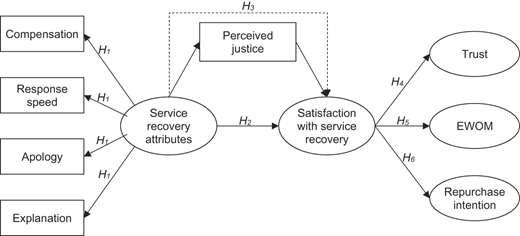
This study investigated the dominant service recovery actions in the existing literature to develop a conceptual service recovery model for mobile ISPs in Africa’s emerging markets. Based on existing studies, service recovery actions, including compensation, response speed, explanation, and apology, have been found to be predominant in literature as mechanisms for performing effective service recovery to address service failure and restore customer satisfaction. Using a unified approach, the identified service recovery actions were adopted to generate a multidimensional construct of service recovery attributes. Hypotheses were formulated to investigate the interrelationships among service recovery components (i.e. compensation, response speed, explanation and apology), satisfaction with service recovery, perceived justice, trust, EWOM and repurchase intention). The proposed conceptual model is illustrated in Figure 1.

This study employed a cross-sectional, descriptive research design to test the hypotheses and relationships between variables (Hair et al., 2017). A reputable marketing research business was contracted to perform the data collection. The choice of an online survey was driven by its accessibility, potential to include participants across diverse geographic regions, and ability to mitigate issues related to incomplete data sets. The measurement items for the questionnaire were derived from relevant previous research. A preliminary test was conducted with 30 participants from the intended demographic, and any identified problems were subsequently resolved. This involved correcting wording and formatting issues to enhance clarity, and a screening question to identify respondents who complained to their mobile ISPs. This study focused on users of major South African mobile ISPs who filed complaints with their respective service providers. Given the lack of a representative sampling frame, researchers have used nonprobability sampling methods. Convenience sampling was chosen for its efficiency in terms of time. To guide the research process, ethics approval was obtained, addressing the participants’ rights to confidentiality, anonymity and result dissemination. The investigator ensured adherence to ethical standards as ethics approval from the Economic and Management Sciences Research Ethics Committee was received (NWU-00313-18-A4), ensuring voluntary participation and consensual data collection. Confidentiality was maintained through questionnaires without personal questions and by ensuring respondents were above 18 years old, as legal age requirements dictate. The study ensured respondents’ human rights by allowing them to withdraw from the questionnaire using IPSOS’s software at any time. The study’s reliability was ensured by trustworthy data collection software, respect for participants, careful question selection, evaluation of potential impact, cultural context, confidentiality, privacy and unbiased data processing, all of which were taken to maintain trustworthiness and minimize discomfort or harm. Data analysis was conducted using IBM SPSS and AMOS.

The results are presented in terms of reliability and validity, as well as structural equation modelling.

Table 1 indicates that males constituted a greater portion of the study population, with 55.6% as compared to females with 44.4%. In terms of age distribution, the sample consisted of participants from different age brackets. The majority, 85.4%, were older than 30 years of age. The majority of respondents were full-time employees (56.0%). The educational background of the sample was fairly high, with over 80% having some form of tertiary education. Regarding average monthly personal net income, the largest portion of the sample (31.9%) reported earnings exceeding R35,000.

Although the scale items were derived from existing research, the reliability of the scales was still evaluated. George and Mallery (2019) define reliability as the consistency of results when administering a measurement scale to the same individual under similar conditions. To evaluate the scale’s reliability, internal consistency reliability measures were used. This approach assessed the degree of interrelation between the items that encompass a measurement scale (Hair et al., 2017). The most widely used method for evaluating a scale’s internal consistency reliability is Cronbach’s alpha coefficient test (Mooi et al., 2018). The Cronbach’s alpha values for each variable in this study are presented in Table 2. The scale items for each measurement scale are presented in  Appendix.

The results shown in Table 2 indicate that all scales used in this study have internal consistency reliability, as evidenced by Cronbach’s alpha values greater than 0.7 for each scale (Hair et al., 2017, p. 168). To further evaluate the reliability of the measurement scales utilized in this study, a confirmatory factor analysis (CFA) was conducted.

From Table 3, the structural model generated an X2/df-value of 5.590, higher than the recommended 5.00 threshold (Wheaton et al., 1977). However, due to the sensitivity of the chi-square (X2) value to sample size, statistically significant X2/df values are frequently observed in large samples, including the 1180.29 value in this study (Hair et al., 2014; Hooper et al., 2008). According to Hair et al. (2014), it is advisable to use a minimum of one absolute fit index and one incremental fit index in addition to the X2 value when evaluating the model fit. This study utilized three fit indices, including RMSEA, an absolute fit index, and CFI and TLI. Both the CFI and TLI values exceeded the recommended thresholds of 0.90, suggesting a well-fitting model (Malhotra et al., 2017). Furthermore, the model fit was deemed acceptable, as shown by the RMSEA value of 0.066, which is below the suggested cutoff of <0.10 (Hair et al., 2014; Hooper et al., 2008).

To assess convergent validity, researchers examined the CFA factor loading values, as presented in Table 4.

When determining convergent validity, the factor loadings should be greater than 0.5 (Malhotra et al., 2017:808) to be significant. The factor loadings for the different individual items ranged from 0.692 to 0.965, which are higher than the recommended 0.5 threshold suggested by Malhotra et al. (2017). The statistical significance of all measurement items was set at p < 0.001. To further assess convergent validity, AVE and CR were calculated (Hair et al., 2014; Malhotra et al., 2017). The AVE values ranged from 0.664 to 0.871, exceeding the recommended level of 0.5 (Malhotra et al., 2017). The CR values ranged between 0.901 and 0.969, surpassing the recommended level of 0.7, which suggests high reliability (Hair et al., 2014:619). The findings further indicate that all constructs in the measurement model displayed evidence of convergent validity. Similarly, discriminant validity was also determined by analyzing the AVEs for each construct, as illustrated in Table 5. The AVE should be greater than the correlation between dimensions (Civelek, 2018:41). Statistical analysis revealed that all variables in this study were significantly correlated (p < 0.001). In addition, the square root of the AVE for each variable exceeded the relationship between any two variables, indicating that all constructs in the measurement model demonstrated discriminant validity.

Exploratory factor analysis was used to assess the possible impact of common method bias using Harman’s single-factor test. According to the unrotated factor solution, the first factor explained 38.2% of the variance overall, which is significantly less than the generally recognized 50% threshold (Podsakoff et al., 2003). This implies that the results are unlikely to have been significantly skewed by common method bias. Multicollinearity was not an issue in the data set, as evidenced by the fact that all variance inflation factor (VIF) values were within the range of 1.4–3.2, comfortably falling below the traditional cutoff of 5. Table 6 further illustrates the psychometric properties of the measurement model with specific items.

High α values for compensation and apology may indicate item redundancy; future research should consider revising these scales.

To assess the theoretical model and consider the proposed relationships between the individual variables, this study used SEM with AMOS software and the results are presented in Table 7. Similarly, to determine the strength of the relationships between the variables, maximum likelihood estimation was used.

The structural model analysis, as shown in Table 7, produced an X2/df ratio of 5.54, slightly exceeding the recommended threshold of 5.00 by Wheaton et al. (1977). Due to the sensitivity of the chi-square (X2) value to sample size, large samples (200 or more participants) often yield substantial, statistically significant X2/df values (Hair et al., 2014; Hooper et al., 2008:54). Although the X2/df-value is slightly elevated, it is considered acceptable as long as the other fit indices (CFI, TLI and RMSEA) meet the suggested thresholds (Gerrard and Johnson, 2015). The model fit was deemed satisfactory, as evidenced by the CFI and TLI values of 0.93 and 0.91, respectively, which exceeded the suggested thresholds (> 0.90) (Malhotra et al., 2017). The model fit was deemed acceptable based on the RMSEA value of 0.097, which fell within the acceptable range of less than 0.10 (Blunch, 2013; Brown, 2015). This indicates that the model adequately fits the data used in this study.

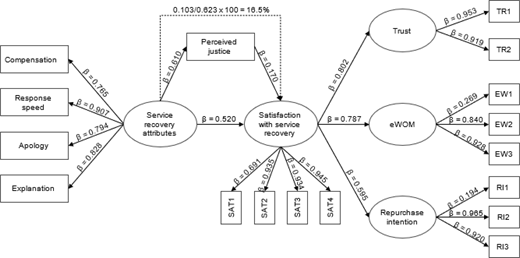
The structural model illustrated in Figure 2 is complemented by Table 8, which displays the analysis outcomes. The findings presented in Figure 2 include the standardized regression coefficients (β-weights) and their associated p-values that signify the statistical significance of each of the proposed hypotheses, H1H6).

Table 8 demonstrates that every relationship among the constructs is statistically significant, with a p-value of less than 0.001. The strength of the relationships was indicated by β-weights ranging from 0.165 to 0.907. Higher β-weight values suggest stronger relationships among constructs (Hair et al., 2017). Based on these findings, H1 is supported, as the service recovery attributes, comprising compensation (β-weight = 0.765), response speed (β-weight = 0.907), apology (β-weight = 0.794), and explanation (β-weight = 0.828), are supported. Hypothesis H2, which suggests that service recovery attributes have a positive impact on satisfaction with service recovery (β-weight = 0.520), was also confirmed. H3 aimed to investigate whether perceived justice acts as a mediator between service recovery attributes and satisfaction with service recovery. The study utilized indirect effects and variance accounted for (VAF) in its mediation analysis. The VAF for perceived justice was 16.5% (0.103 0.623 × 100). Since the VAF did not reach 20%, mediation was not observed (Younas and Bari, 2020, p. 1345), and H3 was dismissed. The results validate that service recovery satisfaction has a positive impact on trust (β-weight = 0.802), supporting H4. In addition, H5, which suggests that service recovery satisfaction positively affects EWOM (β-weight = 0.787), was confirmed. Likewise, the data supports H6, which proposes that customers’ satisfaction with service recovery has a positive effect on their intention to repurchase (β = 0.595).

The results provide evidence supporting H1, H2, H4, H5 and H6, indicating statistically significant and positive relationships between the investigated constructs. Nevertheless, H3 was not confirmed because no positive indirect impact of service recovery attributes on satisfaction with service recovery was detected when perceived justice acted as a mediator.

The discussion includes the theoretical and managerial contributions and limitations of the study.

The structural model presented in this study (Figure 2) offers mobile ISP management and personnel a blueprint for managing customer complaints during service interruptions. This study suggests relationships between various factors, shedding light on aspects that influence customer satisfaction with service recovery and their subsequent behaviors. This model provides a blueprint for managing service failures, restoring customer satisfaction, and achieving favorable behavioral outcomes in the service industry.

This study suggests that mobile ISPs can employ various service recovery strategies to address customer dissatisfaction following service failure. These activities include offering compensation to customers, taking quick action, expressing regret by apologizing to the customer, and providing an explanation of why the service failure happened to try to restore customer satisfaction. The study confirms that compensation, response speed, apology and explanation are significant drivers of service recovery satisfaction, which aligns with the model and justice theory (distributive, procedural, interactional), by emphasizing that fairness in outcomes, processes and communication shapes customer perceptions (Gao et al., 2022). This aligns with banking and hospitality research (Smith et al., 1999; Mattila, 2004). Furthermore, the strong β-weights indicate that these service recovery attributes cannot be compromised to restore customer satisfaction. This supports theoretical models (Miller et al., 2000) that emphasize fast responding and long-term enhancement. The study also shows that trust, EWOM and repurchase intention are directly influenced by service recovery satisfaction, which expands on the social exchange theory by showing that successful recovery improves relationship outcomes without the need for mediation (Kruger et al., 2015).

The results showed that perceived justice did not mediate the relationship between recovery attributes and satisfaction, challenging the tenets of justice theory and indicating that consumers in sectors such as ISPs place a higher value on concrete recovery actions than on abstract perceptions of fairness. ISPs in South Africa seem unable to efficiently deal with customer complaints, as evidenced by the industry assessments undertaken by Consulta (2020). This is consistent with studies showing that service recovery is frequently disregarded in the services sector (Nadiri, 2016; Olatunde et al., 2020).

The rejection of H3 further reveals a weakness in frameworks that assume justice is essential for recovery, particularly in the case of South African ISPs, where customers may value expedient fixes over procedural justice due to the frequency of service outages. This implies that recovery expectations may have cultural or industry-specific variations, highlighting the need to create and implement efficient service recovery plans for South African mobile ISPs.

This study demonstrates that, within the context of South Africa’s mobile ISPs, fairness by itself does not account for customer satisfaction, even though service recovery actions can be connected to various types of perceived justice. Customers value quick and straightforward fixes more than whether the process feels fair in environments with frequent service outages and unreliable infrastructure. These results cast doubt on many of the tenets of the current theory and highlight the need for grounded, situation-specific methods of service recovery.

The empirical results of the study support the crucial impact of these characteristics in boosting and repairing customer satisfaction during a service outage. To prevent customer attrition, mobile ISPs should prioritize basic recovery features, such as paying customers fairly and resolving complaints within 24–48 h (Cao et al., 2022; De Meyer and Petzer, 2012), and educate employees to offer heartfelt apologies along with transparent explanations (Kruger et al., 2015).

With their service recovery protocols, mobile ISPs can enhance their complaint-handling techniques, implement efficient recovery plans and increase overall customer happiness. Mobile ISPs in South Africa may take a more proactive stance by alerting clients ahead of time about anticipated service interruptions. Given that service interruptions are inevitable, these service providers may help reduce customer discontent by providing advance notifications of possible outages due to maintenance work or power failures.

Mobile ISPs in South Africa might incorporate continuous educational practices and root cause analysis into their service delivery strategies. Furthermore, mobile ISPs can also use predictive analytics to notify customers of possible issues, for example, outages in advance. In doing so, it will help with the identification of persistent service-related problems (such as billing issues) and employee responses to service failures. This study, therefore, provides a roadmap for ISPs to operationalize their service recovery theory, particularly in a competitive infrastructure-constrained market such as South Africa by focusing on actionable recovery attributes over abstract mediators.

The results support the use of recovery speed, sincere apologies, open explanations and equitable compensation as frontline complaint management strategies from a managerial standpoint. Employees who receive training on how to provide these consistently and tactfully may enhance client experiences and foster enduring loyalty. Furthermore, proactive communication can help reduce dissatisfaction by providing advance notice of anticipated outages (Kruger, Mostert and De Beer, 2015).

The findings are anchored in the unique mobile ISP landscape of South Africa, which is characterized by infrastructure challenges, including load-shedding, network congestion and a high prepaid user base, which limit applicability to industries with lower service failure frequencies and more stable infrastructure. The study participants included both contract and pay-as-you-go mobile ISPs subscribers in South Africa. Consequently, the findings related to high repurchase intention may be biased, as customers with prepaid plans are not bound by contracts and can easily switch to other mobile ISPs.

Additionally, POPIA compliance necessitated nonprobability sampling; the researcher faced challenges in acquiring a detailed and accurate sampling frame for the study, risking self-selection bias. Furthermore, the model’s focus on compensation, response speed, apology and explanation overlooks emerging factors such as AI-driven personalization and emotional labor in recovery interactions that are critical in digital first service environments (Van Vaerenbergh et al., 2014). To improve the extent to which results can be generalized, future investigations should consider using probability sampling methodologies. Because regulatory limitations hinder researchers from accessing a sampling frame for probability sampling, an alternative strategy is to collaborate with mobile service providers. These providers could gather data on the researchers’ behalf, allowing them to access the information later without compromising respondents’ personal identities.

Future studies in the mobile ISP sector might expand this framework by including factors such as social interactions, customer intimacy and the quality of relationships.

Additional research opportunities exist in examining the effects of successful service recovery on customer attitudes, such as their level of dedication and capacity to forgive. The service recovery model can be expanded by integrating relational constructs such as customer forgiveness that is grounded in Ubuntu principles and emotional metrics by using, for example, facial coding, or voice analytics (Van Vaerenbergh et al., 2014.)

Beyond the exploratory scope of this study, sophisticated techniques such as fuzzy-set qualitative comparative analysis (fsQCA) could reveal complex causal pathways and asymmetric effects among a larger set of antecedents.

By overcoming the drawbacks of cross-sectional data, longitudinal designs may be able to document the changes in loyalty and trust after recovery. Additionally, more research could examine how digital innovations such as self-service tools and predictive analytics affect pre-complaint satisfaction and recovery efficacy, particularly in prepaid versus contract customer segments (Ding et al., 2016).

Future research can also investigate how predictive analytics and self-service tools can impact pre-complaint satisfaction in prepaid vs contract users, as well as track longitudinal outcomes, including churn rates, and lifetime value in using ISP-provided behavioral data to assess the durability of their recovery efforts.

Recovery expectations across customer segments and cultural contexts can also be compared as well as used to identify latent segments based on recovery interaction patterns using machine learning (Van Vaerenbergh et al., 2014).
Abdo
,
M.S.
,
Elsharnouby
,
M.H.
and
Mahran
,
A.F.A.
(
2024
), “
The role of customer’s engagement in service recovery
”,
The Service Industries Journal
, Vol.
45
Nos
9-10
, pp.
779
-
818
, doi: .
Adams
,
J.S.
(
1965
), “
Inequity in social exchange. Advances in experimental social psychology
”,
Social Psychology
, Vol.
2
No.
1
, pp.
267
-
299
, doi: .
Ali
,
F.
,
El-Manstrly
,
D.
and
Abbasi
,
G.A.
(
2023
), “
Would you forgive me? From perceived justice and complaint handling to customer forgiveness and brand credibility-symmetrical and asymmetrical perspectives
”,
Journal of Business Research
, Vol.
166
No.
1
, p.
114138
.
Andreassen
,
T.W.
(
2000
), “
Antecedents to satisfaction with service recovery
”,
European Journal of Marketing
, Vol.
34
Nos
1-2
, pp.
156
-
175
, doi: .
Ateke
,
B.W.
and
Kalu
,
S.E.
(
2016
), “
Complaint handling and post-complaint satisfaction of customers of eateries in Port Harcourt, Nigeria
”,
International Journal of Research in Business Studies and Management
, Vol.
3
No.
12
, pp.
16
-
26
.
Blodgett
,
J.G.
,
Hill
,
D.J.
and
Tax
,
S.S.
(
1997
), “
The effects of distributive, procedural, and interactional justice on postcomplaint behavior
”,
Journal of Retailing
, Vol.
73
No.
2
, pp.
185
-
210
, doi: .
Blunch
,
N.J.
(
2013
),
Introduction to Structural Equation Modelling Using SPSS and AMOS
, (2nd) ed,
London
,
SAGE
:
Borah
,
S.B.
,
Prakhya
,
S.
and
Sharma
,
A.
(
2020
), “
Leveraging service recovery strategies to reduce customer churn in an emerging market
”,
Journal of the Academy of Marketing Science
, Vol.
48
No.
5
, pp.
848
-
868
.
Boshoff
,
C.
(
1999
), “
Post-complaintAT: an instrument to measure satisfaction with transaction-specific service recovery
”,
Journal of Service Research
, Vol.
1
No.
3
, pp.
236
-
249
, doi: .
Brown
,
T.A.
(
2015
),
Confirmatory Factor Analysis for Applied Research
, (2nd) ed
The Guilford Press
,
London
.
Cengiz
,
E.
,
Bünyamin
,
E.
and
Kurtaran
,
A.
(
2007
), “
The effects of failure recovery strategies on customer behaviours via complainants’ perceptions of justice dimensions in banks
”,
Banks and Bank Systems
, Vol.
2
No.
3
, pp.
173
-
198
.
Chang
,
W.L.
,
Chang
,
H.C.
and
Chang
,
T.M.
(
2013
), “
A system dynamics approach to e-service recovery and e-trust
”,
Journal of Information Management
, Vol.
20
No.
2
, pp.
193
-
218
.
Chao
,
C.
and
Cheng
,
B.
(
2019
), “
Does service recovery affect satisfaction and loyalty? An empirical study of medical device suppliers
”,
Total Quality Management and Business Excellence
, Vol.
30
Nos
11-12
, pp.
1350
-
1366
, doi: .
Cheng
,
B.L.
,
Gan
,
C.C.
,
Imrie
,
B.C.
and
Mansori
,
S.
(
2019
), “
Service recovery, customer satisfaction and customer loyalty: Evidence from Malaysia’s hotel industry
”,
International Journal of Quality and Service Sciences
, Vol.
11
No.
2
, pp.
187
-
203
, doi: .
Civelek
,
M.E.
(
2018
), “
Essentials of structural equation modeling
”,
Zea e-books
:,
available at:
Link to Essentials of structural equation modelingLink to the cited article. (
accessed
20 February 2020).
Consulta
(
2020
), “
SA cellular networks increasingly undifferentiated when it comes to customer satisfaction
”,
available at:
Link to SA cellular networks increasingly undifferentiated when it comes to customer satisfactionLink to the cited article. (
accessed
15 June 2020).
Crosby
,
L.A.
,
Kenneth
,
R.E.
and
Cowles
,
D.
(
1990
), “
Relationship quality in services selling: an interpersonal influence perspective
”,
Journal of Marketing
, Vol.
54
No.
3
, pp.
68
-
81
, doi: .
Cui
,
Y.
and
Niu
,
J.
(
2017
), “
Influence of regret on dissatisfaction and repurchase intention after purchasing fashion goods
”,
Economic Management Journal
, Vol.
6
No.
1
, pp.
32
-
38
.
Dandis
,
A.O.
and
Al Haj Eid
,
M.B.
(
2022
), “
Customer lifetime value: investigating the factors affecting attitudinal and behavioural brand loyalty
”,
The TQM Journal
, Vol.
34
No.
3
, pp.
476
-
493
, doi: .
De Meyer
,
C.F.
and
Petzer
,
D.J.
(
2012
), “
Differences between customer type and consumption stage in terms of service failure responses and preferred service recovery strategies in the cellphone industry
”,
Southern African Business Review
, Vol.
16
No.
2
, pp.
24
-
46
.
Ding
,
M.
,
Ho
,
C.W.
and
Lii
,
Y.
(
2016
), “
What men and women really want: differences in gender-based evaluations of service recovery efforts
”,
Journal of Asia-Pacific Business
, Vol.
17
No.
1
, pp.
59
-
80
, doi: .
Doaei
,
H.
,
Rajaee
,
Z.
,
Tavassoli
,
N.
and
Doaei
,
M.
(
2012
), “
A survey and evaluation of service recovery strategies on complainant-client satisfaction, word-of-mouth communication (WOM) and client loyalty in 5 star hotels in Moshhad
”,
IIMS Journal of Management Science
, Vol.
3
No.
1
, pp.
84
-
99
.
Duygun
,
A.
and
Menteş
,
S.A.
(
2015
), “
The impacts of complaint satisfaction on corporate reputation, negative word-of-mouth communication intention and repurchase intention
”,
Balkan. Journal of Social Sciences/Balkan Sosyal Bilmler Dergisi
, Vol.
4
No.
8
, pp.
108
-
120
.
Fatma
,
M.
and
Rahman
,
Z.
(
2017
), “
An integrated framework to understand how customer-perceived ethicality influences consumer hotel brand loyalty
”,
Service Science
, Vol.
9
No.
2
, pp.
136
-
146
, doi: .
Fazel Dehkordi
,
M.
and
Khalili Nasr
,
A.
(
2025
), “
How perceptions of service failure stability, service recovery justice and e-service quality affect value co-creation intentions in two-sided e-retail platforms
”,
International Journal of Quality and Service Sciences
, Vol.
17
No.
3
, pp.
355
-
380
, doi: .
Gao
,
J.
,
Yao
,
L.
,
Xiao
,
X.
and
Li
,
P.
(
2022
), “
Recover from failure: examining the impact of service recovery stages on relationship marketing strategies
”,
Frontiers in Psychology
, Vol.
13
, pp.
1
-
13
, doi: .
Garg
,
A.
(
2013
), “
Service recovery paradox in Indian banking industry: an empirical investigation
”,
The South East Asian Journal of Management
, Vol.
7
No.
2
, pp.
23
-
38
, doi: .
George
,
D.
, and
Mallery
,
P.
(
2019
),
IBM SPSS Statistics 25 Step by Step: A Simple Guides and Reference
, (15th) ed
Routledge
,
New York, NY
.
Gerrard
,
P.
, and
Johnson
,
R.M.
(
2015
),
Mastering Scientific Computing with R
,
Packt Publishing
,
Birmingham
.
Goh
,
S.K.
,
Jiang
,
N.
,
Hak
,
M.F.A.
and
Tee
,
P.L.
(
2016
), “
Determinants of smartphone repeat purchase intention among Malaysians: a moderation role of social influence and a mediating effect of consumer satisfaction
”,
International Review of Management and Marketing
, Vol.
6
No.
4
, pp.
993
-
1004
.
Gohary
,
A.
,
Hamzelu
,
B.
and
Alizadeh
,
H.
(
2016
), “
Please explain why it happened! how perceived justice and customer involvement affect post co-recovery evaluations: a study of Iranian online shoppers
”,
Journal of Retailing and Consumer Services
, Vol.
31
, pp.
127
-
142
, doi: .
Guchait
,
P.
,
Han
,
R.
,
Wang
,
X.
,
Abbott
,
J.
and
Liu
,
Y.
(
2019
), “
Examining stealing thunder as a new service recovery strategy: impact on customer loyalty
”,
International Journal of Contemporary Hospitality Management
, Vol.
31
No.
2
, pp.
931
-
952
, doi: .
Hair
,
J.F.
,
Black
,
W.C.
,
Babin
,
B.J.
, and
Anderson
,
R.E.
(
2014
),
Multivariate Data Analysis
, (7th) ed,
Pearson
,
Essex
.
Hair
,
J.H.
,
Wolfinbarger
,
M.F.
,
Ortinau
,
D.J.
, and
Bush
,
R.P.
(
2017
),
Essentials of Marketing Research
, (4th) ed
McGraw-Hill
,
New York, NY
.
Hellier
,
P.K.
,
Geursen
,
G.M.
,
Carr
,
R.A.
and
Rickard
,
J.A.
(
2003
), “
Customer repurchase intention: a general structural equation model
”,
European Journal of Marketing
, Vol.
37
Nos
11-12
, pp.
1762
-
1800
, doi: .
Hemthong
,
N.
and
Ruanguttamanun
,
C.
(
2025
), “
The effects of perceived justice toward service recovery on electronic word of mouth of four- and five-star hotels in Thailand
”,
International Journal of Quality and Service Sciences
, Vol.
17
No.
3
, pp.
317
-
336
, doi: .
Hennig-Thurau
,
T.
,
Gwinner
,
K.P.
,
Walsh
,
G.
and
Gremler
,
D.D.
(
2004
), “
Electronic word-of-mouth via consumer-opinion platforms: what motivates consumers to articulate themselves on the internet?
”,
Journal of Interactive Marketing
, Vol.
18
No.
1
, pp.
38
-
52
, doi: .
Homburg
,
C.
,
Jozić
,
D.
and
Kuehnl
,
C.
(
2017
), “
Customer experience management: toward implementing an evolving marketing concept
”,
Journal of the Academy of Marketing Science
, Vol.
45
No.
3
, pp.
377
-
401
.
Hooper
,
D.
,
Coughlan
,
J.
and
Mullen
,
M.R.
(
2008
), “
Structural equation modelling: guidelines for determining model fit
”,
Electronic Journal of Business Research Methods
, Vol.
6
No.
1
, pp.
53
-
60
.
Hübner
,
D.
,
Wagner
,
S.M.
and
Kurpjuweit
,
S.
(
2018
), “
The service recovery paradox in B2B relationships
”,
Journal of Business and Industrial Marketing
, Vol.
33
No.
3
, pp.
291
-
302
, doi: .
Huang
,
M.
(
2011
), “
Re-examining the effect of service recovery: the moderating role of brand equity
”,
Journal of Services Marketing
, Vol.
25
No.
7
, pp.
509
-
516
, doi:.
Hur
,
J.C.
and
Jang
,
S.S.
(
2016
), “
Toward service recovery strategies: the role of consumer-organization relationship norms
”,
Journal of Services Marketing
, Vol.
30
No.
7
, pp.
724
-
735
, doi: .
Ismail
,
I.J.
(
2023
), “
The influence of service recovery strategies on resilience to switching intentions among customers of commercial banks in tanzania: the mediating effect of customer loyalty
”,
FIIB Business Review
, doi: .
Kamath
,
P.R.
,
Pai
,
Y.P.
and
Prabhu
,
N.K.P.
(
2020
), “
Determinants of recovery satisfaction and service loyalty: the differing effects of service recovery system and service recovery performance
”,
Journal of Service Theory and Practice
, Vol.
30
No.
6
, pp.
643
-
679
, doi: .
Kim
,
G.
(
2007
), “
The service recovery strategies, customer satisfaction, customer loyalty
”,
Asian Journal on Quality
, Vol.
8
No.
1
, pp.
76
-
86
, doi: .
Kim
,
H.
and
So
,
K.K.F.
(
2023
), “
The evolution of service failure and recovery research in hospitality and tourism: an integrative review and future research directions
”,
International Journal of Hospitality Management
, Vol.
111
, p.
103457
.
Koc
,
N.
,
Ulukoy
,
M.
,
Kilic
,
R.
,
Yumusak
,
S.
and
Bahar
,
R.
(
2017
), “
The influence of customer participation on service failure perceptions
”,
Total Quality Management and Business Excellence
, Vol.
28
Nos
3-4
, pp.
390
-
404
, doi: .
Kruger
,
L.M.
,
Mostert
,
P.
and
De Beer
,
L.T.
(
2015
), “
Relationship intention and satisfaction following service recovery: the mediating role of perceptions of service recovery in the cell phone industry
”,
South African Journal of Economic and Management Sciences
, Vol.
18
No.
4
, pp.
608
-
628
, doi: .
Kucukemiroglu
,
S.
and
Kara
,
A.
(
2015
), “
Online word-of-mouth communication on social networking sites: an empirical study of Facebook users
”,
International Journal of Commerce and Management
, Vol.
25
No.
1
, pp.
2
-
20
, doi: .
Le
,
H.T.
,
Park
,
J.
and
Lee
,
S.
(
2023
), “
Emotion and trust in virtual service assistant design for effective service recovery
”,
Journal of Retailing and Consumer Services
, Vol.
74
, p.
103368
, doi: .
Lee
,
S.H.
(
2018
), “
Guest preferences for service recovery procedures: conjoint analysis
”,
Journal of Hospitality and Tourism Insights
, Vol.
1
No.
3
, pp.
276
-
288
, doi: .
Leninkumar
,
V.
(
2017
), “
The relationship between customer satisfaction and customer trust on customer loyalty
”,
International Journal of Academic Research in Business and Social Sciences
, Vol.
7
No.
4
, pp.
450
-
465
, doi: .
Liao
,
H.
(
2007
), “
Do it right this time: the role of employee service recovery performance in customer-perceived justice and customer loyalty after service failures
”,
Journal of Applied Psychology
, Vol.
92
No.
2
, pp.
475
-
489
, doi: .
Liu
,
H.
,
Jayawardhena
,
C.
,
Dibb
,
S.
and
Ranaweera
,
C.
(
2019
), “
Examining the trade-off between compensation and promptness in eWOM-triggered service recovery: a restorative justice perspective
”,
Tourism Management
, Vol.
75
, pp.
381
-
392
, doi: .
Malhotra
,
N.K.
,
Nunan
,
D.
and
Birks
,
D.F.
(
2017
),
Marketing Research: An Applied Approach
, (5th) ed,
Pearson
,
Harlow
.
Martinez
,
L.M.
,
Pacheco
,
N.
,
Ramos
,
F.R.
and
Bicho
,
M.
(
2023
), “
Would you try it again? Dual effects of customer mindfulness on service recovery
”,
Journal of Retailing and Consumer Services
, Vol.
74
, p.
103438
.
Mathew
,
A.B.
and
Jiang
,
H.
(
2019
), “
Comparing service quality for long-haul low-cost carriers: case for Asia and Australia routes
”,
Journal of Quality Assurance in Hospitality and Tourism
, Vol.
20
No.
6
, pp.
647
-
680
, doi: .
Mayer
,
R.C.
,
Davis
,
J.H.
and
Schoorman
,
F.D.
(
1995
), “
An integrative model of organizational trust
”,
The Academy of Management Review
, Vol.
20
No.
3
, pp.
709
-
734
, doi: .
Miller
,
J.L.
,
Craighead
,
C.W.
and
Karwan
,
K.R.
(
2000
), “
Service recovery: a framework and empirical investigation
”,
Journal of Operations Management
, Vol.
18
No.
4
, pp.
387
-
400
.
Mooi
,
E.
,
Sarstedt
,
M.
and
Mooi-Reci
,
I.
(
2018
), “
Market research: the process, data, and methods using Stata
”,
Springer e-books
,
available at:
Link to Market research: the process, data, and methods using StataLink to the cited article. (
accessed
12 September 2019).
Mostafa
,
R.
,
Lages
,
C.R.
and
Sääksjärvi
,
M.
(
2014
), “
The CURE scale: a multidimensional measure of service recovery strategy
”,
Journal of Services Marketing
, Vol.
28
No.
4
, pp.
300
-
310
, doi: .
Msosa
,
S.K.
and
Fuyane
,
N.
(
2020
), “
Making sense of service recovery in higher education institutions: exploring the relationship between perceived justice and recovery satisfaction
”,
International Journal of Economics and Business Administration
, Vol.
8
No.
1
, pp.
340
-
352
, doi: .
Nadiri
,
H.
(
2016
), “
Diagnosing the impact of retail bank customers’ perceived justice on their service recovery satisfaction and post-purchase behaviours: an empirical study in financial centre of middle east
”,
Economic Research/Ekonomska Istraživanja
, Vol.
29
No.
1
, pp.
193
-
216
, doi: .
Nasir
,
M.
,
Adil
,
M.
and
Dhamija
,
A.
(
2021
), “
The synergetic effect of after sales service, customer satisfaction, loyalty and repurchase intention on word of mouth
”,
International Journal of Quality and Service Sciences
, Vol.
13
No.
3
, pp.
489
-
505
, doi: .
Ngahu
,
C.
,
Kibera
,
F.
and
Kobonyo
,
P.
(
2016
), “
Influence of interactional justice strategy on recovery satisfaction among customers of mobile money services in Kenya
”,
Journal of Marketing and Consumer Research
, Vol.
27
, pp.
55
-
61
.
Ogbonna
,
O.P.
and
Igbojekwe
,
P.A.
(
2015
), “
Evaluation of service recovery strategies in some hotels in Lagos metropolis, Lagos, Nigeria
”,
Indian Journal of Commerce and Management Studies
, Vol.
6
No.
2
, pp.
57
-
63
.
Olatunde
,
O.P.
,
Sunday
,
O.T.
and
Niyi
,
A.S.
(
2020
), “
Complaint management and customer loyalty among aviation customers in Ekiti state
”,
Nigeria. British Journal of Management and Marketing Studies
, Vol.
3
No.
1
, pp.
76
-
94
.
Park
,
J.
and
Park
,
J.
(
2016
), “
Investigating the effects of service recovery quality elements on passengers’ behavioral intention
”,
Journal of Air Transport Management
, Vol.
53
, pp.
235
-
241
, doi: .
Podsakoff
,
P.M.
,
MacKenzie
,
S.B.
,
Lee
,
J.-Y.
and
Podsakoff
,
N.P.
(
2003
), “
Common method biases in behavioral research: a critical review of the literature and recommended remedies
”,
Journal of Applied Psychology
, Vol.
88
No.
5
, pp.
879
-
903
, doi:
Quy
,
V.T.
and
Lan
,
P.T.B.
(
2015
), “
The impact of bank responses to recovery service satisfaction
”,
Asian Economic and Financial Review
, Vol.
5
No.
9
, pp.
1076
-
1090
, doi: .
Quy
,
V.T.
(
2014
), “
The impact of organisational responses to complaints on post purchase behavioral intentions via recovery satisfaction: the case of Saigon Commercial Bank
”,
Strategic Management Quarterly
, Vol.
2
No.
2
, pp.
49
-
79
.
Radu
,
A.G.
,
Arli
,
D.
,
Surachartkumtonkun
,
J.
,
Weaven
,
S.
and
Wright
,
O.
(
2019
), “
Empathy and apology: the effectiveness of recovery strategies
”,
Marketing Intelligence and Planning
, Vol.
37
No.
4
, pp.
358
-
371
, doi: .
Räikkönen
,
J.
and
Honkanen
,
A.
(
2016
), “
Making it right the third time? Pursuing satisfaction and loyalty in a double service recovery
”,
Scandinavian Journal of Hospitality and Tourism
, Vol.
16
No.
4
, pp.
333
-
351
, doi: .
Rashid
,
M.H.A.
and
Ahmad
,
F.S.
(
2014
), “
The role of recovery satisfaction on the relationship between service recovery and brand evangelism: a conceptual framework
”,
International Journal of Innovation, Management and Technology
, Vol.
5
No.
5
, pp.
401
-
405
, doi: .
Rohden
,
S.F.
and
Pizzutti
,
C.
(
2023
), “
Consumer discrimination in service recovery situations
”,
Marketing Intelligence and Planning
, Vol.
41
No.
3
, pp.
293
-
309
, doi: .
Roschk
,
H.
and
Gelbrich
,
K.
(
2017
), “
Compensation revisited: a social resource theory perspective on offering a monetary resource after a service failure
”,
Journal of Service Research
, Vol.
20
No.
4
, pp.
393
-
408
, doi: .
Sadaghashvili
,
A.
and
Correia
,
R.F.
(
2019
), “
Online negative reviews in the hospitality industry: moving from problems to opportunities
”,
Journal of Marketing Research and Case Studies
, Vol.
2019
, p.
126255
, doi: .
Sciarelli
,
M.
,
Nagm
,
A.A.
,
Dakrory
,
M.I.
,
Tani
,
M.
and
Khashan
,
M.A.
(
2017
), “
Mediating service recovery satisfaction in the relationship between internet service recovery and customer loyalty
”,
International Journal of Business and Management
, Vol.
12
No.
10
, pp.
24
-
42
, doi: .
Sembada
,
A.
,
Tsarenko
,
Y.
and
Tojib
,
D.
(
2016
), “
The positive effects of customers’ power on their behavioral responses after service failure
”,
Journal of Service Research
, Vol.
19
No.
3
, pp.
337
-
351
, doi: .
Shin
,
H.
,
Casidy
,
R.
and
Mattila
,
A.S.
(
2018
), “
Service recovery, justice perception, and forgiveness: the “other customers” perspectives
”,
Services Marketing Quarterly
, Vol.
39
No.
1
, pp.
1
-
21
, doi: .
Smith
,
A.K.
,
Bolton
,
R.N.
and
Wagner
,
J.
(
1999
), “
A model of customer satisfaction with service encounters involving failure and recovery
”,
Journal of Marketing Research
, Vol.
36
No.
3
, pp.
356
-
372
, doi: .
Stokburger-Sauer
,
N.E.
and
Hofmann
,
V.
(
2023
), “
Can a smile help healing service failures? The interplay of employee emotions, guest emotions and justice perceptions for successful service recoveries in the hospitality industry
”,
Journal of Hospitality and Tourism Management
, Vol.
55
, pp.
261
-
276
.
Tektas
,
O.O.
(
2017
), “
Perceived justice and post-recovery satisfaction in banking service failures: do commitment types matter?
”,
Service Business
, Vol.
11
No.
4
, pp.
851
-
870
, doi: .
Tseng
,
S.M.
(
2024
), “
The role of service recovery in omnichannel integration services success model
”,
Journal of Enterprise Information Management
, Vol.
37
No.
4
, pp.
1322
-
1347
, doi: .
Van Tonder
,
E.
(
2016
), “
Trust and commitment as mediators of the relationship between quality advice and customer loyalty
”,
Journal of Applied Business Research (JABR)
, Vol.
32
No.
1
, pp.
289
-
302
, doi: .
Van Vaerenbergh
,
Y.
,
De Keyser
,
A.
and
Larivière
,
B.
(
2014
), “
Customer intentions to invoke service guarantees: do excellence in service recovery, type of guarantee and cultural orientation matter?
”,
Managing Service Quality: An International Journal
, Vol.
24
No.
1
, pp.
45
-
62
, doi: .
Varela-Neira
,
C.
,
Vázquez-Casielles
,
R.
and
Iglesias
,
V.
(
2010
), “
The effects of customer age and recovery strategies in a service failure setting
”,
Journal of Financial Services Marketing
, Vol.
15
No.
1
, pp.
32
-
48
, doi: .
Wheaton
,
B.
,
Muthén
,
B.
,
Alwin
,
D.F.
and
Summers
,
G.F.
(
1977
), “
Assessing reliability and stability in panel models
”,
Sociological Methodology
, Vol.
8
, pp.
84
-
136
, doi: .
Wirtz
,
J.
and
Mattila
,
A.S.
(
2004
), “
Consumer responses to compensation, speed of recovery and apology after a service failure
”,
International Journal of Service Industry Management
, Vol.
15
No.
2
, pp.
150
-
166
, doi: .
Younas
,
M.
and
Bari
,
M.W.
(
2020
), “
The relationship between talent management practices and retention of generation ‘Y’ employees: mediating role of competency development
”,
Economic Research-Ekonomska Istraživanja
, Vol.
33
No.
1
, pp.
1330
-
1353
, doi: .
Zeithaml
,
V.A.
,
Bitner
,
M.J.
and
Gremler
,
D.D.
(
2018
),
Services Marketing: integrating Customer Focus across the Firm
, (7th) ed
McGraw-Hill
,
New York, NY
:
Bambauer-Sachse
,
S.
and
Rabeson
,
L.E.
(
2015
), “
Service recovery for moderate and high involvement services
”,
Journal of Services Marketing
, Vol.
29
No.
5
, pp.
331
-
343
, doi: .
Bergel
,
M.
and
Brock
,
C.
(
2018
), “
The impact of switching costs on customer complaint behavior and service recovery evaluation
”,
Journal of Service Theory and Practice
, Vol.
28
No.
4
, pp.
458
-
483
, doi: .
Cantor
,
VJ.
,
M.
and
Li
,
R.C.
(
2019
), “
Matching service failures and recovery options toward satisfaction
”,
The Service Industries Journal
, Vol.
39
Nos
13-14
, pp.
901
-
924
, doi: .
Chao
,
C.
and
Xu
,
H.
(
2023
), “
A study of the effect of service recovery method on purchase intention service recovery timing as a moderating variable
”,
Proceedings of the 2022 International Conference on Computer Science, Information Engineering and Digital Economy (CSIEDE 2022)
, Vol.
103
, pp.
436
-
442
, doi: .
Lii
,
Y.
,
Ding
,
M.
and
Lin
,
C.
(
2018
), “
Fair or unfair: the moderating effect of sustainable CSR practices on anticipatory justice following service failure recovery
”,
Sustainability
, Vol.
10
No.
12
, p.
4548
, doi: .
Lunardo
,
R.
,
Cusin
,
J.
and
Flacandji
,
M.
(
2023
), “
A time (ly) perspective of the service recovery paradox: How organizational learning moderates follow-up recovery effects
”,
Journal of Business Research
, Vol.
166
, p.
114088
.
Oflaç
,
B.S.
(
2016
), “
Consumer response to recovery efforts for online product failures: an empirical study for Turkey
”,
Journal of Marketing Channels
, Vol.
23
No.
4
, pp.
230
-
240
, doi: .
Smith
,
A.
and
Mpinganjira
,
M.
(
2015
), “
The role of perceived justice in service recovery on banking customers’ satisfaction and behavioral intentions: a case of South Africa
”,
Banks and Bank Systems
, Vol.
10
No.
2
, pp.
35
-
43
.
Published by Emerald Publishing Limited. This article is published under the Creative Commons Attribution (CC BY 4.0) licence. Anyone may reproduce, distribute, translate and create derivative works of this article (for both commercial and non-commercial purposes), subject to full attribution to the original publication and authors. The full terms of this licence may be seen at Link to the terms of the CC BY 4.0 licenceLink to the terms of the CC BY 4.0 licence.

Data & Figures

Figure 1.
A flowchart illustrating relationships among concepts such as service recovery attributes, perceived justice, and satisfaction with service recovery, along with associated hypotheses.The diagram presents a flowchart illustrating relationships between various concepts in service recovery. It includes concepts such as Compensation, Response Speed, Apology, and Explanation, which all connect to a central node labelled Service Recovery Attributes. This node is then linked to Perceived Justice, which impacts Satisfaction with Service Recovery. Additionally, Satisfaction is connected to Trust, E W O M, and Repurchase Intention, with hypotheses denoted by H 1 through H 6 for each relationship. The layout shows directional arrows indicating the flow of influence among the concepts.

Proposed conceptual model

Source: Authors’ own work

Figure 1.
A flowchart illustrating relationships among concepts such as service recovery attributes, perceived justice, and satisfaction with service recovery, along with associated hypotheses.The diagram presents a flowchart illustrating relationships between various concepts in service recovery. It includes concepts such as Compensation, Response Speed, Apology, and Explanation, which all connect to a central node labelled Service Recovery Attributes. This node is then linked to Perceived Justice, which impacts Satisfaction with Service Recovery. Additionally, Satisfaction is connected to Trust, E W O M, and Repurchase Intention, with hypotheses denoted by H 1 through H 6 for each relationship. The layout shows directional arrows indicating the flow of influence among the concepts.

Proposed conceptual model

Source: Authors’ own work

Close Figure 1.
Figure 2.
A diagram illustrating relationships between service recovery attributes and their impacts on customer perceptions, including perceived justice, satisfaction with service recovery, trust, electronic word of mouth, and repurchase intention.The diagram presents a flowchart illustrating various service recovery attributes and their connections to customer satisfaction and trust. The attributes displayed include compensation, response speed, apology, and explanation, each connected to a central oval labelled Service recovery attributes, with respective beta values indicating their influence. From this central point, arrows lead to Satisfaction with service recovery, which then connects to Trust, electronic word of mouth, and Repurchase intention, with further beta values detailing the strength of these relationships. Additional boxes labelled S A T 1 to S A T 4 and T R 1 to T R 2 provide details about measurements within these constructs. The diagram includes a calculation box referencing perceived justice, showing its relative contribution. The layout flows predominantly from top to bottom, displaying a clear hierarchical structure of influences.

Structural path relationships

Source: Authors’ own work

Figure 2.
A diagram illustrating relationships between service recovery attributes and their impacts on customer perceptions, including perceived justice, satisfaction with service recovery, trust, electronic word of mouth, and repurchase intention.The diagram presents a flowchart illustrating various service recovery attributes and their connections to customer satisfaction and trust. The attributes displayed include compensation, response speed, apology, and explanation, each connected to a central oval labelled Service recovery attributes, with respective beta values indicating their influence. From this central point, arrows lead to Satisfaction with service recovery, which then connects to Trust, electronic word of mouth, and Repurchase intention, with further beta values detailing the strength of these relationships. Additional boxes labelled S A T 1 to S A T 4 and T R 1 to T R 2 provide details about measurements within these constructs. The diagram includes a calculation box referencing perceived justice, showing its relative contribution. The layout flows predominantly from top to bottom, displaying a clear hierarchical structure of influences.

Structural path relationships

Source: Authors’ own work

Close Figure 2.
Table 1.

Demographics

VariableF%
Gender
Male26855.6
Female21444.4
Age distribution
21–30 years6914.7
31–40 years9921.1
41–50 years9319.8
51–60 years10823.0
Older than 6010121.5
Employment
Full-time student163.3
Unemployed112.3
Self-employed8918.5
Part-time employed377.7
Full-time employed26956.0
Housewife or househusband112.3
Retired479.8
Educational background
Some primary school10.2
Some high school71.5
Matric/grade 128217.1
Technical college diploma6914.4
University or technology diploma7515.6
University degree (B-degree/honors)14029.2
Post-graduate degree (master’s/doctorate)10622.1
Earnings
R5,000 p.m. or less337.2
R5,001–R10,000 p.m.439.5
R10,001–R15,000 p.m.5311.5
R15,001–R20,000 p.m.5311.5
R20,001–R25,000 p.m.5211.3
R25,001–R30,000 p.m.357.6
R30,001–R35,000 p.m.449.5
More than R35,000 p.m.14731.9
Source(s): Authors’ own work
Table 2.

Interval consistency reliability

VariableCronbach’s alpha values
Compensation (5 items)0.964
Response speed (4 items)0.958
Apology (4 items)0.958
Explanation (4 items)0.941
Perceived justice (10 items)0.825
Satisfaction with service delivery (4 items)0.927
Trust (3 items)0.903
EWOM (3 items)0.702
Repurchase intention (3 items)0.953
Source(s): Authors’ own work
Table 3.

Model fit statistics

Fit indicesX2p-valuedfX2/dfTLICFIRMSEA
1180.290.0002155.5900.980.920.066
Recommended values<5.00>0.90>0.90<0.10
Source(s): Authors’ own work
Table 4.

Standardized factor loadings

VariableItemsStandardized factor loadingsS.E.p-value*
CompensationCC10.8570.0000.001*
CC20.9260.0330.001*
CC30.8980.0350.001*
CC40.9590.0300.001*
CC50.9530.0320.001*
Response speedRS10.9110.0000.001*
RS20.9480.0290.001*
RS30.9450.0300.001*
RS40.8930.0340.001*
ApologyAP10.9090.0310.001*
AP20.9330.0290.001*
AP30.9350.0290.001*
AP40.9160.0000.001*
ExplanationEX10.8630.0420.001*
EX20.9340.0360.001*
EX30.9440.0370.001*
EX40.8430.0000.001*
Perceived justicePJ10.8260.0000.001*
PJ30.8920.0430.001*
PJ40.8980.0620.007
PJ50.8680.0420.001*
PJ60.9510.0620.010
PJ70.8240.0430.001*
PJ80.7970.0460.001*
PJ90.8360.0430.001*
Satisfaction with service recoverySAT10.6920.0000.001*
SAT20.9350.0720.001*
SAT30.9340.0700.001*
SAT40.9450.0710.001*
TrustTR10.9530.0000.001*
TR20.9180.0260.001*
TR30.9290.0320.001*
Source(s): Authors’ own work
Table 5.

Correlation matrix and AVE

VariableCCRSAPEPPJSATTREWRI
Compensation(0.664)
Response speed0.627(0.855)
Apology0.5960.680(0.853)
Explanation0.5.650.7310.701(0.805)
Perceived justice0.4080.5870.4400.423(0.744)
Satisfaction with service recovery0.5070.6610.5340.5410.486(0.780)
Trust0.3410.5120.3970.4340.3370.702(0.871)
eWOM0.2940.3840.3570.3400.2240.5610.674(0.754)
Repurchase intention0.1840.3420.3170.3000.2510.4600.5960.479(0.803)
Note(s):

Off-diagonal values represent the intercorrelation between the constructs; All correlations are statistically significant at p < 0.001; CC = compensation; RS = response speed; AP = apology; EP = explanation; PJ = perceived justice; SAT = satisfaction with service recovery; TR = trust; EW = electronic word-of-mouth; RI = repurchase intention

Source(s): Authors’ own work
Table 6.

Psychometric properties

ConstructItem countCronbach’s αComposite reliability (CR)Average variance extracted (AVE)Mean (M)SD (σ)Notes
Compensation50.9640.9570.733.840.67Good reliability, possible item overlap*
Response speed40.9580.9520.703.900.60
Apology40.9580.9510.713.850.63
Explanation40.9410.9350.653.800.68
Perceived justice100.8250.8700.553.500.70
Satisfaction40.9270.9260.683.750.66
Trust30.9030.9100.723.700.59
EWOM30.7020.7400.523.400.75Above acceptable threshold
Repurchase intention30.9530.9420.743.600.64
Source(s): Authors’ own work
Table 7.

Structural model fit statistics

Fit indicesX2p-valuedfX2/dfTLICFIRMSEA
615.780.0001115.540.910.930.097
Recommended values<5.00>0.90>0.90<0.10
Source(s): Authors’ own work
Table 8.

Hypotheses testing

HypothesisRelationshipβ weightsp-valueOutcome
H1Service recovery attributes → compensation0.7650.001*Supported
H1Service recovery attributes → response speed0.9070.001*Supported
H1Service recovery attributes → apology0.7940.001*Supported
H1Service recovery attributes → explanation0.8280.001*Supported
H2Service recovery attributes → satisfaction with service recovery0.5200.001*Supported
H3Service recovery attributes → perceived justice → satisfaction with service recovery0.1650.001*Rejected
H4Satisfaction with service recovery → trust0.8020.001*Supported
H5Satisfaction with service recovery → EWOM0.7870.001*Supported
H6Satisfaction with service recovery → repurchase intention0.5950.001*Supported
Source(s): Authors’ own work
Table A1.

All items were measured on a five-point Likert scale

Compensation
After the service failure, my mobile ISP offered me adequate compensation for the loss incurred
After the service failure, my mobile ISP adequately compensated me for all the time I spent dealing with the service failure
After the service failure, my mobile ISP adequately compensated me to cover my financial losses
After the service failure, my mobile ISP adequately compensated me for all the hard times I had due to the service failure
After the service failure, my mobile ISP adequately compensated me for the inconvenience I went through due to the service failure
Response speed
After the service failure, my mobile ISP reacted promptly to my inquiries regarding the service failure
After the service failure, my mobile ISP quickly attended to my service failure-related problem
After the service failure, my mobile ISP responded promptly to my complaint regarding the service failure
After the service failure, my mobile ISP did not take long to solve the service failure
Apology
After the service failure, my mobile ISP apologized to me for what had happened
After the service failure, my mobile ISP expressed regret for the mistake that occurred
After the service failure, my mobile ISP apologized for the inconvenience the problem had brought to me
After the service failure, my mobile ISP apologized for what I had suffered because of the problem
Explanation
After the service failure, my mobile ISP explained why the problem might have occurred
After the service failure, my mobile ISP explained which factors might have caused the problem
After the service failure, my mobile ISP explained what might have gone wrong
After the service failure, my mobile ISP offered a convincing explanation for the reason of the problem
Perceived justice
In resolving the service failure, my mobile ISP gave me what I needed
I did not get what I deserved
The outcome I received from my mobile ISP in response to the problem was fair
The outcome of addressing the service failure was not up to expectation
My mobile ISP showed adequate flexibility in dealing with my problem
The length of time taken to resolve my problem was longer than necessary
My mobile ISP was appropriately concerned about my problem
My mobile ISP did not put the proper effort into resolving my problem
My mobile ISP’s communications with me were appropriate
My mobile ISP did not give me the courtesy I was due
Satisfaction with service recovery
I am satisfied with the way in which my problem was dealt with
I am satisfied with the way my problem was resolved
In general, my mobile ISP provided a satisfactory solution to this particular problem
I am happy with the way my problem was solved
My mobile ISP can be relied upon to keep its promises
I believe that my mobile ISP is trustworthy
I find it necessary to be cautious in dealing with this mobile ISP
I will share my service experience with my mobile ISP through social networking sites or mobile technology
I will say positive things about my mobile ISP through social networking sites or mobile technology
I will recommend my mobile ISP if someone ask me for information on social networking sites or mobile technology
After the service failure I have experienced, I will not use my current mobile ISP in the near future
I intend to use my mobile ISP’s services in the future
I will keep using the services of my mobile ISP

Supplements

References

Abdo
,
M.S.
,
Elsharnouby
,
M.H.
and
Mahran
,
A.F.A.
(
2024
), “
The role of customer’s engagement in service recovery
”,
The Service Industries Journal
, Vol.
45
Nos
9-10
, pp.
779
-
818
, doi: .
Adams
,
J.S.
(
1965
), “
Inequity in social exchange. Advances in experimental social psychology
”,
Social Psychology
, Vol.
2
No.
1
, pp.
267
-
299
, doi: .
Ali
,
F.
,
El-Manstrly
,
D.
and
Abbasi
,
G.A.
(
2023
), “
Would you forgive me? From perceived justice and complaint handling to customer forgiveness and brand credibility-symmetrical and asymmetrical perspectives
”,
Journal of Business Research
, Vol.
166
No.
1
, p.
114138
.
Andreassen
,
T.W.
(
2000
), “
Antecedents to satisfaction with service recovery
”,
European Journal of Marketing
, Vol.
34
Nos
1-2
, pp.
156
-
175
, doi: .
Ateke
,
B.W.
and
Kalu
,
S.E.
(
2016
), “
Complaint handling and post-complaint satisfaction of customers of eateries in Port Harcourt, Nigeria
”,
International Journal of Research in Business Studies and Management
, Vol.
3
No.
12
, pp.
16
-
26
.
Blodgett
,
J.G.
,
Hill
,
D.J.
and
Tax
,
S.S.
(
1997
), “
The effects of distributive, procedural, and interactional justice on postcomplaint behavior
”,
Journal of Retailing
, Vol.
73
No.
2
, pp.
185
-
210
, doi: .
Blunch
,
N.J.
(
2013
),
Introduction to Structural Equation Modelling Using SPSS and AMOS
, (2nd) ed,
London
,
SAGE
:
Borah
,
S.B.
,
Prakhya
,
S.
and
Sharma
,
A.
(
2020
), “
Leveraging service recovery strategies to reduce customer churn in an emerging market
”,
Journal of the Academy of Marketing Science
, Vol.
48
No.
5
, pp.
848
-
868
.
Boshoff
,
C.
(
1999
), “
Post-complaintAT: an instrument to measure satisfaction with transaction-specific service recovery
”,
Journal of Service Research
, Vol.
1
No.
3
, pp.
236
-
249
, doi: .
Brown
,
T.A.
(
2015
),
Confirmatory Factor Analysis for Applied Research
, (2nd) ed
The Guilford Press
,
London
.
Cengiz
,
E.
,
Bünyamin
,
E.
and
Kurtaran
,
A.
(
2007
), “
The effects of failure recovery strategies on customer behaviours via complainants’ perceptions of justice dimensions in banks
”,
Banks and Bank Systems
, Vol.
2
No.
3
, pp.
173
-
198
.
Chang
,
W.L.
,
Chang
,
H.C.
and
Chang
,
T.M.
(
2013
), “
A system dynamics approach to e-service recovery and e-trust
”,
Journal of Information Management
, Vol.
20
No.
2
, pp.
193
-
218
.
Chao
,
C.
and
Cheng
,
B.
(
2019
), “
Does service recovery affect satisfaction and loyalty? An empirical study of medical device suppliers
”,
Total Quality Management and Business Excellence
, Vol.
30
Nos
11-12
, pp.
1350
-
1366
, doi: .
Cheng
,
B.L.
,
Gan
,
C.C.
,
Imrie
,
B.C.
and
Mansori
,
S.
(
2019
), “
Service recovery, customer satisfaction and customer loyalty: Evidence from Malaysia’s hotel industry
”,
International Journal of Quality and Service Sciences
, Vol.
11
No.
2
, pp.
187
-
203
, doi: .
Civelek
,
M.E.
(
2018
), “
Essentials of structural equation modeling
”,
Zea e-books
:,
available at:
Link to Essentials of structural equation modelingLink to the cited article. (
accessed
20 February 2020).
Consulta
(
2020
), “
SA cellular networks increasingly undifferentiated when it comes to customer satisfaction
”,
available at:
Link to SA cellular networks increasingly undifferentiated when it comes to customer satisfactionLink to the cited article. (
accessed
15 June 2020).
Crosby
,
L.A.
,
Kenneth
,
R.E.
and
Cowles
,
D.
(
1990
), “
Relationship quality in services selling: an interpersonal influence perspective
”,
Journal of Marketing
, Vol.
54
No.
3
, pp.
68
-
81
, doi: .
Cui
,
Y.
and
Niu
,
J.
(
2017
), “
Influence of regret on dissatisfaction and repurchase intention after purchasing fashion goods
”,
Economic Management Journal
, Vol.
6
No.
1
, pp.
32
-
38
.
Dandis
,
A.O.
and
Al Haj Eid
,
M.B.
(
2022
), “
Customer lifetime value: investigating the factors affecting attitudinal and behavioural brand loyalty
”,
The TQM Journal
, Vol.
34
No.
3
, pp.
476
-
493
, doi: .
De Meyer
,
C.F.
and
Petzer
,
D.J.
(
2012
), “
Differences between customer type and consumption stage in terms of service failure responses and preferred service recovery strategies in the cellphone industry
”,
Southern African Business Review
, Vol.
16
No.
2
, pp.
24
-
46
.
Ding
,
M.
,
Ho
,
C.W.
and
Lii
,
Y.
(
2016
), “
What men and women really want: differences in gender-based evaluations of service recovery efforts
”,
Journal of Asia-Pacific Business
, Vol.
17
No.
1
, pp.
59
-
80
, doi: .
Doaei
,
H.
,
Rajaee
,
Z.
,
Tavassoli
,
N.
and
Doaei
,
M.
(
2012
), “
A survey and evaluation of service recovery strategies on complainant-client satisfaction, word-of-mouth communication (WOM) and client loyalty in 5 star hotels in Moshhad
”,
IIMS Journal of Management Science
, Vol.
3
No.
1
, pp.
84
-
99
.
Duygun
,
A.
and
Menteş
,
S.A.
(
2015
), “
The impacts of complaint satisfaction on corporate reputation, negative word-of-mouth communication intention and repurchase intention
”,
Balkan. Journal of Social Sciences/Balkan Sosyal Bilmler Dergisi
, Vol.
4
No.
8
, pp.
108
-
120
.
Fatma
,
M.
and
Rahman
,
Z.
(
2017
), “
An integrated framework to understand how customer-perceived ethicality influences consumer hotel brand loyalty
”,
Service Science
, Vol.
9
No.
2
, pp.
136
-
146
, doi: .
Fazel Dehkordi
,
M.
and
Khalili Nasr
,
A.
(
2025
), “
How perceptions of service failure stability, service recovery justice and e-service quality affect value co-creation intentions in two-sided e-retail platforms
”,
International Journal of Quality and Service Sciences
, Vol.
17
No.
3
, pp.
355
-
380
, doi: .
Gao
,
J.
,
Yao
,
L.
,
Xiao
,
X.
and
Li
,
P.
(
2022
), “
Recover from failure: examining the impact of service recovery stages on relationship marketing strategies
”,
Frontiers in Psychology
, Vol.
13
, pp.
1
-
13
, doi: .
Garg
,
A.
(
2013
), “
Service recovery paradox in Indian banking industry: an empirical investigation
”,
The South East Asian Journal of Management
, Vol.
7
No.
2
, pp.
23
-
38
, doi: .
George
,
D.
, and
Mallery
,
P.
(
2019
),
IBM SPSS Statistics 25 Step by Step: A Simple Guides and Reference
, (15th) ed
Routledge
,
New York, NY
.
Gerrard
,
P.
, and
Johnson
,
R.M.
(
2015
),
Mastering Scientific Computing with R
,
Packt Publishing
,
Birmingham
.
Goh
,
S.K.
,
Jiang
,
N.
,
Hak
,
M.F.A.
and
Tee
,
P.L.
(
2016
), “
Determinants of smartphone repeat purchase intention among Malaysians: a moderation role of social influence and a mediating effect of consumer satisfaction
”,
International Review of Management and Marketing
, Vol.
6
No.
4
, pp.
993
-
1004
.
Gohary
,
A.
,
Hamzelu
,
B.
and
Alizadeh
,
H.
(
2016
), “
Please explain why it happened! how perceived justice and customer involvement affect post co-recovery evaluations: a study of Iranian online shoppers
”,
Journal of Retailing and Consumer Services
, Vol.
31
, pp.
127
-
142
, doi: .
Guchait
,
P.
,
Han
,
R.
,
Wang
,
X.
,
Abbott
,
J.
and
Liu
,
Y.
(
2019
), “
Examining stealing thunder as a new service recovery strategy: impact on customer loyalty
”,
International Journal of Contemporary Hospitality Management
, Vol.
31
No.
2
, pp.
931
-
952
, doi: .
Hair
,
J.F.
,
Black
,
W.C.
,
Babin
,
B.J.
, and
Anderson
,
R.E.
(
2014
),
Multivariate Data Analysis
, (7th) ed,
Pearson
,
Essex
.
Hair
,
J.H.
,
Wolfinbarger
,
M.F.
,
Ortinau
,
D.J.
, and
Bush
,
R.P.
(
2017
),
Essentials of Marketing Research
, (4th) ed
McGraw-Hill
,
New York, NY
.
Hellier
,
P.K.
,
Geursen
,
G.M.
,
Carr
,
R.A.
and
Rickard
,
J.A.
(
2003
), “
Customer repurchase intention: a general structural equation model
”,
European Journal of Marketing
, Vol.
37
Nos
11-12
, pp.
1762
-
1800
, doi: .
Hemthong
,
N.
and
Ruanguttamanun
,
C.
(
2025
), “
The effects of perceived justice toward service recovery on electronic word of mouth of four- and five-star hotels in Thailand
”,
International Journal of Quality and Service Sciences
, Vol.
17
No.
3
, pp.
317
-
336
, doi: .
Hennig-Thurau
,
T.
,
Gwinner
,
K.P.
,
Walsh
,
G.
and
Gremler
,
D.D.
(
2004
), “
Electronic word-of-mouth via consumer-opinion platforms: what motivates consumers to articulate themselves on the internet?
”,
Journal of Interactive Marketing
, Vol.
18
No.
1
, pp.
38
-
52
, doi: .
Homburg
,
C.
,
Jozić
,
D.
and
Kuehnl
,
C.
(
2017
), “
Customer experience management: toward implementing an evolving marketing concept
”,
Journal of the Academy of Marketing Science
, Vol.
45
No.
3
, pp.
377
-
401
.
Hooper
,
D.
,
Coughlan
,
J.
and
Mullen
,
M.R.
(
2008
), “
Structural equation modelling: guidelines for determining model fit
”,
Electronic Journal of Business Research Methods
, Vol.
6
No.
1
, pp.
53
-
60
.
Hübner
,
D.
,
Wagner
,
S.M.
and
Kurpjuweit
,
S.
(
2018
), “
The service recovery paradox in B2B relationships
”,
Journal of Business and Industrial Marketing
, Vol.
33
No.
3
, pp.
291
-
302
, doi: .
Huang
,
M.
(
2011
), “
Re-examining the effect of service recovery: the moderating role of brand equity
”,
Journal of Services Marketing
, Vol.
25
No.
7
, pp.
509
-
516
, doi:.
Hur
,
J.C.
and
Jang
,
S.S.
(
2016
), “
Toward service recovery strategies: the role of consumer-organization relationship norms
”,
Journal of Services Marketing
, Vol.
30
No.
7
, pp.
724
-
735
, doi: .
Ismail
,
I.J.
(
2023
), “
The influence of service recovery strategies on resilience to switching intentions among customers of commercial banks in tanzania: the mediating effect of customer loyalty
”,
FIIB Business Review
, doi: .
Kamath
,
P.R.
,
Pai
,
Y.P.
and
Prabhu
,
N.K.P.
(
2020
), “
Determinants of recovery satisfaction and service loyalty: the differing effects of service recovery system and service recovery performance
”,
Journal of Service Theory and Practice
, Vol.
30
No.
6
, pp.
643
-
679
, doi: .
Kim
,
G.
(
2007
), “
The service recovery strategies, customer satisfaction, customer loyalty
”,
Asian Journal on Quality
, Vol.
8
No.
1
, pp.
76
-
86
, doi: .
Kim
,
H.
and
So
,
K.K.F.
(
2023
), “
The evolution of service failure and recovery research in hospitality and tourism: an integrative review and future research directions
”,
International Journal of Hospitality Management
, Vol.
111
, p.
103457
.
Koc
,
N.
,
Ulukoy
,
M.
,
Kilic
,
R.
,
Yumusak
,
S.
and
Bahar
,
R.
(
2017
), “
The influence of customer participation on service failure perceptions
”,
Total Quality Management and Business Excellence
, Vol.
28
Nos
3-4
, pp.
390
-
404
, doi: .
Kruger
,
L.M.
,
Mostert
,
P.
and
De Beer
,
L.T.
(
2015
), “
Relationship intention and satisfaction following service recovery: the mediating role of perceptions of service recovery in the cell phone industry
”,
South African Journal of Economic and Management Sciences
, Vol.
18
No.
4
, pp.
608
-
628
, doi: .
Kucukemiroglu
,
S.
and
Kara
,
A.
(
2015
), “
Online word-of-mouth communication on social networking sites: an empirical study of Facebook users
”,
International Journal of Commerce and Management
, Vol.
25
No.
1
, pp.
2
-
20
, doi: .
Le
,
H.T.
,
Park
,
J.
and
Lee
,
S.
(
2023
), “
Emotion and trust in virtual service assistant design for effective service recovery
”,
Journal of Retailing and Consumer Services
, Vol.
74
, p.
103368
, doi: .
Lee
,
S.H.
(
2018
), “
Guest preferences for service recovery procedures: conjoint analysis
”,
Journal of Hospitality and Tourism Insights
, Vol.
1
No.
3
, pp.
276
-
288
, doi: .
Leninkumar
,
V.
(
2017
), “
The relationship between customer satisfaction and customer trust on customer loyalty
”,
International Journal of Academic Research in Business and Social Sciences
, Vol.
7
No.
4
, pp.
450
-
465
, doi: .
Liao
,
H.
(
2007
), “
Do it right this time: the role of employee service recovery performance in customer-perceived justice and customer loyalty after service failures
”,
Journal of Applied Psychology
, Vol.
92
No.
2
, pp.
475
-
489
, doi: .
Liu
,
H.
,
Jayawardhena
,
C.
,
Dibb
,
S.
and
Ranaweera
,
C.
(
2019
), “
Examining the trade-off between compensation and promptness in eWOM-triggered service recovery: a restorative justice perspective
”,
Tourism Management
, Vol.
75
, pp.
381
-
392
, doi: .
Malhotra
,
N.K.
,
Nunan
,
D.
and
Birks
,
D.F.
(
2017
),
Marketing Research: An Applied Approach
, (5th) ed,
Pearson
,
Harlow
.
Martinez
,
L.M.
,
Pacheco
,
N.
,
Ramos
,
F.R.
and
Bicho
,
M.
(
2023
), “
Would you try it again? Dual effects of customer mindfulness on service recovery
”,
Journal of Retailing and Consumer Services
, Vol.
74
, p.
103438
.
Mathew
,
A.B.
and
Jiang
,
H.
(
2019
), “
Comparing service quality for long-haul low-cost carriers: case for Asia and Australia routes
”,
Journal of Quality Assurance in Hospitality and Tourism
, Vol.
20
No.
6
, pp.
647
-
680
, doi: .
Mayer
,
R.C.
,
Davis
,
J.H.
and
Schoorman
,
F.D.
(
1995
), “
An integrative model of organizational trust
”,
The Academy of Management Review
, Vol.
20
No.
3
, pp.
709
-
734
, doi: .
Miller
,
J.L.
,
Craighead
,
C.W.
and
Karwan
,
K.R.
(
2000
), “
Service recovery: a framework and empirical investigation
”,
Journal of Operations Management
, Vol.
18
No.
4
, pp.
387
-
400
.
Mooi
,
E.
,
Sarstedt
,
M.
and
Mooi-Reci
,
I.
(
2018
), “
Market research: the process, data, and methods using Stata
”,
Springer e-books
,
available at:
Link to Market research: the process, data, and methods using StataLink to the cited article. (
accessed
12 September 2019).
Mostafa
,
R.
,
Lages
,
C.R.
and
Sääksjärvi
,
M.
(
2014
), “
The CURE scale: a multidimensional measure of service recovery strategy
”,
Journal of Services Marketing
, Vol.
28
No.
4
, pp.
300
-
310
, doi: .
Msosa
,
S.K.
and
Fuyane
,
N.
(
2020
), “
Making sense of service recovery in higher education institutions: exploring the relationship between perceived justice and recovery satisfaction
”,
International Journal of Economics and Business Administration
, Vol.
8
No.
1
, pp.
340
-
352
, doi: .
Nadiri
,
H.
(
2016
), “
Diagnosing the impact of retail bank customers’ perceived justice on their service recovery satisfaction and post-purchase behaviours: an empirical study in financial centre of middle east
”,
Economic Research/Ekonomska Istraživanja
, Vol.
29
No.
1
, pp.
193
-
216
, doi: .
Nasir
,
M.
,
Adil
,
M.
and
Dhamija
,
A.
(
2021
), “
The synergetic effect of after sales service, customer satisfaction, loyalty and repurchase intention on word of mouth
”,
International Journal of Quality and Service Sciences
, Vol.
13
No.
3
, pp.
489
-
505
, doi: .
Ngahu
,
C.
,
Kibera
,
F.
and
Kobonyo
,
P.
(
2016
), “
Influence of interactional justice strategy on recovery satisfaction among customers of mobile money services in Kenya
”,
Journal of Marketing and Consumer Research
, Vol.
27
, pp.
55
-
61
.
Ogbonna
,
O.P.
and
Igbojekwe
,
P.A.
(
2015
), “
Evaluation of service recovery strategies in some hotels in Lagos metropolis, Lagos, Nigeria
”,
Indian Journal of Commerce and Management Studies
, Vol.
6
No.
2
, pp.
57
-
63
.
Olatunde
,
O.P.
,
Sunday
,
O.T.
and
Niyi
,
A.S.
(
2020
), “
Complaint management and customer loyalty among aviation customers in Ekiti state
”,
Nigeria. British Journal of Management and Marketing Studies
, Vol.
3
No.
1
, pp.
76
-
94
.
Park
,
J.
and
Park
,
J.
(
2016
), “
Investigating the effects of service recovery quality elements on passengers’ behavioral intention
”,
Journal of Air Transport Management
, Vol.
53
, pp.
235
-
241
, doi: .
Podsakoff
,
P.M.
,
MacKenzie
,
S.B.
,
Lee
,
J.-Y.
and
Podsakoff
,
N.P.
(
2003
), “
Common method biases in behavioral research: a critical review of the literature and recommended remedies
”,
Journal of Applied Psychology
, Vol.
88
No.
5
, pp.
879
-
903
, doi:
Quy
,
V.T.
and
Lan
,
P.T.B.
(
2015
), “
The impact of bank responses to recovery service satisfaction
”,
Asian Economic and Financial Review
, Vol.
5
No.
9
, pp.
1076
-
1090
, doi: .
Quy
,
V.T.
(
2014
), “
The impact of organisational responses to complaints on post purchase behavioral intentions via recovery satisfaction: the case of Saigon Commercial Bank
”,
Strategic Management Quarterly
, Vol.
2
No.
2
, pp.
49
-
79
.
Radu
,
A.G.
,
Arli
,
D.
,
Surachartkumtonkun
,
J.
,
Weaven
,
S.
and
Wright
,
O.
(
2019
), “
Empathy and apology: the effectiveness of recovery strategies
”,
Marketing Intelligence and Planning
, Vol.
37
No.
4
, pp.
358
-
371
, doi: .
Räikkönen
,
J.
and
Honkanen
,
A.
(
2016
), “
Making it right the third time? Pursuing satisfaction and loyalty in a double service recovery
”,
Scandinavian Journal of Hospitality and Tourism
, Vol.
16
No.
4
, pp.
333
-
351
, doi: .
Rashid
,
M.H.A.
and
Ahmad
,
F.S.
(
2014
), “
The role of recovery satisfaction on the relationship between service recovery and brand evangelism: a conceptual framework
”,
International Journal of Innovation, Management and Technology
, Vol.
5
No.
5
, pp.
401
-
405
, doi: .
Rohden
,
S.F.
and
Pizzutti
,
C.
(
2023
), “
Consumer discrimination in service recovery situations
”,
Marketing Intelligence and Planning
, Vol.
41
No.
3
, pp.
293
-
309
, doi: .
Roschk
,
H.
and
Gelbrich
,
K.
(
2017
), “
Compensation revisited: a social resource theory perspective on offering a monetary resource after a service failure
”,
Journal of Service Research
, Vol.
20
No.
4
, pp.
393
-
408
, doi: .
Sadaghashvili
,
A.
and
Correia
,
R.F.
(
2019
), “
Online negative reviews in the hospitality industry: moving from problems to opportunities
”,
Journal of Marketing Research and Case Studies
, Vol.
2019
, p.
126255
, doi: .
Sciarelli
,
M.
,
Nagm
,
A.A.
,
Dakrory
,
M.I.
,
Tani
,
M.
and
Khashan
,
M.A.
(
2017
), “
Mediating service recovery satisfaction in the relationship between internet service recovery and customer loyalty
”,
International Journal of Business and Management
, Vol.
12
No.
10
, pp.
24
-
42
, doi: .
Sembada
,
A.
,
Tsarenko
,
Y.
and
Tojib
,
D.
(
2016
), “
The positive effects of customers’ power on their behavioral responses after service failure
”,
Journal of Service Research
, Vol.
19
No.
3
, pp.
337
-
351
, doi: .
Shin
,
H.
,
Casidy
,
R.
and
Mattila
,
A.S.
(
2018
), “
Service recovery, justice perception, and forgiveness: the “other customers” perspectives
”,
Services Marketing Quarterly
, Vol.
39
No.
1
, pp.
1
-
21
, doi: .
Smith
,
A.K.
,
Bolton
,
R.N.
and
Wagner
,
J.
(
1999
), “
A model of customer satisfaction with service encounters involving failure and recovery
”,
Journal of Marketing Research
, Vol.
36
No.
3
, pp.
356
-
372
, doi: .
Stokburger-Sauer
,
N.E.
and
Hofmann
,
V.
(
2023
), “
Can a smile help healing service failures? The interplay of employee emotions, guest emotions and justice perceptions for successful service recoveries in the hospitality industry
”,
Journal of Hospitality and Tourism Management
, Vol.
55
, pp.
261
-
276
.
Tektas
,
O.O.
(
2017
), “
Perceived justice and post-recovery satisfaction in banking service failures: do commitment types matter?
”,
Service Business
, Vol.
11
No.
4
, pp.
851
-
870
, doi: .
Tseng
,
S.M.
(
2024
), “
The role of service recovery in omnichannel integration services success model
”,
Journal of Enterprise Information Management
, Vol.
37
No.
4
, pp.
1322
-
1347
, doi: .
Van Tonder
,
E.
(
2016
), “
Trust and commitment as mediators of the relationship between quality advice and customer loyalty
”,
Journal of Applied Business Research (JABR)
, Vol.
32
No.
1
, pp.
289
-
302
, doi: .
Van Vaerenbergh
,
Y.
,
De Keyser
,
A.
and
Larivière
,
B.
(
2014
), “
Customer intentions to invoke service guarantees: do excellence in service recovery, type of guarantee and cultural orientation matter?
”,
Managing Service Quality: An International Journal
, Vol.
24
No.
1
, pp.
45
-
62
, doi: .
Varela-Neira
,
C.
,
Vázquez-Casielles
,
R.
and
Iglesias
,
V.
(
2010
), “
The effects of customer age and recovery strategies in a service failure setting
”,
Journal of Financial Services Marketing
, Vol.
15
No.
1
, pp.
32
-
48
, doi: .
Wheaton
,
B.
,
Muthén
,
B.
,
Alwin
,
D.F.
and
Summers
,
G.F.
(
1977
), “
Assessing reliability and stability in panel models
”,
Sociological Methodology
, Vol.
8
, pp.
84
-
136
, doi: .
Wirtz
,
J.
and
Mattila
,
A.S.
(
2004
), “
Consumer responses to compensation, speed of recovery and apology after a service failure
”,
International Journal of Service Industry Management
, Vol.
15
No.
2
, pp.
150
-
166
, doi: .
Younas
,
M.
and
Bari
,
M.W.
(
2020
), “
The relationship between talent management practices and retention of generation ‘Y’ employees: mediating role of competency development
”,
Economic Research-Ekonomska Istraživanja
, Vol.
33
No.
1
, pp.
1330
-
1353
, doi: .
Zeithaml
,
V.A.
,
Bitner
,
M.J.
and
Gremler
,
D.D.
(
2018
),
Services Marketing: integrating Customer Focus across the Firm
, (7th) ed
McGraw-Hill
,
New York, NY
:
Bambauer-Sachse
,
S.
and
Rabeson
,
L.E.
(
2015
), “
Service recovery for moderate and high involvement services
”,
Journal of Services Marketing
, Vol.
29
No.
5
, pp.
331
-
343
, doi: .
Bergel
,
M.
and
Brock
,
C.
(
2018
), “
The impact of switching costs on customer complaint behavior and service recovery evaluation
”,
Journal of Service Theory and Practice
, Vol.
28
No.
4
, pp.
458
-
483
, doi: .
Cantor
,
VJ.
,
M.
and
Li
,
R.C.
(
2019
), “
Matching service failures and recovery options toward satisfaction
”,
The Service Industries Journal
, Vol.
39
Nos
13-14
, pp.
901
-
924
, doi: .
Chao
,
C.
and
Xu
,
H.
(
2023
), “
A study of the effect of service recovery method on purchase intention service recovery timing as a moderating variable
”,
Proceedings of the 2022 International Conference on Computer Science, Information Engineering and Digital Economy (CSIEDE 2022)
, Vol.
103
, pp.
436
-
442
, doi: .
Lii
,
Y.
,
Ding
,
M.
and
Lin
,
C.
(
2018
), “
Fair or unfair: the moderating effect of sustainable CSR practices on anticipatory justice following service failure recovery
”,
Sustainability
, Vol.
10
No.
12
, p.
4548
, doi: .
Lunardo
,
R.
,
Cusin
,
J.
and
Flacandji
,
M.
(
2023
), “
A time (ly) perspective of the service recovery paradox: How organizational learning moderates follow-up recovery effects
”,
Journal of Business Research
, Vol.
166
, p.
114088
.
Oflaç
,
B.S.
(
2016
), “
Consumer response to recovery efforts for online product failures: an empirical study for Turkey
”,
Journal of Marketing Channels
, Vol.
23
No.
4
, pp.
230
-
240
, doi: .
Smith
,
A.
and
Mpinganjira
,
M.
(
2015
), “
The role of perceived justice in service recovery on banking customers’ satisfaction and behavioral intentions: a case of South Africa
”,
Banks and Bank Systems
, Vol.
10
No.
2
, pp.
35
-
43
.

Languages

or Create an Account

Close subscription notice
Close access options
