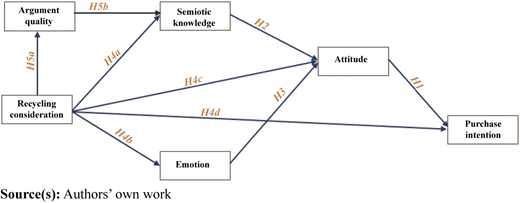
The waste crisis in Australia exacerbates in the household sector, urging local councils and retailers/manufacturers to improve consumers’ recycling shopping behaviour – the most relevant touchpoint to the whole recycling process. In retail stores, packaging recyclability is communicated by either the central route (symbols/signs) or the peripheral route (packaging colours/materials); however, how the effects are differentiated and how the central route can be emphasised for a long-term attitudinal change are unclear. The research investigates these issues by applying the elaboration likelihood model (ELM).
A total sample of 420 respondents were recruited across Australia and managed online by Qualtrics. The data were analysed by using structural equation modelling with AMOS 29 software.
Both routes of processing are significant as per the model. Furthermore, the perceived argument quality of recyclable packaging signs mediates the effect of recycling consideration on consumers’ semiotic knowledge, enhancing attitudinal change via central processing. Recycling considerations display negative effects on recycling shopping behaviour.
This research theoretically contributes by extending the ELM with the newly proposed concepts of semiotic knowledge and symbols’ argument quality, further explaining consumers’ processing of information on packaging recyclability. From a practical perspective, the research provides valuable contributions for both policymakers and retailers by showing how central processing can be emphasised for a more sustainable attitudinal change to enhance recycling shopping behaviour.
1. Introduction
The waste crisis is a critical challenge to Australia, where 76 m tonnes of waste was generated between 2020 and 2021, only approximately 50% of which was successfully recycled (Australian Bureau of Statistics (ABS), 2020; The Department of Climate Change, Energy, the Environment and Water (DCCEEW), 2022). Despite having slightly better performances on recycling, all other high-income countries still generated roughly 1.5 kg of waste per person per day, greatly exceeding that in developing nations (Edmond, 2019; The Editors, 2020); yet, barely managing to sustain their recycling rates above 50% (Statista, 2023). The need to address recycling problems in Australia, therefore, is not only a significant issue within the country but also a concern shared by many others.
Households and individual consumers are one of the sectors generating the most waste, indicating up to 14 m ton, alarmingly, only 13% of which was recycled (ABS, 2020). In addition to biodegradable organic wastes, the other prevalent waste materials by these contributors are plastics, paper and cardboard – the most common packaging materials in retail stores. This suggests an issue prevails in their recycling-related activities towards these materials; therefore, it is worth investigating for valuable implications for both Australia and other countries.
The most relevant touchpoint to the whole individuals’ recycling process, due to its ability to truly enhance the number of recyclable materials, is consumers’ decision to purchase products with recyclable packaging in the first instance. Such behaviour is defined as “recycling shopping behaviour”– one’s inclination or consideration to purchase products whose packaging can be easily recycled after use (Biswas et al., 2000). The rationale for focusing on this behaviour is grounded in the current waste management practices at households. The weight of domestic recyclables was counterintuitively low despite new initiatives in expanding kerbside bins (DCCEEW, 2022). Though one may argue the sorting behaviour at the point of disposal might have been one reason, the evidence of 14 m ton of household waste vs 13% of which being recyclables indicates an inadequate attempt for recycling shopping decisions. Furthermore, recycling shopping behaviour involves an active choice in retail stores, in which the favourable decision can simultaneously increase the amount of recyclable and reduce landfills. This validates such in-store decisions as the most relevant touchpoint to the whole recycling process; hence, the focus of the paper is to identify how consumers can be encouraged to strengthen this behaviour.
Academically, the extant literature suggests enhanced information to consumers is a key factor of recycling shopping behaviour (Neves and Marques, 2022; Shevchenko et al., 2023). This draws our attention to which type of information, for instance, packaging materials/colour or written communication (which are recycle signs/symbols that are endorsed on recyclable packaging), can influence consumer choices. Indeed, some research establishes inconsistent behaviour from consumers after processing recyclable packaging information (Magnier and Schoormans, 2015, 2017; Seo and Scammon, 2017; Steenis et al., 2017) but does not suggest any explanatory indicators. Particularly, consumers failed to specify the aspects of packaging sustainability, i.e. recyclability or reusability after processing relevant information (Steenis et al., 2017) or they misperceived sustainability messages as a greenwashing tactic if exposed to mere packaging designs or colours (Magnier and Schoormans, 2015, 2017; Seo and Scammon, 2017). Furthermore, in retail environments, manufacturers have been much more focused on improving packaging materials or colours to indicate its recyclability to consumers. There is limited examination of whether this means of communication is effective in changing consumers’ recycling shopping behaviour and therefore should be preferred over recycle signs (Nguyen et al., 2020; Sekki et al., 2023). Thus, it is essential to determine the differentiated impacts of each source of recyclability information on consumers’ recycling shopping behaviour to streamline manufacturers’ initiatives in retail stores, considering recycling signs are the official indicators of packaging recyclability (Australian Packaging Covenant, 2018). Highlighting these issues would ultimately contribute to the overarching literature of recycling shopping behaviour, in which the type of communication is yet to be thoroughly scrutinised (Neves and Marques, 2022; Shevchenko et al., 2023). Innovative initiatives to enhance recycling efforts can be introduced by other countries as a result, considering the inadequate attention given to these signs in both academic and practical contexts.
Against this backdrop, the study’s objective is to adopt the elaboration likelihood model (ELM), a prominent framework in information processing, for validating the differentiated impacts of the neglected central routes (signs or symbols) and peripheral routes (materials or colours) of processing packaging recyclability information (Grunert, 2011; Herbes et al., 2018). The study attempts to incorporate the successful outcomes of processing routes into the ELM as exogenous constructs influencing recycling shopping behavioural intention (Liu et al., 2022), which will help guide future academic research and marketing initiatives in retail environments. In addition to emotions as an indicator for peripheral routes, semiotic knowledge – consumers’ overall understanding and comprehension of recyclable packaging signs is used for central processing, which is also the new construct to be introduced. Validating the differentiated impacts of these two paths will therefore not only address the controversial debate around the dual routes of processing in the ELM literature (Kitchen et al., 2014) but also suggest a new addition to the framework, recommending novel theoretical contributions.
2. Literature review and hypothesis development
2.1 The elaboration likelihood model
Since its initial introduction in 1979 by Petty and Cacioppo (1979), the elaboration likelihood model (ELM) has emerged as one of the most well-known and influential theoretical frameworks in message evaluation and persuasion. It has motivated numerous research studies both applying and expanding the use of ELM in marketing, particularly in advertising (Kitchen et al., 2014; Schumann et al., 2012). The model receives strong academic support, thanks to its well-constructed processes, versatility of outcomes due to the model’s intensively descriptive nature, and its academically widespread references (Jackson, 2005; Kitchen et al., 2014).
The fundamental tenets of the ELM are the two routes in which persuasion may occur: “the central and peripheral routes” (Petty and Cacioppo, 1979, 1981; Petty et al., 1983). Petty and Cacioppo (1981) concluded these represented two opposite ways for an individual to process an exposed message and be prone to persuasion, depending on his/her level of likelihood to elaborate, which is driven by motivations and abilities for elaboration (Petty and Cacioppo, 1981; Petty et al., 1983). Specifically, the presence of motivations and abilities to elaborate would lead to a high likelihood, and the absence of which would be equivalent to a low likelihood of elaboration. While abilities refer to such variables as distraction, message comprehensibility or issue familiarity; motivations are generated from the need for cognition and the degree of personal relevance (Petty et al., 1983), which was later proposed to be altered as “response involvement” – the outcome or consequence of that individual’s decision resulted from the elaboration process (Kitchen et al., 2014; Petty and Cacioppo, 1986). In the case of recyclable packaging, it has been indicated that central routes for processing are via recycle signs or symbols, which are usually positioned on the back of packaging, whereas packaging materials or colour are regarded as cues that trigger peripheral processing (Grunert, 2011; Herbes et al., 2018).
ELM has been widely used to explore how consumers respond to messages on sustainability (Manca et al., 2020; Liu et al., 2022), indicating the framework’s relevance to this research context. Herbes et al. (2018) and Grunert (2011) identified the respective routes of processing on recyclable packaging, further suggesting that the framework would be a great fit to investigate the variables of interest and the research context.
The outcome of successful elaboration as per the ELM is attitudinal change towards the behavioural intention promoted by the message, in which the duration of attitudinal shift and its intensity of impacts on behavioural intention are dependent on the processing route (Cialdini et al., 1973; Chang et al., 2020; Manca et al., 2020). Therefore, to investigate the differentiated effects of the processing routes on recyclable packaging (packaging materials/colour vs signs), the first hypothesis between the impacts of attitudes towards the overarching message of recycling shopping and consumer recycling shopping behavioural intention can be developed as follows:
Attitudes towards recycling shopping positively influence consumers’ intention for recycling shopping behaviour.
In line with the tricomponent model (Howard and Sheth, 1969), one’s attitudes are formed by knowledge and emotions as the two outcomes after processing information. In the same manner, these two constructs are proposed as the two outcomes after consumers’ exposure to packaging recyclability cues to be investigated in this research. Justifications are provided in the literature discussion below.
2.2 Semiotic knowledge as the outcome of central route of processing
Research has previously established that environmental knowledge (EK) is an indicator of the successful outcome of central processing of sustainable messages (Liu et al., 2022). Generally defined as one’s awareness of irresponsible consumption’s consequences, EK is a critical antecedent for sustainable behaviour in literature (Chang et al., 2014; Joshi and Rahman, 2015). There are two types of EK. One is general EK – consumers’ awareness and understanding of the environment’s current critical issues or the consequences of environmentally unfriendly consumption and usage (Kumar et al., 2017; Sun et al., 2022). This type of knowledge constitutes one’s level of environmental concerns – a construct which has been widely investigated in research. Since this type of EK is not highly specific towards any research contexts, many researchers supported the overestimated impact of this construct in various studies (Joshi and Rahman, 2015).
The other type of knowledge reflects one’s judgements of how to “specifically act” towards those environmental issues, such as how to recycle properly in this research context (D’Souza, 2005). Such subjective knowledge is provided via recyclable packaging cues, such as the recycle symbols, which accurately reflect the type of EK achieved from processing central cues on recyclable packaging (Grunert, 2011; Herbes et al., 2018). Therefore, it is both theoretically and practically justifiable that the indicator of successful processing via central routes on recyclable packaging is attested to one’s knowledge of those very recycling symbols as central cues, or what authors refer to as semiotic knowledge in this study. Semiotic knowledge, as per the above literature, can be defined as consumers’ overall understanding and comprehension of recyclable packaging signs (D’Souza, 2005; Grunert, 2011; Herbes et al., 2018). Chang et al. (2020) also suggested that information completeness or consumers’ perception of information sufficiency, reflects central processing, aligning with the proposed definition of semiotic knowledge in this context. A hypothesis is therefore formed as follows:
Semiotic knowledge positively influences consumers’ attitudes towards recycling shopping behaviour.
Research on recyclable packaging cues remains quite limited (Atkinson and Rosenthal, 2014; Pancer et al., 2017; Rees et al., 2019), with current findings mostly presented on peripheral cues including recyclable packaging materials or colours (Grunert, 2011; Herbes et al., 2018; Ketelsen et al., 2020; Magnier and Crié, 2015; Steenis et al., 2017). Thus, an investigation into semiotic knowledge is not only theoretically sound according to the research topic at hand but also a much-needed response to its inadequate attention in literature. The addition of semiotic knowledge as a construct also suggests a significant contribution to the ELM framework.
2.3 Emotions as the outcome of peripheral route of processing
Persuasion through the peripheral route, on the other hand, is facilitated by peripheral cues such as packaging materials or colour in the context of recycling (Grunert, 2011; Ketelsen et al., 2020; Petty and Cacioppo, 1981; Petty et al., 1983). Processing routes might result in only a temporary attitudinal shift but the ultimate behaviour change. In the same sense, long-term attitudinal and behavioural changes can only be achieved through the central route, whereas the momentary shift of attitude will persist with some incremental intensity as the exposure to the peripheral cues repeats until the elaboration likelihood is high as required for the central route of persuasion. Researchers acknowledged the ELM’s occurrence of multi-channel processing and processing continuum (Kitchen et al., 2014; Petty and Cacioppo, 1981, 1986; Petty et al., 1983), in which consumers could be inclined to simultaneously process both central and peripheral routes, resulting in attitudinal change. Kitchen et al. (2014) requested a further investigation into how central routes could be further emphasised and prioritised in the context of sustainable consumption.
Research suggests that emotions are one indicator of peripheral routes of processing (Liu et al., 2022). In the context of recycling, previous studies posited that the colour green of recyclable packaging, as a peripheral cue, was found to engender perceived social values and positive emotions (Felix et al., 2020). Emotions and feelings that are evoked by environmental stimuli reflect an affective state (Batra and Ray, 1986; MacKenzie et al., 1989), triggering individuals to further concentrate on more abstract peripheral cues instead of detailed information (Liu et al., 2022). The hypothesis is therefore developed as follows to reflect the outcome of the peripheral route of processing of recycling cues:
Positive emotions for recycling positively influence consumers’ attitudes towards recycling shopping behaviour.
2.4 Recycling consideration as the motivation for elaboration likelihood
Since the processing cues are to communicate packaging’s recyclability, and the attitudinal change is towards one’s intention of recycling shopping to ultimately serve this purpose of recycling, the motivation or degree of personal relevance for the likelihood to elaborate can be characterised as recycling considerations (Petty et al., 1983). Recycling considerations involve factors consumers need to consider when addressing or implementing recycling initiatives.
Being defined as the contemplation of recycling before purchasing (Carrington et al., 2014), this pre-purchase thought would reasonably incline consumers to engage in the elaboration process via either central or peripheral cues, resulting in a positive attitudinal change towards purchasing intention in retail stores. Furthermore, additional hypotheses for recycling consideration can also be formed to explore the construct’s direct and indirect effects on consumers’ attitudes towards recycling shopping behaviour via semiotic knowledge and emotions as mediators. Essentially, it is expected that the indirect paths (recycling considerations – SK–Attitudes and recycling considerations – Emotions–Attitudes) will display stronger effects since consumers will then have achieved certain levels of information on packaging recyclability before any attitudinal change.
Recycling consideration positively influences consumers’ (a) semiotic knowledge, (b) emotions towards recycling and (c) attitudes towards recycling shopping behaviour.
It is important to clarify that recycling considerations as consumer motivations can vary in intensity, operating at either high or low levels. When motivations are high, there is a greater likelihood for consumers to engage in thoughtful elaboration and decision-making regarding recycling. Conversely, when motivations are low, consumers are less likely to invest significant cognitive effort in evaluating recycling options, leading to more automatic or less informed recycling behaviours. On the other hand, under the influence of the retail store environment, it is not uncommon that shoppers totally ignore recycling cues on product packaging despite the existence of prior recycling considerations. Consumers’ thought of recycling may exist as a habitual routine performed at all households in Australia on a fortnightly basis, which will fail to induce any processing routes of recycling signs on packaging. Furthermore, certain situational factors such as information overload (Branco et al., 2016; Fernqvist et al., 2015) and time pressure (Babin and Harris, 2018) may also deter shoppers’ attention from the secondary benefits of products, including packaging recyclability (D’Souza, 2005). Thus, it is worthwhile to investigate the direct effect of recycling consideration on purchasing intention to further validate the overall impacts of recyclable packaging cues, either central or peripheral ones, on consumers’ behavioural intention. Expectedly, the indirect effects from recycling consideration to purchasing intention should display a significantly higher degree, since consumers will have engaged in the elaboration process and the behavioural intention will have been further fortified by favourable attitudinal change. This will also help validate the effects of the ELM in the context of information processing.
Recycling consideration influences consumers’ intention of recycling shopping behaviour.
2.5 Argument quality as a mediator for central processing
Central processing was argued to generate long-term attitudinal change for favourable behavioural intention (Kitchen et al., 2014; Petty et al., 1983); therefore, streamlining retail and manufacturer initiatives requires an understanding of how the central route can assert a dominant effect throughout the elaboration process. Kitchen et al. (2014) challenged the notion of dual processing of both central and peripheral routes, both of which had been argued to induce attitudinal formation (Petty et al., 1983). Stiff (1986) and Bitner and Obermiller (1985) also indicated the lack of evidence for the claim of simultaneous occurrence of both routes. The incident of dual processing was hence rather discussed as a limitation of the ELM (Kitchen et al., 2014). Additionally, a high level of elaboration likelihood resulting from recycling consideration in this study’s context does not ensure thorough central processing. The lack of certain attributes of the message may result in interruptions, eventually leading to a switch to the peripheral route (Kitchen et al., 2014). This calls for research to identify more reinforcements for the central route of processing to be successfully incurred and retained throughout the elaboration process, ensuring a more enduring change in attitudes. One of the reinforcements of central processing has been identified as the cues’ argument quality (Chang et al., 2020; Kitchen et al., 2014; Cyr et al., 2018; Petty et al., 1983).
The argument quality of a message was discussed in past research as a mediator between motivation for processing and its outcome (Kitchen et al., 2014), which in this study are recycling consideration and semiotic knowledge, securing the occurrence of central processing. Generally defined as consumers’ evaluations of the message’s persuasiveness (Petty et al., 1983), strengths (Petty and Cacioppo, 1981) or favourable evaluations towards the message (Chang et al., 2020), argument quality reflected individuals’ perceptions of not only the message’s informativeness but also its persuasion, ability to provoke thoughts (Ko and Kim, 2015) or the perceptions that their beliefs are changed (Lee and Xia, 2011; Chang et al., 2020). In the context of websites, Cyr et al. (2018) also found the central cues’ argument quality significantly and directly heightened the outcome of central processing (change in issue involvement in the study), resulting in a more favourable attitudinal change. In the same manner, a similar hypothesis can be formed towards the argument quality of recycle signs to test their mediating effects between the motivation (recycling consideration) and the outcome of the central route (semiotic knowledge) in this study.
The argument quality of recycling signs mediates the relationship between recycling consideration and semiotic knowledge.
It should be noted that the objective of this research study is not to diminish the importance of peripheral routes via emotions or to emphasise the central routes at all costs. In fact, peripheral processing has been suggested as the dominant approach in certain circumstances in past research (Petty et al., 1983). This study is hence rather to explore the differentiated effects of central and peripheral routes on recyclable packaging and how the current use of recycle symbols on this packaging may or may not influence the entire mechanism of information processing for recycling purposes. Furthermore, the original notion of the ELM is that resultant attitudinal change from peripheral processing is temporary, whereas its magnitude can still be substantial for short-term behavioural change (Kitchen et al., 2014; Petty et al., 1983). The inclusion of argument quality as a variable is therefore to explore if recycle signs as the central cue can be enhanced for both academic and practical contributions (see Figure 1).
3. Methodology
3.1 Data collection
The study’s sample is comprised of adults, aged 18 or above, since the context of recycling and purchasing intention is difficult for minors to comprehend (Chan, 2001). The study followed the recommendation by Hair et al. (1998) for a desired sample of 15–20 respondents per variable. A total of 426 respondents were recruited across Australia, of which six were removed from the final dataset due to their excess of neutral answers (3 on a scale of 1–5). The final number of respondents amounted to 420, which is adequate for structural equation modelling (Boomsma, 1987), of which 43.8% were males and 56.2% were females. The study also aimed to recruit a sample of respondents who were well spread across the age groups and demographics (see Table A2) to avoid biases potentially engendered by these variables in sustainable consumption (Kim and Seock, 2019). The respondents were recruited and incentivised by the popular online survey company Qualtrics, which had access to the population data and was also the external partner to manage the survey and response rates. The response rates were as high as 80% thanks to the expertise of Qualtrics. Stratified random sampling was adopted to ensure a non-biased sample, in which a good mix of demographic groups was recruited and every person in each group had an equal chance of being invited to complete the survey.
The first screening question asked the respondents about their recycling frequency, in which “Never” or “Rarely” would be deemed ineligible. This is to ensure that they do engage in the behaviour, and the thought of recycling does occur.
3.2 Measure
All measurement scales used in this study are taken and adapted from past research. The questions to measure consumers’ attitudes, purchase intention and argument quality were taken from relevant articles on the ELM and adapted to the research context of fast-moving consumer goods (FMCG) (Cyr et al., 2018; Liu et al., 2022). Semiotic knowledge’s scales are adapted from Yoo (2014) and Bulmer and Buchanan-Oliver (2006), in which consumers’ knowledge of visual rhetorics was investigated. The other questions were drawn from highly ranked academic sources (A or A* Journals according to the ABDC’s Journal List), compiled in Bruner's (2009) Marketing Scales Handbook. The authors also referred to this handbook to further validate and adapt the above measuring scales if required. The five-point Likert scales were recommended for research questions in the context of sustainability (Taylor and Todd, 1995).
4. Analysis
4.1 Measurement model
CB-SEM was employed, using AMOS Software 29. The two-step approach suggested by Timm (2002) and Byrne (2004) to building a model was used. The measurement model was investigated prior to the structural model so that the lack of fit could be attributed to the measurement alone. Relevant fitness indices were referenced to ensure the fitness of the measurement model. To maximise the model fit, an assessment of the items’ factor loadings and modification indices was completed. Different thresholds for factor loadings were discussed in the literature, such as 6.0 (Dash and Paul, 2021) or >7.0 (Byrne, 2004; Kline, 2010; Timm, 2002). Since >0.7 is a more widely recommended threshold, only measuring items with factor loadings of above 0.7 were retained (Kline, 2010). As a result, 12 items were removed based on statistical and theoretical justifications [1]. The table of factor loading scores and the details of item elimination (see Table A1) are presented in Appendix 1.
All measuring items had factor loadings ranging between 0.725 and 0.93, indicating that convergent validity had been achieved (Churchill, 1979). The model also realised the required levels of fitness indices for all categories of model fit, with comparative fit index (CFI) = 0.966, root mean square error of approximation (RMSEA) = 0.05 and Chi-square/df = 2.027.
To assess reliability and internal consistency, average variance extracted (AVE), Cronbach’s α scores and composite reliability (CR) were calculated. An AVE ≥ 0.5, α ≥ 0.7, and CR ≥ 0.6 are required for each construct. With all AVE values being above 0.6, CR ≥ 0.8, and Cronbach’s α scores ranging between 0.90 and 0.97 (Table 1), the scale’s reliability and internal consistency were achieved (Hair et al., 1998). A discriminant validity index summary was computed to prove the constructs in the model are discriminant of each other. Essentially, the square root value of each construct’s AVE needs to be higher than the correlation between respective constructs to achieve discriminant consistency (Fornell and Larcker, 1981).
4.2 Common method bias (CMB)
Common method bias is popular in behavioural research due to its emphasis on cognitive efforts (Podsakoff et al., 2003). Both procedural and statistical methods were adopted, including designing proper measuring scales even before commencing the fieldwork and using both Harman’s one-factor test and a common latent factor for detection afterwards (Baumgartner et al., 2021; MacKenzie and Podsakoff, 2012; Archimi et al., 2018). The paper studied the conditions that could potentially cause method bias and strictly applied the remedies to eliminate them. The proposed procedural changes were suggested by MacKenzie and Podsakoff (2012) and supported by Baumgartner et al. (2021). The measures include such remedies as removing ambiguous or double-barreled questions and ensuring the anonymity of responses.
Harman’s single-factor test was then used, where all scales were considered for calculating common method variance (CMV) in the Statistical Package for the Social Sciences (SPSS). Results showed the single factor explained 45.2% of the total variance (<50%). Common latent factor analysis showed small differences in regression weights (<0.200) (Archimi et al., 2018). From the above measures, CMB was determined to be unlikely.
4.3 Hypothesis testing
To test the main hypotheses, the structural model was estimated using the combined sample (n = 420). The structural model showed adequate model fit across the fitness categories, with goodness-of-fit index (GFI) = 0.997, CFI = 0.999, RMSEA = 0.048 and Chi-square/df = 1.978.
All hypotheses were supported with sufficient evidence (Table 2). Mediation analyses were performed using a bias-corrected bootstrapping procedure of 2,000 samples and two-tailed significance. The p-values displayed significant results across paths, p < 0.001, indicating the significant direct and indirect effects. An interesting result is the negative, direct effect from recycling consideration and purchase intention (βRC-PI = −0.512, p < 0.001), whereas the indirect effect between these two constructs after the elaboration process displayed a significant and positive result (β = 1.097*, p < 0.001) via attitudinal change and two processing routes (semiotic knowledge and emotions) as mediators (βattitudes-PI = 1.527*, p < 0.001). This confirms the successful outcome of the ELM and the significant role of recycling cues in retail stores towards sustainable behaviour.
*It should be noted that β being greater than 1 is possible and shows no anomalies; thus, should be interpreted in the same manner as other values (Deegan, 1978).
Between the two routes of processing, resultant emotions from recycling considerations appeared to be a more substantial outcome than SK (βRC-emotions = 0.448, βRC-SK = 0.236, p > 0.001), subsequently showing a more substantial influence on attitudes against semiotic knowledge (βemotions = 0.272, βSK = 0.169, p < 0.001). This indicates the more dominant effect on attitudinal change from peripheral processing in this context (Petty et al., 1983).
Argument quality demonstrated partial mediating effects, influencing the strength of semiotic knowledge in the central route (p < 0.001), suggesting that this construct is a crucial antecedent to minimise the reliance on peripheral routes. This opens avenues for future research to explore how the signs can be better designed to even further strengthen their quality and perceived knowledge. Table 3 of total, direct and indirect effects is available here.
All tables and appendices are included as supplementary files, since key findings for discussions have already been reported here.
5. General discussion
5.1 Theoretical contribution
5.1.1 An extension of the ELM – the roles of semiotic knowledge (SK) and argument quality on the framework’s dual processing
The research study provided a valuable expansion to the ELM in the context of recycling shopping behaviour, introducing the new construct of semiotic knowledge and examining the role of recycling signs’ argument quality. The two variables confirmed the relevance and significance of recycle signs in retail stores, indicating novel contributions to both the ELM and practical implications to retailers. These findings are significant and desirable, since although recycling signs are supposed to be the key means of communication for packaging recyclability (DCCEEW, 2022; Herbes et al., 2018; Grunert, 2011), the impact of these cues was inadequately investigated in research and is yet to be utilised by retailers or manufacturers. Simultaneously, the study also offered insights into consumers’ processing of recyclable packaging cues and how central routes could be more pronounced in retail stores, fortifying long-term attitudinal change and addressing the general debates around the ELM’s dual processing issues (Kitchen et al., 2014). Essentially, the retrieval of consumers’ knowledge of recycling signs is indicative of the central route of processing recycling information (Chang et al., 2020; Manca et al., 2020).
The study indicated that both central and peripheral routes of processing via recycling signs and packaging colours/materials would result in positive attitudes among customers, which aligns with preceding literature (Kitchen et al., 2014; Petty et al., 1983). What is even more interesting is a heightened influence on attitude generated from emotions, as the outcome of peripheral processing was observed, compared to semiotic knowledge in the central route. This confirms the notion by Petty et al. (1983) that the peripheral route could play the dominant role in information processing, though the attitudinal change may be temporary and the framework’s incidence of dual processing (Kitchen et al., 2014; Petty et al., 1983). Additionally, the study established that consumers’ perceived quality of the message (i.e. the recycling signs in this case) was able to significantly increase their knowledge via central routes. Although the peripheral route in the paper still displayed a stronger impact without argument quality as an antecedent in central processing, this finding was able to (1) justify the role of the academically and practically neglected recycling signs in the domain of recycling and (2) validate argument quality as an enhancer of semiotic knowledge in central routes, contributing to past research’s urge to further study the factors that discriminate the two routes (Kitchen et al., 2014). These findings therefore contribute to the literature of both ELM and recycling shopping behaviour.
5.1.2 Recycling shopping behaviour: antecedents
Valuable insights were also found in the domain of recycling shopping behaviour. At the direct effect level, the evidence suggests that recycling considerations result in an adverse impact on behavioural intention, in which consumers’ mere thought of recycling does not necessarily benefit the intention of recycling shopping behaviour. Consumers’ recycling considerations, in many instances, can be simply their household routines every fortnight, which do not require cognitive processing in retail stores and hence fail to represent one’s actual motivation to process recyclability cues. In such cases, the intention may be influenced by other prominent internal and external factors, instead of one’s genuine pre-purchase thought of recycling, such as their level of environmental concern (Joshi and Rahman, 2015), which does not necessarily engender sustainable behaviour (Magnier and Schoormans, 2015, 2017; Steenis et al., 2017). Magnier and Crie (2015) found that consumers’ sustainable behavioural intention could be better predicted by their relevant knowledge instead of environmental concern, since highly concerned individuals could still exhibit inconsistent sustainable behaviour (Steenis et al., 2017). Another external factor is time pressure that tends to induce in-store habitual purchases (Jackson, 2005), which can be unrecyclable.
The above discussion emphasises the relevance and significance of recycling signs and semiotic knowledge in recycling shopping behaviour, being supported by the statistical evidence presented in the paper. The paper justified the necessary switch to recycling signs in retail environments for more favourable intentions, opening more avenues for future research on semiotic knowledge and argument quality. On the other hand, it should be noted that the authors are not trying to disregard the significance of peripheral routes since this was already confirmed in this study. The proven significance of semiotic knowledge and argument quality in making the central route more pronounced is simply plausible because (1) the role of recycling signs is now adequately emphasised as supposedly being the key medium of communication towards packaging recyclability and (2) additional antecedents of semiotic knowledge and argument quality are confirmed, giving more insights about how the ELM’s dual processing works and how the central route can be enhanced for a sustained behavioural change.
5.2 Implications
5.2.1 Implications for managers, manufacturers and retailers
The study affirmed the importance of communicating recyclable packaging information, via recycling signs and with heightened argument quality, to induce sustainable behavioural intention. Manufacturers or retailers of FMCG products in Australia should therefore increase their efforts to maximise consumers’ likelihood to process recycling signs instead. A repositioning of recycling signs, for instance, to steer shoppers’ focus away from packaging materials/materials will surely interrupt their habitual buying, strengthening their central processing and semiotic knowledge subsequently. In fact, recycling signs have been acknowledged by many as the official signifier for packaging recyclability; however, their back-of-the-packaging positions may have failed to catch consumers’ attention during their shopping journeys. Additionally, manufacturers could improve consumers’ overall perceived argument quality of those recycling signs to enhance consumers’ semiotic knowledge through further written communication. Sufficient meanings of these signs are widely available on the Australian Government’s Agencies’ websites, yet rarely used on packaging. Manufacturers simply need to bring them to the attention and comprehension of consumers. Such initiatives will enhance consumers’ recycling shopping behaviour, increasing the amount of recyclable collected from households and individual consumers in Australia.
In the same manner, similar initiatives can also be adopted in other developed countries in the UK or America, where the recycling rates are stubbornly low, and recycling signs are also the official indicator of packaging recyclability (Daggar, 2024). These tactics could also be initiated by retailers, given their negotiation power in Australia.
5.2.2 Implications for consumers
In line with the proposed initiatives, consumers can play a more active role in acquiring semiotic knowledge and argument quality. Recycle signs and their elaborate meanings are abundant on many government agencies’ websites, such as Sustainability Victoria and EPA Victoria, which can constitute sufficient semiotic knowledge and perceived argument quality. Such individual initiatives can help consumers make more informed decisions in retail stores, simultaneously complementing retailers’ or manufacturers’ strategies to enhance one’s semiotic knowledge.
5.2.3 Implications for policymakers
Policymakers can enhance consumers’ likelihood to elaborate. Many social marketing campaigns’ messages are aimed at generating people’s environmental concerns, limiting their knowledge of what to do specifically with the packaging, and therefore minimising their need for cognition as a motivation for processing. A government-funded campaign to educate shoppers on recycling signs or at least enhance consumers’ associations between these cues and packaging recyclability, is thus very much needed. Furthermore, policies can be introduced to encourage the implementation of the above initiatives towards recycling signs on manufacturers’ products’ packaging in retail stores. These will complement the ongoing initiatives on kerbside bins by the local government (DCCEEW, 2022) by increasing the amount of recyclable after purchase.
6. Limitations and future research
The research study is not without its limitations, opening avenues to recommendations for future research. First, although the investigation of only behavioural intentions was sufficiently theoretically justified in this paper, a follow-up study to measure actual behavioural change will provide more conclusive findings. Future studies can also further investigate how various factors, such as situational variables or demographic attributes, can influence the impacts of both central and peripheral routes on recycling shopping behaviour. Valuable insights will be gathered on how differentiated effects between these two routes of processing can be further facilitated. Additionally, quantifying the duration of attitudinal change that resulted from each processing route (temporary vs long-term) according to the tenets of the ELM is also welcomed to further confirm the already justified emphasis on central processing via recycling signs. Finally, since recycling signs are mostly characterised as symbols on packaging, it is desirable to explore how different types of signs, including icons, indexes and symbols or an inclusion of written communication, can generate differentiated levels of argument quality perceived by consumers in another experimental or longitudinal study. Interesting findings are anticipated, since indexes were suggested to be probably more effective in communicating sustainability (Ewing et al., 2012); however, relevant research studies or applications remain limited or even nonexistent in the context of recycling.
The authors acknowledge with thanks the research funding provided by La Trobe Business School.
Notes
Different perspectives on factor loadings’ thresholds are discussed in literature, including 6.0 (Dash and Paul, 2021) and >7.0 (Byrne, 2004; Kline, 2010; Timm, 2002); however, >7.0 has been found to be the most recommended. EFA was performed, after which 2 very poorly performing items of below 0.5 were eliminated. In AMOS, CFA was performed to test the model fit. First, the threshold of >7.0 was referred to, and nine items with factor loadings of 7.0 or below were dropped. Then, modification indices were referred to identify redundant items, further improving the overall model fit (Byrne, 2004; Dash and Paul, 2021; Timm, 2002). Item attitude_positive, despite the high factor loading of 0.876, showed high MI with two other items (both of which had higher factor loadings). Thus, it is justifiable that this item was eliminated. A total of 12 items were removed after the whole process, which was fully grounded in theoretical justifications.