The aim of the present work is to understand the definition shoppers give to the concept of sustainability in general and in the retailing grocery sector and which are the variables they consider more relevant in assessing the sustainability image of a store and which are not included in the evaluation process.
The focus groups provided a platform for participants to discuss key concepts of sustainability and the sustainable strategies implemented by retailers. Participants were then asked to identify their habitual store and, during their next shopping trip, take pictures of anything they perceived as sustainable. These images were later discussed in a follow-up focus group. Store checks were carried out to compare the in-store sustainability marketing strategies employed by retailers (measured in terms of presence or absence) with those noticed by participants.
Results show that shoppers claim to look for bulk products, products without reduced package; information about the origin the products; organic and fair-trade products, information and signs that help finding sustainable products inside the store.
The paper attempts to enrich the understanding of the sustainability concept in the grocery retailing sector focusing on the perceptions of the shoppers about how a sustainable retailer manages the retail mix and which are the variables managed inside the store that contribute to the perceived sustainability image.
1. Introduction
Sustainability has become a critical component of corporate strategy across all sectors. In recent years, its importance has increased significantly in various business areas. To integrate sustainability into the business environment, the Triple Bottom Line model was developed, encompassing environmental, social and economic sustainability (Wiese et al., 2015).
In the food sector, there have been numerous contributions to sustainability from an industrial perspective, while sustainability remains a relatively underexplored topic in retail research (Mauri et al., 2022). One possible explanation for this is the complexity of the retail sector. Its diverse product ranges and varying in-store conditions create different perspectives and interpretations of sustainability, which must be considered as they become part of daily activities and decision-making processes.
However, sustainability must be pursued by companies that have the ability to encourage sustainable behaviors in their customers. In this context, retailers can play a key role in developing sustainability initiatives due to their economic impact and proximity to the end consumer (Claro et al., 2013), their role as intermediaries between consumers and producers (Stolz et al., 2013) and their ability to exert significant control over supply chains (Hingley, 2005). Retailers serve as gatekeepers between producers and consumers. In this role, they can promote sustainability by facilitating changes in production processes and consumption patterns that address social and environmental concerns. Given their market position and large-scale consumer interactions, food retailers are well-positioned to influence consumers to purchase and consume more sustainable food products (Bartels et al., 2018; Bălan, 2020).
Typically, the primary drivers for retailers to implement sustainable strategies include not only economic viability but also factors such as environmental regulations and consumer demand (Saber and Weber, 2019). Consumers today are increasingly aware of sustainability issues, the consequences of unsustainable behaviors and the impact of their dietary choices on the ecosystem and society (Van Bussel et al., 2022). According to several studies, consumers seek out sustainable stores and hold a more favorable view of retailers that act as responsible corporate citizens (Kim et al., 2014), offer sustainable products and services and avoid harming the environment or society (Closs et al., 2011).
In this context, it is crucial to assess whether consumers perceive stores and retailers as sustainable.
Thus, the aim of this study is to understand consumers’ perceptions of the sustainable practices developed and implemented by major grocery store chains in Italy. At the same time, this will help clarify which interventions customers consider sustainable and which aspects they prioritize. Certainly, economic investments in sustainable strategies can be costly (Kumar and Polonsky, 2019), so identifying priority areas can help retailers focus their communication efforts effectively.
2. Theoretical background
2.1 Schema theory and perceptions
According to Schema Theory, our perceptions of the world are determined by the “interaction between external stimuli from the environment and what we bring to them” (Halkias, 2015). Thus, perceptions are mediated by the interpretative function of the mind. When people experience different situations, they collect perceptions and form what the literature calls schema. Schemas are defined as “memory-stored cognitive structures of prior knowledge about a concept or stimulus domain that specify the entire configuration of its defining and relevant attributes.” A schema is learned and acquired through direct and indirect experiences with the environment (Halkias, 2015).
To simplify their environment, individuals store information in categories associated with concepts in their minds. Categorization is based on similarities between attributes and features related to a concept, situation or environment. In general, individuals are exposed to thousands of stimuli that become meaningful when integrated into cognitive schemas (Stead et al., 2021). When encountering a specific situation, customers consciously or subconsciously perceive selected stimuli through one or more senses (touch, smell, vision, hearing and taste), specifically those that relate to existing memories (Greve et al., 2019), while suppressing other existing or competing stimuli (Stead et al., 2021).
Research has demonstrated that consumers also develop schemas regarding market-based practices. These schemas take the form of implicit theories that relate brands to advertising, positioning and marketing mix decisions (Buchanan et al., 1999). When analyzing a brand, the concepts of brand identity and brand image are the main areas of interest.
In the retailing context, the concept of corporate image is closely related to perceptions and can be considered an organization’s “perceived identity,” in contrast to corporate identity. The key difference between these concepts is the fact that corporate identity generally belongs to the sender’s side of the message (the company), while corporate image is more commonly related to the receiving side of the communication process: the stakeholders (Thøger Christensen and Askegaard, 2001). These two concepts are linked by communication. According to Gray and Balmer (1998), corporate identity, through corporate communication, creates corporate image and corporate reputation, which can lead to a competitive advantage. In this model, corporate communication consists of messages from both official and informal sources, conveyed through various media, through which the company communicates its identity to multiple publics or stakeholders.
In retail, particularly in food retailing, consumers primarily associate corporate image with store image. The store serves as a physical space where corporate values are communicated through customer experiences and interactions. Through these experiences, customers build relationships and form perceptions of a retailer, essentially creating a schema. Store image thus becomes a critical factor in retailers’ and marketers’ corporate strategies, ensuring market differentiation (Cornelius et al., 2010) and acting as a precursor to competitive positioning. A positive store image can lead to economic success, customer preference, satisfaction and even loyalty (Burt et al., 2007; Hartman and Spiro, 2005). Store image is not only based on perceptions and beliefs about a particular store but also on the general perception of different retail formats (e.g. discount stores, supermarkets). This suggests that store image is built through a category-based information processing system, where newly acquired information is integrated and compared with existing schemas in memory (Hartman and Spiro, 2005).
In this scenario, the store image concept integrates not only perceptions and beliefs about a particular store but also perceptions and beliefs about the different formats of retailers (discount stores, supermarkets …) and suggests that store image is based on a category-based information processing system, in which newly acquired information is integrated and compared with existing information through schemas held in memory (Hartman and Spiro, 2005). The dimensions analyzed in literature that occur in the creation of a store image are synthetized by Linquist in 1974 and are divided into different categories: merchandise (described through assortment quality, style, warranties and price); service (general service, employees, presence of self-service, ease of returns, shipping service, credit policies); physical facilities (presence of escalators, air conditioning, elevators, store layout, presence of aisles); convenience (general convenience, geographical location and presence of parking); promotions (displays, flyers, advertising, colors and symbols); atmosphere (feelings of acceptance and welcome); institutional factors (reputation, and reliability) and post-transaction satisfaction. More recently, it has been found that the perceptions of consumers are “shaped from various sources when they obtain information about retailers’ environmental activities, including print and social media advertisements, word-of-mouth from existing customers, or personal visits to the store” (Kumar and Polonsky, 2019).
2.2 Sustainability in food retailing and a sustainable image
Given the importance of sustainable strategies in influencing brand identity and loyalty (Simões and Sebastiani, 2017) and the significant role that customer perceptions play in assessing a retailer’s sustainability efforts (Grewal and Levy, 2007), it is essential to identify which in-store elements contribute most effectively to a retailer’s sustainable image.
Sustainable retailers can be defined as those that support sustainable development or operate in a sustainable manner. Their business model is rooted in sustainability principles, meaning they integrate sustainable elements into their strategic management and daily operations, aligning decisions with sustainability objectives (Caniato et al., 2012).
In the context of consumer perceptions of sustainability in grocery retailing, Mauri et al. (2022) identified several key factors that influence the sustainability image of a retailer, including low-plastic packaging, reduced plastic waste, local products and bulk products (which are still underdeveloped in Italian retailers). While these researchers considered services, social campaigns and product range (both in-store and out-of-store strategies), a comprehensive understanding of all the levers managed in-store remains underexplored in the literature.
Since not all in-store marketing strategies perform equally well in terms of sustainability, it is crucial to determine which aspects consumers use to assess a store’s sustainability image—those that are meaningful to them because they align with their “retail sustainability schema”.
Our work intends to understand which is the definition provided by the customers considering the sustainability in the grocery retailing sector; which are the aspects (in-store levers) of the stores that they consider in order to assess the sustainability of a grocery store; if there are aspects (in-store levers) that are not relevant for the customers and are not considered during their shopping expedition and so if there are any areas of improvement in the reallocation of the investments instore done by retailers.
3. Methodology
Our research involves a qualitative investigation aimed at understanding key concepts related to sustainability in retailing and the in-store elements that consumers consider when assessing a company’s sustainability commitment. To achieve these research objectives, we employed focus groups and store checks.
A focus group is a research technique where a group of individuals discusses a specific topic, allowing researchers to gain insights into participants' experiences, beliefs, perceptions and attitudes through moderated interaction (Nyumba et al., 2018). Focus groups are often used in the early stages of research to identify relevant issues, which can then inform the design of larger studies. A key advantage of this method is that participants can collectively develop ideas, sharing their priorities and perspectives (Smithson, 2000).
Sustainability is a well-explored concept in the literature. However, its application in the retail sector, specifically what makes a store “sustainable”, remains under-researched. Given the managerial relevance of consumer perceptions and the novelty of this topic, we used focus groups to develop a shared definition of a “sustainable retailer” starting from the discussion of participants’ in-store experience and in-store marketing levers. We aimed to gather deep insights into sustainability and shopping experiences, identifying which in-store elements are meaningful to consumers and why.
The study consisted of two-stage focus groups: the first one aimed at collecting relevant information regarding the definition of sustainability and information about habits and preferred stores (main definition of sustainability and the sustainable strategies they would like to find inside grocery stores) while the second one aimed at commenting and sharing personal experiences after the shopping expedition in their cited preferred stores.
Five focus group discussions took place between February and March 2022 and involved 39 participants. The total sample consisted of 69.2% women and 30.8% men. 38.5% were under 25; 36% were aged between 26 and 40 and 25.5% were aged between 41 and 61. A more detailed description is provided in Table 1.
Participants were recruited using screening questionnaire in order to ensure that all the participants were responsible for buying food products for themselves or their families and they had different levels of commitment in sustainability issues in order to try to reduce the selection bias. The aim was to come up with a definition of sustainable store shared among individuals with different backgrounds and values. This questionnaire was delivered online. Participants who took part in the first phase of the study (Focus Group 1) were then asked to take part in a second step (Focus Group 2) so that we interviewed each participant twice. This was because, after we asked participants to discuss the main concepts of sustainability and sustainable strategies developed by retailers to understand their importance in the sustainability image of a store, we asked them to indicate their habitual store and were invited, during their next shopping expedition in those stores, to take pictures of everything that seemed sustainable to them (products, promotion, space management, pricing strategies of sustainable product, instore communication). Unlike interviews, the researcher takes a peripheral, rather than a centre-stage role in a focus group discussion. Thus, the influence of the moderator is minor and the possibility of interferences is lower. However, to minimize the moderator bias we ensured that the moderator was from a similar background to the participants like in previous studies (Smithson, 2000).
The moderator then described the area of analysis (shopping expedition in grocery stores), formulated the questions in such a way as to clarify that there was no problem in sharing positions or revealing socially disapproved actions because no one would judge the comments and ideas. The discussions started with general questions rather than immediately asking questions about the topic of the research in order to break the initial tension and allow respondents to gain confidence. The procedure was implemented in order to reduce the so called social desirability bias, a situation in which respondents alter, censor or misrepresent their true opinions, thoughts and beliefs. As a result, the answers to the questions are not representative of how participants actually behave, think or feel (Bispo, 2022).
Then during the second focus group participants were asked to comment the pictures and to motivate their choice. Each discussion lasted for about one hour and a half and was sound and video recorded.
Sessions have been videotaped and verbatim transcribed for the purposes of thematic analysis.
Secondly, store checks were conducted. Researchers from the University of Parma of the marketing area went to the same stores visited by the participants (indicated at the end of the first focus group) to observe the store and take notes of all the initiatives implemented instore based on what different companies communicate on their websites regarding sustainability and the way they try to meet the SDGs. They used a systematic and structured approach for collecting and analyzing data in order to compare the results with the levers perceived by shoppers.
The visits were conducted during March 2022. In each of the ten stores (two discounts, three superstores, three supermarkets and two hypermarkets) mentioned by participants in the first focus group, researchers took note of all the strategies implemented by 10 retailers present in the Italian market and divided them into assortment strategies, communication strategies, space management strategies pricing strategies and structural levers, considering a total of 21 levers. The assortment was measured trough the presence of organic products, fair trade products, bulk products, bulk fruits and vegetables, zero-kilometer products, sustainable private label products, claim and information used and colors of the packages. Considering the communication, the researchers took note of sustainable information conveyed through windows, communication at a corporate, category, product level, check-out communication and services communication. To measure the space, in terms of visibility of the sustainable products, the variables considered were quality and quantity assigned to healthy products, products aggregation, double display and hot spots and visibility of fruit and vegetable products. All the variables were measured in terms of absence/presence in each store. For the purpose of the present study, we did not analyze the differences between store formats.
In order to understand the point of view of the customers, the pictures sent by each participant were analyzed, classified to fill in the levers included in the data sheet and commented by participants. By taking note of absence and presence the researchers could analyze the different approaches developed by different retailers, while comparing the efforts of the retailers to what shoppers reported could help in the identification of the most relevant aspects for shoppers and at the same time areas of improvements and unrewarded efforts.
Our research focused the analysis on physical stores since they represent the most powerful touchpoint. As Lehner (2015) stated, the retail store is an important player in the promotion of sustainable consumption.
Insights from the first focus group were analyzed using T-Lab software, while data from the second part of the study were analyzed and coded manually.
T-Lab was selected given the possibility to conduct co-occurrences analysis. In fact it aims at finding similarities in meaning between word pairs. Words that have similar co-occurrences are in a similar linguistic context.
4. Main results
4.1 Results of the first focus group discussions
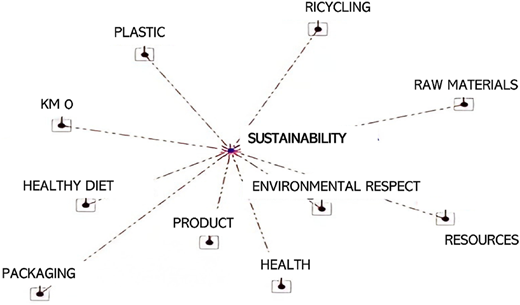
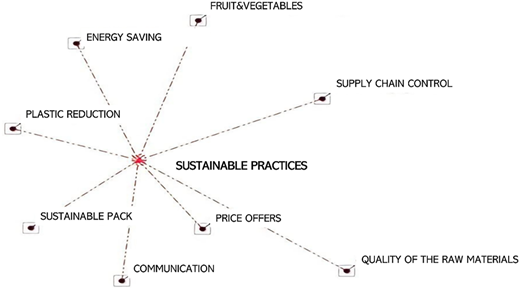
Focus groups participants in the first part of the research were asked to discuss the concept of “sustainability”, “sustainable food product”, “sustainable strategies” develop by grocery retailers and the main meanings and words associated to it. In order to analyze the data, the “word association” tool of T-Lab has been used. Specifically, the software helps identifying the words that were associated most with the concepts analyzed selected on the basis of their meaning and number of times they occurred (Papaleo et al., 2013). The software presents the significant correlations as radial diagrams with the word(s) selected at the center and all the others distributed around it at distances proportionate to their degree of association. Only the relations significant at a level of 0.05 were considered. Then, a qualitative analysis of the main results and the reporting of the transcripts of the discussion are presented.
4.1.1 The concept of sustainability
First, participants have been asked to think about the main concepts, words, meanings linked to their definition of “sustainability” as a general term. The aim was to understand what consumers think sustainability is and how is it possible to follow that principle. Figure 1 presents the output of T-Lab software and the significant associations.
Analysis revealed six broad themes: (1) environment, (2) packaging, (3) supply chain, (4) health, (5) product and (6) circular economy.
Considering the frequencies of the categories identified, the Environment category has been found to be predominant, with 73 instances, which constitutes 50.7% of the total. Packaging and Supply chain are equally represented, each with 16 instances (11.1%). This indicates a moderate focus on these areas, though not as prominent as the environmental dimension. The Health category follows closely with 15 instances, accounting for 10.4% of the overall data. The Product category is represented by 14 instances (9.7%), while the Circular economy category has the smallest share with 10 instances (6.9%).
Participants associate the concept of sustainability to the environment and how to protect it, considering the potential damaging impact for future generations and animals. Some participants stated:
… When I think of sustainability, I envision respecting the consequences, having a low impact on the environment. Minimizing the impact on everything related to the environment, from the commercialization process to various aspects, from production to when it's placed on sale …
… Safeguarding, attention, health, environment, recycling, impact. Safeguarding applies not only to the environment but also to animals and even to human beings …
The environment, because it's the foremost concern we should be thinking about at this moment, especially for future generations. We haven't shown enough respect so far, and we've been too careless, thinking it was okay to do so”
The second theme cited deals with the package of the products, mostly made of plastic, seen as something that must be replaced in terms of materials used, reduced or eliminated.
… packaging, or rather, paper gives me the impression of something more sustainable and recyclable, as opposed to plastic which gives me the impression of something long-lasting, polluting, and not very sustainable …
In my opinion, packaging holds significance not only in terms of the raw material used but also in how it is packaged and presented to the consumer. Therefore, personally, I also pay attention to how a product is presented, rather than solely focusing on the product itself and its origin
The concept of sustainability does not occur only in the last step of the chain, that of the packaging and distributions of the products, but it involves all the steps, from the production to the consumption:
The concept of “kilometer zero,” which is essentially about the proximity of products or, in short, producing things close to where they are consumed. This is especially relevant in the realm of food consumption, considering the significant impact that transporting various goods and products has on the environment, all the way to the store shelves
I've chosen “reduction” as the primary concept … It's not sustainable to continue consuming goods, both food and products, at the current pace. This consumption pattern we're accustomed to isn't sustainable, and it's becoming increasingly evident. I've also included “CO2” in terms of the carbon dioxide emitted in the production of food and goods, as well as transportation
The concept of sustainability also seems linked to the one of health, following the binomial “good for the planet, good for me” and customers said:
These words came to my mind: natural, something simple, healthy, and not artificial. I've thought about this
… respect for the environment in a broader sense, coupled with dedication and education. I believe there should be more information about the concept of sustainability, especially as it relates to healthy eating …
The sixth topic is the product. When consumers think about sustainability they also think about how sustainable the product they consume are, given the understanding that being sustainable also implies buying sustainable products:
… respecting seasonality, especially in fruits and vegetables, or even paying attention to organic products that do not use insecticides
When shopping, it's important to first consider the origin; so, if possible, one should prioritize products from the local area, especially for meat, fruits, and vegetables – fresh products
Finally, sustainability can be pursed implementing the three Rs: re-use, re-cycle, re-duce:
So, for me, sustainability is about infinite replicability. In other words, a process is sustainable when it involves the use of energy and raw materials that are renewable and perfectly recyclable in theory. So, if the energy resources are renewable and the raw materials can be completely recycled, then the entire purchasing process and the production process are theoretically sustainable.
4.1.2 The concept of sustainable retailing strategy
Participants were asked to think about the sustainable strategies they would like to find inside their preferred store with the aim to enhance the quality of the environment. The main was to identify the main strategies that help shoppers to consider a store a sustainable one. Figure 2 presents the output of T-Lab software and the significant associations.
Customers cited as sustainable strategies developed by retailers: (1) packaging, (2) supply chain traceability, (3) sustainable communication, (4) fruit and vegetables, (5) price of sustainable products and (6) energy saving.
Considering the frequencies, the Packaging category emerges as the most prominent, with 30 occurrences accounting for 35.3% of the total dataset, the Traceability of the chain category registers 18 occurrences, equating to 21.2% of the overall data. Both Communication and Product category are tied, each with 13 occurrences, which represent 15.3% of the total. In contrast, the Price category is noted with eight occurrences, or 9.4%, and Energy saving is the least frequent, with only three occurrences (3.5%).
Analyzing the three main associations, packaging is the first thing consumers cite when they think of sustainable practices, in terms of reduction and elimination:
… in the fruit and vegetable section, it would be better to avoid selling plastic-wrapped vegetables. It would be preferable to set this aside and choose to sell only loose products whenever possible
… recyclable packaging gives me a sense of thinking in the medium to long term. It makes me want to shop there …
Secondly, the concept of sustainability developed by retailers is wider than selling sustainable products. Customers also cite the commitment of the retailer in developing and adopting sustainable strategies all along the supply chain, considering the transportation, the logistic aspects and the production process of the process and the proximity of the store.
… energy savings, renewable sources, waste reduction. I also use local elements, such as the promotion of local products or suppliers, organic and biodynamic options, and so on to assess the sustainability of a store.
… I consider the origin and how many miles a product has traveled … so it's about the entire supply chain …
… the variety of sustainable products influences my choice of one store over another, as well as the decision to shop at a smaller, more local store …
Considering the communication, customers mentioned the importance of space management and products’ visibility in the identification of the preferred products. Specifically, the aggregation, the labels and the usage of signals have been identified as valuable ways to promote sustainable products inside the store:
… the arrangement of products within a supermarket should make it easier to find local products or items with specific certifications. Make them more visible and highlight them …
… or the communication of their sustainability through the use of color, such as the frequent association of green with sustainability
… for sustainability, I can think of indicating a sustainability path with colored stripes on the floor or stickers that signify a sort of sustainability route. Even a small initiative like this can make a difference in terms of capturing the consumer's attention …
… the signage appears to be very clear and visible, and I also notice the use of different colors for organic products, certainly to draw attention to those items
4.2 A comparison between consumers’ perceptions and desired sustainable strategies: results from second focus groups and stores check
Table 2 shows for each retailer (identified with a letter) the total number of levers managed by retailers according to the researchers over the total number of levers included in the analysis for each store; the number of levers seen by shoppers over the number of levers managed; the percentage of levers not mentioned by shoppers for the three dimensions considered (communication, space and assortment).
5. General discussion
To summarize the main results obtained and presented in the previous section, the concept of sustainability is closely related to the environment, packaging, supply chain, health, products and the circular economy. These same topics are mentioned when shoppers discuss what they expect from a supermarket to consider it sustainable. Key aspects include product packaging, product traceability and in-store communication, with a focus on visibility. Shoppers look for bulk products, reduced packaging and packaging made from sustainable materials. They also seek information on product origins, organic and fair-trade products and signage that helps them locate sustainable options.
When inside stores, shoppers exhibit varying levels of attention to these sustainability factors. With the exception of one store, all other analyzed stores manage more than 70% of the identified sustainability levers, demonstrating a strong commitment from retailers to provide sustainable options. However, not all retailers effectively communicate their sustainability efforts. In fact, in five out of nine stores, shoppers failed to recognize half of the sustainability strategies implemented, indicating challenges in execution.
The primary goal of this study was to identify the elements shoppers use to assess a store’s sustainability. We found that shoppers prioritize assortment (the presence of sustainable products with sustainable packaging) and efforts to enhance sustainability visibility through space management (aggregation and the use of colors). However, textual communication, such as signage, was mentioned less frequently. This can be explained by the role of visual cues. Products are tangible elements that are easier to perceive and more credible for consumers (Elg and Welinder, 2022) compared to in-store messaging. Meanwhile, colors and product aggregation enhance the visibility of sustainable items, making them effective indicators of a store’s sustainability. Research supports the fact that colors, along with easily processed information, are more effective than textual communication in influencing consumer attitudes and behaviors, as they attract attention and convey messages quickly (Yu and Zhou, 2018).
The limited impact of textual communication can also be attributed to the information overload shoppers experience when making purchasing decisions. Upon entering a store, consumers must evaluate and compare multiple factors such as price, ingredients, brand, size and claims. Adding sustainability-related information may contribute to cognitive overload, defined as “a state where the volume of information exceeds an individual’s information processing capacity” (Khaleel et al., 2020). While reducing information in a retail environment is not always feasible or desirable, given the need to balance simplicity and informed decision-making (Ketron et al., 2016), retailers must find ways to overcome information overload and draw customer attention to key sustainability messages.
Another possible explanation for the weak impact of textual communication is its ineffective and inadequate implementation by retailers. Communication is a powerful tool that could serve as a guide for shoppers in purchasing sustainable products. Retailers should provide relevant information alongside effective space management. Since shoppers appreciate color-based organization and signage, retailers could enhance their efforts by incorporating explanatory information on how to evaluate products, where to find them and how to choose the best sustainable options.
This study suggests the fact that retailers should leverage product visibility and credibility to further promote sustainability while integrating communication strategies that align with shoppers’ expectations and values. According to the Schema Theory, individuals process and perceive stimuli based on existing memories and cognitive schemas, while filtering out competing stimuli (Stead et al., 2021). Understanding which stimuli capture consumer attention provides insight into the attributes and features associated with a given concept or situation. When considering the concept of a “sustainable retailer”, this study attempts to identify the key attributes and levers shoppers associate with sustainability in retail. By asking participants to identify sustainable elements within a grocery environment, we can derive a general definition of a sustainable retailer:
A sustainable store is a store where shoppers can find sustainable products with sustainable packaging that are highly visible and promoted through aggregation and color identification.
Understanding what shoppers perceive as sustainable is the first step in comprehending this multifaceted phenomenon, identifying relevant schemas and enhancing business practices.
6. Conclusion and limitation
This research highlights the importance of understanding shoppers’ perceptions, associations and preferences regarding sustainability in grocery retail. It contributes to the existing literature on the gap between store image and store identity by analyzing in-store experiences. The insights were generated from real-world observations, as participants explored store environments firsthand. Consequently, the sustainability image of a retailer was shaped during the shopping experience.
Additionally, this study aims to understand the reasons behind the discrepancies between store image and store identity by focusing on in-store marketing levers. By doing so, we identify areas for improvement, uncover unrecognized efforts and determine which strategies are most effective in meeting customer expectations. Prior research recognizes the role of retail environments in influencing sustainability perceptions, yet there remains a need to evaluate the importance of different sustainability levers to guide investment in improving a retailer’s sustainability image.
By understanding the elements shoppers consider relevant in assessing a store’s sustainability, retailers can better align their sustainability initiatives with customer expectations, promoting more sustainable consumption patterns and advancing sustainability in the retail sector. This research serves as an initial step in exploring the alignment between intended sustainability image (company perspective) and perceived sustainability image (consumer perspective).
Differences between these two perspectives can arise due to consumers’ prior schemas (e.g. experiences, values, beliefs) and retailers’ ineffective communication strategies. Thus, examining sustainability perceptions from both company and consumer viewpoints is necessary to evaluate the effectiveness of corporate sustainability strategies. Furthermore, both practitioners and academics need to understand which in-store elements influence consumers’ assessment of a retailer’s sustainability.
Sustainability is a complex concept, particularly in the retail sector, where multiple factors shape the overall customer experience. While past studies have focused on specific variables (such as products and services), our research emphasizes the importance of considering all aspects, including communication and space management, both fundamental assets for retailers.
This study has some limitations. The findings are based on specific urban areas, and the sample size does not allow for generalization across the country. Additionally, the research focuses solely on the Italian market, particularly the northern region, where the distribution system is more advanced than in the south, making it easier to detect emerging trends. This limits the study’s applicability to other countries and retail sectors. Furthermore, while the study employs qualitative analysis, expanding the sample size would provide a more comprehensive understanding of the topic. Some limitations are related to the methodology used apart from the generalization of the results. One limitation of focus groups is the potential for socially acceptable opinions to dominate discussions, which may suppress alternative viewpoints. Additionally, some participants may exert greater influence over the conversation, affecting the balance of perspectives shared. For example, compared to quantitative studies or one-on-one interviews, the researcher or moderator has lesser control over the data generated.
Moreover, the group setting may discourage some individuals from sharing sensitive or personal information due to concerns about confidentiality. Lastly, focus groups do not guarantee full confidentiality or anonymity, as participants share insights in a group environment.
Further limitation is that we did not examine how the relationship between shoppers and retailers influences responses. Although participants were asked to identify their habitual stores to control for store familiarity, different stores may vary in their effectiveness at implementing sustainability practices. Consequently, participants’ observations may have been influenced by the retail mix rather than the relevance of specific sustainability practices.
Future research should incorporate quantitative analysis to statistically validate the findings and explore additional variables, such as the relationship between shoppers and retailers (e.g. visit frequency, familiarity with the store). Moreover, investigating variations in sustainable practices across retailers, such as communication strategies, tone of voice, assortment composition and color schemes could further explain differences in consumer responses and attention levels.
Additionally, unconscious insights could be gathered using neuroscientific tools in marketing research. Finally, analyzing how cognitive schemas develop and how new information from the retail environment is processed, accepted or integrated into existing schemas (Stead and Stead, 2008) would provide valuable contributions to the field.
Funding: This research has financially been supported by the Programme “FIL-Quota Incentivante” of the University of Parma and co-sponsored by Fondazione Cariparma.