This paper seeks to answer the question: What are the logistics implications when linear retail business models are complemented with circular ones? In particular, this research targets logistics implications perceived as critical for supporting circular business models (CBMs) that are economically viable.
The study adopts a multiple case study design involving seven Swedish retail companies operating a total of eleven CBMs, including second-hand sales, rentals and repair services. Empirical data were mainly collected through semi-structured interviews, and the analysis followed a Gioia-inspired approach informed by a narrative literature review on logistics implications that arise when retailers combine their forward and reverse logistics operations.
The study identifies 16 empirically grounded logistics implications across the four reverse logistics (RL) activities of collection, sorting, recovery and redistribution. The results reveal the coexistence of two overarching perspectives on logistics implications when combining forward and reverse logistics: an extension perspective emphasising challenges, and a design perspective highlighting various design areas for integration.
The study is limited to Swedish retailers. Further studies in other geographical contexts are suggested.
The research goes beyond the existing, often generic and conceptual literature on barriers to RL operations and provides a more granular view of the role of logistics in retail CBMs. By articulating complementary analytical perspectives, the study advances theory on the integration of forward and reverse logistics in a retail setting.
1. Introduction
In line with the broader societal shift towards a more sustainable retail industry, a crucial step is the adoption of circular economy (CE) practices. In recent years, a range of circular business models (CBMs), such as second-hand sales, rentals and repair services, have been implemented based on various R-principles such as reuse, repair, refurbishment, recycling and others (Lüdeke-Freund et al., 2019). Positioned closest to consumers within the supply chain, retailers are in a prime position to engage end consumers and, ultimately, to contribute to the transformation from linear to CE practices in society (Butt et al., 2024; Lin et al., 2022; Hedegård, 2024; Koers et al., 2024). However, to ensure the long-term expansion of a CE, a prerequisite for the scaling of CBMs is that they are economically viable. This has proven to be both challenging and complex, not least from a logistics perspective, where, for instance, issues related to small, unpredictable volumes and high costs per unit have been raised (Butt et al., 2024; Bressanelli et al., 2019; Silva and Nilsson, 2025; Hedegård et al., 2020; Nilsson and Hazen, 2025).
The logistics operations required for CBMs are often referred to as reverse logistics (RL) and have been well covered conceptually in prior research. However, to further accelerate the research field, there is a need to move beyond the conceptual level and investigate how RL is operationalised in different contexts (Butt et al., 2024; Zhuravleva and Aminoff, 2021). In line with this, and as motivation for this research, recent studies (Mishra et al., 2023; Nilsson and Hazen, 2025) have called for more research on RL in a retail setting – an area that remains underexplored (Koers et al., 2024).
A premise of this research is that logistics challenges regarding the introduction and scaling of CBMs become more salient for retailers with existing linear business models, where RL activities need to be harmonised with existing forward logistics operations. Whereas these are typically standardised and highly efficient, RL activities require a diverse set of additional activities (Hansen et al., 2018). Overall, the combination of forward and reverse logistics flows has been given little research attention in a retail context. Some scholars have noted the potential for sharing equipment, facilities and personnel between forward and reverse flows (Plaza-Ubeda et al., 2021; Hansen et al., 2018; Ghadge et al., 2016), but the logistics implications of doing so remain underexplored. Therefore, this research is guided by the overarching question: What are the logistics implications when linear retail business models are complemented with circular ones? In particular, this research targets logistics implications perceived as critical for enhancing CBMs that are economically viable. Economic viability is understood here as the capacity of a CBM to create and capture sufficient value to cover its costs and generate an acceptable (economic) return (Wu, 2025). It is considered to be a multidimensional, longer-term performance criterion rather than short-term product-level profitability (Darmian and Sgarbossa, 2026), and it may manifest at the level of individual product flows, specific CBMs or the firm as a whole.
Based on case studies of seven Swedish retail companies operating a total of eleven different CBMs, the study identifies sixteen empirically grounded logistics implications across the four RL activities of collection, sorting, recovery and redistribution. Rather than primarily focusing on barriers or challenges associated with RL in general terms, which have been widely discussed in previous research (Mishra et al., 2023; Mallick et al., 2023), this study targets the logistics implications that arise when retailers combine forward and reverse logistics operations. As such, the paper provides a more nuanced and empirically grounded understanding of how CBMs are operationalised alongside dominant linear logistics systems.
2. Reverse logistics in retail
2.1 Retail reverse logistics activities
RL can broadly be defined as “The process of planning, implementing and controlling the efficient, cost-effective flow of raw materials, in-process inventory, finished goods and related information from the point of consumption to the point of origin for the purpose of recapturing or creating value or proper disposal” (Rogers and Tibben-Lembke, 1999, p. 2). This study mainly targets RL related to different retail-oriented CBMs such as resale, rental and repair services. In this context, RL can be further described by the main activities of collection, sorting, recovery and redistribution (Plaza-Ubeda et al., 2021; Hedegård et al., 2020; Gatenholm et al., 2021).
Collection typically includes purchasing or acquisition of the consumer-used products, as well as initial transportation, handling and storing of the products, where the central logistics challenge is to balance cost efficiency against consumer convenience across collection modes such as store drop-offs, curbside bins and pick-up services (Fleischmann et al., 2000; Sandberg and Pal, 2024; Jäämaa and Kaipia, 2022). Sorting includes physical separation, inspection and grading of collected items, and determines the pathway for recovery – a step that must be optimised in tandem with collection to reduce total costs (Mallick et al., 2023; Tibben-Lembke and Rogers, 2002). Recovery covers a range of value-recapturing processes including reuse, repair and refurbishment. These processes require an appropriate logistics network of stores, warehouses and other facilities, and involve often multiple stakeholders such as logistics service providers (LSPs) (Mate et al., 2025; Leder et al., 2025). Redistribution directs recovered products to new markets and customers and includes the associated transportation and storage, with customer demand representing the critical moment that closes the reverse loop (Plaza-Ubeda et al., 2021; Hedegård, 2024; Fleischmann et al., 2000).
2.2 The combination of forward and reverse retail logistics
RL operations have mainly been analysed separately from forward supply chain practices, not least in a retail context (Butt et al., 2024). Where their combination has been addressed, two overarching perspectives can be identified: an extension perspective focusing on the logistics consequences when RL activities are added to a dominant linear supply chain, and an integration-oriented design perspective emphasising how forward and reverse flows can be deliberately designed and integrated.
2.2.1 The extension perspective
In addition, traditional modes of transport are optimised for forward flows and may not suit reverse “many-to-one” collection patterns (Butt et al., 2024; Tibben-Lembke and Rogers, 2002). Moreover, an extension of linear logistics places demands on new capabilities. For instance, sorting and recovery require new competences for product assessment and quality grading (Botticello, 2012) and new information systems for tracking individual items, such as digital product passports (Butt et al., 2024; Sonar et al., 2024).
Furthermore, CBMs and their underlying RL activities tend to be more costly per product than linear ones (Bernon et al., 2018), as both collection and redistribution involve smaller, irregular and often unique shipments that complicate economies of scale (Silva and Nilsson, 2025; Mallick et al., 2023; Hellström and Olsson, 2024). RL activities also tend to be performed closer to end consumers to increase the value added of products and services, which further limits scope for efficient handling (Nilsson and Hazen, 2025).
In addition, traditional modes of transport are optimised for forward flows and may not suit reverse “many-to-one” collection patterns Butt et al. (2024) Tibben-Lembke and Rogers (2002). Moreover, an extension of linear logistics places demands on new capabilities. For instance, sorting and recovery require new competences for product assessment and quality grading (Botticello, 2012) and new information systems for tracking individual items, such as digital product passports (Butt et al., 2024; Sonar et al., 2024).
2.2.2 The integration-oriented design perspective
A second perspective focuses on design areas for the integration of forward and reverse logistics flows. Rather than assuming that RL activities should simply be added to existing systems, a key question in this theme is instead how to design a combination of forward and reverse logistics flows. One such design area is the combination of last-mile deliveries with first-mile collection. Combining these can be challenging from a planning point of view but also rewarding due to improved asset utilisation and a reduction in transportation costs (Hellström and Olsson, 2024; Jäämaa and Kaipia, 2022; Butt et al., 2024; Nilsson and Hazen, 2025). Related to this, packaging solutions can be improved to support both forward and reverse logistics flows and thereby mitigate, for instance, food waste (Butt et al., 2024). For this, the packaging itself, but also surrounding practices and routines, may need to be redesigned (Nilsson and Hazen, 2025; Silva and Nilsson, 2025).
Facility location is another area where it is argued that the combined requirements and objectives for forward and reverse flows should be taken into consideration. For instance, Ghadge et al. (2016) proposed an optimisation model approach for the appropriate location of a distribution centre, taking into account the forward as well as reverse logistics flows in an online retail setting. Finally, the possibilities for shared logistics activities in the form of partnerships with LSPs are another design area suggested in the literature. LSPs are often viewed as enablers for improving forward and reverse flows simultaneously by aggregating and streamlining operations (Butt et al., 2024; Mate et al., 2025; Sonar et al., 2024).
In conclusion, existing research offers valuable insights into challenges as well as design areas for integration but remains fragmented and is rarely empirically grounded (Butt et al., 2024; Nilsson and Hazen, 2025; Hansen et al., 2018; Bernon et al., 2018). The present study addresses this by empirically examining logistics implications across the four RL activities when linear retail business models are complemented with circular ones.
3. Methodology
This research has been inspired by a theory elaboration approach (Ketokivi and Choi, 2014), which seeks neither theory testing nor purely inductive theory generation, but instead refines, extends or contextualises theory through empirical data. The starting point and theoretical grounding of this research was presented in the previous chapter and is based on a narrative literature review (Snyder, 2019) conducted in two steps. First, the fragmented but emerging research on RL activities in a retail context was condensed and structured around the four RL activities of collection, sorting, recovery and redistribution (as proposed by other researchers in the area, e.g. Gatenholm et al., 2021). In a second step, literature specifically targeting the combination of forward and reverse logistics (in a retail context) was elaborated and organised into an extension perspective and an integration perspective, respectively. Close-to-practice logistics implications were thereafter identified in a multiple case study, mainly through interviews.
3.1 Case selection
An important criterion in the case selection process was that the case companies should operate strong and profitable linear business models that had been complemented with one or more CBMs. Another criterion was access to key informants directly involved in logistics operations related to CBMs. Variation among the case companies and their CBMs was sought to capture a broader set of logistics implications. Companies with different product categories, organisational scope and channel strategies (online vs. physical retailing) were therefore included. Seven companies operating a total of eleven CBMs were included. Given the theory elaboration approach and a theoretical sampling logic where analytical rather than statistical generalisation was sought (Eisenhardt and Graebner, 2007), this scope was deemed sufficient to provide depth and variation while approaching empirical saturation. An overview of the companies, their CBMs, and the empirical data sources is presented in Table 1.
3.2 Data collection
The primary data collection method was semi-structured interviews to access real-time reflections from individuals directly experiencing the phenomenon under investigation (Gioia et al., 2013). Potential first respondents at each company were identified in conjunction with the selection of case companies. Typically, these individuals held leading positions and had acted as the company's spokespersons in Swedish news, podcasts, or presentations at practitioner conferences. Snowball sampling was thereafter applied within cases to identify additional relevant informants. While the number of interviewees varied across companies (and collaboration partners) depending on organisational size and internal division of responsibilities, the emphasis was on capturing knowledgeable voices rather than reaching a large sample size. Overall, given that the case companies were mainly linear, the pool of relevant informants was limited.
In total, the interviews ranged between 56 and 89 min and were conducted during autumn 2024 and spring 2025. Interviews were held in a semi-structured format to allow structure (staying on topic) while at the same time allowing for adaptation of the questions depending on the respondent's background and expertise (Gioia et al., 2013). This allowed not only for testing or confirming theory, but also for questioning and challenging it, which is an important aspect of theory elaboration (Ketokivi and Choi, 2014). The main questions centred on two overarching themes: (1) the company's overall business strategy and the role of the CBMs, covering their organisation and the value created for the company (economic, environmental as well as social), and (2) the logistics activities and processes associated with the CBM(s), covering challenges and how the forward and reverse logistics practices were combined and influenced each other.
All interviews were recorded and later transcribed. In some cases, interviewees had participated in podcasts and newspaper articles where information about their CBMs could be found. This material helped to prepare the interviews and allowed for contextualisation and follow-up questions during the interviews, strengthening the validity and reliability of the research (Voss et al., 2002). In some cases, respondents were also able to provide secondary data such as internal presentations of their CBMs and information from company websites. Observations from store visits and facilities further added contextual depth. However, the main source for the analysis was the interviews themselves, and all logistics implications identified were addressed during the interviews.
3.3 Data analysis
The analysis was inspired by the “Gioia approach” (Gioia et al., 2013), a structured yet inductive method for qualitative coding that moves from informants' voices (first-order concepts) towards more abstract, theoretically informed themes. The narrative literature review of the four RL activities of collection, sorting, recovery and redistribution, along with the two theoretical perspectives on extension- and integration-oriented literature, also played a major role in the analysis, representing Gioia's “aggregate dimensions”.
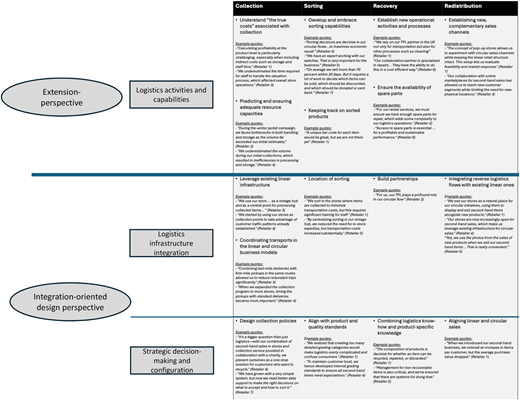
The analysis began with open coding of all interview transcripts. In total, about 130 different first-order concepts were derived from the interviews. In this research, the first-order concepts were considered to be a wide range of “indicators” of logistics implications when the linear logistics system is complemented with RL, including, e.g. challenges and organisational changes made to handle the RL flow. Thereafter, axial coding was applied to identify similarities between the different first-order concepts by comparing the various concepts to each other. In parallel with this, the theoretically informed perspectives and aggregated RL activities provided an overall structure for how to categorise the first-order concepts. Based on the literature review, the researchers here assumed the role of “knowledgeable agents” (Gioia et al., 2013) applying a pre-understanding of the investigated concepts. Furthermore, three empirically derived dimensions were identified as a layer between the perspectives and the individual implications: logistics activities and capabilities, logistics infrastructure integration, and strategic decision-making and configuration (see Table 2). These three dimensions emerged inductively during the axial coding stage, as recurring patterns through which the second-order themes naturally grouped and were subsequently used to structure the relationship between the perspectives and the individual implications.
The analysis aimed to construct the “data structure”, in which first-order concepts were aligned with the aggregate dimensions via the second-order themes as a means to ensure the chain of evidence between empirical data and research findings (Stuart et al., 2002). Quotations from the interviews were also identified to further highlight and exemplify the meaning of the various second-order themes. In the findings chapter, the second-order themes are presented in running text, organised into the four RL activities. To validate the findings, each respondent was sent a full draft of the manuscript and asked to comment on quotations attributed to them and on the correctness and relevance of the identified implications. No specific changes were proposed by the informants.
4. Findings
Sixteen logistics implications across collection, sorting, recovery and redistribution were identified in the study. As Table 2 shows, these have been organised into the overarching theoretical extension and integration perspectives that were elaborated in the previous chapter and are further expressed in three empirically derived dimensions. Whereas implications related to the extension perspective tend to revolve around activities and capabilities, the integration-oriented design perspective focuses on either logistics infrastructure elements or strategic decision-making and configuration aspects. In presenting the implications across the four RL activities below, references are made throughout to these underlying perspectives and dimensions, in order to clarify how each implication relates to the broader understanding of the combination of forward and reverse logistics flows.
4.1 Logistics implications in collection
In many of the cases where the introduced CBMs remain relatively small compared with the linear ones, costs associated with RL activities tend to be less well defined. An implication when introducing CBMs therefore becomes to understand “the true costs” associated with collection (and subsequent activities), i.e. to be able to identify and calculate all types of costs related to collection. This represents the focus on activities and capabilities present in the extension perspective, where the addition of reverse flows imposes new analytical and accounting requirements on the linear cost base. These costs include not only direct operational expenses, such as time spent by staff in stores or warehouses, but also indirect costs of offering customer incentives, such as vouchers or discounts used to encourage product returns. Respondents described challenges related to calculating profitability accurately at various levels, including the individual i.e. product category, and the entire CBM. In general, there is a risk of “hiding” CBM activities and their costs within costs associated with the linear business model.
Compared to forward logistics operations, RL flows are characterised by having more irregular volumes and varying quality (e.g. Tibben-Lembke and Rogers, 2002), making it difficult to create efficient and standardised processes for handling and transportation. Another implication therefore becomes predicting and ensuring adequate resource capacities to deal with collected products (also in subsequent activities of sorting, recovery and redistribution). For instance, one of the case companies encountered significant bottlenecks in handling and storage during a collection drive of used winter jackets where a specific voucher was offered.
A crucial point of departure for the introduction of CBMs in the case companies has been to leverage existing linear infrastructure as a means to minimise the additional operational burden and maximise efficiency in existing processes. This includes the use of existing IT systems and collaborations with LSPs as well as the use of physical stores (with linear offerings) as hubs for collection. According to several respondents, physical stores represent a relatively cost-efficient, yet consumer-convenient, collection mode, which means that they have increasingly become a key resource in the CBMs offered. From an online perspective, existing returns processes for new items play a similar role for efficient and effective collection of pre-owned items. As such, these examples illustrate the infrastructure integration dimension as shown in Table 2 above, and complement and refine previous areas discussed in literature such as facility location (Ghadge et al., 2016) and partnerships (Butt et al., 2024).
Transportation costs constitute a substantial component of RL costs, and several respondents therefore highlight the importance of coordinating transportation in the linear and circular business models as a means to reduce costs and enhance profitability. In particular, this becomes evident in a physical store context, where deliveries to the stores can be coordinated with first-mile pickups. While this approach reduces overall transportation costs, it also highlights logistics complexities, such as timing the readiness of collected products for pickup alongside forward linear deliveries. Coordination of transport flows is another infrastructure integration implication where reverse and forward operations share routing, capacity and timing within the same logistics network.
Another key implication related to collection concerns designing collection policies that ensure efficient operations and ultimately support the economic viability of CBMs. Such policies define the scope and conditions for collection, for example whether all stores or only selected locations should participate, and whether all products should be accepted or only specific categories such as the retailer's own brands or higher-value items. As highlighted by several respondents, these decisions are influenced not only by operational factors such as collection capacity or transportation costs, but also by strategic considerations related to customer value propositions. For instance, allowing all products to be returned at any store location may increase consumer convenience by offering a “one drop-off point” solution, but may also increase handling and transportation costs. Collection policies hence represent an example of strategic decision-making through which RL flows are deliberately aligned with existing forward logistics activities and resources, including store personnel, transport routes, and other elements of the linear logistics infrastructure.
4.2 Logistics implications in sorting
The collection of consumer-used, unique products means that retailers need to develop and embrace sorting capabilities, to cope with various new logistics handling processes such as quality checks, grading and pricing. Respondents across multiple case companies highlighted that accurate sorting decisions, such as determining whether an item can be resold, recycled or discarded, are crucial for maximising value extraction and that new knowledge among staff is required to make these decisions. This knowledge consists of both product knowledge (e.g. for pricing and judging whether a product is possible to repair or not) and logistics knowledge (for understanding the costs of various alternatives such as second-hand sales or repair). The development of sorting capabilities represents an example of the activity and capabilities dimension, where new types of capabilities must be added to the linear, forward logistics system (e.g. Botticello, 2012).
As consumer-used products may vary significantly in terms of quality, size and condition, it becomes vital to have a system capable of keeping track of sorted products. In line with recent RL literature on information systems and IT tools (e.g. Sonar et al., 2024), respondents stressed the need for systems that can display data on each individual item's condition – a capability that is not necessary in a linear business environment. Forward-looking respondents emphasised the necessity of investing in such systems to future-proof operations against evolving customer expectations and legislative demands, particularly regarding the ability to track product origin and composition.
There is also a need to decide on the location of sorting. Four of the case companies have experience with sorting in their local physical stores by store personnel. This local sorting is mainly due to second-hand sales taking place in the same store where collection has occurred, thereby offering a locally oriented CBM in which many transportation and handling costs can be minimised. However, as pointed out by one of the respondents, this process requires substantial staff training and incurs additional time costs, which can strain store resources. By contrast, centralised sorting – for instance, in a central warehouse or in a hub store – reduces the need for in-store expertise but increases transportation costs. Thus, the advantages as well as disadvantages of local sorting need to be taken into consideration. However, in line with an integration-oriented design perspective, many respondents reasoned that an even more decisive parameter for the location of sorting is the existing linear infrastructure (e.g. Ghadge et al., 2016), i.e. sorting needs to be integrated into existing physical stores, warehouses, IT systems etc. The location of sorting is thus both a strategic decision and an infrastructure integration question: where sorting takes place is constrained by – and must be optimised in tandem with – existing physical stores, warehouses and IT systems.
When sorting, another important matter is to align with product and quality standards for used products and materials. Although not regulated in Sweden, establishing consistent standards for judging and describing used products was considered by many respondents to be critical for meeting customer expectations within a specific retail sector. The main argument was that consistent standards for judging and describing used products make it possible to classify items in ways that correspond to customer expectations regarding quality and price, regardless of whether sorting takes place locally in stores or centrally in warehouses, and whether the products are sold online or in physical stores. This in turn facilitates consumer acceptance and improved inclusion of second-hand items alongside new products. Hence, product and quality standards become a key mechanism through which the original linear product assortment can be broadened with a parallel, consistent circular offering.
4.3 Logistics implications in recovery
The introduction of CBMs creates a need to establish new operational activities and processes dedicated to recovery (e.g. Tibben-Lembke and Rogers, 2002). In the case companies, a variety of new activities such as quality inspection, testing, repair operations, and cleaning have therefore been introduced in conjunction with the CBMs. These activities may occur in stores, warehouses or dedicated recovery facilities, and they often require new process interfaces between logistics operations and IT systems to keep track of the products (Butt et al., 2024). As such, these activities are representative of the activities and capabilities dimension under the extension perspective, where new operational steps and complexity are added to the already established forward flows.
Another extension-oriented logistics implication becomes to ensure the availability of spare parts. This is a prerequisite for many recovery processes that underscore CBMs such as repair and rental services. Unlike linear business models, these CBMs require retailers to maintain an inventory of components and materials to support recovery activities. As pointed out by one of the retailers offering rental services for ski equipment, this means a need not only to source the right parts but also to coordinate their availability across multiple rental locations.
Another implication concerns the need to build partnerships to enhance recovery activities. Repair companies, refurbishment specialists and LSPs often play key roles in enabling recovery processes, offering retailers specialised capabilities, facilities and equipment that are not typically available within the retailers' forward logistics operations (Butt et al., 2024; Mate et al., 2025). A particularly important partner in the recovery processes for the case companies and their CBMs is often the LSPs already involved in the forward logistics operations. When developing CBMs, it is therefore important to understand the RL capabilities of existing LSPs and how these can be aligned with their forward logistics operations.
Finally, recovery processes require combining logistics know-how and product-specific knowledge. Respondents emphasised that decisions regarding recovery processes depend heavily on product characteristics such as longevity, modularity and material traceability. However, beyond assessing what is technically feasible from a product perspective, retailers must also consider the economic and environmental feasibility of recovery from a logistics perspective. This implication illustrates the strategic decision-making dimension of the integrated design perspective: recovery decisions are not merely technical product choices but also logistics design choices that determine how reverse flows reconnect with existing forward infrastructures and market channels.
4.4 Logistics implications in redistribution
Redistribution of consumer-used products may be enhanced by establishing new, complementary sales channels. For example, although not controlling them, the retailers in this study acknowledged the role of marketplaces with consumer-to-consumer sales business models as catalysts for increased awareness and acceptance of second-hand sales in general. In the Swedish context, the trend of pop-up stores for second-hand items has also been tested by two of the retailers. According to these retailers, this sales channel represents a promising complement to ordinary stores, offering a new opportunity to increase second-hand sales. However, the establishment of such channels may also introduce a range of new logistics challenges and operational activities related to, for instance, temporary store setups, inventory allocation and product handling, often with less potential for enhancing scale and predictability (Hansen et al., 2018). From an extension perspective, these activities can hence be understood as challenges associated with expanding existing logistics systems beyond their original linear design.
Although examples of new sales channels were identified in the case companies (such as pop-up stores), respondents highlighted the importance of integrating reverse logistics flows with existing linear ones when redistributing products to new customers and markets. A key example here is the incorporation of used-product sales into existing physical retail stores. This approach minimises the need for additional investment while utilising established sales channels and customer traffic. The integration also presents opportunities to optimise workforce utilisation. For instance, by combining staff responsibilities across both linear and circular models, peaks in workload can be managed more effectively. This integration exemplifies the infrastructure integration dimension of the design perspective, where reverse flows are enhanced by leveraging the existing linear logistics base.
Redistribution activities also highlight the challenges of aligning linear and circular sales, as there may be a dependency between sales volumes (with subsequent consequences for logistics operations) in these two categories. One retailer pointed out that there is a risk of cannibalisation between the two categories, whereas several other respondents highlighted the potential for synergies, i.e. the purchase of a circular product may lead to additional purchases of linear, complementary products. In addition, more price-sensitive or sustainability-oriented new customer groups may be attracted when a linear product range is complemented with circular alternatives. Overall, from a logistics perspective, respondents highlighted that these interdependencies make it necessary to integrate planning of sales volumes and related capacities for linear and circular products.
5. Concluding discussion
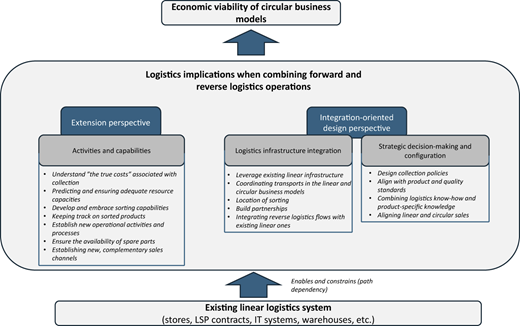
This study set out to examine what logistics implications arise when linear retail business models are complemented with circular ones, with a particular focus on implications that are critical for enhancing the economic viability of CBMs. Figure 1 below summarises the 16 logistics implications and their relationship to the existing linear logistics system and the economic viability of CBMs.
In line with the findings, Figure 1 illustrates that there is a path dependency in the development of RL practices, i.e. retailers' possibilities to introduce and scale CBMs and their underlying RL flows are shaped by the prior structure and processes in the dominant linear system. Established IT systems, warehouses, stores, LSP contracts etc. constitute enabling resources as well as structural constraints for RL practices. The logistics implications represent two overarching perspectives on the combination of forward and reverse logistics that were theoretically derived in this study. While the extension perspective captures how RL activities introduce additional requirements and complexity into existing linear systems, the integration-oriented design perspective highlights how retailers can align and configure RL flows within established linear infrastructures and organisational arrangements. Furthermore, three empirically derived dimensions, i.e. logistics activities and capabilities, logistics infrastructure integration and strategic decision-making and configuration, add an intermediate conceptual layer that clarifies what the development of a combination of forward and reverse logistics entails in practice. Rather than treating it as a single, generic task, the findings suggest that it boils down to three specific areas that need to be addressed: (1) managing and building the activities and capabilities required to handle the (additional) reverse flows, (2) managing integration efforts with respect to physical as well as digital infrastructure, and (3) making strategic choices regarding, e.g. the governance, scope and configuration of RL within the existing logistics system. Finally, above the logistics implications stands economic viability as the orienting outcome that the chosen combination of linear and reverse logistics ultimately aims at.
Despite an emerging interest in the topic, the combination of forward and reverse logistics has been described as under-researched (Hansen et al., 2018) and has rarely been examined empirically in a retail context (Bernon et al., 2018; Butt et al., 2024). Against this backdrop, this study contributes in two principal ways. First, the study refines existing knowledge on both challenges and design areas related to the combination of forward and reverse logistics. Previously identified barriers such as high costs and uncertainty (e.g. Mishra et al., 2023; Butt et al., 2024) have been unpacked into more concrete logistics implications, including the need to coordinate transport flows, manage capacity for irregular product inflows and develop item-level information systems for handling unique products. Similarly, prior discussions on design areas – such as the integration of first- and last-mile flows (Hellström and Olsson, 2024), facility location (Ghadge et al., 2016), and partnerships with LSPs (Mate et al., 2025) – have been further developed by identifying additional design areas of importance. These include the role of physical stores as key nodes for collection and redistribution, collection policies and product standards and the alignment of circular and linear sales volumes. Taken together, these insights contribute to a more granular understanding of how RL is operationalised when embedded in retail logistics systems.
Second, the study contributes by characterising the relationship between forward and reverse logistics as path-dependent. While Hansen et al. (2018) framed this relationship primarily as a design decision concerning the appropriate degree of combination, the findings here show that this decision is bounded by the prior structure of the linear system (e.g. stores, IT systems, warehouses, LSP contracts etc.) that the retailer has inherited. This characterisation responds to recent calls for better understanding of how linear supply chains can be restructured into circular ones (Nilsson and Hazen, 2025), and suggests that the appropriate combination of forward and reverse flows in any given retailer is not a free design choice but is shaped by the historical development of the linear system on which the combination must be built.
The findings offer two principal insights for retail and LSP practitioners. The first concerns the strategic role of existing (linear) logistics infrastructure. Physical stores, IT systems, warehouses and established LSP relationships frequently constitute key starting points for CBMs and serve as critical resources for integrating reverse flows with forward operations. At the same time, the cases highlight the importance of separating the costs of forward and reverse logistics activities. In several cases, RL costs were embedded within existing linear structures and therefore difficult to identify and manage. While this may seem unproblematic at low reverse volumes, costs that appear marginal today risk eroding profitability as CBMs scale, making cost visibility a precondition for longer-term economic viability. The second insight concerns the role of LSPs. The cases indicate that LSPs often play a central role not only in transportation and storage but also in value-adding activities such as repair, cleaning, sorting and component handling. For retailers, this implies a need to assess the circular capabilities of existing logistics partners. For LSPs, it represents an opportunity to expand their offerings into RL operations and underscores the broader importance of collaboration in establishing CBMs (Leder et al., 2025; Mate et al., 2025).
Several avenues for future research emerge from this study. First, as the findings are based on Swedish retailers operating in a context characterised by relatively advanced logistics infrastructures and strong sustainability awareness (Larsson, 2020), future studies could explore whether similar logistics implications arise in other geographical and institutional contexts. Second, further research could examine variations across product categories, retail formats and types of CBMs, such as resale, rental and repair services. Third, while this study provides a cross-sectional analysis, longitudinal studies could build on the proposed framework to explore how logistics implications evolve over time as circular initiatives mature and scale. Finally, this study did not assess the relative importance of the 16 logistics implications. Future research could therefore develop approaches for prioritising these implications, for example by analysing their impact on the economic viability and scalability of CBMs.
The author would like to thank The Swedish Retail and Wholesale Council for funding this research. The author would also like to thank Arne B. Andersson Elfvendahl, Senior E-commerce Advisor at Swedish Commerce, for many invaluable discussions and insightful reflections.