


To explore the cultural embeddedness of (un)welcome experiences among ethnically marginalized consumers in retail spaces.
Drawing on Arjun Appadurai's notion of the ethnoscape, the study is empirically grounded in critical-incident interviews with consumers from multiethnic backgrounds in Sweden.
Three dimensions through which (un)welcome is negotiated are identified: interpersonal recognition in service encounters, cultural resonance in visibility encounters and atmospheric conviviality in material–sensory encounters. The research theorizes the Retail Ethnoscape Framework, conceptualizing (un)welcome as interpersonal, representational and spatial zones of disjuncture between the retailer's official mind and the consumer's lived ethnoscape. The study introduces retail proprioception – a learned bodily attunement through which marginalized consumers detect these disjunctures – revealing the somatic origin of the inclusionary labor they perform.
The framework calls for culturally sensitive service scripts, strategic workforce diversity, and integrated inclusion design. For consumers, understanding retail proprioception enables more effective marketplace navigation, while societally, genuinely welcoming retail environments foster multiethnic engagement, well-being and social cohesion, advancing human-centric retail. The small Swedish sample limits generalizability.
The article advances retail welcome research by moving understandings of (un)welcome beyond discrete cues toward cultural embeddedness, extends atmospheric scholarship by demonstrating that environmental elements are perspectival constructs, reframes consumer vulnerability from a trait to a contextually activated state, and contributes to marketplace inclusion/exclusion scholarship by identifying retail proprioception as the embodied mechanism through which inclusionary labor falls disproportionately on marginalized consumers.
1. Introduction
Retail spaces are undergoing major changes driven by demographic shifts, new consumer expectations and socio-technical developments (Brusset and Kotzab, 2024; Risberg and Jafari, 2022). While retail environments increasingly serve consumers from a wide range of ethnic and cultural backgrounds, for whom inclusion and exclusion manifest in varied ways (Rosenbaum et al., 2017; Shahriar and Ulver, 2025), they are typically configured around dominant cultural norms (Ballantine et al., 2010; Boyd et al., 2020). For ethnically marginalized consumers in particular, marketplace interactions are often conditioned by vulnerability, inequality (Saatcioglu and Corus, 2016; Vilnai-Yavetz et al., 2024) and a history of racialized discrimination (Harris et al., 2005; Rosenbaum et al., 2012), which highlight the importance of understanding how they experience the (un)welcoming nature of these spaces.
Scholars have described welcoming environments as places that ensure accessibility and inclusivity while enabling social interaction (Gallant et al., 2020; Plage et al., 2023), safeguard physical and emotional security to cultivate belonging (Arzate Quintanilla et al., 2026; Poljak et al., 2023) and feature architecturally open aesthetics that create comfort and warmth (Noble and Devlin, 2021; Snethen et al., 2021). However, within retail, only a few studies have explored welcome. For ethnically marginalized consumers, Rosenbaum (2005) describes welcoming environments as communicated through discrete ethnic symbols that function as approach/avoidance signals, while Rosenbaum and Montoya (2007) show that consumers assess welcome by gauging the ethnic composition of employees and customers and (non)verbal cues. Studying consumers with disabilities, Baker et al. (2007) identify situational factors whose interaction triggers feelings of inclusion or exclusion. These studies illustrate that marginalized consumers actively read environmental elements to determine whether a retail space accommodates them, but assume that environmental cues carry relatively stable meanings, such that the presence or absence of the “right” signals determines welcome. What remains unexplored is how their meanings shift across cultural contexts and consumer positions. To address this limitation, this study explores how (un)welcome in retail spaces is culturally embedded for ethnically marginalized consumers.
Drawing on Appadurai's (1990) concept of the ethnoscape, we conducted critical-incident interviews with ethnically marginalized consumers in Sweden. We identify three dimensions through which (un)welcome is negotiated: interpersonal recognition in service encounters, cultural resonance in visibility encounters and atmospheric conviviality in material–sensory encounters. Our analysis advances the Retail Ethnoscape Framework by conceptualizing (un)welcome as a structural negotiation of cultural disjuncture between the retailer's institutional logic and the consumer's lived ethnic reality and by introducing retail proprioception as the embodied mechanism through which consumers navigate it.
2. Conceptual background
2.1 (Un)Welcome in retail
Since retail scholarship on (un)welcome remains limited, we draw on adjacent research bodies – marketplace inclusion and exclusion, consumer vulnerability and marginalization, and retail atmospherics – to identify how retail environments come to feel (un)welcoming. Market inclusion encompasses commitments to diversity, equity, fairness and justice to expand participation and well-being (Arsel et al., 2022; Kipnis et al., 2021). However, retail has also functioned as a site of exclusion where racialized minorities are denied access, dignity or fair treatment, representing denials of market participation and consumer-citizenship (Saatcioglu and Corus, 2016; Shahriar and Ulver, 2025). Exclusion appears structurally and interactionally, through discriminatory encounters such as racial profiling (Harris et al., 2005; Sinha and Lu, 2019).
Retail spaces can perpetuate unwelcoming conditions through identity-based discrimination during marketplace interactions, including those based on gender/body, race/ethnicity, class/social status, age/disability and religion/cultural identity (Arsel et al., 2022; Bennett et al., 2016). This consumer vulnerability is often activated by design choices – environmental “irritants” and poor accessibility – that erect barriers for marginalized groups (Vilnai-Yavetz et al., 2024; Pantano et al., 2022), who can encounter colorism, racialized segregation, stigmatizing representations and majority backlash against minority-targeted inclusion (Francis and Robertson, 2021; Audrezet and Parguel, 2023).
Environmental design has long been shown to influence consumer behavior (Bitner, 1992; Kotler, 1973). Multisensory, atmospheric cues – lighting, music, temperature, scent and layout – shape shopping duration, spending and satisfaction (Ballantine et al., 2010; Szocs et al., 2023). Servicescape research expands this view to social, symbolic and natural dimensions and emphasizes co-created, affective experiences in which socio-material cues interact with consumer backgrounds and interpersonal encounters (Joy et al., 2023; Rosenbaum and Massiah, 2011). Contemporary understanding views atmospheres as spatio-temporally porous across the customer journey, carrying memories and anticipations beyond the store visit (Roggeveen et al., 2020; Steadman et al., 2021). The issue, then, is how consumer experiences of atmosphere shape feelings of (un)welcome, a question the literature on integrated design begins to address.
2.2 Constructing welcome through integrated design
Contemporary retail environments require material–sensory elements, interpersonal interactions and personalized atmospherics (Szocs et al., 2023) to construct welcoming experiences. Consumers can form attachments to stores through multiple affordances: sensory, symbolic and cerebral (Borghini et al., 2020). Inclusive design uses color, lighting, sound and scent as adjustable interfaces, and reduces burdens through accessible entries, fixtures, clear communication aids and supportive staff (Edwards et al., 2018; Vilnai-Yavetz et al., 2024).
Service encounters translate those conditions into lived experience. Attention, authenticity and competence elicit positive affect in retail encounters (Bäckström and Johansson, 2017; Price et al., 1995), while the display and perceived authenticity of emotional labor shape customer emotions through mimicry, contagion and feedback processes (Barger and Grandey, 2006; Hennig-Thurau et al., 2006). Poor service quality heightens scrutiny of other servicescape elements, while positive encounters reduce scrutiny and foster loyalty (Andreassen and Olsen, 2008; Bäckström and Johansson, 2006). The presence and conduct of other customers also matter, with perceived similarity and crowds shaping evaluations and comfort (Brocato et al., 2012; Söderlund, 2011).
Meaningful ethnic symbolic displays can also evoke recognition, comfort and inclusion, signaling value and respect to ethnically marginalized consumers (Rosenbaum, 2005). Everyday cultural markers and greeting practices convey regard for difference, while assortments that reflect local demographics strengthen a sense of belonging (Hillier, 2018). Design choices, service encounters and symbolic elements therefore together set the terms on which different bodies can feel at home (or not) in retail spaces.
Collectively, existing research indicates what signals welcome and demonstrates that these dimensions interact. What is missing, however, is an account of how the interpretation of these designs, services or symbols is culturally situated – feeling welcoming from one subject position and unwelcoming from another. Addressing this requires a culturally sensitive framework, which the next section outlines.
3. Theoretical framework
We draw on Appadurai's (1990) concept of the ethnoscape to theorize the cultural embeddedness of (un)welcome in retail. Appadurai (1990) identifies five dimensions of global cultural flow – ethnoscapes, mediascapes, technoscapes, finanscapes and ideoscapes – which constitute the shifting landscapes through which cultural material circulates. These are “deeply perspectival constructs, inflected by the historical, linguistic and political situatedness of different sorts of actors” (Appadurai, 1990, p. 296).
The ethnoscape refers to “the landscape of persons who constitute the shifting world in which we live: tourists, immigrants, refugees, exiles, guestworkers and other moving groups and persons” (Appadurai, 1990, p. 297). According to Appadurai (1990), scapes are perspectival in that the same setting is experienced differently depending on who is looking and where they stand. Different people sharing the same space therefore inhabit multiple “imagined worlds” constituted by historically situated imaginations that can contest the official, dominant institutional imagination. Appadurai (1990) also emphasizes deterritorialization – the displacement of populations from familiar cultural territories – which generates new forms of belonging and alienation. Disjunctures between scapes create new contexts for identification, aspiration and conflict.
We view retail environments as localized manifestations of the ethnoscape and define these as retail ethnoscapes: market spaces where diverse bodies circulate, encounter institutional structures and are variably positioned within or against the store's imagined norm. Within global interactions, the tension between cultural homogenization and heterogenization finds local expression in the disjuncture separating the “imagined world” constructed by the retailer from the lived reality of the individuals moving through that space. We adopt Appadurai's (1990) notion of the “official mind” – the institutional logic through which organizations manage ethnoscape fluidity – to describe the standardized policies, service scripts and imagined customers through which a store is organized.
4. Methodology
4.1 Research design
The study adopted an interpretive approach using the critical incident technique (CIT) (Flanagan, 1954) to examine how ethnically marginalized consumers experience (un)welcome in retail settings. Critical incidents represent “extreme behavior, either outstandingly effective or ineffective,” revealing the phenomenon more clearly than average incidents (Flanagan, 1954, p. 339). CIT is well-suited to capturing “the unique subjective and processual qualities of services” to illuminate understudied phenomena (Grove and Fisk, 1997, p. 67), including “welcome” (Baker et al., 2007). This design aligns with our aim to elicit concrete, consequential episodes that reveal how cues come to feel (un)welcoming.
4.2 Data collection
We conducted semi-structured interviews guided by CIT to elicit detailed recollections of meaningful (un)welcoming retail experiences (Baker et al., 2007; Gremler, 2004). Interviews focused on critical incidents and prompted contextual details (timing, location, format, purpose), familiarity with the store (new/established relationship), a detailed experiential account, contributing factors (people/space/product) and outcomes (e.g. revisits, word of mouth). This was followed by reflections on the retail environment, interactions and (un)welcoming more generally. A total of 18 interviews were conducted using Zoom and Google Meet (40–180 min), accommodating participants' geographic and demographic dispersion.
Sweden offers a relevant setting. A Nordic welfare state with progressive equality policies, it has experienced growing ethnic diversity through recent immigration and, like many other Western countries, presents tensions between egalitarian ideals and everyday marketplace experiences (Shahriar and Ulver, 2025). Ethical safeguards included informed consent, participant anonymity and secure data handling.
4.3 Sampling
Purposive sampling was used to recruit ethnically marginalized consumers in Sweden. Eligibility criteria included: (1) at least one parent born outside Western Europe, (2) ≥3 years in Sweden, (3) independent household shopping decision-makers, (4) aged 25–65 years and (5) fluency in Swedish or English. Recruitment was partially managed by an agency (Augur), which invited 3,000 panelists, of whom 131 responded and 13 were selected to ensure diversity across demographics and origins. The remaining participants were recruited through the first author's diasporic network and met the same eligibility criteria. We interviewed until we reached “theoretical saturation” (Kvale and Brinkmann, 2009), meaning that no new discursive categories emerged despite new interviews. This is a standard procedure in socioculturally oriented qualitative research, where cultural “thickness” (Geertz, 1973) is prioritized over quantitative generalizability (McCracken, 1988; Patton, 2002). We reached saturation after ten interviews but continued with additional interviews, which cohered with the emerging categories.
4.4 Data analysis
Data analysis followed CIT procedures and a three-step interpretive technique of sorting, reducing and arguing (Rennstam and Wästerfors, 2018). Interviews were transcribed verbatim and coded iteratively, beginning with distinguishing between ethnicity-related and general (un)welcoming experiences. Through constant juxtaposition, we organized incidents into emergent categories, pruned nongermane material and continually asked what each statement revealed about (un)welcome. Three thematic categories emerged, which we then situated within existing theoretical knowledge.
Trustworthiness was ensured through four criteria: credibility through CIT, pilot interviews and verbatim excerpts; transferability through purposive sampling, eligibility criteria, participant variation and theoretical saturation; dependability through transparent reporting of the interview procedure and analytic process; and confirmability through verbatim transcription, iterative comparison of incidents and grounding interpretations in participants' accounts.
5. Findings
Drawing on Appadurai's (1990) notion of ethnoscape as a shifting and perspectival landscape of people-in-motion, we conceptualize stores as retail ethnoscapes. Our analysis reveals that ethnically marginalized consumers navigate (un)welcome in this disjuncture through three interconnected dimensions – interpersonal recognition in service encounters, cultural resonance in visibility encounters and atmospheric conviviality in material–sensory encounters – along a continuum from welcoming to unwelcoming.
5.1 Interpersonal recognition in service encounters: from respectful acknowledgment to prejudicial conduct
Within the retail ethnoscape, face-to-face interactions are where (un)welcome is communicated through verbal and nonverbal performance. Here, the fluid ethnoscape meets the retailer's “official mind” (Appadurai, 1990), where welcome entails equal, competent and dignified treatment that confers acceptance and ease (Baker et al., 2007), whereas exclusion emerges when ethnicity becomes a cue for othering (Francis and Robertson, 2021).
5.1.1 Dignified encounters versus differential treatment
Welcoming service occurs when staff bridge the gap between the store's structure and the consumer's needs, expanding the retailer's “imagined world” (Appadurai, 1990). Such service begins with ordinary acknowledgment that signals belonging, elevating mood and fostering approach behavior (Price et al., 1995). As Hanna put it, “(…) a staff member who was (…) polite, greeted me. I felt important and acknowledged.” The simplicity of being seen anchors belonging and reduces vigilance (Arzate Quintanilla et al., 2026; Plage et al., 2023). Such basic courtesies demonstrate how authentic emotional displays shape positive in-store experiences (Bäckström and Johansson, 2006; Hennig-Thurau et al., 2006). Recognition deepens when attentiveness is paired with competence, as Ali's account illustrates: “They approached immediately and greeted me, personally asked how I was doing, (…) inquired a bit about my background, (…) conducted a good needs analysis [and] came up with a solution to my needs. (…) The service felt personal. It wasn't forced.” This personalization blends authenticity with skilled guidance to co-create an affective atmosphere in which the consumer's goals and identity are respected (Joy et al., 2023).
Conversely, differential treatment converts attention into exclusion. Javier's experience in a ski-shop illustrates this friction: “I had questions about the fit of the [ski] boots. (…) I got this feeling that the guy working there thought I was asking completely absurd things. (…) I have been to similar stores with my stepfather, who is Swedish. (…) They treat him as if he were an expert.” The contrast reveals how ethnic cues serve as proxies for presumed (in)competence (Price et al., 1995), enforcing an institutional norm that associates expertise with majority ethnicity. This condescension delegitimizes and relegates Javier to the periphery (Shahriar and Ulver, 2025). These micro-judgments generate “construals of rejection” and reproduce inequities through uneven information and respect (Francis and Robertson, 2021; Sinha and Lu, 2019), operating through tone, stance and the withholding of assistance.
To be welcoming, recognition must persist across transaction types, even post-purchase. As Kourosh notes: “(…) when you return items, (…) as a store, you still have to show the same interest in the customer.” Poor service at one touchpoint heightens scrutiny of other elements (Andreassen and Olsen, 2008). If staff interest collapses, negative affect bleeds into how the entire environment is interpreted, especially for consumers already accustomed to being second-guessed. What may register as a minor lapse for majority consumers becomes, for others, evidence that politeness was conditional.
5.1.2 Normalized presence versus racialized profiling
Participants described a dichotomy between acceptance as legitimate customers and suspicion rooted in racialized stereotypes, emblematic of racial profiling and spatial exclusion (Harris et al., 2005; Saatcioglu and Corus, 2016). Jasmina underscores the value of routine treatment: “Even though there are people who treat me differently or wrongly or strangely, there are also many who treat me just like any other person.” Such interactions allow consumers to move through the ethnoscape unmarked, communicating belonging without drawing attention to difference.
However, when the “official mind” views the ethnoscape with suspicion, ethnic marking triggers vulnerability. Three forms of profiling emerged: economic stereotyping tied to perceived purchasing power, linguistic prejudice rooted in assumed language deficiency and criminal suspicion manifesting as surveillance of potential theft. The most overt manifestation was Jasmina's experience with hijab-based discrimination: “I have been treated differently in a store because of my hijab. There have been instances where I have stood in line and observed how the staff treated customers before me. When it's my turn to pay, they become very curt in their tone and barely glance at me. They want to get rid of me.” This illustrates how everyday interactions reproduce inequalities through racial and religious signifiers (Audrezet and Parguel, 2023; Francis and Robertson, 2021). Such moments reveal the perspectival nature of the ethnoscape, where the same checkout interaction constitutes a routine transaction for some shoppers and a site of micro-deterritorialization for others.
5.1.3 Communicating belonging versus othering encounters
Communication practices – equality scripts, language use and staff diversity – serve as bridges across cultural disjuncture. Yasmin emphasizes professionalism: “(…) feel[ing] more welcome in a Swedish store (…) has to do with how professionally one can perform their job (…) [and] how they've learned to treat customers in the same way. (…) Speaking another language that I don't understand doesn't feel nice.” While equal treatment lowers vigilance, linguistic barriers often operate as a mechanism of othering (Kipnis et al., 2021), even when unintentional.
Leila highlights linguistic accommodation as recognition: “(…) when you're abroad, (…) you're like (…) ‘Are you Swedish? Our people!’ (…) Automatically, you feel a kind of belonging. (…) Spaniards who have learned Swedish (…) ‘You from Sweden? Thank you very much!’ (…) They've put in an effort and learned.” Such reciprocity eases the tension of cross-cultural encounters, creating a familiar, “homey” atmosphere through gestures of cultural attunement. Similarly, Ali notes that a diverse frontline “signals acceptance and anticipation of my presence, making me feel welcome.” When staff reflect the diversity of the ethnoscape, the store feels less like a fortress of the majority and more like a shared, fluid space that normalizes nondominant bodies and reduces vulnerability (Edwards et al., 2018; Rosenbaum, 2005). These communicative practices frame the retail ethnoscape interpretively, calibrating whether attention is read as care or control and shaping whether the atmosphere feels hospitable or guarded.
5.2 Cultural resonance in visibility encounters: from representational signals to symbolic erasure
This dimension explores how visual, product and spatial elements make the retail ethnoscape culturally recognizable. The mediascape constructs the imagined worlds through which consumers envision identities and understand who belongs. Cultural resonance is negotiated at multiple levels: surface imagery, assortments that fit diverse bodies and practices, and spatial flexibility.
5.2.1 Authentic representation versus performative diversity
Visual representation signals who is central to the retailer's narrative and can reinforce exclusion through the erasure of nondominant ethnic minorities (Audrezet and Parguel, 2023). Appadurai (1990) warns that global production can fabricate an illusion of consumer diversity that masks homogenizing logic. Ali detects this illusory diversity in retail imagery: “(…) what is being advertised is either people of European descent, light hair color, (…) eyes (…) or then it goes towards the black side. (…) Fine, fun with diversification, but (…) it feels like there's nothing between black and white, (…) like they are doing it just because they have to, (…) very few Middle Easterners.” The retailer's mediascape projects an imagined world that leaves little room between the poles it recognizes. Yet when representation is authentic, consumers notice. Ahona describes a mannequin display featuring a salwar kameez: “It wasn't like they stuck her in the corner, (…) [but] looked like how my mom would wear it, (…) they're not just doing it because they have to.” The fissure between performative and authentic inclusion (Shahriar and Ulver, 2025) intensifies exclusion (Kipnis et al., 2021), as the space is decorated with diversity while underlying choices about products, sizes and placement remain untouched.
5.2.2 Inclusionary design versus exclusionary defaults
Product assortment, sizing and merchandising – through physical placement and presentation that represent the retailer's imagined customer – are tangible manifestations of whether diverse consumer needs are accommodated. When defaults ignore cultural differences, they become exclusionary, prompting consumers to avoid the store (Yu and Rahman, 2018). Ali describes exclusion via physical variation: “Due to my origin, I have difficulty finding the right size, particularly (…) the length. (…) I understand that clothes are ordered (…) based on the country you're in and what the average height is. (…) But then it feels like you're still (…) not really, not unwelcome, but you're not accounted for as a customer category. (…) It has led me to steer clear of many stores.” Standard offerings that lack the range (Yu and Rahman, 2018) to accommodate bodily diversity enact a form of micro-deterritorialization (Appadurai, 1990), quietly placing the consumer's body outside the imagined customer norm and producing displacement without overt hostility.
For shoppers who choose modest dress for faith or personal reasons, standard assortments remain insensitive to their needs, as Jasmina notes: “I usually wear fully covering clothes, (…) long sleeves, (…) tunics. (…) [Here] most shirts are short-sleeved, (…) or cropped tops. (…) I've walked into stores where I absolutely haven't found anything (…) because I simply can't wear it out in public.” Here, the disjuncture is physical, as the mainstream portfolio renders her invisible, making it an exclusion by omission (Bennett et al., 2016). Spatial arrangements can soften or sharpen these boundaries. Javier emphasizes: “(…) if the items are displayed openly, allowing customers to touch, look at, and try them out, it feels welcoming, it feels like you are in someone's home.” Open, touch-friendly layouts invite exploration and engagement, easing the tension between the institutional space and the individual, reinforcing inclusive design (Edwards et al., 2018) through what is stocked, how it fits and how it is presented. Narrow defaults leave consumers with the sense that they are only contingently imagined.
5.2.3 Multicultural fluidity versus monocultural rigidity
Culturally specific products, music and décor can signal symbolic recognition and feelings of inclusion when integrated respectfully (Rosenbaum, 2005). However, signals alone do not guarantee welcome. Yasmin cautions: “If you go to stores that sell Iranian goods, (…) Persian music is played, (…) reminds me a lot of my childhood. (…) But I don't know if you feel welcome. (…) If it's messy (…) and if the staff are unfriendly, (…) it doesn't matter if it's a Swedish store or an Iranian store. I get the same irritation, (…) negative feeling.” Cultural signals work only when presentation standards match the promise, such as when ethnic products are displayed and stocked with the same care (Hillier, 2018; Rosenbaum, 2005; Szocs et al., 2023).
“Multicultural fluidity” emerges when diverse assortments are integrated with the same professional care as majority offerings. Bonolata describes her local supermarket: “They actually change[d] the kind of products that they bring, (…) green chilies, (…) focusing on the community, (…) it's nice, inclusive.” Here the store's official mind actively expanded to meet the lived ethnoscape of its community. Alternatively, “monocultural rigidity” occurs when ethnic products are present but not sustained with equivalent care, signaling that diverse needs remain peripheral. As Mustakim notes: “I would go into shops, and I wouldn't find a consistent assortment. (…) I wish this product was here because I saw it in another branch. (…) I cannot be the only person looking for this here.”
5.3 Atmospheric conviviality in material–sensory encounters: from relaxed freedom to coercive surveillance
This dimension captures how diverse bodies, often moving through retail space with heightened bodily awareness, encounter spatial, ambient and social elements that shape felt experience from comfortable autonomy to intrusive monitoring. Atmospheric conviviality refers to how bodily and sensory encounters with space, materiality and other people generate convivial welcome or anxiety-inducing unwelcome, drawing on the store as an affectual space (Miller, 2014) and the notion of convivial affective atmospheres (Rokka et al., 2023).
5.3.1 Environmental comfort versus spatial constraints
The physical layout sets routes, thresholds and rhythms through which bodies move. Aisha views order and cleanliness as respect and hospitality: “I believe that stores should be fresh and orderly. It shows respect for the customer. If I were to enter a store that is (…) chaotic or with boxes out and not tidied up, then it feels like they are not ready to have customers there.” By contrast, clutter, chaos and disorder communicate a lack of care and function as an “environmental irritant,” particularly for more vulnerable shoppers (Vilnai-Yavetz et al., 2024). Constraining spatial layouts convert curiosity into an urge to exit. Leila describes the anxiety of forced pathways: “Normal (…) have a certain store design and layout. (…) I can feel ‘Oh my God’ (…) you always find something interesting, but I always hurry out. (…) Those walkways they have are awful. There's no way out, you have to go through the entire store. I find that really annoying. (…) Let me out!” While such designs are common in manipulating affect and pace (Biehl-Missal and Saren, 2012), for consumers already hyper-aware of their positionality, these constraints feel like entrapment.
5.3.2 Autonomous attention versus invasive monitoring
The boundary between service and surveillance is where the power dynamics of the retail ethnoscape become most visible. Participants valued help but recoiled from invasive attention. Nima describes unease with overbearing staff: “It feels a bit intrusive, (…) almost like I can't say no afterward, (…) that the price isn't right. (…) It could be something that makes you feel a bit coerced because they're there.” This coercive presence turns assistance into pressure, constraining consumer agency and amplifying vulnerability (Vilnai-Yavetz et al., 2024). In contrast, autonomous attention – availability without imposition – enables spatial freedom. As Ananya observes: “They don't bother people, so we can go and pick up stuff that we want.” When staff presence respects this boundary and lets consumers navigate on their own, the atmosphere tips toward ease.
For ethnically marginalized consumers, staff proximity, shadowing or persistent attention are interpreted through histories of profiling. Maya describes being singled out: “They used to check whether I'm shoplifting or not. (…) There were other students doing the same, but they were never asked to show their bag.” The retail ethnoscape becomes a biopolitical space where bodies are targeted through logics of control over care (Miller, 2014).
5.3.3 Affective crowd versus contagious tension
The presence and conduct of other customers co-create atmospheres (Brocato et al., 2012). Beyond any single encounter, crowd composition, pace and emotional tenor shape how safety, dignity and ease are interpreted. Javier describes how homogeneous crowds produce contagious unwelcome: “When you entered (…) it was Swedish and bright. Then you got looks. In other places (…) the people are much darker. Then I also received looks (…) on both sides.” The collective gaze of the majority crowd acts as informal border control, exerting pressure on the minority individual. Preferences for similar others (Brocato et al., 2012; Söderlund, 2011) mean that visibly different shoppers may feel neither welcomed nor unobserved, prompting shorter visits. Sometimes the crowd's influence turns overt. Diego recounts: “When I tried to come [to the gym] for the first time, a man (…) talked about South Americans in a disrespectful way. (…) I just wanted to go there and exercise. (…) Most were nice, but they had a reactionary group. I had to put one man in his place and confront him.” Here, explicit hostility from other customers erupts into open conflict, as the retail space fails to contain the cultural tensions of the outside world, reducing willingness to linger.
Unwelcome can also be vicarious. Leila describes the mistreatment of other customers: “I've been in [a] restaurant, (…) [where] you hear people treating others poorly, (…) that can make you feel unwelcome even if it's not directly aimed at me. (…) I'm also an immigrant. (…) You can hear other customers thinking out loud, and yes, that can make you feel unwelcome.” Negative affect spreads via emotional contagion (Barger and Grandey, 2006), tainting the broader setting. Environmental stress, such as density, also proves contagious. Aisha observes: “If it were crowded (…) and a long queue, then I wouldn't feel welcomed. (…) Then you become just another person to push through.” Yasmin similarly notes that “the stress of fellow consumers can be contagious,” linking crowding and hurried conduct to impersonal, deindividuating atmospheres. Collective affect shapes individual perceptions of welcome (Joy et al., 2023), making the crowd a volatile design element that can tilt the setting toward convivial ease or exclusionary tension. Because atmospheres carry affective residue and project anticipations across visits (Steadman et al., 2021), tense episodes leave traces that narrow future exploration and heighten anticipatory vigilance.
Overall, the findings show how stores invite or deter consumers through the interplay of human conduct, representational symbols, assortments and layout, and the crowd's affective tone. Ethnically marginalized consumers parse these signals simultaneously within spatio-temporally porous experiences, where memories, anticipations and in-the-moment impressions compound, shifting atmospheres toward welcome or withdrawal.
6. Discussion
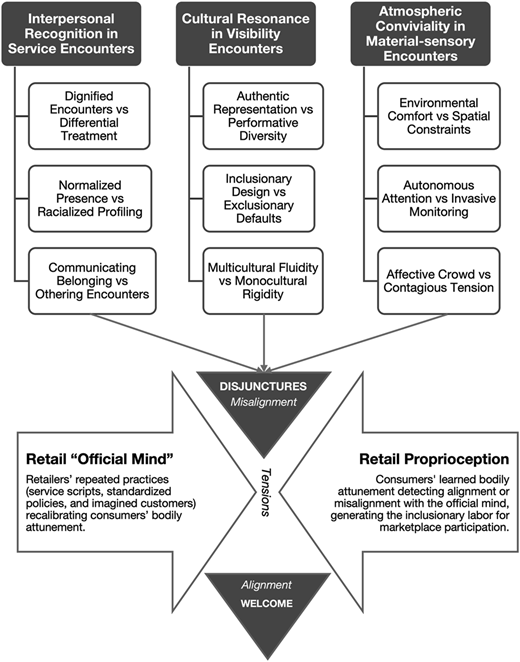
By exploring how (un)welcome in retail spaces is culturally embedded for ethnically marginalized consumers, we advance the Retail Ethnoscape Framework (Figure 1), which reconceptualizes (un)welcome as a negotiation of cultural disjuncture between the retailer's institutional logic and the consumer's lived ethnic reality. The framework illuminates the underlying tension that produces (un)welcome, the zones in which it materializes and the embodied mechanism through which consumers navigate it. Grounded in Appadurai's (1990) theory of cultural globalization, our framework should be readily transferable to empirical contexts beyond this study's Swedish setting.
6.1 (Un)Welcome as cultural disjuncture
We conceptualize (un)welcome as emerging from the tension between the retailer's “official mind” – its standardized procedures and imagined normative customer – and the consumer's lived ethnoscape, understood as the perspectival landscape consumers bring into the space, shaped by histories of displacement, cultural practice and marketplace negotiation (Appadurai, 1990). When these align, welcome is experienced as recognition and ease, and when they diverge, unwelcome manifests as friction, requiring consumers to negotiate visibility, justify presence or absorb differential treatment. These frictions accumulate across encounters, shaping expectations and dispositions toward future marketplace participation (Roggeveen et al., 2020; Steadman et al., 2021).
This reconceptualization shifts (un)welcome from discrete symbolic cues (Rosenbaum, 2005) and situational signals (Baker et al., 2007) to a culturally embedded relationship between the store's imagined world and consumers' lived realities, one that sediments differently across cultural positions and repeated encounters. While prior work highlights identity-space congruence (Rosenbaum and Montoya, 2007), we locate that congruence in the disjuncture between official retail logics and perspectival consumer experiences.
Atmospheric cues, service interactions and symbolic displays constitute the medium through which this disjuncture is experienced. Extending servicescape research (Bitner, 1992; Kotler, 1973) and its recognition of socially symbolic cues (Rosenbaum and Massiah, 2011) and hedonic effects (Ballantine et al., 2010), we show that atmospherics are culturally coded and perspectival, moving beyond assumptions of neutrality. Building on embodied accounts of retail experience (Biehl-Missal and Saren, 2012) and co-created atmospheres (Joy et al., 2023), we demonstrate that their interpretation is shaped not only by consumer expertise but also by ethnic positioning. This advances calls for personalized atmospherics (Szocs et al., 2023) by showing that personalization is effective only when attuned to consumers' cultural background.
6.2 Zones of disjuncture
The tension between the official mind and the lived ethnoscape materializes in three zones of disjuncture – interpersonal, representational and spatial – corresponding to personnel, assortment and layout (Bäckström and Johansson, 2006, 2017). First, interpersonal disjuncture arises when service encounters are shaped by suspicion or disregard, shifting the store from a space of hospitality to one of control (Miller, 2014). Whether through explicit condescension or subtle neglect (Sinha and Lu, 2019), the same behaviors may signal care or surveillance depending on the consumer's position (Francis and Robertson, 2021). Second, representational disjuncture emerges when symbolic claims of diversity are not matched by material realities. When imagery signals inclusion but assortment, sizing or merchandising reflect monocultural norms, the retailer's promise fractures, producing a fissure between mediascape and material ethnoscape (Appadurai, 1990). This expands research on inclusive product offerings (Yu and Rahman, 2018) by highlighting the consequences of misalignment. Third, spatial disjuncture occurs when layout and social texture constrain autonomy. Guided pathways can be experienced as restrictive, while the affective tone of co-present customers (Söderlund, 2011) can shift atmospheres from convivial (Rokka et al., 2023) to tense.
These zones interact and compound, as alignment in one can coexist with friction in another, rendering welcome and unwelcome co-present rather than mutually exclusive and reflecting simultaneous inclusion and exclusion of marginalized consumers in the marketplace (Shahriar and Ulver, 2025). Consequently, isolated interventions rarely resolve exclusion, as improvements in one domain may be offset by tensions in another. Addressing (un)welcome therefore requires coordinated attention to cultural-cognitive, normative and structural barriers (Kipnis et al., 2021) that can narrow these disjunctures.
Although inclusive design has limits, interpersonal conduct in face-to-face service encounters retains a unique capacity to bridge disjunctures. Acts of ordinary kindness can temporarily extend the retailer's imagined world to encompass the consumer, whereas highly automated formats may struggle to generate such experiences (Lu and Sinha, 2023). Designing for inclusion thus depends less on achieving a fixed state (Edwards et al., 2018) than on building the organizational capacity to continually align retail practices with diverse ethnoscapes.
6.3 Retail proprioception: embodied navigation of (un)welcome
To explain how consumers navigate these disjunctures, we introduce retail proprioception as an attunement through which consumers detect alignment or misalignment between the official mind and the lived ethnoscape, expanding accounts of retail as affectual and co-created spaces (Joy et al., 2023; Miller, 2014). This attunement operates largely pre-reflectively through the body's capacity to affect and be affected (Slaby, 2008). It manifests as somatic sensitivity to signs of inclusion and exclusion, comparative awareness of how others are treated and ongoing affective navigation under uncertainty, shaping well-being and participation (Rosenbaum et al., 2017).
Retail proprioception develops through accumulated experiences that become affectively contagious across consumers (Barger and Grandey, 2006; Hennig-Thurau et al., 2006), producing anticipatory orientations toward (un)welcome before store entry. This advances understanding of consumer vulnerability as situational and dynamic, challenging views of vulnerability as a trait inherent to people or place (Bennett et al., 2016; Vilnai-Yavetz et al., 2024). While prior work details how inequality and agency are negotiated (Saatcioglu and Corus, 2016), we show that vigilance subsides when environments offer alignment and intensifies when disjunctures emerge, requiring cognitive and affective labor (Shahriar and Ulver, 2025) that majority consumers do not experience. Such variation is shaped by personal biographies and life courses (Borghini et al., 2020), explaining why the same environment may feel restorative to some and depleting to others. Because such dispositions persist, exclusion can endure even after explicit barriers (Kipnis et al., 2021) are removed. Inclusive retail design must therefore rely on consistent, repeated practices (Boyd et al., 2020; Rosenbaum et al., 2017) that recalibrate embodied expectations over time.
Theoretically, retail proprioception grounds Appadurai's (1990) notion of deterritorialization in everyday market encounters. It captures how institutional norms can unsettle consumers' sense of belonging and how such disruptions are registered somatically before conscious interpretation. This embodied detection generates the ongoing “inclusionary labor” – a disproportionate burden placed on marginalized consumers – required to secure participation (Shahriar and Ulver, 2025), revealing its somatic origin before its discursive articulation, as each friction demands interpretation and response. Over time, these experiences sediment into heightened sensitivity, reinforcing the effort required to navigate retail spaces. The retail ethnoscape thus emerges as a culturally contested terrain in which (un)welcome is negotiated through embodied perception.
7. Conclusion
7.1 Practical implications
Consumers born outside the EU represent a substantial and diverse segment of the retail market, underscoring the need for culturally informed strategies. The Retail Ethnoscape Framework suggests that (un)welcome is shaped across interpersonal, representational and spatial dimensions, with implications for design and management. In service encounters, staff behavior is interpreted through accumulated experiences, making cultural sensitivity essential. Training should move beyond standardized scripts (Bäckström and Johansson, 2006, 2017) to address how interactions can register as attentiveness or surveillance (Bennett et al., 2016). Mystery shopping can be adapted to assess minority experiences and identify patterns of differential treatment.
Assortment and merchandising also carry symbolic weight. Including culturally meaningful products and aligning them with broader store offerings can signal recognition and foster loyalty (Yu and Rahman, 2018), while avoiding tokenistic displays (Rosenbaum, 2005). Through open layouts and inclusive design elements (Edwards et al., 2018; Vilnai-Yavetz et al., 2024), spatial design should support autonomy and reduce proprioceptive vigilance.
As retail becomes more automated, maintaining human interaction remains critical because interpersonal encounters are central to experiences of welcome (Lu and Sinha, 2023). Workforce diversity, ensured through staff who reflect the communities they serve, enables cultural understanding and communication. In digital channels, chatbot interactions, automated responses and algorithmic recommendations should be culturally sensitive and avoid defaulting to majority preferences. More broadly, retail spaces function as everyday sites where inclusion is enacted or undermined, pointing to a clear role for policymakers in addressing subtle forms of exclusion and promoting culturally inclusive environments.
7.2 Future research
Future research should examine how retail proprioception develops longitudinally across life stages and immigrant generations. An intersectional lens could further illuminate how ethnicity interacts with gender, class, age and ability in shaping experiences of (un)welcome. A particularly promising avenue is to explore how these dynamics unfold across cultural and institutional contexts, as well as in digital retail environments (Brusset and Kotzab, 2024; Risberg and Jafari, 2022), where automation, immersive reality and artificial intelligence can reproduce, intensify or disrupt existing patterns (Lu and Sinha, 2023; Pantano et al., 2022). Examining how the three zones of disjuncture operate across physical, digital and hybrid retail channels represents an especially pressing direction. Methodologically, combining ethnographic approaches from diverse contexts with real-time physiological or behavioral measures could deepen understanding of embodied retail experiences. As retail environments evolve, the Retail Ethnoscape Framework shows how sustained attunement to the diverse realities consumers bring into the space opens the way for human-centric and welcoming experiences for all.

