This study examines the role of organizational culture in driving circular economy (CE) practices within healthcare facilities, particularly in managing single-use medical devices. The research responds to rising healthcare waste challenges in developing countries and limited empirical evidence on how organizational culture converts CE education into practice.
A quantitative cross-sectional survey was conducted using structural equation modelling (SEM). The sample frame comprised healthcare professionals from teaching and non-teaching hospitals across three regions of Ghana (Ashanti, Western and Northern). Using purposive and convenience sampling, 125 questionnaires were distributed to facility heads, administrators, medical doctors and nurses, yielding 100 valid responses (80% response rate).
Organizational culture has a strong and statistically significant influence on CE practices (ß = 0.786, p < 0.001) and on the application of CE principles to single-use medical devices (ß = 0.703, p < 0.001). It also significantly mediates the relationship between CE education and CE practices (indirect ß = 0.189, p < 0.001). The model demonstrates high explanatory power, accounting for 83.3% (R2 = 0.833) of the variance in CE practices and 76.7% (R2 = 0.767) in CE application to single-use devices.
The findings extend institutional theory by evidencing culture as a key mechanism enabling CE adoption.
Healthcare managers should embed CE principles within organizational culture through leadership commitment, staff engagement and structured training.
The study provides robust empirical evidence from a developing country context that organizational culture is the central mechanism through which CE education translates into practice.
1. Introduction
The transition from a linear economy to a circular economy (CE) is increasingly recognized as essential for sustainable development. By prioritizing minimal resource consumption, material reuse, and environmental protection, CE provides a robust framework to balance sustainability with economic growth (Barboza, 2022; Bertassini, Ometto, & Gerolamo, 2021a, Bertassini, Machado, de Oliveira, & de Souza, 2021b; Chiappetta et al., 2020; Kazancoglu, Sagnak, & Kazancoglu, 2020; Sehnem, Vazquez-Brust, Pereira, & Campos, 2019). The core of CE lies in principles of restoration and regeneration, emphasizing the optimal use of biological and technical materials to achieve economic and environmental benefits (Ellen MacArthur Foundation, 2015). However, the transition requires not only technological innovation but also significant changes in organizational culture (OC), which is critical for fostering sustainable practices (Kwarteng, Simpson, & Agyenim-Boateng, 2022; Khan & Haleem, 2021; Sehnem, Ndubisi, Preschlak, Bernardy, & Santos Junior, 2020).
The healthcare sector presents a unique opportunity for the application of CE principles, as it is a major contributor to global waste production. Healthcare facilities produce substantial amounts of hazardous and non-hazardous waste, including single-use medical devices that pose environmental and public health risks (Harding, Opdebeeck, & Brems, 2021; Wyssusek, Keys, & van Zundert, 2019). The World Health Organization (WHO) estimates that 15% of hospital waste is hazardous, underscoring the need for effective waste management (Berthod, 2016). Despite the growing environmental footprint of healthcare, the integration of CE principles in this sector remains underexplored, especially in developing regions. As healthcare demands increase, there is an urgent need to incorporate CE practices into hospital operations, prompting a re-evaluation of business models and waste management systems (Borges et al., 2022).
Prior studies indicate that CE practices, such as reusing and regenerating medical devices and developing circular supply chains, can significantly enhance environmental performance, reduce costs, and foster innovation through waste reduction (Harding et al., 2021; Wyssusek et al., 2019). However, the success of these practices depends heavily on OC, which influences knowledge dissemination, policy implementation, and the behavioural changes needed for sustainability (Barboza, 2022; Bertassini et al., 2021a, b; dos Santos, Oliveira, & da Silva, 2024; Kwarteng, Agyenim-Boateng, & Simpson 2023). Despite the potential of CE, limited empirical research exists on how OC moderates CE Knowledge to influence CE practices in healthcare facilities, particularly in the context of developing countries like Ghana, where waste management challenges are acute.
To address this gap, this study investigates the role of OC and its moderating effect on CE Knowledge in influencing circular economy practices of healthcare facilities in Ghana. Using institutional theory as a base, the research examines how organizational norms, values, and systems facilitate or hinder the adoption of sustainable practices (DiMaggio & Powell, 1991; Scott & Scott, 2004). Specifically, the study focuses on how cultural dimensions, such as adaptability, mission-driven focus, and consistency, influence the integration of CE practices. It also explores CE applications in managing single-use medical devices through strategies like circular product design, innovative disposal methods, and stakeholder collaboration.
This research is motivated by the urgent need to address environmental and public health risks arising from inadequate healthcare waste management. It aims to uncover how OC and CE Knowledge can be leveraged to align organizational values with CE principles, engage employees, and promote educational initiatives for sustainability. Furthermore, it challenges existing assumptions about the limitations of CE in managing single-use medical devices, demonstrating how adaptive OC can drive sustainable solutions. Key research questions guiding the study include.
How does organizational culture influence the adoption of circular economy practices in healthcare facilities?
To what extent can circular economy principles be applied to single-use medical devices in the healthcare sector?
How does knowledge of circular economy principles among healthcare professionals impact circular economy practices?
The study's findings are expected to contribute significantly to the field. First, it will provide empirical evidence on the interplay between OC and CE practices in healthcare, highlighting the influence of cultural factors on sustainability outcomes. Second, it will propose actionable strategies to align OC with CE principles, thereby enhancing the sustainability of healthcare operations. Third, it will offer insights into applying CE principles to manage single-use medical devices, paving the way for innovative waste reduction in the healthcare industry.
The study is structured as follows: a literature review presenting theories and empirical findings related to OC and CE, a methodology section outlining the use of structural equation modelling (SEM) and data collection processes, and a results and discussion section detailing the relationship between OC and CE practices. The conclusion synthesizes key insights and identifies future research directions, particularly in the context of healthcare systems in developing regions.
2. Literature review
2.1 Theoretical framework
2.1.1 Institutional theory
Institutional theory explains how organizations conform to established norms, rules, and cultural expectations that shape their structures and behaviours (DiMaggio & Powell, 1991). It emphasizes that institutions operate within regulatory, normative, and cognitive frameworks that influence decision-making and organizational change (Scott & Scott, 2004). These frameworks define acceptable practices and foster legitimacy, guiding how organizations respond to societal pressures.
In the context of the circular economy (CE), institutional theory highlights how cultural and normative shifts are essential for integrating CE principles within organizational systems (Arranz & Arroyabe, 2023). Regulatory pressures, professional standards, and cognitive influences collectively drive organizations toward sustainable practices through institutional isomorphism—where entities adopt similar behaviours to gain legitimacy and meet stakeholder expectations (DiMaggio & Powell, 1991).
The theory underscores the importance of education and knowledge dissemination in transforming organizational values to support CE adoption (Coenen & Díaz López, 2010; Pitkänen, Karppinen, & Myllymaa, 2020). Cultural dimensions such as adaptability, involvement, and consistency enable healthcare institutions to transition from linear to circular resource models (Rondeau & Wagar, 1999; Scott, 2008). Educational initiatives also mitigate resistance to change, fostering shared beliefs that sustain CE practices (Strang & Sine, 2002).
Institutional theory thus provides a lens to understand how internal culture and external pressures jointly influence CE integration within healthcare organizations (Pitkänen et al., 2020).
2.1.2 Stakeholder theory
Stakeholder theory emphasizes that organizational success depends on the ability to create value for all stakeholders rather than solely maximizing shareholder wealth (Freeman, 1984). In the context of the circular economy (CE), this theory highlights the interdependence between businesses, employees, customers, suppliers, regulators, and communities in achieving sustainability goals (Freeman et al., 2020). The theory asserts that organizations must balance economic, environmental, and social objectives by integrating stakeholder expectations into decision-making processes (Donaldson & Preston, 1995).
CE adoption requires collaboration among multiple stakeholders to promote resource efficiency, innovation, and closed-loop production systems (Murray, Skene, & Haynes, 2017; Geissdoerfer, Savaget, Bocken, & Hultink, 2017). Effective engagement enhances transparency, legitimacy, and trust, which are critical for implementing CE strategies (Lacy & Rutqvist, 2020). In healthcare, stakeholders—including policymakers, hospital administrators, healthcare professionals, and patients—play essential roles in developing sustainable waste management and circular procurement systems (van der Velden, van den Berg, & de Jong, 2024).
Thus, stakeholder theory provides a foundation for understanding how shared interests and coordinated actions drive sustainable transformation. It reinforces the idea that long-term value creation in healthcare depends on aligning organizational objectives with the environmental and social well-being of all stakeholders (Freeman et al., 2020; Kirchherr, Reike, & Hekkert 2017).
2.1.3 Circular economy concepts and practices
The circular economy (CE) represents a transformative framework that addresses environmental challenges through sustainable production and consumption systems. Unlike the linear “take-make-dispose” model, CE emphasizes minimizing raw material use and energy consumption through reduction, reuse, recycling, and modularity (Scarpellini, Marín-Vinuesa, Aranda-Usón, & Portillo-Tarragona, 2020; den Hollander, Bakker, & Hultink, 2017). Its objectives—cost efficiency, conservation of natural resources, and environmental protection—are achieved through closed-loop systems that recycle and reuse materials while reducing consumption (Kazancoglu, Kazancoglu, & Sagnak 2018; Sauvé et al., 2016). CE also encourages innovative business models and design thinking that promote durability, reparability, and upgradability of products (Mellquist et al., 2022; Kunc et al., 2020).
Theoretically, CE is grounded in principles that eliminate waste, circulate products and materials, and regenerate natural systems (Ellen MacArthur Foundation, 2015). CE advances global sustainability by transforming resource management and fostering resilience (Geissdoerfer et al., 2017; Lacy & Rutqvist, 2020). It relies on renewable energy and materials to decouple economic growth from resource use (Murray et al., 2017). Key strategies include the “4 Rs”—Reduce, Reuse, Recycle, and Recover—supported by sharing, leasing, repairing, and remanufacturing models (Murray, Skene, & Haynes, 2015). While the 4R framework (Reduce, Reuse, Recycle, and Recover) remains the most widely recognized classification of circular economy (CE) strategies, contemporary scholarship has expanded this typology to include broader R-hierarchies. Kirchherr et al. (2017) observe that CE frameworks now incorporate three or more strategies, reflecting the evolution of sustainability thinking. Subsequent research extended the traditional 3R into 4R, 5R, 6R, and ultimately the 10R framework (Vass et al., 2023). The 10R model, systematically structured by Potting, Hekkert, Worrell, and Hanemaaijer (2017), groups CE strategies into three categories: (1) smarter product use and manufacture (Refuse, Rethink, Reduce), (2) extending product lifespan (Reuse, Repair, Refurbish, Remanufacture, Repurpose), and (3) material recovery (Recycle and Recover) (Mataraarachchi, Sasindri, & Nanayakkara Halloluwa Gamage, 2026). Notwithstanding this broader hierarchy, the present study adopts the 4R framework—Reduce, Reuse, Recycle, and Recover/Regenerate because it reflects operationally measurable and contextually feasible practices within Ghanaian healthcare facilities. Many higher-order strategies, such as remanufacturing or repurposing, require advanced reverse logistics and industrial systems that remain underdeveloped in the study context. Thus, the 4R framework is employed as a pragmatic and empirically observable subset of the broader 10R hierarchy, consistent with healthcare waste management realities and institutional constraints. In healthcare, CE promotes refurbishing, repairing, and reusing medical equipment, as well as adopting sustainable infrastructure such as renewable energy installations and therapeutic gardens (Health Care Without Harm, 2020; WHO, 2022).
Organizational culture (OC) and knowledge play critical roles in facilitating CE adoption. A “green culture” fosters recycling, waste segregation, and innovation (Martínez-Navalón, García, & Ruiz, 2024; Pal, 2021). Green Human Resource Management (GHRM) and knowledge dissemination build resilience and enhance CE implementation (Kimata & Itakura, 2021). Cultural integration helps overcome resistance and promotes compliance (Kazancoglu et al., 2020; Re, Cavicchi, & Giani, 2024).
In Ghana, CE practices are embedded in national healthcare waste guidelines that promote waste separation, recycling, and preventive strategies such as process optimization and material substitution (Ministry of Health and Ministry of Environment, Science, Technology and Innovation, 2020; Ghana Health Service, 2018). Operating rooms produce high infectious waste levels (Abanyie, Amuah, Douti, Amadu, & Bayorbor, 2021; Harding et al., 2021), emphasizing the need for targeted waste management and training. Consequently, aligning CE principles with organizational culture and regulatory frameworks enhances sustainability and environmental performance in Ghana's healthcare sector.
3. Hypothesis development
3.1 Effects of organizational culture on circular economy practices
Hofstede's (1983) dimensions of national culture, such as power distance and uncertainty avoidance, provide a lens to examine cultural barriers and enablers in CE transitions. For example, high power distance and strong uncertainty avoidance cultures often rely on rigid hierarchies and regulations, which may hinder the flexibility and innovation required for CE (Korhonen, Honkasalo, & Seppälä, 2018; Pal, 2021). Organizational culture plays a pivotal role in supporting CE adoption. Adaptive cultures focused on external threats and opportunities promote innovation and flexibility, while high-consistency cultures marked by internal stability may struggle to respond to environmental changes (Rondeau & Wagar, 1999). Circular economy demands cultural change and innovation across business ecosystems, aligning shared values of leaders, employees, partners, and consumers to drive acceptance of circular products and services (Ferreira et al., 2024). Similarly, Barboza (2022) emphasize the need to deeply understand and examine organizational values as a precursor to cultivating innovation and sustainable attitudes. Systemic changes across technological and cultural dimensions are required to achieve environmental, social, and economic benefits (Bertassini, Calache, Carpinetti, Ometto, & Gerolamo, 2022). Thus, Bertassini et al. (2021a, b) posit that OC is critical in supporting long-lasting circular economy (CE) changes by shaping mindsets and behaviours. They emphasize that the wrong culture can hinder CE strategy implementation. Dos Santos et al. (2024) advance this view in emphasizing that changes in organizational culture, supported by innovative practices, are integral to CE implementation. Moreover, organizational culture plays a fundamental role in supporting CE transition (Re et al., 2024). These practices not only influence business performance but also align shared values among stakeholders, shaping positive attitudes toward CE. Organizational culture helps in the implementation of corporate strategies, and since the implementation of the circular economy is a component of the corporate strategy, organizational culture therefore plays a major role in circular economy strategies (Choi, 2020). Internal integration issues are typified by the organizational culture's engagement and consistency characteristics (Kwarteng et al., 2023). Organizational culture, especially leadership commitment and cross-departmental collaboration, remains pivotal in overcoming resistance to new procurement models (van der Velden et al., 2024).
Organizational culture significantly influences the circular economy practice of health care facilities.
3.2 Application of circular economy practice to single-use medical devices
The application of circular economy (CE) practices to single-use medical devices is feasible through the adaptation of operational procedures and organizational culture. This hypothesis is based on the notion that with the right organizational conditions, such as adaptability and a culture focused on sustainability, healthcare facilities can implement processes for cleaning, reprocessing, and reusing single-use devices (Jeannell, 2017; Oturu et al., 2022). The findings from the study suggest that through institutionalized practices, such as rigorous decontamination protocols and employee training on sustainable waste management, CE principles can be applied to single-use devices, reducing waste and environmental impact (Abanyie et al., 2021). The expansion of reusable sterilization packaging is viewed as a promising prospect, given that numerous tools are being utilized in both single-use and sterilizable, reusable forms. Utilizing reusable devices should be the goal wherever feasible (Harding et al., 2021). Indeed, the decision to reuse single-use devices has been made by healthcare organizations all around the world. Developing nations provide arguably the best case for repurposing single-use electronics (Jeannell, 2017). Innovative approaches to reducing single-use plastics in hospitals include biodegradable alternatives and closed-loop recycling systems. Organizational culture, particularly openness to innovation and risk-taking, significantly influences the adoption of these alternatives (Chua, Tan, & Lim 2025). Based on the above viewpoints, our hypothesis is as follows.
Organizational Culture has an effect on the application of circular economy practices to single-use devices
3.3 How circular economy education influences circular economy practices
The knowledge and awareness of circular economy principles significantly influence their practical implementation within healthcare facilities. Adequate understanding of CE practices helps to overcome barriers such as resistance to change and lack of awareness among staff (Pitkänen et al., 2020; Govindan & Hasanagic, 2018). Research indicates that health facilities that invest in educational programs to disseminate knowledge about CE practices exhibit higher levels of adoption, particularly in areas like waste reduction and recycling (Kwarteng et al., 2023). By integrating knowledge about CE into regular training sessions, healthcare organizations can foster a culture that supports sustainable practices and ensures compliance with CE principles (Pitkänen et al., 2020). Knowledge gaps that must be filled for CE policies to be implemented successfully (Govindan & Hasanagic, 2018). Due to their lack of understanding of the CE, poor nations face a great obstacle in their efforts to transition to CE. (Chhimwal, Agrawal, & Kumar, 2022). Given that dental clinics alone can produce a sizable volume of potentially hazardous waste, awareness of biomedical waste management (BWM) is essential to reducing biohazards (Singh, Khan, & Dsilva, 2023). About half of healthcare professionals knew about healthcare waste management; as a result, fewer than half of them separated garbage at the point of generation (Odonkor & Mahami, 2020). Thus, awareness of Circular policies and practices should lay the foundation for the implementation of CE's strategies. Healthcare personnel's attitudes or lack of awareness represent one of the most significant barriers to operating room greening (Wyssusek et al., 2019). Training and participatory decision-making enhance the effectiveness of CE initiatives, reinforcing the moderating role of organizational culture (Martínez-Navalón et al., 2024).
OC mediates the effects of circular economy education on CE practices.
4. Methodology
4.1 Research design
The study employed a quantitative, cross-sectional research design using a structured questionnaire survey, analysed through Structural Equation Modelling (SEM). This approach enabled examination of complex relationships between organizational culture (OC), circular economy (CE) practices, and CE education. The study utilized a survey approach that incorporated a Likert-type survey and descriptive ranking to gauge the two primary constructs: organizational culture and circular economy.
4.2 Sampling and data collection
Health workers were selected from both teaching and non-teaching hospitals across three regions: Ashanti, Western, and Northern, with a total population of 189 according to Ghana Health Service (2018). Hospitals were prioritized over other healthcare facilities due to their relatively higher levels of healthcare waste generation (Abanyie et al., 2021; Harding et al., 2021). The three regions were purposively chosen for geographical representation: Northern Region (far north), Ashanti Region (central belt), and Western Region (southern zone). A convenience sampling approach was used to select 40 hospitals—two teaching and 38 non-teaching facilities. From these institutions, a purposive sample of 125 respondents was drawn, targeting facility heads, administrators, medical doctors, and nurses whose roles align with the study's objective of examining organizational culture and circular economy practices.
Data were collected using structured questionnaires adapted from prior studies (Geissdoerfer et al., 2017; Kwarteng et al., 2022; Rondeau & Wagar, 1999). Circular economy items assessed waste reduction and reuse practices, while organizational culture items captured rule orientation and adaptability. Responses were measured on a five-point Likert scale. Hospital selection was guided by datasets from the Ghana Open Data Initiative and the Ghana Hospitals website. After securing institutional consent and assuring confidentiality, 125 questionnaires were distributed, yielding 100 valid responses (80% response rate).
A final sample of 100 was considered adequate for Structural Equation Modelling (SEM), satisfying minimum sample size recommendations (Hair et al., 2019; Kline, 2015) and ensuring sufficient statistical power (0.80) to detect medium effect sizes at a 0.05 significance level.
4.3 Variable definition and measurement
The dependent variables are circular economy practices, organizational, and the application of Circular Economy to single-use devices. Table 1 shows variable definitions and measurements used. Measurement items were adapted from validated literature sources, reviewed by two academics and two medical practitioners, and pilot-tested with seven practitioners to ensure clarity and content relevance. CE practices and Organizational Culture were treated as latent constructs measured through multiple indicators, as shown in Tables 1 and 2. Items related to the circular economy, the dependent variable, were drawn from Kwarteng et al. (2022) and Geissdoerfer et al. (2017), while items addressing organizational culture, the independent variable, were adapted from Kwarteng et al. (2022) and Rondeau and Wagar (1999).
4.5 Confirmatory factor analysis (CFA)
This subsection provides an integrated assessment of the structural model's explanatory power, robustness, and hypothesis testing outcomes. The Structural Equation Model demonstrated strong explanatory capability.
Model fit indices: The CFA results indicated a good model fit, with indices such as Comparative Fit Index (CFI) and Tucker-Lewis Index (TLI) exceeding the recommended thresholds of 0.90, while Root Mean Square Error of Approximation (RMSEA) was below 0.08. This suggests that the proposed model adequately represents the data collected from the health professionals surveyed.
Factor loadings: Factor loadings ranged from 0.40 to 0.85, satisfying minimum loading criteria and confirming indicator reliability, indicating that the items used to measure organizational culture and circular economy practices are reliable indicators of their respective constructs. High loadings affirm the strength of the relationships between observed variables and their underlying factors.
Construct validity: Convergent validity was supported as Average Variance Extracted (AVE) values exceeded 0.50 across constructs. Discriminant validity was established using the Heterotrait–Monotrait (HTMT) ratio, which recorded a value of 0.76, below the conservative threshold of 0.85.
Collinearity: Multicollinearity diagnostics further confirmed model stability. Variance Inflation Factor (VIF) values ranged between 1.00 and 1.04, while tolerance levels ranged from 0.957 to 1.000, well within acceptable limits. These results indicate the absence of multicollinearity concerns and reinforce the structural integrity of the model.
0.957 and 1.000 as presented in the expanded Table 3 fall within accepted thresholds, indicating that multicollinearity does not pose a threat to the structural model.
4.4 Structural equation modelling
To achieve our research objectives and resolve many complex and multifaceted concepts, the study uses Structural Equation Modelling, a broad modelling framework that includes numerous multivariate methodologies. Instead of utilizing a multivariate regression model, it permits the estimation of a more intricate system of linkages and mediated effects (Rawashdeh, 2023).
Reliability and Validity: Prior to conducting SEM, it is essential that all prerequisites regarding reliability and validity are met. The study utilized structured questionnaires that were pre-tested for clarity and relevance, ensuring that the data collected accurately reflect the constructs being measured (Nunnally & Bernstein, 1994). The study assessed reliability through Cronbach's alpha (all >0.70), factor loadings (0.40–0.85), and convergent validity using AVE (>0.50). Discriminant validity was established through the HTMT ratio (0.76 < 0.85 threshold) as determined from the matrix of correlations in Appendix 1. Model fit indices (CFI and TLI >0.90; RMSEA <0.08) confirmed the adequacy of the measurement model. By confirming high internal consistency (Cronbach's alpha above 0.70), the reliability of the scales used was established. The study used a bootstrap mediation test to test indirect effects. This gives a more reliable test of mediation by generating confidence intervals for the indirect effect, where a confidence interval including zero (0) indicates no mediation.
To ensure that the latent variables are distinct and uncorrelated, the study refers to the heterotrait-monotrait ratio of correlations (HTMT) by Henseler et al. (2015) and is determined by the equation;
Where and are the constructs, circular economy, and organizational structure. This method is recommended as a more robust approach to assessing discriminant validity (Henseler et al., 2015) than the traditional methods.
Data Normality: SEM assumes multivariate normality; with a sample size of 100, normality assumptions were addressed using bootstrapping and robust estimation techniques, which are recommended when working with moderate sample sizes and potential deviations from multivariate normality (Muthén & Muthén, 2009). These techniques enhance the credibility of parameter estimates in SEM, even under non-normal conditions.
4.6 The path model and estimation technique
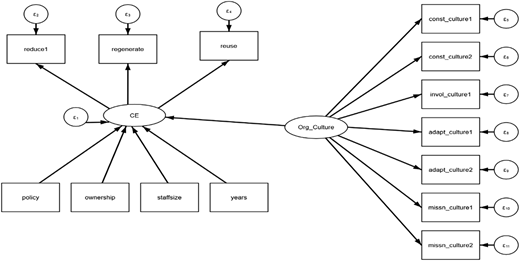
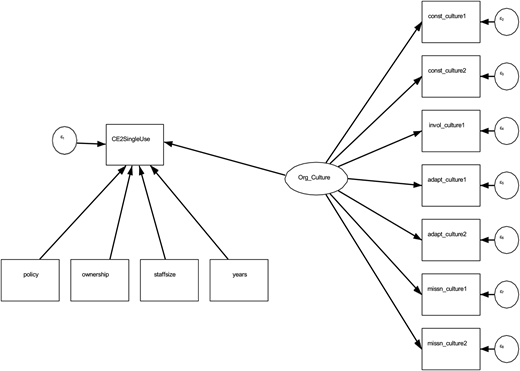
The study uses the Confirmatory Factor Analysis, which consists of observed variables that are hypothesized to measure one or more latent variables (Schumacker & Lomax, 2006). Hence, specify the measurement model as shown in Figures 1 and 2. The model postulates that organizational culture relates to documented rules of an organization, a non-discretionary policy concerned with tried and tested approaches, involvement of all staff in policy-making, the capacity to change in cases of external shocks, encouragement in the use of innovation, a client-centred system, and goal-driven performance measures.
The first model seeks to find if organizational culture affects the circular economy practices of the health facilities, while the second model considers these organizational culture effects on the possibility of applying circular economy practices to single-use items.
The measurement part of the SEM (the outer model) assesses how well the observed indicators represent their latent constructs. In this diagram, CE is a latent variable, measured by the indicators: Reduce, Regenerate, and Reuse. On the other hand, Org_Culture is also a latent variable, measured by indicators: consistency, involvement, adaptability, and mission.
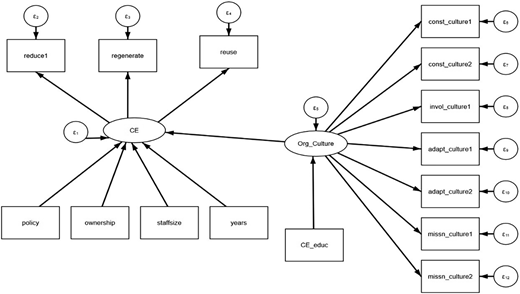
In the third model, as shown in Figure 3, we test the hypothesis that organizational culture mediates the effects of circular economy education on circular economy practices of health facilities.
The method for estimating the structural equation models used in this study is maximum likelihood (ML) under the assumption of multivariate normality. The stability of the model was equally ascertained. A model is considered stable if the reported estimates are said to yield a stable model when the stability index is less than 1.
5. Results and discussion
5.1 The measurement model
The measurement model demonstrated strong adequacy in terms of factor loadings, convergent validity, discriminant validity, and overall model robustness. Confirmatory Factor Analysis (CFA) validated the seven-factor structure of organizational culture documented rules, non-discretionary policies, staff involvement in decision-making, adaptability to external shocks, innovation encouragement, client-centred systems, and goal-driven performance measures. These dimensions align with the cultural typologies of consistency, involvement, adaptability, and mission culture as proposed by Rondeau and Wagar (1999). All constructs exhibited satisfactory factor loadings ranging from 0.40 to 0.85, exceeding the recommended minimum threshold as shown in Table 2.
The five circular economy practices—reducing waste, regeneration, reuse, recycling, and exchange also demonstrated strong associations within the measurement framework. Model fit indices confirmed robustness, with CFI and TLI values above 0.90 and RMSEA below 0.08, indicating good model fit. Convergent validity was established through Average Variance Extracted (AVE) values exceeding 0.50, while discriminant validity was supported by an HTMT ratio of 0.76, below the 0.85 threshold as determined from the matrix of correlation in Appendix 1 and presented in Table 2. Multicollinearity diagnostics showed no concerns (VIF = 1.00–1.04; tolerance = 0.957–1.000) as presented in Table 3.
5.2 Effect of organizational culture on circular economy practices
The structural model demonstrated strong explanatory power. Organizational culture accounted for 83.3% of the variance in circular economy (CE) practices (R2 = 0.833). The study results, therefore, confirm the significant positive impact of organizational culture on circular economy practices (β = 0.786, p < 0.01). The hypothesis testing results consistently reinforce the central role of organizational culture in advancing CE outcomes. H1 demonstrated that organizational culture significantly influences CE practices (β = 0.786, p < 0.001) and confirms the cultural dimension in the shift from linear model to circular economic model (Kwarteng et al., 2022; Khan & Haleem, 2021; Sehnem et al., 2020). Specifically, an adaptive culture enhances innovation and flexibility, which are critical for implementing CE principles effectively. This aligns with existing literature that highlights how cultural dimensions can either facilitate or hinder sustainability efforts (Korhonen et al., 2018; Pal, 2021). The study corroborates previous research by dos Santos et al. (2024), which argues that changes in OC are integral to successful CE implementation. Again, the relationship between organizational culture and the various methods (indicators) of circular economy, except recycling, was significant.
5.3 Effect of organizational culture on the application of the circular economy to single-use devices
Controlling for the facility's ownership type, staff size, years of operation, and the existence of documented policies, the results show that health workers believe that a good organizational culture can encourage the application of a circular economy on single-use devices. As indicated in Table 3, 76.7% of the variation in the application of CE principles to single-use medical devices was explained (R2 = 0.767). These results show significant factor loadings for organizational culture, as H2 confirmed that organizational culture significantly affects the application of CE principles to single-use medical devices (β = 0.703, p < 0.001). More specifically, organizations that have sustainability policies documented, the capacity to adapt to change, and involve all levels of staff are likely to have employees who understand the importance of reducing single-use devices. This implies that a modification of the cultural values of healthcare facilities from the current study, that single-use devices cannot be reused, can influence the reuse of single-use medical devices. Indeed, the decision to reuse single-use devices has been made by healthcare organizations all around the world. Utilizing reusable devices should be the goal wherever feasible (Harding et al., 2021). The application of CE principles to single-use medical devices is feasible when supported by an appropriate OC. This finding challenges assumptions about the limitations of CE in managing such devices, demonstrating that with a focus on sustainability and adaptability, healthcare facilities can effectively implement circular strategies (Bertassini et al., 2021a, b). Thus, the result shows the significant effect of organizational culture (standardized β = 0.703, unstandardized β = 0.349, p < 0.01) as shown in Table 3.
5.4 Results on the hypothesis that organizational culture mediates the effects of circular economy education on circular economy practices.
The study investigates the mediating role of organizational culture in circular economy education on circular economy practices. Table 3 provides evidence that CE education, operating indirectly through organizational culture, explained 30.2% of the variance in CE practices (R2 = 0.302), providing empirical support for the mediation structure proposed in the study. This confirms a significant indirect effect, indicating that CE Knowledge also improves CE practices through better organizational culture. Bootstrapping confirmed the mediation effect with 95% confidence interval [0.08, 0.31] not including zero. The indirect standardized effect of CE education on CE practices through organizational culture was β = 0.189 (p < 0.001), further reinforcing the strength and statistical significance of the mediation pathway. The confidence interval excluding zero confirms full statistical support for H3. The model equally shows significant indirect relationships between knowledge of circular economy and various types of circular economy practices: reducing waste (β = 0.187, p < 0.001), regeneration (β = 0.214, p < 0.001), and reuse (β = 0.213, p < 0.001) as detailed in Appendix 2. The results imply that a health facility would therefore require a good organizational culture to ensure that education on the circular economy is put into practice. This underscores the importance of fostering a strong organizational culture for effective educational initiatives on the circular economy. In effect, knowledge of circular economy policies, training, and education has a significant effect on the circular economy (Pitkänen et al., 2020; Govindan & Hasanagic, 2018). This finding supports the work of Kwarteng et al. (2022), who noted that educational initiatives are crucial for institutionalizing sustainable practices. The findings suggest that cultural norms within healthcare organizations significantly impact knowledge dissemination and behavioural changes necessary for sustainability (Coenen & Díaz López, 2010). By fostering a culture that values sustainability, healthcare facilities can enhance employee engagement and compliance with CE initiatives.
6. Conclusion
The study investigates whether organizational culture plays a role in the circular economy practices of healthcare facilities. This study has effectively addressed the critical points associated with integrating circular economy (CE) practices in healthcare facilities, particularly regarding the management of single-use medical devices. The investigation highlights that organizational culture (OC) significantly influences the adoption of CE principles, emphasizing the necessity for healthcare organizations to foster a culture that prioritizes sustainability and innovation. The findings reveal that an adaptive OC enhances the likelihood of successful CE implementation. By fostering an adaptive culture that encourages knowledge sharing and innovation, healthcare facilities can mitigate resistance and enhance employee engagement in sustainability initiatives. This aligns with previous research by dos Santos et al. (2024), which underscores the importance of cultural alignment with sustainability goals for effective CE implementation. The high R2 values reported (0.833 and 0.767) further demonstrate the strong predictive capability of organizational culture in explaining CE-related outcomes within healthcare facilities.
The results also show that knowledge of the circular economy indirectly affects circular economy practice through organizational culture. This finding supports the work of Kwarteng et al. (2022), who noted that educational initiatives are crucial for institutionalizing sustainable practices within healthcare settings and the assertion by Coenen and Díaz López (2010) that cultural norms within healthcare organizations significantly impact knowledge dissemination and behavioural changes necessary for sustainability. This underscores the importance of fostering a strong organizational culture for effective educational initiatives on the circular economy and confirms the finding by Pitkänen et al. (2020) and Govindan and Hasanagic (2018) that education has a significant effect on the circular economy.
Contrary to the view that the circular economy cannot be applied to single-use medical devices, our empirical results show that health professionals believe the circular economy model can be applied to single-use medical devices with an appropriate organizational culture. This result implies that organizational culture has a significant influence on the practice of the circular economy for single-use medical devices. The study proposes actionable solutions, including cultural transformation initiatives aimed at aligning OC with CE principles and developing targeted training programs to enhance staff understanding of CE practices. These strategies are crucial for overcoming barriers to adopting sustainable practices, as highlighted by Kwarteng et al. (2023), who emphasize the need for internal integration and cultural engagement in implementing corporate sustainability strategies.
7. Implications of the study
The implications of this study are particularly relevant to the medical industry. By highlighting the critical role of organizational culture in adopting CE practices, healthcare managers and policymakers are encouraged to prioritize cultural transformation initiatives. Specific implications include.
7.1 Managerial implications
The study finds that organizational culture (OC) is a critical enabler of successful CE practices in healthcare. Managers must prioritize the development and nurturing of a culture that values sustainability, adaptability, and innovation. Without such a culture, even well-designed CE initiatives may fail.
Knowledge of CE alone is insufficient; its impact on practice is only realized in the presence of a supportive OC. Managers should embed CE concepts into staff training programs and ongoing professional development. This will ensure that staff not only understand CE but are also empowered and motivated to implement CE practices.
The study highlights the mediating role of OC in translating CE knowledge into practice. Managers should ensure that internal policies, procedures, and reward systems reinforce CE objectives and are consistent with the desired culture. This includes integrating CE goals into performance appraisals and operational guidelines.
Leadership behaviours and values set the tone for organizational culture and influence staff attitudes towards CE. Senior management must visibly support and participate in CE initiatives, demonstrating commitment and aligning organizational values with sustainability goals.
The study emphasizes the need for collaboration among various stakeholders, including suppliers, regulatory bodies, and healthcare professionals. Establishing partnerships can facilitate knowledge sharing and resource pooling, leading to more effective implementation of CE practices in managing single-use medical devices.
Policy implications for single-use medical devices: The findings underscore the need for regulatory frameworks that encourage the adoption of CE principles in managing single-use medical devices. Policies should promote practices such as device reuse where safe and feasible, alongside stringent guidelines for recycling and disposal. This could involve incentivizing healthcare facilities that implement sustainable waste management practices or providing funding for innovative technologies that facilitate the recycling of medical devices.
Theoretical implications: The study reinforces institutional theory by illustrating how organizational culture influences the adoption of CE practices within healthcare settings. It highlights the significance of cultural dimensions such as adaptability and mission-driven focus in shaping organizational responses to sustainability challenges. It recognizes the cognitive elements of institutional theory and emphasizes the role of knowledge dissemination in promoting a CE mindset among healthcare professionals.
8. Scope, limitations, and future research
The scope of this study primarily focused on healthcare facilities in Ghana, with specific reference to single-use medical devices, which may not fully capture the complexities of CE practices in different cultural or regulatory contexts. Future research could explore the role of organizational culture in CE adoption across various countries with differing healthcare systems and waste management practices. Additionally, longitudinal studies could provide insights into how organizational culture evolves and its impact on the sustained implementation of CE practices.
The sample size of 100 health professionals, while sufficient for preliminary analysis, may limit the generalizability of the findings across the broader healthcare sector in Ghana. Future research could benefit from larger and more diverse samples that include various healthcare facilities and regions to enhance the robustness of the conclusions drawn.
The reliance on self-reported data may introduce bias, as respondents might provide socially desirable answers rather than their true perceptions or practices regarding circular economy (CE) principles. Future studies could incorporate observational methods or third-party assessments to validate self-reported data and provide a more accurate picture of CE practices.
I would like to acknowledge Dr. Vida Afarebea Agyen, who supported us in diverse ways throughout the process. We are very much grateful.
The supplementary material for this article can be found online.