The study aims to explore how micro-credentials can serve as a sustainable approach to teacher professional development across International Standard Classification of Education (ISCED) levels 1–4 (primary education, lower secondary, upper secondary and post-secondary non-tertiary education), with a particular focus on promoting sustainability in Latvia. It examines how short-term, skills-oriented learning pathways can support teachers’ continuous upskilling and contribute to building a more inclusive and resilient education system.
The research applies a systematic literature review to analyse international perspectives on integrating micro-credentials into teacher education frameworks that promote sustainability. In addition, a legal analysis is conducted to evaluate the current Latvian regulatory context, highlighting policy developments and institutional practices relevant to teacher professional development.
The findings indicate that micro-credentials provide a flexible, personalised and effective means of professional growth for teachers, allowing for rapid adaptation to evolving educational needs. They support the development of sustainability-oriented competencies, enhance resource efficiency and promote lifelong learning across educational levels.
The study focuses primarily on the Latvian context and may not fully capture the implementation challenges and best practices across other European countries. Future research could expand to comparative analyses or include empirical data from pilot initiatives to assess outcomes more comprehensively.
Policymakers and educational institutions can use the insights from this study to strengthen the governance infrastructure needed for micro-credentials to function as sustainability-oriented instruments, including the designation of a national body responsible for maintaining a coherent registry of micro-credential courseware, quality standards and authorised providers.
Integrating micro-credentials into teacher education can promote inclusivity and equity in access to professional learning opportunities, empowering educators to contribute more effectively to sustainable and future-oriented education.
This study provides one of the first comprehensive analyses of micro-credentials as a sustainability-driven approach to teacher professional development in Latvia, bridging policy, legal and pedagogical perspectives within the European Education Area.
1. Introduction
Micro-credentials are increasingly recognised as flexible learning instruments that enable targeted skill development and support lifelong learning in rapidly changing labour markets (Cheng et al., 2024). Academic literature suggests that micro-credentials can contribute broadly to social, economic and educational development (Tamoliune et al., 2023; Varadarajan et al., 2023). More specifically, they have been linked to SDG-oriented competency development (Blaj-Ward et al., 2023; Suryatmojo et al., 2023). In this context, micro-credentials are increasingly seen not merely as training tools but as governance instruments that support adaptive competence development and sustainability-oriented learning pathways (Kato et al., 2020; Oliver, 2019).
At the same time, the success of sustainability-oriented educational transformation depends strongly on educators’ capacity to implement innovative pedagogical practices (Guerra et al., 2024; Persson, 2023). Teachers play a key role in embedding education for sustainable development (ESD) principles into educational practice, which highlights the importance of continuous professional development. Micro-credentials have therefore been proposed as a flexible mechanism for updating pedagogical competencies and supporting teacher professional learning in rapidly evolving educational environments (Scott et al., 2024; Bartz and Kritsonis, 2019). In this study, sustainability is treated not as a generic contextual theme but as a competence-based and normative framework shaping the design, assessment and recognition of teacher professional development.
However, micro-credentials also present specific challenges that distinguish them from other educational innovations. Quality assurance remains a concern, as the proliferation of short learning offerings from diverse providers may lead to uneven standards and reduced credibility (Varadarajan et al., 2023; Oliver, 2019). Recognition and portability across institutions and employers are often limited, particularly where national qualification frameworks do not explicitly accommodate micro-credentials (Kato et al., 2020). There is also a risk of fragmentation, whereby an accumulation of isolated micro-credentials fails to produce coherent professional development pathways (Boud and De St Jorre, 2021). Furthermore, without clear governance arrangements, micro-credentials may reinforce existing inequalities by favouring digitally skilled or institutionally connected learners over those in under-resourced contexts (Clements et al., 2020).
In Latvia, micro-credential development remains at an early stage and has primarily focused on conceptual and regulatory groundwork. Initial analyses of existing regulations identified micro-credentials as an emerging policy priority involving higher education institutions, employers and policy experts (Līce, 2021; Ministry of Education and Science (Latvia), 2024). In 2024, this preparatory phase progressed to a national pilot initiative supporting the practical development of micro-credentials within the higher education system (Ministru kabinets, 2024). At the same time, teacher education and professional development across International Standard Classification of Education (ISCED) levels 1–4 operate within a highly regulated framework defining qualification routes, authorised providers, certification formats and mandatory professional development requirements (Ministru kabinets, 2018a; Ministru kabinets, 2021).
Although micro-credentials and sustainability-related learning initiatives are well established internationally, their systematic integration into regulated teacher professional development systems remains insufficiently explored in the literature. In regulated systems such as Latvia’s, the key challenge lies in the governance, design and interoperability of micro-credentials, namely, how short learning experiences can be recognised, quality-assured, made portable and aligned with national qualification requirements while remaining compatible with the European common approach to micro-credentials. Addressing these issues is essential to avoid fragmentation of teacher professional development pathways and to ensure that micro-credentials meaningfully support sustainability-oriented competencies.
Against this background, this study asks:
How can micro-credentials be implemented in teacher education for ISCED levels 1–4 in Latvia in alignment with the EU common approach?
The aim of the paper is to analyse how micro-credentials, as a sustainability-oriented teacher professional development instrument, can be integrated within regulated education systems. The study contributes a sustainability-anchored conceptual framing, an empirically grounded account of where Latvia’s teacher professional development regulations align with – and diverge from – the EU’s common approach to micro-credentials, and a synthesis of barriers and enabling conditions relevant for policymakers and teacher education providers.
2. Methodology
2.1 Research design
“This study adopts a qualitative research design combining a systematic literature review (SLR) with a legal-policy analysis.” The EU common approach to micro-credentials (Council of the European Union, 2022) is used as the analytical framework structuring both strands of analysis: the SLR synthesises how its governance, design and recognition elements are treated internationally, while the legal-policy analysis maps these same elements against Latvia’s regulatory system. This mixed approach is appropriate given the study’s objective to examine micro-credentials as a sustainability-oriented instrument for teacher professional development and to assess their alignment with regulatory frameworks governing ISCED levels 1–4 in Latvia. The SLR enables the synthesis of international academic perspectives on micro-credentials, sustainability and teacher professional development, while the legal–policy analysis provides context-specific insights into national governance conditions shaping implementation. Together, these methods allow for an integrated analysis that bridges conceptual, policy and practical dimensions. The analysis focuses primarily on in-service teacher professional development, reflecting where micro-credentials are most commonly applied in continuous professional learning; pre-service teacher education is not directly analysed, though the findings may have some relevance there.
2.2 Systematic literature review: search strategy and selection
The systematic literature review followed established principles of transparency, replicability and relevance. Searches were conducted in Scopus, Web of Science and ScienceDirect, complemented by targeted searches of peer-reviewed journals and institutional repositories relevant to education and sustainability research. The search strategy used combinations of keywords including “micro-credentials”, “microcredentials”, “teacher professional development”, “teacher education”, “adult education” and “sustainability”.
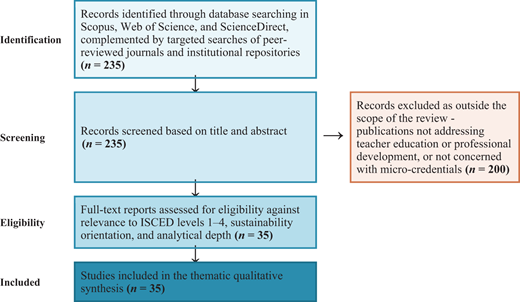
The temporal scope focused on publications from 2019 onwards, reflecting the rapid development of micro-credential frameworks in education policy and practice. Initial database searches yielded 235 publications addressing micro-credentials in relation to sustainability and lifelong learning. Following title and abstract screening, publications were refined to those explicitly addressing teacher education or professional development, resulting in a subset of 35 publications. After full-text screening based on relevance to ISCED levels 1–4, sustainability orientation and analytical depth, a core set of publications was retained for detailed analysis. The selection process is summarised in Figure 1, which shows the identification, screening, eligibility and inclusion of studies.
Inclusion criteria comprised peer-reviewed journal articles, scholarly book chapters and authoritative research reports addressing:
micro-credentials;
teacher education or professional development; and
sustainability or ESD.
Exclusion criteria included publications lacking analytical focus, studies unrelated to formal or non-formal teacher professional development, and sources addressing education levels outside the ISCED 1–4 scope.
The keywords listed were used exhaustively in various combinations to ensure comprehensive coverage of the relevant literature.
2.3 Data analysis and synthesis
The selected publications were analysed using thematic qualitative synthesis. Both authors independently reviewed the included sources, identifying recurring themes related to:
conceptualisations of micro-credentials;
sustainability-oriented competencies;
governance and quality assurance mechanisms; and
implications for teacher professional development.
Through iterative comparison and discussion, themes were refined and consolidated to ensure analytical consistency.
Rather than quantifying effect sizes or outcomes, the analysis focused on conceptual patterns, governance challenges and design principles, which are most relevant for understanding the systemic integration of micro-credentials in regulated education contexts. Bibliometric mapping using VOSviewer was used as a complementary analytical tool to visualise thematic clusters and research trends, supporting interpretation rather than serving as an independent analytical method.
2.4 Legal and policy analysis
To examine the Latvian context, a legal–policy analysis was conducted focusing on national laws, Cabinet of Ministers regulations and policy documents governing teacher education and professional development. Primary sources included legislation regulating teacher qualifications, continuous professional development requirements, recognition of learning outcomes and institutional responsibilities. Secondary sources, such as national policy reports and academic analyses, were used to contextualise legal provisions.
Legal interpretation followed established methods of grammatical, systematic, teleological and historical interpretation, enabling an assessment of how existing regulatory frameworks support or constrain the integration of micro-credentials. Particular attention was paid to the alignment between national regulations and the EU common approach to micro-credentials, especially regarding quality assurance, recognition, transparency and portability.
3. Literature review
Before proceeding with the analysis, the authors clarify the key concepts used throughout the paper (see Appendix 1 for full definitions). Micro-credentials are certified records of learning outcomes achieved through short, targeted learning experiences, which may be stackable or non-stackable and credit-bearing or non-credit-bearing, depending on their design and recognition arrangements (Council of the European Union, 2022). ISCED levels 1–4 refer to primary, lower secondary, upper secondary and post-secondary non-tertiary education, denoting the levels at which teachers in this study are qualified to teach. European Credit Transfer and Accumulation System (ECTS) is the standardised European system used to quantify learning workload, with one credit corresponding to approximately 25–30 h of learner effort. In teacher professional development, a sustainability-focused micro-credential on ESD pedagogy may function either as a stand-alone course contributing to required professional development hours or as a stackable, credit-bearing credential awarding ECTS credits and counting towards a larger qualification, such as a postgraduate certificate or master’s degree in education. This illustrates that the key issue is not course content but the governance and recognition arrangements that determine whether micro-credentials support coherent professional development pathways.
3.1 Global adoption and the EU’s approach to micro-credentials
Globally, the adoption of micro-credentials has accelerated, with universities and private providers offering short, targeted learning opportunities. Early initiatives emerged around 2013, often linked to digital badges and later to certificates issued through massive open online courses (MOOCs) (Oliver, 2019). The expansion of online learning during the COVID-19 pandemic further accelerated the development of such flexible learning formats (Līce, 2021; Aristovnik et al., 2020).
In response to evolving labour market and educational needs, the European Union introduced a common framework for micro-credentials. The Council Recommendation on a European approach to micro-credentials for lifelong learning and employability (Council of the European Union, 2022) aims to support flexible learning aligned with digital and green transitions. Micro-credentials certify learning outcomes from short learning experiences and include standard elements and design principles intended to ensure quality, recognition and portability across sectors and countries (Council of the European Union, 2022; European Commission, 2024).
3.2 Links between micro-credentials and sustainability
The contemporary understanding of sustainability builds on a long-standing body of scientific, economic and interdisciplinary scholarship. Early works such as Silent Spring (Carson, 1962) highlighted the ecological consequences of industrial development, while Diamond (2005) examined how societal resilience depends on interactions between environmental pressures, institutions and collective decision-making. Scientific contributions by Arrhenius (1896), who first quantified the greenhouse effect, and Keeling (1960), whose measurements documented rising atmospheric carbon dioxide levels, provided early empirical evidence of anthropogenic environmental change. These insights were later reinforced by economic analyses such as the Stern Review (Stern, 2007), which framed climate change as a systemic market failure with long-term societal implications. Together, these contributions established sustainability as an enduring and evidence-based societal challenge rather than a transient policy concern.
Building on this intellectual foundation, sustainability has progressively been integrated into education through the concept of ESD, which positions education as a key mechanism for addressing complex environmental, social and economic challenges (UNESCO, 2017). ESD emphasises the development of sustainability-oriented competencies such as systems thinking, critical reflection, anticipatory thinking, ethical reasoning and collaborative problem-solving (Rieckmann, 2012; Wiek et al., 2011). Scholars argue that sustainability education requires a shift from transmissive teaching towards transformative learning approaches that enable learners to question dominant paradigms and navigate uncertainty (Sterling, 2010). Within this framework, teachers play a central role in mediating sustainability knowledge and practices, making teacher education and professional development essential for embedding ESD across educational systems.
From this perspective, teacher professional development becomes a critical leverage point for advancing sustainability in education. Research indicates that the integration of sustainability into educational practice depends not only on curriculum reform but also on teachers’ professional agency, institutional support and access to continuous learning opportunities (Leal Filho et al., 2018). This creates a conceptual link between sustainability education and micro-credentials: when appropriately designed and governed, micro-credentials can support targeted and ongoing competence development aligned with ESD principles. However, without robust governance, quality assurance and recognition mechanisms, such initiatives risk contributing to fragmented professional development rather than to sustainable capacity building (Sterling and Orr, 2024).
At the policy level, sustainability in education has been reinforced through international frameworks, beginning with the United Nations Millennium Development Goals (United Nations, 2000) and later through the UN resolution Transforming Our World: the 2030 Agenda for Sustainable Development, including Goal 4 on ensuring inclusive and equitable quality education and promoting lifelong learning opportunities for all (United Nations, 2015).
As regards the scientific framework, the concept of sustainability in the context of education, including adult education, is widely discussed by scholars (see Jekabsone and Gudele, 2023; Dehtjare and Uzule, 2023; Gavinolla et al., 2022). Various aspects like accessibility, interdisciplinarity, lifelong learning, collaboration with stakeholders, green campus, diversity and inclusiveness are highlighted as the main characteristics of sustainable education.
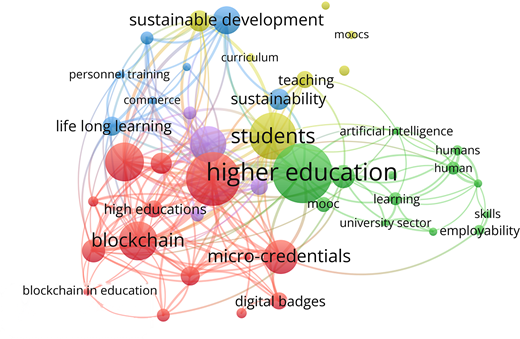
To analyse the concept of micro-credentials in the context of sustainability, the authors conducted a bibliometric review by using the tool VOSviewer (see Figure 2). The bibliometric mapping reveals several distinct thematic clusters, each represented by a different colour.
The largest cluster (green) centres on higher education and micro-credentials, linking terms such as employability, skills, learning, university sector and MOOCs. This cluster reflects the dominant research focus on how universities can use micro-credentials to enhance employability and bridge education with labour-market needs (Hunt et al., 2020; Boud and De St Jorre, 2021; Selvaratnam and Sankey, 2021; Ghasia et al., 2019). Artificial intelligence also appears within this cluster, indicating growing interest in technology-enhanced credentialing (McGreal and Olcott, 2022).
A second cluster (red) groups blockchain, lifelong learning, digital badges and commerce, reflecting research on digital infrastructure for credentialing. Blockchain and digital badges are discussed as enablers of transparent, portable and verifiable micro-credential systems (Hoyos and Kloos, 2023; Wolz et al., 2021; Grech et al., 2021; Clements et al., 2020), while lifelong learning is positioned as a broader policy objective that micro-credentials can support (Brown et al., 2021).
A third cluster (blue) centres on sustainable development and curriculum, appearing relatively separate from the micro-credentials node. This spatial distance in the map suggests that sustainability as a research theme has not yet been deeply integrated with micro-credential research, with publications in this area focusing primarily on curriculum design and MOOCs (Kiiskilä et al., 2022).
A fourth cluster (yellow) connects students, sustainability and teaching, representing research on pedagogical approaches to sustainability in education. However, this cluster shows limited direct links to micro-credentials, indicating that the pedagogical dimension of sustainability-oriented micro-credential design remains underexplored.
Notably, terms such as “teacher education” or “teacher professional development” are absent from the bibliometric map, confirming that the intersection of micro-credentials, sustainability and teacher education represents a significant research gap that this study aims to address.
The identified thematic clusters suggest that existing research addresses micro-credentials and sustainability across multiple domains, yet dedicated studies focusing specifically on teacher professional development in this intersection remain scarce, confirming the research gap addressed in this study.
3.3 Micro-credentials in teacher professional development
Existing research discusses the role of micro-credentials in teacher education mainly in addition to existing pre-service or in-service teacher training to complement the existing curriculum (Bal et al., 2022; Brauer et al., 2019). Research and practice on micro-credentials in teacher education focus particularly on providing innovative approaches to continuous professional development (Berry et al., 2016) drawing on online and hybrid learning methodologies (Brauer et al., 2019; Caetano et al., 2023), fostering technology-enhanced teaching and learning amongst educators (Clausen, 2022; Dennen et al., 2024) or catering for subjects related to computing or technology (Alcaraz-Dominguez and Barbera, 2024). It appears that the experience of COVID-19 has been a particular driving force in the development of such innovative learning content (Alcaraz-Dominguez and Barbera, 2024). Concerns raised include the influence of international organisations on defining the parameters of adequate teacher education (Aydarova, 2023).
Several international examples illustrate the practical application of micro-credentials in teacher education. In Finland, Brauer et al. (2019) describe an open badge-driven micro-credential model for vocational teacher education, where educators earn competence-based digital credentials through online and hybrid learning, fostering both pedagogical innovation and professional recognition. In Australia, Selvaratnam and Sankey (2021) document university-led micro-credential programmes designed to upskill educators in areas such as digital pedagogy and inclusive education, with a focus on flexible delivery and alignment with national teaching standards. In the USA, Berry et al. (2016) highlight a micro-credential framework for teacher professional development that emphasises competency-based assessment, enabling educators to demonstrate mastery of specific skills through evidence-based portfolios rather than seat-time requirements. These examples demonstrate the diversity of approaches internationally and provide relevant points of comparison for the Latvian context discussed in this study.
This lack of dedicated research confirms a clear gap: the intersection of micro-credentials, teacher professional development and sustainability remains underexplored.
3.4 Regulatory framework for teacher professional development ISCED 1–4 levels and its compliance to micro-credentials – case of Latvia
In Latvia, prospective teachers must possess a higher education degree in their chosen subject area and a recognised teaching qualification. This can be achieved through a variety of pathways, including a dedicated higher pedagogical education degree, a separate teacher qualification program undertaken after a subject-specific degree, a 72 h professional development program focused on pedagogy or the inclusion of specific modules or courses related to pedagogy (at least 2 credit points or 72 h) within the higher education degree program. Alternatively, a master’s/doctoral degree with research relevant to the teaching subject or completion of a 160-hour program leading to a teacher’s certificate in another subject can also fulfil the requirement (Ministru kabinets, 2018a). Specific requirements may vary according to the level of education (pre-school, primary, secondary, vocational) the individual intends to teach.
Furthermore, qualified teachers are obligated to engage in continuous professional development, accumulating at least 36 h of relevant activities within each three years. These activities encompass formal programmes (e.g. courses, workshops, professional development programmes focused on pedagogy), informal learning opportunities (e.g. conferences, internships) and participation in programmes like Erasmus+ (Ministru kabinets, 2018a). A minimum of six professional development hours must be dedicated to child rights protection.
Thus, four main short pedagogical training programmes can be identified in the Latvian teacher education system, which, in combination with fulfilling other requirements, can provide access to pedagogical practice or offer professional development opportunities as required by the regulation.
Firstly, the 72-hour pedagogical professional development programme: Developed by higher education institutions in cooperation with the Ministry of Education and Science, this programme provides foundational pedagogical knowledge and skills. It serves either as an entry pathway to the teaching profession or as professional development for practising teachers. Participants receive a certificate in areas such as pedagogy, special education, pre-school pedagogy and didactics, pedagogical career counselling or the right to implement a vocational education subject module.
Secondly, pedagogical modules within study programmes (minimum 2 credit points or 72 h): Pedagogical courses or modules embedded in broader study programmes allow students to acquire pedagogical competencies alongside their subject-specific studies.
Thirdly, additional subject teacher qualification programme (minimum 160 h): Designed for certified teachers wishing to teach an additional subject, this programme provides subject-specific content and didactics to expand existing teaching qualifications.
Fourthly, competence development programmes for teachers: These programmes offer continuing professional development for practising teachers across a range of topics and formats, including workshops, seminars, conferences, online courses and blended learning.
The authors conducted mapping that aims to provide an overview of the extent to which the credentials issued for completing existing short-learning program types comply with the European approach to micro-credentials, as defined by the Council Recommendation (Council of the European Union, 2022), including its mandatory and optional elements and general principles, based on legal analysis (Ministru kabinets, 2018a; Ministru kabinets, 2018b; Ministru kabinets, 2023; Līce, 2021; Saeima, 1995). The full compliance mapping is provided in Appendix 2.
All four short-term pedagogical programme types reviewed satisfy the core identification elements: learner identity, issuer identity and date and place of issuance. Compliance is markedly weaker, however, for elements linked to transparency and guidance. None of the four programme types currently embed structured information and guidance provisions for learners. Competence development programmes also lack a clearly defined title element. This pattern indicates that the existing regulatory basis for short pedagogical programmes is already substantively aligned with the European approach to micro-credentials, even though this alignment is not yet formalised. The main compliance gaps are concentrated in learner-facing transparency and guidance, rather than in the core credentialing mechanics.
The analysis further shows that short pedagogical training programmes in Latvia that provide access to the teaching profession or support professional development largely align with the concept of micro-credentials. These programmes are self-standing, labour-market oriented and offer flexible learning pathways that support upskilling and reskilling for educators. The certificates issued by higher education institutions or other authorised providers are formally recognised for teacher professional development. However, greater transparency would strengthen their alignment with the EU micro-credentials framework. In particular, indicating workload in ECTS, qualification levels and assessment methods would improve portability and international recognition. Authorisation of these providers currently rests on the general accreditation and licencing procedures set out in the Law on Higher Education Institutions and related Cabinet of Ministers regulations (Ministru kabinets, 2018a; Ministru kabinets, 2023), under the oversight of the Ministry of Education and Science. However, these procedures were not designed with micro-credentials specifically in mind, and it remains unclear which authority would be responsible for accrediting providers of micro-credentials as a distinct category, as opposed to formal degree or licenced CPD programmes more broadly.
4. Discussion
Recent work on sustainability implementation in university teacher education stresses that institutional and governance processes, not just individual course design, determine whether sustainability commitments translate into practice (Bowden and Kondratjuk, 2026). The findings presented here contribute to this perspective by examining the governance dimension in detail for one national teacher education system. The legal-policy mapping in Section 3.5 found that Latvia’s four main short pedagogical training programmes already satisfy the European approach’s core identification elements – learner identity, issuer identity and date and place of issuance – indicating that the underlying credentialing mechanics are substantively aligned with EU expectations. Compliance was markedly weaker, however, on transparency and guidance: none of the four programme types currently embed structured learner information or guidance provisions, and competence development programmes specifically lack a clearly defined title element. This pattern is not incidental but traceable to a specific regulatory mismatch: Latvia’s existing certification requirements (MK noteikumi Nr.110 and Nr.52) were designed to standardise what counts as a valid credential – who issued it, when and to whom – rather than to support the kind of learner-facing transparency and stackability that the EU’s 2022 Recommendation envisages. Because the Recommendation is soft law, it created no binding obligation to retrofit these older, harder-law instruments; Latvia’s programmes therefore satisfy the legal requirements that actually bind them while remaining silent on requirements that do not. This indicates that Latvia’s central challenge is not building micro-credential infrastructure from scratch, but closing specific governance gaps within a system that is already largely compatible with the European approach, and whose gaps stem from the non-binding status of the very framework it is now expected to align with.
This combination – strong identification elements alongside weaker transparency and guidance provisions – echoes findings from other national contexts, where Boud and De St Jorre (2021) similarly report that basic credentialing mechanics tend to mature faster than the transparency and guidance infrastructure needed to make credentials meaningful to learners and employers. The following sections examine these gaps as governance barriers and enabling conditions (Section 4.1), before turning to their system-level implications for micro-credential integration (Section 4.2).
4.1 Governance barriers and enabling conditions
The findings of this study highlight several governance-related factors that shape the implementation of sustainability-oriented micro-credentials in teacher professional development. Table 1 summarises the key barriers and enabling conditions identified through the systematic literature review and legal-policy analysis.
Table 1 shows that the main challenges are not related to the availability of sustainability-oriented learning content but to the governance and infrastructure required for micro-credential implementation, consistent with Oliver’s (2019) and Varadarajan et al. (2023) observation that infrastructural and governance gaps, rather than content scarcity, are the dominant constraint on micro-credential implementation internationally. In particular, limitations in transparency, assessment clarity, quality assurance, recognition mechanisms and digital portability constrain their role as trusted and interoperable elements of teacher professional development systems. At the same time, several enabling conditions exist, including the EU common approach to micro-credentials, established higher education quality assurance systems and ongoing national policy initiatives. These factors suggest that Latvia already has important institutional foundations for micro-credential integration, provided that governance frameworks are further clarified and aligned.
Regarding portability specifically, the authors propose that mapping Latvian courseware against EU-level standards would help demonstrate the extent to which the national system is already compatible with the European approach, rather than requiring parallel or duplicative structures. Such mapping would clarify which elements of existing Latvian regulations (e.g. ECTS-based workload descriptors, quality assurance procedures) already satisfy EU mandatory and optional elements, and which require targeted adaptation.
It is important to note, however, that resolving governance and transparency gaps does not by itself guarantee pedagogical quality. Gallagher and Tóth (2026) analysis of European sustainability-focused micro-credentials found that active learning approaches – which they link to the teaching of value-based, action-oriented sustainability competences – were present in fewer than half of the programmes examined, independent of how well those programmes were governed or documented. This concern is echoed by Trenks and Beecroft (2026), who found that transformative competency development in sustainability teaching requires deliberate pedagogical formats, such as real-world, experiential learning, rather than emerging automatically from well-structured programme documentation. Together, these findings suggest that governance clarity, the focus of the present study, is a necessary but not sufficient condition for sustainability-oriented micro-credentials to deliver genuinely transformative rather than purely instrumental learning outcomes. Pedagogical design therefore remains a distinct and equally important area for future attention, alongside the governance priorities discussed below.
4.2 System-level implications for micro-credential governance
Building on these findings, several governance priorities emerge for the next phase of micro-credential implementation in teacher professional development.
Firstly, in response to the quality assurance gaps identified above (Oliver, 2019; Varadarajan et al., 2023), quality assurance mechanisms must be made explicit for short learning programmes to ensure that sustainability-oriented micro-credentials are supported by transparent learning outcomes, assessment criteria and review procedures consistent with existing qualification frameworks.
Secondly, addressing the recognition inconsistencies noted by Boud and De St Jorre (2021) and Varadarajan et al. (2023), recognition frameworks should be clarified across providers and sectors to enable micro-credentials to carry a clear signalling value for teachers, employers and education authorities.
Thirdly, to overcome the infrastructural fragmentation described by Clements et al. (2020) and Wolz et al. (2021), portability mechanisms should be strengthened through standardised credential metadata and the gradual introduction of secure digital credentialing tools that support learner ownership and cross-institutional recognition.
Finally, to avoid the fragmentation risk associated with isolated, non-stackable credentials (Boud and De St Jorre, 2021), stackability pathways should be strategically designed in line with the EU’s stackable/credit-bearing design elements (Council of the European Union, 2022), so that selected micro-credentials can accumulate towards larger professional development pathways or formal qualifications, thereby contributing to long-term sustainability-oriented capacity building rather than fragmented short-term training. Recent empirical evidence from graduate teacher education supports this direction: Sovetkanova et al. (2026) report measurable competence gains and positive expert appraisal for stackable micro-credentials embedded within master’s-level teacher education pathways, though they caution that the portability of such models across institutional contexts still requires further evidence. This suggests that Latvia’s proposed stackability mechanism should be accompanied by longitudinal evaluation once implemented, rather than assumed to function as intended based on design alone.
These four priorities point to a common underlying requirement: a single, clearly designated body responsible for coordinating quality assurance, recognition and courseware standards across providers. Without such a body, the risk is not a shortage of sustainability-oriented learning content but an uncontrolled proliferation of micro-credentials issued under inconsistent standards, leading to duplication, learner confusion and an eventual loss of confidence in the credentials themselves (George et al., 2007). International experience with accrediting bodies for specialised short-course provision shows that a single oversight authority – responsible for maintaining standardised courseware descriptions, learning outcomes, evaluation criteria and prerequisite requirements, and for periodically reviewing and updating these as underlying knowledge evolves – is what allows short-form credentials to scale without sacrificing quality (George et al., 2007; George et al., 2019). For Latvia, the institutional foundations for such a body already exist. Under the Law on Vocational Education, professional continuing education and professional development programmes delivered at higher education level are licensed by the Academic Information Centre (AIC) (Saeima, 1999). In addition, the law’s transitional provisions require higher education institutions to notify the AIC of those professional continuing education and professional development programmes that they implement without additional licencing (Saeima, 1999). In practice, this notification takes the form of a registration procedure in which institutions submit standardised metadata covering learning outcomes, credit volume, qualification level, delivery mode, duration and the qualifications of responsible teaching staff, in exchange for a formal registration number (Academic Information Centre, 2025). The authors propose that this existing registration mechanism be extended to cover sustainability-oriented micro-credentials, rather than establishing a new authority. This would involve formally incorporating micro-credential-specific elements – such as stackability status and EU standard elements – into the existing registration metadata, and clarifying AIC’s mandate to include periodic auditing and update-frequency requirements for registered micro-credential programmes. This route is not without trade-offs. AIC’s current registration function is procedural, verifying that submitted metadata is complete, rather than evaluative in the sense of assessing pedagogical quality or sustainability content. Extending its mandate to include periodic auditing would therefore require new expertise and resourcing that AIC does not currently hold, and risks creating a bottleneck if registration volume grows faster than the institution’s capacity to review it. An alternative would be to distribute quality-assurance responsibility to accredited providers themselves under an AIC-set framework, trading central consistency for scalability. The appropriate balance between central oversight and provider-level responsibility is therefore a design question this study cannot resolve on the basis of governance mapping alone, and is a natural focus for the implementation research called for in Section 4.5.
4.3 Why Latvia is not a “copy–paste” case
The analysis also demonstrates that Latvia cannot be treated as a simple recipient of pre-existing micro-credential models developed elsewhere, despite its integration within the European Education Area. More broadly, the Latvian case illustrates a recurring tension in EU education governance between soft-law recommendations, which set common expectations without binding force and the hard-law national instruments through which member states actually regulate qualifications. Where a national system already has mature hard-law credentialing infrastructure, as Latvia does, soft-law alignment is less a matter of building new capacity and more a matter of selectively retrofitting existing binding instruments – a distinct governance challenge from that faced by systems with little pre-existing regulation to adapt. Teacher education and professional development for ISCED levels 1–4 operate within a highly regulated national framework that defines qualification routes, authorised providers, certification formats and mandatory professional development requirements.
Within such a system, the central challenge lies not in developing new learning content but in embedding micro-credentials into existing regulatory and institutional architectures. Extending the AIC registration mechanism into a coordinated micro-credential registry and quality-assurance function (see Section 4.2) would provide the institutional anchor needed for this embedding to occur systematically, rather than through ad hoc alignment by individual providers. Without such alignment, externally developed micro-credentials risk undermining coherence, recognition and trust in the professional development system. The Latvian case therefore illustrates that effective implementation depends primarily on governance design rather than course development. This insight may also be relevant for other European countries with similarly regulated teacher qualification systems.
4.4 Designing sustainability-oriented micro-credentials
To support coherent implementation, the design of micro-credentials for teacher professional development should follow a structured sequence of steps. The process should begin with needs analysis, identifying sustainability-related competence gaps at individual, institutional and system levels. This should be followed by competency mapping, aligning identified needs with established sustainability and ESD competence frameworks.
Based on this mapping, learning outcomes should be clearly defined to ensure relevance, measurability and alignment with professional practice. Appropriate assessment methods should then be selected to demonstrate achievement of these outcomes. These elements must be embedded within clearly defined quality assurance arrangements, drawing on existing institutional QA systems. Finally, design decisions regarding recognition, portability and stackability should be addressed explicitly to determine whether micro-credentials function as stand-alone professional development units or as components of cumulative qualification pathways.
4.5 Sustainability and teacher professional development: synthesis
The findings of this study indicate that micro-credentials and sustainability have emerged as converging policy priorities across European education systems, including Latvia. However, the analysis suggests that this convergence remains largely rhetorical rather than operational. While policy documents frequently advocate flexible and targeted professional development aligned with sustainability goals, the regulatory infrastructure required to support micro-credentials – including quality assurance, recognition mechanisms and digital portability – is not yet systematically established in many national contexts.
The systematic literature review demonstrates that micro-credentials can support sustainability-oriented professional development through competence-based learning outcomes, flexible delivery modes and learner-centred design. At the same time, the analysis reveals a critical research gap: existing studies rarely address how the sustainability impact of micro-credentials can be measured. Future research could therefore develop indicators that track changes in teacher pedagogical practices, the integration of sustainability content into classroom instruction and the institutional adoption of sustainability-oriented professional development pathways.
4.6 Integrated model of micro-credentials and sustainability in teacher education
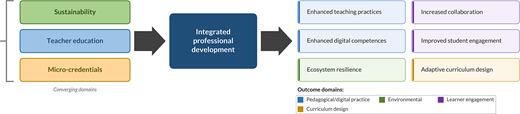
Taking into consideration the analysis of scientific literature, policy documents and regulatory frameworks, the authors developed an integrated model of micro-credentials, sustainability and teacher education (see Figure 3).
This integrated model illustrates how micro-credentials, teacher education and sustainability can be integrated into a cohesive professional development framework. Integrated professional development acts as the connecting element linking flexible learning opportunities offered by micro-credentials with evolving pedagogical practices and sustainability-oriented teaching approaches. By supporting competence development, curriculum adaptability, digital innovation and collaborative learning environments, this framework contributes to building a more resilient and future-oriented education system capable of responding to emerging societal and environmental challenges.
5. Conclusion
This study examined how micro-credentials can be integrated into teacher professional development in Latvia as a sustainability-oriented instrument aligned with the EU common approach. The findings show that effective integration depends primarily on system-level governance conditions rather than isolated course initiatives: quality assurance aligned with institutional and national frameworks, harmonised recognition across authorised providers, standardised credential metadata (learning outcomes, assessment methods, workload, level descriptors) and clear alignment with ECTS and EQF levels to support portability and stackability. In Latvia, these conditions remain only partially in place; the principal obstacle is the absence of a single body responsible for coordinating quality assurance, recognition and courseware standards, and establishing or designating such a body is the clearest lever for progress. More broadly, the case illustrates that where a soft-law EU recommendation meets a mature hard-law national credentialing system, the governance task is one of selective retrofitting rather than infrastructure-building from scratch – a distinction that may be relevant to other regulated European teacher education systems. For policymakers, this means explicitly recognising micro-credentials within CPD regulations with clear provisions for quality assurance, recognition and portability; for higher education institutions and providers, designing micro-credentials that embed sustainability competencies within EU-aligned learning outcomes and assessment; and for teachers and school leaders, using micro-credentials as flexible pathways for sustainability-related competence development where institutional support and recognition mechanisms allow.
Several limitations should be noted. The analysis focuses on Latvia, and while many European education systems share comparable regulatory structures, direct generalisation should be made cautiously. Empirical research on micro-credentials specifically within ISCED 1–4 teacher professional development remains scarce, and the legal-policy analysis assumes a degree of alignment between formal regulation and institutional practice that may not hold uniformly in implementation. The proposed extension of AIC’s registration function, in particular, rests on governance mapping alone and does not establish whether AIC holds the evaluative capacity such a role would require; this remains an open empirical question. Future research should therefore prioritise empirical studies of how sustainability-oriented micro-credentials affect classroom practice, comparative analysis of governance models across European systems, the institutional capacity required to implement centralised quality-assurance functions such as the one proposed here, and the role of digital infrastructure in ensuring equitable access, particularly for teachers in under-resourced or rural contexts; further work should also examine how the content and standards of micro-credentials should be periodically reviewed and updated based on systematic evaluation and feedback from participating teachers.
Inga Jekabsone is a senior researcher at Riga Technical University. Her research focuses on adult education, digitalisation in higher education, micro-credentials and sustainability-oriented competence development. She has authored numerous peer-reviewed publications and is actively involved in research and policy initiatives related to education innovation and lifelong learning.
Anita Līce is an education policy expert and researcher specialising in micro-credentials, lifelong learning and higher education policy development. Her work focuses on the design and implementation of innovative learning models and the integration of micro-credentials within national education systems, with particular attention to policy frameworks supporting flexible and inclusive learning pathways.