

This paper aims to provide data on the self-perceived state of sustainability consciousness of first-year Hong Kong students.
Within a mixed-method research design framework, the authors conducted 787 questionnaires and collected 989 reflective narratives of first-year students of a university in Hong Kong, who were enrolled in the General Education course.
Attributed to students’ immersion in compulsory sustainability education modules within liberal studies programs in secondary through higher education (HE), the quantitative results revealed an increase in the self-perceived knowledge and behavioral aspects of sustainability consciousness of Hong Kong students and their low engagement in sustainability-related civic, campus or action groups. However, qualitative results revealed three aspects of the students’ sustainability consciousness: intentionality to make a difference; engagement with complex questions about identity, society and nature; and eschatological perspectives, which included imaginative, future-oriented and action-oriented approaches to critical reflection, supported by the rhetoric of hope, promises and commitment for better future.
The study provides insights into the challenge of implementation of the United Nations-based sustainable development model in the Hong Kong educational system through the formal liberal studies curriculum. It advances the field by constructing a momentum for conceptual changes in sustainability education research toward design of the non-linear and culturally sensitive frameworks for sustainability implementation in HE. This allows to utilize universities’ unique capacities for fostering students’ sustainability consciousness in a continuous and systemic way.
1. Introduction
A concept of sustainable development (SD) and its three pillars – economic growth, social inclusion and environmental balance – have been serving as a guiding, grounding and unifying framework for the sustainability movement in higher education (HE) since the late 1980s. Proposed by the United Nations in 1987 (World Commission on Environment and Development, 1987), the three-pillared model not only aligns campus sustainability-related policies, strategies and practices with global, national and local development but also applies the SD model across disciplines in university classrooms, aiming to build the awareness of sustainability-minded citizens. Universities generally acknowledge the SD concept as its guiding framework for campus sustainability and practically adapt its three-pillared frame to diverse cultural, political, economic and social contexts outside campus walls. By doing so, the sustainability movement challenges the widely celebrated ideology of development[1] (National Association of Scholars, 2015). On the other hand, the UN-based model has not been giving HE a role of major importance in the process of SD. Those writing about the SD model in HE tend to focus on gaps and challenges of sustainability implementation process on campus, but not on the important role education might play in fostering sustainability-conscious actions, attitudes and values of university students. Sustainability researchers, on their part, have also stopped short of acknowledging HE, and education in general, as a significant agent of SD (Savelyeva et al., 2015).
At the same time, the educational research on three isolated sustainability movements (Savelyeva and McKenna, 2011; Savelyeva, 2013) – campus greening, sustainability sciences and education for sustainability (EfS) – has been providing rigorous data for the rapidly developing scientific discourse on sustainability in HE that suggests universities make a difference (Filho et al., 2015). These rich data create a clear image of how sustainability has evolved in international academic settings over the years and what tangible contributions sustainable universities make to a society. However, the benefits of sustainability implementations in academia through greening, sciences and curricula to its main beneficiaries – a young generation of students – are less certain. More to that, an “unrecognized tangible dimension” (Burford et al., 2013) of shaping sustainability consciousness of students within the walls of HE systems remains omitted from educational research and policy discourses (Filho et al., 2015). Could sustainability be engraved, or “ensouled”[2] (Savelyeva and Park, 2012) in the minds and hearts of university students?
This study is built upon the idea that HE institutions are major agents that challenge the UN-based model of SD. The researchers argue that universities ground sustainability implementation in localized sustainability discourses and, by doing so, utilize their unique capacities to the “ensoulment” of sustainability in their students in continuous and systemic ways. In the context of this study, continuity implies that universities align their sustainability implementation strategies with those in secondary schools and other levels of formal and informal education. In this study, the researchers refer to the EfS aspect of the campus sustainability movement[3] and its curricular manifestations to explore different dimensions of students’ sustainability consciousness (O’Sullivan and Taylor, 2004). The researchers apply a notion of self-perceived sustainability consciousness which was developed by university students in Hong Kong, who take a mandatory liberal studies course in their institute after taking and passing an exam on the three-year compulsory New Senior Secondary Liberal Studies (NSS LS) curriculum, where sustainability is included as a module of study.
The study also stresses the importance of understanding and analyzing the self-perceived sustainability consciousness of first-year university students, resulting from their continuous engagement in sustainability through compulsory liberal studies curricula. For the purpose of this study, the researchers operationalized sustainability consciousness as a way of constructing one’s reality through a reflective process of formulating personal and group-related systems of values, beliefs, goals and strategies (Capra, 2003) that lead to sustainable changes. The researchers hypothesize that as a dimension of global awareness, sustainability consciousness might be fostered by students’ continuous immersion in formal curricular studies of liberal arts that promotes transformative learning, “a quality of learning that is deeply engaging and touches and changes deep levels of values and belief through a process of realization and re-cognition” (Sterling, 2003, p. 94).
This study addresses the challenges of implementation of the UN-based SD model in Hong Kong education through the formal liberal studies curriculum which fosters the sustainability consciousness of students. The research aims to provide data on the self-perceived state of sustainability consciousness of freshmen Hong Kong students to support the scholarly discourse with new insights and advances in the field by constructing a momentum for conceptual changes in HE research toward the importance of HE in the process of SD.
2. Related research on sustainability consciousness
Current research discourses on issues related to sustainability consciousness (Gennore, 2009; Jensen, 2002; Kegan, 2000; Maiteny, 2002; O’Donoghue and Lotz-Sisitka, 2002; Rosenthal, 2009; Scott, 2002; Taylor, 1989) tend to focus on:
issues related to transformative learning, its theoretical developments and possibilities for classroom applications; and
non-behavioral approaches to studies of sustainability consciousness.
First scientific discourse – transformative learning – has to do with a quality of learning that generates sustainable changes and permanent shifts in values, beliefs and attitudes of both teachers and learners (Sterling, 2003). In the words of Senge (1990, p. 13), transformative learning “involves a movement of mind [that] gets to the heart of what it meant to be human”. Other important characteristics of transformative learning are that it grants one the ability to re-create oneself; to do something one never thought to be capable of; and to re-perceive the world and one’s relationship with it (Senge, 1990, p. 14). It is an equivalent to deep learning in Australian theoretical schools (Biggs, 2003), also referred to as a triple-loop learning in the USA (Flood and Romm, 1996) and epistemic learning in the UK (Bawden, 2000, 2010a, 2010b).
The research on transformative learning issues involves theoretical models (Bateson, 1973; Biggs, 2003; Savelyeva, 2009; Sterling, 2003) and their practical applications.
Bateson’s (1996) model of transformative learning is the earliest one and is seminal to all the models that followed. Conceptually, Bateson recognizes three stages to transformative learning: factual learning, when a student is given set of alternatives and he/she is able to learn within a paradigm; contextual learning, when a student understands a nature of the context and is able to form a paradigm; and “a corrective change in a system of sets of alternatives from which choice is made” (Bateson, 1973, p. 293, cited in Sterling, 2003, p. 129), when a student learns about his/her own character and worldview. Interpreting this model, some researchers (Skolimowski, 1994) suggest that transformative learning is unattainable, as it requires a special predisposition of students’ mind. Others (Bateson, 1972; Sterling, 2003) view transformative learning as practical and attainable, but challenging.
The study adapts the latter interpretation of Bateson’s model and describes environmental aspects of sustainability consciousness of university students in Hong Kong as doable and achievable. The previous international studies of the curricular implementation processes (Savelyeva, 2009, 2012, 2013) by means of transformative learning revealed that transformative learning is conditionally attainable[4]. One of the conditions that directly relates to the current study of Hong Kong teachers and students’ self-perceptions of their sustainability consciousness is the importance of cultivating teachers’ intrinsic values for ensuring educational quality of transformative learning. This particular finding corresponds with the works of Hong Kong researchers (Carless, 1997; Lee, 2010; Lee and Efird, 2014; Savelyeva and Lee, 2011) who have contributed to the international studies on transformative learning and stress the importance of cultivating teachers’ intrinsic values for the success of learning to deal with change. Two illustrative examples are the studies of Lee (2010) and Savelyeva and Lee (2011), who conducted investigations on teachers’ perceptions shortly after the implementation of the new curriculum.
3. Advances of sustainability education in Hong Kong
Until recently, local HE institutions followed the international trend of discipline-specific integration of sustainability into science and engineering fields of study (Rusenko, 2010; Vaughter et al., 2013). Recent educational and curricular reforms (Education and Manpower Bureau, 2005; EDB and CDC, 2009) that merged the city’s post-colonial educational structure with the Chinese educational schema allowed to break this trend and place sustainability within liberal studies as one of the core aspects of globalization.
By including liberal studies in the examination and assessment exercise (Hong Kong Examination and Assessment Authority, 2014), the curricular reforms brought the subject to a whole new level and introduced pioneering approaches to global and sustainability education. This approach at the level of national curriculum challenged the traditional curricular boundaries of sustainability education, which internationally has a status of an elective, extra-curricular subject, activity (Lipcombe et al., 2008) or a short-term greening or environmental literacy initiative (Savelyeva and McKenna, 2011) in the non-formal educational sector. Placing sustainability within liberal studies and viewing it as one of the core globalization aspects[5] (Savelyeva, 2016) challenged the traditional approach to HE sustainability as a narrow topic of environmental conservation, greening and innovation within science, engineering or market-based courses and programs.
The new curricular arrangements intended to meet the growing international demand for educational transformation (Sterling, 2003) of a generation of the global-minded (Hanvey, 1976/2004) and sustainability-conscious (O’Sullivan, 1999; O’Sullivan and Taylor, 2004) young citizens who “understand the contemporary world and its pluralistic nature” and who have high “capacity for life-long learning and can face the challenges of the future with confidence” (CDC and HKEAA, 2014, p. 1).
The first batch of prospective sustainability-conscious secondary school graduates sat their first Hong Kong Diploma of Secondary Education Examination in 2012. In 2014, over 19,000 (Hong Kong Census and Statistics Department, 2014) of the graduates entered the tertiary education system, which for over a decade has been adapting liberal education and sustainability programs. Because of the recent implementation of the reforms, the studies on its effects on Hong Kong youth have been limited. One of the examples of the Education Bureau (EDB) research initiative has been conduct to a number of NSS LS implementation surveys in 2014/2015 (Ref. No EDB(CD/C&S/PROJ)/ADM/150/4/4(10). However, the recent student movement has shown the urgency for focusing our understanding of the most immediate impacts of the curriculum changes on its main beneficiary – Hong Kong secondary school graduates who are currently studying in tertiary institutions. This study of sustainability consciousness of freshmen university students in Hong Kong has involved the first and second (2014 and 2015) batches of school graduates and allowed us to triangulate the results with the upcoming findings of EDB and other pilot research studies conducted in Honk Kong (Douglas et al., 2013; Zhu et al., 2014).
It is hypothesized that within a formal educational setting, a sustainability curricular module ignites transformative learning, which fosters a sense of global awareness and increases the sustainability consciousness of young Hong Kong citizens who have entered tertiary education; this might be a common case also for many other secondary school graduates who did not enter the tertiary education system. As Hanvey (1976/2004, p. 2) suggested, “every individual does not have to be brought to the same level of intellectual and moral development in order for a population to be moving in the [global] direction”.
4. Research scope
4.1 Research design
This investigation into students’ sustainability consciousness used a mixed-method design. Within the mix-method design framework, the researchers used a random sampling technique and collected the data using 787 questionnaires and 989 written reflective narratives from first-year students enrolled in the compulsory General Education course at one of the universities in Hong Kong in 2013-2015. This aided our research efforts to understand the complex nature of the formulation of students’ self-perceived sustainability consciousness and the curricular factors that influenced this process.
The questionnaire data from three returns were excluded because the respondents had not taken the Hong Kong Diploma of Secondary Education so had not been influenced by the secondary school Liberal Studies curriculum. In total, 38 returns were excluded because of illogical or inaccurate responses on participation in sustainability-related activities. There were 395 valid questionnaires from the first cohort (academic year 2013/2014) and 351 valid responses from second cohort (academic year 2014/2015). The gender ratio of respondents was 69 per cent female to 31 per cent male students, which is typical of this particular university’s student gender ratio. The findings of the students’ reflective narratives and questionnaires were reviewed and analyzed to serve as a verification procedure for confirming the credibility of the mix-method study (Cresswell, 2003). The university, which was conveniently selected for this study, is one of the eight public HE institutions in Hong Kong, with a focus on both education and sciences. The University maintains the top position in educational subjects in Asia and the world according to the 2016 QS World University ranking system.
4.2 Data collection procedures
The student questionnaires were conducted using hard copy versions to ensure greater participation of the locally based participants than conducting the survey on-line and allow for greater control of the data collection process (de Leeuw et al., 2008). The questionnaires were in English and Chinese (traditional characters) to ensure that students’ responses were not influenced by language ability. The research team distributed the questionnaires during lectures of the compulsory General Education courses in March 2014 and October 2014. The student survey procedure was designed to take no longer than 15 min in total from distribution to collection of completed forms.
The student narrative reflections were collected electronically, using the Institute’s Mahara® platform during the four semesters of the 2013 and 2014 academic years. All narratives were written in English and submitted on-line as part of the General Education course requirements.
4.3 Instruments
The questionnaire instrument was adapted from three highly reliable instruments: EAI, children’s sustainability attitudes and knowledge scale (Leeming and Dwyer, 1995), Cronbach’s alpha 0.88-0.99); children’s attitudes towards the environment scale (Musser and Malkus, 1994), Cronbach’s alpha 0.73-0.83); and sustainability value-based scale (Shepherd et al., 2009), Cronbach’s alpha was 0.89 (Table I). The questionnaire included five scales and a background question on gender. Three scales were designed to measure students’ perceptions of the effect of the Liberal Studies program on their environmental knowledge (knowledge increase scale with eight items and Cronbach’s alpha of 0.939); their perceptions of the effect of the Liberal Studies program on their environmental behavior (behavior change scale with nine items and Cronbach’s alpha of 0.937); and their perceptions of the effect of the Liberal Studies program on their active participation in environmental group activities (group participation decision scale with three items and Cronbach’s alpha of 0.949). Another scale measured students’ participation in environmental group activities (group participation scale with three items and Cronbach’s alpha of 0.668), and the last scale measured students’ perceptions of other influences that might affect their understanding of environmental issues (other influence scale with six items and Cronbach’s alpha of 0.749).
Sample of a student questionnaire
| Domain: Sustainability values Module: Affective belief | Please indicate how much you agree or disagree with the following statements (1 = strongly disagree 2 = disagree 3 = neutral 4 = agree 5 = strongly agree)/請指出你多大程度上同意或不同意下列句子 (1.極不同意 2.不同意 3.中立 4.同意 5.極同意) I perceive myself as very concerned about sustainability-related issues in my community/我認為自己十分關注區內與可持續性相關的議題。 1 2 3 4 5 |
Given the complex nature of the qualitative inquiry into students’ sustainability consciousness, the qualitative focus of the second part of the study on interpretation and emergent design set the researchers as primary instruments of data collection and analysis of students’ reflective narratives (Creswell, 2003; Watt, 2007). Through the practice of reflexivity (Russell and Kelly, 2002), the researchers wrote short memos (Maxwell, 1996) and kept a research journal to create a personal narrative for the data collection and analysis process. The research journal included a record of the pilot studies and served as a memory prompt for the multiple reflexive levels. The researchers drew on the journal excerpts for creating meaningful connections between literature and the context of students’ narratives, research reflexivity and the researchers’ evolving understanding of sustainability consciousness and the ways it manifested in students’ reflective narratives.
4.4 Data analysis
The quantitative data were analyzed using SPSS(V21)® software. Confirmative factor analysis (CFA) was performed using a BASE feature of MPLUS® software for analyzing quantitative data. The qualitative data were analyzed manually. The research used a thematic approach to data analysis performed across its articulated, attributional and emergent levels of interpretation to ensure the clarity of interpretations and make analysis more transparent to stakeholders.
For the analysis of the students’ reflective narratives, the researchers used an open-coding feature of the NVivo(V10)® software for reading the narratives and coding passages in the margins. The researchers applied coding-recoding strategy to ensure dependability of their findings (Table II).
Types of descriptive codes emerged in the analysis of students’ reflective narratives
| Phase of the research | Codes used | Description of codes |
|---|---|---|
| Qualitative analysis of students’ reflective narratives | I-PI/EI/TI | Identity, including prior identity, engaged identity and transformed identity |
| C-CT/CD/CC/CHK | Cultural issues related to Taoism/Daoism, Confucius tradition, Hong Kong heritage | |
| In- InD/InH/InB/InO | Intentionality to make a difference, rhetoric of dreams, hopes, references to past experiences, cultural biases and openness to alternatives | |
| E- EI/ES/EN/Ec | Engagement with complex questions about identity, society and nature. Commitment to better future | |
| Es-EsH/EsP/EsA/EsH | Eschatological perspectives, including future-oriented rhetoric of hope, possibility, aspirations and harmony |
In this study, analysis was aided and framed through the use of a thematic clustering technique, which might be defined as a classification of similar items into groups, where the number of groups and their forms are unknown (Aldenderfer and Blashfield, 1984; Henry et al., 2005). The researchers approached the data set with a lens of a grounded theory to identify different aspects and instances of manifestations of students’ sustainability consciousness in the textual data. The researchers then used the clustering technique to reduce the data to a manageable size, which helped to structure an analytical framework for further data analysis. Resulting from clustering this new analytical structure allowed the researchers to revisit the data set and identify overarching themes that underlined the resulted aspects of students’ sustainability consciousness. This framework facilitated the identification of themes that would be meaningful within and across all cases.
4.5 Limitations
The limitations of this study had to do with its quantitative and qualitative methods. The first limitation was reliability of the students’ responses to the perception survey, which was based on their individual understanding of the key concepts and ability to distinguish sustainability-related ideas resulting from the NSSLS with any other sources of sustainability related information. Another limitation was representativeness of participants, which had to with accessibility issue and led to low generalization of findings. The researchers addressed the limitation of representativeness by describing the specifics of the Hong Kong student population and using a mix-method design to access possibly generalizable characteristics of the students’ sustainability consciousness. The researchers also recognize the overall limitation of using linear statistical modeling in educational research field, where any attempt to predict or explain human behavior is limited, as humans are hard to predict. To increase the power of linear modeling in the studies of sustainability consciousness, the researchers suggested the use of a more sophisticated model statistics in the future studies, as well as consideration of the culturally specific knowledge about Confucius heritage. In the present study, a selection of students with culturally distinct learning characteristics (n = 787) added a limitation of a relatively insufficient sample size for performing sophisticated quantitative analysis. The limitations of the qualitative part of this study included researchers’ biases and also a challenge of interpreting the complexity of findings, derived from the voluminous qualitative data (n = 989). The researchers addressed these limitations by stressing the trustworthiness of the results through three data quality indicators: research credibility, transferability and dependability.
5. Results
5.1 Students’ perceptions of the effect of liberal studies program on their sustainability knowledge
Students’ perceptions of the influence of the Liberal Studies program on their environmental knowledge was measured using the knowledge increase scale. This scale had eight items, with a common item statement: “Has your knowledge of the following issues increased as a result of the Liberal Studies program?” These items were climate change, air quality, waste disposal, biodiversity, nature conservation, industrial pollution, renewable energy and ozone layer depletion. There were four response categories to indicate increase in knowledge: no change, slightly more, more and much more. Results from students of the two cohorts (2013/2014 and 2014/2015) are presented in Figure 1.
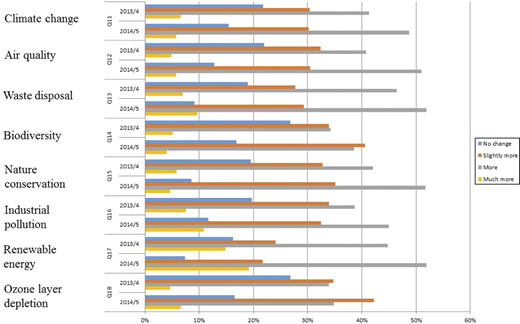
Results from both cohorts showed that a large percentage of students perceived that their environmental knowledge had increased because of the Liberal Studies program. Most indicated that they knew more or slightly more as a result of the Liberal Studies program. The percentage of cohort 2014/2015 students who perceived their knowledge had increased because of the Liberal Studies program (slightly more, more or much more) were larger than those of cohort 2013/2014 students. This results mirrored the existing linear sustainability-related behavioral models (Heimlich and Ardoin, 2008; Kollmus and Agyeman, 2002) which view knowledge as one of the necessary but not sufficient factors (Robelia and Murphy, 2012) impacting student’s environmental sensitivity and behavior. The difference in the two cohorts’ perceptions based on the lower no change item (in 2014/2015) might be explained by the longer immersion in the curriculum for the 2014/2015 student cohort and prolonged teachers’ training and greater experience after the first year of the new curriculum. In total, 20 per cent of the 2013/2014 cohort’s students responded that the curriculum made no change in their perceptions of their knowledge of biodiversity and ozone layer depletion. Although quite alarming, this result could be due to the fact that these items were not part of the student examination (HKEAA, 2014) in these particular years; therefore, they might not be covered by the teachers. On the contrary, topics of climate change, air pollution, nature conservation, renewable energy and industrial pollution are included in the curriculum as core topics as the most relevant to Hong Kong. Another explanation of the low students’ perception of their knowledge increase in items of biodiversity and ozone layer depletion might be the limitation of the instrument and understanding that perception surveys, unlike other types of surveys, measure perceptions only and often are mistaken with knowledge questionnaires (Herbert, 2013). Applying this limitation to the results of our study, students may have been answering questions based on their absolute knowledge rather than based on what they perceived had been learned in school.
5.2 Students’ perceptions of the effect of Liberal Studies program on their sustainability behavior
Students’ perceptions of the influence of the Liberal Studies program on their environmental behavior was measured using the behavior change scale. This scale contained two sets of items, that is, recycle and protection. The recycle set had three items with a common theme of “As a result of what you learnt in the Liberal Studies Program, do you recycle more”. The items were recycle paper, recycle metals and recycle plastic. There were four response categories: no change, slightly more, more and much more.
The protection set had six items. It asked “As a result of what you learnt in the Liberal Studies Program, do you do less of the following”: The items were use air conditioning, use water, waste food, use plastic bags, spend money on clothes and spend money on electronic goods. The four response categories were: no change, slightly less, less and much less. Both the Chinese and English versions of the items were provided in the questionnaire, and each corresponding response category for the two parts were the same in Chinese. Therefore, the same coding method was used for these two parts, that is, no change was coded as 1, slightly less or slightly more as 2, more or less as 3 and much less or much more as 4. The percentage distributions for the items of behavior change scale for both cohorts are presented in Figure 2.
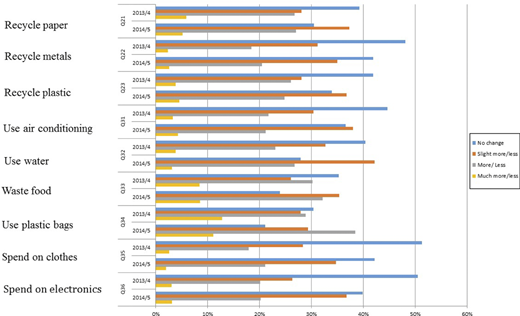
Results from the two cohorts showed that just over 50 per cent of students from the two cohorts believed that their environmental behavior had changed as a result of what they had learnt in the Liberal Studies program. These percentages, however, were less than those of students who perceived that their environmental knowledge had changed. A larger percentage of cohort-2014/2015 students perceived that their environmental knowledge had changed because of Liberal Studies program than cohort 2013/2014 students.
About 40 per cent no change in students’ perceptions of their sustainability behavior resulted from the NSS LS curriculum was not a surprise. The results added to the decades of behavioral data analysis dedicated to a question of translating, transmitting and transforming environmental knowledge into environmental behavior or action by means of education (Brick and Lewis, 2016; Corraliza and Berenguer, 2000; Hines et al., 1986). The results confirmed the overall challenge of impacting students’ behavior with the formal curriculum within a short span of time. The findings also acknowledged another limitation of a perception survey instrument – complexity of data interpretations. There are complex factors, such as students’ personality types (Brick and Lewis, 2016); situational factors (Corraliza and Berenguer, 2000); and emotional and attitude factors (Pooley and O’Connor, 2000), that might affect students’ perceptions of their sustainability-related behavior change. The findings also supported our initial assumption that students might learn sustainability as part of their exam preparation, disconnected from real life experiences. A curriculum design might also explain the low numbers of student self-perceived behavior change: the NSS LS curriculum does not include community-based, project-based or hands-on component, which result in no change in students’ perception of their sustainability-related behavior at about the 40 per cent level. A steady increase in number of students’ behavior perceptions in the 2014/2015 batch of the most recent school graduates in comparison to the 2013/2014 batch might be also due to their longer immersion in the curriculum. Social factors, such as the 2014 student movement, might also have an impact on students’ perception of their sustainability-related behavior.
Change in individual behavior or action has been a key indicator of measuring curricular success of any sustainability-related initiative in Western sustainability education discourse, both its behavioral (Hines et al., 1986) and critical (Posch, 2003; Stevenson et al., 2003) branches. However, the results of this study might reflect the culturally specific focus of a Confucian heritage learning tradition, which emphasizes on academic achievement, diligence in academic pursuits and the significance of education for moral self-cultivation (Chan and Rao, 2009) in a learner in relation to a collective rather than focus change in individual student’s behavior. The cultural specifics of the underlying Confucius heritage tradition are partially responsible for an “Asian learner paradox” (Watkins and Biggs, 2005). The resulted 50 per cent ratio in the self-perceived behavioral increase of 17-years-old Hong Kong school graduates might indicate a healthy, culturally specific dynamics of sustainability behavior caused by the implementation of the curriculum in Confucius heritage classrooms. This could reflect the recently emerged socioecological approach in sustainability education discourse (Kyburz-Graber et al., 2006), which is built on the assumption that targeting an individual change does not form an adequate approach to the multilayered challenge of environmental problems (Kyburz-Graber, 2013).
5.3 Students’ sustainability-related group activity participation
Students’ environmental group activity participation was measured using the group participation scale. This scale includes three items with a common theme of “Have you done any of the following:” The items were donated money to an environmental group (e.g. Friends of the Earth (HK), Green Power, etc.), joined an environmental group and volunteered or been paid for work in an environmental organization. There were two response categories: yes and no. The percentage distributions for the items of the group participation scale for both cohorts are presented in Figure 3.
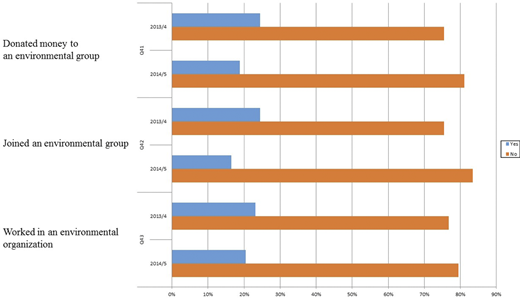
Results showed that between 23.21 and 24.49 per cent of the students from cohort 2013/2014 took part in the listed environmental group activities and between 16.52 and 20.51 per cent of the students from cohort 2014/2015 took part in these activities. Compared to the students from cohort 2013/2014, fewer students from cohort 2014/2015 participated in the listed activities. These results, however, were not consistent with the results that the percentages of cohort 2014/2015 students who perceived that their environmental knowledge and environmental behavior had changed because of Liberal Studies program were larger than those of cohort 2013/2014 students. These results might also reflect the local specifics of schooling, affected by the Confucian heritage tradition, where learning “dwells not around ideas of intelligence, ability, and competence”, but “cultivating personal virtue, self-development […] under parental guidance for social purposes” (Li, 2009, p. 40). The system keeps students overworked so that they have no time to pursue any personal hobbies and interests or join social groups. So, low participation in organized sustainability-related activities would be expected at this age group of Hong Kong students, who just went through what Ishisada (1974) coined with a term “examination hell”. Although it is noted that Western literature indicates that participation promotes awareness and behavior change, it was not a factor for Hong Kong students in this study.
A follow-up question to each item of the group participation scale asked whether the Liberal Studies program had influenced students’ environmental group activities participation (group participation decision scale). The common theme for these questions was “If yes to any of the above, was this decision as a result of the Liberal Studies program you studied at school?” The response categories were yes or no. The percentage distributions for the items of the group participation decision scale for both cohorts are presented in Figure 4.
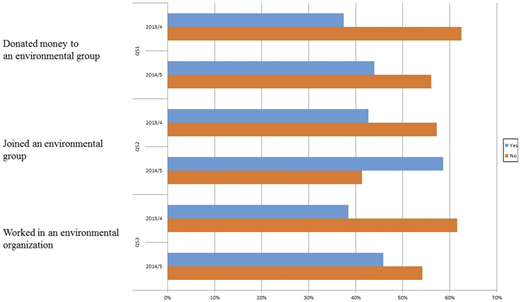
As shown in the results, among the students who participated in the activities listed in the group participation decision scale, larger percentages of students from cohort 2014/2015 perceived that their participation in these activities was as a result of the Liberal Studies program, compared to those of students from cohort 2013/2014. However, these results are inconsistent with the results that less students from cohort 2014/2015 participated in the activities listed in the group participation scale than those from cohort 2013/2014. The fact that students have participated in the sustainability-related activities was actually very surprising given the pressures that students were under meeting the demands of the educational system based on the Confucius heritage principals of self-perfected learning and parents’ expectations of the school system. The results showed students’ tendency for family and not community engagement that also might be explained by the family-centered social norms of Confucian heritage culture.
5.4 Students’ perceptions of other influences on their sustainability understanding
Students’ perceptions of other influences that had increased their understanding of environmental issues were tested using the other influence scale. This scale contained six items with a common theme of “Have other influences increased your understanding of environmental issues?” The items were other school lessons or activities, TV, newspapers/magazines, internet, family and friends. The response categories were yes or no. The percentage distributions for these items for both cohorts are presented in Figure 5.
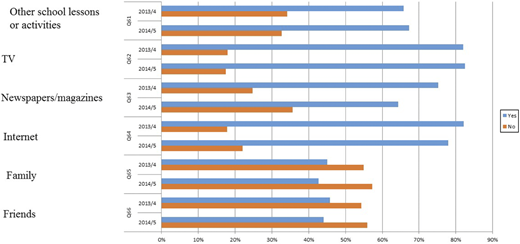
Results indicated that students from the different cohorts rated similarly in the other influence scale. There were three exceptions to this: “Other school lessons or activities”, internet and newspapers/magazines. Compared to students from cohort 2013/2014, a larger percentage (1.44 per cent more) of students from cohort 2014/2015 believed that other school lessons or activities had increased their understanding of environmental issues, whereas a lower percentage of students from cohort 2014/2015 indicated that the internet and newspapers/magazines affected their understanding of environmental issues. The differences in the percentages were 4.23 and 10.86 per cent, respectively.
These findings indicate that family or friends are not important factors that might influence students’ perceptions of their level of sustainability consciousness. These confirm the results of the recent findings reported in the Hong Kong based study by Cheung et al. (2015), who warned about powerful media influences on the formation of Hongkongers’ understanding of sustainability. Considering the important place which family takes in the lives of students in Confucius heritage culture (Koo and Wong, 2009; Savelyeva et al., 2015), the results might be an alarming indication that these items are not discussed within the powerful systems of family or among friends.
The CFA of the linear model used in this study partially supported a set of the researchers’ initial observations (Figure 6), and that constant models may not be the best and only ones for investigating a complex construct of students’ sustainability consciousness.
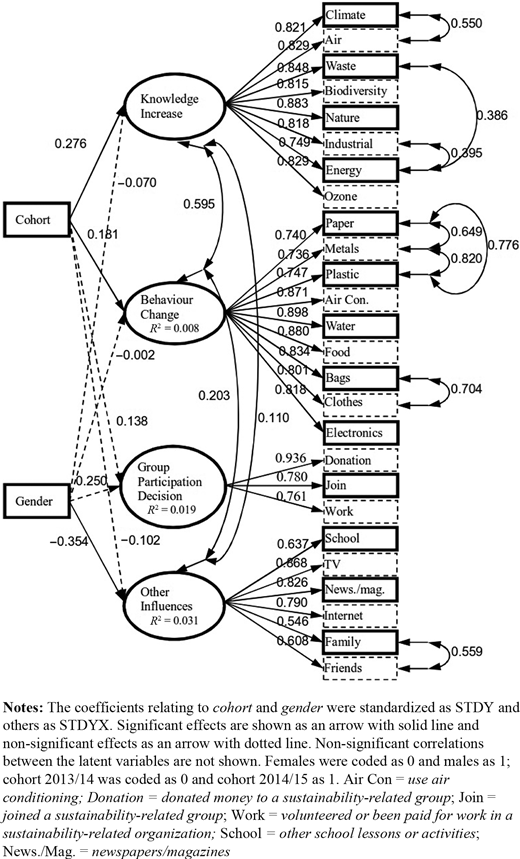
The factor analysis clearly identified the significant differences between 2013/2014 and 2014/2015 students’ cohorts in their perceptions of sustainability-related knowledge and behavior increase due to NSS LS (subscales knowledge increase and behavior increase). The results of the CFA confirmed that the relationship between students’ perceptions of their knowledge and behavior increase due to NSS LS curricula and other factors were all significant, with the correlation coefficients ranging from 0.110 to 0.595. The R2 values of knowledge increase, behavior change, group participation decision and other influences were 0.019, 0.008, 0.019 and 0.031 respectively. Such low R2 values were expected and might be explained by the limitations of the linear approach to explain complexity of human behavior and perceptions. The results also show that the cohort difference in students’ perceptions of their participation in sustainability-related group activities (subscale group participation decision) was not supported. This finding showed that students’ decisions to participate in sustainability-related group activities were not affected by any variables, which might point to limitations of the perception scale adapted for this study.
The R2 results presented in Table III showed that most of the estimates were not significant, except the R2 for other influences in the final model. This finding indicates that neither gender nor cohort differences generated much variance in the dependent variables.
R2 values for dependent variables in the study of students’ sustainability consciousness
| Predictor (model) | Knowledge increase | Behavior change | Group participation | Other influences |
|---|---|---|---|---|
| Gender | 0.001 | 0.000 | 0.023 | 0.028 |
| Gender and cohort | 0.019 | 0.008 | 0.019 | 0.031* |
| Change in R2 | 0.018 | 0.007 | −0.004 | 0.003 |
Note:
Stands for significance at α = 0.05 level
The qualitative analysis of students reflective narratives revealed three aspects of students’ sustainability consciousness, which were derived from the three clusters generated after the thematic cluster analysis: intentionality to make a difference based on dreams, strong cultural biases, openness to alternatives and commitment for better future; engagement with complex questions about identity, society and nature; and eschatological perspectives in description and analysis, which included rhetoric of hope, possibility and harmony. These three aspects we based on the two overarching themes of identity and culture. The theme of identity included three thematic clusters: students’ reflections on their prior identity; engaged identity or identity in action; and transformed identity. The theme of culture included reflective references to the principles of Taoism, Confucius teaching and Hong Kong heritage. The narrative items related to human relationship with nature constituted a critical underlying theme which illustrated instances of students’ identity transformation in all the three aspects of their sustainability consciousness resulted in this study (Figure 7).
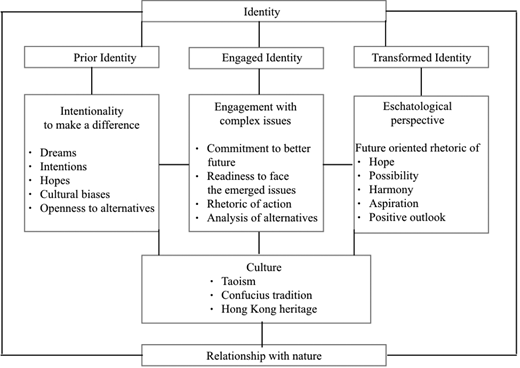
Considering the vast amount of the data generated from our qualitative investigation, we provide only short excerpts derived from most descriptive pieces of students’ narratives.
5.4.1 Intentionality to make a difference.
The theme included reflective students’ narrations describing their dreams, hopes and expectations with the rhetoric of hope, positive outlook in their past and future, openness to alternatives and commitment to a better future. Students acknowledged their cultural biases as a positive stabilizing feature that helped to sustain them, in an otherwise confusing swirling sea of a multitude of worldly alternatives and global solutions of which to select from. Upon analyzing complex social and environmental issues, students remained committed to creating and building a sustainable future for themselves and for the betterment of their countries of origin. One student reflected on his/her group’s first intercontinental videoconference experience that took place in conjunction with other international students who hailed from divergent countries as being inspiring, motivational and uplifting:
It really raised my self-esteem to see how good we [his /her Hong Kong class] was [sic] at this [international] videoconference. They [students from other countries] were different, some made me laugh. But we managed to find an alternative solution [to a sustainability problem], because we have only one bright future.
5.4.2 Engagement with complex questions about identity, society and nature.
Students also reflected on personal issues of their engaged and active identity on both individual and social levels, whereby some indicated this as an intricate and convoluted journey of growth, fluid transformation and exploration. One student contemplated on his/her Hong Kong identity in response to the “One Country – Two Systems” on-going socio-political struggle in his/her city as an important effort of achieving balance between one’s subjected nationhood and public governance:
There are many disputes in the community that are complex and cannot be resolved fully, such as disputes between Hong Kong and Mainland China over identity [of the city and] its people […]. I see education is the ways to establish a good quality of local citizenship, so we could comprehend the differences between the two places. This might decrease the conflict and increase national identity of my [Hong Kong] people.
Given that Taoism teachings comprise a core form of students’ general curricula and local education, it was not surprising to find that some students under an assured voice also referred to the ancient Taoist Chinese principles of unity with nature, morality of a collective action and the attainment of assuming a greater sense of responsibility. Thus, it was not uncommon to find student descriptions exuding the Taoist virtues of the Yin-Yangg philosophy of universality, holistic tendencies and cosmic interconnectedness:
According to Taoism, everything is interrelated, and change in one thing leads to change in others. If we see the universe as a whole, it means that if one major party goes down, another follows. All the living things within the universe are interrelated to each other. Although we rank a living creature’s priority by its place on an evolutionary tree and creature’s usefulness to a human, this does not really rank the value of a creature. The value of a creature should not be evaluated based on the usefulness. We should see universe as a whole as everything is connected to one and other.
5.4.3 Eschatological perspectives.
In formulating their written reflections, descriptions and analyses of sustainability-related issues, students utilized a critical approach with evidence that can be surmised as being imaginative, future-oriented and action-poised. They were encouraged to be expressive; hence, majority of the participants integrated spontaneous hand drawings, e-doodles made using apps on their mobile devices, whimsical poetic stanzas, lyric excerpts from K-pop songs and vivid YouTube video examples to convey their viewpoints on sustainability and other related issues.
One of the students composed a short poem describing their learning as a metaphorical excursion, which revealed a trove of symbolically representative themes expounding on destiny, dreams, inventiveness, hope and excitation. The semantic analysis of the poem illustrates students’ perception of changing identity and on-going transformation, described with the rhetoric of dreams, hopes and future-oriented action:
Since very young, in mother’s care
I dreamed one day to go to college.
I set myself on a bumpy journey
And. stumbled, at last I climbed a college wall.
Just now as a college student
I always hope one day to return back
To the happy days I ran all the way
Laughing and enjoying the innocence
Of my long absence.
In a close examination of the students’ varying points of views on contradistinctive aspects of sustainability, students often turned to a rhetoric of fortuity, aspiration and possibility. In one case, a student described his/her perception of a sustainable city as a wistful, ephemeral entity in direct literary reference to Ursula K. Le Guin’s (1973/1997) short philosophical fiction The Ones Who Walk Away from Omelas:
Every day is full of hope here and people strive to leave even more harmonious. Just like people in a utopian city of Omelas [by Ursula Lequin] who lived in the city that never existed in the human consciousness, we make Hong Kong real. It is possible to us.
When self-reflecting on themselves, their inner transformations, identity and the impact of contemporary issues affecting them in their society, students repeatedly referred to the concept of harmony as one of their main principles to merge contrasting notions of disparity. One student described his/her views on educational reforms as a worthy process of forming a compatible and consistent whole, in spite of the daily onslaught of modern urban stressors:
I think the most suitable words for me to describe my [approach to education] are through living a harmonious and cheerful life that always changes. Teachers are pressured [in our city], and we have to deal with many [social] controversies and sometimes unrests. Striving for harmony in a positive way makes changes easier to sustain.
6. Discussion
The quantitative results revealed an increase in the self-perceived knowledge and behavioral aspects of the sustainability consciousness of Hong Kong students. These point at the increase in students’ knowledge-attitude-behavior axis due to their immersion in compulsory sustainability education modules within liberal studies programs in secondary through HE. At the same time, students’ self-reported engagement in sustainability-related civic, campus or action groups remained low.
However, the qualitative analysis of students’ reflective narratives revealed that beneath these visible or self-declared behavior and knowledge changes, lies imaginative, future oriented and critical approaches to describing and analyzing their views on their identities, nature and their notion of social, environmental and economic sustainability. These results add to the discussion on transformative learning based on Bateson’s (1972) model that emphasize on the importance of one’s ability to imagine, articulate and “endeavor to enact principles of ideal cohabitation” (Code, 2008, p. 24) rather than to display sustainability action as the end-result of sustainability education.
Furthermore, grounded in reflexive criticality, students’ narratives revealed what Gayá and Phillips (2015) refer to as future-oriented and action-oriented “eschatological imagination”. It includes aspects such as rhetoric of hope, possibility and harmonization of contrasts. Our results echoed Gayá and Phillips’ work when, reflecting critically, students were able to connect sustainability with emotional, relational and ethical aspects of their own experiences that, in turn, triggered their engagement with complex questions about identity, society and nature. By doing so, students gradually and meaningfully re-discovered and re-constructed their own nature-related worldviews, setting a foundation for the construction and practical manifestations of their sustainability-related realities.
Assigning to imagination an important role in a process of fostering students’ sustainability consciousness, we challenge the simplistic assumptions of attitude–behavior relationship and stress the importance of contextual factors and changes unrelated to students’ attitude and intention. We join Arbuthnott (2009, p. 153) to caution that “sustainability education must not stop at value and attitude change because considerable evidence indicates that behavior does not flow directly from our attitudes and intentions”. The focus on contextuality that resulted from our study contributed a sociological discourse that distinguishes a person’s eschatological imagination and social imagery, where imagination refers to an explicit set of skills or abilities and imagery deals with a more elusive construction of one’s personal and social identities (Taylor, 2004). In the context of our research, students’ social imagery appeared as a set of self-realizations, understandings, understandings and self-constructions of common expectations related to their future, that might give them a stronger sense of an interconnected and shared life and contribute to social identity. Taylor (2004) envisioned such a type of imagery might trigger a society where each individual is an “immediate to the whole”.
Mapping the results of this study against the original three-pillar UN model, we argue that the model might be useful, as it underlines the curricular module that helps to raise sustainability awareness, increase knowledge and support the environmentally friendly behavior of Hong Kong freshman students. The model has, however, highly anthropocentric and compartmentalized structure, which results in a lack of its completeness and continuity (NAS, 2015). A sustainability implementation guided by such a model is an approach which might yield no results. To address this problem, researchers (Burford et al., 2013; Filho et al., 2015; Velasco and Harder, 2014) propose to enhance the UN model with a “missing pillar” (Burford et al., 2013) that would “consciously and systematically incorporate a deeper, at once more internal and more contextual dimension, designated variously as cultural- aesthetic, political-institutional, or religious-spiritual” (Velasco and Harder, 2014, p. 6554).
Students’ strong cultural biases yet openness to alternatives and commitment to the better future that were revealed in this study underscore contextuality as an important condition for the formation of sustainability consciousness. In this sense, contextuality might be linked with the proposed additional pillars to the UN model, such as culture [Dessein et al., 2015; Hawkes, 2001; United Cities and Local Governments (UCLG), 2010], ethics or values (Barford et al., 2013; Shephard, 2010) and institutionalization (Velasco and Harder, 2014). However, we argue that the additional pillars might not enhance the framework, which stands on a single foundation of anthropocentric assumption about the relationship between humans and nature. The variety of non-Western philosophical and scientific traditions from across the world offer different foundations to the localized sustainability movements that shape sustainability consciousness of their people (Savelyeva, 2016).
The Hong Kong students’ reflective narratives include ideas of harmony and human-nature unity, which suggests the driving ideas about human–nature relationships within the localized sustainability discourse and grounded in Confucianism. Confucian tradition, which does not separate nature and humans and does not assume human superiority over nature, shapes its own anthropocosmic and cosmoanthropic foundation to the regional sustainability discourse (Savelyeva, 2016). We argue that these ontologies (hierarchy of beings) originated from the localized Confucian tradition shape local students’ perceptions and worldviews that might differ from those of their Western peers. This addressed the problem of anthropocentrism by supporting Bateson’s (1979) argument about the perceptual domain of knowing, which has emerged in Western sustainability literature and brought about a new field and arena of “perceptual ecology” (Thomashow, 2002).
7. Conclusion
Since the inception of sustainability education in the late 1970s, HE institutions are among the frontline agents that advance the underlying UN policy model of SD in research, curricula and community practices. Universities acknowledge the model as their guiding framework and, by implementing it in the diverse cultural, political, social and economic contexts, challenge the overall idea of development. The study pointed to the benefits of a possible shift in research approaches – from the simplistic analysis of students’ sustainability behavior and attitudes to a more contextual investigation of their sustainability consciousness. The latter allowed the greater inside into future- and action-oriented mindsets of the students, which were filled with the rhetoric of hope, possibility and harmonization of social contests; openness to alternatives; and a commitment to the better future, much in line with the emerging discussions about eschatological imagination and social imagery. Both quantitative and qualitative results suggest that sustainability education, implemented as part of the formal compulsory liberal studies curriculum in a continuous (secondary to high education levels) manner, increases students’ knowledge-attitude-behavior axis and fosters their sustainability consciousness through a process of transformative learning and identity building.
There is no doubt that the UN-based model proves itself useful on the grounds of HE, yet, its anthropocentric and compartmentalized structure, which is lacking continuity, slows down sustainability implementation in diverse cultural and educational contexts. We believe that refraining from mechanistic policy models and focusing on students’ culturally specific root beliefs about human–nature relationships might help to trigger and “ensoul” sustainability in their hearts and minds. Direct and practical reference to the more localized, non-Western sustainability traditions and philosophies which assume anthropocosmic and commoanthropic kinds of relationships between humans and nature instead of enhancing the UN model with different kinds of “fourth pillars”, might yield better results and target foster sustainability consciousness of our young generations.
The study No. R9183 was supported by the Hong Kong Governmental University Grant Committee Fund under its Early Career Schema. The authors acknowledge Dr Zhu Jinxin for his valuable assistance with quantitative data analysis.
Notes
Education of sustainable development is viewed by NAS as the established ideological force that promoted neoliberal idea of sustainable growth and development.
Savelyeva and Park (2012) use a metaphor of ensoulment to describe the need for re-focusing current campus sustainability model in favor of curriculum that fosters sustainability values rather than dominant focus on campus greening, science and public relation efforts.
Savelyeva and McKenna’s (2011) three-fold model of the campus sustainability movement includes three aspects: education for sustainability, sustainability sciences and campus greening.
Other conditions for the Savelyeva’s model include international, interdisciplinary and innovative curricular features
In this study, globalization is viewed in reference to a strategic goal of EDB to globalize Hong Kong’s curricula, where globalization is approached as a post-colonial stage of the city’s development.

