

Purpose
This paper aims to conceptualize impacts of higher education institutions (HEIs) on sustainable development (SD), complementing previous literature reviews by broadening the perspective from what HEIs do in pursuit of SD to how these activities impact society, the environment and the economy.
Design/methodology/approach
The paper provides a systematic literature review of peer-reviewed journal articles published between 2005 and 2017. Inductive content analysis was applied to identify major themes and impact areas addressed in the literature to develop a conceptual framework detailing the relationship between HEIs’ activities and their impacts on SD.
Findings
The paper identifies six impact areas where direct and indirect impacts of HEIs on SD may occur. The findings indicate a strong focus on case studies dealing with specific projects and a lack of studies analyzing impacts from a more holistic perspective.
Practical implications
This systematic literature review enables decision-makers in HEIs, researchers and educators to better understand how their activities may affect society, the environment and the economy, and it provides a solid foundation to tackle these impacts.
Social implications
The review highlights that HEIs have an inherent responsibility to make societies more sustainable. HEIs must embed SD into their systems while considering their impacts on society.
Originality/value
This paper provides a holistic conceptualization of HEIs’ impacts on SD. The conceptual framework can be useful for future research that attempts to analyze HEIs’ impacts on SD from a holistic perspective.
Introduction
Since the UN Conference on the Human Environment in 1972, higher education institutions (HEIs) have increasingly undertaken active measures to contribute to sustainable development (SD) (Amaral et al., 2015). SD in HEIs has been promoted, for example, through declarations and charters (Lozano et al., 2013b), the redesign of curricula (Du et al., 2013; Qian, 2013), regional and global partnerships (Kawabe et al., 2013) and sustainable campus initiatives (Vaughter et al., 2016). HEI engagement with SD has significantly increased since 1987 (Lozano et al., 2013b) and was further promoted through the UN Decade of Education for Sustainable Development (DESD, 2005-2014), which aimed to integrate the principles of SD into all aspects of HEIs (United Nations Educational, Scientific and Cultural Organization [UNESCO], 2014).
Several literature reviews have been published, providing a comprehensive picture of the state of knowledge on the implementation of initiatives and commitments for SD and the motivations of HEIs to engage with the topic. For example, Wiek et al. (2011) reviewed the significant body of literature on education for SD and identified key competencies in sustainability for academic program development. Wu and Shen’s (2016) systematic review notes that an integrated understanding of SD in higher education curricula (beyond environmental and engineering-related topics) has only recently emerged. Other issues that have received significant attention include the implementation of sustainability initiatives (Velazquez et al., 2005), regional partnerships for SD (Karatzoglou, 2013) and emerging practices such as sustainability reporting and assessment in HEIs (Ceulemans et al., 2015). Within this discourse, campus operations have received the largest share of scholarly attention (Lozano et al., 2015).
While these reviews have greatly improved our understanding of what HEIs do in pursuit of SD, less is known about what they actually achieve by their various activities for society, the natural environment and the economy, i.e. what impact they have on SD. Vaughter et al. (2013) note this research gap in their examination of comparative empirical research. They find that the literature on SD in HEIs remains mostly focused on case studies within institutional operations, with little examination of broader SD policies or impacts on SD. Koehn and Uitto (2014, p. 624) similarly highlight the impacts on SD as an under-researched aspect in the discourse, which has tended to neglect that “impact involves real-world changes in ecological sustainability, policies, and people’s well-being”.
This poses two problems: First, for many HEIs, the communication of their impacts on SD is becoming an essential part of satisfying emerging accountability expectations from public and private funders, policymakers, accreditation agencies, students and faculty (Bonaccorsi et al., 2010). Second, there is a lack of clarity and a divergent understanding of the concept (Gooch et al., 2017; Koehn and Uitto, 2014). Greater clarity on and deeper knowledge of such impacts is a prerequisite for well-informed strategic decisions and improved contribution to SD (Lozano et al., 2013a).
The purpose of this article is to systematically review the existing literature on impacts in higher education to provide an integrative conceptualization of the impacts of HEIs on SD. In this context, the impacts are understood to be the effects an HEI has on its stakeholders, the natural environment, the economy and society. This article addresses the following two research questions:
What themes are addressed within the literature of the impacts of HEIs on SD?
What are the impact areas outside the HEI system in which change occurs?
This literature review is organized as follows. The second section provides insights into the conceptual basics of the impacts of HEIs on SD. The third section presents the method and the approach to the systematic literature review. The fourth section lays out the quantitative and qualitative results, and the fifth section discusses these results and provides a conceptual framework of HEIs’ impacts on SD. The last section concludes the review.
The impacts of higher education institutions on sustainable development
According to Maas and Liket (2011), impacts generally refer to the effects caused by an organization or an intervention (policy, program, project, product, technology or measure) that occur outside the organization in society or the natural environment. Several definitions of “impact” have been advanced for the HEI context. The UK’s Research Excellence Framework (REF) describes research impact as “an effect on, change or benefit to the economy, society, culture, public policy or services, health, the environment or quality of life, beyond academia” (REF, 2016, para. 1). For Koehn and Uitto (2014, p. 624), the impacts of sustainability initiatives of HEIs consist of “real-world changes in ecological sustainability, policies, and people’s well-being.” Thomas and Ormerod (2017) differentiate between traditional academic impacts (e.g. scholarly influence) and nonacademic impacts on civil society, public policies or media.
According to Gupta and Singhal (2017), impacts arise from the core elements of the HEI system (as proposed by Lozano et al., 2013b). Sustainability activities in these core elements cause overall social, environmental and economic impacts (Gupta and Singhal, 2017). Impacts on SD materialize along complex pathways, particularly in the area of research and education (Koehn and Uitto, 2014). They can be direct and indirect, intended and unintended and positive and negative; they may present themselves after a significant time lag, at a distance from the HEI’s location, or at a systems level (Lebeau and Cochrane, 2015). As Bowen (2018, p. 26) notes, “For individuals, the outcomes of higher education are harvested over adult lifetimes averaging fifty to sixty years after graduation from college. For society the impacts may persist through centuries.” This complexity makes the measurement of impacts challenging, and, consequentially, impacts are usually not systematically considered part of sustainability assessments in higher education (Yarime and Tanaka, 2012).
Impacts in this article are, therefore, to be understood as the effects that an HEI has outside of its organizational or academic boundaries – namely, on its stakeholders, the natural environment, the economy and society. This includes the impacts of the HEI as an organization, and the impacts caused by activities in the core elements (Lozano et al., 2013b): education, research, campus operations, outreach, campus experiences, institutional framework and assessment and reporting. Outreach activities (e.g. community teaching) are not regarded as impacts because they take place within the sphere and under the direct control of the HEI and should not be confused with their potential effects (e.g. contribution to school and career achievements).
Methods
This article follows the systematic review process proposed by Denyer and Tranfield (2009) and applied by several other studies (Ceulemans et al., 2015). This process consists of five consecutive steps:
question formulation;
locating studies;
study selection and evaluation;
analysis and synthesis; and
reporting and applying the results.
Building on the research questions provided in the Introduction (Step 1), this article used the ProQuest and the ScienceDirect electronic databases to find studies to review. The articles were all written in English and published in peer-reviewed, scholarly journals, which are regarded as the most useful sources for literature reviews (Saunders et al., 2012). The publication time span ranged from 2005, the starting year of the DESD, to 2017.
Due to the lack of clarity in understanding impacts in the literature, a combination of several keywords was searched among the publication titles and abstracts. The keywords included the concept of sustainability in HEIs and related terminology and the term “impact” in different application contexts (e.g. research impact). The keyword search aimed to identify relevant articles within and beyond the sustainability literature. In the first step, a tag cloud was created to identify relevant studies in the fields of HEIs and SD; it consisted of the following search terms: (“higher education” OR “campus” OR “universit*” OR “academia” OR “college*”) AND (“sustainab*” OR “sustainable development” OR “Green”) AND (“outreach” OR “impact*” OR “assessment”). The same approach was followed in the second step of the search to capture additional impact-relevant articles with the following search terms: (“higher education” OR “universit*”) AND (“research impact*” OR “economic impact*” OR “social impact*” OR “ecological impact*” OR “impact assessment” OR “outreach”).
After the exclusion of duplicates, book reviews, editorials, commentaries and keynotes, the studies were manually and independently checked for appropriate content to ensure that all articles dealt with SD issues in HEIs. This resulted in a sample of 429 articles. In the next step, the sample was screened in light of the understanding of “impact” provided in the previous section, namely, as the effects an HEI has outside of its organizational boundaries on its stakeholders, the natural environment, the economy and society. Building on this distinctive characteristic, all articles addressing the impacts of an HEI on SD were included, while articles solely addressing sustainability activities within organizational boundaries were eliminated. The final sample consisted of 113 articles, which were analyzed in the review.
The studies in the final sample were subjected to inductive content analysis using the MAXQDA 12 qualitative analysis software (Verbie, 2016). Content analysis allows for the systematic reduction of sources and analyzes document characteristics in quantitative and qualitative manners to identify themes (Berg, 2001; Krippendorff, 2004). The articles were coded for journal distribution, date of publication and applied research method to support the quantitative analysis. The content analysis of the impacts of HEIs on SD used a concept-centric approach (Webster and Watson, 2002).
As with other reviews in higher education (Bizerril et al., 2018), the basis of the content analysis was the concept of the seven core elements by Lozano et al. (2013b): education, research, campus operations, outreach, campus experiences, institutional framework and assessment and reporting. Each paper was classified into one, or, in a few cases, more than one core element. Studies that did not fit into this categorization were classified as “generalist papers.” This category included papers dealing with impacts of the entire HEI. The major findings were systemized for each category and synthesized into a set of themes emerging from the literature. Based on this, a conceptual framework of the impacts of HEIs on SD was derived.
The first two authors independently conducted all steps of the analysis to ensure reliability (Seuring and Müller, 2008). Inter-coder reliability was high (Kappa value of 0.877), and any differences among the coders were resolved through discussion until consensus was achieved.
Like other systematic literature reviews (Ceulemans, et al., 2015), this study also has limitations. First, the focus on peer-reviewed journals excluded conference papers, reports, book chapters and sources from grey literature. Second, ProQuest and ScienceDirect are not the only databases available. To ensure that all relevant journals in the research area were considered, the results were crosschecked with recent literature reviews in the field of higher education (Blanco-Portela et al., 2017; Ceulemans et al., 2015). To identify all relevant studies, the term “universit*” was used as a search term. This led to some irrelevant results, due to authors’ affiliations, which usually included “university.” Inappropriate papers were excluded by manually checking all articles for appropriate content. Third, content analysis can sometimes be prone to the misinterpretation of documents. The use of MAXDAQ 12 and performing the review as a team reduced the likelihood of such flaws and enhanced the reliability of the results.
Findings of the literature review
The literature reviewed consisted of 113 articles representing the state of knowledge on HEIs and impacts on SD. There was a steady increase in publications between 2005 and 2017, which shows this relatively recent field of study is still emerging. The largest number of articles was published within the past four years (56.64 per cent of the sample). Papers published between 2005 and 2009 were primarily case studies; qualitative and quantitative studies mainly occurred since 2010. Overall, the sample consisted mostly of case studies (48.67 per cent) and quantitative studies (20.35 per cent). Theoretical contributions (14.16 per cent), mixed methods (8.85 per cent), qualitative empirical research (6.20 per cent) and literature reviews (1.77 per cent) are rather limited, having been published only in the later years of the sample period.
The discourse on the impacts of HEIs on SD remains relatively fragmented and spread over a wide range of journals, with 72.57 per cent of the sample from journals with not more than three contributions. Journal of Cleaner Production had the largest number of contributions (13.27 per cent of the sample). Other strongly represented journals in the sample are Journal of Higher Education Outreach and Engagement presenting 7.08 per cent of the sample, and International Journal of Sustainability in Higher Education, which has published 3.54 per cent of the contributions in the sample. Journal of Cleaner Production and International Journal of Sustainability in Higher Education are the most prominent journals in other literature reviews of sustainability in HEIs (as discussed by Blanco-Portela et al., 2017 and Ceulemans et al., 2015).
As shown in Figure 1, the results of the inductive content analysis reveal a strong focus on the core elements outreach (21.99 per cent) and assessment and reporting (19.86 per cent). None of the articles was classified under the core element institutional framework. Thirty articles (21.28 per cent) were classified into the category generalist papers. Some articles dealt with crosscutting themes and were categorized into two core elements. Selected findings of each core element are presented in detail below.
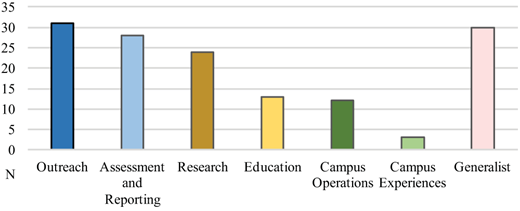
The outreach activities of HEIs are discussed in 31 articles. This category consists of a large part of case studies reporting on specific local outreach projects and their impacts. The main emphasis of these studies is on school collaborations and the support of small businesses and the local community. Anand et al. (2015) illustrated how students’ understanding of SD can be fostered by their participation in a regional education initiative aimed at integrating SD into the member institutions. Other studies exemplified the support of HEIs to establish a high school archival program (Fernekes and Rosenberg, 2008), to reopen a closed school (Officer et al., 2011), and to educate high school students (Lynch, et al., 2005). The support of local businesses is described by Hill et al. (2016), who analyzed the process of knowledge exchange from an HEI to rural businesses, and Riebe (2012), who studied the benefits of university-based entrepreneur centers for women. These works show positive impacts of outreach engagement, which is confirmed by MacPherson and Zilokowski (2005) for university-based industrial extension services. The increasing importance of outreach activities and their contribution to economic development is highlighted by Rubens et al. (2017), who examined the benefits of policies that reward staff engagement in outreach activities. Several studies illustrate the impacts of local outreach activities on different populations. For example, Anstadt (2009) demonstrated how a community connection program managed to reduce the social isolation of seniors, caregivers and international students, while providing foreign students the opportunity to practice the local language and to learn about local culture. Scull and Cuthill (2010) examined a project that supports access to higher education for people from marginalized socioeconomic backgrounds and highlight the importance of a long-term strategy as success factor for the project. Patterson et al. (2014) analyzed the effects of community-based research and outreach to the reduction of homelessness. There is also a variety of other studies focusing on outreach projects that aim to foster SD in local communities (Trencher et al., 2014). Other studies such as Lehmann et al. (2009) emphasized the positive impacts of outreach activities on the HEI itself. They concluded that HEIs benefit from such engagement by improving their ability to cope with emerging SD problems and developing more successful SD education programs.
Twenty-eight studies address the core element assessment and reporting. These articles applied a variety of different approaches, such as simulations (Pastor et al., 2013) and input–output models (Agiomirgianakis et al., 2017) to examine socioeconomic impacts of HEIs. Roessner et al. (2013) used an input–output model to evaluate the economic impacts of licensed commercialized research inventions. Pienaar-Steyn (2012) proposed the millennium development goals (MDGs) as framework for the development of monitoring tools for the evaluation of community outreach engagement, while Lynch-Alexander (2017) discussed the Lynch Outreach Assessment model (LOAM) as a tool for HEIs to assess their outreach engagement. Carteron et al. (2014) analyzed the potential of a sustainability literacy test for students as a monitoring system for tracking educational impacts. The reviewed studies also used footprint and inventory analyses to assess greenhouse gas (GHG) emissions (Li et al., 2015) or combined life cycle assessments with material flow analysis to evaluate the metabolism of HEIs (Lopes Silva et al., 2015).
Twenty-four articles focused on the nonacademic impacts of research. These articles addressed impacts on policy, research uptake in business practice, societal impacts and the impacts of co-creation research. Aguinis et al. (2014) argued for the adoption of a pluralistic concept of research impacts that considers also nonacademic stakeholders and fosters engaged scholarship to increase the relevance of research. In the same vein, Bozeman and Youtie (2017) studied the socioeconomic impacts of government funded research through a case analysis of four publicly funded research projects and provide a framework to compare such projects and their impacts. Marcella et al. (2016) concluded that the REF increases awareness of nonacademic impacts among researchers. The interview data of Smith and Stewart (2017), however, revealed certain concerns about how the REF works in practice. Research impacts on the national economy are estimated based on a national input–output model with licensing of research inventions to industry by Roessner et al. (2013). Their estimates indicate a significant impact on gross domestic product (GDP) and employment. Regarding economic impacts, it is argued that most university spin-off companies remain small, as most of them are “technology lifestyle businesses not dynamic high-growth potential start-ups” (Harrison and Leitch, 2010, p. 1241). The uptake of research by policymakers and other practitioners is examined in the case of medical (Balas and Elkin, 2013), social science (Cherney et al., 2015) and tourism research (Thomas and Ormerod, 2017). Thomas and Ormerod (2017) pointed out that research with high academic citation scores is also likely more cited by policymakers and practitioners. Impacts of action research (Banks et al., 2017; Haigh, 2006) and co-creation (Greenhalgh et al., 2016) are also discussed. For instance, Greenhalgh et al. (2016) identified key principles for the success of co-creation activities and highlighted the importance of metrics apt to capture complex impact pathways linking such activities and their potential societal impacts.
The impacts of education on SD are exemplified in 13 articles that have their thematic focus on sustainable lifestyles, economic impacts, distance learning and impacts on culture. Rodríguez-Barreiro et al. (2013) highlighted the relationship between the conversation perspective in education programs and students’ sustainability intentions and behaviors. Rauch and Hulsink (2015) and Fretschner and Weber (2013) examined the impact of entrepreneurship education on entrepreneurial attitudes, intentions and behavior. Their studies indicated an effect of program or course participation on willingness to engage in entrepreneurial activities. Jones et al. (2017) concluded that entrepreneurship education helps to foster business start-ups and fosters employability. Escobar-Tello and Bharma (2013) described an education project that resulted in the reduction of students’ energy consumption and the enhancement of their happiness to promote sustainable lifestyles. Crucial for the project’s success was the implementation of a reward system and a social network platform for information sharing among the participants. The reduction of GHG emissions was discussed in the context of distance learning (Roy et al., 2008) and online education (Versteijlen et al., 2017). Both studies concluded that distance learning contributes to the reduction of student GHG emissions by reducing travel and energy consumption on campus. GHG emissions of e-learning are slightly lower than those associated with print-based distance learning (Roy et al., 2008). Yao and Bai (2008) studied the economic and cultural impacts of international students. They concluded that student exchange is particularly beneficial for cultural diversity and exchange in rural areas.
The category of campus operations comprised 11 case studies and one theoretical contribution. These studies mainly addressed impacts on the natural environment. Three case studies solely discussed the impacts of GHG emissions of campus operations with a particular focus on the indirect emissions caused by the consumption of staff (Gómez et al., 2016), student behavior (Li et al., 2015) and institutional purchases (Thurston and Eckelman, 2011). All three studies highlighted the significance of indirect GHG emissions, which comprise a significant share of the overall carbon footprint of HEIs (up to 80 per cent in the case of the University of Castilla-La Mancha, see Gómez et al., 2016). Hancock and Nuttman (2014) identified staff and student transport as an important contributor to indirect GHG emissions and highlighted the importance of behavior change toward sustainable modes of transport. To achieve behavior change and a reduction of individual staff and student transport, Rotaris and Danielis (2015) considered bus subsidies and parking restrictions as effective. Two articles examined the impacts of land and water use (Chen et al., 2016) and generated waste and water use (Strasburg and Jahno, 2017) in relation to campus cafeterias and restaurants. Chen et al. (2016) argued that environmental impacts of ingredients strongly vary depending on their provenance and that the adoption of a lacto-vegetarian diet can have both positive and negative environmental impacts. In this context, Barlett (2011) highlighted the importance of campus sustainable food projects to foster alternative food systems. Another aspect of campus operations is the relationship between the campus and its surrounding area. Muller and Tempelhoff (2016) pointed out the relevance of the environmental status of the campus in the context of local communities. Lee (2014) concluded that campus noise emissions not only negatively affect on-campus activities (e.g. student learning) but also the surrounding area.
Three articles address campus experiences and discuss societal challenges. Orme and Coghill (2014) explored how sensible drinking patterns are facilitated on UK campuses. Their study highlights the importance of alcohol policies, staff training and community involvement to promote sensible drinking habits among students. The second paper in this category examines the impacts of green campuses on students’ health (Hipp et al., 2016). This study indicated a relationship between the campus greenness that students perceive and the quality of their lives. In the third article, Kermath (2007) examined the impacts of a campus and urban landscape project aiming to foster biodiversity and ecological literacy by expressing sustainability values.
Thirty papers were classified within the generalist category, which included papers that could not be assigned to one of the core elements. Such studies discuss impacts caused by the entire HEI (rather than a single core element). Ten of these studies analyze the regional economic impacts of HEIs (Alves et al., 2015), while other studies focus on contributions to regional socioeconomic development (see Robinson and Adams; Saúde et al., 2014). The local economic impacts of HEIs are caused by spending on goods and services and spending by staff and students, as well as by indirect effects on local supply chains, e.g. via job creation (Alves et al., 2015). Estimates of GDP contributions vary between 2 and 11 per cent (Alves et al., 2015). Robinson and Adams (2008) examined how HEIs contribute to regional regeneration and neighborhood renewal. They concluded that in the UK many HEIs contribute to regeneration, but there is still untapped potential to strengthen deprived areas. Hubbard (2008) analyzed the impacts of HEIs on demographics. He considered policies as an instrument to integrate students into the local community to prevent social and cultural problems caused by “studentification,” i.e. the effect of growing student populations in the area around an HEI. Orme and Dooris (2010) emphasized the enormous potential of HEIs to influence society. They introduced the concept of a “healthy university” that follows a whole system approach and aims to leverage the synergies between SD, public health and climate change mitigation.
Discussion
The growing number of publications on the impacts of HEIs on SD since 2014 illustrates the increasing relevance of the growing field of study, in practice and academia (Bonaccorsi et al., 2010; Wals, 2014). The review shows that the literature on the SD impacts of HEIs have been mostly case studies that largely focus on specific HEIs and their impacts on society (Anstadt, 2009; Escobar-Tello and Bharma, 2013), the economy (Alves et al., 2015) or the natural environment (Chen et al., 2016; Thurston and Eckelman, 2011). The reviewed single case studies provide rich narratives on individual HEIs in the context of SD impacts, but there remains a lack of whole institution and holistic approaches and perspectives. This is confirmed by the fact that none of the contributions addresses the institutional framework, despite the importance of broad-scale policies to facilitate the implementation of SD across all core elements of HEIs (Lozano et al., 2013b). A whole institution approach, as called for by the DESD (UNESCO, 2014), would require a shift of attention from activities implemented in specific core elements to a focus on the natural environment and a sustainable society as integrative going concern.
Across the reviewed literature, there is an apparent focus on specific projects and economic impacts. Due to predefined tasks, a comprehensive examination of project impacts is less challenging compared with an assessment of the complex pathways between research and educational activities and their impacts on SD. Studies on economic impacts can make use of a variety of methods to determine and aggregate the effects of HEIs’ activities on local, regional and national economies (e.g. input–output systems proposed by Agiomirgianakis et al., 2017). The difficulty of systematically accounting for the impacts of HEIs on SD is exacerbated by many impacts occurring with significant time lags and cannot always be directly attributed to specific core elements. Such indirect impacts (GHG emissions caused by students, Gómez et al., 2016; entrepreneurial activities of graduates, Jones et al., 2017) pose significant assessment challenges. In contrast, direct, short-term impacts can be much more easily observed, described and quantified (GHG emissions caused by operations, contribution to local economy). Tackling the complexity of causal pathways between activities and indirect impacts would be an important step toward fulfilling the requirements of the whole institution approach (UNESCO, 2014).
The impacts of HEIs on SD must account for two fundamental dimensions. First, impacts can be conceptualized depending on the extent to which they are specific to a core element or integrative in nature. Second, impacts must be considered whether they are directly (short term effects) or indirectly (long-term effects) attributable to HEIs’ activities. This paper proposes a framework conceptualizing the impacts of HEIs on SD under consideration of these two dimensions (Figure 2).
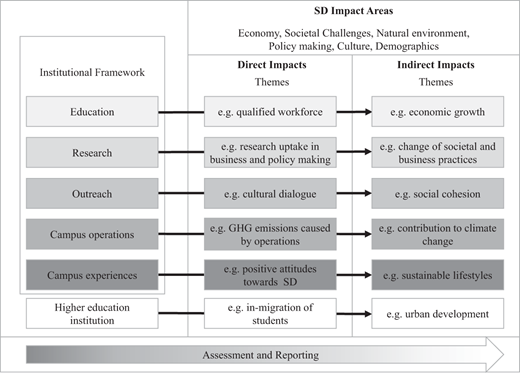
The core elements (Lozano et al., 2013b) in which different organizational and individual activities take place may cause a variety of influences on SD impact areas: economy, societal challenges, natural environment, policies, culture, and demographics. Within these impact areas, this review has resulted in a set of specific themes that further specify direct and indirect impacts on SD, which may be plausibly attributed to HEIs. Systematic and reliable assessment of the impacts of HEIs is a crucial premise for managing and improving the contribution of HEIs to SD. The framework not only highlights the assessment and reporting as a cross-cutting requirement but also identifies it as one of the fundamental challenges to more systematic consideration of impacts. This is because many assessment approaches focus on SD performance within HEIs (Yarime and Tanaka, 2012) but appear not to have been designed to assess impacts from the perspective of a whole institution approach, particularly regarding indirect impacts.
Conclusions
This paper systematically reviewed the existing literature on impacts of HEIs on SD with a view to providing an integrative conceptualization of core themes and SD impact areas. It complements previous reviews of the integration of SD issues in the context of higher education by specifically eliciting the impacts of HEIs on SD.
The SD impact framework of HEIs highlights direct and indirect impacts on SD arising from the activities of HEIs. The framework can provide a useful framing for reflecting on and mapping the potential impacts of HEIs, thereby contributing to a more holistic understanding of how HEIs affect their stakeholders, the natural environment, the economy, and society. This can help to identify and prioritize SD impact areas of HEIs.
Two major gaps in the literature provide ample space for future research in this rapidly evolving field of inquiry. First, more research with a holistic perspective that considers the impacts of all core elements would be a fruitful addition to the many in-depth case studies available. This would allow for a comprehensive understanding of the impacts of HEIs on SD. Such a whole institution approach would also help identify impact areas and stakeholder groups that are currently underrepresented in the literature. For instance, cultural impacts and impacts on policy, social cohesion, individual behavior and life paths of alumni are currently underexplored and merit further attention. Second, the lack of holistic assessment approaches for the impacts of HEIs on SD offers a major avenue for future research. Existing sustainability assessment tools in higher education could be analyzed regarding their ability to effectively examine the direct and indirect impacts of HEIs on SD. Given the difficulty of quantifying long-term indirect impacts, it might be of interest to explore how far qualitative approaches that use narratives can capture impacts that are difficult to measure with quantitative indicators.

