

Purpose
Transformative learning and leadership are key leverage points for supporting society’s transition towards sustainability. The purpose of this study was to identify the outcomes of transformational learning within an international sustainability leadership master’s program in Sweden. The study also prototypes a typology for transformative learning (TTL) in the context of sustainability leadership education.
Design/methodology/approach
Alumni spanning 15 cohorts provided answers to a survey, and the responses were used to identify the outcomes of the program. Graduates were asked to describe what transformed for them through the program. Empirical data was coded prototyping the use of the TTL in sustainability education context.
Findings
Graduates of the Master’s in Strategic Leadership towards Sustainability program, described transformation with regards to their Self-in-relation to Others and the World, their Self-knowledge, sense of Empowerment/Responsibility; their Worldview became More Comprehensive or Complex, and they gained New Awareness/New Understandings which transformed their Worldview. Many described transformations in their general Ways of Being in the world. Findings suggest the TTL learning as a good basis for analysis in the education for sustainable development (ESD) context. Suggestions for the TTL include further development of the process that articulates the relational, interdependent and perhaps a priori relationships between elements that transform.
Research limitations/implications
This study presents the outcomes of transformational learning within an international sustainability leadership master’s program. It prototypes the use of a TTL within the ESD context using empirical data. This combination provides practical insights to a dynamic, often theoretical and hard to articulate process.
Originality/value
This study presents the outcomes of transformational learning within an international sustainability leadership master’s program. It prototypes the use of a TTL in the ESD context and assesses the outcomes of a sustainability leadership program using empirical data. This combination provides practical insights to a dynamic, often theoretical and hard to articulate process.
1. Introduction
The aims laid down in political commitments such as the sustainable development goals (SDGs) require nothing less than a transformation in all aspects of our society. The transformation required is extensive and rapid, including the systems, structures, institutions, worldviews and beliefs underpinning many of our sustainability challenges (Fazey et al., 2018). The change will require social learning in its broadest sense (Barth and Michelsen, 2013), and education is a key leverage point (UNESCO et al., 2020). Yet, within many current political agendas, the role of education is reduced to filling gaps in the job market by teaching existing knowledge and skills. This is considered a transmission style of education (Freire, 2000; Papenfuss et al., 2019). Although there is no doubt of the value of this kind of education, many also question reducing education to pre-existing and pre-determined jobs for a society that is not sustainable (Lotz-Sisitka et al., 2015; Wals and Jickling, 2002). Much of current higher education perpetuates our social and environmental problems and does not educate graduates for a sustainable future nor question the current status quo of power relations that have contributed to creating these challenges (Boström et al., 2018; Macintyre et al., 2020). Futurists and critical pedagogy academics also question the notion of education for a pre-determined (singular) future and instead use the plural of “futures” (Craft et al., 2013; Inayatullah, 1998). This pluralist notion of possible futures points to our agency in shaping and creating that future and not just reproducing the inequalities and power relations of the present and the past (Facer, 2013). This is an essential starting point for us as a society if we are to hope to educate graduates capable of leading us towards a more sustainable future.
The commitment to creating a sustainable future is a values-based one. If we accept this normative stance and are keen to address the sustainability challenge, we can derive the necessity of certain leadership characteristics from the nature of these challenges. For example, they are often described as complex or “wicked”, and the ability to collaborate with others will more likely help us navigating this complexity and find better solutions. Research within Education for Sustainable Development suggests that the kind of education required to help us face these challenges needs to support students to become capable of more: more complex perspectives, systems thinking, becoming better collaborators and emotionally holding more (Brundiers et al., 2021; Brundiers and Wiek, 2017). Research within the field of education for sustainable development (ESD) has been working on identifying the competencies required for sustainability graduates to be able to do the work of sustainability change agents (Brundiers et al., 2021; Wiek et al., 2011). More recent studies have added to the understanding of these competencies in a real-world context (Venn et al., 2022), and others are focusing on the “inner work” of sustainability competence development and aiming to articulate the Intrapersonal skills required to do this work of sustainability change agents (Frank, 2021; Wamsler, 2020).
The field of ESD focuses on building an individual’s capacity to lead this change and has embraced the move towards transformational (or transformative) and emancipatory education that shifts students’ perspective (Papenfuss et al., 2019; Rodríguez Aboytes and Barth, 2020). Education that has the ability to build an individual’s agency to shape a society’s future is captured in various theories, such as Freire’s emancipatory education (2000), theories of Adult Development such as Kegan’s (1983), vertical literacy described by Scharmer (2019), the concept of Bildung (Vásquez-Levy, 2002) as well as transformative learning (TL) theory by Mezirow (1997). Built upon the constructivist theories of Habermas, Kuhn and Freire, TL theory aims to create conditions that promote mindsets, worldviews, capacities and competencies that can help people bring forth the systems change required for sustainability (Rodríguez Aboytes and Barth, 2020). TL encourages individuals to undergo transformation to lead change for sustainability and have an impact on the world around them (Taylor, 2007) and does this by encouraging individuals to reconsider their assumptions and relationships to others and the world, resulting in social action and adoption of new behaviours (Hoggan, 2016). Although focusing on the individual level, this capacity of individuals to work collectively and collaboratively towards making change is often presented with TL in ESD and is often mentioned in tandem with the concepts of social learning – that we learn with, through and from each other (Rodríguez Aboytes and Barth, 2020).
1.1 What transforms?
Being able to assess the outcomes of individual transformation and the impact on the external environment remains an important area for TL research. By outcomes, we mean what the learner is capable of doing and thinking by the end of the learning period, in short, the results of the transformational learning process (Rodríguez Aboytes and Barth, 2020). This echoed a still unanswered critique of TL by adult development psychologist Kegan when he asked what the “form” was that actually transforms (Illeris, 2014). Hoggan (2016) argues that the description of the form (or outcomes of individual transformation) is often narrowly understood as an epistemic shift that places a skewed emphasis on only one aspect of a multifaceted phenomenon: “Does it mean that they have changed their habits of mind as to make them inclusive, discriminating, and so forth, as Mezirow described? Or are there other types of change that scholars are claiming is also transformative?” (Hoggan, 2016, p. 16).
The desire to assess these “outcomes” has led to the creation of a number of examination methodologies and assessment surveys (Cox, 2017; Stuckey et al., 2013; Taylor and Cranton, 2012). Consensus among these assessments remain limited by the different definitions of outcomes; thus, outcomes of TL remain an emerging field of study. Yet, it is arguably of great importance to understand and be able to assess what actually transforms to effectively use transformational learning approaches, especially within ESD given the urgency of the transformation.
Although not in the ESD context, a review done by Hoggan (2016) synthesizes TL outcomes into a suggested typology for transformative learning (TTL) in the hope of offering future scholars the ability to investigate outcomes of TL experiences and answer the question of what happens as a result of the experience, that is, what form in the individual transforms? This typology can be seen in Table 1, with the six themes, which comprise various sub-themes. The themes are Worldview (way of seeing/understanding the world); Self (understanding/experiencing the Self); Epistemology (how do you create knowledge/know what is true); Ontology (Way of Being in the world); Behaviour (what you do and act upon); and Capacity (your capacity or competence to act in the world).
Typology of transformative learning themes and codes (Hoggan 2016, p. 70)
| Themes | Codes (or sub-themes) |
|---|---|
| Worldview | Assumptions, Beliefs, Values, Expectations |
| Ways of Interpreting Experience | |
| More Comprehensive or Complex Worldview | |
| New Awareness/New Understandings | |
| Self | Self-in-relation to Others/World |
| Identity/View of Self | |
| Empowerment/Responsibility | |
| Self-knowledge | |
| Personal Narrative | |
| Meaning/Purpose | |
| Personality | |
| Epistemology | More Discriminating |
| Using Extra-rational Ways of Knowing | |
| More Open | |
| Shift in Thoughts and Ways of Thinking | |
| Autonomous | |
| More Complex Thinking | |
| Ontology | Affective Experience of Life |
| Ways of Being | |
| Attributes | |
| Behaviour | Actions Consistent with New Perspective |
| Social Action | |
| Behaviour | |
| Skills | |
| Capacity | Cognitive Development |
| Consciousness | |
| Spirituality |
Within ESD, Rodríguez Aboytes and Barth (2020) conducted a systematic literature review of TL in ESD and unearthed the following outcomes within the literature:
increase of new knowledge and practical skills;
reconstruction of values, norms and perspectives;
increase in the sense of self-awareness, agency and empowerment;
development of critical, systems and complex thinking; and
social learning (reinforcement of social relationships, social mobilization and activism) (Rodríguez Aboytes and Barth, 2020, p. 1001).
This review of TL within ESD does a thorough investigation of the literature, yet the outcomes presented do not and are not intended to provide an assessment typology for use in empirical studies. It is within these fields of study that this study aims to contribute to.
1.2 Aim of this study
The essential components of the transformational learning experience, meaning the pedagogies, as well as the social and environmental conditions that encourage the transformation for the graduates of the Master’s in Strategic Leadership towards Sustainability (MSLS) Program used in this study are presented in Bryant et al. (2021). The aim of the study presented here is to identify the outcomes of this transformational experience for graduates of the sustainability leadership master’s program. The research question guiding this study is:
What transforms for participants in the MSLS program?
In answering this question, the authors prototype the use of a TTL (Hoggan, 2016) and aim to contribute insight to the field of assessment for transformational ESD learning. Justification for this choice is provided in Section 2.3.
2. Methods
A case study approach of a Master’s Program based in Karlskrona, Sweden is adopted. In this section, we will outline the methods used.
2.1 Description of the program
The MSLS program is a 10-month, cohort-based, international, transdisciplinary program that has been running since 2004 and currently has about 800 alumni from over 80 countries. Each year the class comprises 40–60 self-identified sustainability leaders from across the globe and from many educational, professional and cultural backgrounds. It is one of the oldest sustainability leadership master’s programs and Trencher et al. (2018) identified it as one of 14 best practice programs worthy of study globally. In addition, a previous study found that 91.7% of alumni surveyed stated that the program was transformational for them and identified the essential components that have created the transformational experience for many of the students (Bryant et al., 2021). The alumni operate across a range of sustainability-related disciplines and vocations, and their roles range from corporate sustainability positions to facilitation, consultation and educational work that consider social and ecological sustainability contexts. While tracking all alumni is difficult, a map of their LinkedIn profiles reveals that at least 50% of the alumni work in change agent roles in sustainability, although anecdotally, the number is probably closer to 80%. The survey revealed that more than 90% of graduates found meaningful sustainability change work within two years of graduation, 37% even within two months. As the two first program managers Waldron and Leung (2009) write, “our goal is to provide a learning experience that helps promote and develop a global network of leaders, or ‘change agents’ for sustainability. We want our graduates capable of a whole systems perspective, a scientifically relevant world view, and a structured, strategic approach to decision making when it comes to sustainable development. In addition, we want them to act as leaders which means being able to engage others in collective change efforts – to tap into the collective creativity and innovation that will be necessary for the changes ahead (p. 309)”. The foundation for these two major themes is today provided by two courses: strategic sustainable development (SSD) and leading in complexity (LiC). The themes are integrated with each other and also permeate the other courses in the program. Examples of concepts and content within the SSD course are scientific foundations for ecological and social sustainability, systems and complexity thinking, a strategic approach to Sustainable Development and various tools and approaches to sustainable development, such as the SDGs and Circular Economy. Examples of concepts and content of the LiC course are: theories of organizational and systems change such as “Leverage Points” (Meadows, 1999) and “Theory U” (Scharmer, 2007); facilitation and hosting concepts and methodologies such as “Art of Hosting” (https://artofhosting.org) and “Social Labs” (Hassan, 2014); and personal leadership concepts and development (see, e.g. Ayers et al., 2020). Both courses are grounded in an understanding that we are working in complexity, which requires a systems thinking approach, and graduates are skilled in working towards sustainability in a collaborative way. The pedagogy has always also been characterized by co-learning, meaning that students and staff learn together and from each other, inside and outside of the classroom. For more details on the program, please see Bryant et al. (2021), and the program website (www.msls.se).
2.2 Participant invitation and survey design
This research does not intend to outline the processes of transformation as this contribution has been addressed in Bryant et al. (2021), but rather the TL outcomes of the program as identified by participants. This study uses a retrospective survey to collect individual stories of transformation using open-ended questions (Stuckey et al., 2013) to understand “what transformed” within the student as a result of the program. The approach was chosen because learner self-evaluation is relevant for all types of individual transformation (Cranton and Hoggan, 2012) and “transformations tend to be recognizable in retrospect, with a learner’s perspective on self and world fundamentally altered” (Cox, 2017, p. 27).
The MSLS program has an active alumni network that was invited to partake in an 18-question survey regarding their experience of the program. The alumni network regularly interacts through a social media group, a listserv and email, which were used to communicate the survey. The researchers created a 2-min video explaining the purpose of the research and shared this on a private alumni Facebook group and sent individual written invitations by email. The survey was created on the Survey Monkey platform and was open from 21 October to 18 November 2019. The survey examined a number of program themes including the learning design and the results of this can be found in “Transformational learning for sustainability leadership – essential components in synergy” (Bryant et al., 2021). The two explicit questions regarding the transformational outcomes of the program that were used in this study were:
Was MSLS a transformational experience for you (at that moment or realized later)?
If so, in what way? If not, what was the outcome for you?
Of about 700 alumni at that time, 215 responded to the long survey, but not all answered the questions directly pertaining to this study, which left 156 survey responses to be examined by the researchers.
2.3 Coding mechanism and structures
As a theoretical basis and coding structure, this study uses the TTL developed by Hoggan (2016). The TTL emerged from a thorough systematic examination of significant TL literature and provides a useful framework for thinking about TL outcomes (Watkins, 2022). By synthesizing outcomes of TL processes, the TTL aims to address the challenge that TL cannot be evaluated in a straightforward manner and articulates a distinct set of outcomes that suggest that TL is evidenced in the difference it inspires in the lives of learners (Cranton and Hoggan, 2012). The use of a typology structure seeks to instill clarity regarding understanding about the impact of fostering TL on learner outcomes and addresses the need to know what it is we are evaluating (Cranton and Hoggan, 2012). To be able to use the TTL within the ESD context, the Authors have aligned the TTL with the outcomes of Rodríguez Aboytes and Barth’s (2020) outcomes (Table 2).
Transformative learning outcomes in ESD matched with Hoggan’s TTL
| Outcomes from Rodríguez Aboytes and Barth | Further descriptors from text in Rodríguez Aboytes and Barth (2020 pp. 1002-1003) | Suggested matching Themes and codes from Hoggan’s (2016) Typology of Transformative Learning |
|---|---|---|
| Increase of new knowledge and practical skills | - Understanding concepts and technical information - Ability to implement environmental management practices | Worldview: New Awareness/New Understandings Behaviour: Professional Practices/Skills |
| Reconstruction of values, norms and perspectives | - More empathetic and compassionate - Move from self interest to collective concerns - More importance to environment and social justice - Gain sense of unity and interconnectedness with natural and social surroundings - Changes in life perspectives and worldviews | Ontology: Attributes; Ontology: Way of Being Worldview: Assumptions, Beliefs, Values, Norms Worldview: Assumptions, Beliefs, Values, Norms Self: Self-in-relation to Others/World Worldview: Assumptions, Beliefs, Values, Norms |
| Agency and empowerment | - Gain personal confidence - More integrated identity - Increased self-awareness - Make change in their communities and promote sustainable actions - Improved managerial related skills such as leadership and design thinking | Self: Empowerment/Responsibility Self: Identity/View of Self Self: Self knowledge Behaviour: Actions Consistent with New Perspective Behaviour: Professional Practices/Skills |
| Critical, systems and complex thinking | - See interconnectivity of cultural, economic, social and environmental systems (thus see interdisciplinary nature of sustainability problems) - Recognize social constructs and power structures | Worldview: More Comprehensive or Complex Worldview; Epistemology: More Complex Thinking; Capacity: Cognitive Development Epistemology: More Discriminating |
| Social learning | - Political action, social mobilization and activism - Promotion of sustainability in communities | Behaviour: Social Action; Self: Empowerment/Responsibility Behaviour: Social Action; Behaviour Actions Consistent with a New Perspective |
As can be seen in Table 2, the Authors propose that the TL for ESD outcomes (Rodríguez Aboytes and Barth, 2020) can be represented and aligned to the TTL, making the latter a useful theoretical basis for this study of what transforms in an ESD context.
Students’ responses to the survey’s transformational learning questions were then analysed using codes derived from the TTL and descriptions (Hoggan, 2016, pp. 70-76). Respondents were not given the TTL in advance as open-ended responses were sought, and the researchers did not want to frame or lead the respondents. The results of the student survey were imported into Atlas.ti. One researcher read through each of the responses and coded them to the TTL. A second researcher examined the preliminary results by also coding using the TTL and noted any discrepancies or differences in understanding either the data or the TTL, which created a further round of results. Discrepancies were discussed, and results were refined to the final version presented. The coding was done in an iterative process of sense-making of both the codes as presented in the TTL and the data. Examples of coding with direct quotes are provided in the results section (Table 3).
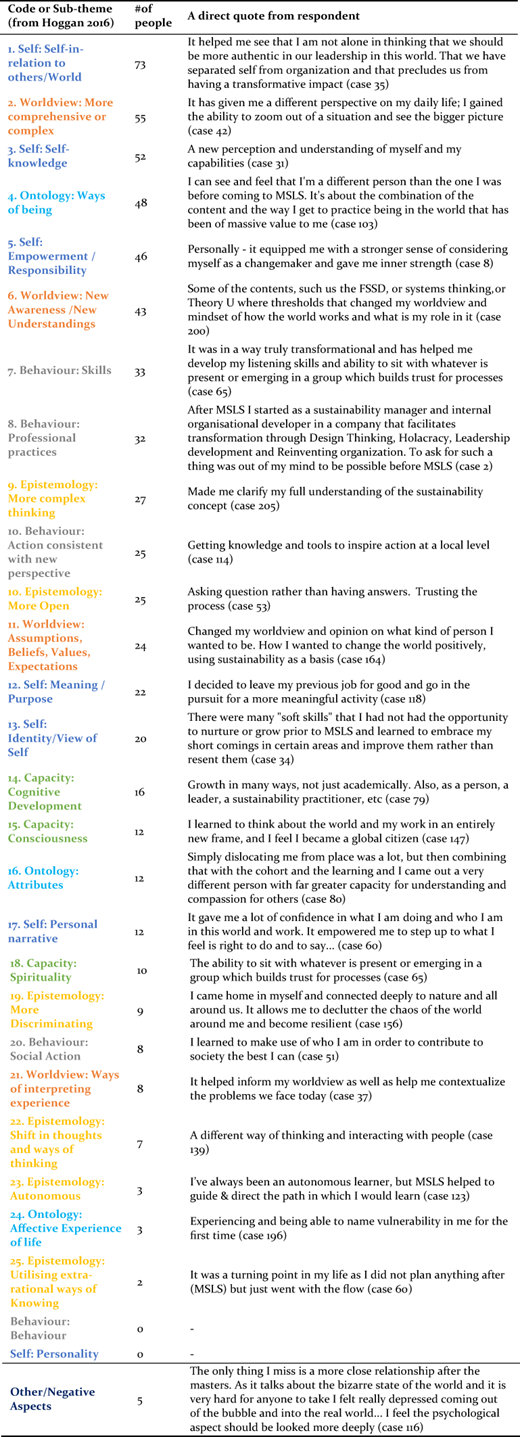
Example of coding for sub-themes with direct quotes from respondents of survey
Example of coding for sub-themes with direct quotes from respondents of survey
A key point of the TTL is the identification of Depth/Evidence of Deep Impact, Relative Stability/Evidence that Change is not Temporary and Breadth/Evidence of Impact on Multiple Life Contexts. With respect to Depth/Evidence of Deep Impact we took the graduates own self-assessment of this as confirming this data point. With regards to the Relative Stability/Evidence that Change is not Temporary we see that the fact that the survey is done in retrospect ranging from 1 to 15 years after graduation as evidence that the change (if identified as transformational) is stable over the years. The volume of data analysed also provides more dependability to the results. Breadth was not asked for directly, but certain quotes provided evidence of the impact on the change in Multiple Life Contexts; others did not. An additional code Other/Negative Aspect was added to capture responses that were addressing either the lack of longer-term transformation or other negative aspects of the transformation. This will be expanded upon in Sections 3 and 4.
2.4 Limitation of the research
There are several possible limitations of the research. These include potential bias as all Authors are alumni and staff of the program, with their own “transformational experience” of the program. While close contact with the case study can lead to bias, it can also allow for more immersion and, thus, more depth in understanding the context of answers provided and more accurate interpretation (Savin-Baden and Major, 2013). The analysis and presentation of results may be influenced by the researchers’ own experiences and pre-understandings. In analysis of the data, responses were de-linked from identifying information when imported into Atlas.ti. However, knowing the respondents and their stories personally, some of the responses could make them identifiable. This was addressed by the two researchers having the least familiarity with the alumni doing the coding as well as using double coding. To ensure integrity in the research process and maximize this benefit while minimizing bias, researchers used triangulation in the coding and a critical and reflective approach in analysing and interpreting the data as a team and making sense collectively. This process should also enhance the credibility and confirmability of the results.
Another challenge is that even though retrospective self-evaluation by learners is deemed appropriate, it does come with limitations. While objective assessment whether someone has transformed might not be as relevant as the subjective assessment (since what counts is how the learner feels), there is still no reliable way for researchers to assess the validity of the answers and respondents might, for various reasons, feel compelled to answer a certain way, e.g. because they think it is expected or because a collective narrative amongst the alumni that it was indeed transformational, makes them either want to be part of this or retroactively interpret things with this lens. In addition, the choice of survey methodology over interviews does not allow for questions of clarification or deepening to understand responses better. Given the volume of questions that were asked about the program in general, researchers were able to glean more information and some clarification, and the volume of data that could be collected with a survey was an advantage that outweighed the disadvantages. This study also does not include an evaluation of the impact of graduates in their work for sustainability transformation as the focus of this study was on the results of a transformational master’s program for sustainability leadership on the graduates at an individual level. We acknowledge the need for connecting that to tangible work of graduates on the “outside” for social transformation, but the causal nature of this is outside the scope of this study. Anecdotally, however, the job titles of graduates and the “Alumni Stories” section of the program website (Cox, 2017) provide evidence that supports the notion that the graduates of this program demonstrate positive impact in the world that contributes to sustainability.
Finally, the TTL provides written descriptions of most of the themes and codes (or sub-themes), and this was used by the Authors to code. This narrative description was not intended for this use necessarily, and some descriptions were only a few words or missing entirely, so the researchers were required to make sense between themselves on the meaning of some phrases. Double-coding was used to address challenges with the lack of detailed information on some codes as well as overlapping codes.
There are numerous approaches the authors could have chosen to provide clarity on the outcomes of the learning experience of the graduates of the MSLS program. The learning outcomes captured in the syllabus, or the sustainability competences are examples of possible choices. This study is looking at TL, and therefore, TL theory was chosen as the frame as it most accurately captures the learning environment, and the opportunity exists to contribute to the theory on the outcomes of the TL process within ESD.
3. Results
The results will be presented at the theme level. Figure 1 gives a visual overview of the results in each theme. Table 3 provides more detail on the addition of the sub-themes and provides direct quotes as examples of the results and coding for the MSLS program using the TTL. The numbers provided (when not percentages) refer to the number of respondents who mentioned a given theme or sub-theme.
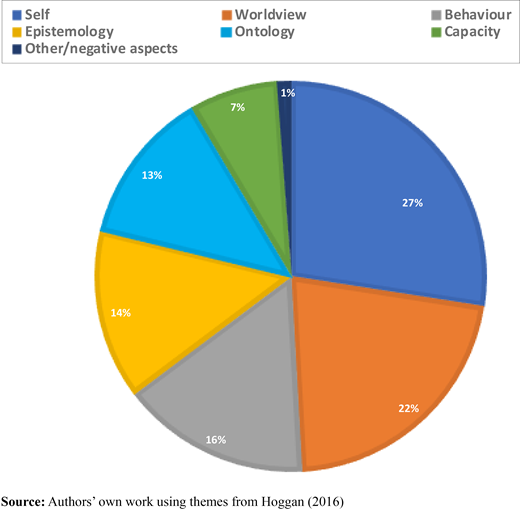
What transformed for graduates of MSLS mapped to themes of typology for transformative learning (TTL)
What transformed for graduates of MSLS mapped to themes of typology for transformative learning (TTL)
Findings indicate that the greatest outcomes of the transformational learning within MSLS were with regards to the Self (27%) followed by (worldview 22%). This is represented at both the theme level and the more refined level of analysis with 5 of the top 6 ranked sub-themes representing different aspects of Self and Worldview.
Those relating to Self:
Self: Self-in-relation to Others/World (73 people).
Self: Self-knowledge (52).
Self: Empowerment/Responsibility (46).
The sub-themes of Worldview:
Worldview: More Comprehensive or More Complex Worldview (55).
Worldview: New Awareness/New Understandings (43).
Ontology gained 13% of the total mentions with the number 4 sub-theme:
Ontology: Way of Being (48).
Behaviour (16%) was the next most represented theme with the sub-themes:
Behaviour: Skills (33).
Behaviour: Professional Practices (32).
Behaviour: Actions Consistent with New Perspective (25).
The sub-themes of Epistemology (14%) ranked 9 and 10 with:
Epistemology: More Complex Thinking (27).
Epistemology: More Open (25).
Capacity was the least represented at 7%, with:
Capacity: Cognitive Development (16).
Capacity: Consciousness (12).
Capacity: Spirituality (10).
Some of the sub-themes received few or no codes (for example, Self: Personality and Behaviour: Behaviour), which is most likely due to the lack of description in the Hoggan (2016) paper to code to. Comments relating to Other/Negative Aspects of the transformation represented 1% of the total. This is illustrated in Figure 1 and Table 3, which include direct quotes from respondents of the survey to give examples that can help provide further data of the TTL for a sustainability leadership program.
With respect to Depth/Evidence of Deep Impact we took the graduates own self-assessment of this as confirming this data point. Some direct quotes that illustrate this are: “It was the soil from which most of my core values have grown. It allowed me to create a framework for my life by having a better understanding of the world I live in and of my inner Self. I now know how I want to live my life, what kind of people I want in my life and why I want them” (case #45); and: “Changed my outlook on the world – brought many pieces together that I had been working with, studying and thinking about in disparate ways into a unified whole” (case #165).
With regards to the Relative Stability/Evidence that Change is not temporary, as mentioned above, we see retrospective aspect (for some from 1 to 15 years after graduation) as evidence. Some students, however, did speak to the fact that the change did not last after they left the MSLS bubble: “It was during the program and while living abroad, however since returning I am finding myself returning to my original thought processes” (case #189). These responses were not included in answering the question of what transformed.
Breadth was not asked for directly, but certain quotes provided evidence of the impact on the change in Multiple Life Contexts. This quote illustrates this:
I feel that MSLS changed my mindset, I was able to see beyond and to work better with complex problems. In a broader sense, it changed a lot how I see life, my role in this world, my values, relationship with nature and society (case #49); and
“I learned a lot about myself, my learning style, and my placement within groups/community. In some ways this has helped me dramatically in my personal and professional relationships” (case #61).
4. Discussion
Below we discuss what transforms for MSLS graduates and why that may matter; explore some of the negative aspects described by respondents; reflect on the use of TTL; and provide suggestions for sustainability leadership program designers for its potential use as an analytical typology of TL outcomes in the context of ESD.
4.1 What transforms for MSLS graduates and why might this matter?
The results of the MSLS alumni survey results show that what transformed for most of the graduates was their:
Self: Self-in-relation to Others/World; Self: Self-knowledge; Self: Empowerment/Responsibility.
Worldview: More Comprehensive or Complex; and Worldview: New Awareness/New Understandings.
Ontology: Ways of Being.
These will be addressed for their relevance in the MSLS context and connection to literature results of the MSLS alumni survey results show what transformed for most of the graduates.
Self: Self-in-relation to Others/World was the most common sub-theme with 73 people mentioning this as an aspect of their transformation. This includes a change in one’s relationships and a “shift in the way they related to others or to the world in general” (Hoggan, 2016, p. 71). An often reported theme in the field of TL for ESD as reflected in “[…] gain a sense of unity and interconnectedness with natural and social surroundings” (Rodríguez Aboytes and Barth, 2020, p. 1003), and the findings of this research support that. Recent literature on ESD describes the importance of a relational pedagogy or paradigm in approaching sustainability education (Walsh et al., 2020). This relational nature of the Self to others and the world is an important aspect for sustainability leaders. To address sustainability challenges, one needs to adopt a systems perspective which sees the relations between the elements of a system as essential to understanding the system as a whole and to see ourselves within that system helps us make change (Fazey et al., 2018). The pedagogies that support this must also then harness this learning. Within the MSLS program, this is done through a synergistic integration of components (Bryant et al., 2021) and other pedagogies that support this relational aspect of self-in-relation to others and the world involve reflective learning and collective dialogue (Ayers et al., 2020).
Also related to the Self: Self-knowledge refers to an increase in self-knowledge with “greater congruence between their actions and who they truly are” (Hoggan, 2016, p. 72) and was reported by 52 people. One respondent said that they graduated with “[…] a new perception and understanding of myself and my capabilities (case #31)”. This increase in Self-knowledge is reflected in other studies of TL and ESD and has an important relationship with other aspects of transformation (Rodríguez Aboytes and Barth, 2020) which we will expand upon in Section 4.3. TL within the MSLS context shows that graduates leave with a greater awareness of themselves, the world and the relationships between them. These first two elements relating to the graduates understanding of the Self is a supporting step to the development of Intrapersonal Competence – managing and regulating oneself – an essential foundation in the work of sustainability that allows change agents the ability to navigate the complex dynamics of hosting sustainability transitions (Brundiers et al., 2021).
Self: Empowerment/Responsibility is a common finding in TL literature with it being an outcome in many studies and connects to mastery over oneself and links to “issues of social justice and the emancipatory affects of learning” (Hoggan, 2016, p. 72). It was named by 46 respondents and is captured directly through responses such as: “[…] it equipped me with a stronger sense of considering myself as a changemaker and gave me inner strength (case #8)”. It is also found in the language used throughout many other responses. Within all the sub-themes in Table 3, respondents used phrases like: “I gained the ability […]”; “[…] my capabilities”; and “[…] I came out a very different person with far greater capacity for […]”. This language demonstrates confidence and empowerment underpinning many of the other transformations described, and we argue that this is a key and necessary component of a sustainability change agent, making the ability to act out various capacities more powerful and effective. The agency, empowerment and confidence to tackle sustainability challenges is one of the key capacities needed in the world (Brundiers et al., 2021; Macintyre et al., 2020). This confidence was also described with regards to the Skills and Professional Practices identified in the results:
It gave me permission to tackle social challenges in a different way. It legitimized that approach when I talked to people in power (be it in organizations, small town government, foundations, etc) because I had a degree to back it up (case #203).
Power relations are an often unexamined aspect of ESD education (Boström et al., 2018), and many are calling for the need of sustainability graduates who can and will confidently and actively challenge power structures that provide the status quo through the term transgressive learning (Cohn, 2021; Lotz-Sisitka et al., 2015). An outcome of the MSLS program for many is the agency and sense of em-power-ment to make changes needed in society. This is essential if we are to have enough change-agents able to collectively organize to transform the unsustainability of our institutional and societal structures. This agency to make change is a building block for sustainability action in the world.
There were 55 people who named Worldview: More Comprehensive or Complex Worldview as being what transformed for them through the MSLS program. This means that a learning outcome includes a person’s meaning making structures that are not just different to before but More Comprehensive or Complex, and peoples “meaning perspectives are more inclusive, discriminating, open, emotionally capable of change and reflective” (Hoggan, 2016, p. 71). This aspect of TL is a cornerstone (Hoggan, 2016) and “Critical, Systems and Complex Thinking” is a major theme found in TL for ESD (Rodríguez Aboytes and Barth, 2020, p. 1003). A more complex way of seeing the world is also cited by researchers and educators in the field of Adult Development as a marker of a leader moving into more effective ways of leading and being (McCauley et al., 2006). Creating sustainability graduates capable of seeing the complexity of the problems we are facing and tailoring responses to these problems is essential for us to move to a more sustainable world. The MSLS program’s pedagogy relies on the diversity of perspectives and collaboration, which would support the development of this expanded more complex Worldview, which in turn would support the development of a more sophisticated understanding of Self in Relation to others.
Worldview: New Awareness/New Understandings as an outcome includes awareness of “social, economic and political contradictions in society or the role that power, privilege and oppression play in people’s lives” (Hoggan, 2016, p. 71). It was mentioned by 43 respondents. This is a common finding of TL for ESD education and aligns with “Increase of New Knowledge and Practical Skills” (Rodríguez Aboytes and Barth, 2020, p. 1002). Arguably, “New Knowledge and Practical Skills” does not take in a wider and larger sense of “ways of knowing” which are captured by “New Awareness” and represents TL as an epistemic shift that places a skewed emphasis on only one aspect of a multifaceted phenomenon. Developing new awareness provides a better understanding of global problems and allows for more comprehensive responses to these challenges as a result of increased knowledge, awareness and skills. It also allows for a critical examination of business through a deepened understanding of systems and structures that perpetuate unsustainability. Critiques of TL over the years have named the focus on shifts related to the mental realm rather than other ways that may include emotional or physical shifts (Dirkx, 2012; Hoggan, 2016). Education that broadens shifts in Worldview that come from a new awareness is important in creating new futures that decolonize education and society (Macintyre et al., 2020).
Ontology: Ways of Being refers to a change in “one’s habitual tendencies and dispositions” (Hoggan, 2016, p. 74) and is a key finding in the MSLS graduates of what transformed with 48 respondents naming it. In the TL for ESD context, it possibly shows up in the “Reconstructing of Values, Norms and Perspectives” with examples of people becoming more empathetic and compassionate and moving from self-interest to more collective concerns (Rodríguez Aboytes and Barth, 2020, p. 1003). These qualities reflect a Way of Being more conducive for inclusive problem solving that moves away from perpetuating unsustainable ones.
Elements coded under Behaviour, such as Skills (33); Professional Practices (32); and Actions Consistent with a New Perspective (25), could be seen to speak to Rodríguez Aboytes and Barth’s (2020) Social Learning theme which speaks to activism and promotion of sustainability in the community. These are critical themes for sustainability leaders and indeed action in society has been a key outcome of TL and its precursors for decades (Mezirow, 1997; Freire, 2000).
4.2 Challenging aspects of transformational learning
Although the majority of respondents claimed “transformation” and positive impacts of that in their lives, there were a number who described negative consequences of this transformation or that it did not have longevity, as Hoggan (2016) would say. Engaging in education that invites the whole person into the experience and learning about the sustainability challenges will doubtless bring uncomfortable emotions and psychological aspects into the mix. Within the MSLS program, a more recent pedagogy – the Pod – a monthly small group check in with a staff member is a way that this has been attempted within the program (Ayers et al., 2020). However, there also seems to be a need to continue to support the change agents once they re-enter the outside world to uphold the longevity of the transformation.
The difficulty of maintaining the “new state” once returning home was mentioned, for one; described as follows in case #29: “I felt comfortable in this group and was the best of myself. Which I actually really miss because if you come back home it quickly changed back if you don't build your own bubble”. In case #62, “When I came back to my country, I saw by HOW much I changed […] I have had serious troubles finding a place where I felt comfortable. I needed a LOT of space for myself. Everything I heard was ‘money, profit, more, more, faster, faster’ and ‘nope, wrong, false, that’s not how it works’”. Others discussed the psychological challenges as problematic: “[…] I felt really depressed coming out of the bubble and into the real world. I felt like breaking lots of times and know that many friends had anxiety attacks. I feel the psychological aspect should be looked more deeply” (case #116). The need for TL to be desired or invited is a key ethical issue raised by Illeris (2014).
It is also worth reflecting here on the enormity of the challenges we face as society and the inevitable feeling of disempowerment one can feel when working to transform existing (power) structures. In this sense, the feeling of agency and empowerment experienced during the program can be a double-edged sword. Having experienced empowerment, one potentially feels even more constrained and thus more dis-empowered and dis-heartened to be able to create change for sustainability. Or perhaps to have at least felt empowerment at one point, and having a sense of what it is, helps one tap back into it when the time and opportunity allows. Being discontented yet knowing what being empowered feels like is a creative tension that can hold open other possible futures as opposed to the pre-determined (singular) future of the dominant power structures paradigms (Craft et al., 2013; Inayatullah, 1998). Remembering this pluralist notion of possible futures and standing for alternatives is not comfortable work, but it is an essential starting point if we are to be a part of shaping and creating alternative futures and not just reproducing the inequalities and power relations of the past (Facer, 2013).
4.3 Reflections on typology of transformative learning for ESD
As seen in Table 2, the Authors proposed that the TL for ESD outcomes (Rodríguez Aboytes and Barth, 2020) are captured in the TTL. From the experience of using the typology to code what transforms for a sustainability leadership master’s program, the Authors find it to be a good starting point for educators to identify and evaluate learning outcomes in sustainability and leadership education. The TTL provided an important and useful structure from which to code and present this research’s data and findings. It became apparent to researchers during coding that relationships between the TL outcomes described by the TTL mean they are likely linked, reliant or predicated on each other. For example, the outcome Self: Self-in-relation to Others/World defined in the TTL as “a shift in the way they (students) related to others or the world” (Hoggan, 2016, p. 71) assumes changes to how learners either see themselves (Self: Identity – View of Self) or see the world (Worldview: More Comprehensive or Complex Worldview). Further relationships present throughout the TTL, for example, if development of Epistemological outcomes, defined by Hoggan as “adopting a new way of knowing”, are achieved, does that show evidence that a developed Worldview: New Awareness/New Understanding outcome occurred also, as learners “become aware of something new […] or are struck by a new concept” (Hoggan, 2016, p. 72)? Likewise, it could be argued that the presence of Worldview: New Awareness/New Understandings in learners portrays the likelihood that an increase in Self: Self-knowledge or Capacity: Cognitive Development has occurred.
It seems likely that there are distinct relationships and connections between the TTL’s themes that remain unexplored. Developing an understanding of this could play a role in both refining the TTL but also in helping educators choose learning designs that may prioritize certain TL outcomes. While typologies by definition are meant to “relate to one another rather than be dominant or subsidiary” (Nind and Lewthwaite, 2020, p. 469), coding using the TTL highlighted the possibility that certain learning outcomes may be more significant than others (also evidenced by the number of articles on each outcome in the original literature review), and potentially have cascading effects that trigger other outcomes. Can a learner have outcomes in the Self theme without first having one’s Worldview: assumptions, beliefs, attitude and expectations challenged? Can changes in Ontology: Ways of Being described as “change of habitual tendencies and dispositions” (Hoggan, 2016 p. 74) occur without impacts to learner Behaviour? While it remains unlikely that dynamic TL experiences operate with a beginning and end outcome, it is possible that some TL outcomes carry some “weight” in their ability to impact others, and these could be focused on in design of learning environments. This may be particularly true in an ESD context where sustainability concepts for many carry epistemological leaps.
These questions are not meant to undermine the current typology but instead highlight the difficulty in homogenising a dynamic, non-linear learning experience into clearly defined boundaries. They show the need for both a more detailed description of the outcomes but also examination of their relationship to each other. Importantly, from a sustainability educational perspective, a more nuanced understanding of TL outcomes and their relationship will be integral to the design of educational environments, highlighting the potential of focusing on certain outcomes by seeing them in relationship. Mezirow spoke to the progressive nature of TL processes by articulating 10 stages, and a refined typology could potentially consider how the outcomes could represent this dynamism and progression. Just as Mezirow presented the disorienting dilemma as a crucial element of TL processes from which other outcomes relied, an updated typology could attempt to represent the TL process using its themes in progression, suggestive of a more cyclical learning process that produces numerous TL outcomes from a specific focus. For example, by cultivating Worldview: More Comprehensive or Complex Worldview outcomes through the deliberate use of diversity in classrooms (as evidence by MSLS), the related development of learners’ Self: Self-in-relation to Others/World and one’s Identity – view of self (Self) would result in direct outcome to learner experience with diversity. Furthermore, this process would create learning conditions that enhance openness (Epistemology: More Open) and discrimination (Epistemology: More Discriminating), encouraging continued learner development in a cyclical learning process.
In the Handbook of Transformative Learning, Taylor and Cranton (2012) recommend that researchers give greater attention to theoretical analyses when developing a rationale and analysing the findings of a study and pay attention to providing a critical review of related research and established theory. They also suggest that, if possible, researchers should contribute to the advancement of TL. Largely missing from empirical studies thus far, an updated TTL could provide sustainability education programs a valuable tool in being able to map and measure transformational learning outcomes in students, as well as providing educators a language to be able to assess the effectiveness of their programs in light of the subjective TL experiences. Our contribution supports this advancement through prototyping the TTL in sustainability leadership context. This paper advances descriptions at the sub-theme level of the TTL as well as discussing potential further development of the typology in an ESD context.
4.4 Transferability and future research
While the data is unique to the case study itself, the process of using the TTL and the resulting reflections and suggestions for improvement to the use of it should contribute to the transferability of the process. As pointed out above, some of the terms within the TTL were undefined, and therefore, the authors needed to add their own interpretations. This comes with implications for replicability. Having now built out the themes with rich examples and more detailed description (Table 3), this should lead to more clarity regarding the TTL, and thus, enhance replicability of future studies making use of the same design. We have used dense descriptions to facilitate this. Further research could indeed apply this in other ESD programs, as well as explore more long-term “outcomes” of the transformation for the participants of the program and the lasting impacts and effects their education has as they move back into their other professional and community contexts.
4.5 Implications for ESD educators and practitioners
The need for educators and practitioners in formal or informal educational settings to develop, design and build capacity for change agents for sustainability has never been greater. Within the ESD field, the discussion of the need for TL has become commonplace, but there remains a lack of clarity as to the outcomes of TL in general and in particular within the ESD field.
This paper suggests the TTL, first developed by Hoggan (2016), as a useful addition within the field and the possibility that educators may use it to assess TL within their programs. By using Hoggan’s (2016) framework in a sustainability context, it offers ESD educators a first step in systematizing TL outcomes for sustainability and creating an emerging but shared language that can be used by ESD educators using TL as a tool for change. While the study does not answer all of the questions regarding the role of TL in sustainability education, it does provide a valuable and needed stepping stone from which further development can occur. The practical implication is that we are moving closer to being able to assess whether an educational experience is transformational for individual students and potentially even to be able to assess from a third-party perspective in what ways students’ perception of Self, ways of thinking, etc. have transformed. This would be a valuable addition to the current use of self-reporting. This knowledge is important so that sustainability educators can test and understand which approaches do indeed lead to transformation so that we may amplify the societal transition to sustainability effectively. To be able to formalize these pedagogies in educational institutions that require robust description of their pedagogical, assessment and measurement process is essential. This has been seen in the vibrant discussion on sustainability competencies which has sought to create a robust framework that educators can use in designing and implementing sustainability education programs that leads to the acquisition of relevant competencies (Brundiers et al., 2021). One practical suggestion is thus that ESD educators use the typology to assess their pedagogy and the learning environments they create and share their results with others, thus, further refining the typology and our ability to assess what transforms.
This study provides the results of a sustainability leadership master’s degree previously described as transformational (Bryant et al., 2021). The factors that change the most during this program are the student’s understanding of their Self (who they are), their Worldview (understanding of the world) and their Ontology (Way of Being in the world). In particular, graduates described a change in their self-knowledge, the way they understood themselves in-relation-to others and their agency and empowerment to make change. Their understanding of the world grows more complex and comprehensive, and they gain new knowledge and their Way of Being in the world changes.
For further understanding of the learning environment used within this particular program, please see Bryant et al. (2021) and the program website (www.msls.se.). This combined knowledge can then allow for a mapping of how certain pedagogical approaches (might) lead to individual transformation outcomes. Were other educators and educational programs to do this, the ESD field could build a catalogue of transformational learning outcomes and their associated pedagogies. The practical implication of this would be that we could more intentionally design such transformation opportunities based on more than anecdotal evidence and thus become more effective in supporting societal transformation.
5. Conclusions
This study presents the transformational learning outcomes of a Master’s program in Sustainability Leadership. The results suggest that transformational outcomes of TL occur for the graduates of the program with significant shifts in the graduates understanding of Self, while a parallel shift emerges in the development of worldviews that can be said to be richer, more nuanced, more complex and perhaps more dynamic. The study prototypes the TTL in ESD and confirms the framework as useful framework to scaffold TL outcomes for a sustainability leadership program. It suggests an evolution of the typology to better represent the relational, interconnected process of transformational learning and proposes the need for “prioritised” TL outcomes that offer leverage points in influencing learning design for sustainability transformations. This further evolution of the TTL would enhance the ability of future studies to achieve replicability, supporting the development of a robust methodology to assess transformational learning for ESD. While important from an academic and an institutional perspective, this knowledge is also vital from a practical perspective, as it allows sustainability educators to identify and design approaches that do indeed lead to individual and support societal transformation towards sustainability.
The authors would like to thank the MSLS alumni for participation in our survey and the rich responses which helped shape this paper. We would also like to thank the anonymous reviewers who helped us continue to improve the article.

