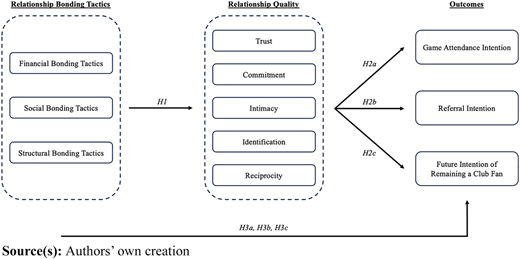
This study examines the role of relationship bonding tactics (RBT) as an antecedent of relationship quality (RQ) in the sport business context and its effect on consumption behavior intentions via RQ.
A mixed-methods approach integrating both qualitative and quantitative data was employed. Semi-structured interviews with nine marketers from Super Rugby clubs in Australia and New Zealand explored their RBT usage. An online questionnaire with 337 Super Rugby fans in these regions was analyzed using second-order structural equation modeling.
The results confirmed the reliability and validity of the RBT scale, establishing RBT as an RQ antecedent. RQ significantly influenced three consumption behavior intentions: game attendance, referral and future intention of remaining a club fan. Moreover, the indirect effect of RBT on consumption behavior intentions via RQ was confirmed.
Identifying the drivers of RQ and its mediating role on consumption behavior intentions allows marketers to allocate resources efficiently to marketing inputs, achieving organizational goals.
This study extends previous research by establishing RBT as an RQ antecedent in the sport business and clarifying its indirect effect on consumption behavior intentions via RQ.
Introduction
The growth of professional sport has led to increased sport franchises, highlighting the need for effective marketing strategies to establish loyal fan bases (Achen, 2016b). In the saturated sport industry, the success of sport organizations hinges on generating revenue by cultivating fan loyalty (Abeza et al., 2017). An effective way to achieve these goals is relationship marketing (RM), which focuses on maintaining existing customers, emphasizing establishing long-term customer relationships over short-term transactions (Abeza et al., 2020). RM promotes frequent interactions between organizations and customers, creating a competitive advantage through strong customer bonds (Gummesson, 2017). The sport industry, like the service sector, is well-suited for RM due to the significant level of personal interaction and the fan-organization exchange embedded in the product (Achen, 2014).
Previous RM research in sport management has explored three major categories: organizational perspective (e.g. RM adoption by club), consumer perspective (e.g. attitude toward relationships), and RM channels (e.g. use of the website or social media) (Abeza et al., 2019). Studies found that professional sport organizations consider RM essential, adopting various tactics to maintain customer relationships (e.g. Abeza et al., 2017; Achen, 2014, 2016a). Research has also illustrated the impact of RM on customer behavioral outcomes, examining various combinations of constructs, including trust, commitment, and satisfaction, to represent relationship quality (RQ) (Athanasopoulou, 2009). RQ is described as the overall strength and depth of a relationship between two parties (Palmatier et al., 2006). In the sport management realm, the Sport Consumer-Team Relationship Quality Scale was developed to measure this RQ (Kim et al., 2011a, b) and demonstrated that RQ positively influences attitudinal and behavioral loyalty, including word-of-mouth, stadium attendance, and merchandise consumption (e.g. Achen, 2019; Lee et al., 2020; Paek et al., 2021).
While previous studies demonstrated positive outcomes of RQ, research on its antecedents in the sport business context is limited (Whitburn et al., 2020). A few studies examined factors such as service quality, communication, team administration, and on-field performance (Lee et al., 2020) and emotional, cognitive, and behavioral motives (Paek et al., 2021) as RQ antecedents. Although studies found that these factors correlated with RQ, they did not fully capture the relational bonds between sports organizations and fans formed through RM inputs, (i.e. specific marketing practices), posing a challenge for marketers to allocate resources strategically for RM practice.
In general marketing, RM inputs are considered RQ antecedents (e.g. De Wulf et al., 2001; Morgan and Hunt, 1994). Relationship bonding tactics (RBT), consisting of three tactics: financial, social, and structural bonding tactics (Berry, 1995), have been recognized as RM input and demonstrated a positive influence on RQ (e.g. Caliskan and Esmer, 2019; Hu and Chaudhry, 2020). Considering the perceived effects of RBT on RQ in general marketing, RBT may also serve as an RQ antecedent in the sport business context, where product quality is inherently volatile and unpredictable. This study posits RBT as an RQ antecedent and examines its effect on consumption behavior intentions via RQ among professional sport fans, including game attendance, referral, and future intention of remaining a club fan. By providing a comprehensive overview of RBT as an RQ antecedent and how RQ influences fans’ behavioral intentions, this study addresses a gap in the existing literature and offers valuable insights for the sport business industry.
Conceptual background and hypothesis development
Relationship quality
The concept of RQ, presented by Crosby et al. (1990), refers to an overall evaluation of relationship strength and is conceptualized as a multidimensional construct consisting of various dimensions (Palmatier et al., 2006). In the business context, relationships are formed through “bonds”, representing psychological connections between organizations and customers (Berry, 1995). RQ reflects these bonds through perceived value from interactions and is commonly used to evaluate marketing efforts to maintain customer relationships (Magnusen et al., 2012). In the sport business context, five RQ sub-dimensions—trust, commitment, intimacy, self-connection, and reciprocity—were identified as valuable predictors of fans’ consumption behaviors (Kim et al., 2011a, b; Lee et al., 2020; Paek et al., 2021).
Trust refers to the belief that one party’s needs will be met in the future through the other party’s action (Anderson and Weitz, 1989), which is shaped by customers’ evaluation of organizations’ services or products (Garbarino and Johnson, 1999). Favorable assessments by fans elevate the quality of relationships and trust toward sport organizations, increasing future purchase intentions (Funk and James, 2006; Kim and Trail, 2011). Commitment describes the desire for a lasting valued relationship, fostering cooperative behavior (Moorman et al., 1992; Morgan and Hunt, 1994). In sport, committed fans are more likely to maintain long-term relationships with their supported organizations (Ross et al., 2006). Intimacy refers to familiarity and closeness between relationship partners (Fournier, 1998), improving communication and facilitating conflict resolution, which supports relationship continuity (Murray et al., 1996). For sport organizations, greater intimacy with fans enhances game attendance, media engagement, and merchandise purchase (Harris and Ogbonna, 2008; Kim et al., 2011a, b).
Self-connection reflects the degree to which customers identify with and express themselves through a brand, and enhanced self-connection strengthens a relational attitude and stability (Fournier, 1998). It is comparable to team identification in sport (Sternberg, 1986), capturing the psychological connection between sport organizations and fans, which drives various consumption behaviors (Kim et al., 2011a, b; Trail et al., 2005). Reciprocity is defined as “internalized beliefs and expectations about the balance of obligations in an exchange relationship” (Palmatier, 2008, p. 77), often involving the proportional return of benefits received (Gouldner, 1960). When fans feel valued and appreciated for their financial and emotional investment in sport organizations, they form a stronger rapport with organizations (Couvelaere and Richelieu, 2005; Harris and Ogbonna, 2008).
Antecedents of relationship quality: relationship bonding tactics
Past research on RM in sport marketing has focused primarily on RQ outcomes, with limited attention to its antecedents (e.g. Lee et al., 2020; Paek et al., 2021). While studies demonstrate that enhanced RQ results in favorable organizational outcomes, its determinants remain unexplored. RM studies outside of the sport context suggested RBT (e.g. Caliskan and Esmer, 2019; Hu and Chaudhry, 2020), RM tactics (e.g. Palmatier et al., 2007), or relational bonds (e.g. Berry, 1995) as RQ antecedents. Relational bonds between organizations and consumers are formed by combining the three broad categories of bonds: financial, social, and structural, all of which encourage customer dependency and commitment (Berry, 1995).
Financial bonding tactics offer pricing incentives and financial rewards to stimulate relational bonds (Berry, 1995). In sport management, examples include discount tickets, merchandise, and membership programs (Achen, 2014, 2016a). Social bonding tactics, which refer to expressing friendship or rapport and enhancing interpersonal relationships by investing time and energy (Berry, 1995), are used in sport organizations to build customer loyalty by increasing opportunities for fans to interact with teams and players (Achen, 2016a). Structural bonding tactics create value-added benefits by offering structural solutions for customers’ problems within the service delivery system (Berry, 1995). Sport organizations use them to make teams and fans equal partners and foster long-term relationships (Achen, 2016a). These three tactics must be effective in strengthening fan loyalty in the sport business.
Social Exchange Theory (SET) explains the associations between RBT and RQ. SET has been applied extensively in relationship-focused studies (e.g. Kim and Manoli, 2021; Weiner et al., 2021). SET is denoted as “a general sociological theory concerned with understanding the exchange of resources between individuals and groups in an interaction situation” (Ap, 1992, p. 668). These resources can be tangible (e.g. goods, money) or intangible (e.g. social amenities, friendship) (Blau, 1964; Homans, 1958). SET involves exchanges and interactions that produce behaviors, demonstrating that reward-seeking motivates exchanges (Emerson, 1976). Individuals evaluate relationships based on cost-benefit analyses. When the benefits of an event outweigh its costs, individuals develop favorable attitudes toward the event (Ap, 1992). The fundamental principle of SET is that relationships evolve over time, leading to trust, loyalty, and mutual commitments, and the parties maintain relationships (Cropanzano and Mitchell, 2005; Lambe et al., 2001).
In this study, the exchanges of resources occur when sports organizations conduct RBT toward fans because RBT involve tangible (e.g. free gifts, rebates) and intangible (e.g. fan interaction, special treatment) resources. Hence, fans who perceive the benefit from the exchange of resources by RBT are expected to form a positive attitude toward the RQ, promoting the following hypothesis (see Figure 1):
RBT positively influence RQ.
Outcomes of RQ: consumption behavior intentions
The analysis of RQ in the sport business is generally connected to behavioral intentions associated with sport consumption. According to the theory of reasoned action (TRA), individuals process information to reach reasonable behavioral decisions (Ajzen and Fishbein, 1980). Behavior is a function of attitude (Fishbein and Ajzen, 1975), a psychological tendency to evaluate an “object” with favor or disfavor (Eagly and Chaiken, 1993). TRA has been widely applied in attitude-behavior research, including sport-related context, demonstrating a positive correlation between attitude and behavioral intentions (e.g. Lin et al., 2020; Xiao, 2019). In this study, the object influencing fans’ rational behavioral decisions is “sport organization”. The RQ factors are critical in forming fans’ positive attitudes toward sport organizations as they create close bonds between organizations and fans, fostering attitudinal loyalty (Achen, 2019; Lee et al., 2020; Paek et al., 2021). Following TRA, fans’ higher positive RQ perception toward sport organizations leads to more positive behavioral intentions.
RQ outcomes in sport marketing research are generally gauged by organizational KPIs tied to revenue and cost metrics (Abeza et al., 2019). This study proposes three RQ outcomes linked to organizational KPIs: game attendance intention, referral intention, and future intention of remaining a club fan. Attendance intention directly impacts revenue through ticket sales and is widely used as an RQ indicator (e.g. Kim et al., 2011a, b; Paek et al., 2021). Customer referrals enhance revenue as interpersonal communication is more reliable and influential than nonpersonal promotions in customers’ decision-making (Hennig-Thurau et al., 2002). Referral intention is a common RQ outcome in sport marketing research (e.g. Achen, 2019; Lee et al., 2020). Lastly, increased retention rates of club fans positively influence revenue through repeat attendance and merchandise purchases, supporting long-term relationships (McDonald, 2010). A study demonstrated that RQ predicts intentions to remain a club fan (Lee et al., 2020). Summarizing the above, the following hypotheses are presented:
RQ positively influences game attendance intention.
RQ positively influences referral intention.
RQ positively influences future intention of remaining a club fan.
Mediator role of relationship quality between relationship bonding tactics and consumption behavior intentions
RQ represents a customer’s trust and commitment toward a seller’s future performance (Crosby et al., 1990). According to the commitment-trust theory, trust and commitment are shaped by various antecedents (e.g. communication, shared value), leading to several outcomes (e.g. loyalty, cooperation, financial performance), and RQ serves as a mediator in the RM model (Hennig-Thurau et al., 2002; Morgan and Hunt, 1994).
Research in sport marketing also supports the mediating role of trust and commitment. When individuals perceive trust and commitment, these variables influence behavioral intentions such as attendance or event support (Magnusen et al., 2012; Zhang et al., 2020). The study on fans’ engagement with their favorite teams on Facebook revealed that such engagement indirectly affects purchase intentions via RQ (Achen, 2016b, 2019). RQ is also confirmed to mediate the relationship between emotional motives and behavioral intentions (Paek et al., 2021). Based on the literature, RQ is expected to mediate the relationship between RBT and consumption behavior intentions, leading to the following hypothesis:
RQ mediates the relationship between RBT and game attendance intention.
RQ mediates the relationship between RBT and referral intention.
RQ mediates the relationship between RBT and the future intention of remaining a club fan.
Methods
Scale development
A mixed-method design, including both semi-structured interviews and questionnaire surveys, was employed in this study. Since no existing RBT scales were available in sport marketing research, scales were developed by reviewing the literature and conducting interviews with sport marketing experts. First, RBT scales were drawn from existing literature on various industries (e.g. Caliskan and Esmer, 2019; Chen and Chiu, 2009; Lin and Chung, 2013). Then, nine marketers from Super Rugby clubs in Australia and New Zealand were interviewed about current RBT usage. These interviews aimed to develop the RBT scale in the sport marketing field, aligning the RBT scales in the general marketing field. These clubs were selected for the interview due to their active implementation of RBT for fan retention. Based on the qualitative interview data, existing RBT scales were carefully modified to fit the sport marketing context (see “Modified Items” in Appendix). Before collecting quantitative data, the revised RBT scales were evaluated by three sport marketing researchers for alignment with three constructs and compared to the original scales. Consequently, five items for financial bonding, five for social bonding, and six for structural bonding tactics were finalized (see the “Revised Items” in Appendix).
To measure RQ, the scale developed by Kim et al. (2011a, b), including five constructs (i.e. trust, commitment, intimacy, identification, and reciprocity), was adopted. This scale has demonstrated good psychometric properties such as convergent and discriminant validity and construct reliability in previous sport marketing research (e.g. Achen, 2016b, 2019; Paek et al., 2021). For outcome variables, attendance intention (Paek et al., 2021), referral intention, and future intention of remaining a club fan (Lee et al., 2020) were adopted. All items were rated on a 7-point Likert scale ranging from 1 (strongly disagree) to 7 (strongly agree).
Data collection and samples
For quantitative data collection, an online survey was conducted with Super Rugby fans, an international professional rugby competition established in 1996. The competition includes 11 clubs from Australia, New Zealand, and Fiji. It is considered the world’s premier rugby league, attracting top-tier players from prominent rugby-playing nations (SANZAAR, 2024). Despite its prestigious status, Super Rugby has undergone frequent format changes, including expansions and contractions, highlighting its struggle to retain attendance over the past decades. Given this background, the authors considered Super Rugby clubs as a suitable research context, as they have been compelled to adopt RBT to maintain their existing fans. The survey targeted Australian and New Zealand fans aged 18 and above who met the criteria of having physically attended games in stadiums within a year. Samples were recruited via Qualtrics and asked about three RBT factors, five QR factors, three outcome variables, and demographics. Of the 360 initial samples, 23 incomplete samples were excluded, leaving 337 valid samples. Respondents were nearly evenly split between New Zealand (50.1%) and Australia (49.9%). Females comprised 74.5%, and males 25.5%, with ages ranging from 18 to over 60. 32% were aged 18–24, 36.5% were 25–34, and 21% were 35–54. Regarding fanship duration, 35.9% had been fans for less than three years, 31.5% for 4–6 years, and 32.6% for over seven years. Additionally, 54.3% attended games 1–5 times yearly, and 72.5% watched games through media (e.g. TV, PC, smartphone) more than four times yearly.
Data analysis
To test the hypothesized research model, confirmatory factor analysis (CFA) and structural equation modeling (SEM) were conducted using SPSS 26 and Amos 26. Given the multidimensional nature of RBT and RQ constructs, a hierarchical construct model was employed. First, CFA tested the structural properties of the proposed RBT and RQ sub-constructs in the measurement model, followed by second-order SEM. Finally, the bootstrapping method was adopted to examine the mediating role of RQ between RBT and consumption behavior intentions, evaluating the statistical significance of indirect and direct effects (Zhao et al., 2010).
Results
Measurement model
CFA demonstrated a good model fit (χ2/df = 2.17, p < 0.001; CFI = 0.940; TLI = 0.928; RMSEA = 0.059; SRMR = 0.038), meeting recommended criteria (Hu and Bentler, 1999). To assess internal consistency reliability and convergent validity for the measurement model, Cronbach’s alpha, composite reliability (CR), average variance extracted (AVE), and factor loadings (λ) were evaluated. Three items (Fin1, Soc5, Str6) were eliminated due to cross or low loading to ensure convergent validity. Post-removal, Cronbach’s alpha exceeded 0.70 (Kaplan and Saccuzzo, 2005), and all factors met the requirements of the model evaluation criteria (CR ≧ 0.70, Hair et al., 2010; AVE ≧ 0.50, Fornell and Larcker, 1981; λ≧ 0.60, McDonald, 1978) (see Table 1). Discriminant validity was tested by comparing AVE with the squared correlations among the constructs (Fornell and Larcker, 1981). The squared correlations of three factors (Financial bonding tactics – Social bonding tactics, Financial bonding tactics – Structural bonding tactics, and Social bonding tactics – Structural bonding tactics) exceeded the AVE, which did not fully confirm the validity (see Table 2). Therefore, following Anderson and Gerbing’s (1988) approach, discriminant validity was determined by constraining the estimated correlation parameters between each pair of constructs to 1.0 and then performing a chi-square difference test on the values obtained for the constrained and unconstrained models. All χ2 differences were significant (p < 0.05), confirming the discriminant validity of all constructs (see Table 3).
To validate the second-order model, the second-order component should have a significant association (p < 0.005), and R2 of each dimension of the first-order models should be greater than 0.5 (Hair et al., 2014). The model demonstrated the significant relationships (p < 0.001) between the two second-order constructs (RBT and RQ) and all their dimensions, and R2 of the three dimensions of RBT construct ranged from 0.938 to 0.983, and R2 of the five dimensions of RQ ranged from 0.683 to 0.880. The analysis of correlations among second-order factors demonstrated that this association remained below 0.85 (see Table 4). This suggested that excessive multicollinearity (or singularity of relationships) was not a concern with respect to the data (Kline, 2005). The authors, therefore, concluded that items measuring RBT performed well.
Hypothesized model
The structural model tested the hypotheses of this study. The result demonstrated an acceptable fit: χ2/df = 2.32, p < 0.001; CFI = 0.923; TLI = 0.913; RMSEA = 0.063; SRMR = 0.051. As shown in Table 5, the path coefficient from RBT to RQ was positive and significant (β = 0.70, p < 0.001), supporting hypothesis 1. RQ had significant and positive associations with game attendance intention (β = 0.75, p < 0.001), referral intention (β = 0.78, p < 0.001), and future intention of remaining a club fan (β = 0.80, p < 0.001), supporting hypotheses 2a, 2b, and 2c.
The indirect effects of RBT on three outcome factors via RQ were analyzed. The bootstrap method was used to calculate 95% confidence intervals for direct and indirect effects among factors by repeating the sampling 5,000 times from the original data (Preacher and Hayes, 2008). As shown in Table 6, the mediated paths from RBT through RQ to game attendance intention (β = 0.53, p < 0.001), referral intention (β = 0.55, p < 0.001), and future intention of remaining a club fan (β = 0.56, p < 0.001) were all significant and positive, demonstrating full mediation. Lastly, how well the hypothesized model explained the variance in the endogenous variables was tested. The coefficients of determination (R2) for game attendance intention, referral intention, and future intention of remaining a club fan demonstrated 0.53, 0.59, and 0.56, respectively.
Discussion
This study investigated factors enabling sport fans to strengthen bonds and relationships with sport organizations. Specifically, the study examined the sport business-specific RBT scale as an antecedent of RQ and how RBT influences consumption behavior intentions, including the mediating role of RQ. The findings indicated that financial, social, and structural bonding tactics constituted RBT components in the sport business context, having a significant and positive relationship with RQ. This is consistent with findings from non-sport business studies where financial, social, and structural bonds fostered dependency and commitment in consumer relationships (e.g. Caliskan and Esmer, 2019; Chen and Chiu, 2009; Lin and Chung, 2013). Furthermore, in line with existing sport management literature (e.g. Lee et al., 2020; Paek et al., 2021), the results confirmed that RQ positively influenced behavioral intentions, including game attendance, referral, and future intentions of remaining a club fan. Additionally, consistent with prior research (e.g. Magnusen et al., 2012; Zhang et al., 2020), the study demonstrated that RQ mediates the relationship between RBT and behavioral intentions, with a full mediation effect observed. These results provide valuable theoretical insight and practical applications.
Theoretical implication
Research on RM in sport management has primarily focused on measuring RQ outcomes, with limited attention to RQ antecedents (e.g. Lee et al., 2020; Paek et al., 2021). In response, this study developed and validated sport business-specific RBT scale as an RQ antecedent, demonstrating its effectiveness in enhancing fans’ RQ. The primary contribution of this study lies in addressing a gap in the existing literature by identifying a specific marketing practice, RBT, as an RQ antecedent. The sport business-specific RBT scale developed here provides a tool for future sport marketing research.
Second, this study enriches SET literature on RM. Conceptualizing RBT as a resource exchange of tangible and intangible assets in SET (Blau, 1964; Homans, 1958), this study examined how resource exchange impacts RQ. Structural equation modeling revealed a significant positive relationship between RBT and fans’ RQ, aligning with previous research that financial, social, and structural bonds promote dependency and commitment in consumer relationships (e.g. Kim and Manoli, 2021; Weiner et al., 2021). As SET suggests, rational fans evaluate rewards from resource exchange, form positive attitudes, and maintain relationships with sport organizations if they are satisfied with rewards. These results support the concept of reward-seeking in SET and justify further application of SET in research on relationship-building between sport organizations and fans.
Third, this study contributes to TRA and behavioral intention literature in the context of sport business. Consistent with the theoretical framework of TRA (Ajzen and Fishbein, 1980), the findings confirmed that RQ, a crucial factor in forming fans’ positive attitudes toward sports organizations, influenced behavioral intentions. This aligns with existing empirical research (e.g. Achen, 2019; Lee et al., 2020; Paek et al., 2021), supporting the applicability of TRA in sport marketing studies.
Lastly, this study empirically confirmed the mediating role of RQ in the relationship between RBT and behavioral intentions, as posited by commitment-trust theory, revealing a full mediation effect. This finding demonstrated that RBT did not directly influence fans’ behavioral intentions. Instead, they were mediated by fans’ trust and favorable attitudes enhanced over time by RBT, which in turn stimulated behavioral intentions. This suggests the importance of leveraging RBT to strengthen fan relationships and recommends more relationship-based marketing practices. Moreover, the findings indicated that it requires a certain time before RBT enhances RQ and behavioral intentions.
Practical implications
This study highlights the importance of RBT and RQ in managing customer-focused outcomes. Identifying RQ drivers among sports fans enables marketers to allocate resources strategically for RBT rather than obscure approaches.
From a practical perspective, several strategies can be applied to financial bonding tactics. As suggested in previous studies (Berry, 1995), pricing incentives and financial rewards (e.g. free gifts, point system, rebates) can strengthen customer bonds. Examples include stadium giveaways (e.g. team merchandise or uniform distribution), membership or loyalty programs, or rebate offers in various transactions. Additionally, findings suggest that fans perceive timesaving services as rewards. This can be interpreted as providing fast passes for stadium entry and concession or pre-sales and priority sales to secure tickets, seats, or merchandise, effective enhancing customer bonds.
Consistent with previous research, interactions between organizations and fans are effective for social bonding tactics (Achen, 2016a). A clear focus should be placed on continuous communication with fans (e.g. phone calls, e-mail, SNS), showing concern by soliciting fans’ feedback (e.g. customer surveys), and providing special treatment for fans (e.g. birthday greetings, seat upgrades, honoring longtime season ticket holders). Marketers can utilize SNS to engage in two-way interactions with fans, positively influencing fans’ perceptions (Baena, 2016; Ioakimidis, 2010). These tactics make fans feel valued and appreciated (Kitchin, 2006). If sports organizations devote time and resources and provide the highest possible interaction quality, in return, fans express their financial and emotional commitment (Couvelaere and Richelieu, 2005; Harris and Ogbonna, 2008).
Finally, several suggestions can be made for the structural bonding tactics. Marketers should respond to fans’ needs by offering customized or personalized products and services (e.g. ticket or membership options, types of events) and work for fans’ convenience by providing varied transaction methods (e.g. online sales, cashless payments). It is also important to provide innovative products and services (e.g. seating options, game day entertainment or activities, diverse concessions or merchandise) tailored to fans’ interests. When addressing fans’ complaints, organizations should be responsive and engage in long-term customer services, showing their commitment (e.g. in-season follow-up calls, season-end greetings). Also, prompt responses are equally important. Lastly, marketers should use multiple channels (e.g. SNS, websites, Direct Mail) to provide timely, up-to-date, and detailed information based on fans’ needs (e.g. relevant tickets, services, events, merchandise) to ensure they are not disadvantaged. These proactive approaches and service delivery systems resolve customers’ dissatisfaction and build trust and loyalty (Berry, 1995). Furthermore, as the mediation effect suggests, RBT do not directly drive behavioral intentions but strengthens RQ over time, which subsequently influences behavioral intentions. Marketers must understand the gradual nature of relationship building and consistently implement RBT to achieve desired outcomes.
Overall, these proposed RBT, leveraging tangible and intangible resources under marketers’ direct control, provide actionable insights to enhance RQ and contribute to RM success.
Limitations and future research
Like any research, this study has certain limitations. First, as a cross-sectional study focusing solely on rugby fans and measured results at a single point, the findings are limited to this context. Further research should examine different sports, countries, and cultural contexts, adopting longitudinal designs for greater insight. Second, the online convenience sampling method may introduce sample bias. The proportion of female samples in this study is relatively high compared to the general rugby fan population, potentially skewing predictions of fans’ behavior and intentions and diminishing generalizability (Remler and Van Ryzin, 2021). Future studies should consider in-person surveys or quota sampling for broader representation. Third, as this study focused on developing the RBT in the sport business context, the RBT was tested as a second-order factor. Future studies should explore relationships between first-order RBT factors, RQ, and behavioral intentions to present more detailed insights. Fourth, this study solely applied RBT as an RQ antecedent. However, previous research suggests that other factors, such as emotional motives (Paek et al., 2021), team administration, or on-field performance (Lee et al., 2020), also influence RQ. Future research should integrate these factors with marketing inputs for a more comprehensive understanding. Lastly, this study did not investigate interactions among RQ-related factors, such as relationship duration. Previous research suggests that long-term relationships with organizations may influence customers’ evaluation of the value of exchange (Finch et al., 2015). Future research should investigate this potential moderator to better understand the relationships between RBT and RQ and refine current theories.
Funding: This research was funded by Grant-in-Aid for Scientific Research (C) of the Japan Society for the Promotion of Science (JSPS KAKENHI Grant Number 21K01776).
References
Appendix
(Table A1)