


This study explores the effect of video assistant referee (VAR) sponsorship on spectator response and compares it with advertising and conventional sponsorship.
An experiment with 809 subjects is conducted by analyzing 20 one-minute video clip stimuli from a Premier League soccer game divided into four formats: two formats of VAR sponsorship, advertising, and conventional sponsorship.
The results show that the indicators of recall, credibility, and perceived congruence improve when the VAR sponsorship format is used.
This is the first manuscript to examine the effectiveness of a new type of sponsorship: VAR sponsorship. This manuscript provides metrics that will guide practitioners on whether to use this type of sponsorship.
1. Introduction
Sports event sponsorship is an effective way for companies to test innovative ideas, increase sales, and improve their image (Miragaia et al., 2017). Innovation is necessary because of the growing sponsorship and promotional disorder drowns out several key messages (O’Reilly and Lafrance Horning, 2013). Tjønndal defines innovation in the sports sector as “… new ideas and changes to sport organizations, coaching, sports events, performance, and new competitive advantages ” (2017, p. 292). However, academics agree that there is still a paucity of research on sports innovation (Ratten, 2016).
The integration of digital technology can be decisive in innovation of sports sponsorship strategies (Koronios et al., 2020). One of the most innovative and technological actions in sports sponsorship could be the sponsorship of the video assistant referee (VAR), which soccer leagues with the largest budgets in Europe and official championships offer live during matches. The VAR allows the review of certain plays that are subject to refereeing errors by using cameras with monitors in an external room. Officially introduced in 2018 as an innovation in this discipline (Tjønndal, 2017, p. 292), the VAR is now being used in major international soccer leagues and competitions, such as the Premier League, La Liga de España, the Italian Serie A, the Europa League, and the FIFA World Cup. Unlike the Hawk-Eye (registered patent) implemented in some tennis or rugby tournaments (which uses a computer system to calculate a trajectory based on triangulation), the VAR uses recording that can be viewed from different angles, paused, and played in slow motion; the technology is intended to help referees make better decisions, which would give the VAR (similar to a brand) a certain personality, such as fairness, equity, or balance.
Research on the implementation of new technologies or new ways and contexts of sponsorship application is insufficient. The exceptions, according to us, are studies on social networks (Phua et al., 2018) and leverage (Weeks et al., 2008a). Authors such as Lin and Bruning (2020) consider it necessary to introduce into the sponsorship research agenda the differences between categories and subcategories, as well as the new sponsorship mechanisms and their congruence, which in the new contexts can influence the results. According to Ratten (2016), there is still a lack of research on the sports industry, especially on sports sponsorships innovation. From a managerial point of view, sponsorship is still managed using an inflexible approach that detracts from communication effectiveness and events occurring during matches (Breuer et al., 2021a, b). One such unpredictable event is the use of VAR. This sponsorship activation goes beyond simple one-way advertising and can become a real-time campaign.
This study examines the effectiveness of sponsoring VAR compared to sponsoring the event property and advertising. We propose that VAR sponsorship will have an advantage because of its novelty and capacity to generate emotions and excitement.
The main research question is: does sponsoring the VAR have a different consumer response outcome than advertising and competition sponsorship? This study explores the effectiveness of VAR sponsorship on spectators versus advertising and conventional sponsorship based on sponsorship congruency. Although this study has a markedly exploratory character, it offers at least two unique contributions: (1) it provides indicators of the effectiveness of two innovative formats for VAR sponsorship, and (2) it compares them with advertising and sponsorship formats.
2. Conceptual framework
Recently, sports sponsorship has attracted interest from academics and private investments (Lin and Bruning, 2020; Peluso et al., 2019) because of its advantages over other techniques (Cheong et al., 2019). While the ability of sponsorship to create brand and image awareness is similar to that demonstrated by advertising (Cornwell, 2019), it has a greater capacity to connect with individuals (Meenaghan and O’Sullivan, 2001). However, few sponsors are displayed during an event, and the opportunity to activate the association or move support to the property or team is scarce (Henderson et al., 2019). It is, therefore, necessary to increase sponsorship success (Alonso Dos Santos et al., 2019). We rely on the mere-exposure and congruence theories to support the idea that viewers may vary their attention (and consequently their behavior) depending on the communication characteristics of a particular format, and the type of relationship or fit between the sponsor and the sponsored property.
According to the mere exposure theory, an individual’s preference for a brand will increase to the extent that the individual is exposed to the brand (Gail et al., 2007). According to Zajonc (1968), “repeated or single exposure to a stimulus, even in the absence of awareness, results in the formation of a positive affective reaction to the stimulus” (Gail et al., 2007, p. 118). The mere-exposure theory suggests that exposure (Gail et al., 2007) can positively influence consumers’ attention to a brand unconsciously (Olson and Thjømøe, 2009). Janiszewski (1993) noted that mere exposure to a brand or product could cause consumers to achieve a higher level of attention, better recall, and higher purchase intent (Kwon and Shin, 2019). Attention is necessary for information processing by spectators and their resultant future behavior (Boronczyk et al., 2018), and exposure is necessary for gaining attention. The influence of exposure on memory is extensive in advertisements (Walker and Dubitsky, 1994). The influence of exposure on the sponsor’s image (Grohs and Reisinger, 2014) and return on investment (Jensen and Cobbs, 2014) has also been demonstrated. Previous research has revealed that attention (and exposure) can be increased by modifying (among other factors) size and position of brand display (Breuer and Rumpf, 2012, 2015). However, innovation can also influence attention. According to Ernst et al. (2020), novelty attracts attention and influences the behavior of the gaze, even when presented less conspicuously. Consequently, sponsor signage modification can influence attention through exposure. Key managers often use exposure level to measure sponsorship coverage, as exposure determines the effectiveness of the sponsored association (Henseler et al., 2011). The optimal selection of sponsor signage position, its size, and reducing visual clutter can influence sponsorship (Rumpf and Breuer, 2015). Therefore, sponsoring the VAR, because of its novelty, size, and position, could provide significantly higher perceived exposure than advertising and current sponsorship techniques, thereby influencing spectator behavior.
Additionally, most academic literature is concurrent on the importance of congruence in sponsorship effectiveness (Filo and Funk, 2005; Weeks et al., 2008b; Woisetschläger and Michaelis, 2012). According to Jagre et al. (2001), the congruity theory has been applied for decades in social psychology research to explain the formation of memories and attitudes. When subjects confront a stimulus that is incongruent, unexpected, or inconsistent with their expectations, a negative effect is produced, which influences their evaluation of the stimulus. Congruence can be described as a dimension that reflects consumers’ perception of “fit” between the sponsor and the sponsored entity or beneficiary (Rifon et al., 2004). Congruence can moderate image transfer between sponsors and the property (Pappu and Cornwell, 2014) and predict various performance metrics: attitudes, recall, and even stock prices (Henderson et al., 2019). However, there are some divergences of opinion in the literature on the meaning of the influence of congruence. Some scholars postulate that congruence enhances performance (Mazodier and Quester, 2014; Rifon et al., 2004), while others maintain that incongruity improves attention and recall indicators (Alonso Dos Santos et al., 2019; Caldern-Martnez et al., 2005; Tribou, 2011).
According to Grohs and Reisinger (2014), sponsorship exposure can influence effectiveness if spectators sense a low “perceived congruence.” This situation could lead to a negative effect on sponsorship performance, making it important to examine whether VAR sponsorship exposure influences the perceived congruence. A sponsor’s appearance in the VAR model can be an unexpected innovation event that captures attention independent of the top-down attentional control settings (Becker and Horstmann, 2011; Horstmann and Herwig, 2016). We examined whether VAR sponsorship would result in Ernst et al.’s (2020) discrepancy with expectations but be resolved according to Jagre et al.’s scheme (2001) congruently, or if the opposite would result in a negative perception, and how it be would influenced depending on the type of sponsor (effective congruent or incongruent). This leads to the following research question:
How does the VAR sponsorship format influence perceived congruence compared to the brand-inserting advertising and sponsorship competition property according to effective congruence?
According to Sandler and Shani (1989) exposure is the number of times consumers are exposed to a sponsor’s message. Exposure is a fundamental concept in image transmission because it allows the sponsor to communicate the message and develop recall and recognition (Maricic et al., 2019). As Lobo et al. (2014) reported, the exposure level positively and moderately influences consumer response. Similarly, Walraven et al. (2016) reported a positive association between exposure, and recall and recognition. According to Grohs and Reisinger (2014), exposure can be moderated by the impact of event-sponsor fit on sponsor image. However, for these authors, the moderating effect would be negative; the impact of fit on the perception of sponsor image is less positive at higher levels of sponsorship exposure. It is important to measure the exposure effects and direction. We argue that the new VAR sponsorship formats attract higher perceived exposure by modifying existing perception schemes regarding the location and size of logos (Boronczyk et al., 2018) or the emotions related to the replay (consumer-related factor) and the VAR decision.
Spectators’ cognitive effort and visual attention (and, thus, perceived exposure) during sports broadcasts can be explained by their emotional arousal and valence (Boronczyk et al., 2021; Breuer et al., 2021a, b; Lee et al., 2019). According to Carrillat et al. (2015) the dramatic component of the game (i.e. the emotion and excitement it generates) negatively influences recall and awareness, especially when sponsors are congruent, because attention appears to be diverted away from the sponsor’s peripheral messages, toward the event. These results confirm the findings of Pham (1992). Novelty captures involuntary attention (Ávila-Contreras et al., 2014) but the VAR system is used only in highly emotional and exciting situations (such as reviewing a penalty kick). Thus, we propose the following research question:
How do the VAR sponsorship formats influence perceived exposure compared to brand-inserting advertising and sponsorship competition property, regardless of congruence?
In sports management literature, it is common to find the attitude toward the sponsor as a measure of sponsorship effectiveness (Ko et al., 2017; Speed and Thompson, 2000). Meenaghan (2001a) and Parganas et al. (2017) concluded that positive attitudes toward the sponsor lead to consumers’ purchase intentions and, ultimately, to actual purchase behavior. Therefore, other authors have evaluated purchase intention through attitude (Levin et al., 2001). However, sponsorship can also negatively affect attitude if spectators perceive that sponsors focus exclusively on large, commercially exploitable events (Meenaghan, 2001b).
Lardinoit and Quester examined the influence of sponsorship of sports and advertising through sports on attitudes (Lardinoit and Quester, 2001) and reported higher attitudes toward sponsorship. Similar results were subsequently obtained by Meenaghan (2001b) and Carrillat and d’Astous (2012) for advertising in general. According to Cheong et al. (2019), these results may be due to fans’ loyalty toward the sponsored property, which encourages positive attitudes toward the sponsors of their team or event (Biscaia et al., 2013). Other studies have reported more favorable attitudes toward advertising through sports compared to conventional or online advertising, especially among younger fans (Pyun et al., 2012). Cheong et al. (2019) compared the attitudes toward advertising through sports and sponsorship and found no difference between the two formats. The format of VAR sponsorship has never been compared with advertising and event sponsorship. Considering our previous argument that attention positively influences attitude (Uhm et al., 2021), the following research question determines which format most affects attitude toward the brand:
How do the VAR sponsorship formats influence attitudes toward brands compared to brand-inserting advertising and sponsorship competition property, regardless of congruence?
According to Meenaghan (2001b), consumers perceive that sponsors derive commercial and economic benefits from sponsorship. This perception was moderated by the degree of commercial exploitation perceived by the spectator. However, only large multi-national companies have the economic capacity to sponsor the European soccer leagues or international championships. The spectator can perceive the sponsorship of this type of event as an act of philanthropy that only this type of company can perform. Therefore, it is important to examine whether consumers perceive that brands sponsor the event for selfish reasons. According to Kim et al. (2015), the authenticity of a brand depends greatly on how spectators perceive its motive for sponsorship. Profit-oriented or selfish sponsors are considered less credible; specifically, congruent sponsors have higher credibility ratios than incongruent sponsors (Rifon et al., 2004).
Credibility represents the degree to which viewers believe in a company’s reliability and experience (Lafferty, 2007). According to Cornwell (2019), credibility is a pillar of authentic engagement. It is an association based on the genuineness of the brand and the satisfaction and emotional bonding achieved through the sponsorship relationship. Despite its importance (Meenaghan, 2001a), it has rarely been measured (Koo and Lee, 2018). Credibility influences attitudes toward the brand (Rifon et al., 2004), the intention to buy (Lafferty and Goldsmith, 1999), and the relationship with them (Charlton and Cornwell, 2019). Therefore, credibility is an important predictor of authentic engagement, motivating this study.
VAR sponsorship could be considered an impersonal and neutral activity for any team, influencing their perceived credibility. Viewers will notice the difference between sponsoring a league or a team and sponsoring a refereeing system. The signal theory (Bird and Smith, 2005) postulates that sponsorship, especially in large events or sports championships (Kim and Choi, 2007), is an indicator of a company’s status, level, and leadership position in the market. Therefore, it is necessary to examine whether sponsorship of the VAR influences the credibility of the sponsoring brand. This leads to the following research question:
How do VAR sponsorship formats influence credibility as compared to brand-inserting advertising and sponsorship competition property, regardless of congruence?
Consumer awareness of a company’s brand or product represents the cognitive stage and is usually the first step in hierarchical sponsorship models. Brand awareness represents a fundamental objective of sponsorship and plays an important role in forming the behavior and attitude of the sports event consumer (Keller, 1993) for three main reasons (Lee, 2010): (1) consumers can only evaluate a brand once they know it; (2) brand awareness influences brand choice, even in low-involvement choices; and (3) brand recall and awareness condition the consumer to form a brand image. Companies hope to translate brand awareness into purchase intention by sponsoring sporting events (Maxwell and Lough, 2009). Brand awareness studies often adopt recall and recognition to assess consumers’ awareness levels (Cianfrone, 2007). In marketing literature, several studies on the effects of sponsorship have included brand recognition as a measure of consumer brand awareness (Park and Andrew Choi, 2011). According to the author, three main approaches have been followed to measure this dimension: (1) identify the factors that influence the spectator´s memory, (2) analyze the internal processes (related to the memory) taking place in the spectators’ minds, and (3) measure the spectator´s sponsor’s memory. This study focuses on the third stage.
Two modes are generally used to measure recall: assessing consumers’ ability to name a sponsor without a clue and identifying the correct sponsor within a group of potential sponsors or through a set of signals. According to Wells (2000), recognition measures show interest in promotion, whereas recall measures determine brand recall. Similar to other studies in the area (e.g. Alonso Dos Santos et al., 2020a, b; Lardinoit and Derbaix, 2001), we focus on measuring spontaneous recall.
Spontaneous recall can be influenced by several factors, including exposure (Breuer and Rumpf, 2012), articulation (Alonso Dos Santos et al., 2020a, b), congruence (Park and Andrew Choi, 2011), and involvement (Pitts, 1998). However, few studies have examined the effect of innovation, size, and type of communication (sponsorship versus advertising) on sponsorship performance (Carrillat and d’Astous, 2012; Cornwell, 2008; Dean, 1999; Meenaghan, 2001b; Olson and Thjømøe, 2009), and especially on recall. Therefore, the following research question is proposed.
How do VAR sponsorship formats impact recall compared to brand-inserting advertising and sponsorship competition property, regardless of congruence?
3. Method
This study aims to examine the influence of sponsorship of the VAR scene (when the referee stops the game and checks the footage of the game played) as compared to advertising through sports and conventional sponsorship, on perceived congruence, perceived exposure, attitude toward the brand, perceived sincerity, and recall.
The experimental design consists of two stages. The first was a pre-study to identify the effective congruent and incongruent sponsorships used in the second stage. In the second stage, a 2 × 4 between-subjects experimental design with a control group was used: congruent vs incongruent (Puma and Adidas vs Whiskas and Apple); conventional sponsorship vs VAR; transit vs VAR; and logo vs advertising. The experimental design consisted of 16 stimuli plus one stimulus from the control group. The control group consisted of participants who were exposed to the stimulus without advertising or sponsorship. This experiment was conducted online, and the participants were exposed to a one-minute and nine-second video with 16 randomized variants explained in detail in the following section.
3.1 Pre-study
Before the design of the definitive stimuli, a pre-study was conducted to identify effective congruent and incongruent sponsors. A group of 100 students was asked to point out the most incongruent and congruent sponsors for a soccer sports event. Student responses were processed, and a list of 10 sponsors of each type was obtained. Later, another survey was conducted with a different group of students; here, they were asked to point out, on a Likert scale from 1 to 7, the congruence and incongruence of the 10 sponsors obtained previously. The sponsors with the highest congruence (Adidas and Puma) and incongruence scores (Whiskas and Apple) were selected from this last survey.
3.2 Stimuli
The next stage in creating the four stimuli was to choose the most current soccer match possible, which had a scene with a repeat of the VAR, and to insert advertising and sponsorship. The match between Tottenham and Manchester United on June 19, 2020, was used for the purpose. This event was chosen for convenience because there is a significant event where VAR is used. VAR was used to check (and avoid) the 89th minute away penalty.
We use four types of stimuli created at our convenience. The first type entailed inserting the logo of the sponsoring brand at the bottom of the screen, while the phrase “official sponsor of” and the Premier League logo were displayed. The design was adapted from some soccer sports broadcasts (e.g. at the UEFA Nations League during the Spanish national soccer team match against the England national team on September 08, 2018). We designated this stimulus as conventional sponsorship.
The second stimulus showed a fade to black screen (curtain type) before and after the VAR consultation. Here, the sponsoring brand was labeled “official sponsor of VAR.” The third format also related to sponsoring the VAR, wherein the brand logo was inserted during the replay, along with the phrase “official sponsor of VAR.” These two formats depicted VAR sponsorship, while the first one showed the Premier League sponsorship. Both were created ad hoc; there are no precedents. The logo was inserted at the bottom of the screen for the advertising version, with no link to either the Premier League or VAR. This format was also adapted following the pattern of the first stimulus. Table 1 presents an example of each format type.
Experimental design conditions
| VAR – logo | Sponsor | Fit | Stimulus example | |
|---|---|---|---|---|
| 1 | VAR transit | Adidas | Congruent | http://ow.ly/xKzf50Hvmrk |
| 2 | VAR transit | Whiskas | Incongruent | |
| 3 | VAR transit | Puma | Congruent | |
| 4 | VAR transit | Apple | Incongruent | |
| 5 | VAR logo | Adidas | Congruent | http://ow.ly/zQLl50HvmsC |
| 6 | VAR logo | Whiskas | Incongruent | |
| 7 | VAR logo | Puma | Congruent | |
| 8 | VAR logo | Apple | Incongruent | |
| 9 | Conventional | Adidas | Congruent | http://ow.ly/7iX650Hvmst |
| 10 | Conventional | Whiskas | Incongruent | |
| 11 | Conventional | Puma | Congruent | |
| 12 | Conventional | Apple | Incongruent | |
| 13 | Advertising | Adidas | Congruent | http://ow.ly/C20x50Hvmt4 |
| 14 | Advertising | Whiskas | Incongruent | |
| 15 | Advertising | Puma | Congruent | |
| 16 | Advertising | Apple | Incongruent | |
| 17 | Control | http://ow.ly/4Rfy50Hvmru |
The stimulus duration was exactly 4 s for all videos, and the logos were the same size (only the brand logo and excepting VAR transit format). The control group videos did not contain sponsorship or advertising stimuli. Finally, the videos were subjected to two focus groups to test for quality, accuracy, and understandability. The subjects viewed the stimuli and other real video clips during sessions without treatment. The participants could not differentiate which of them had been manipulated. After unveiling the solution, the subjects revealed that they understood the differences between sponsoring the Premier League, sponsoring the VAR, and advertising. They all knew the brands and confirmed that the quality of the images was sufficient to look real. These results validate the work done in the previous stages.
3.3 Sample
Data were collected from 947 US subjects through Amazon Turk. Subjects were rewarded with $0.5 for completing a survey through Qualtrics. Before the experiment, all participants provided online consent and were treated as per the institution’s ethical guidelines. After reading an online consent-to-participate form and instructions, the participants were randomly assigned to experimental groups. Responses were filtered by controlling the survey time and IP addresses; incomplete surveys were deleted. The final database comprised 809 participants, of whom 43% were men, and 76% had an annual family income between US$50,000 and US$100,000. Of the sample, 67.5% worked full-time while 7.8% were seeking job opportunities; 54.3% had a high school education while 25.5% held a Bachelor’s degree. The mean age of the sample was 33.3 years (SD = 16.4).
3.4 Measurements
The scales used were adapted from relevant sources. Perceived congruence (effective congruence was determined in phase one) was measured with five items adapted from Grohs and Reisinger (2014) and previously developed by Speed and Thompson (2000). All constructs use 7 points Likert-type scale. The five items were: 1) There is a logical connection between the [VAR] Premier League and [brand name]; 2) The image of the [VAR] Premier League and the image of [brand name] are similar; 3) [brand name] and the [VAR] Premier League fit together well; 4) [brand name] and the [VAR] Premier League stand for similar things; 5) It makes sense to me that [brand name] sponsors this [VAR] Premier League (α = 9.29, M = 4.65).
The scale used to measure perceived exposure was adapted from Lobo et al. (2014), who previously adapted it from Gwinner and Swanson (2003). The four items were: 1) [brand name] stood out; 2) clearly remember [brand name] sponsor message; 3) [brand name] sponsorship is clear and obvious; 4) [brand name] is prominent (α = 9.62, M = 4.33).
Attitude toward the brand was assessed by asking respondents to indicate how strongly they disagree (1) or agree (7) with the following three statements based on MacKenzie and Lutz, (1989), previously used by Na and Kim (2013): 1) [brand name] is good; 2) [brand name] is favorable; and 3) [brand name] is wise (Cronbach’s α = 9.32, M = 5.19).
The credibility scale was adapted from Charlton and Cornwell (2019) and consisted of four items: 1) [brand name] will not betray you; 2) [brand name] accomplishes its value proposition; 3) [brand name] and [VAR] Premier League is an honest combination; 4) [brand name] is believable (α = 9.89, M = 4.67).
Four manipulation checks were conducted. First, we verified that none of the experimental groups had a significantly different number of self-identified fans (yes or no) of either of the two teams that appeared in the stimulus. Second, we compared the indicators of perceived congruence (Grohs and Reisinger, 2014) in the groups, identified as congruent and incongruent sponsors, to validate that the subjects perceived the difference between the types of sponsors. Third, we verified that there were no significant differences in the ratings between the sponsoring brands within each group (Adidas vs Puma; Whiskas vs Apple). Next, we used a sports involvement four-item scale (Alonso Dos Santos et al., 2020a, b) to test that none of the groups had greater involvement than the others. Similarly, research on the impact of consumers’ familiarity with a sponsor brand shows that consumers are likely to recall familiar brands as sponsors from memory (e.g. Olson and Thjømøe, 2009; Breuer and Rumpf, 2012). Therefore, the level of familiarity with the brand (four items) (Velasco Vizcaíno and Velasco, 2019) and the type of stimuli were used to check for no significant differences between them.
4. Results
4.1 Manipulation check
The percentage of participants who declared themselves fans of none of the teams shown in the stimulus did not differ between the stimulus groups (X2 (2, N = 947) = 0.511, p = 0.77). Participants’ scores on the perceived congruence scale were higher (M = 4.9) for the sponsorships of the congruent stimuli that we obtained in the development phase, compared to the incongruent (M = 4.22; F (1,937) = 37.6, p < 0.001). A post hoc Tukey comparison test showed that perceived congruency did not differ between Puma and Adidas or between Whiskas and Apple. Involvement in the sport did not differ across conditions F (2,925) = 1.11, p > 0.33. There was no difference between the type of stimulus and the brand’s familiarity. Therefore, the subjects were randomly assigned to groups based on their previous brand knowledge, F (2,714) = 0.047, p = 0.954. Finally, we checked that there were no significant differences between groups in terms of age (F (4,374) = 1.49, p < 0.202). These checks demonstrated the validity of the experiment.
4.2 Research question resolution
The research questions are examined using ANOVA tests. The first analysis examines RQ1: How does the format of VAR sponsorship influence perceived congruence compared to the brand-inserting advertising and sponsorship competition property, according to effective congruence? The ANOVA result suggests a significant effect of the type of stimulus on the perceived congruence F (4,792) = 19.8, p < 0.001 η2 = 0.15; that is, the perceived congruence differs according to format. Post hoc comparisons using the Tukey HSD test indicated that the mean scores for the VAR logo (M = 5.35, SD = 1.01) and conventional sponsorship (M = 5.27, SD = 1.21) were significantly different and higher than the VAR transit (M = 4.65, SD = 1.72), advertising stimulus (M = 4.44, SD = 1.63), and control conditions (M = 4.38, SD = 1.87). However, we did not find significant differences between VAR transit, control stimulus, and advertising formats. Considering the combined effect of effective congruence and format type shows that incongruent sponsorships are perceived as a significantly less fit, except for the VAR logo and conventional sponsorship (F(4,792) = 14.01, p < 0.001). Figure 1 shows that among the effectively incongruent sponsorships, the VAR logo and conventional formats are perceived with a higher congruence than the rest and are similar to the effective congruent formats, which would be an advantage over the rest.
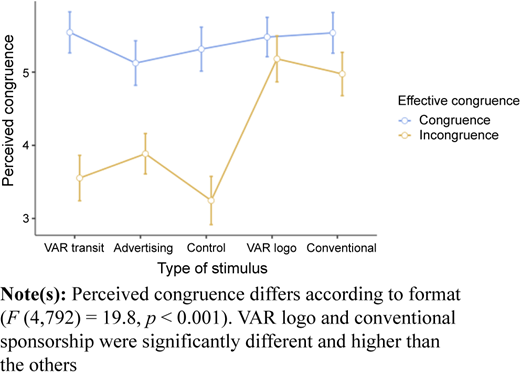
Estimated marginal average perceived congruence according to the type of stimulus
Estimated marginal average perceived congruence according to the type of stimulus
The second analysis seeks to examine RQ2, whether viewers will receive different perceived exposures to VAR sponsorship compared to brand-inserting advertising and conventional sponsorship, regardless of congruence. The ANOVA revealed that transit VAR sponsorship (M = 5.37, SD = 1.53) and VAR logo (M = 5.36, SD = 1.12) have statistically equal marginal average of the exposure variable, which is higher than those of advertising (M = 3.54, SD = 2.03), conventional sponsorship (M = 4.43, SD = 1.13), and the control group (M = 3.06, SD = 2.06) (F (4, 799) = 63.97, p < 0.001, η2 = 0.12) (Figure 2). A post hoc Tukey comparison test showed that the perceived exposure differs between all the stimuli except the VAR stimuli in its two versions: the two versions of VAR sponsorship receive greater perceived exposure in all situations examined. Effective congruence had a significant effect on perceived exposure, F(1,799) = 5.241, p = 0.022, but there was no interaction effect with the type of stimulus, F(4,799) = 0.213, p = 0.931. Therefore, subjects who viewed VAR sponsorship in the two modalities showed greater perceived exposure than those who were not exposed to sponsorship communication and those who were exposed to advertising.
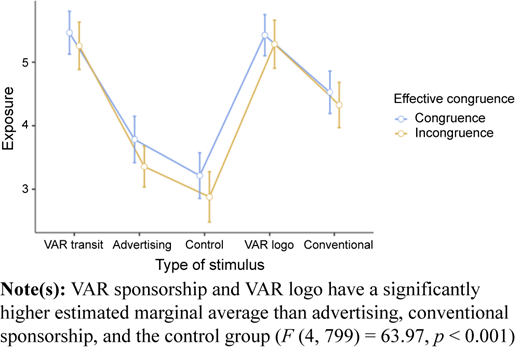
Estimated marginal average exposure according to the congruence of each type of stimulus
Estimated marginal average exposure according to the congruence of each type of stimulus
The third analysis examines RQ3: How do the VAR sponsorship formats influence attitudes toward brands compared to brand-inserting advertising and sponsorship competition property, regardless of congruence? The ANOVA results revealed that the communication format used had a significant effect on attitude toward the sponsor (F (4, 788) = 11.32, p < 0.001, η2 = 0.15). Post hoc comparisons indicated that the marginal mean scores for the VAR logo (M = 5.52, SD = 0.82), conventional sponsorship (M = 5.52, SD = 0.86), VAR transit (M = 5.35, SD = 1.23), and advertising (M = 5.24, SD = 1.31) were statistically equal, but different from the control group (M = 4.86, SD = 1.37). In other words, any form of communication improves the attitude toward the sponsor. It was also seen that effective congruent sponsorships received significantly better scores on the attitude variable than incongruent formats [F(1,788) = 152.75, p < 0.001]. Therefore, congruence improves the attitude toward the sponsor. Figure 3 represents the combined effect of communication formats and congruence, which was significant (F (4,788) = 7.33, p < 0.001). Post hoc comparisons indicated that the marginal mean scores for the incongruent VAR logo and conventional sponsorship were significantly higher than for other incongruence conditions. There were no differences in the types of congruent stimuli. Thus, subjects generally showed a poor attitude toward incongruent sponsorships, but the VAR logo and conventional sponsorship formats had significantly higher scores than the rest.
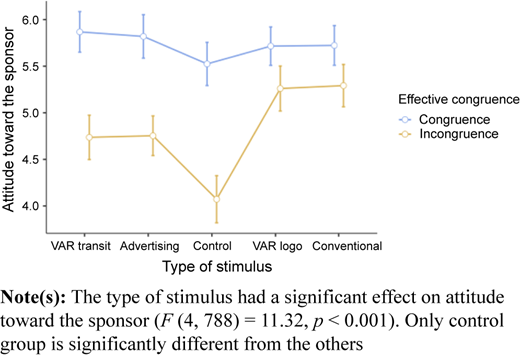
Estimated marginal average attitude according to the congruence of each type of stimulus
Estimated marginal average attitude according to the congruence of each type of stimulus
RQ4 was formulated as follows: How do VAR sponsorship formats influence credibility compared to brand-inserting advertising and sponsorship competition property, regardless of congruence? There was a significant effect of communication format on perceived credibility (F (4, 799) = 23.12, p < 0.001; η2 = 0.04). Post hoc comparisons indicated that the marginal mean scores for the VAR logo (M = 5.48, SD = 0.86) and conventional sponsorship (M = 5.17, SD = 1.15) were significantly different (p < 0.001) from VAR transit (M = 4.43, SD = 1.51), control condition (M = 4.38, SD = 1.69), and advertising (M = 4.37, SD = 1.71). There were significant differences in the combined effect of communication format type and effective congruence on credibility (F (4, 799) = 2.41, p = 0.048). The incongruent stimulus of conventional sponsorship differed significantly from that of the VAR logo (Figure 4). Therefore, the highest credibility is achieved with the conventional sponsorship format when it is congruent with the VAR logo format, regardless of its congruence.
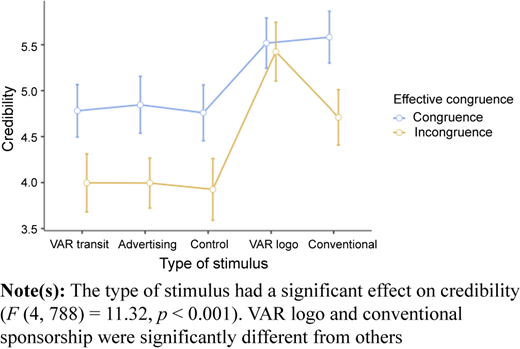
Estimated marginal average credibility according to the congruence of each type of stimulus
Estimated marginal average credibility according to the congruence of each type of stimulus
The last research question (RQ5) is: How do VAR sponsorship formats impact recall compared to brand-inserting advertising and sponsorship competition property, regardless of their congruence? There was a significant effect of communication format on recall [F (3, 659) = 29.03, p < 0.001, η2 = 0.06]. Post hoc comparisons indicated that the marginal mean score for the VAR transit (M = 0.637, SD = 0.48) was significantly different (p < 0.001) from the VAR logo (M = 0.34, SD = 0.47), advertising condition (M = 0.26, SD = 0.44), and conventional sponsorship (M = 0.20, SD = 0.40). The subjects in the control group were not exposed to the stimulus, and their recall could not be calculated. Effective congruence had no significant effect on recall [F (1, 659) = 3.191, p = 0.074] or the combined effect of communication format, F (3, 659) = 0.123, p = 0.947] (Figure 5). In conclusion, subjects remember more of the sponsor brand when the VAR transit format is used, regardless of effective congruence. Effective congruence did not influence the recall.
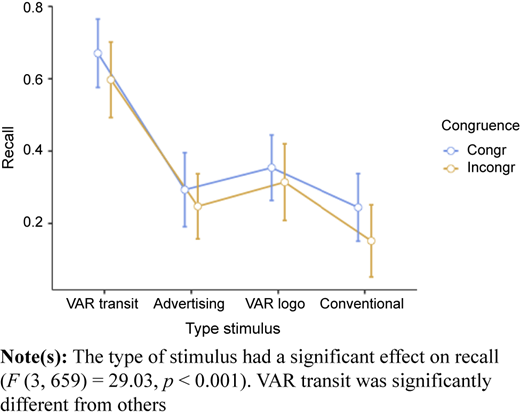
Estimated marginal average attitude according to the congruence of each type of stimulus
Estimated marginal average attitude according to the congruence of each type of stimulus
5. Discussion and conclusions
This study explores the effectiveness of VAR sponsorship in consumer response versus advertising through sports and conventional sponsorship based on sponsorship congruency. The factorial experiment was composed of four stimuli: (1) the VAR sponsorship during the transition between the beginning and end of the VAR scene; (2) the VAR sponsorship during the VAR scene; (3) the insertion of advertisement at the bottom of the screen during matches; and (4) sponsorship communication during matches at the bottom of the screen.
Regarding RQ1, the VAR logo and conventional sponsorship formats received higher scores for perceived congruence than the rest, even when effective congruence was divergent. Although the VAR logo and conventional sponsorship formats are incongruent, they are also perceived as congruent. This is a clear selling point over the rest of the formats because academics have consistently highlighted the influence of congruence on sponsorship performance indicators (Cornwell and Kwon, 2019; Woisetschläger and Michaelis, 2012). For example, congruent sponsorships are easier to remember and develop better attitudes and recognition (Koo and Lee, 2018; Macdougall et al., 2014). This situation improves purchase intent, decreases false sponsorship allocation, and improves brand attitude ratios (Silva and Veríssimo, 2020). According to Cornwell and Kwon (2019), congruence is a context-moderating factor that influences sponsorship outcomes and has been a goal in the decision-making process of sponsorship. Thus, the results of this study could influence the decision-making by considering the communication format. For example, if the communication format is a VAR logo, congruence might not be a decisive factor in the process. No differences were found among the other formats, perhaps because of their familiarity with the brands used in the research. Although manipulation control found no differences between brands, familiarity may positively influence congruent brands (Gross and Wiedmann, 2015).
The analysis concerning RQ2 revealed that formats based on the VAR sponsorships have higher marginal means of perceived exposure than the rest of the formats. Therefore, they have an advantage over the other formats. This could be an obvious result for the VAR transit because the transition requires more space on the screen, but the VAR logo format does not have an obvious display. The VAR sponsorship formats may have a higher perceived exposure owing to the novelty of the format (Becker and Horstmann, 2011; Horstmann and Herwig, 2016) or perhaps because the logo is in a scene during the replay game (Rumpf et al., 2015). However, it cannot be confirmed that the perceived exposure of this format will last once the novelty diminishes. It seems advisable for managers to make changes in format, color, and position to continue capturing the spectator’s attention (Rumpf and Breuer, 2014). Suppose the sponsor changes format, the VAR sponsorship values that may be transferred to the brand will be missed. The sponsoring brand may be placed close to the sports context (Lee and Faber, 2007) and in an exciting situation (Rumpf et al., 2015). The VAR system works only in decisive situations, which guarantee the emotion and excitement of the game. Research on congruency with exposure (or attention) is limited in the literature. Lobo et al. (2014) found a moderate correlation between perceived exposure and congruency, which is consistent with the results of this study. However, Alonso Dos Santos et al. (2019) did not find a significant relationship between visual attention and congruency. However, there is some consensus that without attention, there is no brand awareness or influence on the purchase behavior of potential consumers (Boronczyk et al., 2021).
The attitude toward the sponsor (RQ3) did not improve for the VAR sponsorship formats with respect to the other conditions. However, the combined effect of congruence and communication format type shows that the effect on the attitude of incongruent sponsors is greater for the VAR logo and conventional sponsorship formats than for others. These results agree with those of the analysis of RQ1: the VAR logo brands and conventional sponsorship were perceived to have a better fit than the others. The results also agree with previous findings; a higher congruence leads to a better attitude toward the sponsor (Koo and Lee, 2018; Lee and Cho, 2009). Seeking congruent sponsorships is an advantage, as the literature affirms (Koo and Lee, 2018) because congruence leads to a better attitude (Roy, 2011). However, as stated above, not all formats have the capacity to increase perceived congruence in incongruent situations. Therefore, the VAR logo and conventional sponsorship formats have an advantage when sponsorship is incongruent.
The results of the RQ4 analysis revealed the differences between the VAR logo and conventional sponsorship formats. The VAR logo format is credible when sponsorship incongruence is considered. The results are also consistent with the literature in that perceived credibility is a consequence of congruence and attitude toward the sponsor (Gwinner and Bennett, 2008; Lee and Cho, 2009). In Figure 4, the credibility of the VAR logo is greater. The results could be explained by the effect of the perceived congruence of the format that would influence credibility. This result could also be due to the placement (Alonso Dos Santos et al., 2019; Coker and Altobello, 2018; Yang and Roskos-Ewoldsen, 2007). Placement within the active zone of the VAR logo screen could be more effective as compared to placement at the bottom of the screen of the conventional sponsorship. The exposure time was not an a priori variable because it was same for all formats.
The last analysis (RQ5) shows that the VAR transit format produces more recall than the other formats, regardless of congruence. The VAR logo and conventional sponsorship formats, which have performed better than the others, exhibit similar trends. The explanation for the recall of VAR transit is found in perceived exposure, as it attracts more attention. However, the VAR logo format had lower recall rates but the same perceived exposure. Although the exposure time was the same for all conditions, the VAR transit format is presented at full screen and on two occasions (total duration is the same as for all other formats): as a transition to the introduction and output of the VAR. Visual attention could explain this result (Alonso Dos Santos et al., 2021) since congruency would not explain attention (Alonso Dos Santos et al., 2019). However, we do find some relationship between congruence and perceived exposure. This explanation is consistent with previous studies in terms of exposure frequency (Carrillat et al., 2015) and that the size of the signage have a positive influence on memory (Park and Andrew Choi, 2011).
These results make important contributions to the literature. Although there are several studies on congruence (Cornwell and Kwon, 2019) and some comparing advertising through sports and sponsorship (Cheong et al., 2019; Lardinoit and Quester, 2001), this is the first study exploring indicators of the VAR sponsorship effectiveness. Further, it is one of the few studies linking perceived exposure to congruency. The results complement the current research by shedding light on how perceived congruence, credibility, attitude, and recall may vary as a function of format and effective congruence. It answers potential research questions in sponsorship that have hitherto remained unanswered (Lin and Bruning, 2020). In general, for the set of formats analyzed, the results align with the proposals of congruity theory and with the results of other scholars (Cornwell and Kwon, 2019) because congruent formats are perceived as more congruent and receive better attitudes and credibility. However, this is not the case with the perceived exposure and recall variables. Specifically, the VAR format received more exposure, but among the VAR formats, there were also significant differences in recall and credibility. This result shows that congruity theory and mere exposure theory alone cannot explain the differences between formats and VAR formats. Possibly format novelty (Ernst et al., 2020), size (Park and Andrew Choi, 2011), or familiarity with sponsors (Grohs, 2015) could influence the results, as previously suggested by the authors above. Some authors have reported that the duration of the stimulus and its awareness overrode the effect of mere exposure (Goodrich, 2014). The combined effects of congruency, format, and the variables above need to be further explored. The results have several implications and recommendations for practitioners concerning possible managerial contributions. First, this manuscript explores a new unpublished sponsorship tool sponsoring the VAR. This tool allows sponsor property to increase revenue and sponsor brands to link with a sporting event. Sponsoring the VAR appears to be an opportunity because of the advantages we found. This would apply to an economically important market, such as the European national leagues and official competitions at global levels. In addition, the format and sponsor can be adapted according to the country, market, and fan segment.
Depending on the objective pursued by the sponsorship action, managers should select from three formats: the VAR logo, the VAR transit, or conventional sponsorship. The VAR logo and conventional sponsorship showed a greater capacity to increase credibility. However, sponsorship formats worked better than advertising the VAR logo when the sponsorship was incongruent, excluding several important conditioning factors (such as context, affiliation, activation, and history.).
Congruence is a condition that managers must consider. Some authors argue that incongruent sponsorships improve performance (Olson and Thjømøe, 2009; Stangor and McMillan, 1992). Therefore, managers who decide to support an incongruent sponsor property should sponsor the VAR. However, the results of this research allow us to contrast the capacity of an innovative format to improve the performance of sports sponsorship.
6. Limitations and future research directions
This study is not free of limitations and those should be considered when extrapolating the data. The limitations are related to the geographic distribution of the sample (only from the USA and collected through MTurk), the use of real scenes to insert the conditions, and the use of interviews for gathering information about the viewers. Therefore, future research could investigate the moderating effect of culture on sponsorship processing. It would be advisable to create customized scenes that eliminate uncontrollable variables during the experiment, such as advertising on billboards during the game. Future research could compare the effectiveness of VAR sponsorship with digital insertion in television broadcasts or live streaming. Finally, applying neurophysiological data collection techniques based on eye-tracking or electroencephalography would allow the collection of objective and non-conforming affective information.

