Skip to article sections
Purpose

This study aims to examine the moderating role of subjective well-being (SWB) (happiness) in the relationship between financial development and household debt. It addresses a gap in the literature by investigating both the direct effect of happiness on household indebtedness and its moderating role on the interaction between financial development and household debt.

Design/methodology/approach

The study employs panel data from 34 emerging and developing countries and applies the system generalized method of moments estimator to account for endogeneity, persistence and country-specific effects.

Findings

The results indicate that happiness moderates the relationship between financial development and household debt. At lower levels of happiness, SWB amplifies the positive impact of financial development on household debt. However, happiness exhibits a nonlinear relationship with household debt, exerting a negative effect at higher levels. Financial development is found to significantly increase household debt.

Originality/value

This study contributes to the literature on household indebtedness by incorporating psychological factors into macroeconomic analysis. It provides new evidence on how SWB influences household borrowing behavior and conditions the effect of financial development on household debt in emerging and developing countries.

Household debt has attracted increasing attention from researchers and policymakers due to its critical role in shaping consumption, welfare, and economic growth (Han et al., 2023; Lombardi et al., 2017; Mian et al., 2013). Access to credit enables households to smooth consumption and finance investment, thereby supporting economic growth. However, when household debt exceeds certain thresholds, it becomes detrimental to both consumption and growth. Lombardi et al. (2017) show that when household debt exceeds 60% of gross domestic product (GDP), consumption begins to decline, while economic growth is negatively affected when the debt-to-GDP ratio exceeds approximately 80%. Excessive household debt is also a strong predictor of financial crises, banking sector stress, and economic recessions (Drehmann and Juselius, 2014; Jorda et al., 2016; Schularick and Taylor, 2012). High debt burdens depress consumption, reduce output, and amplify economic downturns, particularly in countries with highly developed financial markets (Han et al., 2023; Mian et al., 2013).

Despite this evidence and the lessons from the Global Financial Crisis of 2007–2008, household debt continues to rise in many economies. This trend is particularly pronounced in emerging market economies and developing Asian countries, where household debt has increased more rapidly than in other regions (Han et al., 2023; Lombardi et al., 2017). Globally, debt levels reached almost 300% of their levels a few decades ago (Heintz-Martin et al., 2021). Although an extensive body of literature has examined the determinants of household debt (Barradas and Tomas, 2023; Dumitrescu et al., 2022; Kim, 2022; Romao and Barradas, 2022), the findings remain mixed and inconclusive. Moreover, most existing studies focus on advanced economies, largely overlooking emerging and developing countries (Chikeya and Ntsalaze, 2025).

Financial development has been identified as a key determinant of household debt through its influence on the supply of credit (Abd Samad et al., 2020; Han et al., 2023; Wang et al., 2022). Developed financial systems are typically characterized by fewer borrowing constraints, greater financial innovation, and higher levels of financial inclusion, all of which expand households' access to credit (Campbell, 2006; Wang et al., 2022). Such systems are often more stable and less vulnerable to shocks, reducing banks' risk aversion when extending credit (Turdaliev and Zhang, 2019). However, credit supply alone is insufficient to fully explain household debt dynamics. Demand-side factors also play a crucial role in shaping household borrowing behavior.

A growing body of research highlights the importance of psychological and behavioral factors in influencing the use of financial services and the demand for household debt. Traits such as impulsivity, self-efficacy, social proof, commitment to goals, and comfort with financial products affect borrowing decisions (Rahman et al., 2020; Thomas and Natarajan, 2018). Behavioral biases that influence decision-making include overconfidence, herding behavior, loss aversion, anchoring, and emotional states such as sadness, love, and fear (Sedliacikova et al., 2021; Shah et al., 2021). While several empirical studies have examined the role of behavioral factors in household indebtedness (Branten, 2022; Lagomarsino and Spiganti, 2021; Tian, 2022; Yaparatne and Senathissa, 2021), the role of happiness has received remarkably little attention.

Recent developments in well-being economics emphasize improving citizens' subjective well-being (SWB) as a central objective of public policy (Ngamaba et al., 2020). Governments increasingly prioritize national happiness alongside traditional indicators such as income, health, and longevity. Correspondingly, researchers have begun examining the economic implications of happiness, including its influence on firm behavior and macroeconomic outcomes. For example, Chen et al. (2025) show that societal happiness positively affects corporate cash holdings. In an environment characterized by expanding credit access, rising household debt, and heightened attention to well-being, an important question emerges: does happiness influence household debt, and if so, through which channels?

Evidence from international comparisons suggests a complex relationship between happiness and household borrowing. According to the World Happiness Report (2022), most developing countries rank relatively low in terms of happiness, yet they have experienced steadily rising household debt, albeit at lower levels than advanced economies. In contrast, Scandinavian countries rank highly in both happiness and household debt (Coletta et al., 2018; World Happiness Report, 2022). These patterns suggest that household borrowing may be shaped not only by income, interest rates, and financial development, but also by psychological factors such as happiness. Although happiness has been shown to affect financial decisions such as participation in risky asset markets and insurance uptake (Apergis et al., 2019; Delis and Mylonidis, 2015), its role in explaining household debt remains largely unexplored. To date, only Tseng and Hsiao (2022) examined the relationship between happiness and household indebtedness, focusing exclusively on China using household-level survey data.

This gap in literature motivates the present study. Specifically, the study aims to: (1) examine the effect of country-level happiness on household debt, and (2) assess the moderating role of happiness in the relationship between financial development and household debt. By integrating psychological factors into a macroeconomic framework, the study provides a more comprehensive understanding of household borrowing behavior.

The study contributes to the literature in several ways. First, unlike Abd Samad et al. (2020), who focus on 19 emerging economies, this study employs an expanded sample of 34 emerging and developing countries that have received limited empirical attention. Second, it investigates the role of happiness in shaping household debt, a factor that has been largely neglected in existing research. Third, in contrast to Tseng and Hsiao (2022), who rely on household-level data from a single country, this study uses macro-level panel data from multiple countries, allowing for broader generalization. Finally, the study examines the moderating role of happiness in the financial development–household debt nexus, thereby capturing the interaction between demand-side psychological factors and supply-side financial conditions.

The remainder of the paper is structured as follows. Section 2 reviews the related literature. Section 3 outlines the methodology and data. Section 4 presents the empirical results, while Section 5 discusses the findings. Section 6 concludes the paper and outlines policy implications.

Several theoretical frameworks have been advanced to explain the determinants of household debt. Consumption-based theories, particularly the life-cycle hypothesis (LCH) and the permanent income hypothesis (PIH), place consumption at the center of household borrowing behavior. The LCH posits that individuals borrow during early adulthood and old age to smooth consumption over their lifetime (Modigliani and Brumberg, 1954). Similarly, the PIH suggests that consumption decisions are driven by expectations of permanent income rather than transitory income fluctuations. When households anticipate higher future income, they may increase current consumption by borrowing, with the expectation that future earnings will enable debt repayment (Friedman, 1957). Under these frameworks, household debt is primarily determined by age, income, and consumption patterns.

Despite their explanatory value, the LCH and PIH oversimplify household borrowing behavior by assuming rational decision-making and perfect foresight regarding future income, needs, and lifespan. Households face substantial uncertainty and are influenced by behavioral biases when making borrowing decisions (Meier and Sprenger, 2010; Lagomarsino and Spiganti, 2021; Rahman et al., 2020). Moreover, these theories do not adequately account for liquidity constraints and credit market imperfections that limit access to credit. High interest rates, for example, can restrict borrowing, particularly among low-income households (Justiniano et al., 2015; Stockhammer and Wildauer, 2017), undermining the ability to smooth consumption. Additionally, these frameworks fail to distinguish between debt incurred for consumption and debt used for investment purposes, thereby overlooking an important motivation for household borrowing. A major limitation of the LCH and PIH is their neglect of credit supply conditions, particularly the role of financial institutions in determining household debt levels (Han et al., 2023; Wang et al., 2022).

Inequality-based theories provide an alternative lens through which household debt can be understood. The expenditure cascade hypothesis (ECH) argues that rising income inequality increases household debt as lower-income households attempt to emulate the consumption patterns of higher-income groups (Stockhammer and Wildauer, 2017). Closely related to the ECH is the Rajan Hypothesis, which posits that governments respond to rising inequality by promoting credit expansion to sustain consumption and employment growth (Rajan, 2010). These perspectives highlight both behavioral motives such as status-driven consumption and policy responses as drivers of household indebtedness. However, the theories fall short in failing to recognize the impact of the supply side factors on household debt. Precisely, governments can push households to borrow more, or households might desire to acquire debt, but this can only happen if financial institutions are able to respond by supplying the debt.

Policy-oriented theories further emphasize the role of macroeconomic and institutional factors in shaping household debt. Policies such as accommodative monetary conditions (the low-interest-rate hypothesis), financial deregulation (financial deregulation hypothesis), and targeted lending programs influence household borrowing by reducing the cost of credit and easing borrowing constraints (Justiniano et al., 2015; Stockhammer and Wildauer, 2017). New Keynesian models also suggest that increases in asset prices, particularly housing prices, relax borrowing constraints by raising collateral values, thus expanding households' access to credit (Iacoviello, 2005). These theories bring in the importance of policy orientations and asset prices in altering credit constraints. A key limitation of these approaches, however, is their reliance on single-factor explanations. To fully understand household debt dynamics, it is necessary to integrate insights from multiple theoretical perspectives and test their relevance across different economic contexts.

More recently, the literature has increasingly emphasized behavioral explanations for rising household debt. Behavioral models challenge the assumption of rationality by highlighting psychological traits and decision-making biases. Hyperbolic discounting, for instance, leads individuals to prioritize immediate gratification over long-term financial sustainability, encouraging borrowing even when future repayment may be problematic (Meier and Sprenger, 2010; Siemens, 2007). Impulsivity has also been shown to significantly predict unsecured borrowing, as individuals with lower self-control place less value on delayed rewards (Ottaviani and Vandone, 2011; Wittmann and Paulus, 2008). Additional behavioral traits including sociability, materialism, risk aversion, emotional states, and financial attitudes have been found to influence household indebtedness (Altundere, 2014; Lagomarsino and Spiganti, 2021; Rahman et al., 2020; Singh et al., 2014; Yaparatne and Senathissa, 2021). These findings suggest that households do not behave as fully rational agents, and that traditional economic theories may fail to capture important psychological dimensions of borrowing decisions (Barberis and Thaler, 2003).

A growing body of research in well-being economics highlights the relevance of happiness for economic behavior and outcomes. Frey and Stutzer (2002) argue that happiness research provides valuable insights for economics, demonstrating that SWB is influenced by factors such as inflation, income, unemployment, democracy, and institutional quality. Happiness is commonly defined as a durable psychological state characterized by feelings of joy, satisfaction, and positive affect (Lyubomirsky, 2001). Through its influence on attitudes toward risk and uncertainty, happiness can shape financial decision-making and, potentially, household debt (Guven and Hoxha, 2015; Kuhnen and Knutson, 2011).

The link between happiness and decision-making is often explained by the “affect-as-information” hypothesis, which posits that individuals rely on their emotional states when evaluating decision options. Affective states such as discrete mood states can influence decision options (Clore et al., 1994; Chick, 2019). Similarly, the affect heuristic suggests that people assess the desirability or riskiness of choices based on feelings rather than objective probabilities (Epstein, 1994). A related concept, “risk as feelings,” emphasizes that emotional reactions to past experiences influence current risk-taking behavior (Slovic et al., 2007). Positive emotions such as happiness tend to increase optimism, leading individuals to overestimate potential gains relative to losses and, consequently, to exhibit greater risk tolerance (Nygren et al., 1996).Therefore, negative or positive feelings or emotions such as happiness affect decision making (Chick, 2019).Basing on Frey and Stutzer (2002), people's state of happiness can be influenced by increasing inflation, high unemployment and low levels of democracy which influence their decision making regarding risk taking behavior as described by the risk as feelings hypothesis.

Empirical evidence supports this view, showing that happier individuals are more likely to participate in financial markets and invest in risky assets (Guven and Hoxha, 2015; Nygren et al., 1996). Since borrowing involves risk owing to fixed repayment obligations regardless of future income realizations, increased risk tolerance may translate into higher demand for debt (Kuhnen and Knutson, 2011). In this context, improvements in economic conditions, institutional stability, or democratic governance can enhance happiness, foster optimism, and encourage borrowing.

An opposing strand of the literature argues that negative emotions, particularly sadness, may increase consumption as individuals seek to improve their mood or respond impulsively, potentially leading to higher household debt (Cryder et al., 2008). Given that consumption is a key driver of borrowing (Chikeya and Ntsalaze, 2025), this perspective suggests that happiness may reduce consumption, increase savings, and ultimately lower household debt. Indeed, Guven (2012) finds that happier individuals tend to save more, consume less, and exercise greater self-control over expenditure. Happy individuals may also adopt a longer-term perspective, expecting to live longer and therefore making more future-oriented financial decisions, which can reduce their willingness to take financial risks (Delis and Mylonidis, 2015). However, Meghana and Rinju (2019) find no significant relationship between happiness and risk-taking behavior, highlighting the ambiguity in existing findings.

Overall, while theoretical and empirical evidence suggests that happiness affects financial decision-making through its influence on risk tolerance, consumption, and savings behavior, its net effect on household debt remains unclear (Cryder et al., 2008; Delis and Mylonidis, 2015; Guven, 2012; Guven and Hoxha, 2015; Nygren et al., 1996). This ambiguity underscores the need for further empirical investigation.

A substantial body of empirical research identifies financial development as a key driver of household debt (Abd Samad et al., 2020; Chikeya and Ntsalaze, 2025; Han et al., 2023; Wang et al., 2022). Financially developed economies are characterized by financial innovation, deregulation, improved information sharing, and lower borrowing costs, all of which enhance households' access to credit (Campbell, 2006; Casolaro et al., 2005; Debelle, 2004; Jappelli et al., 2013). Efficient credit information systems and effective contract enforcement mechanisms increase lenders' willingness to supply credit, whereas weak enforcement and lengthy recovery procedures constrain loan provision (Casolaro et al., 2005; Jappelli et al., 2013).

However, the impact of financial development on household debt also depends on demand-side conditions. For credit expansion to translate into higher household debt, households must be willing to borrow. Psychological factors, particularly emotional states such as happiness, may influence this willingness by shaping attitudes toward risk and financial uncertainty. Research shows that higher levels of national happiness are associated with optimism and lower risk aversion, which can increase households' appetite for financial risk and debt (Guven and Hoxha, 2015; Nygren et al., 1996). This could increase demand for debt from financial institutions thereby enhancing the impact of financial development on household debt. At the same time, happiness may dampen borrowing demand by promoting self-control, prudent financial behavior, higher savings, and lower consumption (Cryder et al., 2008; Delis and Mylonidis, 2015; Guven, 2012). In this case, happiness would weaken the positive relationship between financial development and household debt. Thus, happiness can plausibly either amplify or attenuate the effect of financial development on household debt, depending on which behavioral channel dominates.

This study contends that household debt dynamics reflect the interaction between supply-side factors, such as financial development, and demand-side psychological factors, particularly happiness. Even in highly developed financial systems, household debt will not increase unless households demand credit. Happiness may therefore moderate the impact of financial development on household debt by either strengthening or weakening this relationship. Determining which effect prevails is ultimately an empirical question.

Existing empirical studies provide limited insight into this interaction. Tseng and Hsiao (2022), using household-level data from China, find that happiness does not significantly affect total household liabilities but negatively influences the household debt-to-income ratio. Other studies identify macroeconomic determinants of household debt, including income, house prices, interest rates, unemployment, inflation, and inequality (Abd Samad et al., 2020; Enache, 2022; Khan et al., 2016; Maneejuk et al., 2021; Zimunya and Raboloko, 2015; Zhou and Niyitegeka, 2023). Research focusing on emerging and developing countries remains limited (Czech and Puszer, 2021; Kakuru and Kaulihowa, 2022; Yahya et al., 2023), and none explicitly examine the moderating role of happiness in the financial development - household debt nexus.

By addressing this gap, the present study extends the literature by integrating psychological well-being into a macro-financial framework and examining how happiness conditions the relationship between financial development and household debt in emerging and developing countries. Having looked at the literature underlying the study and the gaps exiting, the next section contains a description of the methodology.

Drawing on the theoretical and empirical literature reviewed in the previous section; the study specifies the following dynamic household debt model:

HDit is household debt as a percentage of GDP for country i at time t, α0 is a constant term. HDit−1 is lagged household debt meant to capture persistence. αJ (j = 1 … 8) are coefficients of explanatory variables happiness (H), domestic credit by banks (DCB), inflation (INF), unemployment (UN), economic growth rate (GDP), interaction term between happiness and domestic credit by banks (HDCB), and quadratic terms of DCB (DCBSq) and happiness (HSq). Quadratic terms test nonlinearity between these variables and household debt following Fasianos et al. (2017) and Romao and Barradas (2022) who found evidence of nonlinearity between household debt, house prices, inequality and asset prices. Happiness is measured by the SWB ranking, financial development by DCB, and µit is white noise error term.

Following Chen et al. (2025), this study employs a national-level measure of happiness to capture psychological and emotional dimensions that are not adequately reflected by conventional macroeconomic indicators. The happiness index is obtained from the World Happiness Report and represents a national average derived from individual survey responses collected by the Gallup World Poll. The survey employs the Cantril Ladder question, in which respondents are asked to evaluate their current life satisfaction on a scale from 0 to 10, where 0 represents the worst possible life and 10 the best possible life (Helliwell et al., 2017). This measure reflects SWB, which conceptually consists of life satisfaction, positive affect, and negative affect (Martela and Sheldon, 2019).

The theoretical relevance of SWB is grounded in self-determination theory, which posits that autonomy, competence, and relatedness are critical determinants of well-being and broader life outcomes (Martela and Sheldon, 2019). The World Happiness Report conceptualizes happiness as an outcome influenced by income per capita, social support, healthy life expectancy, freedom to make life choices, generosity, and perceptions of corruption. Martela and Sheldon (2019) show that satisfaction of the need for autonomy, relatedness and competence affect SWB and other wellness outcomes including health. The World Happiness Report present happiness as an outcome of social support, freedom to make choices, heathy expectancy, GDP per capita, generosity, and perceived absence of corruption. Therefore, given the availability of evidence showing that life satisfaction affect risk taking behavior (Valois et al., 2002) whereas sociability, heath, GDP per capita, risk tolerance, and policy generosity influence indebtedness (Altundere, 2014; Comelli, 2021; Wang et al., 2022; Zhou and Niyitegeka, 2023), SWB is a theoretically plausible determinant of household debt. We follow studies that examined the impact of happiness on firm cash holding (Chen et al., 2025), GDP (Balasubramanian and Cashin, 2019), GDP and its moderating role on the impact of intelligence on GDP (Burhan et al., 2021). To assess robustness, the study replaces the World Happiness Report measure with the Happy Planet Index (HPI), following Chen et al. (2025) and Minkov and Bond (2017). This alternative indicator incorporates elements of well-being, sustainability, and social outcomes.

The empirical analysis uses an unbalanced panel dataset comprising 34 emerging and developing countries over the period 2015–2021. The sample includes: Albania, Argentina, Bangladesh, Brazil, Bulgaria, Chad, Chile, China, Colombia, Costa Rica, El Salvador, Honduras, Hungary, India, Indonesia, Kazakhstan, Lesotho, Malaysia, Mauritius, Mexico, Morocco, Nepal, Nicaragua, North Macedonia, Pakistan, Peru, Poland, Romania, South Africa, Tajikistan, Thailand, Turkey, Ukraine, and the United Arab Emirates.

Macroeconomic variables including household debt, DCB, inflation, unemployment, and GDP growth were obtained from the World Development Indicators database. Happiness data were sourced from the World Happiness Report. Countries were included based on data availability across variables and years.

The model is estimated using the two-step system generalized method of moments (SGMM) estimator developed by Blundell and Bond (1998). This estimator is particularly suitable for dynamic panel models with a lagged dependent variable and potential endogeneity among regressors. SGMM provides consistent and efficient estimates by exploiting both level and first-difference equations, while using internal instruments derived from lagged values of endogenous variables. The SGMM approach addresses several econometric challenges relevant to this study, including unobserved country-specific heterogeneity, simultaneity bias, autocorrelation, and heteroskedasticity. It is well-suited for panels characterized by a relatively small-time dimension (T) and a larger cross-sectional dimension (N), as is the case in this study (Chu, 2019; Pedroni, 2000; Rioja and Valev, 2004). To ensure the validity of the estimated results, standard post-estimation diagnostic tests are conducted, including the Sargan and Hansen tests for instrument validity and the Arellano–Bond test for serial correlation. Although SGMM is known to be sensitive to cross-sectional dependence (Pesaran and Smith, 1995), this issue is explicitly tested for and addressed in the empirical analysis. All estimations are conducted using Stata version 18.

This section presents results of diagnostic tests and econometric estimations.

Table 1 shows the descriptive statistics of the variables used in this study. Statistical measures presented are mean, standard deviation, maximum, minimum, skewness, and kurtosis for the nine variables used in the study.

Table 2 show that all the variables have correlations below 0.8 showing absence of the multicollinearity problem. The only coefficient above 0.8 is between household debt and financial development which is a dependent and independent variable. To further mitigate potential multicollinearity arising from interaction and nonlinear terms, all variables used to construct the interaction term between happiness and financial development HDCB and the quadratic terms HSq and DCBSq were mean-centered prior to estimation. Centering enhances the interpretability of coefficients and reduces collinearity between the constructed terms and their constituent variables (Afshartous and Preston, 2011).

The results in Table 3 show that the variance inflation factor (VIF) values for all the variables are below the 5 cut off, indicating absence of the collinearity problem.

Unit root tests were conducted using the Levin, Lee and Chu test (2002) and Phillips and Perron test (1988) with intercept and no trend. The results show that no variable is integrated of I (2). Since our results show that the variables are integrated of order I (0) and I(1), we tested for cointegration using the Kao Test. Results show a p value of 0. 0002. There is evidence of cointegration, paving way for estimation using the SGMM. The results of the test are presented in Table A1 in the  appendix section.

Due to GMM's weakness in the presence of cross-sectional dependency, we tested for cross sectional dependency using the Peseran cross section dependency (CD) Test by Pesaran (2004). Results produced a p value of 0.7878, indicating the absence of correlation of residuals across countries in the panel. Therefore, we found no evidence of cross-sectional dependency.

Table 4 reports the results of the SGMM estimations examining the determinants of household debt across emerging and developing countries. The findings are presented for the full sample as well as for income-based subsamples to assess the robustness and heterogeneity of the estimated relationships.

The coefficient on the lagged dependent variable is positive and statistically significant at the 1% level across all specifications, confirming the persistence of household debt. This result indicates that current household debt levels are strongly influenced by past indebtedness, suggesting that household borrowing behavior is dynamic and self-reinforcing over time.

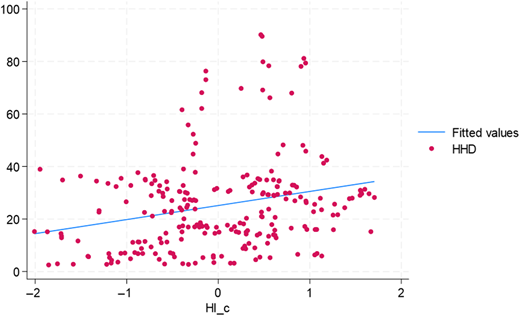
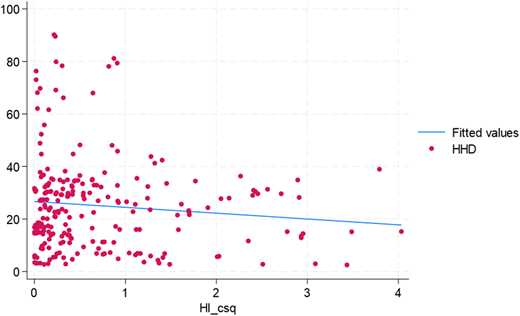
Happiness exhibits a negative but statistically insignificant effect on household debt in the baseline specification, implying that SWB, on its own, is not a direct predictor of household indebtedness in the sampled countries. To explore potential nonlinearities, a squared happiness term is introduced. The estimated coefficient on the quadratic term is negative and statistically significant at the 1% level, indicating an inverted U-shaped relationship between happiness and household debt. This finding suggests that as happiness increases from low levels, household debt initially rises, reaches a peak, and subsequently declines at higher levels of happiness. In particular, the negative coefficient on the squared term (−1.3036 in Model 2) implies that very happy households rely less on debt than moderately happy households. As happiness continues to increase, household debt starts to decrease. Higher household debt has the biggest magnitude in the model as seen by a higher coefficient compared to all variables. This result is supported by the plots presented in Figure A1 in  appendices. The fitted values for happiness (HI) against household debt (HHD) show an upward sloping line, suggesting that as happiness increases, household debt increases. Similarly, the fitted values of quadratic term of happiness and household debt shown in Figure A2 indicate that at higher happiness levels, the effect becomes negative. As happiness increases, household debt is reducing, resulting in a downward sloping fitted line.

Financial development, measured by domestic credit provided by banks, has a positive and statistically significant effect on household debt across the baseline models. This result indicates that greater financial development enhances households' access to credit and increases borrowing. The squared term of financial development is negative but statistically insignificant, providing no strong empirical support for a nonlinear effect. Although the sign suggests a potential saturation effect, the absence of statistical significance indicates that financial development exerts a primarily linear impact on household debt in the sample. The interaction term between happiness and financial development is positive and statistically significant, indicating that happiness moderates the relationship between financial development and household debt. Specifically, increases in happiness strengthen the positive effect of financial development on household debt. According to Model 1, a one-unit increase in happiness raises the marginal effect of financial development on household debt by 0.1133% points. This finding implies that the effectiveness of credit supply in translating into household borrowing depends on the prevailing level of SWB.

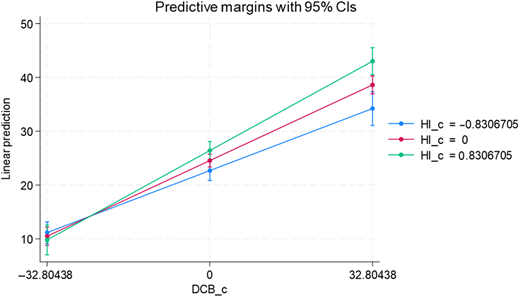
The moderating effect is further illustrated using marginal effects and predictive margins. Figure A3 (predictive margins) shows that financial development has a positive effect on household debt at levels of happiness below the mean, at the mean, and above the mean, with the magnitude of the effect increasing as happiness rises.

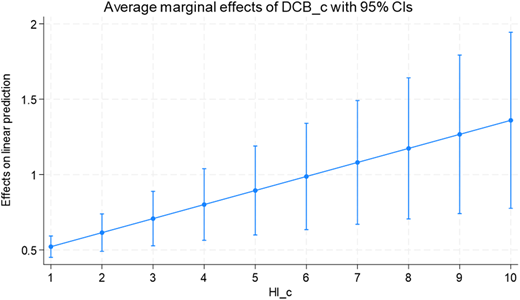
Figure A4, in the  Appendices plot the average marginal effects, confirms a positive and non-zero gradient, indicating that higher happiness levels consistently amplify the impact of financial development on household borrowing. To examine whether this moderating role varies with the level of economic development, the sample is divided into income-based subsamples. In the subsample of upper-middle-income countries (Models 3 and 4), happiness remains statistically insignificant and does not significantly moderate the relationship between financial development and household debt. However, the squared happiness term retains a negative and significant coefficient, suggesting that nonlinear effects persist at higher happiness levels. In contrast, when high-income countries are excluded (Models 5 and 6), happiness continues to significantly moderate the effect of financial development on household debt, while the negative and significant quadratic term confirms the nonlinear relationship. Model 5 show that despite happiness being insignificant, it moderates the relationship between financial development and household through increasing the impact of financial development. Model 6 confirm the negative effect of the squared term of happiness. High-income countries are excluded from a separate regression due to their small number, which would result in instrument proliferation and unreliable estimates.

Model diagnostic tests support the validity of the SGMM estimations. The Hansen test fails to reject the null hypothesis of instrument validity across all models, while the Sargan test is significant in Models 3 and 4, suggesting potential instrument proliferation resulting from smaller sample sizes in the income-based subsamples. Accordingly, results from these models should be interpreted with caution. Results from income subsamples suffer from the risk of instrument proliferation due to smaller number of countries. This makes the results less reliable. The Arrellano-Bond (AR(2)) test indicates no evidence of second-order serial correlation, confirming the appropriateness of the instruments used and the consistency of the estimated coefficients.

To assess the robustness of the baseline results, an alternative measure of happiness was employed. Specifically, the national happiness index from the World Happiness Report was replaced with the HPI, following Chen et al. (2025) and Minkov and Bond (2017). The HPI captures SWB while incorporating broader social and sustainability dimensions, thereby providing an alternative proxy for national happiness.

The robustness results are reported in Table 5. Replacing the happiness measure does not materially alter the main findings. Happiness remains negatively correlated with household debt across all model specifications, although the linear term remains statistically insignificant. Financial development continues to exhibit a positive and statistically significant effect on household debt in most specifications, except for Model 4, where the coefficient is insignificant. This exception is likely attributable to the reduced sample size and instrument proliferation associated with subsample estimation.

The interaction between HPI and DCB is given by the term HPIDCB. Importantly, the moderating role of happiness in the relationship between financial development and household debt is confirmed in the robustness analysis for the full sample and for models excluding high-income countries. The interaction term between happiness and financial development remains positive and statistically significant, indicating that happiness strengthens the effect of financial development on household debt. Consistent with the baseline estimations, the squared term of happiness is negative and statistically significant across all models, reinforcing the evidence of a nonlinear relationship between happiness and household debt. In contrast, the squared term of financial development remains statistically insignificant, providing further support for a predominantly linear effect. Overall, the robustness tests confirm the stability of the baseline results across alternative measures of happiness. The findings suggest that the observed relationships are not sensitive to the choice of happiness proxy and lend credibility to the study's conclusions regarding the role of SWB in shaping household debt dynamics.

The empirical findings reveal several important insights into the dynamics of household debt in emerging and developing countries. First, household debt is shown to be highly persistent, indicating that past borrowing strongly influences current debt levels. This persistence suggests that household debt accumulation is self-reinforcing, potentially driven by factors such as habit formation, debt rollovers, collateral constraints, credit histories, and life-cycle considerations (Jappelli et al., 2013; Modigliani and Brumberg, 1954; Stockhammer and Wildauer, 2017). The result is consistent with earlier studies that document the sticky nature of household debt (Abd Samad et al., 2020; Khan et al., 2016).

Second, happiness is found to have no statistically significant linear effect on household debt, a result that aligns with Tseng and Hsiao (2022). This finding may reflect the generally low levels of happiness observed in most emerging and developing countries, which limit the direct influence of SWB on borrowing decisions. However, the negative and statistically significant quadratic term of happiness indicates that higher levels of happiness reduce household debt. This nonlinear effect suggests that very happy households rely less on debt than moderately happy households. Such behavior may be explained by income stability, contentment, greater self-control, and reduced impulsivity, leading to lower consumption-driven borrowing. This interpretation is consistent with evidence showing that happy individuals are more future-oriented, exercise better financial control, save more, and are less prone to impulsive borrowing (Guven, 2012; Ottaviani and Vandone, 2011; Wittmann and Paulus, 2008).

Third, financial development emerges as a strong predictor of household debt. Greater financial depth enhances households' access to credit by reducing borrowing constraints and transaction costs. Financially developed systems are typically characterized by innovation, efficiency, improved information sharing, and lower frictions, all of which facilitate household borrowing (Campbell, 2006; Casolaro et al., 2005; Debelle, 2004; Jappelli et al., 2013). This finding corroborates existing evidence from both developed and developing economies (Abd Samad et al., 2020; Coletta et al., 2018; Han et al., 2023; Wang et al., 2022). The absence of a statistically significant nonlinear effect suggests that financial development continues to increase household debt without a clear saturation point within the sampled countries, possibly due to relatively low levels of financial development compared to advanced economies.

The most novel finding of this study concerns the moderating role of happiness. The results show that happiness positively moderates the effect of financial development on household debt, particularly at lower and moderate levels of happiness. This finding supports psychological theories suggesting that emotions influence financial decision-making (Schwarz and Clore, 1983; Iaffaldano and Muchinsky, 1985). As happiness rises from a low base, individuals may become more optimistic about their future income prospects and repayment capacity, leading to increased risk appetite and demand for credit (Guven and Hoxha, 2015; Nygren et al., 1996). When financial institutions are capable of supplying credit, this heightened demand translates into higher household debt. This implies that even though the level of happiness in these countries is low, it moderates the relationship between financial development and debt. The result is not influenced by presence of high-income countries in the sample since models excluding high income countries confirm the result. However, the same could not be said for the sample of upper middle-income countries. This could be because of a small sample size which resulted in high instruments relative to number of groups.

Though the results are counterintuitive, there is ample support from literature linking emotions such as happiness, optimism and risk taking. Considering that happiness is also influenced by the socio-economic environment factors such as, inflation, democracy, and sociability, positive change in these variables could explain this positive moderating effect of happiness. For instance, when democracy increase people increase trust in institutions and become optimistic about the future. Similarly, lowering inflation increase people's income and their happiness. All this will result in heightened optimism, more risk-taking behavior and demand for credit due to confidence about capability to repay.

This moderating effect appears to be context-dependent. In emerging and developing countries, where baseline happiness levels are relatively low, marginal increases in happiness may have a pronounced impact on confidence and borrowing behavior. However, at higher levels of happiness, the effect reverses, as indicated by the negative quadratic term, suggesting a self-regulating mechanism. These findings imply that happiness can both stimulate and restrain household borrowing, depending on its level. This result implies that policy endeavors that are targeted at improving the level of happiness could inadvertently increase household debt in emerging countries through high demand. When financial institutions are developed enough, they respond accordingly. Therefore, happiness could be a catalyst for increasing consumption and promoting economic growth. However, its self-regulatory nature should be considered.

From a broader perspective, the results enrich traditional macroeconomic theories such as the life-cycle and permanent income hypotheses by incorporating psychological dimensions. While these theories emphasize income, consumption, and age, the evidence presented here suggests that emotional states also shape intertemporal borrowing decisions. By integrating happiness into the analysis, the study provides a more nuanced understanding of household debt behavior.

Policy wise, when optimism, the risk of over indebtedness and financial instability is also high. During economic booms, regulators should be extra vigilant. For financial institutions, sentiment analysis or proxy measurement of happiness could be useful predictors of credit demand. Product design could be informed by analyzing consumers' state of happiness just as asset management firms do when they measure risk tolerance.

This study examines the moderating role of happiness in the relationship between financial development and household debt in emerging and developing countries using a dynamic panel framework and the SGMM estimator. The findings demonstrate that happiness conditions the effect of financial development on household debt, highlighting the interaction between psychological factors and financial conditions in shaping household borrowing behavior. The results show that happiness does not independently influence household debt in a linear manner, reflecting the generally low levels of SWB in the countries under study. However, happiness exhibits a significant nonlinear effect: at higher levels of happiness, household debt declines, indicating that very happy households rely less on borrowing. Financial development plays a central role in driving household debt, exerting a positive and predominantly linear effect through increased credit supply. Importantly, happiness amplifies the impact of financial development on household debt at lower and moderate levels, suggesting that rising optimism and confidence encourage households to take advantage of available credit.

These findings have important policy implications. Policymakers should recognize that improvements in financial development and access to credit, when combined with rising happiness, may increase the risk of over-indebtedness, particularly among moderately happy households. As countries pursue policies aimed at improving SWB, the potential impact on household borrowing should be considered. In instances where there is need to regulate the growth of household debt, focus should be put on policies that influence credit extension by financial institutions first and on increasing citizen's happiness since its role appears secondary. Regulatory authorities should remain vigilant during periods of economic optimism, as heightened confidence may translate into excessive borrowing and financial vulnerability.

Financial regulation should prioritize macroprudential measures that monitor and manage credit expansion, especially in environments characterized by improving happiness and optimism. Regulations on bank credit should be specific for households that report different levels of happiness, e.g. risk-based lending rules. Also targeting moderately happy household with financial literacy programs can help control spiraling debt levels and reduce risk of over indebtedness. Risk-based lending rules, targeted credit controls, and enhanced borrower assessments could help mitigate the risk of excessive household debt. Financial literacy programs should be directed particularly at moderately happy households, who appear more inclined to borrow, to promote informed and sustainable financial decision-making. Central banks and financial regulators could also benefit from incorporating well-being indicators into financial stability monitoring frameworks. This could be done through utilizing wellbeing data in financial regulation through integrating happiness surveys in financial sector stability reports. Integrating happiness or sentiment measures into stress tests and early warning systems may improve the ability to anticipate shifts in credit demand and systemic risk. More broadly, addressing the structural and social determinants of unhappiness such as inflation, unemployment, weak institutions, and social insecurity may help reduce reliance on debt as a coping mechanism.

The societal implications emanating from the study are that the happiness gap could create a vicious cycle of debt. If moderately happy people borrow more, then over indebtedness could be a symptom of societal distress. Societies with happy people borrow less. These people are less vulnerable to economic shocks such as increase in interest rates and are less susceptible to over indebtedness. On the other hand, people from unhappy societies are likely to rely on debt. This makes the susceptible to economic shocks. When financial markets are less developed, they are at risk of borrowing from informal sources and expensive sources. This will increase their financial vulnerability and reduce their financial welfare. Therefore, policy should focus on addressing the underlying drivers of unhappiness in order to manage unsustainable borrowing.

The study contributes to the growing literature calling for a paradigm shift in macroeconomic research. By demonstrating that emotional states such as happiness influence household debt dynamics, the findings challenge purely rational models of intertemporal choice and highlight the value of interdisciplinary approaches that integrate psychology into macroeconomics. Future research should seek to identify threshold levels of happiness at which borrowing behavior changes and examine whether similar patterns hold in developed economies with higher levels of SWB.
Abd Samad
,
K.
,
Mohd Daud
,
S.N.
and
Mohd Dali
,
N.R.S.
(
2020
), “
Determinants of household debt in emerging economies: a macro panel analysis
”,
Cogent Business and Management
, Vol. 
7
No. 
1
, 1831765, doi: .
Afshartous
,
D.
and
Preston
,
R.
(
2011
), “
Key results of interaction models with centering
”,
Journal of Statistics Education
, Vol. 
19
No. 
3
, doi: .
Altundere
,
B.M.
(
2014
), “
The relationship between sociability and household debt
”,
ADAM AKADEMİ, Cilt
, Vol. 
4
No. 
2
, pp. 
27
-
58
, doi: .
Apergis
,
N.
,
Hayat
,
T.
and
Saeed
,
T.
(
2019
), “
The role of happiness in financial decisions: evidence from financial portfolio choice and five European countries
”,
Atlantic Economic Journal
, Vol. 
47
No. 
3
, pp. 
343
-
360
, doi: .
Balasubramanian
,
S.
and
Cashin
,
P.
(
2019
),
Gross National Happiness and Macroeconomic Indicators in the Kingdom of Bhutan
,
International Monetary Fund
, p.
26
,
015
, doi: .
Barberis
,
N.
and
Thaler
,
R.
(
2003
), “A survey of behavioural finance”, in
Constantinides
,
G.
,
Harris
,
M.
and
Stulz
,
R.
(Eds),
Handbook of the Economics of Finance
,
Elsevier/North Holland
,
Amsterdam, Holland
, Vol. 
3
, pp. 
1053
-
1128
, doi: .
Blundell
,
R.
and
Bond
,
S.
(
1998
), “
Initial conditions and moment restrictions in dynamic panel data models
”,
University College London Discussion Papers in Economics
, Vol. 
97
No. 
7
.
Branten
,
E.
(
2022
), “
The role of risk attitudes and expectations in household borrowing: evidence from Estonia
”,
Baltic Journal of Economics
, Vol. 
22
No. 
2
, pp. 
126
-
145
, doi: .
Burhan
,
N.S.
,
Sabri
,
M.F.
,
Samah
,
A.A.
,
Jaafar
,
W.W.
and
Noor
,
A.M.
(
2021
), “
Does happiness boost the impact of intelligence on economic growth?
”,
Mankind Quarterly
, Vol. 
62
No. 
1
, pp. 
129
-
150
, doi: .
Campbell
,
J.Y.
(
2006
), “
Household finance
”,
The Journal of Finance
, Vol. 
61
No. 
4
, pp. 
1553
-
1604
, doi: .
Casolaro
,
L.
,
Gambacorta
,
L.
and
Guiso
,
L.
(
2005
), “
Regulation, formal and informal enforcement and the development of the household loan market. Lessons from Italy
”,
Working Papers No. 560, Bank of Italy
.
Chen
,
X.
,
Li
,
S.
,
Sowah
,
J.S.
and
Zou
,
S.
(
2025
), “
Soft institutions, hard cash: societal happiness and corporate cash holdings
”,
International Review of Economics and Finance
, Vol. 
103
, 104506, doi: .
Chick
,
C.F.
(
2019
), “
Cooperative versus competitive influences of emotion and cognition on decision making: a primer for psychiatry research
”,
Psychiatry Research
, Vol. 
273
, pp. 
493
-
500
, doi: .
Chikeya
,
C.K.
and
Ntsalaze
,
L.
(
2025
), “
Determinants of household debt: a systematic review of the literature
”,
Economies
, Vol. 
13
No. 
3
, p.
76
, doi: .
Chu
,
J.
(
2019
), “
Accruals, investment, and future performance
”,
Journal of Accounting, Finance and Business Studies
, Vol. 
55
No. 
4
, pp. 
783
-
809
, doi: .
Clore
,
G.L.
,
Schwarz
,
N.
and
Conway
,
M.
(
1994
), “Affective causes and consequences of social information processing”, in
Wyer
,
R.S.
and
Snull
,
T.K.
(Eds),
Handbook of Social Cognition
,
Lawrence Erlbaum Associates
,
Hillsdale, NJ
, Vol. 
1
, pp. 
323
-
417
.
Coletta
,
M.
,
De Bonis
,
R.
and
Piermattei
,
S.
(
2018
), “
Household debt in OECD countries: the role of supply-side and demand-side factors
”,
Social Indicators Research
, Vol. 
143
No. 
3
, pp. 
1185
-
1217
, doi: .
Comelli
,
M.
(
2021
), “
The impact of welfare on household debt
”,
Sociological Spectrum
, Vol. 
41
No. 
2
, pp. 
154
-
176
, doi: .
Cryder
,
C.E.
,
Lerner
,
J.S.
,
Gross
,
J.J.
and
Dahl
,
R.E.
(
2008
), “
Misery is not miserly: sad and self-focused individuals spend more
”,
Psychological Science
, Vol. 
19
No.
6
, pp. 
525
-
530
, doi: .
Czech
,
M.
and
Puszer
,
B.
(
2021
), “
Impact of the COVID-19 pandemic on the consumer credit market in V4 countries
”,
Risks
, Vol. 
9
No. 
12
, p.
229
, doi: .
Debelle
,
G.
(
2004
), “
Macroeconomic implications of rising household debt
”,
BIS Quarterly Review
, Vol. 
3
No. 
153
, pp. 
51
-
64
.
Delis
,
D.M.
and
Mylonidis
,
N.
(
2015
), “
Trust, happiness, and households' financial decisions
”,
Journal of Financial Stability
, Vol. 
20
, pp. 
82
-
92
, doi: .
Drehmann
,
M.
and
Juselius
,
M.
(
2014
), “
Evaluating early warning indicators of banking crises: satisfying policy requirements
”,
International Journal of Forecasting
, Vol. 
30
No. 
3
, pp. 
759
-
780
, doi: .
Dumitrescu
,
B.A.
,
Enciu
,
A.
,
Hândoreanu
,
C.A.
,
Obreja
,
C.
and
Blaga
,
F.
(
2022
), “
Macroeconomic determinants of household debt in OECD Countries
”,
Sustainability
, Vol. 
14
No. 
7
, p.
3977
, doi: .
Enache
,
C.
(
2022
), “
Macroeconomic determinants of household indebtedness in Romania: an econometric approach
”,
Journal of Social and Economic Statistics
, Vol. 
11
Nos
1-2
, pp. 
102
-
117
, doi: .
Epstein
,
S.
(
1994
), “
Integration of the cognitive and the psychodynamic unconscious
”,
American Psychologist
, Vol. 
49
No. 
8
, pp. 
709
-
724
, doi: .
Fasianos
,
A.
,
Raza
,
H.
and
Kinsella
,
S.
(
2017
), “
Exploring the link between household debt and income inequality: an asymmetric approach
”,
Applied Economics Letters
Vol. 
24
No.
6
, pp. 
404
-
409
, ,
Frey
,
B.S.
and
Stutzer
,
A.
(
2002
), “
What can economists learn from happiness research?
”,
Journal of Economic Literature
, Vol. 
40
No. 
2
, pp. 
402
-
435
, doi: .
Friedman
,
M.
(
1957
),
A Theory of the Consumption Function
,
Princeton University Press
,
Princeton, NJ
.
Guven
,
C.
(
2012
), “
Reversing the question: does happiness affect consumption and savings behaviour?
”,
Journal of Economic Psychology
Vol. 
33
No. 
4
, pp. 
701
-
717
, doi: .
Guven
,
C.
and
Hoxha
,
I.
(
2015
), “
Rise or shine. Happiness and risk taking
”,
The Quarterly Review of Economics and Finance
, Vol. 
57
, pp. 
1
-
10
, doi: .
Han
,
B.
,
Ahmed
,
R.
,
Jinjarak
,
Y.
and
Aizenman
,
J.
(
2023
), “
Sectoral debt capacity and business cycles. Developing Asia and the World Economy
”,
Working Paper No. 681, Asian Development Bank
.
Heintz-Martin
,
V.
,
Recksiedler
,
C.
and
Langmeyer
,
N.A.
(
2021
), “
Household debt, maternal well-being, and child adjustment in Germany: examining the family stress model by family structure
”,
Journal of Family and Economic Issues
, Vol. 
43
No. 
2
, pp. 
338
-
353
, doi: .
Helliwell
,
J.
,
Layard
,
R.
and
Sachs
,
J.
(
2017
),
World Happiness Report 2017
,
United Nations Sustainable Development Solutions Network
,
New York
.
Iacoviello
,
M.
(
2005
), “
House prices, borrowing constraints and monetary policy in the business cycle
”,
American Economic Review
, Vol. 
95
No. 
3
, pp. 
739
-
764
, doi: .
Iaffaldano
,
M.T.
and
Muchinsky
,
P.M.
(
1985
), “
Job satisfaction and job performance: a metanalysis
”,
Psychological Bulletin
, Vol. 
97
No. 
2
, pp. 
251
-
273
, doi: .
Jappelli
,
T.
,
Pagano
,
M.
and
Di Maggio
,
M.
(
2013
), “
Households' indebtedness and financial fragility
”,
Journal of Financial Management Markets and Institutions
, Vol. 
1
No. 
1
, pp. 
23
-
46
.
Jorda
,
O.
,
Schularick
,
M.
and
Taylor
,
M.A.
(
2016
), “
The great mortgaging: housing finance, crises and business cycles
”,
Economic Policy
, Vol. 
31
No. 
85
, pp.
107
-
152
, doi: .
Justiniano
,
A.
,
Primiceri
,
G.E.
and
Tambalotti
,
A.
(
2015
), “
Credit supply and the housing boom
”,
Federal Reserve Bank of New York Staff Reports (709)
.
Kakuru
,
C.
and
Kaulihowa
,
T.
(
2022
), “
Determinants of house price dynamics and household indebtedness in Namibia
”,
Studies in Economics and Econometrics
, Vol. 
46
No. 
3
, pp. 
185
-
200
, doi: .
Khan
,
A.H.H.
,
Abdullah
,
H.
and
Samsudin
,
S.
(
2016
), “
Modelling the determinants of Malaysian household debt
”,
International Journal of Economics and Financial Issues
, Vol. 
6
No. 
4
, pp. 
1468
-
1473
.
Kim
,
J.
(
2022
), “
Does the nexus between monetary policy, household indebtedness, and household consumption remain the same in Korea?
Working Paper, Department of Economics at Chosun University
.
Kuhnen
,
C.
and
Knutson
,
B.
(
2011
), “
The influence of affect on beliefs, preferences and financial decisions
”,
Journal of Financial and Quantitative Analysis
, Vol. 
46
No. 
3
, pp. 
605
-
624
, doi: .
Lagomarsino
,
E.
and
Spiganti
,
A.
(
2021
), “
Risk aversion and the size of desired debt
”,
Italian Economic Journal
, Vol. 
9
No. 
1
, pp. 
369
-
396
, doi: .
Lombardi
,
M.
,
Mohanty
,
M.
and
Shim
,
I.
(
2017
), “
The real effects of household debt in the short and long run
”,
Working Paper No 607, Bank for International Settlement
.
Lyubomirsky
,
S.
(
2001
), “
Why are some people happier than others? The role of cognitive and motivational processes in well-being
”,
American Psychologist
, Vol. 
56
No. 
3
, pp. 
239
-
249
, doi: .
Maneejuk
,
P.
,
Teerachai
,
S.
,
Ratchakit
,
A.
and
Yamaka
,
W.
(
2021
), “
Analysis of difference in household debt across regions of Thailand
”,
Sustainability
, Vol. 
13
No. 
21
, 12253, doi: .
Martela
,
F.
and
Sheldon
,
K.
(
2019
), “
Clarifying the concept of well-being: psychological need satisfaction as the common core connecting eudaimonic and subjective well-being
”,
Review of General Psychology
, Vol. 
23
No. 
4
, pp. 
458
-
474
, doi: .
Meghana
,
J.
and
Rinju
,
G.
(
2019
), “
Happiness and decision making: an experimental study
”,
Humanities and Social Science Studies
, Vol. 
8
No. 
1
, pp.
37
-
49
.
Meier
,
S.
and
Sprenger
,
C.
(
2010
), “
Present-biased preferences and credit card borrowing
”,
American Economic Journal: Applied Economics
, Vol. 
2
No. 
1
, pp.
193
-
210
, .
Mian
,
A.
,
Rao
,
K.
and
Sufi
,
A.
(
2013
), “
Household balance sheets, consumption and the economic slump
”,
Quarterly Journal of Economics
, Vol. 
128
No. 
4
, pp. 
1687
-
1726
, doi: .
Minkov
,
M.
and
Bond
,
M.H.
(
2017
), “
A generic component to national differences in happiness
”,
Journal of Happiness Studies
, Vol. 
18
No. 
2
, pp. 
321
-
340
, doi: .
Modigliani
,
F.
and
Brumberg
,
R.
(
1954
), “Utility analysis and the consumption function: an interpretation of cross-section data”, in
Kurihara
,
K.K.
(Ed.),
Post-keynesian Economics
,
Rutgers University Press
,
NB
.
Ngamaba
,
H.K.
,
Armitage
,
C.
,
Panagioti
,
M.
and
Hodkinson
,
A.
(
2020
), “
How closely related are financial satisfaction and subjective well-being? Systematic review and meta-analysis
”,
Journal of Behavioural and Experimental Economics
, Vol. 
85
, 101522, doi: .
Nygren
,
T.E.
,
Isen
,
A.M.
,
Taylor
,
P.J.
and
Dulin
,
J.
(
1996
), “
The influence of positive affect on the decision rule in risk situations: focus on outcomes (and especially avoidance of loss) rather than probability
”,
Organisational Behaviour and Human Decision Processes
, Vol. 
66
No. 
1
, pp. 
59
-
72
, doi: .
Ottaviani
,
C.
and
Vandone
,
D.
(
2011
), “
Impulsivity and household indebtedness: evidence from real life
”,
Journal of Economic Psychology
, Vol. 
32
No. 
5
, pp. 
754
-
761
, doi: .
Pedroni
,
P.
(
2000
), “Fully modified OLS for heterogeneous cointegrated panels”, in
Baltagi
,
B.H.
(Ed.),
Nonstationary Panels, Cointegration in Panels and Dynamic Panels
,
Elsevier
,
Amsterdam
.
Pesaran
,
M.H.
(
2004
), “
General diagnostic tests for cross section dependence in panels
”,
Cambridge Working Papers in Economics 0435, Faculty of Economics, University of Cambridge
.
Pesaran
,
M.H.
and
Smith
,
R.
(
1995
), “
Estimating long-run relationships from dynamic heterogeneous panels
”,
Journal of Econometrics
, Vol. 
68
No. 
1
, pp. 
79
-
113
, doi: .
Rahman
,
M.
,
Azma
,
N.
,
Masud
,
K.A.M.
and
Ismail
,
I.
(
2020
), “
Determinants of indebtedness: influence of behavioural and demographic factors
”,
International Journal of Financial Studies
, Vol. 
8
No. 
8
, pp. 
1
-
14
.
Rajan
,
R.
(
2010
),
Fault Lines: How Hidden Fractures Still Threaten the World Economy
,
Princeton University Press
,
Princeton, NJ
.
Rioja
,
F.
and
Valev
,
T.N.
(
2004
), “
Does one size fit all? A re-examination of the finance and growth relationship
”,
Journal of Development Economics
, Vol. 
74
No. 
2
, pp. 
429
-
447
, doi: .
Romao
,
A.
and
Barradas
,
R.
(
2022
), “
Macroeconomic determinants of households' indebtedness in Portugal: what really matters in the era of financialisation?
”,
International Journal of Finance and Economics
, Vol. 
29
No. 
1
, pp. 
383
-
401
, doi: .
Barradas
,
R.
and
Tomas
,
I.
(
2023
), “
Household indebtedness in the European Union countries: going beyond the mainstream interpretation
”,
PSL Quarterly Review
, Vol. 
76
No. 
304
, pp. 
21
-
49
, doi: .
Schularick
,
M.
and
Taylor
,
A.
(
2012
), “
Credit booms gone bust: monetary policy, leverage cycles and financial crises
”,
American Economic Review
, Vol. 
102
No. 
2
, pp. 
1029
-
1061
, doi: .
Schwarz
,
N.
and
Clore
,
G.L.
(
1983
), “
Mood, misattribution and judgements of well-being: informative and directive functions of effective states
”,
Journal of Personality and Social Psychology
, Vol. 
45
No. 
3
, pp. 
513
-
523
, doi: .
Sedliacikova
,
M.
,
Moresova
,
M.
,
Alac
,
P.
and
Drabek
,
J.
(
2021
), “
How do behavioural aspects affect the financial decisions of managers and the competitiveness of enterprises?
”,
Journal of Competitiveness
, Vol. 
13
No. 
2
, pp. 
99
-
116
, doi: .
Shah
,
S.F.
,
Alshurideh
,
M.
,
Kurdi
,
B.A.
and
Salloum
,
S.A.
(
2021
), “
The impact of the behavioural factors on investment decision-making: a systemic review on financial institutions
”,
Hassanien, A.E., Slowik, A., Snasel, V., El-Deeb, H., Tolba, F.M. (Eds)
,
Advances in Intelligent Systems and Computing. Paper presented at the International Conference on Advanced Intelligent Systems and Informatics
,
Springer
,
Cham
, doi: .
Siemens
,
J.C.
(
2007
), “
When consumption benefits precede costs: towards an understanding of ‘buy now, pay later’ transactions
”,
Journal of Behavioural Decision Making
, Vol. 
20
No. 
5
, pp. 
521
-
531
, doi: .
Singh
,
S.
,
Bhogal
,
S.
and
Singh
,
R.
(
2014
), “
Magnitude and determinants of indebtedness among farmers in Punjab
”,
Indian Journal of Agricultural Economics
, Vol. 
69
No. 
2
, pp. 
243
-
256
.
Slovic
,
P.
,
Finucane
,
M.L.
,
Peters
,
E.
and
MacGregor
,
D.G.
(
2007
), “
The affect heuristic
”,
European Journal of Operational Research
, Vol. 
177
No. 
3
, pp. 
1333
-
1352
, doi: .
Stockhammer
,
E.
and
Wildauer
,
R.
(
2017
), “
Expenditure cascade, low interest rates or property booms? Determinants of household debt in OECD countries
”,
Economics Discussion Papers 2017-3, Kingston University London
,
Thomas
,
B.
and
Natarajan
,
S.
(
2018
), “
Behavioural factors that influence the continued usage of financial services among low-income households
”,
International Journal of Mechanical Engineering and Technology
, Vol. 
9
No. 
7
, pp. 
22
-
36
.
Tian
,
G.
(
2022
), “
Influence of digital finance on household leverage ratio from the perspective of consumption effect and income effect
”,
Sustainability
, Vol. 
14
No. 
23
, 16271, doi: .
Tseng
,
Y.
and
Hsiao
,
I.
(
2022
), “
Decomposing the factors influencing household debt: the case of China
”,
Applied Economics
, Vol. 
54
No. 
23
, pp. 
2627
-
2642
, doi: .
Turdaliev
,
N.
and
Zhang
,
Y.
(
2019
), “
Household debt, macro prudential rules, and monetary policy
”,
Economic Modelling
, Vol. 
77
, pp. 
234
-
252
, doi: .
Valois
,
R.F.
,
Zullig
,
K.J.
,
Scott Huebner
,
E.
,
Kammermann
,
S.K.
and
Wanzer Drane
,
J.
(
2002
), “
Association between life satisfaction and sexual risk-taking behaviors among adolescents
”,
Journal of Child and Family Studies
, Vol. 
11
No. 
4
, pp.
427
-
440
, doi: .
Wang
,
Z.
,
Zhang
,
D.
and
Wang
,
J.
(
2022
), “
How does digital finance impact the leverage of Chinese households?
”,
Applied Economics Letters
, Vol. 
29
No. 
6
, pp. 
555
-
558
, doi: .
Wittmann
,
M.
and
Paulus
,
M.P.
(
2008
), “
Decision making, impulsivity and time perception
”,
Trends in Cognitive Sciences
, Vol. 
12
No. 
1
, pp. 
7
-
12
, doi: .
World Happiness Report
(
2022
), “
World happiness report
”.
Yahya
,
C.N.
,
Zaki
,
B.M.
,
Azid
,
N.N.
,
Ali
,
N.F.
and
Hussain
,
N.A.
(
2023
), “
The determinants of household debt in Malaysia
”,
Information Management and Business Review
, Vol. 
15
No. 
3
, pp. 
183
-
194
, doi: .
Yaparatne
,
Y.M.N.D.K.
and
Senathissa
,
W.A.
(
2021
), “
An empirical analysis to identify the major factors affecting household indebtedness in Sri Lanka
”,
Sri Lanka Journal of Economics, Statistics, and Information Management
, Vol. 
1
No. 
1
, pp. 
55
-
68
.
Zhou
,
S.
and
Niyitegeka
,
O.
(
2023
), “
On the dynamic relationship between household debt and income inequality in South Africa
”,
Journal of Risk and Financial Management
, Vol. 
16
No. 
10
, p.
427
, doi: .
Zimunya
,
M.F.
and
Raboloko
,
M.
(
2015
), “
Determinants of household debt in Botswana: 1994-2012
”,
Journal of Economics and Public Finance
, Vol. 
1
No. 
1
, p.
14
, doi: .
Bolibok
,
P.
(
2015
), “
An empirical evaluation of the demand-side drivers of household residential debt: the case of Poland
”,
Finanse, Rynki Finansowe, Ubezpieczenia nr 74
.
Dharmadasa
,
C.
and
Gunatilake
,
M.M.
(
2023
), “
Determinants of household credit behaviour of low-income households in Sri Lanka
”,
Asian Economic and Financial Review
, Vol. 
13
No. 
10
, pp. 
715
-
726
, doi: .
Djankov
,
S.
,
Glaeser
,
E.
,
La Porta
,
L.
,
Lopez-De-Silanes
,
R.
and
Shleifer
,
A.
(
2003
), “
The new comparative economics
”,
Journal of Comparative Economics
, Vol. 
31
No. 
4
, pp. 
595
-
619
, doi: .
Flores
,
S.A.M.
and
Vieira
,
K.M.
(
2014
), “
Propensity toward indebtedness: an analysis using behavioral factors
”,
Journal of Behavioural and Experimental Finance
, Vol. 
3
 
C
, pp.
1
-
10
, doi: .
Levin
,
A.
,
Lin
,
C.F.
and
Chu
,
C.S.J.
(
2002
), “
Unit root tests in panel data: asymptotic and finite-sample properties
”,
Journal of Econometrics
, Vol. 
108
, pp. 
1
-
24
, doi: .
Long
,
G.M.
(
2018
), “
Pushed into the red? Female-headed households and the pre-crisis credit expansion
”,
Forum for Social Economics
, Vol. 
47
No. 
2
, pp. 
224
-
236
, doi: .
Lyubomirsky
,
S.
,
King
,
L.
and
Diener
,
E.
(
2005
), “
The benefits of frequent positive affect: does happiness lead to success?
”,
Psychological Bulletin
, Vol. 
131
No. 
6
, pp. 
803
-
855
, doi: .
Manole
,
D.S.
,
Petrescu
,
C.
and
Vlada
,
I.R.
(
2016
), “
Determinants of household loans
”,
Theoretical and Applied Economics
, Vol. 
4
No. 
609
, pp. 
89
-
102
.
Meniago
,
C.
,
Mukuddem-Petersen
,
J.
,
Petersen
,
A.M.
and
Mongale
,
P.I.
(
2013
), “
What causes household debt to increase in South Africa?
”,
Economic Modelling
, Vol. 
33
, pp. 
482
-
492
, doi: .
Nieto
,
F.
(
2007
), “
The determinants of household debt in Spain
”,
Working Paper No 0716, Banco de España
.
Nizar
,
B.N.
(
2015
), “
Determinants of Malaysia household debt: macroeconomic perspective
”,
Kuala Lumpur International Business, Economics and Law Conference
, Vol. 
6
, p.
1
.
Nomatye
,
A.
and
Phiri
,
A.
(
2017
), “
Investigating the macroeconomic determinants of household debt in South Africa
”,
Munich Personal RePEc Archive Paper No. 83303
.
Park
,
J.
and
Lee
,
Y.
(
2018
), “
Corporate income taxes, corporate debt, and household debt
”,
International Tax and Public Finance
, Vol. 
26
No. 
3
, pp. 
506
-
535
, doi: .
Pastrapa
,
E.
and
Apostolopoulos
,
C.
(
2015
), “
Estimating determinants of borrowing: evidence from Greece
”,
Journal of Family and Economic Issues
, Vol. 
36
No. 
2
, pp. 
210
-
223
, doi: .
Philbrick
,
P.
and
Gustafsson
,
L.
(
2010
), “
Australian household debt - an empirical investigation into the determinants of the rise in the debt-to-income ratio
”,
Masters Dissertation, Lundi University, City of Lundi, Sweden
.
Phillips
,
P.C.B.
and
Perron
,
P.
(
1988
), “
Testing for a unit root in time series regression
”,
Biometrika
, Vol. 
75
No. 
2
, pp.
335
-
346
, doi: .
Subova
,
N.
and
Buleca
,
J.
(
2020
), “
Macroeconomic factors influencing the level of household indebtedness: evidence from Euro area
”,
Paper Presented at The 14th International Days of Statistics and Economics
,
Prague
.
Tofallis
,
C.
(
2029
), “
Which formulae for national happiness?
”,
Socio-Economic Planning Sciences
, Vol. 
70
, 100688, doi: .
Ullah
,
W.
,
Zubir
,
A.S.M.
and
Ariff
,
A.M.
(
2024
), “
The impact of political instability on financial development, economic growth, economic growth volatility and financial stability in developing countries
”,
Theoretical and Practical Research in Economic Fields
, Vol. 
15
No. 
2
, pp. 
453
-
470
, doi: .
Zain
,
M.Z.
,
Atory
,
A.A.N.
and
Hanafi
,
A.S.
(
2019
), “
Determinants of household debt in Malaysia from the year 2010 to 2017
”,
Advances in Business Research International Journal
, Vol. 
5
No. 
2
, pp.
1
-
11
.
Published by Emerald Publishing Limited. This article is published under the Creative Commons Attribution (CC BY 4.0) licence. Anyone may reproduce, distribute, translate and create derivative works of this article (for both commercial and non-commercial purposes), subject to full attribution to the original publication and authors. The full terms of this licence may be seen at Link to the terms of the CC BY 4.0 licence.

Data & Figures

Figure A1
A scatterplot shows “H H D” values versus “H I underscore c” with a fitted line indicating a slight upward trend.The horizontal axis labeled “H I underscore c” and ranges from negative 2 to 2 in increments of 1 unit. The vertical axis ranges from 0 to 100 in increments of 20 units. The plot shows a line and several data points. A legend identifies the two entries: a solid line as “Fitted values” and plotted points as “H H D”. The “H H D” data points begin near an “H I underscore c” value of approximately negative 2, with an “H H D” value near 15. The points are scattered across the graph with moderate vertical spread. As “H I underscore c” increases, the points generally shift upward. The highest points appear near an “H I underscore c” value of approximately 0.4, with an “H H D” value near 90. The fitted values line begins near approximately 15 at an “H I underscore c” value of negative 2, increases gradually across the axis, and ends near approximately 33 at an “H I underscore c” value of 1.7, indicating a slight positive linear trend across the observed range. Note: All numerical data values are approximated.

Fitted values for happiness and household debt. Source: Authors’ own work

Figure A1
A scatterplot shows “H H D” values versus “H I underscore c” with a fitted line indicating a slight upward trend.The horizontal axis labeled “H I underscore c” and ranges from negative 2 to 2 in increments of 1 unit. The vertical axis ranges from 0 to 100 in increments of 20 units. The plot shows a line and several data points. A legend identifies the two entries: a solid line as “Fitted values” and plotted points as “H H D”. The “H H D” data points begin near an “H I underscore c” value of approximately negative 2, with an “H H D” value near 15. The points are scattered across the graph with moderate vertical spread. As “H I underscore c” increases, the points generally shift upward. The highest points appear near an “H I underscore c” value of approximately 0.4, with an “H H D” value near 90. The fitted values line begins near approximately 15 at an “H I underscore c” value of negative 2, increases gradually across the axis, and ends near approximately 33 at an “H I underscore c” value of 1.7, indicating a slight positive linear trend across the observed range. Note: All numerical data values are approximated.

Fitted values for happiness and household debt. Source: Authors’ own work

Close modal
Figure A2
A scatterplot shows “H H D” versus “H I underscore c s q” with dense clustering near low horizontal values.The horizontal axis labeled “H I underscore c s q” and ranges from 0 to 4 in increments of 1 unit. The vertical axis ranges from 0 to 100 in increments of 20 units. The plot shows a line and several data points. A legend identifies the two entries: a solid line as “Fitted values” and plotted points as “H H D”. The “H H D” data are most densely clustered at low “H I underscore c s q” values between 0 and 0.5, where many observations are tightly packed and “H H D” values mainly fall between 5 and 38, with several higher points extending toward 80 and 90. A moderate level of scatter appears between “H I underscore c s q” values of approximately 0.5 to 1.5, where “H H D” values are more vertically spread and extend from near 0 up to around 45. The data become more widely scattered at higher “H I underscore c s q” values above approximately 2, where fewer observations are present and “H H D” values range broadly from near 0 to around 40. The sparsest region occurs near the upper end of the horizontal axis, close to “H I underscore c s q” equals 4, where only a small number of points are visible. The fitted values line begins at approximately (0, 28) and slopes slightly downward across the horizontal axis. Note: All numerical data values are approximated.

Fitted values for the squared for happiness and household debt. Source: Authors’ own work

Figure A2
A scatterplot shows “H H D” versus “H I underscore c s q” with dense clustering near low horizontal values.The horizontal axis labeled “H I underscore c s q” and ranges from 0 to 4 in increments of 1 unit. The vertical axis ranges from 0 to 100 in increments of 20 units. The plot shows a line and several data points. A legend identifies the two entries: a solid line as “Fitted values” and plotted points as “H H D”. The “H H D” data are most densely clustered at low “H I underscore c s q” values between 0 and 0.5, where many observations are tightly packed and “H H D” values mainly fall between 5 and 38, with several higher points extending toward 80 and 90. A moderate level of scatter appears between “H I underscore c s q” values of approximately 0.5 to 1.5, where “H H D” values are more vertically spread and extend from near 0 up to around 45. The data become more widely scattered at higher “H I underscore c s q” values above approximately 2, where fewer observations are present and “H H D” values range broadly from near 0 to around 40. The sparsest region occurs near the upper end of the horizontal axis, close to “H I underscore c s q” equals 4, where only a small number of points are visible. The fitted values line begins at approximately (0, 28) and slopes slightly downward across the horizontal axis. Note: All numerical data values are approximated.

Fitted values for the squared for happiness and household debt. Source: Authors’ own work

Close modal
Figure A3
A line graph shows linear predictions across “D C B underscore c” categories increasing for all “H I underscore c” levels.The graph is titled “Predictive margins with 95 percent C I s”. The vertical axis is labeled “Linear prediction” and ranges from 10 to 50 in increments of 10 units. The horizontal axis is labeled “D C B underscore c” and is marked with three categories in the following order: negative 32.80438, 0, and 32.80438. The graph displays three solid lines with circular markers. The legend identifies three entries: “H I underscore c equals negative .8306705”, “H I underscore c equals 0”, and “H I underscore c equals .8306705”. For “H I underscore c equals negative point 8306705”, the linear prediction begins near approximately 12 at D C B underscore c equals negative 32.80438, increases to around 23 at 0, and rises further to about 34 at 32.80438. For “H I underscore c equals 0”, the linear prediction starts near approximately 11 at negative 32.80438, increases to around 25 at 0, and reaches approximately 39 at 32.80438. For “H I underscore c equals point 8306705”, the linear prediction begins near 10 at negative 32.80438, rises to around 27 at 0, and increases to approximately 44 at 32.80438. Vertical confidence interval bars are visible at each point for all three series. Note: All numerical data values are approximated.

Marginal interactive effects. Source: Authors’ own work

Figure A3
A line graph shows linear predictions across “D C B underscore c” categories increasing for all “H I underscore c” levels.The graph is titled “Predictive margins with 95 percent C I s”. The vertical axis is labeled “Linear prediction” and ranges from 10 to 50 in increments of 10 units. The horizontal axis is labeled “D C B underscore c” and is marked with three categories in the following order: negative 32.80438, 0, and 32.80438. The graph displays three solid lines with circular markers. The legend identifies three entries: “H I underscore c equals negative .8306705”, “H I underscore c equals 0”, and “H I underscore c equals .8306705”. For “H I underscore c equals negative point 8306705”, the linear prediction begins near approximately 12 at D C B underscore c equals negative 32.80438, increases to around 23 at 0, and rises further to about 34 at 32.80438. For “H I underscore c equals 0”, the linear prediction starts near approximately 11 at negative 32.80438, increases to around 25 at 0, and reaches approximately 39 at 32.80438. For “H I underscore c equals point 8306705”, the linear prediction begins near 10 at negative 32.80438, rises to around 27 at 0, and increases to approximately 44 at 32.80438. Vertical confidence interval bars are visible at each point for all three series. Note: All numerical data values are approximated.

Marginal interactive effects. Source: Authors’ own work

Close modal
Figure A4
A line graph shows the marginal effect of “D C B underscore c” across “H I underscore c” with an upward slope.The graph is titled “Average marginal effects of D C B underscore c with 95 percent C I s”. The vertical axis is labeled “Effects on linear prediction” and ranges from 0.5 to 2 in an increments of 0.5 units. The horizontal axis is labeled “H I underscore c” and displays the categories 1, 2, 3, 4, 5, 6, 7, 8, 9, and 10.The plot shows a single solid line with circular markers and vertical confidence interval bars at each point. The line begins at approximately (1, 0.55) and increases steadily across the categories. The values rise to approximately (2, 0.62), (3, 0.70), (4, 0.80), (5, 0.90), (6, 1.00), (7, 1.10), (8, 1.20), (9, 1.28), and end near (10, 1.35). The confidence intervals widen gradually as “H I underscore c” increases, indicating greater uncertainty at higher values. Note: All numerical data values are approximated.

Average marginal effect. Source: Authors’ own work

Figure A4
A line graph shows the marginal effect of “D C B underscore c” across “H I underscore c” with an upward slope.The graph is titled “Average marginal effects of D C B underscore c with 95 percent C I s”. The vertical axis is labeled “Effects on linear prediction” and ranges from 0.5 to 2 in an increments of 0.5 units. The horizontal axis is labeled “H I underscore c” and displays the categories 1, 2, 3, 4, 5, 6, 7, 8, 9, and 10.The plot shows a single solid line with circular markers and vertical confidence interval bars at each point. The line begins at approximately (1, 0.55) and increases steadily across the categories. The values rise to approximately (2, 0.62), (3, 0.70), (4, 0.80), (5, 0.90), (6, 1.00), (7, 1.10), (8, 1.20), (9, 1.28), and end near (10, 1.35). The confidence intervals widen gradually as “H I underscore c” increases, indicating greater uncertainty at higher values. Note: All numerical data values are approximated.

Average marginal effect. Source: Authors’ own work

Close modal
Table 1

Descriptive statistics

VariableObsMeanStd. DevMinMaxSkewnessKurtosis
HD23825.1617.652.5490.171.405.36
H2385.520.833.517.23−0.782.45
DCB23854.5432.808.30182.871.385.37
DCB Sq2381,0712,2450.00116,4684.2323.44
INF2385.578.17−16.2753.843.0915.85
UN2387.835.380.6028.771.505.37
GDP2382.714.42−14.5513.36−0.874.37
H Sq2380.680.830.0004.031.785.76
HDCB2386.5221.07−52.4885.700.874.75
Source(s): Authors’ own work
Table 2

Correlation matrix

HDHDCBH SqINFUNGDPDCBSqHDCB
HD1.000        
H0.251.000       
DCB0.820.241.000      
H Sq−0.10−0.14−0.181.000     
INF−0.310.02−0.08−0.051.000    
UN−0.07−0.26−0.060.110.131.000   
GDP−0.01−0.060.02−0.21−0.04−0.151.000  
DCBSq0.47−0.050.66−0.14−0.14−0.250.101.000 
HDCB−0.01−0.28−0.140.48−0.07−0.03−0.15−0.281.000
Source(s): Authors’ own work
Table 3

Variance Inflation Factor rankings

VariableVIF1/VIF
DCB Sq2.350.425148
DCB2.270.440824
H1.520.656135
HDCB1.490.671196
H Sq1.380.722419
UN1.370.730884
GDP1.100.910818
INF1.040.960972
Mean VIF1.57 
Source(s): Authors’ own work
Table 4

Estimated coefficients (two step SGMM)

VariableModel 1Model 2Model 3Model 4Model 5Model 6
L.HD0.8434*** (0.1196)0.8112*** (0.0962)0.9313*** (0.0524)0.9596*** (0.0422)0.8556*** (0.0795)0.8762*** (0.0994)
H−1.1844 (0.9796)−0.5257 (0.6279)−0.6199 (1.2171)−0.7564 (0.9694)−1.1520 (1.4943)−0.1179 (1.0201)
DCB0.1035** (0.0510)0.1292** (0.0537)0.0528** (0.0259)0.0293 (0.0233)0.0921** (0.0389)0.0800** (0.0593)
HDCB0.1133* (0.0599)0.1140** (0.0450)0.0275 (0.0379)0.0029 (0.0177)0.1465** (0.0637)0.0859** (0.0053)
INF−0.0981 ** (0.0462)−0.1297** (0.0503)−0.0965*** (0.0321)−0.0624** (0.0304)−0.0881** (0.0406)−0.0934* (0.0504)
UN−0.0419 (0.0702)−0.0401 (0.0256)−0.0583* (0.0347)−0.0262 (0.0666)−0.0249 (0.0897)−0.0376 (0.0469)
GDP−0.1464** (0.0613)−0.1362*** (0.0434)−0.2192*** (0.0352)−0.2066*** (0.0369)−0.1540** (0.0613)−0.167*** (0.0410)
H Sq −1.3036*** (0.3509) −0.7982** (0.3251) −0.8516** (0.5791)
DCB Sq −0.0002 (0.0002) 0.0001 (0.0002) −0.0001 (0.0003)
Sargan0.7680.2370.0230.0010.9860.110
Hansen0.6850.7550.5270.9380.9110.748
AR (2)0.6050.4910.6860.6380.4550.683
Instru.172317231723
Groups343418182727
Observ.204204108108162162
Source(s): Authors’ own work *** 1%, ** 5%, * 10%
Table 5

Robustness test

VariableModel 1Model 2Model 3Model 4Model 5Model 6
L.HD0.8469*** (0.1134)0.8251*** (0.1102)0.9233*** (0.0823)0.9795*** (0.1112)0.9368*** (0.1032)0.8943*** (0.0712)
HPI−0.0251 (0.0838)−0.0470 (0.1080)−0.1829 (0.8883)−0.1918 (0.1307)−0.1610 (0.1073)−0.1205 (0.1630)
DCB0.0789** (0.0346)0.0988*** (0.0296)0.0417** (0.0324)0.0106 (0.0721)0.0442** (0.0239)0.0783*** (0.0264)
HPIDCB0.0034** (0.0014)0.0090** (0.0026)0.0027 (0.0030)0.0047 (0.0053)0.0069* (0.0037)0.0075** (0.0021)
INF−0.124*** (0.0429)−0.132*** (0.0301)−0.1383** (0.0550)−0.1087 (0.0945)−0.0934** (0.0453)−0.114*** (0.0322)
UN0.0168 (0.0907)−0.0403 (0.1037)−0.0956 (0.0848)−0.1358 (0.1282)−0.0975 (0.1139)−0.0894* (0.0498)
GDP−0.216*** (0.0618)−0.1708*** (0.0467)−0.2478*** (0.0408)−0.2771*** (0.0652)−0.250*** (0.0599)−0.194*** (0.0452)
HPI Sq −0.0018** (0.0005) −0.0052** (0.0010) −0.0041** (0.0004)
DCB Sq −0.0001 (0.0003) −0.0001 (0.0003) −0.0002 (0.0002)
Sargan0.1270.1190.4710.3660.6100.390
Hansen0.1910.2240.6080.7910.4580.401
AR (2)0.5040.3750.5200.4530.3080.334
Instru.172317231723
Groups343418182727
Observ.204204108108162162
Source(s): Authors’ own work *** 1%, ** 5%, * 10%
Table A1

Unit root tests

InterceptNone
LevelFirst differenceLevelFirst difference
LLCPPLLCPPLLCPPLLCPP
HHD0.0000.0230.0000.0000.9830.9320.0000.000
H0.0000.0030.0270.0000.0000.0640.0000.000
DCB0.0000.0000.0000.0000.9020.2630.0000.000
HI Sq0.6020.0000.0000.0001.0000.0000.0000.000
UN0.0000.0040.0000.0000.9990.4130.0000.000
GDP0.0000.0000.0000.0000.0000.0000.0000.000
DCB Sq0.0000.0000.0000.0000.0000.0690.0000.000
INF0.0000.0000.0000.0000.0380.2390.0000.000
HDCB0.7940.0000.0000.0000.0000.0000.0000.000
Source(s): Authors’ own work

Supplements

References

Abd Samad
,
K.
,
Mohd Daud
,
S.N.
and
Mohd Dali
,
N.R.S.
(
2020
), “
Determinants of household debt in emerging economies: a macro panel analysis
”,
Cogent Business and Management
, Vol. 
7
No. 
1
, 1831765, doi: .
Afshartous
,
D.
and
Preston
,
R.
(
2011
), “
Key results of interaction models with centering
”,
Journal of Statistics Education
, Vol. 
19
No. 
3
, doi: .
Altundere
,
B.M.
(
2014
), “
The relationship between sociability and household debt
”,
ADAM AKADEMİ, Cilt
, Vol. 
4
No. 
2
, pp. 
27
-
58
, doi: .
Apergis
,
N.
,
Hayat
,
T.
and
Saeed
,
T.
(
2019
), “
The role of happiness in financial decisions: evidence from financial portfolio choice and five European countries
”,
Atlantic Economic Journal
, Vol. 
47
No. 
3
, pp. 
343
-
360
, doi: .
Balasubramanian
,
S.
and
Cashin
,
P.
(
2019
),
Gross National Happiness and Macroeconomic Indicators in the Kingdom of Bhutan
,
International Monetary Fund
, p.
26
,
015
, doi: .
Barberis
,
N.
and
Thaler
,
R.
(
2003
), “A survey of behavioural finance”, in
Constantinides
,
G.
,
Harris
,
M.
and
Stulz
,
R.
(Eds),
Handbook of the Economics of Finance
,
Elsevier/North Holland
,
Amsterdam, Holland
, Vol. 
3
, pp. 
1053
-
1128
, doi: .
Blundell
,
R.
and
Bond
,
S.
(
1998
), “
Initial conditions and moment restrictions in dynamic panel data models
”,
University College London Discussion Papers in Economics
, Vol. 
97
No. 
7
.
Branten
,
E.
(
2022
), “
The role of risk attitudes and expectations in household borrowing: evidence from Estonia
”,
Baltic Journal of Economics
, Vol. 
22
No. 
2
, pp. 
126
-
145
, doi: .
Burhan
,
N.S.
,
Sabri
,
M.F.
,
Samah
,
A.A.
,
Jaafar
,
W.W.
and
Noor
,
A.M.
(
2021
), “
Does happiness boost the impact of intelligence on economic growth?
”,
Mankind Quarterly
, Vol. 
62
No. 
1
, pp. 
129
-
150
, doi: .
Campbell
,
J.Y.
(
2006
), “
Household finance
”,
The Journal of Finance
, Vol. 
61
No. 
4
, pp. 
1553
-
1604
, doi: .
Casolaro
,
L.
,
Gambacorta
,
L.
and
Guiso
,
L.
(
2005
), “
Regulation, formal and informal enforcement and the development of the household loan market. Lessons from Italy
”,
Working Papers No. 560, Bank of Italy
.
Chen
,
X.
,
Li
,
S.
,
Sowah
,
J.S.
and
Zou
,
S.
(
2025
), “
Soft institutions, hard cash: societal happiness and corporate cash holdings
”,
International Review of Economics and Finance
, Vol. 
103
, 104506, doi: .
Chick
,
C.F.
(
2019
), “
Cooperative versus competitive influences of emotion and cognition on decision making: a primer for psychiatry research
”,
Psychiatry Research
, Vol. 
273
, pp. 
493
-
500
, doi: .
Chikeya
,
C.K.
and
Ntsalaze
,
L.
(
2025
), “
Determinants of household debt: a systematic review of the literature
”,
Economies
, Vol. 
13
No. 
3
, p.
76
, doi: .
Chu
,
J.
(
2019
), “
Accruals, investment, and future performance
”,
Journal of Accounting, Finance and Business Studies
, Vol. 
55
No. 
4
, pp. 
783
-
809
, doi: .
Clore
,
G.L.
,
Schwarz
,
N.
and
Conway
,
M.
(
1994
), “Affective causes and consequences of social information processing”, in
Wyer
,
R.S.
and
Snull
,
T.K.
(Eds),
Handbook of Social Cognition
,
Lawrence Erlbaum Associates
,
Hillsdale, NJ
, Vol. 
1
, pp. 
323
-
417
.
Coletta
,
M.
,
De Bonis
,
R.
and
Piermattei
,
S.
(
2018
), “
Household debt in OECD countries: the role of supply-side and demand-side factors
”,
Social Indicators Research
, Vol. 
143
No. 
3
, pp. 
1185
-
1217
, doi: .
Comelli
,
M.
(
2021
), “
The impact of welfare on household debt
”,
Sociological Spectrum
, Vol. 
41
No. 
2
, pp. 
154
-
176
, doi: .
Cryder
,
C.E.
,
Lerner
,
J.S.
,
Gross
,
J.J.
and
Dahl
,
R.E.
(
2008
), “
Misery is not miserly: sad and self-focused individuals spend more
”,
Psychological Science
, Vol. 
19
No.
6
, pp. 
525
-
530
, doi: .
Czech
,
M.
and
Puszer
,
B.
(
2021
), “
Impact of the COVID-19 pandemic on the consumer credit market in V4 countries
”,
Risks
, Vol. 
9
No. 
12
, p.
229
, doi: .
Debelle
,
G.
(
2004
), “
Macroeconomic implications of rising household debt
”,
BIS Quarterly Review
, Vol. 
3
No. 
153
, pp. 
51
-
64
.
Delis
,
D.M.
and
Mylonidis
,
N.
(
2015
), “
Trust, happiness, and households' financial decisions
”,
Journal of Financial Stability
, Vol. 
20
, pp. 
82
-
92
, doi: .
Drehmann
,
M.
and
Juselius
,
M.
(
2014
), “
Evaluating early warning indicators of banking crises: satisfying policy requirements
”,
International Journal of Forecasting
, Vol. 
30
No. 
3
, pp. 
759
-
780
, doi: .
Dumitrescu
,
B.A.
,
Enciu
,
A.
,
Hândoreanu
,
C.A.
,
Obreja
,
C.
and
Blaga
,
F.
(
2022
), “
Macroeconomic determinants of household debt in OECD Countries
”,
Sustainability
, Vol. 
14
No. 
7
, p.
3977
, doi: .
Enache
,
C.
(
2022
), “
Macroeconomic determinants of household indebtedness in Romania: an econometric approach
”,
Journal of Social and Economic Statistics
, Vol. 
11
Nos
1-2
, pp. 
102
-
117
, doi: .
Epstein
,
S.
(
1994
), “
Integration of the cognitive and the psychodynamic unconscious
”,
American Psychologist
, Vol. 
49
No. 
8
, pp. 
709
-
724
, doi: .
Fasianos
,
A.
,
Raza
,
H.
and
Kinsella
,
S.
(
2017
), “
Exploring the link between household debt and income inequality: an asymmetric approach
”,
Applied Economics Letters
Vol. 
24
No.
6
, pp. 
404
-
409
, ,
Frey
,
B.S.
and
Stutzer
,
A.
(
2002
), “
What can economists learn from happiness research?
”,
Journal of Economic Literature
, Vol. 
40
No. 
2
, pp. 
402
-
435
, doi: .
Friedman
,
M.
(
1957
),
A Theory of the Consumption Function
,
Princeton University Press
,
Princeton, NJ
.
Guven
,
C.
(
2012
), “
Reversing the question: does happiness affect consumption and savings behaviour?
”,
Journal of Economic Psychology
Vol. 
33
No. 
4
, pp. 
701
-
717
, doi: .
Guven
,
C.
and
Hoxha
,
I.
(
2015
), “
Rise or shine. Happiness and risk taking
”,
The Quarterly Review of Economics and Finance
, Vol. 
57
, pp. 
1
-
10
, doi: .
Han
,
B.
,
Ahmed
,
R.
,
Jinjarak
,
Y.
and
Aizenman
,
J.
(
2023
), “
Sectoral debt capacity and business cycles. Developing Asia and the World Economy
”,
Working Paper No. 681, Asian Development Bank
.
Heintz-Martin
,
V.
,
Recksiedler
,
C.
and
Langmeyer
,
N.A.
(
2021
), “
Household debt, maternal well-being, and child adjustment in Germany: examining the family stress model by family structure
”,
Journal of Family and Economic Issues
, Vol. 
43
No. 
2
, pp. 
338
-
353
, doi: .
Helliwell
,
J.
,
Layard
,
R.
and
Sachs
,
J.
(
2017
),
World Happiness Report 2017
,
United Nations Sustainable Development Solutions Network
,
New York
.
Iacoviello
,
M.
(
2005
), “
House prices, borrowing constraints and monetary policy in the business cycle
”,
American Economic Review
, Vol. 
95
No. 
3
, pp. 
739
-
764
, doi: .
Iaffaldano
,
M.T.
and
Muchinsky
,
P.M.
(
1985
), “
Job satisfaction and job performance: a metanalysis
”,
Psychological Bulletin
, Vol. 
97
No. 
2
, pp. 
251
-
273
, doi: .
Jappelli
,
T.
,
Pagano
,
M.
and
Di Maggio
,
M.
(
2013
), “
Households' indebtedness and financial fragility
”,
Journal of Financial Management Markets and Institutions
, Vol. 
1
No. 
1
, pp. 
23
-
46
.
Jorda
,
O.
,
Schularick
,
M.
and
Taylor
,
M.A.
(
2016
), “
The great mortgaging: housing finance, crises and business cycles
”,
Economic Policy
, Vol. 
31
No. 
85
, pp.
107
-
152
, doi: .
Justiniano
,
A.
,
Primiceri
,
G.E.
and
Tambalotti
,
A.
(
2015
), “
Credit supply and the housing boom
”,
Federal Reserve Bank of New York Staff Reports (709)
.
Kakuru
,
C.
and
Kaulihowa
,
T.
(
2022
), “
Determinants of house price dynamics and household indebtedness in Namibia
”,
Studies in Economics and Econometrics
, Vol. 
46
No. 
3
, pp. 
185
-
200
, doi: .
Khan
,
A.H.H.
,
Abdullah
,
H.
and
Samsudin
,
S.
(
2016
), “
Modelling the determinants of Malaysian household debt
”,
International Journal of Economics and Financial Issues
, Vol. 
6
No. 
4
, pp. 
1468
-
1473
.
Kim
,
J.
(
2022
), “
Does the nexus between monetary policy, household indebtedness, and household consumption remain the same in Korea?
Working Paper, Department of Economics at Chosun University
.
Kuhnen
,
C.
and
Knutson
,
B.
(
2011
), “
The influence of affect on beliefs, preferences and financial decisions
”,
Journal of Financial and Quantitative Analysis
, Vol. 
46
No. 
3
, pp. 
605
-
624
, doi: .
Lagomarsino
,
E.
and
Spiganti
,
A.
(
2021
), “
Risk aversion and the size of desired debt
”,
Italian Economic Journal
, Vol. 
9
No. 
1
, pp. 
369
-
396
, doi: .
Lombardi
,
M.
,
Mohanty
,
M.
and
Shim
,
I.
(
2017
), “
The real effects of household debt in the short and long run
”,
Working Paper No 607, Bank for International Settlement
.
Lyubomirsky
,
S.
(
2001
), “
Why are some people happier than others? The role of cognitive and motivational processes in well-being
”,
American Psychologist
, Vol. 
56
No. 
3
, pp. 
239
-
249
, doi: .
Maneejuk
,
P.
,
Teerachai
,
S.
,
Ratchakit
,
A.
and
Yamaka
,
W.
(
2021
), “
Analysis of difference in household debt across regions of Thailand
”,
Sustainability
, Vol. 
13
No. 
21
, 12253, doi: .
Martela
,
F.
and
Sheldon
,
K.
(
2019
), “
Clarifying the concept of well-being: psychological need satisfaction as the common core connecting eudaimonic and subjective well-being
”,
Review of General Psychology
, Vol. 
23
No. 
4
, pp. 
458
-
474
, doi: .
Meghana
,
J.
and
Rinju
,
G.
(
2019
), “
Happiness and decision making: an experimental study
”,
Humanities and Social Science Studies
, Vol. 
8
No. 
1
, pp.
37
-
49
.
Meier
,
S.
and
Sprenger
,
C.
(
2010
), “
Present-biased preferences and credit card borrowing
”,
American Economic Journal: Applied Economics
, Vol. 
2
No. 
1
, pp.
193
-
210
, .
Mian
,
A.
,
Rao
,
K.
and
Sufi
,
A.
(
2013
), “
Household balance sheets, consumption and the economic slump
”,
Quarterly Journal of Economics
, Vol. 
128
No. 
4
, pp. 
1687
-
1726
, doi: .
Minkov
,
M.
and
Bond
,
M.H.
(
2017
), “
A generic component to national differences in happiness
”,
Journal of Happiness Studies
, Vol. 
18
No. 
2
, pp. 
321
-
340
, doi: .
Modigliani
,
F.
and
Brumberg
,
R.
(
1954
), “Utility analysis and the consumption function: an interpretation of cross-section data”, in
Kurihara
,
K.K.
(Ed.),
Post-keynesian Economics
,
Rutgers University Press
,
NB
.
Ngamaba
,
H.K.
,
Armitage
,
C.
,
Panagioti
,
M.
and
Hodkinson
,
A.
(
2020
), “
How closely related are financial satisfaction and subjective well-being? Systematic review and meta-analysis
”,
Journal of Behavioural and Experimental Economics
, Vol. 
85
, 101522, doi: .
Nygren
,
T.E.
,
Isen
,
A.M.
,
Taylor
,
P.J.
and
Dulin
,
J.
(
1996
), “
The influence of positive affect on the decision rule in risk situations: focus on outcomes (and especially avoidance of loss) rather than probability
”,
Organisational Behaviour and Human Decision Processes
, Vol. 
66
No. 
1
, pp. 
59
-
72
, doi: .
Ottaviani
,
C.
and
Vandone
,
D.
(
2011
), “
Impulsivity and household indebtedness: evidence from real life
”,
Journal of Economic Psychology
, Vol. 
32
No. 
5
, pp. 
754
-
761
, doi: .
Pedroni
,
P.
(
2000
), “Fully modified OLS for heterogeneous cointegrated panels”, in
Baltagi
,
B.H.
(Ed.),
Nonstationary Panels, Cointegration in Panels and Dynamic Panels
,
Elsevier
,
Amsterdam
.
Pesaran
,
M.H.
(
2004
), “
General diagnostic tests for cross section dependence in panels
”,
Cambridge Working Papers in Economics 0435, Faculty of Economics, University of Cambridge
.
Pesaran
,
M.H.
and
Smith
,
R.
(
1995
), “
Estimating long-run relationships from dynamic heterogeneous panels
”,
Journal of Econometrics
, Vol. 
68
No. 
1
, pp. 
79
-
113
, doi: .
Rahman
,
M.
,
Azma
,
N.
,
Masud
,
K.A.M.
and
Ismail
,
I.
(
2020
), “
Determinants of indebtedness: influence of behavioural and demographic factors
”,
International Journal of Financial Studies
, Vol. 
8
No. 
8
, pp. 
1
-
14
.
Rajan
,
R.
(
2010
),
Fault Lines: How Hidden Fractures Still Threaten the World Economy
,
Princeton University Press
,
Princeton, NJ
.
Rioja
,
F.
and
Valev
,
T.N.
(
2004
), “
Does one size fit all? A re-examination of the finance and growth relationship
”,
Journal of Development Economics
, Vol. 
74
No. 
2
, pp. 
429
-
447
, doi: .
Romao
,
A.
and
Barradas
,
R.
(
2022
), “
Macroeconomic determinants of households' indebtedness in Portugal: what really matters in the era of financialisation?
”,
International Journal of Finance and Economics
, Vol. 
29
No. 
1
, pp. 
383
-
401
, doi: .
Barradas
,
R.
and
Tomas
,
I.
(
2023
), “
Household indebtedness in the European Union countries: going beyond the mainstream interpretation
”,
PSL Quarterly Review
, Vol. 
76
No. 
304
, pp. 
21
-
49
, doi: .
Schularick
,
M.
and
Taylor
,
A.
(
2012
), “
Credit booms gone bust: monetary policy, leverage cycles and financial crises
”,
American Economic Review
, Vol. 
102
No. 
2
, pp. 
1029
-
1061
, doi: .
Schwarz
,
N.
and
Clore
,
G.L.
(
1983
), “
Mood, misattribution and judgements of well-being: informative and directive functions of effective states
”,
Journal of Personality and Social Psychology
, Vol. 
45
No. 
3
, pp. 
513
-
523
, doi: .
Sedliacikova
,
M.
,
Moresova
,
M.
,
Alac
,
P.
and
Drabek
,
J.
(
2021
), “
How do behavioural aspects affect the financial decisions of managers and the competitiveness of enterprises?
”,
Journal of Competitiveness
, Vol. 
13
No. 
2
, pp. 
99
-
116
, doi: .
Shah
,
S.F.
,
Alshurideh
,
M.
,
Kurdi
,
B.A.
and
Salloum
,
S.A.
(
2021
), “
The impact of the behavioural factors on investment decision-making: a systemic review on financial institutions
”,
Hassanien, A.E., Slowik, A., Snasel, V., El-Deeb, H., Tolba, F.M. (Eds)
,
Advances in Intelligent Systems and Computing. Paper presented at the International Conference on Advanced Intelligent Systems and Informatics
,
Springer
,
Cham
, doi: .
Siemens
,
J.C.
(
2007
), “
When consumption benefits precede costs: towards an understanding of ‘buy now, pay later’ transactions
”,
Journal of Behavioural Decision Making
, Vol. 
20
No. 
5
, pp. 
521
-
531
, doi: .
Singh
,
S.
,
Bhogal
,
S.
and
Singh
,
R.
(
2014
), “
Magnitude and determinants of indebtedness among farmers in Punjab
”,
Indian Journal of Agricultural Economics
, Vol. 
69
No. 
2
, pp. 
243
-
256
.
Slovic
,
P.
,
Finucane
,
M.L.
,
Peters
,
E.
and
MacGregor
,
D.G.
(
2007
), “
The affect heuristic
”,
European Journal of Operational Research
, Vol. 
177
No. 
3
, pp. 
1333
-
1352
, doi: .
Stockhammer
,
E.
and
Wildauer
,
R.
(
2017
), “
Expenditure cascade, low interest rates or property booms? Determinants of household debt in OECD countries
”,
Economics Discussion Papers 2017-3, Kingston University London
,
Thomas
,
B.
and
Natarajan
,
S.
(
2018
), “
Behavioural factors that influence the continued usage of financial services among low-income households
”,
International Journal of Mechanical Engineering and Technology
, Vol. 
9
No. 
7
, pp. 
22
-
36
.
Tian
,
G.
(
2022
), “
Influence of digital finance on household leverage ratio from the perspective of consumption effect and income effect
”,
Sustainability
, Vol. 
14
No. 
23
, 16271, doi: .
Tseng
,
Y.
and
Hsiao
,
I.
(
2022
), “
Decomposing the factors influencing household debt: the case of China
”,
Applied Economics
, Vol. 
54
No. 
23
, pp. 
2627
-
2642
, doi: .
Turdaliev
,
N.
and
Zhang
,
Y.
(
2019
), “
Household debt, macro prudential rules, and monetary policy
”,
Economic Modelling
, Vol. 
77
, pp. 
234
-
252
, doi: .
Valois
,
R.F.
,
Zullig
,
K.J.
,
Scott Huebner
,
E.
,
Kammermann
,
S.K.
and
Wanzer Drane
,
J.
(
2002
), “
Association between life satisfaction and sexual risk-taking behaviors among adolescents
”,
Journal of Child and Family Studies
, Vol. 
11
No. 
4
, pp.
427
-
440
, doi: .
Wang
,
Z.
,
Zhang
,
D.
and
Wang
,
J.
(
2022
), “
How does digital finance impact the leverage of Chinese households?
”,
Applied Economics Letters
, Vol. 
29
No. 
6
, pp. 
555
-
558
, doi: .
Wittmann
,
M.
and
Paulus
,
M.P.
(
2008
), “
Decision making, impulsivity and time perception
”,
Trends in Cognitive Sciences
, Vol. 
12
No. 
1
, pp. 
7
-
12
, doi: .
World Happiness Report
(
2022
), “
World happiness report
”.
Yahya
,
C.N.
,
Zaki
,
B.M.
,
Azid
,
N.N.
,
Ali
,
N.F.
and
Hussain
,
N.A.
(
2023
), “
The determinants of household debt in Malaysia
”,
Information Management and Business Review
, Vol. 
15
No. 
3
, pp. 
183
-
194
, doi: .
Yaparatne
,
Y.M.N.D.K.
and
Senathissa
,
W.A.
(
2021
), “
An empirical analysis to identify the major factors affecting household indebtedness in Sri Lanka
”,
Sri Lanka Journal of Economics, Statistics, and Information Management
, Vol. 
1
No. 
1
, pp. 
55
-
68
.
Zhou
,
S.
and
Niyitegeka
,
O.
(
2023
), “
On the dynamic relationship between household debt and income inequality in South Africa
”,
Journal of Risk and Financial Management
, Vol. 
16
No. 
10
, p.
427
, doi: .
Zimunya
,
M.F.
and
Raboloko
,
M.
(
2015
), “
Determinants of household debt in Botswana: 1994-2012
”,
Journal of Economics and Public Finance
, Vol. 
1
No. 
1
, p.
14
, doi: .
Bolibok
,
P.
(
2015
), “
An empirical evaluation of the demand-side drivers of household residential debt: the case of Poland
”,
Finanse, Rynki Finansowe, Ubezpieczenia nr 74
.
Dharmadasa
,
C.
and
Gunatilake
,
M.M.
(
2023
), “
Determinants of household credit behaviour of low-income households in Sri Lanka
”,
Asian Economic and Financial Review
, Vol. 
13
No. 
10
, pp. 
715
-
726
, doi: .
Djankov
,
S.
,
Glaeser
,
E.
,
La Porta
,
L.
,
Lopez-De-Silanes
,
R.
and
Shleifer
,
A.
(
2003
), “
The new comparative economics
”,
Journal of Comparative Economics
, Vol. 
31
No. 
4
, pp. 
595
-
619
, doi: .
Flores
,
S.A.M.
and
Vieira
,
K.M.
(
2014
), “
Propensity toward indebtedness: an analysis using behavioral factors
”,
Journal of Behavioural and Experimental Finance
, Vol. 
3
 
C
, pp.
1
-
10
, doi: .
Levin
,
A.
,
Lin
,
C.F.
and
Chu
,
C.S.J.
(
2002
), “
Unit root tests in panel data: asymptotic and finite-sample properties
”,
Journal of Econometrics
, Vol. 
108
, pp. 
1
-
24
, doi: .
Long
,
G.M.
(
2018
), “
Pushed into the red? Female-headed households and the pre-crisis credit expansion
”,
Forum for Social Economics
, Vol. 
47
No. 
2
, pp. 
224
-
236
, doi: .
Lyubomirsky
,
S.
,
King
,
L.
and
Diener
,
E.
(
2005
), “
The benefits of frequent positive affect: does happiness lead to success?
”,
Psychological Bulletin
, Vol. 
131
No. 
6
, pp. 
803
-
855
, doi: .
Manole
,
D.S.
,
Petrescu
,
C.
and
Vlada
,
I.R.
(
2016
), “
Determinants of household loans
”,
Theoretical and Applied Economics
, Vol. 
4
No. 
609
, pp. 
89
-
102
.
Meniago
,
C.
,
Mukuddem-Petersen
,
J.
,
Petersen
,
A.M.
and
Mongale
,
P.I.
(
2013
), “
What causes household debt to increase in South Africa?
”,
Economic Modelling
, Vol. 
33
, pp. 
482
-
492
, doi: .
Nieto
,
F.
(
2007
), “
The determinants of household debt in Spain
”,
Working Paper No 0716, Banco de España
.
Nizar
,
B.N.
(
2015
), “
Determinants of Malaysia household debt: macroeconomic perspective
”,
Kuala Lumpur International Business, Economics and Law Conference
, Vol. 
6
, p.
1
.
Nomatye
,
A.
and
Phiri
,
A.
(
2017
), “
Investigating the macroeconomic determinants of household debt in South Africa
”,
Munich Personal RePEc Archive Paper No. 83303
.
Park
,
J.
and
Lee
,
Y.
(
2018
), “
Corporate income taxes, corporate debt, and household debt
”,
International Tax and Public Finance
, Vol. 
26
No. 
3
, pp. 
506
-
535
, doi: .
Pastrapa
,
E.
and
Apostolopoulos
,
C.
(
2015
), “
Estimating determinants of borrowing: evidence from Greece
”,
Journal of Family and Economic Issues
, Vol. 
36
No. 
2
, pp. 
210
-
223
, doi: .
Philbrick
,
P.
and
Gustafsson
,
L.
(
2010
), “
Australian household debt - an empirical investigation into the determinants of the rise in the debt-to-income ratio
”,
Masters Dissertation, Lundi University, City of Lundi, Sweden
.
Phillips
,
P.C.B.
and
Perron
,
P.
(
1988
), “
Testing for a unit root in time series regression
”,
Biometrika
, Vol. 
75
No. 
2
, pp.
335
-
346
, doi: .
Subova
,
N.
and
Buleca
,
J.
(
2020
), “
Macroeconomic factors influencing the level of household indebtedness: evidence from Euro area
”,
Paper Presented at The 14th International Days of Statistics and Economics
,
Prague
.
Tofallis
,
C.
(
2029
), “
Which formulae for national happiness?
”,
Socio-Economic Planning Sciences
, Vol. 
70
, 100688, doi: .
Ullah
,
W.
,
Zubir
,
A.S.M.
and
Ariff
,
A.M.
(
2024
), “
The impact of political instability on financial development, economic growth, economic growth volatility and financial stability in developing countries
”,
Theoretical and Practical Research in Economic Fields
, Vol. 
15
No. 
2
, pp. 
453
-
470
, doi: .
Zain
,
M.Z.
,
Atory
,
A.A.N.
and
Hanafi
,
A.S.
(
2019
), “
Determinants of household debt in Malaysia from the year 2010 to 2017
”,
Advances in Business Research International Journal
, Vol. 
5
No. 
2
, pp.
1
-
11
.

Languages

or Create an Account

Close Modal
Close Modal