


Adverse social behavior (ASB) perpetrated by organizational outsiders is a longstanding and significant problem within many organizations, including human service organizations (HSOs). Preventing such behaviors is critical to employee health, well-being, and organizational functioning. Although intervention research is expanding, it remains fragmented, shows variability in implementation quality, and rarely addresses digitally delivered or technology-mediated contexts. To address these gaps, we conducted a systematic scoping review of interventions designed to mitigate ASB across HSOs, synthesizing evidence across sectors to examine intervention approaches, implementation features and potential transferability, including relevance for emerging digital service contexts.
Four academic databases were searched using a PICO structure, yielding 13,075 records. Additional studies were identified via snowball searching. Following title/abstract and full-text screening, 42 studies across 41 papers were included in the final analysis.
Healthcare was the sole industry represented in ASB intervention studies (n = 41), and no studies addressed ASB perpetrated via digital platforms. De-escalation training and awareness campaigns were the most common intervention components, and fewer than a quarter of studies used primary-level approaches such as risk identification, environmental or informational modifications or policy change. Interventions were typically evaluated only during implementation, limiting evidence on longer-term effectiveness. Four key themes for future research and practice were identified.
Existing interventions are highly similar in their target populations, professional focus, intervention type and evaluation methods. The review highlights the need for multi-level strategies that safeguard HSO workers and address emerging risks such as digitally perpetrated ASB, providing a foundation for developing more effective evidence-based interventions.
Adverse social behavior (ASB), defined here as workplace violence or intimidation that includes psychological forms such as bullying, harassment, violence, verbal abuse and verbal threats represent a pervasive occupational hazard affecting about 16% of employees at any given time (Eurofound, 2017, 2022; Grant et al., 2022; Liu et al., 2019). Prolonged exposure to ASB has been linked to diminished health and well-being (Bowling and Beehr, 2006), increased sick leave (Sterud and Hanvold, 2021) and health-related turnover (Sterud et al., 2023). Although prevalent in many professions, ASB is particularly common in Human Service Organizations (HSOs) (Andersen et al., 2018; Eurofound, 2025). HSOs deliver essential community services, including health care, aged care, education and social services, with the primary aim of enhancing, maintaining or protecting the wellbeing of patients, clients and students (Hasenfeld, 2010). However, because this work involves sustained, emotionally charged interactions and close relational engagement, these settings are especially susceptible to abuse and violence directed at staff. Unlike workers in commercial service settings - where interactions are typically transactional and short-term – workers in HSOs develop ongoing relationships with patients, clients and students (herein referred to as organizational outsiders). These relationships are grounded in trust, continuity and an implicit social contract, which involves the expectation that workers will provide care, guidance or solutions to problems (Rousseau, 1995). When these expectations are not met due to systemic constraints, limited resources or the nature of professional decision-making, outsiders may perceive a breach of the psychological contract, leading to frustration, resentment and, in some cases, physical, verbal or psychological abuse (Duxbury and Whittington, 2005; Cowen Forssell et al., 2024a). Additionally, the shift toward digital service delivery - accelerated by the COVID-19 pandemic – has further enabled ASB from organizational outsiders through cyberaggression, cyber harassment and cyberbullying (Cowen Forssell et al., 2025; Rajbhandari and Rana, 2023). This shift is driven in part by the growing reliance on online communication platforms across sectors such as healthcare, education and social services, transforming interactions that have traditionally occurred face-to-face between HSO workers and organizational outsiders (Mishna et al., 2021; Muli et al., 2025; Ohara, 2023). Digital environments have been shown to alter established social dynamics, often stripping away the contextual cues that help regulate behavior in face-to-face interactions, such as body language, tone of voice and immediate feedback (Clark-Gordon et al., 2019; Suler, 2004). The absence of these nonverbal and paralinguistic cues can lead to misunderstandings, as outsiders struggle to accurately interpret intent, emotion or nuance in digital communication. This ambiguity can create frustration and confusion, increasing the likelihood of misperceptions and emotional escalation (Byron, 2008).
Despite increasing recognition of ASB in workplaces (Sterud and Hanvold, 2021; Sterud et al., 2023; Yi and Kim, 2020), the intervention literature remains fragmented and conceptually underdeveloped. There is a need to establish a clearer picture of existing interventions within HSOs that address ASB. However, it is equally important to move beyond simply cataloguing policies, training programs and procedural responses to examine the active ingredients of these interventions – that is, the specific components that drive change. This requires investigating the mechanisms through which these components are expected to influence behavior and organizational outcomes (Nielsen and Miraglia, 2017).
Organizational intervention research consistently demonstrates that outcomes depend not only on intervention content, but on how initiatives are introduced, supported and embedded within existing systems (Nielsen et al., 2010; Nielsen and Randall, 2015). Accordingly, a more integrative overview is needed that considers the levels at which interventions operate (e.g. individual training, team processes, organizational policies or environmental design), their alignment with underlying organizational drivers of ASB (e.g. workload pressures, service design or reporting cultures) and the types of outcomes they produce (e.g. short-term improvements in staff confidence versus sustained reductions in incidents or injuries). At present, it remains unclear how meaningful reductions in ASB are achieved – whether through shifting workplace norms, strengthening reporting systems, redesigning work structures or enhancing leadership capability and psychosocial safety climates.
A further gap concerns the rapid expansion of digital and online service delivery within HSOs. Existing reviews on ASB from organizational outsiders (e.g. Kynoch et al., 2011; Olsen et al., 2020) have not systematically examined whether ASB interventions have been adapted for digital environments, whether distinct strategies have emerged to address online or technology-facilitated behaviours, or how intervention mechanisms may operate differently in virtual contexts. Thus, it remains unclear how the new hazards of digitally perpetrated ASB are handled.
Lastly, prior literature review on ASB from organizational outsiders has primarily focussed on healthcare sector alone, diminishing the possibilities of knowledge transfer between HSO sectors were workers face similar emotionally charged interactions and close relational engagement with service users that sometimes leads to ASB.
Taken together, this study aims to map and critically examine existing research on interventions designed to prevent or mitigate ASB in human service organizations through a systematic scoping review of interventions implemented across HSO contexts. The review seeks to provide greater clarity regarding what types of ASB interventions exist, which intervention components show promise, the contextual conditions that support their effectiveness and their potential transferability across sectors and digital service environments. Addressing these gaps is essential for moving beyond reactive, policy-driven responses toward theoretically informed, system-level strategies, that often hold greater potential for producing sustained change (Hasle et al., 2021; Montano et al., 2014).
By adopting a cross-sector perspective - examining interventions across healthcare, education and social service contexts - the review consolidates fragmented evidence and evaluates the extent to which intervention strategies can be transferred across structurally similar HSOs. Importantly, the review moves beyond descriptive cataloguing to examine the mechanisms of action, and implementation characteristics of existing interventions. By synthesising evidence across settings and identifying common principles underpinning effective ASB prevention and management, the review aims to provide a clearer and more actionable foundation to guide future research, policy and organisational practice within contemporary human service systems.
Our review contributes to academic literature in three ways. By synthesizing research on ASB across diverse HSOs, this review offers a broader perspective than prior reviews limited to specific settings or behaviors. Historically, categorizing interventions by sector has created siloed knowledge, leaving valuable insights confined within disciplinary boundaries (Hershcovis, 2011). In contrast, our review departs from sector-specific analyses by focusing on shared challenges to identify effective practices and common pitfalls across HSOs. While contextual differences exist, we seek to identify overarching strategies that can be adapted more widely, reducing the risk of practitioners replicating ineffective approaches due to limited cross-sector knowledge transfer. Second, our review uniquely seeks to identify interventions targeting digitally perpetrated ASB; an area that remains underexplored despite the growing awareness of cyber aggression, cyberbullying and other forms of digital misconduct (Farley et al., 2024; Ikeda et al., 2022). Third, our study critically examines ASB interventions, focusing not just on the reported outcomes but also on the process and methods that underpin each intervention. Evaluative data are crucial for understanding whether interventions genuinely work and should be replicated across organizations (von Thiele Schwarz et al., 2021). By highlighting gaps and inconsistencies in current practices, this review emphasizes the importance of developing more rigorous and comprehensive behavior management approaches. This not only enhances the credibility of intervention research but also informs the design of future interventions, ensuring they are grounded in evidence that accurately reflects their real-world impact. Ultimately, this focus on evaluation helps practitioners and policymakers make more informed decisions about implementing effective strategies to combat ASB in HSOs.
Literature review and background
ASB in human service organizations
Building on established academic work in related fields (Leather et al., 1999; Chappell and Di Martino, 2006; Einarsen et al., 2011), the conceptualization of ASB seeks to provide a comprehensive framework that captures overlapping negative behaviors while incorporating emerging perspectives such as third-party behaviors by clients or external stakeholders, and new challenges like cyberbullying (Eurofound, 2015). Thus, ASB includes both physical and verbal acts of violence and intimidation, such as threats, bullying and harassment, with verbal aggression being the most common manifestation in contemporary workplaces (Eurofound, 2015). Human service industries such as health care (Liu et al., 2019; Magnavita and Heponiemi, 2011), social services (Parveen et al., 2023) and schools (Arnold et al., 2024) are particularly vulnerable to ASB from organizational outsiders and are experiencing such behaviors at rates much higher than the general working population. In their meta-analysis on prevalence rates of workplace violence perpetrated by patients and visitors against health workers, Liu et al. (2019) reported an exposure rate of 62%. In line with this, Magnavita and Heponiemi (2011) found that 43% of the nurses have experienced at least one upsetting episode of physical or verbal violence in clinical settings. Similar reports are evident in social services where studies from US and Australia report that between 62% and 67% of social workers have been subjected to violence from clients (Koritsas et al., 2010; Ringstad, 2005). For workers within the education industry, abusive behavior and violence has become a key issue (Arnold et al., 2024). In a large sample of almost 35,000 teachers, Kapa et al. (2018) reported that 30% had experienced victimization from students at their school. While students are central sources of abusive behavior, a growing number of studies report parents as a secondary source for ASB towards educational staff (Arnold et al., 2024). This includes ASB online such as aggressively worded emails (Cowen Forssell et al., 2024a) and unwanted negative exposure on social media (Cowen Forssell et al., 2024b).
Digitally perpetrated ASB
While much existing research has focused on face-to-face interactions, the rise of digital communication has introduced new avenues for ASB. Digitally perpetrated ASB refers to negative acts carried out through electronic communication channels and is used here as an overarching terminology for closely related, and to some extent overlapping, terminologies such as cyberbullying, cyber aggression and online harassment. In this review, however, we focus solely on outsider-perpetrated incidents. Digital perpetrated ASB from organizational outsiders are not confined to physical settings but occur through electronic channels. This can be manifested as aggressively worded emails, hostile exchanges through customer service chat platforms, unauthorized filming or recording during professional interactions or the spread of false accusations and rumors on social media. Digital communication often contributes to a sense of anonymity which in turn has been suggested to intensify the level of hostility exhibited during interactions (Kowalski et al., 2012). Consequently, existing studies on digitally perpetrated ASB show serious consequences for the victim's health (Muhonen et al., 2017), including increased stress (Oksanen et al., 2022; Snyman and Loh, 2015) mental strain (Farley et al., 2015) and job satisfaction (Coyne et al., 2017), paralleling findings from research on ASB in physical workplaces (e.g. Dormann and Zapf, 2004; Pap et al., 2021; Sterud and Hanvold, 2021). Altogether, digitally ASB are creating unique situations for HSOs. Traditional intervention strategies, which were largely designed for face-to-face interactions, may not adequately address such new challenges. As a result, it is critical to examine what interventions currently exist, how they are structured and whether they are equipped to effectively mitigate both physical and digitally mediated forms of ASB.
Interventions
Interventions are commonly implemented within organizations to initiate processes of change (Vartia and Leka, 2011). In organizational change literature, these interventions are typically categorized at three levels: individual, team and organizational (Cox et al., 2010). Individual-level interventions aim to modify personal attitudes or behaviors, whereas organizational-level strategies target broader systems such as culture, management practices, job design and training (Cox et al., 2010; Vartia and Leka, 2011). Interventions are also distinguished by their temporal focus: primary interventions are proactive, seeking to prevent risk factors associated with ASB; secondary interventions are reactive, aiming to mitigate harm once negative acts occur (e.g. providing coping resources) and tertiary interventions focus on rehabilitation, restoring employee health and workplace functioning (Vartia and Leka, 2011).
Despite the theoretical clarity of these classifications, empirical research on interventions addressing ASB, particularly from organizational outsiders, remains sparse and fragmented (Escartín, 2016; Nielsen and Einarsen, 2018). Bullying has received the most attention within this domain (Sterud and Hanvold, 2021), yet even here, interventions are predominantly secondary or tertiary in nature, with few proactive strategies implemented (Hodgins et al., 2014; Li et al., 2023)
Critically, meta-analyses reveal that existing interventions are often methodologically weak and inconclusive regarding effectiveness (Escartín, 2016; Gillen et al., 2017; Hodgins et al., 2014). Where positive effects are reported, they typically reflect increased awareness of mistreatment rather than substantive changes in behavior or organizational practices (Nielsen and Einarsen, 2018). This suggests that many interventions may lack the necessary design features, such as theory-driven frameworks, multi-level approaches and organizational integration to produce sustainable outcomes. Consequently, there is a pressing need to systematically identify what interventions currently exist, examine their components and evaluate whether they align with best-practice principles for organizational interventions.
Current study
To address the fundamental literature gap around organizational interventions for ASB, a scoping review methodology was employed as it is specifically designed to provide an overview of a research area and identify gaps in existing knowledge (Arksey and O'Malley, 2005). Unlike systematic reviews, which aim to synthesize evidence to answer a narrowly defined question, scoping reviews map the breadth of literature, clarify key concepts and highlight areas for further research (Arksey and O'Malley, 2005; Munn et al., 2018). While the primary purpose is to describe and categorize existing evidence, scoping reviews can also examine the extent to which interventions have been evaluated and summarize what is known about their effectiveness. This approach is particularly suited to emerging topics (such as interventions addressing ASB) that have not been comprehensively reviewed, enabling researchers to identify what strategies exist, assess their reported outcomes and determine whether they align with best-practice principles. In doing so, scoping reviews provide a foundation for future systematic reviews and guide the development of more robust, evidence-based interventions (Arksey and O'Malley, 2005; Munn et al., 2018).
Method
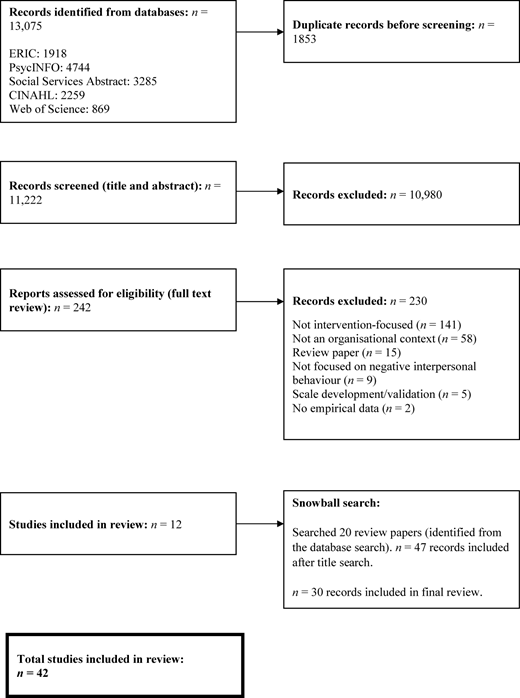
Following Arksey and O'Malley (2005)'s methodological framework, the review was conducted in five stages: identifying the research questions, identifying relevant studies, study selection, charting the data and collating, summarizing and reporting the results. Each stage was conducted sequentially and in conjunction with all authors. Aligning with the PRISMA guidelines for review papers, an overview of the data collection and selection process is shown in Figure 1.
Identifying research questions
Four questions guided the scope of the review: (a) what type of interventions exist to address ASB from outsiders in Human Service Work exist, (b) which strategies and components underpin these interventions, (c) how effective are these interventions in reducing and preventing ASB and, (d) to what extent are digital forms of abusive behavior addressed in the interventions?
Identifying relevant studies
Five databases focusing on human service industry research were utilized: ERIC (education), PsycINFO (behavioral and social sciences), Social Services Abstracts (social work, human services and related areas), CINAHL (cumulative index of nursing and allied health) and Web of Science (general scientific and scholarly publications). The databases where chosen in collaboration with an experienced librarian and were part of a search strategy to cover key areas of human service work. The keywords were generated in consultation with all authors, drawing on their understanding of the research field broadly and refined using the PICO model. Each paper was required to feature at least one keyword from the following four categories: population (i.e. in human service industries), intervention (e.g. programs, methods and interventions designed to reduce ASB), outcome (i.e. provided primary data on the impact and outcomes of the intervention) and context (i.e. behavior was instigated by an organizational outsider). An example of a query string, along with the full list of search terms is available in Appendix.
Inclusion and exclusion criteria
Included studies were limited to peer-reviewed journal articles, published in the English language during or after 1980. Grey literature, i.e. literature that has not been formally published, were excluded from the review. Although incorporating grey literature offers certain advantages (Mahood et al., 2014), its exclusion in this review ensures adherence to peer-reviewed standards that uphold academic research quality. Additionally, this decision aligns with the study's inclusion criteria, which focus solely on evaluated interventions or programs. Additionally, research on violence prevention at work did not start in earnest until the late 1980's and early 1990's in fields such as political science (e.g. Tilly, 2003), psychology (e.g. Berkowitz, 1993) and sociology (e.g. Elwert, 2003), as discussed by Escribano et al. (2019). Thus, our review limited our search to papers published during or after 1980. Finally, while violent and aggressive behavior in human service sectors is prevalent across the world, it is scarcely published in languages other than English. Specifically, once controlling for timeframe and peer-reviewed status, less than 3 results per database search were published in a language other than English, none of which were appropriate for the current review. Thus, the exclusion of non-English studies did not introduce bias to the results.
Study selection
A total of 13,075 papers were identified via the database searches. Once duplicates were removed (n = 1853), 11,222 papers were screened by one author by assessing the title and abstract for suitability. To advance beyond the title and abstract screening stage, each study was required to meet the following criteria: evaluate an intervention, program, method or strategy intended to mitigate ASB perpetrated by organizational outsiders toward individuals employed in HSOs. Accordingly, over 97% of studies were excluded at this stage, primarily because they did not focus on the human service sector, or lacked an evaluation of interventions addressing violent, abusive, harassing or bullying behavior, on- or offline. This high exclusion rate suggests that the initial search may have been overly broad in scope (Pham et al., 2014). However, our exclusion rate aligns exactly with established estimates of the proportion of initially retrieved studies deemed irrelevant based on title and abstract screening (97%; Natukunda and Muchene, 2023) and with comparable scoping reviews in this area (95%; Civilotti et al., 2021; Hirt et al., 2022; Recla-Vamenta et al., 2023). Thus, our initial screening process was deemed appropriately rigorous.
Two authors then located and independently screened the full text of the remaining 242 papers. Any discrepancies in perceived suitability of the articles between coders were resolved through discussion. A further 95% of papers were removed at this stage because they violated one or more inclusion criterion: did not evaluate an intervention or program to prevent violence or aggression (e.g. Sato et al., 2013), were set outside of an organizational context (e.g. Coker et al., 2016), did not feature primary data (e.g. Geoffrion et al., 2020), did not focus on ASB (e.g. Rachwal et al., 2018) or focused on scale development or validation (rather than an actual intervention program), leaving 12 papers for full data extraction.
An additional search for literature was conducted via a snowball search. One author searched the reference lists of review-style papers excluded during the full-text review to identify any primary studies relevant to the topic but not captured during the database searches. Forty-seven papers were identified; 30 of which met the inclusion criteria and were included in the final dataset. This increase in studies reflects the effectiveness of snowballing in identifying studies that may not have been well-indexed or may have used different terminology than our search queries (Wohlin, 2014). Given that ASB research spans multiple disciplines, including psychology, organizational behavior, sociology and public health, relevant studies may be published in diverse journals with varying indexing practices (Boell and Cecez-Kecmanovic, 2014). Indeed, Greenhalgh and Peacock (2005) identified over 50% of sources via snowballing approaches, noting that when reviewing complex evidence, relying only on predefined, structured search strategies is insufficient. Thus, as shown in Figure 1, a total of 42 papers were included in the current scoping review.
Charting the data
An excel spreadsheet was created to capture the extracted data from the studies pertaining to the research questions. Broad categories included article descriptives (e.g. journal title, year), study demographics (i.e. number of participants, gender, age, study design, methodology), study population, intervention, context and outcome type (i.e. industry, type of interpersonally negative behavior, type of outsider) and type and outcomes of the intervention (e.g. measures, delivery mode, timeline, outcomes). This process was carried out by two authors, who sought input from all authors when unsure where or how to code the data.
Results
General study characteristics
A total of 42 studies from 41 papers were included in the analysis. Although the search strategy covered a broad range of ASB, the identified studies primarily focused on interventions targeting two main types: aggression (n = 15) and violence (n = 17). A small number of interventions sought to address a combination of the two (n = 5) or other behaviors of a similar nature (i.e. staff mistreatment, challenging behavior, tense or conflictual interactions, n = 5). Interventions were set in a wide range of geographical locations including Europe (n = 7), the Middle East (n = 7) and Australia and New Zealand (n = 6), however 40% of studies (n = 17) did not report participant origin or location.
Source of behavior and industries of focus
Despite a broad search strategy designed to capture all domains of HSOs, all 42 studies included in this review examined interventions addressing ASB within healthcare settings. Interventions were predominately focused on emergency room and mental health departments; settings that typically record very high levels of aggression and violence (Arnetz and Arnetz, 2000). As such, interventions reviewed in this study typically addressed ASB perpetrated by patients (n = 30), their companions/caregivers (n = 9) or both (n = 1) – one study did not specify the source of perpetrator.
Among the interventions designed with a specific recipient group in mind, healthcare nurses (n = 15), followed by physicians (n = 1), acute ward workers (n = 1) and health care support workers (n = 1) were most common. Many studies (n = 12) targeted multiple health care professionals within the same intervention. Only one intervention was designed for patients (i.e. visitors at an emergency department), and another for managers exclusively. Of those that took part in the intervention, a common analytical subgroup were practitioners in training and student nurses (n = 7) and medical students (n = 1). A further two interventions were evaluated using convenience samples (i.e. university students, paid samples from MTurk), however the studies focused on situations in health care and/or other human services settings.
Reporting transparency
Reporting transparency was generally strong across studies, with most studies providing clear descriptions of interventions, methods, analyses and limitations. Detailed reporting of training content and statistical results was common. However, preregistration was rare, occurring in only a small number (n = 2) of more recent studies. Handling of missing data and attrition was inconsistently reported, with most studies relying on available case or listwise exclusion.
Intervention components and ingredients
Across the reviewed evidence, intervention components clustered into a small number of recurring models, with strong convergence around training-based approaches and more selective inclusion of risk assessment, protocolization and system-level supports. Most interventions consisted of stand-alone education or skills training, ranging from brief single-session formats (e.g. 2-hour de-escalation workshops) to intensive multi-day curricula (e.g. aggression-management or communication programs; Nau et al., 2010). Core content consistently focused on communication and de-escalation skills, early warning signs (i.e. Al-Ali et al., 2016) and escalation cycles, risk assessment (i.e. Anderson, 2006) legal and ethical issues, personal safety and scenario-based practice (e.g. role-play, simulation, case studies or multimedia exemplars). Several programs adopted competency-based designs, incorporating manuals (i.e. Grenyer et al., 2004), scripted curricula, return demonstrations and refresher training.
Using a prevention framework, most interventions operated at the secondary level (n = 28), targeting early detection (i.e. Masa'deh et al., 2021; Kalbali et al., 2018) and response once risk or ASB was evident. These predominantly involved staff de-escalation training and reactive skill development. Baig et al. (2018), for example, evaluated a 4-hour de-escalation training program, based on the ICRC public health manual. The program incorporated modules on understanding violence and stress (e.g. prevalence, triggers), recognizing escalation and applying verbal and non-verbal de-escalation strategies, managing stress and PTSD and improving patient communication through skills such as active listening, empathic communication and delivering difficult news. Training was often delivered using interactive teaching methods, including brainstorming, scenario-based videos, role-plays (de la Fuente et al., 2019) and simulated doctor–patient interactions. Primary interventions were less common (n = 10), and mostly focused on preventing ASB before onset, for example through risk identification, environmental or informational modifications and policy or procedural change (e.g. Gillespie et al., 2014b). Participants in a study published by Kling et al. (2011) were exposed to an alert-based violence prevention system designed to support de-escalation and precautionary responses. The intervention involved a nursing-completed violence risk assessment at admission, with high-risk patients flagged via chart indicators and wristbands to communicate risk to staff. These alerts were intended to prompt precautionary responses (e.g. use of alarms, security presence, avoiding lone entry) and were implemented alongside existing violence-prevention training. Two studies (i.e. Inoue et al., 2011; Martinez, 2017) evaluated a purely tertiary intervention, providing therapeutic support to staff after exposure to violence, while a small number adopted multimodal approaches combining primary, secondary and/or tertiary elements. A subset of studies incorporated organizational or system-level components, such as structured risk screening and flagging systems, preventive action protocols, incident reporting with feedback and reflective review and explicit manager involvement. The most comprehensive programs combined training with policy clarification, environmental modifications and cultural messaging (e.g. reinforcing that “violence is not part of the job”) (Calabro et al., 2002; Gillespie et al., 2013). These multi-component approaches were also associated with meaningful reductions in ASB; for example, during the implementation period reported injury events at the hospital fell to “historical levels” (fewer than 130 annually) (Calabro et al., 2002).
Across studies, several active ingredients recurred as central to effectiveness: experiential communication and de-escalation skill development, early risk recognition supported by shared frameworks or checklists, feedback and reflective learning, self-efficacy enhancement and emotional regulation. Interventions that embedded these mechanisms within team practices and organizational reinforcement appeared most promising. Outcomes were measured primarily at the individual level, most often changes in knowledge and skills (n = 13) and confidence to manage aggression (n = 11), while fewer studies assessed organizational outcomes such as objective reductions in ASB (n = 12).
Measurement approaches
Across the reviewed literature, methodological quality was variable and modest, with notable strengths in psychometric rigor for proximal outcomes but persistent limitations in design and outcome measurement. The evidence base was dominated by quasi-experimental pre–post designs, with 31 studies using this approach. Of these, the majority lacked a control group, substantially constraining causal inference, while a smaller subset (n = 6 studies) included a non-randomized comparison condition. Randomized or cluster-randomized designs were uncommon, identified in only approximately six studies and a further four were descriptive or feasibility-focused rather than evaluative in nature.
Sample sizes varied markedly, ranging from small pilot and simulation studies (n = 15–40; 16 studies) to moderate samples (n = 50–150; 14 studies) and larger organizational or surveillance-based evaluations (11 studies) involving hundreds of staff, thousands of patients or ward-level incident data, which provided greater robustness for system-level outcomes. Measurement quality was strongest for psychological and capability outcomes, with frequent use of validated instruments (e.g. CCPAI, POPAS-NZ, SOAS-R, IES-R, K10) demonstrating acceptable to excellent reliability. In contrast, ASB measurement was limited in both scope and rigor. Three-quarters of studies did not measure ASB at all or relied on unvalidated single items or retrospective self-reports, making estimates vulnerable to recall and reporting bias. A small subset (n = 6) used administrative or surveillance data (e.g. incident reports, assault logs, occupational health records), offering stronger face and operational validity but still dependent on reporting practices. Direct behavioral observation (i.e. Wacker and Dziobek, 2018) and performance-based measures (Al-Ali et al., 2016) were rare and typically confined to simulations rather than real-world incidents.
Intervention outcomes and effectiveness
Across the reviewed studies, short-term intervention effects were consistently observed for individual-level psychological and capability outcomes, whereas effects on actual aggression or violence were more variable. Training-based interventions (Beech and Leather, 2003; Masa'deh et al., 2021) reliably produced immediate improvements in confidence, self-efficacy, knowledge and perceived competence, often with moderate to large effect sizes measured immediately post-intervention or within several weeks. Improvements in attitudes and observable de-escalation behaviors were also evident in the short term, particularly when assessed using simulations or structured behavioral tasks (i.e. Baig et al., 2018). However, short-term reductions in adverse behaviors were less consistently demonstrated, and when present were largely confined to multicomponent interventions that integrated training with risk assessment tools, preventive protocols or organizational and environmental changes (Gillespie et al., 2013). Training delivered in isolation appeared sufficient to enhance staff preparedness and perceived capability but was insufficient on its own to reliably reduce exposure to ASB in the short term.
Long-term evaluation of the interventions was an exception rather than the norm. Roughly half of the interventions did not follow-up on outcomes beyond immediate post-training or short windows (e.g. 4–6 weeks), although several studies explicitly identified the absence of longitudinal assessment as a methodological limitation (i.e. Sharifi et al., 2020; Whittington and Wykes, 1996). Only a quarter of studies (n = 10) reported outcomes beyond one month (most commonly at 1–3 months); only five studies assessed outcomes 6–9 months post intervention, and even fewer (n = 4) examined outcomes over 12 months or longer. Where longer-term data were available, individual-level outcomes (e.g. confidence, knowledge, communication skills, psychological wellbeing) were generally maintained above baseline, though some attenuation over time was evident (i.e. Arnetz and Arnetz, 2000). In contrast, long-term reductions in ASB were inconsistent: a small number of multi-component or system-level interventions (e.g. Arnetz and Arnetz, 2000) demonstrated sustained reductions in incidents, injuries or costs, whereas individual-level training-only interventions rarely showed durable behavioral or incident-level effects (e.g. Needham et al., 2005).
Reporting of effect sizes was inconsistent and often absent, limiting direct comparison of intervention magnitude. Only a minority of studies reported formal metrics such as η2, Cohen's d, risk ratios or f2, with these generally indicating moderate to large short-term effects for psychological and capability-based outcomes (e.g. confidence, self-efficacy, knowledge, communication skills). Where reported, effect sizes for confidence and perceived capability were frequently large (e.g. η2 ≈ 0.44–0.58; d > 1.0), while stress and wellbeing outcomes showed small-to-moderate effects. In contrast, behavioral and ASB related outcomes were rarely accompanied by standardized effect sizes, with magnitude typically inferred from percentage reductions in incidents, changes in incident rates, or raw count comparisons. Multicomponent interventions demonstrated substantial practical effects on violence severity and frequency (often 30–60% reductions) (e.g. Sharifi et al., 2020), whereas training-only interventions primarily showed meaningful but indirect effects reflected in proximal or self-reported outcomes.
Digital-based interventions
Despite a marked increase in digitally perpetrated ASB over the past five years (Farley et al., 2021), none of the included interventions addressed cyber aggression, cyber harassment, cyberbullying or other forms of ASB enacted through communication technologies. This omission is notable given growing evidence that such behaviors also occur in online environments, particularly with the expansion of digital appointments and remote interactions following the COVID-19 pandemic (Shaver, 2022). While the behavioral setting in the reviewed articles excluded online interactions, an electronic delivery mode was included in the delivery of some interventions. A handful of interventions (n = 7) were delivered as complete online educational training programs. Two interventions (n = 2) were delivered as a hybrid educational program where meetings in person also took place, and additional three interventions included multimedia content. This includes an intervention where the human service workers were trained to manage challenging behavior from outsiders through a video game that provided simulation of real events (Mason and Loader, 2019), and an online course to educate student nurses about violence prevention techniques (e.g. Brann and Hartley, 2017).
Discussion
ASBs from organizational outsiders is a substantial and expanding problem in HSOs. Despite continual calls for safety policies and prevention measures prevalence rates continue to rise (Arnold et al., 2024; Liu et al., 2019; Parveen et al., 2023), suggesting current approaches are either ineffectual or misdirected in focus. In response to this gap, this scoping review aimed to map and critically examine existing research on interventions designed to prevent or mitigate ASB in HSOs. The findings reveal a high degree of homogeneity in intervention design and delivery, alongside mixed evidence of effectiveness. Drawing on these findings, four key themes were identified that synthesize the results of the review while highlighting critical directions for future research and opportunities for practical improvement. These include: (1) transferring knowledge from health care to other HSOs, (2) increasing preventative-focused interventions, (3) constructing targeted interventions for digitally perpetraded ASB and (4) enhancing methodological rigor in intervention evaluation. Each of these themes is discussed in detail in the following sections.
Transferring knowledge from health care to other HSOs
Healthcare workers were the main target group in the reviewed interventions, comprising nurses, physicians, acute wards, health care support workers and students. The predominance of interventions focusing on healthcare professionals is understandable considering that ASB from outsiders is a well-documented issue in this group (Grant et al., 2022; Morphet et al., 2018). However, the absence of sector-specific interventions for education and social services is concerning. Despite high rates of ASB in these settings (Arnold et al., 2024; Parveen et al., 2023), our study shows that interventions in education and social services remains empirically untested. A key takeaway from this review is the need for more research in non-clinical healthcare settings, such as in education and social services. While we recognize that differences exist across these fields, the full extent of these differences remains unclear. The nature of worker-outsider interactions varies, from brief, high-intensity encounters in emergency healthcare settings to long-term, trust-based relationships in education and social work. Failing to consider these differences risks overlooking critical factors such as power dynamics between HSO employees and organizational outsiders, intersectional vulnerabilities and the broader organizational climate. This omission can leave significant gaps in protection and enforcement (Munduante and Bennebroek Gravenhorst, 2003). Rather than developing entirely new approaches, strategies, mechanisms and organizational conditions shown to support effective ASB management in healthcare may provide a useful foundation for designing interventions suited to the distinct challenges of education and social services. Lessons from interventions in emergency departments (e.g. Reyt et al., 2022; Shaikh et al., 2022), for example, where visitors are informed about patients' rights and responsibilities to curb ASB from outsiders, can for instance be adapted to the educational context and home-school collaborations. Following a similar preventative logic, school leaders may encourage respectful communication from guardians by clearly outlining expectations for appropriate email conduct and signaling that digitally perpetrated ASB will not be tolerated. Likewise, aggression de-escalation training widely implemented in hospital settings (e.g. Baig et al., 2018; Lamont and Brunero, 2018) may have relevance for social services, where social workers frequently engage with clients and their family members. However, these potential applications remain largely untested. The transferability of interventions across HSO contexts cannot be assumed, as sector-specific dynamics, power relations and patterns of outsider interaction may influence both the emergence of ASB and the effectiveness of intervention strategies. Given the limited empirical work outside healthcare identified in this review, future research is needed to examine whether and how such interventions translate across settings, and to identify context-specific factors that may shape their implementation and effectiveness.
Increasing preventative-focused interventions
The majority of interventions in this review focused on secondary risk management including reactive responses to ASB, typically through training in communication and de-escalation techniques to manage conflicts with patients and their families. Only two interventions incorporated tertiary elements aimed at restoring workers' well-being after exposure to ASB. Additionally, just 10 studies included primary interventions designed to eliminate the root causes of aggression before incidents occurred. Despite growing policy pressure to curb ASB (Eurofound, 2015), this review indicates that current interventions largely fall short of addressing root causes or long-term impacts. Most rely on reactive strategies aimed at responding to or deterring misconduct after it occurs, rather than implementing proactive approaches designed to prevent such behavior from arising in the first place. Common approaches, such as aggression de-escalation training, often emphasize individual responsibility rather than structural or cultural change, limiting their effectiveness (Arthur et al., 2003). Contextual factors like organizational culture and leadership were rarely considered, yet an increasing number of studies point to the need to examine how circumstances within the own organization can influence exposure to ASB from outsiders (Balducci et al., 2020; Farley et al., 2024). When ASB arises in response to workplace conditions, targeting organizational practices offers a pathway to prevention rather than mere mitigation. However, given organizations' limited ability to sanction outsiders, interventions that focus on reducing harm rather than eliminating the stressor may appear more feasible – explaining the dominance of secondary strategies despite the well-documented benefits of primary prevention (Chen et al., 2021; Shier et al., 2021; Yang and Lau, 2019).
Preventive measures identified in the review included structural interventions such as environmental modifications, policy reforms, and procedural changes. Examples include redesigning physical spaces to reduce risk during high-conflict interactions, implementing clear reporting and response protocols and establishing organizational policies that set explicit expectations for acceptable behavior from service users and visitors. In general, approaches that embed prevention within the organizational system, routines and leadership commitments is often argued to hold greater potential for lasting impact compared to reactive strategies that rely on how individual workers manage incidents as they arise (Hasle et al., 2021; Montano et al., 2014). Yet the current lack of emphasis on primary prevention underscores the urgent need for broader, proactive approaches that systematically address the organizational, environmental and relational conditions under which ASB emerges. This may include redesigning service processes that create frustration or conflict (e.g. long waiting times or unclear procedures), proactively communicating behavioral expectations to outsiders or introducing systems that identify and manage risk before interactions escalate. By shifting the focus from responding to incidents toward reducing the conditions that enable them, HSOs can move toward more sustainable prevention strategies. Only by prioritizing such primary-level interventions can organizations meaningfully reduce workers' exposure to ASB and create safer service environments.
Constructing targeted interventions for digitally perpetrated ASB
Although the review noted an increasing use of online platforms for intervention delivery, none of the studies addressed ASB perpetrated in online settings. This gap may reflect the relative novelty of digital services in HSOs (Farley et al., 2021). However, the COVID-19 has accelerated the digital transformation of work, reshaping how and where ASB occurs, is perceived and experienced. As technology evolves, interventions targeting digitally perpetrated ASB risk of becoming short-lived. Moreover, limited familiarity with communication technologies and insufficient understanding of the phenomenon have likely contributed to delays in developing preventive measures in the workplaces. The absence of established best practices remains a major barrier, and for individual organizations, developing such measures may seem resource-intensive and further hindered by a lack of expertise. This highlights the need for more research on interventions that provide actionable insights into digitally perpetrated ASB. While this review shows that interventions originating in workplace contexts remain limited, the substantially larger body of research on cyberbullying in schools may offer useful guidance for researchers and practitioners seeking to develop such approaches. However, this requires careful consideration of which principles can be meaningfully transferred across contexts and how they may need to be adapted. Whether distinct interventions should be developed for digitally perpetrated ASB depends however on its conceptual relationship to offline forms of misconduct. A key debate is whether these behaviors represent separate phenomena or different expressions of the same underlying issue (Dooley et al., 2009; Vranjes et al., 2017). While research suggests cyberbullying often extends face-to-face bullying, sharing similar antecedents and outcomes (Coyne et al., 2024), online interactions introduce unique dynamics (Clark-Gordon et al., 2019; Suler, 2004) and consequences, such as experiencing mistreatment at home (Heatherington and Coyne, 2017) or identity distortion on social media (Cowen Forssell, 2020). These distinctions underscore the need for targeted interventions. Future research should clarify the relationship between online and offline behaviors, but intervention design must account for the specific risks and impacts of digital interactions with organizational outsiders.
In an increasingly digitalized society, addressing digitally perpetrated ASB is essential for creating safe and supportive work environments. Introducing this terminology within the broader framework of ASB, as we have done in this study, enhances identification and labeling while emphasizing the urgency of the issue.
Enhancing methodological rigor of intervention evaluation
Fewer than 12 studies collected data at more than two time points, limiting the ability to examine how intervention effects develop or persist over time. Longitudinal assessment is particularly important in organizational interventions, where behavioral and cultural change may unfold gradually and depend on reinforcement and contextual factors (Nielsen and Randall, 2015; Nielsen and Abildgaard, 2013). Without repeated measurements, it becomes difficult to identify cumulative, delayed and diminishing intervention effects. Additionally, only a small subset of studies reported effect sizes, and those that did revealed considerable variability, suggesting inconsistent intervention impact across settings. Such variability is common in complex organizational interventions, where outcomes are shaped not only by intervention content but also by contextual and implementation factors such as organizational readiness, fidelity and participant engagement (Proctor et al., 2011; Fixsen et al., 2005). Future research should therefore incorporate repeated measurements across multiple time points, report effect sizes more consistently and examine potential moderators and contextual influences. Greater attention to these factors will help clarify when and how interventions are effective and support more robust evidence-based decision-making regarding strategies to address ASB in HSOs.
Strengths, limitations and future directions
The study employed a rigorous methodology, supported by clearly defined aims and comprehensive search strategies. However, we acknowledge the inherent limitations of this approach and their implications for the generalizability of the results. First, the relatively small sample of studies included in our review may both reflect the limited body of existing research on this topic and raise concerns about the breadth of insights available. While our findings provide a valuable overview of current intervention efforts, they also highlight the need for more robust empirical investigations to fully capture the scope of ASB across various workplace contexts.
Second, the evolving and multifaceted nature of digitally perpetrated ASB has resulted in considerable variation in how the phenomenon is defined and labeled in research. Literature uses multiple terms such as cyber aggression, cyber harassment and cyberbullying - all of which were incorporated into our search strategy. However, including additional concepts like cyber incivility or more specific behaviors such as trolling and doxxing would have strengthened the comprehensiveness of this review. Cyber incivility, for example, refers to lower-intensity negative behaviors that may seem minor in isolation but can accumulate over time to cause significant harm. By not explicitly capturing this dimension, our review may have overlooked important nuances within the spectrum of online ASB in HSOs.
Conclusion
ASB from organizational outsiders is a substantial and expanding problem in HSOs, which calls for effective approaches. This scoping review reveals that existing interventions are largely similar in their professional focus, target behaviors, intervention type and evaluation methods. These findings underscore the need for new, multi-component interventions assessed across multiple time points – particularly as ASB are increasingly facilitated through digital communication technologies, including those perpetrated online. In this way, the study provides a comprehensive foundation for novel and advanced evidence-based interventions that can mitigate and prevent ASB for these critical work groups.
Appendix
Example of Query String
((abstract(Violence) OR abstract(Abus*) OR abstract(Cyber-harass*) OR abstract(Cyber-bully*) OR abstract(Harass*) OR abstract(Bully*) OR abstract(Aggression*) OR abstract(Online harass*) OR abstract(Online bully*) OR abstract(Digital harass* OR Digital bully*)) AND PEER(yes)) AND ((abstract(Human service*) OR abstract(Healthcare*) OR abstract(Teach*) OR abstract(Welfare*) OR abstract(Social work*) OR abstract(Social service*) OR abstract(Educat*) OR abstract(Academi*) OR abstract(Universit*)) AND PEER(yes)) AND ((abstract(Outsider*) OR abstract(Third Party*) OR abstract(Customer*) OR abstract(Patient*) OR abstract(Client*) OR abstract(Parent*) OR abstract(Student*)) AND PEER(yes)) AND ((abstract(Intervention*) OR abstract(Program*) OR abstract(Method*) OR abstract(Implementation*) OR abstract(Evaluation*)) AND PEER(yes))
Full list of keywords
| Population | Intervention | Context | Outcome |
|---|---|---|---|
| Human service* | Intervention* | Outsider* | Violence |
| Healthcare* | Program* | Third Party* | Abus* |
| Teach* | Method* | Customer* | Cyber-harass* |
| Welfare* | Implementation* | Patient* | Cyber-bully* |
| Social work* | Evaluation* | Client* | Harass* |
| Social service* | Parent* | Bully* | |
| Educat* | Student* | Aggression* | |
| Academi* | Online harass* | ||
| Universit* | Online bully* | ||
| Digital harass* | |||
| Digital bully* |

