The purpose of this paper is to deliver a structured literature review of existing literature on agri-fresh food supply chain quality (AFSCQ) over a period of 23 years (1994 to mid-2016) and provide a platform for practitioners and researchers trying to identify the existing state of work, gaps in current research, and future directions in the field of AFSCQ.
The existing literature is classified on the basis of several classes like number of publications per year, journal-wise publications, studies across various countries, growth of empirical research, data analysis methods or tool used, issues related to supply chain quality as well as performance measurement (with respect to entity of analysis, level of analysis and element of exchange).
Most of the research publications discuss issues in developed countries, while relatively lesser publications are available on issues in developing countries. Hence, larger opportunities in the field of AFSCQ are available in developing countries. Empirical research is also growing in the field of AFSCQ. Largely research publications make use of “case study” research approach and “statistical analysis” as a quantitative tool of research. The literature is also categorized under the various issues of supply chain quality such as sustainability management, information management, logistic management, collaboration and coordination management, strategic management, demand management, inventory management, food safety, performance management, supply chain integration, supplier management, quality management, etc. It was found that in the majority of articles, information management, sustainability management, and logistics management are very critical issues as far as AFSCQ is concerned. Performance measurement of agri-fresh food supply chain is also on a growing stage. It is also an integral part of AFSCQ.
Most of the prior reviews are concentrated on a particular issue as production and distribution planning for agri-foods, temperature monitoring, corporate and consumer social responsibility, traceability system and ignore the wider perception. There exists a necessity of having a detailed review to cover up all the issues in AFSCQ. This review fills this gap in the extant AFSCQ literature.
1. Introduction
The agri-fresh food segment is perhaps a profitable venture of all farming activities as it provides ample employment opportunities and scopes to raise the income of the agricultural community. In the last decade, there are dramatic changes in the supply chain of agri-fresh products. Agri-fresh food products compose a significant position of the world economy as well as they are the supplies for various food processing industries. Inside agri-fresh food supply chains, raw food stuffs are transformed through packaging, distribution and related services. In this process, it is very important that not only the product quality is ensured but the supply chain quality should be maintained as well. The supply chain quality is defined as a set of practices that emphasize on continuous process improvement among partners (firms) in the supply chain in order to enhance performance and achieve customer satisfaction through prominence in learning (Mellat-Parast, 2013). The agri-fresh supply chain quality (AFSCQ) is distinct and peculiar in some aspects which makes the management of such supply chain typical and difficult. In order to review these characteristics of the AFSCQ, a review is carried out in this paper. AFSCQ indicates a group of organized practices or exercises that stress upon advancement of continuous process improvement among supply chain stakeholders in order to enhance sustainable performance and protect shelf-life of a product.
The AFSCQ is more complex as compared with the supply chain quality of non-perishable products due to short shelf-life of the product, food product safety and quality standards to be followed (Van der Vorst and Beulens, 2002), high uncertainty in demand and cost and dependency on climatic conditions (Salin, 1998). Cheng et al. (2014) discussed the effectiveness of supply and demand information visibility of perishable food supply chain trading. Zhong et al. (2013) proposed an RFID-enabled real-time advanced production planning and scheduling shell to coordinate different decision makers across production processes. Tanik (2010) emphasized on the advantages of using systematic quality enhancement tools in each element of the supply chain in food production. Aramyan et al. (2013) analyzed the adoption of an animal welfare valuation system in European agri-food supply chains for enhancement of supply chain quality. In recent years, supply chain quality practices and their significance to management practices have received more attention (Mellat-Parast, 2013).
A review concisely illustrates the literature. Soni and Kodali (2011) and Rowley and Slack (2004) explained that the literature review is significant to:
identify the research area(s) and research questions;
find the literature to which the research work will mark an influence;
understand and in building of theoretical concepts and terminology;
make possible listing of the resources that have been referred; and
highlight research approaches that might be beneficial.
This review builds upon articles focused on issues of AFSCQ to offer recommendations for further studies. Some of the prominent studies in AFSCQ, for example, by Perez et al. (2009) highlighted the complexity involved in the pork supply chain to obtain the quality of pork products. Ahumada and Villalobos (2009) focused on the application of planning models in the agri-food supply chain. The main contributions of this review were in the field of production, distribution, and planning for agri-food. Raab et al. (2011) highlighted the literature review and novel temperature monitoring systems and its challenges, and the professional experience was applied to system designers of temperature monitoring in the meat supply chain. The role of the supplier is crucial in the supply chain (Yadav and Sharma, 2015a) and it becomes more crucial in case of the food supply chain. Therefore, an appropriate supplier selection process is a necessity (Yadav and Sharma, 2015b). Manning (2013b) conducted a literature review focused on corporate and consumer social responsibility in the food supply chain. Bosona and Gebresenbet (2013) conducted a comprehensive literature review on the food traceability system which embraces the definitions, drivers, benefits, barriers, technologies, improvement and performance of the food traceability system. Dües et al. (2013) focused on the relationship and links among Lean and Green supply chain management practices. Shukla and Jharkharia (2013) studied the literature on the fresh produce supply chain management. This review was done systematically by collecting the existing facts and classifying it from difficulty context, methodology, and the product. Furthermore, the review was also classified according to the year of publication and geographic region. Siddh et al. (2015) presented a complete review on the quality of the perishable food supply chain which highlighted that information management, strategic management, logistic management, sustainability, demand forecasting and supply chain integration are some of the critical issues. Kamalahmadi and Parast (2016) focused on research development in supply chain resilience which embraces the enterprise and supply chain resilience definitions, supply chain resilience principles, and supply chain resilience strategies. Yu et al. (2016) presented a literature review on E-commerce logistics in supply chain management from the view of practice perspective. Global implementations and consistent models together with supportive techniques are studied in this paper. Zhong et al. (2016) focused on big data for supply chain management in the service and manufacturing areas: challenges, openings, and future perceptions. It can be concluded from the analysis of above papers that none of the literature review articles in the recent past reviewed literature on AFSCQ.
Hence, this paper is aimed at finding present status of literature on AFSCQ and suggestions for further research in this area. This literature review is aimed at answering following research questions:
How is the field of AFSCQ evolving over the past years?
How much importance is given to research on AFSCQ across countries?
What is the prevalence of empirical research in the field of AFSCQ?
The replies to above queries are valuable in tracing the development of research in the field of AFSCQ through the world as far as the research is concerned. Now in order to find out prevalent tools of research in AFSCQ, following query arises:
What type of research tools are being used by researchers in the area of AFSCQ?
The reply to this query is valuable to know the research tools and it will also help in finding out the type of problems these type of tools address in the field of AFSCQ:
What type of product quality problems or issues arise in AFSCQ?
What is the significance of performance measurement in AFSCQ?
The answers to these queries are very significant; the reason being, the issue of product quality besides performance measurement reflects the operational effectiveness concerning AFSCQ to a larger extent:
What are the gaps and scope of future research in the field of AFSCQ?
The answer to this question is very useful in finding the gap and future scope in the field of AFSCQ.
2. Methodology
This review consists of a six-step research approach. The first step is the time period (1994 to mid-2016), the year 1994 is taken as the starting point of article collection because the word “supply chain quality” initially appeared in this year itself. The second step is to collect research publications, the publications were selected from management science publishers such as Emerald Online, Taylor & Francis, Wiley Interscience (earlier Blackwell Synergy) and Science Direct. The third step is the selection of research publication from the database using various search keywords such as supply chain quality, agri-food, agri-fresh, agri-food supply chain, food supply chain, vegetable supply chain, fruit supply chain, agri-fresh food supply chain, and perishable food supply chain. The Fourth step is separation or sorting of publications to remove duplication of articles and then analyzing the filtered articles. In the last step, selected articles are classified under several categories: number of research publication per year, journal-wise articles classification, number of studies across countries, empirical research growth in AFSCQ, performance measurement, categorization based on tools utilized or data analysis methods, and classification based on supply chain quality issues. These steps are explained as follows:
Step 1: Time Horizon (1994 to mid-2016) – the evaluation period of research publications is between 1994 and mid-2016 because the word “Food supply chain” initially appeared in 1994 (Taylor, 1994). Mid-2016 is taken as a terminating point of research publications collection.
Step 2: collection of research publications – research publications were selected from the major management science publishers. These are: Science Direct, Emerald online, Taylor & Francis, and Wiley Interscience. These databases have the majority of well-referred journals. Soni and Kodali (2012) also used these management science publishers for a detailed literature review of empirical study approach in supply chain management.
Step 3: search keywords for research publications selection – the search keywords for research publications selection from four databases are supply chain quality, agri-food, agri-fresh, agri-food supply chain, food supply chain, fruit supply chain, vegetable supply chain, agri-fresh food supply chain, and perishable food supply chain. In total, 1,562 articles were found by using the above keywords.
Step 4: sorting of research publications – research publications were shortlisted on the following basis:
Eliminating duplicated publications – here, repeated publications were separated from all the downloaded publications.
Picking only relevant publications – in this step, the sample size was reduced to make a representative sample set for which following policy was used. The research publication should, at least, be concerned with agri-fresh food, quality of agri-fresh food supply chain, supply chain quality, agri-fresh food, food product quality or supply chain quality. Research publications focusing on agri-fresh produce and publications addressing the food product quality and supply chain quality issues were studied.
At last 142 publications were filtered from the aforesaid downloaded publications.
Step 5: research publication categorization – here, publications are organized in subsequent classes:
The number of research publications each year: this one shows the yearly publications rate or trend of AFSCQ literature throughout the period of 23 years.
Journal-wise classification of research publications: it presents the journal-wise classification of publications.
Country-wise classification of research publications: it presents the classification of research studies according to country. The countries are categorized into developed and developing. The research studies or findings which are not specific to any particular country are considered in common studies.
The number of empirical studies each year: it presents the yearly growth of empirical research study in the AFSCQ literature. It is an indicator of the growing importance of empirical studies per year.
Tool utilized or data analysis methods: it shows the details of tool utilized or data evaluation or analysis methods. The tool utilized depends on the research purpose or problem itself and the type of data available.
Supply chain quality issues: supply chain quality issues are one of the important categorizations in the AFSCQ literature. Reviewing these issues will generate generic constructs governing AFSCQ as well as help researchers in better understanding of the subject.
Performance measurement: the measurement of performance is vital at every part of the supply chain and consequently well-timed action can be taken. In this paper, it has been investigated that the performance measures are implemented at which levels of supply chain and what entities are involved in the same.
3. Results and analysis of AFSCQ literature
All the papers in the field of AFSCQ are presented in Table I. This table classifies the publications with respect to country of research, research design and discusses their contribution to research.
3.1 Categorization based on number of research publications each year
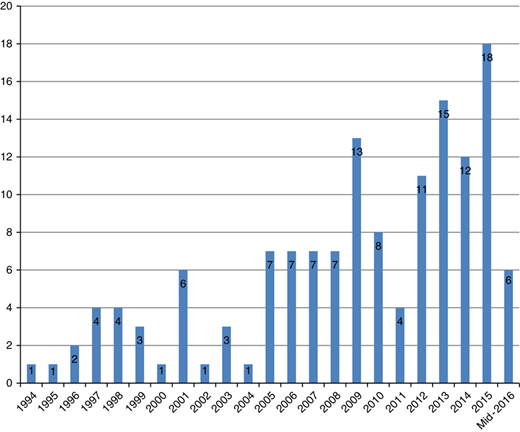
This one represents yearly research publication frequencies of the total research publications. It is evident from Figure 1 that research in the field of AFSCQ is continuously growing. Furthermore, there is a rapid rise in the number of publications since year 2005, and it may be due to the comprehensive issues that raise the awareness of practitioners and researchers in the field of AFSCQ.
It is evident from Figure 1 that the yearly publications were raised recently as more than half of the total publications were published in the last five years.
3.2 Journal-wise classification of research publications
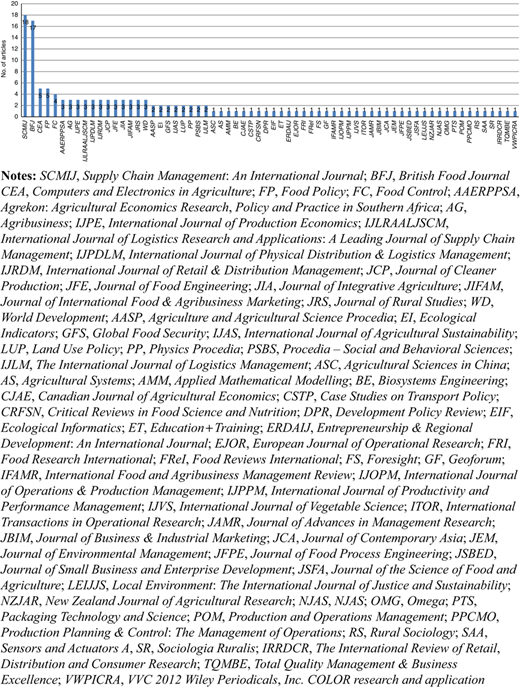
This classification presents the frequency of publications in journals. Figure 2 shows the distribution of research publications on the basis of journals.
These journals particularly deal in the operations management, though the problem may be specific to AFSCQ. In total, 142 articles were found addressing the AFSCQ problems from the context of operations management. This shows that significant amount of research publications were written in context of operations management.
One more aspect perceived from Figure 2 is that maximum research publications are from Supply Chain Management: An International Journal (18 research publications, 12.67 percent), British Food Journal (17 research publications, 12 percent), Food Policy (five research publications, 3.52 percentage), and Computers and Electronics in Agriculture (five research publications, 3.52 percent).
3.3 Country-wise classification of research publications
Research publications are categorized on the basis of developed and developing country. It is evident from Table II that most of the publications are from developed countries such as the UK (23 articles, 16.20 percent), USA (12 articles, 8.45 percent) and the Netherlands (ten articles, 7.04 percent), etc. and not as much attention is paid to research work on issues of AFSCQ in developing countries. While on the contrary developing countries like India are largely agrarian, still research in this area is lacking.
3.4 Year-wise empirical research growth in the field of AFSCQ
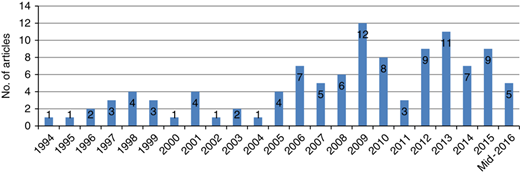
It is observed that the first empirical research publication in agri-fresh food supply chain appeared in the International Journal of Physical Distribution & Logistics Management in 1994. It can be understood from Figure 3 that empirical research publications have exhibited remarkable growth after 2004.
It is visible from the above data that about 60 percent of the empirical research publications were published since last seven years though about 40 percent research publications were remaining publications. It can be seen clearly from Figure 3 that from past seven years, there is a major growth in empirical research publications in the field of AFSCQ. It exhibits the growing fondness of researchers towards case study and survey-based research particularly in this area.
3.5 Classification based on data analysis methods or tool utilized
The literature of AFSCQ may also be classified by data analysis methods or tools utilized. Table III shows the categorization of research publications according to data analysis methods.
It is evident from the above table that a majority of research publications utilized “statistical analysis” (39.43 percent), which also indicates that the nature of research is dominantly quantitative and survey based. In rest of the 44 publications (40.84 percent), no specific tool or data analysis methods were utilized, neither a case study or conceptually centered research publications.
3.6 Research publications categorization based on issues of AFSCQ
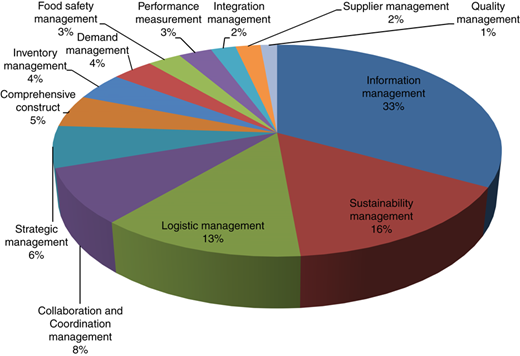
The review of AFSCQ can furthermore be classified on the basis of AFSCQ issues. Figure 4 shows the categorization of research publications according to many types of AFSCQ issues. The thing to be noted is that AFSCQ issues address multiple problems.
From Table IV and Figure 4, it is found that the majority of publications were concerned with “Information management” issues (47 articles, 33 percent), while publications with “Sustainability management” were second highest (22 research publications, 16 percent). Also, research publications with “Logistic management” were 18 (13 percent), “Collaboration and Coordination management” were 12, “Strategic management” were nine, “Inventory management ” were six, “Demand management” were five, “Food safety management” were four, “Performance measurement” were four, “Integration management” were three, “Supplier management” were three, and “Quality management” were two. It is evident from Figure 4 that “Information management” and “Sustainability management” agri-fresh supply chain issues are most relevant issues covering almost half of total research publications selected from the literature review. It does not necessarily mean that other issues are less important but these two issues may indicate their criticality.
Another significant takeaway from the review of articles in this category is the product quality, which is certainly a very important part of AFSCQ. According to Manning et al. (2006) quality assurance standards are very important to be considered for ensuring product quality. As per Oakland (1993), product quality is “conformance to customer’s requirement,” hence as far as AFSCQ is concerned, it should additionally follow the norms of food production authorities. Fidler (1990) mentioned that the quality assurance of a product is to maintain “product and quality.” In AFSCQ, since products are mostly of short shelf-life, maintenance of quality relies much on logistics, collaboration and coordination, food safety and supplier management. As per Baines and Ryan (2002), product quality is considered as a business efficiency tool and minimizes hygienic risks.
From the review, it is also found that several indicators of AFSCQ could be product quality, product safety, cost of quality, quality in logistics, quality of human resources, quality of information and information technology, quality of marketing, performance in terms of quality, relationship quality, sustainability and quality assurance.
Some common issues directed by authors regarding AFSCQ were quality of raw material, biological quality of produce, hygiene quality, nutritional quality, quality of resources (e.g. farm machinery, manures, fertilizers, etc.), monitoring decay parameter, etc.
3.7 Research publications categorization on the basis of performance measurement
It is a vital component of any system of management and so for AFSCQ. A frequency division of performance measurement publications concerning entity of analysis (EOA), element of exchange (EOE) and level of analysis (LOA) is presented in Table V.
From Table V, it is quiet visible that the performance measurement aspect is in growing stage in the AFSCQ literature. By the statistics it is evident that only 19 publications (29.69 percent) are available in a span of 13 years (i.e. 1994-2006) while rest of the 45 publications (70.31 percent) are available in a span of nine and a half years (i.e. 2007 to mid-2016). Additionally a remarkable fact is that 39 publications (60.93 percent) focused on “information,” while 15 publications (23.43 percent) focused on inventory. One more notable aspect found is that 13 publications (20.31 percent) focused on 3PL (single entity) and 46 publications (71.87 percent) focused on a combination of the many EOA. This is a very encouraging trend. Moreover, performance measurement exists at merely in the “chain” level in 52 publications (81.25 percent). It indicates that it is still very difficult to develop an integrated performance measurement system in AFSCQ. The major issue that turns out is that the size of players present at each stage of the supply chain is variable. With heterogeneous size of players, the integration aspects are always challenging. Here it is felt that for perishable products and especially for short shelf-life products, an integrated performance measurement system will elevate the AFSCQ.
4. Discussion
The primary objective of this paper is to discover the gaps existing in the literature of AFSCQ by reviewing selected research publications. As the days are passing by, research publications on the AFSCQ are increasing. Nearly 50 percent of the publications were published in past five to six years; it also shows that research toward AFSCQ is increasing. Hence, there is a need to prescribe proper direction for further research in AFSCQ. Another finding is that 60 percent of the research publications are focusing on the issues of developed countries though merely 40 percent of the research publications are directed to the issues of developing countries. Shukla and Jharkharia (2013) also discussed that limited concentration is paid in developing countries while huge emphasis is on developed country issues like innovative research environment and infrastructure while in developing countries focus on availability of fund, infrastructure, and information technology were prime concerns.
Second, about 60 percent of empirical studies are from previous seven years shows that empirical kind of investigation or research is speedily increasing. In another review in the field of supply chain, Burgess et al. (2006) and Soni and Kodali (2011) also examined that empirical investigation in supply chain management is rising at a steady pace.
As described earlier, AFSCQ emphasizes on practices or exercises that stress on continuous process advancement in order to enhance sustainable performance. Hence, performance measurement is an important aspect for supply chain quality which enables effective organization to indicate correct phase of changes to be brought in the supply chain and a well-timed action can be taken. Such approach is well described by Gopalakrishnan et al. (2006) who focused on the development of scenarios that targeted to reduce energy consumption in the manufacturing system. Siddh et al. (2015) also discussed about the sustainable performance of perishable food supply chain in their review. Another noticable aspect is that the performance measurement facet is also at a growing stage in the literature of AFSCQ. This datum is highlighted from the statistic as merely 29.69 percent (i.e. 1994-2006) of publications are published during 13 years though the rest of 70.31 percent (i.e. 2007 to mid-2016) of publications are published in a span of nine and a half years. Interestingly 71.87 percent research publications considered multiple EOA (manufacturer, supplier, retailer, distributor or consumer) besides 20.31 percent research publications focused on the single entity as 3PL. Atilgan and McCullen (2011) focused on improving supply chain performance through auditing of losses due to perishable nature of products in the supply chain. Fabbe-Costes and Jahre (2008) also observed that 48 percent of publications evaluated performance on dyadic stage or level. Similar trend is observed in this paper as well and this finding seems to be consistent with the past record. These facts prescribe researchers to preferably develop an integrated performance measurement system for AFSCQ which will enable assessment and propagation of uniformly adopted quality practices in complete supply chain of agri-fresh products.
It is also observed from our literature review that greater part of total publications utilized statistical analysis (39.43 percent) such as a tool for research problem resolving and data analysis. Sachan and Datta (2005) presented a similar list of best conventional statistical analysis techniques used in empirical research analysis and the results are concurrent with current findings.
The majority of articles showed that “information management” is vital for addressing AFSCQ issues (33.10 percent), while “sustainability management” is another important aspect of AFSCQ (15.49 percent). It reveals that research toward supply chain quality issues as “information management” and “sustainability management” is being addressed to a greater extent and it also signifies that quality of agri-fresh products and services involved in the same should be promulgated with integration by using better ways of communicating information among supply chain members. Also the technology and ethics of agri-fresh produce industry should be governed by overarching principles of sustainability.
5. Research implications and directions for future research
This review delivers more opportunities of further research in the field of AFSCQ. The outcomes of the review reveal following implications for investigators or researchers:
Agri-fresh food produce comprise a significant portion of the world economy, supplies for various industries and the world price of many foodstuffs. Aggarwal and Srivastava (2016) stated that in developing countries, the agriculture industry is the backbone of the economy. Kalia and Parshad (2015) stated that better economic revenues by food growers and retailers can only be harnessed if the huge post-harvest losses could be decreased through handling and supply chain of food products. Since 2007 research toward AFSCQ is rapidly increasing due to greater potential that AFSCQ is attaining. Thus, there are a lot of research openings in the arena of AFSCQ. One more aspect perceived from the review is that less articles are related to research appeared in developing countries. Akhtar and Khan (2015) discussed that agri-fresh food supply chain coordinators (chief executive officers, managing directors and head of departments, etc.) from developing countries should be extra careful as they often use directive leadership, which might not work in developed countries. Hence, researchers in such areas should develop theories based on aforementioned scenario. Ali (2016) stated that in India the vegetable supply chain has traditionally been divided since the greater part of growers are small holders with inadequate experience to better agricultural practices, therefore, innovative agricultural practices among small holders are needed for supply chain quality or efficiency and effectiveness.
As per discussion, the researchers should focus on verifying already existing theories in AFSCQ as sufficient volume of literature on theory building is collected and must be verified in different conditions. It is also observed that literature on AFSCQ necessitates standardized constructs. Fountas et al. (2015) also emphasized on the requirement of standardized quality audit formats based on defined data infrastructure elements in the agri-fresh food sector developed by organizations. Li et al. (2015) also discussed about progress in the agri-fresh products quality and safety standardization system.
There is remarkable growth in empirical research studies of AFSCQ from 2004. In upcoming days, empirical research needs to be directed at intra-functional and intra-firm scope at organization and supply chain level. If feasible, such empirical studies can concentrate on complete “network” as well. Else, they should at least concentrate on the “dyad” level where interaction of small farms with distributors is investigated. Siddh et al. (2015) also emphasized on the same aspect that empirical research studies are required to be targeted at intra-firm and intra-functional scope at the organization level. This point seems to be in sync with the previous implication that there is a need of promoting integration and sustainability philosophy at all the levels in the agri-fresh supply chain. Kusumastuti et al. (2016) reviewed the literature on crop-related harvesting and process planning stating that research models reflect realism to a limited extent and there is insufficiency of empirical testing research. Future research studies hence may be comprehensive and could investigate realistic research models.
Popularly, AFSCQ is influenced by material, logistics, supplier, distribution, demand, purchasing, marketing, and information management. Thus, it relies on various issues, among them certain are frequently studied by researchers, while others issues are specifically addressed such as supply chain efficiency, risk management, industrial supply chain quality, supply chain security, supply chain quality, relationship quality, strategic alignment, visibility, end deliverable quality, etc. This may require additional focus of researchers toward carrying out empirical research in the AFSCQ area. Tsolakis et al. (2014) stated that the design, development, and operation of agri-fresh food supply chains have begun to be met with enhanced attention in recent management science, while quality of such supply chain remains unexplored. Besides, the instability of weather, the perishability of produces, the complicated food safety governing environs, the varying consumers’ routine styles, the environmental anxieties and the overabundance of stakeholders immersed pose significant challenges in the direction of robust supply chain development within the agri-fresh food sector. Kalia and Parshad (2015) reviewed key nanotechnology innovations useful in preservation, packaging, safety, and storage of fruits and fruit-centered food products. The safety and quality assurance of packaged food products are most important concerns in existing day world-wide integrated food supply chains. It reflects that technological interventions may also affect AFSCQ. Zhou et al. (2015) advised to emphasize on the agri-fresh food safety practices of three governance structures: farmer cooperatives, agricultural companies, and family farms. These are also one of the major components of the supply chain quality. Ding et al. (2015) stated that farm production is dominated by limited households, and fresh food supply chains including large numbers of traders, small brokers and wholesalers, ensuring food safety along the food supply chain represents a major challenge. Handayati et al. (2015) stated that the buyers of agri-fresh food produces are changing their manners to comprise additional ethical concerns in their choice. In particular, they have begun to pay more attention to the quality in conjunction with the traceability of food product. Though food demand is becoming more sophisticated than ever, food supply preserves a traditional form of food production. According to Jack et al. (2014), agri-fresh food sector recognizes that in order to keep its competitive benefit in both present and new markets it will need a business strategy concentrated on product, service and process innovation, eventually adding more components to AFSCQ.
AFSCQ has a major effect on sustainable performance of organization as the AFSCQ practices sum up along the entire length of supply chain. Sustainable performance contains economic, environment and social sustainability. Distinctive from traditional performance measures, not only sales, return, and market share, etc., sustainable performance consists of economic, environment and social sustainability. Aggarwal and Srivastava (2016) found that waste reduction is an outcome of supply chain collaborative activities, which has huge social implications. Bisogno (2016) stated that short chain can help to raise the sustainability of interests in a scene of the advancement of the latest way of “doing business” making significance not only in relations of money but also taking liable attitude toward sustainability issues taking into consideration the environmental and social facets. Researchers may need to incorporate the components of sustainability in various facets of AFSCQ and culminating into proposition of new performance measures.
6. Conclusion and limitations
This paper presents a review of the AFSCQ literature, discussing foremost supply chain operational issues responsible for AFSCQ. The purpose of this paper is to focus on the directions and opportunities of research in AFSCQ. To sustain this objective, literature is picked from four management science publishers over a phase of 23 years (1994-mid2016). The literature review is methodically classified and analyzed to provide a better insight of the research in the past two decades. To sustain the significance of the complete process, the organized research process is followed in both the collection and content investigation of the literature.
It was observed that more than 50 percent of research publications are published during the past five years. This tendency may be attributed to the factors such as increased utilization of vegetable oil as a fuel, food prices, more attention toward reducing food wastage, difficulty in managing short shelf-life products, etc. The research in the field of AFSCQ is in growing phase. However, it is observed that research in the context of supply chain integration, information management, strategic management, and integration of transportation system for enhancing AFSCQ is deficient and researchers can direct their endeavours in blending these areas of research.
This review does have some limitations such as every publication concerning AFSCQ might not have been part of this review. This can be attributed to organized literature review procedure which governed the selection criteria, constrained by the limiting boundaries of publications used for article selection. Mainly, those research works that are published by manuscripts under open source collections, papers published in conferences, Inderscience publishers are not considered in the present study. However, this literature review provided an introductory picture towards AFSCQ issues and future research gap into this area. Further research related to this literature review could be an extension of work in specific key areas of food supply chain quality such as sustainability in food supply chain, collaboration with suppliers for quality, etc.