


The purpose of this research is to investigate how to introduce a financing scheme to tackle the manufacturer's capital constraint problem, discuss the effects of data-driven marketing (DDM) quality, cross-channel-return (CCR) rate and financing interest rate on the members' pricing and delivery-lead-time decisions and optimal performances, and analyzes `how to achieve the coordination within a dual-channel supply chain (DSC) by contract coordination.
This work establishes a DSC model with DDM, and the offline retailer can provide internal financing to the capital-constrained online manufacturer. The demand under the price is determined based on DDM quality, customer channel preference and delivery lead time. Then, combined with the Stackelberg game, the optimal pricing and delivery-lead-time decisions are discussed under the inconsistent and consistent pricing strategies with decentralized and centralized systems. Furthermore, it designs a manufacturer-revenue sharing contract to coordinate the members under the two pricing strategies.
(1) The increase of DDM quality will reduce the delivery-lead-time under the inconsistent or consistent pricing strategy and will push the selling prices; (2) The growth of the CCR rate will raise selling prices and extend the delivery-lead-time under the decentralized decision; (3) Under price competition, the offline selling price is higher than the online selling price when customers prefer the offline channel and vice versa; (4) The retailer and the manufacturer can achieve a win-win situation through a manufacturer-revenue sharing contract.
This paper contributes to the studies related to DSC by investigating pricing and delivery-lead-time decisions based on DDM, CCR, internal financing and supply chain contract and proposes some managerial implications.
1. Introduction
With the growth of the application of big data technology in business, enterprises have more business opportunities. Enterprises can improve customer utility through data-driven analysis because they carry out marketing activities by accurately grasping the consumption trend of the customer (Braverman, 2015; Cohen, 2018). For another, with the rapid development of e-commerce, online shopping is popularly used by customers (Liu et al., 2016). Some companies, such as Lenovo, Sony and Dell, open up online direct sales channels and keep offline channels, which leads to a dual-channel supply chain (DSC) system (Chen et al., 2012). However, it also leads to conflict between channels, i.e. the potential internal pricing competition between the online manufacturer and the offline retailer (Mukhopadhyay et al., 2008; Xu et al., 2012). Meanwhile, in the process of online sales, delivery-lead-time is a vital indicator to weigh the service level of online channels because the customers pay more attention to the time interval between the order payment and the receiving commodities (Hua et al., 2010), especially in countries with low labor cost. Nevertheless, a longer delivery-lead-time will reduce customers' demand for online channels and lower their loyalty. Hence, the pricing and delivery-lead-time decisions are critical issues for DSC management (Noori-Daryan et al., 2019).
In real business, with the development of new channels and the increase of potential market demand, there will be a higher requirement for the manufacturer's initial capital. Thus, more and more manufacturers have to face colossal capital pressure. Supply chain financing is one of the main methods to solve the short-term capital shortage of manufacturers, which includes external and internal financings (Deng et al., 2018). External financing is the provision of short-term loans through external financial institutions. Internal financing is another kind of financing type that provides financing through large retailers in the supply chain. For example, Walgreens and Amazon provide short-term financing to manufacturers through the financing platform (Qin et al., 2020a).
Furthermore, most DSCs provide the same channel return service, which allows customers buy-online-and-return-online or buy-offline-and-return-offline. However, with customers' increasing demand for convenient return services, enterprises such as Suning, Apple and BestBuy have begun to provide customers with buy-online-and-return-offline (cross-channel return) services to improve customer satisfaction (Yan et al., 2020). This cross-channel-return (CCR) service is convenient for customers to draw back the online products to the nearest offline physical store, improving the customers' loyalty (Dijkstra et al., 2019). In the United States of America (USA), 88% of the top 100 retail enterprises provide CCR service, and 72% of customers in China hope for this service (Huang and Jin, 2020). Thus, more and more members of DSCs tend to provide CCR services.
Finally, DSC must alleviate the conflict between offline and online channels. Contract coordination is one of the crucial methods for solving the conflict between channels (Cai, 2010). The role of contract coordination is to ensure the Pareto-optimality of the supply chain members by encouraging them to make the global optimal decisions from the perspective of the overall supply chain. Moreover, reasonable profit allocation could be realized by adjusting contract parameters and achieving Pareto optimality (Xu et al., 2014).
To the best of our knowledge, few studies have investigated the impact of DDM quality on channel pricing decisions and delivery lead time in a capital-constrained DSC. Hence this study develops a DDM-based DSC model including a retailer and a capital-constrained manufacturer, investigates how the DDM quality impacts the pricing and delivery-lead-time decisions and members' profits and investigates how to introduce internal financing to tackle the manufacturer's problem with capital constraint. Furthermore, this work also studies the impacts of customer channel preference, online lead-time sensitivity, CCR rate and financing interest rate on the optimal solutions and performances and analyzes how to achieve coordination within DSC by proposing a manufacturer-revenue sharing contract.
The contributions of this work are new and interesting. Firstly, there is still little work using the DDM quality to investigate both channel pricing decisions and a delivery-lead-time decision within a capital-constrained DSC. Secondly, this study finds that improving DDM quality can help reduce the delivery lead time under the inconsistent or consistent pricing strategy, attracting more potential demand and raising the flexibility of the DSC. This fulfills the research gap about the application of DDM in the field of DSCs. Thirdly, under the inconsistent pricing strategy; it is not true that the online selling price is lower than that of the offline channel, which extends the related conclusion on the price difference between both channels. Fourthly, under the decentralized decision, the increase of the CCR rate will lead to the growth of both channels' selling price and delivery lead time. Finally, the manufacturer-revenue sharing contract can coordinate the online manufacturer and the offline retailer to achieve Pareto-optimality. In particular, they can obtain the same profit growth percentage through a well-designed revenue contract.
The structure of this research is arranged as follows. It reviews the relevant literature in Section 2. Section 3 provides the problem description and symbol definition. Then, under the inconsistent and consistent pricing strategies, the effects of customer channel preference, DDM quality and CCR rate on the optimal decisions of pricing and delivery-lead-time and the manufacturer-revenue sharing contract are investigated in Section 4 and Section 5, respectively. Section 6 provides a numerical study to test the impacts on the optimal pricing, delivery-lead-time and optimal performance, verifies the coordination effect of the manufacturer-revenue sharing contract, and analyzes the profit distribution between the members. In the end, Section 7 overviews this work and proposes several corresponding managerial insights and possible issues for further research. The proofs of all findings and results are displayed in Appendix. All the abbreviations and the corresponding full names are listed in Table 1.
2. Literature review
This section reviews current literature on DSCs, including pricing, customer channel preference, delivery-lead-time and CCR, DDM, supply chain coordination and supply chain financing.
2.1 Dual-channel supply chain
In recent years, with the rise of online shopping modes, many scholars have studied DSC systems' pricing and delivery-lead-time decisions. For instance, Chiang et al. (2003) developed a DSC pricing model. They concluded that opening an online channel could improve the overall income level of the manufacturer and would not affect the retailer's profit. Hua et al. (2010) researched the delivery-lead-time and pricing decisions of the DSC under the decentralized and centralized systems using Stackelberg game and two-stage optimization technology. Xu et al. (2012) studied the DSC's decisions regarding pricing and delivery-lead-time by considering customer-channel-preference. They concluded that the delivery lead time with the decentralized system was shorter than that with the centralized system. Modak and Kelle (2019), based on stochastic demand, analyzed the lead time and pricing decisions and found that the manufacturer would shorten the delivery-lead time under the highly lead-time sensitivity. Radhi and Zhang (2019) analyzed the effect of the CCR rate on the members' optimal profit and ordering decisions under the centralized and decentralized systems, respectively. Yan et al. (2020) analyzed the impact of CCR on pricing decisions under consistent and inconsistent pricing strategies. Huang and Jin (2020) focused on the impact of the CCR rate's role on pricing decisions in a DSC based on customer utility. Zhang et al. (2021) analyzed the two-stage DSC's green and dynamic pricing strategies based on green products. More recently, Liu et al. (2022) considered the customer channel preference and concept of customers' overconfidence level and studied the pricing strategy of DSC under decentralized and centralized schemes. However, less of the above literature on the DSC considered the situation that the members had capital constraints and studied the effect of the DDM quality on the optimal solutions as well. This study investigates the impact of DDM quality on the solution and the performance of the capital-constrained DSC.
2.2 Data-driven marketing (DDM)
Data is critical to the operation of marketers and is also a core of business today (Cloarec, 2022). The effect of data-driven analysis has become a popular topic of supply chain management since the rapid development of information technology (Brinch, 2018; Zhang et al., 2022). Among them, DDM is an essential part of data-driven analysis, and most of the marketing activities of the platform can be implemented by DDM (Arunachalam et al., 2018; Choi et al., 2018). Under the DDM, enterprises can find suitable marketing points by accurately grasping the consumption trend, and creating targeted promotion activities with data mining, to increase customers' purchase desire and utility (Braverman, 2015; Cohen, 2018). Hence, many scholars have studied DDM in recent years. For example, Choi et al. (2018) qualitatively discussed the challenges, opportunities and applications of DDM. Cohen (2018) studied how the DDM helps enterprises improve service quality. Cali and Balaman (2019) researched how enterprises make marketing more precise through the DDM. Kakatkar and Spann (2019) found that DDM helped enterprises measure customer behavior and engagement in every campaign. Liu et al. (2020) considered that the platform could provide targeted service through the DDM and investigated the preference of the platform between agency selling and reselling. Shah and Murthi (2021) analyzed how DDM practices helped expand the marketing scope by tracing past literature. The existing literature on DDM mainly focused on how driven data affected the enterprises' performance and capabilities, seldom analyzing the impact of DDM on the decisions and profits by establishing mathematical models. Few of them considered the effect of driven data on capital-constrained DSCs. Hence, in contrast to the above studies, the manufacturer in this work provides DDM to forecast the demand trend more accurately, stimulating demand for both the online and the offline channels. Furthermore, different from existing literature, we discuss how the DDM quality affects the capital-constrained DSC members' decisions regarding the delivery-lead-time, both channels' selling prices and profits. We find that the growth of DDM quality can lead to the reduction of the delivery lead time under two different pricing strategies and improve the agility of the DSC.
2.3 Supply chain financing
Supply chain financing is one critical method to solve the short-term capital constraints for supply chain members. It is generally divided into external financing and internal financing. In a general way, external financing is one of the popular methods to solve the problem of retailers and manufacturers with a lack of short-term liquidity through financial institutions. Hence, many scholars have investigated the optimal decision of supply chain under external financing (Brennan et al., 1988; Cao et al., 2020; Dada and Hu, 2008; Kouvelis and Zhao, 2011). For another, internal financing is one kind of short-term trade credit provided by the core enterprise of the supply chain so that the financing enterprise can obtain short-term funds by paying interest. Thus, some studies exist on supply chain financing solutions by introducing internal financing schemes (Peura et al., 2017; Wu et al., 2019; Zhang et al., 2018). Among them, some studies considered that manufacturers or upstream enterprises had capital constraints. For example, Tang et al. (2018) compared the financing efficiency under ordering financing and buyer direct financing. They found that direct financing was more effective than ordering financing when capital seriously constrained suppliers (upstream enterprises). Qin et al. (2020a) compared the impact of external financing and mixed financing on carbon emissions and production in the supply chain. They indicated that mixed financing might improve supply chain profits by encouraging manufacturers to control carbon emissions. Xu et al. (2022a) analyzed the supplier's financing decision between the internal and external financings by developing the DSC model and found that the supplier had more benefit from internal financing if the production cost was lower than a certain threshold. The above studies on supply chain financing mainly focused on single-channel supply chains and less on DDM-based DSC. Thus, this work considers a DDM-based DSC composed of a sufficient-fund retailer and a capital-constrained manufacturer, studies how to solve the financing problem of the manufacturer by introducing internal financing solution and discusses the impact of the financing interest rate on the performance of the manufacturer and the retailer. Consistent with our common sense, the growth of the financing interest rate helps to improve the retailer's performance but leads to some loss for the manufacturer. Hence our study suggests that the retailer should provide a reasonable financing interest rate for the manufacturer to achieve a win-win situation.
2.4 Supply chain coordination
Supply chain coordination has great significance on the supply chain's sustainable development. It needs to be realized in combination with specific contracts so that the members can cooperate from the perspective of optimal integration. It can achieve reasonable profit distribution and Pareto optimization. So far, there are many literature studying the role of contract coordination in the supply chain, including contracts for two-part-tariff contracts (Bai et al., 2017; Kolay and Shaffer, 2013), quantity-discount (Li and Liu, 2006; Nie and Du, 2017), buy-back contracts (Pasternack, 1985; Xie et al., 2017), revenue-sharing contracts (Cachon and Lariviere, 2005; Kong et al., 2019; Xu et al., 2022b) and effort cost-sharing contracts (Jorgensen et al., 2000; Zhong et al., 2020). For example, Kong et al. (2019) discussed the coordination effect of a value-added revenue-sharing contract on the wind power supply chain. Zhu et al. (2021) adopted a revenue-sharing contract to coordinate the hybrid power supply chain members. Zhong et al. (2022) investigated the effect of a revenue-sharing contract on the supply chain with uncertain yield and demand. They proposed a revenue-sharing contract with a subsidy mechanism to improve the performance of the supply chain. Most existing studies used revenue-sharing contracts to share the revenue of downstream supply chain members, who usually have high revenue levels concerning upstream members. However, in this work, we focus on the industry supply chain, in which the manufacturer has a high revenue level with respect to the retailer. Thus, this study adopts a manufacturer-revenue sharing contract to coordinate the retailer and the manufacturer to encourage the both parties to make decisions from the overall optimization perspective. Our numerical analysis demonstrates that the contract can coordinate the retailer and manufacturer well. Furthermore, there is a trade-off point in the revenue-sharing proportion range such that both members can have the same profit growth.
Table 2 lists the comparison of this work concerning previous studies.
Comparison of this work with respect to previous studies
| Authors | Decision variables | Channel | Financing | Contract | DDM | CCR | Online-lead-time sensitivity |
|---|---|---|---|---|---|---|---|
| Hua et al. (2010) | Delivery-lead-time, wholesale price, online and offline selling prices | Dual-channel | × | × | × | × | √ |
| Modak and Kelle (2019) | Delivery-lead-time, Online and offline selling prices | Dual-channel | × | × | × | × | √ |
| Radhi and Zhang (2019) | Inventory and ordering | Dual-channel | × | × | × | √ | × |
| Huang and Jin (2020) | Retail price, wholesale price | Dual-channel | × | × | × | √ | × |
| Liu et al. (2020) | Quantity, wholesale price and DDM quality | Single-channel | × | × | √ | × | × |
| Qin et al. (2020a) | Production quantity, carbon emission | Single-channel | External financing, mixed financing | × | × | × | × |
| Xu et al. (2022b) | Booking price, online and Offline selling prices | Dual-channel | External and internal financings | × | × | × | × |
| Kong et al. (2019) | Channel effort level, service price and maintenance demand | Single-channel | × | Value-added revenue-sharing | × | × | × |
| This study | Online and Offline selling prices, delivery-lead-time | Dual-channel | Internal financing | Revenue-sharing | √ | √ | √ |
To our best knowledge, the existing literature on supply chain financing mainly focused on single-channel supply chains and less on introducing internal financing schemes to solve the capital-constrained problems of manufacturers in DDM-based DSCs. Furthermore, fewer of the existing studies of DSCs considered the impacts of DDM quality and CCR on the DSC members' optimal pricing and delivery-lead-time decisions and discussed the coordination effect of supply chain contracts, especially the manufacturer-revenue sharing contract.
Thus, this work delivers the following theoretical contribution in the field of DSCs. First, the DDM quality negatively affects the delivery-lead-time under the inconsistent or consistent pricing strategy, while it is the opposite for the selling prices. Second, the CCR rate positively correlates to the selling prices and the delivery lead time under the decentralized decision. Finally, under the inconsistent pricing strategy, it only holds that the offline selling price is higher than the online selling price when customers prefer the offline channel.
3. Problem statement and symbol definition
This section describes the research problem and defines the relevant variables.
3.1 Problem statement
This work considers that the manufacturer in DSC, as an upstream enterprise, has a capital constraint, discusses how to introduce internal financing to solve the problem of short-term financial constraint for the manufacturer and analyzes how the DDM quality affects the members' optimal pricing and delivery-lead-time decisions, to impact the profits. Hence, the study develops a DDM-based DSC model including a capital-constrained manufacturer and a retailer. The manufacturer sells the same products through its online channel and offline channel. Moreover, the manufacturer provides targeted promotion services for customers through DDM to improve the channels' demand (Liu et al., 2020). It assumes that the manufacturer's initial capital is sufficient to cover the delivery-lead-time and DDM costs but is insufficient to the budget for the total production cost of products for the two channels. Hence, the retailer, as a downstream large supply chain enterprise, will provide internal financing with a given interest rate to the manufacturer by signing an agreement with the manufacturer to supplement the manufacturer's capital insufficiency (Shen et al., 2020). Then inconsistent and consistent pricing strategies are discussed, respectively. Under the inconsistent pricing strategy with a decentralized system, the retailer, as a core supply chain enterprise and a leader of the Stackelberg game, will determine the offline selling price first. Secondly, the manufacturer, as the follower of the game, will decide the delivery-lead-time and selling price of its online channel. With the centralized system, a two-stage optimal technology is adopted, in which delivery-lead-time decisions should be preceded by online and offline pricing decisions (Hua et al., 2010). With the decentralized system under consistent pricing, the retailer first decides the online and offline selling prices (Qin et al., 2020b). Then, the manufacturer will determine its delivery-lead-time. With the centralized system, the supply chain will determine the delivery lead time and selling price simultaneously. Then, in the sales process, the manufacturer and the retailer will fully return services to customers. Moreover, the manufacturer will provide CCR service to customers (Figure 1). Finally, the manufacturer will pay back the loans and financing interest to the retailer, and the retailer should pay some of the value of the CCR commodities to the manufacturer.
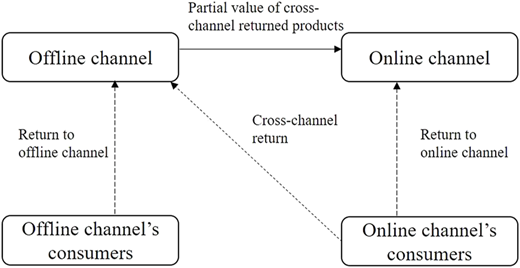
Furthermore, the problem investigates the impacts of DDM quality, customer-channel-preference proportion, CCR rate, financing interest rate and online-lead-time sensitivity on the pricing and delivery-lead-time decisions. It aims to maximize the members' profits and the overall supply chain. Furthermore, it also discusses the coordination role of the manufacturer's revenue-sharing contract.
3.2 Symbol definition
Before the formulation of the models, some related symbols are defined as follows (Table 3).
Related symbols
| Subscripts | Offline channel (), online channel () | |
|---|---|---|
| Superscripts | Decentralized , centralized , revenue-sharing contract | |
| Parameters | Initial market demand | |
| Offline customer preference ratio | ||
| Wholesale price | ||
| Production cost | ||
| Processing cost of Returned product | ||
| Residual value of returned product | ||
| Part of the value of the CCR product for the manufacturer | ||
| Price sensitivity | ||
| Cross-price sensitivity | ||
| Interest rate of internal financing | ||
| Return rate of the offline channel | ||
| Return rate of the online channel | ||
| CCR rate | ||
| Delivery-lead-time dependent cost parameters | ||
| Offline-lead-time sensitivity coefficient | ||
| Online-lead-time sensitivity coefficient | ||
| DDM quality | ||
| Customer's sensitivity of the DDM | ||
| Cost coefficient of data analysis | ||
| Data collection cost | ||
| Manufacturer financing amount | ||
| Revenue-sharing ratio | ||
| Initial funds of the manufacturer | ||
| Total channel demand | ||
| Profit with the decentralized system | ||
| Total profit with the centralized and decentralized systems | ||
| Decision variables | Offline and online channels' selling price | |
| Delivery lead time |
4. Model analysis under the inconsistent-pricing-strategy
This section considers the situation where the supply chain members adopt inconsistent prices and discusses the effects of CCR rate, customer channel preference and DDM quality on each member's optimal decisions. Finally, the contract of manufacturer-revenue sharing is proposed to coordinate the manufacturer and the retailer.
4.1 Decentralized system under the inconsistent-pricing-strategy
It assumes that the manufacturer has capital constraint with initial capital , which can cover the DDM and delivery-lead-time costs, but is insufficient to support the total production cost of products for both channels. Hence, the retailer will provide internal financing to the manufacturer with a financing interest rate . As the game's leader, the retailer will determine the offline channel's selling price . Secondly, the manufacturer decides the online channel's online delivery lead time and selling price . After that, the manufacturer determines the financing amount . The manufacturer's delivery cost is with (Modak and Kelle, 2019; Savaskan and Van Wassenhove, 2006). Furthermore, the data collection cost is , and the cost of data analysis is (Liu et al., 2020). Then, the manufacturer provides wholesale price and sells the products to the retailer. During the sales process, the return rate of the offline channel is , the online-channel's return rate is , and the CCR rate is . The unit processing cost of the returned product is . In addition, the online and the offline channels handle the returned products with unit residual value , and the retailer will repay some of the CCR products' residual value to the manufacturer with unit value , and . Moreover, this work assumes that . Finally, the manufacturer should pay back the retailer's financing amount with the interest .
To ensure that the research conforms to the actual situation, the discussions of this work are based on Assumption 1.
It keeps a fixed value of the total return rate of the online channel, which implies that the return rate of the online channel will decrease if the CCR rate increases. Furthermore, the return rate of the online channel is higher than the offline channel's return rate, and the return rates of the two channels are not seriously unbalanced.
The demand functions of two members are referred to in the studies by Hua et al. (2010), Modak and Kelle (2019), and Liu et al. (2020).
The retailer's demand function is , and the manufacturer's demand function is , where is initial market demand, is offline customer preference ratio, and is customer preference proportion for the online channel. is its own channel's price sensitivity coefficient, is cross-channel sensitivity coefficient, and (Qin et al., 2020b). is online-lead-time sensitivity coefficient, is offline-lead-time sensitivity coefficient and (Modak and Kelle, 2019). is DDM quality, and and are customers' sensitivity of the DDM. Hence, the manufacturer's financing amount can be expressed as
Then the profit functions of the online manufacturer and the offline retailer can be obtained below.
And the profit functions can be simplified as
where , , , , .
4.1.1 The manufacturer's best decision under inconsistent-pricing-strategy
For any given offline-channel's selling price , the profit function of the manufacturer is concave with the online selling price and delivery-lead-time if . And and are given by
For the sake of clarity, the proofs of Proposition 1 and the remaining Propositions are illustrated in Appendix.
Then, analyze the effect of , , , and on and , and provide Proposition 2.
, , , if , otherwise .
, , and .
Proposition 2 illustrates the following results. (1) The rise of the offline selling price will raise the online selling price and reduce the delivery lead time. In real business, the online channel, as a competitive channel, should also decline its selling price when the offline channel adopts to lower selling price strategy, that is, price competition. At this time, the online channel also can improve its channel's competitiveness by shortening the delivery-lead-time. (2) DDM quality positively impacts the online selling price but negatively affects the delivery-lead-time. In practice, high-level DDM quality enables the manufacturer to more accurately grasp the current consumption trend through data-driven analysis, finds the marketing point which can stimulate customers' desire to purchase, creates high-quality and more targeted marketing activities for the manufacturer, and improves customers' utility, to raise the selling price (Cohen, 2018; Liu et al., 2020). Moreover, it will encourage the manufacturer to provide a shorter delivery-lead-time to attract more customers. (3) The increase in customers' offline-channel preference ratio will decrease the online selling price and raise the delivery-lead-time. In real situations, the online channel can attract some customers by appropriately cutting down its selling price when customers prefer offline shopping. It is unnecessary to provide a lower delivery-lead-time. (4) The CCR positively impacts the delivery-lead-time. While the impact of the CCR rate on the online selling price mainly depends on lead-time dependent cost, that is, the online selling price will rise with the growth of the CCR rate if the lead-time dependent cost is higher than a given threshold and vice versa.
4.1.2 The retailer's optimal decision
In the following, the retailer's optimal decision is studied. Bring and into the profit function of the retailer, and get the function of .
is concave with the offline selling price if . And can be expressed as
To discuss the effects of on , investigate the first derivatives of with respect to .
Similar to Proposition 2, Proposition 4 illustrates that the effect of DDM quality on the optimal offline selling price mainly depends on the lead-time-dependent cost. Thus, DDM quality will positively impact the offline selling price if the lead-time dependent cost is no less than a given threshold .
4.1.3 Demands and optimal profits of the two members
Then, bring into and , leading to the optimal lead-time and the optimal online selling price .
Finally, under the optimal decisions, the demands and the optimal profits of each channel can be gotten through , and .
4.2 Centralized system under inconsistent-pricing-strategy
With the centralized system, the members make global optimal decisions with maximizing the profit of the overall supply chain.
In this case, the overall-supply-chain profit is given by
Based on Assumption 1, is concave with and , but not sufficient to be concave with , and . And for any given delivery-lead-time , and can be expressed as follows.
Proposition 5 illustrates that it is not sufficient to find the optimal delivery-lead-time , the optimal selling prices and of the two channels through the first-order partial derivations. Thus, for any given , the two-stage optimal technology is adopted so as to get the and at first, and then can be obtained through the implicit function theorem.
Then, discuss the impacts of , and on the and the , determine the first-order partial derivative of and with respect to , and .
Proposition 6 implies that: (1) The customer's offline-channel preference proportion negatively affects the online selling price and has a positive impact on the offline selling price. And the difference between both channels' optimal selling prices mainly depends on the customer's channel preference proportion. That is, for the products that customers attach more attention to quality and authenticity, the offline selling price should be higher than that of the online channel since customers prefer offline purchasing, and vice versa (Hua et al., 2010). (2) The growth of the DDM quality will lead to the increase of the optimal selling prices of the two channels since it will simulate the customers' demand in both channels through accurate marketing activities, leading both channels to adopt higher price strategies. And the effects of DDM quality on the two channels' selling prices depend on the ratio of sensitivity coefficients of the DDM. That is, if , and vice versa. (3) The influence of the delivery-lead-time on the offline selling price mainly depends on the ratios of sensitivity coefficients of prices and delivery-lead-time . Hence, the rise of the delivery-lead-time will increase the optimal offline selling price when the price sensitivity coefficient ratio is higher than the delivery-lead-time sensitivity coefficient ratio, and vice versa. Furthermore, the selling price of the online channel will be negatively impacted by the delivery-lead-time.
The optimal delivery-lead-time under the centralized system should satisfy the following condition.
Hence, the optimal delivery-lead-time can be obtained by Proposition 7.
Then, it discusses the effects of and on , and leads to Proposition 8.
Proposition 8 states that the delivery-lead-time will be negatively affected by the DDM quality if the DDM sensitivity coefficient ratio , and vice versa. The growth of the offline customer preference ratio will lead to an increase of the optimal delivery-lead-time if the price sensitivity coefficient ratio is higher than the delivery-lead-time coefficient ratio. Furthermore, the CCR rate has no effect on the optimal delivery-lead-time .
Then, bring into and to get the optimal and .
Finally, with the expressions of and , the optimal profit of the overall supply chain and the two channels' demand are expressed as follows.
4.3 Contract coordination
In real business, the profit of the overall supply chain will be higher than that under the decentralized system if both the members make the global optimal decisions. However, it needs a specific mechanism for profit distribution. Thus, it is necessary to combine contracts to coordinate the members for Pareto optimality. Among the existing contracts, a revenue-sharing contract can improve the internal cooperation of the supply chain in the complex market environment so that the members can make optimal decisions from the perspective of overall performance optimization and finally achieve Pareto optimization (Cachon and Lariviere, 2005; Hu et al., 2017).
Hence, this study considers that the manufacturer promotes the interaction with the retailer by sharing part of its profit () and encourages the retailer to make the decision from the perspective of global optimization (Govindan and Popiuc, 2014; Yao et al., 2008).
In this situation, under the manufacturer-revenue sharing contract, the offline and online channels' profits can be expressed as
The manufacturer-revenue sharing ratio should be subject to the below two conditions to ensure the coordination of the supply chain.
Thus, the upper and lower limits of the corresponding revenue-sharing proportion can be derived from Proposition 9.
The upper bound is
The lower bound is
Thus, a reasonable profit distribution can be realized by modifying within the lower and upper bounds.
5. Model analysis under the consistent-pricing-strategy
The above focuses on the inconsistent pricing strategy. However, some scholars also believe it can effectively alleviate the conflict between channels if the DSC adopts a consistent pricing strategy (Cai et al., 2009; Li et al., 2014). Hence, this section assumes that the members use the consistent-pricing-strategy, and also assumes that the manufacturer has capital constraint with initial capital, the retailer will provide internal financing to the manufacturer, and analyzes the effects of customer-channel-preference, DDM quality and CCR rate on the optimal selling price and delivery-lead-time under the centralized and decentralized systems, respectively. Finally, it also coordinates the members by using a manufacturer-revenue sharing contract.
In this situation, the demand functions of the members are below.
The retailer's demand .
The manufacturer's demand .
5.1 Decentralized system under consistent-pricing-strategy
With the decentralized system, the retailer first determines the two channels' selling price (Qin et al., 2020b). Then, the manufacturer determines the delivery-lead-time .
In this case, the two members' profit functions are similar to those with inconsistent pricing strategy.
Let, , .
5.1.1 The manufacturer's best decision under the consistent-pricing-strategy
The is strictly concave with the for any given selling price . And can be expressed as
Next, it investigates the impacts of and on , and proposes Proposition 11.
Proposition 11 demonstrates that the selling price negatively affects the optimal delivery-lead-time , while it is opposite for the CCR rate . In general, the manufacturer should shorten the online delivery-lead-time when both channels' selling prices uniformly increase since it will improve the channel's competitiveness and attract more customers to use online shopping. Meanwhile, an increase of the CCR rate means that more customers choose to return the online purchased products to the offline channel, which will lead to cut down the manufacturer's sales opportunities, and finally will reduce the motivation of the manufacturer to shorten the delivery-lead-time.
5.1.2 The retailer's optimal decision with the consistent-pricing-strategy
In the following, bring into to get the function of .
is concave with if , and the optimal selling price is given as
Then, it analyzes the impacts of and on .
Proposition 13 shows that the improvement of DDM quality can obtain more customers' demand through more accurate marketing activities so as to push the selling price, and it also brings incentives for the retailer to grow up the selling price when customers prefer offline purchasing.
5.1.3 Demands and optimal profits of the two members
Then, the optimal delivery-lead-time can be determined by bringing into .
Hence, through and , the demands and the optimal profit of two channels can be given by
5.2 Centralized system under consistent-pricing-strategy
The overall supply chain with a centralized system simultaneously decides the selling price and delivery lead time .
In this case, the profit of the overall-supply-chain can be obtained as
is concave with and if , and and are given by
To analyze the effects of and on and , investigate the first-order derivative of and with respect to and .
Proposition 15 suggests that DDM quality and customer offline preference ratio under the centralized system have positive impacts on . In addition, the increase of the customer preference ratio on the offline channel and DDM quality will raise the optimal delivery-lead-time if the ratio of the offline channels and online-channel's nonreturn rate is higher than the coefficient ratio of the two channels' lead-time sensitivities , and vice versa.
Finally, bring and into , and so as to obtain the optimal overall-supply-chain profit and the offline and the online demands.
5.3 Contract coordination
This subsection uses the contract of manufacturer-revenue sharing parameter to coordinate the members.
In this case, with the manufacturer-revenue sharing contract, the profits of the two channels are
With the consistent pricing strategy, the following two formulas should hold so as to realize the coordination.
Thus, the upper bound and lower bound of can be obtained by Proposition 16.
The upper bound is
The lower bound is
Thus Pareto-optimality can be achieved by adjusting within the range of upper and lower bounds, which is similar to that in Section 4.3.
6. Numerical analysis
This part tests the feasibility of the model under two pricing strategies and analyzes the sensitivity of customer channel preference, DDM quality, the sensitivity of the online lead time and CCR rate on the optimal lead-time, pricing and optimal profits by numerical analysis. Finally, it also proves the feasibility of the manufacturer-revenue sharing contract.
6.1 Numerical analysis under the inconsistent-pricing-strategy
The relevant parameters in this subsection are set as follows. Same channel price sensitivity . Cross-price sensitivity coefficient . The offline return rate . The online return rate . The CCR rate . Financing interest rate = 0.03. Initial funds of the manufacturer . Online-lead-time sensitivity coefficient = 15. Offline-lead-time sensitivity coefficient . Delivery-lead-time dependent cost parameters and . Initial market demand . Wholesale price . Production cost . The unit residual value of returned product . Return processing cost . Offline customer preference proportion . Part of the value of the CCR product for the manufacturer . Data collection cost . Customer sensitivity of DDM . DDM quality . Data analysis cost coefficient .
When = 0.6, the optimal solutions are as follows. , , , , , , , , , , , , and .
6.1.1 Sensitivity analysis of pricing and delivery-lead-time under inconsistent-pricing-strategy
Based on the inconsistent-pricing-strategy, it discusses the impacts of , , , and on the two channels' optimal selling prices and delivery-lead-time.
Figure 2 derives the following conclusions. (1) Under the centralized and decentralized systems, the online delivery-lead-time is positively impacted by the increased customer offline-channel preference ratio. Under the decentralized system with a lower ratio of offline customer preference, it will be close to that under the centralized system. It states that, the manufacturer should set a shorter delivery lead time when more customers choose the online channel so as to retain more customers. (2) Research by Yan et al. (2010) and Radhi and Zhang (2018) mentioned that the selling price under the centralized decision is higher than that under the decentralized decision since coordination eliminates price competition and provides a chance for both channels to raise selling prices. In contrast, this work finds that the selling prices under the centralized decision are lower than that under the decentralized decision, which is similar to the conclusion from the research of Ryan et al. (2013).
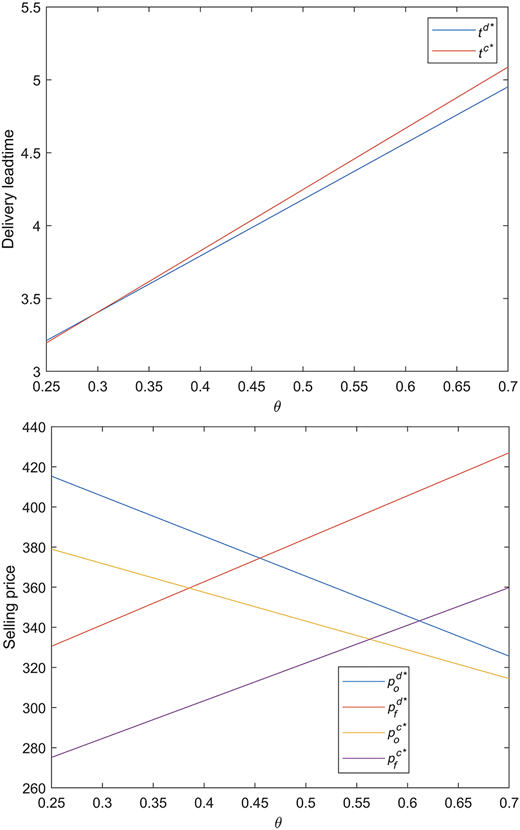
Figure 3 discloses the following information. (1) Under the centralized and decentralized systems, DDM quality is positively related to the selling prices of the online and the offline channels and negatively related to the online delivery lead time. (2) The online selling price under the centralized system is highly impacted by DDM quality than that under the decentralized system.
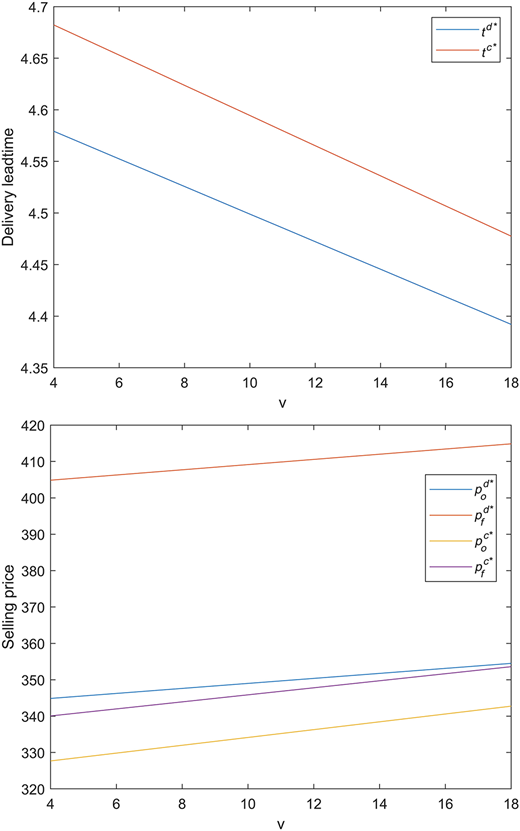
Figure 4 demonstrates that the offline and online selling prices are not sensitive to the online-lead-time sensitivity. In comparison, the optimal delivery lead time will decline with the growth of the sensitivity of the online lead time. In general, a high online-lead-time sensitivity coefficient implies that more and more customers will leave the online channel if the manufacturer provides a longer delivery lead time. Hence, in this situation, the manufacturer should retain more customers by shortening the online delivery lead time.
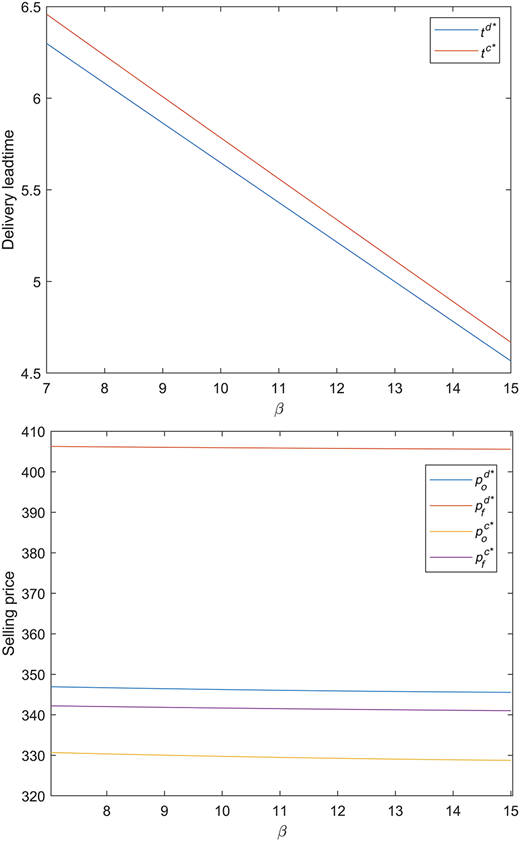
Figure 5 illustrates that the growth of the CCR rate under the decentralized system will lift the delivery lead time and the selling prices of the two channels, while the delivery lead time and the two channels' selling prices are not impacted by the CCR rate under the centralized system.
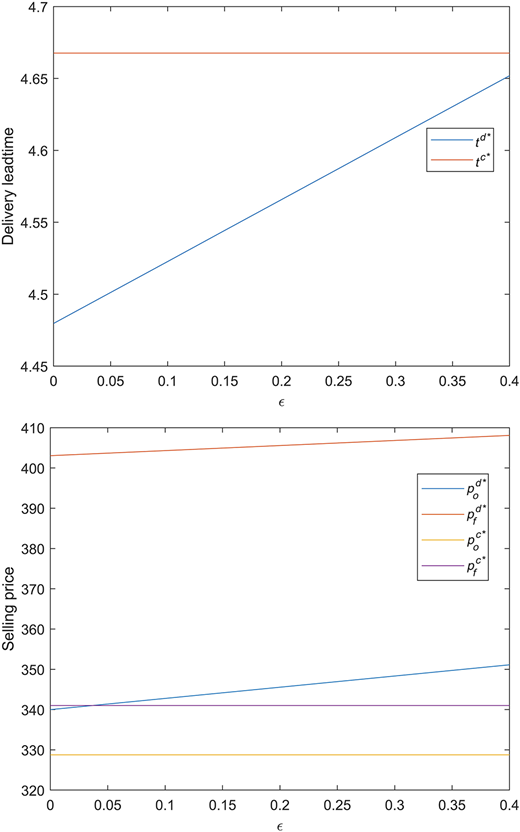
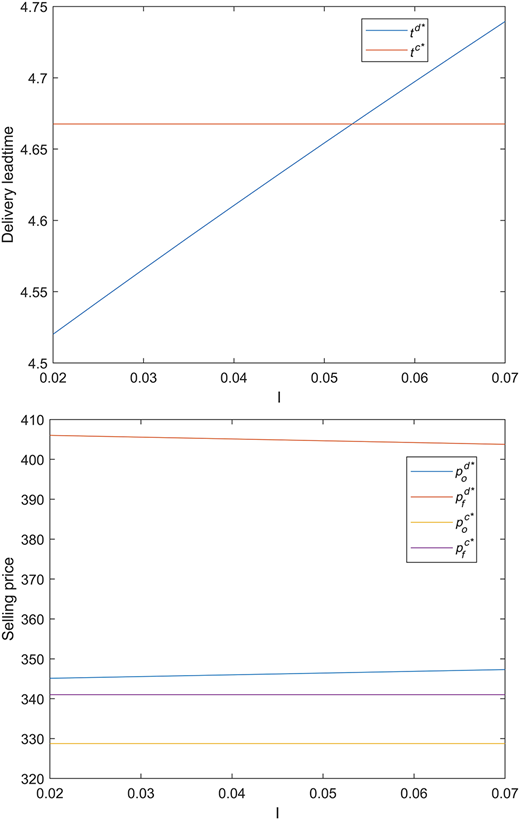
Figure 6 shows that the growth of the financing interest rate will reduce the selling price of the offline channel and will raise the selling price of the online channel and delivery-lead-time under the decentralized system, while the selling prices of the offline and the online channels and the delivery-lead-time under the centralized-system are not affected by the financing interest rate.
6.1.2 Sensitivity analysis of profit with inconsistent-pricing-strategy
This subsection analyzes the effects of , , , and on the supply chain members and the overall-supply-chain profits.
Figure 7 indicates that the profit of the retailer will go down slightly, and the manufacturer's profit will decline with the rise of online-lead-time sensitivity under the decentralized system. Under decentralized and centralized systems, the profits of the overall supply chains will decrease with it.
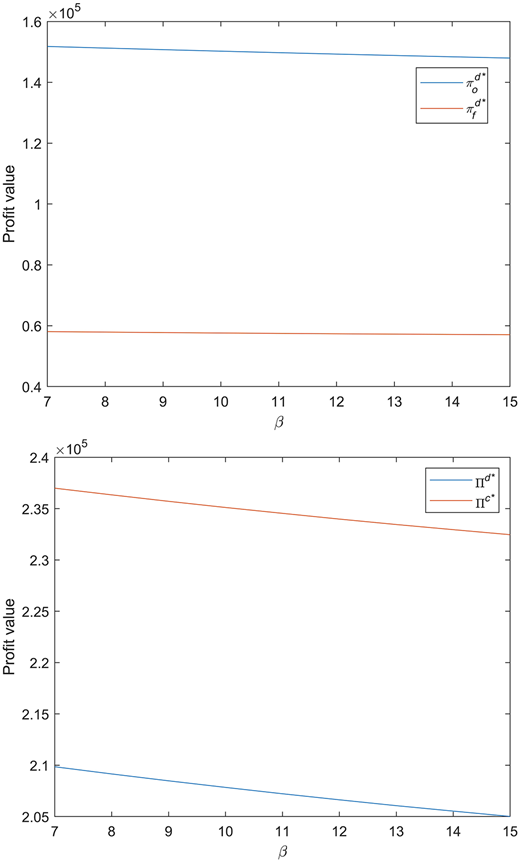
Figure 8 suggests the following. (1) Under the decentralized system, the retailer's profit will go up with the rise of the customer's preference for the offline channel, while the profit of the manufacturer will go down first and then go up. In addition, the profit of the retailer is always less than that of the manufacturer. (2) The rise of the CCR rate under the decentralized system will lead to the profit reduction of the manufacturer but will raise the retailer's profit. Moreover, the negative impact of the CCR rate on the manufacturer's profit and the positive impact of the CCR rate on the retailer's profit is relatively small with the higher offline-channel customer preference. (3) The overall-supply-chain profit with a decentralized system will go down with the rise of the CCR rate. Furthermore, the profit of the total supply chain is more negatively impacted by the CCR rate with less customer offline-channel preference. (4) The total profit of the supply chain under the decentralized system will always be less than that under the centralized system, although it is not sensitive to the CCR rate under the centralized system.
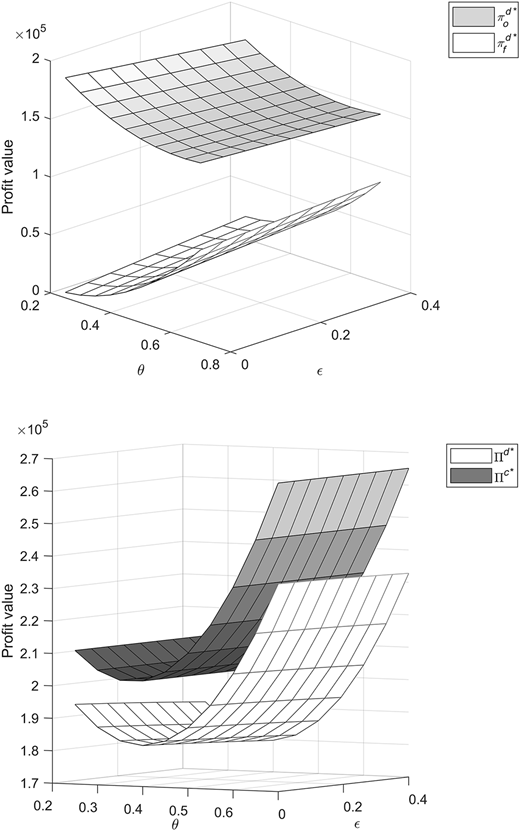
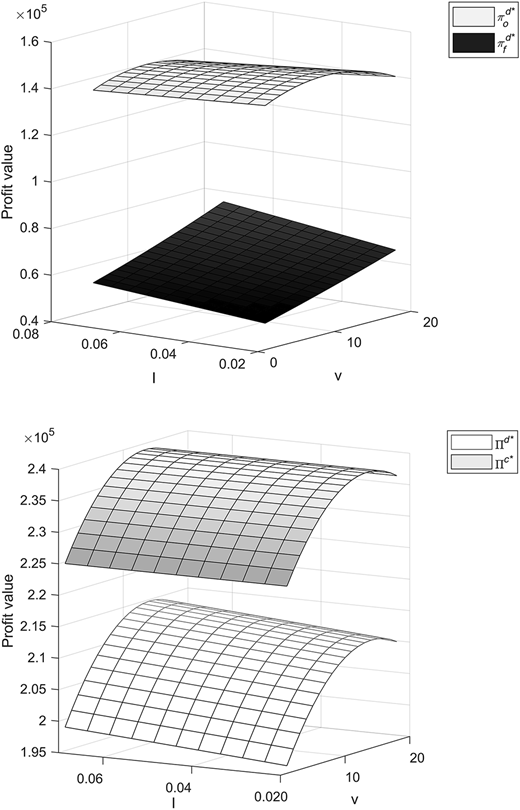
Figure 9 states the following information. (1) The retailer's profit with the decentralized system goes up with the rise of DDM quality. The manufacturer's profit and overall supply chain profit with the decentralized system and the overall-supply-chain profit with the centralized system will go up first and then go down with the rise of DDM quality. It means that the members should set a reasonable DDM quality to achieve more profit because a higher DDM quality level will also be accompanied by higher costs. (2) The offline channel's profit with the decentralized system will rise, and the profit of the online channel will reduce with the growth of financing interest rates with different DDM quality, and the lift of the offline profit is higher than the loss of the profit of the online channel. Hence, the retailer should set a reasonable financing interest rate for the capital-constrained manufacturer or share some of the revenue to the manufacturer if it raises the financing interest rate in order to keep the long-term transaction between the members. (3) The overall supply chain's profit under the centralized system will not be affected by the financing interest rate.
6.1.3 Profit distribution with a revenue-sharing contract under inconsistent-pricing-strategy
This subsection verifies whether the manufacturer's revenue-sharing contract can achieve the coordination without losing any party's profit and analyzes the profit distribution under the different sharing ratio .
The range of the revenue-sharing ratio can be determined by Proposition 9.
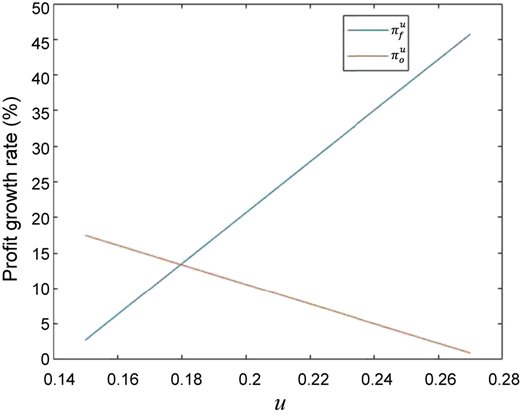
Table 4 and Figure 10 illustrate that the manufacturer's revenue-sharing contract can perfectly achieve supply chain coordination. And with a lower revenue-sharing ratio, the manufacturer will be allocated more profit. And there exists a reasonable sharing ratio so as to make the retailer and the manufacturer get the same growth percentage of the profit.
Coordination analysis under inconsistent-pricing-strategy
| 0.15 | 58,580 | 173,880 | 232,460 |
| 0.19 | 66,763 | 165,697 | 232,460 |
| 0.23 | 74,945 | 157,515 | 232,460 |
| 0.27 | 83,128 | 149,332 | 232,460 |
6.2 Numerical analysis under the consistent-pricing-strategy
The values of relevant parameters with the consistent pricing strategy are given as
, , , , , , , , , , , , , , , , , , , , and .
Then, the relevant optimal values can be obtained with . , , , , , , , , , , and .
6.2.1 Sensitivity analysis of pricing and delivery-lead-time under consistent-pricing-strategy
This subsection discusses the effects of , , , and on the optimal selling price and delivery-lead-time.
Figure 11 indicates that under the centralized and decentralized systems, the selling price will be positively impacted by the customer's offline-channel preference ratio. In contrast, offline customer preference has a negative impact on the delivery-lead-time under the two systems, which are opposite to those under the inconsistent pricing strategy. Furthermore, the delivery-lead-time under the decentralized decision is not always shorter than that under the centralized decision since it depends on the customer's channel preference, which is different from the research of Xu et al. (2012). It means that the overall supply chain will set shorter delivery-lead-time than that under the decentralized decision when customers prefer the online channel.
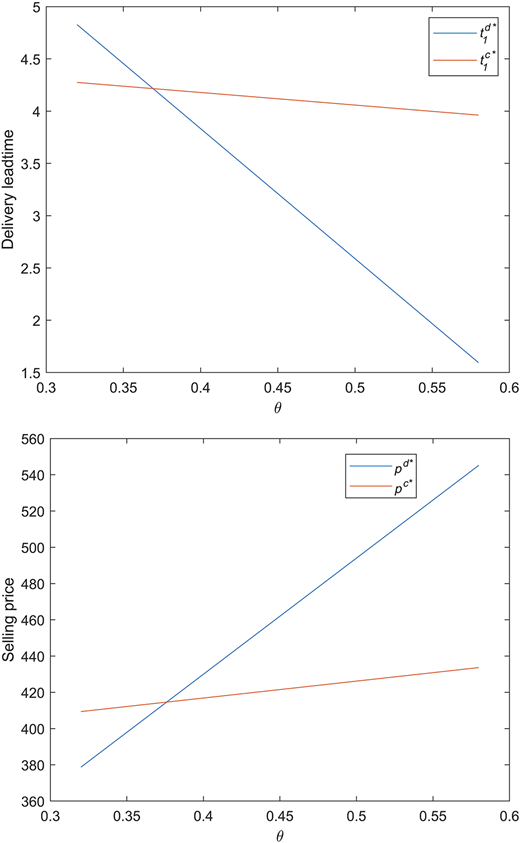
Figure 12 illustrates that the increase of DDM quality will decrease the online-delivery-lead-time but will raise the selling price under the centralized and decentralized systems, which are the same as that with the inconsistent pricing strategy.
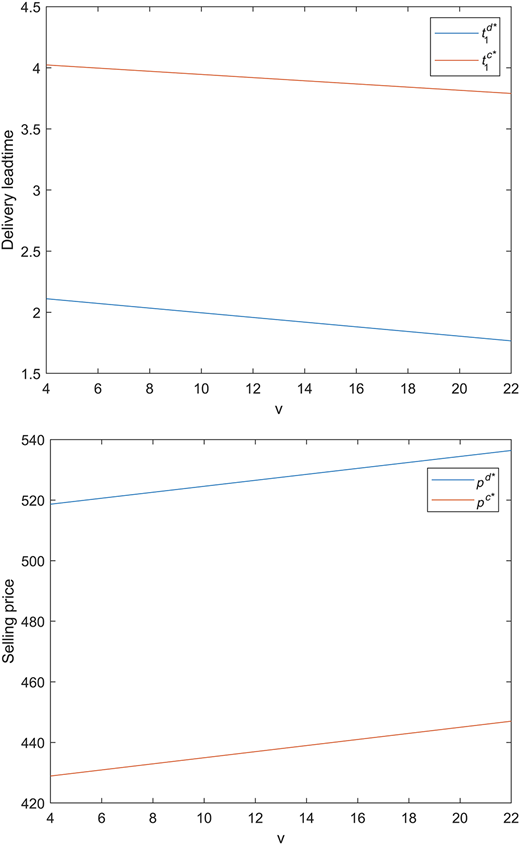
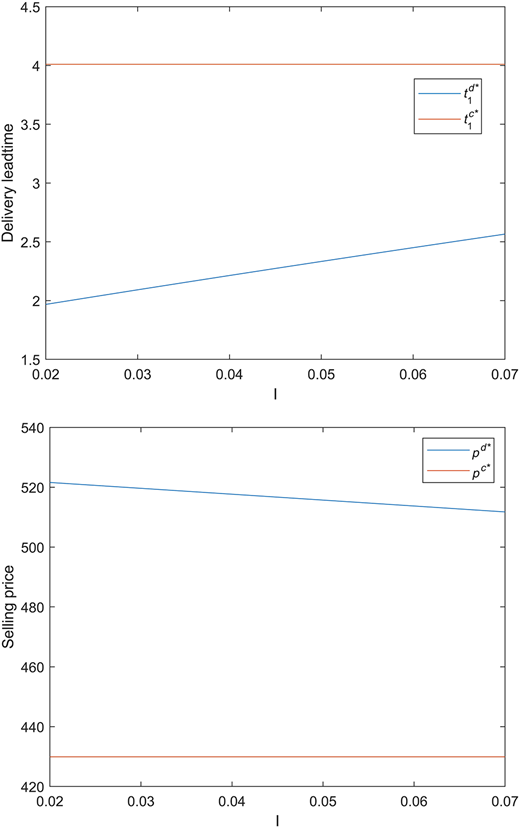
Figure 13 demonstrates that the delivery-lead-time will reduce with the growth of sensitivity of the online lead time, but the selling price under the decentralized and centralized system is not sensitive, which is also the same as that with the inconsistent pricing strategy.
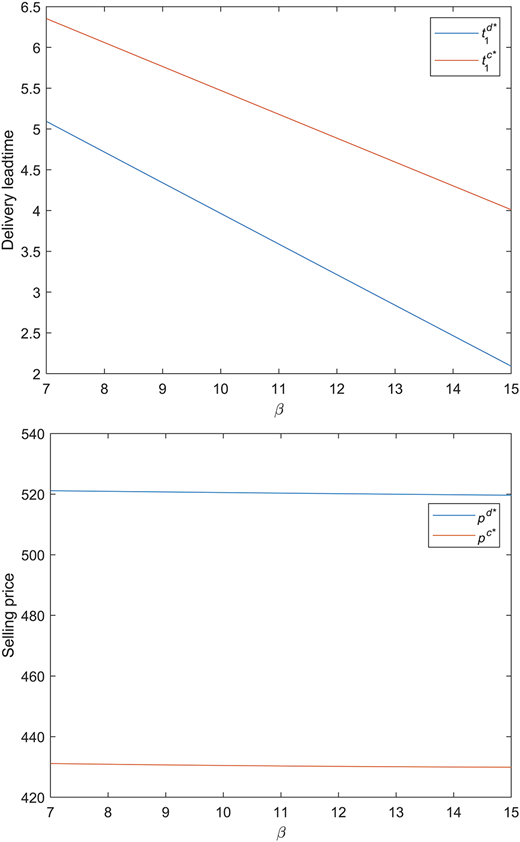
Figure 14 shows the effects of the CCR rate on the decisions. (1) The CCR rate under the centralized system will not affect the optimal delivery lead time and the selling price. (2) The growth of the CCR rate will raise the delivery lead time but will reduce the selling price with the decentralized decision, which is different from the situation under the inconsistent pricing strategy.
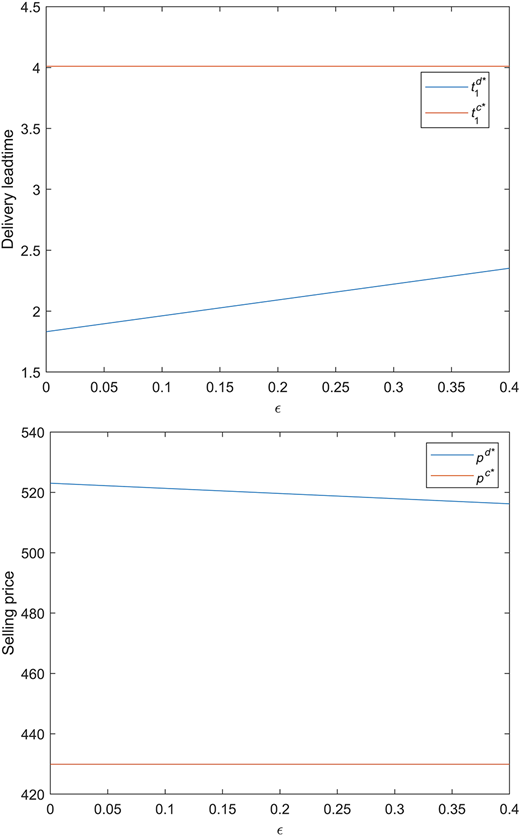
Figure 15 states that the delivery-lead-time will go up with the rise of financing interest rate under the decentralized system, but the selling price will go down with it. Furthermore, the financing interest rate will not affect the centralized optimal selling price and delivery lead time.
6.2.2 Sensitivity analysis of profit under consistent-pricing-strategy
This subsection discusses the effects of , , , and on the profits of the members and the overall-supply-chain.
Figure 16 illustrates that under the decentralized system, the retailer's, the manufacturer's and the overall-supply-chain profits, and the centralized profit of the overall supply chain will all decrease with the rise of consumer sensitivity of the online lead time, which are the same with the inconsistent-pricing-strategy.
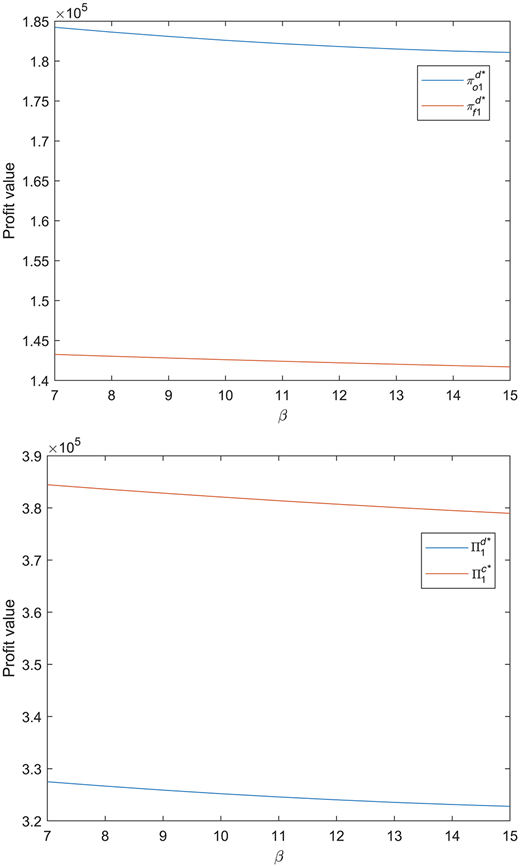
Figure 17 demonstrates the results below. (1) Under inconsistent pricing with a decentralized system, the profit of the retailer will go up with the rise of the customer's preference ratio of the offline channel, which is the same as that under the inconsistent pricing strategy. However, with the rise of the customer's preference proportion of the offline channel, the manufacturer's profit will go up first and then go down, which is opposite to the case under the inconsistent pricing strategy. Furthermore, the retailer's profit will be higher than the profit of the manufacturer with the high customer preference ratio of the offline channel, which is also different from that under the inconsistent pricing. (2) The CCR rate will positively affect the retailer's profit under the decentralized system, which is the same as that under inconsistent pricing. However, with a lower (higher) customer preference ratio of the offline channel, the profit of the manufacturer will go down (increase) with the rise of the CCR rate, which is different from that under the inconsistent pricing strategy. Hence, it suggests that the members can use a consistent pricing strategy when the customers prefer offline channels and CCR. (3) With the decentralized system, the profit of the supply chain will reduce (rise) with the growth of the CCR rate with the lower (higher) customer preference for the offline channel. (4) Under the decentralized system, the total profit of the supply chain will always be less than that of the centralized system, although the centralized total profit of the supply chain will not be affected by the change of CCR rate.
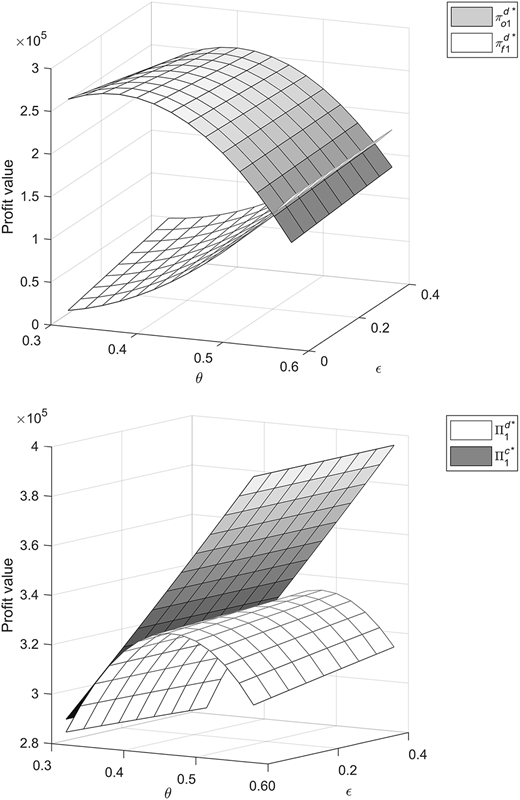
It can be concluded from Figure 18 as follows. (1) Under the centralized and decentralized systems, the impacts of DDM quality on the profit of the total supply chain and the profits of each member under the decentralized system are similar to those under the inconsistent pricing strategy. (2) Based on the decentralized system with a high-level DDM quality, the manufacturer's profit will be smaller than the profit of the retailer, which is different from that when members use the inconsistent pricing strategy. (3) The rise of the financing interest rate will cut down the manufacturer's profit but will raise the profit of the retailer under the decentralized system if the manufacturer sets a high level of DDM quality. In general, the manufacturer needs to pay more for DDM costs if it chooses a high-level DDM quality, and it will also lead to more financing costs. Furthermore, with a consistent-pricing-strategy, the profit of the manufacturer under the decentralized system will go up with the growth of financing interest rate if the manufacturer adopts a small level of DDM quality, which is different from that when members use the inconsistent-pricing-strategy. In this situation, the rise of the financing interest rate will improve the manufacturer's wholesale revenue and sales revenue and be higher than the increase in the financing cost.
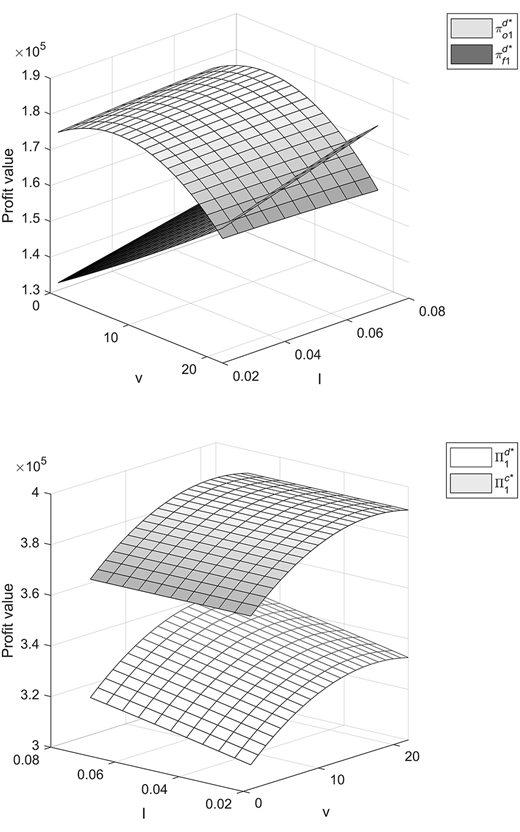
6.2.3 Profit distribution with a revenue-sharing contract under consistent-pricing-strategy
This subsection also investigates how the members are coordinated by the manufacturer's revenue-sharing contract.
In this case, the manufacturer's revenue-sharing proportion range is derived through Proposition 16.
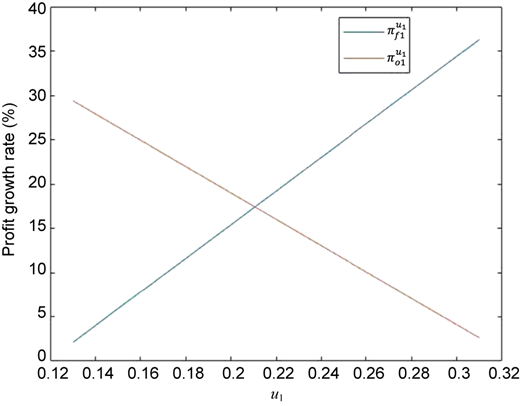
It can be concluded from Figure 19 and Table 5 that the contract of manufacturer-revenue sharing under the consistent pricing strategy can well coordinate the offline retailer and online manufacturer. The rise of the sharing ratio will make the retailer more profitable. Moreover, there also exists one reasonable revenue-sharing proportion that can make both of them have the same growth percentage of the profit.
7. Conclusions and managerial implications
This study established a DDM-based DSC model including a retailer with the sufficient fund and a capital-constrained manufacturer. The retailer can provide internal financing to help the manufacturer solve the problem of capital shortage. In addition, the manufacturer provides targeted advertising services for customers through DDM. This work considers inconsistent and consistent pricing strategies. It firstly discusses the effects of customer channel preference, DDM quality and CCR rate on the optimal pricing and delivery-lead-time solutions under the decentralized and centralized systems. Then it introduces a manufacturer-revenue sharing contract to coordinate the members. Furthermore, this research uses numerical examples to discuss the effects of customer channel preference, DDM quality, online-lead-time sensitivity, CCR rate and financing interest rate on the optimal selling prices, delivery-lead-time, and the optimal profits of the overall supply chain and each member, and finally verifies whether the contract of manufacturer-revenue sharing can achieve Pareto-optimality.
The main conclusions and the corresponding managerial implications are summarized as follows.
Under the inconsistent and consistent pricing strategies, the increase of DDM quality will reduce the delivery-lead-time and will raise the selling prices (Propositions 2, 6, 8, 13 and 15). It means that high DDM quality will improve customers' utility by providing more accurate marketing activities and encouraging both the manufacturer and the retailer to turn up the selling prices, which is consistent with the results in Cohen (2018) and Liu et al. (2020). Furthermore, in this situation, the online manufacturer also can attract more customers through the reduction of delivery-lead-time since it will effectively improve the online channel's competitiveness.
The rise of the CCR rate will increase the offline selling price, which keeps consistent with our common sense. In real business, the increase of CCR rate will result that more online customers return the products to the offline channel, which will bring additional sales opportunities for the offline retailers. The manufacturer, as a competitor and a follower of the Stackelberg game, will raise the online selling price. However, it will extend the online delivery-lead-time since it will decrease the manufacturer's sales opportunities and ultimately negatively affect the manufacturer's enthusiasm to shorten the delivery-lead-time.
Under the inconsistent pricing strategy, the price difference between the two channels mainly depends on the customer's channel preference. It holds that the offline selling price is higher than the online selling price when customers prefer the offline channel and vice versa. In practice, such as luxuries, customers will prefer offline purchasing because of the product's authenticity. Hence, the selling price of the offline channel will be higher than that of the online channel. However, in terms of products with a short delivery cycle, such as fresh milk, customers prefer the online channel because of the purchasing convenience and the easy verification of the authenticity and quality. Thus, the offline channel should improve competitiveness by setting a lower selling price.
The retailer and the manufacturer can be well coordinated by the manufacturer-revenue sharing contract, and there exists a revenue-sharing proportion range to enable the members to achieve Pareto optimality. Particularly, there is a point in the revenue-sharing proportion range so that the two members can obtain the same profit growth percentage, which is a good trade-off for the two members. In addition, other similar contracts can also achieve coordination, such as quantity discount contracts, sales rebate contracts, etc. Hence, it can be further discussed in future research.
Furthermore, this work also illustrates some interesting observations through numerical analysis.
There is an optimal DDM quality to make sure that the supply chain achieves the highest profit under the centralized system. In reality, with the growth of big data analysis, there is more commercial opportunity for the supply chain members. Hence, the enterprises should not only join the alliance but choose a reasonable DDM quality level as well so that both of the members can obtain higher profits through a well-designed contract.
Under the decentralized system with price competition, the rise of the CCR rate will raise the retailer's profit but cut down the profit of the manufacturer. Meanwhile, the CCR rate has no impact on the profit of the centralized overall supply chain, which is always higher than that under the decentralized system. Thus, in reality, the supply chain should alleviate the conflict between the members through the contract since it can motivate the enterprises to provide customers with CCR service, effectively improve customers' loyalty and satisfaction, and finally achieve the sustainable development of the supply chain (Radhi and Zhang, 2018). Furthermore, it suggests that the members in real business can adopt a consistent pricing strategy if the customers prefer offline shopping and CCR since the rise of CCR will improve the two members' profits, respectively.
Higher financing interest rate will bring more profit to the retailer. However, under the inconsistent pricing strategy, the manufacturer's profit will always go down with the growth of financing interest rate. Hence, in real business, the core enterprise should set a reasonable financing interest rate to help the capital-constrained enterprises so as to achieve long-term transactions between the enterprises. In contrast, under the consistent pricing strategy, the manufacturer can achieve more profit by adopting a lower DDM quality level if the retailer chooses a higher financing interest rate because it will contribute more wholesale and sales revenues to the manufacturer.
There exists one reasonable manufacturer-revenue sharing rate to assure that the members have the same growth percentage of the profit. Hence, in reality, the enterprises can refer to this point to set the revenue-sharing ratio if they execute the solutions under the centralized system with the contract so as to achieve a win-win situation and the overall supply chain can have a sustainable development.
Finally, there exist some limitations in this study, which can be extended for further research. Firstly, demand in this work is assumed to be the linear function of the offline customer preference ratio, the price sensitivity coefficient of the online and offline channels, the online-lead-time sensitivity coefficient and DDM sensitivity, but market demand in reality often faces uncertainty, and there will be the possibility of product shortage. Secondly, further research can focus on the impact of DDM and CCR on the optimal performance and decisions of the manufacturer and the retailer from the perspective of customer utility. Finally, it can consider the logistics cost and return cycle in further research.
Funding: This research was funded by the Higher Education Fund of the Macao SAR Government (Grant No. HSS-MUST-2021-04).
Conflicts of interest: The authors declare no conflict of interest.
References
Appendix
Proof of Proposition 1
For any given offline selling price , calculate the first-order partial derivative of with respect to and .
Then, the second-order partial derivative of with respect to and are derived.
The Hessian matrix of with respect to and can be expressed as follows.
And .
Hence, is concave with and if .
Finally, and can be determined by combining and .
Where , .
Proof of Proposition 2
Find the first-order partial derivative of and with respect to , , , and .
Thus, if and if .
Proof of Proposition 3
Bring and into , and can get
Determine the first-order derivative of with respect to .
Where .
Then, the second-order derivative about is obtained for to determine the concavity and convexity.
Hence, is concave with if . And let the , and is obtained as follows.
Proof of Proposition 4
Find the first-order derivative of with respect to .
Hence, if .
Proof of Proposition 5
Find the first-order partial derivative of with respect to and .
Then, find the second-order partial derivative of with respect to and .
The Hessian matrix of with respect to and can be obtained.
The corresponding determinant is
And >0 when and are not seriously unbalanced.
However, it is not sufficient to prove that
Thus, based on Assumption 1, is concave with and , but not sufficient to prove that concave in and .
Furthermore, and can be determined by combining and .
Proof of Proposition 7
Under the centralized-system, of can be obtained by following implicit function theorem.
And
Then, analyze the second-order derivative of with respect to .
Hence, if .
Finally, let , and can get .
Proof of Proposition 8
Proof of Proposition 10
For any given , find the first-order partial derivative of with respect to .
Then, find the second-order partial derivative of with respect to .
Hence, for given , is strictly concave with .
Let , and can get .
Proof of Proposition 12
Bring into , and can get
Find the fist-order derivative of with respect to .
Then, find the second-order derivative of with respect to .
Thus, is concave with if .
Let , and can get .
Proof of Proposition 13
Find the first-order derivative of with respect to and .
Hence, and .
Proof of Proposition 14
Find the first-order partial derivative of with respect to and .
Then, find the second-order partial derivative of with respect to and .
The Hessian matrix of with respect to and can be shown as follows.
And the corresponding determinant is
Thus, is concave with and when >0.
Finally, and can be obtained by combining and .
Proof of Proposition 15
Find the first-order derivative of and with respect to and .
Hence, and if , and and if . and based on Assumption 1.

