The global spread of coronavirus brought the economy to a screeching halt as entrepreneurs faced constraints in their ability to transact business. Mandatory shutdowns of businesses, travel restrictions and other measures were taken. This study aimed to explore adaptations of small businesses for surviving in such a turbulent environment.
The authors conducted exploratory research with detailed interviews with 15 small business owners from various industries in rural communities in the Midwestern United States.
The study revealed a variety of strategic responses and highlighted creativity and flexibility in coping with uncertainty. Business owners adapted their strategies regarding processes, products and target customers to remain flexible and reallocate resources to meet ever-changing demands. Some created and strengthened relationships with other business owners, clients, customers and the community. Several showed optimism for the long-term, whereas others viewed survival as contingent on a speedy return to normalcy.
A modest sample of fifteen small business owners were interviewed in similar communities in the Midwest using snowball sampling. With a larger sample size and more variance in age and gender, interview responses may be more diverse and potentially more generalizable. However, the current research may provide some unique insights for younger, up-and-coming entrepreneurs in smaller cities and communities regarding some effective small business and community response to uncertainty and change.
The coronavirus pandemic provided a unique environment to gain insight into entrepreneurial adaptation to unpredictable crisis situations and highlights the importance of assessing and adjusting business strategies to constantly changing demands. The authors also present an emergent theoretical process model of small business adaptive responses to uncertainty that summarizes the major themes derived from the interview responses.
1. Introduction
“Navigating uncharted waters” was the repeated phrase used by businesses, policymakers and the government as they devised plans to survive the onset of COVID-19. The pandemic and shutdown of businesses generated an unprecedented amount of uncertainty and fear. Government-imposed restrictions, shutdowns and other measures were taken. “Social distancing” was advocated, originally to keep social gatherings to 10 individuals or less and recommendations to stay at least 6 feet apart from others not living within the same household. Many businesses closed their doors temporarily unless they met government-imposed criteria as “essential”. Because businesses were struggling to operate due to COVID-19, this unfortunate circumstance allowed a unique opportunity to understand small business responses to crisis and uncertainty.
The current study sought to identify patterns of small business owner responses to COVID-19 across a variety of business types in a nonurban setting. The study results produce both a qualitatively rich and detailed description of themes and patterns of small business response to heightened levels of uncertainty and crisis, and an emergent process model summarizing those themes that may be valuable in understanding potential future business crises and small business strategic responses. Through careful review of detailed open-ended interviews with small business owners, informed by principles suggested by scholars of grounded theory qualitative methodology (Strauss and Corbin, 1998), the current study was undertaken with a fresh mindset unburdened by prior theory and research framework expectations. Hence, this article presents the study methodology and results in detail and provides linkages to prior research mostly in the results and discussion sections. Yet readers may find a brief consideration of some relevant past work informative to approach and orient the current study findings.
2. Small businesses facing uncertainty and crisis
Crisis adaptation among small business owners is a neglected topic in contrast with better established literature on existing and larger firms. Yet, prior literature does provide some logically relevant insight into crisis situations that may share some similarities with the coronavirus threat. Several classic treatments have highlighted uncertainty as a persistent multifaceted challenge to businesses. Various scholars have explained that businesses encounter multiple types and forms of environmental uncertainty (e.g. Milliken, 1987), and benefit from a forward-thinking approach when adapting to variation and chaos (e.g. De Meyer, Loch, & Pich, 2002). During recession, for example, entrepreneurs able to recognize opportunities or innovate are more likely to succeed. Opportunity recognition usually involves combining processes, technologies or products that are ripe for entrepreneurial exploitation (Devece, Peris-Ortiz, & Rueda-Armengot, 2016). Unpredictable crises such as COVID-19 likely accentuate the role and intensity of uncertainty and place special emphasis on responsive opportunity recognition and exploitation. Creativity and innovation in business are often improvisational, requiring frequent shifts in response to new information and changing conditions (Amabile and Pratt, 2016). During the initial stages of the shutdown, small businesses were forced to act quickly to remain competitive. The uncertainty of future sales placed additional financial constraints on small businesses. According to Ho & Wong (2007), such financial constraints can further limit entrepreneurship. Business plans should be able to accommodate alternate strategies opportunistically when faced with inflated uncertainty (Frese and Gielnik, 2014). Uncertainty is commonly discussed as a phenomenon affecting the design or configuration of business models (McGrath, 2010). Many entrepreneurs pursue new challenges despite their inability to attract new resources. This allows them to survive and even flourish by solving problems and exploiting opportunities when faced with resource constraints (Baker and Nelson, 2005). According to Penrose (2000), crisis can be perceived as both a threat and an opportunity. Yet, why some entrepreneurs and small business owners seek and pursue opportunity during times of uncertainty and change is not fully understood.
The COVID-19 pandemic offers a fitting context to analyze how uncertainty affects entrepreneurial actions. Entrepreneurs may adapt to the future by being opportunistic and implementing what is possible within the environment. As the coronavirus (i.e. COVID-19) made its appearance in the United States, small business owners recognized the possibility of future uncertainty, but many of them did not immediately foresee the extreme lasting effects. During initiatives to contain the virus, many small businesses were forced to come up with new ways to remain competitive. Some offered new products, while others found new ways to deliver existing products to customers or to identify new target markets.
Previous studies on uncertainty have generally relied on scale-based measures or on experimental design and control of environmental factors (Carver and Connor-Smith, 2010). The current study used an intensive qualitative interview approach to identify processes of adaptation during crisis among small business owners in smaller cities and rural settings in the Midwestern United States, with the goal of uncovering emergent themes of coping and response supported by rich and detailed descriptive and anecdotal information. Thus, the current study sought to gain a greater understanding of how these small business owners navigated such an ambiguous and turbulent environment.
3. The method
Based on interviews with fifteen small business owners in communities with a population of less than 40,000 in Missouri and Illinois, this exploratory study identified compelling patterns of coping with the ambiguous and continuously changing environment. Careful analysis of interviews informed by principles suggested by grounded theory scholars (Strauss and Corbin, 1998) was used to understand the complex phenomenon. Grounded theory scholars suggest a systematic approach to data collection and analysis that also allows for some flexibility to uncover processes and inform theory. Specifically, although the study did not endeavor to following all the formal steps (e.g. multistage textual content coding and recoding) suggested by various grounded theory practitioners and instead used a more general open-ended interview approach, the study did adopt the principles of using an open-minded approach (to allow patterns to emerge in the qualitative data rather than seeking to test a specific theory) and paying systematic attention to the specifics of the interview responses over time. The exploratory nature of the study allowed for emergent patterns of response to be better understood without imposing preconceived expectations. The theoretical sampling strategy was to identify a range of small businesses that varied in industry type, number of years in business, owner gender and the extent to which the company continued to operate during the onset of the pandemic. Local chambers of commerce assisted with generating contact information for small business owners. Because most of the sample is from Missouri, a timeline of actions taken by both federal and state (Missouri) governments is shown in Supplementary File 1. We selected businesses in this region due both to feasibility of data collection and to allow comparisons of businesses facing very similar government-imposed constraints. Although the actions taken in Illinois were not identical to those in Missouri, both faced state-mandated shutdowns and stay at home orders of similar form and duration.
Interviews were conducted primarily via Zoom videoconferencing. Interviews consisted of open-ended questions, with follow-up and clarifying questions, as is often done in qualitative inquiry (Spradley, 1979). The study concentrated on in-depth interviews of a limited number of small business owners to more deeply understand the experience of entrepreneurs with a focus on local research rather than generalizability. Anonymity of interviewees was guaranteed to promote candid responses and open discussion. Interviews ranged from 30 to 90 minutes in duration and were recorded and transcribed for analysis. The fifteen interviews took place over a period of 57 days beginning on April 10, 2020.
Questions (shown in Supplementary File 2) were written to address several major areas: (a) business attributes and owner demographics, (b) operations prior to the coronavirus, (c) changes in business performance related to the pandemic, (d) perceived business risk, (e) precautions taken, (f) strategic responses, (g) community outreach, and (h) plans to take advantage of government financial assistance.
As interviews progressed, it became evident that the small business owners made significant and creative adaptions to their business strategy to remain competitive even under limited operations and continuous changes, and acted to strengthen relationships with business owners, customers, clients and the community. The two researchers periodically discussed the interview answers and used this feedback to identify potential converging themes and identify areas of special focus for follow-up and clarifying questions in remaining interviews. Although a formal coding/recoding scheme was not implemented, the exploratory nature of the study with open-ended interviews during the early onset of the pandemic allowed for real-time, in-depth conversations with business owners.
4. Results and linkages with prior research
The small businesses varied in a range of business features and owner demographics, including type of business, business size (range = 0–54 employees), owner age (range = 29–63 years), length of time as the business owner (range = 2 months to 35 years) and owner gender (11 women and 4 men; 73% female). Supplementary File 3 lists the key attributes of each business owner in the current sample. Subjective success was measured by asking “How successfully was your business operating to COVID-19 (Coronavirus) becoming a major concern in the United States?” and “How would rate this since COVID-19 has become a major concern?” using a scale ranging from 0 = not at all successful to 10 = extremely successful.
The interviews provided a better understanding of a range of adaptations and highlight the vital importance of flexibility and preparation for ongoing and future uncertainty. A number of clear and compelling themes emerged from the analysis. Table 1 provides a detailed breakdown of themes, subthemes and prototypical or representative interview quotes. The discussion below provides an overview of some especially noteworthy and representative points. These emergent themes are then summarized and integrated into a resultant process model of small business adaptation.
4.1 Coping with uncertainty
All interview participants expressed some uncertainty about the future of their business. Those already experiencing decreased sales were concerned with whether these declines would continue and how long they could be sustained. Participant 1 (boutique owner) said, “My business is down just over 30% since all of this has occurred…But my anticipation is that will become a larger percentage going forward because we do not really know how long this is going to last.”
Several assistance programs were implemented to help businesses during the period. Paycheck protection program (PPP), economic injury disaster loan (EIDL) and other coronavirus emergency loans were put in place and were distributed in phases, with many of the small business owners unsure of whether funds might be depleted before they receive anything. Participant 5 (travel agency owner) expressed gratitude, but also mentioned that the amounts were far from making up for losses, noting: “[I] have lost over $2 million of revenue in an 8-week period and the government gives [me] a $47,000 check to pay for 8 weeks of revenue in the industry that everybody knows is going to rebound last…”
Owners conveyed a general concern about the future of the economy, especially among those who had not personally seen a huge downturn. For example, Participant 7 (insurance agent) noted: “I don’t think people realize how long in the future this is really going to affect the economy.” Participant 13 (daycare owner) similarly stated, “It’s just the unknown and being apprehensive about what is coming next and how long it is going to last…just a little unsettling.”
4.2 Assessing resources and strategies to identify new creative opportunities
During the shutdowns, small businesses were forced to think of new ways to transact business. Entrepreneurs experimented with new processes, redesigned products and searched for new opportunities regarding markets or products. Adaptations generally began with an inventory of resources, followed by identification of opportunities to use these resources in the changing environment, followed by implementing changes. Participant 15, a digital media business owner followed these steps. He had experienced a decline in revenue and began to advertise in a more cost-efficient manner. He stated, “I told myself I can’t spend any more money right now because I don’t know if I will get a return on investment, so I looked at the resources I had.” He then began to offer new services that could be used while social distancing, including video broadcasting for events with the use of professional video and sound. He then used statistics on the effectiveness of his marketing to show other business owners how he could add value by helping them stand out among competition.
Participant 5 (travel agency owner) also discussed taking inventory of available resources and pivoting the business. She began mentoring others and set up plans to implement a new idea for humanitarian travel, aided by time becoming a more available resource due to reduced customer traffic. According to Amabile and Pratt (2016), time to explore creative solutions and to implement effectively is an often-neglected resource.
Participant 10 (Endoscopist) had just launched her business, but hospitals were hesitant to send their patients for fear of contracting COVID-19 and bringing it back to the hospital. She decided to bring services to the patients, a type of mobile service not previously preferred. All three of these business owners experienced a period of dramatic decline in income with Participant 5 experiencing almost zero income, including refunds for travel that was canceled due to restrictions. The business owners were not willing and able to invest additional capital, yet they reallocated existing resources to meet changing needs and pursue different opportunities.
According to Papaoikonomou, Segarra, and Li (2012), strategies of entrepreneurs faced with crises are adjusted based on perceptions about context, existing difficulties and possible growth opportunities. The study participants also showed clear evidence of forward thinking and adaptive improvisation (cf. De Meyer et al., 2002) to the uniquely challenging environment.
4.3 Adapting strategies to increase flexibility
4.3.1 Adjusting processes and changing product offerings
The small businesses typically changed their processes given that face-to-face interaction was limited. Customer efficiency involves making customers' access to products easy (Sorescu, Frambach, Singh, Rangaswamy, & Bridges, 2011) and became increasingly important during the pandemic. Internet increased the efficiency of the shopping experiences and allowed customers to purchase products without stepping into a store. The local food wholesaler (Participant 3) discussed shifting a traditional model to more flexible approaches, such as starting drive-up farmers markets or retail stores selling products through restaurants or websites. The real estate agent (Participant 2) reduced her everyday office operations but began having virtual calls multiple times a week. Participants 1 and 3 (boutique owner and local food wholesaler) offered free local deliveries and shifted to more of an online and social media presence.
The Internet, websites and social media platforms served as necessary tools for these businesses to stay in contact with clients, customers and the general public easily and affordably. Participants discussed restaurants that had posted specials for curbside pickup and small shops encouraging shopping on websites. Similarly, the Endoscopist stated, “I’ve been doing a lot more social media and marketing and posting, activating a LinkedIn account. I have a Facebook business page and am getting ready to launch an Instagram page.” She also made phone calls to discuss the services offered by her business.
4.3.2 Targeting new customers
Small business owners also shifted their target marketing strategies to new customers. Participant 3 focused on getting food from farmers and producers to individuals, where they had previously focused on restaurants as customers, commenting “We have pivoted and changed our sales in that we looked at other areas of revenue…” and that “…nobody had ground beef. We did. So, we began to sell to individual families…making local deliveries.” This also met the needs of families because local grocery stores, even large chains, had limited supply of meat and many were avoiding stores due to the virus. This was recognized as a long-term opportunity for the business.
Participant 1 owns a small store, so did not completely shift target customers, but gained different customers through the boutique website and social media posts. When business dropped, she offered a discount to draw in new customers. The online platform was already active, but she emphasized and further developed the website and offered curbside pickup and free local deliveries. Thus, she was able to generate revenue while the brick-and-mortar store was closed and even gained new customers.
These findings relate to Baker and Nelson's (2005) analysis of Lévi Strauss’s concept of bricolage, or creating something from nothing using otherwise rejected or ignored inputs. When faced with challenges and resource constraints, firms make do with “whatever is at hand”. Individuals in the current study were able to use bricolage to identify or create temporary sources of income and adapt strategies without significantly altering overall business activities.
4.4 Creating and strengthening relationships
One especially compelling finding in this study was the desire of business owners to work with others to navigate the ever-changing conditions often via digital platforms. Social capital building has been associated with enhanced business, collaborative innovation, collective intelligence and organizational sustainability (Cooke and Wills, 1999; Al-Omoush, Ribeiro-Navarrete, Lassala, & Skare, 2022; Al-Omoush, Simón-Moya, & Sendra-García, 2020). Though some businesses were only able to operate at a limited capacity, they increased efforts to communicate with other business owners, customers and clients, and the general public. Creating business networks allows information sharing and opportunity for learning, resource sharing and important information about the market (Li and Zhou, 2010).
4.4.1 Connecting with other business owners
Many of the businesses formed or strengthened relationships with other business owners and the community. Udimal, Liu, and Lou (2021) found that such external networking is key in entrepreneurship, allowing for greater access to resources and improving performance. The local food wholesaler (Participant 3) provided services to some previously neglected local farmers and producers. She said, “We reached out to other farmer’s market vendors and offered to offer their products to our customers at no additional cost to them.” Participant 1 also began to sell products of other small businesses on their website.
Participant 5 chose to gather other women business owners to hold virtual weekly meetings and also mentored other less-experienced business owners. Participant 8 (preschool owner) highlighted virtual meetings with other local preschool owners and directors to discuss how to cooperate saying, “We have been in very close contact. The whole thing has actually made us a little bit closer than in the past because we have all worked together on what we are doing, what our policies are going to be, what procedures we are following, and just have gotten thoughts and ideas from everyone.” One problem involved differences in the percentage of rates different preschools charged when the school had to close or when families chose to withdraw their children during the pandemic. By negotiating agreement, despite some pricing differences, she felt this could keep children from “bouncing centers” in the area.
Participant 11 (bakery and café owner) was involved in another collaborative effort among many local business owners. They created an open webpage the local community could visit to find out which businesses were operating to what extent. The companies also cooperated to help feed those in need.
4.4.2 Connecting with clients, customers and community
The small business owners recognized the importance of maintaining relationships with clients, customers and the community. A few even connected with the community through service projects. The real estate agent (Participant 2) created an online forum as a community resource and further emphasized internet communication. She said “I’ve seen a lot of people cutting out their advertising and lead sources, so I amped mine up. So, I am spending more now than we were before. And us as a team, we are doing everything we can in the community to be involved.” She also created a fundraiser to buy from local restaurants to feed caregivers working in local hospitals during the crisis. Participant 14 (restaurant owner) similarly donated to essential workers, saying, “We donated pizzas to both hospitals – not just the doctors and nurses but the custodial staff and people you wouldn’t normally think of. We also have donated to blood drives.” Such actions both help the community and gain positive exposure for businesses.
The carpentry business owner (Participant 4) faced less disruption as his company was still considered “essential” and operating at almost full capacity. Yet, he began to post more on social media and share videos about his business. He said, “I’ve tried to be relevant and post more to social media. Trying to just get my name in people’s heads since they are spending a lot of time online.” Participant 7 (insurance agent) also connected with the community by purchasing gift cards to local businesses and giving them away in drawings on her social media business page.
Community members worked together to solve problems, with many acting as advocates for the small businesses that they most wanted to help survive. Several also discussed the local Chamber of Commerce reaching out and providing information about financial assistance. Participant 9 (property manager) said, “[The Chamber of Commerce] was personally making phone calls saying ‘Is there anything that you don’t know that you are curious about?… Some of these small business loans have been offered through part of the package that was unveiled by the federal government.’” Participants widely discussed a strong sense of community and the desire to work together. Consistent with these findings, Williams, Gruber, Sutcliffe, Shepherd, and Zhao (2017) have identified relational capabilities, described as “social connections that enable access to and exchange of resources”, as critical during adversity. By maintaining contact, firms are able to better understand values, experiences and perceptions of customers (Chaithanapat, Punnakitikashem, Oo, & Rakthin, 2022).
Trust and network relationships (Shepherd & Williams, 2014) as well as strategic alliances (Marino, Lohrke, Hill, Weaver, & Tambunan, 2008) may be important parts of disaster responses and environmental shock. Al-Omoush et al. (2022) used quantitative scales to examine top Jordanian manufacturing firms and found that social capital and collaboration played a role in recovery from crises. Our study, using qualitative interviews with small firms in more rural areas of the United States, further enhances understanding of the perceived importance of such relational ties and collaboration with others during the COVID-19 crisis.
4.5 Long-term outlook
Despite the vast amounts of uncertainty, several of the participants expressed long-term optimism and resilience. Participant 12 (restaurant owner) expressed uncertainty and concern that the phases implemented by the government to reopen the state might not be completed until the following year. Nonetheless, she expressed optimism stating, “I think we will do very well. Right now, I think we are going up the hill” and stressed the importance of creating a new routine to provide employees with clarity about their assigned tasks and duties.
Others discussed a tentative cut-off date for business to return to normal before it would be detrimental to their business. For example, Participant 6 (cabinet producer) stated, “By September 1st, or by Labor Day, things have to be turned back around or this is going to be very, very, very tight…We are still limping along and just hoping that it gets turned around.” Many analyzed their financial situation to estimate how long they could survive operating with limited income, allowing them to set realistic and specific goals and make financial and business decisions.
4.6 An emergent process model of small business adaptation
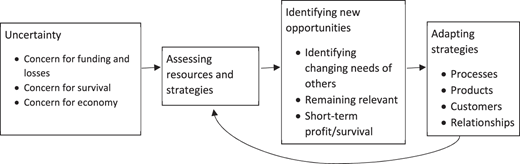
The major themes that emerged from the interviews suggest a process model of adaptation for small businesses, as shown in Figure 1. The figure summarizes the major trends regarding uncertainty, assessment of business strategy and available resources, identification of opportunities and new ways of doing business, and changes in business strategy. During the interviews, the participants identified areas of uncertainty and concern for their business and the overall economy. There was a short timeframe to implement changes as many of them experienced steep declines in sales and profits. The financial uncertainty and unprecedented business restrictions for an undefined and thereafter extended period forced many of these businesses to assess their strategy and adapt to the constantly changing environment.
The authors identified four distinct areas highlighted by participants for assessing and adapting their strategies: their processes for conducting business, the products they offered, the customers they did business and interacted with, and the relationships they established or further developed with other businesses, clients, customers and communities. Through identification of available resources and recognition of the changing needs of others, they identified ways to remain relevant and survive. Processes were adjusted to find new modes of delivering products, converting processes to a virtual or “contact-free” method of delivery, and changing employee processes to allow them to continue working. Product offerings were changed due to new demands and regulations and through collaboration with other businesses. Lastly, these small businesses adapted strategies in terms of people, including customers, other business owners and clients/customers. New customers were targeted as new goals were pursued and businesses pivoted to find ways to generate revenue. Owners strengthened relationships and utilized social capital to form alliances with others and remain in contact with customers and the community. Through these actions, entrepreneurs navigated uncharted waters to adapt and remain competitive, or simply stay in business, through the pandemic.
Achieving a balance between exploration and exploitation is seen as essential for innovation and organizational survival (Gupta, Turban, & Bhawe, 2008), illustrating the importance of the feedback loop in Figure 1. The feedback loop suggests an assessment and reassessment of strategies as recommendations, requirements and customer needs constantly changed. The flexibility and adaptability of small businesses was particularly important.
5. Discussion
The current study provides a wealth of qualitative information detailing the responses of a variety of small business in nonurban areas to the uncertainty and challenges of the COVID-19 pandemic. The results highlight emergent themes and lead to resultant process model providing a detailed summary of small business adaption that may also provide a road map for small business owners in adapting to future situations of crisis and uncertainty. Specifically, the business owner responses show the importance of assessing and reassessing strategies, identifying new opportunities in the face of uncertainty, and adapting strategies regarding processes, products, customers and relationships that contributes to a continual process of strategic reassessment.
Because the coronavirus pandemic is in many ways a novel situation with many external factors affecting small businesses, the study was intentionally developed using a fresh lens rather than being driven by previous theoretical works. Nevertheless, the resultant findings add more value when considered in relation to prior literature. Namely, in addition to offering new COVID-19 specific insights and a new emergent process model of small business adaptation to crisis and uncertainty, the current study findings also showed compelling linkages several important theoretical and research streams in prior work. Such linkages were discussed in detail in the “Results and linkages to prior research” section.
In addition to those previously noted linkages, consideration of some especially relevant recent research may add further value. Schneckenberg, Velamuri, Comberg, and Spieth (2017) unpack the coping mechanisms of decision-makers during uncertainty and reveal five strategies – customer centricity, value co-creation, capability evolution, ecosystem growth and adaptive pricing – applied by decision-makers when coping with uncertainty in business model innovation. Further, Reeves and Deimler (2009) discuss several strategies for competitive advantage: adjust customer offerings, new pricing models, rapid prototyping and partnership with competitors. Similar mechanisms for small business entrepreneurs were uncovered during the present study. Customers and clients were at the center of some of these adaptations, as businesses realigned to customer needs and behaviors and focused on remaining in contact with customers and clients during times of limited face-to-face interaction. By aligning with customer needs, firms are likely to generate higher profits (Schneckenberg et al., 2017). Previous studies have found that firms must experiment and fit resource allocation to new business models (McGrath, 2010; Martins, Rindova, & Greenbaum, 2015). Respondents in the current study adapted to evolve work processes by reallocating resources to meet changing needs. Pricing was discussed by some of the business owners, but mostly in terms of what to charge for limited-service availability. For example, the daycare owners (Participant 13) had to decide how to charge families when they decided to pull their children out due to recommendations or COVID-related absentees. Partnership with competitors was also discovered as the daycare providers collaborated to make decisions and consider how they could best serve the community and maintain trust of the families.
Because this was a sudden and ongoing situation, the pandemic provided a unique set of challenges. In their pandemic-specific research, Salamzadeh and Dana (2021) conducted interviews with co-founders of well-known startups and identified six principal types of challenges during the pandemic outbreak: financial, human resources management, support measures and mechanisms, marketing, crisis management and others. The current study reinforces the importance of those challenges and adds further richness. For example, the current findings and emergent process model highlight the importance of offering new products, creating new processes, changing target customers and continuously adapting in response to feedback and results. These results reinforce other COVID-19 studies that have identified the importance of communication and collaboration with customers and other businesses (Al-Omoush et al., 2020, 2022). For example, a study on e-business response to COVID-19 found that social capital and collaborative knowledge creation can play a significant role in response to the pandemic, confirming the importance of knowledge as a renewable resource (Al-Omoush et al., 2020). A later study found that social capital significantly impacts organizational sustainability during COVID-19 (Al-Omoush et al., 2022). Insights about business adaptation to the pandemic also complement studies on prior crises, such as Hurricane Katrina (in 2005) or the 2008 financial crisis. Although each crisis presents unique problems, they all add greater understanding of response to uncertainty. For example, research on the effects of hurricane Katrina found that small businesses were particularly affected as they were more susceptible to interrupted cash flows, lack of access to capital and difficulty accessing federal assistance (Runyan, 2006), challenges shared by many of the businesses in the current study. In summary, the current findings add rich qualitative insights into small businesses in rural communities during the pandemic and suggest a valuable emergent process model. Although the process model may well be applicable to many situations of crisis and uncertainty, the detailed study results also allow for a greater understanding of the specific cognitive and behavioral processes of small business entrepreneurs during the COVID-19 pandemic. This allows for both policymakers and practitioners to understand “why” and “how” small business owners might respond to crisis and uncertainty.
6. Conclusion
The in-depth interviews and detailed, qualitative analyses allow for a better understanding of how small business owners in smaller communities respond to a situation of intense crisis coupled with high levels of uncertainty. Findings highlight impressive resilience and creativity of small business owners in re-evaluating resources, identifying new opportunities and adapting to changing needs in the face of adversity. A key contribution of this study is the emergent theoretical process model for small business owners when coping with uncertainty. As businesses recognized uncertainty and assessed their strategies in terms of processes, products and people, they were able to identify new opportunities. Business owners discussed opportunities in relation to identifying changing needs of others, remaining relevant and being able to produce enough profits in the short term for firm survival. By identifying such opportunities, entrepreneurs adapted strategies and constantly reassessed during the most turbulent periods of the virus onset.
Much of the existing literature discusses entrepreneurial action at the beginning of the venture or success in terms of survival or profit. The COVID-19 (coronavirus) pandemic is a compelling context for analyzing how small businesses cope with and adapt to unexpected crisis, uncertainty and change. This study provides insight into entrepreneurial adaptation to intense and unpredictable crisis situations and highlights the importance of being able to assess and adjust business strategies and reallocate resources under fluidly changing conditions.
Existing limitations of the study provide opportunities for future research. Notably, a modest sample of fifteen small business owners was interviewed in similar communities in the Midwest. With a larger sample size and more variance in age and gender, interview responses may be more diverse and potentially more generalizable. However, the current research may provide unique insights with special relevance for younger entrepreneurs in smaller cities and communities regarding effective response to uncertainty and change.
This study may be used to inspire future empirical research on reactions to uncertainty, changes in business strategy, and strengthening and developing relationships during turbulent times. The emergent process model can be used in empirical studies to understand how small business owners process and adapt to changing environmental contexts. Future research could use quantitative analysis to understand when and to what level small businesses adapt during crisis and how they continue to adjust over time. Lastly, it is important to understand how strategy adaptations are assessed and revised. The model can be used and updated with the addition of new findings. Longitudinal data of small businesses could also provide a deeper understanding of the impact of crises. By learning from current and ongoing crises, small businesses may gain insight on how to better prepare for the future.