

The National Football League (NFL), the most lucrative sports league in the world, has its second largest foreign audience in Brazil. Its Brazilian broadcasts stimulate the audience to extrapolate television reception and interact through a social media platform, seeking to integrate a collective consumption. Thus, attachments are established between consumers and league. Based on this, this study aims to analyze how the interaction in social media of the Brazilian NFL audience, during the transmissions of its games, results in consumption attachments.
The method undertaken was Netnography, commonly used to investigate cultural practices occurring in online environments. The research corpus consisted of messages posted on Twitterhashtags created by the ESPN Brazil channels to reverberate its broadcasts of the league between 2016-2017 and 2017-2018 seasons.
The findings of this study indicate that Brazilian audience interaction in social media establishes consumer attachment with the NFL by means of the brand elements and aspects of social life, mediated by the league.
The research observed only the part of the Brazilian audience of the NFL that engages in the broadcasts of the games through social media.
The research of this study demonstrates how brands can use social media to enable social interactions that create or improve consumer attachments with them.
The study presents how a media brand imbricated in the American culture has been the target of attachment by Brazilian fans through social media interactions.
Introduction
Sports are one of the most important modern entertainments, because they are massively mediated, but no longer limited by physical and geographical constraints. In addition, they also disseminate characteristics of the culture they are inserted in (Jackson, 2014; Toffoletti, 2015). According to Whannel (2014), sports can be divided into two categories: practice sports, which has popular commotion and a significant number of practitioners in a given place or culture, and media sports, which is popularized by worldwide broadcasts and has repercussion among viewers. However, these categories should not be seen as disjointed, because a sports category with a large number of practitioners can gain room in the media, whereas a widely broadcasted sports category can attract new practitioners. Thus, media sports can turn into practice sports and vice-versa.
Some media sports are intrinsically associated with the brand of the league or confederation that popularized them; thus, consumers get attached to them due to their notoriety among the worldwide audience. However, although some of these media sports are broadcasted in several countries, their practice and wide popular commotion are restricted to the cultural context they belong to (Wenner, 2012; Whannel, 2014). It is the case of American football and its main league, which is known as National Football League (NFL). Despite its growing audience in several countries (ESPN Brasil, 2017; TSN, 2016), the popular and cultural commotion of this sports category are fundamentally restricted to its country of origin (Oatesl, Furness, & Oriard, 2014; Wenner, 2012).
The NFL has changed its rules over the years, and it may have happened because American football was established as media sports. The league often improves and innovates in broadcasting to privilege fans that primarily enjoy the games on TV and in other platforms, rather than the ones who go to stadiums. Thus, it is crafted as a package of brand elements (e.g. teams, players, and experiences) that enable viewers’ attachment, regardless of where they watch the games (Spinda, Wann, & Hardin, 2015).
NFL brand elements accumulate great value in the financial market; besides, they show relevance in three out of four characteristics indicated by Forbes Magazine as the determinants of sports brand value: events, business and teams (Ozanian, 2017). NFL organizes the most lucrative sports event in the global media industry, namely: The Super Bowl, whose revenue is estimated to reach US$663m. In addition, its 32 teams are among the top 50 most profitable teams among all sports modalities (Badenhausen, 2017). Still, the commotion of its audience influences the recall of advertisements broadcasted during the games (Pavelchak, Antil, & Munch, 1988) and shapes public perception about the brands (Jenkins, 2013). However, NFL brand value is not limited to the economic sphere. The league is also influential at cultural sphere (Wenner, 2012, 2014; Whannel, 2014), as American football represents the principle of effort and meritocracy, which is one of the national maxims in the USA (Schimmel, 2013); it also works as a way to present the US culture to foreign people and countries (Ha et al., 2014).
Although the American football tradition is not established in Brazil, the NFL has managed to beat audience records in the country (ESPN Brasil, 2017). Nowadays, the country is the second largest foreign consumer market of the league; it only stays behind Mexico (ESPN Brasil, 2015; Francischini, 2018). It was no surprise when, in 2018, the championship game – Super Bowl LII – hit a record audience in the country on Pay TV for the third year in a row (Firmino, 2018; UOL Esportes, 2018). As Brazil has one of the largest consumer markets on social media interaction (Yokoyama & Sekiguchi, 2014), ESPN Brazil mobilizes viewers through exclusive hashtags launched on the Twitter platform, and it generates a community of fans interacting on this social media (ESPN Brasil, 2017). Such interactions are encouraged by Brazilian ESPN channels. During game breaks, narrators and commentators show and make comments about messages, answer sport-related questions posted by the audience on Twitter and highlight community’s participation in the broadcast (Firmino, 2018; Mesquita, 2017).
Consumer communities are forged based on a collective consumption principle, due to its members’ attachment to brands and to each other (McAlexander, Schouten, & Koenig, 2002; Muñiz & O’Guinn, 2001). Consumer attachment is the value attributed by consumers to connections established with goods, services or brands (Kaiser, Schreier, & Janiszewski, 2017; Wallendorf &Arnould, 1988). Such attachment is underpinned by the symbolic value and sense of belonging fostered by the league (Cova & Cova, 2002; Moraes & Abreu, 2017).
As brand consumption is influenced by the link established between consumers (Aiken, Campbell, & Koch, 2013; Muñiz & Schau, 2005), it gives them the opportunity to express themselves by sharing their reasons to attach to a given brand (Scaraboto, Vargas, & Costa, 2012). Therefore, when consumers interact for this purpose, they no longer limit themselves to passive consumption (Ritzer, 2014). Many consumers in nowadays technological society search for tips and suggestions from other consumers in virtual environments (Franco & Leão, 2016; Ritzer & Jurgenson, 2010). Social networks have increasingly become a meeting point for consumers who exchange information about their consumer experiences (Kozinets, 2010; Nunes & ArrudaFilho, 2018). Thus, monitoring and encouraging interaction on virtual brand communities (VBC) is an innovative strategy that brands have been adopting to establish strong relationships with consumers (Guschwan, 2012).
Consumers in the social media context are productive toward the brands they are attached to, as they give these brands meaning and enhance their reach and visibility. Therefore, they escape the traditional dualistic consumption and production model to become prosumers (Ritzer, 2014; Zajc, 2015). Prosumers attached to media products can be seen as fans (de Souza-Leão and Costa, 2018), they intensively collaborate to resonate their practices in a specific consumer culture, in a coordinated and organized way (Costa & Leão, 2017; Jenkins, 2006; Rodrigues, Chimenti, & Nogueira, 2015). Thus, fans’ attachment to a given brand enables emotional bond, social responsibility and community interaction (Aiken et al., 2013; Kozinets, 2006).
Based on this line of reasoning, it is possible inferring that the NFL collective consumption through social media in Brazil produces consumer attachments. Thus, the current study asks the following research question: how does the interaction of Brazilian fans in social media during NFL broadcast result in consumption attachments?
The primary aim of the present research was to investigate consumer attachment in the entertainment industry context, based on bonds established between fans and brands in the social network, by taking into consideration the prosumerist practices. The study takes part in the consumer culture theory agenda, which focuses on consumer practices, articulations and social organizations in cultural contexts (Arnould & Thompson, 2005).
Fan’s productive consumption
The Web 2.0 context allows understanding of how media ubiquity affects consumer practices (Franco & Leão, 2016). Brands have been using digital technologies to interact with actual and potential customers (Hackley & Hackley, 2018). The media–consumer interface has popularized innovative marketing formats and models to promote relationships between brands and consumers, mainly in the present decade (Castro, 2012).
Social networks are consolidated as a cultural space for spontaneous interaction and, therefore, as a means to promote brands and maintain their relationships with consumers (Guschwan, 2012). These spaces illustrate how cultures are symbolic, but they can also result from market actions. Cultures encompass social groups who use consumption as a way to elaborate symbols or to attribute collective meanings to their environments (Arnould & Thompson, 2005; Askegaard, 2014). Consumers interact with each other in a productive way to reconfigure consumer cultures they belong to and to integrate a participatory culture (Jenkins, 2006).
Participatory cultures are all about how collective engagement renews the cultural participation of social individuals. They are potentiated by media convergence, which is possible due to technological changes. Thus, individuals move from sociocultural isolation to communal participation (Jenkins, 2006; Rodrigues et al., 2015). The ones who spontaneously engage in a particular participatory culture escape the passive content receptor position and start archiving, signifying and reproducing the cultural content appropriated by them (Jenkins, 2014; Tombleson & Wolf, 2017).
Media text contents are intensely appropriated by fans, who re-create and re-signify them (Guschwan, 2012; Sandvoss, 2005); this practice differentiates fans from regular consumers (Sandvoss, 2005). Most consumer practices adopted by fans can result in consumer attachment (Tumbat & Belk, 2011). According to Jenkins (2008), fans are the most active members of the audience who receives media texts. They recreate mediatic texts because they feel as much responsible for them as their producers (Guschwan, 2012; Jenkins, 2006). Therefore, they constantly express their attachment to media products by spreading such content to consolidate the culture they take part in; this is the practice through which they assume their responsibility (Hills, 2013; Jenkins, Ford, & Green, 2013).
The performance of fans can be considered, in several aspects, as prosumption acts (de Souza-Leão & Costa, 2018). Prosumers are productive consumers who do not fit the dual model that separates production from consumption; thus, they assume functions attributed to both sides (Ritzer, 2014; Zajc, 2015). This practice has become even more evident in the Web 2.0 context, as the interaction between prosumers has been intensified by the ease of information exchange (Ritzer & Jurgenson, 2010) and content sharing (Collins, 2010; Ritzer, Dean, & Jurgenson, 2012). When prosumers share inferences and feelings about media products and try to spread and popularize them, they assume a task that is often up to producers (Ritzer, 2014; Zajc, 2015).
Sports fans can be seen as prosumers, as they play the role of additional players in their teams and setup the atmosphere that defines the sports consumer experience (Andrews & Ritzer, 2017; Price & Palmero, 2014). According to Andrews and Ritzer (2018), sports prosumers in the Web 2.0 context are not only productive fans for their teams; but consumers who generate contents that can enhance and enrich the consumption experience.
The performance of fans often takes place in the fandoms (Jenkins, 2008), which are social spaces where they establish relationships and feel comfortable and safe to express their feelings and opinions about media products of common interest (Hills, 2013). Fans legitimize new forms of collective consumption in these social spaces; they configure fandoms as consumer communities responsible for perpetuating and expanding collectivity concepts (Kozinets, 2006).
Attachments in collective consumption
Consumption practices are one of the most visible cultural expressions of modern society, as they can establish consumer attachment (Arnould & Thompson, 2005; Belk & Casotti, 2014). Individuals living in contemporary society start materializing feelings and valuing their connection with others (Bauman, 2007; Schroll, Schnurr, & Grewal, 2018). Thus, understanding the linking value set by consumption is one of the main tasks of marketing studies nowadays (Schau, Gilly, & Wolfinbarger, 2009; Kaiser et al., 2017).
Consumer attachment is forged in collective consumption and it can change the cultural behavior of a given society (Cova & White, 2010). Collective consumption connects consumers belonging to the same micro-social level (e.g. family and friends) to the ones belonging to the macro-social level (e.g. market relations and the society as a whole) (Carú & Cova, 2003); this phenomenon can be observed in encounters happening in consumer communities (Cova & Cova, 2014).
Consumer communities are micro-social groups configuring modern society; individuals can simultaneously belong to several consumer communities (Cova & Cova, 2002; Moraes & Abreu, 2017). These groups are formed and maintained based on attachments established among their members, who identify themselves with brands and share consumption activities (Henriques & Pereira, 2018; McAlexander et al., 2002; Muñiz & O’Guinn, 2001). Therefore, consumer attachment is a social interaction experience between members of a consumer community, which is based on internal codes of a given culture and could also be presented to individuals who do not belong to such culture (Pihl, 2014).
Because the consumption of a given brand is influenced by the relationship between consumers and the brand itself (Aiken et al., 2013; Muñiz & Schau, 2005), consumer attachment makes consumers consider themselves loyal to brands. Consequently, they incorporate brands’ goods and services into their routine (Humphreys & Wang, 2018; Sharma, Kumar, & Borah, 2017) and humanize their characteristics to enable identification processes (González & Francisco García, 2013). Discrepant feelings such as excitement and abstinence are often associated with consumer attachment to brands (Ahuvia, 2005; Albert, Merunka, & Valette-Florence, 2013; Masset & Decrop, 2016).
Consumers connect to others who share their consumption preferences (Schroll et al., 2018; Wallendorf & Arnould, 1988). The interaction between them influences their perception about the consumed product, as well as their relationship with it (Parmentier & Fischer, 2015; Muñiz & Schau, 2005). On the other hand, the consumer–brand relationship often influences other consumers engaged in social relationships (Epp & Price, 2010). Consumer attachment to brands is so strong that opinions and feelings about brands can get new consumers to attach to them (Batra, Ahuvia, & Bagozzi, 2012; Scaraboto et al., 2012).
Wallendorf and Arnould (1988) indicate three types of consumer attachment in an approach widely adopted in marketing studies. Possessive attachment refers to the material connection between consumers and brands. Social attachment, in its turn, results from relationships established between consumers on social media during, or due to, consumption practices. Finally, favorite attachment is based on personal memories about the importance of consumer practices.
Virtual communities have emerged in the digital culture context. According to Castells (2003), these communities have emerged from individuals’ desire for freedom. Most of these groups do not meet each other in the physical world and many of their participants choose to remain anonymous (Kozinets, 1999). This relationship is based on computer-mediated communication; thus, its members behave differently from members of offline communities. In addition, each virtual community presents a different cultural composition, a fact that generates a unique feeling of collectivity in its members (Muñiz & O’Guinn, 2001).
This context has opened room for VBC, that is, for consumer communities of shared involvement to a certain brand (Freitas & Leão, 2012). According to Muñiz and O’Guinn (2001), VBCs are based on three central features, namely: rituals and traditions, shared consciousness and sense of moral responsibility. Rituals and traditions indicate how social interactions are reproduced to constitute and establish a given brand, mainly if one takes into consideration the historical perspective about the relationship between brand and society. Shared consciousness concerns the social and affective identity established between the community and its participants, including the emotional involvement resulting from the relationship between them and the culture connecting each other. Finally, the sense of moral responsibility is determined by VBC members’ perception that there is a purpose in such belonging, which is evidenced in the way they are integrated, retained and assisted in such communities, as well as in their suitable behavior (Henriques & Pereira, 2018).
Kozinets (2006) advocates that the connection between fans driven by their common interest in a certain media product can create a brand fandom; it may happen through their interactions and through the gathering and production of contents associated with such product. Their spontaneous and productive actions help in spreading brand content, mainly on social media, which stands out for lack of physical (i.e. geographical) barriers.
Methodology
Netnography was the research methodology adopted in the current study. It is commonly used in studies focused on investigating online-mediated interactions (Kozinets, 2010) and on better understanding virtual cultures (Guesalag, Pierce, & Scaraboto, 2016; Hamilton & Alexander, 2017; Izogo & Jayawardhena, 2018). The aforementioned method can reveal the richness of online social interactions and relationships (Henriques & Pereira, 2018), as well as the way social and cultural perceptions about the world are maintained and modified depending on the observed community (Nunes & ArrudaFilho, 2018). Furthermore, the method reveals how structures and social relationships in online cultures can support relationships in the physical world (Underberg & Zorn, 2013).
The approach adopted in the current study was the one suggested by Kozinets (2001), which is strongly applied in marketing research. It was adapted from the classical ethnography used to investigate online consumer cultures. The method enables analyzing consumer interactions taking place in virtual environments (Bartl, Kannan, & Stockinger, 2016; Henriques & Pereira, 2018). It is also often used in studies about media sports and online relationships established among sports fans (Filo, Lock, & Karg, 2015; Næss, 2017; Stavros, Meng, Westberg, & Farrelly, 2014).
Netnographic studies differ from regular ethnography because they focus on better understanding online consumer communities, by taking into consideration relationships between, and practices adopted by, members of such communities (Gammarano & ArrudaFilho, 2014; Kozinets, 2010). However, as an ethnographic study, netnography is also based on observation; thus, it requires researchers to have the ability of perceiving details and particularities of the investigated culture and of analyzing its modus operandi and meaning construction process (Barboza & ArrudaFilho, 2014; Underberg & Zorn, 2013).
Table I explains netnography stages, definitions and the way they were implemented in the present research, based on guidelines by Kozinets (2001, 2006, 2010, 2015). The way people interact in the social network and the variety of topics addressed in this virtual environment have guided the codification process involved in the data analysis. The spontaneous use of Twitter hashtags integrates its users in a cultural community representative of the investigated phenomenon (Kozinets, 2010; Nunes & ArrudaFilho, 2018).
Netnography stages and research conduction
| Netnography stage | Cultural entrée | Data collection | Data analysis and interpretation |
|---|---|---|---|
| Definition | The investigated online community must be fully investigated by researchers to make its cultural configuration as natural to them as it is to its members | Texts addressing interactions taking place in the investigated online community must be collected and filed by researchers, who can also complete these data with field notes about their perceptions and inferences during data collection | Data are analyzed through a range of procedures subdivided into the following steps: codification, reflection, abstraction, comparison, verification, refinement, theoretical generalization and (possibly) theorizing |
| Execution | Both researchers have been watching the NFL since 2009. In addition, one of them is a Twitter platform user who has been interacting with the investigated community since 2011. This aspect makes the study a participatory netnography, whose researcher is an active and visible part of the investigated community. Besides, this very same co-researcher has been an American football player in Brazil since 2012. This experience has enabled him to understand particularities of this foreign sport, which has been practiced in the country, as well as the relationship between consumers and the brand in VCB interactions | During the research period, the investigated community used four hashtags that had been launched by ESPN Brazil to enable their audience to interact during NFL broadcasts in the country: #TudoPelaNFL, #PlayOffsNFLnaESPNand #SuperBowlnaESPN, in the 2016-17 season; and #NFLnaESPN, in the 2017-18 season. The first season broadcasted 119 games, whereas the second one broadcasted 141. All posted messages were saved and filed in PDF format. These files included texts, photos and images of videos of the original messages. Besides, instant field notes were elaborated during game broadcasts to help contextualizing the data analysis | We followed the analytical steps in three-stage analysis. Initially, we have set provisional codes and classified them to establish hierarchies between inferred meanings. Next, we identified relationships between broader categories encompassing the initial codes. Finally, categories were interpreted based on the literature. The analysis applied to data about the first season was partially inductive; general concepts were adopted as initial basis, whereas more specific concepts were only used to validate inferences. The analysis applied to data about the second season, in its turn, was partially deductive, since it started from the findings in the first period, although it kept the process open to enable identifying new codes and categories |
The current study also took into consideration research quality criteria based on what Kozinets (2015) highlights as appropriate for a netnography: rigorous method application, axiologically demarcated cultural entreé, commitment to achieve data saturation, data interpretation in compliance with the available literature or theorization, researchers’ reflexivity and respect for the observed praxis. In addition, analysis triangulation was implemented among researchers; research findings were presented in a clear, rich and detailed description (Paiva, Leão, & Mello, 2011). This process was implemented in the inductive and deductive phases of the analysis. Provisional codes were suggested and discussed by the authors of the current study on a weekly basis during the first NFL season to minimize the likelihood of unnoticed aspects. Marketing literature was explored during the offseason period between seasons to meet the empirical results. Finally, categories and their relationship with adjusted codes were discussed during the second NFL season to validate the results.
Results and discussion
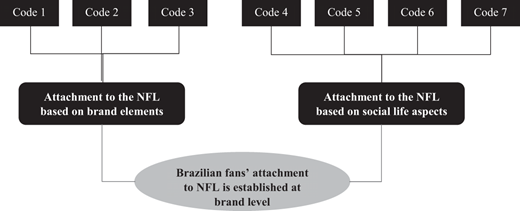
The analysis performed in the current study has identified seven codes, which were organized into two categories, as shown in Table II. In addition, Figure 1 explains the relationship between codes and categories, as well as how it converges to the main result of the study. The next section presents the empirically contextualized discussion about each code and category.
Codes and categories
| Attachment to NFL through brand elements | |
| [1] Cheering for NFL teams | The involvement of Brazilian NFL fans makes them cheer for some of the 32 league teams. This relationship becomes passionate and critical to the way games are enjoyed |
| [2] Admiring NFL athletes | Brazilian NFL fans consider players vital to league enjoyment, since they understand that players make sports spectacles complete. Fans admire players for their contribution to develop the sport, the league and the teams, as well as they emphasize players’ outstanding athleticism |
| [3] Euphoria and melancholy toward Super Bowl | The final match of NFL seasons triggers different emotions in fans: on the one hand, Brazilian fans feel ecstatic to witness the most important game of the year; on the other hand, they feel sorrowful due to the offseason (period without NFL games) |
| Attachment to NFL through social life aspects | |
| [4] Fans’ daily life is changed by the NFL | The routine of some Brazilian NFL fans changes during the league season. They avoid scheduling appointments at match times and stay awake at dawn to watch the games, even on the eve of business days |
| [5] Family-life fitted to the NFL | Brazilian NFL fans are so involved with the league that they compromise moments often devoted to family activities (e.g. weekends) to watch the games during the season. Therefore, they strive to introduce their families to the sport and turn the game broadcasts into family events |
| [6] Friendships forged and maintained through the NFL | Brazilian NFL fans enjoy the league games in the company of friends. They turn the game broadcasts into social events to be shared with friends, a fact that deepens their relationship. Enthusiasts even invite friends who are not familiar to this modality as an attempt to introduce them to the NFL. Some of these friends invite other friends and so forth, and it expands their friendship network |
| [7] Spreading the league through social media | Brazilian NFL fans use other social media platforms such as WhatsApp, Facebook and Instagram to spread the league content to others. They feel responsible for promoting the league in their social networks to win new fans |
Attachment to the National Football League based on brand elements
Brazilian NFL fans become attached to the league due to its unique brand features. Code 1 evidences the link established between NFL Brazilian fans and league teams (a.k.a., franchises). When fans use tweets to announce their support to NFL teams, they consolidate their attachment to the brand, as they experience a deep emotional bond to such teams. An example of it lies on @CheeseheadsBr; this Twitter profile is managed by a local supporter of Green Bay Packers, which is one of the most popular NFL teams in the country. On October 16, 2016, the fan posted a message with a photo of himself at Lambeau Field, Packers’ Stadium (one of the most iconic stadiums in the American football history), in which he declared to have accomplished one of his biggest dreams in life.
The preference for one of the NFL franchises acts in a complementary way to Code 2. It reveals the identification of Brazilian fans with league players, who constitute another brand element. The most admired players are the main stars of the teams. In opposite, although complementary, direction, the admiration for certain players can make fans support the teams they play for. This bond can be seen in a message posted by a viewer who reported his girlfriend’s involvement with New England Patriots, which is another franchise that is quite popular among Brazilian fans. According to his tweet from September 28, 2016, his girlfriend had named her newborn kittens after her favorite Patriots’ players: “Danny Amendola” and “Jimmy Garopolo”.
Fan’s admiration for players also shape the way they experience NFL games, as they admire players’ athletic performance. Tweets released on October 2, 2016, during the game between Atlanta Falcons and Carolina Panthers, demonstrated how impressed Brazilian NFL fans were with the performance of Julio Jones (the main receiver of Falcons’ team). These messages highlighted how watching the player in action was spectacular and how it improved their game-watching experience.
With respect to Super Bowl, Code 3 reveals a mix of enthusiasm and frustration experienced by Brazilian viewers who watched the final NFL game. They were simultaneously excited about the most anticipated game of the season and distressed for realizing that it was the last game for the following seven months. This mixture of feelings was evident on tweets published on the first Sunday of February in the two NFL seasons. A flood of messages highlighted the excitement of watching the Super Bowl, while expressing “saudade”, a Portuguese term of unique meaning referring to a blend of nostalgia and missing something/someone.
Attachment to the National Football League based on social life aspects
Brazilian fans’ attachment to NFL is reinforced by the sociability involving the enjoyment of the league. Code 4 illustrates this bond and reveals how fans prioritize watching the games. A tweet published on September 8, 2016, well expressed this bond. A viewer asked the Brazilian ESPN broadcast team to help him explain to his girlfriend how important it was to stay home and watch the league games live.
Another facet of this code indicates how watching the games justifies sleep deprivation and even low productivity in the morning following the match days, as the broadcasting of the games enters the dawn. During the first game of the 2016-2017 season, a viewer happily wrote that sleepless nights’ season had begun.
Code 5 concerns brand attachment in a more intimate form of social interaction, i.e. the one involving family members. Part of the Brazilian NFL audience influences family members to follow the broadcasts of the games; they act as league ambassadors who present and explain the rules and peculiarities of American football. In doing so, they try to reconcile the moments that would often be devoted to family activities with the enjoyment of American sports games by incorporating the social and affective relationship they have with their loved ones to NFL consumption. Tweets posted in several moments reveal how Brazilian fans of the league tried to introduce their parents, boyfriends and girlfriends, siblings and other relatives to the rules and particularities of American football by relying on the charisma of Brazilian ESPN broadcasts.
Friendship is another type of effective relationship associated with NFL consumption in Brazil. Code 6 shows how the transmission of league games become moments of friendship among fans. More than that, NFL broadcasts in Brazil bring together sports fans who do not know each other and who have become friends due to their consumption of league games. Similar to what happens to family members (Code 5), some fans introduce the sport to their friends. Messages revealing collective league consumption among friends and how league consumption was responsible for establishing new friendships were posted at different times of the two observed seasons.
Finally, Code 7 reveals how Brazilian NFL fans play the role of spreading NFL information, characteristics and rules to a broader audience in different social media platforms to expand the community of fans. According to a tweet published during the 2018 Super Bowl, a fan shared his WhatsApp use to, in his own words, “catechize” his girlfriend to watch the event with him.
Final considerations
Findings in the current study indicate that Brazilian audience interactions in social media establish consumer attachment to the NFL based on brand elements and social life aspects mediated by the league. These findings illustrate how the observed interactions enable relationships that are, simultaneously, social- and market-based. It is possible saying that Brazilian fans’ attachment to NFL is established at a brand level due to relationships established in social, affective and even moral dimensions.
The direct relationship between Brazilian fans and brand elements depicts the attachment type defined by Wallendorf and Arnould (1988) as a relationship between, and nurtured by, consumers and their favorite entities or objects. On the other hand, sports fans often extend their involvement with the game to sports’ brand elements (Harris & Ogbonna, 2008; Hoegele, Schimdt, & Torgler, 2016). Choosing the team to cheer for is essential to sports fans and it may drive them into sporting brands’ attachment (Harris & Ogbonna, 2008; Hoegele et al., 2016). The admiration for players’ athleticism, in its turn, generates fan identification with athletes (González & Francisco García, 2013; Healy & McDonagh, 2013), who are given a celebrity or even “human brand” status (Thomson, 2006). Finally, the involvement with Super Bowl shows the emotional bond established between Brazilian fans and the NFL. The consumption of one’s favorite brand feeds the feeling of possession, which can equally lead to the excitement for enjoying it (Ahuvia, 2005; Albert et al., 2013), as well as to abstinence for losing it (Masset & Decrop, 2016).
The league also establishes attachment with Brazilian fans based on the sociability among its viewers. People interacting about certain consumption objects often nourish the feeling of experiencing a special event together (Schroll et al., 2018; Wallendorf & Arnould, 1988). Besides, consumers become loyal to a certain brand when they incorporate it into their everyday lives (Humphreys & Wang, 2018). The enjoyment of the games among family members and friends shows how this experience happens in the midst of social integration. The existence of a consumption object shared by social groups intensifies, materializes and transforms the relationship between its members and between them and products and/or brands (Epp & Price, 2010). In addition, routine changes implemented to allow fans watching the games indicate the establishment of a ritual linked to one’s feelings toward the brand or consumption momentum (Batra et al., 2012; Sharma et al., 2017). Finally, spreading the league evidences the moral commitment of fans toward the NFL, as they act as brand ambassadors. It happens because some consumers use to consider themselves responsible for propagating the frontiers of brand communities (Jenkins et al., 2009; Muñiz & O’Guinn, 2001). All these aspects corroborate every characteristic pointed out by Muñiz & O’Guinn (2001) as fundamental for VBC establishment and maintenance. Furthermore, brands consider VBC and social media as environments fit to promote products or services in the Web 2.0 context and, mainly, to implement strategies that can generate identification and attachment to them. According to Jenkins (2006), cultural spaces are capable of turning consumers into brand fans.
The current study has some limitations such as the observation of only part of the Brazilian NFL audience. Only fans who engaged the broadcasts of the games through social media were observed, leaving aside the whole part of the audience who did not use this resource. However, such choice corresponded to the definition of the research scope. Another limitation lies on the coverage of only two NFL broadcast seasons. This clipping was justified by time constraints to perform the investigation. However, research conduction and results have indicated that the study achieved its purpose.
The current study addressed how NFL – a media brand imbricated in the American culture – has been the target of attachment by Brazilian fans through social media interactions. Thus, the research contributed to better understanding how these platforms can show consumer attachments in contemporary society. The research evidenced that social media is an environment where brands can encourage prosumerist acts and social interactions to create or improve consumer attachments to them.
As the potential unfolding of the research, investigating Brazilian fans’ attachment to other American sports leagues, such as the Major League Baseball and the National Basketball Association, would enable extend and compare results to findings in the present study. These leagues are broadcasted in Brazil in the same way as the NFL, a fact that would make this new research possible.
National Council for Scientific and Technological Development (CNPq) supported the current research.
Coordination for the Improvement of Higher Education Personnel (CAPES) supports the graduate program to which the researchers are affiliated.

