


The study explores the factors influencing consumers’ motivation to use video streaming services of over-the-top (OTT) platforms and their willingness to pay for those services.
Using a sample of 256 Indian consumers of OTT services, the study empirically tests a research framework based on the technology acceptance model (TAM) and uses and gratifications theory (UGT). Partial least squares structural equation modeling (PLS-SEM) method was used to analyze the primary data and explain consumers’ motivations toward the OTT services.
The findings suggest that consumers’ intentions to use OTT services are determined by both extrinsic as well as intrinsic factors. However, their motivations to pay for OTT services are strongly linked with intrinsic factors such as instrumental use, interactive control and flow experience.
The research focuses largely upon the individual motivations and perception towards the OTT services. It omits the prevalent communal behaviors in Indian households, where use of OTT may be considered as a shared activity. This study relies upon the data collected from urban technology savvy individuals. This may not accurately reflect the opinion of rural consumers where accessing OTT is increasing rapidly.
The study will guide the global OTT players to design strategies and successfully expand their operations in emerging markets.
This paper contributes to the literature by explaining the attitudes of Indian consumers toward OTT services.
1. Introduction
The growth of new media technologies has changed the way consumers used to look toward television and broadcast media. Today, consumers are shifting from television services to innovative webcasting or online streaming services that enable high-quality, original content accessible through the Internet (Camilleri & Falzon, 2021). Consumers are subscribing to over-the-top (OTT) services for more informative, convenient, customized and diverse entertainment. The streaming of entertainment programs via OTT platforms has given rise to a new kind of television, replacing the classical TV channels (Puthiyakath & Goswami, 2021).
The developing countries offer a lucrative market to OTT players (Kim, Kim, Hwang, Kim, & Kim, 2017). India is one of these markets where OTT services are growing rapidly. According to a report by Redseer Strategy Consultants (ETGovernment, 2022), India will surpass one billion Internet users by 2030. Accelerated growth of the Internet, cheaper data costs and adoption of affordable smartphones have led to the increased online time of Indian consumers. An average Indian consumer spends a significant amount of time (around 7.3 h per day) on smartphones for YouTube streaming and watching OTT content (ETGovernment, 2022). The high levels of smartphone penetration and Internet usage in India create significant opportunities for OTT players. Being the second largest online market in the world, with a diverse and young population, OTT consumption in India is bound to grow in the coming future (Nagaraj, Singh, & Yasa, 2021). By 2024, the revenue growth in OTT on-demand video consumption is estimated at 3.9% worldwide and 5.3% in India (Statista, 2020).
To harness the massive growth potential in online video consumption, the OTT players have innovated different business models (e.g. subscription-based and advertising-based) to align with customer expectations (Gupta & Singharia, 2021). The OTT players are trying to find new ways to enhance their customers’ experiences and remain competitive (Camilleri & Falzon, 2021). A free trial period, integrating personalized recommender systems and competitive subscription charges, are a few examples. Customers are required to buy subscriptions to multiple OTT platforms to watch their favorite content. However, Indian customers are price-sensitive and look for value-for-money deals. The cost of subscribing to multiple OTT services and the availability of pirated content may deter them from paying for these services. Hence, to understand the Indian consumers who come from diverse socioeconomic and cultural backgrounds, there is a need to systematically investigate their attitudes toward accepting OTT services (Bhatt, 2022).
Though the adoption of online streaming services has been researched in developed countries for long (Cha, 2013; Lee, Nagpal, Ruane, & Lim, 2018; Cebeci, Ince, & Turkcan, 2019), developing nations such as India have recently started gaining attention (Bhattacharyya, Goswami, Mehta, & Nayak, 2022). Moreover, the investigation into the consumers’ intention to pay for OTT services has been very limited (Gupta & Singharia, 2021; Nagaraj et al., 2021). The present study addresses this gap by exploring the factors influencing Indian consumers’ intention to use as well as pay for OTT services. Grounded in the technology acceptance model (TAM) (Davis, Bagozzi, & Warshaw, 1989) and uses and gratification theory (UGT) (Katz, Blumler, & Gurevitch, 1973), the study attempts to explain the consumers’ extrinsic as well as intrinsic motivations toward OTT services. Based on the presented theoretical model, global players can design strategies while expanding in emerging markets such as India.
2. Theoretical background
2.1 Previous studies on OTT adoption
Based on a review spanning 2007 to 2021, Mulla (2022) identified several factors that lead to the adoption of OTT. These factors include price, content, flexibility, convenience, desire to be freed from any constraint, entertainment value, socialization, culture inclusion and binge-watching (Mulla, 2022). For empirical investigation of OTT adoption, previous studies have used various theoretical frameworks such as, unified theory of acceptance and use of technology (UTAUT), UTAUT2, theory of planned behavior (TPB) and TAM. For example, by using UTAUT, Shah and Mehta (2023) demonstrated that performance expectancy and effort expectancy determine consumers’ attitude, which in turn affects their intention to adopt OTT services. Bhattacharyya et al. (2022) extended the UTAUT2 model by content quality, economic position and habitual behavior to study the influencing factors of hedonistic motivation for using OTT services in India. The authors concluded that content quality is a significant mediator as well as a direct determinant of the usage intention of OTT services by consumers. Several studies have used TAM to understand user behavior toward OTT services. The two fundamental constructs within TAM, namely, “perceived ease of use” and “perceived usefulness,” have been identified as significant predictors of consumers’ intention to adopt OTT services (Chen, Chen, Tsaur, & Chui, 2023; Yousaf, Mishra, Taheri, & Kesgin, 2021). Integrating the constructs of TAM and TPB, Cha (2013) identified relative advantage and compatibility of OTT platforms as key motivations to use OTT services. Recently, Polisetty, Sowmya, and Pahari (2023) integrated TAM with innovation resistance theory (IRT) to understand the consumers’ intention to continue using OTT services.
Prior studies suggest that both extrinsic as well as intrinsic factors are important for determining OTT adoption (Isa, Mahmud, & Sulaiman, 2020). Though researchers have adequately addressed the consumers’ extrinsic motivations for using OTT services through the lenses of various technology adoption models, the examination of consumers’ intrinsic motivations needs further investigation (Soren & Chakraborty, 2023). Very few studies have investigated the intrinsic aspects of consumers’ motivations for using OTT services by employing media-related paradigms such as UGT (Isa et al., 2020; Camilleri & Falzon, 2021). Despite its utility in explaining consumers’ needs and motives for using media and communication technologies, the applicability of UGT for investigating consumers’ attitudes toward OTT has been underexplored in the literature.
2.2 Technology acceptance model (TAM)
TAM relies on two core constructs, namely, “perceived ease of use” and “perceived usefulness.” These constructs directly or indirectly influence users’ behavioral intention to use a technology (Lee, Kim, Ryu & Lee, 2010). TAM has often been used to explore individuals’ intention to engage with technology in the contexts of gaming (Pando-Garcia, Periañez-Cañadillas & Charterina, 2016) and self-service technologies (Oh, Jeong & Baloglu, 2013). TAM has been also used to understand the motivations to use streaming media devices (Yang & Lee, 2018), online streaming (Bhatt, 2022) and OTT (Cha, 2013). TAM has also been extended to include context-specific variables accounting for the unique features of OTT services, such as content quality and content variety (Gupta, Verma, Toteja & Narang, 2021). Recent studies indicate that TAM provides a valuable framework for understanding users’ extrinsic motivations to embrace OTT platforms (Polisetty et al., 2023).
2.3 Uses and gratifications theory (UGT)
The UGT addresses intrinsic motivations of users (Katz et al., 1973). There are two underlying principles of UGT: first, the users are active and engaged in their usage and selection of media; second, users are aware of their specific requirements for selecting different media options (Katz et al., 1973). The focus of UGT is on how people engage with media, rather than how they are impacted by the media (Menon & Meghana, 2021). It has been used to understand consumers’ motivations for using various media such as television (Stafford, Stafford, & Schkade, 2004), social media (Menon & Meghana, 2021) and online streaming television or OTT platforms (Tefertiller, 2018; Camilleri & Falzon, 2021).
3. Conceptual framework and hypotheses development
Previous studies argue that traditional technological models fail to include technology-specific factors which are important for rational and conscious decision-making (Khatri, Samuel, & Dennis, 2018), such as willingness to pay for OTT services. Hence, to examine the intrinsic as well as extrinsic factors that influence the consumers’ intention to use (ITU) as well as their intention to pay (ITP) for the OTT services, the present study proposes an integrated model by combining the constructs from TAM and UGT. The proposed framework is depicted in Figure 1. The TAM constructs, i.e. perceived usefulness (PU) and perceived ease of use (PEoU), focus on the extrinsic motivations of consumers, whereas the factors based on UGT, i.e. instrumental use (IU), interactive control (IC) and flow experience (FE), address the intrinsic motivations of the consumers. Specifically, instrumental use contributes toward content gratification, whereas interactive control and flow experience contribute toward the process gratification.
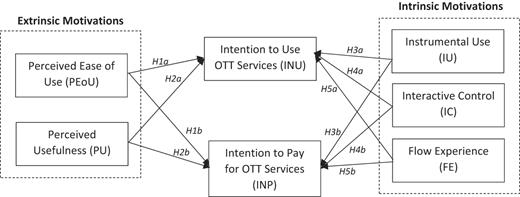
Conceptual framework. Source: Authors’ own work
Conceptual framework. Source: Authors’ own work
3.1 Extrinsic motivations and consumers’ intentions
3.1.1 Perceived ease of use
Perceived ease of use is “the degree to which a person believes that using a particular system would be free from effort” (Davis, 1989). PEoU has been found to be the most crucial variable for users’ decisions to use internet-based technologies (Gefen, Karahanna & Straub, 2003). Cha (2013) opines that as compared to traditional television platforms, online video platforms require more time, effort and technical know-how on the viewers’ part. Järveläinen (2007) suggests that PEoU plays a central role in accepting a technology that is considered to be time-consuming and laborious. Previous studies have found ease of use to be a significant predictor of users’ intentions to use online streaming services (Camilleri & Falzon, 2021) and online video platforms (Allam & Dinana, 2021). Hence, we postulate the following hypotheses:
Perceived ease of use has a significant positive influence on consumers’ intention to use OTT services.
Perceived ease of use has a significant positive influence on consumers’ intention to pay for OTT services.
3.1.2 Perceived usefulness
Perceived usefulness is “the degree to which a person believes that using a particular system would enhance his or her job performance” (Davis, 1989). The perceived usefulness of online streaming media refers to the advantages over traditional media (Camilleri & Falzon, 2021). Prior research indicates that users are inclined toward online streaming media since they perceive it to be more advantageous over existing television media (Cha, 2013). Yang and Lee (2018) have also found that perceived usefulness of streaming media devices exerts a strong influence on individuals’ intentions to use them. Hence, we postulate that:
Perceived usefulness has a significant positive influence on consumers’ intention to use OTT services.
Perceived usefulness has a significant positive influence on consumers’ intention to pay for OTT services.
3.2 Intrinsic motivations and consumers’ intentions
3.2.1 Instrumental use
Instrumental uses of media are goal-oriented and purposeful that contribute to content gratification (Papacharissi & Rubin, 2000). Earlier cross-media research has identified entertainment and information as key uses of television (Katz et al., 1973). Individuals use specific media for information-seeking and entertainment purposes (Lee et al., 2010; Quan-Haase & Young, 2010). Camilleri and Falzon (2021) suggest that individuals fulfill their instrumental purposes through online streaming services by watching informative content such as news and talk shows as well as entertainment programs such as movies and web series. The needs for entertainment are identified as key motivators for the adoption of web streaming services (Tefertiller, 2018) and online video platforms (Allam & Dinana, 2021). Thus, we propose that:
Instrumental use has a significant positive influence on consumers’ intention to use OTT services.
Instrumental use has a significant positive influence on consumers’ intention to pay for OTT services.
3.2.2 Interactive control
Interactive control allows users to control a medium in real time (Sundar & Limperos, 2013). It is an important process of gratification that satisfies the users’ needs, as it acknowledges their active media usage patterns (Ruggiero, 2000). Utilizing the interactive nature of the Internet and digital technology, the OTT platforms are able to provide control over the search, selection and playback of their favorite programs. For video streaming platforms, it reshapes the audience’s experience and hence results in increased satisfaction (Tefertiller, 2018). Many such studies indicate that control over the viewing content exerts a significant positive influence on the intention to use video streaming services (Allam & Dinana, 2021; Cha, 2013). Hence, we postulate that:
Interactive control has a significant positive influence on consumers’ intention to use OTT services.
Interactive control has a significant positive influence on consumers’ intention to pay for OTT services.
3.2.3 Flow experience
Flow is a concept that accounts for pleasure found by immersion in an activity (Nakamura & Csikszentmihalyi, 2002). The enjoyment realized in the state of flow is a self-motivating experience that is characterized by focused concentration (Nakamura & Csikszentmihalyi, 2002). Fulfilling flow experience contributes to process gratification within media contexts (Sherry, 2004). Previous studies examining online consumer behavior observe a significant correlation between flow experience and intention to adopt the virtual services (Damasceno, Morini, & Pannellini, 2023). People experiencing a high degree of flow while browsing online video platforms are intrinsically motivated to watch video content (Cha, 2013). Their seamless experience positively influences their decisions to use a particular video platform (Allam & Dinana, 2021). Hence, we propose that:
Flow experience has a significant positive influence on consumers’ intention to use OTT services.
Flow experience has a significant positive influence on consumers’ intention to pay for OTT services.
4. Research method
4.1 Survey instrument
A structured questionnaire divided into two parts was used to collect data. Part A was intended to gather demographic information like gender, age, family income and occupation. Part B consisted of the items that were used to measure the seven latent constructs included in the research framework. All the items were measured using a five-point Likert scale ranging between 1 (strongly disagree) and 5 (strongly agree). To ensure the content validity of the constructs, all the items were adopted from the previous studies. Specifically, two items for PEoU, three items for PU, three items for IU and two items for INU were adopted from Camilleri and Falzon (2021), four items for IC were adopted from Tefertiller (2018), two items for FE were adopted from Cha (2013) and two items for INP were adapted from Gupta and Singharia (2021). To ensure the face validity, the questionnaire was pre-tested with a panel of five researchers and five academics.
4.2 Sample
Like other previous studies, data were collected using convenience sampling through an online survey using digital and social media platforms (Bhattacharyya et al., 2022; Gupta & Singharia, 2021). People who have used the OTT services served as the target respondents for the study. The survey period was spread over three months. Overall, 1,200 respondents were contacted via emails and WhatsApp to participate in the study. The respondents were provided with a link to the online survey. Apart from the initial invitation email/message, follow-up reminders were also sent to the respondents. A total of 279 questionnaires were returned, out of which 256 were found to be viable. The majority of respondents exhibited demographic information as – females (57.5%), students (57.8%), age 18–25 years (65.2%) and an average monthly family income of more than one lakh (52.3%).
5. Results
The partial least square structural equation modeling (PLS-SEM) was employed for data analysis. The minimum sample size required for PLS-SEM should be at least ten times the number of indicator variables in the research model (Chin, 1998). As our research model had 18 items, the sample size of 256 satisfied the minimum requirement. We used SmartPLS4 software to apply the PLS-SEM.
5.1 Analysis of measurement model
The measurement model with 18 items was assessed to check the reliability and validity of the model constructs. As presented in Table 1, all the constructs exhibited adequate reliability with Cronbach’s alpha and composite reliability (CR) cut-off values of 0.70 (Hair, Black, Babin, & Anderson, 2014). The factor loadings were >0.70 (p < 0.001), indicating that items were significantly correlated with their respective factors. The values of average variance extracted (AVE) for all constructs were >0.50, indicating adequate convergent validity (Fornell & Larcker, 1981; Hair et al., 2014). Moreover, the squared roots of AVEs for all constructs were greater than their correlations with other constructs (see Table 2), ensuring discriminant validity (Hair et al., 2014). The discriminant validity was further confirmed using the heterotrait–monotrait (HTMT) criterion, as all HTMT ratios (see Table 3) were less than the threshold value of 0.85 (Henseler, Ringle, & Sarstedt, 2015).
Reliability and convergent validity
| Constructs | Items | Standardized loadings | Cronbach’s alpha | AVE | CR |
|---|---|---|---|---|---|
| PEoU | PEoU1 | 0.868*** | 0.840 | 0.737 | 0.849 |
| PEoU2 | 0.849*** | ||||
| PU | PU1 | 0.878*** | 0.879 | 0.713 | 0.882 |
| PU2 | 0.845*** | ||||
| PU3 | 0.809*** | ||||
| IU | IU1 | 0.843*** | 0.871 | 0.694 | 0.872 |
| IU2 | 0.814*** | ||||
| IU3 | 0.841*** | ||||
| IC | IC1 | 0.885*** | 0.874 | 0.529 | 0.877 |
| IC2 | 0.875*** | ||||
| IC3 | 0.752*** | ||||
| IC4 | 0.75*** | ||||
| FE | FE1 | 0.819*** | 0.800 | 0.667 | 0.800 |
| FE2 | 0.814*** | ||||
| INU | INU1 | 0.843*** | 0.835 | 0.718 | 0.836 |
| INU2 | 0.852*** | ||||
| INP | INP1 | 0.803*** | 0.782 | 0.644 | 0.783 |
| INP2 | 0.802*** |
Note(s): ***p < 0.001
Source(s): Authors’ own work
Discriminant validity
| Construct | PEoU | PU | IU | IC | FE | INU | INP |
|---|---|---|---|---|---|---|---|
| PEoU | 0.859 | ||||||
| PU | 0.362** | 0.844 | |||||
| IU | 0.107* | 0.393** | 0.833 | ||||
| IC | 0.254** | 0.212** | 0.224** | 0.727 | |||
| FE | 0.246** | 0.177* | 0.138** | 0.378** | 0.817 | ||
| INU | 0.514** | 0.700** | 0.443** | 0.445** | 0.141** | 0.848 | |
| INP | 0.223** | 0.364** | 0.301** | 0.353** | 0.317** | 0.577** | 0.885 |
Note(s): Diagonal elements are the squared roots of AVEs of the respective constructs
**p < 0.01; *p < 0.05
Source(s): Authors’ own work
5.2 Analysis of structural model
The structural model was examined to test the proposed hypotheses. The results (see Figure 2) revealed that INU was significantly and positively influenced by PEoU (β = 0.284, p < 0.001), PU (β = 0.413, p < 0.001), IU (β = 0.270, p < 0.001), IC (β = 0.142, p < 0.01) and FE (β = 0.139, p < 0.01), thus providing support for hypotheses H1a–H5a. The results also indicated that INU was most strongly determined by PU, followed by PEoU, IU, IC and FE. All five factors explained 66.8% of the variation in INU.
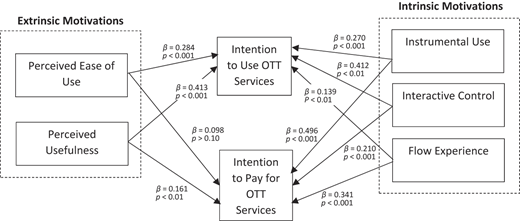
The structural model. Source: Authors’ own work
The structural model. Source: Authors’ own work
The results further revealed that INP was significantly influenced by PU (β = 0.161, p < 0.01), IU (β = 0.496, p < 0.001), IC (β = 0.210, p < 0.001) and FE (β = 0.341, p < 0.001), thus providing support for hypotheses H2b–H5b. However, the results failed to support the influence of PEoU on INP (β = 0.098, p > 0.10), thereby rejecting H1b. The results also indicated that INU was most strongly determined by FE and IC, followed by IU and PU. All four factors explained 61.2% of the variation in INP.
6. Discussion
The findings indicated that amongst the two extrinsic factors, PU exerted a positive influence on both INU as well as INP. This implies that the advantages of OTT services over traditional TV play an important role in shaping consumers’ intentions to use and pay for those services. Our findings resonate with those of Camilleri and Falzon (2021) and Bhatt (2022), who also highlighted the important role of PU in the acceptance of online streaming services. If the OTT services reflect the usefulness by enabling the accomplishment of consumers’ tasks, then the consumers are more likely to be satisfied and continue using OTT services (Yousaf et al., 2021). Another extrinsic factor, i.e. PEoU was also found to be a significant predictor of INU. However, the influence of PEoU on INP was not found to be significant. This implies that consumers can be initially motivated to use the OTT services if they find those services useful and easy to use. This finding is in line with that of Cha (2013), who argued OTT services can be perceived as time- and effort-consuming by the initial and inexperienced users and hence can influence their adoption intention. However, once the users become skilled at using OTT services, they do not require much effort to use them and hence do not consider the ease of using them as an important factor while deciding to pay. This finding is in line with that of Li, Guo & Bai (2017), who concluded that the effect of PEoU on technology acceptance disappears with time.
With regards to the intrinsic factors, the findings advocate for the important roles of IU, IC and FE in determining consumers’ INU as well as INP. The significant influence of IU indicates that if the consumers feel that OTT services can fulfill their instrumental needs of entertainment and information, then they are more likely to use and subscribe to those services. Our finding is in consensus with Bhattacharyya et al. (2022), who concluded that Indian consumers are attracted to those service providers who provide better value-added OTT services. The information and entertainment gratification play an important role in intrinsically motivating the consumers, as it not only determines the satisfaction of users but also affects their continuance intention (Yousaf et al., 2021). The significant influences of FE and IC indicate that consumers consider the factors related to process gratification, such as flow experience, interactivity and control, while deciding to use and pay for OTT services. The technical functionalities such as pause, forward, rewind, record, review and playback give them freedom and control, due to which they feel actively engaged while watching OTT content (Allam & Dinana, 2021). The satisfaction drawn from such active engagement intrinsically motivates them to use OTT services (Gupta & Singharia, 2021).
7. Conclusion
Based on the theories of TAM and UGT, this study investigated the influence of two extrinsic factors (i.e. PU and PEoU) and three intrinsic factors (i.e. IU, IC and FE) on Indian consumers’ intentions to use and pay for OTT services. Overall, the findings indicate that both extrinsic as well as intrinsic factors are important to motivate consumers to use OTT services. However, their motivation to pay for OTT services is strongly linked with the intrinsic factors.
7.1 Managerial implications
Our findings indicate that perceived usefulness of OTT services can generate positive intentions in consumers. Thus, OTT platform managers should focus on providing differential and improved service experiences to their consumers. Reaggregation of the content libraries by including a wide range of offerings, including music, video and gaming services, can help the OTT service providers create a distinction in the market and attract more customers. The findings also suggested that easy-to-use interfaces tend to help consumers become extrinsically motivated to use the OTT services. Hence, OTT service providers should design user-friendly platforms to attract users. Technical support can be provided by the OTT service providers to address the technical issues of the consumers. Our findings also indicate that fulfilling user gratifications intrinsically encourages consumers not only to use OTT services but also to pay for them. Hence, OTT platforms need to have high-quality, enjoyable as well as informative, content to generate engaging experiences for consumers. Including international shows with platform-original content can help maintain audience engagement with the OTT platform. By providing personalized and enjoyable content, OTT platform managers can keep their customers “hooked” (Yousaf et al., 2021). Considering the important roles of flow experience and interactive control, the OTT platform managers need to design extremely interactive and controllable user platforms.
7.2 Theoretical contributions
The study makes three notable contributions. Firstly, the study investigates the consumers’ acceptance of OTT services in an emerging economy, i.e. India, which is the world’s most populous nation and has significant potential for the OTT market. Though the adoption of OTT has been extensively researched in developed nations, prior studies have indicated a requirement for further investigating the OTT users’ behavior in the context of developing nations (Nagaraj et al., 2021). Hence, the present study has made a worthwhile contribution in this regard. Secondly, the study responds to the call by previous researchers to investigate the consumers’ intention to pay for the subscription charges of OTT services (Nagaraj et al., 2021). Lastly, the study contributes to the literature by integrating a traditional technology acceptance model, i.e. TAM, and a communication theory, i.e. UGT. While TAM is effective in explaining extrinsic factors, UGT addresses intrinsic factors.
8. Limitations and future research directions
The present study has some limitations. First, the scope of this study was limited to India, wherein the data were collected from 256 respondents using an online survey. Future studies may employ more comprehensive face-to-face data collection with a larger sample size. Second, the present study was grounded in the theories of TAM and UGT. Future studies can consider factors from other theoretical frameworks (such as UTAUT and UTAUT2) to explore consumers’ attitudes toward the use of OTT services. Third, the present study undertook a quantitative research to examine the consumers’ perceptions. Further research may involve qualitative methodology to investigate the in-depth opinions and beliefs of consumers regarding the usage of OTT services. This may reveal other important factors and provide a holistic understanding of the consumption behaviors of users.

