


This article investigates the impact of relational social capital (RSC) and relational risk perception (RRP) on innovation openness (IO) and examines whether innovation openness serves as a precursor to organizations’ innovation capability (IC).
The authors conducted a survey with 189 Brazilian companies operating within technology parks. Covariance-based structural equation modeling (CB-SEM) was employed to test the proposed conceptual framework.
The results reveal that RSC positively influences IO, while RRP tends to reduce openness. The analysis of relational aspects demonstrates that open innovation significantly contributes to the development of innovation capabilities. Furthermore, the presence of relational intensity enhances the effectiveness of RSC on IO and fosters the development of innovative skills.
This study broadens the discussion on the dynamics of interorganizational relationships by exploring the interplay between relational aspects and open innovation in the development of capabilities. Additionally, it provides managers with a framework to assess their organization’s innovation processes through relational perspectives, enabling them to maximize innovation capabilities.
This research addresses the conditions under which relationships are influenced by relational aspects, introducing relational intensity as a moderator in the proposed model between RSC-IO and IO-IC. It also explores the interconnections among RSC, RRP, IO, and IC, offering a comprehensive analysis of their combined impact.
1. Introduction
Social capital theorists emphasize that connections facilitate access to resources and opportunities, thereby improving performance (Nahapiet, 2008). Relational social capital has been widely investigated for its influence on innovation, demonstrating that social bonds significantly impact innovative performance (Ganguly, Talukdar, & Chatterjee, 2019; Yeşil & Doğan, 2019).
Open innovation attracts organizations by enabling access to partner resources (Cricelli, Greco, & Grimaldi, 2016). This openness necessitates restructuring innovation processes to integrate external knowledge and transform organizational boundaries into permeable relational systems (Bogers & West, 2012; Chesbrough, 2012). However, the perception of relational risk, often associated with opportunistic behavior, can hinder such collaborations (Das & Teng, 2001; Nooteboom, 2001).
Adapting traditional routines and processes is essential to effectively leverage external knowledge (Kim & Ahn, 2019). Consequently, organizations aim to enhance their innovation capabilities by opening their processes to improve both innovative and organizational performance (Raghuvanshi, Agrawal, & Ghosh, 2019; Vincenzi & da Cunha, 2021). These capabilities, associated with innovation capacity, are fundamental to transforming knowledge into innovation (Lawson & Samson, 2001; Machikita & Ueki, 2015; Narcizo, Canen, & Tammela, 2017).
Although prior studies have examined the effects of open innovation, gaps persist regarding its implications for innovation capability, particularly its dynamic nature (Tavares, Gohr, Morioka, & da Cunha, 2021; Yeşil & Doğan, 2019). Moreover, the tension between openness and relational risks warrants further exploration (Ritala & Stefan, 2021).
This study investigates: (1) the impact of relational social capital and risk on innovation openness; and (2) whether openness precedes innovation capability, considering relational intensity. To address these objectives, covariance-based structural equation modeling (CB-SEM) with a robust estimator (WLSMV) was employed, analyzing 189 valid questionnaires using R software.
The findings reveal that relational social capital strengthens connections and fosters open innovation, whereas relational risk diminishes the willingness to collaborate. Relational intensity amplifies the positive effects of open innovation, facilitating the development of organizational skills and innovation capabilities.
This study advances theoretical discussions by examining how relational aspects influence open innovation and innovation capability. Confidence, reciprocity, and knowledge sharing were identified as central factors. The incorporation of relational risk perception and intensity broadens the understanding of the role of relationship quality in innovation, complementing previous research by highlighting the dynamics of interorganizational relationships (Tavares et al., 2021; Yeşil & Doğan, 2019).
At the managerial level, the study underscores the importance of balancing trust and risk mitigation in building interorganizational collaborations. It suggests that successful open innovation practices depend more on the quality of relationships than on the number of collaborations, contributing to sustainable innovative strategies.
2. Theoretical framework
Relational social capital is rooted in relational incorporation (Granovetter, 1992) and is defined by the personal connections formed through interactions (Nahapiet & Ghoshal, 1998). These bonds are built on trust, obligations, respect, and friendship between actors (Kale, Singh, & Perlmutter, 2000; Nahapiet & Ghoshal, 1998).
From a relational perspective, failures in interorganizational relationships have prompted the investigation of risks involved (Bazyar, Teimoury, Fesharaki, Moini, & Mohammadi, 2013). Relational risk refers to the perceived vulnerability to a partner’s actions, with assumptions of bounded rationality and opportunistic behavior being key factors (Das & Teng, 2001).
Opportunism involves pursuing self-interest, where the absence of complete control over a partner renders one party vulnerable to the other’s actions, relying solely on the expectation of honesty (Cunha & Melo, 2006). The concept of bounded rationality reflects individuals’ cognitive limitations in processing and communicating transactional information and is closely linked to risk perception (Zhang & Li, 2014). Thus, beyond the risk itself, it is the perception of relational risk that shapes strategies and decisions in partnerships (Zhang & Li, 2014; Yao, Chen, Chen, & Zhu, 2019).
The relational context also facilitates access to partner resources and fosters open innovation (Cricelli et al., 2016). Open innovation requires the reconfiguration of organizational boundaries, systematizing the integration of external knowledge with internal R&D efforts (Chesbrough, 2006; Chesbrough & Bogers, 2014). It is defined as the intentional use of knowledge inflows and outflows to accelerate internal innovation and expand market reach (Chesbrough, 2006).
In this context, organizations achieve innovative performance by generating, combining, and utilizing knowledge. Zhou and Wu (2017) emphasize that innovation capability is linked to the ability to transform available resources into new products and processes. Consequently, organizations that develop such capabilities are better positioned in high-potential markets (Foroudi, Gupta, Sivarajah, & Broderick, 2017).
Lawson and Samson (2001) define innovation capability as the ability to continuously transform knowledge into new products, processes, and systems. This competency is intrinsically connected to organizations’ internal capabilities (Martínez-Román, Gamero, & Tamayo, 2011).
3. Model and hypotheses
3.1 Relational social capital and innovation openness
Relational social capital refers to the ability of organizations to establish and sustain relationships with their partners (Nahapiet & Ghoshal, 1998). García-Villaverde, Rodrigo-Alarcón, Parra-Requena, and Ruiz-Ortega (2018) emphasize that this construct relies on characteristics such as identification and solidarity, with trust serving as a fundamental element.
Previous studies suggest that relational social capital plays a critical role in the sharing and integration of complex, tacit knowledge (Kim & Shim, 2018; Popa, Soto, & Martinez, 2017). Trust enhances the willingness of parties to share resources and adopt cooperative behaviors (Bravo, Montes, & Moreno, 2017). Consequently, long-term relationships promote collective learning, open communication, productivity, and innovation (Yayla, Yeniyurt, Uslay, & Cavusgil, 2018).
In the context of open innovation, process management involves the intentional use of knowledge inflows and outflows, challenging traditional organizational boundaries (Chesbrough, 2006). This approach necessitates cooperation and partnerships with diverse organizations and experts (Cavallo, Burgers, Ghezzi, & Van de Vrande, 2021). As a result, barriers imposed by organizational boundaries are removed, incorporating external interested parties into the innovation process (Lappalainen, Aleem, & Sandberg, 2023).
Open innovation activities are divided into two key types. Inbound activities focus on accessing external ideas, knowledge, and technologies to complement or accelerate internal R&D (Spithoven, Vanhaverbeke, & Roijakkers, 2013). Outbound activities, conversely, aim to create external relationships to transfer proprietary technologies developed internally (Bianchi, Cavaliere, Chiaroni, Frattini, & Chiesa, 2011).
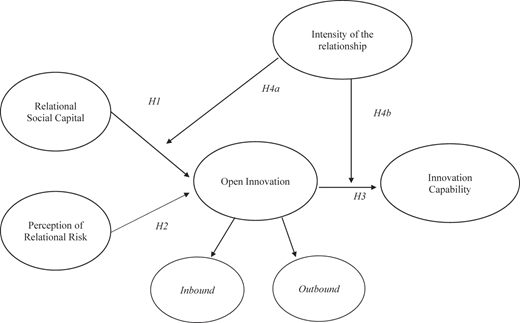
This study examines how relational social capital affects innovation openness. The proposed hypothesis investigates how the relational assets of social capital influence innovation in strategic and dynamic contexts such as open innovation. By complementing studies that primarily address general outcomes, this approach enhances understanding of the factors that foster interorganizational innovative practices. Based on this rationale, we formulate the following hypothesis:
Relational social capital positively influences the openness of innovation.
3.2 Perception of relational risk and innovation openness
Social relationships offer benefits such as value creation but also expose resources and knowledge to risks (Alvarez & Barney, 2001; Brusoni, Prencipe, & Pavitt, 2001; Sedita, Hoffmann, Guarnieri, & Toso Carraro, 2021). The transfer of explicit knowledge between partners is often constrained by fears of information leakage (Long, Li, & You, 2014), even within territorial clusters (Sedita et al., 2021).
Knowledge overflow refers to the intentional appropriation or unintentional transfer of private knowledge to partners beyond the agreed scope (Jiang, Li, Gao, Bao, & Jiang, 2013). As a result, the risk of knowledge leakage becomes a critical factor that hinders information sharing (Martínez-Cañas, Sáez-Martínez, & Ruiz-Palomino, 2012; Ritala, & Hurmelinna-Laukkanen, 2009).
To protect their competitive advantages—especially those linked to innovation—organizations employ intellectual property rights, trademarks, and other safeguards, such as avoiding participation in activities involving sensitive strategic knowledge (Sedita et al., 2021).
Oduro (2020) emphasizes that a significant barrier to adopting open innovation among small and medium-sized enterprises (SMEs) is the opportunistic behavior of their partners. According to the author, collaboration is undermined not only by misaligned goals but also by conflicting strategic preferences. The imbalance of information in interorganizational relationships further increases uncertainties regarding the behavior of agreement partners (Delerue, 2005).
The perception of relational risk, shaped by expectations about a partner’s behavior, is a central factor affecting interorganizational relationships (Zhang & Li, 2014; Yao et al., 2019). Opportunistic behavior introduces uncertainties that reduce the willingness to share knowledge, especially in the absence of intermediary institutions (Bouças da Silva, Hoffmann, & Martínez-Cháfer, 2023; Sedita et al., 2021).
This study examines how the perception of relational risk adversely impacts innovation openness. While existing research suggests that risk complicates knowledge sharing due to opportunistic behavior and information leakage, there is limited understanding of how this perception directly influences decisions to engage in open innovation processes. Based on this gap, we propose the following hypothesis:
The perception of relational risk negatively influences the openness of innovation.
3.3 Innovation openness and innovation capability
The influence of collaborative processes on innovation development has been extensively studied (Bogers & Horst, 2014; Oliveira, Olave, Moreno, & Silva, 2020). Knowledge management has been identified as a fundamental antecedent of innovation capability (Ganguly et al., 2019). Within this context, open innovation expands knowledge bases and provides access to complementary assets, facilitating the creation and development of resources that would otherwise be challenging to mobilize independently (Ortiz, Donate, & Guadamillas, 2018).
Organizations must develop and manage innovation capabilities through learning and strategy, which are key factors in driving innovation (Yeşil & Doğan, 2019). These capabilities are closely linked to internal learning processes (Ortiz et al., 2018).
Open innovation operates through knowledge flows, which are divided into two primary activities: inbound and outbound (Chesbrough, 2006). Emphasizing inbound activities enhances technical learning and exploration, fostering better outcomes in radical innovations. Conversely, focusing on outbound knowledge activities strengthens administrative capabilities, improving incremental performance (Cheng & Shiu, 2015).
Open innovation activities foster trust, collaboration, and learning, resulting in greater efficiency in knowledge management (Lam, Nguyen, Le, & Tran, 2021). Aro and Perez (2021) highlight that organizations develop essential skills to sense, learn, and transform through management routines and processes, which are vital for successful innovation.
This study examines how knowledge flows between organizations enhance internal capabilities. While collaborative processes and knowledge management are widely acknowledged as critical to innovation capability, limited research explores the direct impact of open innovation flows on this capability. Based on this gap, we propose the following hypothesis:
Innovation openness positively influences innovation capability.
3.4 Moderating role of relational intensity
Regular interactions among organizations foster innovation by improving the quality and speed of knowledge sharing (Hsieh & Tidd, 2012). In contexts where trust is indispensable (Bouças da Silva et al., 2023), the development and maintenance of these relationships become essential.
The literature highlights that the intensity, frequency, and scope of relationships in innovation activities directly influence innovative behavior (Greco, Grimaldi, & Cricelli, 2016; Vincenzi & da Cunha, 2021). Stronger relationships with innovation partners enhance the openness of these activities (Lazzarotti, Manzini, Nosella, & Pellegrini, 2016).
Through these interactions, organizations improve their innovation processes by learning from one another, broadening their resource bases, and gaining exclusive access to knowledge (Huang, 2011). The degree of openness—or the strength of external connections—has a positive impact on innovation performance. This suggests that open innovation provides two primary benefits: it enhances innovation performance and serves as a foundation for continuous learning (Capone & Innocenti, 2020; Vincenzi & da Cunha, 2021).
Moreover, stronger relationships foster trust between organizations, enhancing collaboration and, ultimately, boosting innovative performance (Capone & Innocenti, 2020).
Based on these insights, the proposed hypotheses explore the moderating role of relational intensity in the relationships between relational social capital, innovation openness, and innovation capability. By suggesting that relational intensity amplifies these effects, the hypotheses contribute to the understanding of the specific mechanisms that enhance the effectiveness of inter-organizational relationships in driving innovation. Accordingly, we propose the following hypotheses:
Relational intensity moderates the relationship between relational social capital and innovation openness.
Relational intensity moderates the relationship between innovation openness and innovation capability.
All proposed relationships are demonstrated in Figure 1.
4. Method
We adopted a quantitative approach using survey data collection. Covariance-based structural equation modeling (CB-SEM) was employed, as it is well-suited for confirming established theories (Afthanorhan, Awang, & Aimran, 2020; Dash & Paul, 2021). The weighted least squares robust estimator adjusted for mean and variance (WLSMV) was applied, given the ordinal nature of the data.
The study focused on Brazilian companies operating in technology parks associated with the Ministry of Science, Technology, Innovation, and Communications (MCTIC), selected for their role in fostering knowledge sharing and interaction (Correia & Gomes, 2012). In 2018, Brazil had 40 operational technology parks. By reaching out to managers and gathering information from various websites, 600 companies were identified. The questionnaire was distributed via SurveyMonkey® between October 2018 and April 2019, resulting in 198 responses.
Following a preliminary analysis, nine questionnaires were excluded due to inconsistencies, leaving 189 valid responses. The minimum sample size required was calculated as 161, based on a confidence level of 0.05, a statistical power of 0.80, and an effect size of 0.30, as estimated using Soper software (2023). Hair, Matthews, Matthews, and Sarstedt (2017) recommends a sample size of at least 100 for CB-SEM. Therefore, the final sample met the methodological requirements.
Data analyses were conducted using R software (version 1.4.1106) and the lavaan package, chosen for its compatibility and cost-free availability. Table 1 presents the operationalization of the variables, including first-order reflective constructs and a higher-order construct termed Innovation Openness, which was based on previously validated scales. The “Intensity of the Relationship” variable was measured based on respondents’ perceptions of the intensity of their business partnerships.
Constructs and variables
| Construct | Indicators | References |
|---|---|---|
| Relational social capital | CSR1 - Close personal interaction | García-Villaverde et al. (2018), Kale et al. (2000) |
| CSR2 - Mutual respect | ||
| CSR3 - Mutual trust | ||
| CSR4 - Personal friendship | ||
| CSR5 - Reciprocity | ||
| Relational risk perception | PRR1 - Breach of signed contract | Bazyar et al. (2013), Liu et al. (2008) |
| PRR2 - Theft of trade information | ||
| PRR3 - Information fraud | ||
| Knowledge inflow | E1 - Examine the external environment | Cheng and Shiu (2015), Sisodiya, Johnson, and Grégoire (2013) |
| E2 - Engage external partners | ||
| E3 - Acquire intellectual property | ||
| E4 - Use external sources | ||
| Knowledge outflow | S1 - Sell licenses | Cheng and Shiu (2015) |
| S2 - Offer license agreements | ||
| S3 - Strengthen the use of intellectual properties | ||
| S4 - Create companies (spin-offs) | ||
| Innovation capability | CAP1 - Partially modify products/services | Liu, Huang, Dou, and Zhao (2017) |
| CAP2 - Partially modify processes | ||
| CAP3 - Partially modify organizational methods | ||
| CAP4 - Partially modify design | ||
| CAP5 - Completely modify products/services | ||
| CAP6 - Completely modify processes | ||
| CAP7 - Completely modify organizational methods | ||
| CAP8 - Completely modify design | ||
| Relational intensity | INT - Degree of relationship intensity |
Source(s): Survey data. Authors’ own work
The items related to relational social capital, knowledge input and output, and innovation capacity were assessed on a scale from 1 (strongly disagree) to 7 (strongly agree). The perception of relational risk was evaluated on a scale from 1 (low impact) to 7 (high impact), while the intensity of partnerships was measured on a scale from 1 (low intensity) to 10 (high intensity), based on managers’ perceptions.
The data collection instrument underwent content validation and pre-testing. The questionnaire was initially reviewed by five PhD researchers with expertise in innovation, strategy, cooperation networks, and inter-organizational relations. Based on their feedback, improvements were made to the semantics of the questions.
A pre-test was conducted with eight managers from companies located in a technological park in Minas Gerais, with support from the park’s administration. The questionnaire was administered via SurveyMonkey®, accompanied by instructions for respondents to report any doubts or suggestions. After this stage, participants found the questions clear and reported no difficulties in responding.
5. Results
We conducted confirmatory factor analysis (CFA) because the proposed model is based on previously validated scales. During the initial interaction, the model presented issues with reliability and convergent validity in three indicators: CSR4 - Personal friendship, E3 - Acquiring intellectual property, and S2 - Offering license agreements. These indicators were sequentially removed due to factor loadings below 0.50 (Hair, Black, Babin, Anderson, & Tatham, 2009).
After these adjustments, both convergent validity and reliability fell within the recommended thresholds. Convergent validity was evaluated using the average variance extracted (AVE), with all values exceeding 0.50, and through indicator loadings that were significantly different from zero (p < 0.001). Indicators with loadings below 0.70 were retained as long as the AVE exceeded 0.50 (Hair et al., 2009).
The reliability of the variables was assessed using composite reliability (CR). All variables, except for the Inbound variable, had CR values above 0.70. The Inbound variable had a CR of 0.68; however, it met Hair et al.'s recommendations (2009) due to an AVE greater than 0.50 and a Cronbach’s alpha above 0.70. Table 2 presents a summary of the data.
Reliability and convergent validity
| Latent variable | Items | Cronbach’s alpha | Composite reliability (omega) | AVE | Loadings |
|---|---|---|---|---|---|
| Relational social capital | CSR1 | 0.82 | 0.78 | 0.56 | 0.62 |
| CSR2 | 0.85 | ||||
| CSR3 | 0.89 | ||||
| CSR5 | 0.60 | ||||
| Knowledge inflow | E1 | 0.76 | 0.68 | 0.51 | 0.80 |
| E2 | 0.62 | ||||
| E4 | 0.71 | ||||
| Knowledge outflow | S1 | 0.66 | 0.75 | 0.51 | 0.73 |
| S3 | 0.76 | ||||
| S4 | 0.66 | ||||
| Relational risk perception | IMP1 | 0.89 | 0.89 | 0.76 | 0.71 |
| IMP2 | 0.97 | ||||
| IMP3 | 0.91 | ||||
| Innovation capability | CAP1 | 0.89 | 0.87 | 0.53 | 0.61 |
| CAP2 | 0.69 | ||||
| CAP3 | 0.83 | ||||
| CAP4 | 0.57 | ||||
| CAP5 | 0.76 | ||||
| CAP6 | 0.86 | ||||
| CAP7 | 0.86 | ||||
| CAP8 | 0.59 |
Source(s): Survey data. Authors’ own work
To assess discriminant validity, we conducted the Fornell-Larcker test, which confirmed the presence of discriminant validity in the model’s constructs (Table 3).
Discriminant validity
| Relational social capital | Knowledge inflow | Knowledge outflow | Relational risk perception | Innovation capability |
|---|---|---|---|---|
| Relational social capital | 0.751 | |||
| Knowledge inflow | 0.237 | 0.712 | ||
| Knowledge outflow | 0.235 | 0.608 | 0.716 | |
| Relational risk perception | −0.03 | −0.256 | −0.038 | 0.870 |
| Innovation capability | 0.211 | 0.153 | 0.319 | −0.067 |
Source(s): Survey data. Authors’ own work
The final model yielded the following fit indices: χ2 = 337.353, df = 168, CFI = 0.96, and TLI = 0.95. These values are close to the recommended threshold of above 0.95. Additionally, RMSEA = 0.076 and SRMR = 0.079 are both near the reference indicator (of less than 0.08). Together, these indicators suggest a good fit for the model (Hair et al., 2009).
When evaluating the structural model, we considered the significance and relevance of the relationships between the constructs. The test results for the path coefficients are presented in Figure 2.
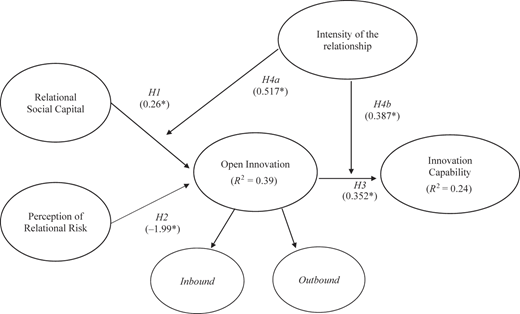
Result of path coefficients. Note: *p-value < 0.05. Source: Authors’ own work
Result of path coefficients. Note: *p-value < 0.05. Source: Authors’ own work
The model demonstrated significant results (p < 0.05) for all proposed relationships. The explanatory power was assessed using the coefficient of determination (R2). The results indicate that 39% of the variation in innovation openness is explained by the CSR and PRR variables. Additionally, 24% of the variation in innovation capability is attributed to open innovation.
It is worth noting that the model focuses exclusively on relational aspects as facilitators of open innovation, which remains a notably complex topic (Lopes & Carvalho, 2018).
6. Discussion
The hypothesis that relational social capital positively influences innovation openness (H1) was confirmed. This finding aligns with previous studies that emphasize the importance of trust, reciprocity, and collaboration in knowledge sharing (Kim & Shim, 2018; Popa, Soto-Acosta, & Martinez-Conesa, 2017). The study reinforces the role of relational assets as fundamental elements in structuring open innovation.
The results indicate that stronger ties enhance the integration of external knowledge and foster collaborative behaviors through collective learning and knowledge sharing (Yayla et al., 2018). Relational social capital plays a critical role in overcoming organizational barriers and reconfiguring internal boundaries (Lappalainen et al., 2023).
Hypothesis H2 confirms that the perception of relational risk negatively impacts innovation openness. This finding is consistent with studies showing that perceived risk reduces the willingness to collaborate and share knowledge (Das & Teng, 2001; Oduro, 2020). A primary contribution of this study is demonstrating that risk perception not only reduces collaboration but also directly affects open innovation flows. Behavioral factors influence decision-making processes, limiting organizations’ willingness to establish knowledge flows with partners (Bouças da Silva et al., 2023; Oduro, 2020; Sedita et al., 2021; Yao et al., 2019).
Although collaboration between organizations provides benefits, such as access to new knowledge, it also presents risks, including potential information leakage and opportunistic behavior from partners (Alvarez & Barney, 2001; Liu, Li, Tao, & Wang, 2008; Long, Li, & You, 2014). When managers encounter behavioral uncertainties and suspect opportunistic behavior, organizational boundaries tend to become more restrictive (Zhang & Qian, 2017).
Hypothesis H3 indicates that engaging external partners and resources in innovation processes enhances the development of organizational skills. This is consistent with the literature, which emphasizes that expanding knowledge bases is a crucial factor in achieving superior results (Ortiz et al., 2018). The findings demonstrate that knowledge flows operate synergistically, aligning internal and external processes while reinforcing the role of organizational learning.
The results suggest that combining complementary resources enables organizations to acquire new skills, broaden their knowledge bases, and enhance their research and development (R&D) processes. Open innovation emerges as a precursor to innovation capability, leveraging the complementary nature of knowledge in innovation processes (Ganguly et al., 2019).
Aro and Perez (2021) underscore that management routines and processes are essential for capturing, learning from, and transforming knowledge, thereby enhancing innovation capacity. This study corroborates their perspective, demonstrating that knowledge flows significantly improve internal aspects, enabling both strategic and operational advancements.
Hypotheses H4a and H4b reveal that relational intensity amplifies the effect of relational social capital on open innovation and innovation capability. In contexts characterized by high relational intensity, these effects are more pronounced, supporting the findings of Capone and Innocenti (2020) and Vincenzi and da Cunha (2021). These results contribute by identifying relational intensity as a moderating factor, emphasizing that the quality of connections is pivotal for maximizing the benefits of open innovation.
In high relational intensity scenarios, organizational boundaries become more flexible. Trust and proximity strengthen social connections, providing a solid foundation for organizational learning (Capone & Innocenti, 2020; Vincenzi & da Cunha, 2021). Partnerships with high relational intensity enhance knowledge flows, facilitating agile learning and driving significant changes in internal processes (Aro & Perez, 2021; Lam et al., 2021).
7. Conclusion
This research aimed to analyze the effects of relational social capital and perceived relational risk on innovation openness, as well as to examine the relationship between innovation openness and innovation capability, considering the moderating role of relational intensity.
The findings confirmed the four hypotheses, demonstrating that strong personal relationships among organizational members facilitate the opening of innovation processes within companies. This process relies on trust, respect, close interaction, and reciprocity, underscoring the critical role of relational social capital in overcoming organizational barriers. However, the perception of relational risk can hinder openness.
Additionally, knowledge flows between companies strengthen internal organizational aspects and foster the development of innovative skills. The quality of personal ties in intense relationships increases the permeability of organizational boundaries, thereby accelerating learning processes the managerial level, the results emphasize the importance of investing in relational capital to promote open innovation practices and develop innovative capabilities. Managers must carefully balance the openness of innovation processes with the perception of relational risks. The findings highlight that the quality and intensity of connections, rather than the sheer number of collaborations, are key to enhancing innovation capacity.
While the results contribute to the understanding of relational aspects in innovation, some limitations should be acknowledged. The cross-sectional design adopted in this study does not capture the dynamics of relationships over time. A longitudinal approach could provide insights into the evolution of relational social capital, the intensification of relationships, and their long-term impact on innovation openness. Future research could adopt such an approach to offer a more comprehensive and dynamic perspective on inter-organizational collaborations.
Finally, the practical and theoretical implications of this study pave the way for further exploration of the role of relational assets in fostering innovative ecosystems. This research enhances the connection between management practices and innovation theories, providing a foundation for more effective strategies in collaborative environments.

