


This study aims to investigate the predictive power of institutional pressures (IP)—including coercive, normative, and mimetic influences—on environmental innovations (EI) within medium and large (M&L) manufacturing firms operating in Uganda.
This quantitative study gathered data through structured surveys from key stakeholders in Uganda's manufacturing sector, involving 208 firms across diverse regions. Utilizing SmartPLS Version 4, Structural Equation Modeling was applied to examine the correlation between IP and EI.
Our analysis reveals the significant influence of IP on EI in Uganda's M&L manufacturing firms. While regulatory mandates theoretically relate to EI, our findings suggest no statistically significant association. Conversely, societal norms and mimetic pressures positively impact EI. Notably, mimetic pressures exhibit the strongest predictive potential, followed closely by normative pressures.
Our findings highlight the significant impact of mimetic and normative pressures on EI in Uganda's industrial sector. Policymakers and business leaders can utilize these pressures to foster industry-wide innovations and align strategies with societal values, complementing coercive pressures for regulatory compliance.
This study provides new insights into how IP drive EI in Uganda's manufacturing sector. By clarifying the roles of coercive, normative, and mimetic pressures, it guides policymakers and business leaders in enhancing environmental initiatives.
1. Introduction
The unrestrained exploitation of natural resources in industrial pursuits has become a major catalyst for environmental decline, exacerbating the rift between economic advancement and ecological preservation (Scheffran, 2025). Additionally, the growing recognition of environmental threats has prompted governments to impose stricter regulations (Zhao, Feng, & Shi, 2018). Simultaneously, increased awareness of environmental degradation by stakeholders accentuates the urgency for corporations to tackle issues like energy conservation and emissions reduction (Doran & Ryan, 2016). Understanding environmental innovation (EI) as a means to revamp production methods and as a strategic necessity for effective pollution and resource management, companies are increasingly aligning their strategies with societal responsibilities (Qiu, Hu, & Wang, 2020). Furthermore, acknowledging the dual facets of EI in addressing environmental challenges (Rennings, 2000) emphasized the need for an institutional framework that actively promotes corporate engagement in EI.
Consequently, recent studies have highlighted the complex factors shaping EIs in Uganda's manufacturing sector. Alinda, Wakibi, Ahimbisibwe, and Andabati (2024c) identify structural capital as the strongest predictor of EIs, followed by human capital, while relational capital lacks statistical significance, suggesting the need for further investigation into inter-firm dynamics. However, this study does not account for the influence of institutional pressure (IP) on EIs, leaving a critical gap in the discourse.
Similarly, Alinda, Tumwine, and Kaawaase (2024a) provide strong evidence that product and process innovations drive sustainability practices. Yet, their framework treats EIs as an independent variable rather than an outcome, emphasizing the need for further exploration of institutional forces in shaping innovation trajectories.
Meanwhile, Wakibi, Alinda, and Ntayi (2025) illuminate the profound impact of institutional logics, organizational resilience, and inter-organizational networks on fostering sustainable innovation within financial institutions. However, given the sector-specific focus, these findings lack broad applicability to the manufacturing landscape. Taken together, these studies expose a fundamental gap in understanding how IPs shape EIs, highlighting the imperative for further research to elucidate the mechanisms through which IPs catalyze sustainability-driven innovation in manufacturing firms.
The relationship between IP and EI has garnered increasing scholarly attention, particularly concerning how environmental regulations influence firm behavior. Empirical studies by Colwell and Joshi (2013), Cai and Zhou (2014), and del Río, Peñasco, and Romero‐Jordán (2015), and Horbach (2016) underscore the catalytic role of regulatory frameworks, which often drive firms to innovate either to comply with environmental standards or to secure competitive advantage. However, Triguero, Moreno-Mondéjar, and Davia (2016) caution that such effects are not universally consistent, as they are shaped by contextual factors including industry type, firm capabilities, and institutional maturity.
Expanding on this foundation, recent scholarship explores the intersection of governance structures, external risk exposure, and institutional environments. For example, Tian and Chen (2025) found that biodiversity risk significantly promotes EI, particularly when reinforced by external monitoring, strong ESG performance, and supportive regulation—though this relationship weakens as technological diversification increases. Similarly, Dwekat, Alia, Abdeljawad, and Meqbel (2025) demonstrate that governance characteristics such as board diversity, independence, and CEO duality positively influence EI across European firms, highlighting the strategic role of corporate leadership in fostering environmental innovation.
Additionally, Forés (2025) investigated the relative effectiveness of R&D-driven, efficiency-oriented, and ambidextrous EI strategies across different institutional and industrial contexts in Spain. His findings indicate that ambidextrous strategies yield the most favorable outcomes in dynamic, environmentally progressive sectors, whereas the success of other approaches depends on regulatory and market stability.
Despite growing interest in EI, much of the literature remains focused on coercive pressures, often overlooking the full scope of institutional influences—particularly normative and mimetic forces (DiMaggio & Powell, 1983). This narrow view limits a holistic understanding of how these distinct dimensions affect eco-innovation, especially in least-developed countries (LDCs) where institutional enforcement is weak. To address this gap, the present study examines how coercive, normative, and mimetic pressures influence the adoption of eco-innovation among manufacturing firms in a resource-constrained setting. Grounded in institutional theory (Scott, 2005), the study builds on prior research affirming its relevance for explaining firms' environmental behavior (Zhu, Cordeiro, & Sarkis, 2013; Chakraborty & Chatterjee, 2017), and aims to enhance both theoretical insights and empirical evidence on the institutional drivers of eco-innovation.
The paper is structured as follows: Section 2 critically reviews existing literature and delineates hypotheses; Section 3 elucidates the research methodology; Section 4 presents empirical results; Section 5 deliberates on the findings; and a concluding section integrates insights, explores implications, and proposes avenues for future research.
2. Literature review and hypothesis development
2.1 Theoretical underpinning
EIs are commonly shaped by IPs (DiMaggio & Powell, 1983; Oliver, 1991). Institutional theory suggests firms adopt environmentally responsible practices not only for efficiency but also to conform to societal norms and gain legitimacy (Meyer & Rowan, 1977; Scott, 2005). Coercive pressures arise from regulatory mandates; in Uganda, agencies like the National Environment Management Authority (NEMA) set environmental standards, though weak enforcement often limits their impact on eco-innovation. Meanwhile, normative pressures, stemming from professional norms, industry expectations, and civil society, increasingly encourage Ugandan firms to adopt EIs even without binding laws. Additionally, mimetic pressures drive firms—especially under uncertainty—to imitate successful or globally affiliated peers, serving both legitimacy and competitive purposes. While institutional theory centers on legitimacy-seeking, critics note it underemphasizes performance outcomes. In developing contexts where financial returns may be uncertain or delayed, firms often adopt EIs to enhance reputation or meet stakeholder expectations (Berrone and Gómez-Mejía, 2009). Research indicates such adoption is frequently motivated more by institutional conformity than direct economic benefits (Delmas, 2002). Therefore, in Uganda's weak regulatory environment, mimetic and normative pressures likely exert greater influence on eco-innovation than coercive mandates.
2.2 The concept of institutional pressures
IP encompass external influences that compel organizations to address specific stimuli, emanating from formal and informal sources, such as organizational dependencies and societal cultural norms (DiMaggio & Powell, 1983; Glover, Champion, & Daniels, 2014; Kursunova, Goodman, & Halme, 2016; Amoako, Lyon, & Tian, 2017). These pressures ensure adherence to prevailing norms (Colwell & Joshi, 2013). DiMaggio and Powell's (1983) triad of coercive, mimetic, and normative pressures highlight fundamental forces promoting uniformity, with Beckert (2010) adding competitive pressures as a fourth facet. However, this study primarily conceptualizes IP based on the triad, recognizing the contextual nuances of environments like Uganda, where competitive pressures are less prevalent.
2.3 The concept of environmental innovations
EI refers to the development of new or significantly improved products, services, processes, organizational changes, or marketing strategies that reduce resource use and limit harmful emissions throughout their lifecycle (Eco-innovation Observatory, 2016). Scholars like Halila and Rundquist (2011) and Ar (2012) highlight its crucial role in promoting environmental sustainability. Although terms such as “green innovation” and “eco-innovation” are often used interchangeably, EI broadly includes organizational practices that deliver environmental benefits, such as energy conservation, pollution reduction, waste recycling, and incorporating eco-friendly principles into product design and packaging to enhance differentiation (Kammerer, 2009; Chen, Sousa, & van Doorn, 2006).
2.4 Institutional pressures and environmental innovations
Studies underscore the critical role of IPs from industry associations, government, and societal expectations in driving eco-innovation (Berrone, Fosfuri, Gelabert, & Gómez-Mejía, 2013; Ahmadi-Gh & Bello-Pintado, 2024; Singh, 2024; Liao, 2018). Institutional support, including financial and technical resources, further facilitates green practices (Marzec, 2020; Meier & Pohl, 2021). Xu, Chin, Liu, and He (2023) highlight the combined influence of coercive, normative, and mimetic pressures on green innovation, while Granger and Turner (2022) emphasize how national regulations and support link macro-level and organizational pressures to enhance eco-innovation. Challenging the traditional view of a trade-off between environmental regulation and competitiveness, Porter and van der Linde (1995) argue that well-designed environmental standards stimulate innovation, boost resource productivity, and benefit both the economy and environment by shifting focus from pollution control to prevention. Accordingly, we hypothesize that:
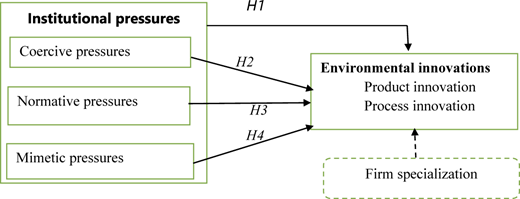
There exists a significant positive relationship between institutional pressures and environmental innovations.
2.4.1 Coercive pressures and environmental innovations
Recent studies suggest that companies facing coercive pressures, such as stringent environmental regulations or public scrutiny, are more likely to adopt eco-innovation (Marzec, 2020; Meier & Pohl, 2021; Habib & Farooq, 2025). These pressures drive firms to innovate solutions that reduce environmental impact (Wang, Yu, & Zhang, 2025). In industries such as automotive, regulations on CO2 emissions spur innovations in engine efficiency and alternative fuels (Hu, Yang, Jiang, Ma, & Cai, 2021). Coercive pressures ensure regulatory compliance, foster competitive advantages, and promote sustainable development, with formal institutions encouraging energy-efficiency innovations, while social pressures drive product energy-efficiency (Garrone, Grilli, & Mrkajic, 2018). Therefore, we hypothesize that:
There is a significant positive relationship between coercive pressures and environmental innovations.
2.4.2 Normative pressures and environmental innovations
Normative pressure, derived from societal norms, consumer expectations, and industry-specific standards, is a key driver of EI (DiMaggio & Powell, 1983). Berrone et al. (2013) and Forés (2025) found that heightened regulatory and normative pressures related to environmental concerns positively influence companies' inclination toward EI. Analyzing environment-related patents across 326 publicly traded firms in pollutant-intensive sectors in the United States, they revealed that IP effectively stimulates such innovation, especially among companies with significant deficiency gaps—those polluting more than industry counterparts. This emphasizes the pivotal role of institutional influences in propelling EI, particularly in industries with pronounced pollution imbalances. Liao and Huang (2025) further support this notion in the Chinese manufacturing industry, emphasizing the importance of regulatory compliance and societal norms in driving environmentally responsible practices. Therefore, we hypothesize that:
There is a significant positive relationship between normative pressures and environmental innovations.
2.4.3 Mimetic pressures and environmental innovations
Mimetic pressure, driven by firms imitating peers amid uncertainty, plays a crucial role in fostering eco-innovation (DiMaggio & Powell, 1983). Empirical evidence shows that firms improve environmental performance by replicating successful competitors (Qi et al., 2021) and that competitive intensity encourages proactive environmental strategies (Phan & Baird, 2015). In global markets, eco-innovation supports market share growth, green branding, and sustained competitiveness (Li, Gu, Liu, & Li, 2019), with SMEs adopting such practices to enhance their competitive position (Cai & Li, 2018; Mady, Halim, Omar, Abdelkareem, & Battour, 2022). However, excessive competition may hinder innovation due to resource limitations and strategic uncertainty (Tyler et al., 2018). Mimetic pressures also correlate with increased process innovation (Cong, Abe, Fujiyama, & Matsumoto, 2025), and the combined effects of coercive, normative, and mimetic pressures significantly influence green procurement and innovation (Acquah, Essel, Baah, Agyabeng-Mensah, & Afum, 2021). Research on Chinese technology firms (Cacciolatti, Zhao, & Lee, 2025) reinforces mimetic pressure as a key driver of eco-innovation, noting that political ties strengthen coercive pressures but diminish mimetic influence, with state-owned enterprises showing greater sensitivity to mimetic pressures. Additionally, emerging technologies like AI and blockchain enhance transparency and resource efficiency.
Similarly, Alinda et al. (2024b) observe that all IPs shape sustainability practices in Uganda's manufacturing sector, though their specific impact on eco-innovation in developing countries remains underexplored. Building on these findings, we hypothesize:
There is a significant positive relationship between mimetic pressures and environmental innovations.
3. Methodology
3.1 Research design, population, and sample
This research utilized a cross-sectional quantitative design to examine patterns and relationships within manufacturing companies. Cross-sectional data collection enabled the analysis of contemporaneous data, enhancing the findings' credibility and applicability. The quantitative approach aimed to quantify data and derive generalizable conclusions from a representative sample of Medium and Large (M&L) manufacturing firms. Focusing on M&L firms in central, eastern, northern, and western Uganda, a sample of 256 firms affiliated with the Uganda Manufacturers' Association was selected from a total of 713 enterprises using Yamane's (1967) method.
The required sample size (n) is determined based on the population size (N) and the acceptable sampling error (e), assuming a 95% confidence level and p = 0.05. The calculation for the sample size in this study is as follows:
This study investigates how IP shape EI among M&L manufacturing firms in Uganda, classified based on Uganda Investment Authority (UIA, 2020) criteria. Using stratified and purposive sampling, 208 firms were selected to capture insights from key personnel involved in EI. Anchored in the Porter Hypothesis—which links strong environmental regulations to innovation and competitiveness (Porter & van der Linde, 1995)—the study examines institutional dynamics within Uganda's resource-constrained, weakly regulated context. While institutional theory explains firms' legitimacy-driven behavior (DiMaggio & Powell, 1983), its application to EI in Sub-Saharan Africa is underexplored. Moreover, prior studies on EI's environmental and operational benefits (Dangelico & Pujari, 2010) have largely centered on developed economies, highlighting a critical gap that this research seeks to fill.
The spatial distribution of the surveyed manufacturing firms indicates a strong regional concentration. As shown in Supplementary_material_Table_1, the majority of firms (90.4%) are located in Uganda's Central region. This clustering is likely attributable to structural advantages such as proximity to major markets, better transport and energy infrastructure, and access to skilled labour, which collectively make the region strategically attractive for manufacturing operations.
3.2 Demographic characteristics
The demographic profile of the respondents is summarized in the Supplementary_material_Table_2. The findings indicate that 57.2% of respondents fall within the 36–45 age category, suggesting a leadership cohort with substantial managerial experience. In terms of educational attainment, 54.6% of respondents hold bachelor's degrees, implying a workforce reasonably equipped to engage with EI initiatives. However, gender disparities persist, with male respondents constituting 60.6% of the sample compared to 39.4% female representation, highlighting the continued need to strengthen gender inclusivity within manufacturing leadership.
Regarding professional experience, most respondents (61.9%) reported between 5 and 10 years of manufacturing experience, reflecting a depth of sectoral knowledge that may enhance awareness of the strategic importance of EI. Human resource managers (30.3%) and operations managers (21.9%) constitute the largest proportion of respondents, indicating that responsibility for EI is embedded within broader managerial functions rather than confined to specialised environmental roles. Environmental managers account for a smaller share (8.8%), suggesting that EI responsibilities are often integrated across organizational structures.
Firm-level characteristics are presented in Supplementary_material_Table_3. The results show that 88.5% of the sampled firms are medium-sized enterprises employing between 51 and 100 workers, consistent with Uganda's national firm classification standards. Similar to the respondent distribution, most firms (90.4%) are located in the Central region, benefiting from infrastructure and market accessibility. The majority of firms have been operational for 5–16 years, indicating moderate organizational maturity that may support the adoption of EI practices. Sectoral representation is dominated by the food and beverage industry, reflecting its environmental intensity and regulatory exposure, followed by textile and footwear manufacturing. In contrast, the relatively limited presence of printing firms suggests an underexplored area for EI adoption.
Uganda's manufacturing sector plays a pivotal role in both economic development and environmental transformation (Uganda Bureau of Statistics, 2021). Within this context, IP may either enable or constrain innovation, rendering the sector particularly suitable for analysis through an institutional theory lens (Alinda et al., 2024b). While prior studies demonstrate that regulatory mandates can stimulate EI (Cai & Zhou, 2014; Horbach, 2016), weak enforcement capacity and regulatory inconsistencies in Uganda may attenuate the effectiveness of coercive pressures. Accordingly, this study examines how different dimensions of IPs influence EI within Uganda's manufacturing sector, offering context-specific insights into institutional dynamics and contributing to sustainability-oriented innovation discourse in developing economies.
3.3 Questionnaire and variable measurement
Data were collected using a self-administered questionnaire comprising closed-ended items rated on a six-point Likert scale, selected to reduce ambiguity and enhance response clarity (Spector, 1992). The instrument was grounded in prior literature, with EI measures adapted from Carrillo-Hermosilla, del Río, and Könnölä (2010) and Cheng and Shiu (2012), and IP conceptualized based on Colwell and Joshi (2013), Martínez-Ferrero and García-Sánchez (2017), and Shi, Liu, Wang and Chiu (2020).
3.4 Control variables
Prior research suggests that firm-specific factors influence EI initiatives (Balasubramanian & Shukla, 2020). Bartov, Gul, and Tsui (2000) highlight the importance of accounting for confounding variables to prevent invalid hypothesis rejection. Aligning with this perspective, this study incorporates firm specialization as a control variable. Figure 1 illustrates the research model analyzing the relationship between IP and EIs.
3.5 Reliability and validity
The study established validity and reliability through expert evaluations and statistical analyses. Content validity was confirmed via the Content Validity Index (CVI), with all scores exceeding the 0.7 threshold (Field, 2009), as reported in Table 1. Academic, policy, and environmental innovation experts assessed item clarity and relevance (Nunnally, 1978). Reliability, measured by Cronbach's alpha, also exceeded 0.7 across constructs, indicating strong internal consistency (Nunnally, 1978). These outcomes, supported by discriminant validity analysis, confirm the instrument's robustness in accurately measuring the intended constructs (Field, 2009).
Reliability, convergent validity, collinearity, and discriminant validity (HTMT) of the research constructs
| Construct | Cronbach's α | Composite Reliability | AVE | CVI | VIF | HTMT CP | HTMT MP | HTMT NP | HTMT PN | HTMT PI |
|---|---|---|---|---|---|---|---|---|---|---|
| Coercive Pressures- CP | 0.885 | 0.887 | 0.685 | 0.778 | 1.930 | – | 0.793 | 0.725 | – | – |
| Mimetic Pressures -MP | 0.858 | 0.860 | 0.638 | 0.909 | 1.942 | 0.793 | – | 0.606 | – | – |
| Normative Pressures-NP | 0.848 | 0.706 | 0.526 | 0.800 | 1.398 | 0.725 | 0.606 | – | – | – |
| Institutional Pressures | 0.864 | 0.818 | 0.616 | 0.833 | 1.757 | – | – | – | – | – |
| Process Innovation-PN | 0.722 | 0.762 | 0.551 | 0.714 | 1.704 | – | – | – | – | 0.649 |
| Product Innovation-PI | 0.887 | 0.892 | 0.529 | 0.857 | 1.565 | – | – | – | 0.649 | – |
| Environmental Innovations | 0.805 | 0.827 | 0.540 | 0.810 | 1.634 | – | – | – | – | – |
Note(s): Cronbach's α ≥ 0.70, composite reliability ≥0.70, and AVE ≥0.50 indicate satisfactory reliability and convergent validity. HTMT values below 0.85 confirm discriminant validity. VIF values below 3.3 indicate the absence of multicollinearity concerns
Table 1 reports the assessment of the measurement model, encompassing internal consistency reliability, convergent validity, collinearity diagnostics, and discriminant validity. Internal consistency is well supported, with Cronbach's alpha and composite reliability values for all constructs exceeding the recommended threshold of 0.70, indicating robust scale reliability. Convergent validity is also established, as all constructs exhibit Average Variance Extracted (AVE) values above the 0.50 benchmark, confirming that the indicators adequately capture their respective latent constructs. In addition, CVI scores surpass the acceptable minimum of 0.70, providing further evidence of adequate content representativeness. Variance Inflation Factor (VIF) values are consistently below the conservative threshold of 3.3, suggesting that multicollinearity does not pose a concern.
Discriminant validity is assessed using the Heterotrait–Monotrait (HTMT) ratio (Henseler, Ringle, & Sarstedt, 2015). All HTMT values fall below the stringent cut-off value of 0.85, thereby confirming the empirical distinctiveness of the constructs. Specifically, the HTMT ratios between Coercive Pressures (CP) and Mimetic Pressures (MP) (0.793), CP and Normative Pressures (NP) (0.725), and MP and NP (0.606) indicate adequate differentiation among the IP dimensions. Similarly, the HTMT ratio between Process Innovation (PN) and Product Innovation (PI) (0.649) supports the discriminant validity of the environmental innovation sub-constructs. Collectively, these results provide strong support for the adequacy of the measurement model, justifying its use in subsequent structural model analyses.
3.6 Data analysis
Data was analyzed using SmartPLS Structural Equation Modeling (SEM) Version 4, selected for its effectiveness in handling small sample sizes and complex models (Hair et al., 2014). Prior to analysis, SPSS Version 23 was used for data cleaning; missing values (<5%) were addressed through linear interpolation, and item entry inconsistencies were resolved using numerical coding. SmartPLS facilitated the assessment of both measurement and structural models, accommodating reflective and formative constructs. Its application is further justified by its robustness with non-normal data and its suitability for exploratory research (Hair et al., 2014; Henseler et al., 2015).
4. Results
4.1 Measurement model assessment
SmartPLS Version 4 was used to evaluate the measurement model due to its flexibility and robustness in handling complex causal models (Kock & Hadaya, 2018). PLS-SEM is well-suited for non-parametric data and varying sample sizes, providing stable parameter estimates and high predictive accuracy, especially when theoretical frameworks are still evolving. Its ability to visually represent relationships among constructs also enhances interpretability and communication of findings.
4.1.1 Exploratory factor analysis (EFA)
EFA was conducted to identify the underlying dimensions of IP and EI and to assess the dimensional validity of the measurement scales. Factor retention was guided by established criteria, including eigenvalues greater than 1, factor loadings exceeding 0.40, and the proportion of variance explained, to ensure robustness and construct clarity.
For IP, the analysis revealed three distinct dimensions—mimetic, coercive, and normative pressures—comprising 15 measurement items that loaded satisfactorily onto their respective constructs. The Kaiser-Meyer-Olkin (KMO) measure of sampling adequacy was 0.910, confirming the suitability of the data for factor analysis. All retained items exhibited factor loadings above 0.50, with eigenvalues of 5.884, 3.616, and 2.021 for the three factors, respectively. Collectively, these dimensions accounted for 64.005% of the total variance, exceeding commonly accepted thresholds and indicating strong explanatory power. These results are consistent with recommended standards for factor structure adequacy and discriminant validity (Field, 2009; Hair et al., 2014).
A separate EFA was performed to examine the dimensional structure of environmental innovations. The results indicate that 14 items loaded effectively onto the EI construct, capturing two distinct but related dimensions: product innovation and process innovation. The KMO value of 0.927 demonstrates excellent sampling adequacy. All retained items exhibited factor loadings above 0.50. The two EI dimensions yielded eigenvalues of 6.854 and 4.005, and together explained 63.880% of the total variance. These findings confirm the conceptual distinction between product and process innovations and support their inclusion within the broader EI construct, in line with established methodological guidelines (Field, 2009; Hair et al., 2014).
4.1.2 Analysis of the measurement model
Following Neumann's (2007) framework, construct validity was assessed through both convergent and discriminant validity. Convergent validity was evaluated using the average variance extracted (AVE), with all constructs exceeding the recommended threshold of 0.50, thereby confirming adequate convergence among measurement items (Henseler et al., 2015). The measurement model specifies the key latent dimensions and their structural relationships, thereby enabling an assessment of the model's explanatory and predictive capacity (Fleacă, Fleacă, Maiduc, & Croitoru, 2023). Model explanatory power was further evaluated using the coefficient of determination (R2), where higher values indicate stronger predictive relevance (Field, 2022).
Hypothesis testing was conducted using path estimates derived from 5,000 bootstrap resamples, ensuring robustness and statistical reliability of the estimates (Wong, Wong, & Liu, 2019). The results indicate that all dimensions of IPs—MP, CP, and NP—exhibited item loadings exceeding the recommended threshold of 0.400, confirming indicator reliability (Hair et al., 2014). Among these, MP demonstrated the strongest explanatory influence on IP (β = 0.449, p < 0.05), followed closely by CP (β = 0.438, p < 0.05), while NP showed a comparatively weaker yet statistically significant effect (β = 0.274, p < 0.05). Collectively, these dimensions explained 99.5% of the variance in IPs, indicating a highly robust measurement structure.
With respect to EI, PI emerged as the most influential dimension (β = 0.703, p < 0.05), suggesting that product-based innovations contribute substantially to the explanation of variance in overall EI. This construct, represented by two indicators, accounted for approximately 99% of the variance in EI, underscoring its central role within the innovation framework.
The model's predictive relevance was further assessed using effect size (f2) estimates. The results demonstrate strong predictive capability, with PN exhibiting a substantial effect size (f2 = 4.625), while product innovation displayed an even higher effect size (f2 = 19.300). These values substantially exceed conventional benchmarks, indicating that both innovation dimensions exert a powerful influence on EI outcomes. Overall, the results confirm the robustness, explanatory strength, and predictive adequacy of the measurement model.
4.2 Structural models
After confirming the reliability and validity of the measurement model, the analysis shifted to the structural model, evaluating relationships between endogenous and exogenous variables and assessing predictive performance. R2 values were examined for predictive power, while the f2 statistic gauged the influence of exogenous variables on endogenous ones, as per Hair et al. (2014) methodology.
4.2.1 Test of hypotheses
Table 2 presents model estimates showing the relationships between IP dimensions and PI (e.g. see Supplementary_material_ Figure_ 1). CP (β = 0.115, p = 0.177) have a non-significant effect on PI. However, MP (β = 0.576, p < 0.05) and NP (β = 0.203, p < 0.05) exhibit strong, statistically significant positive associations with PI, indicating significant contributions to PI, whereas CP shows no significant impact.
Model estimates for IP dimensions and product innovation
| Prediction estimates for product innovations | β | Std. Error | t-statistics | p-value |
|---|---|---|---|---|
| Firm Specialization ▬▬► Product Innovation | 0.020 | 0.037 | 0.546 | 0.585 |
| Coercive Pressure ▬▬► Product Innovation | 0.115 | 0.085 | 1.350 | 0.177 |
| Mimetic ▬▬► Product Innovation | 0.576 | 0.078 | 7.428 | 0.000 |
| Normative ▬▬► Product Innovation | 0.203 | 0.054 | 3.791 | 0.000 |
The effect size and predictive relevance of the model further substantiate the robustness of the findings. Although coercive pressures exhibit a small effect size (f2 = 0.015), the model's overall explanatory power remains substantial, as evidenced by a coefficient of determination (R2) of 0.611 and an adjusted R2 of 0.604. These values indicate that the combined influence of coercive, mimetic, and normative pressures accounts for a significant proportion of the variance in PI, accentuating the model's strong predictive capability despite variation in individual effect sizes.
The structural relationships between IP dimensions and PN were further examined, with the underlying model structure illustrated in Supplementary_material_Figure_2. The results indicate that firm specialization and CP do not exhibit statistically significant associations with product innovation (p > 0.05), suggesting that neither organizational focus nor regulatory enforcement alone is sufficient to stimulate PN.
Table 3 displays model estimates of the relationships between IP dimensions and PN. Firm Specialization and CP lack significance (p > 0.05), indicating no significant associations with PN. Conversely, MP exhibits a significant positive relationship (β = 0.591, p < 0.05), suggesting heightened MP corresponds to increased PN. Similarly, NP shows a significant positive association (β = 0.127, p = 0.038) with PN. These results emphasize the crucial roles of MP and NP in driving PN.
Model estimates for IP dimensions and process innovation
| Prediction estimates for process innovations | β | Std. Error | t-statistics | p-value |
|---|---|---|---|---|
| Firm Specialization ▬▬► Process Innovation | 0.013 | 0.042 | 0.313 | 0.754 |
| Coercive Pressure ▬▬► Process Innovation | 0.100 | 0.111 | 0.900 | 0.368 |
| Mimetic ▬▬► Process Innovation | 0.591 | 0.102 | 5.768 | 0.000 |
| Normative ▬▬► Process Innovation | 0.127 | 0.061 | 2.074 | 0.038 |
The effect size and predictive relevance of the model were further examined to assess the contributions of IP dimensions to PN. CP exhibited a small effect size (f2 = 0.010), indicating only a modest contribution to the variance in PN, which is reflected in an R2 of 0.544 and an adjusted R2 of 0.535. MP, in contrast, displayed a substantial effect size (f2 = 0.390), suggesting that MP is a major determinant of process innovation outcomes. NP demonstrated a small effect size (f2 = 0.023), reflecting a comparatively limited influence on PN. Overall, these results highlight the differential impact of IP dimensions on PN, with MP emerging as the most influential driver within the model.
Table 4 displays model estimates of the relationships between CP, MP, NP, and EI. Firm Specialization and CP lack significance (p > 0.05), indicating inconclusive relationships. In contrast, MP exhibits a highly significant positive association (p < 0.001) with EIs, as does NP (p < 0.001). These results emphasize the substantial roles of MP and NP, while CP has minimal impact.
Model estimates for IP dimensions and EIs
| Prediction estimates for Environmental innovations | β | Std. Error | t-statistics | p-value |
|---|---|---|---|---|
| Firm Specialisation▬▬► EI | 0.010 | 0.035 | 0.295 | 0.768 |
| Coercive Pressure▬▬► EI | 0.120 | 0.091 | 1.312 | 0.189 |
| Mimetic Pressure ▬▬► EI | 0.605 | 0.081 | 7.476 | 0.000 |
| Normative Pressure ▬▬► EI | 0.179 | 0.053 | 3.404 | 0.001 |
The effect sizes and predictive relevance of the model were assessed to examine the contributions of firm specialization and IP dimensions—coercive, mimetic, and normative pressures—to EIs. The results indicate that the model explains a substantial proportion of variance in environmental innovations (R2 = 0.636; adjusted R2 = 0.629), demonstrating strong explanatory and predictive power. Among the predictors, mimetic pressures exert the most pronounced influence on EIs, followed by normative pressures and, to a lesser extent, coercive pressures. These findings underscore the dominant role of competitive imitation and normative expectations in shaping EI outcomes, while suggesting that regulatory pressures play a comparatively weaker role within the studied context.
5. Discussion
This study confirms a positive association between IPs and EI, thereby supporting H1 (Figure 2) and accentuating the central role of institutional forces in shaping corporate environmental behavior (Jiang, Liu, Wu, Lin, & Guo, 2021; Wang et al., 2025). In line with institutional theory (DiMaggio & Powell, 1983), firms respond to regulatory and societal expectations by adopting sustainable strategic initiatives. Regulatory bodies and industry associations influence EI adoption by aligning corporate practices with evolving standards and stakeholder demands (Khan & Badulescu, 2025). These findings echo Bansal and Roth (2000), who emphasize the critical role of external pressures—such as regulation and consumer preferences—in fostering EI.
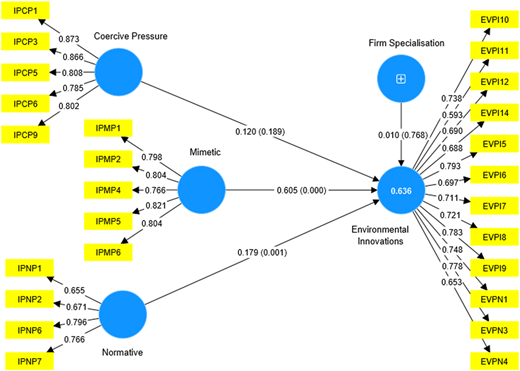
Structural model for IP dimensions and EIs. Source: Author's estimation using SmartPLS version 4
Structural model for IP dimensions and EIs. Source: Author's estimation using SmartPLS version 4
Additionally, the study validates H3, revealing a statistically significant positive relationship between NP and EI. This aligns with prior research demonstrating the role of social norms in encouraging pro-environmental behavior (Chen, Yang, Jin, & Khoo, 2021; Gatersleben, Steg, & Vlek, 2018) and affirms the relevance of societal expectations in shaping firms' sustainability actions (Alinda et al., 2024b). These results suggest that efforts to strengthen normative frameworks—such as public awareness campaigns and stakeholder engagement—may effectively promote EI. Nonetheless, the influence of NP may vary depending on cultural and sector-specific contexts (Feygina, Silver, & Zeckhauser, 2017).
MP also emerged as a strong predictor of EI (H4), supporting prior findings that firms often innovate to remain competitive and align with industry benchmarks (Zhang, Wang, He, & Liu, 2025; Huang, Wang, Chin, Huang, & Cheng, 2022; Xu et al., 2023). In uncertain environments, peer emulation becomes a strategic response, with firms adopting EI to reflect best practices and conform to global sustainability norms.
Conversely, the lack of statistical significance for CP in driving EI challenges traditional assumptions of institutional theory. Despite existing environmental regulations in Uganda, weak enforcement, limited institutional capacity, and inconsistent policy implementation appear to undermine their effectiveness (Alinda et al., 2024b). Firms may thus deprioritize regulatory compliance in favor of market-driven or reputational motivations. This supports literature suggesting that incentive-based approaches—such as subsidies or tax relief—may be more effective than punitive measures in stimulating green innovation.
6. Conclusion, implications, and areas for future research
6.1 Conclusion
This study investigated the influence of IP on EI among M&L manufacturing firms in Uganda. Guided by institutional theory and based on data from 208 firms, the findings reveal that mimetic pressure is the most significant driver of EI adoption. This suggests that firms are more likely to implement EI practices when they observe peers successfully doing so. NP also exhibited a moderate yet statistically significant effect, underscoring the role of societal expectations, professional standards, and stakeholder norms in shaping environmental behavior. In contrast, coercive pressure—typically associated with regulatory mandates—did not significantly predict EI, suggesting potential limitations in enforcement capacity or the credibility of environmental regulations in the Ugandan context.
6.2 Implications
6.2.1 Theoretical contribution
This study advances institutional theory by examining how different types of IP influence EI in a low-income, developing economy. Contrary to traditional emphasis on coercive mechanisms, the findings show that in Uganda's manufacturing sector, mimetic and normative pressures play a more significant role. This accentuates the importance of peer influence, reputational concerns, and professional norms over formal regulations in weakly enforced settings. The study thus extends institutional theory by highlighting its relevance and limitations in African industrial contexts, where informal structures often shape legitimacy-seeking behavior.
6.2.2 Managerial and policy implications
From a managerial standpoint, the findings indicate that Ugandan manufacturing firms should proactively harness mimetic and normative pressures to advance EI. Strategies such as institutionalizing benchmarking practices, participating in green industry networks, and aligning operations with international sustainability standards can enhance competitive positioning. Industry associations and professional bodies play a crucial role in facilitating this by promoting best practices and embedding EI within core business strategies.
For policymakers, the study highlights the urgent need to strengthen Uganda's regulatory architecture and enforcement capacity. While environmental regulations are in place, their limited efficacy points to gaps in institutional capability and consistency. A shift toward more participatory, bottom-up policy approaches—emphasizing peer learning, industry-led emulation, and stakeholder collaboration—can improve outcomes. Integrating these initiatives with Uganda's National Development Plan IV and global commitments, particularly SDGs 9 and 12, would enhance both their policy coherence and developmental impact.
6.3 Limitations and areas for future research
This study acknowledges several limitations. Its cross-sectional design restricts causal inferences, suggesting that longitudinal approaches would better capture the evolving impact of IP on EI. Reliance on self-reported data introduces potential bias, which future studies could address through mixed methods or objective metrics. The exclusive focus on medium and large firms limits generalizability to smaller enterprises, warranting size-disaggregated analyses. Comparative research across African countries is also recommended to assess regional applicability. Lastly, further investigation is needed into how different IPs interact to shape EI adoption.
The supplementary material for this article can be found online.

