
Skip to article sections
Purpose

There is little empirical evidence on how blockchain affordances may encourage consumers to make sustainable choices. Thus, this paper examines how blockchain affordances affect consumers’ sustainable consumption.

Design/methodology/approach

We focus on three blockchain affordances: transparency, traceability, and immutability in this paper. By integrating the affordance lens and theory of consumption values (TCV), we develop a research model wherein we posit that blockchain affordances influence several consumption values, which then affect consumers’ intention to purchase sustainable products. In the study, we designed a scenario and user interface for a novel blockchain-based app for sustainable consumption in the context of the fashion industry and surveyed 295 European consumers to examine the study’s research model. We then analyzed the collected data using the partial least squares technique.

Findings

The results show that blockchain affordances positively affect consumption values, including efficiency, social impression, trust, and sustainability information clarity. In turn, these values influence the consumers’ purchase intention of sustainable products. Additionally, our post hoc analysis shows that these consumption values fully mediate the effect of blockchain affordances on consumers’ purchase intention, where trust and sustainability information clarity is found to have a higher impact.

Originality/value

Empirical research studies focusing on understanding blockchain’s effect on sustainable consumption values have been limited in prior literature. This study, drawing on the affordance lens, proposes distinct blockchain affordances and empirically validates their impact on consumers’ sustainable purchase intention. By integrating TCV, it highlights the mediating mechanism that drives blockchain’s impact on consumers’ purchase intention. We empirically identify the values that mediate the effects of blockchain affordances on consumers’ purchase intention; further, we discuss implications for research and practice based on the study findings.

The global surge in unsustainable consumption carries far-reaching consequences, influencing the environment, economy, and society at large (Bocken and Short, 2021). Therefore, sustainable consumption and production have become a cornerstone of business strategies (White et al., 2019). Several scholars are increasingly focusing on sustainable consumption and broadening its scope to different industrial contexts, such as fast-moving consumer goods, travel, agri-food, and fashion products among others (Chakraborty and Dash, 2022; Dal Mas et al., 2023; Guo and Kim, 2023), which signifies the gravity of sustainable consumption. However, the efficacy of current sustainable consumption practices is hindered by the challenges of information asymmetry across the supply chain (SC) (de Lima et al., 2022) and transparency of production procedures, which are exacerbated by businesses disseminating inaccurate or incomplete information, projecting an ecologically conscious public image (Testa et al., 2020). For example, ambiguous labeling practices, such as using the term “green” to describe packaging and adding logos that declare products to be “100% natural” and “eco-friendly” (Lola, 2022), often fall short of providing enough information to consumers to trace and verify the authenticity of a business’s claim throughout their production practices and SC. This lack of clarity leads consumers to perceive businesses’ sustainability claims as evasive and unclear, which reduces their likelihood of opting for sustainable products (Kahraman and Kazançoğlu, 2019). As a result, businesses are harnessing technological solutions to provide an unparalleled consumer experience and fulfill the demand for transparently sustainable products (Waller et al., 2019).

Several technologies, including radiofrequency identification (RFID), quick response (QR) codes, and the Internet of Things (IoT), are emerging to streamline product traceability throughout the SC and production processes to ensure sustainable production and consumption. Despite the benefits of these technologies, certain downsides are discussed in the prior literature. For example, these types of systems are often centralized, which means that all stakeholders in the SC must rely on a single source of information (Feng et al., 2020; Khan and Salah, 2018). Moreover, the absence of integrated and transparent data sharing and retrieval along the whole SC is a critical flaw in most product traceability technologies (Stefanova and Salampasis, 2019). Information management takes place in silos inside each organization, which leads to low transparency in SC processes and makes it easy to tamper with data. Furthermore, although data sharing is considered a step toward transparency, it poses challenges related to the accuracy and reliability of data, as well as the potential for misuse (Behnke and Janssen, 2020).

To overcome the challenges outlined above, in recent years, blockchain has emerged as a solution to improve product traceability (Behnke and Janssen, 2020), transparency, and information exchange across the SC (Rana et al., 2021). This technology can potentially alleviate consumers' concerns about the reliability of sustainable products that hinder sustainable consumption. For example, blockchain can increase consumers' trust and the likelihood that they will decide to use sustainable products by enabling them to trace product history (Casino et al., 2021). Blockchain’s capabilities to enable traceability, transparency, and immutability all position this approach as offering a way to overcome the challenges of other technologies (Choi et al., 2020), and they are often recognized as blockchain affordances. As such, blockchain affordances can be of great significance when it comes to promoting consumers’ sustainable consumption decision-making and increasing their trust in sustainable products (Liang et al., 2023).

Despite the gravity of sustainable consumption, empirical studies in information systems (IS) linking blockchain affordances and sustainable consumption are limited. Prior literature suggests that individuals’ consumption behavior is affected by various independent consumption values and is a multifaceted process (Lee et al., 2015; Lin and Huang, 2012). These consumption values are developed from an individual’s interaction and experience with a service or product (Lee et al., 2015). However, in the context of a blockchain-based service, how these consumption values may be affected by blockchain affordances is largely unknown. Thus, in an effort to contribute to the nascent but crucial area of research mentioned above, this study poses the following research question (RQ1):

RQ1.

How do blockchain affordances shape consumers’ sustainable product consumption?

To address this RQ1, we build on affordance theory (Jahanbin et al., 2023; Leonardi, 2013) and the theory of consumption value (TCV; Sheth et al., 1991) to develop a research model to examine the effects of blockchain affordances on consumption values, which in turn influence consumers’ purchase intentions. Next, we conducted focus group discussions that helped us to understand consumers’ information needs when purchasing sustainable products. This enabled us to design a scenario and a blockchain-based mobile app user interface (UI), which aided us in conducting a survey to investigate sustainable consumption. We collected data from 295 European consumers and analyzed the causal relationships between our study constructs (i.e. blockchain affordances, consumption values, and purchase intention). Our findings reveal that, by enabling transparency, traceability, and immutability, blockchain can deliver greater trust and confidence in product sustainability promises for consumers, thereby increasing their propensity to purchase sustainable products. This study’s findings make a significant contribution to the IS literature by theorizing and empirically validating the roles of blockchain affordances in promoting consumption values and sustainable consumption behavior.

The remainder of this study is organized as follows: Section 2 begins with a discussion of previous pertinent literature and presents the theoretical background of this study. Section 3 formulates the study hypotheses and integrates them into a theoretical framework that consolidates the impact of blockchain affordances and consumption values. This study conducts a consumer survey, covered in detail in Section 4, followed by the results in Section 5. Section 6 discusses the key findings and study implications for theory and practice. Finally, Section 7 concludes the study by summarizing the main study findings and highlighting future research directions.

Blockchain is a distributed ledger where data are stored and shared among multiple nodes, meaning that multiple users have access to the stored information, and information validation is shared among them. Although blockchain was initially popularized by the rise of bitcoin cryptocurrency, it has a range of other uses beyond cryptocurrencies. Some use cases include voting systems, digital signatures, healthcare, and supply chain management (SCM) (de Lima et al., 2022; Erol et al., 2023; Huang et al., 2021). Blockchain has been considered a crucial link between SCM and sustainability to ensure protection for the consumer market (Mukherjee et al., 2021; Nygaard and Silkoset, 2023). For example, Aura Blockchain allows consumers to trace a product’s history from production to sale and verify the authenticity of luxury items such as Cartier and Prada (Nygaard and Silkoset, 2023). Prior scholars have also recognized that blockchain can enhance the reliability and accuracy of information exchange among stakeholders in a network (Jahanbin et al., 2023; Kshetri, 2017). As a result, it may address consumers’ concerns related to the sourcing and distribution of sustainable products by specifying sustainability metrics and making them verifiable (Wang et al., 2018).

This study aims to investigate how blockchain affordances support consumers’ sustainable product consumption by influencing their consumption values; thus, we reviewed prior literature studies focusing on blockchain and consumers’ purchase decision-making, as summarized in Table 1. Recent findings suggest that blockchain may influence trust and result in impulse buying owing to the increased perceived transparency of environmental information (Liu et al., 2023). Similarly, consumers tend to prefer products that are transparent and traceable as evidenced (Cozzio et al., 2023). Few prior studies have also revealed the counterintuitive results regarding blockchain’s impact on consumers’ purchase intentions. For example, while blockchain transparency and traceability have been found to enhance consumers’ confidence and their purchase intention (Liu et al., 2023; Zhu et al., 2024), consumers are more willing to pay for paper-based ecolabeling certification as compared to blockchain-based digital certification (Bigerna et al., 2021).

Our literature review has identified significant gaps. First, while previous scholars have offered insights into the impact of blockchain traceability on consumer behavior (e.g. Cozzio et al., 2023), there is a lack of research conceptualizing how multiple blockchain affordances evoke sustainable consumption behavior. Second, while prior studies have recognized consumption values as an integral aspect of sustainable consumption behavior (Gonçalves et al., 2016), limited attention has been paid to the impact of blockchain on these values when exploring consumer behavior (e.g. Dionysis et al., 2022; Nygaard and Silkoset, 2023). To systematically cover these gaps, our study conceptualizes blockchain affordances and develops and tests a contextualized model of blockchain affordances and consumers' sustainable consumption behavior (see Figure 1).

The concept of affordance, originally coined by Gibson (1977), is defined as the possible action that is closely related to the relationship between an agent and its environment. In IS literature, Volkoff and Strong (2013) explain affordance as a potential behavior achieving a direct outcome, which can arise from the connection between an artifact and a goal-oriented actor or actors. It is well established that affordances play a vital role in understanding the relationship between technology and users (Tang and Zhang, 2020). Moreover, an object can have an unbounded affordance set because affordances depend on the perceiving actor and their goals. Thus, affordances neither belong solely to the user nor the technology; however, they emerge from the interplay between the technology’s capability and the user’s goals (i.e. possible actions) (Majchrzak et al., 2013). Prior scholars have used affordance theory in diverse contexts, including mobile applications, social media, and consumer decision-making, among others (Gholizadeh et al., 2022; Wang et al., 2022; Sun et al., 2023).

In the context of blockchain, establishing transparency, traceability, and immutability in SC operations has been discussed in prior literature (Jahanbin et al., 2023; Shin and Hwang, 2020). Therefore, drawing upon affordance theory (Gibson, 1977) and based on IS literature on affordances (Volkoff and Strong, 2017), we consider transparency, traceability, and immutability as affordances. Establishing transparency, traceability, and immutability implies that users may seamlessly access real-time product information, trace the product’s origin throughout the SC, and ensure the truthfulness of data records, respectively. These three affordances are chosen due to their given significance in sustainability and consumer decision-making literature as explained below (e.g. Nygaard and Silkoset, 2023; Cozzio et al., 2023).

First, blockchain affords all the transactions among the parties to be visible to the users in the network. Thus, establishing transparency is realized from the visibility of interactions and transactions (Goertzel et al., 2017). When transparency is established, it satisfies consumers’ increasing need for reliable information by offering transparent records of production processes. Due to this transparency, stakeholders, including consumers, can ensure product quality without going through an intermediary (Tessitore et al., 2022). As a result, consumers are better equipped to decide on products with confirmed sustainability and make environmentally conscious decisions.

Second, establishing traceability is realized when users trace a product’s origin and follow its path across its entire transformation and distribution chain (Shin, 2019). With this traceability, consumers can determine a product’s sustainability and details, such as product originality, manufacturing location, components, and distribution location (Sodhi and Tang, 2019). Rainero and Modarelli (2021) suggested that traceability is critical for sustainable consumption and requires certainty about the sustainable source of the product and its production process. We argue that transparency and traceability, while related, are distinct constructs that play different roles in enhancing consumption values. Transparency, when realized, is about making all relevant information open and accessible, fostering a culture of openness. Traceability, on the other hand, is about the ability to follow and verify the path of products, ensuring accuracy and accountability in specific processes. Prior scholars have also established traceability and transparency as separate constructs in blockchain literature (see Centobelli et al., 2022).

Third, since the information in a blockchain cannot be altered or manipulated (Ølnes et al., 2017), it allows consumers to access genuine information. This immutability indicates that information cannot be changed or withdrawn from a blockchain after it has been recorded and ensures information integrity (Liu et al., 2021; Politou et al., 2019). Consumers in today’s market are more informed and circumspect than they were previously, and immutability reinforces their confidence in the quality of information, enabling them to verify product information.

TCV serves as a comprehensive framework that integrates components from different consumer behavior models and presumes that consumer choices stem from diverse consumption values. This theory, proposed by Sheth et al. (1991), is predicated on three requisite claims: first, consumer choice is influenced by a wide array of consumption values; second, several consumption values (e.g. functional, social, emotional, conditional, and epistemic value) influence several facets of a given decision situation; and third, each consumption value operates independently. These values operate as underlying considerations that affect consumer decisions about whether to purchase a product. TCV has been widely utilized to comprehend a variety of consumer choices in the digital and sustainability arenas, including user behavior related to freemium services (Mäntymäki et al., 2020), use intentions in the context of wearable health technologies (Talukder et al., 2021), green product buying behavior (Gonçalves et al., 2016), and use of over-the-top platforms (e.g. Netflix; Talwar et al., 2024).

TCV offers a framework for context-specific theorizing instead of a predetermined set of constructs and factors (Davison and Martinsons, 2016). Sheth et al. (1991) identified five values (i.e. functional, social, emotional, conditional, and epistemic value) that drive decision-making behavior. Next, we describe the context-specific theorizing of TCV in our study.

Functional value is “the perceived utility acquired from an alternative’s capacity for physical, utilitarian, or functional performance” (Sheth et al., 1991, p. 160). Reliability, ease of use, price and dependability are some elements that affect a product’s functional value (Mohd Suki, 2016). It is logical to anticipate that consumers would be satisfied, loyal, and demand a product when they perceive it to have a better functional quality (a sustainable product in this study context). Thus, consumer choice is believed to be significantly influenced by functional value (Creusen and Schoormans, 2005). Functional value has been comprehensively examined in the prior literature in terms of numerous subdimensions. For instance, scholars have explored the subdimensions of perceived benefits, convenience, attributes, needs, price, acquisition, quality, and efficiency (Peng et al., 2014; Ruangkanjanases and Wutthisith, 2018; Wu et al., 2017; Yang and Lin, 2017). We consider efficiency as a functional value in this study as consumers prefer easy, quick, and efficient decision-making (Eberhart and Naderer, 2017). In particular, they may prefer the ability to assess whether a product is sustainable through systems that present authentic information for quick decision-making. Consequently, the value of efficiency is important when it comes to decision-making in the context of sustainable consumption. This is consistent with other prior studies on TCV that have acknowledged the importance of functional value in influencing consumer behavior and decision-making (e.g. Omigie et al., 2017; Peng et al., 2014).

Social value is defined as “the perceived utility acquired from an alternative’s association with one or more specific social groups” (Sheth et al., 1991, p. 161). In this study’s context, social impression is the essence of social value; in addition to contributing to environmental protection, consumers may try to project a social impression to others by choosing sustainable products. This illustrates the connection between a consumer’s perception of the product and an image of a consumer consuming it (Sánchez et al., 2006). This relates to improving self-image and acceptance, which ultimately affect sustainable behavior (Finch, 2006; Sweeney and Soutar, 2001). In the prior literature, a number of social values have been investigated as subdimensions, including social interactions and social enhancement (Kaur et al., 2018), the maintenance of social relationships (Yang and Lin, 2017), and the need for social recognition (Biswas and Roy, 2015). In the context of sustainable consumption, individuals may enhance their self-image and seek social approval by adopting sustainable behaviors driven by a desire to make a positive impression on others (Biswas and Roy, 2015). Consequently, we employ the concept of social impression, representing social value in this study.

Emotional value, as conceptualized by Sheth et al. (1991, p. 161), is “the perceived utility acquired from an alternative’s capacity to arouse feelings or affective states”. Emotional value has been examined under different alternative titles, such as aesthetic value (Omigie et al., 2017) and hedonic value (Shen et al., 2013). As the context of our study is blockchain, which promotes trust by design, we recognize trust as a requisite subdimension of emotional value. Interestingly, few scholars have noted the viability of the emotional dimension of trust in IS (Benbasat and Zmud, 2003; Komiak and Benbasat, 2004). This emotional dimension of trust is described as emotional security, such as having faith, an affirmative effect for a trustee, or experiencing a sense of comfort and security when relying on a trustee (Lewis and Weigert, 2012; Xiao and Benbasat, 2003). When this trust is betrayed, it leads to emotional pain of guilt and intense resentment toward betrayers (Lewis and Weigert, 2012). In this vein, it can be argued that emotional values, such as confidence, comfort, and security, are tied to consumers’ trust sentiments, underscoring the emotional impact on their decision-making (Lease et al., 2014). For instance, if consumers are given false information, they could feel betrayed and develop sentiments of distrust (Utz et al., 2023). Beyond this, Awuni and Du (2016) considered emotional value to be a collection of feelings linked to buying certain products.

Conditional value is “the perceived utility acquired by an alternative as the result of the specific situation or set of circumstances facing the choice maker” (Sheth et al., 1991, p. 162). Holbrook (1994) has asserted that conditional value depends on the particular situation in which a value judgment is made. Given situations of ambiguous labeling practices, such as using the terms “green”, “100% natural”, “eco-friendly”, and so on (Lola, 2022), blockchain-based platforms may play a significant role in giving consumers access to comprehensive information to determine product sustainability. Therefore, we view sustainability information clarity as a fundamental sub-dimension of conditional value.

Epistemic value is “the perceived utility acquired from an alternative’s capacity to arouse curiosity, provide novelty, and/or satisfy a desire for knowledge” (Sheth et al., 1991). However, in this study’s context, epistemic value may not be relevant for at least three reasons. First, as Sheth et al. (1991) specified, epistemic value offers novelty and is particularly important for those customers who are interested in novel experiences. Such value is especially relevant to experiential services, for example, holidays, shopping trips, and adventures (Sheth et al., 1991), and apparently less important in the case of the purchase of sustainable products (Sweeney and Soutar, 2001). Second, a blockchain-based platform is inherently a knowledge or information platform, enabling traceable and transparent information sharing (Centobelli et al., 2022). Hence, using blockchain aligns with consumers’ desire for knowledge that has an implied epistemic value. Finally, for conditional value (described above), we have considered situations where sustainability information clarity varies. The presence of sustainability information clarity may increase consumers’ curiosity to learn more, which is also consistent with epistemic value. Taken together, the epistemic value was deemed less critical either because it is less relevant in our study context or could be captured using other values.

Consequently, we tailored TCV to encompass functional, social, emotional, and conditional values, making it well-suited to our research (Figure 1). The adopted constructs and their definitions are summarized in Table 2.

The affordances of an object encourage people to act in a goal-oriented manner, perhaps as a result of what they perceive when they look at it (Leonardi, 2011). Blockchain enables consumers to efficiently trace and access trustworthy information about products from their origin to the end of life (Cozzio et al., 2023). While a variety of digital apps provide information about products, the unique affordances of blockchain, such as its capacity to afford transparency and traceability throughout the product life cycle, make it easier for consumers to make decisions quickly (Esmaeilian et al., 2020). These findings imply that blockchain affordances (i.e. transparency, traceability, and immutability) may influence the efficiency-based functional value consumers ascribe to sustainable products during their decision-making process. Transparency may lead to higher efficiency due to reduced information asymmetry and faster decision-making (Ying et al., 2023). Traceability can positively impact efficiency because when consumers can trace products accurately, it reduces the time and effort required to track down issues, leading to a perception of a more efficient and reliable SC, and ensures product authenticity (Vazquez Melendez et al., 2024). Finally, immutability may enhance efficiency by preventing fraud, and simplifying the verification process (Asante et al., 2021). Considering these issues, we anticipate that blockchain affordances improve consumers’ efficiency value and hypothesize the following.

H1.

Blockchain affordances positively impact efficiency.

Jung and Lee (2006) suggested that individuals have a tendency to evaluate others based on how they present themselves. This implies that, in the context of sustainable consumption, using authentic and sustainable products conveys information about one’s image to others. In order to maintain a positive impression, consumers rely on trustworthy and verifiable information sources (Chen et al., 2022) to prove the sustainability claims of their purchases. Blockchain may help organizations communicate trustworthy information about their corporate image to external audiences (Boukis, 2020). For example, when organizations are transparent about their processes, sourcing, and sustainability efforts, it enhances their reputation as socially responsible entities. Furthermore, traceability can increase an organization’s image by providing proof of ethical sourcing, fair labor practices, and environmental responsibility. These in turn allow consumers to have the information they need to communicate their own image by supporting an organization’s sustainable efforts. By enabling consumers to trace a product’s history and validate sustainability claims boosts their confidence in illustrating their sustainable image. Similarly, blockchain yields consumers the assurance that unaltered sustainable information makes an organization’s sustainable claims accountable and adds to a positive consumer image when using sustainable products. In this context, blockchain enables consumers to access and trace sustainable product information and empowers them in their quest for sustainable consumption by enabling them to make a good impression on others. Therefore, it can be argued that blockchain affordances will improve the perception of consumers’ social image.

H2.

Blockchain affordances positively impact social impression.

Blockchain’s transparency may positively impacts trust as it demonstrates the organization’s commitment to honesty and openness. Thus, consumers who trust a product’s environmental impact are more likely to continue using that product from an organization that utilizes blockchain to track and trace (Watson et al., 2010). For example, a consumer may readily assess product sustainability on a blockchain-based platform by tracing and viewing the tamperproof information related to the origin of the product, its processing, and environmental performance. The immutable information assures consumers that the records of claims regarding sustainable products are unalterable, which reinforces trust. These imply that consumers' ability, enabled by blockchain, to access and verify the information conveys the reliability of sustainable products. Consequently, consumers’ trust in product sustainability will be higher in the case of blockchain-based information (Ying et al., 2023) as compared to inadequate information available from other sources (Azzi et al., 2019). Against this backdrop, we anticipate that blockchain would provide a higher degree of perceived trustworthiness of sustainable products and lead to a stronger intention to engage in sustainable consumption.

H3.

Blockchain affordances positively impact trust.

Conditional value, as defined above, refers to products whose value is closely associated with their usage in specific situations (Holbrook, 1994). Most digital apps may provide information on products, such as price, customization, and other basic product details that are necessary, but they may lack authentic information regarding product sustainability. In contrast, blockchain-based apps can provide comprehensive and transparent information regarding a product’s sustainability. Thus, consumers can easily access and verify the details, leading to a clearer understanding of the product’s sustainability credentials. On the other hand, when consumers can trace the origin and journey of a product, it provides a clear and detailed picture of the sustainability efforts, reducing ambiguity and enhancing understanding. Zhu et al. (2024) suggest that consumers are likely to be inclined to purchase and consume sustainable products for which authentic, transparent, and traceable information is available. Thus, we contend that, given their affordances, blockchain-based apps provide consumers with sustainability information clarity to make decisions about sustainable consumption as compared to the situation of sustainability information ambiguity in traditional apps. Therefore, we hypothesize the following.

H4.

Blockchain affordances positively impact sustainability information clarity.

The value of efficiency, which is concerned with the time and effort required to make a decision, is crucial for consumer choices (Mathwick et al., 2002). Consumers can make decisions efficiently if they can determine product sustainability based on the available information in an efficient manner. Prior findings revealed that consumers’ perceptions of values in the face of a time-consuming task are heavily influenced by time saving and transactional efficiency (Peng et al., 2014). Blockchain expedites information gathering regarding sustainable production, requiring less time and effort for consumers to consciously make decisions. Prior scholars have recognized positive relationships between efficiency and consumption behavior in different contexts (Fuchs and Lorek, 2005; Lukman et al., 2016). Therefore, we anticipate that consumers will have a greater intention to purchase sustainable products because they have a higher perception of efficiency using blockchain-based apps. Accordingly, we propose the following hypothesis:

H5.

Efficiency value positively impacts consumers’ purchase intention.

TCV asserts that consumers’ decisions extend beyond functional performance and include the social impression that they project through their choices. Status seeking and developing a positive consumer image are recognized drivers influencing consumer choice (O'Cass and Siahtiri, 2013; Wu and Li, 2018). For sustainable consumption, consumer decisions are progressively shaped by the quest for and creation of a positive social impression through individual consumption practices. Biswas and Roy (2015) found that the desire for social recognition has a considerable influence on the consumption behavior of the consumer segment that favors green-certified products (i.e. sustainable products). Dagher and Itani (2014) suggested that individuals can socially communicate their self-image as environmentally concerned individuals to others by purchasing and consuming sustainable products. These findings lead to the evolving nature of consumer decisions, which seem to be increasingly influenced by the aspiration to make a positive social impression. Thus, we hypothesize the following:

H6.

Social impression positively impacts consumers’ purchase intention.

Consumers who have a feeling of trust in a product may significantly develop their purchase intention, which in turn influences their behavior (Harris and Goode, 2010). When consumers trust the source of information, they develop positive emotions about buying a certain product (Lease et al., 2014). Such positive feelings significantly influence the intention to engage in sustainable behavior, including buying organic products (Laroche et al., 2001). Using blockchain-based apps, consumers can obtain authentic product information, building up their trust in sustainable products. Consequently, consumers’ intention to buy and consume sustainable products is more likely to be greater. Thus, we hypothesize that there is a relationship between trust and consumers’ purchase intention:

H7.

Trust positively impacts consumers’ purchase intention.

Purchases are often made in response to specific situations, and conditional factors can affect buying behavior (Samson and Voyer, 2014). For instance, information about global warming and environmental danger can influence consumers’ preferences and behavior around green products (Lin and Huang, 2012). Hence, it follows that the conditional value depends on the perceived desire for verified information regarding the situational factors influencing sustainable consumption. Situational factors include the environment around individuals, information availability in our setting, and how individuals respond to such an environment to satisfy their requirements (Nicholls et al., 1996). When situational factors change, consumers’ buying behavior may be affected (Laaksonen, 1993). Thus, we anticipate that consumers’ intention to purchase sustainable products is influenced by the situation of availability or nonavailability of clear sustainability information. As a result, we hypothesize the following:

H8.

Sustainability information clarity positively impacts consumers’ purchase intention.

Connecting the proposed hypotheses, we developed the theoretical research model shown in Figure 1.

The clothing fashion industry is the research backdrop for our study. This industry has to confront major sustainability concerns in terms of its contribution to greenhouse gas (GHG) emissions and the substantial waste created. For instance, Forb’s study (2018) reported that the garment sector generates wastage of 92 million tons; most of this waste is dumped in landfills or incinerated (Bird, 2018). In 2018, the sector produced about 4% of the world’s GHG emissions, at nearly 2.1 billion metric tons (Berg et al., 2020). Berg et al. (2020) further stated that, despite efforts to reduce emissions, by 2030, this sector’s GHG emissions must be reduced to 1.1 billion tons of CO2 equivalent. Consumers are also becoming curious about the origins of clothing; thus, companies such as Everlane and Patagonia are placing their brands according to the sustainability dimension and adopting a transparent SC (Jain et al., 2022; Lloret, 2016; Radocchia, 2018). According to a recent study, fast fashion consumption among millennials is declining since they believe that fast fashion brands contribute to waste, are ecologically unfriendly, and fail to adhere to ethical norms (Niinimäki et al., 2020). Blockchain has the capacity to deal with such concerns. For instance, the adoption of a resale verification system based on blockchain technology in the secondhand clothing sector would reassure buyers that they will receive true value without the risk of fake and defective items (Jain et al., 2022). These points make it pertinent to examine the context of the fashion industry to investigate and analyze the research framework of this study.

We designed a scenario and UI of a blockchain-based app for sustainable consumption in the context of the fashion industry, along with the survey research approach, to examine the study’s research model. The scenario and the UIs helped the respondents understand the context of the study. While scenario-based experiments are frequently preferred because of their capacity to offer a high level of validity through the controlled manipulation of variables (Bitner, 1990), our focus was on understanding consumers’ reactions to a hypothetical situation rather than carrying out a conventional experimental manipulation.

To understand consumers’ information needs for sustainable consumption behavior in the fashion industry context and design UIs with relevant information, we conducted two targeted focus group discussions with seven participants in total, including the moderator. The first focus group included three participants: two females and one male; the second included four participants: one female and three males. Focus group discussions are strongly emphasized when it comes to comprehending users’ needs and creating scenarios (Le Rouge and Niederman, 2006; Wang and Strong, 1996). Moreover, a focus group provides a way to obtain feedback from stakeholders (i.e. consumers) through collaborative discussion instead of relying on negotiation or consensus (Morgan, 1997). To meet our study goals, the participants were required to have knowledge of sustainability, experience in buying sustainable products at least once, and basic know-how related to blockchain technology. A minimum of one participant with a working knowledge of sustainability and blockchain technology was selected from each group. To present a broader understanding, the focus groups were composed of both genders; as mentioned above, four males and three females were included.

The focus group discussions were held in April 2023 and lasted for 60–90 min each. The topics included the following:

  • (1)

    As a clothing buyer, what information would you like to see when purchasing a sustainable product?

  • (2)

    What information do you believe is relevant for you as a consumer considering sustainable manufacturing when purchasing clothes?

  • (3)

    How should the information be presented on the UI to best meet the needs of consumers?

We were able to capture different viewpoints and subtle concerns through these discussions.

During the discussions, the moderator asked follow-up questions as prompts to learn more about participants’ opinions (Le Rouge and Niederman, 2006). Detailed notes were taken throughout the discussion to ensure the accurate portrayal of these opinions. Subsequently, using the knowledge obtained, we built a scenario and UI that mirrored the main factors and themes raised during the discussion.

After developing the scenario and UI ( Appendix 1), we planned meetings with the same groups to validate that the ideas we captured matched the participants’ viewpoints. We presented the scenario to the participants and asked for their comments and suggestions. We revised the scenarios and UIs based on the feedback received. In this way, we could tap into the collective intellect of the participants, which helped us capture various viewpoints and unearth subtle concerns. This is consistent with the conclusions of Boudreau and Robey (2005), who stressed the need to consider many viewpoints when creating more thorough scenarios and research instruments.

To measure blockchain affordances, we adapted four items for transparency (Fang et al., 2021), five items for traceability (Leung et al., 2023), and three items for immutability based on prior survey studies (Kim and Shin, 2019; Shoaib et al., 2020). The measurement items for other study constructs were also adapted from the existing validated scales, including four items on efficiency (Jarupathirun and Zahedi, 2007), four items on social impression (Sweeney and Soutar, 2001), four items on trust (Komiak and Benbasat, 2006), four items on sustainability information clarity (Filieri et al., 2018), and five items on consumers’ purchase intention (Everard and Galletta, 2005,  Appendix 2).

After the questionnaire was drafted, card sorting was employed to ensure that the instrument reliably measures the intended constructs (Moore and Benbasat, 1991). Ten master’s and PhD students who are familiar with purchasing sustainable products participated in the card-sorting exercise as judges. They were presented with the instrument items and were asked to sort them into categories based on their similarity. Two dimensions—transparency and sustainable information clarity—showed some overlap as some of the judges placed items from these dimensions into the same category. The wordings of these items were revised based on the inputs received from the judges. Furthermore, the judges helped us to make minor corrections in the items’ phrasing to ensure survey clarity. The items were measured on a five-point Likert scale, with the lowest score of 1 indicating “strongly disagree” and the highest score of 5 indicating “strongly agree”. At the time of data collection, the survey included a screening question to evaluate whether the respondents knew about the concept of sustainability.

We used the online Academic Prolific platform to recruit the study respondents, who were compensated for participation. The utilization of an online platform for our study was deemed appropriate since respondents tend to represent general consumers. We adopted different measures to ensure response integrity. First, to overcome some of the constraints identified by Peer et al. (2014), we included attention check items to weed out respondents who were not fully attentive to all the questions. Second, we added screening questions at the start of the survey to guarantee the inclusion of desired respondents and exclude the rest. Third, we used reverse-coded items to make it challenging for the respondents to fake their responses, ensuring that respondents answered the questions truthfully. All these measures guaranteed the appropriateness of survey responses and elicited high-quality feedback.

We specified a sample from the European region. Most respondents were from Poland, Italy, Portugal, and Germany. The survey was accessed by 387 participants; however, 324 responded. Of the responses, 23 were returned as incomplete or unsubmitted. We further examined the remaining dataset and excluded six responses that failed the attention checks and did not meet the screening criteria. Consequently, we had 295 valid responses. The chosen sample varied in terms of gender, age, education, and income. The descriptive analysis shows that 178 respondents identified as men (60.3%), 115 as women (39%), and 2 as other genders (0.7%). Most responses (55.6%) came from people in the age bracket of 21–30 years; the minimum age was 20 years, and the maximum was 50 years. The respondents had a minimum monthly income of 1,000 USD and a maximum of 7,500 USD. Moreover, cumulatively, 70.5% of respondents had completed college and bachelor’s degrees. These demographics show the diversity of the respondents. Table 3 presents the detailed demographic profiles of the respondents.

We implemented multiple metrics to address common method bias (CMB), adhering to the procedural guidelines provided by Podsakoff et al. (2003) and Jordan and Troth (2020) to mitigate the issues with self-reported data. First, we included reverse-coded items, which can reduce CMB and force respondents to concentrate on the questions being asked. Second, after collecting data, the risk of CMB was also investigated statistically, adhering to the statistical remedy suggested by Podsakoff et al. (2003). Harman’s single factor test is the most widely used CMB test (Harman, 1976). We carried out this test in SPSS using the principal component analysis approach. We observed that no single factor explained the majority of the variance. Third, we conducted a common method factor test (Liang et al., 2007) and observed that the method variance was small compared with the substantive variance. The ratio of substantive variance to method variance was 96:1, which indicates that CMB was not a concern in the data.

We employed partial least squares structural equation modeling (PLS-SEM) to analyze the empirical data. PLS-SEM has been widely used in research disciplines, such as those on online social behavior (James et al., 2017), information systems (Neufeld et al., 2007; Venkatesh et al., 2013), operations management (Peng and Lai, 2012), organizational research (Rönkkö and Evermann, 2013), and strategic management (Sarstedt et al., 2014). This approach offers many advantages in several situations, including in cases of a small sample size, formative measurements, complex models, and data that do not show normal distribution (Hair et al., 2021). In addition, PLS-SEM enables the estimation of a structural model and the simultaneous testing of a measurement model (Sharma et al., 2022). Using SmartPLS version 4, we analyzed the research model via a two-step approach, as described in the next section.

A two-stage hierarchical component model analysis is most appropriate for second order reflective–formative models. We employed a two-stage analysis because the blockchain affordance dimensions were reflective and the overall blockchain affordance construct was formative. In stage one, we determined the scores of the latent variables for the lower-order constructs of transparency, traceability, and immutability. Then, in the second stage, latent variable scores for the lower-order constructs from stage one were used to model the higher-order construct—namely, blockchain affordances (Matthews et al., 2018).

Prior to conducting the hypothesis test, we assessed the construct measures’ validity and reliability. We evaluated the loading of each indicator to its corresponding underlying construct to ensure the reliability of the indicators. The loadings must be 0.70 or higher (Chin, 1998). We ensured that all the loadings for our reflective constructs were higher than this threshold (see Table 4). One item did not pass this criterion and thus was removed. Afterward, we calculated Cronbach’s alpha (CA) and composite reliability (CR) for each construct and found the values were above the cutoff of 0.7 (Fornell and Larcker, 1981). Next, we made sure that the AVE values were above 0.5. Altogether, these test results show that a sufficient level of convergent validity has been achieved.

Next, to ensure the discriminant validity, we compared the square roots of AVE values to the correlations among constructs (Fornell and Larcker, 1981). As shown in Table 5, the square roots of AVE values were higher than the correlations, suggesting that discriminant validity is confirmed. Moreover, discriminant validity based on the HTMT ratio was also established (see Table 6) according to the criterion (threshold of 0.90) set by Henseler et al. (2015).

Next, we analyzed how the three first-order constructs—transparency, traceability, and immutability—were weighted in relation to the second-order construct of blockchain affordances. Each weight was found to be significant for the designated blockchain affordances. We also checked for multicollinearity in the first-order constructs. A low level of multicollinearity was shown by the variance inflation factor (VIF), in which all first-order constructs were below the cutoff of 3.3 (see Table 7) (Hair et al., 2017).

We computed the structural model to test the research hypothesis. We calculated the path coefficient (β) and the level of significance by bootstrapping with 5,000 subsamples, as suggested by Hair et al. (2017). Each of the eight hypotheses was supported, as presented in Figure 2.

Blockchain affordances were found to significantly affect all consumption values. A positive association was observed between blockchain affordances and efficiency (β = 0.341, t = 5.485, p < 0.001); hence, H1 is accepted. Moreover, blockchain affordances showed a significant positive relationship with the social impression (β = 0.324, t = 6.543, p < 0.001), supporting H2. The significant association between blockchain affordances and trust (β = 0.602, t = 14.935, p < 0.001) supported H3. Blockchain affordances have also been observed to show a positive relationship with sustainability information clarity (β = 0.569, t = 15.060, p < 0.001); therefore, H4 is accepted. In addition, we observed a positive impact of efficiency on consumers’ purchase intention (β = 0.169, t = 2.782, p < 0.01); thus, H5 is supported. Social impression was positively associated with consumers’ purchase intention (β = 0.169, t = 3.045, p < 0.01), supporting H6. Similarly, trust has been found to be positively associated with consumers’ purchase intention (β = 0.322, t = 4.709, p < 0.001), supporting H7. The relationship between sustainability information clarity and consumers’ purchase intention (β = 0.209, t = 3.476, p < 0.01) turned out to be significantly positive, supporting H8. The structural model accounted for 11.6% of the variance in efficiency (R2 = 0.116), 10.5% in social impression (R2 = 0.105), 36.3% in trust (R2 = 0.363), 32.4% in sustainability information clarity (R2 = 0.324), and 44.6% in consumers’ purchase intention (R2 = 0.446).

We performed a post hoc test to analyze the direct effect of latent construct blockchain affordances and to examine the effect size of mediated associations using the PROCESS macro (Hayes, 2012). According to the findings (see results in Table 8), blockchain affordances have a nonsignificant direct impact on consumers’ purchase intention (Effect = 0.072, Standards error = 0.066, LLCI = −0.058, ULCI = 0.202). However, the indirect paths showed that blockchain affordances indirectly influence consumers’ purchase intention through efficiency (Effect = 0.064, Standards error = 0.026, LLCI = 0.018, ULCI = 0.119) and social impression (Effect = 0.063, Standards error = 0.023, LLCI = 0.021, ULCI = 0.110). Furthermore, blockchain affordances, through trust (Effect = 0.188, Standards error = 0.054, LLCI = 0.088, ULCI = 0.296) and sustainability information clarity (Effect = 0.116, Standards error = 0.041, LLCI = 0.038, ULCI = 0.198) significantly impact consumers’ purchase intention. These findings imply that the impact of blockchain affordances on consumers’ purchase intention is fully mediated by consumption values—namely, efficiency, social impression, trust, and sustainability information clarity.

This study’s results revealed a number of key findings. First, by examining the data collected from consumers who prioritize sustainability, we identified a significant influence of three theorized blockchain affordances—transparency, traceability, and immutability—on the consumption values that predict buying decisions. This finding answers the question on how blockchain can facilitate consumers’ choices in relation to sustainable consumption. It aligns with prior studies highlighting the impact of blockchain affordances on consumers’ sustainable buying choices (Chen et al., 2023; Cozzio et al., 2023). It is evident that consumers value information that is transparent, traceable, and immutable (Nygaard and Silkoset, 2023). Our findings explicitly indicate the path through which blockchain affordances create distinct consumption values. It should be noted that although other systems (e.g. database) may enable affordances such as traceability, one major limitation is that information storage, deletion, and sharing is controlled by a single entity (Centobelli et al., 2022) and may not be entirely transparent to all stakeholders in the SC. In other words, these solutions depend on centralized ownership and may suffer from data manipulation (Sunny et al., 2020). In contrast, blockchain is decentralized by architecture and ownership that not only establishes traceability and transparency but also eradicates the possibility of data manipulation and fosters trust between consumer and producer. However, blockchains can restrict the actualization of these affordances as well. For example, private blockchains are largely centralized, whereas public blockchains may be hosted by a cloud service provider. Therefore, we believe that although the conceptualized affordances—traceability, transparency, and immutability—have been studied in the context of blockchain in this paper, these results can be generalized to other systems that offer these affordances.

Second, we found a strong effect of blockchain affordances on efficiency. This implies that blockchain affordances are highly important when consumers seek assurance regarding a product’s sustainability and want to make a quick decision. Against this backdrop, blockchain-based apps promote efficiency by saving consumers’ time (Peng et al., 2014), which aligns with our theorization that blockchain enables consumers to make sustainable consumption decisions more efficiently.

Third, blockchain can provide information that is transparent, traceable, and immutable from the product’s inception to its final state. Therefore, consumers can trust the sustainability of the products they buy. In fact, our results show that blockchain affordances also have a significant impact on promoting consumers’ trust. Hence, our findings empirically validate the claim that blockchain affordances stimulate consumers’ trust in the information to assess product sustainability. This finding is consistent with Nygaard and Silkoset (2023), who state that consumers are more likely to trust products when information is transparent and traceable.

Fourth, our study found that consumers are willing to purchase sustainable products in a situation where they are provided with transparent and traceable product information to determine product sustainability clearly and independently. This finding is consistent with the claim by Dionysis et al. (2022) that customers feel confident about purchasing a product with clear information that is readily available and can be traced back to the product’s origin.

Finally, the findings show that the TCV variables—namely, efficiency, social impression, trust, and sustainability information clarity—fully mediated the impact of blockchain affordances on consumers’ purchase intention. Hence, this study furnishes a test to validate TCV in the unique context of the use of blockchain systems (de Boissieu et al., 2021).

6.2.1 Theoretical implications

There are four major theoretical implications of our study. First, although the significance of blockchain affordances has been widely recognized by prior scholars, the conceptualizations and methods for evaluating them in terms of sustainable consumption are still dispersed and limited (Agrawal et al., 2021; Shin and Hwang, 2020; Wu, 2022). In this study, we tried to connect blockchain affordances with TCV and explore their association with consumption values. To the best of our knowledge, this study is the first to integrate the affordance perspective with TCV in the context of blockchain-assisted sustainable consumption, a vital area in sustainability research. We conceptualized blockchain affordances using three dimensions—namely, immutability, traceability, and transparency and empirically tested their effects on consumption values for sustainable products. Building on our findings, prospective scholars can investigate other blockchain affordances in the realm of perceived consumption values for sustainable consumption behavior.

Second, our results show that blockchain affordances affect all four consumption values: efficiency, social impression, trust, and sustainability information clarity. With these findings, we contribute to the literature on blockchain affordances and sustainable consumption (Adams et al., 2018) in a broader sense. More specifically, the effect of blockchain affordances on consumers’ efficiency underscores the importance of faster-informed decision-making by gathering accurate information in less time. Thus, efficiency is found to be an important outcome of blockchain affordances in the context of sustainable product consumption. In this manner, our findings enrich the understanding of efficiency (a functional value) for sustainable decision-making and offer insights for prospective research studies. Moreover, the relationship between blockchain affordances and social impressions was demonstrated to be positive in our results; this extends the prior findings (Shen et al., 2022) on how blockchain can be used to assist consumers in evaluating the quality of products and the organization’s selling of genuine products with significant social impact, as well as highlighting the importance of social status in consumer behavior. Our study reveals that blockchain is a powerful tool that facilitates meeting consumers’ social needs by encouraging a propensity to purchase sustainable products. Our research results also empirically verified the impact of blockchain affordances on building consumers’ trust (Chen and Lee, 2017). Blockchain affordances make information immutable and transparent; thus, consumers may trust the information. Although the link between blockchain affordances and trust has been extensively studied and debated (Shin and Bianco, 2020; Shin and Hwang, 2020), actionable trust determinants for sustainable consumption have yet to be explicitly identified (Utz et al., 2023). Our work contributes to and extends this body of knowledge by empirically showing that blockchain affordances are determinants of emotional trust in particular. Moreover, this study has also identified the importance of blockchain affordances in enabling sustainability information clarity (a conditional value), which is crucial for consumers’ decision-making when choosing sustainable products. To opt for sustainable products, consumers need information about the product’s origin, material, and manufacturing process, and blockchain has the potential to provide such information.

Third, although considerable prior literature on leveraging blockchain for enhancing efficiency and increasing trust in organizational processes has accrued (Rana et al., 2021), the conceptualization of consumption values in the context of blockchain is omitted in the theoretical models of consumer behavior (Talukder et al., 2021). The results of our study have revealed that consumption values (efficiency, trust, social impression, and sustainability information clarity) influence the purchase intention for sustainable products. However, it is interesting to observe that the effects of trust (an emotional value) and sustainability information clarity (a conditional value) are higher than others. These findings contribute to prior literature on TCV (Gonçalves et al., 2016; Talukder et al., 2021) and sustainable consumption (Lee et al., 2015; Pristl et al., 2021) by highlighting that purchasing sustainable products is perhaps more motivated by trust and readily available information on a product’s sustainability in the context of blockchain. This opens new research opportunities on how sustainability information can promote consumers’ sustainable consumption behavior in different contexts.

Finally, the post hoc analysis revealed that all consumption values fully mediate the effect of blockchain affordances on the purchase intention of sustainable products. This finding extends the prior literature (Mutum et al., 2021) to the blockchain-enabled sustainable consumption context by confirming that consumption values mediate the effects of other factors on purchase behavior.

6.2.2 Practical implications

In addition to significant theoretical insights, the study findings offer useful implications for practice as we describe next.

Our study demonstrates that blockchain affordances indeed influence the consumption preferences of consumers and their propensity to buy sustainable products. The results of this study can inform managers in terms of how to strategize blockchain implementation to promote sustainable choices. This study evidenced that blockchain affordances not only enhance functional values but also equally impact non-functional values. Managers can specifically benefit from the trust and sustainability information clarity that has been found to furnish a strong link between blockchain affordances and consumers’ purchase intentions. Leveraging blockchain-based apps, managers can develop strategies to capitalize on consumers’ perceptions of trust and promote sustainable products. For example, they can cooperate with marketers to promote sustainable products via blockchain-based apps and advertise to enhance consumers’ trust in sustainable products. Moreover, in addition to providing the functional details of the product, such as material and manufacturing processes, organizations can design their blockchain-based apps to offer additional value-added information and help customers accurately identify a product’s sustainability. To aid in this, organizations can conduct consumer surveys to learn more about their attitudes toward sustainable products and then incorporate the results into the design of the app. Consequently, while using the app to decide on sustainable consumption, consumers would feel more like a part of the community.

Based on our study’s findings, we suggest that managers and designers coordinate and incorporate comprehensive details on the sustainability of products and manufacturing processes on the app or website to increase consumer confidence in sustainable products. Since websites and apps are vital sources for linking individuals and organizations, they can also acquire insights into consumers’ behavioral perspectives in relation to the consumption of sustainable products and accordingly develop strategies to strengthen this link.

The empowerment gained from putting forward a blockchain-based service for end consumers may be a key positive impact (Liu et al., 2022). Given the minimal consideration of blockchain to promote sustainable consumption, this could present a distinctive offering to enhance competition. For the fashion industry, for instance, the ability of blockchain to standardize product information provides a significant benefit that safeguards the value chain’s integrity and shields against potential counterfeits. Consequently, when considering blockchain adoption to encourage sustainable consumption, our study results can show managers the extremely important linkages between blockchain affordances and consumption values.

Despite the pervasive accessibility of apps and websites facilitating consumers in their buying decisions, research advancement on linking blockchain affordances and sustainable consumption in this context has yet to be furnished. This study is an initial attempt to investigate how blockchain affordances can shape consumers’ sustainable consumption. Drawing upon affordance theory and TCV, this study enriches our understanding of the impact of blockchain affordances on consumption values in the specific context of sustainable consumption. Our findings reveal that blockchain enables consumers to track and view product sustainability, thus enhancing their understanding to make informed sustainable consumption decisions. These findings provide the foundation for sustainability scholars to advance the theoretical development about blockchain’s impact on sustainable consumption.

This study has some limitations that prospective scholars can address. First, our study presents a one-sided viewpoint (i.e. we focused on consumers); thus, future research might examine the compatibility between businesses’ and end consumers’ perceptions of blockchain for sustainable consumption. Second, following Schwartz (1992, 2012), who theorizes on several value dimensions (success, self-direction, power, hedonism, universalism stimulation, benevolence, and traditionalism), it would be interesting to comprehensively investigate consumption values, as this study merely focused on Sheth et al. (1991). Third, we collected data from only the European region; since tradition, culture, and historical elements may affect sustainable consumption behavior, prospective studies could replicate our findings in non-Western nations. Fourth, we conceptualized blockchain affordances using transparency, traceability, and immutability. Consequently, the underlying construct should only be viewed as representative of the core affordances of focus, not exhaustive. Future context-specific studies can focus on additional blockchain affordances, including decentralization, privacy, and security. Finally, prospective scholars should analyze a larger and wider population to generalize the findings.

This work was jointly supported by the Foundation for Economic Education (www.lsr.fi) and Business Finland funded project, SafeRecords (Project number: 7441/31/2022).

Adams
,
R.
,
Kewell
,
B.
and
Parry
,
G.
(
2018
), “Blockchain for good? Digital ledger technology and sustainable development goals”, in
Handbook of Sustainability and Social Science Research
,
World Sustainability Series
,
Springer International Publishing
,
Cham
, pp. 
127
-
140
.
Agrawal
,
T.K.
,
Kumar
,
V.
,
Pal
,
R.
,
Wang
,
L.
and
Chen
,
Y.
(
2021
), “
Blockchain-based framework for supply chain traceability: a case example of textile and clothing industry
”,
Computers and Industrial Engineering
, Vol. 
154
, 107130, doi: .
Alan
,
A.
,
Dursun
,
I.
,
Kabadayi
,
E.
,
Aydin
,
K.
and
Anlagan
,
F.
(
2016
), “
What influences the repurchase intention for luxury brands? The relative impacts of luxury value dimensions
”,
International Business Research
, Vol. 
9
No. 
5
, pp. 
11
-
24
, doi: .
Asante
,
M.
,
Epiphaniou
,
G.
,
Maple
,
C.
,
Al-Khateeb
,
H.
,
Bottarelli
,
M.
and
Ghafoor
,
K.Z.
(
2021
), “
Distributed ledger technologies in supply chain security management: a comprehensive survey
”,
IEEE Transactions on Engineering Management
, Vol. 
70
No. 
2
, pp. 
713
-
739
, doi: .
Awuni
,
J.A.
and
Du
,
J.
(
2016
), “
Sustainable consumption in Chinese cities: green purchasing intentions of young adults based on the theory of consumption values
”,
Sustainable Development
, Vol. 
24
No. 
2
, pp. 
124
-
135
, doi: .
Azzi
,
R.
,
Chamoun
,
R.K.
and
Sokhn
,
M.
(
2019
), “
The power of a blockchain-based supply chain
”,
Computers and Industrial Engineering
, Vol. 
135
, pp. 
582
-
592
, doi: .
Behnke
,
K.
and
Janssen
,
M.
(
2020
), “
Boundary conditions for traceability in food supply chains using blockchain technology
”,
International Journal of Information Management
, Vol. 
52
, 101969, doi: .
Benbasat
,
I.
and
Zmud
,
R.W.
(
2003
), “
The identity crisis within the IS discipline: defining and communicating the discipline's core properties
”,
MIS Quarterly
, Vol. 
27
No. 
2
, pp. 
183
-
194
, doi: .
Berg
,
A.
,
Karl-Hendrik
,
M.
,
Kappelmark
,
S.
,
Granskoq
,
A.
,
Lee
,
L.
,
Sawers
,
C.
,
Polgampola
,
P.
,
Lehmann
,
M.
,
Syrett
,
H.
and
Arici
,
G.
(
2020
), “
Fashion on climate—how the fashion industry can urgently act to reduce its greenhouse gas emissions
”,
available at:
 https://www.mckinsey.com/∼/media/mckinsey/industries/retail/our%20insights/fashion%20on%20climate/fashion-on-climate-full-report.pdf (
accessed
 17 May 2023).
Bigerna
,
S.
,
Micheli
,
S.
and
Polinori
,
P.
(
2021
), “
New generation acceptability towards durability and repairability of products: circular economy in the era of the 4th industrial revolution
”,
Technological Forecasting and Social Change
, Vol. 
165
, 120558, doi: .
Bird
,
J.
(
2018
), “
Fashion's dirty little secret and how it's coming clean
”,
available at:
 https://www.forbes.com/sites/jonbird1/2018/09/09/fashions-dirty-little-secret-and-how-its-coming-clean/#601157101771 (
accessed
 4 June 2023).
Biswas
,
A.
and
Roy
,
M.
(
2015
), “
Green products: an exploratory study on the consumer behaviour in emerging economies of the East
”,
Journal of Cleaner Production
, Vol. 
87
, pp. 
463
-
468
, doi: .
Bitner
,
M.J.
(
1990
), “
Evaluating service encounters: the effects of physical surroundings and employee responses
”,
Journal of Marketing
, Vol. 
54
No. 
2
, pp. 
69
-
82
, doi: .
Bocken
,
N.M.
and
Short
,
S.W.
(
2021
), “
Unsustainable business models–Recognising and resolving institutionalised social and environmental harm
”,
Journal of Cleaner Production
, Vol. 
312
, 127828, doi: .
Boudreau
,
M.C.
and
Robey
,
D.
(
2005
), “
Enacting integrated information technology: a human agency perspective
”,
Organization Science
, Vol. 
16
No. 
1
, pp. 
3
-
18
, doi: .
Boukis
,
A.
(
2020
), “
Exploring the implications of blockchain technology for brand–consumer relationships: a future research agenda
”,
The Journal of Product and Brand Management
, Vol. 
29
No. 
3
, pp. 
307
-
320
, doi: .
Casino
,
F.
,
Kanakaris
,
V.
,
Dasaklis
,
T.K.
,
Moschuris
,
S.
,
Stachtiaris
,
S.
,
Pagoni
,
M.
and
Rachaniotis
,
N.P.
(
2021
), “
Blockchain-based food supply chain traceability: a case study in the dairy sector
”,
International Journal of Production Research
, Vol. 
59
No. 
19
, pp. 
5758
-
5770
, doi: .
Centobelli
,
P.
,
Cerchione
,
R.
,
Del Vecchio
,
P.
,
Oropallo
,
E.
and
Secundo
,
G.
(
2022
), “
Blockchain technology for bridging trust, traceability and transparency in circular supply chain
”,
Information and Management
, Vol. 
59
No. 
7
, 103508, doi: .
Chakraborty
,
D.
and
Dash
,
G.
(
2022
), “
Using the consumption values to investigate consumer purchase intentions towards natural food products
”,
British Food Journal
, Vol. 
125
No. 
2
, pp. 
551
-
569
, doi: .
Chen
,
L.
and
Lee
,
H.L.
(
2017
), “
Sourcing under supplier responsibility risk: the effects of certification, audit, and contingency payment
”,
Management Science
, Vol. 
63
No. 
9
, pp. 
2795
-
2812
, doi: .
Chen
,
H.
,
Chen
,
H.
and
Tian
,
X.
(
2022
), “
The impact of social shopping feature richness on buying intention: a product perspective
”,
Internet Research
, Vol. 
32
No. 
4
, pp. 
1378
-
1400
, doi: .
Chen
,
R.R.
,
Chen
,
K.
and
Ou
,
C.X.
(
2023
), “
Facilitating interorganizational trust in strategic alliances by leveraging blockchain-based systems: case studies of two eastern banks
”,
International Journal of Information Management
, Vol. 
68
, 102521, doi: .
Chin
,
W.W.
(
1998
), “
Commentary: issues and opinion on structural equation modeling
”,
MIS Quarterly
, Vol. 
22
No. 
1
, pp. 
vii
-
xvi
.
Choi
,
T.M.
,
Feng
,
L.
and
Li
,
R.
(
2020
), “
Information disclosure structure in supply chains with rental service platforms in the blockchain technology era
”,
International Journal of Production Economics
, Vol. 
221
, 107473, doi: .
Cozzio
,
C.
,
Viglia
,
G.
,
Lemarie
,
L.
and
Cerutti
,
S.
(
2023
), “
Toward an integration of blockchain technology in the food supply chain
”,
Journal of Business Research
, Vol. 
162
, 113909, doi: .
Creusen
,
M.E.
and
Schoormans
,
J.P.
(
2005
), “
The different roles of product appearance in consumer choice
”,
Journal of Product Innovation Management
, Vol. 
22
No. 
1
, pp. 
63
-
81
, doi: .
Dagher
,
G.K.
and
Itani
,
O.
(
2014
), “
Factors influencing green purchasing behaviour: empirical evidence from the Lebanese consumers
”,
Journal of Consumer Behaviour
, Vol. 
13
No. 
3
, pp. 
188
-
195
, doi: .
Dal Mas
,
F.
,
Massaro
,
M.
,
Ndou
,
V.
and
Raguseo
,
E.
(
2023
), “
Blockchain technologies for sustainability in the agrifood sector: a literature review of academic research and business perspectives
”,
Technological Forecasting and Social Change
, Vol. 
187
, 122155, doi: .
Davison
,
R.M.
and
Martinsons
,
M.G.
(
2016
), “
Context is king! Considering particularism in research design and reporting
”,
Journal of Information Technology
, Vol. 
31
No. 
3
, pp. 
241
-
249
, doi: .
de Boissieu
,
E.
,
Kondrateva
,
G.
,
Baudier
,
P.
and
Ammi
,
C.
(
2021
), “
The use of blockchain in the luxury industry: supply chains and the traceability of goods
”,
Journal of Enterprise Information Management
, Vol. 
34
No. 
5
, pp. 
1318
-
1338
, doi: .
de Lima
,
F.A.
,
Seuring
,
S.
and
Sauer
,
P.C.
(
2022
), “
A systematic literature review exploring uncertainty management and sustainability outcomes in circular supply chains
”,
International Journal of Production Research
, Vol. 
60
No. 
19
, pp. 
6013
-
6046
, doi: .
Dionysis
,
S.
,
Chesney
,
T.
and
McAuley
,
D.
(
2022
), “
Examining the influential factors of consumer purchase intentions for blockchain traceable coffee using the theory of planned behaviour
”,
British Food Journal
, Vol. 
124
No. 
12
, pp. 
4304
-
4322
, doi: .
Eberhart
,
A.K.
and
Naderer
,
G.
(
2017
), “
Quantitative and qualitative insights into consumers' sustainable purchasing behaviour: a segmentation approach based on motives and heuristic cues
”,
Journal of Marketing Management
, Vol. 
33
Nos
13-14
, pp. 
1149
-
1169
, doi: .
Erol
,
I.
,
Oztel
,
A.
,
Searcy
,
C.
and
Medeni
,
İ.T.
(
2023
), “
Selecting the most suitable blockchain platform: a case study on the healthcare industry using a novel rough MCDM framework
”,
Technological Forecasting and Social Change
, Vol. 
186
, 122132, doi: .
Esmaeilian
,
B.
,
Sarkis
,
J.
,
Lewis
,
K.
and
Behdad
,
S.
(
2020
), “
Blockchain for the future of sustainable supply chain management in Industry 4.0
”,
Resources, Conservation and Recycling
, Vol. 
163
, 105064, doi: .
Everard
,
A.
and
Galletta
,
D.F.
(
2005
), “
How presentation flaws affect perceived site quality, trust, and intention to purchase from an online store
”,
Journal of Management Information Systems
, Vol. 
22
No. 
3
, pp. 
56
-
95
, doi: .
Fang
,
Y.H.
,
Li
,
C.Y.
and
Bhatti
,
Z.A.
(
2021
), “
Building brand loyalty and endorsement with brand pages: integration of the lens of affordance and customer-dominant logic
”,
Information Technology and People
, Vol. 
34
No. 
2
, pp. 
731
-
769
, doi: .
Feng
,
H.
,
Wang
,
X.
,
Duan
,
Y.
,
Zhang
,
J.
and
Zhang
,
X.
(
2020
), “
Applying blockchain technology to improve agri-food traceability: a review of development methods, benefits and challenges
”,
Journal of Cleaner Production
, Vol. 
260
, 121031, doi: .
Filieri
,
R.
,
McLeay
,
F.
,
Tsui
,
B.
and
Lin
,
Z.
(
2018
), “
Consumer perceptions of information helpfulness and determinants of purchase intention in online consumer reviews of services
”,
Information and Management
, Vol. 
55
No. 
8
, pp. 
956
-
970
, doi: .
Finch
,
J.E.
(
2006
), “
The impact of personal consumption values and beliefs on organic food purchase behavior
”,
Journal of Food Products Marketing
, Vol. 
11
No. 
4
, pp. 
63
-
76
, doi: .
Fornell
,
C.
and
Larcker
,
D.F.
(
1981
), “
Evaluating structural equation models with unobservable variables and measurement error
”,
Journal of Marketing Research
, Vol. 
18
No. 
1
, pp. 
39
-
50
, doi: .
Fuchs
,
D.A.
and
Lorek
,
S.
(
2005
), “
Sustainable consumption governance: a history of promises and failures
”,
Journal of Consumer Policy
, Vol. 
28
No. 
3
, pp. 
261
-
288
, doi: .
Gholizadeh
,
M.
,
Akhlaghpour
,
S.
,
Isaias
,
P.
and
Namvar
,
M.
(
2022
), “
Emergent affordances and potential challenges of mobile learning apps: insights from online reviews
”,
Information Technology and People
, Vol. 
35
No. 
7
, pp. 
2500
-
2517
, doi: .
Gibson
,
J.J.
(
1977
), “
The theory of affordances
”,
Hilldale, USA
, Vol. 
1
No. 
2
, pp. 
67
-
82
.
Goertzel
,
B.
,
Goertzel
,
T.
and
Goertzel
,
Z.
(
2017
), “
The global brain and the emerging economy of abundance: mutualism, open collaboration, exchange networks and the automated commons
”,
Technological Forecasting and Social Change
, Vol. 
114
, pp. 
65
-
73
, doi: .
Gonçalves
,
H.M.
,
Lourenço
,
T.F.
and
Silva
,
G.M.
(
2016
), “
Green buying behavior and the theory of consumption values: a fuzzy-set approach
”,
Journal of Business Research
, Vol. 
69
No. 
4
, pp. 
1484
-
1491
, doi: .
Guo
,
W.
and
Kim
,
E.
(
2023
), “
Categorizing Chinese consumers' behavior to identify factors related to sustainable clothing consumption
”,
Sustainability
, Vol. 
15
No. 
7
, p.
6126
, doi: .
Hair
,
J.F.
 Jr
,
Hult
,
G.T.M.
,
Ringle
,
C.M.
,
Sarstedt
,
M.
,
Danks
,
N.P.
and
Ray
,
S.
(
2021
), “An introduction to structural equation modeling”, in
Hair
,
J.F.
 Jr
,
Hult
,
G.T.M.
,
Ringle
,
C.M.
,
Sarstedt
,
M.
,
Danks
,
N.P.
and
Ray
,
S.
(Eds),
Partial Least Squares Structural Equation Modeling (PLS-SEM) Using R
,
A workbook
,
Springer International Publishing
,
Cham
, pp. 
1
-
29
.
Hair
,
J.F.
,
Hult
,
G.T.M.
,
Ringle
,
C.M.
,
Sarstedt
,
M.
and
Thiele
,
K.O.
(
2017
), “
Mirror, mirror on the wall: a comparative evaluation of composite-based structural equation modeling methods
”,
Journal of the Academy of Marketing Science
, Vol. 
45
No. 
5
, pp. 
616
-
632
, doi: .
Harman
,
H.H.
(
1976
),
Modern Factor Analysis
,
University of Chicago Press
,
Chicago
.
Harris
,
L.C.
and
Goode
,
M.M.
(
2010
), “
Online servicescapes, trust, and purchase intentions
”,
Journal of Services Marketing
, Vol. 
24
No. 
3
, pp. 
230
-
243
, doi: .
Hayes
,
A.F.
(
2012
), “
Process: A versatile computational tool for observed variable mediation, moderation, and conditional process modeling
 
[White paper]
,”
available at:
 http://www.afhayes.com/public/process2012.pdf
Henseler
,
J.
,
Ringle
,
C.M.
and
Sarstedt
,
M.
(
2015
), “
A new criterion for assessing discriminant validity in variance-based structural equation modeling
”,
Journal of the Academy of Marketing Science
, Vol. 
43
No. 
1
, pp. 
115
-
135
, doi: .
Holbrook
,
M.B.
(
1994
), “
The nature of customer value: an axiology of services in the consumption experience
”,
Service Quality: New directions in Theory and Practice
, Vol. 
21
No. 
1
, pp. 
21
-
71
, doi: .
Huang
,
J.
,
He
,
D.
,
Obaidat
,
M.S.
,
Vijayakumar
,
P.
,
Luo
,
M.
and
Choo
,
K.-K.R.
(
2021
), “
The application of the blockchain technology in voting systems: a review
”,
ACM Computing Surveys
, Vol. 
54
No. 
3
, pp. 
1
-
28
, doi: .
Jahanbin
,
P.
,
Wingreen
,
S.C.
,
Sharma
,
R.
,
Ijadi
,
B.
and
Reis
,
M.M.
(
2023
), “
Enabling affordances of blockchain in agri-food supply chains: a value-driver framework using Q-methodology
”,
International Journal of Innovation Studies
, Vol. 
7
No. 
4
, pp. 
307
-
325
, doi: .
Jain
,
G.
,
Kamble
,
S.S.
,
Ndubisi
,
N.O.
,
Shrivastava
,
A.
,
Belhadi
,
A.
and
Venkatesh
,
M.
(
2022
), “
Antecedents of Blockchain-Enabled E-commerce Platforms (BEEP) adoption by customers–a study of second-hand small and medium apparel retailers
”,
Journal of Business Research
, Vol. 
149
, pp. 
576
-
588
, doi: .
James
,
T.L.
,
Lowry
,
P.B.
,
Wallace
,
L.
and
Warkentin
,
M.
(
2017
), “
The effect of belongingness on obsessive-compulsive disorder in the use of online social networks
”,
Journal of Management Information Systems
, Vol. 
34
No. 
2
, pp. 
560
-
596
, doi: .
Jarupathirun
,
S.
and
Zahedi
,
F.M.
(
2007
), “
Exploring the influence of perceptual factors in the success of web-based spatial DSS
”,
Decision Support Systems
, Vol. 
43
No. 
3
, pp. 
933
-
951
, doi: .
Jordan
,
P.J.
and
Troth
,
A.C.
(
2020
), “
Common method bias in applied settings: the dilemma of researching in organizations
”,
Australian Journal of Management
, Vol. 
45
No. 
1
, pp. 
3
-
14
, doi: .
Jung
,
J.
and
Lee
,
S.H.
(
2006
), “
Cross‐cultural comparisons of appearance self‐schema, body image, self‐esteem, and dieting behavior between Korean and US women
”,
Family and Consumer Sciences Research Journal
, Vol. 
34
No. 
4
, pp. 
350
-
365
, doi: .
Kahraman
,
A.
and
Kazançoğlu
,
İ.
(
2019
), “
Understanding consumers' purchase intentions toward natural‐claimed products: a qualitative research in personal care products
”,
Business Strategy and the Environment
, Vol. 
28
No. 
6
, pp. 
1218
-
1233
, doi: .
Kaur
,
P.
,
Dhir
,
A.
,
Rajala
,
R.
and
Dwivedi
,
Y.
(
2018
), “
Why people use online social media brand communities: a consumption value theory perspective
”,
Online Information Review
, Vol. 
42
No. 
2
, pp. 
205
-
221
, doi: .
Khan
,
M.A.
and
Salah
,
K.
(
2018
), “
IoT security: review, blockchain solutions, and open challenges
”,
Future Generation Computer Systems
, Vol. 
82
, pp. 
395
-
411
, doi: .
Kim
,
J.-S.
and
Shin
,
N.
(
2019
), “
The impact of blockchain technology application on supply chain partnership and performance
”,
Sustainability
, Vol. 
11
No. 
21
, p.
6181
, doi: .
Komiak
,
S.X.
and
Benbasat
,
I.
(
2004
), “
Understanding customer trust in agent-mediated electronic commerce, web-mediated electronic commerce, and traditional commerce
”,
Information Technology and Management
, Vol. 
5
Nos
1/2
, pp. 
181
-
207
, doi: .
Komiak
,
S.Y.
and
Benbasat
,
I.
(
2006
), “
The effects of personalization and familiarity on trust and adoption of recommendation agents
”,
MIS Quarterly
, Vol. 
30
No. 
4
, pp. 
941
-
960
, doi: .
Koroma
,
J.
,
Rongting
,
Z.
,
Muhideen
,
S.
,
Akintunde
,
T.Y.
,
Amosun
,
T.S.
,
Dauda
,
S.J.
and
Sawaneh
,
I.A.
(
2022
), “
Assessing citizens' behavior towards blockchain cryptocurrency adoption in the Mano River Union States: mediation, moderation role of trust and ethical issues
”,
Technology in Society
, Vol. 
68
, 101885, doi: .
Kshetri
,
N.
(
2017
), “
Blockchain's roles in strengthening cybersecurity and protecting privacy
”,
Telecommunications Policy
, Vol. 
41
No. 
10
, pp. 
1027
-
1038
, doi: .
Laaksonen
,
M.
(
1993
), “
Retail patronage dynamics: learning about daily shopping behavior in contexts of changing retail structures
”,
Journal of Business Research
, Vol. 
28
Nos
1-2
, pp. 
3
-
174
, doi: .
Laroche
,
M.
,
Bergeron
,
J.
and
Barbaro‐Forleo
,
G.
(
2001
), “
Targeting consumers who are willing to pay more for environmentally friendly products
”,
Journal of Consumer Marketing
, Vol. 
18
No. 
6
, pp. 
503
-
520
, doi: .
Le Rouge
,
C.M.
and
Niederman
,
F.
(
2006
), “
Information systems and health care xi: public health knowledge management architecture design: a case study
”,
Communications of the Association for Information Systems
, Vol. 
18
No. 
1
, p.
9
, doi: .
Lease
,
H.
,
MacDonald
,
D.H.
and
Cox
,
D.N.
(
2014
), “
Consumers' acceptance of recycled water in meat products: the influence of tasting, attitudes and values on hedonic and emotional reactions
”,
Food Quality and Preference
, Vol. 
37
, pp. 
35
-
44
, doi: .
Lee
,
C.K.
,
Levy
,
D.S.
and
Yap
,
C.S.F.
(
2015
), “
How does the theory of consumption values contribute to place identity and sustainable consumption?
”,
International Journal of Consumer Studies
, Vol. 
39
No. 
6
, pp. 
597
-
607
, doi: .
Leonardi
,
P.M.
(
2011
), “
When flexible routines meet flexible technologies: affordance, constraint, and the imbrication of human and material agencies
”,
MIS Quarterly
, Vol. 
35
No. 
1
, pp. 
147
-
167
, doi: .
Leonardi
,
P.M.
(
2013
), “
When does technology use enable network change in organizations? A comparative study of feature use and shared affordances
”,
MIS Quarterly
, Vol. 
37
No. 
3
, pp. 
749
-
775
, doi: .
Leung
,
W.K.
,
Chang
,
M.K.
,
Cheung
,
M.L.
,
Shi
,
S.
and
Chan
,
P.C.
(
2023
), “
Understanding the determinants of blockchain adoption in supply chains: an empirical study in China
”,
European Conference on Information Systems (ECIS) 2023
.
Lewis
,
J.D.
and
Weigert
,
A.J.
(
2012
), “
The social dynamics of trust: theoretical and empirical research, 1985-2012
”,
Social Forces
, Vol. 
91
No. 
1
, pp. 
25
-
31
, doi: .
Liang
,
X.
,
Hu
,
X.
,
Li
,
E.Y.
and
Meng
,
H.
(
2023
), “
Untangling the influence of perceived sustainability orientation on value-co-creation behavior in crowdfunding process: investigating a mediation model
”,
Internet Research
, Vol. 
33
No. 
4
, pp. 
1544
-
1572
, doi: .
Liang
,
H.
,
Saraf
,
N.
,
Hu
,
Q.
and
Xue
,
Y.
(
2007
), “
Assimilation of enterprise systems: the effect of institutional pressures and the mediating role of top management
”,
MIS Quarterly
, Vol. 
31
No. 
1
, pp. 
59
-
87
, doi: .
Lin
,
P.-C.
and
Huang
,
Y.-H.
(
2012
), “
The influence factors on choice behavior regarding green products based on the theory of consumption values
”,
Journal of Cleaner Production
, Vol. 
22
No. 
1
, pp. 
11
-
18
, doi: .
Liu
,
W.
,
Liang
,
Y.
,
Lim
,
M.K.
,
Long
,
S.
and
Shi
,
X.
(
2022
), “
A theoretical framework of smart supply chain innovation for going global companies: a multi-case study from China
”,
International Journal of Logistics Management
, Vol. 
33
No. 
3
, pp. 
1090
-
1113
, doi: .
Liu
,
H.
,
Ma
,
R.
,
He
,
G.
,
Lamrabet
,
A.
and
Fu
,
S.
(
2023
), “
The impact of blockchain technology on the online purchase behavior of green agricultural products
”,
Journal of Retailing and Consumer Services
, Vol. 
74
, 103387, doi: .
Liu
,
R.
,
Tan
,
C.
and
Zhao
,
C.
(
2021
), “
Pricing and coordination of vaccine supply chain based on blockchain technology
”,
Internet Research
, Vol. 
31
No. 
6
, pp. 
2096
-
2119
, doi: .
Lloret
,
A.
(
2016
), “
Modeling corporate sustainability strategy
”,
Journal of Business Research
, Vol. 
69
No. 
2
, pp. 
418
-
425
, doi: .
Lola
(
2022
), “
What is greenwashing and how to avoid it?
”,
available at:
 https://myshadeofgreen.com/what-is-greenwashing-and-how-to-avoid-it/ (
accessed
 2 May 2023).
Lu
,
B.
,
Fan
,
W.
and
Zhou
,
M.
(
2016
), “
Social presence, trust, and social commerce purchase intention: an empirical research
”,
Computers in Human Behavior
, Vol. 
56
, pp. 
225
-
237
, doi: .
Lukman
,
R.K.
,
Glavič
,
P.
,
Carpenter
,
A.
and
Virtič
,
P.
(
2016
), “
Sustainable consumption and production–research, experience, and development–the Europe we want
”,
Journal of Cleaner Production
, Vol. 
138
No. 
2
, pp. 
139
-
147
, doi: .
Majchrzak
,
A.
,
Faraj
,
S.
,
Kane
,
G.C.
and
Azad
,
B.
(
2013
), “
The contradictory influence of social media affordances on online communal knowledge sharing
”,
Journal of Computer-Mediated Communication
, Vol. 
19
No. 
1
, pp. 
38
-
55
, doi: .
Mäntymäki
,
M.
,
Islam
,
A.N.
and
Benbasat
,
I.
(
2020
), “
What drives subscribing to premium in freemium services? A consumer value‐based view of differences between upgrading to and staying with premium
”,
Information Systems Journal
, Vol. 
30
No. 
2
, pp. 
295
-
333
, doi: .
Mathwick
,
C.
,
Malhotra
,
N.K.
and
Rigdon
,
E.
(
2002
), “
The effect of dynamic retail experiences on experiential perceptions of value: an Internet and catalog comparison
”,
Journal of Retailing
, Vol. 
78
No. 
1
, pp. 
51
-
60
, doi: .
Matthews
,
L.
,
Hair
,
J.
and
Matthews
,
R.
(
2018
), “
PLS-SEM: the holy grail for advanced analysis
”,
Marketing Management Journal
, Vol. 
28
No. 
1
, pp.
1
-
13
.
Mohd Suki
,
N.
(
2016
), “
Green product purchase intention: impact of green brands, attitude, and knowledge
”,
British Food Journal
, Vol. 
118
No. 
12
, pp. 
2893
-
2910
, doi: .
Moore
,
G.C.
and
Benbasat
,
I.
(
1991
), “
Development of an instrument to measure the perceptions of adopting an information technology innovation
”,
Information Systems Research
, Vol. 
2
No. 
3
, pp.
192
-
222
, doi: .
Morgan
,
D.L.
(
1997
),
Qualitative Research Methods: Focus Groups as Qualitative Research
,
SAGE Publications
,
Thousand Oaks, CA
,
10.9781412984287
.
Mukherjee
,
A.A.
,
Singh
,
R.K.
,
Mishra
,
R.
and
Bag
,
S.
(
2021
), “
Application of blockchain technology for sustainability development in agricultural supply chain: justification framework
”,
Operations Management Research
, Vol. 
15
Nos
1-2
, pp. 
1
-
16
, doi: .
Mutum
,
D.S.
,
Ghazali
,
E.M.
and
Wei‐Pin
,
W.
(
2021
), “
Parallel mediation effect of consumption values and the moderation effect of innovativeness, in predicting the influence of identity on green purchasing behavior
”,
Journal of Consumer Behaviour
, Vol. 
20
No. 
3
, pp. 
827
-
844
, doi: .
Neufeld
,
D.J.
,
Dong
,
L.
and
Higgins
,
C.
(
2007
), “
Charismatic leadership and user acceptance of information technology
”,
European Journal of Information Systems
, Vol. 
16
No. 
4
, pp. 
494
-
510
, doi: .
Nicholls
,
J.
,
Roslow
,
S.
,
Dublish
,
S.
and
Comer
,
L.B.
(
1996
), “
Relationship between situational variables and purchasing in India and the USA
”,
International Marketing Review
, Vol. 
13
No. 
6
, pp. 
6
-
21
, doi: .
Niinimäki
,
K.
,
Peters
,
G.
,
Dahlbo
,
H.
,
Perry
,
P.
,
Rissanen
,
T.
and
Gwilt
,
A.
(
2020
), “
The environmental price of fast fashion
”,
Nature Reviews Earth and Environment
, Vol. 
1
No. 
4
, pp. 
189
-
200
, doi: .
Nygaard
,
A.
and
Silkoset
,
R.
(
2023
), “
Sustainable development and greenwashing: how blockchain technology information can empower green consumers
”,
Business Strategy and the Environment
, Vol. 
32
No. 
6
, pp. 
3801
-
3813
, doi: .
O'Cass
,
A.
and
Siahtiri
,
V.
(
2013
), “
In search of status through brands from Western and Asian origins: examining the changing face of fashion clothing consumption in Chinese young adults
”,
Journal of Retailing and Consumer Services
, Vol. 
20
No. 
6
, pp. 
505
-
515
, doi: .
Ølnes
,
S.
,
Ubacht
,
J.
and
Janssen
,
M.
(
2017
), “
Blockchain in government: benefits and implications of distributed ledger technology for information sharing
”,
Government Information Quarterly
, Vol. 
34
No. 
3
, pp. 
355
-
364
, doi: .
Omigie
,
N.O.
,
Zo
,
H.
,
Rho
,
J.J.
and
Ciganek
,
A.P.
(
2017
), “
Customer pre-adoption choice behavior for M-PESA mobile financial services: extending the theory of consumption values
”,
Industrial Management and Data Systems
, Vol. 
117
No. 
5
, pp. 
910
-
926
, doi: .
Peer
,
E.
,
Vosgerau
,
J.
and
Acquisti
,
A.
(
2014
), “
Reputation as a sufficient condition for data quality on Amazon Mechanical Turk
”,
Behavior Research Methods
, Vol. 
46
No. 
4
, pp. 
1023
-
1031
, doi: .
Peng
,
D.X.
and
Lai
,
F.
(
2012
), “
Using partial least squares in operations management research: a practical guideline and summary of past research
”,
Journal of Operations Management
, Vol. 
30
No. 
6
, pp. 
467
-
480
, doi: .
Peng
,
K.-F.
,
Chen
,
Y.
and
Wen
,
K.-W.
(
2014
), “
Brand relationship, consumption values and branded app adoption
”,
Industrial Management and Data Systems
, Vol. 
114
No. 
8
, pp. 
1131
-
1143
, doi: .
Podsakoff
,
P.M.
,
MacKenzie
,
S.B.
,
Lee
,
J.-Y.
and
Podsakoff
,
N.P.
(
2003
), “
Common method biases in behavioral research: a critical review of the literature and recommended remedies
”,
Journal of Applied Psychology
, Vol. 
88
No. 
5
, pp. 
879
-
903
, doi: .
Politou
,
E.
,
Casino
,
F.
,
Alepis
,
E.
and
Patsakis
,
C.
(
2019
), “
Blockchain mutability: challenges and proposed solutions
”,
IEEE Transactions on Emerging Topics in Computing
, Vol. 
9
No. 
4
, pp. 
1972
-
1986
, doi: .
Pristl
,
A.C.
,
Kilian
,
S.
and
Mann
,
A.
(
2021
), “
When does a social norm catch the worm? Disentangling social normative influences on sustainable consumption behaviour
”,
Journal of Consumer Behaviour
, Vol. 
20
No. 
3
, pp. 
635
-
654
, doi: .
Radocchia
,
S.
(
2018
), “
Altering the apparel industry: how the blockchain is changing fashion
”,
available at:
 https://www.forbes.com/sites/samantharadocchia/2018/06/27/altering-the-apparel-industry-how-the-blockchain-is-changing-fashion (
accessed
 9 May 2023).
Rainero
,
C.
and
Modarelli
,
G.
(
2021
), “
Food tracking and blockchain-induced knowledge: a corporate social responsibility tool for sustainable decision-making
”,
British Food Journal
, Vol. 
123
No. 
12
, pp. 
4284
-
4308
, doi: .
Rana
,
R.L.
,
Tricase
,
C.
and
De Cesare
,
L.
(
2021
), “
Blockchain technology for a sustainable agri-food supply chain
”,
British Food Journal
, Vol. 
123
No. 
11
, pp. 
3471
-
3485
, doi: .
Rönkkö
,
M.
and
Evermann
,
J.
(
2013
), “
A critical examination of common beliefs about partial least squares path modeling
”,
Organizational Research Methods
, Vol. 
16
No. 
3
, pp. 
425
-
448
, doi: .
Ruangkanjanases
,
A.
and
Wutthisith
,
M.
(
2018
), “
Predicting intention to purchase digital stickers in an application for instant communications on mobile devices: a comparative study
”,
Journal of Telecommunication, Electronic and Computer Engineering
, Vol. 
10
Nos
1-10
, pp. 
75
-
80
.
Samson
,
A.
and
Voyer
,
B.G.
(
2014
), “
Emergency purchasing situations: implications for consumer decision-making
”,
Journal of Economic Psychology
, Vol. 
44
, pp. 
21
-
33
, doi: .
Sánchez
,
J.
,
Callarisa
,
L.
,
Rodriguez
,
R.M.
and
Moliner
,
M.A.
(
2006
), “
Perceived value of the purchase of a tourism product
”,
Tourism Management
, Vol. 
27
No. 
3
, pp. 
394
-
409
, doi: .
Sarstedt
,
M.
,
Ringle
,
C.M.
and
Hair
,
J.F.
(
2014
), “
PLS-SEM: looking back and moving forward
”,
Long Range Planning
, Vol. 
47
No. 
3
, pp. 
132
-
137
, doi: .
Schwartz
,
S.H.
(
1992
), “
Universals in the content and structure of values: theoretical advances and empirical tests in 20 countries
”,
Advances in Experimental Social Psychology
, Vol. 
25
, pp. 
1
-
65
, doi: .
Schwartz
,
S.H.
(
2012
), “
An overview of the Schwartz theory of basic values
”,
Online Readings in Psychology and Culture
, Vol. 
2
No. 
1
, pp. 
2307
-
0919
, doi: .
Sharma
,
P.N.
,
Liengaard
,
B.D.
,
Hair
,
J.F.
,
Sarstedt
,
M.
and
Ringle
,
C.M.
(
2022
), “
Predictive model assessment and selection in composite-based modeling using PLS-SEM: extensions and guidelines for using CVPAT
”,
European Journal of Marketing
, Vol. 
57
No. 
6
, pp. 
1662
-
1677
, doi: .
Shen
,
X.-L.
,
Sun
,
Y.
and
Wang
,
N.
(
2013
), “
Recommendations from friends anytime and anywhere: toward a model of contextual offer and consumption values
”,
Cyberpsychology, Behavior, and Social Networking
, Vol. 
16
No. 
5
, pp. 
349
-
356
, doi: .
Shen
,
B.
,
Dong
,
C.
and
Minner
,
S.
(
2022
), “
Combating copycats in the supply chain with permissioned blockchain technology
”,
Production and Operations Management
, Vol. 
31
No. 
1
, pp. 
138
-
154
, doi: .
Sheth
,
J.N.
,
Newman
,
B.I.
and
Gross
,
B.L.
(
1991
), “
Why we buy what we buy: a theory of consumption values
”,
Journal of Business Research
, Vol. 
22
No. 
2
, pp. 
159
-
170
, doi: .
Shin
,
D.D.
(
2019
), “
Blockchain: the emerging technology of digital trust
”,
Telematics and Informatics
, Vol. 
45
, 101278, doi: .
Shin
,
D.
and
Bianco
,
W.T.
(
2020
), “
In blockchain we trust: does blockchain itself generate trust?
”,
Social Science Quarterly
, Vol. 
101
No. 
7
, pp. 
2522
-
2538
, doi: .
Shin
,
D.
and
Hwang
,
Y.
(
2020
), “
The effects of security and traceability of blockchain on digital affordance
”,
Online Information Review
, Vol. 
44
No. 
4
, pp. 
913
-
932
, doi: .
Shoaib
,
M.
,
Lim
,
M.K.
and
Wang
,
C.
(
2020
), “
An integrated framework to prioritize blockchain-based supply chain success factors
”,
Industrial Management and Data Systems
, Vol. 
120
No. 
11
, pp. 
2103
-
2131
, doi: .
Sodhi
,
M.S.
and
Tang
,
C.S.
(
2019
), “
Research opportunities in supply chain transparency
”,
Production and Operations Management
, Vol. 
28
No. 
12
, pp. 
2946
-
2959
, doi: .
Stefanova
,
M.
and
Salampasis
,
M.
(
2019
), “
Farm-to-fork traceability: blockchain meets agri-food supply chain
”,
12th European Federation for Information Technology in Agriculture, Food and the Environment
,
Rhodes
,
June
.
Sun
,
Y.
,
Mengyi
,
Z.
and
Jeyaraj
,
A.
(
2023
), “
How enterprise social media affordances affect employee agility: a self-determination theory perspective
”,
Information Technology and People
,
Vol. ahead-of-print No. ahead-of-print
, doi: .
Sunny
,
J.
,
Undralla
,
N.
and
Pillai
,
V.M.
(
2020
), “
Supply chain transparency through blockchain-based traceability: an overview with demonstration
”,
Computers and Industrial Engineering
, Vol. 
150
, 106895, doi: .
Sweeney
,
J.C.
and
Soutar
,
G.N.
(
2001
), “
Consumer perceived value: the development of a multiple item scale
”,
Journal of Retailing
, Vol. 
77
No. 
2
, pp. 
203
-
220
, doi: .
Talukder
,
M.S.
,
Laato
,
S.
,
Islam
,
A.N.
and
Bao
,
Y.
(
2021
), “
Continued use intention of wearable health technologies among the elderly: an enablers and inhibitors perspective
”,
Internet Research
, Vol. 
31
No. 
5
, pp. 
1611
-
1640
, doi: .
Talwar
,
S.
,
Kaur
,
P.
,
Kumar
,
S.
,
Laroche
,
M.
and
Dhir
,
A.
(
2024
), “
Caged, helpless but not bored: consumption values derived from over-the-top platforms during pandemic
”,
Information Technology and People
, Vol. 
37
No. 
1
, pp. 
422
-
448
, doi: .
Tang
,
J.
and
Zhang
,
P.
(
2020
), “
The impact of atmospheric cues on consumers' approach and avoidance behavioral intentions in social commerce websites
”,
Computers in Human Behavior
, Vol. 
108
, 105729, doi: .
Tessitore
,
S.
,
Iraldo
,
F.
,
Apicella
,
A.
and
Tarabella
,
A.
(
2022
), “
Food traceability as driver for the competitiveness in Italian food service companies
”,
Journal of Foodservice Business Research
, Vol. 
25
No. 
1
, pp. 
57
-
84
, doi: .
Testa
,
F.
,
Iovino
,
R.
and
Iraldo
,
F.
(
2020
), “
The circular economy and consumer behaviour: the mediating role of information seeking in buying circular packaging
”,
Business Strategy and the Environment
, Vol. 
29
No. 
8
, pp. 
3435
-
3448
, doi: .
Treiblmaier
,
H.
and
Garaus
,
M.
(
2023
), “
Using blockchain to signal quality in the food supply chain: the impact on consumer purchase intentions and the moderating effect of brand familiarity
”,
International Journal of Information Management
, Vol. 
68
, 102514, doi: .
Utz
,
M.
,
Johanning
,
S.
,
Roth
,
T.
,
Bruckner
,
T.
and
Strüker
,
J.
(
2023
), “
From ambivalence to trust: using blockchain in customer loyalty programs
”,
International Journal of Information Management
, Vol. 
68
, 102496, doi: .
Vazquez Melendez
,
E.I.
,
Bergey
,
P.
and
Smith
,
B.
(
2024
), “
Blockchain technology for supply chain provenance: increasing supply chain efficiency and consumer trust
”,
Supply Chain Management
, Vol. 
29
No. 
4
, pp. 
706
-
730
, doi: .
Venkatesh
,
V.
,
Brown
,
S.A.
and
Bala
,
H.
(
2013
), “
Bridging the qualitative-quantitative divide: guidelines for conducting mixed methods research in information systems
”,
MIS Quarterly
, Vol. 
37
No. 
1
, pp. 
21
-
54
, doi: .
Volkoff
,
O.
and
Strong
,
D.M.
(
2013
), “
Critical realism and affordances: theorizing IT-associated organizational change processes
”,
MIS Quarterly
, Vol. 
37
No. 
3
, pp. 
819
-
834
, doi: .
Volkoff
,
O.
and
Strong
,
D.M.
(
2017
), “Affordance theory and how to use it in IS research”, (
Ed. 1
), in
Galliers
,
R.D.
and
Stein
,
M.K.
(Eds),
The Routledge Companion to Management Information Systems
,
Routledge
,
London
, pp. 
232
-
245
.
Waller
,
M.A.
,
Van Hoek
,
R.
,
Davletshin
,
M.
and
Fugate
,
B.
(
2019
),
Integrating Blockchain into Supply Chain Management: A Toolkit for Practical Implementation
,
Kogan Page
,
London
.
Wang
,
R.Y.
and
Strong
,
D.M.
(
1996
), “
Beyond accuracy: what data quality means to data consumers
”,
Journal of Management Information Systems
, Vol. 
12
No. 
4
, pp. 
5
-
33
, doi: .
Wang
,
Y.
,
Han
,
J.H.
and
Beynon-Davies
,
P.
(
2018
), “
Understanding blockchain technology for future supply chains: a systematic literature review and research agenda
”,
Supply Chain Management: International Journal
, Vol. 
24
No. 
1
, pp. 
62
-
84
, doi: .
Wang
,
L.
,
Sun
,
Y.
and
Luo
,
X.
(
2022
), “
Game affordance, gamer orientation, and in‐game purchases: a hedonic–instrumental framework
”,
Information Systems Journal
, Vol. 
32
No. 
6
, pp. 
1097
-
1125
, doi: .
Watson
,
R.T.
,
Boudreau
,
M.-C.
and
Chen
,
A.J.
(
2010
), “
Information systems and environmentally sustainable development: energy informatics and new directions for the IS community
”,
MIS Quarterly
, Vol. 
34
No. 
1
, pp. 
23
-
38
, doi: .
White
,
K.
,
Habib
,
R.
and
Hardisty
,
D.J.
(
2019
), “
How to SHIFT consumer behaviors to be more sustainable: a literature review and guiding framework
”,
Journal of Marketing
, Vol. 
83
No. 
3
, pp. 
22
-
49
, doi: .
Wu
,
J.
(
2022
), “
Sustainable development of green reverse logistics based on blockchain
”,
Energy Reports
, Vol. 
8
, pp. 
11547
-
11553
, doi: .
Wu
,
Y.-L.
and
Li
,
E.Y.
(
2018
), “
Marketing mix, customer value, and customer loyalty in social commerce: a stimulus-organism-response perspective
”,
Internet Research
, Vol. 
28
No. 
1
, pp. 
74
-
104
, doi: .
Wu
,
C.
,
Tao
,
Y.-H.
and
Lin
,
Y.-M.
(
2017
), “
Repurchase decision for music products in Taiwan: physical versus online media
”,
Digital Policy, Regulation and Governance
, Vol. 
19
No. 
4
, pp. 
302
-
316
, doi: .
Xiao
,
S.
and
Benbasat
,
I.
(
2003
), “
The formation of trust and distrust in recommendation agents in repeated interactions: a process-tracing analysis
”,
5th International Conference on Electronic Commerce
, pp. 
287
-
293
, doi: .
Yang
,
H.-L.
and
Lin
,
R.-X.
(
2017
), “
Determinants of the intention to continue use of SoLoMo services: consumption values and the moderating effects of overloads
”,
Computers in Human Behavior
, Vol. 
73
, pp. 
583
-
595
, doi: .
Ying
,
H.
,
Peng
,
X.
,
Zhao
,
X.
and
Chen
,
Z.
(
2023
), “
The effects of signaling blockchain‐based track and trace on consumer purchases: insights from a quasi‐natural experiment
”,
Production and Operations Management
, Vol. 
ahead-of-print
 
No. ahead-of-print
, doi: .
Zhu
,
Q.
,
Duan
,
Y.
and
Sarkis
,
J.
(
2024
), “
Supply chain carbon transparency to consumers via blockchain: does the truth hurt?
”,
International Journal of Logistics Management
, Vol. 
35
No. 
3
, pp. 
833
-
864
, doi: .

Imagine you are a fashion conscious individual who is also an environmentally concerned consumer. You prefer purchasing fashion products from brands that are committed to sustainability. Recently, you came across a brand that uses blockchain technologies to promote sustainable practices and contribute to the sustainability drive. Through the use of blockchain, the company can provide you with complete transparency, allowing you to trace the product credentials from its origin to the end product. This gives you greater confidence in the product’s sustainability. The information stored on the blockchain cannot be tampered with, ensuring the integrity of the information. The brand provides access to product information through a mobile app that reads data from the blockchain. You can learn about the materials used in the product and its manufacturing process. If you are buying a product from the store, you will find a QR code on the product tag.

You can access the information presented in the visual below by scanning the QR code using the app on your smartphone. This visual is an example of how product information is presented through the mobile app.
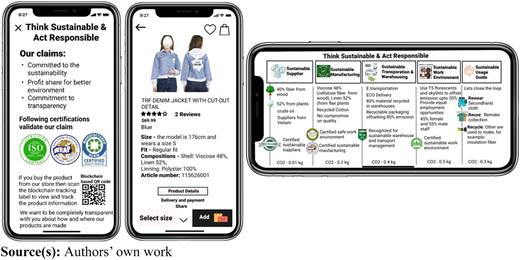
Published by Emerald Publishing Limited. This article is published under the Creative Commons Attribution (CC BY 4.0) licence. Anyone may reproduce, distribute, translate and create derivative works of this article (for both commercial and non-commercial purposes), subject to full attribution to the original publication and authors. The full terms of this licence may be seen at http://creativecommons.org/licences/by/4.0/legalcode

Data & Figures

Figure 1

Research model

Figure 2

Structural model results

Figure 2

Structural model results

Close Figure 2
Table A1

Survey items

ConstructsItem codesItemsMeanSD
Transparency This brand app allows me to
TRANSP1a) Find vital information on product sustainability4.2580.606
TRANSP2b) Read sustainability-related product information4.3560.604
TRANSP3c) Access sustainability-related product information (e.g. material flows from suppliers to retailers)4.1970.756
TRANSP4d) Overall, the openness of this brand app enhances transparency between the brand and its customers4.3660.719
Traceability This brand app allows me to
TRACE1a) Track product sustainability conveniently4.2680.616
TRACE2b) Easily trace the origin of sustainable products4.2370.758
TRACE3c) Easily trace the history of sustainable products4.0070.832
TRACE4d) Easily verify all information ranging from the origin of a sustainable product to its sale4.0750.799
TRACE5e) Track to have a better understanding of how all processes are sustainable4.0200.794
Immutability This brand app allows me to  
IMMUT1a) believe that the sustainability related information provided on it is immutable3.5930.937
IMMUT2b) count on it for sustainability related information based on data and information immutability3.8140.821
IMMUT3c) ensure that the sustainability related information provided on it are not changed3.6071.144
Efficiency When using this brand app, I expect
EFF1a) To arrive at a decision for the most sustainable product fastremoved
EFF2b) To be able to save time3.5930.735
EFF3c) To accomplish more tasks3.5420.706
EFF4d) In general to be more efficient3.5490.691
Social impression Consuming sustainable products for which available information can be traced and verified using this brand app
S.IMPRSS1a) Would help me to feel acceptable3.0541.053
S.IMPRSS2b) Would improve the way I am perceived2.9321.071
S.IMPRSS3c) Would make a good impression of me on other people3.0311.072
S.IMPRSS4d) Would give me social approval2.9151.053
TrustTRUST1I feel secure about relying on this brand app for information about a sustainable product3.7860.806
TRUST2I feel comfortable about relying on this brand app for information about a sustainable product3.9250.723
TRUST3I feel content about relying on this brand app for information about a sustainable product3.8370.728
TRUST4I do not feel comfortable about relying on this brand app for information about a sustainable product3.8240.940
Sustainable information clarity Information on a sustainable product, provided on this brand app
INFORM1a) Is helpful for me to evaluate the sustainability of the product that I was planning to buy4.1150.746
INFORM2b) Is helpful to familiarize myself with the sustainability of the product that I was planning to buy4.2000.706
INFORM3c) Is helpful for me to understand the performance of the sustainable product that I was planning to buy3.8440.779
INFORM4d) Is more helpful in influencing my overall evaluation of the sustainable product4.0240.761
Consumers’ purchase intentionP.INT1I would consider purchasing a sustainable product from this brand3.9220.730
P.INT2I would purchase a sustainable product from this brand3.6750.734
P.INT3I would expect to buy a sustainable product from this brand3.6100.836
P.INT4If a product were competitively sustainable, I would consider buying it from this brand3.9930.718
P.INT5If a product were significantly more sustainable at this brand app than at a better-known brand app, I would consider buying it from this brand3.8750.782

Note(s): *SD; Standard deviation

Table 1

A sample of prior literature on blockchain and consumers’ purchase decision-making

StudyObjectiveTheoryMethodsKey findings
Bigerna et al. (2021) To assess the market’s ability to sustain the repairability and durability of sustainable products involved in the fourth industrial revolution and investigate willingness to pay for smartphones eco labeled and attested by either blockchain or paper-based schemeTheory of planned behavior (TPB)Mixed method: qualitative study, focus group interviews, sample 25 participants; quantitative study, Cragg hurdle model, sample of 1,508 respondentsPaper-based schemes are preferred to blockchain and durability is preferred to repairability, highlighting that consumers value products that can last longer instead of being easily repaired. Despite the reason that paper-based schemes are preferred to blockchain, a fair percentage of respondents supported the transition to blockchain
Rainero and Modarelli (2021) To investigate blockchain adoption in food SC, and how it can provide information for purchase decision-making and support the creation of conscious sustainable behavioral choicesStakeholders theoryQuantitative survey-based field analysis, sample of 80 consumersConsumers’ limited knowledge and perception of blockchain, the low usage level and high willingness to buy traceable food are highlighted. Additionally, blockchain adoption can generate bidirectional values as it can alter consumption habits by offering antecedent certainty and security and external technological interventions that provide information
Dionysis et al. (2022) To investigate and analyze the prosocial determinants of attitude and purchase intention of blockchain traceable coffeeTPBQuantitative method, hierarchical regression analysis, sample of 123 participantsBy including factors such as trust, habits, and environmental protection, significantly enhances the explanatory power of TPB. Moreover, these factors positively influence the purchase intention of blockchain traceable coffee by enabling consumers to identify and understand the additional information about products without any help and enhance their trust in blockchain traceable coffee when the origin is known
Jain et al. (2022) To investigate the Blockchain-Enabled E-commerce Platform (BEEP) adoption antecedents for secondhand apparel retailingThe unified theory of acceptance and use of technology (UTAUT)Quantitative method, structural model analysis, sample of 374 respondentsBuying motives including critical motives, economic motives, and hedonic motives, and UTAUT constructs such as facilitating condition, performance expectancy, and attitude demonstrate acceptance of BEEP for purchasing secondhand apparel. Blockchain fosters behavioral intention toward the online purchase of secondhand apparel and hence lessens waste and advances the circular economy
Koroma et al. (2022) To investigate the impact of trust on citizens’ behavior in making decisions for blockchain cryptocurrencyTrust transfer theoryQuantitative method: structural model, sample of 421 citizensTechnology attachment and blockchain transparency positively influence trust in cryptocurrency, which in turn affects citizens’ behavior. However, ethical concerns adversely affect the relationship between trust and consumer behavior
Nygaard and Silkoset (2023) To examine how blockchain information dimensions (i.e. transparent, traceable, and tamperproof) counteract perceived greenwashing among consumers of ecological foods–Quantitative method: structural equation modeling, sample of 492 respondentsConsumers' access to tamperproof, transparent, and reliable product information offset the perceived greenwashing among ecological food consumers. Thus, blockchain as compared to any other certification system protects consumers against the threat of greenwashing
Cozzio et al. (2023) To examine the importance of blockchain traceability for consumers and the blockchain adoption barriers faced by suppliersAffordance theoryMixed method approach: Study 1, Scenario-based experiment, quantitative method, 2-way ANOVA, sample of 139 consumers. Study 2, Qualitative interviews, sample of 20 managers and suppliersBlockchain traceability enhances consumers’ trust when the food is local and positively impacts behavior and attitude. However, suppliers are hesitant to adopt this technology due to a fear of sharing business information with their peers
Liu et al. (2023) To investigate trust types and their effect mechanism in blockchain-based applications for green agricultural productsSignal theory and trust transfer theoryMixed method: qualitative interviews with consumers, sample of 29; quantitative method, structural model analysis, sample of 474 consumersConsumers’ experience of blockchain significantly influences the perceived transparency of environmental information and positively impacts swift trust and digital trust. Consequently, both types of trust impact impulse buying. Environmental information transparency is perceived as an important mechanism through which blockchain affects consumer trust
Treiblmaier and Garaus (2023) To investigate how the blockchain -based traceability label enhances consumer purchase intentionSignaling theoryQuantitative: two consecutive experiments. Study 1: sample of 151; Study 2: sample of 152, method: ANOVAThe blockchain label serves as a signal in food SC that helps to fortify the perceived quality of food, and as a result, enhances consumers’ intentions to purchase
Zhu et al. (2024) To analyze the impact of blockchain supported carbon offset information and shipping options with different environmental footprint implications. This study further examines how blockchain supported information influences perceptions of consumers toward logistics service providers and retailers–Quantitative method: vignette-based and role-play experiment, one way ANOVA, sample of 189 consumerBlockchain supports greater transparency, traceability, and reliability in SC carbon offset information, and carbon emission information in the product journey enhances consumer confidence. As a result, consumers are more willing to pay a premium price for such shipping options and products
Table 2

Definitions and operationalization of study measures

MeasuresDefinition and operationalizationReferences
AffordancesAffordances are referred to the goal-oriented action possibilities that a technological object offers to the users. In this study context, affordances are actions or behaviors made possible by blockchain such as enabling users to access product information, trace the origin of the product, and ascertain its truthfulness, and are conceptualized as transparency, traceability, and immutabilityVolkoff and Strong (2017) 
EfficiencyEfficiency value deals with the resources for obtaining service, while consumers' perception of efficiency depends on transactional efficiency and timesaving. It is operationalized as consumers' perception of blockchain based app capacity to speed up their decision making by effectively utilizing the product knowledge to assess its sustainabilityMathwick et al. (2002) 
Social impressionSocial value (i.e. social impression) is an advantage to one’s social standing resulting from using an offering. We operationalized it as the perceived social impression connected to buying sustainable products made possible through blockchain based appsAlan et al. (2016), Lu et al. (2016) 
TrustTrust has been conceptualized as an emotional trust, highlighting the feelings of consumers including comfort and security about relying on blockchain based brand appXiao and Benbasat (2003) 
Sustainability information clarityWe have operationalized sustainability information clarity as a conditional value when consumers are provided with transparent and verifiable information to make their choicesLaroche et al. (2001) 
Table 3

Profile of the respondents (N = 295)

CategoriesFrequency%
Gender
Male17860.3
Female11539.9
Other20.7
Age
Below 20 years93.1
21–30 years16455.6
31–40 years8829.8
41–50 years3411.5
Above 50 years  
Education
Less than high school41.4
High school completed5819.7
College completed258.5
Bachelor’s degree completed12141.0
Master’s degree completed8328.1
PhD completed41.4
Monthly income (in USD)
Less than 1,0009331.5
1,001–2,50013345.1
2,501–5,0005619.0
5,001–7,500103.4
Above 7,50031.0

Source(s): Authors' own work

Table 4

The assessment of the measurement model for constructs

ConstructsIndicatorsLoadingsCACRAVE
TransparencyTRANSP10.7400.7680.8520.590
TRANSP20.786   
TRANSP30.800   
TRANSP40.745   
TraceabilityTRACE10.7590.8430.8890.616
TRACE20.818   
TRACE30.834   
TRACE40.781   
TRACE50.726   
ImmutabilityIMMUT10.8600.8100.8830.717
IMMUT20.881   
IMMUT30.796   
EfficiencyEFF20.8340.7400.8520.657
EFF30.798   
EFF40.799   
Social impressionS.IMPRSS10.8520.9170.9410.800
S.IMPRSS20.905   
S.IMPRSS30.922   
S.IMPRSS40.898   
TrustTRUST10.8860.8690.9100.718
TRUST20.846   
TRUST30.873   
TRUST4R0.781   
Sustainability information clarityINFORM10.8310.8050.8720.631
INFORM20.829   
INFORM30.724   
INFORM40.789   
Consumers’ purchase intentionP.INT10.8620.8550.8970.635
P.INT20.842   
P.INT30.802   
P.INT40.753   
P.INT50.717   

Note(s): CA; Cronbach’s Alpha, CR; Composite Reliability, AVE; Average Variance Extracted

Source(s): Authors' own work

Table 5

Correlation matrix and the square root of AVEs

12345678
1. Transparency0.768       
2. Traceability0.6990.785      
3. Immutability0.4280.4620.847     
4. Efficiency0.2800.2700.2960.811    
5. Social impression0.2420.2590.3040.3330.895   
6. Trust0.4700.4570.5680.4530.4190.847  
7. Sustainability information clarity0.5480.4920.3720.3860.3550.5510.795 
8. Consumers’ purchase intention0.3130.3320.4430.4530.4350.5860.5120.797

Note(s): Diagonal italic values show the square root of AVE

Source(s): Authors' own work

Table 6

Heterotrait-monotrait (HTMT) ratio criterion test

12345678
1. Transparency        
2. Traceability0.867       
3. Immutability0.5270.554      
4. Efficiency0.3670.3370.350     
5. Social impression0.2880.2940.3300.404    
6. Trust0.5680.5290.6400.5640.466   
7. Sustainability information clarity0.6930.5950.4270.4920.4110.648  
8. Consumers’ purchase intention0.3830.3850.5110.5660.4900.6650.607 

Source(s): Authors' own work

Table 7

High-order construct validation

ConstructsMeasuresWeightSignificanceVIF
Blockchain affordancesTransparency0.412p < 0.0012.013
Traceability0.391p < 0.0012.089
Immutability0.404p < 0.0011.308

Source(s): Authors' own work

Table 8

Direct and indirect effects of blockchain affordances on consumers' purchase intention (PROCESS Model #4)

Types of effectEffectSELLCIULCIZero include?
Direct
Blockchain affordances → consumers’ purchase intention0.0720.066−0.0580.202Yes
Indirect
Blockchain affordances → efficiency → consumers’ purchase intention0.064*0.0260.0180.119No
Blockchain affordances → social impression → consumers’ purchase intention0.063*0.0230.0210.110No
Blockchain affordances → trust → consumers’ purchase intention0.188*0.0540.0880.296No
Blockchain affordances → sustainability information clarity → consumers’ purchase intention0.116*0.0410.0380.198No

Note(s): *p < 0.05; SE = Standard Error; LLCI = Lower Limit Confidence Interval; ULCI = Upper Limit Confidence Interval

Source(s): Authors' own work

Supplements

References

Adams
,
R.
,
Kewell
,
B.
and
Parry
,
G.
(
2018
), “Blockchain for good? Digital ledger technology and sustainable development goals”, in
Handbook of Sustainability and Social Science Research
,
World Sustainability Series
,
Springer International Publishing
,
Cham
, pp. 
127
-
140
.
Agrawal
,
T.K.
,
Kumar
,
V.
,
Pal
,
R.
,
Wang
,
L.
and
Chen
,
Y.
(
2021
), “
Blockchain-based framework for supply chain traceability: a case example of textile and clothing industry
”,
Computers and Industrial Engineering
, Vol. 
154
, 107130, doi: .
Alan
,
A.
,
Dursun
,
I.
,
Kabadayi
,
E.
,
Aydin
,
K.
and
Anlagan
,
F.
(
2016
), “
What influences the repurchase intention for luxury brands? The relative impacts of luxury value dimensions
”,
International Business Research
, Vol. 
9
No. 
5
, pp. 
11
-
24
, doi: .
Asante
,
M.
,
Epiphaniou
,
G.
,
Maple
,
C.
,
Al-Khateeb
,
H.
,
Bottarelli
,
M.
and
Ghafoor
,
K.Z.
(
2021
), “
Distributed ledger technologies in supply chain security management: a comprehensive survey
”,
IEEE Transactions on Engineering Management
, Vol. 
70
No. 
2
, pp. 
713
-
739
, doi: .
Awuni
,
J.A.
and
Du
,
J.
(
2016
), “
Sustainable consumption in Chinese cities: green purchasing intentions of young adults based on the theory of consumption values
”,
Sustainable Development
, Vol. 
24
No. 
2
, pp. 
124
-
135
, doi: .
Azzi
,
R.
,
Chamoun
,
R.K.
and
Sokhn
,
M.
(
2019
), “
The power of a blockchain-based supply chain
”,
Computers and Industrial Engineering
, Vol. 
135
, pp. 
582
-
592
, doi: .
Behnke
,
K.
and
Janssen
,
M.
(
2020
), “
Boundary conditions for traceability in food supply chains using blockchain technology
”,
International Journal of Information Management
, Vol. 
52
, 101969, doi: .
Benbasat
,
I.
and
Zmud
,
R.W.
(
2003
), “
The identity crisis within the IS discipline: defining and communicating the discipline's core properties
”,
MIS Quarterly
, Vol. 
27
No. 
2
, pp. 
183
-
194
, doi: .
Berg
,
A.
,
Karl-Hendrik
,
M.
,
Kappelmark
,
S.
,
Granskoq
,
A.
,
Lee
,
L.
,
Sawers
,
C.
,
Polgampola
,
P.
,
Lehmann
,
M.
,
Syrett
,
H.
and
Arici
,
G.
(
2020
), “
Fashion on climate—how the fashion industry can urgently act to reduce its greenhouse gas emissions
”,
available at:
 https://www.mckinsey.com/∼/media/mckinsey/industries/retail/our%20insights/fashion%20on%20climate/fashion-on-climate-full-report.pdf (
accessed
 17 May 2023).
Bigerna
,
S.
,
Micheli
,
S.
and
Polinori
,
P.
(
2021
), “
New generation acceptability towards durability and repairability of products: circular economy in the era of the 4th industrial revolution
”,
Technological Forecasting and Social Change
, Vol. 
165
, 120558, doi: .
Bird
,
J.
(
2018
), “
Fashion's dirty little secret and how it's coming clean
”,
available at:
 https://www.forbes.com/sites/jonbird1/2018/09/09/fashions-dirty-little-secret-and-how-its-coming-clean/#601157101771 (
accessed
 4 June 2023).
Biswas
,
A.
and
Roy
,
M.
(
2015
), “
Green products: an exploratory study on the consumer behaviour in emerging economies of the East
”,
Journal of Cleaner Production
, Vol. 
87
, pp. 
463
-
468
, doi: .
Bitner
,
M.J.
(
1990
), “
Evaluating service encounters: the effects of physical surroundings and employee responses
”,
Journal of Marketing
, Vol. 
54
No. 
2
, pp. 
69
-
82
, doi: .
Bocken
,
N.M.
and
Short
,
S.W.
(
2021
), “
Unsustainable business models–Recognising and resolving institutionalised social and environmental harm
”,
Journal of Cleaner Production
, Vol. 
312
, 127828, doi: .
Boudreau
,
M.C.
and
Robey
,
D.
(
2005
), “
Enacting integrated information technology: a human agency perspective
”,
Organization Science
, Vol. 
16
No. 
1
, pp. 
3
-
18
, doi: .
Boukis
,
A.
(
2020
), “
Exploring the implications of blockchain technology for brand–consumer relationships: a future research agenda
”,
The Journal of Product and Brand Management
, Vol. 
29
No. 
3
, pp. 
307
-
320
, doi: .
Casino
,
F.
,
Kanakaris
,
V.
,
Dasaklis
,
T.K.
,
Moschuris
,
S.
,
Stachtiaris
,
S.
,
Pagoni
,
M.
and
Rachaniotis
,
N.P.
(
2021
), “
Blockchain-based food supply chain traceability: a case study in the dairy sector
”,
International Journal of Production Research
, Vol. 
59
No. 
19
, pp. 
5758
-
5770
, doi: .
Centobelli
,
P.
,
Cerchione
,
R.
,
Del Vecchio
,
P.
,
Oropallo
,
E.
and
Secundo
,
G.
(
2022
), “
Blockchain technology for bridging trust, traceability and transparency in circular supply chain
”,
Information and Management
, Vol. 
59
No. 
7
, 103508, doi: .
Chakraborty
,
D.
and
Dash
,
G.
(
2022
), “
Using the consumption values to investigate consumer purchase intentions towards natural food products
”,
British Food Journal
, Vol. 
125
No. 
2
, pp. 
551
-
569
, doi: .
Chen
,
L.
and
Lee
,
H.L.
(
2017
), “
Sourcing under supplier responsibility risk: the effects of certification, audit, and contingency payment
”,
Management Science
, Vol. 
63
No. 
9
, pp. 
2795
-
2812
, doi: .
Chen
,
H.
,
Chen
,
H.
and
Tian
,
X.
(
2022
), “
The impact of social shopping feature richness on buying intention: a product perspective
”,
Internet Research
, Vol. 
32
No. 
4
, pp. 
1378
-
1400
, doi: .
Chen
,
R.R.
,
Chen
,
K.
and
Ou
,
C.X.
(
2023
), “
Facilitating interorganizational trust in strategic alliances by leveraging blockchain-based systems: case studies of two eastern banks
”,
International Journal of Information Management
, Vol. 
68
, 102521, doi: .
Chin
,
W.W.
(
1998
), “
Commentary: issues and opinion on structural equation modeling
”,
MIS Quarterly
, Vol. 
22
No. 
1
, pp. 
vii
-
xvi
.
Choi
,
T.M.
,
Feng
,
L.
and
Li
,
R.
(
2020
), “
Information disclosure structure in supply chains with rental service platforms in the blockchain technology era
”,
International Journal of Production Economics
, Vol. 
221
, 107473, doi: .
Cozzio
,
C.
,
Viglia
,
G.
,
Lemarie
,
L.
and
Cerutti
,
S.
(
2023
), “
Toward an integration of blockchain technology in the food supply chain
”,
Journal of Business Research
, Vol. 
162
, 113909, doi: .
Creusen
,
M.E.
and
Schoormans
,
J.P.
(
2005
), “
The different roles of product appearance in consumer choice
”,
Journal of Product Innovation Management
, Vol. 
22
No. 
1
, pp. 
63
-
81
, doi: .
Dagher
,
G.K.
and
Itani
,
O.
(
2014
), “
Factors influencing green purchasing behaviour: empirical evidence from the Lebanese consumers
”,
Journal of Consumer Behaviour
, Vol. 
13
No. 
3
, pp. 
188
-
195
, doi: .
Dal Mas
,
F.
,
Massaro
,
M.
,
Ndou
,
V.
and
Raguseo
,
E.
(
2023
), “
Blockchain technologies for sustainability in the agrifood sector: a literature review of academic research and business perspectives
”,
Technological Forecasting and Social Change
, Vol. 
187
, 122155, doi: .
Davison
,
R.M.
and
Martinsons
,
M.G.
(
2016
), “
Context is king! Considering particularism in research design and reporting
”,
Journal of Information Technology
, Vol. 
31
No. 
3
, pp. 
241
-
249
, doi: .
de Boissieu
,
E.
,
Kondrateva
,
G.
,
Baudier
,
P.
and
Ammi
,
C.
(
2021
), “
The use of blockchain in the luxury industry: supply chains and the traceability of goods
”,
Journal of Enterprise Information Management
, Vol. 
34
No. 
5
, pp. 
1318
-
1338
, doi: .
de Lima
,
F.A.
,
Seuring
,
S.
and
Sauer
,
P.C.
(
2022
), “
A systematic literature review exploring uncertainty management and sustainability outcomes in circular supply chains
”,
International Journal of Production Research
, Vol. 
60
No. 
19
, pp. 
6013
-
6046
, doi: .
Dionysis
,
S.
,
Chesney
,
T.
and
McAuley
,
D.
(
2022
), “
Examining the influential factors of consumer purchase intentions for blockchain traceable coffee using the theory of planned behaviour
”,
British Food Journal
, Vol. 
124
No. 
12
, pp. 
4304
-
4322
, doi: .
Eberhart
,
A.K.
and
Naderer
,
G.
(
2017
), “
Quantitative and qualitative insights into consumers' sustainable purchasing behaviour: a segmentation approach based on motives and heuristic cues
”,
Journal of Marketing Management
, Vol. 
33
Nos
13-14
, pp. 
1149
-
1169
, doi: .
Erol
,
I.
,
Oztel
,
A.
,
Searcy
,
C.
and
Medeni
,
İ.T.
(
2023
), “
Selecting the most suitable blockchain platform: a case study on the healthcare industry using a novel rough MCDM framework
”,
Technological Forecasting and Social Change
, Vol. 
186
, 122132, doi: .
Esmaeilian
,
B.
,
Sarkis
,
J.
,
Lewis
,
K.
and
Behdad
,
S.
(
2020
), “
Blockchain for the future of sustainable supply chain management in Industry 4.0
”,
Resources, Conservation and Recycling
, Vol. 
163
, 105064, doi: .
Everard
,
A.
and
Galletta
,
D.F.
(
2005
), “
How presentation flaws affect perceived site quality, trust, and intention to purchase from an online store
”,
Journal of Management Information Systems
, Vol. 
22
No. 
3
, pp. 
56
-
95
, doi: .
Fang
,
Y.H.
,
Li
,
C.Y.
and
Bhatti
,
Z.A.
(
2021
), “
Building brand loyalty and endorsement with brand pages: integration of the lens of affordance and customer-dominant logic
”,
Information Technology and People
, Vol. 
34
No. 
2
, pp. 
731
-
769
, doi: .
Feng
,
H.
,
Wang
,
X.
,
Duan
,
Y.
,
Zhang
,
J.
and
Zhang
,
X.
(
2020
), “
Applying blockchain technology to improve agri-food traceability: a review of development methods, benefits and challenges
”,
Journal of Cleaner Production
, Vol. 
260
, 121031, doi: .
Filieri
,
R.
,
McLeay
,
F.
,
Tsui
,
B.
and
Lin
,
Z.
(
2018
), “
Consumer perceptions of information helpfulness and determinants of purchase intention in online consumer reviews of services
”,
Information and Management
, Vol. 
55
No. 
8
, pp. 
956
-
970
, doi: .
Finch
,
J.E.
(
2006
), “
The impact of personal consumption values and beliefs on organic food purchase behavior
”,
Journal of Food Products Marketing
, Vol. 
11
No. 
4
, pp. 
63
-
76
, doi: .
Fornell
,
C.
and
Larcker
,
D.F.
(
1981
), “
Evaluating structural equation models with unobservable variables and measurement error
”,
Journal of Marketing Research
, Vol. 
18
No. 
1
, pp. 
39
-
50
, doi: .
Fuchs
,
D.A.
and
Lorek
,
S.
(
2005
), “
Sustainable consumption governance: a history of promises and failures
”,
Journal of Consumer Policy
, Vol. 
28
No. 
3
, pp. 
261
-
288
, doi: .
Gholizadeh
,
M.
,
Akhlaghpour
,
S.
,
Isaias
,
P.
and
Namvar
,
M.
(
2022
), “
Emergent affordances and potential challenges of mobile learning apps: insights from online reviews
”,
Information Technology and People
, Vol. 
35
No. 
7
, pp. 
2500
-
2517
, doi: .
Gibson
,
J.J.
(
1977
), “
The theory of affordances
”,
Hilldale, USA
, Vol. 
1
No. 
2
, pp. 
67
-
82
.
Goertzel
,
B.
,
Goertzel
,
T.
and
Goertzel
,
Z.
(
2017
), “
The global brain and the emerging economy of abundance: mutualism, open collaboration, exchange networks and the automated commons
”,
Technological Forecasting and Social Change
, Vol. 
114
, pp. 
65
-
73
, doi: .
Gonçalves
,
H.M.
,
Lourenço
,
T.F.
and
Silva
,
G.M.
(
2016
), “
Green buying behavior and the theory of consumption values: a fuzzy-set approach
”,
Journal of Business Research
, Vol. 
69
No. 
4
, pp. 
1484
-
1491
, doi: .
Guo
,
W.
and
Kim
,
E.
(
2023
), “
Categorizing Chinese consumers' behavior to identify factors related to sustainable clothing consumption
”,
Sustainability
, Vol. 
15
No. 
7
, p.
6126
, doi: .
Hair
,
J.F.
 Jr
,
Hult
,
G.T.M.
,
Ringle
,
C.M.
,
Sarstedt
,
M.
,
Danks
,
N.P.
and
Ray
,
S.
(
2021
), “An introduction to structural equation modeling”, in
Hair
,
J.F.
 Jr
,
Hult
,
G.T.M.
,
Ringle
,
C.M.
,
Sarstedt
,
M.
,
Danks
,
N.P.
and
Ray
,
S.
(Eds),
Partial Least Squares Structural Equation Modeling (PLS-SEM) Using R
,
A workbook
,
Springer International Publishing
,
Cham
, pp. 
1
-
29
.
Hair
,
J.F.
,
Hult
,
G.T.M.
,
Ringle
,
C.M.
,
Sarstedt
,
M.
and
Thiele
,
K.O.
(
2017
), “
Mirror, mirror on the wall: a comparative evaluation of composite-based structural equation modeling methods
”,
Journal of the Academy of Marketing Science
, Vol. 
45
No. 
5
, pp. 
616
-
632
, doi: .
Harman
,
H.H.
(
1976
),
Modern Factor Analysis
,
University of Chicago Press
,
Chicago
.
Harris
,
L.C.
and
Goode
,
M.M.
(
2010
), “
Online servicescapes, trust, and purchase intentions
”,
Journal of Services Marketing
, Vol. 
24
No. 
3
, pp. 
230
-
243
, doi: .
Hayes
,
A.F.
(
2012
), “
Process: A versatile computational tool for observed variable mediation, moderation, and conditional process modeling
 
[White paper]
,”
available at:
 http://www.afhayes.com/public/process2012.pdf
Henseler
,
J.
,
Ringle
,
C.M.
and
Sarstedt
,
M.
(
2015
), “
A new criterion for assessing discriminant validity in variance-based structural equation modeling
”,
Journal of the Academy of Marketing Science
, Vol. 
43
No. 
1
, pp. 
115
-
135
, doi: .
Holbrook
,
M.B.
(
1994
), “
The nature of customer value: an axiology of services in the consumption experience
”,
Service Quality: New directions in Theory and Practice
, Vol. 
21
No. 
1
, pp. 
21
-
71
, doi: .
Huang
,
J.
,
He
,
D.
,
Obaidat
,
M.S.
,
Vijayakumar
,
P.
,
Luo
,
M.
and
Choo
,
K.-K.R.
(
2021
), “
The application of the blockchain technology in voting systems: a review
”,
ACM Computing Surveys
, Vol. 
54
No. 
3
, pp. 
1
-
28
, doi: .
Jahanbin
,
P.
,
Wingreen
,
S.C.
,
Sharma
,
R.
,
Ijadi
,
B.
and
Reis
,
M.M.
(
2023
), “
Enabling affordances of blockchain in agri-food supply chains: a value-driver framework using Q-methodology
”,
International Journal of Innovation Studies
, Vol. 
7
No. 
4
, pp. 
307
-
325
, doi: .
Jain
,
G.
,
Kamble
,
S.S.
,
Ndubisi
,
N.O.
,
Shrivastava
,
A.
,
Belhadi
,
A.
and
Venkatesh
,
M.
(
2022
), “
Antecedents of Blockchain-Enabled E-commerce Platforms (BEEP) adoption by customers–a study of second-hand small and medium apparel retailers
”,
Journal of Business Research
, Vol. 
149
, pp. 
576
-
588
, doi: .
James
,
T.L.
,
Lowry
,
P.B.
,
Wallace
,
L.
and
Warkentin
,
M.
(
2017
), “
The effect of belongingness on obsessive-compulsive disorder in the use of online social networks
”,
Journal of Management Information Systems
, Vol. 
34
No. 
2
, pp. 
560
-
596
, doi: .
Jarupathirun
,
S.
and
Zahedi
,
F.M.
(
2007
), “
Exploring the influence of perceptual factors in the success of web-based spatial DSS
”,
Decision Support Systems
, Vol. 
43
No. 
3
, pp. 
933
-
951
, doi: .
Jordan
,
P.J.
and
Troth
,
A.C.
(
2020
), “
Common method bias in applied settings: the dilemma of researching in organizations
”,
Australian Journal of Management
, Vol. 
45
No. 
1
, pp. 
3
-
14
, doi: .
Jung
,
J.
and
Lee
,
S.H.
(
2006
), “
Cross‐cultural comparisons of appearance self‐schema, body image, self‐esteem, and dieting behavior between Korean and US women
”,
Family and Consumer Sciences Research Journal
, Vol. 
34
No. 
4
, pp. 
350
-
365
, doi: .
Kahraman
,
A.
and
Kazançoğlu
,
İ.
(
2019
), “
Understanding consumers' purchase intentions toward natural‐claimed products: a qualitative research in personal care products
”,
Business Strategy and the Environment
, Vol. 
28
No. 
6
, pp. 
1218
-
1233
, doi: .
Kaur
,
P.
,
Dhir
,
A.
,
Rajala
,
R.
and
Dwivedi
,
Y.
(
2018
), “
Why people use online social media brand communities: a consumption value theory perspective
”,
Online Information Review
, Vol. 
42
No. 
2
, pp. 
205
-
221
, doi: .
Khan
,
M.A.
and
Salah
,
K.
(
2018
), “
IoT security: review, blockchain solutions, and open challenges
”,
Future Generation Computer Systems
, Vol. 
82
, pp. 
395
-
411
, doi: .
Kim
,
J.-S.
and
Shin
,
N.
(
2019
), “
The impact of blockchain technology application on supply chain partnership and performance
”,
Sustainability
, Vol. 
11
No. 
21
, p.
6181
, doi: .
Komiak
,
S.X.
and
Benbasat
,
I.
(
2004
), “
Understanding customer trust in agent-mediated electronic commerce, web-mediated electronic commerce, and traditional commerce
”,
Information Technology and Management
, Vol. 
5
Nos
1/2
, pp. 
181
-
207
, doi: .
Komiak
,
S.Y.
and
Benbasat
,
I.
(
2006
), “
The effects of personalization and familiarity on trust and adoption of recommendation agents
”,
MIS Quarterly
, Vol. 
30
No. 
4
, pp. 
941
-
960
, doi: .
Koroma
,
J.
,
Rongting
,
Z.
,
Muhideen
,
S.
,
Akintunde
,
T.Y.
,
Amosun
,
T.S.
,
Dauda
,
S.J.
and
Sawaneh
,
I.A.
(
2022
), “
Assessing citizens' behavior towards blockchain cryptocurrency adoption in the Mano River Union States: mediation, moderation role of trust and ethical issues
”,
Technology in Society
, Vol. 
68
, 101885, doi: .
Kshetri
,
N.
(
2017
), “
Blockchain's roles in strengthening cybersecurity and protecting privacy
”,
Telecommunications Policy
, Vol. 
41
No. 
10
, pp. 
1027
-
1038
, doi: .
Laaksonen
,
M.
(
1993
), “
Retail patronage dynamics: learning about daily shopping behavior in contexts of changing retail structures
”,
Journal of Business Research
, Vol. 
28
Nos
1-2
, pp. 
3
-
174
, doi: .
Laroche
,
M.
,
Bergeron
,
J.
and
Barbaro‐Forleo
,
G.
(
2001
), “
Targeting consumers who are willing to pay more for environmentally friendly products
”,
Journal of Consumer Marketing
, Vol. 
18
No. 
6
, pp. 
503
-
520
, doi: .
Le Rouge
,
C.M.
and
Niederman
,
F.
(
2006
), “
Information systems and health care xi: public health knowledge management architecture design: a case study
”,
Communications of the Association for Information Systems
, Vol. 
18
No. 
1
, p.
9
, doi: .
Lease
,
H.
,
MacDonald
,
D.H.
and
Cox
,
D.N.
(
2014
), “
Consumers' acceptance of recycled water in meat products: the influence of tasting, attitudes and values on hedonic and emotional reactions
”,
Food Quality and Preference
, Vol. 
37
, pp. 
35
-
44
, doi: .
Lee
,
C.K.
,
Levy
,
D.S.
and
Yap
,
C.S.F.
(
2015
), “
How does the theory of consumption values contribute to place identity and sustainable consumption?
”,
International Journal of Consumer Studies
, Vol. 
39
No. 
6
, pp. 
597
-
607
, doi: .
Leonardi
,
P.M.
(
2011
), “
When flexible routines meet flexible technologies: affordance, constraint, and the imbrication of human and material agencies
”,
MIS Quarterly
, Vol. 
35
No. 
1
, pp. 
147
-
167
, doi: .
Leonardi
,
P.M.
(
2013
), “
When does technology use enable network change in organizations? A comparative study of feature use and shared affordances
”,
MIS Quarterly
, Vol. 
37
No. 
3
, pp. 
749
-
775
, doi: .
Leung
,
W.K.
,
Chang
,
M.K.
,
Cheung
,
M.L.
,
Shi
,
S.
and
Chan
,
P.C.
(
2023
), “
Understanding the determinants of blockchain adoption in supply chains: an empirical study in China
”,
European Conference on Information Systems (ECIS) 2023
.
Lewis
,
J.D.
and
Weigert
,
A.J.
(
2012
), “
The social dynamics of trust: theoretical and empirical research, 1985-2012
”,
Social Forces
, Vol. 
91
No. 
1
, pp. 
25
-
31
, doi: .
Liang
,
X.
,
Hu
,
X.
,
Li
,
E.Y.
and
Meng
,
H.
(
2023
), “
Untangling the influence of perceived sustainability orientation on value-co-creation behavior in crowdfunding process: investigating a mediation model
”,
Internet Research
, Vol. 
33
No. 
4
, pp. 
1544
-
1572
, doi: .
Liang
,
H.
,
Saraf
,
N.
,
Hu
,
Q.
and
Xue
,
Y.
(
2007
), “
Assimilation of enterprise systems: the effect of institutional pressures and the mediating role of top management
”,
MIS Quarterly
, Vol. 
31
No. 
1
, pp. 
59
-
87
, doi: .
Lin
,
P.-C.
and
Huang
,
Y.-H.
(
2012
), “
The influence factors on choice behavior regarding green products based on the theory of consumption values
”,
Journal of Cleaner Production
, Vol. 
22
No. 
1
, pp. 
11
-
18
, doi: .
Liu
,
W.
,
Liang
,
Y.
,
Lim
,
M.K.
,
Long
,
S.
and
Shi
,
X.
(
2022
), “
A theoretical framework of smart supply chain innovation for going global companies: a multi-case study from China
”,
International Journal of Logistics Management
, Vol. 
33
No. 
3
, pp. 
1090
-
1113
, doi: .
Liu
,
H.
,
Ma
,
R.
,
He
,
G.
,
Lamrabet
,
A.
and
Fu
,
S.
(
2023
), “
The impact of blockchain technology on the online purchase behavior of green agricultural products
”,
Journal of Retailing and Consumer Services
, Vol. 
74
, 103387, doi: .
Liu
,
R.
,
Tan
,
C.
and
Zhao
,
C.
(
2021
), “
Pricing and coordination of vaccine supply chain based on blockchain technology
”,
Internet Research
, Vol. 
31
No. 
6
, pp. 
2096
-
2119
, doi: .
Lloret
,
A.
(
2016
), “
Modeling corporate sustainability strategy
”,
Journal of Business Research
, Vol. 
69
No. 
2
, pp. 
418
-
425
, doi: .
Lola
(
2022
), “
What is greenwashing and how to avoid it?
”,
available at:
 https://myshadeofgreen.com/what-is-greenwashing-and-how-to-avoid-it/ (
accessed
 2 May 2023).
Lu
,
B.
,
Fan
,
W.
and
Zhou
,
M.
(
2016
), “
Social presence, trust, and social commerce purchase intention: an empirical research
”,
Computers in Human Behavior
, Vol. 
56
, pp. 
225
-
237
, doi: .
Lukman
,
R.K.
,
Glavič
,
P.
,
Carpenter
,
A.
and
Virtič
,
P.
(
2016
), “
Sustainable consumption and production–research, experience, and development–the Europe we want
”,
Journal of Cleaner Production
, Vol. 
138
No. 
2
, pp. 
139
-
147
, doi: .
Majchrzak
,
A.
,
Faraj
,
S.
,
Kane
,
G.C.
and
Azad
,
B.
(
2013
), “
The contradictory influence of social media affordances on online communal knowledge sharing
”,
Journal of Computer-Mediated Communication
, Vol. 
19
No. 
1
, pp. 
38
-
55
, doi: .
Mäntymäki
,
M.
,
Islam
,
A.N.
and
Benbasat
,
I.
(
2020
), “
What drives subscribing to premium in freemium services? A consumer value‐based view of differences between upgrading to and staying with premium
”,
Information Systems Journal
, Vol. 
30
No. 
2
, pp. 
295
-
333
, doi: .
Mathwick
,
C.
,
Malhotra
,
N.K.
and
Rigdon
,
E.
(
2002
), “
The effect of dynamic retail experiences on experiential perceptions of value: an Internet and catalog comparison
”,
Journal of Retailing
, Vol. 
78
No. 
1
, pp. 
51
-
60
, doi: .
Matthews
,
L.
,
Hair
,
J.
and
Matthews
,
R.
(
2018
), “
PLS-SEM: the holy grail for advanced analysis
”,
Marketing Management Journal
, Vol. 
28
No. 
1
, pp.
1
-
13
.
Mohd Suki
,
N.
(
2016
), “
Green product purchase intention: impact of green brands, attitude, and knowledge
”,
British Food Journal
, Vol. 
118
No. 
12
, pp. 
2893
-
2910
, doi: .
Moore
,
G.C.
and
Benbasat
,
I.
(
1991
), “
Development of an instrument to measure the perceptions of adopting an information technology innovation
”,
Information Systems Research
, Vol. 
2
No. 
3
, pp.
192
-
222
, doi: .
Morgan
,
D.L.
(
1997
),
Qualitative Research Methods: Focus Groups as Qualitative Research
,
SAGE Publications
,
Thousand Oaks, CA
,
10.9781412984287
.
Mukherjee
,
A.A.
,
Singh
,
R.K.
,
Mishra
,
R.
and
Bag
,
S.
(
2021
), “
Application of blockchain technology for sustainability development in agricultural supply chain: justification framework
”,
Operations Management Research
, Vol. 
15
Nos
1-2
, pp. 
1
-
16
, doi: .
Mutum
,
D.S.
,
Ghazali
,
E.M.
and
Wei‐Pin
,
W.
(
2021
), “
Parallel mediation effect of consumption values and the moderation effect of innovativeness, in predicting the influence of identity on green purchasing behavior
”,
Journal of Consumer Behaviour
, Vol. 
20
No. 
3
, pp. 
827
-
844
, doi: .
Neufeld
,
D.J.
,
Dong
,
L.
and
Higgins
,
C.
(
2007
), “
Charismatic leadership and user acceptance of information technology
”,
European Journal of Information Systems
, Vol. 
16
No. 
4
, pp. 
494
-
510
, doi: .
Nicholls
,
J.
,
Roslow
,
S.
,
Dublish
,
S.
and
Comer
,
L.B.
(
1996
), “
Relationship between situational variables and purchasing in India and the USA
”,
International Marketing Review
, Vol. 
13
No. 
6
, pp. 
6
-
21
, doi: .
Niinimäki
,
K.
,
Peters
,
G.
,
Dahlbo
,
H.
,
Perry
,
P.
,
Rissanen
,
T.
and
Gwilt
,
A.
(
2020
), “
The environmental price of fast fashion
”,
Nature Reviews Earth and Environment
, Vol. 
1
No. 
4
, pp. 
189
-
200
, doi: .
Nygaard
,
A.
and
Silkoset
,
R.
(
2023
), “
Sustainable development and greenwashing: how blockchain technology information can empower green consumers
”,
Business Strategy and the Environment
, Vol. 
32
No. 
6
, pp. 
3801
-
3813
, doi: .
O'Cass
,
A.
and
Siahtiri
,
V.
(
2013
), “
In search of status through brands from Western and Asian origins: examining the changing face of fashion clothing consumption in Chinese young adults
”,
Journal of Retailing and Consumer Services
, Vol. 
20
No. 
6
, pp. 
505
-
515
, doi: .
Ølnes
,
S.
,
Ubacht
,
J.
and
Janssen
,
M.
(
2017
), “
Blockchain in government: benefits and implications of distributed ledger technology for information sharing
”,
Government Information Quarterly
, Vol. 
34
No. 
3
, pp. 
355
-
364
, doi: .
Omigie
,
N.O.
,
Zo
,
H.
,
Rho
,
J.J.
and
Ciganek
,
A.P.
(
2017
), “
Customer pre-adoption choice behavior for M-PESA mobile financial services: extending the theory of consumption values
”,
Industrial Management and Data Systems
, Vol. 
117
No. 
5
, pp. 
910
-
926
, doi: .
Peer
,
E.
,
Vosgerau
,
J.
and
Acquisti
,
A.
(
2014
), “
Reputation as a sufficient condition for data quality on Amazon Mechanical Turk
”,
Behavior Research Methods
, Vol. 
46
No. 
4
, pp. 
1023
-
1031
, doi: .
Peng
,
D.X.
and
Lai
,
F.
(
2012
), “
Using partial least squares in operations management research: a practical guideline and summary of past research
”,
Journal of Operations Management
, Vol. 
30
No. 
6
, pp. 
467
-
480
, doi: .
Peng
,
K.-F.
,
Chen
,
Y.
and
Wen
,
K.-W.
(
2014
), “
Brand relationship, consumption values and branded app adoption
”,
Industrial Management and Data Systems
, Vol. 
114
No. 
8
, pp. 
1131
-
1143
, doi: .
Podsakoff
,
P.M.
,
MacKenzie
,
S.B.
,
Lee
,
J.-Y.
and
Podsakoff
,
N.P.
(
2003
), “
Common method biases in behavioral research: a critical review of the literature and recommended remedies
”,
Journal of Applied Psychology
, Vol. 
88
No. 
5
, pp. 
879
-
903
, doi: .
Politou
,
E.
,
Casino
,
F.
,
Alepis
,
E.
and
Patsakis
,
C.
(
2019
), “
Blockchain mutability: challenges and proposed solutions
”,
IEEE Transactions on Emerging Topics in Computing
, Vol. 
9
No. 
4
, pp. 
1972
-
1986
, doi: .
Pristl
,
A.C.
,
Kilian
,
S.
and
Mann
,
A.
(
2021
), “
When does a social norm catch the worm? Disentangling social normative influences on sustainable consumption behaviour
”,
Journal of Consumer Behaviour
, Vol. 
20
No. 
3
, pp. 
635
-
654
, doi: .
Radocchia
,
S.
(
2018
), “
Altering the apparel industry: how the blockchain is changing fashion
”,
available at:
 https://www.forbes.com/sites/samantharadocchia/2018/06/27/altering-the-apparel-industry-how-the-blockchain-is-changing-fashion (
accessed
 9 May 2023).
Rainero
,
C.
and
Modarelli
,
G.
(
2021
), “
Food tracking and blockchain-induced knowledge: a corporate social responsibility tool for sustainable decision-making
”,
British Food Journal
, Vol. 
123
No. 
12
, pp. 
4284
-
4308
, doi: .
Rana
,
R.L.
,
Tricase
,
C.
and
De Cesare
,
L.
(
2021
), “
Blockchain technology for a sustainable agri-food supply chain
”,
British Food Journal
, Vol. 
123
No. 
11
, pp. 
3471
-
3485
, doi: .
Rönkkö
,
M.
and
Evermann
,
J.
(
2013
), “
A critical examination of common beliefs about partial least squares path modeling
”,
Organizational Research Methods
, Vol. 
16
No. 
3
, pp. 
425
-
448
, doi: .
Ruangkanjanases
,
A.
and
Wutthisith
,
M.
(
2018
), “
Predicting intention to purchase digital stickers in an application for instant communications on mobile devices: a comparative study
”,
Journal of Telecommunication, Electronic and Computer Engineering
, Vol. 
10
Nos
1-10
, pp. 
75
-
80
.
Samson
,
A.
and
Voyer
,
B.G.
(
2014
), “
Emergency purchasing situations: implications for consumer decision-making
”,
Journal of Economic Psychology
, Vol. 
44
, pp. 
21
-
33
, doi: .
Sánchez
,
J.
,
Callarisa
,
L.
,
Rodriguez
,
R.M.
and
Moliner
,
M.A.
(
2006
), “
Perceived value of the purchase of a tourism product
”,
Tourism Management
, Vol. 
27
No. 
3
, pp. 
394
-
409
, doi: .
Sarstedt
,
M.
,
Ringle
,
C.M.
and
Hair
,
J.F.
(
2014
), “
PLS-SEM: looking back and moving forward
”,
Long Range Planning
, Vol. 
47
No. 
3
, pp. 
132
-
137
, doi: .
Schwartz
,
S.H.
(
1992
), “
Universals in the content and structure of values: theoretical advances and empirical tests in 20 countries
”,
Advances in Experimental Social Psychology
, Vol. 
25
, pp. 
1
-
65
, doi: .
Schwartz
,
S.H.
(
2012
), “
An overview of the Schwartz theory of basic values
”,
Online Readings in Psychology and Culture
, Vol. 
2
No. 
1
, pp. 
2307
-
0919
, doi: .
Sharma
,
P.N.
,
Liengaard
,
B.D.
,
Hair
,
J.F.
,
Sarstedt
,
M.
and
Ringle
,
C.M.
(
2022
), “
Predictive model assessment and selection in composite-based modeling using PLS-SEM: extensions and guidelines for using CVPAT
”,
European Journal of Marketing
, Vol. 
57
No. 
6
, pp. 
1662
-
1677
, doi: .
Shen
,
X.-L.
,
Sun
,
Y.
and
Wang
,
N.
(
2013
), “
Recommendations from friends anytime and anywhere: toward a model of contextual offer and consumption values
”,
Cyberpsychology, Behavior, and Social Networking
, Vol. 
16
No. 
5
, pp. 
349
-
356
, doi: .
Shen
,
B.
,
Dong
,
C.
and
Minner
,
S.
(
2022
), “
Combating copycats in the supply chain with permissioned blockchain technology
”,
Production and Operations Management
, Vol. 
31
No. 
1
, pp. 
138
-
154
, doi: .
Sheth
,
J.N.
,
Newman
,
B.I.
and
Gross
,
B.L.
(
1991
), “
Why we buy what we buy: a theory of consumption values
”,
Journal of Business Research
, Vol. 
22
No. 
2
, pp. 
159
-
170
, doi: .
Shin
,
D.D.
(
2019
), “
Blockchain: the emerging technology of digital trust
”,
Telematics and Informatics
, Vol. 
45
, 101278, doi: .
Shin
,
D.
and
Bianco
,
W.T.
(
2020
), “
In blockchain we trust: does blockchain itself generate trust?
”,
Social Science Quarterly
, Vol. 
101
No. 
7
, pp. 
2522
-
2538
, doi: .
Shin
,
D.
and
Hwang
,
Y.
(
2020
), “
The effects of security and traceability of blockchain on digital affordance
”,
Online Information Review
, Vol. 
44
No. 
4
, pp. 
913
-
932
, doi: .
Shoaib
,
M.
,
Lim
,
M.K.
and
Wang
,
C.
(
2020
), “
An integrated framework to prioritize blockchain-based supply chain success factors
”,
Industrial Management and Data Systems
, Vol. 
120
No. 
11
, pp. 
2103
-
2131
, doi: .
Sodhi
,
M.S.
and
Tang
,
C.S.
(
2019
), “
Research opportunities in supply chain transparency
”,
Production and Operations Management
, Vol. 
28
No. 
12
, pp. 
2946
-
2959
, doi: .
Stefanova
,
M.
and
Salampasis
,
M.
(
2019
), “
Farm-to-fork traceability: blockchain meets agri-food supply chain
”,
12th European Federation for Information Technology in Agriculture, Food and the Environment
,
Rhodes
,
June
.
Sun
,
Y.
,
Mengyi
,
Z.
and
Jeyaraj
,
A.
(
2023
), “
How enterprise social media affordances affect employee agility: a self-determination theory perspective
”,
Information Technology and People
,
Vol. ahead-of-print No. ahead-of-print
, doi: .
Sunny
,
J.
,
Undralla
,
N.
and
Pillai
,
V.M.
(
2020
), “
Supply chain transparency through blockchain-based traceability: an overview with demonstration
”,
Computers and Industrial Engineering
, Vol. 
150
, 106895, doi: .
Sweeney
,
J.C.
and
Soutar
,
G.N.
(
2001
), “
Consumer perceived value: the development of a multiple item scale
”,
Journal of Retailing
, Vol. 
77
No. 
2
, pp. 
203
-
220
, doi: .
Talukder
,
M.S.
,
Laato
,
S.
,
Islam
,
A.N.
and
Bao
,
Y.
(
2021
), “
Continued use intention of wearable health technologies among the elderly: an enablers and inhibitors perspective
”,
Internet Research
, Vol. 
31
No. 
5
, pp. 
1611
-
1640
, doi: .
Talwar
,
S.
,
Kaur
,
P.
,
Kumar
,
S.
,
Laroche
,
M.
and
Dhir
,
A.
(
2024
), “
Caged, helpless but not bored: consumption values derived from over-the-top platforms during pandemic
”,
Information Technology and People
, Vol. 
37
No. 
1
, pp. 
422
-
448
, doi: .
Tang
,
J.
and
Zhang
,
P.
(
2020
), “
The impact of atmospheric cues on consumers' approach and avoidance behavioral intentions in social commerce websites
”,
Computers in Human Behavior
, Vol. 
108
, 105729, doi: .
Tessitore
,
S.
,
Iraldo
,
F.
,
Apicella
,
A.
and
Tarabella
,
A.
(
2022
), “
Food traceability as driver for the competitiveness in Italian food service companies
”,
Journal of Foodservice Business Research
, Vol. 
25
No. 
1
, pp. 
57
-
84
, doi: .
Testa
,
F.
,
Iovino
,
R.
and
Iraldo
,
F.
(
2020
), “
The circular economy and consumer behaviour: the mediating role of information seeking in buying circular packaging
”,
Business Strategy and the Environment
, Vol. 
29
No. 
8
, pp. 
3435
-
3448
, doi: .
Treiblmaier
,
H.
and
Garaus
,
M.
(
2023
), “
Using blockchain to signal quality in the food supply chain: the impact on consumer purchase intentions and the moderating effect of brand familiarity
”,
International Journal of Information Management
, Vol. 
68
, 102514, doi: .
Utz
,
M.
,
Johanning
,
S.
,
Roth
,
T.
,
Bruckner
,
T.
and
Strüker
,
J.
(
2023
), “
From ambivalence to trust: using blockchain in customer loyalty programs
”,
International Journal of Information Management
, Vol. 
68
, 102496, doi: .
Vazquez Melendez
,
E.I.
,
Bergey
,
P.
and
Smith
,
B.
(
2024
), “
Blockchain technology for supply chain provenance: increasing supply chain efficiency and consumer trust
”,
Supply Chain Management
, Vol. 
29
No. 
4
, pp. 
706
-
730
, doi: .
Venkatesh
,
V.
,
Brown
,
S.A.
and
Bala
,
H.
(
2013
), “
Bridging the qualitative-quantitative divide: guidelines for conducting mixed methods research in information systems
”,
MIS Quarterly
, Vol. 
37
No. 
1
, pp. 
21
-
54
, doi: .
Volkoff
,
O.
and
Strong
,
D.M.
(
2013
), “
Critical realism and affordances: theorizing IT-associated organizational change processes
”,
MIS Quarterly
, Vol. 
37
No. 
3
, pp. 
819
-
834
, doi: .
Volkoff
,
O.
and
Strong
,
D.M.
(
2017
), “Affordance theory and how to use it in IS research”, (
Ed. 1
), in
Galliers
,
R.D.
and
Stein
,
M.K.
(Eds),
The Routledge Companion to Management Information Systems
,
Routledge
,
London
, pp. 
232
-
245
.
Waller
,
M.A.
,
Van Hoek
,
R.
,
Davletshin
,
M.
and
Fugate
,
B.
(
2019
),
Integrating Blockchain into Supply Chain Management: A Toolkit for Practical Implementation
,
Kogan Page
,
London
.
Wang
,
R.Y.
and
Strong
,
D.M.
(
1996
), “
Beyond accuracy: what data quality means to data consumers
”,
Journal of Management Information Systems
, Vol. 
12
No. 
4
, pp. 
5
-
33
, doi: .
Wang
,
Y.
,
Han
,
J.H.
and
Beynon-Davies
,
P.
(
2018
), “
Understanding blockchain technology for future supply chains: a systematic literature review and research agenda
”,
Supply Chain Management: International Journal
, Vol. 
24
No. 
1
, pp. 
62
-
84
, doi: .
Wang
,
L.
,
Sun
,
Y.
and
Luo
,
X.
(
2022
), “
Game affordance, gamer orientation, and in‐game purchases: a hedonic–instrumental framework
”,
Information Systems Journal
, Vol. 
32
No. 
6
, pp. 
1097
-
1125
, doi: .
Watson
,
R.T.
,
Boudreau
,
M.-C.
and
Chen
,
A.J.
(
2010
), “
Information systems and environmentally sustainable development: energy informatics and new directions for the IS community
”,
MIS Quarterly
, Vol. 
34
No. 
1
, pp. 
23
-
38
, doi: .
White
,
K.
,
Habib
,
R.
and
Hardisty
,
D.J.
(
2019
), “
How to SHIFT consumer behaviors to be more sustainable: a literature review and guiding framework
”,
Journal of Marketing
, Vol. 
83
No. 
3
, pp. 
22
-
49
, doi: .
Wu
,
J.
(
2022
), “
Sustainable development of green reverse logistics based on blockchain
”,
Energy Reports
, Vol. 
8
, pp. 
11547
-
11553
, doi: .
Wu
,
Y.-L.
and
Li
,
E.Y.
(
2018
), “
Marketing mix, customer value, and customer loyalty in social commerce: a stimulus-organism-response perspective
”,
Internet Research
, Vol. 
28
No. 
1
, pp. 
74
-
104
, doi: .
Wu
,
C.
,
Tao
,
Y.-H.
and
Lin
,
Y.-M.
(
2017
), “
Repurchase decision for music products in Taiwan: physical versus online media
”,
Digital Policy, Regulation and Governance
, Vol. 
19
No. 
4
, pp. 
302
-
316
, doi: .
Xiao
,
S.
and
Benbasat
,
I.
(
2003
), “
The formation of trust and distrust in recommendation agents in repeated interactions: a process-tracing analysis
”,
5th International Conference on Electronic Commerce
, pp. 
287
-
293
, doi: .
Yang
,
H.-L.
and
Lin
,
R.-X.
(
2017
), “
Determinants of the intention to continue use of SoLoMo services: consumption values and the moderating effects of overloads
”,
Computers in Human Behavior
, Vol. 
73
, pp. 
583
-
595
, doi: .
Ying
,
H.
,
Peng
,
X.
,
Zhao
,
X.
and
Chen
,
Z.
(
2023
), “
The effects of signaling blockchain‐based track and trace on consumer purchases: insights from a quasi‐natural experiment
”,
Production and Operations Management
, Vol. 
ahead-of-print
 
No. ahead-of-print
, doi: .
Zhu
,
Q.
,
Duan
,
Y.
and
Sarkis
,
J.
(
2024
), “
Supply chain carbon transparency to consumers via blockchain: does the truth hurt?
”,
International Journal of Logistics Management
, Vol. 
35
No. 
3
, pp. 
833
-
864
, doi: .

Languages

or Create an Account

Close subscription notice
Close access options
