


Both geometric and non-geometric parameters have noticeable influence on the absolute positional accuracy of 6-dof articulated industrial robot. This paper aims to enhance it and improve the applicability in the field of flexible assembling processing and parts fabrication by developing a more practical parameter identification model.
The model is developed by considering both geometric parameters and joint stiffness; geometric parameters contain 27 parameters and the parallelism problem between axes 2 and 3 is involved by introducing a new parameter. The joint stiffness, as the non-geometric parameter considered in this paper, is considered by regarding the industrial robot as a rigid linkage and flexible joint model and adds six parameters. The model is formulated as the form of error via linearization.
The performance of the proposed model is validated by an experiment which is developed on KUKA KR500-3 robot. An experiment is implemented by measuring 20 positions in the work space of this robot, obtaining least-square solution of measured positions by the software MATLAB and comparing the result with the solution without considering joint stiffness. It illustrates that the identification model considering both joint stiffness and geometric parameters can modify the theoretical position of robots more accurately, where the error is within 0.5 mm in this case, and the volatility is also reduced.
A new parameter identification model is proposed and verified. According to the experimental result, the absolute positional accuracy can be remarkably enhanced and the stability of the results can be improved, which provide more accurate parameter identification for calibration and further application.
1. Introduction
Because of the characteristics of dexterity, high automation, good flexibility and low cost (Wang et al., 2018; Chen et al., 2017), the industrial robot, as the most typical mechatronic digital equipment, is more and more widely applied in the field of precision work such as automatic assembly, drilling and riveting, dimension inspections and laser machining. Meanwhile, due to the increasing requirements of the complexity and flexibility of the industrial robot operation and frequent usages in the real-time applications (Bo et al., 2014), the off-line programming technology has become a hotspot in the robot technology. However, although the repeatability accuracy of the industrial robot can be high enough, the absolute positioning accuracy is rather low (For instance, the repeatability accuracy of KUKA KR500-3 type robot is 0.08 mm but the absolute accuracy only reaches to centimeter-level.), which severely restricts the popularization and application of the robot off-line programming technology.
To improve the absolute positional accuracy and promote the practicability of off-line programming, the robot calibration is the main technology, which contains the processes of modeling, measurement, parameter identification and compensation (Ren et al., 2007). Among these steps, the parameter identification is a crucial part, which divides the identification into two types, geometric parameter calibration and the non-geometric parameter calibration (Nubiola and Bonev, 2013), based on the different types of identification parameters. According to Zhong and Lewis (1995), Liou et al. (1993), as well as Ziegert (1988), the factors that affect the absolute positioning accuracy of the industrial robot are multitudinous, consisting of geometric factors that include the structure parameter error caused by assembly and manufacturing process, zero deviation and specific applications (end effector installation), as well as non-geometric factors that include environmental factors such as the temperature, kinetic parameters, stiffness, backlash and other nonlinearities. On account of the lower stiffness, the absolute positioning errors of industrial robots caused by compliance errors due to the external load cannot be neglected.
However, most traditional calibration technologies for industrial robots are limited to studying the influence of a single factor on the absolute positioning accuracy of the robot and ignore the coupled effect of various factors on this accuracy. Chen et al. (2008) developed a convenient and practical method which only calculated the zero offset. Considering the robot end-effector errors, Joubair et al. (2016) developed an analysis to determine the most appropriate observability index, which allowed for the best parameter identification, and Oh (2018) proposed a method to analyze the robot geometric error by using the data measured during circle contouring movement of the industrial robot end effectors. Besides the research related to geometric parameters, there are also many studies considering non-geometric parameters. On the premise of neglecting the error from geometric parameters, Chen (2011) and Wang et al. (2009) analyzed and identified the robot joint stiffness. Based on the calibration modeling of relative positioning accuracy and the identification of geometric parameters, Wang et al. (2011) proposed a method to compensate the compliance error of the external load and self-weight. He et al. (2017) identified the geometric parameters based on kinematics parameter calibration and proposed a method of compensation for residual error based on error similarity. Filion et al. (2018) applied a portable photogrammetry system to proceed the elasto-geometrical model and parameter identification. Considering both geometric and non-geometric parameters, Karan and Vukobratovic (2009) elaborated a joint-stiffness identification model but did not display the specific model.
According to the literature, there are a few researches integrated considering the geometric and non-geometric parameters into the identification and calibration. Therefore, to remove the coupled effect of multi-factors on positioning accuracy and improve it, this paper proposes a more practical parameter identification model which considers geometric parameter errors and compliance errors caused by external loads. Based on the proposed model, a calibration experiment on KUKA robot KR500-3 is performed and the result analysis verifies that the proposed model can enhance the absolute positioning accuracy and reduce the volatility at the same time.
2. Kinematics model of the 6R robot
Based on the classical DH coordinate system, the kinematics model is set up, which is shown in Figure 1. The robot theoretical DH parameters are shown in Table I. The robot used in this paper is KUKA KR500-3 type robot, whose payload, arm length and repeatability are 500 ± 50kg, 2826 mm and 0.08 mm, respectively. Some specific values of parameters of this robot are also shown in Table I.
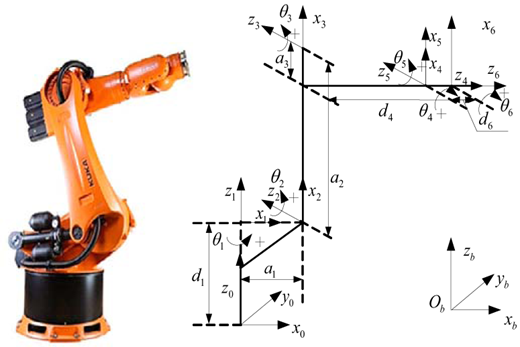
KR 500-3 robot and its coordinate system
KR 500-3 robot and its coordinate system
3. Positional error model
3.1 Geometric and non-geometric factors
The positioning error of industrial robots is composed of a variety of geometric and non-geometric factors, where the linkage deformations and joint deformations of robots caused by external loads need to be considered in most cases. For most industrial robots, the joint deformation caused by inadequate joint stiffness is the main part, which results in the positioning error. Thus, an important assumption is made that the industrial robot is regarded as a rigid linkage and flexible joint model, namely neglecting the linkage deflection caused by external loads.
According to this assumption, each joint can be treated as an elastic torsion spring that its elasticity coefficient is constant (Wang et al., 2009), and the error which is introduced by the insufficient stiffness is concretized as the joint angle error. Thus, the total angle error can be expressed as
where Δθs and Δθp represent the joint angle error caused by the joint stiffness and geometric factors, respectively. Δθetc is the error caused by other factors which is neglected.
For the error caused by geometric parameters, the traditional DH parameters are not applicable when the axis 2 and axis 3 of the robot are nominal parallel. Thus, a parameter β, the twist angle along direction y, is introduced. Because of the installation error or other relative effects, an angle Δβ2 which is usually in a small scale is introduced between the axis 2 and axis 3, which is along the direction of y2 (according to the right hand rule), shown in Figure 2(a). The xi, yi and zi represent the coordinate direction. Instead of Δd2, the error of the joint distance which is set as Δd2 = 0 under the condition, the Δβ2 is used to describe this deviation. Δa2 is a distance deviation between axis z2 and z3 along the direction of x2. Δα2 is the angle deviation between axis z2 and z3 around the direction of x2.
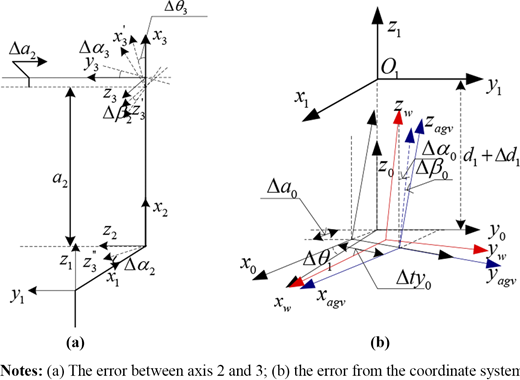
Schematic of the error. O-xagvyagvzagv: the constructed base coordinate system, O-xwywzw: the actual world coordinate system, O-x1y1z1: the coordinate system of fixed axis 1 of robot
Schematic of the error. O-xagvyagvzagv: the constructed base coordinate system, O-xwywzw: the actual world coordinate system, O-x1y1z1: the coordinate system of fixed axis 1 of robot
When the positioning deviation is under measurement, the robot basic coordinate system (O-xagvyagvzagv) is established that aims to overlap with the actual basic coordinate system (O-xwywzw). But it is impossible to make them coincident based on the existed technologies, which depends on the positioning accuracy and measurement accuracy. The error is shown as Figure 2(b). Thus, coordinate transformations are constructed, where ΔTaw and ΔTw1 represent the transformation from the basic coordinate system to the actual base coordinate system and the transformation from the real robot base coordinate to the coordinate fixed to the axis 1(O-x1y1z1), respectively. To simplify the model, the error transformations can be expressed as:
where the six parameters describing the error are Δty0, Δβ0, Δα0, Δa0, Δθ1 and Δd1. Among these parameters, Δty0 expresses the distance offset from the base coordinate to the actual robot coordinate system in the base coordinate system along the axis y0. Δβ0 expresses the angle deviation from zagv to axis z1 measured by zagv. Other four parameters are defined according to the rule of DH parameter.
3.2 Geometric and non-geometric parameter model of positional error
Considering both geometric and non-geometric parameters, the total number of the robot error parameters is 33, which includes 27 geometric parameters and 6 stiffness parameters. For the specific KUKA KR500-3 robot, its error parameters are listed in Table II. Notably particularly, it is necessary to eliminate non-independent variables before calculating because of the correlation among parameters.
The Error parameters of KR 500-3
| link i | Joint angleθi(∘) | Joint distance di(mm) | Joint deviation distance ai−1(mm) | Joint twist angle ∂i−1(∘) | y-axis torsion angle Δβi(∘) |
|---|---|---|---|---|---|
| Structure Parameters | |||||
| 1 | θ1 + Δθp1 + Δθs1 | d1 + Δd1 | Δa0 | Δ∂0 | 0 |
| 2 | θ2 + Δθp2 + Δθs2 | 0 | a1 + Δa1 | Δ∂1 - 90∘ | Δβ2 |
| 3 | θ3 + Δθp3 + Δθs3 | Δd2 | a2 + Δa2 | Δ∂2 | 0 |
| 4 | θ4 + Δθp4 + Δθs4 | d4 + Δd4 | a3 + Δa3 | Δ∂3 - 90∘ | 0 |
| 5 | θ5 + Δθp5 + Δθs5 | Δd5 | Δa4 | Δ∂4 + 90∘ | 0 |
| 6 | θ6 + Δθ6(ΔA,Δθ6s) | d6 + Δd6(Δtdz) | Δa5 | Δ∂5 - 90∘ | 0 |
| Tool Coordinate System | tdx + Δtdx | tdy + Δtdy | A + ΔA | ||
| Positional Deviation | Δty0 | Δβ0 | |||
4. The parameter identification model considering joint stiffness
According to the kinematic model, when the joint angle θ is known, the nominal position is defined as:
where a is the joint deviation, d is the joint distance, and α is the joint twist angle. Meanwhile, considering the errors from both geometric and non-geometric parameters, the actual position is expressed as:
Thus, the positioning error of robot can be expressed as:
To simplify the expression into the linear equation when the involved parameters are relatively small, this error can be represented as:
In this equation, J is the Jacobian matrix which is the derivative of the tool center point (TCP) of the robot with respect to geometric parameters. And J1(3×6) is a part of the J which includes the first six columns. ΔQ, ΔQp and ΔQs are respectively expressed as:
In the state of static equilibrium, the relationship between the external force of robot and the joint force is:
where Γ and Ff represent the external force and joint force, respectively. Ff contains both forces and torques, in the form as [Fx, Fy, Fz, Tx, Ty, Tz]T, which are measured under the force coordinate system. Jf is the 6 × 6 Jacobian matrix of the robot, calculated by using the differential transformation method. It describes the linear relationship between the velocity of TCP and the corresponding joint speed. With the relationship between the external force of robot and the joint force, the error Δθs can be represented as:
where Kθ and Cθ are the stiffness matrix and the joint adaptation vector, respectively, which are expressed as:
Substituting (12) into (7), the absolute positional error is obtained as:
where
When the measuring points are in the number of N, the error can be expressed as:
Using the least square method, the least square solution of (15) is obtained, and the iteration makes ΔP verge to 0.
5. Experiment
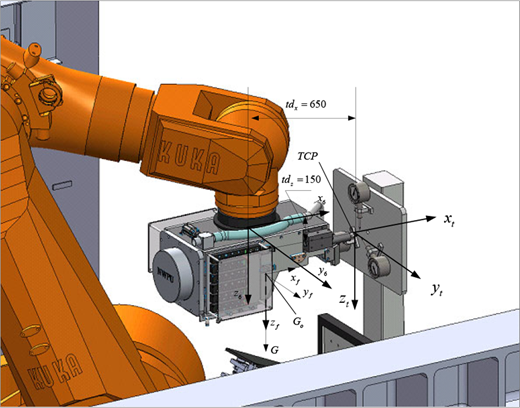
To test the performance of the proposed model, an experiment is developed on KUKA KR500-3 type robot with an end effector which is 1103.58 N, shown as Figure 3. The absolute position of TCP is measured by laser tracker. The flange coordinate system is translated to the center of the gravity of end effector, then the force coordinate system is created and the vector Ff is defined upon it. Therefore, the value of the vector Ff changes with the posture of tool coordinate system. One thing should be noted is that the influence from self-weight is not considered.
Twenty groups of joint positions are selected and converted based on robot joint coordinates. Then, the converted locations are sent to robot and their actual positions are measured, which are listed in Table III. To guarantee the accuracy, each point is measured 5 times after the robot arrives at the position. The measured data are divided into two groups, where the data of the first 15 points are used for the construction of the model and the data of the last 5 points are used for testing the validity of the robot. Substituting the results in Table III to equation (17) and setting the iteration termination condition as:
it can be calculated by MATLAB that rA = 33. Thus, the matrix A is column full rank, which means there are 33 independent variables. Therefore, it’s not necessary to remove relevant variables.
The position of measured points
| No. | θ1(°) | θ2(°) | θ3(°) | θ4(°) | θ5(°) | θ6(°) | px(mm) | py(mm) | pz(mm) | Fx(N) | Fy(N) | Fz(N) |
|---|---|---|---|---|---|---|---|---|---|---|---|---|
| 1 | 51.8876 | −64.1974 | 31.2652 | 180.8670 | −34.7215 | −319.4809 | 501.2187 | 1,460.3168 | 2,650.7974 | 486.858 | 570.254 | 16.742 |
| 2 | 62.9244 | −3.5251 | 55.0468 | 287.8476 | −79.8006 | −112.4795 | −1,934.2742 | −929.401 | 106.1919 | −489.996 | −472.616 | 314.703 |
| 3 | 47.7290 | −4.8094 | 31.0728 | 314.3727 | 19.6290 | −50.3342 | 747.1197 | 642.7241 | −1,089.1321 | −698.257 | 138.962 | 235.853 |
| 4 | 156.4787 | −86.9572 | 72.1386 | −204.8011 | −54.2309 | −152.7702 | 905.4033 | −1,098.991 | 576.2688 | 65.627 | 745.481 | 49.516 |
| 5 | −102.3094 | −36.0818 | 26.1144 | −240.1487 | −103.8645 | −201.4592 | −686.2284 | −319.5266 | 605.3495 | 355.361 | −224.578 | −621.115 |
| 6 | 73.5625 | −40.5295 | 135.3407 | 130.5171 | 58.1248 | 213.9446 | −52.3411 | 1,620.4519 | 58.9349 | −721.377 | −197.866 | 54.447 |
| 7 | −92.7150 | −46.4446 | −44.3108 | −270.1097 | −58.6449 | −46.6023 | −229.7357 | −684.7827 | 3,295.2156 | 650.937 | −344.503 | −141.769 |
| 8 | −133.7822 | 0.4666 | −70.4760 | 16.8939 | −13.1323 | 257.8677 | 117.3119 | −2,449.8263 | −416.5125 | 198.759 | 494.390 | −527.801 |
| 9 | 37.7173 | −85.7690 | −69.5721 | 20.1789 | 42.8175 | −72.3633 | −2,003.7123 | −287.7133 | 441.2528 | 269.119 | −694.934 | −84.511 |
| 10 | −17.5266 | −78.1744 | −80.2595 | 240.1580 | −32.0960 | 178.9611 | 16.3885 | 992.646 | 984.5409 | −253.999 | 701.855 | −73.375 |
| 11 | −14.5080 | −106.5119 | −1.2184 | −10.0725 | 53.8855 | −68.6336 | −329.3199 | −2,061.7682 | 382.5754 | 370.037 | −6.172 | 2.114 |
| 12 | 56.9236 | 10.4257 | 8.9328 | −70.8515 | −24.0067 | 205.1619 | −721.8295 | −1,003.226 | 1,610.0954 | 6.102 | −2.368 | −3.662 |
| 13 | 95.0054 | −31.5089 | −10.2038 | 114.0017 | 41.8188 | 169.6263 | 1,200.1913 | 1,132.176 | 1,346.6274 | −2.207 | 4.649 | −5.456 |
| 14 | −52.6484 | −55.1765 | 81.9804 | 160.4365 | 46.5228 | −81.5320 | 162.3543 | 375.1391 | −829.4882 | −5.592 | −1.198 | −4.853 |
| 15 | 56.9464 | −32.3973 | 50.5464 | 13.3349 | −13.1544 | −188.8474 | 2,369.8822 | 559.102 | 1,691.4481 | 6.768 | −1.144 | −3.023 |
| 16 | −16.2587 | −120.6932 | 53.9811 | 23.6404 | 59.1152 | 18.2717 | −101.2094 | 786.2615 | 3,343.3189 | 5.701 | −2.228 | −4.334 |
| 17 | −147.3823 | −85.2634 | −78.0664 | −273.5921 | −117.5192 | 160.7966 | 298.3035 | 384.7125 | 120.5957 | 6.134 | −3.939 | 1.761 |
| 18 | 183.2942 | −123.0473 | −80.2696 | 228.0662 | −108.3726 | 145.0774 | 316.7298 | −79.8154 | 293.6327 | −6.935 | −2.118 | −1.916 |
| 19 | −62.1257 | −54.1858 | 89.6467 | −113.3316 | 40.2999 | 196.9639 | 237.0330 | −498.1911 | 548.5982 | 2.609 | 1.272 | −6.915 |
| 20 | −74.9817 | −15.7861 | 120.8529 | −144.2189 | 24.8323 | −148.4161 | 914.4789 | 63.7062 | 725.0378 | −6.257 | −2.565 | 3.244 |
To verify that considering joint stiffness can improve the accuracy of parameter identification, the compared experiment is taken which only considers 27 geometric parameters without the joint stiffness. Using the proposed model to iteratively calculate, the results show that ΔP of both considering and non-considering joint stiffness verges to 0. The results of considering the stiffness and not considering the stiffness are shown in the Table IV.
Calculated error parameters
| i | Δ∂i−1/(°) | Δθi/(°) | Δβi−1/(°) | Δdi/(mm) | Δai−1/(mm) | kθi/(°) | others |
|---|---|---|---|---|---|---|---|
| 1 | 0.9151/0.9147 | 0.8166/0.8067 | 0.6793/0.6643 | 0.4163/1.3581 | 1.0858/1.0741 | 3.6122e9 | Δty0 |
| 2 | −0.7911/−0.7953 | 0.9048/0.9282 | / | / | 0.9734/1.0467 | 2.6513e9 | 0.8775/0.8277 |
| 3 | −0.9605/ −0.9557 | 0.9412 | 0.9346/0.9285 | 0.4891/0.6767 | −0.4349/−0.2737 | 3.5621e9 | Δtdx |
| 4 | 0.6593/0.6565 | 0.9105/0.9554 | / | −0.9680/−1.0116 | 0.8070/0.9041 | 2.6359e9 | 0.7310/0.5475 |
| 5 | 0.0364/0.0279 | 0.9709 | / | 0.9670/0.2143 | 0.1000/−0.2137 | 1.3969e9 | |
| 6 | −0.8443/−0.8072 | 0.1014/0.0731 | / | −0.1562/0.2093 | 0.3897/0.4632 | 1.3302e8 |
Note:
Considered stiffness/not considered
To modify the data of last five groups in Table III, the results in Table IV are used. The comparison between theoretical data and modified data is shown in Figure 4. It is clear that the results calculated by the model considering the joint stiffness have smaller errors along all three directions than the non-considered one, which means the modified data are closer to the actual value where the error can be within 0.5 mm. Thus, with the loads, the model considering the joint stiffness can improve the absolute positioning accuracy remarkably. Moreover, from the figure, the results from the model not considering joint stiffness have larger differences, indicating the bad stability. On the contrary, the results from the model considering joint stiffness are more stable, having smaller differences in different positions. Also according to the calculation of the standard deviation, the model considering joint stiffness has better stability and smaller volatility.
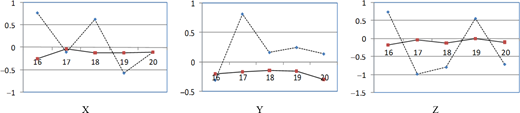
The comparison between actual data and rectified data (mm). ---considering joint stiffness, ----not considering joint stiffness
The comparison between actual data and rectified data (mm). ---considering joint stiffness, ----not considering joint stiffness
6. Conclusion
The parameter identification is an important part of robot calibration, and an unneglectable positional error during calibration is the compliance error. To improve the positional accuracy, this study integrates the joint stiffness parameter into the geometric parameter identification model and proposes a more accurate model. To test the accuracy and performance of the proposed model, a calibration experiment on KUKA robot KR500-3 is performed, using mathematical model to process the data which are acquired via laser tracker. Comparing two kinds of results which one considers the joint stiffness and the other does not, the result indicates that the model considering joint stiffness can better reflect the actual condition of robot with better stability.
This work is partially supported by the National Science Foundation for Young Scientists of China (Grant No. 51805438) and the “111 project” of China (Grant No. B13044).

