


UN/IFR World Robot Statistics 1998
UN/IFR World Robot Statistics 1998
Keywords Robotics,Robots, Statistics
Record investment in industrial robots in 1997.
A robust growth in industrial robot investment is forecast for North America and Europe until 2002 for Japan and other Asian countries previous forecasts are revised downwards.
The number of robots per employee in industry continues to rise sharply.
In the next ten to 15 years, dedicated service robots will be used extensively in a wide range of professional applications as well as in homes. A new substantial business area will be created.
These are a few of the conclusions drawn in the World Robotics 1998 Statistics, Market Analysis, Forecasts, Case Studies and Profitability of Robot Investment just published by the United Nations Economic Commission for Europe (UN/ECE), in cooperation with the International Federation of Robotics (IFR).
Record investment in industrial robots in 1997
In 1997, a record number of 85,000 industrial robots were installed worldwide, surpassing for the first time the previous record of 1990 (see Table I and Figure 1). In the same period,Japan's share of new robot installations fell from 74 percent of the world total to 50 percent, marking a clear trend towards deceleration of the automation drive in that country. Although the 1997 robot investment in Japan was 43 percent higher than in the trough year of 1994, it was still only 70 percent of the record 1990 level.
For the USA and the major western European countries, on the other hand, robot investment was booming and in both 1996 and 1997 all-time records were set. The 1997 robot investment in the USA, for instance, was almost three times as large as in 1990. In the UK it was 2.5 times larger and about 50 percent larger in Germany and Italy but only 16 percent larger in France.
One consequence of the slowdown in robot investments in Japan, compared to the booming 1980s and early 1990s, is that a large share of new robot installations is made up of replacement investment. While almost 43,000 new robots were installed in 1997,the stock of operational robots only increased by an estimated 13,000 units. In other words, more than two thirds of all the new robots replaced older robots.
... but the value of the world robot market is slightly falling
In 1997, the market for industrial robots, in terms of units, increased by 6 percent. Total market value, however, fell by about 4 percent over 1996 to $4.8 billion. This drop in the world market, in dollar value, is mainly explained by the fact that the dollar appreciated against most other currencies. In this context it should be noted, however, that the value of robot shipments only accounts for 30 percent on average of the total system cost.
The market in the USA increased from $485 million in 1990 to almost $1,100 million in 1997. After the record year of 1996, it was expected that the market in Germany would fall back in 1997. The fall was, however, only 13 percent, in terms of DM, and the market amounted to about 1 billion DM. The market in the Republic of Korea, on the other hand, plummeted by almost 50 percent over 1996 to $143 million. While the UK market surged by 32 percent to £66 million, France recorded zero growth and a market of FF 585 million. The Italian market grew by 5 percent to 410 billion lire.
Forecast to 2001 and inclusive Europe and North America are catching up
Worldwide investment in industrial robots is forecast to be about 40 percent higher in 2001 than in 1997. In the six major economies, almost the same growth is projected (see Table I). Taking into account the fact that a rising share of robot investment is directed toward replacement investment, in particular in Japan, the stock of robots in operation is forecast to increase from about 710,000 units in 1997 to about 870,000 units in 2001, an increase of 23 percent. This forecast is significantly lower than the forecast in previous years, which is exclusively the result of significant revisions downwards of the forecasts for Japan and other Asian countries.
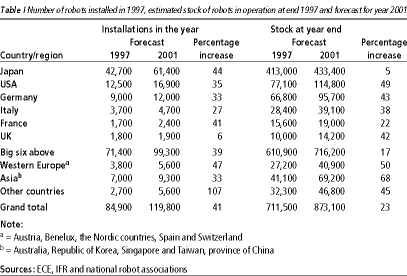
While the stock of robots is projected to grow by only 5 percent in Japan between 1997 and 2001, it is projected to increase between 20 percent (France) and 50 percent (USA) in the other major economies (see Table I). Western Europe, excluding the four major economies, is also projected to have a robot stock in 2001 which will be 50 percent higher than in 1997. One can therefore conclude that although Japan continues to be the country with the highest penetration of industrial automation, the balance of automation is swinging back toward Europe and North America.
The robot density continues to rise more robots per employee
When comparing the rate of diffusion of industrial robots in various countries, the robot stock, expressed in the total number of units, can sometimes be a misleading measure. In order to take into account the differences in the size of the manufacturing industry in various countries, it is preferable to use a measure of robot density. One such measure of robot density is the number of robots per 10,000 persons employed in the manufacturing industry.
Japan has by far the highest density of robots. In 1997, it amounted to 277 units per 10,000 persons engaged in manufacturing industries. Germany had the second highest with 90 units, followed by Sweden and Italy with just over 60 (see Figure 1)[1]. In the other countries in western Europe, Australia and the USA, the density ranged between about 20 and 40 units.
Relative prices of robots continue to fall
The unit value of robots for USA, Germany, Italy, France and UK peaked at just under $110,000 in 1991. Since 1990, there has been a continuous fall in the unit price of industrial robots. In terms of national currencies, the unit price fell by 21 percent in the USA between 1990 and 1997. In the same period, it fell by 25 percent in Germany, 19 percent in the UK and a record 41 percent in France. In Italy, on the other hand, it fell by only 5 percent.
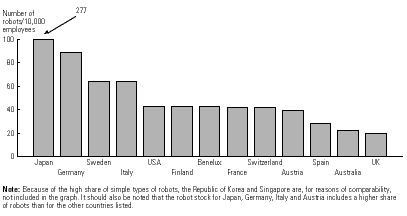
Figure 1 Number of industrial robots per 10,000 persons employed in the manufacturing industry, end 1997
The relative price of robots, i.e. the price of robots for a given set of performance indicators, in relation to labor costs has been falling rapidly. Since 1989, prices of robots relative to employee compensation in the business sector have fallen by between 30 percent and 50 percent in the USA, Germany and France, although there was a slight reversal of this trend in 1996 in the first two countries. It should be noted, however, that these calculations of relative prices do not take into account the improvements made in the quality and efficiency of robots, factors which would, if included, have made relative prices fall even more. Data on different types of robots being installed strongly indicate that for many countries there has been a gradual shift toward a higher share of more sophisticated robots. The calculations of relative prices above thus underestimate the true relative prices. With rising labor costs and falling price/performance ratio for robots, manual operations will successively be replaced with robotic solutions.
Figure 2 compares the index of labor compensation in the business sector in the USA with the index of the average unit price of robots being installed, illustrating the widening gap between the two indices, the so-called "crocodile gap".
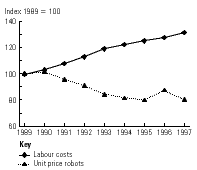
Figure 2 Index of labor compensation in the business sector and of unit price of robots in the USA
The food and agriculture industries the robotization drive has not yet taken off as previously projected
The use of robots has become established in the automotive industry and is showing significant growth in electronics. For a number of years the food sector has been forecast to become the next major user of robots. This forecast has been based largely on the need for increased automation coupled with the significant numbers of personnel involved in basic handling operations in this sector.
In the case of the food sector the main drivers to encourage automation are worker health issues, due to highly repetitive handling of tasks and, increasingly, hygiene. The increasing need for flexibility has encouraged the drive to robots as an alternative to other forms of automation. However, the difficulties of application,particularly processing speed and the nature of the product, coupled with the relatively low labor costs prevalent throughout the food sector, have delayed the anticipated growth.
World Robotics 1998demonstrates the low uptake of robots in this sector and also the slow growth to date. It is difficult to obtain a clear picture of the current situation without data from the USA, which is generally acknowledged as being one of the largest users of robots for food applications. However, it can be seen that the number of robots supplied to the food sector is still in the low single figure percentages of the total installations of the major robot users such as Japan, Germany and France.
Two major factors which are impeding the uptake of robots into this sector relate to the expertise and experience of the engineers in both the users and suppliers. A typical food plant consists of either highly automated machinery or manual operations. There is very little that is similar to a robot system, particularly in the combination of disciplines required to specify, develop and implement robot systems. The robot suppliers and their system integrators may have a great deal of experience of robot applications but most of this has been gained within the automotive and electronics industries. The food industry has specific requirements and modes of operating that differ from both these sectors. These differences introduce a communications barrier and a gap in understanding which is impeding the introduction of robots.
However, there is still a widespread belief that there will be significant growth in robot applications in the food sector. The robot suppliers are making increasing efforts to tailor their products to meet the needs of the sector. The existing equipment suppliers to the food industry are also either developing their own machines or using robots from the major suppliers. These strategies are helping to remove the"cultural" barrier and make applications more likely. At the same time labor costs are increasing and particularly food cleanliness requirements are making robot installations more cost effective.
Service robots an area which is expected to take off in the next ten to 15 years
Statistics on the diffusion of service robots are very scarce and incomplete. Based on sales figures from some leading manufacturers, the total world stock can be estimated at a few thousand but certainly below 10,000 units. For instance, when cleaning robots, lawn-mowing robots and other types of service robots have reached such a level of costeffectiveness that they are affordable not only for professional use but also for households then the market for service robots could take off in the same way as it did for the PC. Other important growth areas for service robots are household robots (household equipment is increasingly being equipped with microcomputers, and will eventually be controlled by a central home PC in such a system configuration the service robot would be an ideal component), robots for handicapped and disabled persons, surgical robots,safeguarding and patrol robots and repair robots.
The publication World Robotics 1998 Statistics, Market Analysis, Forecasts, Case Studies and Profitability of Robot Investment is available, quoting Sales No. GV.E.98.0.25, through the usual United Nations sales agents in various countries or from the United Nations Office at Geneva (see address below), priced at US$120. Sales and Marketing Section, United Nations, Palais des Nations, CH-1211 Geneva 10, Switzerland. Tel: +41 (22) 917 26 06/26 12/26 13; Fax: +41 (22)917 00 27; E-mail: unpubli@unog.ch
For more information about the publication, please contact Mr Jan Karlsson, Statistical Division, United Nations Economic Commission for Europe (UN/ECE), Palais des Nations, CH-1211 Geneva 10, Switzerland. Tel: +41 (22) 917 32 85; Fax: +41 (22) 917 00 40;E-mail: jan.karlsson@unece.org
Note
1The Republic of Korea and Singapore would have had the second and third highest density but as these countries have a very high proportion of very simple robots they are for reasons of comparability excluded from this ranking.

