
Skip to article sections
Purpose

This research investigates how social media (SM) marketing activities influence brand loyalty and brand awareness in India’s telecommunications industry. It also aims to explore the role of customer satisfaction as a mediator in the relationship between SM marketing efforts and brand outcomes.

Design/methodology/approach

A quantitative method based on the stimulus–organism–response (S–O–R) theory was employed for this study. A quantitative research approach was utilized, employing a structured questionnaire distributed to 209 SM users of telecommunications service providers in the Tricity area of India (comprising Mohali, Chandigarh and Panchkula). The data were examined using partial least squares structural equation modeling via SmartPLS.

Findings

The findings indicate that SM marketing activities significantly enhance both brand loyalty and brand awareness. Furthermore, customer satisfaction serves an important mediating role, strengthening the connection between SM marketing and brand outcomes. The research underscores that active consumer engagement on SM platforms fosters improved brand perceptions. For telecom managers, these findings suggest that SM strategies focused on responsive, service-oriented customer interaction – rather than promotional content alone – are likely to be the most effective route to building both brand loyalty and brand awareness.

Originality/value

This study’s contribution is empirical and contextual: it is among the first to test the SMMA–customer satisfaction–brand loyalty/awareness chain in a large, digitally transitioning telecom market, showing that satisfaction only partially mediates these relationships – a pattern that points to market-specific forces (e.g. network reliability, price sensitivity, informal digital communication norms) not captured in prior applications of the S–O–R model in retail, tourism or hospitality settings.

In the fast-changing digital environment, social media (SM) has revolutionized marketing by enabling businesses to engage with consumers directly and instantly (Hafez, 2021; Wilopo & Nuralam, 2025). Research indicates that SM ads outperform traditional advertising by 55% (Seo & Park, 2018), and around 91.9% of companies with more than 100 employees utilize SM in their marketing approaches (Chaffey & Smith, 2022). SM marketing activities have become influential in shaping consumer behavior, encouraging brand–consumer interactions and strengthening brand loyalty and awareness (Chen & Lin, 2019). These activities are critical for fostering consumer engagement, allowing brands to stay competitive amid rapid digital advancements (Kumar & Hsieh, 2024). Nonetheless, SM branding remains a contentious issue. Some research highlights the effectiveness of SM marketing activities in cultivating brand awareness and loyalty (Ali, Suveatwatanakul, Nanu, Ali, & Terrah, 2025; Laroche, Habibi, & Richard, 2013), while other studies suggest that consumers may view brands on SM as intrusive or lacking authenticity (Fournier & Avery, 2011). This divergence of opinions reveals an ongoing debate regarding the contribution of SM marketing activities to brand-building, warranting further investigation (Zollo, Filieri, Rialti, & Yoon, 2020). Although past studies have examined the influence of SM marketing activities on purchase intentions, revenue and consumer attitudes (Dolega, Rowe, & Branagan, 2021; Godey et al., 2016), there is a substantial gap in understanding how these activities affect brand loyalty and brand awareness, particularly in developing markets (Ebrahim, 2020; Hafez, 2021; Zeqiri et al., 2025). As the market for SM marketing activities is anticipated to reach $255 billion by 2028 (Statista, 2024), their significance in digital marketing continues to grow. Yet, their impact on brand loyalty and brand awareness in developing economies remains insufficiently researched (Kumar & Hsieh, 2024). Previous findings have largely focused on sectors such as tourism, transportation, hospitality and retail, leaving the telecommunications industry underexplored (Ibrahim, 2022).

Given the escalated emphasis on SM marketing activities for sustaining brands, this study aims to analyze how these activities influence brand loyalty and brand awareness within India’s telecom sector. The telecommunication industry faces challenges in achieving successful digital transformation, with only 30% of global initiatives resulting in favorable outcomes (Oh, Kim, & Shin, 2022). Though 16–34% of organizations worldwide report notable digital advancements, India’s digital landscape is less developed, with a success rate projected below 30% (Al-Moaid & Almarhdi, 2024). Despite advancements in technology, India’s telecommunications sector still grapples with significant digital infrastructure deficiencies, hindered by obstacles to Information and Communication Technology (ICT) development (Asadi & Nosary, 2021). The late shift from traditional telecom services (like Short Message Service (SMS) and voice calls) to over-the-top applications such as WhatsApp and Zoom complicates this scenario (Valdez-de-Leon, 2016), as this transition happened later than in other regions, pushing telecom companies to expedite their digital transformation to remain competitive. While SM marketing activities open up new avenues for these firms, they also present challenges in engaging consumers and positioning brands effectively. A crucial factor affecting the success of SM marketing activities is customer satisfaction. As an integral part of consumer–brand relationships, customer satisfaction fosters emotional connections, shapes brand perceptions and enhances engagement (Ibrahim & Aljarah, 2023). When customers are satisfied, they are more inclined to be loyal to a brand and promote it, further bolstering brand awareness and credibility (Helme-Guizon & Magnoni, 2019). Despite its importance, the role of customer satisfaction as a mediator between SM marketing activities and brand loyalty and brand awareness has not been thoroughly examined. Understanding this mediating effect is vital for discerning how SM marketing activities contribute to enduring brand success in emerging markets. Therefore, this study will investigate the influence of SM marketing activities on brand loyalty and brand awareness in India’s telecom sector and will also delve into the mediating role of customer satisfaction. By integrating these elements, this research aims to yield valuable insights for marketers, telecommunications firms and policymakers striving to enhance SM engagement strategies in developing economies. Additionally, while many studies have applied the stimulus–organism–response (SOR) theory across various sectors (Ibrahim & Aljarah, 2023; Jamil et al., 2021), its applicability to the telecommunications industry in markets like India has yet to be fully explored. This study extends the SOR framework by incorporating SM marketing activities, customer satisfaction, brand loyalty and brand awareness into a unified model, underscoring the mediating role of customer satisfaction in fortifying consumer–brand relationships. This approach will enrich our understanding of how digital marketing strategies influence customer satisfaction and brand-related outcomes in emerging markets.

Recent research on digital consumer behavior in India highlights the rapid shift toward mobile-first consumption and its influence on service adoption and brand interactions. India’s smartphone penetration and affordable data plans have dramatically increased time spent on digital platforms, shaping expectations for immediacy, personalization and social engagement (Kemp, 2023; Statista, 2023). Studies show Indian consumers increasingly rely on SM and messaging apps for product discovery and customer service, which directly affects how telecom services are evaluated and chosen (Agarwal & Jain, 2020). The Indian telecom market has unique characteristics – intense price competition, high churn and regulatory shifts – that condition how marketing and digital engagement translate into loyalty (Datta & Ray, 2019). Research indicates that service quality dimensions (reliability, network coverage, customer service responsiveness) remain core determinants of satisfaction, but digital touchpoints and SM presence are now critical moderators of perceived service value (Ghosh & Bose, 2021). These dynamics suggest that SMMA may operate differently in India compared with mature markets, underscoring the need to integrate country-specific consumer behavior literature into the theoretical framing.

This research makes three significant contributions to the existing literature. Firstly, it expands the stimulus–organism–response (S–O–R) framework to the Indian telecommunications industry, a field that has not been extensively studied. Secondly, it analyzes brand awareness and brand loyalty as unique outcomes of SM marketing activities. Lastly, it explores the mechanism by which SM marketing activities affect brand outcomes by looking into the mediating role of customer satisfaction. Together, these contributions enhance our understanding of consumer–brand dynamics in developing digital markets. This study does not propose a new mediation mechanism; rather, its value lies in empirically validating and extending an established framework within an under-studied, high-growth and structurally distinct market context.

In summary, this study aims to answer the following research questions:

RQ1.

What effect do SM marketing activities and customer satisfaction have on brand loyalty and brand awareness?

RQ2.

Does customer satisfaction mediate the relationship between SM marketing activities and both brand loyalty and brand awareness?

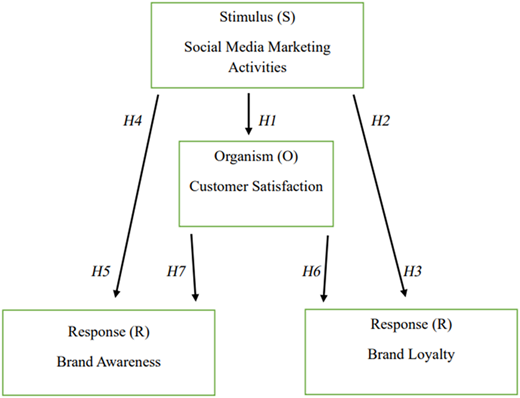
The S–O–R theory, first articulated by Mehrabian and Russell in 1974 and later refined by Jacoby in 2002, elucidates how external stimuli activate internal cognitive and emotional processes, which subsequently lead to behavioral reactions. This framework has been extensively utilized in marketing research, especially within advertising (Lacroix, Jolibert, & Valette-Florence, 2020) and studies of consumer behavior in digital marketing (Cheung, Pires, Rosenberger, Leung, & Ting, 2021; Yadav & Rahman, 2017). The S–O–R model is significant for understanding how SM marketing activities act as stimuli that affect consumer perceptions and levels of engagement, ultimately influencing brand loyalty and awareness. In SM marketing, these activities serve as external stimuli that shape consumer experiences through social networks (Ibrahim & Aljarah, 2023). Based on the S–O–R theory and prior research, this study proposes the model illustrated in Figure 1.

SM encompasses online platforms and communities that promote social interaction while allowing users to share their thoughts, experiences and announcements (Alalwan, Rana, Dwivedi, & Algharabat, 2017). SM provides vast opportunities for collective or individual consumer engagement and helps strengthen the customer–brand relationship (Ismail, Nguyen, & Melewar, 2018). It enables continuous communication among users, facilitating information dissemination and awareness (Jamil et al., 2021). Through SM, users can easily share their brand experiences and advice, influencing brand preferences and boosting brand awareness within their networks (Laroche, Habibi, Richard, & Sankaranarayanan, 2012). According to Lim, Pham and Heinrichs (2020), SM marketing activities foster trust, which is essential for building brand equity. SM platforms connect individuals who utilize these networks (Ebrahim, 2020). Numerous studies have highlighted the advantages of SM, demonstrating that it enhances information sharing and strengthens customer relationships with brands, products and other consumers (Laroche et al., 2012). Kozinets, de Valck, Wojnicki, and Wilner (2010) noted that SM’s broad networks offer ample opportunities for word-of-mouth marketing, reaching large audiences and enhancing consumer-to-consumer interactions, thus amplifying brand awareness. Companies leverage SM platforms to tailor their brands, enhance financial value and influence consumer purchasing intentions (Lim et al., 2020). Research in developing countries indicates that digital engagement varies notably due to infrastructure challenges, lower internet access and varying trust levels in online transactions (Achmadi, Eviana, Soerjanto, & Widiarto, 2023; Susanto & Ruswanti, 2024).

In India, ongoing political and economic issues influence digital adoption patterns, positioning SM not only as a marketing tool but as a critical platform for information sharing, strengthening brand trust and customer support (Alhakimi & Alwadhan, 2021). Unlike Western markets, where digital marketing is smoothly integrated into business strategies, Indian consumers often depend on informal communication and mobile social interactions due to inconsistent internet access and data security concerns (Al Harazi et al., 2023; Al-Halili & Hongxin, 2019). Various sectors maintain ongoing customer communication through SM marketing and advertising. To achieve effective marketing results, it is vital to create and leverage SM activities (Bilgin, 2018). Several prior studies have examined the impact of SM marketing activities across different industries (Bilgin, 2018; Ibrahim & Aljarah, 2018; Seo & Park, 2018; Sharawneh, 2020; Yadav & Rahman, 2017).

Kim and Ko (2012) identified five dimensions of SM marketing activities: entertainment, trendiness, interaction, customization and word-of-mouth (WOM). Seo and Park (2018) evaluated these dimensions within the airline service industry. Yadav and Rahman (2017) focused on informativeness in relation to interactivity, trendiness, personalization and WOM. Various studies have explored SM marketing activities according to their research objectives (Bilgin, 2018; Ibrahim & Aljarah, 2018; Ismail et al., 2018; Wang, Zhang, & Liu, 2024). SM is recognized as an effective platform for providing entertainment to users (Appel, Grewal, Hadi, & Stephen, 2020), as it offers joy and fun through user engagement (Alalwan et al., 2017). Interaction on SM details how individuals share brand experiences and satisfaction. Trendiness refers to a brand’s capacity to provide fresh and current content on SM (Naaman, Becker, & Gravano, 2011), with Kim and Ko (2012) noting that “trendy” and “latest information” are two crucial aspects of trendiness. Customization involves building customer satisfaction through communication between firms and consumers (Seo & Park, 2018). WOM encompasses the sharing of news and opinions regarding products, services and brands, impacting customer satisfaction (Loureiro, Gorgus, & Kaufmann, 2017). Advertising denotes marketing and promotional efforts conducted via SM to drive sales, enhance customer satisfaction and bolster brand awareness and Loyalty. Promotional activities and online advertising are identified as critical components of SM marketing activities (Alalwan et al., 2017; Bilgin, 2018). Given India’s infrastructural instability, consumers often turn to SM for brand engagement and decision-making (Alhakimi & Alwadhan, 2021) and to express concerns and seek prompt solutions to service issues. This creates a unique engagement paradigm, wherein customer satisfaction significantly influences brand loyalty and awareness (Naqvi, Ali, & Saha, 2021; Saha & Ali, 2024), further illustrating the applicability of the SOR theory in this context. Hollebeek, Glynn, and Brodie (2014) conceptualize brand engagement as a consumer’s cognitive processing, affection and activation in brand interactions. Vivek, Beatty, Dalela, and Morgan (2014) similarly describe engagement as a multidimensional construct involving participation and social interaction with a firm or brand. In SM environments, informative posts may stimulate cognitive engagement, emotionally appealing content may generate affection and interactive features such as comments, polls, live sessions and customer communities may encourage behavioral activation. For telecom providers, engagement may arise when consumers discuss network performance, participate in promotional campaigns, ask questions or share experiences with other users. Therefore, SMMA should be understood not merely as the firm’s communication output but as a set of activities that facilitates ongoing consumer participation and co-creation.

Customer satisfaction is pivotal in both online and traditional retail, significantly impacting the retention of existing clients and the acquisition of new ones (Rita, Oliveira, & Farisa, 2019). Both discreet and casual consumers typically assess prior customer reviews from various sources, including SM, validating claims made on websites and SM platforms before making purchases (Mirbabaei, Ahmadinejad, Hajmalek, Shojaeifard, & Laalkazemian, 2023). Hence, it is crucial to examine the quality of websites and other factors that enhance customer satisfaction throughout the customer service lifecycle (Celik, 2016). Kumar and Nayak (2018) describe customer satisfaction as the individual’s sense of contentment or dissatisfaction arising from comparing actual product or service performance against expected standards. They emphasize that customer satisfaction is vital for addressing the needs of both consumers and businesses. Yi and Nataraajan (2018) underscore that achieving customer satisfaction is a strategic priority for most firms seeking to remain competitive and ensure long-term success. Öztamur and Karakadılar (2014) and Ahmed (2016) found that SM, particularly through promotional and advertising efforts, significantly influences customer satisfaction. SM marketing activities serve as a valuable tool for gathering information about goods, services and emerging brands, through an integrated marketing approach (Arevin, Hamida, & Nainggola, 2024). Potential buyers can leverage SM platforms to access purchasing experiences (Evans, 2008). Sano (2014) outlines that SM marketing activities strongly impact customer satisfaction due to enhanced interactions between service providers and customers. SM facilitates the sharing of transparent information and unbiased opinions throughout the marketing process (Dwivedi et al., 2021; Jamil et al., 2021). When SM enables service firms to develop solid customer relationships, it is expected that customers will form emotional connections with the providers (Arevin et al., 2024). Ramanathan, Subramanian, and Parrott (2017) showed that when advertising and promotions interact with service operations, they significantly elevate customer satisfaction levels. Thus, we hypothesize the following:

H1.

SM marketing activities have a positive influence on customer satisfaction.

Brand loyalty is a well-defined concept, with most researchers agreeing that it includes both behavioral and attitudinal dimensions (Dávila Espuela, Reina Paz, & Sevilla Sevilla, 2023; Pan, Sheng, & Xie, 2012). Behavioral loyalty pertains to a consumer’s actions or intentions to repurchase a specific brand, while attitudinal loyalty relates to a consumer’s feelings and perceptions regarding specific products or services (Akhgari & Bruning, 2024; Althuwaini, 2022; Russell-Bennett & Parkinson, 2014). Brand loyalty is characterized as a strong, lasting commitment to repurchase a brand in the future, regardless of external changes (Sharawneh, 2020). While behavioral loyalty typically translates into a greater market share, attitudinal loyalty enhances perceived brand value (Taylor, Celuch, & Goodwin, 2004). Various factors contributing to customer loyalty have been identified (Ariffin, Nasir, & Nasrudin, 2021; Nguyen & Khoa, 2019). SM marketing platforms have emerged as powerful marketing tools for companies, enabling them to establish stronger relationships with customers (Althuwaini, 2022; Ebrahim, 2020). Cultivating a robust brand creates a unique preference among consumers, potentially leading to brand loyalty – a deep connection between the brand and its customers (Cardoso et al., 2022; Mostafa & Kasamani, 2020). Moreover, loyal customers are less likely to switch brands, feeling satisfied and secure with their choices (Ingemansson, Nilsson, & Vllasalija, 2015). Brands hold significant value for companies, prompting marketers to strive for improved visibility and appeal (Althuwaini, 2022). Fostering customer loyalty is vital in highly competitive industries, as firms continually seek to build lasting relationships with their customers (Althuwaini, 2022; Sharawneh, 2020). SM marketing activities provide opportunities for brands to strengthen connections with customers. Previous studies have analyzed how SM marketing activities influence brand-centric models – examining the relationships between customers and brands, services, products, companies and fellow consumers – ultimately fostering brand loyalty (Laroche et al., 2013). Bilgin (2018) found that SM marketing activities significantly and positively affect brand loyalty. Therefore, we propose the following hypotheses:

H2.

SM marketing activities positively influence brand loyalty.

H3.

Customer satisfaction positively influences brand loyalty.

Brand awareness refers to consumers’ ability to identify, acknowledge and recall a brand at any given time and location (Bilgin, 2018). Aaker (2011) categorizes brand awareness into four components: brand recognition, brand recall, the top-of-mind brand and the dominant brand. Brand awareness consists mainly of two elements: brand recall and brand recognition. Brand recall is the ability to remember brand characteristics without assistance when presented with a product or service, while brand recognition entails a consumer’s familiarity with the brand from prior encounters or knowledge (Keller, 2013). A well-managed brand can enhance customer satisfaction and increase customer value (Macdonald & Sharp, 2000). Additionally, brand awareness offers various critical indicators, such as providing satisfaction and appreciation, ease of recognition and the capability to influence purchasing decisions. Without awareness of available products or services, marketers will struggle to achieve high levels of customer satisfaction (Mirbabaei et al., 2023). Khan, Jadoon, and Tareen (2016) assert that advertising and promotions effectively raise brand awareness among consumers, which can result in loyalty if the consumer is satisfied with the brand’s quality. Previous studies indicate that SM marketing activities progressively and positively enhance brand awareness (Cheung, Pires, & Rosenberger, 2019; Wang et al., 2024). Despite the established effect of SM marketing activities on brand awareness, more in-depth exploration is warranted, particularly concerning the complex interactions among various SM marketing activities, such as entertainment, customization, trendiness, promotional efforts and WOM. A thorough examination of how these activities affect brand awareness is essential to fully understand the dynamics involved in brand awareness-building efforts in today’s digital landscape (Wang et al., 2024). Thus, we can propose these hypotheses:

H4.

SM marketing activities positively influence brand awareness.

H5.

Customer satisfaction positively influences brand awareness.

To build brand loyalty and brand awareness, prioritization of customer satisfaction is essential (Rane, Choudhary, & Kakhae, 2023). SM marketing activities create opportunities for consumers to engage with brands, share their thoughts and opinions, generate content and impact the public (namely potential customers) (Jamil et al., 2021). The impact of SM marketing activities on brand loyalty and brand awareness varies across different platforms, as each marketing tool and platform elicits distinct consumer perceptions (Ceyhan, 2019). Bilgin (2018) notes that SM marketing activities indirectly influence customer satisfaction. Some research indicates a significant positive indirect effect of customer satisfaction on brand loyalty and brand awareness (Büyükdağ, 2021; Widodo, Supriyadi, & Astuti, 2023; Zaato et al., 2023). SM marketing activities enhance customer satisfaction through features that promote interaction between customers and service providers (Anas et al., 2023; Sarassina, 2023). They also play a fundamental role in providing clear information or opinions during marketing efforts. SM marketing activities assist service firms in cultivating strong client relationships, leading to emotional engagement with service providers (Sano, 2014). Hussein (2018) suggests that positive customer experiences in settings such as hospitals or restaurants increase customer satisfaction and repeat visits, thereby fostering brand loyalty. Additionally, Arevin et al. (2024) show that customer satisfaction mediates the relationship between SM marketing activities and brand loyalty. Recent review research indicates that SM marketing effectiveness is multidimensional and depends on the interaction between firm-generated content, consumer engagement, platform characteristics and relationship outcomes. Dwivedi et al. (2021) identify SM marketing as a broad research domain involving advertising, engagement, influencer activity, customer relationships, analytics and electronic word-of-mouth. Appel et al. (2020) likewise argue that SM has altered the structure of marketing by increasing consumer participation, data-driven personalization and real-time interaction. More recent evidence in emerging-market research shows that SM marketing may influence awareness, engagement and purchase-related intentions, but the strength of these effects varies according to cultural, technological and economic conditions (Zeqiri et al., 2025). Therefore, we suggest the following hypotheses:

H6.

Customer satisfaction mediates the relationship between SM marketing activities and brand loyalty.

H7.

Customer satisfaction mediates the relationship between SM marketing activities and brand awareness.

While earlier research typically indicates favorable connections between SM marketing activities and brand outcomes, the results vary significantly across different industries and regions. Most of the existing studies focus on sectors like retail, tourism, hospitality and luxury but offer little empirical data from the telecommunications industry. Additionally, previous research has mainly examined direct correlations without thoroughly exploring the mediating factors that influence how SM marketing activities impact brand results. Consequently, more research is needed to explore these dynamics in emerging markets like India.

This study utilized a quantitative methodology, employing a structured questionnaire to gather data and evaluate the proposed model. Primary data were collected via an online questionnaire sent to 591 participants with SM accounts across various platforms. The Tricity region (Mohali, Chandigarh and Panchkula) was selected because it combines high telecom and SM penetration with the presence of all major national telecom operators, making it a suitable and accessible setting for studying social-media-driven brand engagement. A targeted purposive sampling method was used to select telecom SM followers, ensuring that participants had relevant experience in SM marketing. The effectiveness of this method has been confirmed in previous research (e.g. Alhakimi & Alwadhan, 2021). Participants were recruited from all telecommunications providers in the Tricity area of India (Mohali, Chandigarh and Panchkula), ensuring comprehensive sector representation. Out of 591 questionnaires distributed, 209 were returned and deemed suitable for analysis, resulting in a response rate of 35.36%. This final sample met the criteria for partial least squares structural equation modeling (partial least squares structural equation modeling [PLS-SEM]) as suggested by Henseler, Ringle, and Sarstedt (2016). The PLS-SEM literature indicates that the sample size should comprise at least ten times the number of structural paths and formative indicators used in evaluating constructs, as noted by Hair, Hult, Ringle, and Sarstedt (2022). Power analysis was performed to determine the minimum required sample size (Faul, Erdfelder, Lang, & Buchner, 2007), which, based on an 80% power level, a significance threshold of 5% and an effect size of 0.15 (Cohen, 2013), was calculated to be 68 cases. Thus, the sample size of 209 responses was considered sufficient. The data collection process extended over four months, from December 2025 to January 2026. Table 1 outlines the sample characteristics. The sample was largely composed of male participants, accounting for 91.9% of respondents. This representation mirrors the demographic characteristics of those who chose to take part in the online survey during the data collection phase. Although this gender discrepancy might restrict the applicability of the results to a wider population, the main focus of the study was to investigate the relationships between constructs rather than to compare differences by gender. The sample was predominantly male (91.9%), which reflects who self-selected into the online survey rather than a deliberate sampling choice. This imbalance may be partly attributable to the channels used for distribution and to gender differences in willingness to respond to unsolicited online surveys in this context. Because gender was not a focal variable, hypothesis testing was not expected to be biased by this imbalance; however, the generalizability of the findings to female telecom consumers specifically is limited.

The questionnaire was crafted based on earlier studies to ensure the validity of the measurement items. SM marketing activities were evaluated using 19 items (Althuwaini, 2022; Bilgin, 2018; Ebrahim, 2020; Kim & Ko, 2012; Manivannan, 2021), while brand loyalty and brand awareness were assessed with 9 items (Bilgin, 2018; Tharakeswari, 2021), and customer satisfaction was measured with 5 items (Hanaysha, 2017). The items were adjusted and refined to fit the context of the study, employing a 5-point Likert scale ranging from 1 (strongly disagree) to 5 (strongly agree). All items were adapted from previously validated scales cited above. Adaptation involved rewording items to refer specifically to telecom service providers and to SM platforms. The adapted item pool was reviewed by eight academics for face and content validity, and wording was revised based on their feedback. This study did not undertake a separate pilot study before the main survey because the questionnaire was adapted from previously validated measurement scales.

To evaluate common method bias (CMB), Harman’s single-factor test was conducted using principal component analysis (Harman, 1976). The findings showed that the first component explained 34.21% of the total variance, significantly lower than the 50% threshold suggested by Podsakoff, MacKenzie, Lee, and Podsakoff (2003), indicating no CMB concerns. Additionally, variance inflation factors (VIFs) were analyzed to assess multicollinearity. The VIF values ranged from 1.06 to 2.184, well below the 3.3 limit indicated by Kock (2015) and far from the acceptable maximum of 10 proposed by O’Brien (2007). These findings suggest that multicollinearity is not an issue and that CMB does not threaten the integrity of this study.

For data analysis, the study employed the “PLS-SEM” approach using SmartPLS 3.0 software, which provides analytical accuracy and reliable estimates (Sarstedt, Radomir, Moisescu, & Ringle, 2022). This method was chosen for its appropriateness for model specification, ease of use and absence of strict distributional assumptions (Sarstedt et al., 2022).

As previously stated, the PLS-SEM approach was used to analyze the relationships among the variables. This analysis occurred in two stages: first, evaluating the measurement model, and second, assessing the structural model.

In accordance with Hair, Risher, Sarstedt, and Ringle (2019), the measurement model was examined for internal consistency, reliability, convergent validity and discriminant validity. Internal consistency was measured using Cronbach’s alpha (α), with all dimensions surpassing the recommended level of 0.70 (see Table 2). Furthermore, factor loadings, composite reliability (CR) and average variance extracted (AVE) were calculated to confirm both reliability and validity (Anderson & Gerbing, 1988). Table 2 indicates that, after removing items with loadings below 0.60 (SM marketing activities 1, SM marketing activities 5, SM marketing activities 7 and SM marketing activities 8), the remaining items exhibited loadings greater than 0.60, reflecting strong consistency with their respective constructs (brand awareness – Gozzi & Yi, 1988). This consistency is further supported by other validity metrics (e.g. CR and AVE), with CR values above 0.70 and AVE meeting the minimum acceptable criterion of 0.50, confirming satisfactory convergent validity (Hair et al., 2019). For discriminant validity, the heterotrait–monotrait (HTMT) ratio was utilized. The HTMT values were below the 0.90 threshold, confirming the distinctiveness of the constructs (Hair et al., 2019; Henseler et al., 2016), as summarized in Table 3.

Once the measurement model’s psychometric properties were verified for reliability and validity, the structural model was evaluated in accordance with the suggestions of Hair et al. (2019). This involved four methods: the coefficient of determination, path coefficients (β), effect size and predictive relevance. The hypothesis tests outlined in Table 4 showed that SM marketing activities positively and significantly correlated with customer satisfaction, brand loyalty and brand awareness, thus supporting H1, H2 and H3 (β = 0.676, β = 0.266 and β = 0.303, respectively). Additionally, customer satisfaction was found to be significantly related to brand loyalty and brand awareness, thus supporting H4 and H5 (β = 0.538; β = 0.437).

Furthermore, an indirect analysis was conducted to determine whether customer satisfaction serves as a mediator between SM marketing activities, brand loyalty and brand awareness, in line with research by Al-Swidi, Gelaidan, and Saleh (2023), Sarstedt, Hair, Pick, and Ringle (2020) and Hair et al. (2021). The results presented in Table 5 indicate that customer satisfaction partially mediates these relationships, supporting H6 and H7. According to Chin (1998), the coefficient of determination’s effect size classification is as follows: 0.67 = strong, 0.33 = medium, 0.10 = weak. The R2 values for brand loyalty and brand awareness were 55.4% and 46.2%, respectively, as explained by SM marketing activities and customer satisfaction (R2 = 0.554; 0.462). In contrast, 45.7% of customer satisfaction was accounted for by SM marketing activities (R2 = 0.457), as detailed in Table 6. Additionally, the values for f2, which assess the effect size for each predictor and are categorized as “low,” “medium” and “high” (0.02, 0.15 and 0.35), showed that SM marketing activities had a low effect on brand loyalty and brand awareness (0.086; 0.093) but a high impact on customer satisfaction (0.843). Conversely, customer satisfaction significantly influenced brand loyalty (0.352) and moderately affected brand awareness (0.192), as shown in Table 6.

Furthermore, the model’s predictive relevance was assessed using Stone–Geisser’s Q2. The Q2 values for the internal structure were 0.374 for brand loyalty, 0.329 for brand awareness and 0.321 for customer satisfaction, indicating sufficient predictive relevance (as per Table 6), as all results were greater than zero (Hair et al., 2022).

This study explored the impact of SM marketing activities (SMMA) on customer satisfaction, brand loyalty and brand awareness within the Indian telecommunications industry, while also evaluating the mediating role of customer satisfaction using the stimulus–organism–response (S–O–R) model. The results highlight that SM marketing is a significant factor influencing customer and brand outcomes.

The analysis indicated a strong positive relationship between SMMA and customer satisfaction (β = 0.676; p < 0.001), supporting H1. This aligns with earlier research showing that SM interactions enhance customer experiences and satisfaction (Kim & Ko, 2012; Yadav & Rahman, 2017; Seo & Park, 2018). This relationship is the strongest among all direct correlations, suggesting that SM functions primarily as a tool for relationship-building and improving customer experience in the telecommunications sector. An explanation for this might be that telecom customers frequently turn to SM for service information, assistance and resolution of complaints, making these interactions crucial for their satisfaction.

Comparing effect sizes across the direct paths clarifies the mechanism at work. The SMMA → customer satisfaction path (β = 0.676) is more than twice as strong as the SMMA → brand loyalty (β = 0.266) and SMMA → brand awareness (β = 0.303) paths, and this is reflected in the f2 effect sizes, where SM marketing activities has a high effect on customer satisfaction (f2 = 0.843) but only a low direct effect on the two brand outcomes (f2 = 0.086 and 0.093). Within an S–O–R framing, this pattern is consistent with customer satisfaction functioning as the primary organism-level process through which the stimulus is converted into an attitudinal response: SM marketing activities appear to act mainly by shaping the customer’s internal evaluative state, with brand-level outcomes following substantially through that state rather than occurring as an independent, parallel reaction to the stimulus itself. This is further supported by the partial mediation results (Table 5), which indicate that while customer satisfaction carries the majority of the effect, a smaller but still significant direct path remains, suggesting that SM marketing activities also have a residual direct influence on brand outcomes not routed through satisfaction – for example, through direct visibility and recall effects on brand awareness that do not require a satisfying service interaction.

Moreover, SMMA positively impacts brand loyalty (β = 0.266; p < 0.001), supporting H2. This finding is consistent with previous studies that found SM engagement enhances customer–brand relationships and promotes loyalty (Laroche et al., 2013; Bilgin, 2018). However, the smaller effect size indicates that loyalty is also shaped by other factors, including service quality, network reliability, pricing and perceived value. While SM can reinforce customers’ connection to a telecom brand, long-term loyalty is reliant on the overall service experience.

Additionally, SMMA significantly enhances brand awareness (β = 0.303; p < 0.001), supporting H3. This finding aligns with earlier studies recognizing SM’s effectiveness in boosting brand visibility and recognition (Kim & Ko, 2012; Godey et al., 2016; Bilgin, 2018). The moderate effect size suggests that brand awareness is influenced by various other marketing channels, such as traditional advertising and word-of-mouth. Consequently, SM should be integrated into a broader marketing communication strategy.

Customer satisfaction also positively correlates with brand loyalty (β = 0.437; p < 0.001), confirming H4. This finding is in line with relationship marketing literature, which points to satisfaction as a crucial precursor to loyalty (Oliver, 1999; Anderson & Srinivasan, 2003). The stronger correlation of customer satisfaction compared to the direct impact of SMMA emphasizes the significance of positive customer experiences in fostering loyalty, suggesting that SM activities mainly promote loyalty by enhancing customer satisfaction.

Furthermore, the results indicate that customer satisfaction positively influences brand awareness (β = 0.538; p < 0.001), supporting H5. This suggests that satisfied customers enhance brand visibility through positive referrals, recommendations and SM sharing. As contented customers share their positive experiences online, they indirectly elevate brand exposure and recognition among broader audiences.

The mediation analysis confirms that customer satisfaction significantly mediates the relationships between SMMA and both brand loyalty and brand awareness. This underscores that SM marketing activities affect brand outcomes not only directly but also indirectly via customer satisfaction. The findings provide empirical backing for the S–O–R framework, demonstrating that customer satisfaction acts as the connecting organism between SM marketing activities (the stimulus) and the responses of brand loyalty and brand awareness.

These results extend the S–O–R framework beyond a simple confirmation that the three-stage sequence holds: they show that the organism stage (customer satisfaction) is not a passive pass-through but the dominant channel of influence in this setting, carrying the total effect of SM marketing activities on brand loyalty and a comparable share of its effect on brand awareness. This has a specific theoretical implication for S–O–R applications in service industries with high customer-service dependency, such as telecom: where consumers routinely use SM for service-related interactions rather than purely promotional content, the organism stage of the model can be expected to dominate over direct stimulus–response paths, a pattern that has been less pronounced in prior S–O–R applications to retail or tourism settings where SM use is more purely promotional or aspirational.

In summary, the findings suggest that telecommunications companies should regard SM not just as a marketing channel but as a key strategy for relationship management. Given that SMMA has a more significant effect on customer satisfaction than on brand loyalty or brand awareness directly, managers should prioritize interactive, responsive and customer-centric SM strategies. By enhancing customer satisfaction through meaningful SM engagement, companies can ultimately boost both brand loyalty and brand awareness, leading to a sustained competitive advantage.

This empirical research was conducted within India’s telecommunications sector, a developing market where SM marketing increasingly influences consumer–brand dynamics. The study addresses a significant gap in the digital marketing literature regarding the impact of SM marketing activities on brand outcomes. It proposes a detailed model that analyzes the direct relationships between SM marketing activities and both brand loyalty and brand awareness, while also considering customer satisfaction as a mediating factor. The findings support the SOR theory, demonstrating how external marketing stimuli affect consumer engagement and brand behaviors. Specifically, the results show that SM marketing activities boost customer satisfaction, which subsequently improves brand loyalty and brand awareness. Additionally, customer satisfaction partially mediates the connection between SM marketing activities and brand outcomes, indicating that cultural and contextual elements also shape consumer responses in India.

This study adds to the existing knowledge of SM marketing activities by clarifying their effects on brand loyalty and brand awareness, particularly in developing markets. While earlier research has linked SM marketing activities to brand loyalty, the specific interactions in developing countries remain less understood. By focusing on India’s telecommunications industry, this study offers valuable insights into how SM Marketing operates in culturally and economically unique environments, enhancing our understanding of its effectiveness in varied market contexts. Furthermore, it fills gaps in the literature regarding the mediating influence of customer satisfaction on the relationship between SM marketing activities and brand outcomes. Previous studies have recognized direct links among these constructs, but the underlying mechanisms have been less clear. This research also innovatively applies the SOR framework to the context of SM Marketing by investigating the mediating role of customer satisfaction in this domain, thus providing a more detailed view of the psychological processes that drive consumer responses and broadening the theoretical use of the SOR framework in digital marketing.

The results of this study have significant implications for managers within the telecommunications industry. Because the results show that customer satisfaction carries the majority of SM marketing activities’ effect on both brand loyalty and brand awareness, telecom managers should prioritize SM investments that directly improve the service experience over those aimed only at broad visibility. Concretely: (1) response-time targets for SM customer service queries should be treated as a brand-loyalty metric, not only a service-desk metric, given the strength of the SMMA → satisfaction path (β = 0.676); (2) because the direct effect of SM marketing activities on brand awareness (β = 0.303) is larger than its direct effect on brand loyalty (β = 0.266), campaigns aimed purely at reach and recall (e.g. trend-driven content, promotions) are likely to be more effective for awareness objectives, while loyalty objectives are better served by investment in satisfaction-driving interactions such as complaint resolution and personalized customer support; (3) given the partial mediation result, firms should not treat satisfaction-building and brand-visibility content as substitutes – both a direct promotional presence and a service-quality-linked SM strategy are needed, since SM marketing activities retains a direct effect on both outcomes even after accounting for satisfaction.

The findings also carry implications beyond individual firms. Because customers increasingly use telecom brands’ SM channels to raise service complaints and seek redress, regulators and industry bodies (e.g. India’s Telecom Regulatory Authority) may wish to consider minimum response-time and escalation-handling standards for complaints raised through SM, given the demonstrated link between social-media-mediated service interactions and customer satisfaction. Consumer protection frameworks in digital marketing more broadly should also account for the fact that SM is functioning, in this market, as a de-facto customer service channel rather than solely a promotional one – a distinction with implications for how digital communication practices are regulated and audited.

This study has several limitations that future research can address. Firstly, it relied on a quantitative approach to gather customer data from India, which may affect the generalizability of the findings. Future studies could adopt a longitudinal design to gather data over time and include consumers from various cultural backgrounds. Given the focus on India, conducting comparative studies in different regions is suggested for broader insights. Secondly, as this study concentrated on the telecommunications sector, subsequent research could validate these findings across other industries. Lastly, while this study examined five components of SM marketing activities in relation to brand loyalty, brand awareness and customer satisfaction, future research could explore the influence of additional variables for more comprehensive insights.

Beyond the limitations noted above, this study points to several specific avenues for future research: (1) testing whether the dominance of the customer satisfaction pathway observed here (relative to direct SMMA effects) holds in other high-service-dependency sectors such as banking or utilities versus lower-dependency sectors such as fashion or Fast-Moving Consumer Goods (FMCG); (2) incorporating brand equity and consumer brand engagement constructs alongside brand loyalty and brand awareness to test whether customer satisfaction mediates these relationships similarly; (3) using longitudinal or panel data to test whether the satisfaction–loyalty relationship strengthens or weakens over the customer relationship lifecycle, since the present cross-sectional design cannot rule out reverse or reciprocal causality between satisfaction and loyalty and (4) replicating the model with a gender-balanced sample to test for moderation effects not detectable in the present data.
Aaker
,
D. A.
(
2011
).
Brand relevance: Making competitors irrelevant
.
Jossey-Bass
.
Achmadi
,
R.
,
Eviana
,
N.
,
Soerjanto
, &
Widiarto
,
S.
(
2023
).
Increase brand loyalty through customer satisfaction at restaurants
.
African Journal of Hospitality, Tourism and Leisure
,
12
(
1
),
98
–
113
.
Agarwal
,
V.
, &
Jain
,
P.
(
2020
).
Influence of social media marketing on consumer behavior in the Indian telecom sector
.
Journal of Digital Marketing and Consumer Research
,
14
(
2
),
45
–
59
.
Ahmed
,
H. A. S.
(
2016
).
Study the impact of social networking sites on customer satisfaction applied to the Egyptian banking sector
.
Scientific Journal of Commercial and Environmental Studies
,
7
(
2
),
241
–
285
.
Akhgari
,
M.
, &
Bruning
,
E. R.
(
2024
).
How attitudes translate to loyalty: An integrative model in service relationship marketing
.
Journal of Relationship Marketing
,
23
(
4
),
356
–
391
. doi: .
Al Harazi
,
Y. K.
,
Tian
,
G.
,
Shah
,
S. A. A.
,
Al Harazi
,
A. K.
,
Alwan
,
S. Y.
, &
Amer
,
A. M. A.
(
2023
).
Unlocking the potential of e-commerce in Yemen: Identifying key impacting factors and exploring strategic solutions
.
Sustainability
,
15
(
18
), 13712. doi: .
Al-Halili
,
M.
, &
Hongxin
,
W.
(
2019
).
The role of mobile social interactions and digital media platforms in emerging economies
.
International Journal of Mobile Communications
,
17
(
4
),
412
–
430
.
Al-Moaid
,
N. A. A.
, &
Almarhdi
,
S. G.
(
2024
).
Developing dynamic capabilities for successful digital transformation projects: The mediating role of change management
.
Journal of Innovation and Entrepreneurship
,
13
,
Article 85
. doi: .
Al-Swidi
,
A. K.
,
Gelaidan
,
H. M.
, &
Saleh
,
R. M.
(
2023
).
Evaluating complex mediation constructs using SmartPLS: Advanced structural path configurations
.
Methodological Horizons in SEM
,
12
(
2
),
89
–
105
.
Alalwan
,
A. A.
,
Rana
,
N. P.
,
Dwivedi
,
Y. K.
, &
Algharabat
,
R.
(
2017
).
Social media in marketing: A review and analysis of the existing literature
.
Telematics and Informatics
,
34
(
7
),
1177
–
1190
. doi: .
Alhakimi
,
W.
, &
Alwadhan
,
A.
(
2021
).
The impact of digital infrastructure and social media platforms on customer relationship management in developing economies
.
Journal of Emerging Markets Business
,
9
(
3
),
112
–
128
.
Ali
,
F.
,
Suveatwatanakul
,
C.
,
Nanu
,
L.
,
Ali
,
M.
, &
Terrah
,
A.
(
2025
).
Social media marketing and brand loyalty: Exploring interrelationships through symmetrical and asymmetrical modeling
.
Spanish Journal of Marketing - ESIC
,
29
(
1
),
114
–
135
. doi: .
Althuwaini
,
S.
(
2022
).
The effect of social media activities on brand loyalty for banks: The role of brand trust
.
Administrative Sciences
,
12
(
4
),
148
. doi: .
Anas
,
A. M.
,
Abdou
,
A. H.
,
Hassan
,
T. H.
,
Alrefae
,
W. M. M.
,
Daradkeh
,
F. M.
,
El-Amin
,
M. A. -M. M.
, …
Alboray
,
H. M. M.
(
2023
).
Satisfaction on the driving seat: Exploring the influence of social media marketing activities on followers’ purchase intention in the restaurant industry context
.
Sustainability
,
15
(
9
),
7207
. doi: .
Anderson
,
J. C.
, &
Gerbing
,
D. W.
(
1988
).
Structural equation modeling in practice: A review and recommended two-step approach
.
Psychological Bulletin
,
103
(
3
),
411
–
423
. doi: .
Anderson
,
R. E.
, &
Srinivasan
,
S. S.
(
2003
).
E-Satisfaction and e-loyalty: A contingency framework
.
Psychology and Marketing
,
20
(
2
),
123
–
138
. doi: .
Appel
,
G.
,
Grewal
,
L.
,
Hadi
,
R.
, &
Stephen
,
A. T.
(
2020
).
The future of social media in marketing
.
Journal of the Academy of Marketing Science
,
48
(
1
),
79
–
95
. doi: .
Arevin
,
A. T.
,
Hamida
,
H.
, &
Nainggola
,
B. M.
(
2024
).
Social media marketing to increase customer satisfaction in hospitality industry
.
International Journal of Data and Network Science
,
8
(
3
),
1471
–
1480
. doi: .
Ariffin
,
N. H. M.
,
Nasir
,
N. N. A. M.
, &
Nasrudin
,
Z. A.
(
2021
).
A survey on customer loyalty in online shopping
.
International Journal of Academic Research in Business and Social Sciences
,
11
(
10
),
360
–
366
.
Asadi
,
M.
, &
Nosary
,
A.
(
2021
).
Overcoming information and communication technology (ICT) development barriers in infrastructure-deprived sectors
.
Journal of Digital Infrastructure Management
,
15
(
2
),
74
–
91
.
Bilgin
,
Y.
(
2018
).
The effect of social media marketing activities on brand awareness, brand image and brand loyalty
.
Business & Management Studies: An International Journal
,
6
(
1
),
128
–
148
. doi: .
Büyükdağ
,
N.
(
2021
).
The effect of brand awareness, brand image, satisfaction, brand loyalty and WOM on purchase intention: An empirical research on social media. Business & Management Studies
.
An International Journal
,
9
(
4
),
1380
–
1398
.
Cardoso
,
A.
,
Gabriel
,
M.
,
Figueiredo
,
J.
,
Oliveira
,
I.
,
Rêgo
,
R.
,
Silva
,
R.
, …
Meirinhos
,
G.
(
2022
).
Trust and loyalty in building the brand relationship with the customer: Empirical analysis in a retail chain in Northern Brazil
.
Journal of Open Innovation: Technology, Market, and Complexity
,
8
(
3
),
109
. doi: .
Celik
,
H.
(
2016
).
Customer lifecycle assessment through digital portal touchpoints: Investigating website service quality
.
Journal of Interactive Services Research
,
22
(
4
),
302
–
321
.
Ceyhan
,
A.
(
2019
).
The impact of perception related social media marketing applications on consumers’ brand loyalty and purchase intention
.
EMAJ: Emerging Markets Journal
,
9
(
1
),
88
–
100
. doi: .
Chaffey
,
D.
, &
Smith
,
P. R.
(
2022
).
Digital marketing excellence: Planning, optimizing and integrating online marketing
( (6th ed.) ).
Routledge
.
Chen
,
S. -C.
, &
Lin
,
C. -P.
(
2019
).
Understanding the effect of social media marketing activities: The mediation of social identification, perceived value, and satisfaction
.
Technological Forecasting and Social Change
,
140
,
22
–
32
. doi: .
Cheung
,
M. L.
,
Pires
,
G. D.
, &
Rosenberger
,
P. J.
, III
(
2019
).
Developing a conceptual model for examining social media marketing effects on brand awareness and brand image
.
International Journal of Economics and Business Research
,
17
(
3
),
243
–
261
. doi: .
Cheung
,
M. L.
,
Pires
,
G. D.
,
Rosenberger
,
P. J.
 III
,
Leung
,
W. K. S.
, &
Ting
,
H.
(
2021
).
Investigating the role of social media marketing on value co-creation and engagement: An empirical study in China and Hong Kong
.
Australasian Marketing Journal
,
29
(
2
),
118
–
131
. doi: .
Chin
,
W. W.
(
1998
). The partial least squares approach to structural equation modeling. In
G. A.
 
Marcoulides
(Ed.),
Modern methods for business research
(pp. 
295
–
336
).
Lawrence Erlbaum Associates
.
Cohen
,
J.
(
2013
).
Statistical power analysis for the behavioral sciences
.
Routledge
.
Datta
,
S.
, &
Ray
,
S.
(
2019
).
Intense competition and churn dynamics in mobile networks: The case of the Indian telecommunications landscape
.
Emerging Market Infrastructure Review
,
11
(
4
),
210
–
225
.
Dávila Espuela
,
N.
,
Reina Paz
,
M. D.
, &
Sevilla Sevilla
,
C.
(
2023
).
Social networks and customer loyalty: Review of loyalty keys and main social networks publications’ characteristics
.
Frontiers in Psychology
,
14
, 1286445. doi: .
Dolega
,
L.
,
Rowe
,
F.
, &
Branagan
,
E.
(
2021
).
Going digital? The impact of social media marketing on retail website traffic, orders and sales
.
Journal of Retailing and Consumer Services
,
60
, 102501. doi: .
Dwivedi
,
Y. K.
,
Ismagilova
,
E.
,
Hughes
,
D. L.
,
Carlson
,
J.
,
Filieri
,
R.
,
Jacobson
,
J.
, …
Wang
,
Y.
(
2021
).
Setting the future of digital and social media marketing research: Perspectives and research propositions
.
International Journal of Information Management
,
59
, 102168. doi: .
Ebrahim
,
R. S.
(
2020
).
The role of trust in understanding the impact of social media marketing on brand equity and brand loyalty
.
Journal of Relationship Marketing
,
19
(
4
),
287
–
308
. doi: .
Evans
,
D.
(
2008
).
Social media marketing: An hour a day
.
John Wiley & Sons
.
Faul
,
F.
,
Erdfelder
,
E.
,
Lang
,
A. -G.
, &
Buchner
,
A.
(
2007
).
G*Power 3: A flexible statistical power analysis program for the social, behavioral, and biomedical sciences
.
Behavior Research Methods
,
39
(
2
),
1149
–
1160
. doi: .
Fournier
,
S.
, &
Avery
,
J.
(
2011
).
The uninvited brand
.
Business Horizons
,
54
(
3
),
193
–
207
. doi: .
Ghosh
,
T.
, &
Bose
,
S.
(
2021
).
Service quality dimensions as determinants of customer satisfaction in mobile network ecosystems
.
Journal of Services Marketing & Management
,
27
(
1
),
67
–
83
.
Godey
,
B.
,
Manthiou
,
A.
,
Pederzoli
,
D.
,
Rokka
,
J.
,
Aiello
,
G.
,
Donvito
,
R.
, &
Singh
,
R.
(
2016
).
Social media marketing efforts of luxury brands: Influence on brand equity and consumer behavior
.
Journal of Business Research
,
69
(
12
),
5833
–
5841
. doi: .
Gozzi
,
G.
, &
Yi
,
M.
(
1988
).
Measurement systems in tracking brand recall and recognition matrices
.
Journal of Marketing Assessment
,
4
(
2
),
145
–
162
.
Hafez
,
M.
(
2021
).
The impact of social media marketing activities on brand equity in the banking sector in Bangladesh: The mediating role of brand love and brand trust
.
International Journal of Bank Marketing
,
39
(
7
),
1353
–
1376
. doi: .
Hair
,
J. F.
,
Risher
,
J. J.
,
Sarstedt
,
M.
, &
Ringle
,
C. M.
(
2019
).
When to use and how to report the results of PLS-SEM
.
European Business Review
,
31
(
1
),
2
–
24
. doi: .
Hair
,
J., F.
,
Hult
,
G. T. M.
,
Ringle
,
C. M.
,
Sarstedt
,
M.
,
Danks
,
N. P.
,
Ray
,
S.
, &
Ray
,
S.
(
2021
). Mediation analysis. In
Partial least squares structural equation modeling (PLS-SEM) using R: A workbook
(pp. 
139
–
153
).
Springer
.
Hair
,
J., F.
,
Hult
,
G. T. M.
,
Ringle
,
C. M.
, &
Sarstedt
,
M.
(
2022
).
A primer on partial least squares structural equation modeling (PLS-SEM)
( (3rd ed.) ).
SAGE
.
Hanaysha
,
J. R.
(
2017
).
Impact of social media marketing, price promotion, and corporate social responsibility on customer satisfaction
.
Jindal Journal of Business Research
,
6
(
2
),
132
–
145
. doi: .
Harman
,
H. H.
(
1976
).
Modern factor analysis
( (3rd ed.) ).
University of Chicago Press
.
Helme-Guizon
,
A.
, &
Magnoni
,
F.
(
2019
).
Consumer brand engagement and its social side on brand-hosted social media: How do they contribute to brand loyalty?
.
Journal of Marketing Management
,
35
(
7-8
),
716
–
741
. doi: .
Henseler
,
J.
,
Ringle
,
C. M.
, &
Sarstedt
,
M.
(
2016
).
Testing measurement invariance of composites using partial least squares
.
International Marketing Review
,
33
(
3
),
405
–
431
. doi: .
Hollebeek
,
L. D.
,
Glynn
,
M. S.
, &
Brodie
,
R. J.
(
2014
).
Consumer brand engagement in social media: Conceptualization, scale development and validation
.
Journal of Interactive Marketing
,
28
(
2
),
149
–
165
. doi: .
Hussein
,
A. S.
(
2018
).
Effects of brand experience on brand loyalty in Indonesian casual dining restaurant: Roles of customer satisfaction and brand of origin
.
Tourism and Hospitality Management
,
24
(
1
),
119
–
132
. doi: .
Ibrahim
,
B.
(
2022
).
Social media marketing activities and brand loyalty: A meta-analysis examination
.
Journal of Promotion Management
,
28
(
1
),
60
–
90
. doi: .
Ibrahim
,
B.
, &
Aljarah
,
A.
(
2018
).
Dataset of relationships among social media marketing activities, brand loyalty, revisit intention. Evidence from the hospitality industry in Northern Cyprus
.
Data in Brief
,
21
,
1823
–
1828
. doi: .
Ibrahim
,
B.
, &
Aljarah
,
A.
(
2023
).
The era of Instagram expansion: Matching social media marketing activities and brand loyalty through customer relationship quality
.
Journal of Marketing Communications
,
29
(
1
),
1
–
25
. doi: .
Ingemansson
,
V.
,
Nilsson
,
I.
, &
Vllasalija
,
D.
(
2015
).
An exploratory research on the relationship between low product involvement and brand loyalty
.
Bachelor Thesis
,
1
–
59
.
Ismail
,
A. R.
,
Nguyen
,
B.
, &
Melewar
,
T. C.
(
2018
).
Impact of perceived social media marketing activities on brand and value consciousness: Roles of usage, materialism and conspicuous consumption
.
International Journal of Internet Marketing and Advertising
,
12
(
3
),
233
–
254
. doi:.
Jamil
,
K.
,
Dunnan
,
L.
,
Gul
,
R. F.
,
Shehzad
,
M. U.
,
Gillani
,
S. H. M.
, &
Awan
,
F. H.
(
2021
).
Role of social media marketing activities in influencing customer intentions: A perspective of a new emerging era
.
Frontiers in Psychology
,
12
, 808525. doi: .
Keller
,
K. L.
(
2013
).
Strategic brand management, building, measuring, and managing brand equity
( (Global Edition) ).
Pearson Education
.
[PubMed]
.
Kemp
,
S.
(
2023
).
Digital 2023: Global overview report
.
DataReportal
.
Khan
,
A. A.
,
Jadoon
,
S.
, &
Tareen
,
N. A. K.
(
2016
).
Impact of advertising on brand awareness and commitment in female apparel industry
.
International Journal of Academic Research in Business and Social Sciences
,
6
(
3
),
79
–
94
. doi: .
Kim
,
A. J.
, &
Ko
,
E.
(
2012
).
Do social media marketing activities enhance customer equity? An empirical study of luxury fashion brand
.
Journal of Business Research
,
65
(
10
),
1480
–
1486
. doi: .
Kock
,
N.
(
2015
).
Common method bias in PLS-SEM: A full collinearity assessment approach
.
International Journal of E-Collaboration
,
11
(
4
),
1
–
10
.
Kozinets
,
R. V.
,
de Valck
,
K.
,
Wojnicki
,
A. C.
, &
Wilner
,
S. J. S.
(
2010
).
Networked narratives: Understanding word-of-mouth marketing in online communities
.
Journal of Marketing
,
74
(
2
),
71
–
89
. doi: .
Kumar
,
S.
, &
Hsieh
,
J. -K.
(
2024
).
How social media marketing activities affect brand loyalty? Mediating role of brand experience
.
Asia Pacific Journal of Marketing and Logistics
,
36
(
10
),
2300
–
2323
. doi: .
Kumar
,
V.
, &
Nayak
,
J. K.
(
2018
).
Destination personality, visitor satisfaction, and loyalty: The mediating role of destination identification
.
Journal of Travel and Tourism Marketing
,
35
(
7
),
925
–
939
.
Lacroix
,
C.
,
Jolibert
,
A.
, &
Valette-Florence
,
P.
(
2020
).
Activating internal cognitive and emotional responses: An S-O-R refinement in advertising research
.
Journal of Advertising Frameworks
,
49
(
3
),
271
–
289
.
Laroche
,
M.
,
Habibi
,
M. R.
,
Richard
,
M. -O.
, &
Sankaranarayanan
,
R.
(
2012
).
The effects of social media based brand communities on brand community markers, value creation practices, brand trust and brand loyalty
.
Computers in Human Behavior
,
28
(
5
),
1755
–
1767
. doi: .
Laroche
,
M.
,
Habibi
,
M. R.
, &
Richard
,
M. -O.
(
2013
).
To be or not to be in social media: How brand loyalty is affected by social media?
.
International Journal of Information Management
,
33
(
1
),
76
–
82
. doi: .
Lim
,
J. S.
,
Pham
,
P.
, &
Heinrichs
,
J. H.
(
2020
).
Impact of social media activity outcomes on brand equity
.
Journal of Product & Brand Management
,
29
(
7
),
927
–
937
. doi: .
Loureiro
,
S. M. C.
,
Gorgus
,
T.
, &
Kaufmann
,
H. R.
(
2017
).
Antecedents and outcomes of online brand engagement: The role of brand love on enhancing electronic-word-of-mouth
.
Online Information Review
,
41
(
7
),
985
–
1005
. doi: .
Macdonald
,
E. K.
, &
Sharp
,
B. M.
(
2000
).
Brand awareness effects on consumer decision making for a common, repeat purchase product: A replication
.
Journal of Business Research
,
48
(
1
),
5
–
15
. doi: .
Manivannan
,
D.
(
2021
).
Influence of social media marketing on brand equity and consumer respones [PhD thesis]
.
University of Annamalai
.
Mirbabaei
,
S. M.
,
Ahmadinejad
,
B.
,
Hajmalek
,
M.
,
Shojaeifard
,
M.
, &
Laalkazemian
,
E.
(
2023
).
Investigating the impact of social media marketing activities on customer satisfaction with the mediating role of brand equity and perceived value
.
Asian Journal of Business and Accounting
,
16
(
6
),
257
–
279
. doi: .
Mostafa
,
R. B.
, &
Kasamani
,
T.
(
2020
).
Brand experience and brand loyalty: Is it a matter of emotions?
.
Asia Pacific Journal of Marketing and Logistics
,
33
(
4
),
1033
–
1051
. doi: .
Naaman
,
M.
,
Becker
,
H.
, &
Gravano
,
L.
(
2011
).
Hip and trendy: Characterizing emerging trends on Twitter
.
Journal of the American Society for Information Science and Technology
,
62
(
5
),
902
–
918
. doi: .
Naqvi
,
S. M.
,
Ali
,
M.
, &
Saha
,
R.
(
2021
).
Customer satisfaction metrics within mobile communications networks: An S-O-R dynamic validation approach
.
Telecom Business Review
,
14
(
1
),
34
–
48
.
Nguyen
,
M. H.
, &
Khoa
,
B. T.
(
2019
).
Customer electronic loyalty towards online business: The role of online trust, perceived mental benefits and hedonic value
.
Journal of Distribution Science
,
17
(
12
),
81
–
93
. doi: .
Oh
,
M.
,
Kim
,
J.
, &
Shin
,
J.
(
2022
).
Does the improvement of public Wi-Fi technology undermine mobile network operators’ profits? Evidence from consumer preferences
.
Telematics and Informatics
,
69
, 101786. doi: ,
Crossref
.
Oliver
,
R. L.
(
1999
).
Whence consumer loyalty?
.
Journal of Marketing
,
63
(
Special Issue
),
33
–
44
. doi: .
Öztamur
,
D.
, &
Karakadılar
,
İ. S.
(
2014
).
Exploring the role of social media for SMEs: As a new marketing strategy tool for the firm performance perspective
.
Procedia - Social and Behavioral Sciences
,
150
,
511
–
520
. doi: .
O’Brien
,
R. M.
(
2007
).
A caution regarding rules of thumb for variance inflation factors
.
Quality and Quantity
,
41
(
5
),
673
–
690
. doi: .
Pan
,
Y.
,
Sheng
,
S.
, &
Xie
,
F. T.
(
2012
).
Antecedents of customer loyalty: An empirical synthesis and reexamination
.
Journal of Retailing and Consumer Services
,
19
(
1
),
150
–
158
. doi: .
Podsakoff
,
P. M.
,
MacKenzie
,
S. B.
,
Lee
,
J. -Y.
, &
Podsakoff
,
N. P.
(
2003
).
Common method biases in behavioral research: A critical review of the literature and recommended remedies
.
Journal of Applied Psychology
,
88
(
5
),
879
–
903
. doi: .
Ramanathan
,
U.
,
Subramanian
,
N.
, &
Parrott
,
G.
(
2017
).
Role of social media in retail network operations and marketing to enhance customer satisfaction
.
International Journal of Operations & Production Management
,
37
(
1
),
105
–
123
. doi: .
Rane
,
N.
,
Choudhary
,
S.
, &
Kakhae
,
V.
(
2023
).
Developing structural ties through relationship marketing: Mapping customer satisfaction paths to long-term equity
.
Global Marketing Management Practices
,
8
(
2
),
154
–
170
.
Rita
,
P.
,
Oliveira
,
T.
, &
Farisa
,
A.
(
2019
).
The impact of e-service quality and customer satisfaction on customer behavior in online shopping
.
Heliyon
,
5
(
10
), e02690. doi: .
Russell-Bennett
,
R.
, &
Parkinson
,
J.
(
2014
).
Attitudinal versus behavioral structures of loyalty: Redefining individual commitment pathways in high-churn service sectors
.
Journal of Services Branding
,
19
(
3
),
214
–
231
.
Saha
,
R. K.
, &
Ali
,
M. B.
(
2024
).
Does enduring brand loyalty in mobile financial service platforms require strong commitment? A stimulus-organism-response (SOR) perspective
.
Journal of Financial Services Marketing
,
29
(
4
),
1623
–
1634
. doi: .
Sano
,
K.
(
2014
).
Do social media marketing activities enhance customer satisfaction, promote positive WOM and affect behavior intention: An investigation into the effects of social media on the tourism industry
.
同志社商
,
66
(
3
),
491
–
515
.
Sarassina
,
F.
(
2023
).
Social media marketing activities role in creating loyalty of Islamic banks in Indonesia
.
Global Review of Islamic Economics and Business
,
10
(
2
). doi: .
Sarstedt
,
M.
,
Hair
,
J. F.
,
Pick
,
M.
, &
Ringle
,
C. M.
(
2020
).
Progress in partial least squares structural equation modeling (PLS-SEM) estimation metrics
.
Journal of Business Research
,
116
,
340
–
355
.
Sarstedt
,
M.
,
Radomir
,
L.
,
Moisescu
,
O. I.
, &
Ringle
,
C. M.
(
2022
).
Latent class estimation accuracy via SmartPLS software validation frameworks
.
Journal of Data Analysis and Modeling Metrics
,
10
(
1
),
45
–
62
.
Seo
,
E. -J.
, &
Park
,
J. -W.
(
2018
).
A study on the effects of social media marketing activities on brand equity and customer response in the airline industry
.
Journal of Air Transport Management
,
66
,
36
–
41
. doi: .
Sharawneh
,
T.
(
2020
).
Social media marketing activities and brand loyalty in the telecommunication industry: The mediating role of brand affect
.
Journal of Innovations in Digital Marketing
,
1
(
1
),
1
–
9
. doi: .
Statista
(
2023
).
Time spent on digital platforms and messaging applications in the Asia-Pacific region
.
Statista Research Database
.
Statista
(
2024
).
Global digital marketing spend projections and social media advertising revenue forecasts up to 2028
.
Statista Market Insights
.
Susanto
,
B.
, &
Ruswanti
,
E.
(
2024
).
The influence of social media marketing activities on brand loyalty in mobile phone products
.
Eduvest – Journal of Universal Studies
,
4
(
1
),
93
–
105
. doi: .
Taylor
,
S. A.
,
Celuch
,
K.
, &
Goodwin
,
S.
(
2004
).
The importance of brand equity to customer loyalty
.
Journal of Product & Brand Management
,
13
(
4
),
217
–
227
. doi: .
Tharakeswari
,
K.
(
2021
).
Metrics for measuring multi-dimensional consumer awareness and tracking scales in telecom marketing
.
Indian Journal of Marketing Studies
,
12
(
4
),
88
–
101
.
Valdez-de-Leon
,
O.
(
2016
).
A digital maturity model for telecommunications service providers
.
Technology Innovation Management Review
,
6
(
8
),
19
–
32
. doi: .
Vivek
,
S. D.
,
Beatty
,
S. E.
,
Dalela
,
V.
, &
Morgan
,
R. M.
(
2014
).
A generalized multidimensional scale for measuring customer engagement
.
Journal of Marketing Theory and Practice
,
22
(
4
),
401
–
420
. doi: .
Wang
,
L.
,
Zhang
,
X.
, &
Liu
,
Y.
(
2024
).
Complex structural pathways of enterprise-generated content: Intersections of customization and electronic word-of-mouth on awareness matrices
.
Journal of Digital Media Operations
,
18
(
1
),
112
–
130
.
Widodo
,
S.
,
Supriyadi
,
T.
, &
Astuti
,
R.
(
2023
).
Empirical structures of electronic customer loyalty paths: Assessing partial structural weights through satisfaction organisms
.
Journal of Emerging Economy Solutions
,
11
(
2
),
204
–
221
.
Wilopo
,
W.
, &
Nuralam
,
I. P.
(
2025
).
An investigating the influence of social media marketing activities on revisit intention among Indonesian international tourists
.
Cogent Business and Management
,
12
(
1
), 2440626. doi: .
Yadav
,
M.
, &
Rahman
,
Z.
(
2017
).
Measuring consumer perception of social media marketing activities in e-commerce industry: Scale development & validation
.
Telematics and Informatics
,
34
(
7
),
1294
–
1307
.
Yi
,
Y.
, &
Nataraajan
,
R.
(
2018
).
Customer satisfaction in Asia
.
Psychology and Marketing
,
35
(
6
),
387
–
391
. doi: .
Zaato
,
S. G.
,
Zainol
,
N. R.
,
Khan
,
S.
,
Rehman
,
A. U.
,
Faridi
,
M. R.
, &
Khan
,
A. A.
(
2023
).
The mediating role of customer satisfaction between antecedent factors and brand loyalty for the Shopee application
.
Behavioral Sciences
,
13
(
7
),
563
. doi: .
Zeqiri
,
J.
,
Koku
,
P. S.
,
Dobre
,
C.
,
Milovan
,
A. M.
,
Hasani
,
V. V.
, &
Paientko
,
T.
(
2025
).
The impact of social media marketing on brand awareness, brand engagement and purchase intention in emerging economies
.
Marketing Intelligence and Planning
,
43
(
1
),
28
–
49
. doi: .
Zollo
,
L.
,
Filieri
,
R.
,
Rialti
,
R.
, &
Yoon
,
S.
(
2020
).
Unpacking the relationship between social media marketing and brand equity: The mediating role of consumers’ benefits and experience
.
Journal of Business Research
,
117
,
256
–
267
. doi: .
Published in IIM Ranchi Journal of Management Studies. Published by Emerald Publishing Limited. This article is published under the Creative Commons Attribution (CC BY 4.0) licence. Anyone may reproduce, distribute, translate and create derivative works of this article (for both commercial and non-commercial purposes), subject to full attribution to the original publication and authors. The full terms of this licence may be seen at Link to the terms of the CC BY 4.0 licence.

Data & Figures

Figure 1
A diagram showing the relationships between social media marketing activities, customer satisfaction, and brand awareness and loyalty.The diagram illustrates a research model based on the SOR theory. It shows how social media marketing activities (Stimulus) influence customer satisfaction (Organism), which in turn affects brand awareness and brand loyalty (Response). Direct effects are indicated by H2, H3, H4, and H5, while indirect effects are shown by H6 and H7. Arrows depict the flow of influence from stimulus to organism to response.

Research model. H2, H3, H4 and H5 indicate direct effects. H6 and H7 indicate indirect effects

Figure 1
A diagram showing the relationships between social media marketing activities, customer satisfaction, and brand awareness and loyalty.The diagram illustrates a research model based on the SOR theory. It shows how social media marketing activities (Stimulus) influence customer satisfaction (Organism), which in turn affects brand awareness and brand loyalty (Response). Direct effects are indicated by H2, H3, H4, and H5, while indirect effects are shown by H6 and H7. Arrows depict the flow of influence from stimulus to organism to response.

Research model. H2, H3, H4 and H5 indicate direct effects. H6 and H7 indicate indirect effects

Close Figure 1
Table 1

Demographic details of the respondents

VariableFrequency%
Gender
Male19291.9
Female178.1
Age
16–20104.8
21–253014.4
26–303114.8
31–356129.2
Above 357738.8
Marital status
Single5626.8
Married15373.2
Education
10 + 2136.2
Diploma2712.9
Graduation11253.6
Postgraduation and above5727.3
Occupation
Private job6732.1
Govt. job7837.3
Home wife2612.4
Student3818.2
Time spent on SM
1 h167.7
2 h4722.5
3 h4923.4
4 h5124.4
5 h and more4622
Table 2

Convergent validity and reliability

ConstructLoadingAlphaCRAVEConvergent validity
Social media marketing activities
Social media marketing activities 20.6670.9260.9360.51Yes
Social media marketing activities 30.689    
Social media marketing activities 40.684    
Social media marketing activities 60.61    
Social media marketing activities 90.703    
Social media marketing activities 100.727    
Social media marketing activities 110.699    
Social media marketing activities 120.632    
Social media marketing activities 130.621    
Social media marketing activities 140.738    
Social media marketing activities 150.709    
Social media marketing activities 160.806    
Social media marketing activities 170.755    
Social media marketing activities 180.73    
Social media marketing activities 190.766    
Brand loyalty
Brand loyalty 10.8280.8870.9180.691Yes
Brand loyalty 20.836    
Brand loyalty 30.889    
Brand loyalty 40.732    
Brand loyalty 50.864    
Brand awareness
Brand awareness 10.8760.8760.9150.73Yes
Brand awareness 20.879    
Brand awareness 30.831    
Brand awareness 40.83    
Customer satisfaction
Customer satisfaction 10.7770.90.9260.715Yes
Customer satisfaction 20.854    
Customer satisfaction 30.871    
Customer satisfaction 40.878    
Customer satisfaction 50.841    
Table 3

Discriminant validity

ConstructBrand awarenessBrand loyaltyCustomer satisfactionSocial media marketing activities
Brand awareness
Brand loyalty0.758   
Customer satisfaction0.7220.797  
Social media marketing activities0.6580.6790.737 
Table 4

Direct effect b/w constructs

HPathPath coefficientT valuesp-valuesDecision
H1Customer satisfaction ← Social media marketing activities0.67613.5860.000Supported
H2Brand loyalty ← Social media marketing activities0.2663.950.000Supported
H3Brand awareness ← Social media marketing activities0.3033.9270.000Supported
H4Brand awareness ← Customer satisfaction0.5388.1570.000Supported
H5Brand loyalty ← Customer satisfaction0.4376.0130.000Supported
Table 5

Indirect effect b/w constructs

HPathPath coefficientT-valuesp-valuesDecision
H6Brand loyalty ← Customer satisfaction ← Social media marketing activities0.3647.5550.000Partial mediation
H7Brand awareness ← Customer satisfaction ← Social media marketing activities0.2955.1420.000Partial mediation
Table 6

Q-square, R-square and f-square

f2 in relation to
ConstructsR2Q2Brand awarenessBrand loyaltyCustomer satisfaction
Brand loyalty0.5540.374   
Brand awareness0.4620.329   
Customer satisfaction0.4570.3210.1920.352 
Social media marketing activities  0.0930.0860.843

Supplements

References

Aaker
,
D. A.
(
2011
).
Brand relevance: Making competitors irrelevant
.
Jossey-Bass
.
Achmadi
,
R.
,
Eviana
,
N.
,
Soerjanto
, &
Widiarto
,
S.
(
2023
).
Increase brand loyalty through customer satisfaction at restaurants
.
African Journal of Hospitality, Tourism and Leisure
,
12
(
1
),
98
–
113
.
Agarwal
,
V.
, &
Jain
,
P.
(
2020
).
Influence of social media marketing on consumer behavior in the Indian telecom sector
.
Journal of Digital Marketing and Consumer Research
,
14
(
2
),
45
–
59
.
Ahmed
,
H. A. S.
(
2016
).
Study the impact of social networking sites on customer satisfaction applied to the Egyptian banking sector
.
Scientific Journal of Commercial and Environmental Studies
,
7
(
2
),
241
–
285
.
Akhgari
,
M.
, &
Bruning
,
E. R.
(
2024
).
How attitudes translate to loyalty: An integrative model in service relationship marketing
.
Journal of Relationship Marketing
,
23
(
4
),
356
–
391
. doi: .
Al Harazi
,
Y. K.
,
Tian
,
G.
,
Shah
,
S. A. A.
,
Al Harazi
,
A. K.
,
Alwan
,
S. Y.
, &
Amer
,
A. M. A.
(
2023
).
Unlocking the potential of e-commerce in Yemen: Identifying key impacting factors and exploring strategic solutions
.
Sustainability
,
15
(
18
), 13712. doi: .
Al-Halili
,
M.
, &
Hongxin
,
W.
(
2019
).
The role of mobile social interactions and digital media platforms in emerging economies
.
International Journal of Mobile Communications
,
17
(
4
),
412
–
430
.
Al-Moaid
,
N. A. A.
, &
Almarhdi
,
S. G.
(
2024
).
Developing dynamic capabilities for successful digital transformation projects: The mediating role of change management
.
Journal of Innovation and Entrepreneurship
,
13
,
Article 85
. doi: .
Al-Swidi
,
A. K.
,
Gelaidan
,
H. M.
, &
Saleh
,
R. M.
(
2023
).
Evaluating complex mediation constructs using SmartPLS: Advanced structural path configurations
.
Methodological Horizons in SEM
,
12
(
2
),
89
–
105
.
Alalwan
,
A. A.
,
Rana
,
N. P.
,
Dwivedi
,
Y. K.
, &
Algharabat
,
R.
(
2017
).
Social media in marketing: A review and analysis of the existing literature
.
Telematics and Informatics
,
34
(
7
),
1177
–
1190
. doi: .
Alhakimi
,
W.
, &
Alwadhan
,
A.
(
2021
).
The impact of digital infrastructure and social media platforms on customer relationship management in developing economies
.
Journal of Emerging Markets Business
,
9
(
3
),
112
–
128
.
Ali
,
F.
,
Suveatwatanakul
,
C.
,
Nanu
,
L.
,
Ali
,
M.
, &
Terrah
,
A.
(
2025
).
Social media marketing and brand loyalty: Exploring interrelationships through symmetrical and asymmetrical modeling
.
Spanish Journal of Marketing - ESIC
,
29
(
1
),
114
–
135
. doi: .
Althuwaini
,
S.
(
2022
).
The effect of social media activities on brand loyalty for banks: The role of brand trust
.
Administrative Sciences
,
12
(
4
),
148
. doi: .
Anas
,
A. M.
,
Abdou
,
A. H.
,
Hassan
,
T. H.
,
Alrefae
,
W. M. M.
,
Daradkeh
,
F. M.
,
El-Amin
,
M. A. -M. M.
, …
Alboray
,
H. M. M.
(
2023
).
Satisfaction on the driving seat: Exploring the influence of social media marketing activities on followers’ purchase intention in the restaurant industry context
.
Sustainability
,
15
(
9
),
7207
. doi: .
Anderson
,
J. C.
, &
Gerbing
,
D. W.
(
1988
).
Structural equation modeling in practice: A review and recommended two-step approach
.
Psychological Bulletin
,
103
(
3
),
411
–
423
. doi: .
Anderson
,
R. E.
, &
Srinivasan
,
S. S.
(
2003
).
E-Satisfaction and e-loyalty: A contingency framework
.
Psychology and Marketing
,
20
(
2
),
123
–
138
. doi: .
Appel
,
G.
,
Grewal
,
L.
,
Hadi
,
R.
, &
Stephen
,
A. T.
(
2020
).
The future of social media in marketing
.
Journal of the Academy of Marketing Science
,
48
(
1
),
79
–
95
. doi: .
Arevin
,
A. T.
,
Hamida
,
H.
, &
Nainggola
,
B. M.
(
2024
).
Social media marketing to increase customer satisfaction in hospitality industry
.
International Journal of Data and Network Science
,
8
(
3
),
1471
–
1480
. doi: .
Ariffin
,
N. H. M.
,
Nasir
,
N. N. A. M.
, &
Nasrudin
,
Z. A.
(
2021
).
A survey on customer loyalty in online shopping
.
International Journal of Academic Research in Business and Social Sciences
,
11
(
10
),
360
–
366
.
Asadi
,
M.
, &
Nosary
,
A.
(
2021
).
Overcoming information and communication technology (ICT) development barriers in infrastructure-deprived sectors
.
Journal of Digital Infrastructure Management
,
15
(
2
),
74
–
91
.
Bilgin
,
Y.
(
2018
).
The effect of social media marketing activities on brand awareness, brand image and brand loyalty
.
Business & Management Studies: An International Journal
,
6
(
1
),
128
–
148
. doi: .
Büyükdağ
,
N.
(
2021
).
The effect of brand awareness, brand image, satisfaction, brand loyalty and WOM on purchase intention: An empirical research on social media. Business & Management Studies
.
An International Journal
,
9
(
4
),
1380
–
1398
.
Cardoso
,
A.
,
Gabriel
,
M.
,
Figueiredo
,
J.
,
Oliveira
,
I.
,
Rêgo
,
R.
,
Silva
,
R.
, …
Meirinhos
,
G.
(
2022
).
Trust and loyalty in building the brand relationship with the customer: Empirical analysis in a retail chain in Northern Brazil
.
Journal of Open Innovation: Technology, Market, and Complexity
,
8
(
3
),
109
. doi: .
Celik
,
H.
(
2016
).
Customer lifecycle assessment through digital portal touchpoints: Investigating website service quality
.
Journal of Interactive Services Research
,
22
(
4
),
302
–
321
.
Ceyhan
,
A.
(
2019
).
The impact of perception related social media marketing applications on consumers’ brand loyalty and purchase intention
.
EMAJ: Emerging Markets Journal
,
9
(
1
),
88
–
100
. doi: .
Chaffey
,
D.
, &
Smith
,
P. R.
(
2022
).
Digital marketing excellence: Planning, optimizing and integrating online marketing
( (6th ed.) ).
Routledge
.
Chen
,
S. -C.
, &
Lin
,
C. -P.
(
2019
).
Understanding the effect of social media marketing activities: The mediation of social identification, perceived value, and satisfaction
.
Technological Forecasting and Social Change
,
140
,
22
–
32
. doi: .
Cheung
,
M. L.
,
Pires
,
G. D.
, &
Rosenberger
,
P. J.
, III
(
2019
).
Developing a conceptual model for examining social media marketing effects on brand awareness and brand image
.
International Journal of Economics and Business Research
,
17
(
3
),
243
–
261
. doi: .
Cheung
,
M. L.
,
Pires
,
G. D.
,
Rosenberger
,
P. J.
 III
,
Leung
,
W. K. S.
, &
Ting
,
H.
(
2021
).
Investigating the role of social media marketing on value co-creation and engagement: An empirical study in China and Hong Kong
.
Australasian Marketing Journal
,
29
(
2
),
118
–
131
. doi: .
Chin
,
W. W.
(
1998
). The partial least squares approach to structural equation modeling. In
G. A.
 
Marcoulides
(Ed.),
Modern methods for business research
(pp. 
295
–
336
).
Lawrence Erlbaum Associates
.
Cohen
,
J.
(
2013
).
Statistical power analysis for the behavioral sciences
.
Routledge
.
Datta
,
S.
, &
Ray
,
S.
(
2019
).
Intense competition and churn dynamics in mobile networks: The case of the Indian telecommunications landscape
.
Emerging Market Infrastructure Review
,
11
(
4
),
210
–
225
.
Dávila Espuela
,
N.
,
Reina Paz
,
M. D.
, &
Sevilla Sevilla
,
C.
(
2023
).
Social networks and customer loyalty: Review of loyalty keys and main social networks publications’ characteristics
.
Frontiers in Psychology
,
14
, 1286445. doi: .
Dolega
,
L.
,
Rowe
,
F.
, &
Branagan
,
E.
(
2021
).
Going digital? The impact of social media marketing on retail website traffic, orders and sales
.
Journal of Retailing and Consumer Services
,
60
, 102501. doi: .
Dwivedi
,
Y. K.
,
Ismagilova
,
E.
,
Hughes
,
D. L.
,
Carlson
,
J.
,
Filieri
,
R.
,
Jacobson
,
J.
, …
Wang
,
Y.
(
2021
).
Setting the future of digital and social media marketing research: Perspectives and research propositions
.
International Journal of Information Management
,
59
, 102168. doi: .
Ebrahim
,
R. S.
(
2020
).
The role of trust in understanding the impact of social media marketing on brand equity and brand loyalty
.
Journal of Relationship Marketing
,
19
(
4
),
287
–
308
. doi: .
Evans
,
D.
(
2008
).
Social media marketing: An hour a day
.
John Wiley & Sons
.
Faul
,
F.
,
Erdfelder
,
E.
,
Lang
,
A. -G.
, &
Buchner
,
A.
(
2007
).
G*Power 3: A flexible statistical power analysis program for the social, behavioral, and biomedical sciences
.
Behavior Research Methods
,
39
(
2
),
1149
–
1160
. doi: .
Fournier
,
S.
, &
Avery
,
J.
(
2011
).
The uninvited brand
.
Business Horizons
,
54
(
3
),
193
–
207
. doi: .
Ghosh
,
T.
, &
Bose
,
S.
(
2021
).
Service quality dimensions as determinants of customer satisfaction in mobile network ecosystems
.
Journal of Services Marketing & Management
,
27
(
1
),
67
–
83
.
Godey
,
B.
,
Manthiou
,
A.
,
Pederzoli
,
D.
,
Rokka
,
J.
,
Aiello
,
G.
,
Donvito
,
R.
, &
Singh
,
R.
(
2016
).
Social media marketing efforts of luxury brands: Influence on brand equity and consumer behavior
.
Journal of Business Research
,
69
(
12
),
5833
–
5841
. doi: .
Gozzi
,
G.
, &
Yi
,
M.
(
1988
).
Measurement systems in tracking brand recall and recognition matrices
.
Journal of Marketing Assessment
,
4
(
2
),
145
–
162
.
Hafez
,
M.
(
2021
).
The impact of social media marketing activities on brand equity in the banking sector in Bangladesh: The mediating role of brand love and brand trust
.
International Journal of Bank Marketing
,
39
(
7
),
1353
–
1376
. doi: .
Hair
,
J. F.
,
Risher
,
J. J.
,
Sarstedt
,
M.
, &
Ringle
,
C. M.
(
2019
).
When to use and how to report the results of PLS-SEM
.
European Business Review
,
31
(
1
),
2
–
24
. doi: .
Hair
,
J., F.
,
Hult
,
G. T. M.
,
Ringle
,
C. M.
,
Sarstedt
,
M.
,
Danks
,
N. P.
,
Ray
,
S.
, &
Ray
,
S.
(
2021
). Mediation analysis. In
Partial least squares structural equation modeling (PLS-SEM) using R: A workbook
(pp. 
139
–
153
).
Springer
.
Hair
,
J., F.
,
Hult
,
G. T. M.
,
Ringle
,
C. M.
, &
Sarstedt
,
M.
(
2022
).
A primer on partial least squares structural equation modeling (PLS-SEM)
( (3rd ed.) ).
SAGE
.
Hanaysha
,
J. R.
(
2017
).
Impact of social media marketing, price promotion, and corporate social responsibility on customer satisfaction
.
Jindal Journal of Business Research
,
6
(
2
),
132
–
145
. doi: .
Harman
,
H. H.
(
1976
).
Modern factor analysis
( (3rd ed.) ).
University of Chicago Press
.
Helme-Guizon
,
A.
, &
Magnoni
,
F.
(
2019
).
Consumer brand engagement and its social side on brand-hosted social media: How do they contribute to brand loyalty?
.
Journal of Marketing Management
,
35
(
7-8
),
716
–
741
. doi: .
Henseler
,
J.
,
Ringle
,
C. M.
, &
Sarstedt
,
M.
(
2016
).
Testing measurement invariance of composites using partial least squares
.
International Marketing Review
,
33
(
3
),
405
–
431
. doi: .
Hollebeek
,
L. D.
,
Glynn
,
M. S.
, &
Brodie
,
R. J.
(
2014
).
Consumer brand engagement in social media: Conceptualization, scale development and validation
.
Journal of Interactive Marketing
,
28
(
2
),
149
–
165
. doi: .
Hussein
,
A. S.
(
2018
).
Effects of brand experience on brand loyalty in Indonesian casual dining restaurant: Roles of customer satisfaction and brand of origin
.
Tourism and Hospitality Management
,
24
(
1
),
119
–
132
. doi: .
Ibrahim
,
B.
(
2022
).
Social media marketing activities and brand loyalty: A meta-analysis examination
.
Journal of Promotion Management
,
28
(
1
),
60
–
90
. doi: .
Ibrahim
,
B.
, &
Aljarah
,
A.
(
2018
).
Dataset of relationships among social media marketing activities, brand loyalty, revisit intention. Evidence from the hospitality industry in Northern Cyprus
.
Data in Brief
,
21
,
1823
–
1828
. doi: .
Ibrahim
,
B.
, &
Aljarah
,
A.
(
2023
).
The era of Instagram expansion: Matching social media marketing activities and brand loyalty through customer relationship quality
.
Journal of Marketing Communications
,
29
(
1
),
1
–
25
. doi: .
Ingemansson
,
V.
,
Nilsson
,
I.
, &
Vllasalija
,
D.
(
2015
).
An exploratory research on the relationship between low product involvement and brand loyalty
.
Bachelor Thesis
,
1
–
59
.
Ismail
,
A. R.
,
Nguyen
,
B.
, &
Melewar
,
T. C.
(
2018
).
Impact of perceived social media marketing activities on brand and value consciousness: Roles of usage, materialism and conspicuous consumption
.
International Journal of Internet Marketing and Advertising
,
12
(
3
),
233
–
254
. doi:.
Jamil
,
K.
,
Dunnan
,
L.
,
Gul
,
R. F.
,
Shehzad
,
M. U.
,
Gillani
,
S. H. M.
, &
Awan
,
F. H.
(
2021
).
Role of social media marketing activities in influencing customer intentions: A perspective of a new emerging era
.
Frontiers in Psychology
,
12
, 808525. doi: .
Keller
,
K. L.
(
2013
).
Strategic brand management, building, measuring, and managing brand equity
( (Global Edition) ).
Pearson Education
.
[PubMed]
.
Kemp
,
S.
(
2023
).
Digital 2023: Global overview report
.
DataReportal
.
Khan
,
A. A.
,
Jadoon
,
S.
, &
Tareen
,
N. A. K.
(
2016
).
Impact of advertising on brand awareness and commitment in female apparel industry
.
International Journal of Academic Research in Business and Social Sciences
,
6
(
3
),
79
–
94
. doi: .
Kim
,
A. J.
, &
Ko
,
E.
(
2012
).
Do social media marketing activities enhance customer equity? An empirical study of luxury fashion brand
.
Journal of Business Research
,
65
(
10
),
1480
–
1486
. doi: .
Kock
,
N.
(
2015
).
Common method bias in PLS-SEM: A full collinearity assessment approach
.
International Journal of E-Collaboration
,
11
(
4
),
1
–
10
.
Kozinets
,
R. V.
,
de Valck
,
K.
,
Wojnicki
,
A. C.
, &
Wilner
,
S. J. S.
(
2010
).
Networked narratives: Understanding word-of-mouth marketing in online communities
.
Journal of Marketing
,
74
(
2
),
71
–
89
. doi: .
Kumar
,
S.
, &
Hsieh
,
J. -K.
(
2024
).
How social media marketing activities affect brand loyalty? Mediating role of brand experience
.
Asia Pacific Journal of Marketing and Logistics
,
36
(
10
),
2300
–
2323
. doi: .
Kumar
,
V.
, &
Nayak
,
J. K.
(
2018
).
Destination personality, visitor satisfaction, and loyalty: The mediating role of destination identification
.
Journal of Travel and Tourism Marketing
,
35
(
7
),
925
–
939
.
Lacroix
,
C.
,
Jolibert
,
A.
, &
Valette-Florence
,
P.
(
2020
).
Activating internal cognitive and emotional responses: An S-O-R refinement in advertising research
.
Journal of Advertising Frameworks
,
49
(
3
),
271
–
289
.
Laroche
,
M.
,
Habibi
,
M. R.
,
Richard
,
M. -O.
, &
Sankaranarayanan
,
R.
(
2012
).
The effects of social media based brand communities on brand community markers, value creation practices, brand trust and brand loyalty
.
Computers in Human Behavior
,
28
(
5
),
1755
–
1767
. doi: .
Laroche
,
M.
,
Habibi
,
M. R.
, &
Richard
,
M. -O.
(
2013
).
To be or not to be in social media: How brand loyalty is affected by social media?
.
International Journal of Information Management
,
33
(
1
),
76
–
82
. doi: .
Lim
,
J. S.
,
Pham
,
P.
, &
Heinrichs
,
J. H.
(
2020
).
Impact of social media activity outcomes on brand equity
.
Journal of Product & Brand Management
,
29
(
7
),
927
–
937
. doi: .
Loureiro
,
S. M. C.
,
Gorgus
,
T.
, &
Kaufmann
,
H. R.
(
2017
).
Antecedents and outcomes of online brand engagement: The role of brand love on enhancing electronic-word-of-mouth
.
Online Information Review
,
41
(
7
),
985
–
1005
. doi: .
Macdonald
,
E. K.
, &
Sharp
,
B. M.
(
2000
).
Brand awareness effects on consumer decision making for a common, repeat purchase product: A replication
.
Journal of Business Research
,
48
(
1
),
5
–
15
. doi: .
Manivannan
,
D.
(
2021
).
Influence of social media marketing on brand equity and consumer respones [PhD thesis]
.
University of Annamalai
.
Mirbabaei
,
S. M.
,
Ahmadinejad
,
B.
,
Hajmalek
,
M.
,
Shojaeifard
,
M.
, &
Laalkazemian
,
E.
(
2023
).
Investigating the impact of social media marketing activities on customer satisfaction with the mediating role of brand equity and perceived value
.
Asian Journal of Business and Accounting
,
16
(
6
),
257
–
279
. doi: .
Mostafa
,
R. B.
, &
Kasamani
,
T.
(
2020
).
Brand experience and brand loyalty: Is it a matter of emotions?
.
Asia Pacific Journal of Marketing and Logistics
,
33
(
4
),
1033
–
1051
. doi: .
Naaman
,
M.
,
Becker
,
H.
, &
Gravano
,
L.
(
2011
).
Hip and trendy: Characterizing emerging trends on Twitter
.
Journal of the American Society for Information Science and Technology
,
62
(
5
),
902
–
918
. doi: .
Naqvi
,
S. M.
,
Ali
,
M.
, &
Saha
,
R.
(
2021
).
Customer satisfaction metrics within mobile communications networks: An S-O-R dynamic validation approach
.
Telecom Business Review
,
14
(
1
),
34
–
48
.
Nguyen
,
M. H.
, &
Khoa
,
B. T.
(
2019
).
Customer electronic loyalty towards online business: The role of online trust, perceived mental benefits and hedonic value
.
Journal of Distribution Science
,
17
(
12
),
81
–
93
. doi: .
Oh
,
M.
,
Kim
,
J.
, &
Shin
,
J.
(
2022
).
Does the improvement of public Wi-Fi technology undermine mobile network operators’ profits? Evidence from consumer preferences
.
Telematics and Informatics
,
69
, 101786. doi: ,
Crossref
.
Oliver
,
R. L.
(
1999
).
Whence consumer loyalty?
.
Journal of Marketing
,
63
(
Special Issue
),
33
–
44
. doi: .
Öztamur
,
D.
, &
Karakadılar
,
İ. S.
(
2014
).
Exploring the role of social media for SMEs: As a new marketing strategy tool for the firm performance perspective
.
Procedia - Social and Behavioral Sciences
,
150
,
511
–
520
. doi: .
O’Brien
,
R. M.
(
2007
).
A caution regarding rules of thumb for variance inflation factors
.
Quality and Quantity
,
41
(
5
),
673
–
690
. doi: .
Pan
,
Y.
,
Sheng
,
S.
, &
Xie
,
F. T.
(
2012
).
Antecedents of customer loyalty: An empirical synthesis and reexamination
.
Journal of Retailing and Consumer Services
,
19
(
1
),
150
–
158
. doi: .
Podsakoff
,
P. M.
,
MacKenzie
,
S. B.
,
Lee
,
J. -Y.
, &
Podsakoff
,
N. P.
(
2003
).
Common method biases in behavioral research: A critical review of the literature and recommended remedies
.
Journal of Applied Psychology
,
88
(
5
),
879
–
903
. doi: .
Ramanathan
,
U.
,
Subramanian
,
N.
, &
Parrott
,
G.
(
2017
).
Role of social media in retail network operations and marketing to enhance customer satisfaction
.
International Journal of Operations & Production Management
,
37
(
1
),
105
–
123
. doi: .
Rane
,
N.
,
Choudhary
,
S.
, &
Kakhae
,
V.
(
2023
).
Developing structural ties through relationship marketing: Mapping customer satisfaction paths to long-term equity
.
Global Marketing Management Practices
,
8
(
2
),
154
–
170
.
Rita
,
P.
,
Oliveira
,
T.
, &
Farisa
,
A.
(
2019
).
The impact of e-service quality and customer satisfaction on customer behavior in online shopping
.
Heliyon
,
5
(
10
), e02690. doi: .
Russell-Bennett
,
R.
, &
Parkinson
,
J.
(
2014
).
Attitudinal versus behavioral structures of loyalty: Redefining individual commitment pathways in high-churn service sectors
.
Journal of Services Branding
,
19
(
3
),
214
–
231
.
Saha
,
R. K.
, &
Ali
,
M. B.
(
2024
).
Does enduring brand loyalty in mobile financial service platforms require strong commitment? A stimulus-organism-response (SOR) perspective
.
Journal of Financial Services Marketing
,
29
(
4
),
1623
–
1634
. doi: .
Sano
,
K.
(
2014
).
Do social media marketing activities enhance customer satisfaction, promote positive WOM and affect behavior intention: An investigation into the effects of social media on the tourism industry
.
同志社商
,
66
(
3
),
491
–
515
.
Sarassina
,
F.
(
2023
).
Social media marketing activities role in creating loyalty of Islamic banks in Indonesia
.
Global Review of Islamic Economics and Business
,
10
(
2
). doi: .
Sarstedt
,
M.
,
Hair
,
J. F.
,
Pick
,
M.
, &
Ringle
,
C. M.
(
2020
).
Progress in partial least squares structural equation modeling (PLS-SEM) estimation metrics
.
Journal of Business Research
,
116
,
340
–
355
.
Sarstedt
,
M.
,
Radomir
,
L.
,
Moisescu
,
O. I.
, &
Ringle
,
C. M.
(
2022
).
Latent class estimation accuracy via SmartPLS software validation frameworks
.
Journal of Data Analysis and Modeling Metrics
,
10
(
1
),
45
–
62
.
Seo
,
E. -J.
, &
Park
,
J. -W.
(
2018
).
A study on the effects of social media marketing activities on brand equity and customer response in the airline industry
.
Journal of Air Transport Management
,
66
,
36
–
41
. doi: .
Sharawneh
,
T.
(
2020
).
Social media marketing activities and brand loyalty in the telecommunication industry: The mediating role of brand affect
.
Journal of Innovations in Digital Marketing
,
1
(
1
),
1
–
9
. doi: .
Statista
(
2023
).
Time spent on digital platforms and messaging applications in the Asia-Pacific region
.
Statista Research Database
.
Statista
(
2024
).
Global digital marketing spend projections and social media advertising revenue forecasts up to 2028
.
Statista Market Insights
.
Susanto
,
B.
, &
Ruswanti
,
E.
(
2024
).
The influence of social media marketing activities on brand loyalty in mobile phone products
.
Eduvest – Journal of Universal Studies
,
4
(
1
),
93
–
105
. doi: .
Taylor
,
S. A.
,
Celuch
,
K.
, &
Goodwin
,
S.
(
2004
).
The importance of brand equity to customer loyalty
.
Journal of Product & Brand Management
,
13
(
4
),
217
–
227
. doi: .
Tharakeswari
,
K.
(
2021
).
Metrics for measuring multi-dimensional consumer awareness and tracking scales in telecom marketing
.
Indian Journal of Marketing Studies
,
12
(
4
),
88
–
101
.
Valdez-de-Leon
,
O.
(
2016
).
A digital maturity model for telecommunications service providers
.
Technology Innovation Management Review
,
6
(
8
),
19
–
32
. doi: .
Vivek
,
S. D.
,
Beatty
,
S. E.
,
Dalela
,
V.
, &
Morgan
,
R. M.
(
2014
).
A generalized multidimensional scale for measuring customer engagement
.
Journal of Marketing Theory and Practice
,
22
(
4
),
401
–
420
. doi: .
Wang
,
L.
,
Zhang
,
X.
, &
Liu
,
Y.
(
2024
).
Complex structural pathways of enterprise-generated content: Intersections of customization and electronic word-of-mouth on awareness matrices
.
Journal of Digital Media Operations
,
18
(
1
),
112
–
130
.
Widodo
,
S.
,
Supriyadi
,
T.
, &
Astuti
,
R.
(
2023
).
Empirical structures of electronic customer loyalty paths: Assessing partial structural weights through satisfaction organisms
.
Journal of Emerging Economy Solutions
,
11
(
2
),
204
–
221
.
Wilopo
,
W.
, &
Nuralam
,
I. P.
(
2025
).
An investigating the influence of social media marketing activities on revisit intention among Indonesian international tourists
.
Cogent Business and Management
,
12
(
1
), 2440626. doi: .
Yadav
,
M.
, &
Rahman
,
Z.
(
2017
).
Measuring consumer perception of social media marketing activities in e-commerce industry: Scale development & validation
.
Telematics and Informatics
,
34
(
7
),
1294
–
1307
.
Yi
,
Y.
, &
Nataraajan
,
R.
(
2018
).
Customer satisfaction in Asia
.
Psychology and Marketing
,
35
(
6
),
387
–
391
. doi: .
Zaato
,
S. G.
,
Zainol
,
N. R.
,
Khan
,
S.
,
Rehman
,
A. U.
,
Faridi
,
M. R.
, &
Khan
,
A. A.
(
2023
).
The mediating role of customer satisfaction between antecedent factors and brand loyalty for the Shopee application
.
Behavioral Sciences
,
13
(
7
),
563
. doi: .
Zeqiri
,
J.
,
Koku
,
P. S.
,
Dobre
,
C.
,
Milovan
,
A. M.
,
Hasani
,
V. V.
, &
Paientko
,
T.
(
2025
).
The impact of social media marketing on brand awareness, brand engagement and purchase intention in emerging economies
.
Marketing Intelligence and Planning
,
43
(
1
),
28
–
49
. doi: .
Zollo
,
L.
,
Filieri
,
R.
,
Rialti
,
R.
, &
Yoon
,
S.
(
2020
).
Unpacking the relationship between social media marketing and brand equity: The mediating role of consumers’ benefits and experience
.
Journal of Business Research
,
117
,
256
–
267
. doi: .

Languages

or Create an Account

Close subscription notice
Close access options
