Advertisers utilize paid search ads and bid on the branded keywords of companies that are ranked organically in search results to acquire customers from their competitors. Understanding of the actual effect of the advertisers on organically ranked companies is vague and underdeveloped. As a response, this study examines the impact of paid search ads on organically ranked companies.
Drawing on a social constructivist perspective and utilizing a netnographic approach, the present study examines the effect that advertisers have on organically ranked companies and explores how advertisers utilize branded keywords to target customers throughout their shopping journey.
The present study concludes with a framework that expands theoretical understanding of paid search ads and addresses the inconclusiveness and contradictory findings in the literature. In practical terms, it provides insights that organically ranked companies could utilize to strategize paid search ads in a way that defends their customers from advertisers, regardless of customers' stage in the shopping journey.
The present study, to the best of our knowledge, is the first to explore the effects of paid search ads on organically ranked companies using a holistic approach. The approach includes analysis of the key factors that are recognized to explain customer clicks, namely positioning, impression and promotional messages, and it is applied across all stages of a customer's shopping journey.
1. Introduction
Online search has become an important step in customer evaluations of products and during the buying process. Google remains the dominant search engine for customers seeking online information. According to Statista, in February 2025, Google accounted for “60.4% of all core search queries in the United States” (Statista, 2025). The ubiquity of online search has led companies to prioritize higher rankings within search results; this reflects the significance of customers' use of keywords in their search inquiries. A keyword is generally defined as a search term that signals a customer's “purchase desires or intents” (Lu and Zhao, 2014, p. 300). Keywords may consist of a single term (e.g. t-shirt) or multiple terms (e.g. black t-shirt). To secure visibility, firms often rely on Google's paid search advertising system, which operates on an auction-based model. In this process, advertisers bid for specific keywords, with the winning bidder gaining preferential placement of their advertisement (ad) or website link at the top of the search results. In simplified terms, the greater the bid for a keyword, the higher the likelihood of the ad being displayed in a premium position. Firms that do not engage in paid search advertising depend on organic rankings, which may result in comparatively lower placement within search listings.
Existing research has examined the effects of paid search advertising on customer behavior, particularly in relation to click-through rates (CTR) and customer conversion rates (CCR) (Li et al., 2016; Jeziorski and Moorthy, 2017; Huang et al., 2021; Chang et al., 2025). While these studies provide valuable insights, they have predominantly concentrated on discrete performance metrics, often framing paid search advertising as a technical instrument for eliciting immediate customer response. Building on this foundation, the present study interprets existing findings to underscore the significance of keywords, positioning, impressions (i.e. the frequency with which potential customers encounter advertisers during search) and promotional messages as interrelated factors that influence patterns of consumer behavior.
A key limitation within the current body of knowledge is its atomistic orientation, in which individual variables – such as CTR, CCR or keyword effects – are typically investigated in isolation. This fragmented perspective obscures how consumers interpret and respond to the combined influence of keywords, positioning, impressions and promotional messages. As a result, existing studies fall short of explaining the behavioral mechanisms through which paid search advertising shapes attention, evaluation and subsequent action.
In this context, some researchers posited the keyword as a mediating factor of paid search ads; for example, Rutz and Bucklin (2011) suggested that generic inquiries (i.e. broad keywords) have a positive effect on future branded searches. Other researchers proposed that generic keyword-based advertising is more effective for convenience products, whereas branded keyword-based ads are more effective for customers seeking specialty products (Tunuguntla et al., 2023). Other researchers suggested that the positioning of an ad explains the effectiveness of paid search advertising (Narayanan and Kalyanam, 2015; Huang et al., 2021). It is argued that the higher the position of an advertiser in the search results, the greater the CTR and CCR for the advertiser (Huang et al., 2021). Other researchers showed that a greater volume of ad impressions generates customer conversion even when ads are positioned lower in the search results (Schultz, 2020; Yang et al., 2021; Christopher et al., 2022). Lastly, some researchers argued that the messages presented in ads explain the effectiveness of paid search ads (Yao, 2021).
Recently, Huang et al. (2021) linked paid search ads' effectiveness with the stage of the
customer's shopping journey. This implies that customers' stage in the shopping journey could explain the effect of factors, such as positioning and promotional messages, on CTR. Huang et al. (2021) utilized shopping goal theory to understand paid search ads in the context of shopping goals, and argued that the keywords that customers utilize reflect their shopping goal/stage in their shopping journey. However, the focus of Huang et al. (2021) was on two stages of the shopping process (i.e. two different types of keywords): an early stage, when the customer is uncertain, and a later stage, when the customer seems to be comfortable with the selected brand. This approach provides incomplete insight. Contemporary literature in marketing suggests that customers are pluralistic (Patten et al., 2020; Ozuem et al., 2021; Azemi et al., 2022). Customer perceptions, expectations, evaluations and behavior alter as they shift from one stage to another in the shopping journey.
Much of the existing research on paid search marketing examined the effects of paid search ads on advertisers that bid on either branded or generic keywords. In practice, it is common for advertisers to bid on the branded keywords of rival companies in an attempt to capture their potential customers by diverting clicks and conversions. Huang et al. (2021) do not address this competitive dynamic. Despite the significance of such competitiveness, only a limited number of studies have explicitly addressed it (Desai et al., 2014; Simonov et al., 2018). Evidence suggests that the presence of additional advertisers bidding on a company's branded keywords intensifies competitive pressure, with organically ranked companies particularly vulnerable to losing visibility and customer traffic under such conditions (Simonov et al., 2018). Therefore, the greater the number of impressions of the advertisers, the lower the number of clicks on an organically ranked company. However, these studies did not reveal thorough information on the effects of advertisers utilizing paid search ads to target customers of organically ranked companies at different stages of their shopping journey. Such a comprehensive understanding would be possible if all the branded keywords of an organically ranked company on which advertisers are bidding were explored. This could help organically ranked companies to understand customer behavior and identify customer stands throughout their shopping journey. Furthermore, an investigation across all branded keywords could capture information on all advertisers that bid on the keywords of organically ranked companies, and their performance across key factors (impressions, ad positioning and promotional messages) that are known to affect paid search ad effectiveness and customer behavior (i.e. clicks) (Rutz and Trusov, 2011; Simonov et al., 2018; Schultz, 2020; Huang et al., 2021). This would set the stage for organically ranked companies to comprehend the effects and consequences of paid search ads, and to construct paid search ad strategies that secure favorable customer behavior regardless of their stage in the shopping journey. Given these gaps in the literature and the need for further investigation, the aims of the present study are:
to examine the effects that advertisers have on customer behaviors (i.e. clicks) toward companies that are organically ranked in search results.
to understand how advertisers utilize paid search ads and utilize branded keywords to target customers of organically ranked companies.
Based on a social constructivist, phenomenological approach, and adopting shopping goal theory, the current study focused on 33 advertisers that utilized Google paid search ads and appeared in search results as a response to inquiries on eight branded keywords of an organically ranked organization. Each branded keyword reveals a specific stage in a customer's shopping journey. To achieve the aims of the study, and based on the existing literature, the positioning of advertisers in search results was examined. Observation revealed that advertisers were positioned across four ranks in the search results. Impressions (961) were also observed and the promotional messages that advertisers applied in their paid search ads were analyzed. Lastly, the authors used a search engine optimization tool to capture and assess customer behaviors (i.e. customer clicks) toward paid search ads. Customer clicks are often considered along with rates of customer conversion; however, conversion is often influenced by other factors that are not necessarily directly related to paid search ad performance, such as user experience, which are beyond the scope of the present study.
This paper provides theoretical and practical suggestions to search engine marketers by identifying the effects that paid search ads have on organically ranked companies; it reveals how paid search ads are utilized along with keywords, positioning, impressions and promotional messages to generate customer clicks from customers at specific stages of their shopping journey or as they move from stage to stage in their shopping journey. This paper also addresses the inconclusiveness of findings in the literature. From a practical perspective, insights from this study could assist organically ranked companies in their development of strategies for the successful use of paid search ads for all their customers, regardless of the stage of their shopping journey.
2. Literature review
2.1 Paid search ads and factors that explain their effectiveness
Research on Internet paid search advertising remains in its early stages; as such, a coherent and consolidated conceptual framework has yet to emerge in this developing field. In response to this gap, we engage with the expanding body of scholarship that has examined the effectiveness of paid search advertising on customer behavior – particularly in terms of CTR and CCR – and categorize these contributions into three main streams. The first stream of research investigates the effect of ads on customer behavior by examining the keywords that customers utilize. In this context, it is suggested that generic-based inquiries contribute to branded keyword searches (Rutz and Bucklin, 2011). Some researchers explored the effect of branded and generic keywords on paid search ad clicks across three different devices, namely desktop computers, smartphones and tablets (Lu and Du, 2020). They identified that the intention to click on top-positioned search results was the same for branded inquiries that came via desktop computers and smartphones. However, tablet users seemed to trigger more clicks on top-positioned ads than users of desktop computers and smartphones. In contrast, smartphone and tablet users who searched for generic keywords seemed to click on top-positioned ads more than users of desktop computers (Lu and Du, 2020).
In addition, researchers have investigated the selection and performance of branded versus generic keywords in relation to three different types of goods, namely: (1) convenience goods, “where the consumer employs least effort in purchase-related decision making due to her inherent familiarity with the product category”; (2) shopping goods, “where consumers ‘shop’ around to select the ‘best’”; and (3) specialty goods, “where consumers are relatively more knowledgeable about the product and the brands they are planning to purchase” (Tunuguntla et al., 2023, p. 1435). Tunuguntla et al. (2023) imply that branded keywords are more effective when used to capture shopping and specialty products, whereas generic keywords are more effective when used to capture convenience shopping. Recent research showed that positive incidental emotions lead to customers' increased selection of positive emotion keywords; furthermore, such keywords lead to more clicks on sponsored ads (Whitley et al., 2025).
The second research stream investigates the effects of the positioning (ranking) of advertisers' websites in search results and impressions in relation to customer behavior (Jeziorski and Moorthy, 2017; Simonov et al., 2018; Huang et al., 2021). The researchers suggested that the role of positioning in the effectiveness of paid search ads is explained by the “feature prime,” which refers to the feature that customers have in mind due to their exposure to that feature (Dou et al., 2010, p. 265). Therefore, an ad of a brand that shows in the search results might be effective, even though it might be an unknown brand, as long as it is in line with the customer's feature prime (Dou et al., 2010). Other research suggested that price-sensitive customers click on ads that are positioned higher versus lower in the search results (Rutz and Trusov, 2011). Other studies suggested that ad position prominence and advertiser prominence generate similar effects on customer clicking (Dou et al., 2010; Jeziorski and Moorthy, 2017). This suggests positioning has an impact on customer clicks for advertisers with lower prominence.
In general, advertisers bid on multiple keywords (Rutz et al., 2011; Li et al., 2016). The pay-per-click method that Google's paid search advertising favors seems to facilitate this. The pay-per-click method means that advertisers do not have to pay for the appearance of their ad in search results unless somebody clicks on the ad (Salsi, 2024). Higher volumes of impressions could also benefit advertisers in situations when customer clicks and conversions are not the primary goal of the advertiser. As the marketing communications literature suggests, increased promotional presence could lead to the recognition of retailers or serve as a reminder to the customer (e.g. Azemi et al., 2022). However, the immediate goal of paid search ads seems to be to generate clicks and conversions (Lu and Du, 2020); therefore, advertisers pay for search ad placements to persuade, rather than to provide information or reminders of products/services. Finally, bidding on a greater number of keywords could secure higher-ranked positions in the search results, at least for some of the keywords.
The third stream of research explores the intention of customers to click on ads because of the ads' promotional message. Customers' intentions could be influenced by the sidedness of the promotional message (i.e. two-sided message, which consists of positive and negative message vs. one-sided message that provides positive information only), conclusiveness of the message (i.e. conclusive vs. inconclusive information) and the breadth of the message campaign (i.e. national or local campaign) (Yao, 2021). Here, some of the findings suggest that ads with an inconclusive message are effective for both national and local campaigns (Yao, 2021). Lastly, price-related information appears to be crucial in customer evaluations of paid search ads (Huang et al., 2021). Research on price effects in consumer behavior remains highly relevant. Recent studies indicate that advertisements featuring implausible price claims, such as extreme discounts, tend to attract a greater number of clicks but result in lower conversion rates (Chang et al., 2025). A recent study on display advertising examined the influence of presenting multiple product advertisements within a single display (Lu et al., 2025). The findings provide important insights into the positive impact of this format on “within-category satiation,” namely the tendency for multiple advertisements within the same product category to reduce subsequent clicks on similar products (Lu et al., 2025, p. 119). These insights reveal that initial engagement measures, such as click-through rates, do not always translate into purchasing behavior. They also suggest that advertising effectiveness should be assessed not only in terms of interaction volume but also with regard to the quality and persuasiveness of the message.
The three research streams identify keywords, positioning, impressions and promotional messages as key factors that explain the effectiveness of paid search ads and customer behavior. However, exploration across the streams mostly followed an atomistic approach, with a few exceptions such as the work by Rutz and Trusov (2011). We argue that this approach generates inconclusiveness and inconsistency among the findings on the effect of key factors on the performance of paid ads. Rutz and Trusov (2011) adopted a relatively comprehensive approach to the study of paid search advertising. They examined ad performance in terms of clicks and conversions while also considering the influence of keywords, ad design and positioning. Their findings suggest that ads with headlines containing a keyword and a clear call to action tend to produce higher CTR, whereas broad or generic keyword queries are associated with lower CCR. Their analysis also acknowledged the competitive dynamics of paid search advertising, an aspect that is relevant to the present study. Nonetheless, their research was primarily centered on broad or generic keywords, with branded search terms largely unexplored.
Drawing on shopping goal theory, we argue that this gap is particularly significant. Searches involving broad or generic keywords often signal early-stage, utilitarian shopping goals, where consumers are still exploring product categories and alternatives. By contrast, branded keyword searches typically indicate more advanced, goal-directed behavior in which consumers are already familiar with a brand and may be driven by affective or experiential goals as well as utilitarian ones. Recent research on ad-initiated searches supports this distinction by showing that such queries – especially when based on generic terms – are generally undertaken at the beginning of the search process and tend to generate fewer transactions than organic website searches (Ursu et al., 2025). Against this backdrop, the exploration of branded keyword advertising becomes especially important, as it provides insight into consumer behavior at later and more purposive stages of the shopping journey. In this way, the present study extends prior work by investigating how branded keywords operate within paid search advertising, thereby offering a more behaviorally grounded understanding of consumers' goals in digital search environments.
Recent research on ad sets has shown that they can generate multiple clicks, although this effect diminishes as the number of ads within the set increases (Cheng and Zhu, 2025). These findings highlight the importance of adopting a holistic perspective when examining the effects of paid advertising on organically ranked companies, as consumer responses cannot be fully understood in isolation from the competitive advertising environment. To address this gap, we argue that the effectiveness of paid search advertising should be assessed in relation to the branded keywords of organically ranked companies that become the target of advertiser bidding. Specifically, attention must be given to how positioning, impressions, and promotional messages shape customer click behavior in these contexts. Grounded in the principles of shopping goal theory and informed by existing studies, this study seeks to capture how consumers' goals – whether utilitarian, experiential or affective – mediate their responses to branded keyword advertising.
2.2 Shopping goal theory and stages in a customer's shopping journey
Shopping goal theory suggests that consumers' responses to marketing stimuli are shaped by the accessibility of their underlying goals, whether utilitarian or hedonic (Lee and Ariely, 2006). In digital environments, this perspective is particularly relevant when examining the interaction between paid search advertising and organically ranked results. Consumers pursuing utilitarian goals may value efficiency and credibility, often giving greater weight to organic rankings as reliable sources for task-oriented decisions. In contrast, when hedonic goals are more salient, consumers may be more receptive to the persuasive and affective appeals within paid search ads, especially those emphasizing novelty or enjoyment. Lee and Ariely's findings indicate that the degree to which advertising appeals correspond with consumers' dominant shopping goals strongly influences their evaluations. Consequently, the effect of advertisers on organically ranked companies is shaped not solely by visibility but also by how effectively promotional strategies resonate with consumers' prevailing goals. Huang et al. (2021) recognized that the stage of a customer's shopping journey can explain their behaviors toward paid search ads. Huang et al. (2021) suggested that customers reveal their shopping stage through the keywords that they utilize in online searches. The more specific the keyword, the closer a customer is to making a decision (Li et al., 2016; Tunuguntla et al., 2023). Huang et al. (2021) investigated the effects of paid search ads on customer behavior based on customers' use of two different types of keywords, explained by the keyword specificity, that indicated two different stages of the shopping process: an early stage, when the customer is uncertain, and a later stage, when the customer seems to be comfortable with their preference. However, they did not take into account that the needs, wants, expectations and perceptions of customers evolve throughout the shopping journey as an outcome of their cognitive-based and emotion-based perceptions and external factors. Customers are “susceptible to contextual and external influences” unless they are certain of the purchase (Lee and Ariely, 2006, p. 61). Thus, the mediating power of positioning, impressions and promotional messages could differ across customers at different stages of their shopping journey.
Shopping goal theory can be applied to the entire shopping journey; an investigation that included all the keywords utilized by customers would improve current understanding of paid search ads across positioning, impressions and promotional messages, and the effectiveness of paid search ads across customer clicks at specific shopping stages as customers move through their shopping journey.
3. Methodology
3.1 Social constructivist approach
The present study adopts a social constructivist phenomenological approach, which understands phenomena as outcomes of “social structures,” wherein “both human and nonhuman entities affect and connect with each other in the formation of reality” (Ozuem et al., 2021, p. 1444). Within this framework, the study foregrounds the nuanced role of human agency in shaping digital advertising dynamics. First, the effectiveness of paid search ads is examined through consumers' behavioral responses, specifically measured via CTR. Second, this behavioral investigation is bounded by a focus on branded keywords, which, although theoretically grounded in prior scholarship and reflective of practitioner practices, were ultimately selected by the researchers. This selection process was informed by the researchers' expertise and their in-depth understanding of paid search advertising and customers' shopping journeys. In this way, the study acknowledges the interpretive role of the researcher, consistent with phenomenological inquiry, while situating its methodological choices within both theoretical and practical relevance.
The nonhuman effect is understood through the advertisers that appear in search results when the branded keywords of an organically ranked organization are used. The positioning of these advertisers and the organically ranked company in the search results, and the impressions and promotional messages that the advertisers reveal are all key to the analysis; here, the positioning of these advertisers and the organically ranked company in the search results is an outcome of Google's algorithms, rather than human-based efforts.
From a social constructivist viewpoint, realities are neither static nor a construct of absolute truths. Instead, realities develop and emerge as customers' perceptions of a phenomenon advance based on the intersection of their emotion-based and cognitive-based perceptions and external contextual elements (Denzin and Lincoln, 2000; Patten et al., 2020; Azemi et al., 2022). As such, social constructivism helps the present study to explore paid search ads across different branded keywords, each of which provides indications of the stage of a customer's shopping journey.
3.2 Data collection: two-staged netnography
The present study employed a two-stage netnographic approach to capture rich, contextual insights into consumer interactions. Data collection was conducted between February and June 2022. Netnography, as an extension of ethnographic inquiry, is particularly suited to digital environments because it enables researchers to observe behaviors, discourses and cultural practices within their “natural environment” (Xharavina et al., 2020, p. 503). Unlike traditional ethnography, it does not require physical co-presence, allowing for the unobtrusive study of online communities where sensitive or situationally embedded phenomena emerge (Daneshfar et al., 2022; Ozuem et al., 2024).To ensure that data collection demonstrated trustworthiness and credibility (Guba and Lincoln, 1994; Ozuem et al., 2025), the present study followed two steps of the netnographic research guide – though not in the precise sequence originally outlined by Kozinets (2002, p. 63). The first step involved a comprehensive review of literature on paid search advertising, which was supplemented by insights from practitioner perspectives. The convergence of theoretical understanding, industry practice and the researchers' experiential knowledge provided the basis for identifying the core data elements that shaped the inquiry: positioning, impressions, promotional messages, clicks and eight branded keywords associated with organically ranked companies. These elements, discussed further in the paper, served as the conceptual anchor of the study. At this stage, the research aims were also refined, thereby establishing the framework for the subsequent research design.
The second step, data collection, began after the researchers agreed on the research aims. In netnography, the research question (in the present study, two research aims) informs the research design (Kozinets, 2023). Therefore, in the present study, data were collected within the scope of the research. Following principles of netnography, the researchers were involved in observation but not intrusiveness (Kozinets, 2002; Xharavina et al., 2020); as such, the researchers did not restrain the research design or data collection. The researchers inquired and created interpretations of meanings and experiences by observing keywords and other data inquiry elements: positioning, messaging, impressions and clicks.
In the first stage of data collection, the authors observed advertisers that appeared in Google search results for eight different branded keywords of an organically ranked organization. The goal was to capture the positioning of these ads in the results, the impressions per advertisers and the promotional message of their ads. The organically ranked organization (anonymized here) that directed data collection offers informative services, and is in the United States. The researchers selected this organization as the research case because of their profound knowledge of such services. The premise of social constructivism lies in deep exploration and the connection of the researcher with the investigation.
The eight keywords utilized in the present research included all possible branded keywords of the organically ranked organization (see Table 1). The researchers identified the keywords after deep thought and numerous consultations with each other. The consultations were rich and reflected researchers' extensive personal experience (as users), insights from existing literature, shopping goal theory, and the viewpoints of practitioners. The goal was to identify keywords that disclose customer inquiries at all stages of their shopping journey.
A thorough reflection on the identified branded keywords revealed heterogeneity among the keywords across three elements, namely: (1) the number of terms included in the keyword, (2) the level of specificity of the brand that the keyword conveys and (3) the level of focus on the branded service (see Table 1 for the keywords). The selection of these three elements is in line with existing studies that indicated that as customers' inquiries shift from broad/generic keywords to more specific branded keywords, they are more aware of the company and closer to clicking on paid search ads (e.g. Tunuguntla et al., 2023).
The branded keywords have two, four, or six terms. The specificity of the brand is identified with the usage of the abbreviation and/or the full name of the brand (company) and the brand service as a keyword (i.e. brand name plus the service). The keywords are categorized into three levels of specificity: keywords with high specificity are those with abbreviations only (i.e. abbreviations that represent the name of the company, and abbreviations that represent the service); keywords with medium specificity consist of an abbreviation that represents the name of the organization or the service and the full name of the organization or the service (e.g. abbreviation that represents the name of the organization and full name of the service, or vice versa); keywords with low specificity consist of the full name of the organization and the service as a keyword. Lastly, a highly focused keyword is one that begins with the term that highlights the brand itself, followed by the service that the customer is aiming to purchase. A low-focused keyword is a keyword that consists of a term that highlights the service, followed by the brand.
Here, the assumption is that the smaller the number of keywords, and the higher the specificity and the focus of the keyword, the closer the customer is to decision-making. The branded keywords in the present study reveal eight customer stages in the shopping journey. Thus, customers who utilize keyword #8 in their search inquiries are closest to decision making, whereas those who utilize keyword #1are the most far away from decision making in their shopping journey. This is important for understanding the effects of advertisers' paid search ads on organically ranked companies and to track customers across their shopping journey.
During the second stage of the data collection, the authors used a search engine optimization tool to investigate the CTR that advertisers received from customers. This platform tracks the online performance of advertisers, including the advertisers' performance against paid search ads.
The information received from the platform provided an opportunity to explore the occurrences and performances of paid search ads as they appear in practice-based environments. Exploration that considers both theory and practice supports understanding (Kallevig et al., 2022). The emerging data at this stage helped to assess the effects that advertisers have on customer behaviors toward companies that are ranked organically in the search results.
4. Data analysis
The netnographic observation revealed a total of 100 advertisers with bids on one or multiple branded keywords of the organically ranked organization between February and June 2022. The study did not aim for generalizability but sought to generate a deep understanding of the effects of paid search ads on organically ranked companies. Therefore, following the sample size used in qualitative studies (e.g. Naeem and Ozuem, 2022), the data collection/analysis focused on 33 advertisers. The 33 advertisers were selected based on the following two criteria. First, advertisers with the highest total volume of impressions between February and June 2022 were considered, and, second, the advertisers with the greatest persistence in their bidding for at least two months during the February to June timeframe were selected. The use of advertisers with a greater number of impressions is in line with existing studies, which note greater threats when there is a larger number of advertisers (e.g. Simonov et al., 2018). Advertisers that are more determined with their ads, and have a greater number of impressions, provide a favorable environment to contextualize and grasp a true understanding of the structure and effects of paid ads; this supports gathering of data to address both research aims of the present study. Also, these selection criteria provided a more robust environment for data analysis by possibly reducing errors of misinterpretation or lack of consideration of major advertisers. We suggest that strategic actions that address persistent advertisers naturally take care of possible threats from occasional or smaller advertisers. The selected advertisers generated 961 impressions and they made bids for the keywords of the organically ranked organization for at least two months and at most five months of the study.
Data analysis was informed by the key principles of qualitative inquiry, namely the construction of themes, systematic coding, and the grouping of insights. In particular, the study was guided by the template analysis approach developed by Brooks et al. (2015) (see Figure 1). Template analysis was selected because of its capacity to balance “structure” and “flexibility” (Brooks et al., 2015, p. 203), thereby enabling a structured yet adaptive engagement with the dataset. Its methodological strength lies in accommodating both deductive and inductive processes, thereby allowing researchers to work with a priori themes grounded in existing theoretical insights while remaining responsive to new themes emerging directly from participants' accounts (King, 2012). This dual orientation was considered especially suitable for the present study, where branded keywords served as an anticipated starting point, but participants' meaning-making processes required careful exploration beyond predefined categories. Moreover, the hierarchical coding structure of template analysis facilitates the organization of data at multiple levels, thus enabling the researchers to capture fine-grained variations in meaning within broader thematic categories. This feature allows overarching themes to be systematically broken down into sub-themes and clusters, which ensures that both shared patterns and context-specific differences are represented in the analysis (Brooks et al., 2015). Such layered coding was particularly valuable for this study, as it provided a means to trace both commonalities and divergences in consumer perceptions while keeping the analysis anchored to central research concerns.
Compared with more rigid approaches, such as conventional content analysis, template analysis provides researchers with opportunities to refine, expand or reorganize coding templates as the analysis develops (Brooks et al., 2015; King, 1998). At the same time, it offers more structure than approaches such as grounded theory, which are less compatible with studies where certain conceptual categories are already identified prior to data collection. As Crabtree and Miller (1992) argued, template-style approaches are particularly valuable in applied research where researchers benefit from an initial coding framework but still need interpretive sensitivity to contextual dynamics. This methodological balance was therefore considered highly appropriate for the current study, which sought to examine consumer perceptions in depth while maintaining analytical coherence with its research design.
The researchers employed central features of template analysis, such as a priori themes, thematic clusters and final themes, as analytical anchors to support the progressive interpretation of the data. At the same time, informed by their social constructivist stance and the overarching research design, the researchers exercised flexibility in how these features were ordered and operationalized, thus ensuring that interpretation remained responsive to the data and attuned to the study's research aims. This combination introduced into the template method the interpretive richness and contextual sensitivity characteristic of qualitative analysis.
First, the analysis commenced with the identification and assignment of branded keywords to the initial a priori themes. This step was both methodologically consistent and conceptually appropriate, given that branded keywords formed the conceptual core of the research design and provided a meaningful entry point for the analytical process.
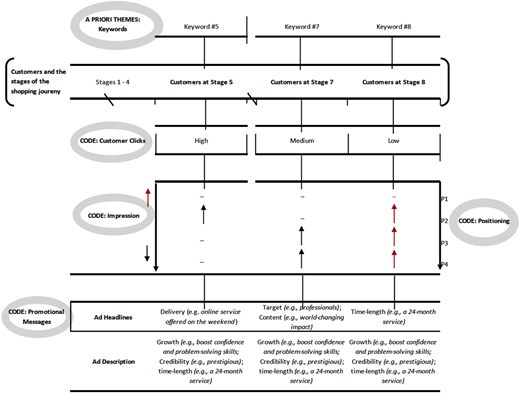
Second, the researchers examined clusters of related information; they identified recurring patterns in relation to the branded keywords (i.e. the a priori themes) across four predefined elements: (1) impressions, (2) positioning, (3) promotional messages and (4) customer clicks. These elements were identified prior to data collection in order to provide an initial analytical framework. Within this framework, impressions, positioning and promotional messages emerged as critical dimensions shaping how customers engaged with the ads, and, ultimately, influenced customer clicks (Schultz, 2020; Huang et al., 2021). By clustering data around these interconnected elements, the researchers were able to trace how advertising elements worked in combination to generate customer responses, while also allowing space for participants' interpretations to extend or challenge the anticipated relationships between these factors. The last element (customer clicks) identified the outcome of the paid search effects and confirmed the mediating impact that impressions, positioning and promotional messages have on customer behavior (Simonov et al., 2018; Lu and Du, 2020). To distinguish the four elements from the branded keywords, we refer to the four elements as “codes.”
Identification and interpretation of data into clusters was an iterative process; it involved an analysis of descriptive (e.g. positioning in the search result) and interpretive data (e.g. promotional messages). Template analysis emphasizes the merging of descriptive and interpretive data in the analysis (Brooks et al., 2015); this empowered the researchers to make sense of the two to derive meaningful and significant insights.
This approach revealed three clusters, which were evident across three branded keywords utilized by the advertisers, namely keyword #8 (high specificity, high focus), keyword #7 (high specificity, low focus) and keyword #5 (medium specificity, low focus). As such, the clusters revealed keywords #5, #7 and #8 to be the (final) a priori themes that provided the pathway to further analysis. The advertisers that bid most frequently on these keywords received the greatest number of clicks: those that had bid mostly on keyword #5 generated the highest clicks, followed by keyword #7 and keyword #8.
Given that each keyword represents a stage in the shopping journey, and that the more specific and focused the keyword is, the closer the customer is to decision making, the data revealed that advertisers' paid search ads target customers of organically ranked companies who are close to
The decision-making stage (i.e. stages #5, #7, and #8). However, their main focus is on customers who are close to the decision stage but not at the decision stage (i.e. stage 5). This makes sense; it is more challenging to convince customers to switch to another brand if they are keen to proceed with the brand. Customers who used keyword #5 rather than keywords #7 and #8 were exposed to a greater volume of paid search ads (i.e. impressions). Researcher have shown that the higher the number of impressions could generate greater number of customers that click on the ad (Schultz, 2020). This does not seem to be the case for all customers across the three stages. Instead, the data show that the positioning of the ad plays a mediating role in determining clicks, impressions and the customer's shopping stage. When customers use keyword #8 and as the number of impressions for the ads goes up, the position of the ads increases by one rank, from position 4 to 3, from position 3 to position 2, and from position 2 to 1. From the customer's perspective, this could mean that both the impression and the higher-positioned ads determine ad clicks. In terms of ads that appear when customers use keywords #7 and #5, the position rather than the impression seems to explain customer behavior. As the number of impressions for the advertisers that bid on keyword #7 goes down, the ads in positions 3 and 4 rose by one rank. There was no shift in ranking for ads ranked in position 2. As impressions decreased for ads with bids on keyword #5, the ads ranked in position one remained unchanged, whereas the ads in position 2 rose (zero shift in ranking was seen in the ads ranked in positions 3 and 4). This could imply that the position of the ad is a key factor that determines the behavior of customers in stage 5.
Advertisers also seemed to utilize promotional messages to influence customer behavior. To analyze the promotional messages, researchers created mini-clusters for ad headlines.
A headline is the title of the ad and ad descriptions separately (this is the text that describes the product/service and follows the headline). The authors followed the traditional interpretivist data analysis approach, whereby all the major promotional words utilized in the ad headlines and ad descriptions were identified. The promotional words were organized into clusters based on the similar meaning that they presented, and then they were assigned to mini-themes. In total, ad headlines revealed 90 major words, whereas ad descriptions included 218 major words. The clusters on headline messages revealed four mini-themes, namely: (1) target, which refers to the customers that the advertisers target (e.g. professionals); (2) delivery, which refers to the mode and means of delivery (e.g. online service offered on the weekend); (3) content, which refers to the focus of the services (e.g. digital services that have world-changing impact and (4) time-length, which refers to the delivery time of the service (e.g. a 24-month service). Data on the ad description generated three mini-themes namely: (1) growth – the benefit that the customer will receive from using the service (e.g. boost confidence and problem-solving skills), (2) credibility – refers to the quality of the service (e.g. recognized service) and (3) time-length (the length of the delivery time of the service, e.g. a 24-month service). Finally, these clusters and mini-themes were reviewed in the context of the a priori themes. This showed that all the advertisers, regardless of the keywords that they were bidding on and the customers that they were targeting, emphasized ad descriptions similarly. However, a difference was evident in the ad headlines. Advertisers that bid on keyword #5 highlighted delivery as the key promotional message, followed by target, content and time-length. Advertisers that bid on keyword #8 highlighted time-length first, followed by content, target and delivery. Advertisers that bid on keyword #7 highlighted target first, followed closely by content, followed by time length and delivery.
Finally, researchers investigated the raw data for paid search ads that target customers who shift from one stage to another in their shopping journey. Here, two observations emerged, which showed the shift of customers from keyword #5 to #7 and from keyword #7 to #8. In these cases, the positioning of the ad was identified as a mediator; this could imply that positioning, rather than impression and promotional messages, is the most powerful factor to explain clicks from customers who move through various stages of their shopping journey before making a decision. The data showed that if customers utilize keyword #5 to submit an inquiry, and they are exposed to an ad that is ranked in position 1 or 2, then as they move through the various stages of their journey, customers will click on the ad if it ranks in position 1 (except on the final stage before the decision is made). If customers utilize keyword #5 and get exposed to an ad that is ranked in position 3 in the search results, then there seems to be no need for a company to improve the ranking of the ad throughout the shopping stages. However, when customers are exposed to an ad that is ranked in position 4, the company should improve the ad's position by one rank throughout the stages in the journey for a customer click to occur.
5. Discussion of findings
 The figure consists of two main sections separated by a vertical double line. The left section consists of three rectangular boxes at the top, which are arranged horizontally from left to right, labeled: “Advertisers Paid Search Ads Effect: HIGH”, “Advertisers Paid Search Ads Effect: MEDIUM”, and “Advertisers Paid Search Ads Effect: LOW”. A downward vertical arrow from each of these boxes connects below to three separate stage boxes labeled from left to right as: “STAGE hashtag 5”, “STAGE hashtag 7”, and “STAGE hashtag 8”, respectively. From the “STAGE hashtag 5” box, a downward arrow connects to a box labeled “CUSTOMER GROUP hashtag 1”, which further leads downwards to three rectangular boxes via a downward arrow and labeled as “Keywords Medium, Low”, “Impression”, and “Position 2”. A leftward arrow from the “CUSTOMER GROUP hashtag 1” box points to a double-bordered oval labeled “Customers at specific stages” on the far left. From the “STAGE hashtag 7” box, a downward arrow leads to a box labeled “CUSTOMER GROUP hashtag 2”, which connects downwards to three boxes labeled “Keywords High, Low”, “Impression”, and “Position 3, 4”. From the “STAGE hashtag 8” box, which includes a “Click” icon to its right, a downward arrow leads to a box labeled “CUSTOMER GROUP hashtag 3”, which connects downwards to three boxes labeled “Keywords High, High”, “Impression”, and “Position 2, 3, 4”. At the bottom, a large horizontal oval contains four black circular markers labeled “Delivery”, “Content”, “Time-line”, and “Target” in a anticlockwsie sense. A box labeled “Ad Headline” connects to the “Delivery” marker, while a box labeled “Ad Description” connects to a smaller oval labeled “Growth, Credibility, time-line”, which is positioned just below the large oval. The right section consists of three rectangular boxes at the center alligning with the stages in the left section, arranged horizontally, labeled as: “STAGE hashtag 5”, “STAGE hashtag 7”, and “STAGE hashtag 8”, where downward arrows from each box converge and connect to a single rectangular box below labeled “Keywords Medium, Low”. From this “Keywords Medium, Low” box, a downward arrow connects to a vertical stack of four boxes labeled from top to bottom as: “CUSTOMER GROUP hashtag 4”, “CUSTOMER GROUP hashtag 5”, “CUSTOMER GROUP hashtag 6”, and “CUSTOMER GROUP hashtag 7”. A leftward arrow from the “CUSTOMER GROUP hashtag 5” box points to a double-bordered oval labeled “Customers through journey” on the left of the right section. From each of the four customer group boxes, a rightward arrow leads to a corresponding rectangular box on the far right labeled from top to bottom, as: “Exposed: Position: 1; No change”, “Exposed: Position 2; Position 2”, “Exposed: Position 3; No change”, and “Exposed: Position 4; Positions 4, 3, 1”, respectively. A large horizontal bracket spans across the top of both sections, covering all STAGE boxes, and is labeled “Shopping Journey”.
Paid search ads: Advertisers' effects and targeting of customers across the shopping journey
The figure consists of two main sections separated by a vertical double line. The left section consists of three rectangular boxes at the top, which are arranged horizontally from left to right, labeled: “Advertisers Paid Search Ads Effect: HIGH”, “Advertisers Paid Search Ads Effect: MEDIUM”, and “Advertisers Paid Search Ads Effect: LOW”. A downward vertical arrow from each of these boxes connects below to three separate stage boxes labeled from left to right as: “STAGE hashtag 5”, “STAGE hashtag 7”, and “STAGE hashtag 8”, respectively. From the “STAGE hashtag 5” box, a downward arrow connects to a box labeled “CUSTOMER GROUP hashtag 1”, which further leads downwards to three rectangular boxes via a downward arrow and labeled as “Keywords Medium, Low”, “Impression”, and “Position 2”. A leftward arrow from the “CUSTOMER GROUP hashtag 1” box points to a double-bordered oval labeled “Customers at specific stages” on the far left. From the “STAGE hashtag 7” box, a downward arrow leads to a box labeled “CUSTOMER GROUP hashtag 2”, which connects downwards to three boxes labeled “Keywords High, Low”, “Impression”, and “Position 3, 4”. From the “STAGE hashtag 8” box, which includes a “Click” icon to its right, a downward arrow leads to a box labeled “CUSTOMER GROUP hashtag 3”, which connects downwards to three boxes labeled “Keywords High, High”, “Impression”, and “Position 2, 3, 4”. At the bottom, a large horizontal oval contains four black circular markers labeled “Delivery”, “Content”, “Time-line”, and “Target” in a anticlockwsie sense. A box labeled “Ad Headline” connects to the “Delivery” marker, while a box labeled “Ad Description” connects to a smaller oval labeled “Growth, Credibility, time-line”, which is positioned just below the large oval. The right section consists of three rectangular boxes at the center alligning with the stages in the left section, arranged horizontally, labeled as: “STAGE hashtag 5”, “STAGE hashtag 7”, and “STAGE hashtag 8”, where downward arrows from each box converge and connect to a single rectangular box below labeled “Keywords Medium, Low”. From this “Keywords Medium, Low” box, a downward arrow connects to a vertical stack of four boxes labeled from top to bottom as: “CUSTOMER GROUP hashtag 4”, “CUSTOMER GROUP hashtag 5”, “CUSTOMER GROUP hashtag 6”, and “CUSTOMER GROUP hashtag 7”. A leftward arrow from the “CUSTOMER GROUP hashtag 5” box points to a double-bordered oval labeled “Customers through journey” on the left of the right section. From each of the four customer group boxes, a rightward arrow leads to a corresponding rectangular box on the far right labeled from top to bottom, as: “Exposed: Position: 1; No change”, “Exposed: Position 2; Position 2”, “Exposed: Position 3; No change”, and “Exposed: Position 4; Positions 4, 3, 1”, respectively. A large horizontal bracket spans across the top of both sections, covering all STAGE boxes, and is labeled “Shopping Journey”.Paid search ads: Advertisers' effects and targeting of customers across the shopping journey
The secondary focus of the advertisers is the targeting of customers close to decision-making but not yet at the last stage before decision-making occurs (i.e. those that utilize keyword #7). To influence clicks, advertisers focus on the position rather than the impression. As the impression goes down, ads in positions 3 and 4 rise by one rank. No shift was found in the ranking for ads ranked in position 2. Existing literature revealed that some positions influence customers' behavior more than others (Narayanan and Kalyanam, 2015). When targeting a customer group that utilizes keyword #7, advertisers highlight the customers themselves in the ad headlines. The promotional messages in ad headlines are rotated to highlight content, followed by time length and by delivery mode of the service.
Finally, advertisers utilize paid search ads to target customers of organically ranked companies who are at the closest stage to clicking/purchasing (i.e. those who utilize keyword #8). This group generates the lowest number of clicks. To influence clicks from this customer group, advertisers increase impressions as well as improve the ranking of positioning up to ranking #2. This aligns with existing studies that state that competitiveness in paid ads settings is an important factor in determining customer behavior (Li et al., 2016; Simonov et al., 2018), and adds to the literature that does not explicitly consider positioning in tandem with the impression for customer clicks to occur (Huang et al., 2021). While the descriptors in messaging remain the same as those in messages that target other groups, the promotional messages in the ad headlines rotate to highlight time-length, followed by content, target and delivery.
6. Theoretical implications
In general, existing studies have explored the effect of paid search ads on advertisers that bid on their own branded or generic keywords (Huang et al., 2021; Chang et al., 2025). This does not explain the effect that paid search ads have on companies that are organically ranked on Google search results in situations when other advertisers bid on the branded keywords of these companies. The present study addresses this. More specifically, it explores paid search ads' usage and effects on an organically ranked company across all its branded keywords. This adds to the existing literature on two main fronts. First, it allowed for an understanding of paid search ads across all key factors that mediate customer clicks, namely positioning of the paid search advertisers and the organically ranked company, impressions and promotional messages. This is important as existing studies to a great extent do not explore the effects of these in parallel on customer behavior (Simonov et al., 2018; Tunuguntla et al., 2023). Second, the application of shopping goal theory allowed the capture of all the shopping stages of the customers in their shopping journey, which in turn permitted the investigation of the effects of paid search ads on the customers of an organically ranked company who were situated at specific stages, as well as of those who moved from one stage to another before making a purchase decision. The theoretical insights gained from this are important for the following two fundamental reasons.
First, studies on paid search ads have explored paid search ads along two main stages in the shopping journey (i.e. the earliest stage and the last stage in the journey), which leaves existing theory with assumptions on how the behavior of customers at other stages of the journey is explained by paid search ads. Second, contemporary literature in marketing presents customers as subjective and pluralistic in their behavior (Ozuem et al., 2021). This implies that paid search ads could have different impacts on customers as they shift from one stage of the journey to another. Finally, the exploration of the effects and usage of paid search ads across all of a company's branded keywords and on the stages of a shopping journey provides a more overarching understanding and it addresses some of the contradictory findings in existing studies across all of the three existing research streams.
7. Managerial implications
Today's intense market competition has motivated advertisers to utilize paid search ads to acquire customers from organically ranked companies. The framework that emerged from the present study provides insights for organically ranked companies about the bidding of advertisers on their branded keywords and potential customer losses across the shopping journey. Therefore, the framework serves as a blueprint for organically ranked companies to strategize their paid search ads and defend their customers regardless of their customers' shopping stage. More specifically, it provides guidelines for digital marketing managers about the main keywords that their company should bid on, the positioning of the keywords, and the frequency of bidding per keyword (i.e. impression); it also provides insights for communication managers on the promotional messages that their company should utilize in their paid search ads. This informs the company's budget allocation to paid search ads and can ensure that the budget is effectively optimized. Finally, given that the order of paid search ads in search results is based on algorithms, and that the performance of a company's paid search ads depends on other advertisers' bidding, the framework would support a company's data marketing analysts in their evaluation of the overall performance of paid search ads; that is, to track the effect of paid search ads on customers' behavior as they shift from one stage in their shopping journey to another, and to easily detect other advertisers' and/or algorithm impact on their paid search ads, which would help them to apply intervention strategies when needed.
8. Limitations and future research
The present study opens four interesting topics for future research. First, it invites researchers to test the framework, which would reveal the scope of its generalizability. If researchers investigate the applicability of the framework across different industries, the findings could support possible amendments to the framework that pertain to specific industries. In addition, the focus of the present framework is on customer clicks. Exploring the usability of the framework in the context of customer conversion would provide a more comprehensive overview of the applicability of the framework. The present study suggests that paid search ads have the greatest impact on customers who are in shopping stages #5 (in the middle of their shopping journey), #7 (close to the decision stage) and #8 (last stage before decision making occurs). It would be interesting to investigate if and why advertisers' paid search ads do not influence customers in the shopping stage #6. The present study observes the effect of paid search ads and the clicks that an advertiser received from the keywords jointly. Lastly, exploring the effects of keywords individually could help practitioners make a more efficient distribution of their marketing budget and bidding for keywords.
Depending on the criteria advertisers employ when developing ads, combined with the functioning of search engine algorithms, paid ads may appear in response to a customer's query even when advertisers have not directly bid on the branded keywords of an organically ranked company. In the present study, we therefore treat all advertisers appearing in search results for the selected branded keywords as having targeted those terms, since their presence within the results nonetheless competes for consumer attention. Such appearances function as distractions that potentially divert customers away from organically ranked companies, thereby affecting customer behavior in ways unfavorable to them. Future research could refine this analysis by examining the extent to which ad design parameters and algorithmic processes, rather than direct bidding on branded keywords, shape the visibility of paid ads in search results and their subsequent impact on organically ranked firms.