


Electronic word-of-mouth (eWOM) has become one of the most influential information sources for consumers' purchase decision-making. Based on construal-level theory and from the perspective of cognitive effort, this study investigated the effects of eWOM social media types and conflicting eWOM on consumers' purchase intentions and validated the mediation role of social psychological distance, perceived value, and perceived cognitive effort.
Two scenario-based experiments were conducted to validate the research model. Specifically, a 2 (eWOM social media type: strong-tie vs weak-tie) × 2 (conflicting eWOM: with vs without) between-subjects design was used. ANOVA, multiple regression analysis with PROCESS, and partial least squares (PLS) were employed to test the hypotheses.
The results showed that eWOM social media types had significant effects on both social psychological distance and perceived value. The significant chain mediating effects of social psychological distance and perceived value between eWOM social media types and consumers' purchase intentions were found. In addition, conflicting eWOM had significant effects on both perceived value and perceived cognitive effort. Indirect effects of conflicting eWOM on purchase intention through perceived cognitive effort were discovered.
These results contribute to the eWOM literature by investigating the influences of eWOM social media types and conflicting eWOM on consumers' purchase intentions. They also contribute to construal-level theory by extending its applicability to the field of eWOM.
1. Introduction
Electronic word-of-mouth (eWOM) refers to positive and negative comments that are made by actual and potential consumers and that are diffused widely through the internet (Hennig-Thurau et al., 2004). Consumers usually seek each other's suggestions and recommendations in the pre-purchase stage (Wang et al., 2018), as well as share their experiences and reviews in the post–purchase stage (Liu et al., 2021a). Thus, eWOM has become one of the most influential information sources for consumers' purchase decision-making (Ruiz-Alba et al., 2021; Verma and Yadav, 2021). In the digital age, eWOM occurs on various Internet platforms, such as social media, online reviews, and e-commerce websites (Ismagilova et al., 2021; Rosario et al., 2016). As a result, consumers are faced with the challenging tasks of identifying and evaluating the multitudinous channels of eWOM that are available for acquiring information valuable and useful to purchase decision-making (Naujoks and Benkenstein, 2020; Zhao et al., 2020).
Previous studies have explored how differences in eWOM platforms affect consumers' perceptions and purchase decision-making (Gvili and Levy, 2016; Jalilvand and Heidari, 2017; Wang et al., 2018; Yan et al., 2018). Having compared the influences of eWOM on e-commerce and social media websites, Yan et al. (2018) found that higher tie strength and more social cues on social media than on e-commerce websites. Strong tie strength can lead to consumers' positive perceptions, attitudes, and behaviors (Dong and Wang, 2018; Horng and Wu, 2020; Ismagilova et al., 2021). For example, the strong relationships between the consumer and eWOM provider can improve eWOM credibility (Hershkovitz and Hayat, 2020; Verma and Dewani, 2020), trust in peers (Wang et al., 2016), and engagement behavior (Kang et al., 2021).
The social media websites also differed in the strengths of ties. On strong-tie social media websites, peers were usually relatives, friends, and acquaintances (Chu et al., 2019; Yan et al., 2018), whereas, on weak-tie ones, the peers were usually strangers (Hernández-Ortega, 2018). However, very few studies have focused on the distinctions between eWOM in both types of social media websites, as well as on the distinctions in their effects on consumers' perceptions and purchase intentions. Social media is an important means by which consumers seek product information before making purchase decisions. Hence, investigations into eWOM on different types of social media channels could offer a better understanding of consumer purchase behaviors. Furthermore, consumers may encounter conflicting eWOM while searching for product information (Bigne et al., 2020; López-López and Parra, 2016). Previous studies have investigated how aggregated ratings and conflicting single reviews presented on the same eWOM webpage affected purchase intentions (Naujoks and Benkenstein, 2020), but few studies have explored conflicting eWOM across various eWOM platforms. If the valences of the eWOM presented on strong-tie and weak-tie social media websites are opposing, then how consumers evaluate the conflicting eWOM is still unclear.
Thus, to fill these gaps, this study applies construal-level theory and from the perspective of cognitive effort to explain the mediating process of the relationships among eWOM social media type, conflicting eWOM, and consumers' purchase intentions. Specifically, this study distinguished two types of eWOM social media: strong- and weak-tie, and investigated the effects of eWOM social media types on purchase intentions through social psychological distance and perceived value. Furthermore, the influences of conflicting eWOM on purchase intentions through perceived cognitive effort and perceived value were also validated.
The results show that social media types have significant effects on both social psychological distance and perceived value. Specifically, the chain mediating effects of social psychological distance and perceived value between eWOM social media types and consumers' purchase intentions were found. In addition, conflicting eWOM was found to be a significant predictor of perceived value and perceived cognitive effort. Indirect effects of conflicting eWOM on purchase intentions through perceived cognitive effort were discovered. These results contribute to the eWOM literature by investigating the influences of eWOM social media types and conflicting eWOM on consumers' purchase intentions. They also contribute to construal-level theory by extending its applicability to the field of eWOM.
2. Theoretical background
2.1 eWOM
Typical eWOM platforms include social media (e.g. Facebook, WeChat, discussion forums), online review websites (e.g. Yelp, TripAdvisor), and e-commerce websites (e.g. Amazon, Taobao) (Rosario et al., 2016). The importance of eWOM in predictions of purchase intentions has been validated (Erkan and Evans, 2016; Naujoks and Benkenstein, 2020; Wu and Lin, 2017; Yan et al., 2018). eWOM information quality (Erkan and Evans, 2016; Zhao et al., 2020), content credibility (Verma and Dewani, 2020), and source credibility (Cheng et al., 2021) are all important aspects that can influence purchase intentions. In addition, the antecedents and drivers of providing eWOM have been explored (Li et al., 2021a, b; Liu et al., 2021a; Zhou et al., 2021). For example, website quality (Yang et al., 2015), social capital (Horng and Wu, 2020; Liu et al., 2016; Wang et al., 2016), perceived service quality and experienced pleasure (Lajante et al., 2022), swift guanxi (Fan et al., 2019) and guanxi elements (Yang, 2019a) were found to be positively related to eWOM sharing intention. Dedication is an effective mediator between the need for self-enhancement and eWOM sharing intention, whereas the mediating role of vigor and adsorption between self-enhancement and eWOM sharing intention were insignificant (Chu et al., 2019).
A promising new line of research has been focusing on how differences in eWOM platforms affect purchase decision-making (Gvili and Levy, 2016; Wang et al., 2018; Yan et al., 2018). Consumers' perceived values, attitudes toward eWOM communication, tie strength, social cues, and perceived credibility were found to differ significantly across the platforms. Our study differs from previous studies in two ways. First, we focused solely on social media as a channel of eWOM and distinguished between strong- and weak-tie platforms. Second, we explored the unique mediation process between eWOM social media type and purchase intention. Thus, our study can clarify the consumer's psychological process in using different platforms to inform their purchase decision-making.
2.2 Construal-level theory
Construal-level theory states that an individual can form different levels of mental construals of a distal object. These construals are based on the psychological distance between the object and the individual (Trope and Liberman, 2010). Psychologically distant or proximate events are reflected by high- or low-level construals, respectively (Rim et al., 2009). High-level construals are relatively abstract, simple, and decontextualized features that represent the general core information about the object, whereas low-level ones are more concrete, subordinate, contextual, and incidental features that represent specific, detailed information (Trope and Liberman, 2003). Four different dimensions comprise psychological distance: temporal distance (proximity of an event in time), spatial distance (proximity of an event in space), social distance (familiarity with social objects), and hypothetical distance (degree of uncertainty) (Fiedler et al., 2012). Construal-level theory has been widely employed to investigate the various behaviors of individuals across different domains (Bandara et al., 2021; Connors et al., 2021; Phang et al., 2015; Zhao et al., 2020).
Social psychological distance has been operationalized as interpersonal similarity (Liviatan et al., 2008). It represents the extent to which an individual distinguishes themselves from others (Trope and Liberman, 2010). As regards eWOM domain, reciprocity mediates the relationship between social psychological distance and eWOM sharing intention (Yang, 2019b). Profile photographs, linguistic styles, and reported experiences were found to be positively related to social psychological distance, which, in turn, affects eWOM credibility, usefulness, service quality, and purchase intention (Hernández-Ortega, 2018). Information quality can enhance social psychological distance, thus increasing trust in e-commerce (Zhao et al., 2020).
2.3 Cognitive effort
Cognitive effort refers to the total amount of cognitive resources (perception, memory, and judgment) needed to complete a task (Cooper-Martin, 1994; Russo and Dosher, 1983). According to the effort–accuracy framework of cognition, individuals usually tend to maximize decision-making and minimize cognitive effort (Payne, 1982). They treat effort minimization as an important target when selecting a decision strategy and are inclined to adjust the selection of their strategy to save effort when making choices (Bettman et al., 1998; Todd and Benbasat, 1999). The more cognitive effort required, the more negative are the effects, the less likely is the individual to make a choice, and the more likely they would select an alternative requiring less cognitive effort (Garbarino and Edell, 1997).
Some studies have found perceived cognitive effort to be negatively related to usage intentions for information systems (Heimbach and Hinz, 2018; Wang and Benbasat, 2009). Interestingly, the effects of perceived cognitive effort on the dimensions of trust in online recommendation agents were found to be different. Perceived cognitive effort was found to be negatively related to competence, whereas its effects on integrity and benevolence were insignificant (Wang and Benbasat, 2016). Other studies have investigated means of leveraging consumers' cognitive effort to improve their decision-making (Chen, 2017; Kwark et al., 2021; Muthitachareon et al., 2014). When a rating system fits a consumer's shopping task, their cognitive effort will decrease and enhance their usage intention of the system (Chen, 2017).
3. Hypotheses
3.1 Social psychological distance
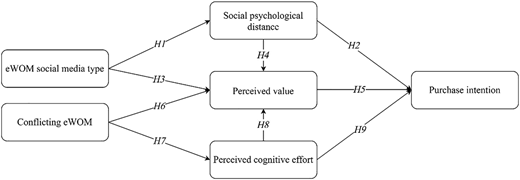
In this study, two types of eWOM social media were distinguished: strong- and weak-tie. It is believed that consumers can perceive closer social psychological distance in strong-tie social media than weak-tie social media. First, peers are usually relatives, friends, and acquaintances knowing each other in real life in strong-tie social media (Chen et al., 2019; Chu et al., 2019). Whereas peers are usually strangers barely knowing each other in weak-tie social media (Hernández-Ortega, 2018). An individual can be considered to be socially close when he is an in-group member (e.g. relative, friend, and acquaintance), whereas an individual can be perceived to be socially distance when he is an out-group member (e.g. stranger). Thus, individuals perceive closer social psychological distance with friends and acquaintances than with strangers (Song et al., 2017). In addition, in strong-tie social media, individuals can achieve more emotional support (Tajvidi et al., 2021), which enhances the intimacy, passion, and commitment between individuals (Liang and Turban, 2011). Feeling of closeness and connectedness can further lead to close social psychological distance. Thus,
Social psychological distance between eWOM providers and receivers is closer in strong-tie than in weak-tie eWOM social media.
Social psychological distance is believed to be positively related to purchase intention. Closer distances can lead to stronger purchase intentions. Interpersonal similarity is considered to be a form of social psychological distance (Liviatan et al., 2008). It is believed that the closer social psychological distance perceived by the consumers, the more interpersonal similarity will exist between the consumers and eWOM providers. Interpersonal similarity and homophily will positively impact the consumers' perceptions to the eWOM and purchase intentions. When consumers are closer to each other, they usually share more interests, tastes, and characteristics. Homophily encourages them to develop more positive attitudes to eWOM and increases their likelihood of following recommendations (Arazy et al., 2010; Bu et al., 2022; Chen et al., 2019). Moreover, building a network of friends and acquaintances is a useful channel of accessing product information while shopping. Consumers may communicate and interact with friends more frequently, thus reducing communication barriers. They are more willing to follow advice from friends than from strangers because the former is more likely to share the same preferences and be helpful in purchase decision-making (Cui et al., 2020). Thirdly, consumers' opinion is more easily influenced by the people with close social psychological distance because consumers tend to trust in the eWOM from those similar to them. Consumers are more likely to take the eWOM from providers with close social psychological distance. Thus,
Social psychological distance is positively related to purchase intention.
3.2 Perceived value
Consumers can achieve more perceived value in strong-tie social media. First, as mentioned above, consumers are usually knowing each other in real life rather than strangers in strong-tie social media (Hernández-Ortega, 2018; Wang et al., 2019). An atmosphere of mutual trust is more likely between close friends than between strangers, thus facilitating the sharing of product- and experience-related eWOM. Frequent interpersonal interactions help consumers achieve more useful recommendations, thereby improving the perceived value of eWOM (Liu et al., 2021b). In addition, eWOM source credibility is of great concern to consumers (Li et al., 2021a, b). Source credibility can reflect the reliable and truthful of the recommendation information. Consumers usually equate source credibility with the credibility of the eWOM offered by the source (Qahri-Saremi and Montazemi, 2019). eWOM from providers of strong-tie media is usually considered to be more reliable and useful (Zheng et al., 2017). Compared to low reliable eWOM, consumers are more likely to treat the high reliable eWOM as useful. Thus,
Perceived value is higher in strong-tie than in weak-tie eWOM social media.
Social psychological distance is believed to be positively related to perceived value. If consumers feel socially close to the eWOM providers, it will positively impact their perceptions and attitudes to the recommendation information. First, consumers' self-image congruity with the providers can enhance perceived value (Karjaluoto et al., 2019). Closer distances lead them to feel that they and the eWOM providers belong to the same group, thus forming a closer identity with the providers (Zhao et al., 2020). A closer identity with the eWOM providers enhances the consumers' perceptions of value and will make them think the recommendation is useful. Moreover, with closer distances, the providers and consumers may form intimate personal relationships (Chen et al., 2022a; Yili et al., 2017), which are positively related to perceived information quality (Zheng et al., 2017). Perceived information quality is considered to be positively related to consumers' decision-making. Thus, closer distances can enhance the consumers' perceptions of the value of eWOM. Conversely, if consumers feel distant from the eWOM providers, it will have less influence on the perceived value of eWOM.
Social psychological distance is positively related to perceived value.
The relationship between perceived value and purchase intention has been widely discussed (Chen et al., 2022b; Konuk, 2019; Peng et al., 2019). High levels of perceived values are positively related to both purchase intention (Chae et al., 2020) and repeated intention (Konuk, 2019). Perceived value can be manifested as functional, emotional, and social value, which is positively associated with purchase intentions in a social commerce context (Liu et al., 2021b). Moreover, perceived value, such as hedonic and utilitarian value, is positively related to consumers' attitude, satisfaction, and commitment, which can, in turn, improve purchase intentions (Hsu and Lin, 2016; Karjaluoto et al., 2019). When consumers use the social media platforms to search for product-related eWOM, the more the recommendation information perceived to be valuable for purchase decision-making, the more likely consumers will complete the transaction. Thus,
Perceived value is positively related to purchase intention.
When using a particular eWOM social media, a consumer may receive contradictory information from another platform. Such information may reduce the credibility and usefulness of an eWOM (Naujoks and Benkenstein, 2020). Consistency of the recommendation demonstrates the similarity of the information in different social media platforms. Consumers usually identify the credibility of an eWOM by the consistency of its content and information. Consistency enhances information objectivity and reduces cognitive dissonance (Verma and Dewani, 2020), thus improving the consumers' perceived values. Contradictory information enhances the perceived risks of adopting an eWOM, thus lowering the perceived value (Karjaluoto et al., 2019). Consumers usually tend to reduce their risks and make better purchase decisions (Hussain et al., 2017). Thus,
A consumer's perceived value of an eWOM would be lower in the presence of contradictory information from another eWOM social media.
3.3 Perceived cognitive effort
Cognitive effort refers to the total amount of cognitive resources (perception, memory, and judgment) needed to complete a task (Cooper-Martin, 1994; Russo and Dosher, 1983). Contradictory recommendation requires additional cognitive effort of the consumers to filter information, rendering the experience frustrating and confusing. Low eWOM consistency results in high cognitive dissonance, which increases the consumers' cognitive effort. Consumers cannot make product- or service-related attributions on the basis of contradicting information (Naujoks and Benkenstein, 2020; Qiu et al., 2012). Inconsistent comments make it difficult for consumers to identify the recommendation information. Hence, they must authenticate the information but must expend more cognitive effort to do so. Moreover, rumors and fake news on the internet have presented a grave problem to consumers (Lappas et al., 2016), who must expend more time and effort to evaluate the rumors and look for evidence to support their decisions (Kim et al., 2019). Hence, they may need to seek more detailed descriptions of products or services in order to judge the truthfulness and accuracy of the information, thus requiring additional cognitive effort. Thus,
A consumer's perceived cognitive effort is higher in the presence of contradictory information from various eWOM social medias.
Higher perceived cognitive effort leads to lower perceived value. First, consumers usually have the desire to reduce cognitive effort when making the purchase decision. The efficiency of a consumer's information processing relies on their ability to employ proper cognitive processes (Cheung and Thadani, 2012). Complex cognitive processes reduce the effectiveness of information processing, especially for consumers with little experience. High perceived cognitive effort means more difficulty in extracting valid information from the eWOM and making effective purchase decisions (Chu et al., 2019), thus lowering the perceived value of the eWOM. Furthermore, individuals are always geared to the greatest contextual effects for the smallest effort in decision-making process. Reducing the cognitive effort needed to perform a task will make it more emotionally satisfying. Consumers find the eWOM valuable if it can meet their needs and requirements (Xu and Yao, 2015). Processing information with less cognitive effort is more likely to make customers perceive that their needs are being met more easily, thus enhancing their perceived value. Thus,
Perceived cognitive effort is negatively related to perceived value.
High perceived cognitive efforts reduce purchase intentions. The process by which a consumer adopts an eWOM involves the receiving, managing, and absorbing of information about products, services, and experiences. The product-related information provided by the eWOM is transferred to and internalized by the consumer (Ismagilova et al., 2021; Qahri-Saremi and Montazemi, 2019), who is more willing to consult the eWOM that can save the time and cost of information searching (Heinze and Matt, 2018; Wang et al., 2020). When perceived cognitive effort is high, consumers must spare much time and effect to process and comprehend the information (Huang et al., 2013). A consumer experiences more difficulty in making purchase decisions if they need more cognitive resources to comprehend the information. If too much cognitive effort is expended, they may sacrifice effectiveness in their purchase decision-making to save effort (Todd and Benbasat, 1999). If the consumer feels uneasy about comprehending the information, they would be less likely to adopt the eWOM. Thus,
Perceived cognitive effort is negatively related to purchase intention.
Figure 1 shows the research model.
4. Methodology
4.1 Measurements
In this study, the items used to measure social psychological distance, perceived value, perceived cognitive effort, and purchase intention were adopted from Hernández-Ortega (2018), Karjaluoto et al. (2019), Wang and Benbasat (2009), and Wang et al. (2018), respectively. All the items were measured by a seven-point Likert scale ranging from strongly disagree (1) to strongly agree (7), as shown in Appendix, which also contains the α values, CR values, AVE, and factor loadings used to ensure the reliability and validity of the scales (Fornell and Larcker, 1981).
4.2 Research design and samples
In Study 1, a scenario-based experiment with a between-subjects design was conducted. A total of 99 participants were recruited from credamo.com, which is a professional data collection platform in China, to participate in an online survey. The professional sample service of credamo.com was employed to collect the data. Respondents were randomly invited by credamo.com to participate in the online survey. Procedures in credamo.com can randomly assign the respondents to one of the two conditions. Of the participants, 60.61% were female and 75.76% had bachelor's degrees (see Table 1).
Demographic characteristics of study 1
| Item | Characteristics | Frequency | % |
|---|---|---|---|
| Gender | Male | 39 | 39.4 |
| Female | 60 | 60.6 | |
| Age | <20 | 3 | 3 |
| 21–30 | 59 | 59.6 | |
| 31–40 | 33 | 33.3 | |
| >40 | 4 | 4 | |
| Education | Collage and below | 11 | 11.1 |
| Bachelor degree | 75 | 75.8 | |
| Graduate degree | 13 | 13.1 |
Each participant was first asked to image that they were searching for a hotel in a city they had never visited and consulting a social media platform for information about the hotel (Naujoks and Benkenstein, 2020). Then, one positive eWOM was presented to the participants. The eWOM social media type was manipulated by using WeChat as strong-tie social media and Redbook as weak-tie social media. WeChat is one of the most popular social media in China. Friends in WeChat can share shopping information with each other through private message or “Friends circle”, and the information posted through “Friends circle”can only be seen by the users' conjunct friends. In addition, the likes and comments from whom you have not connected in your friend list are not visible. Thus, WeChat is a social media reflects more closely and intimately connected real-life friends in China, with the most of interpersonal connections being strong-tie (Chu et al., 2019). Redbook is a kind of social sharing networks, and users can share shopping information in the platform. The shared information can be seen, liked, shared and commented by everyone not even friends or followers. Thus, Redbook is a social media reflects more loosely connected strangers, with the most of interpersonal connections being weak-tie.
In Study 2, a scenario-based experiment with a 2 × 2 between-subjects design (type: strong-tie vs weak-tie × conflicting eWOM: with vs without) was conducted. A total of 299 participants were recruited from credamo.com to complete an online survey. The professional sample service of credamo.com was employed to collect the data. Respondents were randomly invited by credamo.com to participate in the online survey. Procedures in credamo.com can randomly assign the respondents to one of the four conditions. Of the participants, 57.86% were female and 83.61% had bachelor's degrees (see Table 2). Each participant in this study was asked to perform the same task as those in Study 1 (Naujoks and Benkenstein, 2020). They were shown two eWOM posts in WeChat and Redbook, respectively. The conflicting eWOM was manipulated by controlling the valences of the eWOM, i.e. for consistent eWOM, the eWOM posts in WeChat and Redbook are either positive or negative. For inconsistent eWOM, the valences of the eWOM posts in both platforms were the opposite of each other.
5. Results
5.1 Manipulation checks
The manipulation checks of the eWOM social media types were evaluated by answers to a yes/no question asking the participants in the WeChat and Redbook groups whether they had read an eWOM post on their respective platforms. All the participants in each group responded affirmatively. For a manipulation check of conflicting eWOM, the participants were asked to rate the consistency of the two eWOM posts on both platforms by using a seven-point scale ranging from “very inconsistent” to “very consistent”. Respondents in consistent eWOM group were perceived more significantly consistency than those in inconsistent eWOM group (M consistent = 6.305, M inconsistent = 1.392, F (1,297) = 3589.528, p < 0.001).
5.2 Results of study 1
ANOVA was conducted to test the effects of the eWOM social media types on the social psychological distances between the eWOM providers and receivers, as well as on the perceived value. The social media types had significant effects on social psychological distance (F (1,97) = 8.854, p < 0.05), which was closer in the strong-tie (M = 5.592) than in the weak-tie platform (M = 5.084), thus supporting H1. Social media types also had a significant effect on perceived value (F (1,97) = 9.137, p < 0.05), which was higher in the strong-tie (M = 6.229) than in the weak-tie platform (M = 5.796), thus supporting H3.
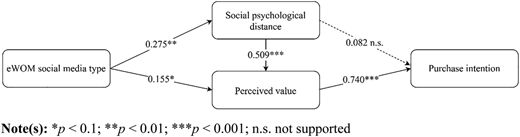
Next, the mediating effects of social psychological distance and perceived value between social media types and purchase intention were examined by the PROCESS macro in SPSS. Social psychological distance had no effect on purchase intention (β = 0.074, p > 0.1), thus not supporting H2. Moreover, social psychological distance was found to be positively related to perceived value (β = 0.419, p < 0.001), thus supporting H4. The perceived value was positively related to purchase intention (β = 0.836, p < 0.001), thus supporting H5.
As shown in Table 3, the indirect effects of the eWOM social media types on purchase intention through social psychological distance (β = 0.037, boot CI = −0.056 to 0.153) and perceived value (β = 0.184, boot CI = −0.025 to 0.437) were insignificant. Interestingly, the chain mediating effects of social psychological distance and perceived value were significant (β = 0.178, boot CI = 0.047 to 0.373).
Indirect effects of eWOM social media type on purchase intention
| Path | Effect | Boot SE | Boot LLCI | Boot ULCI |
|---|---|---|---|---|
| eWOM → SPD → INT | 0.037 | 0.051 | −0.056 | 0.153 |
| eWOM → PEV → INT | 0.184 | 0.116 | −0.025 | 0.437 |
| eWOM → SPD → PEV → INT | 0.178 | 0.085 | 0.047 | 0.373 |
Note(s): eWOM, SPD, PEV, and INT denote eWOM social media types, social psychological distance, perceived value, and purchase intention, respectively
A robust test using partial least squares (PLS) (see Figure 2) was also conducted. As shown in Table 4, it arrived at the same conclusions. The chain mediating effects of social psychological distance and perceived value were significant (β = 0.104, p < 0.05).
Robust test of study 1
| Path | β | Standard deviation | T statistics | p values |
|---|---|---|---|---|
| eWOM → SPD → INT | 0.023 | 0.032 | 0.716 | 0.475 |
| eWOM → PEV → INT | 0.115 | 0.070 | 1.656 | 0.098 |
| eWOM → SPD → PEV → INT | 0.104 | 0.043 | 2.393 | 0.017 |
Note(s): eWOM, SPD, PEV, and INT denote eWOM social media types, social psychological distance, perceived value, and purchase intention, respectively
5.3 Results of study 2
ANOVA was also employed to examine the effects of conflicting eWOM on perceived value and perceived cognitive effort. Conflicting eWOM had significant effects on perceived value (F (1,297) = 205.539, p < 0.001), which was lower when conflicting eWOM was present (M = 3.986) than when absent (M = 6.118), thus supporting H6. Conflicting eWOM also had significant effects on perceived cognitive effort (F (1,297) = 433.622, p < 0.001), which was higher when conflicting eWOM was present (M = 4.899) than when absent (M = 2.972), thus supporting H7. The results are shown in Tables 5 and 6.
Multiple comparisons of conflicting eWOM and effects on perceived value
| (I) Group | (J) Group | Mean difference (I-J) | Std. error | Sig | 95% confidence interval | |
|---|---|---|---|---|---|---|
| Lower bound | Upper bound | |||||
| 1 (M = 6.139) | 2 | 2.120* | 0.205 | 0.000 | 1.568 | 2.672 |
| STSM-Positive | 3 | 0.041 | 0.100 | 0.999 | −0.225 | 0.307 |
| WTSM-Positive | 4 | 2.185* | 0.213 | 0.000 | 1.612 | 2.758 |
| 2 (M = 4.019) | 1 | −2.120* | 0.205 | 0.000 | −2.672 | −1.568 |
| STSM-Positive | 3 | −2.079* | 0.213 | 0.000 | −2.649 | −1.508 |
| WTSM-Negative | 4 | 0.065 | 0.284 | 1.000 | −0.691 | 0.822 |
| 3 (M = 6.097) | 1 | −0.041 | 0.100 | 0.999 | −0.307 | 0.225 |
| STSM-Negative | 2 | 2.079* | 0.213 | 0.000 | 1.508 | 2.649 |
| WTSM-Negative | 4 | 2.144* | 0.220 | 0.000 | 1.553 | 2.735 |
| 4 (M = 3.953) | 1 | −2.185* | 0.213 | 0.000 | −2.758 | −1.612 |
| STSM-Negative | 2 | −0.065 | 0.284 | 1.000 | −0.822 | 0.691 |
| WTSM-Positive | 3 | −2.144* | 0.220 | 0.000 | −2.735 | −1.553 |
Note(s): * The mean difference is significant at the 0.05 level
STSM-Positive, STSM-Negative, WTSM-Positive, and WTSM-Negative denote positive and negative eWOM in strong-tie (ST) and weak-tie (WT) social media (SM), respectively
Multiple comparisons of conflicting eWOM and effects on perceived cognitive effort
| (I) Group | (J) Group | Mean difference (I-J) | Std. error | Sig | 95% confidence interval | |
|---|---|---|---|---|---|---|
| Lower bound | Upper bound | |||||
| 1(M = 2.660) | 2 | −2.204* | 0.109 | 0.000 | −2.498 | −1.911 |
| STSM-Positive | 3 | −0.621* | 0.115 | 0.000 | −0.930 | −0.311 |
| WTSM-Positive | 4 | −2.274* | 0.099 | 0.000 | −2.541 | −2.007 |
| 2 (M = 4.864) | 1 | 2.204* | 0.109 | 0.000 | 1.911 | 2.498 |
| STSM-Positive | 3 | 1.584* | 0.148 | 0.000 | 1.190 | 1.978 |
| WTSM-Negative | 4 | −0.069 | 0.136 | 0.996 | −0.431 | 0.293 |
| 3 (M = 3.281) | 1 | 0.621* | 0.115 | 0.000 | 0.311 | 0.930 |
| STSM-Negative | 2 | −1.584* | 0.148 | 0.000 | −1.978 | −1.190 |
| WTSM-Negative | 4 | −1.653* | 0.141 | 0.000 | −2.028 | −1.278 |
| 4 (M = 4.934) | 1 | 2.274* | 0.099 | 0.000 | 2.007 | 2.541 |
| STSM-Negative | 2 | 0.069 | 0.136 | 0.996 | −0.293 | 0.431 |
| WTSM-Positive | 3 | 1.653* | 0.141 | 0.000 | 1.278 | 2.028 |
Note(s): * The mean difference is significant at the 0.05 level
STSM-Positive, STSM-Negative, WTSM-Positive, and WTSM-Negative denote positive and negative eWOM in strong-tie (ST) and weak-tie (WT) social media (SM), respectively
Next, the mediating effects of perceived cognitive effort between conflicting eWOM and purchase intention were also examined by the PROCESS macro in SPSS. Perceived cognitive effort was negatively related to perceived value (β = −0.808, p < 0.001) and purchase intention (β = −0.708, p < 0.001), thus supporting H8 and H9. The indirect effects of conflicting eWOM on purchase intention through perceived cognitive effort were significant (β = 1.364, boot CI = 1.071 to 1.688).

6. Discussion
This study investigated the effects of eWOM social media types and conflicting eWOM on consumers' purchase intentions. Specifically, this study distinguished two types of eWOM social media: strong- and weak-tie and investigated the effects of eWOM social media type on purchase intentions through social psychological distance and perceived value. First, the results showed that social media types had significant effects on the social psychological distances between eWOM providers and receivers, as well as on perceived value. Unlike previous studies, this study focused solely on social media as a channel of eWOM and distinguished between strong- and weak-tie platforms. This study found that social psychological distance was closer in strong-tie than in weak-tie social media. This result was similar with previous studies focusing on various channels of eWOM, which showed consumers' perceiving closer social psychological distances with strong-tie eWOM (Song et al., 2017). In addition, eWOM in strong-tie social media creates more perceived value. Social media that consist of friends and acquaintances are important channels by which consumers achieve persuasive eWOM. Though social media can consist of strangers, who can provide heterogeneous, non-redundant information, consumers value eWOM from friends and acquaintances more (Wang et al., 2018). The best information and recommendations about products and services usually come from friends and acquaintances.
Second, we explored the unique mediation process between eWOM social media type and purchase intention. Thus, our study can clarify the consumer's psychological process in using different platforms to inform their purchase decision-making. One interesting finding was the significant chain mediating effects of social psychological distance and perceived value between eWOM social media type and consumers' purchase intentions. Close social psychological distance between the eWOM providers and receivers can enhance the receivers' perceived value of the eWOM and, in turn, improve their purchase intentions. These results were also consistent with previous studies (Hernández-Ortega, 2018; Zhao et al., 2020), which emphasized the important role played by social psychological distance in affecting consumers' perceptions and decision-making. Social psychological distance between eWOM providers and receivers is closer in strong-tie than in weak-tie eWOM social media. Close social psychological distance in strong-tie social media induces consumers' positive attitudes to the eWOM and enhance the perceived value of the eWOM, which in turn improve their purchase intention.
Furthermore, the influences of conflicting eWOM on purchase intentions through perceived cognitive effort and perceived value were also validated. The results also showed that conflicting eWOM had significant effects on both perceived value and perceived cognitive effort. Perceived value was lower and perceived cognitive effort was higher when conflicting eWOM was present. This result is also consistent with previous studies suggesting that conflicting eWOM reduced the credibility of product and service reviews (Qiu et al., 2012) because consumers perceived the value of the eWOM to be lower. Indirect effects of conflicting eWOM on purchase intentions through perceived cognitive effort were discovered. These results were consistent with previous studies suggesting that perceived cognitive effort was negatively related to consumers' usage intention (Wang and Benbasat, 2009). A consumer's perceived cognitive effort is higher in the presence of contradictory information from various eWOM social media. Conflicting eWOM enhanced cognitive effort, thus hampering purchase intention.
6.1 Theoretical implications
This study has several theoretical implications. First, it sheds new light on eWOM research by its investigation of the effects of eWOM social media types on consumers' purchase intentions. Previous studies compared the effects of eWOM posted on social media and e-commerce websites (Yan et al., 2018). This study enhanced this field of research by focusing on social media as the channel of eWOM and distinguishing between strong-tie and weak-tie eWOM social media. This study extends this line of research by showing that social psychological distance between eWOM providers and receivers is closer in strong-tie than in weak-tie eWOM social media. Thus, this study can become a foundation for future research to further investigate the influence of eWOM social media on purchase intention.
Second, this study extends the current research on eWOM by its investigation of the role of conflicting eWOM on consumers' perceptions and purchase intentions. Previous studies have investigated the effects of aggregated ratings and single conflicting reviews on purchase intentions (Naujoks and Benkenstein, 2020). Our study contributes by its investigation of the roles played by conflicting eWOM in consumers' perceptions and purchase intentions when the valences of eWOM posted on strong-tie eWOM social media conflict with that on weak-tie. Indirect effects of conflicting eWOM on purchase intentions through perceived cognitive effort were discovered. The results of this study are novel in demonstrating the role of conflicting eWOM in influencing purchase decision-making.
Finally, this study contributes to construal-level theory by extending its applicability to the field of eWOM through its exploration of the unique mediation process between eWOM social media type and consumers' purchase intentions, as well as its clarification of the consumers' psychological processes in purchase decision-making when using different eWOM social media. Our findings extend construal-level theory by showing that social psychological distance plays a crucial role in mediating consumers' purchase intentions. Specifically, the significant chain mediating effects of social psychological distance and perceived value between eWOM social media type and consumers' purchase intentions were found.
6.2 Practical implications
This study has three major practical implications. First, the results showed that eWOM social media types have significant effects on both social psychological distance and perceived value. Therefore, social commerce companies should realize the effects of different types of social media. The use of only weak-tie eWOM social media is insufficient, so companies should pay attention to omnichannel eWOM management, especially for strong-tie eWOM social media. For example, companies should encourage consumers to post eWOM on their social network websites and share their product recommendations with their close friends. To motivate consumers, spiritual or material rewards, such as membership privileges, gift cards, lucky draws, and even, cash prizes, for sharing eWOM should be awarded to positive consumers.
Another interesting finding was the significance of the chain mediating effects of social psychological distance and perceived value between eWOM social media type and consumers' purchase intentions. Social commerce companies should improve their customers' social psychological distance and perceived value. For example, self-disclosure in social media should be encouraged. Personal information, such as profile photographs, gender, age, education, and location, can help them know each other better and narrow the social distances between them. Interpersonal communication should be encouraged as well because frequent interactions can increase familiarity and closeness.
Finally, perceived value and perceived cognitive effort were found to be lower and higher, respectively, when conflicting eWOM was present. Therefore, social commerce companies should spare no effort to reduce conflicting eWOM from different eWOM social media platforms. For example, a flexible business model should be formulated to respond to customers' comments rapidly in order to reduce the impacts of negative eWOM. In addition, effective service recovery is an important way to address service failures, restore the loss of customer satisfaction, and increase customer awareness of e company image, which can in turn avoid consumers' negative eWOM intention.
6.3 Limitations
There are three limitations in this study. First, this study only considered one product type (e.g. experience products). Besides experience products, there are lots of eWOM regarding to search products as well. Only considering the experience products hindered the universality of this study. Future research can extent the current research to investigating the search products. In addition, this study is limited to without considering other types of eWOM presentation. In this study, both positive and negative eWOM were presented using only text. Future research may consider other types of eWOM presentation, such as static and dynamic pictures, video, and live streaming. Future research employing different eWOM presentation may be conducted to generalize the results of this study. Finally, this study did not take consumers' personality trait into account. Personality trait was found to be an important predictor of online information selection (Kourouthanassis et al., 2017). Future research may include the consumers' personality trait into the research model.
7. Conclusion
The objective of this study was to investigate the effects of eWOM social media types and conflicting eWOM on consumers' purchase intentions. The empirical results showed that the eWOM social media types had significant effects on both social psychological distance and perceived value. Social psychological distance between eWOM providers and receivers was closer in strong-tie than in weak-tie social media and eWOM in strong-tie resulted in more perceived value. Other results showed that the chain mediating effects of social psychological distance and perceived value between eWOM social media types and consumers' purchase intentions were significant. In addition, conflicting eWOM was found to have significant effects on both perceived value and perceived cognitive effort. Perceived value was lower and perceived cognitive effort was higher when conflicting eWOM was present than when absent. Finally, indirect effects of conflicting eWOM on purchase intention through perceived cognitive effort were discovered. These findings provide several theoretical and managerial implications for the field of eWOM.
This study was funded by the Natural Science Foundation of Zhejiang Province of China (No. LQ21G020010).
References
Appendix
Measurements
| Construct | Items | α | CR | AVE | Loadings |
|---|---|---|---|---|---|
| Social psychological distance (Hernández-Ortega, 2018) | Regarding the consumers who wrote the above eWOM, I think that to some extent … | ||||
| They could have tastes similar to mine | 0.878 | 0.911 | 0.672 | 0.795 | |
| They could have values similar to mine | 0.803 | ||||
| They are close to me | 0.780 | ||||
| I could belong to the same group | 0.845 | ||||
| I am similar to them | 0.872 | ||||
| Perceived value (Karjaluoto et al., 2019) | Please evaluate your attitude to the above eWOM for the following items. The above eWOM is … | ||||
| Ineffective–effective | 0.863 (0.973) | 0.901 (0.979) | 0.646 (0.903) | 0.838 (0.952) | |
| Unhelpful–helpful | 0.780 (0.956) | ||||
| Not functional–functional | 0.780 (0.949) | ||||
| Unnecessary–necessary | 0.764 (0.930) | ||||
| Impractical–practical | 0.854 (0.963) | ||||
| Perceived cognitive effort (Wang and Benbasat, 2009) | Using the above eWOM, choosing a hotel … | ||||
| Was very frustrating | 0.970 | 0.976 | 0.871 | 0.913 | |
| Was easier because I found helpful information more quickly (R) | 0.914 | ||||
| Took too much time | 0.934 | ||||
| Was easy (R) | 0.956 | ||||
| Required too much effort | 0.943 | ||||
| Was too complex | 0.937 | ||||
| Purchase intention (Wang et al., 2018) | As a result of reading the above eWOM, I … | ||||
| Believe that my selecting this hotel is highly likely | 0.874 (0.963) | 0.914 (0.973) | 0.726 (0.901) | 0.862 (0.949) | |
| May make a reservation at this hotel | 0.804 (0.952) | ||||
| Would like to select this hotel | 0.867 (0.944) | ||||
| Predict that I would book this hotel | 0.874 (0.952) | ||||
Note(s): The values in parentheses are for Study 2

