This paper aims to provide a systematic review of extant literature on supplier selection by identifying drivers of integration of Environmental Sustainability (ES) into supplier selection, with the aim of classifying them under broad categories for the development of a framework showing the interrelationships among them.
A search was ran for selected keyword themes using three powerful and rigorous search engines: Scopus, Google Scholar and Science Direct, to identify relevant articles from 12 peer-reviewed journals. These were desk reviewed through manual filtering to select drivers of integration of ES into supplier selection.
Thirty-one drivers identified from 41 relevant articles as propelling integration of ES into supplier selection were then classified into five categories: strong policy direction, high level of commitment, desire for high reputation, robust technology and availability of green products. This yielded a framework showing the interconnectedness among the drivers.
The study contributes to the body of knowledge by developing a classification of drivers of integration of ES into supplier selection. The interconnectedness brought to the fore a more subtle appreciation of the drivers of green integration, which could help expand current knowledge outside the narrow scope of isolated drivers. This study provides detailed analyses of drivers of green integration into supplier selection.
This paper provides a comprehensive review of drivers of integrating green into supplier selection, which is lacking in the body of knowledge on ES.
Introduction
Public organizations, especially in developing countries, require to boost the success of their green sustainability (GS) practices in order to protect the ecosystem. In view of this, governments are focusing more on environmental issues through the issuance of numerous ecological protocols to contain the waning raw materials as well as the degradation of the ecology. Also, pressures from major stakeholders are making public organizations cautious of the harmful effects of their actions on the ecology (Rostamzadeh et al., 2016). Again, organizations are held accountable for the impact of their activities on the environment and their supply chain participants (Saeed and Kersten, 2019; Hsu et al., 2013). Hence, organizations have invested in numerous green supplier development programs to improve their green performance within the supply chain (Awasthi and Kannan, 2016).
Green procurement (GP) has its roots in both environmental and procurement management literature, incorporating “green” component in PM means linking the influence and relationships of PM to the natural ecology. GP involves the assessment of suppliers along environmental credentials and engaging only those who meet these environmental standards (Rao, 2002). The prospective green benefit that could be obtained from environmental procurement is rather clear and measurable (Parikka-Alhola, 2008). GP could shape trends for production and consumption, and a considerable public demand for green products could also enlarge markets for environmentally sustainable goods (Testa et al., 2012). However, in implementing green issues in procurement, selection of the supplier with green credentials is an important task, as it gives the procurers the chance to improve directly or indirectly their environmental performance (Sarkis and Dhavale, 2015).
Integrating green issues into supplier selection (SS) can be made through the inclusion of ecological criteria in the decision-making process (Gurel et al., 2015). Green supplier selection (GSS) concept emerged from the inclusion of green credential in SS (Igarashi et al., 2015). Green in this paper refers to the environmental aspect of the three pillars of sustainable procurement (i.e. economic, social and environmental).
Incorporation of green thinking into SS is becoming significant to the success of public organizations. Dhulla and Narwa (2016) observed that suppliers could provide important ideas that can be used to achieve environmental objectives of the buyer. As a result, greening SS process has attracted scholarly attention (Hashmi et al., 2015; Kannan et al., 2014).
Also, decision on GSS is largely considered as an important responsibility of management (Benn et al., 2014), and at the same time, one of the most critical and complex issues that require attention (Amindoust, 2018). Greening supplier selection and its implementation practices enhance organization's legitimacy and public image (Hsu et al., 2013). Tate et al. (2012) describe supplier selection with regard to green integration as one of the main drivers of organizational sustainability. Hence, selection of suppliers is considered as key in minimizing costs of integrating green issues into procurement decisions and simultaneously help public organizations in achieving their environmental goals (Govindan et al., 2015).
The thorniest issue for integrating green into procurement is the ability to select suppliers with green credentials. According to Tseng (2009), it is difficult to select green responsive supplier because it involves certain criteria and methods, which are usually considered as complex and uncertain. This complexity occurs as a result of different factors. For example, when considering green impact of SS, the duration may be longer, and choosing a variable could be difficult as the choice will depend on certain intangible factors like reputation (Roehrich et al., 2017). Also, integration of green into SS may require many trade-offs between economic and environmental issues (Zhu et al., 2013).
There is large quantity of reviews on green integration, but most of these studies focus on certain specific areas. For example, Centobelli et al. (2017) focus on drivers for service industry for transportation providers. Sancha et al. (2015) focus on drivers of supplier development. Ayarkwa et al. (2020), Zaidi et al. (2019), Köksal et al. (2017) and Hsu et al. (2013) focus on the drivers in general for the construction industry. Although Centobelli et al. (2017) looked at green drivers and their interrelationships, their study was limited to only five drivers. Also, Yevu and Yu (2019) conducted a comprehensive review of drivers of environmental sustainability (ES), but their review focused on only Electronic (E)-procurement. This paper therefore provides a comprehensive review of drivers of incorporating green into SS and shows their interconnectedness. A detailed review of drivers will enhance a bigger and better appreciation of the drivers obtained from different studies to facilitate the integration of green into supplier selection.
Also, it is essential to classify these drivers into their relevant groupings for a better understanding. An analysis of the literature highlights the different contributions that focus on specific classifications of green drivers (Bag, 2017; Centobelli et al., 2017; Lo et al., 2012). An interpretative classification of green drivers in literature provides only little highlight on the intensity of use. This classification therefore gives more extensive analysis.
Definition of key terms
Supplier selection (SS) process
The process of SS usually begins with needs identification and follows with reviewing the information provided by prospective suppliers (Igarashi et al., 2013). This ordinarily takes numerous interactions, and the final decision is made from the pool of the applicants. Van Weele (2010), Cousins et al. (2008) and De Boer et al. (2001) describe SS as one activity which comprises several tasks.
Green procurement (GP)
The GP concept has found a place in the literature of sustainable procurement management (SPM) and has been subjected to different definitions. GP involves the buying of environmentally friendly products and the collaboration with suppliers for environmental objectives (Le et al., 2019). Min and Galle (2001) defined GP as an environmentally conscious procuring practice that reduces sources of waste and promotes recycling and reclamation of procured materials without adversely affecting performance requirements of such material. Carter and Carter (1998) define green procurement as procurers' involvement in buying activities in order to facilitate recycling, reuse and resource reduction. Zsidisin and Siferd (2001) describe GP as a set of buying policies held, actions taken and relationships formed in response to concerns associated with the natural environment. Green public procurement (GPP) is the practice where public buyers integrate environmental criteria into their procurement processes throughout all stages. By selecting products with least possible environmental impact throughout their life cycle, and the encouragement of environmental technologies, an organization is practicing GP (Nissinen et al., 2009).
Green supplier selection
The process of selecting suppliers becomes more complex and difficult when environmental criteria are added to the traditional ones (i.e. cost, quality and service). This difficulty and complexity emanate from the trade-off for selecting between environmental attributes and the traditional attributes (costs, quality and service).
Enablers/drivers of green
Studies by Sancha et al. (2015) and Lee and Klassen (2009) draw distinction between two types of antecedents: drivers and enablers of green. A driver of green is a factor that initiates the adoption of green practices in supplier selection. An enabler of green, however, is a factor that facilitates or assists the organization in the adoption of these practices. Sancha et al. (2015) posit that the adoption of green practices will be easier to the extent that an organization is externally integrated with its suppliers. Drivers of green are considered as pressures that compel public organizations to implement specific GS initiatives (Caniato et al., 2012). Saeed and Kersten (2019) and Saeed et al. (2017) refer to drivers of green as influencers that push public organizations to adopt green initiatives throughout the supply chain. Therefore, in this context, drivers of GSS refer to the internal or external force, which compel or encourage procurement practitioners to incorporate green credentials into their selection process. Motivations or drivers are important for green integration because organizations are rationale agents that are likely to adopt “green” activities if there is an observable incentive for them to do so (Hoejmose et al., 2014). Despite the subtlety of the distinction between drivers and enablers, for the purpose of this review, the two words were used interchangeably.
Research methodology
In order to gain insight into the present status and trend of research on any issue, Tsai and Lydia Wen (2005) suggest that the methodological analysis of papers published in recognized academic journals is essential. This study of drivers of integration of ES into supplier selection therefore considered only articles published in recognized academic journals. This study adopted the approach used by Centobelli et al. (2017), Easterby-Smith et al. (2012) and Pittaway et al. (2004) to conduct the review. The research focused on publications within the period 2009 and 2020. The review was organized in three phases:
General selection of publications with abstracts focusing on ESS and published within 2009 and 2020.
Specific selection of papers whose abstracts focus on drivers of integration of green or ES into supplier selection.
Content analysis involving in-depth study and review of papers for the required divers.
General selection of publications with abstracts focusing on ESS
A search was ran for selected keyword themes using three powerful and rigorous search engines: Scopus, Google Scholar and Science Direct, to identify the relevant themes. Apart from their widespread adoption and use, these tools were selected for two main reasons: (1) many research publications in the field of management, engineering, business and construction are archived in Google Scholar, Scopus and Science Direct (Bakkalbasi et al., 2006; Falagas et al., 2008; Darko et al., 2019) and (2) in terms of coverage and accuracy in delivery, these tools have been known to perform better than other search engines (Bakkalbasi et al., 2006; Falagas et al., 2008; Darko et al., 2017; Darko et al., 2019). Several authors have used keyword searches to select the relevant research papers and journals for their review studies (Xue et al., 2010; Deng and Smyth, 2013; Ahn et al., 2013; Darko et al., 2017; Darko et al., 2019; Geng et al., 2019). This study also adopted the keyword search approach to retrieve and identify the needed journals and research papers related to ESS. Three researchers were involved in the identification of the initial search string of keywords. The researchers used functionalities provided by the academic database to validate research strings. This was done by comparing initial keywords with new keywords used by the individual papers identified in the original list. The keywords frequency analysis revealed the importance of keywords such as sustainable procurement, environmental procurement, GP and GSS, from sustainable procurement literature. Therefore, the search string was refined and the final one included Green, Environmental and Supplier Selection. “Vendor”, “Contractor” and “Partner” were used alternatively with “Supplier”. For the word “Selection”, the substitutes were “Choice”, “Evaluation”, “Assessment” and “Qualification.” In total, 28 combinations of keywords were used in the search for relevant literature on environmental supplier selection (ESS). Because GSS is a decision-making process, a search by multiple word phrases (green selection, SS and green buying) in the tittle and abstract was used.
These keywords/multiple word phrases and the year of publication made it possible to identify papers with abstracts that focused on ESS. This led to the collection of 215 publications on ESS in 12 recognized peer reviewed academic journals (Table 1) in the areas of sustainable supply chain management, SPM and environmental management. The impact factor of the selected journals had ratings higher than 1.0 by Thomas Reuters in the recent past. The systematic search was to ensure an accumulation of a reasonably complete census of the appropriate literature (Webster and Watson, 2002).
Specific selection of publications focusing on drivers of integration of GSS or ESS into supplier selection
Manual filtering was used to select specific papers focusing on drivers of integration of GSS or ESS into supplier selection. This process could be replicable and transparent and help to lessen bias in the results (Tranfield et al., 2003). In fact, this approach provides a satisfactory review on the chosen topics and assist reviewers in obtaining more understandings of the topic. Also, this manual aspect gives an in-depth understanding of the concept than automatic filtering. The 215 abstracts on ESS were read separately by two independent researchers, and where there was doubt, a third researcher was made to cross-check. Based on the review by Centobelli et al. (2017) and Easterby-Smith et al. (2012), the papers were categorized into the following five themes:
Code A: papers with abstracts on ES and SS but make no reference to drivers or enablers, motivators or facilitators;
Code B: papers with abstracts mainly on ES, but make no reference to SS;
Code C: papers with abstracts focusing on SS but make no reference to ES;
Code D: papers whose abstract focus on drivers, enablers, motivators or facilitators of supplier selection but make no references to green or ES;
Code E: papers whose abstract focus on drivers, enablers, motivators or facilitators of supplier selection and make references to green or ES or procurement.
The papers falling under Code A (32 papers), Code B (58 papers), Code C (36) and Code D (36) were excluded as they fell outside the scope of the study. The 53 papers included in Code E were subsequently considered fully in the third phase. These papers were fully read by two independent researchers, which led to further exclusion of 12 papers which did not specifically meet the research aim. In all, 41 papers were analyzed in Phase 3.
Content analysis to identify the required drivers
The selected publication abstracts were systematically reviewed to identify drivers of integration of ES into supplier selection. The content analysis provided a comprehensive picture of the drivers identified in the literature on ESS. The content analysis made it possible to achieve the three objectives of the study:
To identify drivers of integration of green into supplier selection;
To classify the drivers of integration of green into SS into categories and
To show the interconnectedness among the categories of drivers of integration of green into supplier selection.
Results and discussion
Year of publication
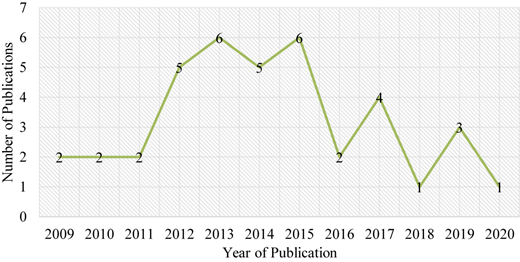
The search was limited to papers published in scholarly journals within the period of 2009–2020, and each of the 41 articles identified was classified according to its year of publication. After the World Summit on Sustainable Development in Johannesburg in 2002, it was not until 2009 that many works were done on drivers of SPP, GPP/EPP and GSS or ESS. For example, UNEP (2017) did a lot of work on ES. Hence, 2009 appeared to be a sound starting point for working on any publications on drivers of GSS. Figure 1 shows the yearly distribution of publications on drivers of GSS. From the relevant papers obtained, 2013 and 2015 recorded the highest number of publications, with six publications each, followed by 2012 and 2014 with five publications each. The year 2016 was the turning point at the global level when Sustainable Development Goals (SDGs) were set under Agenda 2030, and the advent of SDGs was expected to ignite scholarly works on environmental supplier selection. However, the years 2018 and 2020 recorded the least number of publications with one publication each (Figure 1).
Research type
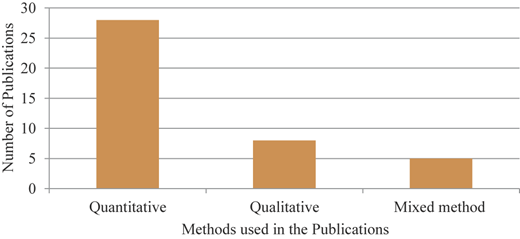
The classification of the articles in terms of research type was based on qualitative, quantitative and mixed approach. Majority of the papers adopted quantitative methodologies (surveys and models), followed by qualitative (case studies) approaches. Only few adopted conceptual or mixed methods studies. Figure 2 shows the number of papers published under each research approach. Twenty-eight (28) papers used quantitative approach, with 20 surveys and eight models. Eight papers used qualitative approach based on multiple case studies. Five papers used mixed method which was based on conceptual approaches using secondary data rather than empirical data.
Drivers of integration of green into supplier selection
There are many drivers influencing organizations to adopt green initiatives in supplier selection process. A thorough understanding of green drivers is essential since it aids organization in deciding on the measures to be taken (Etzion, 2007). Drivers are defined synonymously in the literature as influential factors, pressures, triggers and enablers (Köksal et al., 2017; Hsu et al., 2013). Also, identification of drivers which enable the incorporation of green help public organizations to understand relevant capabilities for GS in its global context and assist policy makers and top management to support the development of these capabilities (Sancha et al., 2015).
Out of 41 papers analyzed, 31 drivers were identified from the literature as propelling integration of ES (Table 2). The number of occurrences of each driver in the literature is provided against the various drivers. Formulation of policy/goals/action plans for green is the topmost occurring drivers found in the 12 journals with a score of 17. Flexible procedures, laws, and attitudes follows as the second most occurring driver with a score of 16. The third most occurring driver is pressure from stakeholders/NGOs, with a score of 12. Top management commitment is the fourth occurring driver which was found 10 times in the journals. Expertise in GP laws and environmental issues was identified as the fifth occurring driver with a score of 9. External recognition for ESS program and Inclusion of green activities in performance and promotion reviews are found at the bottom of the list with 1 and 2 occurrences, respectively.
The papers identified authors and their year of publications and showed the number of drivers identified by each author in their publications. The codes used in Table 2 were used to represent specific drivers identified in the literature. Table 3 shows these authors, year of publications and the corresponding drivers.
Classification of the drivers of integration of green into supplier selection
To understand drivers of green integration better, it was essential to classify them into appropriate categories. Some classification of drivers for incorporating green into supplier selection have been done in previous studies (Hinrichs and Wettlin, 2019; Dhulla and Narwal, 2016). Saeed et al. (2017) classified drivers as: market pressure, societal pressure, regulatory pressure, corporate strategy, organizational culture, organization resources and organization characteristics. Sancha et al. (2015) used institutional theory to classify drivers as coercive, normative and mimetic. While UNEP (2017) classified them as economy-related, policy-related, procurement-related and market-related drivers, some authors (Chari and Chiriseri, 2014; UNEP, 2017; Darko et al., 2017) classified these drivers as cost-related and product-related.
Also, drivers for GP can be classified as primary and secondary according to their access to supply chain knowledge and value contribution (Saeed et al., 2017). However, Bey et al. (2013) classify these drivers as drivers for initiation and drivers for sustaining implementation. They posit that while some drivers are essential to initiate implementation, others are needed for sustaining the implementation process. Example of initiating drivers include pressure from stakeholders, whereas the need for gaining competitive advantage is classified as a sustaining driver (Bey et al., 2013). These drivers were also classified as technical, economic, political–legal, organizational, ecological, risk factors, education and culture level and mixed factors (Tambovceva, 2016).
A careful assessment of previous literature showed that classification based on Tambovceva (2016) and Saeed et al. (2017) presented a basis that could be used for the classification of drivers for this study, but with the introduction of additional classifications to better describe the dynamic nature of these drivers. Based on the process view approach, this study largely classified drivers of integration of green into supplier selection into five levels: strong policy direction (Ru1), high level of commitment (Ru2), desire for high reputation (DRu3), robust technology (Ru4) and availability of green products (Ru5). The drivers in Table 2 were classified into the five categories by the authors based on the areas of their impact (Glover et al., 2014; Schrettle et al., 2014). These classifications were compared and deliberated to achieve consistency and reliability among the drivers in Table 2. The classification of the drivers is shown in Table 4.
Strong policy direction (Ru1)
Literature establishes the importance of legislation as a driver of ecological responsiveness in supplier selection (Roehrich et al., 2017; Oberhofer and Dieplinger, 2014; Tacken et al., 2014; Oberhofer and Fürst, 2013). Escalating penalties, fines and legal costs has punctuated the importance of complying with legislation (Buying Green, 2016). Regulatory drivers are enshrined in the form of standards, laws, procedures and use to promote sustainability practices (Hsu et al., 2013). These drivers have an important influences on organizations' approaches to greening SS and, also, could have the knack to compel organization to initiate sustainability (Haverkamp et al., 2010; Schrettle et al., 2014).
High level of commitment (Ru2)
Empirical evidence from literature shows that level of commitment is important for integrating green issues into supplier selection. Level of commitment includes the largest number of drivers identified in Table 4, made up of 11 drivers including personal commitment to sustainability by practitioners, top management commitment, pressure from stakeholders/NGOs, high degree of green collaboration with suppliers, innovative support, constant training of green practitioners, among others (Danese et al., 2019; Govindan and Hasanagic, 2018; Bai et al., 2015; Bag, 2017; Dhulla and Narwalb, 2016; Hsu et al., 2013). For example, consistent pressure from the stakeholders may force top management of the organization to develop commitment to integration of green into supplier selection. Also, vision and policies of organization are usually defined by top management, and exercise supervisory role over the implementation GSS (Haverkamp et al., 2010). Therefore, commitment of top management is seen as an important step toward the achievement of GS in supplier selection.
Desire for high reputation (Ru3)
Integrating green issues into supplier selection process is significant for organizations that cherish their organizational reputation (Alzawawi, 2014). The quest for green image can make public organizations adopt GP. Reputation as a public organization in employing green initiatives means an organization becomes a role model for their competitors. Organization’ reputation has the tendency to raise staff morale. Desire for green reputation contains four drivers from Table 4: External recognition for ESS program, desire to do the right thing, globalization, trust building in suppliers and desire for high green image reputation. Stakeholders may withdraw their support if public organizations do not have a positive green reputation (González-Benito and Gonzale-Benito, 2006).
Robust technology (Ru4)
Technology describes the motivations for integrating green into supplier selections. There are three drivers that were classified under this category: information technology (e-procurement), information systems and compatibility of technology. For example, the compatibility of technology could make green integration easier. Studies indicate that organizations are keen to use technology because of the likely solutions it provide for their needs, hence a major factor promoting green integration (Agi and Nishant, 2017; Bag, 2017). Technology compatibility could encourage purchasers and their suppliers to incorporate green issues into supplier selection.
Availability of green products (Ru5)
Market drivers shape the market context which organizations are exposed to (Schrettle et al., 2014). The drivers refer to market drivers show the readiness of the market to provide green products (Saeed et al., 2017). If green products are available in the market, procurers are encouraged to consider them during selection. Stakeholders playing a role in these mechanisms include buyers, suppliers, competitors and shareholders (Bai et al., 2015; Bag, 2017; Ayuso et al., 2013; Haverkamp et al., 2010). The drivers under this category include availability of green products, accessible tools that measure life cycle cost, availability of credible standards and ecolabel, availability of green criteria and specifications, high level of green knowledge, financial efficiency and expertise in GP laws and environmental issues have all driven organizations to embrace green in their supplier selection. For example, availability of green product inspires practitioners to integrate green into supplier selection.
Interrelationship among drivers and categories
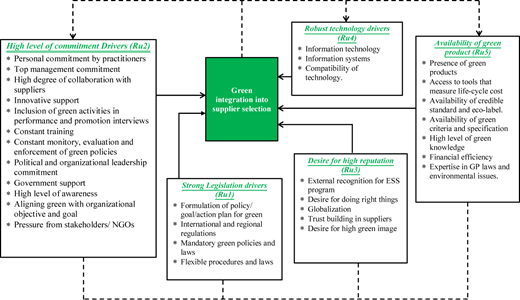
Different factors driving the motivations for integrating green into supplier selection have been identified and discussed in this paper. A closer look at the drivers and their classifications or categories shows the interrelationship among them. This interrelationship led to the development of a framework in Figure 3. This framework shows the interconnectedness of the five classifications of green drivers: strong policy direction (Ru1), high level of commitment (Ru2), desire for high reputation (DRu3), robust technology (Ru4) and availability of green products (Ru5). From Figure 3, drivers in one classification may influence other drivers in another classification. For example, Expertise in GP laws and environmental issues (Ru5) may influence top management commitment and level of awareness in an organization (Ru2). In the same way, high level of green knowledge classified under availability of green products (Ru5) may influence or lead to high commitment level (Ru2). If an organization has sufficient green knowledge, the tendency to commit itself to its integration is high. Again, there is interrelationship among the various categories or classifications. The drivers within one classification are interrelated to another classification, for instance, strong legislation (Ru1) could lead to high level of commitment (Ru2) and also to the introduction of robust technology (Ru4). Desire for high reputation (Ru3) may influence the availability of green products (Ru5). As shown in Table 2, the most significant drivers identified from literature were formulation of policy/goals/action plans for green. The broken lines shown in the framework infer the influence of one driver in one classification on another driver in other classifications and vice versa. The deep lines show how each of the five categories or classifications contribute to the integration of green into supplier selection. This framework provides a guide that helps to identify drivers that influence the integration of green into supplier selection.
The framework developed from the present study (Figure 3) is an improvement on previous reviews as it shows the interrelationships among drivers of integration of green into supplier selection.
Conclusions, implications and future research
Drivers of the adoption of GP have received considerable attention in literature. However, a broad review of the drivers of integration of green into supplier selection in procurement decisions is still scanty in literature. This study aimed at reviewing extant literature to identify drivers, classify them and show their interrelationship to enhance integration of green into supplier selection. The study reviewed 41 articles from 12 peer-reviewed journals between 2009 and 2020 and identified 31 drivers of green integration into supplier selection.
From the findings, formulation of policy/goals/action plans for green; flexible procedures, laws and attitudes; pressure from stakeholders/NGOs; top management commitment and expertise in GP laws and environmental issues were the drivers prevalent in literature. Other drivers of green integration were identified, but not as many, but may gain attention in the future. All the drivers identified in this study were classified into five categories as: strong policy direction (Ru1), high level of commitment (Ru2), desire for high reputation (DRu3), robust technology (Ru4) and availability of green products (Ru5). The interrelationships among the drivers and categories were further shown in a framework developed. Considering insufficient review studies on drivers of green integration, this classification presents the foundation for promoting green in supplier selection.
This study primarily contributes to the body of knowledge by developing a classification of drivers of integration of ES into supplier selection in procurement. In addition, the interrelationships revealed among these drivers in the framework present a more nuanced understanding of the drivers of green integration by expanding the current knowledge beyond the narrow borders of isolated drivers.
The interrelationships among drivers should inform policy makers that, to integrate green into supplier selection, a structured method should be used to determine the group of drivers that motivate green integration among different kinds of stakeholders during supplier selection, since the influence of the drivers may vary contextually.
The findings from this study indicate the existence of interrelationships among drivers for integration of ES into supplier selection, which have been lacking in extant literature. Future research could investigate how combination of these drivers could influence green integration during different phases of supplier selections. For instance, which of these drivers together could motivate organizations to integrate ES into supplier selection in procurement? Which of these drivers together could motivate organizations to sustain integration of green into supplier selection once started? Which of these drivers together could influence the checking of supplier's environmental performance against legal requirement? These would provide insights into which drivers to employ to motivate green integration considering the different phases in supplier selection process. It is acknowledged that this study is not exhaustive as it focused only on 41 articles from 12 peer-reviewed journals selected through an extensive search.