This study investigates how sociotechnical factors shape artificial intelligence (AI) trust and how it influences perceived complexity reduction and decision-making quality in maritime organisations. It addresses the limited understanding of how trust enables maritime professionals to improve AI-supported decision-making quality in high-risk operational environments.
Drawing on sociotechnical systems theory and Luhmann's systemic trust theory, the study develops a structural model linking AI familiarity, AI beliefs, AI system quality, AI system transparency, AI trust, perceived complexity reduction and decision-making quality. Data were collected from 106 maritime professionals in Singapore and examined through structural equation modelling.
The results indicate that AI system quality, AI system transparency and AI familiarity significantly enhance AI trust, while AI beliefs have a non-significant effect. AI trust is strongly associated with both perceived complexity reduction and decision-making quality. In contrast, perceived complexity reduction shows a weaker positive effect on decision-making quality. These findings suggest that trust is the main mechanism through which AI-related social and technical factors contribute to improved decision-making outcomes.
This study integrates sociotechnical systems theory and Luhmann's systemic trust theory to explain AI adoption in maritime organisations. It advances existing research by positioning AI trust as the central link between sociotechnical factors, perceived complexity reduction and decision-making quality in the maritime context.
1. Introduction
The global maritime sector is currently undergoing substantial change, with artificial intelligence (AI) becoming a key driver in shaping its operations (Lee et al., 2025). Industries ranging from finance to transportation are experiencing rapid AI-driven shifts, and the maritime sector is following suit by integrating AI innovations into its operations (Portillo Juan et al., 2025). Emerging AI has revolutionised maritime operations by improving decision-making, optimising navigation routes and strengthening data security (Tahsin et al., 2025). The maritime AI market has grown substantially, expanding from $1.47 billion in 2023 to $4.13 billion in 2024 (Bensalhia, 2025). Despite these advancements and rapid growth, this vital industry continues to face growing challenges in its efforts to enhance innovation and efficiency while maintaining safety and complying with regulatory requirements (Tahsin et al., 2025).
A key obstacle to fully leveraging AI is the issue of trust, which is a key factor that influences whether a person is inclined to engage in work alongside and rely on AI (Atchley et al., 2024; Bedué and Fritzsche, 2021). This is particularly important when AI introduces additional complexity, such as human-like characteristics and the ability to engage emotionally, which can influence the amount of trust users place in it (Glikson and Woolley, 2020). The inherent complexity and uncertainty of the maritime industry can further affect how individuals trust the AI in the workplace (Ay, 2025). Thus, in high-risk settings like the maritime industry, where mistakes lead to severe outcomes, it is important to enhance and cultivate trust in AI through hands-on experience, institutional training and collaborative work in real-world maritime operations (Jirak et al., 2025). AI trust (AT) is not solely about whether the system makes the “right” decisions but also about whether the decisions are transparent and consistent with the individual's expectations, particularly when the system's recommended actions differ from established maritime operational practices (Hoffman et al., 2023). As the maritime industry increasingly integrates AI, it becomes vital to understand the factors influencing AT and how it helps reduce perceived complexity, ultimately improving decision-making quality (DMQ) among individuals in maritime organisations.
Although many existing studies have examined the factors influencing AT, such as transparency, acceptance and fairness, they are often grounded in system-centric and behavioural frameworks, including the Fairness-Accountability-Transparency framework and the Elaboration Likelihood Model, which emphasise ethical design principles and individual cognitive processing in shaping trust (Huynh and Aichner, 2025; Karran et al., 2025; Park and Yoon, 2025). Although these approaches offer valuable insights, they primarily emphasise individual-level evaluation and overlook the broader sociotechnical context, particularly in complex and high-risk environments (Hjelle et al., 2024). Furthermore, studies examining DMQ have primarily focused on managerial and technological enablers (e.g. leadership characteristics, organisational support and system capabilities) as key determinants of decision outcomes (Hjelle et al., 2024; Hung et al., 2023). These perspectives are often grounded in theoretical frameworks such as upper echelon theory, which emphasises the influence of managerial attributes and organisational context on strategic decision-making (Hung et al., 2023). However, such approaches tend to overlook the underlying human and social dynamics that shape how decisions are made. Therefore, how trust mitigates perceived complexity in AI-supported environments remains insufficiently examined (Ay, 2025; Jirak et al., 2025). This research solves this gap by integrating sociotechnical systems (STS) theory and Luhmann's systemic trust theory (LSTT) to explain the formation and impacts of AT in maritime organisations.
STS theory offers a relevant framework for this study by highlighting the interdependence between social and technical subsystems in determining organisational performance (Appelbaum, 1997). In relation to implementing AI in the maritime sector, STS theory highlights that such technological decisions are not isolated but embedded within organisational structures, human behaviours and cultural contexts (Ang et al., 2024; Portillo Juan et al., 2025). Complementing this, LSTT offers a foundation for understanding trust as a mechanism for reducing perceived complexity, allowing individuals and organisations to act under conditions of uncertainty and incomplete information (Luhmann, 2018). By integrating both STS theory and LSTT, this study adopts a holistic lens to explain how sociotechnical factors shape AT and how it serves as a mechanism for reducing perceived complexity and enhancing DMQ (Ay, 2025). This approach combines sociotechnical and trust perspectives, offering a comprehensive framework to examine how human, technical and organisational factors collectively influence AT in maritime operations.
The unique contribution of this study is its integrated examination of AT within a sociotechnical framework, particularly its role as a mechanism for reducing perceived complexity and enhancing DMQ in maritime organisations. While existing research has mainly focused on isolated determinants of AT or system-centric perspectives, this study advances the literature by simultaneously incorporating both social and technical factors to explain the formation of AT. More importantly, it moves beyond conventional approaches by conceptualising trust as not just an antecedent or outcome but as an active mechanism through which individuals manage perceived complexity in AI-enabled environments. By integrating STS theory with LSTT, this study develops a novel theoretical framework to reflect the dynamics between human, organisational and technical elements, offering deeper insights into how AT translates into improved decision-making outcomes in high-risk maritime contexts.
Grounded in the integration of STS theory and LSTT, this study pursues three core research objectives.
To examine how sociotechnical factors jointly shape AT in maritime organisations;
To examine the role of AT in reducing perceived complexity and its subsequent effects on DMQ and
To provide practical recommendations on strengthening AT, reducing perceived complexity and improving DMQ.
The next section introduces the theoretical basis of the study and explains how the hypotheses are derived. The methodology section then presents the survey design, participant recruitment, measurement items and SEM procedure. The results section reports the measurement and structural model findings, followed by a discussion of the total effects. The final section summarises the study's conclusions, implications, limitations and recommendations for future research.
2. Literature review
2.1 Theoretical basis
2.1.1 Sociotechnical system theory
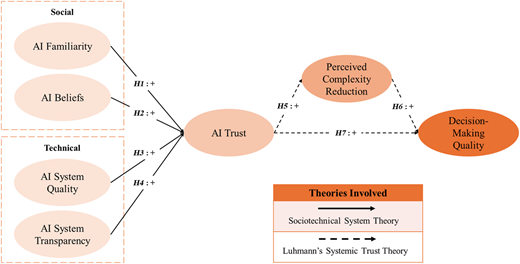
The STS theory describes organisations as systems composed of social and technical subsystems, where alignment between these subsystems is critical for effective performance (Ang et al., 2024; Appelbaum, 1997). In this study, STS provides a foundational framework for examining how these components influence AT in maritime organisations. Specifically, the social subsystem is operationalised through AI familiarity (AF) and AI beliefs (AB), reflecting users' knowledge, perceptions and prior experiences with AI. The technical subsystem is represented by AI system quality (ASQ) and AI system transparency (AST), reflecting the performance, reliability and explainability of AI.
The constructs selected for this study reflect the intricate interplay between human, technological and organisational elements that shape trust in AI. From a social perspective, AF enhances users' understanding of AI, reducing uncertainty and fostering confidence, while AB shapes attitudes and willingness to rely on AI (Khan and Khan, 2025; Komiak and Benbasat, 2006; Luhmann, 2018; Stein et al., 2024; Wang et al., 2015, 2025). From a technical perspective, ASQ and AST influence user perceptions of AI systems' reliability, accuracy and interpretability (Ali et al., 2022; Kasilingam, 2020; Schulz et al., 2023). When AI systems demonstrate consistent performance and transparent processes, users are more inclined to build confidence and trust the AI's recommendations and decisions.
2.1.2 Luhmann's systemic trust theory
LSTT conceptualises trust as a social mechanism that allows individuals and organisations to act despite incomplete information or unpredictable outcomes (Luhmann, 2018). In complex environments, trust can function as a means of reducing perceived uncertainty, allowing individuals to rely on systems and make decisions without needing complete information.
Within the context of AI in maritime operations, LSTT explains how trust in AI can reduce perceived complexity and support more effective decision-making processes (Ay, 2025). By enabling users to rely on AI despite inherent risks and unpredictability, trust reduces cognitive burden and facilitates more efficient interactions with AI-supported tools.
2.1.3 Integration of STS theory and LSTT
Building on STS theory and LSTT, this study explains AT in maritime organisations from both antecedent and outcome perspectives. STS theory provides the basis for examining how social and technical factors influence AT, while LSTT explains how trust reduces perceived complexity and improves DMQ. Through this integration, AT is positioned as a key intermediary linking sociotechnical conditions to DMQ and enables individuals to act with confidence despite incomplete information, thereby reducing perceived complexity and supporting more effective decision-making processes (Jirak et al., 2025). This reduction in perceived complexity can subsequently enhance DMQ as users could better process information and make informed judgments in complex operational environments (Korzyński et al., 2024). Together, this integrated framework offers a comprehensive explanation of how sociotechnical factors and AT interact to improve AI-enabled decision-making in high-risk maritime contexts.
2.2 Research model
Drawing on the integration of STS theory and LSTT, a model is developed to study how AT influences perceived complexity reduction (PCR) and DMQ within the maritime industry. The model (Figure 1) outlines the relationships between social and technical antecedents of AT, as well as the subsequent effects of AT on reducing perceived complexity and enhancing DMQ.
2.3 Hypothesis development
AT reflects the level at which users view AI as competent, reliable and acting with integrity (Chen and Cheng, 2026). In organisational settings, the level of trust in AI can shape users' inclination to rely on recommendations produced by AI, particularly within the setting of maritime operations. As AI increasingly supports the process of decision-making, the development of trust becomes essential for ensuring that users confidently engage with AI-supported tools.
2.3.1 AI familiarity
AF refers to the understanding developed through users' prior experiences and interactions with AI (Wang et al., 2025). Within AI-related contexts, familiarity serves an important role in minimising the uncertainty typically associated with AI (Wang et al., 2015). From a theoretical perspective, familiarity and trust function as complementary mechanisms for managing complexity as familiarity reduces uncertainty by creating structure, while trust allows individuals to develop reliable expectations about the system behaviour (Luhmann, 2018).
As users accumulate experience with AI, they gain relevant knowledge that supports the formation of trust. Moreover, when users are familiar with AI, their confidence and the degree of trust placed in it increase (Zhu et al., 2023). For instance, greater familiarity with how an AI collects, processes and utilises data enhances users' understanding of its operations, thereby enhancing their trust in AI (Shin, 2021). This is especially apparent in high-risk settings such as maritime operations, where hands-on experience has been recognised as a crucial factor in building trust, with navigators developing confidence through actual sailing operations (Aalberg et al., 2024). Therefore, AF is not merely experiential but serves as a foundational driver of trust formation in AI-supported environments.
Higher levels of AF positively influence AT
2.3.2 AI beliefs
AB refers to individuals' perceptions and attitudes towards AI, which may range from optimistic expectations to concerns such as job displacement and existential threats (Stein et al., 2024). These beliefs represent individuals' psychological responses in the social subsystem when they engage with developing AI systems (Khan and Khan, 2025).
Prior research suggests that positive beliefs about AI are linked to greater acceptance and adoption as individuals with favourable perceptions are more willing to use and trust AI in the workplace (Kasilingam, 2020). Empirical evidence also indicates that positive attitudes towards AI can directly influence trust, reinforcing the relationship between AB and trust (Schulz et al., 2023). Similarly, in maritime contexts, crew members' trust in AI can be linked to their underlying beliefs and attitudes toward the technology (Aalberg et al., 2024). These results indicate that users' beliefs about AI can influence their willingness to trust it.
Stronger positive beliefs about AI positively influence AT
2.3.3 AI system quality
ASQ reflects the technical characteristics of a system that shape its overall performance and functionality and is commonly defined as an assessment of key technical characteristics that influence a system's reliability, responsiveness and usability (Cimino et al., 2025). Usability describes how easily users are able to interact with and operate the AI, while reliability reflects the system's consistency and stability over time (Al-Emran et al., 2025). Responsiveness, in contrast, captures the system's capability to provide timely and prompt responses (Magno and Dossena, 2022). Together, these three dimensions form the foundation upon which users assess the AI system's quality and develop confidence in its capabilities.
Existing research has emphasised system quality as a major factor influencing trust. Users typically hold greater trust in AI that exhibits high levels of usability, reliability and responsiveness as these features reduce uncertainty and enhance confidence in systems (Thielsch et al., 2018). In particular, high initial reliability is critical for trust formation as consistent and reliable performance reinforces users' belief that the system can support their tasks effectively (Behzadan and Dabiri, 2025). In maritime organisations, for example, an AI-supported route optimisation or voyage planning system that provides stable, timely and accurate recommendations under changing operational conditions is more likely to be perceived as trustworthy by users. Therefore, ASQ can function as a foundational determinant of AT as users' reliance on AI depends substantially on their perception of the system's technical soundness and accuracy in decision-making processes.
Higher perceived quality of the AI system positively influences AT
2.3.4 AI system transparency
AST refers to the level of clarity of the AI's processes, decision-making logic and management of different types of data that can be understood by its users (Rana et al., 2024). The intricate nature of AI models often lacks transparency in how they make decisions, leading to users doubting the validity of the outcomes (Siachos and Karacapilidis, 2024). By enabling users to comprehend how the system operates, understand its underlying reasoning, identify outcomes and evaluate their appropriateness, transparency minimises uncertainty and strengthens confidence in using AI (Felzmann et al., 2019).
Studies have demonstrated that AST enhances AI utilisation and is vital for fostering user trust and confidence (Ahn et al., 2025; de Fine Licht and de Fine Licht, 2020; Rana et al., 2024). When users can see and understand how AI functions, they are more inclined to trust and accept the technology (Vorm and Combs, 2022). Additionally, transparency enhances the perceived clarity and usefulness of AI, promoting greater acceptance among users (Bian et al., 2025). In maritime organisations, for example, an AI-based collision avoidance or route recommendation system that clearly presents the factors considered, such as vessel traffic, weather conditions, navigational constraints and risk levels, can help crew members and operators assess whether the recommendation is appropriate. Such transparency is particularly important for stakeholders such as crew members and operators, who should understand AI-generated decisions before relying on them in operational contexts (Durlik et al., 2024). Accordingly, AST can act as a key mechanism through which users develop confidence and trust in AI.
Greater transparency of the AI system positively influences AT
2.3.5 Perceived complexity reduction
Perceived complexity refers to how users perceive AI as challenging to understand or operate (Yuen et al., 2020). In AI-supported environments, users may face uncertainty due to the complexity of AI algorithms and the black-box characteristics of AI systems, which introduce unpredictability and make it difficult to fully understand AI-generated processes or outcomes (Choung et al., 2023). Under such conditions, AT becomes important because it enables users to rely on AI despite incomplete understanding and operational complexity.
Based on LSTT, AT can act as a mechanism for reducing complexity by allowing users to act under uncertainty (Luhmann, 2018). In the context of AI, higher AT can help users perceive AI-supported decision-making as more manageable, even when the underlying algorithms are complex. Standards and frameworks that balance AI performance with interpretability, security and accountability may further support this process by fostering trust in AI (Paliwal et al., 2025). Therefore, AT serves as a key mechanism through which perceived complexity can be reduced in AI-supported environments.
Higher AT positively influences PCR
2.3.6 Decision-making quality
DMQ refers to the accuracy and precision of decisions, reflecting how closely the outcomes align with internal expectations (Ghasemaghaei, 2019; Visinescu et al., 2017). In complex environments, reducing perceived complexity is essential for enhancing DMQ (Hjelle et al., 2024). High levels of complexity can hinder the decision-making process by creating conditions in which using rational decision-making models is either impossible or ineffective (Koch et al., 2009). In real-world organisational contexts, decision-makers often face constraints such as limited time, information and computational capacity (Yayavaram and Chanda, 2023). As a result, complexity can limit their ability to interpret the environment and make decisions that effectively reduce uncertainty, thereby compromising decision quality (Hjelle et al., 2024).
The effect of perceived complexity becomes more pronounced as problems become more intricate, influencing both the decisions made and the quality of their outcomes (Andraszewicz, 2023). In dynamic and data-rich environments such as the maritime industry, decision-makers must continuously navigate evolving conditions that require adaptability and clarity (Salem et al., 2022). When perceived complexity is reduced, decision-makers are better able to exercise clearer judgments, make more accurate evaluations and achieve higher DMQs.
Greater PCR positively influences DMQ
At the same time, AT may directly enhance DMQ by reducing scepticism towards emerging technologies, facilitating their adoption and strengthening their contribution to decision-making (Salem et al., 2024). By increasing users' confidence in AI, trust supports the effective use of AI-generated recommendations, reduces the need for continuous oversight and allows users to focus on critical aspects of complex tasks (Bansal et al., 2021; Kaplan et al., 2023). In high-pressure maritime contexts, AT can therefore help users manage the cognitive and psychological demands of decision-making, enabling more efficient and better-informed decisions (Zafar, 2024; Zhang et al., 2025). Accordingly, AT is expected to enhance DMQ in AI-supported maritime organisations.
Higher levels of AT positively influence DMQ
3. Methodology
To evaluate the proposed hypotheses, this study adopts structural equation modelling (SEM) as the principal analytical approach to assess relationships among the constructs. SEM is extensively applied in empirical research due to its capacity to analyse multiple interdependent relationships concurrently and to provide a comprehensive representation of interactions among latent variables (Almeida, 2024). This capability makes SEM particularly appropriate for investigating the complex relationships among AI-related constructs and their collective influence on DMQ within maritime organisations.
3.1 Construct and measurement items
The measurement items were derived from established sources on AT, PCR and DMQ to establish reliability and validity while reflecting the context specific to AI adoption in maritime organisations. In total, 30 items were integrated into the survey instrument, as summarised in Table S1 in the Supplementary Materials.
3.2 Survey design and administration
A structured survey questionnaire was designed to obtain empirical data for this research. The survey was structured into three clearly distinct sections to enhance readability, logical flow and response accuracy. The opening section introduced the study's objectives, background and relevance to the maritime industry while also assuring respondents' anonymity and data confidentiality to encourage honest and unbiased participation. The second section focused on collecting respondents’ demographic and professional details, including their job role, years of industry experience, company size and level of engagement with AI and digital technologies. The final section comprised the key measurement items corresponding to the seven constructs examined in this study, as shown in Table S1. Respondents indicated their responses on a 7-point Likert scale spanning from “strong disagree” (1) to “strongly agree” (7), allowing for a more nuanced evaluation of their perceptions and attitudes.
The target participants of this study were maritime professionals working in Singapore, consistent with the study's objective of examining AI adoption within maritime organisations. To ensure relevance to the research context, participants were required to meet the basic eligibility criteria, including being above 21 years old and currently working in the Singapore maritime industry. Potential participants were approached through professional networking platforms, particularly LinkedIn. Individuals whose professional profiles indicated involvement in maritime-related organisations or roles were contacted through personalised messages. The invitation message briefly introduced the study and provided a link to the online survey questionnaire. Efforts were made to approach respondents from different age groups, levels of work experience, organisational positions and functional departments to obtain a more diverse sample.
The questionnaire was administered through an online survey platform. Screening questions were included at the beginning of the questionnaire to confirm participants' eligibility before they proceeded to the main survey. Attention-check questions were also included to identify inattentive responses and improve data quality. The data collection process took place over two months, yielding 106 complete and valid responses for subsequent analysis.
3.3 Demographics of respondents
The demographic information of the respondents is shown in Table 1.
The majority of the respondents fell within the 21 to 29 age group (62.3%), followed by those aged 30 to 39 (21.7%), indicating a relatively young workforce profile. Gender distribution was evenly split, with male and female respondents each accounting for 50% of the sample.
In terms of educational background, most respondents held a university degree (73.6%), followed by those with a master's degree (7.5%), suggesting a generally well-educated sample. With regard to industry experience, the majority of respondents had between one and five years of experience, while smaller proportions had more extensive experience, reflecting a workforce that was relatively early in its maritime career.
Most respondents were in non-management roles (74.5%), with 24.5% in managerial positions, indicating that the sample largely represents operational-level perspectives. In terms of departmental distribution, respondents were primarily from operations (34.9%) and commercial functions (20.8%), alongside representation from technical management, finance and other supporting functions.
Regarding organisational characteristics, most respondents were employed in large and established companies, with 54.7% working in firms established for over two decades and 52.8% in organisations with more than 200 employees. Additionally, a high proportion of organisations reported using digital technologies (85.8%) and AI (74.5%), although only 57.5% of respondents indicated that they had received AI-related training.
4. Results and discussion
This study utilised SEM with AMOS version 22 to examine the data, thereby enabling the analysis of the measurement model and the structural model. The analysis proceeded in two distinct steps. Initially, CFA [1] was applied to examine the adequacy of the measurement model by assessing how well the observed variables reflected their underlying constructs. This stage also involved evaluating model fit alongside key measurement criteria, such as internal consistency, convergent validity and discriminant validity. In the subsequent step, the structural model was analysed to examine the hypothesised relationships among the constructs. This approach allows multiple relationships to be estimated simultaneously, enabling a more holistic evaluation of the proposed research framework.
4.1 Confirmatory factor analysis
Model fit was evaluated using established guidelines, where acceptable fit is reflected by CFI [2] and TLI [3] values above 0.90, RMSEA [4] below 0.08 and SRMR [5] below 0.10 (Hu and Bentler, 1999). The findings (Table 2) revealed that the measurement model meets these recommended thresholds, thereby providing empirical evidence supporting the model's adequacy and robustness of fit.
Tests of reliability and validity were done to further assess the model. Indicator reliability was first examined using standardised factor loadings, where items lower than the suggested benchmark of 0.70 were excluded to maintain measurement quality. All retained items surpassed the recommended loading benchmark, with composite reliability values consistently above 0.80, showing a strong level of consistency among the constructs (Hair et al., 2010).
Construct validity was evaluated through both convergence and distinctiveness checks. Evidence of convergent validity was observed as all constructs recorded AVE [6] values above 0.50, suggesting that the indicators adequately captured their underlying constructs. To assess discriminant validity, the AVE of each construct was examined relative to its squared correlations with other constructs, and all values met the required condition, thereby fulfilling the Fornell–Larcker criterion (Franke and Sarstedt, 2019; Hair et al., 2010). Taken together, the results suggest that the data provide strong support for the model. A detailed breakdown of the AVE values and squared correlations is presented in Table 3 below.
Given that the survey questionnaire was mainly disseminated through online platforms, the potential for acquiescence bias may arise, which could contribute to common method bias (CMB) and compromise the validity of the findings. To mitigate this issue, a marker variable technique was used to assess the presence of CMB (Lindell and Whitney, 2001). The results indicated that correlations observed between the marker variable and the constructs examined in the study were moderate and below critical thresholds, suggesting that CMB is not expected to substantially influence the findings. Overall, the evidence from the statistical assessments provides confidence that CMB does not compromise the validity of the results.
4.2 Structural model analysis
Model fit was assessed based on commonly accepted benchmarks, where a p-value below 0.05 signifies statistically significant path coefficients, and a χ2/df [7] value below 3 reflects satisfactory fit. The CFI assesses improvement relative to a baseline model, with values above 0.90 considered satisfactory. Similarly, the TLI reflects model fit adjusted for model complexity, where values above 0.90 indicate a good fit. The RMSEA evaluates approximation error, with values below 0.08 deemed acceptable, while the SRMR represents residual discrepancies, with values below 0.10 indicating a good fit (Hu and Bentler, 1999; Maydeu-Olivares et al., 2018; Shi et al., 2019). In line with these benchmarks, the proposed model shows an overall satisfactory fit to the data.
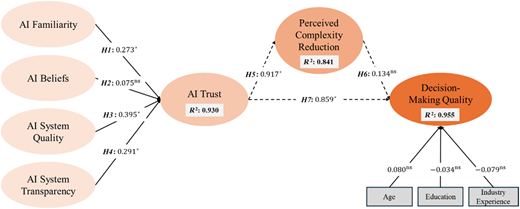
Furthermore, the R2 values for the endogenous constructs (i.e. AT, PCR and DMQ) all exceed 0.80, indicating strong explanatory capability (Hair et al., 2010). This suggests that the antecedent variables account for a considerable share of variance in these outcomes. Overall, the findings demonstrate that the proposed model effectively captures the interplay among AI-related factors and their role in shaping decisions within maritime organisations. The results are presented in Figure 2.
The findings indicate that AF (β = 0.273, p < 0.05), ASQ (β = 0.395, p < 0.05) and AST (β = 0.291, p < 0.05) exert statistically significant positive effects on AT, providing support for H1, H3 and H4. Among these predictors, ASQ demonstrates the greatest influence on AT, underscoring the critical role of AI performance, reliability and effectiveness in developing users' trust in AI (Thielsch et al., 2018). AST emerged as the second strongest predictor of trust, suggesting that users value AI systems that transparently present how they operate and make their reasoning and decision-making mechanisms understandable. Transparent systems reduce uncertainty and perceived risk, thereby strengthening users' confidence in AI-generated outcomes (Felzmann et al., 2019). Furthermore, AF exhibits a significant positive effect on AT, suggesting that AF can enhance users' comfort and reduce hesitation when interacting with AI-supported tools but the effect is not as strong as the technical factors' effects (Wang et al., 2025).
In contrast, AB (β = 0.075, p > 0.05) did not exhibit a significant effect on AT, indicating that H2 is not supported. This finding contrasts with prior literature, which suggests that positive beliefs about AI enhance trust and adoption (Kasilingam, 2020; Schulz et al., 2023). The results suggest that in environments such as the maritime industry, users rely more heavily on direct experience and observable technical attributes rather than on abstract beliefs when forming trust (Aalberg et al., 2024).
The analysis further shows that AT exerts a strong and statistically significant positive effect on PCR (β = 0.917, p < 0.05), supporting H5. This suggests that users who have greater trust in AI tend to perceive AI as capable of simplifying complex tasks, reducing uncertainty and assisting in problem-solving (Choung et al., 2023; Zhu et al., 2023). Trust, therefore, acts as a key enabler that allows users to rely on AI recommendations, thereby lowering the perceived complexity of AI. This finding aligns with LSTT, which conceptualises trust as a mechanism for managing complexity in uncertain environments.
Subsequently, the effects of AT and PCR on DMQ were examined. The results reveal that AT (β = 0.859, p < 0.05) exerts positive effects on DMQ, supporting H7. In contrast, PCR (β = 0.134, p > 0.05) exhibits a positive effect on DMQ that is non-significant, and thus H6 is not supported. AT demonstrates a substantially stronger influence, implying that trust in AI strengthens users' confidence in acting on its recommendations, which leads to improved DMQ (Salem et al., 2024). At the same time, PCR shows a weaker positive contribution to DMQ, suggesting that reductions in cognitive burden may enhance users' ability to process information, evaluate alternatives and make more informed decisions but the effect is relatively small (Hjelle et al., 2024).
Furthermore, participants' age, education level and industry experience were accounted for as control variables in the analysis, as prior studies in technology adoption literature suggest that such factors may influence individuals' perceptions and interactions with technological systems (Venkatesh et al., 2013). However, the findings suggest that these variables do not have a statistically significant effect on the key constructs examined in this study. This finding may be due to the increasing integration and widespread use of AI in maritime organisations, where individuals across different demographic groups are increasingly required to interact with AI-supported tools in their daily operations. Consequently, the limited impact of demographic factors suggests that AT and its influence on PCR and DMQ are more strongly driven by sociotechnical factors rather than individual background characteristics.
4.3 Direct, indirect and total effect analysis
Table 4 presents a detailed summary of the direct, indirect and total effects of these antecedent variables on the endogenous constructs in the proposed structural model.
The examination of direct effects indicates that all antecedent variables positively influence AT, with ASQ exerting the strongest effect (a31 = 0.395), followed by AST (a41 = 0.291), AF (a11 = 0.273) and AB (a21 = 0.075). These findings highlight that technical factors play a more prominent role in shaping user trust compared with general beliefs about and familiarity with AI. Regarding the downstream outcomes, AT exhibits a strong direct effect on PCR (a52 = 0.917), emphasising its pivotal role in alleviating perceived complexity. In addition, AT (a53 = 0.859) and PCR (a63 = 0.134) both positively influence DMQ, indicating that users who trust AI and perceive reduced complexity in tasks tend to achieve better decision outcomes. Among these, AT remains the dominant predictor, reflecting its critical function in guiding user reliance on AI recommendations.
Indirect effect analysis further clarifies the mediating role of AT and PCR. All antecedent variables influence PCR and DMQ indirectly through AT, including both direct mediation via AT and sequential mediation through AT and PCR. Among these, ASQ demonstrated the strongest indirect effects on both PCR (b32 = 0.362) and DMQ (b33 = 0.388), followed by AST (b42 = 0.267 and b43 = 0.286, respectively) and AF (b12 = 0.251 and b13 = 0.268, respectively), while AB exhibits comparatively weaker indirect effects. Additionally, AT also exerts an indirect effect on DMQ through PCR (b53 = 0.123), suggesting that PCR acts as a partial mediator between AT and DMQ.
The total effects further reinforce these findings. ASQ emerged as the most influential sociotechnical factor overall, with the highest total effects on both PCR (c32 = 0.362) and DMQ (c33 = 0.388), followed by AST and AF, respectively. Although AB shows positive total effects, its overall influence remains comparatively weaker. Notably, AT exerts a total substantial effect on DMQ (c53 = 0.981), underscoring its central role in enhancing decision outcomes.
Overall, the combined direct and indirect effects illustrate that AT acts as the central mechanism by which both social and technical factors influence decision-making outcomes. While ASQ and AST play a major role in shaping trust, the resulting reduction in perceived complexity further enhances users' ability to make sound and effective decisions. These results underscore the significance of cultivating trust and improving system design as trust functions as the key mechanism through which both social and technical factors translate into improved DMQ.
5. Conclusion
5.1 Summary
This study systematically examined the role of AT in enhancing DMQ within the maritime industry. Drawing on STS theory and LSTT, a theoretical model was developed linking social factors (AF and AB) and technical factors (ASQ and AST) to AT. The model further investigated how AT influences PCR and subsequently DMQ. SEM was used to analyse survey data collected from 106 maritime professionals working in Singapore.
The results demonstrated a satisfactory model fit and offered strong support for the majority of the hypothesised relationships. ASQ and AST emerged as the most influential predictors of AT, while AF showed a weaker and significant effect, and AB did not exhibit a significant effect. AT was found to be a key mechanism influencing both PCR and DMQ, with a particularly strong effect on reducing complexity. In turn, PCR contributed positively to DMQ, although the effect was relatively weak.
Furthermore, the findings provide important insights into stakeholder dynamics within maritime organisations. By demonstrating how AT reduces users' perceived complexity of AI, this study highlights its critical role in enabling effective human–AI collaboration. In high-risk operational environments, trust facilitates more confident interactions between stakeholders and AI, thereby supporting improved DMQ and reducing resistance to AI adoption.
5.2 Theoretical contributions
This study advances the literature on AT, sociotechnical systems and decision-making in complex organisational environments.
First, this research extends STS theory by developing and empirically validating a framework that reflects the combined effects of social factors (AF and AB) and technical factors (ASQ and AST) on the formation of AT. By demonstrating how the alignment between social and technical subsystems shapes trust in high-risk maritime contexts, this study reinforces the applicability of STS theory in explaining technology adoption in real-world operational settings.
Second, the study advances the literature by integrating STS theory and LSTT to provide a more complete understanding of AT within organisational environments. By combining the system-level perspective of STS theory with the conceptualisation of trust as a mechanism for managing uncertainty in LSTT, this study positions AT as a critical link between sociotechnical factors and decision-making outcomes. This integrated framework moves beyond fragmented theoretical approaches, offering a more holistic insight into how social, technical and organisational elements interact with trust to enable individuals to navigate complexity and engage effectively with AT.
Third, this study extends the decision-making literature by uncovering and empirically validating AT as a key mediating mechanism linking sociotechnical factors to PCR and DMQ and provides a contextual extension of AT within the maritime industry, a high-stakes and underexplored domain characterised by operational uncertainty and complexity. While existing research has largely emphasised direct relationships between technological capabilities and decision outcomes, this study uncovers the underlying causal pathway through which trust translates into improved decision quality. In doing so, it bridges the gap between micro-level cognitive processes (such as perceived complexity) and macro-level organisational outcomes, offering a more detailed perspective of how AI influences decision quality.
5.3 Strategic implications
This study highlights several key strategic insights for maritime organisations pursuing effective AI adoption in complex operational environments.
First, policymakers and maritime organisations should prioritise AT as the main factor for reducing perceived complexity and improving DMQ. AT's strongest total effect indicates that employees are more likely to benefit from AI when they can rely on its outputs with confidence. Maritime organisations should therefore develop clear procedures that specify how AI recommendations should be reviewed, accepted or over-ridden by human decision-makers. For example, in AI-supported voyage planning, port scheduling or collision-risk assessment, users should be provided with clear decision protocols, accountability rules and escalation procedures. Policymakers can support this process by developing sector-level guidelines on AI assurance, human oversight, data governance and accountability. These measures can help maritime professionals use AI with greater confidence, perceive AI-supported tasks as more manageable and make better-informed decisions in complex operational settings.
Second, technical factors should receive primary attention because ASQ and AST are the strongest sociotechnical drivers of AT. The findings suggest that employees are more likely to trust AI when systems are reliable, responsive, easy to use and transparent in their decision logic. Maritime organisations should therefore strengthen technical quality through rigorous system testing, user-centred interface design and explainable AI functions before large-scale deployment. For example, an AI-based route optimisation system should be tested under different weather, traffic and vessel-operating conditions to ensure stable and timely recommendations. Similarly, an AI-supported collision avoidance system should display the key factors behind its recommendations, such as vessel proximity, navigational constraints, traffic density and risk level. These measures can make AI outputs more understandable and dependable, thereby strengthening trust, reducing perceived complexity and supporting higher-quality decisions.
Third, social factors should be strengthened through practical exposure to AI, with greater emphasis on AF than general AB. The findings suggest that maritime professionals are more likely to trust AI when they have direct experience with how it works in their operational context. Organisations should therefore provide hands-on training, simulation-based exercises and guided demonstrations that allow users to interact with AI-supported tools before relying on them in real tasks. For example, navigators and operations staff could be trained to compare AI-generated route recommendations with conventional decision-making practices, while managers could examine how AI outputs support risk evaluation and resource allocation. Cross-functional workshops involving technical teams and operational users can also help clarify system functions, address concerns and align AI design with actual maritime workflows. These initiatives can increase familiarity, reduce hesitation and strengthen AT, thereby supporting perceived complexity reduction and DMQ.
5.4 Limitations and recommendations
Despite its contributions, this study has several limitations that should be recognised.
First, the study uses a cross-sectional design, which limits the capacity to determine causal relationships among the constructs. Although SEM enables the testing of theoretically grounded relationships, the findings reflect associations at a given point in time. Future studies could overcome this limitation by adopting longitudinal research designs to capture the dynamic evolution of AT, particularly as users gain experience and interact with AI over extended periods.
Second, the study focuses on the Singapore maritime context, which may potentially prevent the transferability of the results to other regions with varying institutional, regulatory and technological environments. Future studies can build on this work by undertaking comparative research across multiple maritime hubs or international settings to provide a deeper understanding of the contextual boundaries of the proposed model.
Declarations
During the preparation of this work, the authors used ChatGPT in order to improve the language. After using this tool/service, the authors reviewed and edited the content as needed and take full responsibility for the content of the publication.
Notes
CFA: confirmatory factor analysis.
CFI: comparative fit index.
TLI: Tucker–Lewis index.
RMSEA: root mean square error of approximation.
SRMR: standardised root mean square residual.
AVE: average variance extracted.
χ2/df: chi-square divided by degrees of freedom.
The supplementary material for this article can be found online.