


The study aims to investigate the direct effect of globalization on financial inclusion in SSA and examine the role of the political regime between globalization and financial inclusion.
The methodology involves the following steps: Compute a financial inclusion index; Disentangle globalization into social, economic, political and overall; Employ the two-Stage-Least Squares (2SLS) with instrumental variables; use of the System Generalized Method of Moments (S-GMM).
Globalization through social, economic and overall dimensions increase financial inclusion while political globalization has no significant effect; political regime through Polity2 and Freedom House increases the effect of globalization on financial inclusion.
Policymakers should develop long-term strategies that transcend political cycles and adapt to the evolving landscape of globalization to ensure effectiveness in achieving inclusive financial systems.
This paper is the first to analyze the direct effect of globalization on financial inclusion. It also explores the mediating role of the political regime between globalization and financial inclusion.
1. Introduction
Despite the effort made by policymakers and international organizations to increase financial inclusion in the world, sub-Saharan Africa (henceforth SSA) is still lagging behind compared to the rest of the world. According to the latest Global Findex database, only 55% of the adult population holds a bank account in 2021 (Demirgüç-kunt et al., 2022) against the global average of 76% in the world, 97% in OECD or 69% in developing countries. Promoting financial inclusion is essential to economic development. It improves productivity, ecological sustainability, poverty reduction and income distribution (Chinoda and Kapingura, 2024; Saha and Qin, 2023).
The literature on financial inclusion provides three main axes of analysis. The first develops its measures (Tram et al., 2023), the second axis focuses on its effects (Oyewole et al., 2024; Kebede et al., 2023) and the third strand strives to explore its determinants (Allen et al., 2014).
This last track allows to note that, financial inclusion can be explained by micro and macro factors (Zins and Weill, 2016) including internal or external factors (Nsiah and Tweneboah, 2023; Anzoategui et al., 2014). Considering external factors, several works endeavored to examine the importance of globalization on financial inclusion (Gautam, 2019; Timbi et al., 2024).
Between 1970 and 2020, SSA witnessed a tremendous growth in globalization with a rise from 27 in 1970 to 50 in 2020, primarily in social, economic and political dimensions (Gygli et al., 2019). Hence, since the beginning of the wave of globalization in the 1980s, SSA, like other Least Developed Countries are among those who have been getting integrated into the world economy at a rapidly accelerated rate (Nkoro and Uko, 2014). Due to this rapid integration into the world, recent research shows that globalization can improve financial inclusion through economic growth (Shabir, 2024), technological infrastructures (Lenka and Barik, 2018) or international remittances (Qamruzzaman and Wei, 2019).
At the same time, during these last decades, SSA’s democratization has been uneven, with certain sub-regions experiencing clusters. According to the Economist Intelligence Unit report (2024), SSA is the second least democratic region in the world. In fact, the area suffered a significant democratic reversal in 2023 with a regional average score falling from 4.14 in 2022 to 4.04 in 2023. Although, this score is above the one of the Middle East and North Africa, which decreases from 3.34 to 3.23 between the same period, it is lower than Asia and Australia which recorded 5.46–5.41, 5.79–5.68 in Latin America and the Caribbean, 5.39–5.37 in Eastern Europe and Central Asia, 8.36–9.37 in Western Europe and 8.37 to 8.27 in North America. However, disparities exist between countries. Democracy is important for financial inclusion because it is recognized to better facilitates property rights protection, contract enforcement and encourages investment in financial services in comparison with autocracy (Olson, 1993).
Previous studies on the link between globalization [1] and financial inclusion highlights two main streams of researches. The first one considers the linear relationship (Dymski, 2005; Toxopeus and Lensink, 2008; Knill and Lee, 2014; Kouladoum et al., 2022; Bongomin et al., 2018; Gopalan and Rajan, 2018; Yeyouomo et al., 2023) and provides inconclusive results. The second axis analyzes the non-linear relationship and the conclusions are not unanimous (Akpa et al., 2024; Williams, 2016). On the one side, some studies show a significant relationship. For instance, Akpa et al. (2024) conclude that Internet can be implemented with the quality of governance to improve financial inclusion in SSA by providing thresholds of governance. Along the same line, Timbi et al. (2024) found that governance modulates the effect of remittances on financial inclusion in 29 SSA’s countries. For Issabayev et al. (2020), Saydaliyev et al. (2022), the effect of remittances depends on people’s perception about institutions. On the other side, Williams (2016) found that democratic institutions do not significantly affect the interplay between remittances and financial development.
Although these works are interesting, they do present some limitations. First, most studies have captured globalization through a specific indicator such as economic globalization (Knill and Lee, 2014), social globalization (Akpa et al., 2024) or financial globalization (Bashiru et al., 2023). Moreover, these studies overlook the role of political globalization. Globalization is a multifaceted phenomenon, so taking it into account as a whole would allow to suggest appropriate economic policy measures. Secondly, most of these studies analyzed the institutional channel through the lens of governance. Although focusing on democratic institutions, Williams (2016) analyzed the effect on financial development which is not the same as financial inclusion. Thirdly, although there are studies on the relationship between globalization dimensions and financial inclusion (Nsiah and Tweneboah, 2023) or institutions and financial inclusion (Nkoa and Song, 2020), there is a dearth of research on how political regimes interplay between globalization and financial inclusion in SSA.
From what proceeds, the contribution of this work can be seen on four levels. First, while previous studies touched on single measures of globalization, this study used four types namely social, economic, political and overall globalization in order to have a general insight of this variable. Secondly, to the best of our knowledge, since the seminal works of Olson (1993), Clague et al. (1996) and Huang (2010) on the effect of political institutions on financial development, no study has analyzed the effect of the political regime on financial inclusion in the context of SSA, knowing that, financial development is not the same as financial inclusion. Thirdly, following North (1990) who argued that it is not the factors of economic performance that determine it, but that these are the consequence of the good quality of institutions, we analyze the mediating role of the political regime between globalization and financial inclusions in SSA. The fourth contribution is the usage of the Generalized Method of Moments (GMM) in system and the Two-Stage Least Squares (TSLS) to deal with potential endogeneity. Finally, the findings are relevant for achieving the 1st, 16th and 17th SDG; aiming at ending poverty, promoting peace, justice and effective institutions, and strengthening global partnerships through international trade.
The remainder of the article is organized as follows. The second section displays the literature review. The third section develops the methodological strategy. The fourth presents the data and results, while the last section summarizes the key findings, and provides policy recommendations.
2. Selected literature review
2.1 Globalization and financial inclusion
Theoretically, the effect of globalization on financial inclusion can be analyzed through the lens of the Heckscher-Ohlin theory and the political economy of financial development. The Heckscher–Ohlin theory and particularly the Stolper–Samuelson theorem stipulates that if a country wishes to trade with another, that country must produce large quantities of products for which it has a relative advantage. According to this theory, trade between and within nations is a key factor in global growth and poverty reduction, as there is evidence that an open economy provides greater opportunities for millions of people around the world, which can lead to a reduction in extreme poverty. Growing trade openness means improving income levels, which encourages households to demand financial services. In the same logic, Samuelson (1948) thinks that if two countries trade freely, wages in the two countries must equalize.
Empirically, concerning the effect of economic globalization on financial inclusion Kocenda and Eshun (2023) found that trade openness increases financial inclusion. Léon and Zins (2020) on their part highlight the capacity of pan-African banks in facilitating the availability of credit. In the same vein, Knill (2005) opines that foreign portfolio investment promote access to credit for small firms. Regarding, the effect of social globalization, several studies show the positive effect of technologies in enhancing financial inclusion (Kouladoum et al., 2022; Aga and Martinez Peria, 2014; Anzoategui et al., 2014) while others show that remittance can hinder financial inclusion (Barnabe, 2021; Ozaki, 2012).
2.2 The interplay between globalization, political regime and financial inclusion
Theoretically, starting from North (1990) who argues that it is not the factors that directly influence economic performance but the consequence of a more or less efficient institutional environment, it is possible to highlight the mediating role of the political regime on the relationship between globalization and financial inclusion. In fact, a political regime that is democratic promotes property rights and the execution of contracts (Clague et al., 1996). This can favor the installation of foreign banks likely to promote firms' access to financial services. Similarly, a politically stable environment is conducive to the establishment of digital infrastructures that can promote the development of financial innovations and contribute to increasing financial inclusion.
Empirically, three main controversies animate the relationship between globalization, political regime and financial inclusion. The first strand suggests that political regimes can moderate the role of globalization on financial inclusion, with trade openness varying depending on governance indicators (Akpa and Asongu, 2022; Law et al., 2014; Kebede et al., 2023). The second strand suggests that political institutions have mixed effects on the globalization-financial inclusion nexus, with remittances promoting development if social institutions balance the positive and negative effects (Chami and Fullenkamp, 2013). The third strand argues that political regimes do not significantly influence the relationship between globalization and financial inclusion. Williams (2016) examines the impact of remittances on financial development in Sub-Saharan Africa, finding that remittances are positively connected with financial progress, but not significantly influenced by democratic institutions.
3. Methodology
3.1 Data description
This research looks at how financial inclusion is impacted by globalization as well as how political regimes in SSA moderate these effects. The sample is limited to 36 countries between 2004 and 2018 due to data limitations. The Appendix contains a list of the sampled countries.
3.1.1 Dependent variable
Following Sarma (2016), we rely on financial inclusion index (FII). This FII is a composite index covering three financial inclusion related-aspects namely penetration of financial services captured by the number of account per 1,000 adults (Sarma and Pais, 2011), the availability of financial services measured by the number of bank branches per 100,000 adults (Sarma, 2016) and the usage of financial services proxied by the outstanding loans with commercial banks (% GDP) (Lenka and Bairwa, 2016). The author relies on the multidimensional approach used by the UNDP for the computation of some well-known development indexes such as the HDI, the HPI or the GDI to compute the FII. The index comprised three categories ranged between 0 and 1. refers to low FII, is medium FII and means high FII. Table 1 show that on average, the FII is ranged between 0.5 and 1 meaning that financial inclusion is growing in SSA. This can be justified by the high penetration of mobile money services or ICT in this area (Demirgüc-kunt et al., 2022).
Descriptive statistics
| Variables | Observations | Mean | Std. dev. | Min | Max |
|---|---|---|---|---|---|
| FII | 515 | 0.121 | 0.098 | 0.006 | 0.650 |
| Hdi | 539 | 0.505 | 0.099 | 0.289 | 0.811 |
| Dens | 540 | 3.907 | 1.355 | 0.857 | 6.452 |
| Depend | 540 | 84.04 | 14.37 | 40.45 | 110.4 |
| Internet | 536 | 10.41 | 12.77 | 0.155 | 62.40 |
| Mobile | 534 | 56.10 | 39.19 | 0.207 | 161.2 |
| Fh | 540 | 0.469 | 0.352 | 0 | 1 |
| polity2 | 540 | 0.725 | 0.251 | 0 | 1 |
| Glob | 540 | 48.30 | 7.972 | 28.09 | 71.74 |
| Globeco | 540 | 43.67 | 10.49 | 22.91 | 85.35 |
| Globsoc | 540 | 40.92 | 11.58 | 15.01 | 77.69 |
| Globpo | 540 | 41.01 | 14.33 | 10.92 | 79.96 |
Source(s): Authors’ calculation
Figure 1 shows the average distribution of financial inclusion dimensions in SSA over the period 2004 and 2018. It indicates that all three dimensions are on a growing pathway. However, although there is a high penetration of financial services, the availability and usage are still low.
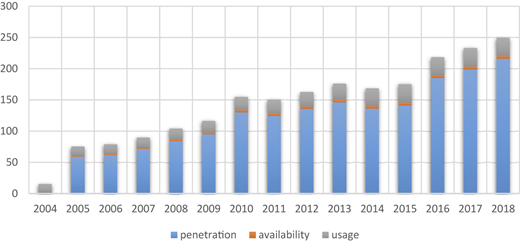
Evolution of financial inclusion dimensions in SSA (average value 2004–2018). Source: Authors’ construction
Evolution of financial inclusion dimensions in SSA (average value 2004–2018). Source: Authors’ construction
3.1.2 Variable of interest
Two variables of interest are considered in this study. The first variable is globalization which comprises several sub-dimensions. Based on Gygli et al. (2019), we rely on four pillars of globalization: overall, economic, social and political globalization. According to Dreher (2006), economic globalization involves trade, investment, income payments and restrictions, while social globalization includes personal contact, information flows and cultural proximity, encompassing trade, investment and participation in UN security (Dreher, 2006). Political globalization refers to the spread of government policies, including UN peacekeeping missions, embassies, NGOs and political cooperation capabilities among countries (Gygli et al., 2019). The overall globalization index and its three dimensions are available for almost every country in the world since 1970 (Dreher et al., 2008). These indexes are the most used measure of globalization in the academic literature (Fotio and Nguea, 2022). The values range from 0 to 100, with “0” indicating a country’s autarkic economy and “100” indicating its complete integration into the global economy.
The political regime is the second variable of interest. Although there are numerous indices used to assess the political system, none of them are flawless (Williams and Siddique, 2008). Following Acemoglu et al. (2008), Asiedu and Lien (2011) and Gandjon (2018), we use two different metrics of political regime: the Polity2 variable indicator and the Freedom House (FH) indicator to strengthen the credibility of our conclusions. Freedom House’s political regime metric assigns a country’s status based on its political and civil rights metrics. Countries with an average of 1–7 are classified as autocratic (NF), while those with an average of 2.5 are democratic (F). The FH indicator integrates democracy components like political competition, free elections and civil liberties, but does not differentiate between regimes. The Polity2 indicator differentiates between regimes and countries with the same regime, making both useful in analysis. To facilitate a comparison between different measures of political regime, we follow Acemoglu et al. (2008) and Asiedu and Lien (2011), Gandjon (2018) and normalize FH and Polity2 to range between 0 and 1, so that a number less than 0.5 implies that the country is an autocracy while a number greater or equal to 0.5 implies that the country is a democracy.
3.1.3 Control variables
To avoid variable omission bias, we add five control variables to the econometric model: the human development index, population density, the dependency ratio, Internet access and mobile phone penetration. Human development index is a summary measure of key dimensions of human development including a long and healthy life, a good education and a decent standard of living (UNDP, 2022). High human development levels are linked to higher financial inclusion, and human capital plays a crucial role in enhancing financial inclusion in Africa (Sarma and Pais, 2011; Nkoa and Song, 2020). Population density positively impacts financial inclusion (Allen et al., 2014), while the dependency ratio, which represents the proportion of dependents compared to active workers, can negatively affect financial inclusion (Park and Mercado, 2021). ICT positively impacts financial inclusion by promoting inclusive finance and development, as seen in studies capturing Internet and mobile phone users (Abor et al., 2018; Sha’ban et al., 2019).
3.2 Econometric specification
In this study, the empirical model is derived from the work of Issabayev et al. (2020) who adopted specifications that consider the effects of international determinants of financial inclusion.
This paper aims to investigate the interplay between globalization and political regimes for financial inclusion. Although the theoretical arguments are not extensively discussed, the literature suggests that autocracies and democracies can impede or facilitate the development of the financial sector (Clague et al., 1996). On this basis, theoretical foundations on the link between globalization, political regime and financial inclusion can be rooted in the new institutional economics which explores the efficiency of institutions (Williamson, 1973; North, 1990).
Given these arguments, the reduced specification is illustrated by equation (1):
The moderating role of the political regime is considered in equation (2)
where is the interaction term between globalization and political regimes. Considering the interaction variable leads to Equation (3).
Where , the dependent variable, captures the financial inclusion index of country at the period . captures globalization, which measure the degree of integration into the world economy of a country i at the period t. We consider the overall KOF globalization index and its three dimensions: economic, social and political globalization introduced by Dreher (2006) and updated in Dreher et al. (2008) and Gygli et al. (2019).
This study uses two-stage least squares with instrumental variables to address omitted variables and reverse causation, preventing bias in estimates correlated with globalization, political regime and financial inclusion (Ajefu and Ogebe, 2019). The migration and development literature generally proposed the migrant network effects (Anzoategui et al., 2014). Therefore, we use it as instrument in this study. Our estimates could be impacted by reverse causality because financial inclusion might increase international trade (Wasim et al., 2023). To check the robustness of our results we use the two-step system generalized method of Moments (GMM) estimator developed by Arellano and Bover (1995) and Blundell and Bond (1998). The main advantage of this estimator is its capacity to deal with potential heterogeneity and endogeneity issues.
3.2.1 Descriptive statistics
Table 1 shows that the mean (standard deviation) for financial inclusion index is 0.121 (0.0984), human development index is 0.505 (0.029), population density is 3.907 (1.355), the ratio of dependence is 84.04 (14.87), Internet users is (10.41 (12.77), mobile phone subscription is 56.10 (39.19), freedom house index is 0.469 (0.352), polity2 is 0.725 (0.251), overall globalization is 48.30 (7.972), economic globalization is 43.67 (10.42), social globalization is 40.92 (11.58) and political globalization is 41.01 (14.33).
Furthermore, Figure 1 shows the evolution of financial inclusion dimension in SSA countries from 2004 to 2018 with the highest level of the penetration and availability dimension found in Seychelles, while the highest level of the usage dimension is registered in Nigeria in 2005.
Table 2 displays the fact that the correlation between the financial inclusion index and determinants like human development index, population density, Internet access and mobile phone penetration is positive. However, the dependence ratio and FII have negative correlations. Political regime measures have positive correlations. Globalization positively correlates with financial inclusion, with upward trend lines suggesting it increases regardless of dimension (see Figure 2). The correlations coefficients are below 0.8 value considered as a decision rule thump for multicollinearity test except the correlation between social globalization and the ratio of dependence. Nonetheless, in order to mitigate the risk of biased estimations, these variables are employed in various models. Although these correlation coefficients reflect the type of link that can exist between the dependent variable and all the explanatory variables, only econometric estimation can determine their explanatory power.
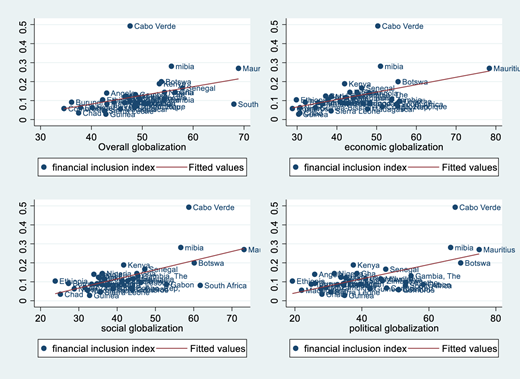
Correlation between globalization and financial inclusion index in SSA between 2004 and 2018. Source: Authors’ construction
Correlation between globalization and financial inclusion index in SSA between 2004 and 2018. Source: Authors’ construction
Matrix of correlation
| FII | Hdi | Dens | Depend | Internet | Mobile | Fh | Polity2 | Glob | Globeco | Globsoc | Globpo | |
|---|---|---|---|---|---|---|---|---|---|---|---|---|
| FII | 1.0000 | |||||||||||
| Hdi | 0.5404* | 1.0000 | ||||||||||
| Dens | 0.0499 | −0.0386 | 1.0000 | |||||||||
| Depend | −0.4911* | −0.7738* | −0.0644 | 1.0000 | ||||||||
| Internet | 0.4572* | 0.6182* | 0.0618 | −0.6317* | 1.000 | |||||||
| Mobile | 0.3945* | 0.6242* | −0.1137* | −0.5526* | 0.7821* | 1.0000 | ||||||
| Fh | 0.4173* | 0.3187* | 0.0461 | −0.5031* | 0.2893* | 0.2191* | 1.0000 | |||||
| Polity2 | 0.3239* | 0.2642* | 0.1179* | −0.4249* | 0.2184* | 0.1349* | 0.6928* | 1.0000 | ||||
| Glob | 0.3845* | 0.6605* | −0.0023 | −0.6333* | 0.5941* | 0.6566* | 0.4659* | 0.2380* | 1.0000 | |||
| Globeco | 0.3844* | 0.6032* | −0.0033 | −0.6502* | 0.4389* | 0.4317* | 0.4334* | 0.2306* | 0.7588* | 1.0000 | ||
| Glosoc | 0.5816* | 0.8312* | −0.0177 | −0.8205* | 0.7057* | 0.7564* | 0.5187* | 0.4312* | 0.7438* | 0.6691* | 1.0000 | |
| Globpo | 0.5727* | 0.7174* | −0.0861* | −0.7516* | 0.5924* | 0.6510* | 0.4417* | 0.3557* | 0.5430* | 0.5598* | 0.9205* | 1.0000 |
Source(s): Authors’ calculation
3.2.2 CD dependence test and unit root test
To avoid spurious regression, it is crucial to determine interdependence and integration properties in panel data before econometric analysis. Cross-section dependence tests like such as Friedman (1937), Frees (1995) and Pesaran (2004) are available, with the Pesaran (2004) CD test having high power for small samples and applicable to balanced and unbalanced data. They allow to choose between first generation unit root tests in case of independence between individuals or second generation unit root tests otherwise. Table 3 indicated the rejection of the null hypothesis of no independence between countries.
Cross-sectional dependence test results
| Variables | CD-test | p-value | Corr | Abs (corr) |
|---|---|---|---|---|
| FII | 45.03 | 0.000 | 0.761 | 0.794 |
| Hdi | 51.89 | 0.000 | 0.884 | 0.884 |
| Dens | 61.44 | 0.000 | 0.999 | 0.999 |
| Depend | 55.96 | 0.000 | 0.965 | 0.965 |
| Internet | 49.34 | 0.000 | 0.850 | 0.850 |
| Mobile | 50.46 | 0.000 | 0.870 | 0.870 |
| Fh | 49.96 | 0.000 | 0.813 | 0.813 |
| Polity2 | 47.66 | 0.000 | 0.775 | 0.775 |
| Glob | 59.09 | 0.000 | 0.961 | 0.961 |
| Globeco | 54.90 | 0.000 | 0.893 | 0.893 |
| Globsoc | 60.35 | 0.000 | 0.982 | 0.982 |
| Globpo | 60.53 | 0.000 | 0.984 | 0.984 |
Source(s): Authors’ calculation
The cross-sectional dependence test results lead to the choice of second-generation unit root test. In Table 4, the application of Pesaran’s CIPS unit root test (2007) indicates that all variables are stationary in level.
Pesaran (2007)’ panel unit root test
| Variables | Level | First difference | Order |
|---|---|---|---|
| FII | −12.505*** | – | I(0) |
| Hdi | −15.945*** | – | I(0) |
| Dens | −17.341*** | – | I(0) |
| Depend | −15.375*** | – | I(0) |
| Internet | −15.582*** | – | I(0) |
| Mobile | −16.576*** | – | I(0) |
| Fh | −15.497*** | – | I(0) |
| Polity2 | −17.319*** | – | I(0) |
| Glob | −15.758*** | – | I(0) |
| Globeco | −15.748*** | – | I(0) |
| Globsoc | −15.724*** | – | I(0) |
| Globpo | −17.587*** | – | I(0) |
Note(s): *** is the statistical significance at 1%
Source(s): Authors’ own calculation
4. Results and discussion
In this section, we discuss the empirical effect of globalization on financial inclusion on the one and analyze the interplay of political regime between globalization and financial inclusion in SSA on the other hand.
4.1 Direct effects of globalization on financial inclusion
Table 5 depicts the results of the effect of globalization on financial inclusion. The study reveals two main tendencies. On the one side, overall, economic and social globalization positively impact financial inclusion in SSA countries. A one-unit increase in these factors increases the index by 0.431, 0.237 and 1.03 points, respectively, ceteris paribus. These results can be explained by the fact that the exchange of goods and services might help economic agents generate foreign currency income which can allow them to demand the opening of bank accounts to manage their money. This result corroborates with the findings of Majumder (2020) who found that new exports have a positive impact on employment in the home country and thus allow individuals to request for financial services or Gökmenoğlu and Taspinar (2016) who discovered that globalization stimulates the economy by increasing product and service demand, leading to financial activity. The results also show that the political regime significantly improves the financial inclusion index.
The effect of globalization on financial inclusion
| Variables | (1) | (2) | (3) | (4) |
|---|---|---|---|---|
| Hdi | 0.497*** | 0.460*** | 0.824*** | 0.409*** |
| (0.085) | (0.0723) | (0.233) | (0.060) | |
| Dens | 0.512* | 0.355 | 0.378 | 0.296 |
| (0.281) | (0.258) | (0.321) | (0.271) | |
| Depend | 0.0119 | −0.029 | −0.162* | 0.015 |
| (0.036) | (0.048) | (0.098) | (0.055) | |
| Internet | 0.115*** | 0.122** | 0.119*** | 0.127*** |
| (0.029) | (0.053) | (0.039) | (0.048) | |
| Mobile | 0.0379* | 6.99e−03 | 0.116** | 9.29e−03 |
| (0.020) | (0.175) | (0.050) | (0.028) | |
| Fh | 0.106*** | 0.089*** | 0.118*** | 0.071*** |
| (0.024) | (0.017) | (0.030) | (0.010) | |
| polity2 | 0.022*** | 0.015*** | 0.047** | 0.008*** |
| (0.003) | (0.001) | (0.024) | (0.002) | |
| Glob | 0.431* | |||
| (0.223) | ||||
| Globeco | 0.002** | |||
| (0.001) | ||||
| Glosoc | 0.010** | |||
| (0.005) | ||||
| Globpo | 0.001 | |||
| (0.001) | ||||
| Constant | −0.016 | −0.041 | 0.085 | −0.143* |
| (0.093) | (0.078) | (0.128) | (0.084) | |
| Observations | 506 | 506 | 506 | 506 |
| R-squared | 0.372 | 0.348 | 0.275 | 0.349 |
| Kleibergen–Paap rk LM p.value | 0.000 | 0.000 | 0.002 | 0.000 |
| Kleibergen–Paap rk Wald F stat | 23.663 | 39.560 | 6.479 | 11.239 |
| Hansen p-value | 0.257 | 0.426 | 0.141 | 0.298 |
Note(s): Robust standard errors in parentheses
***p < 0.01, **p < 0.05, *p < 0.1
We used one instrument in this study such as: personal remittances received (% of GDP). This variable is extracted from the World Bank
Source(s): Authors’ calculation
This can be explained by the progressive implementation of political participation, openness in executive recruiting and institutional restraints on executive power, which protect property rights and favor supply and demand for services (La Porta et al., 1998). This result is in line with Kebede et al. (2023) and Agyekum et al. (2016) both emphasize the importance of promoting institutional quality and protecting property rights for financial inclusion. Looking at control variables, the human development index shows a positive and statistically significant effect financial inclusion corroborating Sarma and Pais (2011) who found that human development is associated with high financial inclusion. Education increases financial inclusion in SSA and the result is in line with Zins and Weill (2016). Population density positively impacts financial inclusion (Allen et al., 2014), while dependency ratio negatively affects it when considering social globalization as found by Park and Mercado (2018). Internet access, particularly through ICTs, improves financial inclusion in SSA, allowing quick access to bank accounts and managing banking services without visiting a branch (Bawuah, 2024).
On the other side, political globalization does not have significant effect on financial inclusion in SSA. This result can be explained by two main stylized facts. First, political globalization implies the presence of embassies in a country, membership in international organizations and participation in UN security Council missions. For instance, belonging to UN security which aims at insuring peace in the world, does not have directly impact the capacity of individuals to demand or supply financial services. Moreover, a stable country is a prerequisite for financial contracts formation. Similarly, the presence of an embassy in a country can not necessarily lead to the demand or supply of financial services especially in SSA because economic agents make their daily economic transactions without caring of the presence or not of an embassy. However, this result does not corroborate the one of Tepeciklioğlu et al. (2024) who found that the presence of an embassy in an African country increases Turkey’s exports to this country by 108% which can allow importers, by retailing these products, to increase their demand for financial services.
4.2 Globalization and financial inclusion: does a political regime matter?
Tables 6 and 7 show that economic globalization directly and positively impacts financial inclusion, while polity2 has a significant effect on financial inclusion. When polity2 interacts with economic, social, political and total globalization, the financial inclusion index increases by 0.104, 2.530, 0.940 and 3.0 points. Table 7 shows that overall, economic and political globalization directly positively impact financial inclusion in SSA, with the Freedom House index having a significant positive effect. The political regime helps channel the beneficial effects of globalization on financial inclusion. This result can be explained by two arguments. First, a stable political regime that allows the diffusion of Information and Communication Technology (Biatour and Kegels, 2008) and the protection of intellectual property (Furman et al., 2002) reduces the uncertainty and transactions costs of new products like financial innovations that ultimately promote the supply and demand of financial services. Second, a democratic regime that respects electoral decisions creates confidence in the economy that can allow the establishment of financial contracts. This point was analyzed by Forcadell (2005) confirming this intuition. Third, by promoting international trade, a stable political regime promotes an increase in exportation of goods and services which increase the income of economic agents and stimulate them to demand for financial services. Thus, payments received in bank accounts or mobile accounts can allow individuals to pay bills, make purchases or firms to pay salaries or receive deposits and thus promote financial inclusion. This result is in line with Abdih et al. (2012) who found that the quality of institutions can promote remittances which are major tools for financial inclusion. Fourth, by enhancing the confidence in an economy as documented in the literature between presidential election and financial markets performance a democratic political regime creates more confidence in an economy which can attract investors and increase the demand or supply of financial services.
The moderating role of political regime (polity2) in the relationship between globalization and financial inclusion
| Variables | (1) | (2) | (3) | (4) |
|---|---|---|---|---|
| Hdi | 0.389*** | 0.495*** | 0.276** | 0.369*** |
| (0.121) | (0.165) | (0.116) | (0.0845) | |
| Dens | 0.288 | 0.00422* | 0.00350 | 0.0108** |
| (0.477) | (0.00247) | (0.00241) | (0.00466) | |
| Depend | −0.019 | 0.00292 | 0.00169 | 0.00416*** |
| (0.129) | (0.00364) | (0.00137) | (0.00125) | |
| Internet | 0.135*** | 0.000373*** | 0.000731 | 0.00166 |
| (0.033) | (0.0000) | (0.00144) | (0.00157) | |
| Mobile | 8.88e−03 | 0.000163*** | −0.000129 | 0.000947* |
| (0.0351) | (0.00002) | (0.000496) | (0.000529) | |
| Polity2 | 0.015*** | 0.982 | 0.321*** | 1.094*** |
| (0.005) | (1.246) | (0.063) | (0.389) | |
| Glob | −0.158 | |||
| (0.06) | ||||
| Glob*polity2 | 0.001*** | |||
| (0.000) | ||||
| Globeco | 0.018* | |||
| (0.009) | ||||
| Globeco*polity2 | 0.025** | |||
| (0.010) | ||||
| Globsoc | 0.004** | |||
| (0.002) | ||||
| Globsoc*polity2 | 0.009* | |||
| (0.005) | ||||
| Globpo | 0.021*** | |||
| (0.008) | ||||
| Globpo*polity2 | 0.030*** | |||
| (0.010) | ||||
| Constant | −0.057 | 0.309 | −0.072 | 0.235 |
| (0.660) | (0.535) | (0.218) | (0.191) | |
| Observations | 506 | 506 | 506 | 506 |
| R-squared | 0.345 | 0.122 | 0.404 | 0.114 |
| Kleibergen–-Paap rk LM p.value | 0.021 | 0.001 | 0.000 | 0.029 |
| Kleibergen–Paap rk Wald F stat | 3.843 | 7.253 | 8.201 | 3.574 |
| Hansen p-value | 0.256 | 0.102 | 0.379 | 0.182 |
Note(s): Robust standard errors in parentheses
***p < 0.01, **p < 0.05, *p < 0.1
We used one instrument in this study such as: personal remittances received (% of GDP). This variable is extracted from the World Bank
Source(s): Authors’ calculation
The moderating role of political regime (freedom house) in the relationship between globalization and financial inclusion
| Variables | (1) | (2) | (3) | (4) |
|---|---|---|---|---|
| Hdi | 0.475*** | 0.349*** | 0.174 | 0.303*** |
| (0.079) | (0.066) | (0.108) | (0.099) | |
| Dens | 0.448* | 0.525 | −0.0247 | 1.60** |
| (0.259) | (0.325) | (0.501) | (0.689) | |
| Depend | 0.074 | −0.171* | −0.166 | −0.407*** |
| (0.088) | (0.095) | (0.246) | (0.128) | |
| Internet | 0.097 | 0.233** | 0.358** | 0.265** |
| (0.100) | (0.118) | (0.166) | (0.108) | |
| Mobile | 0.0301* | 0.028* | 0.108 | 0.128* |
| (0.0175) | (0.016) | (0.087) | (0.070) | |
| Fh | 0.162*** | 0.612** | 0.739* | 0.868** |
| (0.0324) | (0.310) | (0.449) | (0.377) | |
| Glob | 0.541* | |||
| (0.296) | ||||
| Glob*Fh | 0.517** | |||
| (0.209) | ||||
| Globeco | 0.607* | |||
| (0.359) | ||||
| Globeco*Fh | 0.013* | |||
| (0.007) | ||||
| Globsoc | 0.012 | |||
| (0.009) | ||||
| Globsoc*Fh | −0.016 | |||
| (0.016) | ||||
| Globpo | 0.010** | |||
| (0.005) | ||||
| Globpo*Fh | 0.022** | |||
| (0.009) | ||||
| Constant | −0.010 | −0.214*** | −0.316*** | −0.114 |
| (0.142) | (0.072) | (0.112) | (0.112) | |
| Observations | 506 | 506 | 506 | 506 |
| R-squared | 0.337 | 0.199 | 0.110 | 0.114 |
| Kleibergen–Paap rk LM p.value | 0.0006 | 0.0000 | 0.013 | 0.000 |
| Kleibergen–Paap rk Wald F stat | 8.078 | 14.955 | 3.951 | 2.875 |
| Hansen p-value | 0.142 | 0.804 | 0.251 | 0.297 |
Note(s): Robust standard errors in parentheses
***p < 0.01, **p < 0.05, *p < 0.1
We used one instrument in this study such as: personal remittances received (% of GDP). This variable is extracted from the World Bank
Source(s): Authors’ calculation
4.3 Robustness check
This section examines the sensitivity of baseline results to globalization, financial inclusion and V-democracy measures, using a multidimensional dataset to understand the complexity of democracy beyond elections. The study uses the system GMM estimator to analyze trade and political regime effects on financial inclusion in SSA (see Table 8). Results show positive and significant effects when V-democracy interacts with trade, indicating globalization’s impact as it is show in Table 9.
Robustness check
| Variables | (1) | (2) |
|---|---|---|
| Estimation technique: 2SLS | ||
| Hdi | 99.35** | 56.65*** |
| (40.41) | (21.22) | |
| Dens | 5.167 | −4.796*** |
| (4.198) | (1.452) | |
| Depend | −1.322* | −0.519*** |
| (0.779) | (0.167) | |
| Internet | 0.518* | 0.360* |
| (0.311) | (0.206) | |
| Mobile | 0.0904 | 0.0263 |
| (0.0820) | (0.0559) | |
| V-Democracy | 8.116 | −22.93*** |
| (6.695) | (5.778) | |
| Trade | 1.385** | 0.00915*** |
| (0.636) | (0.0020) | |
| Trade*V-Democracy | 0.185*** | |
| (0.0586) | ||
| Constant | −257.6* | −91.93 |
| (133.6) | (70.80) | |
| Observations | 370 | 370 |
| R-squared | 0.734 | 0.332 |
| Kleibergen–Paap rk LM p.value | 0.0130 | 0.0062 |
| Kleibergen–Paap rk Wald F stat | 6.222 | 7.36 |
| Hansen p-value | 0.325 | 0.112 |
Note(s): Robust standard errors in parentheses
***p < 0.01, **p < 0.05, *p < 0.1
We used one instrument in this study such as: personal remittances received (% of GDP). This variable is extracted from the World Bank
Source(s): Authors
Robustness using alternative estimation technique and alternative measure of financial inclusion
| Variables | (1) | (2) |
|---|---|---|
| Estimation technique: system GMM | ||
| Outloan (−1) | 0.716*** | 0.857*** |
| (0.217) | (0.319) | |
| Hdi | 43.9*** | 21.6 |
| (13.1) | (25.9) | |
| Dens | 2.517*** | 1.483* |
| (0.593) | (0.835) | |
| Depend | −0.579*** | −0.705*** |
| (0.065) | (0.107) | |
| Internet | 0.923*** | 1.123*** |
| (0.037) | (0.083) | |
| Mobile | 0.111*** | 0.134*** |
| (0.033) | (0.032) | |
| Democracy | 0.119*** | 0.365* |
| (0.028) | (0.208) | |
| Trade | 0.010*** | 0.596* |
| (0.001) | (0.305) | |
| c.Trade#c.Democracy | 0.842** | |
| (0.396) | ||
| Constant | 0.624*** | 0.457 |
| (0.117) | (0.389) | |
| Instruments | 25 | 25 |
| Countries | 36 | 36 |
| Observations | 359 | 359 |
| AR(1) | 0.007 | 0.002 |
| AR(2) | 0.141 | 0.118 |
| Hansen test p-value | 0.645 | 0.625 |
Note(s): Standard errors in parentheses
***p < 0.01, **p < 0.05, *p < 0.1
Source(s): Authors’ estimation
5. Conclusion and policy implications
This paper examines the impact of globalization on financial inclusion in 36 SSA countries from 2004 to 2018, and focusing on the moderating role of political regimes. Employing the Two Stage Least Squares (2SLS) instrumental variables and the two step system GMM estimator for empirical analysis, the findings show that overall, economic and social globalization enhance financial inclusion, while political globalization has an insignificant impact on financial inclusion. The political regime namely polity2 and freedom House helps channels the beneficial effects of globalization on financial inclusion. Thus, globalization and democracy go hand in hand to increase financial inclusion.
The study suggests that aligning financial inclusion efforts with global sustainable development goals can help policymakers leverage the interactions between globalization, political regimes and financial inclusion to promote sustainable development. It suggests considering international factors influencing financial services supply and demand, dismantling domestic barriers and supporting financial, business and property rights. Moreover, governments must implement measures that can promote the establishment of the rule of law, which is a basis for the expression of political and civil freedoms.
Policymakers involved in promoting financial inclusion should put in place a conducive political environment, which is crucial to benefit from the globalization effect. More specifically, the government should invest more in social globalization, particularly data on personal contact (transfers) or on information flows (Internet users), which are important tools for financial inclusion. Moreover, a good and stable political regime that reinforces that capacity for negotiation of a country can help attract portfolio investors or foreign direct investment, which can be important for financing firms and improving access for individuals to financial services. To reduce dependency, it suggests increasing living, health and education standards by creating economic opportunities, investing in digital literacy programs and prioritizing ICT investments. These measures can strengthen the benefits of globalization on access to financial services.
This study is not without caveat and the main one is methodological. In fact, the tendencies of these results depend on the selected independent variables and the availability of data. However, this does not detract from the interesting nature of this work which could be supplemented by case studies in certain specific countries of the SSA. Furthermore, this study has a number of potential avenues for future research. On the one side, it could be interesting to look not only at the quantity but also the quality of globalization. In this vein, it could be interesting to examine the effect of other dimensions of globalization such as cultural dimension or their interaction with the quality of institutions such as legal, economic or political institutions on financial inclusion. On the other side, considering the mobile money dimension of financial inclusion could also help better understanding the challenges of financial inclusion in SSA.
Notes
See Dreher et al. (2008) for the components of index of globalization.
References
Further reading
Appendix
Variables names, definitions, measurements and sources
| Code | Variable name | Definition | Measurement | Source |
|---|---|---|---|---|
| Dependent variable | ||||
| FII | Financial inclusion index | Based on Sarma (2016), we use three dimensions namely penetration, availability and usage of financial services to construct the index | 0–1 | Construction (FAS, GFDD) |
| Control variables | ||||
| Hdi | Human development index | Human development index, based on key dimensions of human development: a long and healthy life, a good education and a decent standard of living | 0–1 | UNDP |
| DENS | Population density | Population density | people per sq. km of land area) | WDI |
| Depend | Age dependence ratio | Age dependence ratio, in % of working-age population | % | WDI |
| Internet | Individual using the Internet | Individuals who have used the internet (from any location) in the last 3 months | % | WDI |
| Mobile | Mobile phone subscriptions | Subscriptions to a public mobile telephone service that provide access to the PSTN using cellular technology | % | WDI |
| Globalization variables of interest | ||||
| Glob | Overall Globalization | Average value of economic, social and political indexes | 0–100 | KOF Swiss Economic Institute Gygli et al. (2019) |
| Globeco | Economic globalization | Average value of trade and financial globalization indexes | 0–100 | KOF Swiss Economic Institute Gygli et al. (2019) |
| Globsoc | Social globalization | Average value of interpersonal, informational and cultural globalization indexes | 0–100 | KOF Swiss Economic Institute Gygli et al. (2019) |
| Globpo | Political globalization | Aggregated and weighted data on the number of embassies and high commissioners in a country, number of country’s membership in international organization, participation in the UN peacekeeping missions and the number of international treaties signed by a country | 0–100 | KOF Swiss Economic Institute Gygli et al. (2019) |
| Political Regime variables of interest | ||||
| Polity2 | Polity2 | Normalized between 0 and 1 to capture pure democracy or pure autocracy | 0–1 | http://www.cidcm.umd.edu/polity |
| Fh | Freedom house | Normalized between 0 and 1 to capture pure democracy or pure autocracy | 0–1 | http://www.freedomhouse.org/ratings |
| Dependent and Independent variables of interest: robustness | ||||
| Democracy | Democracy index | combines information on the extent to which open, multi-party and competitive elections choose a chief executive who faces comprehensive institutional constraints, and political participation is competitive | 0–1 | Polity V |
| Outloan | Financial inclusion | Outstanding loan from commercial banks | % | Financial Access Survey |
| Trade | Globalization | Trade | % | WDI |
| List of countries | ||||
| Angola, Botswana, Burkina-Faso, Burundi, Cabo Verde, Cameroon, Chad, Comoros, Congo, Côte d’Ivoire, Ethiopia, Gabon, Gambia, Ghana, Guinea, Guinea Bissau, Kenya, Lesotho, Madagascar, Malawi, Mali, Mauritania, Mauritius, Mozambique, Namibia, Niger, Nigeria, Rwanda, Senegal, Sierra Leone, South Africa, Tanzania, Togo, Uganda, Zambia, Zimbabwe | ||||
Source(s): Authors

