This study aims to examine the influence of mandatory sustainability reporting on the cost stickiness of companies.
The study employs Anderson et al.’s (2003) cost stickiness model, using the difference-in-difference method, where the treatment and control groups comprise companies from 17 European Union (EU) countries and 11 non-EU Organisation for Economic Co-operation and Development countries, respectively. The time period spans from 2013 to 2022, with 2017 being the year of the EU Directive’s implementation. The study uses various approaches in addressing endogeneity issues, including propensity-score matching, the multiple specifications method, parallel trend analysis, placebo variable and control variables.
The results confirm a statistically significant increase in discretionary costs, i.e. selling general and administrative costs, for EU companies in the post-implementation period. The stickiness is more profound in companies demonstrating an annual improvement in sustainability performance. Stakeholder-oriented civil law countries exhibit an increase, while shareholder-oriented common law countries show a decrease in cost stickiness.
The study extends the literature on the economic effects of mandatory sustainability reporting by examining the novel aspect of cost behaviour, thereby revealing managerial perceptions about costs arising from compliance. It also highlights the role of company-level and country-level pre-regulation sustainability involvement in moderating the regulatory effect.
The study provides insights for policymakers in terms of formulating future regulations.
This study is the first to analyse cost stickiness in relation to mandatory sustainability reporting, adopting a multiple-country setting and covering a significantly long time period.
1. Introduction
Regulations worldwide, including the European Union (EU), China, India, and South Africa, have made it mandatory for companies to disclose sustainability information, either integrated into annual reports or as stand-alone documents (Ioannou and Serafeim, 2019). A prominent step in this respect, the EU’s Non-Financial Reporting Directive 2014/95/EU (NFRD), came into effect in 2017, requiring large publicly listed companies in the EU to disclose certain non-financial and sustainability information (Hummel and Jobst, 2024). Since then the EU regulatory framework for sustainability reporting has been undergoing continuous reform. The NFRD has been superseded by the Corporate Sustainability Reporting Directive (CSRD), and the CSRD itself is currently under re-evaluation (EY, 2025). Despite these ongoing reforms, we concur with La Torre et al. (2018) that the NFRD remains a crucial reference point for capturing how mandatory sustainability reporting affects companies’ internal practices. Our study, therefore, focuses on the NFRD period, thereby providing insights relevant to the ongoing re-evaluation of the CSRD.
The implementation and consistent development of the NFRD (the EU Directive hereafter) have posed several challenges for companies, from increased political and stakeholder pressure for transparency to the need for modifying business practices to accommodate these requirements. Given the broader aim of the regulation, i.e. to drive a change towards more sustainable economies, companies are increasingly seeking to reconcile financial goals with environmental, social, and ethical ones (Christensen et al., 2021). Correspondingly, research has shown significant interest in exploring the economic effects of this transition from voluntary to mandatory sustainability reporting. The EU Directive is particularly relevant in this context, as it was the first supranational regulation for mandatory sustainability reporting (La Torre et al., 2018) and has been in effect for a substantial period.
Significant evidence in the literature shows that mandatory sustainability reporting imposes an economic burden on companies (Kim et al., 2017; Manchiraju and Rajgopal, 2017; Chen et al., 2018; Grewal et al., 2019; Li et al., 2020; Christensen et al., 2021; Cupertino et al., 2022). For example, Cupertino et al. (2022) argued that non-financial regulation negatively impacts companies’ operating profitability and shareholder value. Chen et al. (2018) found that mandating sustainability disclosures negatively affected company profitability, even when the mandate did not require spending on such activities. Li et al. (2020) reported a negative effect of environmental regulations on company value, and Christensen et al. (2021) argued that compliance with sustainability-related regulations is costly for companies, particularly due to the administrative tasks related to the preparation, certification, and dissemination of reports.
However, to the best of our knowledge, there is a lack of evidence on how these regulations influence the cost behaviour of companies, where cost behaviour is defined as the relationship between a company’s costs and production levels (Banker et al., 2018). Since the full impact of mandatory sustainability reporting depends on managerial choices (Aragón-Correa et al., 2020), including cost-related decisions (Golden et al., 2020), studying this influence is essential regarding how managers internalize compliance costs. Banker et al. (2018) emphasized that cost behaviour can be used to gain insights into managerial decision-making processes across various facets of businesses. To this end, the cost stickiness concept provides a useful lens, positing that as production increases, managers raise the costs; however, as production declines, managers do not promptly decrease costs. In production downturns, managers conduct cost-benefit analyses regarding whether to adjust or retain certain costs (Anderson et al., 2003).
Moreover, research on mandatory sustainability reporting often suffers from temporal, regional, and thematic limitations (Korca and Costa, 2021; Dinh et al., 2023). Studies so far have focused on a narrow time frame, assessing only the short-term effects of the regulation (Dumitru et al., 2017). Additionally, results on unique regulatory environments such as China (Chen et al., 2018) and India (Manchiraju and Rajgopal, 2017) are subject to local market effects and legal differences. Similarly, studies on oil, gas, and mining companies (Christensen et al., 2017; Rauter, 2020) lack implications for other industries. The research on environmental or social aspects solely – e.g. green house gases emissions reporting (Broadstock et al., 2018) or the Securities and Exchange Commission’s (SEC’s) mine-safety reporting regulation (Christensen et al., 2017) – fails to reflect on the influence of a regulation covering the three sustainability pillars: Environmental, Social, and Governance (ESG). The variations originating from stakeholder- and shareholder-oriented markets also need attention (Korca and Costa, 2021; Dinh et al., 2023).
Accounting for these limitations, this study examines the influence of the EU Directive on the stickiness of the discretionary costs of companies. It further investigates the moderating role of company-level and country-level pre-regulation sustainability involvement on the responsiveness of companies’ cost behaviour to mandatory sustainability reporting.
The study puts forth its propositions based on resource-based theory and agency theory. On the one hand, the resource-based theory suggests managers may view compliance with mandatory sustainability reporting as a strategic resource. The increased transparency in mandatory settings drives companies to benchmark against peers and themselves, leading to innovative sustainability investments (Ioannou and Serafeim, 2019). Once incurred, such practices are typically irreversible due to high adjustment costs, managerial optimism, and/or managerial opportunism (Habib and Hasan, 2019). Conversely, agency theory suggests that while managers sometimes indulge in sustainability with empire-building motives (Eccles et al., 2014; Dyck et al., 2019), increased transparency mitigates manager-shareholder information asymmetry. The consequent enhanced shareholder oversight (Dhaliwal et al., 2012) may curb sustainability spending that inhibits profits.
The lack of empirical evidence in the literature and the conflicting theoretical perspectives highlight the need for investigation. To test our theoretical predictions, the difference-in-differences method is employed using Anderson et al. (2003) model on propensity-score-matched treatment and control groups over a ten-year period (2013–2022). The treatment group is derived from the 2017 implementation of the EU Directive, while the control group comprises non-EU Organisation for Economic Co-operation and Development (OECD) companies. The results, robust to propensity-score matching, multiple specifications method, parallel trend analysis, placebo variable, and control variables, show an increased stickiness in selling general and administrative costs (SGA) for EU companies in the post-implementation period, while non-EU OECD companies show no such stickiness. Further analyses reveal higher cost stickiness for companies demonstrating an annual improvement in sustainability performance as well as civil law country companies, while lower cost stickiness for common law country companies.
The study offers theoretical and practical implications. Theoretically, it advances the knowledge on the cost of mandatory sustainability reporting by the novel approach of cost stickiness. While it is established that compliance with such regulations is costly, this study provided empirical evidence on managerial perceptions about such costs in fluctuating business conditions. Retention of compliance costs emphasizes that managers view them as strategic resources. Moreover, the study reinforces the contingency view of regulation, revealing heterogeneity in EU Directive’s influence at company- and country-level.
A multi-country and longitudinal design add to the significance of the study. Practically, it offers policy implications by emphasizing the need to align reporting requirements with operational feasibility in future regulations. This alignment is essential to avoid financial strain on companies and managerial opportunism.
2. Conceptual framework
2.1 The EU directive
The EU Directive came into effect in 2017 for large publicly listed companies with more than 500 employees, with a dual aim of increasing transparency and promoting actual change in companies’ practices in terms of ESG pillars (European Union, 2014; Hummel and Jobst, 2024). To achieve this, the directive extended the scope of management reports to cover five key areas: environmental protection, social responsibility, labour rights protection, anti-corruption and bribery, and board diversity. In response, companies were expected to disclose information about their business model, policies, outcomes, risks, and key performance indicators in these areas.
Since its implementation, the directive has faced significant criticism for being “too general,” primarily because it lacks a standardized framework and mandatory assurance (La Torre et al., 2018; Hummel and Jobst, 2024). Instead of specifying a single uniform framework, the directive recommends various international standards, which differ significantly in terms of content and definitions, compromising the disclosed information’s comparability, reliability, and relevance. Additionally, according to the Directive, the non-financial information should be disclosed to the extent necessary for a clear understanding of the company’s performance, position, and the consequences of its operations, without specifying the “extent necessary” (Aureli et al., 2019). This ambiguity allows companies to apply a “cherry-picking” approach when adopting practices and disclosing information, potentially leading to symbolic reporting (Tariq, 2025).
As noted, we acknowledge that, as of 2024, the NFRD has been superseded by the CSRD, which revises and considerably expands the scope and intensity of sustainability reporting within the EU (European Union, 2022; Hummel and Jobst, 2024). Compared with the NFRD, the CSRD extends the obligation to a larger set of companies, including certain non-EU parent companies. It requires that sustainability information be included in a dedicated section of the management report, digitally tagged and subject to assurance. Companies must prepare their sustainability reports in accordance with binding European Sustainability Reporting Standards (ESRS) and apply a double-materiality perspective that combines financial materiality with impacts on people and the environment (Baumüller and Sopp, 2022). At the same time, the CSRD regime is currently under active re-evaluation. The European Commission has published FAQs to clarify scope, timelines and key concepts, and the European Financial Reporting Advisory Group (EFRAG) has issued ESRS implementation guidance on materiality assessment, value chains and data points to facilitate proportionate application in practice (European Union, 2022; EFRAG, 2024; European Commission, 2024). In 2025, a “Simplification Omnibus” proposal was introduced that aims to streamline ESRS disclosures, delay or phase in some requirements, and substantially reduce the number of companies in scope, reflecting concerns about administrative burden and competitiveness towards non-EU companies (Deloitte, 2025; EY, 2025; KPMG, 2025).
2.2 Cost stickiness
The cost stickiness concept, based on the non-mechanistic relationship between costs and production, reshapes the traditional cost behaviour model of contemporaneous increase and decrease in both costs and production (Anderson et al., 2003; Banker et al., 2018). According to this concept, costs are not always as responsive to changes in production as traditionally assumed; they are subject to managerial discretion (Anderson et al., 2003). Cooper and Kaplan (1992) and Noreen and Soderstrom (1997) were among the first to demonstrate that the decline in costs is smaller for decreasing production than the rise in costs for increasing production. While the pioneering studies focused on specific industries, e.g. Noreen and Soderstrom (1997) work on hospitals, Anderson et al. (2003) provided evidence of cost stickiness across a broad cross-sectional sample. They showed that the rise or drop in production is stochastic in nature, and managers typically analyse whether it is transitory or permanent before making cost adjustments.
The literature identifies several factors of cost stickiness, such as future sales forecast (Banker et al., 2018), economic climate, agency-related issues, social and employee policies (Anderson et al., 2003), corporate social responsibility (Habib and Hasan, 2019), and personal incentives (Banker et al., 2018). All these factors are driven by managerial discretion and can be delineated into three main categories: high adjustment costs, managerial optimism, and managerial opportunism (Banker et al., 2018; Chen et al., 2019). High adjustment costs occur when the costs of cutting down investments exceed the costs of retaining them, leading managers to continue the same investments even in lower production periods. Managerial optimism refers to managers’ expectations of future value from certain expenditures, prompting them to prioritize long-term benefits over short-term profitability. Managerial opportunism arises when managers’ personal incentives, psychological biases, and amplified goals influence cost adjustment decisions, sometimes at shareholders’ expense.
3. Theories, literature review, and hypotheses development
3.1 Mandatory sustainability reporting and cost stickiness
Mandatory sustainability reporting is often regarded as a hybrid, soft, and outcome-based regulation, which allows significant managerial discretion. Therefore, managerial perception can shape the costs arising from such regulations (Aragón-Correa et al., 2020; Golden et al., 2020). In the EU Directive, this regulation takes the form of more extensive reporting requirements, which increase the transparency of company sustainability practices and outcomes (Ioannou and Serafeim, 2019), thereby exposing them to greater scrutiny from regulators, shareholders, and other stakeholders.
To this end, the resource-based theory and agency theory offer contrasting arguments on how the increased transparency affects the extent of resources allocated and retained in sustainability. On the one hand, as the market visibility of a company’s sustainability activities increases, forces including stakeholder scrutiny, future-value creation, competition, and self-benchmarking may intensify, motivating managers to build and retain sustainability-related investments. The resource-based theory (Barney, 1991) posits that managers prioritize and retain costs that bear strategic value (Cohen and Tubb, 2018). When managers view sustainability as strategically valuable, they are likely to allocate resources to develop ESG-related systems, expertise, and stakeholder relationships (Christensen et al., 2017). As a result, legitimacy is created among stakeholders. Moreover, compliance with sustainability-related regulations is frequently associated with financial gains in the form of improved liquidity (Roy et al., 2022), higher operating cash flows and investment efficiency (Barth et al., 2017), and positive capital market effects (Krueger et al., 2021), even if the short-term profits drop (Kim et al., 2017). Therefore, managerial optimism about these material and non-material value-creation capacities of such resources may motivate them to deliberately allocate resources towards long-term sustainability goals (Banker et al., 2013). In addition, the increased transparency encourages companies to benchmark against one another, driving a market shift towards superior sustainability performance. Managers driven by such competition may elevate and retain sustainability investments to differentiate from peers (Aragón-Correa et al., 2020; Kim et al., 2020).
Sustainability reports not only reveal companies’ current achievements but also signal a commitment to maintain or improve over time (Christensen et al., 2021; Hummel and Jobst, 2024). When the regulation allows managers discretion in how they measure or present their sustainability progress (Aureli et al., 2019), they may go beyond the bare minimum compliance levels, being innovative to gain competitive advantages (Doshi et al., 2013). However, in production-declining periods, the fear of sending a weak signal to the market by reducing expenditures explains why managers might retain these investments. Consequently, in highly transparent and competitive markets, withdrawing from resources already committed to sustainability does not come without damage (Xu et al., 2024). These factors lead to high adjustment costs (both financial and non-financial), one of the primary drivers of cost stickiness.
On the other hand, the increased transparency may amplify the agency theory’s disciplining effect, thereby limiting managers’ discretionary investments in sustainability. If shareholders’ profit maximization goal is at stake, they may force managers to decline such expenses (Meckling and Jensen, 1976). In the context of mandatory sustainability reporting, shareholders with enhanced visibility into sustainability spending (Dhaliwal et al., 2012) potentially discipline managers and diminish their opportunistic behaviour that might otherwise lead to hoarding unproductive resources. For example, since higher compensation or performance-based rewards are often tied to ESG metrics (Eccles et al., 2014), managers may sustain unnecessary sustainability expenditures. They may sometimes use these investments to avoid activists’, regulators’, and stakeholders’ scrutiny (Dyck et al., 2019) and improve their reputation, even at the cost of shareholders’ profits (Christensen et al., 2017). Moreover, managerial decisions are often driven by career concerns; for example, managers in companies with poor safety records may prioritize sustainability efforts to safeguard their employability (Dewatripont et al., 1999). When disclosure becomes mandatory and more comparable, shareholders are better equipped to distinguish between sustainability-related expenditures that genuinely enhances performance and those that primarily serves managerial interests. This tends to strengthen shareholder monitoring and may exert pressure to cut back symbolic or unproductive sustainability-related SGA when activity declines, thereby resulting in more efficient cost management and reduced cost stickiness.
Based on this discussion, we propose and test two competing hypotheses:
The cost stickiness of companies increases after the implementation of mandatory sustainability reporting.
The cost stickiness of companies decreases after the implementation of mandatory sustainability reporting.
3.2 Moderating factors
While regulations are often assumed to affect all companies uniformly, the contingency view of regulation states that their impact varies significantly based on managerial discretion, company-specific adaptations, market dynamics, and stakeholder influence (Aragón-Correa et al., 2020; Korca and Costa, 2021; Dinh et al., 2023). This section deals with how companies’ cost behaviour response to mandatory sustainability reporting is moderated by pre-regulation sustainability commitment at the company- and country-level.
3.2.1 Company-level pre-regulation sustainability involvement
Fiechter et al. (2022) asserted that genuine organizational changes induced by mandatory sustainability reporting often manifest as increased costs and that the magnitude of these effects differs depending on a company’s pre-regulation sustainability performance. As transparency and stakeholder scrutiny grow, it becomes difficult, even for companies minimally involved beforehand, to remain disengaged from sustainability (Brunner and Ostermaier, 2019). In contrast, companies that have already embedded sustainability into their operations are less likely to alter their approaches. By enforcing higher accountability, sustainability-related regulations spur weaker performers to adopt more robust sustainability measures, thereby incurring higher costs relative to those with stronger pre-regulation performance (Grewal et al., 2019). These pressures motivate managers to maintain ongoing investments because it can be hard to scale them back when production declines (Christensen et al., 2017; Truong et al., 2021). Therefore, we propose:
The greater the improvement in a company’s sustainability performance in response to mandatory sustainability reporting, the higher the cost stickiness.
3.2.2 Country-level pre-regulation sustainability involvement
The literature consistently highlights the need to analyse the country-level variations, in compliance with sustainability regulations, especially the dichotomy between civil law and common law countries (Aragón-Correa et al., 2020; Korca and Costa, 2021; Dinh et al., 2023).
Civil law countries are characterized by relatively low shareholder litigation risk, high managerial discretion, and great stakeholder protection (La Porta et al., 1998). Under these conditions, managers can pursue objectives beyond immediate shareholder profit maximization and cultivate deep relationships with employees and other stakeholders (Kim et al., 2020). Consequently, companies in these countries tend to adopt a balanced approach to corporate responsibilities rather than focusing solely on economic goals (Kolk and Perego, 2010). Liang and Renneboog (2017) emphasized that these influence a company’s sustainability commitment more strongly than the profit-oriented “doing good by doing well” motive. Therefore, companies from civil law countries tend to show a higher level of commitment to sustainability than those in common law countries. Similarly, Kim et al. (2017) reported that companies in these contexts allocate more resources to pollution control, indicating stronger engagement with environmental stewardship. Given this proactive stance, we anticipate that the cost behaviour of companies in these countries will be less influenced by regulatory changes, as they are already voluntarily committed to sustainability initiatives. Therefore, the following hypothesis is formulated:
The cost stickiness of companies in stakeholder-oriented civil law countries is less likely to be affected by mandatory sustainability reporting than in other countries.
In contrast, companies in common law countries generally face high shareholder litigation risk, low managerial discretion, and weak stakeholder protection (La Porta et al., 1998). These features foster a shareholder orientation, prioritizing profit maximization while often limiting discretionary spending on social or environmental practices (Demirbag et al., 2017). Indeed, a “race to the bottom” in sustainability performance can emerge, wherein companies underinvest in stakeholder-driven areas (Mellahi and Wood, 2004). However, under mandatory sustainability reporting requirements, managers may gain some flexibility to drift away from rigid profit-maximization goals and begin allocating resources towards sustainability initiatives. As a result, companies in these economies are more likely to change their cost behaviour in response to regulatory mandates. Accordingly, we hypothesize:
The cost stickiness of companies in stakeholder-oriented common law countries is more likely to be affected by mandatory sustainability reporting than in other countries.
4. Methodology
4.1 Sample
The financial data for this study was extracted from Worldscope, and the company-level sustainability-related data was retrieved from Refinitiv and Bloomberg. As per the EU Directive criteria, the sample includes publicly listed companies with over 500 employees from all OECD countries, divided into a treatment and a control group. The treatment group was derived from the 2017 adoption of the EU Directive across 17 EU countries. The control group included 11 OECD countries that did not implement any comparable law for mandatory sustainability reporting during the study period. The choice of OECD companies as a control group is justified for two reasons: (1) OECD countries represent advanced economies with stable capital markets, relatively high corporate governance standards, accounting practices, and transparency. They have also readily available financial and operational data (OECD, 2021), and (2) prior studies on the adoption of mandatory financial reporting have established their role as a control group (Ottenstein et al., 2022).
Company-year observations obtained after removing missing values are 25,040, of which 5,810 (19,230) are in the treatment (control) group. The sample period spans the 2013–2022 window around the implementation of the EU Directive in 2017. The ten-year period provides long enough pre- and post-implementation windows for the analysis, as the research on mandatory financial reporting has emphasized the significance of a sufficiently extended period before implementation (Daske et al., 2008). Moreover, we require a reasonable post-implementation period to account for the gradual adoption of the EU Directive due to the “comply or explain” liberty. Table 1 summarizes the sample selection steps in Panel A, and sample distribution according to year, industry, and country in Panels B, C, and D, respectively. Panel D shows that while some countries (e.g. Czechia, Hungary, and Ireland) are represented by few companies, we retain them to ensure full EU representation. Despite variation in country sample sizes, results are driven by pooled multi-country regressions with company-level clustering. Excluding these countries would not change the main findings but would reduce sample size and institutional coverage.
4.2 Measurement of sustainability costs – the dependent variable
Measuring compliance costs consistently across companies is inherently challenging due to the subjectivity and comparability issues in sustainability reports (Habib and Hasan, 2019; Christensen et al., 2021). Therefore, we use financial report data as a proxy, a method widely applied in the literature. Habib and Hasan (2019) analysed operating costs to study the stickiness of sustainability expenditures, while Fiechter et al. (2022) argued that a genuine commitment to mandatory sustainability reporting is most clearly reflected in SGA. Chen and Wang (2023) found that companies with sustained ESG performance experience higher SGA-stickiness, and Xu et al. (2024) reported that sustainability-related cost retention translates into SGA-stickiness. Similarly, Cannon et al. (2020) showed that a company’s sustainability disclosure intensity is associated with a higher SGA margin.
In accordance, we use SGA as a proxy for discretionary costs although it shall be noted that recent studies have shown that cost stickiness extends beyond SGA. For example, Research & Development (R&D) expenditures remain sticky in innovation-driven companies (Kym, 2023), and labour, depreciation, and other overhead costs also exhibit asymmetric behaviour (Dierynck et al., 2012). However, these cost categories are typically industry-specific and subject to reporting heterogeneity. By contrast, mandatory sustainability reporting primarily manifests as administrative and governance activities, consistently reflected in SGA expenses across all industries (Standard & Poor’s, 2003). Moreover, SGA excludes direct production costs and is inherently subject to managerial discretion and incentives (Anderson et al., 2003; Banker et al., 2018), making it a suitable lens for this study. All variables used in this study, including definitions and data sources, are presented in Table A1 in the Appendix.
4.3 Independent variables
To assess cost stickiness, we have to analyse cost changes relative to shifts in production levels. Since production changes are not directly observable, we used changes in Annual Total Revenue as a proxy (cf. Anderson et al., 2003).
The additional hypotheses-specific independent variables are outlined below:
EU_Directive, an indicator variable that distinguishes between treatment and control groups, taking value 1 for company-year observations exposed to the Directive.
Sustainability_performance, measured by the log of annual change in a company’s Refinitiv ESG score. This score is well-suited for this study (cf. Ioannou and Serafeim, 2019; Yu et al., 2020), as it aggregates extensive data across the E, S, and G pillars to assess companies’ sustainability performance. Refinitiv’s methodology is data-driven and transparent, incorporating diverse data types and publishing its rating process and data points (Ehlers et al., 2024).
Civil_law, an indicator variable, taking value 1 if the companies resides in France, Sweden, Finland, and Norway (cf. La Porta et al., 1998; Spamann, 2010).
Common_law, an indicator variable taking value 1 if the companies resides in the United Kingdom (cf. La Porta et al., 1998; Spamann, 2010).
4.4 Control variables
Several control variables were considered. To capture macroeconomic effects, we used Economic_growth, measured as the log of country-specific nominal GDP growth (cf. Anderson et al., 2003). Asset_turnover, calculated as the log of annual total assets scaled by total revenue, gauged the effect of asset intensity (cf. Anderson et al., 2003). Company-level control variables included ROA, Tobins_q, and Leverage. Lastly, Board_size, measured as the log of the total number of board directors, accounted for corporate governance aspects.
4.5 Model
We adopt the differences-in-differences technique (cf. Athey and Imbens, 2006) to investigate the influence of the EU Directive on cost stickiness. This is a quasi-experimental research design extensively referred to in sustainability-related regulatory changes (e.g. Chen et al., 2018; Ioannou and Serafeim, 2019; Christensen et al., 2021; Fiechter et al., 2022).
The study further draws on the model for cost stickiness (Anderson et al., 2003), which analyses the contemporaneous change in costs (i.e. SGA) and production levels (i.e. Revenue). We expand this model to accommodate various factors likely to affect the degree of companies’ cost stickiness temporally as well as cross-sectionally, as presented below:
Where is the change in SGA for year t, calculated as log of the quotient of current (t ) and previous years (t −1) SGA, is log of the quotient of current (t) and previous year’s (t −1) annual total revenue. The log specification addresses the issue of heteroskedasticity and increases the comparability of the variables included (Davidson and MacKinnon, 1981). For a typical cost stickiness model, is assigned a value of 1 when the revenue in year t is lower than the years t −1 and 0 in all other cases. takes a value 1 when the revenue decreases for two consecutive years. The coefficient quantifies the percentage change in costs contemporaneous to a 1% rise in revenue. The combined value of the coefficients ( ) indicates the percentage change in costs following a 1% drop in revenue. If the coefficient is significantly positive and is significantly negative, it would substantiate the presence of cost stickiness. The error term measures the residuals.
The interaction term represents the hypothesized variable. The variable was replaced by the respective independent variables while testing each hypothesis. A negative value for , conditional on a positive value for , indicates the presence of stickiness in relation to the hypothesized variable. The interaction terms for each model are presented in Table 2. We account for the invariant effects through company-, time-, and industry-fixed effects.
4.6 Descriptive statistics
Table 3 provides the descriptive statistics over the ten-year period for the treatment and control groups. The mean SGA as a percentage of revenue is 21.79%, while the standard deviation is 26.2%. The mean change in the sustainability performance of companies is −1.37, with a standard deviation of 5.04.
4.7 Bivariate correlation analysis
We conducted a Pearson correlation analysis to examine bivariate correlations among all dependent and independent variables (see Table 4). The EU Directive shows a statistically significant positive correlation with SGA, indicating that the directive has generally elevated companies’ discretionary costs, reflecting the added financial burden of adhering to mandatory sustainability reporting. Sustainability performance has a negative correlation with SGA, suggesting that companies with stronger environmental and social performance allocate resources to relevant activities, resulting in reductions in SGA.
4.8 Propensity-score matching
Studies examining regulatory interventions aimed at specific organizational practices often struggle to empirically isolate the law’s impact from other confounding factors. To increase the comparability of the treatment and control groups, we used propensity-score matching on a number of observable company-level characteristics that are likely to affect companies’ sustainability-related choices as well as cost behaviour (cf. Ioannou and Serafeim, 2019). Specifically, we matched the companies in the year prior to the directive’s implementation, i.e. 2016, on ROA, Company_size (log of total revenue), Leverage (total liabilities over total assets), Tobins_q (market expectations about growth opportunities), and Industry, using the model presented below:
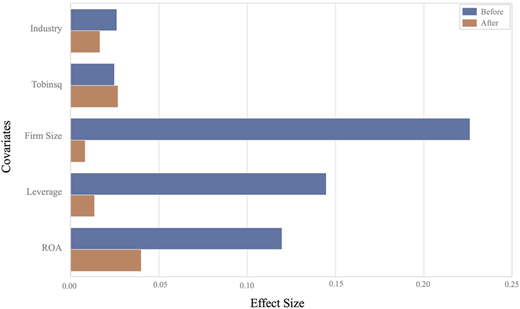
The indicator variable Treatment takes a value 1 when company i falls under the EU Directive, and 0 otherwise. is an indicator variable that equals 1 for industry j, and 0 otherwise. Table 5 presents summary statistics pertaining to the matching algorithm in terms of the effect size for each covariate before and after matching. We expressed the effect size as Cohen’s d, which compares two groups by measuring the standardized difference between their means (Cohen, 2013).
As can be seen in Figure 1, the matching procedure works reasonably well, with Cohen’s d value decreasing after matching. The mean differences for all covariates were practically significant across the unmatched treatment and control groups but practically insignificant between the matched treatment and control groups. The insignificance of mean differences indicates that the two groups have become closer and more similar in terms of the considered covariates.
5. Empirical results and discussions
5.1 Mandatory sustainability reporting and cost stickiness
Table 6 reports the OLS estimation results to test H1a and b. To mitigate the threat of multicollinearity, we employed multiple specifications of the independent variables (cf. Kalnins, 2018). All specifications result in consistent and statistically significant coefficient magnitudes and signs, including the hypothesized interaction term. We began the analysis with the baseline model (Model 1 in Table 6) to test the complete sample for the presence of cost stickiness through the years 2013–2022. Consistent with prior research, we find SGA to be significantly sticky. The estimated coefficient for is statistically significant and positive with a value of 0.646 (t: 50.749). It indicates a 0.65% increase in SGA with every 1% rise in total revenue for the given period. The value for is −0.118 (t: −5.333), where the negative sign affirms the prevalence of stickiness in SGA in response to changes in revenue in the complete sample. The aggregate value for + is 0.528, suggesting that SGA decreases by 0.53% per 1% decrease in revenue. Model 2 is the baseline model incorporated with the hypothesized variable, without control interaction terms, while Model 3 includes and control interaction terms only. We included in all specifications since a vital condition for the empirical hypothesis of stickiness is that the coefficient for should be greater than zero (Anderson et al., 2003).
Model 4 is the main specification model, including all variables from the baseline model, the hypothesized variable, control variables, and company-, time-, and industry-fixed effects. The coefficient for is negative and statistically significant across all the Models, with the value −0.106 (t: −4.328) in the main model. The value for is positive throughout. Thus, the EU companies experienced a higher stickiness in SGA after the EU Directive’s implementation compared to non-EU OECD companies. This finding confirms H1a and rejects H1b.
The increased SGA cost stickiness observed following the EU Directive complements and extends prior evidence of cost stickiness in voluntary sustainability contexts (Habib and Hasan, 2019) to mandatory setting, reinforcing the predictions of resource-based theory. The Directive raises reporting requirements, and thus transparency, which increases pressure on companies (potentially as competition, self-benchmarking and stakeholder visibility) to demonstrate credible sustainability performance rather than mere compliance. Prior studies already suggests that EU sustainability regulation tends to expand companies’ administrative costs (Baumüller and Sopp, 2022). Investments increase not only in reporting systems (e.g. data collection, internal control, assurance, specialist staff) but also in measures that improve sustainability performance itself (i.e. training, stakeholder engagement, process changes). Our evidence indicates that once these reporting and performance-oriented infrastructures are established, managers tend to view the associated SGA as strategic resources – supporting legitimacy, enhancing ESG capabilities and strengthening stakeholder relationships – and are costly to dismantle. This perspective helps explain why these costs are retained even when revenues decline, leading to greater asymmetry between cost increases and decreases.
The findings are harder to reconcile with agency theory. If increased transparency primarily strengthened shareholder monitoring and curtailed managerial opportunism, we would expect revenue-curbing sustainability-related spending to be cut back more aggressively in downturns. Under such circumstances, cost stickiness would be expected to decrease following the implementation of the Directive, rather than increase. Instead, the documented rise in SGA stickiness suggests that shareholders and other stakeholders tolerate, and perhaps demand, a stable level of sustainability-related reporting and performance-improvement costs when these are perceived as value-creating.
5.2 Company-level pre-regulation sustainability involvement
We further examined whether the extent of the regulation’s effect on a company’s sustainability performance has an influence on its cost stickiness by incorporating in Anderson’s model (2003). The variable accounts for the log of annual change in the given company’s sustainability performance.
Table 7 presents the findings across multiple model specifications (Models 1–3), culminating in Model 3, where equals −0.039 (t: −4.670). The negative and statistically significant coefficient provides evidence supporting H2, aligning with the proposition that companies demonstrating an annual improvement in sustainability performance in response to the regulation incur persistent and stable costs. These findings extend the insights of Fiechter et al. (2022), who evidenced increased SGA due to mandatory sustainability reporting and related it to substantial changes in company activities.
5.3 Country-level pre-regulation sustainability involvement
To assess country-level variations, we conducted a two-stage analysis. First, we estimated a unique cost stickiness coefficient for each EU country, as shown in Table 8. The results indicate that most EU countries experienced increased cost stickiness compared to the control group following the directive’s implementation, albeit significant cross-country differences prevail. Countries like Denmark (−0.975), Portugal (−0.828), and Finland (−0.581) exhibit increased SGA stickiness, whereas Ireland (0.802), Greece (0.236), and France (0.135) show lower stickiness. France’s results are particularly notable since it is typically considered a civil law country with a strong stakeholder orientation ( Spamann, 2010) and, therefore, expected to show a similar trend as other civil law countries. However, due to the early adoption of mandatory sustainability reporting through the Grenelle II Act in France in 2013 (Kaya, 2016), the influence of the EU Directive was not pronounced.
Given that the company- and time-fixed effects subsume country-level time-invariant effects, in the second stage, we regressed these cost stickiness coefficients in separate regressions against each variable: Civil_law and Common_law. Table 9 depicts that civil law (common law) countries positively (negatively) correlate with cost stickiness, hence rejecting H3a and H3b. Specifically, the findings suggest that civil law countries (0.1253, t: 16.066), characterized by greater managerial discretion and a market predisposition towards sustainability, more readily embrace regulatory changes and incorporate compliance costs into their long-term strategic planning, opting not to adjust these costs even when production decreases. In contrast, cost stickiness is lower in common law countries (−0.2931, t: −39.481), suggesting that the regulatory framework might have intensified shareholder oversight. Although these results diverge from our predictions, they reinforce the evidence from voluntary sustainability studies, which indicate that civil law countries show higher sustainability commitment as compared to common law countries (Kim et al., 2017; Liang and Renneboog, 2017). A plausible explanation is that mandatory sustainability reporting simply amplifies the given country’s inherent market conditions, fostering manager-stakeholder relations in civil law countries and manager-shareholder relations in common law countries.
5.4 Robustness tests
5.4.1 Endogeneity
Endogeneity can be a threat in sustainability-based studies as sustainability practices are non-random and subject to management strategic decisions (Du et al., 2023). Moreover, factors like anticipation, early adoption, or non-compliance in mandatory sustainability reporting settings can pose identification challenges (Leuz, 2018). In this study, endogeneity can arise from the selected nature of the identification strategy, the EU Directive’s implementation, potentially leading to “selection of treatment” bias (Hill et al., 2021) due to several factors. First, some companies voluntarily adopted sustainability practices and reporting before the mandatory implementation. Second, the country-level and company-level discretion associated with the EU Directive may result in systematic variations in companies’ cost behaviour.
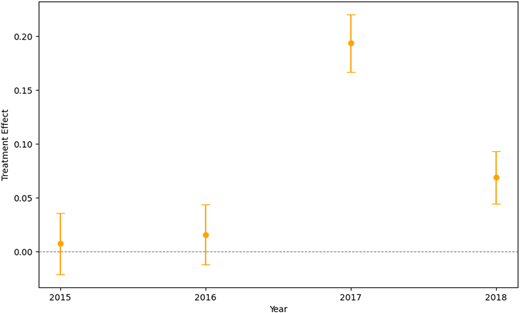
To mitigate endogeneity due to the “selection of treatment” bias, we used the estimation of the average treatment effect method, explained by Wooldridge (2010), by employing the difference-in-differences method as our primary analysis method (cf. Athey and Imbens, 2006). This method accounts for temporal as well as cross-sectional effects of the treatment by using a control group (Hill et al., 2021). We also performed propensity-score matching prior to the primary analysis to increase the comparability of our treatment and control groups in terms of several company-level covariates (see Section 4.8). To increase robustness, we also assessed the yearly treatment effects two years before and two years after the EU Directive’s implementation to test the parallel trends in the samples (see next section). Finally, we included a comprehensive set of control variables to mitigate the omitted variable bias (see Section 4.4).
5.4.2 Parallel trend analysis
A critical underpinning for our study is the plausibility of parallel trends between the treatment and control groups in the pre-implementation period, as proposed by Atanasov and Black (2016). To this end, we assume that the EU and non-EU OECD companies are valid counterfactuals for each other, and the EU companies would have followed the same trends in cost behaviour had the EU Directive not been implemented.
To test the parallel trend assumption, we estimated yearly treatment effects, two years pre- and two years post-implementation periods, using 2014 as the reference year. Figure 2 illustrates the yearly treatment effects on SGA, plotting the point-estimates with 95% confidence intervals for all four years. The treatment effects in the pre-implementation period (i.e. 2015 and 2016) were insignificant for both groups; therefore, we found no evidence for different cost behaviour in terms of SGA between the EU and non-EU OECD companies. However, a noticeable significantly positive effect was observed in 2017, which means that the EU companies experienced higher costs as compared to the control group. The treatment effect in 2018 remained higher than in the pre-treatment years, though slightly lower than in 2017. Taken together, these yearly difference-in-differences results provide some confidence about the plausibility of the parallel trend assumption.
5.4.3 Costs of goods sold as a placebo variable
For further robustness, we used Costs of Goods Sold (COGS) as a placebo measure. Since the costs of mandatory sustainability reporting should be primarily reflected in SGA, the costs directly related to the production of goods and services, i.e. COGS, should remain stable and unaffected (Fiechter et al., 2022). If the observed increased stickiness in the SGA is driven by underlying trends (e.g. overall costs increase due to some other contemporaneous phenomenon in the EU) or model misspecification, we would expect to see a significant effect on COGS as well.
To test this assumption, we used the log of the quotient of COGS (ΔCOGS) as the dependent variable, repeated the empirical tests, and found no statistically significant evidence for the relationship between the EU Directive and COGS stickiness (see Table 10).
6. Concluding remarks
6.1 Conclusions
This study analyses the influence of mandatory sustainability reporting on companies’ cost behaviour, employing the EU Directive as the identification strategy. It also investigates whether the pre-regulation company-level and country-level sustainability commitment moderates this relationship.
The difference-in-differences results show that the EU Directive has significant influence on cost behaviour. Companies subject to the Directive demonstrated greater stickiness in discretionary costs (SGA) compared to non-EU OECD companies, indicating that the regulation induces internal adjustments that persist even during production downturns. Propensity-score matching ensures the comparability of treatment and control groups, strengthening the causal interpretation. The results are robust to parallel trend analysis, ensuring that the post-Directive changes were not driven by pre-treatment differences between the two groups. To confirm that the effect is specific to discretionary costs, as it should be in case of mandatory sustainability reporting, a placebo test was conducted using COGS, showing no treatment effect. This distinction highlights that the Directive primarily influences costs subject to managerial discretion rather than production-driven costs.
Additional heterogeneity analyses demonstrated that companies showing sustainability performance improvements exhibited stronger cost retention, while country-level differences between civil law and common law countries also played a moderating role. The analysis was also repeated for each EU country, and the overall pattern of results remained consistent, underscoring the robustness of the results.
6.2 Theoretical implications
This study contributes to the ongoing debate on the economic implications of mandatory sustainability reporting, adopting the novel approach of cost stickiness. Prior studies has primarily assessed regulation in terms of incremental cost changes (e.g. Fiechter et al., 2022), whereas we focus on how costs adjust when production declines. By documenting that SGA remains sticky even when revenues decline, we show that these costs are not treated as temporary compliance outlays but become embedded in companies’ cost structures. In line with resource-based theory, this pattern suggests that managers view compliance costs as strategic resources that increase company value. The Directive’s increase in transparency appears to intensify internal (i.e. managerial optimism about future value creation) and external factors (i.e. adjustment costs from stakeholder scrutiny) driving the build-up and retention of these costs. At the same time, the observed increase in cost stickiness is difficult to reconcile with the agency theory prediction that greater transparency should primarily discipline managers and reduce unproductive sustainability spending. Our findings, therefore, nuance agency-based arguments by showing that, in a mandatory setting, transparency tends to legitimize and stabilize sustainability-related investments instead of triggering their downsizing.
The study further highlights the importance of considering pre-regulation sustainability involvement at company and country levels in moderating the effects of regulation. Companies more strongly affected by the regulation, evidenced by greater improvements in their sustainability performance, show higher levels of cost stickiness. It implies that regulatory mandates have a disproportionate impact on companies depending on the extent of organizational changes they undertake. The results further reveal significant heterogeneity across legal settings (stakeholder-oriented versus shareholder-oriented), supporting the contingency and context-dependent view of regulation (Aragón-Correa et al., 2020). These results provide more granular knowledge of how governance traditions and legal origins shape cost responses to non-financial reporting mandates, complementing existing literature (Liang and Renneboog, 2017) on the role of institutional environments in sustainability regulation.
Following Aragón-Correa et al. (2020), the current study advances theory on the contingent effects of regulation by highlighting the moderating role of pre-regulation sustainability involvement at the company and country levels. Companies that display larger improvements in sustainability performance after the implementation of the Directive exhibit stronger cost stickiness, indicating that real changes in sustainability practices are accompanied by persistent commitments of resources. Moreover, the differing cost responses across civil law and common law countries show that institutional environments shape whether resource-based or agency-based mechanisms dominate. In stakeholder-oriented civil law systems, where sustainability is more deeply embedded, mandatory reporting appears to reinforce existing manager-stakeholder relationships and the persistence of related costs. In shareholder-oriented common law systems, the same regulation is more closely associated with strengthened shareholder oversight and lower cost stickiness. Taken together, these findings offer more fine-grained insights of how legal origins and governance traditions shape the real effects of sustainability reporting mandates, thereby complementing the existing literature (cf. Liang and Renneboog, 2017).
6.3 Practical implications
Since sustainability-related regulations are still in their infancy, with constant development and evolution, our study offers timely policy implications. The fact that companies retain costs over time suggests that sustainability-related resources are institutionalized rather than treated as temporary adjustments.
To translate these retained costs into meaningful ESG performance, future regulations should more closely link reporting to outcome measures, while upholding a balance between ambition and operational feasibility. While the persistence of costs may indicate integration of sustainability into business practices, it may also create financial rigidity, especially for companies facing economic stress, where the increased stickiness results from opportunistic managerial behaviour. Policymakers, therefore, should establish standardized disclosure requirements to help companies manage compliance efficiently.
This is particularly relevant for the ongoing development of the EU Directive. Under the NFRD, companies operated within a relatively principles-based regime, yet we still observe that sustainability-related discretionary costs become sticky once incurred. This implies that under the more prescriptive CSRD, the long-term embedding of such expenses in companies’ cost structures is likely to be even more pronounced. In 2025, a “Simplification Omnibus” proposal was introduced to streamline ESRS disclosures, and substantially reduce the number of in-scope companies, reflecting concerns about administrative burden and competitiveness (Deloitte, 2025; EY, 2025; KPMG, 2025). Our evidence speaks directly to this debate. Once companies have invested in systems, personnel and processes, these costs tend to be difficult to scale back. Simplification and scope reduction may therefore alleviate short-term compliance pressures, particularly for smaller or financially constrained companies. It may also risk weakening the institutionalization of sustainability practices that our results suggest is already taking place. Regulators designing and re-evaluating CSRD should thus adopt a calibrated approach that preserves the Directive’s transparency and transformation objectives, while ensuring that requirements remain proportionate, stable and predictable enough to avoid excessive financial strain and incentives for opportunistic use of sustainability-related resources.
6.4 Limitations and future studies
This study has limitations that future studies can address. To maintain homogeneity, we constructed our sample applying the EU Directive’s general criteria. However, as emphasized by Dinh et al. (2023), the EU Directive is transposed into each country’s legislation, meaning that future studies can account for national-level variations in rules and regulations. Additionally, even though the scope of this study was to analyse the effect of mandatory sustainability reporting on overall discretionary costs, future studies can consider different SGA components, such as R&D, employee benefits, and advertising costs. Finally, after the CSRD has been in effect for significant time, future studies can evaluate its effects on the cost behaviour and compare it to the findings of the current study.