In the future, cement clinker formation is likely to take place in high temperatures and high carbon dioxide atmospheres in carbon-neutral production processes as part of, for example, electrified processes. The aim of this study was thus to compare the volatilisation of minor and trace elements during cement clinker formation in a high carbon dioxide atmosphere and a conventional combustion atmosphere. Raw meal samples were exposed, at high temperature, to the two different atmospheres, with elemental analysis performed before and after. For both atmospheres, the minor elements potassium and sulfur, and the trace elements rubidium, lead, thallium, caesium, cadmium and mercury were highly volatile. For most of the analysed elements, no difference was observed between the two atmospheres. However, volatilisation of potassium, sodium and sulfur was lower in the high carbon dioxide atmosphere. It is suggested that this should be further studied in relation to the molar ratio of sulfur to alkalis in the clinker and the effect on clinker quality.
Introduction
Cement is one of the most used manufactured products in the world and, at present, no other material has the necessary quality and quantity to fully replace cement in concrete (Nwankwo et al., 2020). Portland cement clinker is produced by heating a carbonate-rich raw meal to around 1450°C, whereafter it is milled and mixed with additives to form the final cement product. The production process is energy intensive and the cement industry is associated with high carbon dioxide emissions (Andrew, 2019). Efforts to reduce the emissions per tonne of produced cement have already been made, for example through fuel switching and reduction of the clinker-to-cement ratio (Andrew, 2019; Benhelal et al., 2021; Cormos, 2022). However, to reach near-zero carbon dioxide emissions, both fuel emissions and process emissions need to be reduced. The latter originate from the thermal decomposition of the main raw material, limestone. Around 60% of carbon dioxide emissions are process emissions, while 40% are from the combustion of fuels (Schorcht et al., 2013). Carbon dioxide capture and subsequent storage or utilisation may be one solution to this problem as this reduces both fuel and process emissions to near zero (Bjerge and Brevik, 2014; Leilac, 2017, 2021; Tokheim et al., 2019; Wilhelmsson et al., 2018). To date, post-combustion capture is the solution that has attracted the most attention within the cement industry (Hills et al., 2016).
To facilitate carbon dioxide capture, the gas stream exiting the process should have a high share of carbon dioxide, preferably near 100% (MacDowell et al., 2010). Two ways to achieve a high concentration of carbon dioxide in the exit gas have been suggested: electrifying the production process and oxy-fuel combustion (Hökfors et al., 2015; Wilhelmsson and Backman, 2019). In an electrified process, the heat conventionally generated by the combustion of fuels is replaced by heat generated by electricity from fossil-free production, and the exit gas thus consists of nearly pure carbon dioxide originating from the thermal decomposition of limestone. Fuel emissions are eliminated, and thus the volume of flue gas to be captured is decreased (Wilhelmsson and Backman, 2019; Wilhelmsson et al., 2018). No operational industrial plant is yet fully electrified, but several studies have investigated the potential of electrical heating using different techniques, such as microwave heating, plasma heating and electrical gas heating (Buttress et al., 2015; Fang et al., 1996; Glasser, 1975; Kaewwichit et al., 2017; Long et al., 2002; Quéméneur et al., 1983; Wilhelmsson and Backman, 2019; Wilhelmsson et al., 2018). During oxy-fuel combustion, fuels are combusted using concentrated oxygen instead of air, significantly reducing the nitrogen input. The carbon dioxide concentration in the flue gas is expected to increase, for example from 33 vol.% to 76 vol.% (Hökfors et al., 2015), with the other main flue-gas components being oxygen and water. The potential of oxy-fuel combustion in cement clinker production has been investigated in several studies (Ditaranto and Bakken, 2019; ECRA, 2012; Hökfors et al., 2015; Zeman, 2009; Zheng et al., 2016). For both electrified and oxy-fuel systems, gas-tight production is essential to avoid dilution of the flue gas (Wilhelmsson et al., 2018).
To produce cement clinker, sources of calcium, silicon, aluminium and iron are needed. The main raw material for cement production is limestone, but other raw materials or additives (e.g. chalk, marl, clay, shale, sand, iron oxide and bauxite) are generally also needed. Industrial by-products such as blast-furnace slag, fly ash and sand are also used (Hewlett and Liška, 2019). The fuel used for the heating of the process contains ash-forming elements, and the ash contributes to the elemental composition of the cement clinker; in an electrified system the fuel is eliminated, and thus so too is the fuel ash. Since natural raw materials are utilised, minor and trace elements are included, and the origin of the raw material determines the amount and type of these elements (Bhatty, 1995).
Typically, in clinker, the elements present at concentrations <1 wt% are defined as minor elements (European Union, 2010; Gineys et al., 2011a), while elements at concentrations <0.02 wt% (Frandsen et al., 1994) or <0.01 wt% (Taylor, 1997) are defined as trace elements. In this study, major elements are defined as those present at ≥1.00 wt%, minor elements as 0.02 wt% ≤ x <1.00 wt% and trace elements as <0.02 wt%.
During thermal processing, the minor and trace elements interact in complex ways with the main product phases of alite (3CaO.SiO2 (C3S)), belite (2CaO.SiO2 (C2S)), calcium aluminate (3CaO.Al2O3 (C3A)), calcium ferrite (4CaO.Al2O3.Fe2O3 (C4AF)), lime and periclase, influencing the formation of melt phases and solid solutions and the stability of crystalline products (Taylor, 1997). Some trace elements, such as lead and mercury, are known to volatilise at high temperatures (Bhatty, 1995; Frandsen et al., 1994), such as in the hot zone of the kiln. Some volatilised elements condense within the kiln system at lower temperatures, while others leave the kiln system and are, to a large extent, captured in the flue-gas cleaning equipment. Small amounts exit through the stack. The leaching properties of minor and trace elements that are retained in the cement clinker need to be considered in the final concrete product (Müllauer et al., 2015; Overmann et al., 2021). Elements identified as especially important from a pollution perspective in EU directive 2010/75 on industrial emissions (EU, 2010) are arsenic, cadmium, cobalt, chromium, copper, mercury, manganese, nickel, lead, antimony, thallium and vanadium.
Some minor and trace elements are also of importance for cement production and product quality, since they can affect clinker reactivity and cement hydration (Bhatty, 2006; Gineys et al., 2011a; Kolovos et al., 2001, 2002). Kolovos et al. (2001, 2002) studied the effect of foreign elements on clinker reactivity, measured by reduction of free lime content, in a chemical grade system of calcium carbonate/silicon dioxide/aluminium oxide/ferric oxide. Among the tested anions, sulfur and fluorine showed the highest reduction of the free lime content at 1450°C. Among the tested cations, tungsten, tantalum, copper, titanium and molybdenum showed the highest reduction of the free lime content at 1450°C. For the tested cations, elements with a decreased atomic radius or increased electronegativity were suggested to improve clinker reactivity.
From both emissions and product perspectives, the relationship between the volatilisation and retention of minor and trace elements is of high importance and, to a large extent, is still not understood. Furthermore, a change in the composition of the process gas, from around 20 vol.% carbon dioxide in a typical fuel-heated kiln to almost 100 vol.% carbon dioxide in, for example, an electrified process, might affect several aspects of the process, such as heat transfer, calcination temperature and clinker formation (Hökfors et al., 2015; Wilhelmsson et al., 2018). The volatilisation of minor and trace elements is known to be affected by the process atmosphere (Frandsen et al., 1994). Therefore, there is a need for both fundamental knowledge of volatilisation of minor and trace elements during cement clinker production, and further knowledge of how volatilisation is affected by a high carbon dioxide atmosphere.
The objective of this study was to experimentally investigate the volatilisation of 68 major, minor and trace elements during cement clinker formation in both a conventional combustion gas atmosphere and a high carbon dioxide atmosphere. Two industrial raw meals were heated in a laboratory furnace in the two different atmospheres (conventional combustion atmosphere and high carbon dioxide atmosphere). Raw meal and cement clinker samples were then analysed for elemental composition using inductively coupled plasma sector field mass spectrometry (ICP-SFMS). In addition, X-ray diffraction (XRD) was used to monitor and validate successful clinker mineral formation, and support interpretation of the ICP data.
Materials and methods
Raw meals at two industrial sites (here called A and B) in northern Europe were sampled. The compositions can be considered of industrial relevance and typical for the region, with some differences that are relevant to consider in both the clinker production process and the quality of the final product. The main differences in the elemental composition of the raw meals (reported as oxides in Table 1) were found to be in the contents of magnesium oxide, manganese(III) oxide, zinc oxide, sulfur trioxide and phosphorus pentoxide. Furthermore, the lime and marlstones were mainly of sedimentary geological origin but, in raw meal A, some of the limestone was also of reef origin.
Chemical composition, determined by ICP-SFMS (expressed as oxides), clinker moduli and particle size (D10%, D50% and D90%) of the two raw meals (A-RM and B-RM).
| A-RM | B-RM | |
|---|---|---|
| Chemical composition | ||
| Calcium oxide (CaO): wt% | 44.91 | 46.45 |
| Silicon dioxide (SiO2): wt% | 14.35 | 14.59 |
| Aluminium oxide (Al2O3): wt% | 3.48 | 3.97 |
| Ferric oxide (Fe2O3): wt% | 1.92 | 1.86 |
| Magnesium oxide (MgO): wt% | 2.39 | 0.79 |
| Potassium oxide (K2O): wt% | 0.84 | 0.94 |
| Sodium oxide (Na2O): wt% | 0.18 | 0.084 |
| Titanium dioxide (TiO2): wt% | 0.20 | 0.14 |
| Manganese(III) oxide (Mn2O3): wt% | 0.074 | 0.42 |
| Zinc oxide (ZnO): wt% | 0.047 | 0.0029 |
| Phosphorus pentoxide (P2O5): wt% | 0.030 | 0.094 |
| Sulfur trioxide (SO3): wt% | 1.09 | 0.28 |
| Others (by difference)a | 30.489 | 30.379 |
| Sum | 100 | 100 |
| Clinker moduli | ||
| Lime saturation factor | 98.62 | 99.38 |
| Silica modulus | 2.66 | 2.50 |
| Alumina modulus | 1.81 | 2.13 |
| Particle size | ||
| D10%: μm | 3 | 3 |
| D50%: μm | 19 | 30 |
| D90%: μm | 163 | 170 |
Including elements of lesser content and non-analysed elements such as hydrogen, carbon, chlorine and oxygen
Dried, ground and homogenised raw meals were sampled from sampling points in air chutes before the elevators to the top cyclones. The sample size was reduced using a riffle splitter and two raw meal samples (A-RM and B-RM) were produced. Nodules with an approximate size of 1 cm3 were hand-rolled from samples mixed with deionised water and dried at 105°C overnight. The chemical composition of the main elements in A-RM and B-RM, as determined by ICP-SFMS and expressed as oxides, are presented in Table 1 together with the clinker moduli (Taylor, 1997) and particle size (D10%, D50% and D90%) measured by laser diffraction using a Panalytical Mastersizer 2000.
The experiments were performed in a laboratory tube furnace with a gas flow of 1 tube volume/min. Two different atmospheres were examined: a conventional combustion atmosphere (20 vol.% carbon dioxide, 5 vol.% oxygen, 10 vol.% water and 65 vol.% nitrogen) and a high carbon dioxide atmosphere (95 vol.% carbon dioxide and 5 vol.% oxygen). The tube furnace was preheated to 1450°C and batches of 4–5 g of raw meal nodules were heated for 40 min in an alumina crucible lined with platinum foil. After heating, the samples were quickly pushed out of the tube furnace and allowed to cool in ambient air. Four cement clinker samples were produced – two in the conventional atmosphere (called A-CC and B-CC) and two in the high carbon dioxide atmosphere (called A-CC-CO2 and B-CC-CO2). Each batch was weighed before and after exposure. A total of 25–30 g of clinker was produced per raw meal and atmosphere.
The chemical compositions of the raw meal and cement clinker samples were determined using ICP-SFMS, performed according to ISO 17294-2:2016 and US EPA method 200.8:1994. The samples were prepared by milling according to ISO 11464:2006, and either dissolution in acid according to EN 13656:2020 or lithium metaborate (LiBO2) melting according to ASTM D3682:2013; ASTM D4503:2008. A total of 68 elements were analysed: silver (Ag), aluminium (Al), arsenic (As), gold (Au), boron (B), barium (Ba), beryllium (Be), bismuth (Bi), calcium (Ca), cadmium (Cd), cerium (Ce), cobalt (Co), chromium (Cr), caesium (Cs), copper (Cu), dysprosium (Dy), erbium (Er), europium (Eu), iron (Fe), gallium (Ga), gadolinium (Gd), germanium (Ge), hafnium (Hf), mercury (Hg), holmium (Ho), iridium (Ir), potassium (K), lanthanum (La), lithium (Li), lutetium (Lu), magnesium (Mg), manganese (Mn), molybdenum (Mo), sodium (Na), niobium (Nb), neodymium (Nd), nickel (Ni), phosphorus (P), lead (Pb), palladium (Pd), praseodymium (Pr), platinum (Pt), rubidium (Rb), rhenium (Re), rhodium (Rh), ruthenium (Ru), sulfur (S), antimony (Sb), scandium (Sc), selenium (Se), silicon (Si), samarium (Sm), tin (Sn), strontium (Sr), tantalum (Ta), terbium (Tb), tellurium (Te), thorium (Th), titanium (Ti), thallium (Tl), thulium (Tm), uranium (U), vanadium (V), tungsten (W), yttrium (Y), ytterbium (Yb) zinc (Zn) and zirconium (Zr).
XRD was used to monitor and validate successful clinker formation, as well as to support interpretation of the ICP data. Scans were collected with Cu Kα radiation using a Bruker D8 Advance instrument equipped with a Våntec-1 detector in 2θ mode. Data was collected in the 2θ range of 10–70°, with a step size of 0.02° and a sample rotation of 15 rpm. Phase identification was obtained by matching against references in the PDF-4 database (Gates-Rector and Blanton, 2019) in EVA 5.1 software, and semi-quantitative phase analysis was performed by the Rietveld method (Rietveld, 1969) using Topas-Academic 4.2 software.
Results and discussion
Clinker formation
The phase compositions of the cement clinkers, as obtained by XRD and subsequent qualitative and semi-quantitative analysis, are presented in Table 2 and the molar ratios of sulfur to alkalis in the clinkers, as determined by ICP-SFMS, are shown in Table 3 (discussed later).
Phase composition obtained by XRD analysis for clinker exposed to conventional atmosphere (A-CC, B-CC) and high carbon dioxide atmosphere (A-CC-CO2, B-CC-CO2)
| A-CC | A-CC-CO2 | B-CC | B-CC-CO2 | |
|---|---|---|---|---|
| Free lime: wt% | 1.6 | 2.4 | 2.7 | 4.3 |
| Quartz alpha: wt% | 0.2 | 0.9 | 0.9 | 0.6 |
| C2S beta: wt% | 7.3 | 3.7 | 5.0 | 5.3 |
| C3A cubic: wt% | 8.7 | 2.3 | 0.8 | 0.1 |
| C3A orthorhombic: wt% | 1.8 | 5.8 | 7.6 | 6.8 |
| C4AF: wt% | 5.7 | 7.3 | 8.6 | 12.4 |
| C3S M1: wt% | 45.5 | 43.0 | 37.2 | 44.4 |
| C3S M3: wt% | 23.6 | 28.4 | 36.8 | 25.6 |
| Periclase: wt% | 4.9 | 4.2 | 0.1 | 0.3 |
| Arcanite: wt% | 0.0 | 0.9 | 0.0 | 0.0 |
| Aphthitalite: wt% | 0.8 | 0.9 | 0.3 | 0.3 |
| Sum: wt% | 100 | 100 | 100 | 100 |
The molar ratio of sulfur to alkalis (SO3/(K2O + Na2O)) in the clinker, as determined by ICP-SFMS
| Molar ratio of sulfur to alkalis | |
|---|---|
| A-CC | 0.356 |
| A-CC-CO2 | 0.300 |
| B-CC | 0.111 |
| B-CC-CO2 | 0.086 |
The XRD patterns of the clinkers produced in the conventional atmosphere and the high carbon dioxide atmosphere are presented in Figure A1 of the online supplementary material. It is inherently challenging to produce cement clinker samples representative of industrially produced products at laboratory scale. In this work, all four samples had proper clinker composition with regard to the amount of calcium silicates. The relatively high quantity of free lime, even though the lime saturation factor was <100 for both raw meals (Table 1), was likely due to coarse raw meals or the comparably short residence time in the furnace.
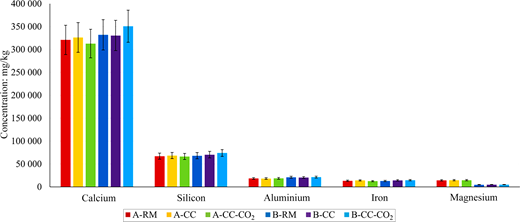
Concentrations of major elements in raw meals (A-RM and B-RM) and clinkers exposed to conventional atmosphere (A-CC and B-CC) and high carbon dioxide atmosphere (A-CC-CO2 and B-CC-CO2), measured using ICP-SFMS. Clinker concentrations normalised for weight loss
Concentrations of major elements in raw meals (A-RM and B-RM) and clinkers exposed to conventional atmosphere (A-CC and B-CC) and high carbon dioxide atmosphere (A-CC-CO2 and B-CC-CO2), measured using ICP-SFMS. Clinker concentrations normalised for weight loss
Previous studies have shown that a high carbon dioxide atmosphere does not affect phase composition to a great extent (ECRA, 2012; Zheng et al., 2016), and this was found to be the case for the main clinker phases in this work, where the differences in phase composition between the samples exposed to the high carbon dioxide atmosphere and the reference atmosphere were small. Some differences in the polymorphism of C3A were observed, possibly linked to the sulfatisation degree, which could be interesting for future studies. In addition to the main clinker phases, the qualitative analysis indicated the presence of the minor constituents arcanite and aphthitalite. However, XRD analysis holds some limitations regarding the quantification of phases of low quantity.
Minor and trace elements can affect clinker composition, but generally the concentrations required for this are higher than those observed in typical raw meals. This is especially true regarding trace elements (e.g. Gineys et al., 2011b).
Volatilisation
ICP-SFMS was undertaken to assess the volatilisation of the minor and trace elements in the two raw meals after heating and to enable comparisons of heating in a simulated conventional combustion atmosphere and a high carbon dioxide atmosphere. The results are summarised in Figures 1–4. The error bars in the figures represent the reported combined analytical and sample-handling uncertainties, corresponding to two standard deviations or approximately 95% confidence intervals for the method. The clinker samples lost an average of 35.4% weight upon exposure (the average weight loss for each clinker sample can be found in Table A1 of the online supplementary material). The weight loss data for each consolidated clinker sample were used to normalise the concentrations and enable comparison with the corresponding raw meal compositions (hence the normalised concentrations for the clinker samples in Figures 1–4 and Tables 4–6 are around 35% lower than measured). Non-normalised ICP-SFMS data for all elements can be found in Table A2 of the online supplementary material.
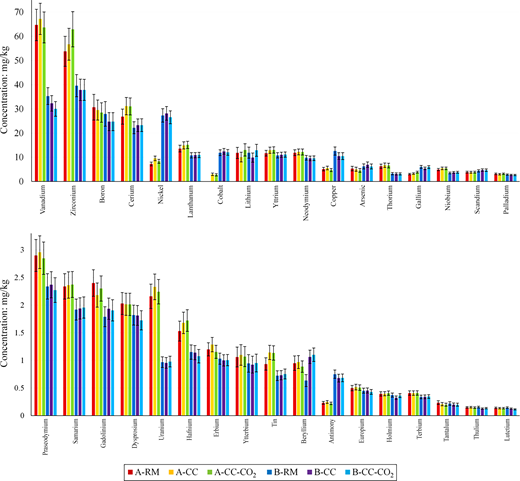
Concentrations of non-volatile trace elements in raw meals (A-RM and B-RM) and clinkers exposed to conventional atmosphere (A-CC and B-CC) and high carbon dioxide atmosphere (A-CC-CO2 and B-CC-CO2), as determined by ICP-SFMS. Clinker concentrations normalised for weight loss
Concentrations of non-volatile trace elements in raw meals (A-RM and B-RM) and clinkers exposed to conventional atmosphere (A-CC and B-CC) and high carbon dioxide atmosphere (A-CC-CO2 and B-CC-CO2), as determined by ICP-SFMS. Clinker concentrations normalised for weight loss
Major elements
Major elements were defined as elements with concentrations of ≥1 wt% in the clinker samples. The results of the ICP-SFMS analysis are presented in Figure 1.
All the major elements (calcium, silicon, aluminium, iron and magnesium) presented in Figure 1 were found in the clinker regardless of the process atmosphere, as expected (Hewlett and Liška, 2019; Taylor, 1997). The ICP-SFMS results show that the major elements constituted 43–44 wt% of the raw meals.
Minor elements
Minor elements were defined as elements present at 0.02 wt% ≤ x < 1.00 wt% in the clinker samples. The results of the ICP-SFMS analysis are presented in Figure 2 and Table 4.
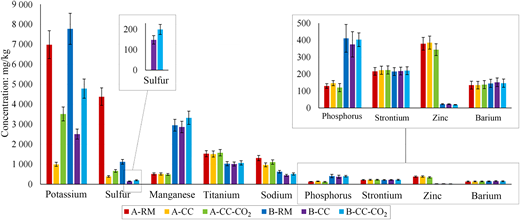
Concentrations of minor elements in raw meals (A-RM and B-RM) and clinkers exposed to conventional atmosphere (A-CC and B-CC) and high carbon dioxide atmosphere (A-CC-CO2 and B-CC-CO2), measured using ICP-SFMS. Clinker concentrations normalised for weight loss
Concentrations of minor elements in raw meals (A-RM and B-RM) and clinkers exposed to conventional atmosphere (A-CC and B-CC) and high carbon dioxide atmosphere (A-CC-CO2 and B-CC-CO2), measured using ICP-SFMS. Clinker concentrations normalised for weight loss
Minor elements in raw meals and clinker samples, as determined by ICP-SFMS. Clinker concentrations normalised for weight loss
| A-RM | A-CC | A-CC-CO2 | B-RM | B-CC | B-CC-CO2 | |||||
|---|---|---|---|---|---|---|---|---|---|---|
| Concentration: mg/kg | Concentration: mg/kg | Retention: wt% | Concentration: mg/kg | Retention: wt% | Concentration: mg/kg | Concentration: mg/kg | Retention: wt% | Concentration: mg/kg | Retention: wt% | |
| Potassium | 6980 | 995 | 14 | 3514 | 50 | 7770 | 2505 | 32 | 4783 | 62 |
| Sulfur | 4380 | 386 | 9 | 665 | 15 | 1120 | 149 | 13 | 200 | 18 |
| Manganese | 513 | 512 | 100 | 491 | 96 | 2950 | 2864 | 97 | 3322 | 113 |
| Titanium | 1530 | 1512 | 99 | 1578 | 103 | 1030 | 1012 | 98 | 1069 | 104 |
| Sodium | 1310 | 969 | 74 | 1108 | 85 | 625 | 445 | 71 | 511 | 82 |
| Phosphorus | 130 | 147 | 113 | 121 | 93 | 411 | 375 | 91 | 403 | 98 |
| Strontium | 216 | 223 | 103 | 224 | 104 | 215 | 218 | 101 | 220 | 102 |
| Zinc | 379 | 386 | 102 | 344 | 91 | 23 | 23 | 99 | 19 | 83 |
| Barium | 135 | 135 | 100 | 138 | 102 | 145 | 152 | 105 | 147 | 101 |
| Sum | 15 573 | 5264 | 34 | 8184 | 53 | 14 289 | 7743 | 54 | 10 673 | 75 |
The ICP-SFMS results show that the minor elements constituted 1.4–1.6 wt% of the raw meals. Several of the minor elements (Figure 2 and Table 4) were expected to exhibit volatilisation to different degrees (Bhatty, 1995). The normalised ICP-SFMS results for the clinkers show great variation in retention between the raw meals and between the atmospheres. In the conventional atmosphere, 34 wt% of the minor elements was incorporated in the A-CC clinker, and 54% in B-CC. For the high carbon dioxide atmosphere, 53 wt% of the minor elements was incorporated in A-CC-CO2, and 75% in B-CC-CO2, meaning that the overall volatilisation of minor elements was lower in the high carbon dioxide atmosphere. Manganese, titanium, phosphorus, strontium and barium were all incorporated in the clinker, and no clear difference could be observed between the two different atmospheres.
As shown in Figure 2, potassium, sulfur and (to some extent) sodium were affected by the change in atmosphere. These elements exhibited lower volatilisation in the high carbon dioxide atmosphere, with the difference being especially large for potassium.
Water vapour is known to favour alkali volatilisation under some conditions (Bhatty, 1995). In the present study, the raw meals were dried prior to high-temperature exposure, and only the conventional atmosphere contained water vapour, possibly contributing to the higher volatilisation degree in the conventional atmosphere. Sulfur is known to both form volatile compounds and be incorporated as sulfates into clinker (Bhatty, 1995). For both atmospheres, the ICP-SFMS results showed low incorporation of sulfur into the clinker (see Table 4). The volatilisation of both alkali and sulfur was, however, higher in the conventional atmosphere. Bhatty (1995) suggested that water vapour in a cement kiln may affect the volatility of alkali and sulfur according to the following reaction.
Furthermore, a high carbon dioxide atmosphere can stabilise carbonates at high temperature, possibly contributing to the higher retention of potassium and sodium at high carbon dioxide concentrations.
Alkali sulfates are important for clinker mineralogy and cement performance (Ma and Qian, 2018), and most cement producers have guidelines regarding the sulfatisation degree (molar ratio of sulfur to alkalis), which should ideally be around 1 (Cortada Mut et al., 2015). Excess sulfur tends to stabilise C2S, resulting in a higher temperature needed for C3S formation. The ICP-SFMS results indicate that the higher retention of sulfur, potassium and sodium in the high carbon dioxide atmosphere did not affect the molar ratio of sulfur to alkalis to a large extent (Table 3). All the clinkers showed a molar ratio of sulfur to alkalis <1, indicating excess alkali compared with sulfur for all the clinker compositions (Table 3). Excess alkalis are mainly incorporated into C2S and C3A, especially affecting the polymorphism of C3A and resulting in more orthorhombic C3A (Hewlett and Liška, 2019). The C3A polymorphs presented in Table 2 show that C3Aorthorhombic/C3Atotal was higher for B-CC and B-CC-CO2 than for A-CC and A-CC-CO2. B-CC and B-CC-CO2 also showed a lower molar ratio of sulfur to alkali as compared with A-CC and A-CC-CO2. The clinker produced in the high carbon dioxide atmosphere had a higher ratio of C3Aorthorhombic/C3Atotal compared to its analogue produced in a conventional atmosphere and the molar ratio of sulfur to alkalis in the clinker was somewhat lower for the high carbon dioxide atmosphere, although the difference was small. Considering the small scale of this study, the impact on C3A polymorphs of a dry atmosphere with a high carbon dioxide concentration compared with a conventional atmosphere should be addressed in further studies, preferably in a simulated industrial process using a counter-current reactor design, enabling the recirculation of volatile elements.
In counter-current reactors such as cement kilns, potassium, sodium, sulfur and chlorine are known to volatilise when exposed to high temperature and subsequently condense in the colder end of the kiln, giving rise to internal circulation and local accumulation in the kiln (Cortada Mut et al., 2015; Taylor, 1997). This phenomenon did not occur in the experimental setup described herein because the tube furnace was purged with gas. This accumulation in industrial kilns can be expected to lead to a higher incorporation of these elements into the clinker as compared with the results obtained in this study.
Zinc was mostly incorporated into the clinker, in accordance with previous studies (Bhatty, 1995; Hökfors and Backman, 2015) but exhibited some volatilisation in the high carbon dioxide atmosphere, although the difference between atmospheres was within the reported measurement uncertainty. Zinc can affect hydration and setting times as well as clinker formation rates (Bhatty, 2006; Bhatty, 1995), meaning that the higher volatilisation in a high carbon dioxide atmosphere can affect clinker quality, even though the concentrations were below established limits in conventional raw meals to have an effect on the final quality (Gineys et al., 2011a, 2011b).
Trace elements
Trace elements were defined as elements present at concentrations <0.02 wt%. For the purposes of discussion, the trace elements were divided into two categories based on the extent of volatilisation during heating. The results of the ICP-SFMS analysis for trace elements volatilised to the average extent of ≥20 wt% are shown in Figure 3 and Table 5, and those for trace elements mostly or fully incorporated in the clinker are presented in Figure 4 and Table 6. In addition, 11 trace elements were close to the detection limit or were not detected at all in either the raw meal or clinker; these elements were silver, gold, bismuth, germanium, iridium, molybdenum, rhenium, rhodium, ruthenium, tellurium and tungsten. These 11 elements, together with platinum, are thus not included in the figures, but are detailed in Table A2 of the online supplementary material. Platinum was excluded as traces of platinum foil were found in the clinker samples.
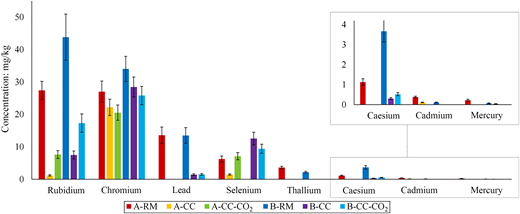
Concentrations of volatile trace elements in raw meals (A-RM and B-RM) and clinkers exposed to conventional atmosphere (A-CC and B-CC) and high carbon dioxide atmosphere (A-CC-CO2 and B-CC-CO2), as determined by ICP-SFMS. Clinker concentrations normalised for weight loss
Concentrations of volatile trace elements in raw meals (A-RM and B-RM) and clinkers exposed to conventional atmosphere (A-CC and B-CC) and high carbon dioxide atmosphere (A-CC-CO2 and B-CC-CO2), as determined by ICP-SFMS. Clinker concentrations normalised for weight loss
Trace elements exhibiting ≥20% volatilisation in raw meals and clinker samples, as determined by ICP-SFMS. Clinker concentrations normalised for weight loss
| A-RM | A-CC | A-CC-CO2 | B-RM | B-CC | B-CC-CO2 | |||||
|---|---|---|---|---|---|---|---|---|---|---|
| Concentration: mg/kg | Concentration: mg/kg | Retention: wt% | Concentration: mg/kg | Retention: wt% | Concentration: mg/kg | Concentration: mg/kg | Retention: wt% | Concentration: mg/kg | Retention: wt% | |
| Rubidium | 27.4 | 1.2 | 4 | 7.6 | 28 | 43.8 | 7.5 | 17 | 17.3 | 40 |
| Chromium | 27.0 | 22.2 | 82 | 20.5 | 76 | 34.0 | 28.4 | 84 | 25.8 | 76 |
| Lead | 13.6 | <1 | 0 | <1 | 0 | 13.5 | 1.4 | 11 | 1.5 | 11 |
| Selenium | 6.22 | 1.46 | 23 | 7.11 | 114 | <2 | 12.56 | — | 9.40 | — |
| Thallium | 3.62 | <0.05 | 0 | <0.05 | 0 | 2.21 | <0.05 | 0 | <0.05 | 0 |
| Caesium | 1.13 | <0.05 | 0 | <0.1 | 0 | 3.67 | 0.31 | 8 | 0.53 | 14 |
| Cadmium | 0.383 | 0.109 | 28 | <0.05 | 0 | 0.108 | <0.05 | 0 | <0.05 | 0 |
| Mercury | 0.223 | <0.05 | 0 | <0.05 | 0 | 0.0682 | 0.0384 | 56 | <0.05 | 0 |
| Sum | 79.6 | 25.0 | 31 | 35.2 | 44 | 97.4 | 50.2 | 52 | 54.5 | 56 |
The trace elements present in concentrations above the detection limit of ICP-SFMS and exhibiting ≥20% volatilisation were cadmium, chromium, caesium, lead, rubidium, selenium, thallium and mercury. The volatile trace elements constituted 79–98 ppm of the raw meals, and some differences were observed between the atmospheres. Rubidium, and to some extent caesium, followed the same pattern as other alkali metals, as expected (Bhatty, 1995). Chromium showed a trend of being more volatile in the high carbon dioxide atmosphere, but the difference was within measurement uncertainty. The results for selenium were unexpected: selenium is expected to be volatile and not incorporated in the clinker to any great extent (Bhatty, 1995), yet it was completely incorporated in A-CC-CO2. For clinkers produced from B-RM, more selenium was present in the clinker than the raw meal, and it is likely that there was some analytical error with the results for selenium. Lead, thallium, cadmium and mercury were all almost completely volatilised, and no difference could be detected between the atmospheres. Mercury showed a high retention in B-CC, but this was most likely due to the values being very close to the detection limit.
The trace elements present at concentrations above the detection limit of ICP-SFMS and exhibiting <20% volatilisation were vanadium, zirconium, boron, cerium, nickel, lanthanum, cobalt, lithium, yttrium, neodymium, copper, arsenic, thorium, gallium, niobium, scandium, palladium, praseodymium, samarium, gadolinium, dysprosium, uranium, hafnium, erbium, ytterbium, tin, beryllium, antimony, europium, holmium, terbium, thulium and lutetium. The less volatile trace elements constituted 260–290 ppm of the raw meals. For all the trace elements mostly or fully incorporated in clinker, all the differences between the atmospheres were within measurement uncertainty. However, it is worth noting that lithium followed the same trend as the other alkali metals, with higher volatilisation in the conventional atmosphere.
As can be seen for most trace elements, there was no significant difference between the two atmospheres, and most of the trace elements were incorporated in the clinker.
Of the 12 elements identified in EU directive 2010/75 (EU, 2010) as being especially important in relation to the prevention and control of air pollution, manganese, vanadium, nickel, cobalt, arsenic and antimony are expected to be mostly incorporated in the clinker. Mercury and thallium are highly volatile. Lead is also fairly volatile and is not expected to be incorporated in the clinker to any large extent. A major portion of chromium and copper is expected to be incorporated in the clinker; for cadmium, it depends on the conditions (Bhatty, 1995). For some of these elements, a trend of higher volatilisation in the high carbon dioxide atmosphere was observed, but the differences were within measurement uncertainty. However, as this was recurring for several of the elements in both samples, it is worth noting and investigating further in future studies.
Summary
A summary of the ICP-SFMS results is presented in Table 7. For both atmospheres, the minor elements potassium and sulfur, and the trace elements rubidium, lead, thallium, caesium, cadmium and mercury were highly volatile. The other tested trace elements were volatile to some extent, mostly retained in the cement clinker or present in levels close to or below the detection limit.
Trace elements exhibiting <20% volatilisation in raw meals and clinker samples, as determined by ICP-SFMS. Clinker concentrations normalised for weight loss
| A-RM | A-CC | A-CC-CO2 | B-RM | B-CC | B-CC-CO2 | |||||
|---|---|---|---|---|---|---|---|---|---|---|
| Concentration: mg/kg | Concentration: mg/kg | Retention: wt% | Concentration: mg/kg | Retention: wt% | Concentration: mg/kg | Concentration: mg/kg | Retention: wt% | Concentration: mg/kg | Retention: wt% | |
| Vanadium | 64.7 | 67.2 | 104 | 63.7 | 98 | 35.3 | 32.3 | 91 | 30.0 | 85 |
| Zirconium | 53.8 | 56.7 | 105 | 62.9 | 117 | 39.6 | 37.9 | 96 | 37.7 | 96 |
| Boron | 30.7 | 29.5 | 96 | 28.5 | 93 | 27.9 | 24.7 | 89 | 24.7 | 89 |
| Cerium | 26.8 | 31.1 | 116 | 31.0 | 116 | 22.2 | 23.3 | 105 | 23.3 | 105 |
| Nickel | 7.24 | 9.56 | 132 | 8.35 | 115 | 27.3 | 28.1 | 103 | 26.5 | 97 |
| Lanthanum | 13.6 | 14.9 | 110 | 15.1 | 111 | 10.8 | 10.9 | 101 | 10.9 | 101 |
| Cobalt | <3 | 2.98 | — | 2.75 | — | 11.9 | 12.4 | 104 | 12.0 | 101 |
| Lithium | 11.8 | 10.1 | 85 | 13.0 | 111 | 11.9 | 9.9 | 83 | 12.9 | 108 |
| Yttrium | 11.7 | 12.9 | 110 | 13.0 | 111 | 10.8 | 11.0 | 102 | 11.1 | 103 |
| Neodymium | 11.9 | 12.2 | 103 | 12.2 | 102 | 9.78 | 9.55 | 98 | 9.59 | 98 |
| Copper | 5.11 | 5.58 | 109 | 4.70 | 92 | 12.6 | 10.5 | 83 | 10.5 | 83 |
| Arsenic | 5.32 | 5.04 | 95 | 4.56 | 86 | 6.25 | 6.92 | 111 | 6.19 | 99 |
| Thorium | 6.26 | 6.72 | 107 | 6.59 | 105 | 3.23 | 3.14 | 97 | 3.15 | 97 |
| Gallium | 3.04 | 3.24 | 107 | 3.86 | 127 | 6.00 | 5.39 | 90 | 5.97 | 100 |
| Niobium | 4.92 | 5.43 | 110 | 5.41 | 110 | 3.52 | 3.75 | 106 | 3.82 | 108 |
| Scandium | 3.87 | 3.82 | 99 | 3.85 | 99 | 4.38 | 4.70 | 107 | 4.64 | 106 |
| Palladium | 3.14 | 3.00 | 95 | 3.18 | 101 | 2.84 | 2.71 | 95 | 2.67 | 94 |
| Praseodymium | 2.90 | 2.96 | 102 | 2.85 | 98 | 2.34 | 2.37 | 101 | 2.27 | 97 |
| Samarium | 2.34 | 2.36 | 101 | 2.37 | 101 | 1.92 | 1.94 | 101 | 1.96 | 102 |
| Gadolinium | 2.40 | 2.18 | 91 | 2.30 | 96 | 1.79 | 1.93 | 108 | 1.91 | 106 |
| Dysprosium | 2.03 | 2.02 | 99 | 2.01 | 99 | 1.82 | 1.81 | 100 | 1.73 | 95 |
| Uranium | 2.16 | 2.33 | 108 | 2.24 | 104 | 0.968 | 0.955 | 99 | 0.979 | 101 |
| Hafnium | 1.53 | 1.68 | 110 | 1.72 | 113 | 1.15 | 1.14 | 99 | 1.08 | 93 |
| Erbium | 1.20 | 1.29 | 107 | 1.15 | 96 | 1.03 | 1.00 | 97 | 1.00 | 98 |
| Ytterbium | 1.06 | 1.10 | 104 | 1.07 | 101 | 0.945 | 0.92 | 98 | 0.95 | 101 |
| Tin | 0.934 | 1.14 | 122 | 1.13 | 121 | 0.723 | 0.73 | 101 | 0.75 | 104 |
| Beryllium | 0.949 | 0.97 | 102 | 0.89 | 93 | 0.634 | 1.06 | 168 | 1.10 | 174 |
| Antimony | 0.23 | 0.25 | 107 | 0.22 | 96 | 0.749 | 0.68 | 91 | 0.68 | 91 |
| Europium | 0.497 | 0.516 | 104 | 0.507 | 102 | 0.45 | 0.45 | 101 | 0.43 | 95 |
| Holmium | 0.392 | 0.396 | 101 | 0.406 | 103 | 0.371 | 0.323 | 87 | 0.362 | 98 |
| Terbium | 0.406 | 0.406 | 100 | 0.410 | 101 | 0.338 | 0.340 | 100 | 0.345 | 102 |
| Tantalum | 0.235 | 0.207 | 88 | 0.196 | 84 | 0.218 | 0.200 | 92 | 0.198 | 91 |
| Thulium | 0.148 | 0.151 | 102 | 0.144 | 97 | 0.154 | 0.127 | 82 | 0.134 | 87 |
| Lutetium | 0.139 | 0.135 | 97 | 0.134 | 96 | 0.144 | 0.124 | 87 | 0.113 | 79 |
| Sum | 283.5 | 300.1 | 106 | 302.5 | 107 | 262.0 | 253.2 | 97 | 251.9 | 96 |
Summary of results as determined by ICP-SFMS. Clinker concentrations normalised for weight loss
| A-RM | A-CC | A-CC-CO2 | B-RM | B-CC | B-CC-CO2 | |||||
|---|---|---|---|---|---|---|---|---|---|---|
| Concentration: mg/kg | Concentration: mg/kg | Retention: wt% | Concentration: mg/kg | Retention: wt% | Concentration: mg/kg | Concentration: mg/kg | Retention: wt% | Concentration: mg/kg | Retention: wt% | |
| Major elements | 434 300 | 441 806 | 102 | 425 619 | 98 | 438 940 | 440 901 | 100 | 466 021 | 106 |
| Minor elements | 15 573 | 5264 | 34 | 8184 | 53 | 14 289 | 7743 | 54 | 10 673 | 75 |
| Volatile trace elements | 79.6 | 25.0 | 31 | 35.2 | 44 | 97.4 | 50.2 | 52 | 54.5 | 56 |
| Non-volatile trace elements | 283.5 | 300.1 | 106 | 302.5 | 107 | 262 | 253.2 | 97 | 251.9 | 96 |
| Sum | 450 236 | 447 395 | 99 | 434 141 | 96 | 453 588 | 448 947 | 99 | 477 000 | 106 |
As previously noted, there was a distinguishable difference in volatilisation between the atmospheres for the minor elements, with a lower degree of volatilisation observed for the high carbon dioxide atmosphere. Potassium was responsible for a large part of this difference, followed by sulfur and sodium. In addition, for the volatile trace elements there was a trend of lower volatilisation in the high carbon dioxide atmosphere, but this difference was much smaller and could be due to measurement uncertainty.
For most of the 68 elements analysed, no difference could be observed between the two atmospheres. With regard to implementing electrification for cement clinker production, this can be viewed as a promising initial result, as there is no clear hindrance for such a process change from the perspective of the volatilisation of minor and trace elements. Even so, further investigation of the fates of alkalis, sulfur and zinc as well as some of the trace elements included in EU directive 2010/75 (EU, 2010) is suggested, preferably in a counter-current reactor design that would enable the recirculation of volatile elements. Furthermore, it would be valuable to investigate whether the differences between atmospheres affect how some of these elements are incorporated in the clinker phases, which was beyond the scope of the present work. Future studies should also address a range of temperatures and times for clinker formation, and also compare the results for minor and trace elements with multicomponent chemical equilibrium calculations. Chemical speciation and mineral association of the minor and trace elements should also be addressed in order to facilitate mechanistical understanding of the observations.
Conclusions
The volatilisation of minor and trace elements in cement clinkers, which were produced at laboratory scale in either a conventional combustion atmosphere or a high carbon dioxide atmosphere, was analysed using ICP-SFMS. High carbon dioxide atmospheres are expected in the future when near-zero emission production is achieved by carbon dioxide capture through process electrification or oxy-fuel combustion.
For both atmospheres, the minor elements potassium and sulfur, and the trace elements rubidium, lead, thallium, caesium, cadmium and mercury were highly volatile. The other tested trace elements were either volatile to some extent, mostly retained in the cement clinker or present at levels close to or below the detection limit.
A clear trend was observed for the two atmospheres, with the volatilisation of potassium, sodium, and sulfur being lower in the high carbon dioxide atmosphere. This may affect the molar ratio of sulfur to alkalis in clinkers produced in the high carbon dioxide atmosphere, potentially affecting clinker quality.
Of the 12 elements regulated in EU directive 2010/75 (EU, 2010), manganese, vanadium, nickel, cobalt, arsenic, antimony, copper and chromium were mostly incorporated in the clinker, regardless of the atmosphere. Mercury, thallium, lead and cadmium were highly volatile for both atmospheres. For some of these elements, there was a trend of higher volatilisation in the high carbon dioxide atmosphere, but the low concentrations and relatively high measurement uncertainty suggest the need for further studies.
The results of this study, limited to two raw meals and with idealised experimental conditions compared with industrial production, should be seen as indicative and a basis for further work. Further studies could make use of larger samples and a simulated industrial process using a counter-current reactor design that would enable the recirculation of volatile elements. It would also be interesting to include chlorine among the analysed elements, in addition to further investigating the elements exhibiting changes in volatilisation in the high carbon dioxide atmosphere. Furthermore, studies targeting chemical speciation and mineral association of the minor and trace elements are needed in order to facilitate mechanistical understanding of the observations and, ultimately, enable predictions for new raw meal mixtures.
Author contributions
Conceptualisation: A.V., K.S., B.W., M.E., M.C. and M.B. Data curation: A.V. Formal analysis: A.V., K.S., M.E., M.C. and M.B. Funding acquisition: M.E., B.W. and M.B. Investigation: A.V. and K.S. Methodology: A.V., K.S., B.W., M.C., M.E. and M.B. Project administration: M.E. M.C. and M.B. Supervision: M.E. and M.B. Visualisation: A.V., K.S. and M.B. Writing – original draught: A.V., M.E. and M.B. Writing – review and editing: A.V., K.S., B.W., M.B., M.C. and M.E.
Acknowledgements
José Aguirre Castillo at Umeå University is acknowledged for sampling and XRD support. Nils Skoglund, Flemming Frandsen, Charlie Ma and Rainer Backman at Umeå University are acknowledged for fruitful discussions. ALS Scandinavia AB is acknowledged for the ICP-SFMS analysis. Heidelberg Materials Cement Sverige AB, the Ellen, Walter and Lennart Hesselman Foundation, J. Gust. Richert Foundation, the Swedish Mineral Processing Research Association – MinFo, the Industrial Doctoral School for Research and Innovation at Umeå University and the Swedish Energy Agency are acknowledged for project support.