This study examines whether financial restatement announcements affect stock returns of South African firms and whether market reactions vary across the pre- and post–King IV periods, by the reason for the restatement and by whether firms have previously restated their financials.
We analyse financial restatements by South African firms between 2007 and 2023 using an event study. Cumulative abnormal returns (CARs) are calculated over 3-, 5- and 21-day event windows. Differences in CARs are examined across sub-groups defined by the pre- and post–King IV period, the reason for restatement (accounting error, irregularity or policy change) and whether firms have previously restated. Cross-sectional regressions further assess these effects while controlling for other factors.
CARs across all event windows are negligible, suggesting that markets show limited response to financial restatement announcements. Market reactions do not vary meaningfully across the pre- and post–King IV periods, across restatement types or between firms with and without prior restatements.
Financial restatements are relatively rare in South Africa, resulting in a limited sample. Findings should therefore be interpreted as indicative of average market responses within this institutional setting and caution should be exercised in generalising these beyond the South African context.
The limited market reaction suggests that investors may view restatements as technical corrections rather than as signals of severe governance failure.
This study contributes evidence on market responses to financial restatements from a Majority World context, using a broader sample than prior South African studies, and evaluates whether changes in the governance regime and the reason for restatement influence the market response.
1. Introduction
Financial statements are a crucial source of information for investors as they provide insights into a firm's performance and prospects. The integrity of financial reporting is thus fundamental to the functioning of capital markets. International Accounting Standard 8 (IAS) requires listed firms to retrospectively correct material prior period inaccuracies in published financial statements in the first set of financial statements post-discovery (IAS 8.42). Information is considered material if omitting, misstating or obscuring it will likely impact the decisions of financial statement users. These inaccuracies may be due to accounting irregularities, changes in accounting policies or accounting errors (intentional or unintentional) (Presley and Abbott, 2013). Firms may voluntarily restate their financials or be prompted by auditors or regulators.
When firms restate their financials, it signals to the market that previous reports were inaccurate, indicating low financial reporting quality and potentially low audit quality (Sievers and Sofilkanitsch, 2019). Regardless of the underlying cause, restatements can significantly harm firm value by lowering expectations of future cash flows. Additionally, they can damage a firm's reputation, raising concerns about the firm's corporate governance, internal controls and the reliability of its management and auditors (Palmrose et al., 2004). This heightened perception of risk can lead investors to demand a higher return, increasing the firm's cost of capital and negatively affecting its overall valuation. Restatements may also attract regulatory scrutiny and legal challenges, further compounding the firm's difficulties. Given these consequences, understanding the market impact of financial restatements and the factors driving market responses is crucial, not only for investors but also for policymakers and corporate leaders seeking to improve the quality and reliability of financial reporting (Files et al., 2009).
Prior studies on the stock market impact of financial restatement announcements predominantly focus on the United States due to the availability of comprehensive data, unlike other countries where data often require manual collection. Palmrose et al. (2004), Hribar and Jenkins (2004) and Files et al. (2009), among others, find a negative market response to financial restatements in the United States, driven by reduced cash flows and damage to a firm's reputation. Notably, restatements caused by fraud elicit a stronger negative reaction than those resulting from errors or policy changes. In contrast, evidence from other markets suggests more muted reactions. Hitz et al. (2012) and Wang and Wu (2011) find a relatively subdued response in Germany and China respectively, suggesting that firms are penalised less harshly for deficiencies in financial statement quality. In South Africa, Watson and Coetzee (2012) and Watson and Rossouw (2012) report a negative market reaction on the day of the announcement for firms forced to restate. However, it is not known whether this response pertains to broader restatements in South Africa.
Jategaonkar et al. (2012) document that following the introduction of the Sarbanes–Oxley Act (SOX) in the United States, which strengthened corporate governance and financial reporting, financial restatement announcements were met with more negative market reactions, consistent with heightened enforcement and stronger penalties for reporting failures. However, governance reforms may also operate through a different channel by improving the credibility of financial reporting systems and strengthening investor confidence, thereby reducing the informational shock associated with restatements (Francis et al., 2008; Velte, 2023).
South Africa provides an important context for examining market responses to financial restatements. The Johannesburg Stock Exchange (JSE) is one of the largest and most liquid equity markets in emerging economies and is regarded as institutionally advanced, with high disclosure standards (World Bank, 2022). The market consistently ranks highly in global assessments of market regulation and reporting quality, supported by a well-developed auditing profession and overseen by relatively robust enforcement mechanisms. At the same time, high-profile corporate failures, such as Steinhoff, EOH and Tongaat-Hullet, have intensified scrutiny of financial reporting, audit quality and corporate governance practices (Rossouw and Styan, 2021). Against this backdrop, the King IV Report on Corporate Governance, introduced in 2016, represents a substantive shift in the South African governance landscape. Like SOX, King IV was designed to strengthen oversight, accountability and the quality of corporate reporting, but it adopts a principles-based “apply and explain” approach rather than a rules-based compliance framework (IoDSA, 2016). This provides a natural setting to revisit market reactions to financial restatements relative to earlier South African evidence under prior King Codes (Watson and Coetzee, 2012; Watson and Rossouw, 2012) and to assess whether this governance transition led to a similar shift in investor responses to restatements as that documented following SOX in the United States. The approach of King IV places greater accountability on boards for governance outcomes, increasing expectations regarding oversight, transparency and internal controls. This stronger governance framework may influence investor interpretation of financial restatements in two competing ways. On the one hand, restatements may be viewed as more serious failures of board oversight, amplifying their reputational significance and leading to a more negative market response. On the other hand, King IV's emphasis on transparency and stakeholder communication may lead investors to interpret restatements as evidence of improved reporting processes and governance rather than severe reporting failure, thereby muting the informational shock associated with restatement announcements (Francis et al., 2008; Velte, 2023).
Using an event study framework, we analyse the impact of financial restatements issued by JSE-listed firms between 2007 and 2023 on stock returns. We examine whether market reactions differ across the pre- and post–King IV periods, by the reason for the restatement (accounting irregularity, error or policy change) and by whether firms have previously restated their financials, using tests of equality of means. As a robustness check, we estimate a cross-sectional regression with these measures while controlling for other factors. We find that cumulative market reactions across event windows are negligible suggesting that markets show limited price response to restatements. Market reactions also do not vary meaningfully across the pre- and post–King IV periods, restatement types or between firms with and without prior restatements. However, further analysis suggests that smaller effects may remain undetected given the power of the tests.
This study makes several contributions to the literature on financial restatements. First, while prior research has largely focused on the United States, there is a growing call for evidence from Majority World settings, both across broader accounting research (Uddin, 2025) and within the restatements literature specifically (Fragoso et al., 2020). We address this gap by examining financial restatements in South Africa, an emerging market characterised by relatively strong financial regulation and a well-developed corporate governance framework under the King Codes, contributing evidence grounded in Majority World context. Second, since the original work on restatement announcements in South Africa by Watson and Coetzee (2012) and Watson and Rossouw (2012), the country has faced a major development with the introduction of King IV in 2016. By extending the sample to 2023, we provide evidence on whether market responses to financial restatements have evolved in light of this change (Jategaonkar et al., 2012). Unlike prior South African studies, which focus exclusively on forced restatements from GAAP Monitoring Panel investigations (Watson and Coetzee, 2012; Watson and Rossouw, 2012), this study examines a broader sample encompassing accounting irregularities, errors and policy changes, providing a more comprehensive characterisation of market responses to these disclosures. Third, to the best of our knowledge, this study is the first in the South African context to examine the determinants of abnormal returns associated with restatement announcements, including the reason for the restatement (irregularity, error or policy change). Fourth, we extend the international literature of Gondhalekar et al. (2012) and Mun (2022) by investigating whether firms that have previously restated their financials experience different market reactions compared to firms restating for the first-time.
The remainder of this study is structured as follows: Section 2 provides an overview of the relevant literature on market reactions to financial restatements. Section 3 discusses the dataset and outlines the method used while the results are discussed in Section 4. Finally, Section 5 contains the conclusions and implications of our findings.
2. Literature review
The stock valuation hypothesis posits that stock prices are determined by discounted expected cash flows. Financial statements represent a key source of fundamental information about a company. According to the efficient market hypothesis (EMH), when financial statements are released, stock prices should respond fully and immediately to reflect the relevant information that these accounting statements contain (Fama, 1970). The subsequent restating of a firm's financials, when announced, can impact market prices for several reasons. First, if the restatement alters future cash flow projections, this will lead to a change in the stock price. As such, although the restatement relates to historical data, it may have implications for the current valuation of the firm. In line with the EMH, this should lead to an immediate positive or negative reaction depending on whether the restatement leads to an increase or decrease in the firm's future cash flows. Second, restatements can harm the firm's reputation (Fragoso et al., 2020), raising concerns about a firm's corporate governance including managerial oversight, internal controls and auditor reliability. This contributes to a perception of an increase in a firm's risk (Hribar and Jenkins, 2004). As such, investors may demand a higher discount rate to compensate for the greater risk, negatively affecting a firm's valuation.
Evidence from the United States predominantly demonstrates a negative market reaction to the announcement of a restatement attributable to lower future cash flows and/or an increase in risk due to the reputational damage. Dechow et al. (1996), using a sample of firms forced by the Securities and Exchange Commission (SEC) to restate their financials, observe a −6% market effect upon announcement of the restatement. The findings of Wu (2002) confirm that the market responds negatively to the announcement of a financial restatement during a 3-day event window (, ). Wu (2002) also documents a downward pattern starting approximately 6 months preceding the restatement announcement and a persistent negative post-announcement drift for up to 4 months thereafter. For a sample of 403 restatements over the period 1995 to 1999, Palmrose et al. (2004) report a −9% abnormal return over a 2-day window (, ), with no abnormal returns identified on the day prior to the announcement. Results also show that 29% of all firm abnormal returns are non-negative which is primarily due to concurrent earnings announcements subsuming the effects of the restatement. Palmrose et al. (2004) also find that restatements involving fraud result in more negative returns than non-fraud related restatements while restatements initiated by management or auditors, surprisingly, yield a larger negative market response than those initiated by the SEC. Restatements that result in lower reported income are also associated with more negative returns although restatements that result in higher income still yield a negative market reaction suggesting that the reputational damage dominates the cash flow effect. Akhigbe et al. (2005) confirm that financial restatements elicit a negative market reaction. They further find that returns are more negative when the restatement is associated with a revision in revenue compared to costs and, in contrast to Palmrose et al. (2004), forced by the auditor or the SEC. Li et al. (2018) document that restatements by United States firms due to internal control weaknesses result in significant negative returns in a 3-day event window around the announcement.
Hribar and Jenkins (2004), in their sample of 292 restatements, show that the decline in stock value commences 25 days prior to the announcement, attributable to information leakage concerning the impending restatement. Firms experience a decline in their stock price of approximately 3% from to and a further 9% in the 5-day event window (, ). Thus, despite the information leakage, most of the price decline still occurs in the days surrounding the announcement. They further observe that both auditor and company-initiated restatements result in a more damaging impact on stock prices than those initiated by the SEC, similarly to Palmrose et al. (2004). Files et al. (2009) also report abnormal negative returns of 5.5% over a 3-day event window (, ) and 6.7% over a longer 22-day window (, ). The more negative return over the longer period reflects the continued downward movement in the stock price as investors slowly absorb the meaning of the restatement. Accordingly, the market response is not immediate as posited by the EMH. Notably, Files et al. (2009) document greater negative market reactions to restatements that are more prominent (where the restatement is in the heading of the announcement) as opposed to those where the restatement is part of an update with a headline on a different subject (e.g. an earnings update). Files et al. (2009) also observe that accounting irregularities result in a larger deleterious impact on stock prices than accounting errors while changes in accounting policy have the least negative effect.
Gondhalekar et al. (2012) and Mun (2022) examine whether there is a difference in market impact for one-time vs firms restating multiple times, with both studies confirming a differing response between the two groups. Mun (2022) demonstrates that the initial negative response to restatement announcements diminishes as additional restatements are announced. The study also highlights differing investor responses to subsequent market reactions; optimistic investors becoming increasingly sceptical with further restatements while pessimistic investors exhibit a less severe negative reaction. Mun (2022) attributes the former to the time required for restating firms' remedial actions to restore investor trust, and the latter to investors interpreting frequent restatements as signals of both errors and potential improved governance. Jategaonkar et al. (2012) show that announcements of restatements are viewed more negatively after the introduction of SOX, particularly those attributable to accounting errors and restatements of core earnings. Gordon et al. (2013) find that a greater amount of disclosure prior to a restatement is associated with a less severe market reaction to the restatement although a more optimistic tone in pre-restatement discretionary disclosures exacerbates the negative market reaction. Recent studies further show that non-financial disclosures matter for how markets interpret restatements. For example, Zhang et al. (2021) report that corporate social responsibility (CSR) disclosures by restating firms help mitigate the reputational damage on firm value caused by restatements. Similarly, Dong and Wang (2023) find that disclosing positive CSR activities is perceived by United States investors as an effective strategy to restore management's reputation and boost investor interest in the firm.
Considerably less attention has been given to the market impact of financial restatements beyond the United States. Robbani and Bhuyan (2010) observe a negative market response to financial restatements in Canada. However, they note that the initial price reaction is quite muted, but the long-term reaction is much larger, which includes both the period prior to the announcement (information leakage) and after the announcement (a delayed market response). Hitz et al. (2012) find negative abnormal returns for short-event windows around the announcement of a restatement by German firms but these are substantially smaller in magnitude than observed in United States studies. They also document a continued downward trend in the stock price after the announcement suggesting that the restatement does reflect a critical news event that the market slowly incorporates into the stock price.
With regards to emerging market evidence, Wang and Wu (2011) examine the Chinese market from 1999 to 2005 and report a muted stock market reaction to financial restatements. While the 3-day (, ) abnormal return is negative but insignificant, the market reacts more negatively in the week leading up to the announcement. They conclude that the Chinese market is less punitive towards poor-quality financial reporting compared to the United States. However, Ma et al. (2016) document significant negative market reactions to accounting restatements among Chinese firms over the period 2004 to 2010. Family-controlled firms experience significantly more negative CARs, attributable to the difficulty in separating ownership from management failure in family firms, which intensifies both reputational damage and investor scepticism about the integrity of corporate insiders. Watson and Coetzee (2012) and Watson and Rossouw (2012) investigate the stock market reaction to the announcement of forced financial restatements (following a GAAP Monitoring Panel review) of South African firms from 2002 to 2010. They confirm negative abnormal market reactions across event windows, with some evidence of market participants anticipating the announcement approximately 10 days prior to the formal announcement. Their results also show evidence of a sustained negative response up to 20 days after the announcement. However, they confirm that overall the market response is more muted than witnessed in the United States.
Beyond the limited evidence on market reactions in emerging markets, the broader literature on accounting restatements in these markets is also sparse, although with some insight on the determinants thereof. Hasnan et al. (2021) find that in Malaysia executive compensation and firm performance reduce the likelihood of restatements while leverage increases it. Al Salti et al. (2026) observe that more mature firms are less likely to issue financial restatements in Gulf Co-operation Council countries.
Several key findings emerge from this literature. Markets generally react negatively to financial restatement announcements, though some of this response occurs before the formal announcement, suggesting information leakage, or after, reflecting a delayed market reaction. The magnitude of the response varies based on factors such as the cause and value of the restatement, as well as the firm's recent performance. Furthermore, changes in corporate governance legislation, such as SOX, affect the market reaction to restatement announcements. However, research on market reactions outside the United States remains limited, especially in emerging markets, and, where studies exist, the response appears more subdued. The existing South African evidence is further limited to forced restatements, leaving open the question of how markets respond to a broader sample encompassing accounting irregularities, errors and policy changes, and whether the introduction of King IV or a history of prior restatements influences these responses. This study addresses these gaps.
3. Data and methodology
3.1 Data
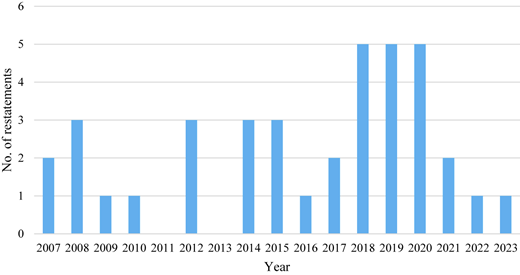
Under IAS 8.42, firms must correct material prior period errors in the first set of financial statements after discovery of the error. IAS 8.49 further requires disclosure of the nature of the error, together with the corrected amounts for each affected financial statement line item and, where applicable, earnings per share figures. In terms of the JSE Listings Requirements, issuers are generally required to notify the JSE of material restatements where they affect earnings per share (EPS), headline EPS or key financial statement line items, although adjustments arising only from the retrospective application of new or amended IFRS standards are excluded from this requirement. Where such restatements constitute price-sensitive information, they must be communicated to the market through the Stock Exchange News Service (SENS). We manually obtain SENS announcements from Bloomberg and validate these against announcements from IRESS for the period 2007 to 2023. The year 2007 is chosen as the starting point due to the increased frequency of financial restatements among JSE-listed firms from this period onward. Daily stock price and other firm-level accounting data are collected for the restating firms from Bloomberg. Daily returns for each firm are calculated as the change in the natural logarithm of the prices. Four firms did not have sufficient price data to compute returns for the estimation window and are excluded, resulting in a final sample of 38 restatements. Figure 1 demonstrates the distribution of the restatements over the sample period.
3.2 Methodology
We evaluate the impact of financial restatements on stock returns using an event study (see for example Palmrose et al., 2004; Akhigbe et al., 2005). The event day is the announcement of the restatement of the firm's financials on SENS, denoted . We use the market model as it provides the most reliable results for event study analysis due to the fact that it accounts for market-wide movements compared to the constant mean return model (Yousaf et al., 2022). The event window is 21 days from to . We also assess the robustness of our results using two shorter event windows of 5 and 3 days ( to and to , respectively). The short windows are used to capture the immediate market response while limiting contamination from unrelated firm-specific or market-wide news. The longer 21-day window allows for the possibility of gradual information diffusion. The estimation window is 200 days from to . Although MacKinlay (1997) recommends a 120-day estimation window using daily data, we follow Park (2004) by selecting a longer window to mitigate the influence of unusual market movements which improves estimation precision. The estimation window falls prior to the event window to avoid contamination. The equation estimated is given as:
where and are the daily returns on firm i and the FTSE/JSE All Share index, respectively. The parameters and from Eq. (1) are used to calculate the abnormal return, , for firm i on day t as follows (Park, 2004):
The response of each firm's stock price to the restatement is measured by aggregating the abnormal returns on each day of the event window:
where is the average abnormal return on day and is the number of firm restatements. We also compute the cumulative abnormal return for each firm () by summing the abnormal returns across the event window as follows:
Finally, we use the to obtain the cumulative average abnormal return for each day in the event window, :
To determine the significance of the and values, we utilise the cross-sectional t-tests as shown in Eqs. (6.1) and (6.2) respectively [1].
Drawing from the literature, our hypothesis is that the market responds negatively to firms which restate their financials due to the harmful effect on the firm's reputation and/or the detrimental implications for the firm's future cash flows (Fragoso et al., 2020). Therefore, this suggests that financial restatements contain important information for market participants. If investors react immediately to new information, then the market response to the announcement should be swift. The possibility also exists that those privy to the financial restatement may trade on this information prior to the announcement. This will result in an impact on the stock price prior to the official announcement.
We then examine several factors that may influence the magnitude of the CAR, beginning with the role of King IV. Announcements are classified as occurring in the post–King IV period if they occur after 1 April 2017 (the effective implementation date), and as pre–King IV before this date. We advance two competing hypotheses regarding the impact of King IV on market reactions to financial restatements. King IV was designed to strengthen oversight, accountability and the quality of corporate reporting through a principles-based “apply and explain” approach rather than a rules-based compliance framework (IoDSA, 2016; Clamp, 2017). This approach places greater accountability on boards for governance outcomes. Investors may therefore interpret restatements in the post–King IV period as more serious failures of board oversight, amplifying their reputational signal and producing more negative market reactions. In contrast, King IV's principles-based emphasis on transparency and stakeholder communication may lead investors to interpret restatements as evidence of improved reporting processes rather than severe reporting failure, reducing the informational shock associated with restatement announcements and producing more muted reactions (Francis et al., 2008; Velte, 2023).
Restatements occur for several reasons, some of which may result in a greater impact on the firm's future cash flows or cause more harm to the firm's reputation (Akhigbe et al., 2005; Gondhalekar et al., 2012). We thus examine the effect of the cause of the restatement on the CAR by categorising announcements due to accounting errors, irregularities and policy changes. We expect restatements due to accounting irregularities to elicit a larger negative market response due to the fall in the firm's credibility and deleterious impact on future cash flows. Accounting errors may have a material effect on the firm's future cash flows but will also likely harm the reputation of the company (Palmrose et al., 2004). Restatements due to accounting standard changes are likely to have a negligible impact on a firm's reputation but may still impact prices if the change affects expected cash flows (Akhigbe et al., 2005).
Finally, we assess the impact of multiple restatements. If a firm restates more than once within a fairly short horizon, this could arguably have a greater influence on the firm's reputation than a firm that restates its financial statements for the first time (Gondhalekar et al., 2012; Mun, 2022) [2].
Given the small sample size, we undertake a comparison of means across groups. While tests of equality of means do not adjust for confounding variables, they rely on fewer distributional assumptions than regression-based approaches and can therefore be preferable when working with small samples and uneven sub-sample sizes. We employ both the parametric Welch two-sample t-test and the non-parametric Wilcoxon rank-sum test to account for potential differences in variance and distributional shape. For each comparison, the mean difference is computed as the average CAR for observations classified as belonging to that group minus the average CAR for the remaining observations.
To ensure the robustness of conclusions drawn from the comparison of means, we also estimate a cross-sectional regression including dummy variables for each category defined above and several control variables as follows:
where takes on a value of 1 if the announcement occurs post 1 April 2017 and 0 otherwise; is equal to 1 if the restatement is due to an accounting error; is equal to 1 if the restatement is due to an accounting irregularity and 0 otherwise; is equal to 1 if the restatement is due to a change in accounting policy; takes on a value of 1 if the firm has previously restated its financials and refers to the vector of control variables. Newey–West heteroscedasticity and autocorrelation standard errors are used, where appropriate, to ensure robust results.
Six control variables are included. A larger restated profit value is expected to trigger a stronger market response, as this requires a greater revision to expected cash flows (Akhigbe et al., 2005). Therefore, we include the magnitude of the restated profit, quantified as the percentage change in basic EPS between the restated and original financials for both the prior period and the immediately preceding period as control variables. In cases where firms disclose only the revised EPS, the original figure is sourced from the firm's financial statements. In cases where restatement warnings provide no quantification, EPS changes are denoted as “not applicable”.
Earnings announcements often accompany restatements and the direction of the earnings news may influence market reactions (Akhigbe et al., 2005). Accordingly, we include dummy variables for positive news ( is 1 if current earnings exceeds the prior period) and negative news ( is 1 if current earnings are lower). Lastly, we control for firm size, measured as the natural log of the firm's market capitalisation at the time of the restatement, and prior period performance, proxied by the cumulative return in the year before the restatement. Smaller firms and those with strong prior returns may experience more pronounced market reactions if investors are more surprised by the announcement (Akhigbe et al., 2005; Fragoso et al., 2020).
4. Results
4.1 Descriptive statistics
The descriptive statistics for the CARs and sub-groups are presented in Table 1. The minimum, maximum and standard deviations for the CAR series over the three event windows confirm the wide dispersion in abnormal returns across restatement announcements, including some large positive returns. 55.26% of the announcements during the sample period occurred in the post–King IV period. The sample is dominated by financial restatements due to accounting errors (78.95%), followed by policy changes (13.16%) and irregularities (7.89%). Only a small proportion of the firms have previously restated their financials (10.53%). The descriptive statistics also show that financial restatement announcements occur concurrently with an earnings announcement approximately 48.48% of the time (24.24% with negative updates and 24.24% with positive updates). The average change in basic EPS due to the restatement in the most recent period is small but positive (0.07%). However, the average change in EPS in the preceding period was substantial and negative (−23.78%). The average cumulative return in the year prior to the announcement of the restatement is negative, suggesting that investors viewed the performance of these firms unfavourably prior to the firms restating their financials. The market capitalisations of the firms vary markedly with several very small and large firms.
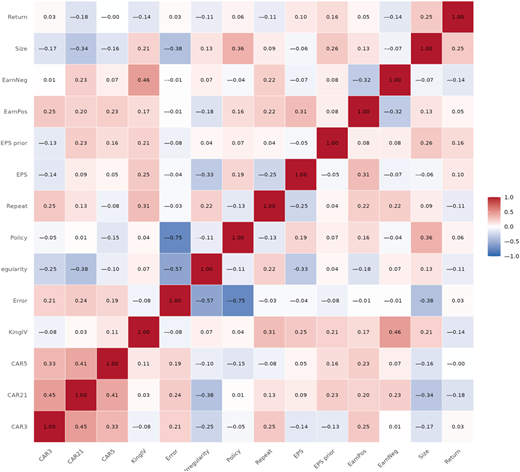
The correlation heatmap in Figure 2 shows, as expected, strong positive correlation (dark pink) among the three CAR measures. King IV exhibits minimal correlation with any CAR measure (almost white), suggesting limited market response to restatements after the introduction of King IV. Restatements due to policy changes also show little association with CARs (almost white), while restatements due to errors and irregularities display opposite properties, with irregularities strongly negatively correlated with CARs (blue), consistent with expectations, whereas restatements due to accounting errors show a mild positive correlation (light pink). Correlations are generally low among the other variables, with the only notable case being between the indicator variables error and irregularity (dark blue), attributable to their near mutual exclusivity.
4.2 Market reaction
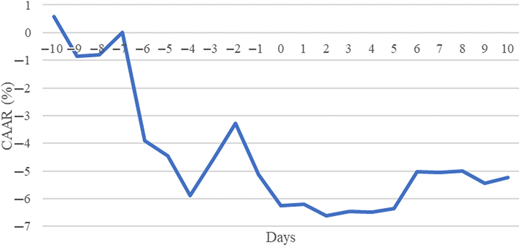
The AAR and CAAR results from the event study are reported in Tables 2 and 3. Isolated significant negative abnormal returns are observed 9 days (−1.45%) and 1 day (−1.85%) prior to the event. This is consistent with a majority of firms (66% and 61%, respectively) experiencing negative abnormal returns on these pre-event days. The abnormal return on the announcement day () is negative but statistically insignificant and none of the post-announcement day abnormal returns are significant. This aligns with less than half the sample exhibiting negative abnormal returns on the announcement day or thereafter (except for and ). This pattern indicates substantial heterogeneity in firm responses and suggests that positive and negative reactions largely offset each other in the aggregate. Figure 3 confirms that the CAAR declines prior to the announcement, before stabilising around the announcement date and persisting thereafter. Importantly, however, the CAARs over the 21-day, 5-day and 3-day event windows (Table 3) are statistically insignificant. Accordingly, the results point to the absence of a systematic market reaction to financial restatement announcements in South Africa.
While the negative abnormal returns observed prior to the announcement may reflect market anticipation or information leakage (Hribar and Jenkins, 2004), these effects are not persistent and do not translate into a statistically significant cumulative market response. As such, the pre-announcement price movements are more consistent with normal return volatility and idiosyncratic firm-level price movements than with systematic incorporation of restatement-related information.
The absence of a significant response contrasts with expectations that markets should respond negatively to financial restatements either because of the detrimental impact of the restatement on future cash flows and/or on the firm's reputation (Fragoso et al., 2020). Our findings also differ from the international literature, including studies documenting strongly negative reactions in the United States (Hribar and Jenkins, 2004; Palmrose et al., 2004) and comparatively more muted but still negative reactions in Canada (Robbani and Bhuyan, 2010), Germany (Hitz et al., 2012) and China (Wang and Wu, 2011). The results also differ from prior South African evidence which documents negative abnormal returns (Watson and Coetzee, 2012; Watson and Rossouw, 2012). Several factors may explain this divergence. Restatement announcements in South Africa often coincide with other disclosures, such as earnings updates, that convey offsetting information, making it difficult for investors to isolate the valuation impact of the restatement itself. In addition, investors may perceive restatements as technical corrections rather than signals of governance failure, particularly in a market characterised by a relatively strong auditing profession and governance framework. Investors may already be aware of the underlying issues, such as when Steinhoff announced its restatement in December 2017 (Rossouw and Styan, 2021). Importantly, improvements in disclosure practices and corporate governance over time, most notably following the introduction of the King IV code in 2017, may have reduced the informational surprise associated with restatements, leading them to be interpreted as part of a transparent corrective reporting process rather than as evidence of misconduct. It should further be noted that the prior South African studies (Watson and Coetzee, 2012; Watson and Rossouw, 2012) focus exclusively on forced restatements resulting from GAAP Monitoring Panel investigations, which represent a more severe subset of restatements than the broader mix of accounting irregularities, errors and policy changes examined in this study. Their sample composition is likely to have contributed to the stronger negative reaction. Together, these factors may attenuate market reactions to restatement announcements relative to both earlier South African studies and international findings.
As 31.58% of the restatements (12 of 38) result in an increase in prior EPS, we also estimate the CAAR for these announcements separately (Panel B, Table 3). Although the 21-day, 5-day and 3-day CAARs remain negative, none are statistically significant. This differs from Palmrose et al. (2004) who find a significant negative response to restatements that increase income in their sample. In our sample, the absence of a significant response suggests that restatements which increase reported earnings are not viewed as distinct from other restatements. Accordingly, the lack of a significant market reaction in the full sample does not appear to be driven by income-increasing restatements.
4.3 Differences in CARs across sub-groups
The results of the comparison of means across sub-groups are presented in Table 4. The mean 21-day and 5-day CARs are higher in the post–King IV period as reflected by the positive mean differences (Panel A); however, these differences are statistically insignificant. The mean difference in 3-day CARs is negative, but likewise insignificant. Overall, there is no evidence to support the hypothesis that the introduction of King IV altered the magnitude of market reactions to restatement announcements. The absence of a differential market response does not provide support for either of the competing hypotheses. Investors do not appear to have interpreted restatements as more serious failures of board oversight in the post–King IV period, nor is there evidence of a more muted response consistent with restatements being viewed as part of a transparent corrective process under the principles-based governance framework. This may indicate that investors place greater weight on firm-specific information conveyed by individual restatements than on the broader governance regime within which they occur. It may also reflect the possibility that investors regarded South Africa's governance environment as relatively strong even prior to King IV, limiting the incremental impact of the governance transition on how restatements are interpreted.
Given the relatively small sample size and hence low statistical power, we evaluate whether this finding of no statistically significant difference in mean CARs across sub-groups reflects the absence of an effect or insufficient statistical power to detect an effect using the minimum detectable effect (MDE) (Duflo et al., 2007). The MDE is the smallest true difference in means that the study could reliably detect given the sample size and variance. The MDE was calculated assuming a two-sided test with a 5% significance level and 80% power. Table 4 reports these values. For the 21-day, 5-day and 3-day CARs, the absolute MDEs of 42.75%, 11.57% and 11% imply that differences smaller than these respective thresholds would not be detectable with reasonable power. Thus, while we do not observe a statistically significant difference between the pre- and post–King IV period CARs, the analysis is only sensitive to relatively large effects, especially over the 21-day window. Smaller but potentially meaningful differences cannot be ruled out.
Restatements attributed to errors are associated with a higher CAR while those attributable to irregularities yield lower CARs especially over a 21-day horizon (mean difference of −64.03%) (Panels B–D). Although the mean CARs vary across sub-groups, these differences are not statistically distinguishable from zero. The MDE results confirm that the study only has power to detect relatively large differences between groups. For example, for accounting irregularities, a true difference of more than 21.34% in the 5-day CAR would be required to achieve statistical significance.
Although none of the mean CAR differences across restatement types are statistically significant, restatements attributed to irregularities exhibit the most negative mean CARs, consistent with stronger market penalties for disclosures associated with fraud or corruption (Palmrose et al., 2004). Policy-related restatements also show negative CARs over shorter horizons, suggesting that accounting policy changes may signal lower expected future cash flows, in contrast to Akhigbe et al. (2005). By comparison, error-related restatements are associated with positive mean CARs across all windows, possibly because investors view such errors as isolated rather than symptomatic of broader governance failures (Callen et al., 2006).
Finally, the results in Panel E show that firms with a history of prior restatements do not exhibit consistently lower CARs across window periods as both the Welch t-test and Wilcoxon rank-sum tests indicate that these differences are insignificant. This differs from the findings of Gondhalekar et al. (2012) and Mun (2022). The small number of repeat offenders in the sample may be a contributing factor, as shown by the MDE values.
4.4 Robustness tests
The results from the regressions conducted for the purposes of robustness are shown in Table 5. There is limited evidence that the introduction of King IV systematically altered market reactions to financial restatements across event windows as the King IV indicator is negative and statistically significant only for the 3-day CAR (−3.75%). This aligns with the negative mean difference across the sub-groups for the 3-day CARs (see Table 4), suggesting more negative short-term market responses after the introduction of King IV, as per Jategaonkar et al. (2012). However, this effect does not persist over longer horizons and becomes insignificant in the presence of other variables. Irregularity-related restatements are associated with significantly more negative 3-day CARs (−13.15%), consistent with the market penalising disclosures perceived as more severe. This also follows the negative mean differences observed in Table 4 across sub-groups sorted based on this characteristic. Policy-related restatements show evidence of a negative association but only with the 21-day CAR (−3.62%). Overall, the results suggest that the market responds more to restatements caused by accounting irregularities and accounting policy changes than errors. However, both become insignificant after controlling for other variables. The regression results also confirm the conclusion from the comparison of means that the market does not respond differently to firms that have restated their financials previously.
Among the control variables, concurrent earnings announcements are associated with stronger market reactions over the 21-day window, with larger effects for positive than negative earnings news (28.77% and 10.95%, respectively). Positive earnings announcements are also positively related to the 5-day CAR. The amplified CARs when restatements occur simultaneously with earnings updates suggest that the market response to earnings information may dominate the restatement effect. While the positive response to good news is expected, the favourable reaction to negative earnings announcements may reflect that the news is less adverse than anticipated or that investors incorporate other price-relevant information not captured in the financial statements (Chen and Tiras, 2015). Consistent with Files et al. (2009), these results suggest that firms may combine restatement disclosures with earnings announcements to mitigate potential reputational damage. The size of the firm does not significantly impact the CAR (Fragoso et al., 2020). Although smaller firms are typically subject to greater information asymmetry and less analyst coverage, these results suggest that restatement announcements convey limited incremental information to the market.
The cumulative returns in the run-up period have a negative impact on the 21-day CAR, consistent with expectations that firms with stronger prior returns are more affected as the market is surprised by the restatement (Fragoso et al., 2020). The prior-period EPS revision is positively related to the 21-day CAR, indicating that the magnitude and context of earnings information play an important role in shaping investor responses, as found by Thompson and McCoy (2008). Overall, however, explanatory power is limited.
5. Conclusion
This study investigates the stock market response to financial restatement announcements by firms listed on the JSE between 2007 and 2023, with particular attention to the impact of the King IV corporate governance framework and the reason for the restatement on the market response. Using an event study, we find that CARs across standard event windows are negligible, suggesting markets show limited response to restatement announcements. Differences in market reactions across the pre- and post–King IV periods, across restatement reasons and between firms with and without prior restatements are economically immaterial.
Overall, the findings reveal that in the South African context financial restatements are not systematically perceived as price-relevant shocks and that the introduction of King IV had little impact on stock market reactions. The finding of limited market response differs from the results of international studies, including a strong negative market reaction in the United States and a more muted but still negative response in other markets (Palmrose et al., 2004; Wang and Wu, 2011; Hitz et al., 2012). The absence of a market response implies that investors may view many restatements as technical corrections within a relatively strong governance and enforcement environment in South Africa rather than as a signal of reporting failure. At the same time, the MDE analysis indicates that the study only has power to detect relatively large differences in market reactions, implying that smaller but meaningful effects cannot be ruled out. The results also deviate from prior South African studies of a negative market reaction (Watson and Coetzee, 2012; Watson and Rossouw, 2012), which can be attributed to the broader sample of financial restatements examined in this study compared to only forced restatements analysed in prior work. The absence of a differential market response across the pre- and post–King IV periods does not support either competing hypothesis, suggesting that investors place greater weight on firm-specific information conveyed by individual restatements rather than the governance regime or that South Africa's governance environment was perceived as relatively strong even prior to King IV.
For market participants, these results suggest that, on average, restatement announcements do not provide strong standalone trading signals in the South African context, though reputational costs and regulatory scrutiny may still arise in cases involving accounting irregularities. For policymakers, the findings highlight the importance of a strong governance framework to minimise negative effects of restatements on public trust in financial markets and suggest that well-functioning governance environments may limit adverse spillovers to market confidence and capital flows. More broadly, the findings caution against generalising evidence from larger, developed markets to well-regulated emerging market settings. Much of the existing evidence on market reactions to restatements is drawn from the United States, whose institutional features cannot be assumed to apply elsewhere. Our finding that South African investors do not respond systematically to restatement announcements despite a well-developed governance framework and disclosure environment underscores the value of evidence grounded in Majority World contexts for developing a more complete understanding of how investors respond to financial restatements (Uddin, 2025).
This study is subject to several limitations. Financial restatements are relatively rare in South Africa, resulting in a small sample that constrains statistical power and limits generalisability. The disaggregation of this sample across subgroups, namely the pre- and post–King IV periods, restatement types and firms with and without prior restatements, further reduces the number of observations available for each grouping, constraining the strength of inferences that can be drawn from the subgroup analyses. These results should therefore be interpreted as reflecting average market responses within this institutional setting and period. Future research could benefit from larger cross-country samples or longer horizons. Endogeneity is a concern given the co-occurrence of financial restatement announcements and earnings disclosures. Although we control for concurrent earnings news, future studies using larger samples could explicitly distinguish between clean restatement events and those accompanied by earnings updates. While this study focuses on the King IV governance regime, the King V Report effective for financial years ending after 1 January 2026 may further shape how investors interpret financial reporting quality and corrective disclosures.
The authors would like to thank the participants of the 2nd Corporate Governance Conference (December 2023) in Stellenbosch, South Africa for valuable feedback.
Notes
We also test the significance using the standardised cross-sectional test which controls for event-induced volatility and serial correlation, and the non-parametric sign test which is less sensitive to violations of the normality assumption (Brown and Warner, 1980, 1985). Our results are robust to the use of these alternative tests.
We consider a ten-year period before the start of the sample for this measure.