

Papers published in Bioinspired, Biomimetic and Nanobiomaterials are eligible for awards from the Institution of Civil Engineers. Papers from any of the ICE journals can be nominated for several awards. In addition, each journal has awards dedicated to their specific subject area.
On Friday 6 October 2017, ICE president Tim Broyd presented an award to the following papers published in Bioinspired, Biomimetic and Nanobiomaterials in 2016. The editorial panel nominated their best papers and an awards committee chaired by Nigel Wright allocated the awards.
Kajal Mallick Memorial (best paper in the journal)
The best paper was awarded to Alexander Dejaco, Vladimir S. Komlev, Jakub Jaroszewicz, et al. (2016) Fracture safety of double-porous hydroxyapatite biomaterials.
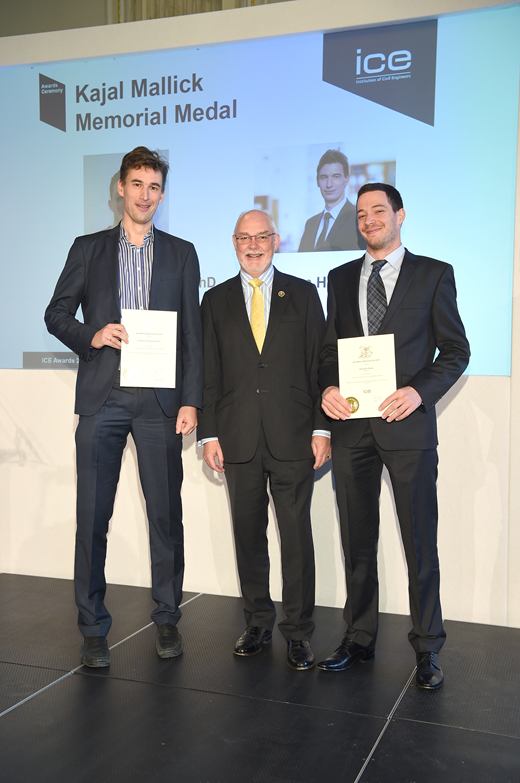
Kajal Mallick Memorial winners, Alexander Dejaco and Christian Hellmich with ICE President Tim Broyd
Kajal Mallick Memorial winners, Alexander Dejaco and Christian Hellmich with ICE President Tim Broyd
Abstract
Biological requirements call for substantial porosities in clinical biomaterials – challenging the mechanical integrity and strength of the latter. In this study, the authors resort to quantitative engineering principles to assess the fracture safety of double-porous hydroxyapatite ceramics: micro-computed tomography scans give access to the morphology of macropores at the submillimeter scale, as well as to voxel-specific microporosities. Advanced micromechanics of porous ceramics with needle-shaped elementary units then allows for translating voxel-specific microporosities to corresponding elasticity and strength properties, as well as to macro-to-micro scale transition (‘concentration’) tensors. These mechanical properties and tensors are fed into a large-scale finite-element model of a biomaterial granule as used for mandibular tissue regeneration. Loading the granule in splitting mode, up to physiological strain, evidences stress concentrations at the loaded poles and close to internal macropores and cracks. A parallel computing-supported subvoxel analysis of needle orientations evidences that in highly loaded regions, the intravoxel ‘single crystals’ oriented perpendicular to the loading direction undergo the most unfavorable loading. Still, only 0·6% of the finite-elements show stresses indicating failure, and the mean safety factor against fracture is as high as 7. This analysis confirms, from an engineering science viewpoint, the successful use of the investigated biomaterials in clinical practice.

