Business dynamics are caused by the interplay between organizations and their contexts. The purpose of this paper is to complement mainstream framings by investigation of the content of this interplay.
The framework is based on concepts and models from the Industrial Network Approach (Håkansson et al., 2009), which has been shown useful for analysis of both the connections between organizations and contexts, and the evolution of this relationship. The conceptual framing is illustrated by examples from a major transformation of the business reality and by observations in previous research.
The main finding is the significant role for business dynamics of a firm’s action base – the activities, resources and actors to which a firm is connected through its business relationships. The action base is the platform for a firm’s innovative activity because major changes require collaboration. Moreover, the action base imposes restrictions for change because it is featured by interdependencies. Change initiatives of firms must therefore balance interdependencies and dynamic action. This paper investigates this balancing through the analysis of network vectors. These vectors enable examination of the features and consequences of interdependencies and the impact on business dynamics.
Mainstream perspectives tend to take the starting point in the change agent. Based on action base and network vectors, this paper contributes with a complementary approach rooted in the network context. Furthermore, this paper challenges the prevailing perceptions of the dynamic effects of determinism and voluntarism in established frameworks.
1. Introduction
Business dynamics are normally characterized as the changes of an organization’s alignment with its environment (Van de Veen and Poole, 1995; Fiss and Zajak, 2006). Such modifications are explained by the ongoing interplay between the actions of organizations and the impact of changes in the environmental context. This context represents a complex configuration, characterized as “a nested arrangement of structures and processes in which the subjective interpretation of actors’ perceiving, learning and remembering help shape process” (Pettigrew et al., 2001, p. 699).
Business dynamics are central in both practice and theory. Practitioners are constantly involved in exploiting and improving their businesses in the most favourable ways. Researchers struggle to enhance the understanding of what is ongoing by developing models and concepts for analysis. In both cases, the business conditions are impacted: practitioners provide showcases, illustrating best practices, which are likely to be followed by others. Similarly, researchers develop models, based on prosperous modifications of the business conditions. Such models tend to function as business recipes, in turn driving further change.
Over time, a rich plethora of best practices and models of business dynamics have been presented. Both the features of the context and the interplay with organizations have been conceptualized in various ways with subsequent consequences for the interpretation of what should be adequate actions for organizations. Müller and Kunisch (2018) identified three main perspectives on the underlying reasons behind business dynamics:
the deterministic view, where changes are perceived as processes driven from the context through institutional and/or environmental pressure;
the voluntaristic, where it is considered that the main influence on change stems from managerial action; and
the dialectic perspective, which claims that business dynamics result from the combined effect of determinism and voluntarism.
This means that the mainstream literature has focused on the direction of the impact of the firm–context relationship.
The overall purpose of this paper is to complement the established notion of business dynamics. This is achieved through exploration of the features of the linkages between a firm and its context. The focus of the study is to investigate the space in which the interplay occurs. We are concerned thus with the characteristics of what resides outside the corporate boundary and how the firm is connected to this environment. We define this space as the firm’s “action base”. The action base represents the platform for the firm’s acting. In the paper we investigate the role of the action base in relation to the linkages in the interplay between the firm and its context. The main ingredients in the action base are the joint capabilities and resources of the single firm and its direct business partners.
Based on the purpose of the study, two research questions are formulated. The first is to conceptualize the notion of an action base. This assignment calls for definition of the features of the action base and analysis of its potential role in business dynamics. The second research question is to explore in which ways the action base can be used as the platform for a firm’s dynamic acting.
2. Research design and outline of the paper
This paper is conceptual to its nature. It is a well-known fact that conceptual exercises represent challenging research tasks (Fulmer, 2012; Shepherd and Suddaby, 2017). These struggles are caused by the fact that there is a lack of commonly accepted templates to guide the structuring of the research process and the writing of the paper (Cornelissen, 2017; Jaakkola, 2020). However, it is possible for researchers to find literature support in their ambitions to secure that conceptual papers live up to the requirements for research standard. Based on such recommendations, we discuss three fundamental issues to clarify in a conceptual paper:
the choice and development of theories and concepts;
the positioning of the study; and
the logic of the presentation of the findings.
2.1 Theories and concepts
In the scrutinizing of the action base, we rely on one of the dialectic perspectives. The framework for investigation of business dynamics is based on the “Industrial Network Approach” (e.g., Håkansson and Snehota, 1995; Håkansson et al., 2009). The industrial network approach (INA) is an empirically grounded framing for analysis of business relationships and networks. INA has shown to be useful for analysis of complex constellations, like the “nested arrangements” mentioned in the Introduction (Wilkinson, 2008). Moreover, the framework has been applied in numerous studies of dynamics following from interaction in business relationships and among firms connected in network configurations (Håkansson and Snehota, 2017).
In the development of theory, Floyd (2009) suggests “borrowing theory” as a useful approach. The borrowing of theory is a means of “bringing ideas from one theoretical domain to address an issue, or explain a phenomenon, in another domain” (Floyd, 2009, p. 1057). Likewise, Zahra and Newey (2009) argued that the intersection of academic fields provides an important forum for creative theory building. They conclude that importation of theory from other disciplines may lead to substantial enrichment and extension of a theoretical domain. Similarly, MacInnis (2011) claimed that such “revising” of theories and concepts helps researchers see something in a new light through the shift of perspective.
In such theoretical transfers, Lukka and Vinnari (2014) made a distinction between two types of theories: domain theory and method theory. Domain theories involve the prevailing knowledge within a specific research field regarding constructs, theories and assumptions. Method theories are applied in efforts to provide some new insight into the domain theory by offering a complementary perspective, originating in another field. In this study, the mainstream views on business dynamics (presented in Section 3) represent the domain theory. The industrial network approach is the method theory that is applied to provide a complementary view of the domain.
2.2 The positioning of the study
MacInnis (2011) distinguished between six entities around which conceptualization may occur – from single constructs (defined as measurable theoretical concepts) to complete sciences (featuring the knowledge within entire research disciplines). This paper centres on the two lowest levels of entities. First, our paper aims at explicating “action base” as a construct portraying the linkage between firm and context. Second, our study also relates to the relationship/theory entity, dealing with the connections between constructs. Such connections will appear in relation to previously defined constructs featuring the industrial network approach. One example concerns the role of “network vectors” in the dynamic actions of firms. This construct was defined some 30 years ago (Håkansson and Johanson, 1993), but has received only limited attention this far.
In addition, Jaakkola (2020) identified several types of research designs related to conceptual papers. This study relates primarily to theory adaptation, which is concerned with complementing established theories by “introducing a new theoretical lens” (Jaakkola, 2020, p. 22). Such lenses may contribute to re-interpretation of domain theories.
2.3 The logic of the presentation
The logic of the presentation of the findings is a strong determinant of the quality of a paper (Hirschheim, 2008; Jaakkola, 2020). Securing this chain of evidence involves clarification of two central issues: the research setup and the structuring of the paper.
The research journey started with the ambition to analyse business dynamics by applying concepts related to the industrial network approach. The INA literature provided basic building blocks dealing with interaction between firms and the structure and functioning of networks (e.g. Håkansson et al., 2009). Building on these framings, we developed the action base construct as the response to the first research question regarding the firm–context connection. The second research question concerns the relationship between the action base and the dynamic actions of the firm. For this analysis, we found an almost neglected conceptualization useful. “Network vectors”, originally launched by Håkansson and Johanson (1993), served as mechanisms for the understanding of the linkages between action base and acting.
Moreover, a review of the mainstream features of the domain theory was required. In the search for relevant literature, we found a paper that provided a useful overview of the business dynamics field. Müller and Kunisch (2018) presented the result of a substantial review of the established literature. The paper is based on the analysis of 119 studies published during 30 years in leading academic journals. The studies are categorized along their basic perspectives and discussed in terms of antecedents, processes and outcomes. Based on the similarities and differences across the perspectives, the authors synthesize the findings and come up with suggestions for further research. We found the information from Müller and Kunisch (2018) sufficiently rich for our purpose to relate to established views of industrial dynamics.
The structuring of the written presentation resulted in the following outline of the paper. In Section 3, we present the domain and method theories, together with a minor empirical illustration of business dynamics. Section 4 is devoted to discussion of the core construct – the action base. After that we investigate how the action base can be used as a platform for the firm’s acting. In Section 5, we bring in dynamics by introducing the second significant construct – network vectors. Section 6 presents our view of acting in business networks, identified as “networking”. In Section 7, we integrate the discussions in Sections 5 and 6 and analyse networking in relation to the network vectors. Section 8 deals with the overall role of the action base in a firm’s networking. The paper concludes in Section 9 with contributions, managerial implications and suggestions for further research.
3. Domain and method theories
3.1 The domain theory
As described above, Müller and Kunisch (2018) explored three main perspectives on the interplay between firm and context. First, according to the deterministic perspective, change is a process driven from the outside and caused mainly by institutional and environmental impact. This view is associated with, for example, the processes of variation, selection, retention and struggle in Aldrich (1979), as well as the population ecology framework in Hannan and Freeman (1977). According to this perspective, the role of management is rather limited because structural and environmental conditions severely constrain the possibilities for managerial action.
Second, from the voluntaristic perspective it is suggested that management can largely influence the dynamics of business. Managers can decide upon courses of action not only by establishing structural forms but also through the manipulation of environmental features (Child, 1972). Similarly, Miles and Snow (1978) argued that managers define their domains and strive to construct mechanisms to pursue their strategies. Over time, the voluntaristic perspective became more significant both in practice and research. The strategic management approach launched by Ansoff (1965) got widespread attention and was developed further into competitive strategy and strategic change by, for example, Porter (1980), Grant (1998) and (Welch, 2023). In addition, theories on the role of dynamic capabilities contributed to the increasing attention to voluntarism (e.g. Teece and Pisano, 1994; Helfat and Peteraf, 2009).
Third, a dialectic perspective was launched, aiming at bridging the two opposing views. Researchers adhering to this framing argue that the understanding of business change requires that both determinism and managerial action are taken into consideration (e.g., Astley and Van de Ven, 1983; MacKay and Chia, 2013). Another stream of research sharing this perspective relates to the literature on Industrial Dynamics. This field developed from theories on industrial organization (e.g. Bain, 1959; Scherer, 1970). The significant aspects of industrial dynamics are outlined in, for example, Nelson and Winter (1982) and Dosi et al. (1988). One of the basic assumptions in this framing is that strategic action regarding business dynamics both shapes, and becomes shaped by, the environment in which the firms operate. Innovation is achieved through cooperative behaviour where activities and capabilities within firms interact across ownership boundaries. This interplay generates new resource combinations that cause structural changes, within and across firms. One central feature of these processes is the co-evolution of technology, industry structure, support institutions and firms (Carlsson, 2016).
Mainstream domain theories on business dynamics have focused primarily on the direction of the impact of the firm–context relationship. The voluntaristic perspective, with the emphasis on the firm, received increasing attention through its relations to the growing literature on strategic management and dynamic capabilities. Despite the input from the dialectic perspective, it is obvious that the actions of firms still are considered the main determinants of business dynamics. The industrial dynamics school modified this view by paying more attention to the context and the firm’s co-evolution with other elements.
Applying the industrial network approach as the method theory will enable further exploration, and deep-probing analysis, of the joint dynamics of the firm and its context. According to the INA perspective, the firm is in constant interplay with its business context – identified as a network of actors. Through this interplay strong interdependencies are generated between the actors in the network. These connections involve aspects of determinism because they may severely constrain the degrees of freedom for the acting of the focal actor. On the other hand, the connections to the business partners constitute the most significant base for the acting of the firm. In this way, they provide the conditions for restricted voluntarism. Our claim is that the industrial network approach is a relevant means to complement established theories on business dynamics. INA offers a theoretical lens to enable researchers and practitioners to see things in new ways. In the terms of MacInnis (2011) such revising through the shifting of perspective may provide important conceptual contributions. Before we proceed to the presentation of the industrial network approach as the method theory, we present an empirical illustration of business dynamics.
3.2 Business dynamics in the 1900s
In the late 1800s, the invisible hand was no longer assumed to be the ruler of the development of business. Over time, Adam Smith’s deterministic conceptualization had been modified to include dimensions of voluntarism. The prevailing business regime in the second half of the 1800s has been characterized as “self-regulating markets based on firm autonomy” (Biggart and Hamilton, 1992). In the beginning of the 1900s, this governance form was replaced by an evolving perspective. This framing – later identified as the Modern Business Enterprise (MBE) – was derived from analysis of the reorganization of some major US corporations in the early 1900s (Chandler, 1977). This transformation, towards the vertically integrated MBE, implied a strong emphasis on voluntarism. The prominent example of the MBE was the Ford Motor Company. Ford integrated not only final assembly and component production but also steelworks and mines, as well as rubber plantations (Drucker, 1990). The internalizing of strategic resources and activities provided benefits regarding both manufacturing operations (Drucker, 1990) and innovation (Piore, 1992).
The improvements realized by the MBEs made other firms to adapt these principles that became perceived as the recipe for successful business. In this way, the dominant perspective had changed from the semi-determinism in the end of the 1800s towards the voluntarism of the MBE. In this regime, firms deliberately avoided interaction with the environment. The connections to the suppliers they still had to rely on were antagonistic rather than collaborative, because the buyer played the market and put pressure on suppliers (Håkansson et al., 2009).
Over time, the glory of the MBE began to fade away. Changing environmental conditions paved the way for substantial business dynamics in the second half of the 1900s. The narrative of this process is based on, among others, Piore and Sabel (1984) and Langlois and Robertson (1998). The MBE relied on mass production and standardization to secure low-cost production. Technical development now enabled firms to increasingly supply customized offerings, because large-scale manufacturing was no longer a prerequisite for cost-efficient operations (Hayes and Pisano, 1994). Moreover, the technological frontier expanded rapidly and substantially (Langlois, 2003). The growth of the knowledge base made it impossible for individual firms to be at the cutting edge within all the capabilities on which they depended. The walls around the MBE, that once favoured innovation, now became an obstacle. The corporate boundary hindered the exchange with the new opportunities evolving in the environmental context.
In the changing business environment, the action base of the MBE had become too narrow. The new conditions led to the dissolution of the integrated corporation. This was a necessary step to enable contact with the modified context. In this way, an alternative business recipe evolved. The MBE had deliberately avoided contact with the context by controlling critical resources and operations in-house. Through new business arrangements, a firm could now benefit from exploiting external capabilities, for example, from suppliers specializing in a narrow range of technologies (Powell, 1998; Quinn, 1999). In this way, the business dynamics directed individual firms towards outsourcing to suppliers. This approach enabled synchronized and boundary-crossing activities and interactive product development (Axelsson et al., 2005). These beneficial arrangements required new forms of relationships to the business partners. The previous atmosphere featuring confrontation had to be replaced by collaboration (e.g., Dyer and Singh, 1998; Gadde and Håkansson, 2001). Firms now actively engaged in situations of dependence towards suppliers; conditions they previously did their best to keep away from.
3.3 The method theory – the industrial network approach
In the syntheses of their review of the domain theories, Müller and Kunisch (2018, p. 474) concluded that future research needs to “expand the scope of actors considered”. They claimed that involving also the impact of the change agent’s business partners would enhance the understanding of business dynamics. This conclusion is an important argument for using the industrial network approach as the method theory. According to the INA framework, actors do not affect business dynamics through their individual features and actions. It is through their interaction in constellations of connected relationships that business develops. In these interactions, joint resource combining and recombining are crucial ingredients. Concepts from INA enable analysis of the potential impact of various types of change initiatives and the effects of changes undertaken (e.g. Håkansson et al., 2009).
The industrial network approach portrays the single firm as outcome of the interaction patterns in which it is involved. Through their interplay in long-term relationships, individual firms become connected to other firms. The underlying reasons are the joint combining of resources and synchronization of activities across corporate boundaries. INA investigates these network connections through the ARA model, containing three layers – activities, resources and actors (Håkansson et al., 2009). The three layers are completely interwoven because changes in one of the layers cause changes in the other two. For analytical reasons, however, separation makes sense because the three layers together shed three different lights on the same phenomenon. The firm’s connections to the outside are formed through the activity links, resource ties and actor bonds to the business partners. In this way, the portfolio of business relationships represents a highly significant dimension of the context. Firms dwell in close relationships with groups of counterparts on both the input and the output sides. Over time, the features of the firm are formed through the interaction with these counterparts. Because the couplings are relation-specific, every firm is related to its specific context (Håkansson and Snehota, 2017).
Industrial activities and resources are typified by complexity and heaviness through the mutual adaptations and adjustments (Håkansson and Waluszewski, 2002). Business networks have no natural borders and are in continuous evolvement. This development is driven by actions performed by the companies and by their responses to changes undertaken elsewhere. These processes are characterized by an active interplay among the companies, where various types of suggestions for modifications become confronted (Gadde and Håkansson, 2023). Over time, and through their interaction, the actors become increasingly embedded in their contexts. In this way, actors contribute to the features of each other, and complex business relationships are built up. The content of the relationships functions as the connection between a firm and its environment.
In conclusion, we found the industrial network approach more relevant for the investigation than alternative conceptualizations. Protagonists of the dynamic capabilities school share the interest of exploring the dynamic conditions featuring firms. Also, they have increasingly taken the impact of the environment into consideration (Nayernia, 2025). However, in a recent review of the literature on dynamic capabilities, the conclusion was that “scarcely any attention has been paid to addressing how a firm can take into account and benefit from the dynamic capabilities of other organizations” (Qiu et al., 2022, p. 149). Because this function is a central element in the action base, we found this approach less suitable for our purpose. Advocates of industrial dynamics are similar to the INA view regarding the combined effect of environmental impact and actions of firms. However, in industrial dynamics the main perspective tends to be on the industry level rather than on connected firms. Moreover, when the impact of firms is considered, proponents of industrial dynamics focus on the role of individual change agents rather than on firms in interaction.
Finally, theories on business ecosystems have increasingly been applied in the analysis of the dynamics of business. Initial conceptualizations (Moore, 1993) identified a keystone that regulated the features of ecosystems. The keystone was typically an actor, able to support and orchestrate the activities in relation to a common purpose of joint value creation. This perspective, which is not in line with the interactive role of the action base, seems to have continued over time. For example, Mäntymäki et al. (2018, p. 114) concluded that the ecosystem approach “appears to fit particularly well to situations where there is a focal firm or platform leading the network”. Furthermore, they argue that in these situations the network consists of many actors that are led and co-ordinated by this keystone actor. These characteristics do not correspond to the interactivity in the action base.
4. Action base – the linkage between firm and context
4.1 The main construct
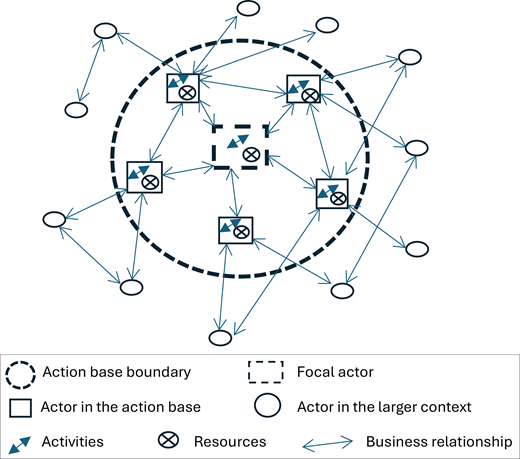
As argued above, firms become increasingly embedded in the context where they reside. According to the INA perspective, the business relationships represent the most important resources of an actor (Ford et al., 2003). Therefore, they are highly significant for the focal actor’s efforts directed to business dynamics and thus significant elements of the action base. The action base of a firm consists of the specific part of the total network constellation in which the firm is involved. The action base is thus a sub-set of the larger business context. The base is rooted in the firm’s own resources and activities and the related resources and activities of its direct business partners (see Figure 1). The features of the action base are the outcome of previous interactions between the focal company and its counterparts. The joint undertakings of the companies have generated a configuration, grounded in some specific network logic, which functions as the basic platform for a firm’s acting. The main substance of the action base is the set of threads of interdependencies between the firms.
Action bases differ regarding range and scope. The range is determined by the number of significant counterparts. The scope is defined through the extent of interaction and the magnitude of the investments in specific relationships. Within this action base, each actor holds a certain position in relation to others. The actions related to these functions generate cooperative connections to some actors and conflicting connections to others. These conditions may cause tensions in the action base. Tensions are derived from differing interpretations of the functioning and the features of the business conditions. Balancing tensions require compromises among the actors to avoid destructive conflict. An action base is the outcome of the compromises over time that actors have landed in through their interaction (Håkansson and Waluszewski, 2002).
The structural features of the action base are crucial for the performance of firms. Even more significant are the dynamic aspects. The features of the action base change over time through adjustments and adaptations. Such modifications develop the action base in certain directions. As long as the modifications follow the established network logic, they tend to preserve the basic conditions in the action base. Now and then, however, some actors may perceive opportunities to improve performance through actions that break with the established logic.
4.2 Dynamic forces in the action base
In most situations, network modifications can be traced back to new conditions in the resource layer. In line with Penrose (1959), we claim that it is not the resource itself that determines its value. Instead, the value is contingent on the services a resource can render. This means that network dynamics spring not only from radical innovation. Also, refined features of a resource, in terms of capacity expansion or performance improvement, represent significant sources of network dynamics. When these conditions are at hand, the resource layer mainly contributes to an evolutionary trajectory. Another source of dynamics is that previously uncovered features of resources may be discovered when resources are combined in novel ways. Such changes, including modifications of the interfaces among resources, are key to technological development, that can stretch from evolutionary transformation to radical innovation (Håkansson and Waluszewski, 2007).
The services rendered through resource development are exploited in the activity layer. This occurs through reconfiguration of manufacturing operations and redesign of activities in transportation and logistics, as well as exploitation of new methods for exchange of information (Gadde and Håkansson, 2001). There are two factors related to potential improvements in the activity layer. The first is that individual activities can be performed in more efficient ways. The second, and most important, is that the linkages between activities can become better synchronized. Operations in logistics may be co-ordinated with manufacturing operations, for example, in terms of just-in-time arrangements.
The actor layer is crucial for any kind of network dynamics because actors control the resources and conduct the activities. In these efforts, actors have strategic intent, which manifests in two ways (Snehota, 2007). First, actors are continually involved in attempts to improve the features of the current activity and resource configurations in which they are involved. Second, they search for prospects to exploit new opportunities by engaging with resource and activity configurations outside their current action base. In this way, strategic ambitions of individual actors make them strive to rearrange the network. These efforts require interaction and collaboration with other firms.
4.3 Network vectors and the action base
Most studies of network dynamics take the starting point in one of the network layers. This is exemplified by research regarding supply chain initiatives in the activity layer, technological innovation in the resource layer and strategic management in the actor layer. However, as shown above, network changes occur through a complex interplay between the three layers. In some situations, the potential for change in one network layer may stem from new conditions in one of the other two. Improved understanding of network dynamics should thus be gained if this entire interplay is taken into consideration.
Analysis of the interplay between all three layers would be a highly complex undertaking. A first step in this direction is to explore the connections between the layers two-by-two: activities in relation to resources, activities in relation to actors and actors in relation to resources. These pairwise connections have been identified as network vectors (Håkansson and Johanson, 1993; Håkansson and Snehota, 1995). The three vectors – activity-resource, actor-activity and actor-resource – constitute basic ingredients in the network because “they develop the connections between actors, activities and resources” (Håkansson and Johanson, 1993, p. 24). Network vectors function as dynamic forces that diffuse through the network because of the prevailing interdependencies. In this way, modifications of network vectors illustrate business dynamics from the perspective of the network.
Network vectors represent the second construct in our analysis of business dynamics. As pointed out above, the vector construct was defined some 30 years ago. However, to the best of our knowledge, it was only recently that network vectors were applied in research studies. Gadde and Håkansson (2023) relied on network vectors in their analysis of the restructuring of the automotive industry in the late 1900s. In the following section, we explore their role in the dynamic changes of networks.
5. The role of network vectors in business dynamics
5.1 Central features of the network vectors
First, the activity-resource vector is concerned with dynamics occurring when activities are moved from one type of equipment to another one. Such shifts can enhance operational performance through increasing economies of scale and/or through extending the value that is generated. For example, new facilities in production and logistics can make new options available for distribution arrangements. Changes in the activity-resource vector showed to be highly significant for both the establishment and the dissolution of the modern business enterprise. When the boundary around the MBE was removed, individual activities could be performed more efficiently. Even more important was that activities could be better linked through advancements in information technology. This synchronization enabled just-in-time deliveries, which lowered costs through reduced need of warehousing (Ford et al., 2003).
Second, the main issue in the actor-activity vector concerns the division of work between actors. Changes in the allocation of activities to actors occur through outsourcing and insourcing of operations. Such modifications may contribute substantially to both efficiency and effectiveness. The design of the MBE was based on insourcing of critical activities within the corporate boundary. Later, changing conditions made it necessary to revise this approach and rely on outsourcing to suppliers. This modification required changes in the linkages between activities and called for development of relationships to new business partners (Chandler, 1977). The actor-activity vector is always significant for network dynamics because activity links often cross corporate borders. Therefore, actors must engage in joint coordination of activities if they aim at designing well-functioning arrangements along entire supply chains.
Third, the actor-resource vector is concerned with resource exploitation. The resources available determine the value-generating capacity of actors. These conditions are particularly important for innovation and renewal. Significant issues related to this vector regard what actors that control resources, and how the various resources in the network are combined. Again, the transition in relation to the MBE is an example of such changes. Ford and other MBEs located crucial resources within the ownership boundary to improve conditions for resource control. Changes in the business context required re-orientation to enable resource sharing with business partners. Modifications of resource control occur when actors invest and de-invest in the resource layer. Similar effects on indirect resource control can be obtained by increasing or decreasing relationship involvement. Successful combining of resources require transparency and openness in the relationships between business partners (Håkansson et al., 2009).
Finally, the framing of network dynamics must take the magnitude of change into consideration. From our perspective the main distinction concerns the relation between the type of modification and the network logic. When changes are in line with the network logic and occur within the current action base, they tend to stabilize the configuration of the network. Change attempts breaking with the logic in any of the network vectors will result in de-stabilization. Such situations may require substantial reconfiguration of the action base and the features of the network vectors.
5.2 Consequences for business network dynamics
Our view of business network dynamics is rooted in the continuous interplay between the network vectors and the action base. Table 1 summarizes the discussion above by illustrating the main features and issues related to the three vectors. Moreover, the table shows in which ways changes of the network vectors cause modifications of the action base and some implications of these changes. From the perspective of the network, business dynamics occur through changes of the features of the network vectors. In turn, these modifications impact the action base. The vectors provide the action base with its structural characteristics but also pave the way for its dynamics. Sometimes, changes of network vectors may follow general patterns. This was illustrated in the analysis of the development of the modern business enterprise, when business recipes prescribed emphasis on internal resource control, and later, on an extended focus on outsourcing. Such changes are normally caused by movements originating from emerging development paths in the larger business environment.
6. Acting in business networks
6.1 Acting through networking
The two previous sections deal with the first research question – the conceptualization of an INA framework for analysis of business dynamics. The second research question is to explore how the action base can be used as the platform for a firm’s actions – in this paper identified as “networking”. Networking represents the conscious attempts to affect the continuously ongoing interactive processes, through which “individual resources, activities and actors confront each other and through which they are modified and take their form” (Håkansson et al., 2009, p. 197). Networking aiming at change is a highly complicated issue because of existing interdependencies, potential counteracting and the multiple change initiatives of several actors. The conditions featuring change efforts, in general, have been characterized “as indeed chaotic, complex, fluid, sometimes random, frequently messy, and often surprising in its emergence” (MacKay and Chia, 2013, p. 225). Similarly, the same authors describe change processes to be “constantly moving, rarely controllable, and often unpredictable” (ibid. p. 226). This means that the action base is far from a stable configuration. Rather it should be seen as a moving context, experiencing several simultaneous change patterns through the transformation efforts initiated by various actors. In addition, these change patterns are affected by the major development paths ongoing in the larger business context.
The complexity described above indicates the need for deep-probing analysis. Such analyses must cover potential opportunities and problems related to the change initiatives. The first analytical step is to create an understanding of the current business conditions and what is required for transformation – i.e. to make sense of the business reality and its dynamics.
6.2 Sensemaking through network pictures
Sensemaking of reality has a long history in organizational research (Weick, 1995). In the literature on strategic change, it is claimed that managers’ decisions are based on sensemaking in terms of “mental maps” (Hambrick and Mason, 1984; Siggelkow, 2001). These maps affect both the information considered by decision-makers and the way they process this information. Gioia and Chittipeddi (1991) argued that intended changes require sensemaking related to the organizations internal and external environment. In this paper, we rely on “network pictures” as a means of sensemaking (Ford et al., 2003; Henneberg et al., 2006). Network pictures constitute the breeding ground for networking. They represent the managers’ perceptions of the business setting where their organizations reside. The network picture contains the subjective interpretation of the action base of which the company is part. This interpretation involves what actors are considered relevant and the actual and expected behaviour of these actors, as well as the features and potential features of the network’s activities and resources. Network pictures are formed through the experience managers have gained through their interaction with specific business partners and are patterned by their problems, uncertainties and abilities (Ford et al., 2003).
Håkansson and Waluszewski (2002) made an important distinction between the activated network structure and the idea structure. The activated structure represents the actual set of actor bonds, activity links and resource ties – in this paper defined as the action base. The idea structure is a desired outcome of a possible transformation towards an ideal setting. Any networking effort takes the starting point in the features of the action base. Managers’ expectations regarding potential conditions are based on the opportunities identified in the idea structure. The more the idea structure deviates from the action base – the more likely it is that the actor involves in networking aiming at changing the currently activated action base. In the analysis of potential network acting, the perceived restrictions related to specific changes must be carefully considered, particularly in terms of possible counteracting from other actors.
6.3 Critical issues in networking
Networking initiatives will sometimes break with the established network logic (Håkansson et al., 2009). In these situations, the ambition is to modify some of the connections among activities, resources and actors, in the action base. The features of this structure have been formed through numerous resource adaptations and activity adjustments over time. Therefore, it is difficult to change the action base because interdependencies tend to function as a glue. Interdependencies generate resistance towards the change efforts and can also result in active counteracting. It is important to realize that intense networking is necessary also to secure that the current action base works efficiently and effectively. Moreover, the action base must be defended against unwanted changes.
The occurrence of interdependences, tensions and potential counteractivity implies that it would be extremely difficult for an individual actor to attain the desired network effects on its own. Instead, such assignments require new couplings between activities, resources and actors. Therefore, collaborative interaction with some of the business partners is necessary in any attempt to challenge the established network logic. One unavoidable consequence of a modified network structure is that some previous business partners will lose importance in the new arrangement. These conditions may cause substantial tensions that may create lock-in effects in the change process. They can also provide opportunities for openings of the structure, depending on how they are handled.
Networking aiming at change is thus a highly complicated matter. Any change, whether minor or major, will impact on the action base. The joint efforts of several actors will redirect and transform the action base. Moreover, the action base is affected by the movements in the larger business context regarding, for example, technological development or institutional and infrastructural re-arrangements. In this way, the action base becomes a self-organizing mechanism located between a firm and the larger context. This mechanism affects network layers and network vectors considerably – but is out of control of individual actors. In addition, a specific action base is partly overlapping with the action bases of the business partners. These conditions indicate that firms will meet substantial complexity in networking.
7. Networking and the role of network vectors
The analysis of preconditions and consequences of modifications of the action base takes the starting point in the three network vectors. It is towards the action base the change efforts are directed, because it is the fundamental mechanism for business dynamics. In this section, we bring up three significant aspects of acting in business networks: economizing, mobilizing and scouting – each one related to one of the network vectors.
7.1 Networking in the activity-resource vector – economizing
Networking in the activity-resource vector focuses on improvements of operational performance. Such effects can be achieved through allocating activities to resources in novel ways, often through technology investments. Such changes may increase the efficiency of the operations by extending the utilization of resources. Improved operational efficiency is achieved when the performance of an activity arrangement is increasing at a constant level of resources, or when the same performance level can be attained through less resources. These efforts are grounded in a networking dimension we identify as economizing.
Economizing in the activity-resource vector occurs mainly within the current action base through adjustments of the connections between resources and activities. More significant effects may be obtained through joint technical development. Such actions will change the linkages between resources and activities in several connected action bases. In this way, new possibilities for conducting activities are established, in turn providing new opportunities for economizing.
The dissolution of the modern business enterprise was affected by changes in the activity-resource vector in combination with the organizing of broader and better-connected action bases. At that time, the larger business context went through considerable modifications, because of development paths related to both resources and activities. The broadened action bases enabled restructuring of production through new manufacturing systems and production techniques. Developments in information and communication technology promoted both speed and accuracy in the flows of information and transportation (Garcia-Dastugue and Lambert, 2003). Logistics operations were improved through new facilities for physical handling and transportation and through the expansion of the hub infrastructure (Jahre et al., 2006).
The development paths in the larger business context, initiated change patterns in the action base of a firm, favourable for economizing. On the supply side, just-in-time deliveries implied that continuous flows of small-scaled lot-sizes replaced messy bulk transportation. This change substantially reduced the need for buffering inventories, which decreased capital costs. Moreover, actors began to increasingly rely on purchasing from business partners rather than conducting their own production activities. Over time, the input from suppliers was modified from components towards systems and modules (Baldwin and Clark, 1997). This strategic change, promoting economizing, has been described as outsourcing of activities to suppliers. However, the shift can as well be characterized as insourcing of resources from suppliers. This twist of arguments indicates an interesting interplay in the activity-resource vector (Håkansson et al., 2009).
On the demand side of firms, business exchange was modified from sales of standardized mass products to increasingly contain supply that was individualized to the demands of specific customers. The combined impact of developments in manufacturing, logistics and communication, enabled this make-to-order approach that boosted economizing through dynamics in the activity-resources vector (Holweg and Pil, 2001).
7.2 Networking in the actor-activity vector – mobilizing
Networking in the actor-activity vector aims at modifying the division of work through re-allocation of activities among actors. Central issues concern efforts related to outsourcing and insourcing. Moreover, performance improvements may be gained through fine-tuning of the synchronization of activities in relation to specific business partners. In other situations, changing from one counterpart to another one with other skills and competencies might be a way to improve activity conditions. In the actor-activity vector, the most significant aspect of reorganizing relates to the mobilizing of business partners. Mobilizing is required to defend the current action base and in efforts to break with the established network logic.
Mobilizing is resource-demanding, especially when it occurs outside the current action base. Such mobilizing may be required when the focal actor initiates or responds to networking issues involving firms to which no previous connections exist. Mobilizing is important even when change efforts concern adjustments in the current action base and follow the established network logic. However, this mobilizing is less resource-demanding because relationship interaction over time has made firms knowledgeable about the business partners’ capabilities and strategic ambitions (Hoholm and Araujo, 2017). One form of extended mobilization in such constellations would be to involve some of the current business partners in joint arrangements with other partners. Triadic constellations, including one focal firm and two suppliers (or two customers), have shown to be instrumental in efforts to enhance performance (e.g. Choi and Wu, 2009).
The position and identity of the change agent is a strong determinant of the opportunities to mobilize others (Floyd and Lane, 2000; Nag et al., 2007). As mentioned previously, there are two significant dimensions of positioning in the action base – range and scope. The range is associated with the actor’s coverage of the action base, which can be broad or narrow. A narrow positioning is often related to some dimension of specialization. The scope is defined by the level of embeddedness in the action base, represented by the features of the business relationships. The actor can be deeply rooted in the action base or more loosely connected. This view of positioning relates in one way to Floyd and Lane (2000), who identify the strategic position as determined by the firm’s product scope and resource deployment. However, it also differs since Floyd and Lane (2000) connect the position to the competitors of the firm. The industrial network approach normally defines the position in relation to the collaborative actors in the action base.
Actors that cover a broad range and are deeply rooted in the action base are likely to be more capable to take the lead in the mobilization of actors than those with weaker positions. Specialized actors, positioned narrowly, but deeply rooted, may be interesting targets for the mobilization initiatives of other actors.
7.3 Networking in the actor-resource vector – scouting
The actor-resource vector is fundamental in business dynamics and corporate strategy. This vector forms the basis for two important theoretical perspectives: resource-dependence theory (e.g. Pfeffer and Salancik, 1978) and the resource-based view of the firm (e.g. Wernerfeldt, 1984). Also, within INA, the actor-resource vector is central because “resources provide the building blocks for the structure and process of business” (Håkansson et al., 2009, p. 65). One central assumption in INA is that the value of a single resource is determined by its combination with other resources. Therefore, networking in the actor-resource vector aims at improving the exploitation of current resources and exploration of potentially new resource constellations.
We define the search for novel resource combinations as scouting in the actor-resource vector. Because resources are highly strategic assets, resource control is a central issue in this vector. Resources can be made available either through ownership or by access to the resources of other actors through interaction in close relationships (Ford et al., 2003). Scouting in the actor-resource vector is crucial for identifying conditions for new forms of resource availability and development. Scouting is a constantly ongoing process, both within and outside the current action base. Within the action base, business partners must be motivated to keep up the performance in their resource exploitation and further development. Scouting also involves evaluation of the overall function of the action base and the performance of individual business partners. Scouting within the action base largely occurs automatically through the ongoing interaction in business relationships. Outside the action base, scouting is more complicated and resource demanding. One form of scouting is the overall scanning of what is ongoing in the outside business context. Another form is the scouting that is required when the action base needs modification. This aspect of scouting is directed towards the specific issue to identify the potential for new resource combinations with new business partners.
Adaptations to the developments in the larger business context demanded the modern business enterprise to reconfigure the actor-resource vector and broaden the action base. These change patterns confirm that technology change must be accompanied by organizational change (Dubois and Araujo, 2006). Outsourcing to business partners enabled firms to access the resources of other actors. Full exploitation of these resources required high-involvement relationships. Such engagement with business partners provided indirect control of the external resources and opportunities to impact on resource combining. The observations of the benefits of the dissolution of the MBE resulted in substantial re-interpretation of what role suppliers can play for customers. In turn, this experience led to re-orientation of the relationships with suppliers. Moreover, firms reconsidered the view of efficient and effective purchasing and supply management strategies (Gadde and Håkansson, 2001; Axelsson et al., 2005).
Finally, scouting gets another flavour when interpreted from the INA perspective in comparison with mainstream framings. Normally, scouting is assumed to be a mechanism for identifying external resources as complements to the internal resources of an actor. From the INA standpoint, however, the view of scouting may as well be twisted. Instead of starting with internal resources, the first step in the process could be to identify resources located at other actors that would be useful in realizing the business mission. Once these resources have been made available, the next step would be to develop internal resources to complement the external ones.
7.4 An illustration from practice
In this section, we use details from a case study to exemplify how the framing presented above can be applied in practice. The case is published in the IMP Journal (Bocconcelli and Håkansson, 2008). We use information from that study and re-interpret some of the details in the case with concepts from our framework based on the action base and the network vectors.
In the 1990s, the famous motor bike supplier Ducati was in a severe financial crisis; the underlying reasons being decreasing productivity and declining product quality. In relation to our framework, both problems originated in the activity-resource vector, thus requiring improvements in economizing through reconfiguring of the action base. At the outset of this process, the action base contained 380 suppliers, accounting for 80% of total product cost. This means that re-configuring of the action base required that suppliers could be mobilized. The massive number of counterparts implied that suppliers so far had been handled in quite standardized ways in low-involvement relationships. The ambition of Ducati was to make better use of supplier resources to improve both productivity and product quality. Such ambitions called for changes in the action base in terms of closer collaboration with a reduced number of suppliers. Therefore, Ducati engaged in scouting of the features of the actor-resource vectors, both inside and outside the action base. They approached the most promising alternatives and tried to mobilize them. Some of these suppliers were not interested in becoming involved in the new arrangement, others were not considered qualified, implying that 200 supplier relationships ended.
The scouting and mobilizing actions resulted in a reconfigured action base containing 178 suppliers, some of which delivered only marginal purchasing volumes. Nine suppliers were provided with major responsibilities and accounted together for 40% of total purchases. Adding 27 suppliers raised this proportion to 80. This means that major changes were undertaken in the division-of-work in the actor-activity vector. Activities were shifted not only among suppliers. Ducati insourced some operations from suppliers and outsourced even more. The outsourcing level increased from 80% of the production volume to 92%. The changes in the actor-resource and actor-activity vectors enabled considerable opportunities for economizing in the activity-resource vector. The improvements in the manufacturing operations increased the sales volume from 4,000 motor bikes to 12,000 with obvious impact on the economies of scale in the resource utilization. Fine-tuned synchronization in the activity chains resulted in smother delivery forms and substantial reductions in logistical lead times. All these improvements were accompanied by increasing profits and margins.
This mini case illustrates how dynamic reconfiguring of the action base and modifications in the three network vectors can contribute to substantial improvements for actors in business networks. Moreover, it becomes evident how scouting in the actor-resource vector and mobilizing in the actor-resource vector are significant means for successful economizing in the activity-resource vector.
8. Networking and the action base
The action base provides a firm with specific benefits in its networking efforts, particularly regarding the handling of dynamic issues. The action base involves the important business partners and generates a context that is more straightforward to overview than the entire environment. This means that context complexity is reduced, in turn shaping conditions that can be analysed and handled in more thorough ways. Therefore, it will be less demanding for both the focal firm and its counterparts to agree on constructive solutions and to handle diverging opinions. In the previous section, we showed how the action base relates the three network vectors to the firm’s acting regarding economizing, mobilizing and scouting. Below we focus on the functioning of the action base in relation to networking issues regarding resistance to change, joint action and upcoming tensions.
The action base enhances the individual firm’s ability to deal with contextual changes. In these situations, the action base serves as a mechanism to grasp and to translate the characteristics of the dynamic issues. Prevailing network couplings will always be a hinder in the adaptations to new conditions (Levinthal, 1997). Also, they will require a firm to modify some of its previous strategic choices (Siggelkow, 2001). On the other hand, the established connections in the action base will make it easier to induce adjustments in the couplings to business partners. Changing conditions might require that some of the tight couplings must be loosened, while others need to be tightened. In the efforts to mobilize others in the dynamic processes, it may be difficult to convince potential partners to involve in new constellations. Those candidates have made substantial investments in their current action bases in terms of time, financial resources and people’s competence (Gadde and Håkansson, 2023). Likewise, Levinthal (1997, p. 936) argued that they may hesitate to give up existing investments “because the changes in the environment negate the value of the organizational assets”.
We have argued throughout the paper that modification of an action base requires joint action with business partners. The resistance to change discussed above may be an obstacle in the mobilizing of potential partners. Another problem regards the uncertainty of the final consequences of the dynamic efforts. Managers develop action plans based on the desired outcome of the transformation of the action base towards an idea structure. However, the realization of such plans becomes confronted by networking efforts undertaken by other actors, inside and outside the action base. Some of these change patterns may have directions that coincide with those of the focal firm. In such situations, networking becomes collaborative with associated positive consequences for the renewal of the action base. Other networking attempts may go in completely different directions and thus become confrontative. A crucial managerial issue is therefore to try to connect to change patterns that has been scouted to enable collaborative actions. In mobilization efforts, a well-functioning action base is an important asset. Regarding dynamic changes, MacKay and Chia (2013) conclude that intended actions interact with haphazard environmental circumstances. This interaction may result in changes that cause unintended consequences – negative or positive. Irrespective of the actual outcome, the effects must be handled within the action base.
Joint network reconfiguration will always lead to tensions between the parties. Some actors may perceive that the ongoing changes will negatively impact on their network positions. For this reason, Floyd and Lane (2000) recommended organizations to be sensitive to the risk that upcoming tensions may result in strategic role conflict in the implementation of major changes. Although the parties share some ideas about the future, they also have individual visions that may contradict those of the partner (Chicksand, 2015). Therefore, it is most likely that some tensions will come to the fore in the attempts to reorganize an action base. MacKay and Chia (2013) argued that organizations may have to tolerate some disruptive relationship effects in the short run, to realize potential benefits in the longer run. The action base facilitates the handling of tensions because those can be balanced through the established connections to the business partners. Sometimes tensions intensify and lead to conflict among parties. In such situations, it is important to realize that conflict is not necessarily negative but may also be functional. For example, Claro et al. (2018) claimed that disagreements regarding ideas often can be constructive and promote performance. Gadde and Håkansson (2001) showed that conflict can improve creativity and innovation. Because of existing interdependencies, conflict in the action base can never be escaped. However, owing to the same conditions, the parties need to find a solution despite their differing perceptions regarding some of the business issues. The main managerial task is to handle potential conflicting aspects before they escalate to become dysfunctional.
The focal firm’s networking will always imply changes in the portfolio of business partners within the action base. Some relationships may require modification, new relationships must be developed and other relationships have to be ended. Such restructuring is complex and can be handled only through the connections in the action base. Sometimes, reorganization leads to termination of supplier/customer relationships that historically were highly significant. Such consequences may be unavoidable in an actor’s attempts to maintain its “external fit” – i.e. the appropriateness of the configuration of internal activities in relation to the environmental conditions (Siggelkow, 2001). For this reason, Cui et al. (2011) claimed that partnership termination is not necessarily an indication of failure. Rather, it follows from the fact that changing conditions in the context affects the value of partnership resources.
9. Concluding discussion
9.1 The contributions of the study
This paper offers a complementary perspective on business dynamics, based on the industrial network approach. The first aspect of this complementarity is the launching of the action base of a firm as the central construct. The action base is highly significant for business dynamics because it constitutes the connections between the single firm and the wider business environment. It is within the action base that the resources and activities of a firm are related to the resources and activities of the business partners. The second complementary aspect is the vitalization of the network vector construct for the analysis of the connections between the action base and the firm’s acting. Furthermore, network vectors enable analysis of business dynamics from the perspective of the network.
The INA framing is rooted in the dialectic perspective and builds on one of its central assumptions: business dynamics is outcome of both managerial action and the impact from the context. However, the framing in this paper somewhat contrasts mainstream views of voluntarism and determinism. From the INA perspective, the degrees of freedom in voluntarism are severely constrained by the network interdependencies. The room for action in the short run is restricted to changes that can be undertaken through joint accomplishments with the partners in the action base. Moreover, the one-sided impact featuring determinism becomes less pronounced when considered from the interplay in the action base. Through interaction and joint actions over time, the firms in the action base may substantially affect the business context.
In the Introduction, we formulated two research questions. The first regards the conceptualization of the action base and its role in business dynamics. The second is to explore how the action base can be used as a platform for a firm’s actions regarding business dynamics. In response to these research questions, the paper offers four significant contributions:
The development and conceptualization of the action base as the “content” in the space between the firm and the wider business context.
The unveiling of network vectors to capture the interdependencies in the linkages among actors, resources and activities.
The analysis of the combined impact of the action base and the network vectors in a firm’s networking efforts related to business dynamics.
The examination of the features and consequences of the three networking issues: economizing, mobilizing and scouting.
Firstly, the main contribution of the study is the action base construct. Any network actor is rooted in its action base – containing the activities, resources and actors through which a specific firm is connected to its business partners. The action base constitutes the “inner context” for a firm and represents the linkage to the “outer context” in the larger business environment. In this way, the action base is the platform for a firm’s networking. The features of the action base in terms of range and scope are outcome of previous interactions. These interactions have created substantial network interdependencies. These couplings are crucial for the functioning and stabilization of the action base. For this reason, interdependencies also make it problematic to modify the action base when conditions change.
Second, the establishing and loosening of interdependencies are significant causes of business dynamics. Understanding such evolution processes requires enhanced knowledge of the features and consequences of the couplings. Therefore, the second contribution is the launch of network vectors as important elements in business dynamics. Network vectors signify the linkage between a firm, its action base and the wider business context. They enable extension of the perspective on interdependencies – from analysis in three separate network layers to exploration of the combined impact of the three.
The third contribution builds on the first two and regards the analysis of how the network vectors are related to the action base. Applying the three pairwise connections among activities, resources and actors extends the analytical scope. This expansion substantially improves the understanding of the consequences of the linkages in the action base and how they are affected by networking.
The fourth contribution concerns the analysis of the relationship between action base and significant networking tasks. This examination identified three central issues – economizing, mobilizing and scouting – each one related to one of the network vectors. There are important systematic differences in how the networking issues can be handled within the action base, compared with the ways they can be applied outside the action base.
9.2 Managerial implications
Because this is a conceptual paper, the theoretical implications are presented in the above section. Before turning to the consequences for practice, we recapitulate some of the theoretical aspects that are critical to the implications for management. The action base represents a novel way to conceptualize the interface between the single firm and its context. The action base constitutes the platform for a firm’s networking. The features of the action base are continuously affected by the improvement efforts of the focal firm. Moreover, they are impacted by the modification attempts of business partners with overlapping action bases. In this way, the action base functions as a moving inner context in the firm’s overall business environment. In turn, the features of this context are affected by another moving context – the impact of development paths in the wider business environment outside the action base.
Networking is thus an issue of manoeuvring in a highly complex context. Any networking effort is based on the management team’s joint network picture. Manoeuvring in this complex reality require managers to make sense of the business structure in which they are involved. The INA approach to sensemaking offers action base and network vectors as instruments in the formation of network pictures and the associated networking. The main management task then is to achieve a balance between the features of the firm, the characteristics of the action base and the conditions in the wider context. According to Siggelkow (2001), this balancing is concerned with developing and maintaining internal and external fit. From the INA perspective, balancing requires that the networking efforts of a firm must harmonize with the change patterns in the action base and the development paths in the wider context. Below, we outline four crucial aspects of balancing.
The first significant balancing issue is that firms need to consider whether they should strive to strengthen the connections in the current action base or challenge the network logic by modifying central characteristics. Actions grounded in the established network logic will tend to emphasize further adaptations and adjustments to current business partners, thus stabilizing the action base through the increasing interdependencies. In other situations, the management conclusion may be that the firm would benefit from modifications of the features of the action base. Here, we agree with Müller and Kunisch (2018) that management must evaluate when maintaining stability is more – or less – beneficial than change. In this assessment, the decision is determined by the outcome of the firm’s scouting activities. The choice is affected also by the managements’ perceptions of the opportunities to mobilize other actors for the change process.
Second, when a firm’s decision is to go for modification of the action base, two options are available. The action base is always affected by ongoing change patterns introduced by other actors, because the action bases of firms overlap. Therefore, management has the choice whether to embark on one of these change patterns, or to take the lead in the orchestration of another reorganization initiative. This balancing decision is contingent on the firm’s position in the action base. Floyd and Lane (2000) claimed that firms’ positions are determined by the resource deployment relative to other firms. A strong position provides the firm with opportunities to select what they find most appropriate. If the position is weak, the firm may have to take the approach of a follower. Key in this balancing is the scouting of the change patterns related to the action base and the development paths in the outer context.
Because resource deployment relative to others is important, a third issue concerns the balancing of internal and external resources and activities. The historical example showed that changes in this balancing was a major factor behind both the establishing and the dissolution of the Modern business enterprise. Modification of the balancing between external and internal resources may thus contribute substantially to performance improvements in situations of contextual changes. However, previous research shows that firms may tend to drive an ongoing transformation too far, thus over-exploiting potential benefits (Gadde, 2013). One example is that the outsourcing wave in the late 1900s in many cases had to be followed by a shift to re-insourcing (Drauz, 2014; Stentoft et al., 2016). Therefore, firms must carefully assess the effects of ongoing changes of sourcing principles to avoid that the applied approach becomes over-emphasized.
The fourth, and final, balancing issue regards the sequencing of the modifications of the action base. Floyd and Lane (2000) claimed that strategic renewal most often is a successive process. This means that action base modification is a stepwise undertaking where bits and pieces change over time. In such situations, firms perceive a substantial balancing problem. They must efficiently deploy existing competencies and other resources. At the same time, they need to experiment and develop new resource combinations to be exploited further on. Handling such issues properly, require management to become deeply involved in sensemaking of the business reality. This analysis is necessary both regarding the action base and what is ongoing in the wider context. Moreover, the undertaking of the associated actions requires substantial skills in scouting and mobilizing to enable further exploitation of the potential for economizing.
9.3 Further research
This paper is conceptual to its nature. There is thus an urgent need for systematic empirical studies based on the suggested framework for analysis of business network dynamics. Special attention should then be directed to the role of the two main constructs presented in the paper: the action base and the network vectors. To grasp the full complexity of the dynamic processes, holistic perspectives are required. We fully agree with Müller and Kunisch (2018, p. 472) that the traditional focus on change agents needs to be replaced by “expansion of the scope of actors considered”.
Empirical studies should preferably deal with action bases with differing features. Such variation can concern, for example, the positioning of the focal actor, the range and scope of the action base, the nature of the interfaces to the firm and to the context and the magnitude of the changes in the wider environment. The studies should also examine the networking processes to understand how management in focal firms make sense of the business reality. Finally, researchers should be observant on the role of network vectors in business dynamics. We need more knowledge regarding the way they can be used in scouting, mobilization and economizing, as well as other issues related to networking that further research may identify.