Skip to Main Content
Purpose

This paper aims to shed light on the relationship between sustainability and branding activities in a business-to-business (B2B) context. These activities are often studied as two different and, at times, conflicting tasks. Current understanding primarily adopts a single-firm perspective, in which sustainability and branding are fully controlled by each company’s management. This concept-generating case study offers an extended network perspective on the sustainable B2B branding phenomenon and proposes network reputation (NR) as a promising concept for future research.

Design/methodology/approach

The paper adopts an abductive research logic to support conceptual development in B2B branding. This approach is complemented by an illustrative longitudinal case study, which is used to make sense of the NR concept in practice, while also proposing a new dynamic research framework.

Findings

NR is defined as a dynamic, collective perception that emerges from the interdependent actions of firms and stakeholders embedded in networks. NR processes may emerge through stakeholder-oriented sustainable B2B branding strategies and/or be influenced by unforeseen critical events, resulting in reactive and responsive actions from business partners and stakeholders. Both NR processes may also develop and unfold simultaneously.

Research limitations/implications

The paper contributes to the B2B marketing literature by emphasizing the importance of a stakeholder perspective on sustainable B2B branding. However, due to the unavailability and sensitivity of empirical data, the paper adopts an abductive approach to make sense of the NR concept. This is supported by an illustrative case, drawing on rich secondary data and narrative content analysis.

Practical implications

The paper contends that B2B companies should closely monitor the sustainability practices and branding positions of their business partners and stakeholders because these actors jointly influence their NR in B2B markets.

Originality/value

This paper addresses gaps in the current literature by introducing the NR concept as a dynamic relationship- and stakeholder-oriented framework for exploring sustainable B2B branding.

Research on business-to-business (B2B) branding spans nearly five decades (Seyedghorban et al., 2016). However, despite growing recognition of its strategic importance, B2B branding research remains comparatively underdeveloped relative to the business-to-consumer (B2C) domain (Feng et al., 2023; Loureiro et al., 2023; Mandler et al., 2023). One particularly underexplored area is B2B sustainability, despite its growing importance for firms operating in complex industrial markets (Abratt and Kleyn, 2023; Markovic et al., 2023; Vrontis et al., 2025). Recent research demonstrates that integrating sustainability into business models is not only an ethical imperative but also a strategic mechanism for enhancing competitive positioning and organizational legitimacy (Touratier‐Muller et al., 2025). These findings further indicate that sustainable branding in B2B markets is increasingly central to attracting talent, securing investment and building durable relationships with customers and partners (Forbes, 2021).

Sustainability-related branding in B2B markets is rarely confined to a single organization. Firms operate through interconnected networks of suppliers, partners and other stakeholders and sustainability claims are enacted, evaluated and contested across these relationships (Anderson et al., 1994; Möller et al., 2020). Relating B2B brands to shared triple bottom line (TBL) values, such as responsibility, social and environmental management and morality, can enhance stakeholder engagement and strengthen interorganizational relationships (Sheth and Sinha, 2015). As Abratt and Kleyn (2023, p. 1) note, “While B2B firms have embraced corporate branding, their leaders are now looking at the environmental and social effects of their business strategies.” Increasingly, stakeholders expect firms not only to respond to sustainability challenges but also to proactively shape sustainability-oriented practices within and beyond their immediate organizational boundaries (Abratt and Kleyn, 2023; Han et al., 2022).

A sustainable corporate brand has been defined as one “whose promise or covenant, has sustainability as a core value” (Stuart, 2011, p. 139). Accordingly, sustainable B2B branding encompasses organizational actions that support firm growth while contributing positively to economic, social and environmental outcomes (Daniel, 2019; Koporcic and Törnroos, 2021; Kumar and Christodoulopoulou, 2014). Despite these developments, research on managing sustainability in B2B branding remains limited (Abratt and Kleyn, 2023; Chabowski et al., 2022; Rudawska, 2019; Sharma, 2020). Prior studies have called for greater attention to stakeholder awareness, the role of business partners and the integration of sustainability into B2B branding strategies (Abratt and Kleyn, 2023; Rudawska, 2019; Sharma, 2020). However, only a small number of studies have directly examined sustainable B2B branding from a network or multi-stakeholder perspective (see Maon et al., 2021; Vesal et al., 2021), leaving important conceptual and empirical gaps.

Another limitation of existing research is its continued reliance on firm-centric perspectives. Both sustainable B2B branding and corporate reputation (CR) are typically conceptualized as outcomes associated with a focal organization. However, in turbulent and highly interconnected business environments, reputational challenges often arise from the actions and interactions of multiple actors. High-profile cases, such as controversies involving Walmart, Tesco and BP, demonstrate how the behavior of business partners and other stakeholders can generate cascading reputational effects that extend well beyond the focal firm (Ferguson et al., 2020; Foster, 2016; Wagner et al., 2008). As Fombrun (2005, p. 7) observes, “Companies are increasingly often asked to demonstrate that their actions and policies meet various predetermined social and ethical criteria. Doing so can help build a reputation; failing to do so can be a source of reputational risk.” These dynamics suggest that reputation in B2B markets cannot be fully understood as an isolated firm-level attribute. If sustainability is a shared and relational responsibility, reputation likewise emerges through interconnected assessments across business and stakeholder networks [1]. Yet, CR research has largely overlooked how reputational meanings form and evolve when sustainability claims are jointly enacted, interpreted and contested by multiple actors. This underscores the need for conceptual approaches that capture the processes and reputational outcomes of sustainable B2B branding in a networking context.

To address this gap, we introduce the concept of network reputation (NR). NR is defined as a dynamic, collective perception that emerges from the interdependent actions of firms and stakeholders embedded in networks. Accordingly, NR reflects how sustainability-related meanings are constructed in relationships, instead of residing solely at the level of an individual focal firm [2]. While NR can be observed at a given point in time, it is inherently processual, shaped by ongoing interactions and interdependencies among network actors. In this study, NR is introduced as an analytical concept and refined through abductive reasoning applied to an in-depth case. Building on this, the paper addresses the following research question: How can CR in B2B networks be conceptualized to reflect the connected and interactive network environment and stakeholders’ increasing role in sustainable branding?

We approach this question as follows. First, drawing on interactive B2B relationship research and the literature on corporate branding and reputation, we develop the conceptual foundations of NR through abductive reasoning. Second, we examine an in-depth case of a multinational company facing reputational challenges following its investment in Pakistan, where sustainability-related concerns generated negative reputational consequences across connected firms and stakeholders. Third, through an abductive comparison between the evolving NR concept and the unfolding case narratives, we develop a dynamic research framework for understanding sustainable B2B branding in networked contexts.

This study contributes to the extant literature in two main ways. First, it advances research on sustainable B2B branding by offering a network-oriented conceptualization of CR that aligns with calls for purpose-driven and relational approaches (Sheth and Sinha, 2015). Second, it responds to repeated calls for additional research on sustainability in B2B marketing (Han et al., 2022; Koporcic and Törnroos, 2021; Rudawska, 2019; Sharma, 2020) by reframing CR as a network-oriented, temporal [3] outcome of shared branding goals among business partners and other stakeholders. By integrating insights from B2B marketing, sustainability and branding research, the NR concept provides a foundation for understanding and managing reputational interdependencies that arise when closely connected firms face joint reputation effects related to sustainability.

In this section, we review the literature relevant to understanding sustainable branding and CR in B2B markets. Section 2.1 focuses on sustainable B2B branding, highlighting how firms integrate environmental, social and economic considerations into their brand strategies while engaging with stakeholders across B2B networks. Section 2.2 examines CR, emphasizing its relational and dynamic nature, particularly within interdependent B2B networks where sustainability performance and partner actions jointly shape reputational outcomes.

Corporate sustainability has emerged as a core strategic imperative in response to growing concerns about climate change, environmental degradation and global issues of social justice and equity (Lindgreen et al., 2012). These challenges, driven by pressure from international organizations, governments and civil society, have prompted companies to align their operations with the TBL, balancing environmental stewardship, social responsibility and economic performance (Elkington, 2013; Sheth and Sinha, 2015). From a B2B perspective, sustainability commitments extend beyond internal operations to include moral and strategic obligations toward business partners, employees, investors and customers (Markovic et al., 2023; Perrini, 2006). While traditional branding research often adopts a firm-centric view that emphasizes market positioning and competitive advantage (e.g. Aaker, 2012), we argue that sustainable B2B branding [4] should integrate this perspective with a broader network- and stakeholder-oriented approach, reflecting the interdependencies inherent in business markets.

Despite the increasing prominence of sustainability in corporate strategy, sustainable B2B branding remains underexplored in the B2B marketing and branding literature (Vesal et al., 2021). B2B markets, with greater economic value than consumer markets, are resource-intensive and place significant strains on the natural and human environment (Sheth and Sinha, 2015). This amplifies the need for sustainability-driven branding strategies that extend beyond profit maximization to embrace ethical and environmental considerations throughout the network (Lindgreen et al., 2012). For multinational corporations (MNCs) in particular, the scale of their operations, public visibility and exposure to volatile market conditions amplify both the opportunities and risks associated with sustainable branding.

Early sustainability communication models often assumed a one-way dissemination of corporate responsibility information, focusing on the isolated actions of individual firms. However, recent research stresses the importance of multi-stakeholder perspectives in B2B sustainability communication and branding (Koporcic and Törnroos, 2021; Markovic et al., 2023; Schultz et al., 2013). In networked markets, sustainable branding is frequently co-created by the collaborative efforts of interconnected firms, aligning shared values and coordinating responses to external pressures such as reputational crises or institutional requirements (Lång and Ivanova-Gongne, 2019). Hence, we argue that a joint approach not only strengthens sustainability positioning but also creates shared reputational outcomes where a positive or negative brand reputation of one company affects that of its partners [5].

Sustainable B2B brands thus act as “strong signals” in industrial markets, influencing customer perceptions and purchase decisions, particularly in sectors where environmental and social issues are of high strategic importance (Vesal et al., 2021). The sustainability values of decision makers can directly affect procurement choices (Mustonen et al., 2016), underscoring the role of branding in building trust and long-term partnerships. In such contexts, the sustainability performance of business partners, especially key suppliers, becomes a critical determinant of a firm’s credibility (Koporcic and Törnroos, 2019). Conversely, unsustainable actions by upstream or downstream actors can quickly damage the reputations of business partners (Ivanova-Gongne and Lång, 2020; Rudawska, 2019). This reinforces the need for companies to consider not only their own sustainability practices but also those of all active stakeholders in their partner network.

The challenges of sustainable B2B branding are further complicated by contextual differences across countries, industries and cultural settings, each of which brings unique interpretations, expectations and regulatory standards for sustainability (Huq et al., 2014; Ivanova-Gongne et al., 2022). Operating in this complex and volatile business environment demands vigilant reputation management across organizational and network boundaries. This includes aligning internal sustainability programs with those of partners, ensuring message consistency and protecting against risks such as greenwashing in the supply chain (Tura et al., 2019). Transparent communication, accurate reporting of sustainability practices and adherence to the “do as you say” principle (Nyilasy et al., 2014) are essential for maintaining positive stakeholder perceptions, including regulators, advocacy groups and customers (Kapitan et al., 2019).

In sum, sustainable B2B branding is best understood as a collective, network-embedded process that integrates TBL principles into both branding practices and CR. When managed effectively, it positively influences CR and contributes to positive relationships among involved partners.

CR constitutes a socially constructed asset, reflecting collective approval of a firm and contributing significantly to its corporate value (Pfarrer et al., 2010). It provides differentiation in competitive markets (Koporcic and Törnroos, 2019), signals product and service quality (Klein and Leffler, 1981) and supports superior financial performance (Roberts and Dowling, 2002). A strong CR also functions as a risk-reduction mechanism (Diamond, 1989), which is particularly relevant in partner selection and the development of business relationships in B2B contexts (Koporcic et al., 2017). And while companies can attempt to influence stakeholder perceptions through their actions, communications and branding strategies, CR itself is not created by the firm itself. Rather, it emerges from stakeholders’ interpretations and evaluations of what the firm does and does not do, internally and externally (Barnett et al., 2006; Fombrun and van Riel, 1997) [6].

Despite its acknowledged importance, CR remains conceptually fragmented and operationally ambiguous (Chun, 2005; Veh et al., 2019). Numerous definitions have accumulated over time (see Table 1) [7]. While our study adopts Fombrun and van Riel’s (1997) definition of CR as the conceptual foundation, Table 1 provides a comparative overview of key definitions from the literature, illustrating their conceptual diversity and evolution. Most definitions maintain a single-firm focus and treat reputation as an outcome of firm-level behavior evaluated by stakeholders. Although some definitions allude to broader societal dimensions, such as social status (Spence, 1974) or financial, social and environmental impacts (Barnett et al., 2006), explicit integration of sustainability concerns remains limited. In particular, existing conceptualizations rarely incorporate the role of interconnected business partners and wider stakeholders in shaping reputational outcomes.

This limitation becomes especially problematic in B2B markets, where reputation is inherently relational in nature. Firms operate within interdependent network relationships where suppliers, customers and other stakeholders influence how each organization is perceived. Actions taken by business partners can directly enhance or damage a focal firm’s CR (Koporcic and Törnroos, 2021; Sheth and Sinha, 2015; Vesal et al., 2021). Key suppliers, for instance, act as extensions of a firm’s operations, shaping market expectations regarding its conduct and responsibility (Sheth and Sinha, 2015). Consequently, CR cannot be understood solely at the firm level, as it is embedded in relationship structures characterized by trust, commitment and mutual interdependence.

Sustainability further broadens and intensifies this relational exposure. Firms face increasing expectations related to the TBL, encompassing financial, social and environmental performance (Koporcic and Törnroos, 2021). Sustainable branding, therefore, involves not only demonstrating responsible practices but also engaging transparently with a broad network of stakeholders, including media and non-governmental organizations (NGOs), whose external signals can substantially influence reputational evaluations (Salam and Jahed, 2023). Failure to meet communicated sustainability commitments may result in reputational damage that extends beyond the focal firm to its partners (Markovic et al., 2023).

Moreover, reputation is not static but evolves through B2B interaction. As Koporcic and Halinen (2018, p. 395) argue, reputation is “continuously generated and changing in interaction among external actors.” In B2B contexts, such interaction unfolds within and across business and stakeholder networks, where branding processes assume an explicitly relational character (Mäläskä et al., 2011). Ongoing mutual adaptations between participating actors shape how reputational meanings develop and shift.

These dynamics become particularly visible during critical events. Such events, whether triggered by a firm’s visible actions, partner misconduct or external societal developments, act as engines for reputational change (Barnett et al., 2006; Hedaa and Törnroos, 2008; Halinen et al., 2012). Because firms are embedded in interconnected networks, the consequences of critical events rarely remain confined to a single organization (Christopher and Gaudenzi, 2009). Instead, reputational evaluations may spill over across actors, activating adaptive processes within business and stakeholder relationships.

Overall, the literature acknowledges that CR is socially constructed, relational and dynamic. However, it does not yet offer a concept that fully captures how reputational evaluations emerge and evolve within interconnected B2B networks under sustainability pressures. This gap motivates the development of a more explicitly shared, network-oriented perspective on reputation.

This study follows an abductive research design in which the existing literature provides conceptual foundations, while the empirical case enables the articulation and refinement of emerging theoretical concepts. In particular, NR emerges from the interplay of the literature review and the case analysis as a lens for understanding how sustainable B2B branding and stakeholder interactions shape CR in networked environments. Referring to NR in this section reflects its role as an analytical focus guiding the unfolding empirical analysis rather than as a pre-defined construct.

To explore these dynamics, a B2B case was used, relying on qualitative longitudinal data from secondary sources (Yin, 2009). A longitudinal approach was adopted to capture process dynamics, focusing on how events and interactions unfolded over time (Van de Ven, 1992; Pettigrew, 1997; Halinen et al., 2012) in relation to what is later conceptualized as NR. Due to the sensitivity of sustainable practice challenges, primary interview data were not collected, as they could introduce social desirability bias or lead to nonparticipation (Cowton, 1998). Instead, secondary sources, including company reports and press releases, provided rich insights into observable actions, stakeholder responses and communication dynamics. These documents can also be understood as performative acts of communication, serving as points of interaction in themselves (Tseëlon, 1992; Ivanova-Gongne and Lång, 2020).

The chosen case focuses on a critical event concerning the use of child labor in Pakistan, which had severe reputational consequences for the Nordic-based multinational forest company Stora Enso (SE), following its investment in a local joint venture. Developing countries are often attractive for B2B operations due to their natural and human resources, growing markets and export potential. However, these markets are also socio-economically and ecologically fragile, creating significant reputational and operational risks (Sheth and Sinha, 2015).

Data were collected from major Swedish and Finnish news outlets (BBC, 2023a; BBC, 2023b; Kauppalehti; YLE; TV4; Veckans Affärer; Svenska Dagbladet) and from company communications, including sustainability reports, CEO letters, stakeholder letters, presentations and conference call transcripts. A total of 103 documents and articles spanning 2012–2015 were analyzed, with additional follow-up documents from 2016 to 2025 to capture longer-term adaptations and reputational changes (see Appendix 1–3).

The analysis was carried out in three phases:

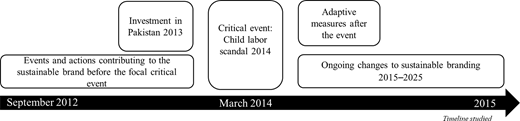
  1. Identification of activities occurring before, during and after the critical event (see Figure 1).

  2. Extraction and coding of text related to communications from the company, media and other stakeholders.

  3. Identification of main actors, network contexts and key communication elements to understand how the focal company and other network actors managed their CR and sustainable branding.

Qualitative content analysis was applied to examine communication characteristics central to branding and reputation development (Harwood and Garry, 2003). The approach was primarily abductive, whereby predefined concepts from the literature, such as CR, sustainable B2B branding, stakeholder relationships, networks, critical events and communication, were iteratively refined based on insights from the empirical case (Dubois and Gadde, 2002; Lincoln and Guba, 1985). The analysis focused on events and interactions related to sustainable B2B branding and their influence on reputational changes among involved business actors. In addition, the roles of media and NGOs were considered triggers of these events, as well as how reputational effects unfolded across the network. This setup allows NR to emerge as a concept that captures the relational and dynamic nature of CR in networked B2B contexts under sustainability pressures.

The focal company, SE, is an MNC operating in the global forest industry. The company has its headquarters in Finland and Sweden and conducts business operations worldwide.

In September 2012, SE announced plans to invest in Pakistan, presenting the move as part of its strategy to expand operations in developing markets. In May 2013, it established a joint venture with the Pakistani company Packages Ltd., forming Bulleh Shah Packaging. Prior to establishing the joint venture, SE had commissioned an external consultancy report to assess potential social risks associated with the investment. The report identified risks of child labor linked to suppliers in the joint venture’s supply chain; however, it was not made public until 2014. Despite these identified risks, the Pakistan investment proceeded in May 2013. During this period, SE publicly stated that it was endeavoring to identify social risks in its supply chain and to improve working conditions in developing markets. The company also publicized its initiatives on responsible sourcing and labor standards. Shortly before the investment was finalized, the vice president of global responsibility overseeing the investment resigned. According to media reports, the resignation was linked to disagreements over the company’s approach to the Pakistan investment. Through the joint venture and its supplier relationships, SE became connected to several subcontractors operating within the Pakistani packaging and raw materials supply chain.

The main critical event in the case occurred on 6 March 2014, when the Swedish business magazine Veckans Affärer and TV4 reported that SE had been aware of the risk of child labor in the supply chain of its Pakistani joint venture. Following the publication, the issue received significant media coverage in Sweden and Finland. The reports referred to the consultancy report that had identified the risk of child labor among suppliers linked to the joint venture. Initially, SE responded by stating that only one confirmed case of child labor had been identified in the supply network. The company also stated that addressing social challenges in developing countries could be complex. During the public discussion, a company representative argued that, without employment opportunities provided by companies operating in the region, some children might face limited income alternatives. This statement was widely reported in the media and became part of the ongoing public debate surrounding the company’s activities in Pakistan. Following the media coverage, several investors and shareholders requested clarification regarding the company’s supply-chain practices. Some institutional investors placed SE on exclusion lists and announced that they would review their relationship with the company. Public attention also turned to the company’s code of conduct, which prohibits child labor in both its operations and supply chains. Several shareholders publicly called for the company to address the situation by providing a clear and comprehensive response to the reported issues.

Following the media coverage, SE introduced several internal and external measures related to its supply chain management and reporting practices. The company implemented an updated supplier code of conduct that specified requirements concerning labor standards, including restrictions on child labor. Suppliers were required to sign a declaration confirming their compliance with these requirements. SE also introduced additional communication channels, including a “Speak Up” hotline, through which employees, suppliers and other stakeholders could report potential violations of the company’s code of conduct. In addition, the company expanded the sustainability sections of its corporate reporting, providing updates on activities related to supply-chain monitoring and labor-standard initiatives in developing markets. Furthermore, the company carried out organizational changes and terminated cooperation with several subcontractors in Pakistan. In later media interviews, the company’s CEO acknowledged that the company had been aware of the risks related to child labor in the supply chain but stated that the full circumstances had not been publicly disclosed at the time.

Some investors continued to maintain their exclusion decisions following the event. For example, the Swedish state pension fund remained among the investors that ended their association with SE after the public reports. The joint-venture partner, Bulleh Shah Packaging Ltd., continued its operations and publicly referred to their association with SE as a joint venture in its communications during 2015 and 2016. Company materials from that period described the partnership and highlighted ongoing collaboration between the two companies.

In mid-2017, SE terminated its investment in Bulleh Shah Packaging, transferring full ownership to Packages Ltd. Following its withdrawal from the joint venture, SE continued to support several community programs in Pakistan. These initiatives included financial support for educational programs targeting children who had previously been identified as working in supply chains connected to the joint venture. Bulleh Shah Packaging subsequently began publishing its own sustainability reports, starting in 2019. These reports refer to the earlier collaboration with SE in a factual manner, noting the period of cooperation and the subsequent transfer of ownership. In later sustainability communications, the company described initiatives related to environmental practices, community engagement and stakeholder interaction.

Our abductive analysis of the longitudinal data reveals that reputational dynamics unfolded through network interactions, stakeholder evaluations and subsequent organizational responses.

The SE case illustrates how sustainability-related practices and claims were interpreted and evaluated through interactions among the focal firm, its partners and external stakeholders. These dynamics indicate that CR in networked B2B contexts cannot be fully understood by examining a single organization in isolation. Instead, reputational assessments emerge and evolve through a series of interconnected events involving multiple actors across the business and stakeholder network.

Table 2 summarizes the key actions taken by different network actors before, during and after the focal critical event. These actions encompass corporate decisions, stakeholder reactions, media exposure and subsequent responses from other actors in the network.

From Table 2, it can be observed that, prior to the critical event, SE did not disclose the consultancy report identifying child labor risks in its Pakistani supply chain, while simultaneously proceeding with the Bulleh Shah joint venture. In addition, concerns raised by external actors, such as the consulting firm, were not met by visible corrective actions. During the critical event, media exposure triggered intense scrutiny, while SE’s initial responses, characterized by partial denial and delayed engagement, elicited negative reactions from investors and business partners, including a loss of trust and a readiness to reconsider current relationships. These developments show that reputational assessments were shaped not only by the focal firm’s actions but also by how the situation was interpreted and how reputational meanings evolved across the network.

Building on the interactions outlined in Section 5.1, the case shows that reputational assessments evolved through a sequence of interconnected evaluations among multiple actors. Media exposure initially directed attention to the focal firm’s actions, triggering a critical event. This was followed by reactions from investors, business partners and other stakeholders, who reassessed their relationships and expressed concerns regarding SE’s conduct. Subsequently, organizational responses and corrective actions contributed to further reevaluations across the network. This sequence indicates that reputational judgments develop through an ongoing interplay between media reporting, stakeholder reactions and organizational responses. As new information circulated, actors continuously revised their assessments and these revisions, in turn, shaped how other actors made sense of the situation. Reputational meanings were therefore formed through distributed and interdependent evaluation processes unfolding across the network.

These observations suggest that reputation in this context cannot be adequately explained at the level of the focal firm alone. Although the initial trigger was linked to SE’s actions, the subsequent evolution of reputational judgments depended on how multiple interconnected actors interpreted, communicated and responded to those actions. In this sense, reputational outcomes were jointly produced and continuously reevaluated across the network of business partners and stakeholders.

To capture this empirically observed phenomenon, we introduce the concept of NR. NR refers to a dynamic, collective perception that emerges from the interdependent actions of firms and stakeholders embedded in networks. As illustrated by the case, NR does not reside at the level of a single firm but rather reflects a relational and processual outcome shaped by ongoing interactions and interdependencies among actors.

The concept of NR differs from existing branding concepts in contemporary B2B literature. For example, co-branding refers to the transfer of brand effects, where the brand equity of one brand transfers to another collaborating brand (e.g. Kalafatis et al., 2012). Co-branding activities are often used in B2C settings to produce offerings that attract final consumers through the combined appeal of multiple brands (Simonin and Ruth, 1998). In addition, co-branding is typically carefully planned and strategically executed, involving a limited number of partners. In contrast, the case illustrates that reputational outcomes emerged without deliberate coordination across multiple interconnected actors. For instance, the reputational consequences of the critical event extended from the focal firm to its suppliers, investors and partners, despite the absence of a planned joint branding effort. NR thus reflects network-level effects resulting from both planned and unplanned actions and interactions among participating actors. These do not necessarily lead to the production of a specific joint offering but instead emerge through ongoing business collaboration and stakeholder engagement over time.

Moreover, NR differs from corporate brand identity co-creation, where business partners actively contribute to shaping brand identity meanings (Iglesias et al., 2020). While brand identity represents “who the company is” and can be co-created with partners, NR reflects how organizations are perceived by stakeholders across a network of interacting firms. As shown in the case, stakeholders such as media and investors evaluated not only the focal firm but also its connected partners, indicating that reputational assessments extended beyond identity construction to collective assessment. Whereas identity co-creation focuses on how firms jointly define and communicate who they are, NR captures how their actions and interactions are interpreted and evaluated externally across the network. Thus, while co-created identity may contribute to NR, NR itself represents a broader, collectively formed perception shaped by distributed stakeholder evaluations. Overall, a well-grounded NR emerges as an important relational asset for the focal firm, its business partners and other stakeholders.

These empirical insights demonstrate that reputational dynamics in networked B2B environments emerge through distributed interactions and collective evaluation processes. To further explain how such dynamics evolve over time, the following section develops a dynamic conceptual model of NR.

Building on the empirically grounded conceptualization of NR developed in Section 5, this section extends the concept by developing a model of its structural context, as well as its dynamic process nature.

The perspective developed here conceptualizes business markets as interconnected sets of relationships in which reputation is not confined to a single firm but embedded in a broader network setting. While B2B branding primarily unfolds between connected firms, companies are situated within a wider stakeholder environment that shapes how their actions are interpreted and evaluated. This perspective highlights the interconnected nature of CR in business networks, where reputational outcomes extend beyond a single firm to encompass both planned and unplanned interactions, as well as emerging events, among multiple business actors and broader stakeholders.

Stakeholders such as media, governmental organizations and NGOs monitor and publicly communicate firms’ sustainability-related activities (Christopher and Gaudenzi, 2009). Through various communication instruments, such as sustainability reports, corporate websites, product packaging, stakeholder dialogues, public statements and industry initiatives (Dawkins, 2005), firms articulate their sustainable branding efforts across financial, social and environmental dimensions. In addition, international organizations and regulatory frameworks (e.g. UN, EU and WTO initiatives) establish standards and reporting structures that frame how sustainability performance is assessed.

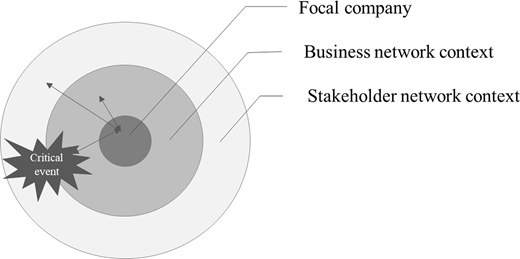
Figure 2 presents a contextual representation of the proposed network environment, illustrating the structural embedding of a focal company within two interconnected relational contexts that jointly shape NR.

The innermost circle represents the focal company (SE, in this case). The second circle depicts the business network context, consisting of directly connected firms whose relationships are characterized by interdependence, trust and mutual adaptation. Within this domain, NR becomes a shared matter through ongoing interactions between business partners. The outer circle represents a broader stakeholder network context. This includes actors who may not maintain direct exchange relationships with the focal firm but who nevertheless influence reputational evaluations through monitoring, communication and public discourse. We distinguish analytically between the business network (interdependent exchange relationships among firms) and the stakeholder network (a wider constellation of societal actors). This distinction follows Möller et al. (2020), who argue that contemporary ecological and societal challenges have extended firms’ responsibilities beyond their immediate exchange partners.

The model thus clarifies that NR is situated within overlapping relational spheres. It is shaped through interactions in the business network while simultaneously being exposed to interpretations and reactions originating in the broader stakeholder context.

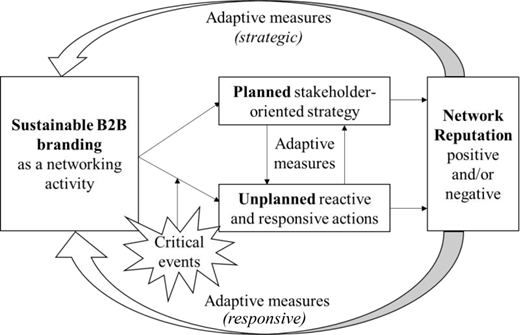
Building on the contextual positioning of NR presented in Figure 2, we now elaborate on a dynamic process model of NR (Figure 3). Whereas Figure 2 illustrates the structural embedding of firms within business and stakeholder networks, Figure 3 conceptualizes how NR evolves over time through B2B interaction and adaptations.

NR is conceptualized as a temporal outcome of sustainable B2B branding efforts, situationally unfolding across interconnected actors. It evolves through the interplay between planned, stakeholder-oriented strategies and unplanned, reactive responses to emerging critical events, as suggested by the empirical patterns identified in Section 5. These events may originate from the focal firm, a connected business partner or actors in the broader stakeholder network. Regardless of origin, their consequences are rarely confined to a single firm due to relational interdependencies within the network.

The model (Figure 3) highlights three core processual features. First, NR develops through cumulative interaction. Sustainable branding efforts, such as communication initiatives, sustainability programs and relational adaptations, shape shared reputational evaluations over time. These efforts are influenced by the positions and roles of actors within the network (Anderson et al., 1994), meaning that reputational consequences vary depending on relational proximity and interdependence between the actors. Second, NR is event-sensitive. Critical events act as triggers that may reinforce or weaken shared reputational evaluations. Because firms in B2B networks are mutually dependent, misconduct or failure by one actor can spill over to others. Conversely, coordinated responses may mitigate reputational damage or strengthen collective credibility. Thus, NR reflects joint reputational exposure. Third, NR is jointly adaptive. While no single firm fully controls the branding efforts of its network, the actions of each actor contribute to the evolving reputational outcome. Sustainable B2B branding, therefore, shifts from being a firm-centric strategic activity to becoming a shared and temporally unfolding process. Planned sustainability strategies may transform into collective, reactive adaptations when confronted with emergent and potentially disruptive events.

Figure 3 synthesizes these insights by portraying NR as a discontinuous, cumulative process shaped by strategic intent, relational interdependence and event-triggered adjustments. Hence, we contend that sustainable B2B branding may begin as a planned, stakeholder-oriented strategy but can evolve into unplanned collective responses when changes occur, highlighting the importance of shared branding responsibilities and joint reputational consequences within the broader network context.

This paper advances CB research by introducing the concept of NR and by developing a dynamic process model that conceptualizes CR as a network-embedded and temporally evolving phenomenon in sustainable B2B markets. Figure 3 captures the study’s core conceptual contribution by synthesizing insights from the literature and the empirically grounded conceptualization developed through the longitudinal case analysis into a processual model of how NR emerges, evolves and is collectively shaped.

Where traditional CR research largely adopts a single-firm perspective, our conceptualization extends this view by demonstrating that reputational evaluations in B2B markets are jointly constructed, relationally embedded and event-sensitive. The empirical case illustrates how sustainability-related critical events can activate adaptive processes among interconnected firms and stakeholders, thereby influencing shared reputational outcomes over time. Through the integration of conceptual analysis and empirically grounded insights, NR is defined as a dynamic, collective perception that emerges from the interdependent actions of firms and stakeholders embedded in networks. The dynamic model clarifies how planned branding strategies, relational interdependencies, emergent disruptions and unplanned reactive actions interact to shape reputational trajectories. Thus, we argue that sustainable B2B branding, especially in relation to increasing TBL demands, should be a key strategic marketing issue for companies. In the following subsections, we explore the theoretical and managerial implications, outline some limitations of the study and suggest avenues for future research.

This concept-generating case study set out to answer the question: How can CR in B2B networks be conceptualized to reflect the connected and interactive network environment and stakeholders’ increasing role in sustainable branding? Our findings suggest that CR in B2B markets is more adequately understood as NR: a dynamic, collective perception that emerges from the interdependent actions of firms and stakeholders embedded in networks. Unlike firm-level or dyadic perspectives, NR captures how reputation is co-developed across three interconnected levels: the focal company, the business network of interdependent partners and the wider stakeholder network. Critical events, whether triggered internally or by external actors, can swiftly reshape NR, producing outcomes that are shared across the network but vary in intensity depending on each actor’s proximity and position.

With this conceptualization, the paper contributes to the limited literature on sustainability in B2B markets (e.g. Abratt and Kleyn, 2023; Chabowski et al., 2022; Rudawska, 2019; Sharma, 2020; Vrontis et al., 2025) and to the emerging stream on sustainable B2B branding (see, e.g. Maon et al., 2021; Markovic et al., 2023; Sheth and Sinha, 2015; Vesal et al., 2021). Specifically, we extend the literature on corporate branding by showing how the dual nature of identity and reputation (Hatch and Schultz, 2003; Iglesias et al., 2020) unfolds in a networked context. While identity expresses “who we are” as a collective, NR reflects “how we are seen and evaluated” by multiple stakeholders. Communication and actions link these two sides of the coin, both of which are subject to change through network-level interactions and external influences.

In addition, the contextual model of NR change (Figure 2) provides a research framework that illustrates how sustainable B2B branding is jointly shaped and transformed. By mapping the three circles of actors, the model helps identify which parties contribute most to NR and how the network effect unfolds. Our perspective extends the “branding pool” described by Mäläskä et al. (2011) in the context of small companies, broadening it from business actors to include an extended stakeholder network that can indirectly shape or disrupt NR.

Finally, this study contributes to the literature on CR by highlighting its interconnected and processual nature in B2B contexts (Figure 3). NR is thus a collectively evolving and evaluated outcome of sustainable branding efforts, adaptive responses and stakeholder discourses. In doing so, the paper responds to recent calls for research on sustainability in B2B branding (Abratt and Kleyn, 2023; Sharma, 2020; Rudawska, 2019). It also offers a foundation for future research to further explore how NR evolves under conditions of turbulence and heightened stakeholder scrutiny.

The increasingly interconnected and interactive nature of B2B markets requires managers to adopt a dynamic approach to developing sustainable branding strategies. The findings suggest that managers need to recognize that sustainable branding is not a one-way communication effort but a continuous, relational process involving mutual influence among business partners and actors within the stakeholder network. Focal companies need to remain attentive to their partners’ sustainability practices, policies and positions, as these actions collectively shape NR outcomes, which in turn reflect on their reputation.

To encourage positive outcomes, managers should actively monitor and facilitate dialogue and coordination within their networks, ensuring that sustainability-related expectations, standards and practices are understood and mutually reinforced. Advisory boards or joint forums with representatives from suppliers, customers, distributors and relevant stakeholders may serve as platforms for ongoing interaction, feedback and alignment of sustainable practices.

Companies should also plan adaptive measures to address discrepancies or misalignments in partners’ sustainability approaches. This includes continuously monitoring network actors’ sustainability activities, establishing shared expectations and coordinating responses to prevent or mitigate negative outcomes. Importantly, sustainable branding initiatives should be understood as evolving over time, requiring managers to implement adaptive measures that enable swift responses to both positive and negative developments within the network. By approaching sustainable B2B branding as an interactive, processual activity, companies can strengthen trust, commitment and collaborative capacity among stakeholders, ultimately enhancing their NR.

This concept-generating case approach has several limitations. First, while it introduces and explores the concept of NR in the context of sustainable B2B branding, it is based on an illustrative case of a focal firm and its embedded business and stakeholder network. A single case naturally limits the generalizability of the findings and may not capture the full complexity or diversity of NR formation across different industries or network configurations. The case was selected for its exploratory potential rather than empirical representativeness. Although it offers valuable insights into how NR evolves through stakeholder interactions and adaptive responses, further multiple-case and experimental studies are needed to empirically validate the NR concept.

Second, the paper proposes a conceptual framework for understanding NR and its relevance to sustainable B2B branding, aiming to inspire further theorizing and empirical research. However, a limitation lies in the early-stage development of the framework and the need for more systematic empirical testing. While it offers a conceptual foundation for future research, a comprehensive or operationalizable model for studying NR in diverse B2B contexts is yet to be attained. The conceptual approach, however, demonstrates its practical relevance through the longitudinal case but calls for further refinement and the development of propositions to assess its broader applicability.

Third, in the data collection and analysis, direct interaction between the focal firm (SE) and key network actors could not be captured through interviews or participant observation. Instead, the study relied on a multitude of secondary sources, including public communications, media coverage and stakeholder statements as expressions of will and performance. While this approach aligns with prior research suggesting that such communications can be treated as performative and as points of interaction in themselves (Tseëlon, 1992; Ivanova-Gongne and Lång, 2020), it introduces methodological limitations. In addition, the specific actions and interactions discussed in the study are limited to those traceable through available sources. Hence, the absence of primary, in-depth data from actors may reduce the depth and nuance of insights, introducing a risk of interpreting mediated expressions without detailed contextual access to the studied process. We, therefore, suggest that further studies attempt to collect primary data from key informants and stakeholder actors with practical experience, focusing on critical incident techniques and/or multiple case studies to explore how different types of events, both positive and negative, shape NR.

Fourth, even though the presented SE case covers different actors and their actions, it adopts a focal actor-network perspective (Halinen and Törnroos, 1998). Consequently, it does not provide all-encompassing data for an in-depth understanding of all key actors and their jointly planned and unplanned sustainability activities and processes. Due to the sensitivity of the issues at stake, the illustrative example focused only on the unfolding process of NR change in response to a specific negative critical event in its business network context. Hence, more explorative and mixed-method research is called for, with consideration given to a wider spectrum of interaction processes to understand different and joint actor perspectives on sustainable B2B branding strategies.

Finally, regarding the measurement of NR, we acknowledge that quantifying this type of social and processual phenomenon remains an open and challenging task. As branding and reputation continuously evolve, systematically capturing NR is demanding. Thus, our paper is primarily conceptual and exploratory in nature, aiming to lay the groundwork for further research. We therefore call for more longitudinal qualitative research across diverse B2B contexts to build a deeper processual understanding of NR. Such foundational work is essential to inform the development of robust approaches for the future quantitative operationalization and measurement of NR.

[1]

In this paper, we distinguish “business networks” (sets of connected business relationships among firms, i.e. business-related stakeholders) from the broader “stakeholder networks” (all other stakeholders, i.e. actors outside the business network, such as investors, NGOs, or media). When we use the term “stakeholders”, we refer to anyone with an interest in a firm’s activities, including actors within both business and stakeholder networks.

[2]

Unlike firm-level corporate reputation, which is typically conceptualized as an aggregated external evaluation of a focal organization, NR foregrounds the relational and distributed nature of reputation formation in networked B2B settings, where multiple actors jointly shape reputational outcomes.

[3]

Here, temporal deals with a process of events that ends with an outcome at a certain point in time, while leading to further developments and outcomes.

[4]

Although sustainability and branding go hand in hand, the two are not interchangeable. A firm may act sustainably, yet without effective branding, these sustainability-oriented actions may remain invisible or undervalued by stakeholders. In B2B contexts, sustainable branding actively communicates and aligns sustainability practices across the network.

[5]

While our focus is on interactive and embedded branding efforts in business networks, such stakeholder-oriented practices also contribute to firm-level brand equity and competitive advantage in traditional market terms. Thus, our approach offers a complementary view to the company/market perspective on branding by showing how business relationships shape both sustainability and branding outcomes.

[6]

In this way, CR is shaped by the experiences, expectations, and discourses of diverse stakeholders, making it one side of a corporate brand coin; the other side being corporate identity (see e.g. Brown et al., 2006; Koporcic and Halinen, 2018).

[7]

Table 1 presents definitions that have been found, either explicitly or implicitly, to include a stakeholders’ perspective.
Aaker
,
D.A.
(
2012
),
Building Strong Brands
,
Simon and Schuster
.
Abratt
,
R.
and
Kleyn
,
N.
(
2023
), “
The conscientious corporate brand: definition, operationalization and application in a B2B context
”,
Journal of Business and Industrial Marketing
, Vol.
38
No.
10
, pp.
2122
-
2133
.
Alvesson
,
M.
(
1990
), “
Organization: from substance to image?
”,
Organization Studies
, Vol.
11
No.
3
, pp.
373
-
394
.
Andersen
,
P.H.
and
Sørensen
,
H.B.
(
1999
), “
Reputational information: its role in inter-organizational collaboration
”,
Corporate Reputation Review
, Vol.
2
No.
3
, pp.
215
-
230
.
Anderson
,
J.C.
,
Håkansson
,
H.
and
Johanson
,
J.
(
1994
), “
Dyadic business relationships within a business network context
”,
Journal of Marketing
, Vol.
58
No.
4
, pp.
1
-
15
.
Barnett
,
M.L.
,
Jermier
,
J.M.
and
Lafferty
,
B.A.
(
2006
), “
Corporate reputation: the definitional landscape
”,
Corporate Reputation Review
, Vol.
9
No.
1
, pp.
26
-
38
.
BBC
(
2023a
), “
Finland media guide
”,
available at:
Link to Finland media guideLink to the cited article (
accessed
20 February 2026).
BBC
(
2023b
), “
Sweden media guide
”,
available at:
Link to Sweden media guideLink to the cited article (
accessed
20 February 2026).
Boivie
,
S.
,
Graffin
,
S.D.
and
Gentry
,
R.J.
(
2016
), “
Understanding the direction, magnitude, and joint effects of reputation when multiple actors’ reputations collide
”,
Academy of Management Journal
, Vol.
59
No.
1
, pp.
188
-
206
.
Brown
,
T.J.
,
Dacin
,
P.A.
,
Pratt
,
M.G.
and
Whetten
,
D.A.
(
2006
), “
Identity, intended image, construed image, and reputation: an interdisciplinary framework and suggested terminology
”,
Journal of the Academy of Marketing Science
, Vol.
34
No.
2
, pp.
99
-
106
.
Cable
,
D.M.
and
Graham
,
M.E.
(
2000
), “
The determinants of job seekers’ reputation perceptions
”,
Journal of Organizational Behavior
, Vol.
21
No.
8
, pp.
929
-
947
.
Carter
,
S.M.
(
2006
), “
The interaction of top management group, stakeholder, and situational factors on certain corporate reputation management activities
”,
Journal of Management Studies
, Vol.
43
No.
5
, pp.
1145
-
1176
.
Chabowski
,
B.R.
,
Gabrielsson
,
P.
and
Mena
,
J.A.
(
2022
), “
Using bibliometric research to advance the business-to-business sustainability literature: establishing an integrative conceptual framework for future application
”,
Industrial Marketing Management
, Vol.
102
, pp.
527
-
545
.
Chun
,
R.
(
2005
), “
Corporate reputation: meaning and measurement
”,
International Journal of Management Reviews
, Vol.
7
No.
2
, pp.
91
-
109
.
Christopher
,
M.
and
Gaudenzi
,
B.
(
2009
), “
Exploiting knowledge across networks through reputation management
”,
Industrial Marketing Management
, Vol.
38
No.
2
, pp.
191
-
197
.
Cowton
,
C.J.
(
1998
), “
The use of secondary data in business ethics research
”,
Journal of Business Ethics
, Vol.
17
No.
4
, pp.
423
-
434
.
Daniel
,
C.O.
(
2019
), “
Assessing the role of green marketing in small and medium enterprises
”,
International Journal of Scientific and Research Publications (IJSRP)
, Vol.
9
No.
1
, pp.
85
-
85
.
Dawkins
,
J.
(
2005
), “
Corporate responsibility: the communication challenge
”,
Journal of Communication Management
, Vol.
9
No.
2
, pp.
108
-
119
.
Deephouse
,
D.L.
(
2000
), “
Media reputation as a strategic resource: an integration of mass communication and resource-based theories
”,
Journal of Management
, Vol.
26
No.
6
, pp.
1091
-
1112
.
Diamond
,
D.W.
(
1989
), “
Reputation acquisition in debt markets
”,
Journal of Political Economy
, Vol.
97
No.
4
, pp.
828
-
862
.
Dubois
,
A.
and
Gadde
,
L.-E.
(
2002
), “
Systematic combining: an abductive approach to case research
”,
Journal of Business Research
, Vol.
55
No.
7
, pp.
553
-
560
.
Elkington
,
J.
(
2013
), “Enter the triple bottom line”, in
The Triple Bottom Line
,
Routledge
, pp.
23
-
38
.
Feng
,
W.
,
Yang
,
M.X.
and
Irina
,
Y.Y.
(
2023
), “
From devil to angel: how being envied for luxury brand social media word of mouth discourages counterfeit purchases
”,
Journal of Business Research
, Vol.
165
, p.
113919
.
Ferguson
,
J.
,
Brown
,
B.
and
Boyd
,
D.E.
(
2020
), “
A conceptualization of corporate social (ir)responsibility and moral intensity in the supply chain
”,
Journal of Business and Industrial Marketing
, Vol.
35
No.
3
, pp.
602
-
611
.
Ferguson
,
T.D.
,
Deephouse
,
D.L.
and
Ferguson
,
W.L.
(
2000
), “
Do strategic groups differ in reputation?
”,
Strategic Management Journal
, Vol.
21
No.
12
, pp.
1195
-
1214
.
Fombrun
,
C.J.
(
2005
), “
A world of reputation research, analysis and thinking – building corporate reputation through CSR initiatives: evolving standards
”,
Corporate Reputation Review
, Vol.
8
No.
1
, pp.
7
-
12
.
Fombrun
,
C.
(
1996
),
Reputation: Realizing Value from the Corporate Image
,
Harvard Business School Press
,
Cambridge, MA
.
Fombrun
,
C.J.
and
van Riel
,
C.
(
1997
), “
The reputational landscape
”,
Corporate Reputation Review
, Vol.
1
No.
1
, pp.
5
-
13
.
Forbes
(
2021
), “
A guide to getting started with sustainability branding
”,
available at:
Link to A guide to getting started with sustainability brandingLink to the cited article (
accessed
20 December 2023)
Foster
,
A.
(
2016
), “
Watchdog slams Tesco for mistreating suppliers
”,
available at:
Link to Watchdog slams Tesco for mistreating suppliersLink to the cited article (
accessed
24 December 2023).
Halinen
,
A.
,
Medlin
,
C.J.
and
Törnroos
,
J.-Å.
(
2012
), “
Time and process in business network research
”,
Industrial Marketing Management
, Vol.
41
No.
2
, pp.
215
-
223
.
Halinen
,
A.
and
Törnroos
,
J.Å.
(
1998
), “
The role of embeddedness in the evolution of business networks
”,
Scandinavian Journal of Management
, Vol.
14
No.
3
, pp.
187
-
205
.
Han
,
P.
,
Wang
,
H.
and
Fan
,
P.
(
2022
), “
Green strategies and relationship maintenance: a network evolution perspective
”,
Journal of Business and Industrial Marketing
, Vol.
37
No.
7
, pp.
1422
-
1431
.
Harwood
,
T.G.
and
Garry
,
T.
(
2003
), “
An overview of content analysis
”,
The Marketing Review
, Vol.
3
No.
4
, pp.
479
-
498
.
Hatch
,
J.M.
and
Schultz
,
M.
(
2003
), “
Bringing the corporation into corporate branding
”,
European Journal of Marketing
, Vol.
37
Nos
7-8
, pp.
1041
-
1064
.
Hedaa
,
L.
and
Törnroos
,
J.-Å.
(
2008
), “
Understanding event-based business networks
”,
Time and Society
, Vol.
17
Nos
2-3
, pp.
319
-
348
.
Huq
,
F.A.
,
Stevenson
,
M.
and
Zorzini
,
M.
(
2014
), “
Social sustainability in developing country suppliers: an exploratory study in the readymade garments industry of Bangladesh
”,
International Journal of Operations and Production Management
, Vol.
34
No.
5
, pp.
610
-
638
.
Iglesias
,
O.
,
Landgraf
,
P.
,
Ind
,
N.
,
Markovic
,
S.
and
Koporcic
,
N.
(
2020
), “
Corporate brand identity co-creation in business-to-business contexts
”,
Industrial Marketing Management
, Vol.
85
, pp.
32
-
43
.
Ivanova-Gongne
,
M.
and
Lång
,
S.
(
2020
), “
The drama of corporate social responsibility communication
”,
Critical Perspectives on International Business
, Vol.
16
No.
3
, pp.
233
-
258
.
Ivanova-Gongne
,
M.
,
Galkina
,
T.
,
Uzhegova
,
M.
and
Torkkeli
,
L.
(
2022
), “
Sense making of environmental commitment: a socio-historical contextualization of post-Soviet managers’ views
”,
Scandinavian Journal of Management
, Vol.
38
No.
4
, p.
101233
.
Stuart
,
H.
(
2011
), “
An identity‐based approach to the sustainable corporate brand
”,
Corporate Communications: An International Journal
, Vol.
16
No.
2
, pp.
139
-
149
.
Kalafatis
,
S.P.
,
Remizova
,
N.
,
Riley
,
D.
and
Singh
,
J.
(
2012
), “
The differential impact of brand equity on B2B co‐branding
”,
Journal of Business and Industrial Marketing
, Vol.
27
No.
8
, pp.
623
-
634
.
Kapitan
,
S.
,
Kennedy
,
A.-M.
and
Berth
,
N.
(
2019
), “
Sustainably superior versus greenwasher: a scale measure of B2B sustainability positioning
”,
Industrial Marketing Management
, Vol.
76
, pp.
84
-
97
.
Klein
,
B.
and
Leffler
,
K.B.
(
1981
), “
The role of market forces in assuring contractual performance
”,
Journal of Political Economy
, Vol.
89
No.
4
, pp.
615
-
641
.
Koporcic
,
N.
and
Halinen
,
A.
(
2018
), “
Interactive network branding: creating corporate identity and reputation through interpersonal interaction
”,
IMP Journal
, Vol.
12
No.
2
, pp.
392
-
408
.
Koporcic
,
N.
and
Törnroos
,
J.-Å.
(
2019
), “
Conceptualizing interactive network branding in business markets
”,
Journal of Business and Industrial Marketing
, Vol.
34
No.
8
, pp.
1681
-
1691
.
Koporcic
,
N.
and
Törnroos
,
J.-Å.
(
2021
), “Interactive network branding: towards a sustainability-driven strategy of small and medium-sized enterprises”, in
Markovic
,
S.
,
Sancha
,
C.
and
Lindgreen
,
A.
(Eds),
Handbook of Sustainability-Driven Business Strategies in Practice
,
Edward Elgar
, pp.
108
-
120
.
Koporcic
,
N.
,
Tolusic
,
Z.
and
Resetar
,
Z.
(
2017
), “
The importance of corporate brands for decision making in the business-to-business context
”,
Econviews – Review of Contemporary Business, Entrepreneurship and Economic Issues
, Vol.
30
No.
2
, pp.
429
-
441
.
Kumar
,
V.
and
Christodoulopoulou
,
A.
(
2014
), “
Sustainability and branding: an integrated perspective
”,
Industrial Marketing Management
, Vol.
43
No.
1
, pp.
6
-
15
.
Lång
,
S.
and
Ivanova-Gongne
,
M.
(
2019
), “
CSR communication in stakeholder networks: a semiotic perspective
”,
Baltic Journal of Management
, Vol.
14
No.
3
, pp.
480
-
499
.
Lincoln
,
Y.S.
and
Guba
,
E.G.
(
1985
),
Naturalistic Inquiry
,
Sage
,
Newbury Park, CA
.
Lindgreen
,
A.
,
Uy
,
X.
,
Maon
,
F.
and
Wilcock
,
J.
(
2012
), “
Corporate social responsibility brand leadership: a multiple case study
”,
European Journal of Marketing
, Vol.
46
Nos
7-8
, pp.
965
-
993
.
Loureiro
,
S.M.C.
,
Friedmann
,
E.
,
Breazeale
,
M.
and
Middendorf
,
I.
(
2023
), “
How can brands encourage consumers to donate data to a data-driven social partnership? An examination of hedonic vs. functional categories
”,
Journal of Business Research
, Vol.
164
, p.
113958
.
Mandler
,
T.
,
Bartsch
,
F.
and
Zeugner-Roth
,
K.P.
(
2023
), “
Are brands re-evaluated when consumers learn about brand origin misperceptions? Outcomes, processes, and contingent effects
”,
Journal of Business Research
, Vol.
164
, p.
113941
.
Maon
,
F.
,
Swaen
,
V.
and
De Roeck
,
K.
(
2021
), “
Corporate branding and corporate social responsibility: toward a multi-stakeholder interpretive perspective
”,
Journal of Business Research
, Vol.
126
, pp.
64
-
77
.
Markovic
,
S.
,
Koporcic
,
N.
,
Samara
,
G.
and
Barkemeyer
,
R.
(
2023
), “
Sustainability and interactive network branding in fast-changing business environments
”,
Business Ethics, the Environment and Responsibility
, Vol.
32
No.
3
, pp.
877
-
881
.
Mäläskä
,
M.
,
Saraniemi
,
S.
and
Tähtinen
,
J.
(
2011
), “
Network actors’ participation in B2B SME branding
”,
Industrial Marketing Management
, Vol.
40
No.
7
, pp.
1144
-
1152
.
Möller
,
K.
,
Nenonen
,
S.
and
Storbacka
,
K.
(
2020
), “
Networks, ecosystems, fields, market systems? Making sense of the business environment
”,
Industrial Marketing Management
, Vol.
90
, pp.
380
-
399
.
Mustonen
,
N.
,
Karjaluoto
,
H.
and
Jayawardhena
,
C.
(
2016
), “
Customer environmental values and their contribution to loyalty in industrial markets
”,
Business Strategy and the Environment
, Vol.
25
No.
7
, pp.
512
-
528
.
Nyilasy
,
G.
,
Gangadharbatla
,
H.
and
Paladino
,
A.
(
2014
), “
Perceived greenwashing: the interactive effects of green advertising and corporate environmental performance on consumer reactions
”,
Journal of Business Ethics
, Vol.
125
No.
4
, pp.
693
-
707
.
Perrini
,
F.
(
2006
), “
SMEs and CSR theory: evidence and implications from an Italian perspective
”,
Journal of Business Ethics
, Vol.
67
No.
3
, pp.
305
-
316
.
Pettigrew
,
A.
(
1997
), “
What is processual analysis?
”,
Scandinavian Journal of Management
, Vol.
13
No.
4
, pp.
337
-
348
.
Pfarrer
,
M.D.
,
Pollock
,
T.G.
and
Rindova
,
V.P.
(
2010
), “
A tale of two assets: the effects of firm reputation and celebrity on earnings surprises and investors’ reactions
”,
Academy of Management Journal
, Vol.
53
No.
5
, pp.
1131
-
1152
.
Post
,
J.E.
and
Griffin
,
J.J.
(
1997
), “
Part vii: managing reputation: pursuing everyday excellence: corporate reputation and external affairs management
”,
Corporate Reputation Review
, Vol.
1
No.
2
, pp.
165
-
171
.
Rindova
,
V.P.
,
Williamson
,
I.O.
,
Petkova
,
A.P.
and
Sever
,
J.M.
(
2005
), “
Being good or being known: an empirical examination of the dimensions, antecedents, and consequences of organizational reputation
”,
Academy of Management Journal
, Vol.
48
No.
6
, pp.
1033
-
1049
.
Roberts
,
P.W.
and
Dowling
,
G.R.
(
2002
), “
Corporate reputation and sustained superior financial performance
”,
Strategic Management Journal
, Vol.
23
No.
12
, pp.
1077
-
1093
.
Rudawska
,
E.
(
2019
), “
Sustainable marketing strategy in food and drink industry: a comparative analysis of B2B and B2C SMEs operating in Europe
”,
Journal of Business and Industrial Marketing
, Vol.
34
No.
4
, pp.
875
-
890
.
Salam
,
M.A.
and
Jahed
,
M.A.
(
2023
), “
CSR orientation for competitive advantage in business-to-business markets of emerging economies: the mediating role of trust and corporate reputation
”,
Journal of Business and Industrial Marketing
, Vol.
38
No.
11
, pp.
2277
-
2293
.
Schultz
,
F.
,
Castelló
,
I.
and
Morsing
,
M.
(
2013
), “
The construction of corporate social responsibility in network societies: a communication view
”,
Journal of Business Ethics
, Vol.
115
No.
4
, pp.
681
-
692
.
Seyedghorban
,
Z.
,
Matanda
,
M.J.
and
LaPlaca
,
P.
(
2016
), “
Advancing theory and knowledge in the business-to-business branding literature
”,
Journal of Business Research
, Vol.
69
No.
8
, pp.
2664
-
2677
.
Sharma
,
A.
(
2020
), “
Sustainability research in business-to-business markets: an agenda for inquiry
”,
Industrial Marketing Management
, Vol.
88
, pp.
323
-
329
.
Sheth
,
J.N.
and
Sinha
,
M.
(
2015
), “
B2B branding in emerging markets: a sustainability perspective
”,
Industrial Marketing Management
, Vol.
51
, pp.
79
-
88
.
Simonin
,
B.L.
and
Ruth
,
J.A.
(
1998
), “
Is a company known by the company it keeps? Assessing the spillover effects of brand alliances on consumer brand attitudes
”,
Journal of Marketing Research
, Vol.
35
No.
1
, pp.
30
-
42
.
Spence
,
A.M.
(
1974
),
Market Signalling: Informational Transfer in Hiring and Related Screening Procedures
,
Harvard University Press
,
Cambridge, MA
.
Tseëlon
,
E.
(
1992
), “
Is the presented self sincere? Goffman, impression management and the postmodern self
”,
Theory, Culture and Society
, Vol.
9
No.
2
, pp.
115
-
128
.
Tura
,
N.
,
Keränen
,
J.
and
Patala
,
S.
(
2019
), “
The darker side of sustainability: tensions from sustainable business practices in business networks
”,
Industrial Marketing Management
, Vol.
77
, pp.
221
-
231
.
Touratier‐Muller
,
N.
,
Koporcic
,
N.
,
Markovic
,
S.
and
Damnjanović
,
V.
(
2025
), “
Drivers and barriers to the adoption of circular business models in small‐ and medium‐sized enterprises: a comparison study between developed and developing economies
”,
Business Strategy and the Environment
, Vol.
34
No.
8
, pp.
10349
-
10372
.
Van de Ven
,
A.H.
(
1992
), “
Suggestions for studying strategy process: a research note
”,
Strategic Management Journal
, Vol.
13
No.
S1
, pp.
169
-
188
.
Van Riel
,
C.B.
and
Fombrun
,
C.J.
(
2007
),
Essentials of Corporate Communication: Implementing Practices for Effective Reputation Management
,
Routledge
,
New York, New York
.
Veh
,
A.
,
Göbel
,
M.
and
Vogel
,
R.
(
2019
), “
Corporate reputation in management research: a review of the literature and assessment of the concept
”,
Business Research
, Vol.
12
No.
2
, pp.
315
-
353
.
Vesal
,
M.
,
Siahtiri
,
V.
and
O’Cass
,
A.
(
2021
), “
Strengthening B2B brands by signaling environmental sustainability and managing customer relationships
”,
Industrial Marketing Management
, Vol.
92
, pp.
321
-
331
.
Vrontis
,
D.
,
Shams
,
R.
,
Kotabe
,
M.
and
Kumar
,
V.
(
2025
), “
B2B marketing for people, planet and profit: theoretical advancement and empirical insights
”,
Industrial Marketing Management
, Vol.
130
, pp.
A1
-
A9
.
Wagner
,
T.
,
Bicen
,
P.
and
Hall
,
Z.R.
(
2008
), “
The dark side of retailing: towards a scale of corporate social irresponsibility
”,
International Journal of Retail and Distribution Management
, Vol.
36
No.
2
, pp.
124
-
142
.
Whetten
,
D.A.
and
Mackey
,
A.
(
2002
), “
A social actor conception of organizational identity and its implications for the study of organizational reputation
”,
Business and Society
, Vol.
41
No.
4
, pp.
393
-
414
.
Yin
,
R.K.
(
2009
),
Case Study Research. Design and Methods
, (4th ed.) ,
Sage Publications
,
Thousand Oaks
, California.
Törnroos
,
J.-Å.
,
Lång
,
S.
,
Ivanova-Gongne
,
M.
and
Koporcic
,
N.
(
2021
), “Stora Enso – corporate reputation in an emerging market”, in
Cavusgil
,
S.T.
,
Ghauri
,
P.N.
and
Liu
,
L.A.
(Eds),
Doing Business in Emerging Markets
, (3rd ed.) ,
SAGE
.
Published by Emerald Publishing Limited. This article is published under the Creative Commons Attribution (CC BY 4.0) licence. Anyone may reproduce, distribute, translate and create derivative works of this article (for both commercial and non-commercial purposes), subject to full attribution to the original publication and authors. The full terms of this licence may be seen at Link to the terms of the CC BY 4.0 licenceLink to the terms of the CC BY 4.0 license.

Data & Figures

Figure 1
A timeline presents sustainable branding events from 2012 to 2025, centred on a child labour scandal in 2014.The timeline begins at September 2012 and continues through 2015 toward 2025. A section before March 2014 is labelled Events and actions contributing to the sustainable brand before the focal critical event. A box above states Investment in Pakistan 2013. A central box states Critical event: Child labour scandal 2014. A box after the event states Adaptive measures after the event. Another section states Ongoing changes to sustainable branding 2015 minus 2025. The bottom right corner reads Timeline studied.

Main developments analyzed in relation to the critical event

Figure 1
A timeline presents sustainable branding events from 2012 to 2025, centred on a child labour scandal in 2014.The timeline begins at September 2012 and continues through 2015 toward 2025. A section before March 2014 is labelled Events and actions contributing to the sustainable brand before the focal critical event. A box above states Investment in Pakistan 2013. A central box states Critical event: Child labour scandal 2014. A box after the event states Adaptive measures after the event. Another section states Ongoing changes to sustainable branding 2015 minus 2025. The bottom right corner reads Timeline studied.

Main developments analyzed in relation to the critical event

Close modal
Figure 2
A concentric circle diagram presents a focal company within business and stakeholder network contexts affected by a critical event.The diagram contains three concentric circles. The smallest central circle is labelled Focal company. The middle circle is labelled Business network context. The outer circle is labelled Stakeholder network context. A starburst shape labelled Critical event appears at the lower left edge of the circles. Arrows extend from the critical event toward the central area and outward through the larger circles.

A contextual model of network reputation

Figure 2
A concentric circle diagram presents a focal company within business and stakeholder network contexts affected by a critical event.The diagram contains three concentric circles. The smallest central circle is labelled Focal company. The middle circle is labelled Business network context. The outer circle is labelled Stakeholder network context. A starburst shape labelled Critical event appears at the lower left edge of the circles. Arrows extend from the critical event toward the central area and outward through the larger circles.

A contextual model of network reputation

Close modal
Figure 3
A framework links sustainable B 2 B branding, planned and unplanned actions, critical events, adaptive measures, and network reputation.The framework begins with Sustainable B 2 B branding as a networking activity on the left. Arrows connect this box to Planned stakeholder-oriented strategy and Unplanned reactive and responsive actions in the centre. A starburst labelled Critical events appears below the centre. Planned stakeholder-oriented strategy and Unplanned reactive and responsive actions connect to each other through arrows labelled Adaptive measures. Both central boxes connect to Network Reputation, positive and slash or negative, on the right. Large curved arrows labelled Adaptive measures, strategic, and Adaptive measures, responsive, loop around the framework from Network Reputation back towards Sustainable B 2 B branding.

A dynamic process model of network reputation change

Figure 3
A framework links sustainable B 2 B branding, planned and unplanned actions, critical events, adaptive measures, and network reputation.The framework begins with Sustainable B 2 B branding as a networking activity on the left. Arrows connect this box to Planned stakeholder-oriented strategy and Unplanned reactive and responsive actions in the centre. A starburst labelled Critical events appears below the centre. Planned stakeholder-oriented strategy and Unplanned reactive and responsive actions connect to each other through arrows labelled Adaptive measures. Both central boxes connect to Network Reputation, positive and slash or negative, on the right. Large curved arrows labelled Adaptive measures, strategic, and Adaptive measures, responsive, loop around the framework from Network Reputation back towards Sustainable B 2 B branding.

A dynamic process model of network reputation change

Close modal
Table 1

Comparative overview of corporate reputation definitions in the literature

Author(s) and yearDefinitions
Spence (1974) “Corporate reputation is the outcome of a competitive process in which firms signal their key characteristics to constituents to maximize their social status”
Alvesson (1990) “Reputation refers to a holistic and vivid impression held by a particular group towards a corporation, partly as a result of information processing (sense-making) carried out by the group’s members and partly by the aggregated communication of the corporation in question concerning its nature, i.e. the fabricated and projected picture of itself”
Fombrun (1996) “A corporate reputation is a perceptual representation of a company’s past actions and future prospects that describes the firm’s overall appeal to all of its key constituents when compared with other leading rivals”
Fombrun and van Riel (1997) “A collective representation of a firm’s past actions and results that describes the firm’s ability to deliver valued outcomes to multiple stakeholders. It gauges a firm’s relative standing both internally with employees and externally with its stakeholders, in both its competitive and institutional environments”
Post and Griffin (1997) “Corporate reputation is a synthesis of the opinions, perceptions and attitudes of an organization’s stakeholders, employees, customers, suppliers, investors, community members, activists, media and other stakeholders”
Andersen and Sørensen (1999) “A reputation can be defined as a bundle of attributes and the interrelationships among them, shared among a group of individuals in a socio-cognitive community”
Cable and Graham (2000) “A public’s affective evaluation of a firm’s name relative to other firms”
Deephouse (2000) “The evaluation of a firm by its stakeholders in terms of their effect, esteem and knowledge”
Ferguson et al. (2000) “In essence, reputation reflects what stakeholders think and feel about a firm”
Whetten and Mackey (2002) “Reputation is a particular type of feedback, received by an organization from its stakeholders”
Rindova et al. (2005) “Stakeholders’ perceptions about an organization’s ability to create value relative to competitors”
Barnett et al. (2006) “Observer’s collective judgments of a corporation based on assessments of the financial, social and environmental impacts attributed to the corporation over time”
Carter (2006) “A set of key characteristics attributed to a firm by various stakeholders”
Van Riel and Fombrun (2007) “Reputations are overall assessments of organizations by their stakeholders. They are aggregate perceptions by stakeholders of an organization’s ability to fulfill their expectations, whether these stakeholders are interested in buying the company’s products, working for the company or investing in the company’s shares”
Boivie et al. (2016) “We define reputation as a collective social judgment regarding the quality or capabilities of a focal actor within a specific domain…”
Veh et al. (2019) “We recommend focusing on corporate reputation as an attitudinal concept and thereby emphasizing the stakeholder who acts as an evaluator of the corporation”
Table 2

Network actors and actions shaping reputational meanings

ActorAction
Before the focal critical event
Corporate knights
  • Inclusion of SE in the Global 100 list during 2009 and 2011

SE
  • Illegal activities and environmental violations in China and Brazil

  • Announcement of investments in Pakistan

  • Not disclosing the consultancy report that highlighted child labor

  • Resignation of the vice president of global responsibility due to divergent views on sustainable branding efforts

Bulleh Shah (and SE)
  • Formation of a joint venture with SE

SEBCON
  • Consultancy report highlighting the use of child labor in the Bulleh Shah supply chain

Suppliers of Bulleh Shah
  • Use of child labor

During the focal critical event
Veckans affärer and TV in Sweden
  • Public announcement that SE knew about the risk that child labor was a part of its business network in Pakistan

SE
  • Denial of accusations, for the most part (admits only one case of child labor)

  • Inappropriate response by the PR manager

Investors of SE
  • Questioning the continuation of relationships with SE

  • Decrease in trust and commitment

  • Placing SE on an investor blacklist

SE business and stakeholder network actors
  • Demanding clear decisions and action plans to correct the situation and recover NR

  • Questioning the company’s code of conduct

  • Questioning the possibility of the business relationship continuing with SE

  • Decrease in trust from investors and business partners

  • Deeming it impossible to accept child labor

After the focal critical event
SE
  • Implementing internal changes, e.g. new code of conduct, supplier’s declaration, dialogical communication tools, more intensive CSR reporting and reorganization of the company

  • Engaging in several communication and interaction events with its stakeholder network

  • Admission of knowing about the use of child labor in its supply chain

  • Stopped its investment in Bulleh Shah altogether

  • Pakistani local community support, despite withdrawing its investment

Bulleh Shah
  • In 2015 / 2016, Bulleh Shah continued to brand itself as a joint venture with Stora Enso

  • Until late summer 2017, Stora Enso continued to be mentioned on the website.

  • From 2018 onwards, cooperation with Stora Enso is mentioned in the company’s historical description

  • Began publishing sustainability reports in late 2019

  • As of 2025, the sustainability webpages focus on information regarding both social and environmental sustainability

SE suppliers
  • Must sign a supplier’s declaration, confirming that they consent to the SE code of conduct and will act accordingly

SE business network actors
  • Can report any misconduct or violations of SE’s code of conduct in the SE “speak up” hotline

Media
  • The supportive reaction to the company’s actions highlights the difficulty in controlling child labor issues in developing countries

Investors of SE
  • SE remains on investor blacklists and some have terminated their relationship with the company

Table A1

Stora Enso’s documents analyzed

YearNo.Document nameTarget audienceTypeLink to the document
20121Earnings Conference Call (Q3 2012)InvestorsEdited transcriptNot available as of September 2025
2Earnings Conference Call (Full Year 2012)InvestorsEdited transcriptNot available as of September 2025
3Annual Financial Statement Releases 2012InvestorsStock exchange releaseLink to storaenso.comLink to the cited article.
4Interim Review Q3InvestorsInterim reviewLink to storaenso.comLink to the cited article.
5Report of the Board of Directors 2012InvestorsFinancial reportLink to storaenso.comLink to the cited article.
6Facts and Figures 2012GeneralReportLink to storaenso.comLink to a PDF the cited article.
7Stora Enso expands business in PakistanInvestorsStock exchange releaseLink to storaenso.comLink to the cited article.
8Global Responsibility Report 2012GeneralReportLink to storaenso.comLink to a PDF the cited article.
9Report on the situation in Pakistan (inc. child labor) commissioned by Stora Enso and prepared by SEBCONInternalReportLink to storaenso.comLink to a PDF the cited article. (Not available as of September 2025)
201310Annual Financial Statement Releases 2013InvestorsStock exchange releaseLink to storaenso.comLink to a PDF the cited article.
11Investor information requestInvestorsExternal report (CDP)Not available as of September 2025
12Interim Review January–March 2013InvestorsStock exchange releaseLink to storaenso.comLink to the cited article.
13Stora Enso’s annual general meetingStakeholdersPPTLink to storaenso.comLink to the cited article.
14Earnings Conference Call (Q1 2013)InvestorsEdited transcriptLink to storaenso.comLink to the cited article.
15Earnings Conference Call (Q4 2013)InvestorsEdited transcriptLink to storaenso.comLink to the cited article.
16Report of the Board of Directors 2013InvestorsFinancial reportLink to storaenso.comLink to the cited article.
17Facts and Figures 2013GeneralReportLink to storaenso.comLink to the cited article. and Figures 2013]
18Global Responsibility Report 2013GeneralReportLink to storaenso.comLink to the cited article.
19Stora Enso Rethink Volume 4 2013CustomersCustomer magazineLink to storaenso.comLink to the cited article.
201420Statements in the mediaPublic; generalMedia articles
21Progress book 2014GeneralReportLink to storaenso.comLink to the cited article.
22Interim Review Q2InvestorsReportLink to storaenso.comLink to the cited article.
23Interim Review Q3InvestorsReportLink to storaenso.comLink to the cited article.
24Stora Enso Fourth Quarter and Full Year Results 2014InvestorsReportLink to storaenso.comLink to the cited article.
25Financial report 2014InvestorsReportLink to storaenso.comLink to the cited article.
26Annual general meeting presentationStakeholdersPPTLink to storaenso.comLink to the cited article.
27Financial results Q2InvestorsPPTLink to storaenso.comLink to the cited article.
28Global Responsibility Performance 2014GeneralPart of the annual reportLink to storaenso.comLink to the cited article.
29Stora Enso’s Global Responsibility update Q3StakeholdersBulletinLink to storaenso.comLink to the cited article.
30Mitigating child labor in Pakistan – fact sheetStakeholdersBulletinNot available as of September 2025
31Earnings Conference Call (Q2)InvestorsEdited transcriptLink to storaenso.comLink to the cited article.
32Bulletin for stakeholders – PakistanStakeholdersBulletinNot available as of September 2025
33Letter from the CEO – PakistanStakeholdersBulletinNot available as of September 2025
34Global responsibility in Q4/2014StakeholdersBulletinLink to storaenso.comLink to the cited article.
201535Stora Enso’s Human Rights Assessments 2014InvestorsPPTLink to storaenso.comLink to a PDF the cited article.
36Interim Review Q1InvestorsReportLink to storaenso.comLink to the cited article.
37Interim Review Q2InvestorsReportLink to storaenso.comLink to the cited article.
38Interim Review Q3InvestorsReportLink to storaenso.comLink to the cited article.
39Stora enso’s human rights assessments reportGeneralReportLink to storaenso.comLink to the cited article.
40Combating child labor in PakistanGeneralWebsite articleNot available as of September 2025
41Financial report 2015InvestorsReportLink to storaenso.comLink to the cited article.
42Investing in children’s rightsGeneralWebsite articleLink to storaenso.comLink to the cited article.
43Responsible sourcing in PakistanGeneralWebsite articleLink to storaenso.comLink to the cited article.
44Stora enso ESG investor presentationInvestorsPPTNot available as of September 2025
45Global Responsibility in the 1st quarter of 2015StakeholdersBulletinLink to storaenso.comLink to the cited article.
46Global Responsibility in the 2nd quarter of 2015StakeholdersBulletinLink to storaenso.comLink to the cited article.
47Stora Enso Q4 and Full year resultsInvestorsReportLink to storaenso.comLink to the cited article.
48Sustainability report 2015GeneralReportLink to storaenso.comLink to the cited article.
49Progress book 2015GeneralReportLink to storaenso.comLink to a PDF of the cited article.
201750Stora Enso to divest its holding in Bulleh Shah packaging in PakistanGeneralWebsite articleLink to storaenso.comLink to the cited article.
202151Stora Enso supplier code of conductGeneralReportLink to storaenso.comLink to the cited article.
202252Stora Enso code and speak up hotlineGeneralWebsite articleLink to storaenso.comLink to the cited article.
53Engaging with vulnerable groupsGeneralWebsite articleLink to storaenso.comLink to the cited article.
Accessed in 202554Stora Enso: SustainabilityGeneralWebsiteLink to storaenso.comLink to the cited article.
Table A2

List of news analyzed concerning the events

JournalArticle nameDateLink to the document
KauppalehtiStora Enso laajentaa Pakistaniin18.09.2012Link to kauppalehti.fiLink to the cited article.
Ruotsin tv: Stora Enson alihankkijalla lapsityövoimaa06.03.2014Link to kauppalehti.fiLink to the cited article.
Karvinen lapsityövoimasta: “Mahdotonta hyväksyä"12.03.2014Link to kauppalehti.fiLink to the cited article.
Kauppalehti seuraa Stora Enson yhtiökokousta23.04.2014Link to kauppalehti.fiLink to the cited article.
FT: Lapsityövoima vei Stora Enson mustalle listalle08.02.2015Link to kauppalehti.fiLink to the cited article.
Lapsityövoiman käyttöä vaikea valvoa18.02.2015Link to kauppalehti.fiLink to the cited article.
YleStora Enso Accused of Illegalities in Brazil08.10.2010Link to yle.fiLink to the cited article.
Stora Enso mukaan pakkaustuotetehtaaseen Pakistaniin18.09.2012Link to yle.fiLink to the cited article.
Yritysvastuuntuntija: Globalisaatio on lisännyt korruptiota28.01.2013Link to yle.fiLink to the cited article.
Stora Enso myöntää riskit lapsityövoiman käytöstä Pakistanissa03.09.2013Link to yle.fiLink to the cited article.
Ruotsalaisväite: Stora Enson alihankkija käyttää Pakistanissa lapsityövoimaa06.03.2014Link to yle.fiLink to the cited article.
Stora Enson maajohtaja lapsityöväitteistä: Riskit ovat korkeat06.03.2014Link to yle.fiLink to the cited article.
Stora Enson toimitusjohtaja: Meidän olisi pitänyt kertoa lapsityövoimasta alihankintaketjussa10.03.2014Link to yle.fiLink to the cited article.
Ruotsalaiskanava: Stora Enso tiesi lapsityövoiman käytöstä10.03.2014Link to yle.fiLink to the cited article.
Haavisto kuuli Stora Enson lapsityövoimatilanteesta viikko sitten11.03.2014Link to yle.fiLink to the cited article.
Pakistan-kohu sai Stora Enson reagoimaan – hämäystä vai organisointia?21.03.2014Link to yle.fiLink to the cited article.
Stora Enson toimitusjohtaja Karvinen eroaa – “arvostettu, vaikka virheitä ollut"23.04.2014Link to yle.fiLink to the cited article.
Eroava Karvinen: Kritiikkiä tullut joka vuosi23.04.2014Link to yle.fiLink to the cited article.
Valtio ja Wallenberg-säätiö Stora Ensosta: “Mahdotonta hyväksyä lapsityövoiman käyttöä"23.04.2014Link to yle.fiLink to the cited article.
Stora Enso kertoo havainneensa lapsityövoiman käyttöä21.07.2014Link to yle.fiLink to the cited article.
FT: Stora Enso eläkerahaston mustalle listalle lapsityövoimasta – myi sijoituksensa08.02.2015Link to yle.fiLink to the cited article.
TV4Kalla fakta granskar svenska företag i Asien05.03.2014Link to tv4.seLink to the cited article.
Stora Enso-chef petas efter Kalla Fakta-avslöjande21.03.2014Link to tv4.seLink to the cited article.
Efter Kalla Faktas avslöjande - nu avgår Stora Ensos vd23.04.2014Link to tv4.seLink to the cited article.
Kalla Fakta: Lögnen om barnen2015Link to tv4play.seLink to the cited article.
SvDStora Enso satsar i Pakistan18.09.2012Link to svd.seLink to the cited article.
Stora Enso anklagas för barnarbete05.03.2014Link to svd.seLink to the cited article.
Stora Enso kände till barnarbete09.03.2014Link to svd.seLink to the cited article.
Stora Ensos skandaler runt om i världen11.03.2014Link to svd.seLink to the cited article.
Investerare kritiska mot Stora Ensos agerande11.03.2014Link to svd.seLink to the cited article.
Räkna med bråk på de här stämmorna18.03.2014Link to svd.seLink to the cited article.
Stora Enso organiserar om21.03.2014Link to svd.seLink to the cited article.
Bär hundhuvudet för barnarbete i Stora Enso-företag21.03.2014Link to svd.seLink to the cited article.
”Vacka ord – men Stora Enso håller inte sina löften”26.03.2014Link to svd.seLink to the cited article.
Wallenberg: “Barnarbete är förkastligt”11.04.2014Link to svd.seLink to the cited article.
Stämma i skamfilad skogskoncern21.04.2014Link to svd.seLink to the cited article.
Stora Enso - ”en ohälsosam företagskultur”22.04.2014Link to svd.seLink to the cited article.
Vd för skamfilad skogsjätte avgår23.04.2014Link to svd.seLink to the cited article.
Stora Enso avfärdar kritiken26.04.2014Link to svd.seLink to the cited article.
Sundström ny vd för Stora Enso30.06.2014Link to svd.seLink to the cited article.
”Sundström måste våga lyfta fram problemen”30.06.2014Link to svd.seLink to the cited article.
Stora Enso svartlistas av Sjunde AP-fonden11.12.2014Link to svd.seLink to the cited article.
Vd:n: ”Barnarbetet tråkigt och skämmigt”21.07.2015Link to svd.seLink to the cited article.
Menar storbolagen allvar – eller är allt teater?06.08.2015Link to svd.seLink to the cited article.
Veckans affärerAvslöjande: Stora Enso och barnarbetarna05.03.2014Veckans Affärer and its website was closed in 2019; hence, the links to the articles no longer open
"Ångrar definitivt inte investeringen i Pakistan"06.03.2014
Krismöten med storägarna efter skandalen10.03.2014
"Avgå Karvinen"13.03.2014
Fackpampar kräver ansvar av Stora Enso19.03.2014
Så fel, Stora Enso!21.03.2014
"De ska absolut inte lämna barnen i sticket"11.03.2014
Nu kryper Stora Enso till korset10.03.2014
Skandalbolagets vd avgår23.04.2014
Skandalerna kastar skugga på stämman22.04.2014
Stora Enso svartlistas efter skandalen med barnarbetare11.12.2014
Stora Ensos vd: “Vi mörkade om barnarbetet"07.01.2015
Sjunde AP-fonden har uppdaterat sin svarta lista - Stora enso ensamt svenskt15.12.2015
Table A3

Bulleh Shah documents analyzed

YearAuthorDocument nameLink to document
2015Bulleh ShahGlobal responsibility: Our approachLink to web.archive.orgLink to the cited article.
2015Bulleh ShahStora Enso – packages: PartnersLink to web.archive.orgLink to the cited article.
2016Bulleh ShahGlobal responsibility: Our approachLink to web.archive.orgLink to the cited article.
2016Bulleh ShahStora Enso – packages: PartnersLink to web.archive.orgLink to the cited article.
2019Bulleh ShahSustainability Report 2019Link to packages.com.pkLink to the cited article.
Accessed in 2025Bulleh ShahSustainability reports webpageLink to bullehshah.com.pkLink to the cited article.
Accessed in 2025Bulleh ShahSustainability at Bulleh ShahLink to bullehshah.com.pkLink to the cited article.

Supplements

References

Aaker
,
D.A.
(
2012
),
Building Strong Brands
,
Simon and Schuster
.
Abratt
,
R.
and
Kleyn
,
N.
(
2023
), “
The conscientious corporate brand: definition, operationalization and application in a B2B context
”,
Journal of Business and Industrial Marketing
, Vol.
38
No.
10
, pp.
2122
-
2133
.
Alvesson
,
M.
(
1990
), “
Organization: from substance to image?
”,
Organization Studies
, Vol.
11
No.
3
, pp.
373
-
394
.
Andersen
,
P.H.
and
Sørensen
,
H.B.
(
1999
), “
Reputational information: its role in inter-organizational collaboration
”,
Corporate Reputation Review
, Vol.
2
No.
3
, pp.
215
-
230
.
Anderson
,
J.C.
,
Håkansson
,
H.
and
Johanson
,
J.
(
1994
), “
Dyadic business relationships within a business network context
”,
Journal of Marketing
, Vol.
58
No.
4
, pp.
1
-
15
.
Barnett
,
M.L.
,
Jermier
,
J.M.
and
Lafferty
,
B.A.
(
2006
), “
Corporate reputation: the definitional landscape
”,
Corporate Reputation Review
, Vol.
9
No.
1
, pp.
26
-
38
.
BBC
(
2023a
), “
Finland media guide
”,
available at:
Link to Finland media guideLink to the cited article (
accessed
20 February 2026).
BBC
(
2023b
), “
Sweden media guide
”,
available at:
Link to Sweden media guideLink to the cited article (
accessed
20 February 2026).
Boivie
,
S.
,
Graffin
,
S.D.
and
Gentry
,
R.J.
(
2016
), “
Understanding the direction, magnitude, and joint effects of reputation when multiple actors’ reputations collide
”,
Academy of Management Journal
, Vol.
59
No.
1
, pp.
188
-
206
.
Brown
,
T.J.
,
Dacin
,
P.A.
,
Pratt
,
M.G.
and
Whetten
,
D.A.
(
2006
), “
Identity, intended image, construed image, and reputation: an interdisciplinary framework and suggested terminology
”,
Journal of the Academy of Marketing Science
, Vol.
34
No.
2
, pp.
99
-
106
.
Cable
,
D.M.
and
Graham
,
M.E.
(
2000
), “
The determinants of job seekers’ reputation perceptions
”,
Journal of Organizational Behavior
, Vol.
21
No.
8
, pp.
929
-
947
.
Carter
,
S.M.
(
2006
), “
The interaction of top management group, stakeholder, and situational factors on certain corporate reputation management activities
”,
Journal of Management Studies
, Vol.
43
No.
5
, pp.
1145
-
1176
.
Chabowski
,
B.R.
,
Gabrielsson
,
P.
and
Mena
,
J.A.
(
2022
), “
Using bibliometric research to advance the business-to-business sustainability literature: establishing an integrative conceptual framework for future application
”,
Industrial Marketing Management
, Vol.
102
, pp.
527
-
545
.
Chun
,
R.
(
2005
), “
Corporate reputation: meaning and measurement
”,
International Journal of Management Reviews
, Vol.
7
No.
2
, pp.
91
-
109
.
Christopher
,
M.
and
Gaudenzi
,
B.
(
2009
), “
Exploiting knowledge across networks through reputation management
”,
Industrial Marketing Management
, Vol.
38
No.
2
, pp.
191
-
197
.
Cowton
,
C.J.
(
1998
), “
The use of secondary data in business ethics research
”,
Journal of Business Ethics
, Vol.
17
No.
4
, pp.
423
-
434
.
Daniel
,
C.O.
(
2019
), “
Assessing the role of green marketing in small and medium enterprises
”,
International Journal of Scientific and Research Publications (IJSRP)
, Vol.
9
No.
1
, pp.
85
-
85
.
Dawkins
,
J.
(
2005
), “
Corporate responsibility: the communication challenge
”,
Journal of Communication Management
, Vol.
9
No.
2
, pp.
108
-
119
.
Deephouse
,
D.L.
(
2000
), “
Media reputation as a strategic resource: an integration of mass communication and resource-based theories
”,
Journal of Management
, Vol.
26
No.
6
, pp.
1091
-
1112
.
Diamond
,
D.W.
(
1989
), “
Reputation acquisition in debt markets
”,
Journal of Political Economy
, Vol.
97
No.
4
, pp.
828
-
862
.
Dubois
,
A.
and
Gadde
,
L.-E.
(
2002
), “
Systematic combining: an abductive approach to case research
”,
Journal of Business Research
, Vol.
55
No.
7
, pp.
553
-
560
.
Elkington
,
J.
(
2013
), “Enter the triple bottom line”, in
The Triple Bottom Line
,
Routledge
, pp.
23
-
38
.
Feng
,
W.
,
Yang
,
M.X.
and
Irina
,
Y.Y.
(
2023
), “
From devil to angel: how being envied for luxury brand social media word of mouth discourages counterfeit purchases
”,
Journal of Business Research
, Vol.
165
, p.
113919
.
Ferguson
,
J.
,
Brown
,
B.
and
Boyd
,
D.E.
(
2020
), “
A conceptualization of corporate social (ir)responsibility and moral intensity in the supply chain
”,
Journal of Business and Industrial Marketing
, Vol.
35
No.
3
, pp.
602
-
611
.
Ferguson
,
T.D.
,
Deephouse
,
D.L.
and
Ferguson
,
W.L.
(
2000
), “
Do strategic groups differ in reputation?
”,
Strategic Management Journal
, Vol.
21
No.
12
, pp.
1195
-
1214
.
Fombrun
,
C.J.
(
2005
), “
A world of reputation research, analysis and thinking – building corporate reputation through CSR initiatives: evolving standards
”,
Corporate Reputation Review
, Vol.
8
No.
1
, pp.
7
-
12
.
Fombrun
,
C.
(
1996
),
Reputation: Realizing Value from the Corporate Image
,
Harvard Business School Press
,
Cambridge, MA
.
Fombrun
,
C.J.
and
van Riel
,
C.
(
1997
), “
The reputational landscape
”,
Corporate Reputation Review
, Vol.
1
No.
1
, pp.
5
-
13
.
Forbes
(
2021
), “
A guide to getting started with sustainability branding
”,
available at:
Link to A guide to getting started with sustainability brandingLink to the cited article (
accessed
20 December 2023)
Foster
,
A.
(
2016
), “
Watchdog slams Tesco for mistreating suppliers
”,
available at:
Link to Watchdog slams Tesco for mistreating suppliersLink to the cited article (
accessed
24 December 2023).
Halinen
,
A.
,
Medlin
,
C.J.
and
Törnroos
,
J.-Å.
(
2012
), “
Time and process in business network research
”,
Industrial Marketing Management
, Vol.
41
No.
2
, pp.
215
-
223
.
Halinen
,
A.
and
Törnroos
,
J.Å.
(
1998
), “
The role of embeddedness in the evolution of business networks
”,
Scandinavian Journal of Management
, Vol.
14
No.
3
, pp.
187
-
205
.
Han
,
P.
,
Wang
,
H.
and
Fan
,
P.
(
2022
), “
Green strategies and relationship maintenance: a network evolution perspective
”,
Journal of Business and Industrial Marketing
, Vol.
37
No.
7
, pp.
1422
-
1431
.
Harwood
,
T.G.
and
Garry
,
T.
(
2003
), “
An overview of content analysis
”,
The Marketing Review
, Vol.
3
No.
4
, pp.
479
-
498
.
Hatch
,
J.M.
and
Schultz
,
M.
(
2003
), “
Bringing the corporation into corporate branding
”,
European Journal of Marketing
, Vol.
37
Nos
7-8
, pp.
1041
-
1064
.
Hedaa
,
L.
and
Törnroos
,
J.-Å.
(
2008
), “
Understanding event-based business networks
”,
Time and Society
, Vol.
17
Nos
2-3
, pp.
319
-
348
.
Huq
,
F.A.
,
Stevenson
,
M.
and
Zorzini
,
M.
(
2014
), “
Social sustainability in developing country suppliers: an exploratory study in the readymade garments industry of Bangladesh
”,
International Journal of Operations and Production Management
, Vol.
34
No.
5
, pp.
610
-
638
.
Iglesias
,
O.
,
Landgraf
,
P.
,
Ind
,
N.
,
Markovic
,
S.
and
Koporcic
,
N.
(
2020
), “
Corporate brand identity co-creation in business-to-business contexts
”,
Industrial Marketing Management
, Vol.
85
, pp.
32
-
43
.
Ivanova-Gongne
,
M.
and
Lång
,
S.
(
2020
), “
The drama of corporate social responsibility communication
”,
Critical Perspectives on International Business
, Vol.
16
No.
3
, pp.
233
-
258
.
Ivanova-Gongne
,
M.
,
Galkina
,
T.
,
Uzhegova
,
M.
and
Torkkeli
,
L.
(
2022
), “
Sense making of environmental commitment: a socio-historical contextualization of post-Soviet managers’ views
”,
Scandinavian Journal of Management
, Vol.
38
No.
4
, p.
101233
.
Stuart
,
H.
(
2011
), “
An identity‐based approach to the sustainable corporate brand
”,
Corporate Communications: An International Journal
, Vol.
16
No.
2
, pp.
139
-
149
.
Kalafatis
,
S.P.
,
Remizova
,
N.
,
Riley
,
D.
and
Singh
,
J.
(
2012
), “
The differential impact of brand equity on B2B co‐branding
”,
Journal of Business and Industrial Marketing
, Vol.
27
No.
8
, pp.
623
-
634
.
Kapitan
,
S.
,
Kennedy
,
A.-M.
and
Berth
,
N.
(
2019
), “
Sustainably superior versus greenwasher: a scale measure of B2B sustainability positioning
”,
Industrial Marketing Management
, Vol.
76
, pp.
84
-
97
.
Klein
,
B.
and
Leffler
,
K.B.
(
1981
), “
The role of market forces in assuring contractual performance
”,
Journal of Political Economy
, Vol.
89
No.
4
, pp.
615
-
641
.
Koporcic
,
N.
and
Halinen
,
A.
(
2018
), “
Interactive network branding: creating corporate identity and reputation through interpersonal interaction
”,
IMP Journal
, Vol.
12
No.
2
, pp.
392
-
408
.
Koporcic
,
N.
and
Törnroos
,
J.-Å.
(
2019
), “
Conceptualizing interactive network branding in business markets
”,
Journal of Business and Industrial Marketing
, Vol.
34
No.
8
, pp.
1681
-
1691
.
Koporcic
,
N.
and
Törnroos
,
J.-Å.
(
2021
), “Interactive network branding: towards a sustainability-driven strategy of small and medium-sized enterprises”, in
Markovic
,
S.
,
Sancha
,
C.
and
Lindgreen
,
A.
(Eds),
Handbook of Sustainability-Driven Business Strategies in Practice
,
Edward Elgar
, pp.
108
-
120
.
Koporcic
,
N.
,
Tolusic
,
Z.
and
Resetar
,
Z.
(
2017
), “
The importance of corporate brands for decision making in the business-to-business context
”,
Econviews – Review of Contemporary Business, Entrepreneurship and Economic Issues
, Vol.
30
No.
2
, pp.
429
-
441
.
Kumar
,
V.
and
Christodoulopoulou
,
A.
(
2014
), “
Sustainability and branding: an integrated perspective
”,
Industrial Marketing Management
, Vol.
43
No.
1
, pp.
6
-
15
.
Lång
,
S.
and
Ivanova-Gongne
,
M.
(
2019
), “
CSR communication in stakeholder networks: a semiotic perspective
”,
Baltic Journal of Management
, Vol.
14
No.
3
, pp.
480
-
499
.
Lincoln
,
Y.S.
and
Guba
,
E.G.
(
1985
),
Naturalistic Inquiry
,
Sage
,
Newbury Park, CA
.
Lindgreen
,
A.
,
Uy
,
X.
,
Maon
,
F.
and
Wilcock
,
J.
(
2012
), “
Corporate social responsibility brand leadership: a multiple case study
”,
European Journal of Marketing
, Vol.
46
Nos
7-8
, pp.
965
-
993
.
Loureiro
,
S.M.C.
,
Friedmann
,
E.
,
Breazeale
,
M.
and
Middendorf
,
I.
(
2023
), “
How can brands encourage consumers to donate data to a data-driven social partnership? An examination of hedonic vs. functional categories
”,
Journal of Business Research
, Vol.
164
, p.
113958
.
Mandler
,
T.
,
Bartsch
,
F.
and
Zeugner-Roth
,
K.P.
(
2023
), “
Are brands re-evaluated when consumers learn about brand origin misperceptions? Outcomes, processes, and contingent effects
”,
Journal of Business Research
, Vol.
164
, p.
113941
.
Maon
,
F.
,
Swaen
,
V.
and
De Roeck
,
K.
(
2021
), “
Corporate branding and corporate social responsibility: toward a multi-stakeholder interpretive perspective
”,
Journal of Business Research
, Vol.
126
, pp.
64
-
77
.
Markovic
,
S.
,
Koporcic
,
N.
,
Samara
,
G.
and
Barkemeyer
,
R.
(
2023
), “
Sustainability and interactive network branding in fast-changing business environments
”,
Business Ethics, the Environment and Responsibility
, Vol.
32
No.
3
, pp.
877
-
881
.
Mäläskä
,
M.
,
Saraniemi
,
S.
and
Tähtinen
,
J.
(
2011
), “
Network actors’ participation in B2B SME branding
”,
Industrial Marketing Management
, Vol.
40
No.
7
, pp.
1144
-
1152
.
Möller
,
K.
,
Nenonen
,
S.
and
Storbacka
,
K.
(
2020
), “
Networks, ecosystems, fields, market systems? Making sense of the business environment
”,
Industrial Marketing Management
, Vol.
90
, pp.
380
-
399
.
Mustonen
,
N.
,
Karjaluoto
,
H.
and
Jayawardhena
,
C.
(
2016
), “
Customer environmental values and their contribution to loyalty in industrial markets
”,
Business Strategy and the Environment
, Vol.
25
No.
7
, pp.
512
-
528
.
Nyilasy
,
G.
,
Gangadharbatla
,
H.
and
Paladino
,
A.
(
2014
), “
Perceived greenwashing: the interactive effects of green advertising and corporate environmental performance on consumer reactions
”,
Journal of Business Ethics
, Vol.
125
No.
4
, pp.
693
-
707
.
Perrini
,
F.
(
2006
), “
SMEs and CSR theory: evidence and implications from an Italian perspective
”,
Journal of Business Ethics
, Vol.
67
No.
3
, pp.
305
-
316
.
Pettigrew
,
A.
(
1997
), “
What is processual analysis?
”,
Scandinavian Journal of Management
, Vol.
13
No.
4
, pp.
337
-
348
.
Pfarrer
,
M.D.
,
Pollock
,
T.G.
and
Rindova
,
V.P.
(
2010
), “
A tale of two assets: the effects of firm reputation and celebrity on earnings surprises and investors’ reactions
”,
Academy of Management Journal
, Vol.
53
No.
5
, pp.
1131
-
1152
.
Post
,
J.E.
and
Griffin
,
J.J.
(
1997
), “
Part vii: managing reputation: pursuing everyday excellence: corporate reputation and external affairs management
”,
Corporate Reputation Review
, Vol.
1
No.
2
, pp.
165
-
171
.
Rindova
,
V.P.
,
Williamson
,
I.O.
,
Petkova
,
A.P.
and
Sever
,
J.M.
(
2005
), “
Being good or being known: an empirical examination of the dimensions, antecedents, and consequences of organizational reputation
”,
Academy of Management Journal
, Vol.
48
No.
6
, pp.
1033
-
1049
.
Roberts
,
P.W.
and
Dowling
,
G.R.
(
2002
), “
Corporate reputation and sustained superior financial performance
”,
Strategic Management Journal
, Vol.
23
No.
12
, pp.
1077
-
1093
.
Rudawska
,
E.
(
2019
), “
Sustainable marketing strategy in food and drink industry: a comparative analysis of B2B and B2C SMEs operating in Europe
”,
Journal of Business and Industrial Marketing
, Vol.
34
No.
4
, pp.
875
-
890
.
Salam
,
M.A.
and
Jahed
,
M.A.
(
2023
), “
CSR orientation for competitive advantage in business-to-business markets of emerging economies: the mediating role of trust and corporate reputation
”,
Journal of Business and Industrial Marketing
, Vol.
38
No.
11
, pp.
2277
-
2293
.
Schultz
,
F.
,
Castelló
,
I.
and
Morsing
,
M.
(
2013
), “
The construction of corporate social responsibility in network societies: a communication view
”,
Journal of Business Ethics
, Vol.
115
No.
4
, pp.
681
-
692
.
Seyedghorban
,
Z.
,
Matanda
,
M.J.
and
LaPlaca
,
P.
(
2016
), “
Advancing theory and knowledge in the business-to-business branding literature
”,
Journal of Business Research
, Vol.
69
No.
8
, pp.
2664
-
2677
.
Sharma
,
A.
(
2020
), “
Sustainability research in business-to-business markets: an agenda for inquiry
”,
Industrial Marketing Management
, Vol.
88
, pp.
323
-
329
.
Sheth
,
J.N.
and
Sinha
,
M.
(
2015
), “
B2B branding in emerging markets: a sustainability perspective
”,
Industrial Marketing Management
, Vol.
51
, pp.
79
-
88
.
Simonin
,
B.L.
and
Ruth
,
J.A.
(
1998
), “
Is a company known by the company it keeps? Assessing the spillover effects of brand alliances on consumer brand attitudes
”,
Journal of Marketing Research
, Vol.
35
No.
1
, pp.
30
-
42
.
Spence
,
A.M.
(
1974
),
Market Signalling: Informational Transfer in Hiring and Related Screening Procedures
,
Harvard University Press
,
Cambridge, MA
.
Tseëlon
,
E.
(
1992
), “
Is the presented self sincere? Goffman, impression management and the postmodern self
”,
Theory, Culture and Society
, Vol.
9
No.
2
, pp.
115
-
128
.
Tura
,
N.
,
Keränen
,
J.
and
Patala
,
S.
(
2019
), “
The darker side of sustainability: tensions from sustainable business practices in business networks
”,
Industrial Marketing Management
, Vol.
77
, pp.
221
-
231
.
Touratier‐Muller
,
N.
,
Koporcic
,
N.
,
Markovic
,
S.
and
Damnjanović
,
V.
(
2025
), “
Drivers and barriers to the adoption of circular business models in small‐ and medium‐sized enterprises: a comparison study between developed and developing economies
”,
Business Strategy and the Environment
, Vol.
34
No.
8
, pp.
10349
-
10372
.
Van de Ven
,
A.H.
(
1992
), “
Suggestions for studying strategy process: a research note
”,
Strategic Management Journal
, Vol.
13
No.
S1
, pp.
169
-
188
.
Van Riel
,
C.B.
and
Fombrun
,
C.J.
(
2007
),
Essentials of Corporate Communication: Implementing Practices for Effective Reputation Management
,
Routledge
,
New York, New York
.
Veh
,
A.
,
Göbel
,
M.
and
Vogel
,
R.
(
2019
), “
Corporate reputation in management research: a review of the literature and assessment of the concept
”,
Business Research
, Vol.
12
No.
2
, pp.
315
-
353
.
Vesal
,
M.
,
Siahtiri
,
V.
and
O’Cass
,
A.
(
2021
), “
Strengthening B2B brands by signaling environmental sustainability and managing customer relationships
”,
Industrial Marketing Management
, Vol.
92
, pp.
321
-
331
.
Vrontis
,
D.
,
Shams
,
R.
,
Kotabe
,
M.
and
Kumar
,
V.
(
2025
), “
B2B marketing for people, planet and profit: theoretical advancement and empirical insights
”,
Industrial Marketing Management
, Vol.
130
, pp.
A1
-
A9
.
Wagner
,
T.
,
Bicen
,
P.
and
Hall
,
Z.R.
(
2008
), “
The dark side of retailing: towards a scale of corporate social irresponsibility
”,
International Journal of Retail and Distribution Management
, Vol.
36
No.
2
, pp.
124
-
142
.
Whetten
,
D.A.
and
Mackey
,
A.
(
2002
), “
A social actor conception of organizational identity and its implications for the study of organizational reputation
”,
Business and Society
, Vol.
41
No.
4
, pp.
393
-
414
.
Yin
,
R.K.
(
2009
),
Case Study Research. Design and Methods
, (4th ed.) ,
Sage Publications
,
Thousand Oaks
, California.
Törnroos
,
J.-Å.
,
Lång
,
S.
,
Ivanova-Gongne
,
M.
and
Koporcic
,
N.
(
2021
), “Stora Enso – corporate reputation in an emerging market”, in
Cavusgil
,
S.T.
,
Ghauri
,
P.N.
and
Liu
,
L.A.
(Eds),
Doing Business in Emerging Markets
, (3rd ed.) ,
SAGE
.

Languages

or Create an Account

Close Modal
Close Modal