Little research has explored the relationship between artificial intelligence (AI) and marketing performance, particularly regarding managers’ perceptions and attitudes toward AI. This paper aims to investigate the impact of AI fairness and transparency on business-to-business (B2B) marketing managers’ attitudes toward AI. From a marketing manager’s human-oriented perspective, this study proposes three scientific contributions.
The research presents a conceptual framework for examining marketing professionals’ attitudes toward AI in marketing. Two studies involving 233 marketing managers provide insights into the drivers of AI adoption.
Industrial managers view AI primarily as a tool to enhance efficiency, improve lead generation and support complex decision-making processes, demonstrating a pragmatic and utility-focused attitude.
B2B firms should leverage AI for lead qualification, predictive analytics and account-based marketing, allowing businesses to benefit from its potential. AI competence must be considered a core competency for all involved organizations to ensure the creative deployment of AI.
This study shows how attitudes toward AI and control over it affect its expected performance in B2B marketing, contributing to a deeper understanding of AI’s role in this context.
1. Introduction
Artificial intelligence (AI) has transformed society and commerce, including business-to-business (B2B) marketing (Pedersen and Ritter, 2024). B2B organizations leverage AI for targeting, analytics, personalization and automation. While studies link AI to improved performance (Kumar and Bargavi, 2024), others note a gap between promise and results (Kinney et al., 2024). In B2B, AI aids market knowledge (Paschen et al., 2019), streamlines operations (Mikalef et al., 2023), targets customers and automates relationship activities (Chatterjee et al., 2021), yet its impact on staff work remains underexplored. Managers’ attitudes toward AI range from aversion to confidence (Jussupow et al., 2024), shaping their expectations of AI’s effect on performance (Lichtenthaler, 2020). This is critical in B2B, where long-term, trust-based buyer–seller relationships are sensitive to decision-making changes (Cannon and Perrault, 1999).
Introducing AI to one side of a relationship can disrupt coordination and expectations, particularly if recommendations are inaccurate, biased or misaligned with norms (Keegan et al., 2023; Papagiannidis et al., 2023). As B2B marketers increasingly rely on algorithms for decisions (Mikalef et al., 2023), understanding how their attitudes shape performance expectations is vital. If managers believe AI enhances rather than threatens reliable, relationship-preserving interactions, they are more likely to adopt it. Thus, examining these expectations is fundamental to understanding AI adoption in B2B marketing.
Rooted in Vroom’s expectancy theory (Vroom, 1964), this study applies a cognitive framework where individuals choose behaviors based on expected outcomes. Assuming rational decision-making, people evaluate anticipated effort, performance and rewards before acting (Van Eerde and Thierry, 1996). We investigate how marketers’ attitudes toward AI influence their performance expectations, drawing on Rodriguez and Peterson (2024), Kot and Leszczyński (2020) and Leone et al. (2021).
This study identifies drivers of B2B marketing managers’ expected AI-supported decision-making behavior. Understanding how attitudes relate to AI features (Shin and Park, 2019) and control (Kahl et al., 2022) is essential given the rise of algorithmic decision-making in B2B marketing. This study aims to answer the following research questions:
What drivers influence the attitudes of industrial managers toward AI in marketing?
What are the key drivers that impact how AI is perceived in terms of its performance?
A major limitation of AI in managerial decision-making is its lack of interpretability (Lipton, 2018). Often described as “black boxes” with opaque processes (Goodness et al., 2025), these systems raise concerns about transparency and fairness (Shin and Park, 2019). Yet, studies linking these features to managerial attitudes remain scarce (Wanner et al., 2023; Cao et al., 2021). Despite this, industry surveys indicate widespread engagement: over half of companies are piloting AI with formal strategies (Ransbotham et al., 2017), and roughly 50% have adopted it in at least one function. Advances in computing and big data now enable AI to handle complex, cognitively demanding tasks – such as tacit judgments, emotion recognition and process management – previously thought beyond automation (Cao et al., 2021). This prompts our third research question:
How do managers’ perceptions of transparency and fairness in AI decision-making systems influence their attitudes toward using AI to make organizational decisions?
This research focuses on an iterative design that consists of two complementary studies. In the first phase, a study tests the proposed relationships between managers’ perceptions of AI features and the expected marketing performance of those features. The second phase of the study builds on the findings of the first study to further explore how managers interpret transparency and fairness in AI-supported decision-making.
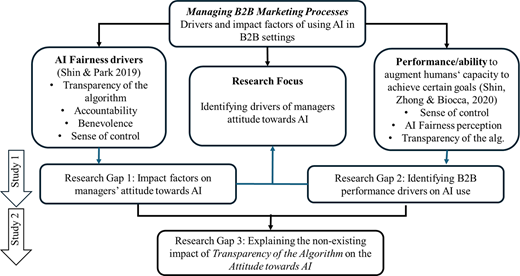
Figure 1 presents our research model for studying managers’ attitudes toward AI in B2B marketing, linking AI fairness concepts and performance factors to three identified research gaps that guide a two-study research design to investigate algorithm transparency’s unexpected lack of influence on AI attitudes.
Figure 1 presents two theoretical perspectives. The first, based on Shin and Park (2019), focuses on AI fairness drivers: algorithm transparency, accountability, benevolence and sense of control, which influence managerial perceptions. The second perspective (Shin et al., 2020) addresses AI’s ability to augment human capacity for goal achievement, highlighting sense of control, fairness perception and transparency as key factors.
These foundations reveal two research gaps: Gap 1 investigates how fairness aspects shape managers’ attitudes toward AI, while Gap 2 identifies B2B performance drivers linked to AI capabilities and organizational outcomes. Both converge on the primary focus: identifying drivers of managerial attitudes. Additionally, a fourth question arises from Study 1’s empirical findings, which unexpectedly showed no consistent impact of algorithm transparency on attitudes despite theoretical expectations.
Following quantitative evaluation, significant path correlations in the structural equation models were analyzed. Since Study 1 could not answer the third research question, Study 2 was conducted to further examine the impacts of AI fairness and algorithm transparency.
In short, Study 1 examines drivers of managers’ attitudes toward AI, while Study 2 investigates performance drivers to explain the unexpected link between transparency and those attitudes. Together, these studies deepen understanding of AI perception and use in B2B marketing.
This work contributes by explaining how attitude and control influence AI performance in B2B marketing, highlighting the roles of fairness, benevolence and unbiased data. It addresses existing gaps by focusing on individual-level marketing performance and managers rather than organizational outcomes, offering new insights into AI’s impact on B2B marketers and algorithmic transparency.
The paper proceeds as follows: an overview of AI theoretical foundations; Study 1 based on feedback from 200 US B2B marketing managers; hypothesis development and a conceptual framework for attitudes toward AI; results and discussion of Study 1; Study 2 with 66 US managers; answers to research questions; and finally, scientific and managerial implications.
2. Contextual background
2.1 Intelligence in the context of AI
The notion of “intelligence” in artificial systems is often treated in abstract terms. Legg and Hutter (2007) defined human intelligence as the capacity to learn, adapt and comprehend abstract concepts, while Kaplan and Haenlein (2019) described AI as a system’s ability to interpret external data, learn from it and achieve specific goals. In marketing, this suggests AI can transform raw data into market intelligence, supporting more informed and consistent decision-making when properly designed and governed (Huang and Rust, 2022).
Marketers analyze organizational needs, buying behaviors and industry trends to drive targeting, segmentation and relationship strategies (Petrescu et al., 2022). AI, through advanced analytics and decision-support systems, enhances B2B performance by analyzing complex data sets, identifying latent patterns and generating predictions for precise, timely actions (Hallikainen et al., 2020). Consequently, AI is viewed as a tool to improve marketing effectiveness and efficiency – from lead scoring and account selection to personalization and resource allocation – ultimately driving superior outcomes in B2B markets.
B2B firms often face small, sparse data sets due to infrequent transactions and concentrated portfolios (Lilien, 2016), causing AI models to struggle with stability and accuracy (Hsu et al., 2015). Furthermore, marketers and salespeople often resist AI recommendations perceived as opaque, biased or misaligned with customer knowledge (Habel et al., 2024; Gaczek et al., 2023). Consequently, AI’s performance impact depends not only on technical capabilities but also on data quality and managers’ belief that AI enhances rather than jeopardizes decisions and relationships.
While bounded rationality limits human optimization due to cognitive constraints and biases (Simon, 1957), AI can mitigate these by processing vast data sets and applying consistent judgments. However, improved decision quality and performance require manager trust and retained control over AI-supported decisions. This study captures this link via the construct performance of AI, defined as managers’ expectancy that AI will enhance the effectiveness, efficiency and relational quality of their actions. This expectation is central to understanding AI adoption in B2B contexts.
2.2 Managerial attitudes toward AI
Although AI technologies are increasingly prevalent in managerial practice, managerial acceptance of these tools remains mixed. While organizational environments often prioritize efficiency (Lilien, 2016), and AI is typically seen as a means of enhancing it (Davenport et al., 2020), this perception alone does not ensure managerial trust or widespread adoption. Studies have shown that managers, particularly at lower levels of hierarchy, may hesitate to integrate AI into their decision-making processes (You and Robert, 2018). Many prefer human judgment over algorithmic recommendations (Lichtenthaler, 2020). This hesitation can stem from several factors, including unclear responsibility for AI-driven decisions (Choi, 2021), privacy concerns and ethical unease regarding automation (Gaczek et al., 2025).
The literature identifies several constructs that appear especially influential in shaping managers’ attitudes toward AI. The first is perceived performance, which refers to how useful and competent the system is believed to be. The higher the perceived capability of the AI, the greater the likelihood of acceptance (Wang and Benbasat, 2007). The second is the sense of control, defined as a manager’s perception of the retention of authority over decisions despite the use of AI. When individuals feel that their control is diminished, resistance often follows, since users prefer systems, they can guide or override.
A third key factor is algorithmic transparency. If the inner workings of an AI system are not understandable, trust declines. Transparency enhances the comprehension of AI recommendations and reduces concerns about hidden bias or manipulation (Larsson and Heintz, 2020). Fairness is another crucial factor, in the context of whether AI decisions are seen as impartial and just. Benevolence refers to the belief that the AI system operates in the user’s best interest. Although this construct is crucial to trust formation, AI often falls short compared to human managers because it lacks emotional understanding. This gap becomes particularly relevant in high-empathy settings, where the inability to convey concern or compassion may limit AI acceptance (Li and Bitterly, 2024). For the definitions of all constructs, see Table A in the Supplementary material.
3. Development of hypotheses and measurement model
3.1 Research problem
The research problem in this study focuses on understanding how B2B marketing managers’ attitude toward AI and their sense of control over it affect their expectations about the performance of that technology. Specifically, we examine the interplay between the fairness, transparency and benevolence of AI and its perception in a business context. This research fills a crucial gap regarding the use of AI in marketing by managers, exploring the performance levels and explaining their expectations of algorithms.
3.2 Development of hypotheses
The sense of control enhances motivation and performance, especially in dynamic contexts like customer relationships (Miao and Evans, 2012). During AI integration, managers’ perception of AI performance is crucial (Shin and Park, 2019; Amankwah-Amoah et al., 2024). The technology acceptance model (TAM) suggests that perceived usefulness drives adoption, which is boosted by user confidence (Cao et al., 2021). A strong sense of control may foster a constructive interaction with AI, improving AI-related performance (Mikalef et al., 2023), leading to H1:
In the B2B context, a positive relationship exists between a marketing manager’s Sense of Control and Performance of AI.
Research suggests that marketers’ attitude toward AI influences collaboration and performance (Haesevoets et al., 2021; You and Robert, 2018). When AI is perceived as understandable and controllable, marketers collaborate more actively (Dietvorst et al., 2018), enhancing performance. Positive attitudes toward AI are associated with increased performance expectancy (Subaşı et al., 2024), greater trust (Sindermann et al., 2022) and more frequent use (Kwak et al., 2022). According to expectancy theory and models like TAM and UTAUT (Darda et al., 2023), users who believe in AI’s utility experience higher performance. Favorable attitudes influence behavioral intentions and perceptions of AI’s performance (Lee et al., 2015). In B2B marketing, positive attitudes lead to integration, trust and confidence, contributing to performance outcomes. Marketers with positive attitudes are more likely to integrate AI into their routines, trust its recommendations and feel confident in its support (Gaczek et al., 2025b; Dietvorst et al., 2018), thus we formulate H2:
In the B2B context, a positive relationship exists between a marketing manager’s Attitude toward AI and the Performance of AI.
Benevolence indicates the extent to which a manager is perceived as genuinely caring about the welfare of customers. Marketers in control are likelier to act benevolently because they believe their choices can meaningfully impact customer outcomes. Research shows that emotional intelligence and autonomy are positively associated with benevolent, customer-centered behavior (Sailendra et al., 2020).
In AI-enhanced marketing environments, this dynamic becomes even more significant. AI tools provide real-time data and recommendations that augment a marketers’ capacity to tailor their approach, increasing their perceived control over the marketing function (Bag et al., 2021). When marketing managers trust these systems, they experience greater agency. This, in turn, can reinforce benevolence, since the perception of control leads to confidence, and confidence encourages more authentic, empathetic customer engagement. Notably, transparency in AI systems has been linked to increased trust, which further supports the connection between perceived control and benevolent behavior (Kumar and Bargavi, 2024). Thus:
In the B2B context, a positive relationship exists between a marketing manager’s Sense of Control and his or her Benevolence.
A marketer’s sense of control over AI systems is crucial in shaping their attitude toward AI (Zhang et al., 2025). Sense of control over AI systems strongly determines whether the attitudes toward AI are positive or negative. When individuals perceive that they can influence how AI operates – adjusting its outputs, understanding its logic or integrating it into their workflows – they are more likely to develop trust and openness toward the technology. This perception of control mitigates common concerns such as unpredictability or job displacement, which are often barriers to AI acceptance (Georganta and Ulfert, 2024). Empowerment through a sense of control also reduces anxiety and fosters a sense of partnership with AI, as users are more inclined to see it as a supportive tool rather than a threat (McKee and Wouters, 2022). Furthermore, environments that promote autonomy align with the psychological need for competence and agency, reinforcing favorable attitudes (Stein et al., 2024). Thus, a higher sense of control will likely foster more positive, confident and constructive perceptions of AI in B2B marketing contexts:
In the B2B context, a positive relationship exists between a marketing manager’s Sense of Control and his or her Attitude toward AI.
A marketer’s benevolence – defined as the empathy, ethical behavior and concern for others – can positively shape their attitude toward AI. Benevolent individuals are more inclined to trust, a key driver of AI acceptance (Bedué and Fritzsche, 2022). Their inclination to act in the best interest of others may extend to perceiving AI as a tool used to serve customers better, foster relationships and enhance marketing outcomes. Additionally, benevolence is closely related to traits like agreeableness, which have been linked to more favorable views of AI (Sindermann et al., 2022). As such, benevolent marketing managers may be more open to adopting AI, seeing it not as a threat, but as a partner that helps deliver value to customers:
In the B2B context, a positive relationship exists between a marketing manager’s Benevolence and his or her Attitude toward AI.
AI fairness aims to decrease bias in AI models using explainable AI methods to detect prejudiced data or algorithm bias (Bhatia et al., 2024). Algorithmic fairness has been explored in various publications (Dwork et al., 2012; Pessach and Shmueli, 2022) and is crucial for models that are deployed to achieve larger goals (Mitchell et al., 2021). Users who perceive AI systems as fair develop favorable attitudes toward them (Shin and Park, 2019), reducing skepticism and building trust. When marketers believe AI operates impartially, they view it as a valuable tool (Cabiddu et al., 2022) and are more likely to engage with it, integrating it into daily workflows. Fairness perceptions also contribute to the sense that AI aligns with ethical standards, reinforcing its legitimacy and usefulness in marketing (Cavique, 2024):
In the B2B context, a positive relationship exists between a marketing manager’s AI Fairness perception and his or her Attitude toward AI.
Transparency in AI algorithms is crucial for shaping users’ perceptions and attitudes. The major aspects of transparency are simulatability, decision-making and algorithmic transparency (Bhatia et al., 2024). When marketing managers understand how AI systems make decisions, this understanding reduces uncertainty and promotes trust (Zerilli et al., 2019). Transparency mitigates anxiety, enables clarity and makes users feel more comfortable with AI. Studies have shown that transparent AI systems are viewed as fair and reliable, fostering positive attitudes (Shin et al., 2020). As a result, marketers develop favorable attitudes toward AI, reducing uncertainty and increasing trust through transparency:
In the B2B context, a positive relationship exists between a marketing manager’s Transparency of the algorithm perception and his or her Attitude toward AI.
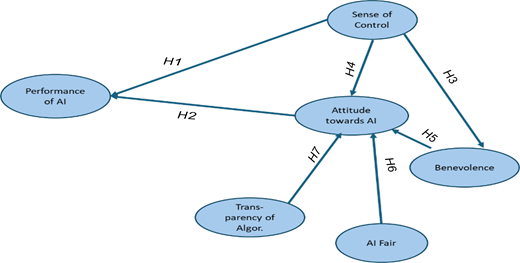
Following the findings of the literature cited above, we propose a conceptual model on the antecedents of attitude toward AI with reference to B2B managers. The antecedents relate to a sense of AI control, benevolence and the perception of AI fairness, as well as the transparency of the AI algorithm. At the same time, the consequence results in a marketing manager’s perception of the performance of AI. Figure 2 depicts the latent variables integrated in our structural model as well as the hypotheses discussed in this section. For the formation of constructs, please refer to Table 1. The model illustrates the hypothesized relationships between the key constructs influencing managers’ attitudes toward AI in organizational decision-making.
4. Quantitative research design overview
This research adopts a two-phase, iterative design to examine the relationships between theoretically specified constructs that influence managers’ attitudes toward AI and the perceived performance of AI in B2B settings and then to further explore selected findings through content analysis. This iterative design allowed us to test theoretically grounded relationships across a broader sample and then further interpret or contextualize the results by examining how actors experience the focal phenomenon in practice (Wellman et al., 2023).
In the first phase, a survey was conducted among B2B marketing managers to test the hypothesized relationships between sense of control, AI fairness, transparency of algorithms, benevolence, attitude toward AI and expected AI performance. A quantitative design was appropriate because the research questions and hypotheses examine the direction and strength of relationships among established constructs. A statistical analysis allowed us to systematically assess the proposed model across a larger sample of managers and evaluate the relative importance of the examined factors.
The second phase introduced an iterative extension of the study. The results of the first study indicated that algorithmic transparency did not significantly influence managers’ attitudes toward AI, despite the theoretical expectations of its importance. To better understand this observation, Study 2 was designed as a follow-up focusing on concrete AI use cases in B2B marketing contexts. This phase enabled a more detailed examination of how managers interpret and experience transparency when interacting with AI systems and whether they perceive it as a more experiential and potentially multidimensional concept than could be captured through the initial survey.
5. Study 1: factors influencing AI performance in B2B settings
5.1 Sampling and measurements
The authors distributed an online questionnaire in March 2024 by specifically targeting English-speaking marketing managers residing in the USA. Data were collected using Prolific, a crowdsourcing platform frequently used in academic research to recruit specific professional populations (Palan and Schitter, 2018). Prolific’s filtering tools allowed us to efficiently reach groups of management professionals, and its reliability has been supported by studies showing higher attentiveness and honesty compared to other crowdsourcing platforms (Peer et al., 2022). To ensure data quality, participants were required to pass two attention checks embedded in the survey. Respondents who reported having no subordinates were excluded from the final sample, as the study focused on individuals in managerial roles. In total, 167 B2B managers participated in a survey and completed the questionnaire. Participants aged 20–67, half female and half male.
Table 1 contains the measurement items used in this investigation. Some adjustments were required to fit the measurement items within our framework, even though they were created using the same construct that was previously described in the literature.
5.2 Results
The research study begins with four open-ended questions to explore managers’ personal experiences with AI and its implementation within their organizations. The authors also sought to understand the perceptions of AI’s most significant potential in marketing. The authors asked participants for their opinions about how AI can aid in making better marketing-related decisions under uncertain conditions. Despite limitations such as the lack of trust in AI and doubts about its ability to reliably predict the future, survey participants emphasized several benefits, including content customization, data analysis and trending, decision support, targeting and personalization, risk reduction and strategic adaptability. These results align with the findings of Paschen et al. (2019, 2020), who argue that companies should empower themselves to use AI strategically at the core of marketing. Our results confirm the findings of Bashir et al. (2024) that B2B marketing managers are consistently seeking to leverage AI to enhance their efficiency and effectiveness.
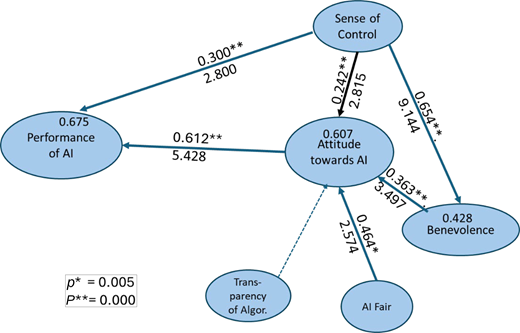
The authors simultaneously tested the relationships hypothesized in our framework using structural equation modeling (SEM) with SmartPLS software (Ringle et al., 2005; Henseler et al., 2016). PLS-based fitting of SEM is suited for causal-predictive analysis in situations of high complexity but with low theoretical information (Jöreskog and Wold, 1982). The characteristics of PLS are said to be advantageous, since “theory construction is as important as theory verification” (Deshpande, 1983, p. 107). Bootstrapping was used to evaluate the significance (t-values, p-values and variances) of the path coefficients. All the fit criteria (see Table 2) present perfect reliability. Figure 3 highlights significant path correlations.
The authors were able to explain 60.7% of the variance in a manager’s attitude toward the use of AI. Additionally, 67.5% of the variance in the performance of AI was explained, correlations driven by the attitude toward AI and sense of control. The authors assessed the reliability of the data using Cronbach’s alpha, average variance extracted and composite reliability (see Table 2). The study results confirmed the hypotheses H1–H6, while hypothesis H7 was not supported.
The model suggests a chain reaction: sense of control is the central influencing factor. It directly increases attitudes, benevolence and performance. Attitude toward AI acts as a mediator: it boosts performance and perceptions of benevolence. AI fairness helps shape attitudes, but transparency of algorithm does not. The model demonstrates that participants’ feelings of control over AI is the single most important factor that shapes how positively they view AI.
5.3 Discussion: influencing factors
Despite the promise of AI in enhancing B2B marketing activities, a substantial proportion of organizations are still struggling to leverage their AI investments in a way that adds value (Mikalef et al., 2023). Our study results indicate that managers perceive certain aspects of AI usage differently. A strong positive relationship exists between managers’ sense of control and their performance of AI and sense of control also positively influences attitude toward AI. This pattern is consistent with research on trust in automation and algorithm aversion, which shows that users are more willing to rely on algorithmic systems when they feel able to supervise and, if necessary, override their outputs (Dietvorst et al., 2018; Lee and See, 2004). In B2B settings, where marketing decisions often affect long-term, high-value relationships, retaining such control is likely interpreted as a way to manage the relational and performance risks of AI-supported decisions.
In the data set, benevolence (e.g. “I believe that AI will warn me if it recommends a decision that can be wrong or harmful”) has a positive impact on the manager’s attitude toward AI. This finding aligns with the literature on trust that describes benevolence – the belief that the other party acts in one’s interest – as a core dimension of trust alongside ability and integrity (Bedué and Fritzsche, 2022). Our results suggest that B2B managers do not view AI merely as a technical tool, but also as a partner-like system whose outputs must be reliable and non-harmful to be accepted. No relationship was found between transparency of the algorithm (e.g. “any outputs produced by AI are explainable to the people affected by those outputs”) and a manager’s attitude toward AI. This differs from several studies on marketers’ expectations from AI, which emphasize transparency (Huang and Rust, 2022; Wanner et al., 2023). However, authors agree that B2C marketing differs from B2B marketing (Feike and Rösch, 2024). In B2B, transparency may be less significant in a narrow, technical sense, because decisions are more structured and they are evaluated on technical soundness rather than emotional resonance; managers may prioritize accurate, fair and controllable outputs over detailed explanations of model internals (Petrescu et al., 2022). This interpretation was the motivation behind Study 2, which explores how B2B managers define and interpret transparency.
Our study reveals that a sense of control and attitude toward AI impact performance of AI understood here as the expected performance in B2B marketing decision-making. This is consistent with expectancy theory and technology acceptance models, which link beliefs about usefulness and control to performance expectancy and adoption (Venkatesh et al., 2003). We agree that AI competence is a core competency for organizations to ensure creative deployment of AI. This conclusion impacts AI marketing communication in industrial business fields: firms must not only build technical AI capabilities but also design governance and interfaces that strengthen managers’ sense of control and perceptions of benevolence. We confirm Shin and Park’s (2019) findings that social topics such as fairness, transparency and accountability must be addressed in the context of AI user experiences. The analysis of answers to open-ended questions highlights fact-based factors such as content customization, decision support, targeting, personalization, risk reduction and strategic adaptability, which are crucial for B2B marketers when working with AI (Brink et al., 2024).
6. Study 2. Transparency of AI in B2B marketing contexts
6.1 Motivation for Study 2
Study 1 shows that managers’ attitudes toward AI are influenced by perceived fairness, sense of control and benevolence. However, unlike recent consumer-facing B2C studies (Hermann and Puntoni, 2024; Mourali et al., 2025), where transparency often shapes responses to concrete AI outputs and decisions, the transparency of algorithms was not significant in our model. In the literature, transparency is commonly understood as the ability to “open the black box” of AI systems by making their functioning or decision logic interpretable to users (Larsson and Heintz, 2020; Von Eschenbacher, 2021). In managerial contexts, transparency may be a more experiential, potentially multidimensional construct that becomes salient primarily through direct interaction with AI systems and may extend beyond simple, explainable AI mechanisms. The unexpected transparency result motivated a second phase to explore how managers understand and experience transparency in real-world AI use, consistent with the iterative research design adopted in this study. Accordingly, Study 2 adopts a content analysis approach to understand how managers interpret the meaning of AI transparency and its connection (or lack thereof) to their attitudes toward AI in B2B marketing contexts. This leads to the following research question:
Given that AI systems are designed to be unbiased and to operate based on algorithms, why does perceived algorithmic transparency not influence managers’ attitudes toward AI?
6.2 Sampling and method
To address RQ4, a study was conducted among B2B marketing managers to investigate how they conceptualize AI transparency and its relation to their attitudes toward AI in practice. Respondents answered open-ended questions about the use of AI in marketing, their attitudes toward AI and its trustworthiness (see Table B in the Supplementary material). The questionnaire was distributed in April 2025 to English-speaking marketing managers residing in the USA on the Prolific platform, using the same selection criteria as in Study 1. In total, 66 usable responses were obtained.
The data were analyzed using content analysis to identify attributes and components shaping managers’ understanding of AI transparency (Elo and Kyngäs, 2008). The analysis involved data reduction, response grouping and concept formation without using a predefined coding framework.
ATLAS.ti software supported the textual analysis (Friese et al., 2018). Because many responses were relatively brief, the software’s LLM-assisted functionality was used for initial data reduction and coding. The AI-generated coding was critically reviewed and validated by the researchers, following recent recommendations on combining AI-assisted analysis with human oversight (Lee et al., 2024). This analytical process resulted in the identification of three main concepts: AI transparency, including ethics, explainability, rules of control and trustworthiness; attitude toward AI, capturing both positive and negative evaluations of AI and use of AI in B2B marketing, including applications such as data analysis, prediction and automation. Examples of responses and the corresponding coding structure are presented in Table C in the Supplementary material.
6.3 Use of AI by B2B marketing managers
The results indicate that the application of AI in B2B marketing is predominantly associated with advanced data analytics. AI’s primary role lies in its ability to analyze extensive customer data sets, detect behavioral patterns and translate these insights into actionable segmentation and personalization strategies. AI’s analytical capabilities enable the integration of heterogeneous data formats and sources, such as CRM logs, e-mail interactions and social media activity, thereby facilitating a more comprehensive understanding of customer behavior across the entire marketing ecosystem. A B2B marketer expressed it this way:
AI should excel at analyzing vast datasets of customer interactions, behaviors, and preferences to create granular customer segments and individual-level profiles […] I expect AI to identify non-obvious patterns and correlations that human analysts might miss.
Beyond descriptive analytics, AI also supports evaluative and experimental marketing practices. Several respondents described using AI to test alternative scenarios, for example, automated A/B testing or the exploration of strategic alternatives for planned marketing actions. AI was also reported to enhance performance analysis by identifying correlations between marketing activities and measurable outcomes, using its capacity to combine and process multichannel data.
A significant area of AI application concerns marketing planning and forecasting. AI-driven predictive models were described as being useful for anticipating customer expectations and behavioral trends, as well as for identifying broader market developments. This predictive functionality contributes to more informed and forward-looking marketing strategies, enabling marketers to allocate resources more efficiently and tailor their initiatives to emerging conditions.
Participants noted that AI tools can automate routine or repetitive activities, reduce manual workload and allow marketers to focus on higher-level strategic tasks. Lead scoring was frequently cited as a particularly effective use case, with respondents describing how AI supports a more precise evaluation of sales prospects. In addition, AI was reported to contribute to more strategic functions such as customer segmentation and communication personalization, reflecting its expanding role across the marketing value chain.
AI is increasingly being viewed as a decision-support mechanism. By automating complex analytics and offering recommended actions based on data-driven insights, AI assists marketers in making more confident and informed decisions. This aligns with broader perceptions in the data set that AI not only accelerates work processes but also enhances the quality and the rigor of marketing decision-making. This opinion reflects AI’s role in decision-making in B2B marketing: “SOME of the current AI are very inaccurate when you insert complex data.”
6.4 Attitudes toward AI
Participants’ responses indicate a predominantly positive orientation toward the technology. Respondents consistently emphasized AI’s capacity to process and synthesize large volumes of data, often exceeding what could feasibly be handled by human analysts within comparable timeframes. This enhanced analytical capability was regarded as particularly valuable when integrating information originating from multiple sources, such as CRM systems, social media platforms and e-mail communications. Through this integration, AI facilitates a more holistic understanding of customer behavior and marketing performance. A B2B marketer said that: “AI can process large volumes of customer data quickly, helping us uncover patterns, trends, and insights that would be difficult to spot manually. This allows for more informed and timely decision-making.”
Moreover, because AI systems are inherently reliant on data inputs, their implementation appears to encourage the adoption of more data-driven practices in marketing functions. Several managers noted that AI contributes to the institutionalization of data-driven decision-making by linking marketing activities more explicitly to measurable performance indicators. In this sense, AI not only increases efficiency but also reshapes managerial approaches to evaluation, accountability and strategic alignment.
Respondents portrayed AI as a significant support tool in managerial decision-making. AI applications were described as enabling deeper customer insight generation, pattern detection across diverse data sets and the identification of emerging trends that may not be readily observable to human decision-makers. These capabilities were perceived as improving both the precision and confidence with which decisions are made, enhancing the overall quality of marketing work. One opinion was: “AI tools can process large amounts of data quickly and extract actionable insights, helping to identify trends, patterns, and customer behaviors that might be difficult to uncover manually.”
Responses occasionally express concern, including references to negative influences on work processes. These remarks suggest that challenges may persist in relation to system usability, integration demands or the perceived reliability of AI-generated output. Managers noted several potential drawbacks associated with AI. These included AI-generated hallucinations, biases in AI-derived results, the complex and often opaque nature of AI decision-making processes, concerns over the uncertainty of controlling AI systems and issues surrounding accountability for AI-driven outcomes.
6.5 Transparency of AI
The notion of transparency holds a multifaceted and nuanced meaning for B2B marketing managers. Participants did not view transparency as a single characteristic, but rather as a constellation of interrelated features that collectively determine whether an AI system can be trusted and effectively integrated into their professional workflows. At the most fundamental level, respondents associated transparency with the algorithm’s internal functioning, emphasizing that AI can be regarded as transparent only when it is grounded in credible, representative and diverse data sets. Transparency requires that the system consistently produce accurate outcomes across repeated interactions and in a variety of contexts. Consistency and accuracy were perceived not merely as technical qualities but as signals that the underlying data and model logic are sound, thereby making the AI’s operations intelligible and trustworthy. One of the managers expressed it this way: “If I understand how the AI tool makes decisions and can see the data it is based on, I am more likely to trust its outputs. I also want to know that the tool is regularly audited for bias and errors.”
Beyond the algorithmic dimension, transparency was also linked to the establishment of clear rules and mechanisms governing human control over AI processes. Respondents repeatedly emphasized their preference for AI systems that maintain a strong “human-in-the-loop” structure, where human users retain oversight and ultimately approve or accept AI-generated outcomes. This expectation was tied to a broader concern for responsibility and accountability: managers highlighted the importance of clearly delineating how decision-making authority is shared between human actors and technological systems. They expressed a desire for explicit statements that clarify whether responsibility for actions or errors lies with the individual user, the algorithm or the organization implementing it. Ethical considerations also featured prominently in participants’ assessments of transparency. Many respondents underscored the need for robust frameworks addressing data protection, especially regarding the handling of customer information used to train or operate AI models. Ethical guidelines for human–AI collaboration were viewed as essential for ensuring that AI adoption aligns with organizational values and external regulations. Legal compliance, including adherence to privacy legislation and industry standards, was framed as a critical condition for creating an environment in which AI use is perceived as safe, responsible and transparent.
To support transparency across these dimensions, respondents identified explainability as a central feature that AI systems must possess. Several elements emerged as necessary components of meaningful explanations. First, privacy and security rules must be explicitly communicated, including what data the AI uses, how it is stored and who has access to it. Second, participants expected clarity regarding the sources of data that feed the AI models, as this helps them assess reliability and potential biases. Third, managers stressed the importance of understanding the AI’s reasoning processes. They wanted insight into how the system makes decisions, which criteria it prioritizes and why particular recommendations are generated. Additionally, respondents expressed a desire for assurances that the AI that is deployed includes mechanisms to identify, avoid and correct biases or errors. This emphasis on self-regulation reflects a broader demand for systems that are not only transparent but also capable of demonstrating their own safeguards and quality-control processes. A manager said that “Transparency clearly explains how decisions or predictions are made. I don’t need to see every line of code, but I should understand the logic or data driving the outcomes.”
Respondents distinguished transparency from fairness, viewing them as related yet conceptually distinct dimensions of trustworthy AI. While transparency was associated with understanding how AI systems operate, fairness was linked directly to the quality and neutrality of the data used to train and inform algorithmic processes. Participants emphasized that data sets must be free from structural or historical biases to prevent discriminatory outcomes, particularly in areas such as customer segmentation, lead scoring or personalized communication. They stressed that biased data might undermine the legitimacy of AI-driven actions, regardless of how transparent the system’s internal logic may be. For the managers, fairness functioned as a safeguard, ensuring that AI systems do not reinforce inequities or produce systematically skewed decisions. Importantly, respondents pointed out that transparency and fairness together constitute the foundation of AI trustworthiness. Transparency enables users to understand and evaluate AI decisions, while fairness ensures that these decisions are ethically sound and applied equitably across customer groups. Without the presence of both qualities, participants believed that AI cannot be fully trusted or responsibly integrated into B2B marketing practices.
6.6 Discussion
Our findings indicate that AI in B2B marketing functions at the intersection of analytics, automation and strategic insight generation. Although the data set reflects predominantly positive experiences, it also underscores the need for the careful integration of AI tools into existing marketing workflows to fully realize their potential to support decision-making. Overall, managers perceive AI as an enabling technology that enhances analytical capabilities, streamlines processes and establishes more informed decision-making. At the same time, the presence of critical perspectives highlights the importance of managing expectations and addressing implementation challenges to ensure successful adoption.
These findings demonstrate an alignment between managers’ attitudes toward AI – viewed primarily as a technology that facilitates their work – and the ways in which they use it, mainly as an analytical tool. This pattern mirrors the results of Study 1 and aligns with previous research suggesting that AI’s analytical function plays a central role for marketers (Huang and Rust, 2018). However, this role appears relatively conservative when contrasted with more recent conceptualizations of “thinking” and “feeling” AI in marketing (Huang and Rust, 2022, 2024).
Interestingly, respondents did not report using generative AI, which contrasts with recent scholarly arguments about its growing importance in marketing practice (Grewal et al., 2025; Kshetri et al., 2024). One explanation may lie in the nature of B2B marketing work, where data tends to be highly structured and where prescriptive and predictive analytics remain central to decision-making processes (Hallikainen et al., 2020). Despite this, content marketing is a significant component of B2B strategy, implying that marketers must regularly produce content (Terho et al., 2012). The absence of generative AI in their accounts may suggest either that such content is still created manually or that its use was not explicitly recognized or disclosed in this study.
Another plausible explanation relates to the relatively early stage of generative AI adoption within organizations. Many companies continue to limit or regulate access to generative AI tools, meaning that marketers may lack institutional permission or the technological infrastructure to experiment with them. In such contexts, practitioners’ experience with AI would naturally be dominated by predictive analytics, recommendation systems and marketing automation technologies. Additionally, firms may impose restrictions due to the perceived risks, compliance concerns and data protection requirements (Li, 2025), slowing the integration of generative AI into everyday marketing activities.
Study 2 shows that attitudes toward AI are strongly linked to perceptions of its transparency. This finding contrasts with Study 1, but the difference can be explained by how B2B marketing managers conceptualize this feature of the technology. For these managers, transparency extends far beyond technical clarity; it encompasses ethical, procedural and operational dimensions. They understand transparency as the combination of accurate and reliable model behavior, clearly defined structures for human oversight, robust ethical and legal frameworks and mechanisms that enable meaningful explainability. Managers reported feeling confident in using AI for analytical, strategic and decision-making tasks only when these elements are present. This interpretation of transparency is considerably more nuanced than what emerged in Study 1, as well as in many studies that use Shin and Park’s (2019) measurement scale. It is therefore possible that the scale used in Study 1 did not sufficiently capture the multidimensional nature of transparency, limiting its ability to detect its importance. Professional users need multidimensional transparency to understand how the algorithm proceeds with data (Leszczyński et al., 2025).
The need for a more nuanced understanding of AI transparency can also be attributed to the characteristics of B2B marketing work. Operating in environments that are defined by long-term contracts, scrutiny from multiple stakeholders (Saura et al., 2020) and making decisions involving high-stakes customer relationships (Ferro-Soto et al., 2025), managers place a strong emphasis on data governance, compliance and ethical accountability (Behera et al., 2022). Because B2B marketers often maintain close, ongoing relationships with clients, they may be required to explain or justify AI-supported decisions directly to them. As a result, understanding the logic behind AI output becomes not only desirable, but it is also essential in sustaining trust and maintaining these relationships.
7. Conclusions
7.1 Final conclusions
From a company-level perspective, our findings indicate that B2B firms deploy AI conservatively yet strategically as decision-support infrastructure for data integration, forecasting and routine automation. Rather than stand-alone innovations, managers embed AI into portfolio management for tasks like lead scoring and risk reduction. This operationalizes prior work on rational, data-driven B2B marketing (Hallikainen et al., 2020; Mikalef et al., 2023; Paschen et al., 2019).
Contrary to literature linking adoption directly to commercial gains (Kumar and Bargavi, 2024), B2B performance depends not on technical sophistication but on managerial attitudes and, crucially, sense of control. This driver boosts attitudes, benevolence and performance expectancy. Managers recognize that AI errors can damage long-term relationships; thus, benefits materialize only when they can monitor, correct or override outputs to align with ethical norms. Conversely, perceived loss of control to opaque systems threatens trust and stability (Keegan et al., 2023; Papagiannidis et al., 2023), reducing expected performance.
Finally, B2B AI success relies on specific fairness and transparency configurations where ethical behavior supersedes technical understanding. Extending prior work (Shin and Park, 2019; Mitchell et al., 2021), we define B2B transparency as pragmatic assurances making outputs defensible. Firms must treat AI as relational governance – integrating oversight and accountability – to bridge micro-perceptions and macro-outcomes, ensuring technology, agency and relationships remain aligned.
7.2 Theoretical contribution
This study offers three theoretical contributions. First, it links AI antecedents to B2B marketing performance and buyer–seller relationships, moving beyond prior focus on technology features or cognitive factors (Cao et al., 2021). In B2B, where performance relies on long-term high-value relationships (Cannon and Perrault, 1999), managers prioritize relational outcomes. Consistent with technology acceptance models (Venkatesh et al., 2003), positive attitudes correlate with expected performance. Crucially, perceived control is vital: managers expect AI to improve results only when they can monitor and override outputs to prevent relationship-damaging errors. This shifts the view from generalized marketing performance (Lamberti and Noci, 2010) to a human-oriented perspective where control safeguards relationships.
Second, we show that B2B managers adopt a pragmatic stance toward AI. While existing research focuses on functional issues like ambiguity and bias (Cabiddu et al., 2022; Gaczek et al., 2023; Ransbotham et al., 2017), less attention has been paid to fairness and benevolence (Shin et al., 2020). Managers accept partial opacity but demand “pragmatic transparency” – credible data, consistent outputs and clear oversight – to ensure fair, benevolent behavior. This addresses integrating semi-opaque AI into governance without eroding trust (Keegan et al., 2023; Dwivedi and Wang, 2022). Resonating with AI-as-teammate literature (Georganta and Ulfert, 2024), our findings suggest trust in B2B depends on ethical conduct rather than full technical understanding (Cavique, 2024).
Third, we position perceived managerial control as a relational governance mechanism. While control generally drives adoption (Legaspi et al., 2024), we demonstrate its critical role even amidst positive attitudes. As stewards of relationships (Palmatier et al., 2006), managers require the ability to oversee and override AI (Dietvorst et al., 2018; Lee and See, 2004; Legaspi et al., 2024). Shifting control to machines risks damaging customer relationships (Keegan et al., 2023). Thus, while AI aids coordination (Paschen et al., 2019), B2B managers insist on retaining agency to protect trust and accountability.
7.3 Managerial implications
This study emphasizes designing AI systems that managers can trust and integrate into decision-making. Acceptance depends less on algorithmic transparency and more on practical performance within B2B realities. Managers evaluate AI via experiential cues: fairness, controllability, workflow relevance and support quality.
Addressing RQ1, attitudes are primarily driven by perceived control, benevolence and fairness. Both control and attitude significantly influence perceived AI performance.
For RQ2, perceived performance stems from psychological, ethical and contextual judgments rather than technical attributes. Performance improves when managers understand AI’s effects, influence outputs and see alignment with core processes (e.g. lead qualification). Fairness strengthens trust; controllability reduces uncertainty, creating a reinforcing cycle of confidence and positive attitudes.
Regarding RQ3, perceived fairness significantly influences attitudes toward AI use, indirectly improving performance outcomes. Conversely, perceived algorithmic transparency shows no significant effect, leading to the rejection of H7.
These findings suggest managers prioritize outcome-oriented and normative considerations – fairness and alignment with goals – over technical explainability. In complex B2B contexts where AI often operates as a “black box,” managers remain unconcerned with internal logic provided outputs are fair, unbiased and supportive of organizational objectives.
Importantly, the model reveals that sense of control is the dominant driver with reference to attitudes toward AI. Sense of control directly enhances attitudes toward AI, perceptions of benevolence and AI performance. Managers’ willingness to adopt AI is less about system visibility and more about their perceived ability to supervise, influence and override AI-driven decisions when necessary.
Overall, RQ3 confirms that fairness outweighs transparency in shaping attitudes, yet both remain secondary to sense of control. This extends trust and algorithm aversion literature (Dietvorst et al., 2018; Lee and See, 2004), establishing control and fairness – not explainability – as critical for B2B AI acceptance.
Addressing RQ4, algorithmic transparency fails to influence attitudes because it does not yield meaningful process understanding. As Ribeiro et al. (2016) noted, managers lack the expertise or motivation to interpret model details; thus, technical transparency builds little trust. Instead, they respond to functional explainability: how AI affects decisions and whether outcomes are fair, consistent and beneficial.
Interviews reinforced this, with participants valuing AI for automating routine tasks, reducing manual effort and enabling strategic focus. Respondents highlighted its role in segmentation and personalized communication, describing it as a decision-support mechanism that accelerates analysis and provides data-driven recommendations. In B2B marketing, value stems from enhancing efficiency, rigor and strategy – not algorithmic transparency – even when tools face limitations with complex data.
Consequently, organizations should avoid overinvesting in technical transparency. Instead, prioritize practical explainability, ethical data practices and interfaces that enhance managerial control. Firms must integrate AI into workflows supporting real tasks (e.g. lead scoring, segmentation) while ensuring insights are actionable. We propose the following seven-step implementation process:
establish ethical and data governance foundations;
provide meaningful, practical explainability rather than technical transparency;
align AI applications with business-critical B2B use cases;
develop AI competence and cross-functional collaboration;
enhance managers’ sense of control by integrating AI into workflows;
reinforce trust through consistent, fair and interpretable outcomes; and
balance AI automation with human interaction to preserve relationship quality.
In summary, AI acceptance and perceived performance in B2B firms depend less on understanding algorithms and more on how AI supports work, improves decisions and fits within established relational and operational practices. By prioritizing usability, fairness, trust and competence development, organizations can deploy AI responsibly and effectively across the marketing value chain.
7.4 For further studies
Future studies should investigate managers’ interactions with AI using experimental designs, exploring transparency and fairness under various conditions. Research should examine the mediating role of transparency and fairness in shaping responses to AI outputs (vs human recommendations) and sector-specific/cultural variations in prioritizing these factors. Future research may also concentrate on other countries to learn if managers’ attitude toward AI differs from country to country.
References
Supplementary material
The supplementary material for this article can be found online.