This paper departs from how the literature is filled with partly contradictory notions on disruption, while lacking a perspective that interlinks disruption causes of technology, business model and mindset with disruption effects beyond focal firms and industries. The purpose of this paper is to approach the notion of disruption from the perspective of interdependencies to discuss its different meanings, time-limitations and magnitude of effects.
The paper is based on an integrative literature review to develop a typology. Empirical examples illustrate interdependency effects of disruption as a missing perspective in past research.
A typology is developed, indicating a gap related to magnitude as spread and transformative disruption. The interdependency lens helps to capture this configuration. It thereby addresses the lacking perspective that interlinks disruption causes of technology, business model and mindset with disruption effects beyond focal firms and industries. The examples indicate how the parties being disrupted are determined by imbalances in interdependencies as disruption spreads, and how safeguarding and internalisation reshape these interdependencies.
The paper contributes to past research through critically discussing the past partly contradictory notions of disruption in the literature, while creating an understanding for disruption effects as spread of disruption. It helps to structure past disruption research through developing a typology while extending such research through discussing it from an interdependency perspective.
Introduction
In a fast-changing world, it is increasingly important to understand pervasive changes and their effects. Disruption, as early defined by Clayton Christensen, referred to how new parties entered a sector, making present players redundant (Christensen, 1997). The mechanism achieving this was a new technology – often exemplified by how analogues solutions were replaced by digital ones (Sandström, 2011; Skog et al., 2018).
Disruption has since been linked to business models (Riemer et al., 2017; Kask and Öberg, 2019; Geissinger et al., 2020) and more recently mindsets (Riemer and Johnston, 2019), the latter exemplified by how stakeholders start valuing other parameters than bottom-line financial results and how a societal shift has caused a different orientation to ownership from before (Öberg, 2023c).
Beyond these various reasons for disruption with redundancy of actors as a central characteristic (Christensen, 1997), disruption is also used in other regards in the literature. The supply-chain research is frequent to refer to disruption of supply chains. Research then mostly focuses on temporary breakdowns (Lawson et al., 2019; Xu et al., 2020), whereby firms recover the supply chain after temporal interruptions or have back-up suppliers to ensure delivery (Ambulkar et al., 2015; Hohenstein et al., 2015). Within industrial marketing and purchasing (IMP) research, disruption has at times been used to describe discontinued business relationships (Halinen et al., 1999; Bengtson et al., 2026).
Disruption thereby has come to mean several different things, with the only shared determinator being some sort of interruptive change. To start structuring these various meanings of disruption and drawing on dimensions that help to highlight the differences between them, we can, as suggested in this paper, understand disruption along a time and a magnitude dimension. The time dimension refers to its temporality with recovery (as in the supply-chain literature) at one end (e.g. Yu et al., 2009; Sawik, 2019; Xu et al., 2020), and the for-good, transformative change – as defined by Christensen – at the other (e.g. Clarke, 2019; Jones et al., 2020).
The magnitude can be understood along the line of where disruption takes place and who is affected in terms of whether disruption spreads. In the innovation and entrepreneurship literature, focus is thus on firms and industries, following from a sector-level definition of redundancy. In the supply chain literature, it is rather the supply chain that fails, with downstream actors losing goods access.
When comparing definitions of disruption across the innovation and entrepreneurship literature and the supply chain literature, we can distinguish between those affected atomistically – being part of the same industry but not directly connected – and those affected through the spread of disruption across linked actors. In the innovation and entrepreneurship literature, disruption is connected to customers as beneficiaries (Adner, 2002); however, customers themselves are not considered disrupted. Rather, they are the agents whose changing preferences bring about disruption. In contrast, the supply chain literature clearly illustrates how disruption propagates throughout the supply chain, typically unfolding from upstream to downstream actors (Blackhurst et al., 2005; Xu et al., 2020).
Through adopting the IMP perspective (e.g. Håkansson and Snehota, 1995; Ford and Håkansson, 2006; Thilenius et al., 2016), we can start to understand how the disruption neither becomes a one-firm concern nor “stays” in an industry, but also – as shown in this paper – how interdependencies cause disruption to spread, and how interdependencies among actors are affected by disruption – whether technology, business model or mindset driven.
This paper aims to approach the notion of disruption from the perspective of interdependencies to discuss its different meanings, time-limitations and magnitude of effects. The following question is addressed:
How can the variety of understandings of disruptions across literatures be understood and integrated into an understanding of disruption effects across parties?
In addressing this question, the paper advocates for a return to the definition of disruption by Christensen (1997), while including not merely technology, but also business models and mindsets, and while discussing interdependency to capture a system level of disruption.
The paper contributes to prior research by critically examining previously partly contradictory notions of disruption, while structuring and extending the literature through the development of a typology. This extended perspective captures how disruption moves beyond customers as mere beneficiaries or victims (Adner, 2002; Revilla and Jesus Saenz, 2017) to encompass redundancy of actors in diverse positions across supply chains and networks. Through introducing an interdependency perspective to the disruption literature and based on some empirical examples, it is suggested how actors often assumed to be redundant are not necessarily those who become so. Rather, it is those characterised by a one-sided dependency on others who are most at risk of redundancy, thereby also providing explanations for the spread-of-change debate in IMP research (Havila and Salmi, 2000). While previous studies – particularly in the area of disruptive innovation – have frequently focused on consumer goods, applying an interdependency perspective extends the analysis to business-to-business (B2B) contexts.
Following this introduction, a closer look on disruption research is provided, and the interdependency perspective is highlighted. To structure past research, the dimensions of magnitude and time are introduced. Next, the method is described. The findings and analysis section outlines the typology, discusses and exemplifies how an interdependency lens extends past knowledge. The empirical examples illustrate that the different interpretations of disruption do not imply separation, but rather integration across empirical justifications. The paper ends with a concluding remark, including theoretical and managerial implications, along with limitation and suggestions for future research.
Theoretical background and framing
Disruption
Disruption thus refers to how something is interrupted. Prominent scholars who have placed disruption at the center of their analyses have interpreted such interruptions in varying ways. It may be the term’s roots in everyday language that have contributed to disruption’s multiple meanings across distinct literatures. The introduction highlighted differences among the innovation and entrepreneurship, supply chain and business network perspectives on disruption – summarised in Table 1.
The literature that has engaged with questions of disruption for the longest period has focused on innovation and entrepreneurship issues (Danneels, 2004), where disruption thus expands from product-related technology, over business models and into mindsets. If considering these, we can start to understand how they are not separated but related: The mindset disruption requires both new business models and technologies, while the business models need the new technology (Moreau, 2013; Riemer and Johnston, 2019; Öberg, 2023c).
When focusing on the industry as the unit of disruption (Christensen, 1997; Adner, 2002; Danneels, 2004; Christensen, 2006), attention is strongly at the technology replacing a solution with a new one. Competencies related to the new technology make incumbents redundant (Utterback, 1994). Furthermore, it has been noted how incumbents fail to realise emerging, disruptive changes and how they operate under burdens of past investments (Moreau, 2013).
Recurrently, the technological shift has been about digitalisation (Bughin and van Zeebroeck, 2017; Skog et al., 2018; Vial, 2019; Fraser and Ansari, 2021). A frequent example across the innovation and entrepreneurship literature is the Kodak case, when digital cameras challenged the firm and camera manufacturing sector. More recent cases include, the digitalisation of content including the newspaper industry (Gilbert and Bower, 2002; Karimi and Walter, 2015), music and film streaming (Riemer and Johnston, 2019).
Such digitalisation came forth as new business models, thereby indicating how the technology was not product-oriented but business operational. More specifically, business model disruption has tended to focus on platform-based operations replacing the traditional supplier–buyer exchanges (Riemer et al., 2017), with technology as an enabler only (Kask and Öberg, 2019).
Music streaming replaced the production of physical records with digital formats, while introducing platforms as disrupting parties (Moreau, 2013; Kask and Öberg, 2019). The sharing economy similarly introduced platforms, but also non-professional providers as disrupting parties (Geissinger et al., 2020). Both of these requested digitalisation, not only as intermediary actors, but also in terms of digital content, and in the case of the sharing economy, evaluation systems, payments, preferencing and algorithmic coordination (Geissinger et al., 2021; Öberg, 2023d). The sharing economy, while challenging incumbents, does so across industries, while the individual platforms remain enmeshed into such individual industries. However, and which I come back to below, the sharing economy and indeed streaming of music, films and other contents, also disrupted supply chains, not temporarily, but in a transformational manner. This also positions disruption more firmly within B2B markets, rather than solely within consumer goods.
Mindset disruption – at times described as the disruption of informal institutions – which was early linked to such platforms as Pirate Bay, and initial configurations of Uber and Airbnb (Öberg, 2023d), concerns how customers think differently about ownership and sustainability, for instance. Öberg, (2023c) shows how such disruption is not sudden but rather evolves over time as early introductions of mindset disruptions are met with hostility, to later become salient, for instance, in the light of solutions that do not compromise the environment. Such mindsets would from the customer perspective not be industry-specific, while the introduction of them, from the supplier point of view, is done in tandem with business model disruptions.
The supply chain disruption is thus about interruptions in availability to upstream resources, caused by contextual challenges such as war and pandemics, or following from shortages at upstream supply. This literature frequently discusses how firms should operate for resilience and include alternative suppliers or solutions (Ponomarov and Holcomb, 2009; Baghalian et al., 2013; Ambulkar et al., 2015; Xu et al., 2020). Recovery is thereby central to the literature (Sawik, 2019) as is robustness of supply chains (Baghalian et al., 2013). This is to keep the firms’ operations unaffected by any supply chain disruption.
The temporality of disruption and the underlying assumption of going back to what was is thereby fundamental in the supply chain literature on disruption. So, in addition to the wording – disruption – how does this type of disruption relate to the innovation and entrepreneurship literature disruption? The interruption is there, but thus with a temporality rather than transformation.
Meanwhile, also the supply chain literature may handle transformative disruption. Research on additive manufacturing and related business models has shown how positions along the supply chain are erased (Öberg and Shams, 2019; Öberg, 2022; Öberg, 2023a), thereby in line with Christensen (1997) making firms redundant. As a consequence, we cannot neglect that supply chains change without returning to past configurations.
What is more, also in the innovation and entrepreneurship literature, disruption may be presented as less dramatic. Tushman and Anderson (1986) refer to competence-enhancing and competence-destroying technologies, thereby denoting how the disrupting technology may be driven by the incumbents (the competence-enhancing technologies), while the competence-destroying technology challenges their resource and competence structures.
Indeed, some researchers elaborate on the incumbents surviving disruption (King and Tucci, 2002; Danneels, 2004), pointing at how such firms access resources, may be adaptable and also have experiences that may be fruitful as change occurs (cf. Helfat and Lieberman, 2002). Danneels (2004) reflects how incumbents may survive disruption based on the very factors challenging them: their resources and values. Relatedly, Christensen and Raynor (2003) refer to low-end and new-market disruption, highlighting how the new technology is directed at current or new customers. While this indicates how the disruption reaches beyond the firm or sector and into downstream players, the innovation and entrepreneurship literature on disruption is scarce on such sentiments and do not refer to these downstream actors becoming redundant, while they are a key part of the supply-chain literature on disruption.
The business network literature on disruption rather puts such parties at its heart. Disruption is, namely, focused on terminated business relationships (Tähtinen and Halinen, 2002; Bengtson et al., 2026). This means that disruption is neither temporal nor is it per default connected with technological, business model or mindset changes. Rather, reasons for such disruptions include firms’ (changed) strategies, decompositions of networks and choices to discontinue with a supplier or customer (cf. Öberg et al., 2016). The focus in the literature is the spread of change (Havila and Salmi, 2000; Thilenius et al., 2016; Havila et al., 2018), in how a change between two actors affect also others.
How does this then relate to the other types of disruption? Similar to the supply-chain literature, it points to how other parties are affected by the change. Meanwhile, the network approach does not convey such change to be temporal. While we can envision technological, business model or possibly mindset shifts as preceding said business network disruptions and more specifically re-orientational strategies of firms, this is not a central focus in the business network literature. Rather the effects are, and these are thus packaged related to change in business relationships rather than those conveyed in the innovation and entrepreneurship literature.
As a partly related lens, studies on ecosystems do discuss the technological and business model disruptions. While researchers such as Öberg, (2023b) discuss various roles of external stakeholders related to disruption – them as creating the inertia previously described related to past investments, creating blindsight to change, and the need for new stakeholders as change occurs – most of that literature focuses on the ecosystem as the disrupting party. The literature on ecosystem thereby indicates how firms come together to induce change. Focus becomes on new solutions and operational logics in terms of business models (Snihur et al., 2018). Such arguments for the most part occur in the innovation and entrepreneurship fields of research, somewhat closing the circle across the three literatures on disruption as outlined in Table 1.
Magnitude and time in disruption
Once comparing across the three literatures on disruption it is easy to distinguish among them based on whether the disruption is transformative or temporal. This is a key difference where the supply chain literature separates itself from the other fields. Meanwhile, there is also the difference in unit of disruption, and whether its effects are described as spreading to other actors. Here, the business network and supply-chain research suggest such spreads, while the innovation and entrepreneurship literature focuses on the unit of the firm or the industry as a construct whereby ties among parties are suppressed.
The dimensions of magnitude and time emerge from the literature review that forms a foundation of this paper, providing a means to capture differences in how disruption is conceptualised across the literature, and laying the groundwork for the typology developed herein. Structuring prior research along these two dimensions also enables the identification of the literature gap of transformative disruption affecting stakeholders beyond possible customers as beneficiaries (Adner, 2002) or victims (Qi et al., 2004). To elaborate on this configuration and situate it within existing research on disruption, this paper adopts an interdependency perspective on disruption.
An interdependency perspective on disruption
Interdependency refers to how parties mutually need each other for resource provision, income, or competencies (Aiken and Hage, 1968; Puranam et al., 2012; Raveendran et al., 2020). The mutuality means that one actor cannot easily control the other, while it is not a given that they balance off their dependency on the other party. In dyads, research has described how parties may try to boost their power over the other party through making the latter party asymmetrically dependent. Meanwhile, and once we move into the network (or ecosystem) level, interdependencies become inherent yet influenced notions that create dynamics across actors (Hallén et al., 1991).
In research, it has been noted how parties either strive for balance or unbalance in their connections with others. In this regard, Casciaro and Piskorski (2005) distinguish between mutual dependency and imbalance to highlight how both instances may lead to actions of firms to deal with interdependency.
Meanwhile, the interdependency is also a force through which change transcends. If the starting point is a new technology, business model or changed mindset, it would (A) be evaluated and acted upon, with possible modifications as consequence among interdependent parties; (B) require possible new connections and thereby create new interdependencies (cf. Öberg, 2023b). Related to this, Kapoor and Agarwal (2017) describe how complementor firms in platform-based business ecosystems can be influenced by their interdependencies at the ecosystem level, and Ganco et al. (2020) define two types of structural interdependencies in ecosystems: interdependency based on the structure of technological interactions between components, and the structure of input–output flows between production stages. While thereby indicating how such interdependency has been discussed in past research, and in the case of Öberg (2023b), related to disruption, the literature is truly scant on such disruption effects.
Method
A conceptual view – the integrative literature review
This paper started off with an integrative literature review. Such a review condenses past research while introducing new insights to it through cross-positioning findings with other literatures (Torraco, 2016). In the paper, this is done through:
(A) summarising past research on disruption, linking it to fields and synthesising differences across literatures;
(B) developing a typology and establishing gaps related to identified dimensions of past research; and
(C) proposing and illustrating the coverage of such gaps through integrating the disruption research with other literature, in this case interdependency.
The paper thereby combines literature synthesis and organisation (cf. Jaakkola, 2020) with literature extension through theory adaptation and empirical illustration, demonstrating practical relevance and applicability of the proposed interdependency perspective.
Much related to (A) is presented above (the theory section). This is based on literature searches using Web of Science to reach high-quality, peer-reviewed journal articles. The literature search was taken as point of departure to indicate the relative engagement with disruption issues in various fields, traced through Web of Science’s categorisation of meso- and micro-fields; and analyse contents related to meanings of disruption.
For this, various search strings were tested to identify queries that maximised coverage while minimising the retrieval of irrelevant literature (Tranfield et al., 2003). As part of this process, different research categories and keywords, along with additional meso- and micro-level categories, were evaluated to ensure that the selected search string adequately captured the relevant literature. This evaluation involved scanning titles and conducting spot-checks of abstracts from the search results. The process resulted in the following final search string:
(“Disruption” in Business and Management research (defined by Web of Science categories) in “Articles” and “Review articles” titles);
Distributed across meso-level categories of (“Management” (containing the innovation and entrepreneurship literature) and “Supply chain and logistic”); and
And further refined within micro-level categories of (“Supply chain optimisation”; “Innovation Strategies”, “Consumer Behaviour” and “Entrepreneurship”).
No restrictions were imposed on publication year or journal ranking. For the IMP perspective on disruption, targeted searches were conducted focusing on research related to change and relationship termination.
The searches and their results were reviewed by a research colleague for validation purposes. This entailed an examination of alternative keywords, their respective outcomes, and the exclusion of articles resulting from the application of research category delimitations and specific combinations of keywords. This validation was conducted in parallel with the development of the search string, with feedback incorporated into the final version.
Based on the searches derived from the final search string, which yielded 585 articles, abstracts were screened to ensure that the studies explicitly addressed disruption – rather than merely referencing it in the background – and focused on disruption within a business context. This process resulted in a final set of 551 articles, presented in Table 1, spanning publications from 1987 to the early publications of 2026.
To gain a deeper understanding of these articles, they were read and coded through iterative cycles of comparison, recoding and code reduction (Gioia et al., 2013). The coding was content-driven, aimed at capturing the disruption focus of each article, while maintaining distinctions between the research categories represented – namely, innovation and entrepreneurship, supply chains and business marketing – as indicated by the journals in which they were published. More specifically, each article was categorised according to research field (based on journal classifications in Web of Science and the AJG list), year of publication and article type (conceptual or empirical, including the type of data and analysis). In addition, articles were coded for their definition of disruption – captured through its treatment in the theoretical, empirical and conclusion sections if not stated clearly – as well as for the geography and sector of the study, whether disruption concerned technology, business models, or mindsets, and any discussion of disruption effects and their severity.
With the intention to systemise past research through distinguishing characteristics, the coding next turned to identify such differences. The meaning of disruption, including possible effects, was compared across articles through several iterative cycles of code reduction, while maintaining each article’s connection to its research category. This process involved systematic cross-checks and comparisons, ultimately leading to a distinction between disruption as temporary and disruption as transformative. By relating this back to the respective research categories, a clear distinction emerged: temporary disruption was predominantly observed in the supply chain literature, whereas transformative disruption was prevalent in the innovation and entrepreneurship literature.
Another distinguishing characteristic that emerged from the analysis concerned what was challenged by disruption. While the categorisation into technology, business models and mindsets draws on the author’s previous work, the coding revealed clear distinctions in the literature between disruptions affecting incumbents and sectors, and those shaping how disruption unfolds across and impacts interconnected actors. To theorise this difference further, the coding and subsequent reduction of codes led to the identification of atomistic and interdependent forms of disruption. This categorisation reflects distinctions in the literature between disruption affecting actors or sectors occupying positions similar to those of new entrants, and disruption affecting connected firms, thereby cascading to parties not initially confronted by the disruption.
While other distinguishing dimensions could also be relevant for organising disruption literature, the dimensions of time and magnitude proved particularly salient, as evidenced by the extent to which the literature could be meaningfully categorised into these dimensions.
Towards a typology and illustrating gaps through empirical examples
The analysis and accompanied understanding of disruption thereby led to the capturing of the dimensions of time and magnitude as separating characteristics in the literature. To develop a typology – as a thematic typology to structure past disruption research and defining related gaps (cf. Stapley et al., 2022) – these dimensions were tested towards each other to ensure that they were not dependent on each other and thereby measured the same phenomenon (Dess et al., 1993; Meyer et al., 1993). This was achieved by sorting the literature across the dimensions and ensuring that the literature did not fall into two separate sets of combinations only. Having established that this was not the case, a typology was developed (Short et al., 2008; Baden-Fuller and Morgan, 2010; Jaakkola, 2020).
The quadrants in the typology were named to capture the meanings of the configurations. By structuring the literature according to content, definition of disruption and research category, the typology presents configurations that reflect combinations of time and magnitude, while simultaneously allowing for the systematic consideration of these dimensions. Along this development, the gap associated with transformational disruption and spread was established.
To fill this gap, the notion of interdependency was used to theorise this configuration, thereby borrowing the description of connectivity from the supply chain and IMP literatures, both of which engaging with disruption as affecting others but either treating it as a temporal state or concerning relationship dissolutions, rather than new technologies, business models or mindsets.
With an exemplifying intention, and to ensure that the absence of the configuration was not due to its irrelevance or lack of empirical presence and to investigate the applicability of the interdependency perspectives, examples were used to illustrate the configuration across different sectors, selected with the means to include technological, business model and mindset disruptions, see Table 2. These examples are all based on the author’s previous research. While not a selection criterion for such previous research, they all showed effects not contained only within a specific industry or by a specific firm but disruption spreading to stakeholders beyond the firm and industry.
The illustrative nature of these examples thus means that the aim was not to build theory, but rather to demonstrate that the configuration missing in previous research has practical coverage and to indicatively test that the interdependency perspective has some explanation value in relation to the configuration. Through juxtaposing the examples with descriptions of interdependency as mutual dependency and imbalance (Casciaro and Piskorski, 2005), propositions were developed as early suggestions of empirical patterns (cf. Neuhaus et al., 2022) that can be developed into theory in future studies. Repeated patterns emerged across the examples, thereby indicating the relevance of the interdependency perspective and the division into mutually dependency and imbalance. As a final step, these early indications were compared with the other configurations to ensure that the missing configuration contributed additional insight rather than replicating what was already captured in prior research.
Findings and analytical discussion
A typology on disruption literature
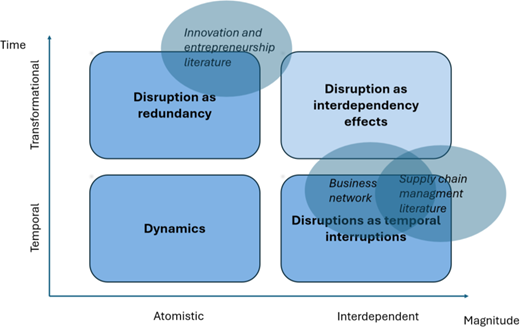
Based on the dimensions of magnitude and time, Figure 1 displays a typology on disruption. As conveyed in the figure, time is divided between temporality and transformation, the former indicating how disruption means interruption with a back-to-normal principle, the latter a forever change. The magnitude describes an atomistic focus on the disruption and one including how others are affected by it in terms of disruption hitting them as well.
To shortly recapitulate past literature and the gap, the four configurations in Figure 1 are summarised as follows, starting at the lower left configuration and moving into the more severe ones:
Dynamics indicates changes as part of organisations that follow from internal processes. The configuration can be understood as competence-enhancing disruption, as coined by Tushman and Anderson (1986), whereby change is introduced by an incumbent and directed towards existing customers (cf. low-end market disruption, Christensen and Raynor, 2003). This also means that parties would not become redundant, and it would thus be an act of incumbents, rather than them being challenged.
Disruption as temporal interruptions is how the disruption concept is used in most of the supply chain literature (e.g. Xu et al., 2020). This is a field with a sharp rise of publications since COVID-19, and this, together with the reshaped global geopolitical landscape are also recurrent mechanisms in such disruption. While these may not necessarily turn back to past circumstances neither short nor long term, the essence of the literature departs from how a supplier cannot deliver and how the firm needs to manage its supply chain in ways to avoid any type of disruption of supply (Revilla and Jesus Saenz, 2017). Resilience and recovery with, for instance, parallel options of supply are repeatedly discussed in the literature (e.g. Ambulkar et al., 2015). The supply chain focus, while often being regarded from the single firm perspective indicates an interdependency where the disruption importantly would be with another supply chain party than the focal firm and also lead to the (temporal) disruption for downstream parties. Relatedly, the business network research, equally connected to this configuration, is about changes from within rather than based on the technology, business model or mindset disruption. While not necessarily going back to what was, a recurrent argument in the literature is that there remains an energy that means that if recaptured, the business relationships would not be at a starting point and there is indeed a tendency to return back to past actors (Havila and Wilkinson, 2002; Poblete, 2017). An important aspect of the configuration, as highlighted in previous research, is its description of a domino-type disruption, which illustrates how interdependency and disruption unfold – albeit here in a temporary context.
Disruption as redundancy captures disruption in the Christensen tradition. This thus means that external parties enter a sector (or more lately across sectors) making past firms redundant (Millar et al., 2018; Antonio and Kanbach, 2023; Amankwah-Amoah et al., 2024). The severeness for these firms are thereby much greater than is the case when supply chains or indeed business relationships are interrupted. While there are firm effects, firms are not seen as connected but rather identified based on their industry sector (Christensen, 1997). From an interdependency perspective, this therefore becomes atomistic, suppressing any propagation of the disruption.
Disruption as interdependent thus relies on the notion of transformational changes, but which, different to the prevailing innovation and entrepreneurship literature, emphasises how disruption spreads to other actors. This gap in the disruption research thereby acknowledges how disruption is interdependent and leads to disruption effects not encapsulated in the incumbent redundancy notion of disruption. Spread occurs in a domino or cascade-like manner, across firms’ (inter)dependencies, originating from the party initially affected by the disruption. This is where this paper focuses its contribution: to approach the notion of disruption from the perspective of interdependencies.
Through plotting the literature into the various quadrants of Figure 1, it is acknowledged how the transformative disruption spreading to others extensively lacks a literature domicile. Important to note here is how the business network description of disruption does not relate to technology, business model or mindset disruptions, but rather to mechanisms captured within the business interactions among parties (Havila and Salmi, 2000; Havila et al., 2018). The interdependency lens on transformative disruption helps to capture the meaning of transformative disruption’s stakeholder effects, which is illustrated and discussed below.
Should we allow disruption to be about redundancy?
As defined by Christensen (1997), disruption is thus about new parties entering an industrial sector, making incumbents there redundant. While examples in the literature are about new technologies, and later business models and mindsets, this conveys a scale that, while not spreading, implies how disruption is not an everyday activity and that it indeed creates revolutionary changes affecting a multitude of parties.
When concepts become hyped and spread not only across research fields but also into the public debate, risks are evident that they lose distinctness. Often, less severe situations become included in definitions, or indeed words are interpreted from a dictionary rather than past-research point of view. To re-establish a concept’s former meaning, going back to roots become important. This is what this paper tries to accomplish while recognising that the “incumbent becoming redundant” definition of disruption leaves an atomistic perspective on disruption that at times also fails to capture who becomes redundant. What would this then mean if relating disruption as described by Christensen (1997) with disruption as spreading across actors?
The missing configuration – The meaning of interdependency for transformational disruption
The missing configuration Disruption as interdependency effects thus cross-positions the notion of spread from the supply chain literature with disruption as transformational, drawn from the innovation and entrepreneurship literature. As suggested, an interdependency perspective informs this configuration by indicating how disruption spreads. More specifically, it is conceptualised through the distinction between interdependency as imbalance and as mutual dependency (cf. Casciaro and Piskorski, 2005). This means that the configuration moves beyond simply stating that disruption spreads, to also indicating how it spreads, with distinct patterns depending on whether dependencies among actors are balanced or unbalanced. It follows from the way interdependencies are enacted: mutual dependencies may lead actors to negotiate and respond jointly to disruption, whereas asymmetric dependencies constrain such responses, particularly for the more dependent party, given the lower reliance of the other. At the same time, disruption – like other forms of challenge – may prompt more mandated or defensive behaviours aimed at safeguarding operations, thereby altering the conditions of interdependence and potentially shifting relationships between mutually dependent and imbalanced states.
To illustrate the notion of spread in relation to transformative disruption, Table 2 summarises a set of empirical examples. These examples, selected based on their focus across technological, business model and mindset disruptions, indicate two consequences when relating transformational disruption based on the redundancy connotation to interdependency as imbalance and mutual dependency, respectively:
how it is not the party depicted to be challenged by new entrances that becomes redundant; and
how disruption as redundancy spreads across actors.
The first indication connects to unbalanced dependencies, the second to how mutually dependent parties respond to disruption, making them increasingly one-sided in their orientation to other parties and thereby unbalancing to their favour, past mutuality.
Related to imbalance, and interesting compared to past research on disruption is thereby how it is not the core party challenged by disruption that is the primary victim of it. The record industry streaming thought to challenge record manufactures. This occurred because physical records were no longer being produced. Moreover, singers and songwriters without record labels thought to gain a platform to release their music. However, as indicated by the Music industry example, the record manufacturers rather prospered from the development as the platforms did not afford to lose any of the labels. In the case of Spotify, the major record labels took ownership, and through playlists started to influence what users listened to. They also no longer had to deal with expensive manufacturing of records and the risks associated with producing records that may not turn into successes. Here, it was the record stores that lost the battle, and later, based on the concentration and directed provision of music through platforms, those initially thought to create ground based on the digital format: independent artists faced increasingly severe difficulties to reach out. Another example is how video stores were those becoming redundant following the streaming of film (see the Content industries example), while cinemas had cut the cord when the video boxes were firstly introduced, however not becoming entirely redundant. Beyond the empirical examples presented in Table 2, the Kodak case – and the firm’s timing relative to the advent of digital cameras – has been repeatedly referenced in the innovation and entrepreneurship literature on disruption. However, a closer examination of the case reveals that camera manufacturers themselves survived, later facing challenges from mobile phone developments. It was, rather, the stores offering one-hour photo development, and the companies producing camera film, that experienced the disruptive impact.
If looking at these three examples from an interdependency perspective, we can start to understand that negotiation power, and mutual dependency kept parties from becoming redundant while they were those primarily replaced by new entrances to the sector. In the Music industry example, record labels negotiated their space while the platforms were thus dependent on the record labels for content. Meanwhile, retailers, as repeatedly being those parties becoming redundant in the examples, were dependent on the upstream players while not having negotiation power or critical resources for these, indicating imbalance. What thereby comes forth in these examples is how imbalance to a party’s disadvantage may create the redundancy and how redundancy is “negotiated” across parties as a new firm enters a field. Such negotiations follow from mutual dependencies, and their characteristics. By thereby adopting an interdependency perspective on disruption, a first set of propositions is suggested:
A party characterised by a pre-disruption one-sided dependency is the one that becomes redundant following disruption due to dependency disadvantage.
Negotiation among balanced, interdependent parties explains why a party primarily challenged by new entrants does not become redundant.
Extending the examples and demonstrating that disruption is not confined to downstream retail effects, the Additive manufacturing example shows how sub-suppliers – highly dependent on large manufacturing firms for orders and design – also experienced disruption. Their one-sided dependency made them vulnerable, thereby moving beyond a downstream, retailer disruption risk and highlighting asymmetric dependency as a key risk factor for disruption.
Beyond one-sided dependency as an explanation for which actors become redundant, mutual dependencies contained how disruption spread. In the Advertising example, and as web designers entered the sector and challenged the traditional roles of copywriters and art directors for printed media, the spread of disruption led traditional advertising agencies to move away from established modes of interaction. According to the example, they increasingly internalised activities, while printing houses – remaining external – faced the brunt of the disruption. This internalisation was a response to heightened uncertainties and an attempt to counteract the imbalances created by the entry of new actors into the sector. Where possible, advertising agencies sought to hire web designers, thereby internalising such competencies.
Similarly, in the sharing economy (see the Sharing economy example), incumbents challenged by platform-based entrants sought to replicate the sharing model, either through acquisitions or by adapting their own business models. Hotels attempted to emulate Airbnb, and car manufacturers, for example, launched their own car-sharing platforms. In the Additive manufacturing example, and the industrial use for the rapid manufacturing of components and spare parts, not only changed sub-suppliers following their one-sided dependency but as the rapid manufacturing is based on the notion of internalisation it also reduced transportation needs and thereby disrupted the business of third-party logistics firms.
Across these examples, disruption suggests leading to internalisation of activities – the production in the Additive manufacturing example, critical competencies in the Advertising example, and ways of operating through, for instance, acquisitions in the Sharing economy example. Hence, disruption as such is spread to others in terms of their redundancy based on related issues of uncertainty. The interdependency perspective on disruption thereby leads to a second set of suggested propositions:
Reactions to disruption, in terms of safeguarding and internalisation, cascade the disruption by creating imbalances between parties that were previously in a state of pre-disruption balanced interdependency.
Cascaded disruption spreads redundancies to pre-disruption collaboration partners, whose offerings are affected by safeguarding and internalisation.
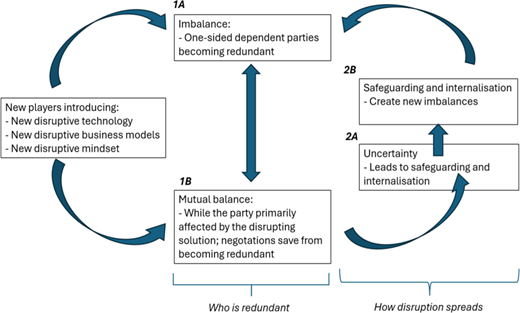
In short and across the suggestions, one-sided dependency explains who disrupts, while such one-sided dependency spreads as firms make safeguarding decisions and internalise from parties, they previously were mutually dependent on, thereby creating new one-sided dependency with these parties (see Figure 2).
The configuration thereby indicates mechanisms and related consequences of disruption that have not been previously addressed in the disruption literature and provides an extended understanding of disruption as involving not only the spread effects, but also the propagation of disruption and redundancies, while relating these to imbalance and mutual dependency, respectively.
Conclusion
This paper approaches the notion of disruption from the perspective of interdependencies to discuss its different meanings, time-limitations and magnitude of effects. It depicted how the meaning of disruption differs across literatures, where the dimensions of time and magnitude help to separate across definitions and thereby structure disruption research. Meanwhile, this separation also defines a current gap in the literature, where to this paper positions an early contribution. In the introduction, the following research question was formulated:
How can the variety of understandings of disruptions across literatures be understood and integrated into an understanding of disruption effects across parties?
Through highlighting disruption as redundancy following from key sources of technologies, business models and mindsets, while highlighting these from an interdependency perspective, two key findings are proposed:
Pre-disruption imbalances in interdependency decide who becomes redundant following disruption; and
Redundancy transfers to others through safeguarding and internalisation, leading to how also that part of balanced interdependencies are affected by redundancy.
Theoretical contributions
This paper contributes to past research through:
summarising existing research on disruption and critically investigate its differences across various research fields;
developing a typology that marks central dimensions that sets the meaning of disruption apart on a research field level;
highlighting missing perspectives related to such configurations while turning focus back to original meanings of disruption; and
introducing how interdependency plays an important part in extending past knowledge to understand network level effects of disruption and thereby addressing a missing perspective in disruption research.
It importantly highlights how redundancy follows from imbalances in dependencies, with the deficit actor risking redundancy, and how the uncertainty created following disruption leads to internalisations making past interdependent parties redundant, via the mechanism of imbalance, suggesting cascading disruption. Combined, this highlights a system-level understanding of disruption as redundancy following transformational change.
Contributions are thus made to the innovation and entrepreneurship literature on disruption by suggesting patterns of redundancy that differ from prior expectations and by indicative explanations for why a party becomes redundant. In the B2B context, this paper helps to explain how disruption unfolds not only across supply chains but also according to deficit positions and the management of risk in more complex patterns. It thereby adds explanations to the research on spread of change, while specifically focusing on disruption.
Managerial implications
Based on the combined perspectives of disruption and interdependency, this paper identifies two practical managerial approaches for responding to disruption:
mapping interdependencies to identify vulnerabilities; and
diagnosing disruptive risks and allocating resources.
These approaches can be operationalised through a set of diagnostic questions and decisions that guide managerial prioritisation. Across both approaches, managers should apply structured scenario planning linked to predefined decision triggers, continuously monitor external developments and maintain flexibility in resource allocation. A central managerial challenge is balancing efficiency against resilience, which requires explicit trade-offs rather than general optimisation. Maintaining strong solvency and access to financing is particularly important, as it enables firms to respond quickly when disruptive changes occur.
(A) Mapping interdependencies to identify vulnerabilities: Interdependency in the context of transformational disruption implies that actors characterised by one-sided dependency are more likely to become redundant. From this follows that if a relationship exhibits high dependence asymmetry and low switching flexibility, it should be prioritised for immediate mitigation. Managers can operationalise this approach through the following steps:
Mapping relationships: Systematically map key internal functions and external parties using a structured representation that captures: the direction of dependency; switching costs; and time-to-replace.
Classifying dependencies: Categorise each critical relationship as balanced, mutually dependent, or one-sided, and assign a corresponding risk level based on dependency asymmetry and its importance for value creation.
Identifying high-risk nodes: Evaluate which actors – including the focal firm – are most exposed by applying diagnostic questions such as: Would disruption of this actor halt core operations? How quickly can the relationship be substituted? Does the actor control critical knowledge or assets?
Prioritising monitoring and planning: Focus managerial attention on high-risk nodes and select responses based on explicit trade-offs. Multiple suppliers, for instance, increase resilience but raises costs; insourcing enhances control but reduces flexibility; and deepened partnerships improve coordination but may increase dependency.
(B) Diagnosing disruptive risks and allocating resources: Understanding how disruption propagates through interdependencies allows managers to anticipate where intervention is most needed. Resource allocation should prioritise nodes where the product of disruption impact and propagation potential is highest. Managers can act on this through the following practices:
Assess propagation of disruption: Regularly evaluate how technological, business model, or mindset disruptions may affect both direct and indirect partners. This includes mapping how disruptions cascade across business connections rather than considering isolated effects.
Experiment and innovate: Invest selectively in new business models and supply chain reconfigurations, particularly where high dependency risks coincide with a high likelihood of disruption. This involves a trade-off, as exploratory investments enhance adaptability but may reduce short-term performance.
Scan beyond current boundaries: Extend contextual scanning beyond existing partners and industry boundaries, covering domains such as technological developments, regulatory change, business model innovation and societal shifts. Each domain should be explicitly linked to potential dependencies.
Translate foresight into action: Allocate resources based on predefined trigger points, such as regulatory changes or technological maturity thresholds, and strengthen capabilities that reduce dependency risks.
Reposition strategically within networks: Reconfigure the firm’s role based on its position relative business partners: strengthen positions where control over critical nodes exists; reduce or exit positions characterised by high dependency and low control; and develop bridging roles where intermediation creates strategic advantage.
More broadly, managing disruption related to interdependencies requires making explicit trade-offs between flexibility, efficiency and control. Firms can do so by aligning fixed cost structures with revenue volatility, avoiding long-term lock-in to technologies or partners under high uncertainty, maintaining sufficient liquidity and solvency to enable rapid strategic response, and selectively internalising resources that are critical for maintaining control.
A simple diagnostic checklist can support managerial reflection: Are current operations over-optimised for efficiency at the expense of resilience? Which dependencies would critically constrain the firm under disruption? Where is flexibility underfunded due to short-term performance pressures? Addressing these questions helps ensure that firms move from reactive adjustment towards proactive positioning in the face of disruption.
Limitations and future research
This paper is at large conceptual. Further research should ideally provide in-depth empirical investigations on disruption related to interdependency. This would help to further explore the broader consequences of disruption across parties and, in large data sets, to refine and test the indicative propositions outlined in this current paper.
Moreover, although the typology was developed through the categorisation of literature, it would be valuable to relate it to disruption cases to examine whether disruption in practice aligns with its various configurations, whether additional dimensions are required, and how these dimensions vary across different disruptions. Future research that critically examines the causes of disruption is also important, not least because this paper reveals previously unanticipated patterns of redundancy.
In the current context, characterised by geopolitical instability, trade tariffs, inflation and climate change – factors that affect supply chains – there are empirical settings in which we can expect the boundaries between temporary and transformational disruption to blur, as behaviour changes and new relationships are established. These developments provide important opportunities for extending the current disruption literature and for critically advancing existing knowledge.
What is interesting for future studies also beyond the disruption focus is how uncertainty reshapes business connections, the inherency of deficiency in interdependency and whether this is a repeated pattern for retailers (as indicated across the examples of the digital cameras, music and other content disruptions), and how we as researchers can be more conscious about how concepts are used with different meanings across fields.
The author would like to express her sincere gratitude to Arkadiusz Kawa and Andrea Sabatini for their valuable comments on an earlier version of this paper presented at the 2025 IMP Forum in Poznan. She is also grateful to the anonymous reviewers for their constructive and insightful feedback throughout the review process.