Skip to article sections
Purpose

This study aims to explain the areas of opportunity for entrepreneurship offered by digitalization and proposes strategic recommendations for entrepreneurs and firms offering B2B services in the digital economy.

Design/methodology/approach

Exploratory research is used to analyze how digitalization is affecting B2B services entrepreneurship in the mobility industry. A mixed methodology combining 4 in-depth interviews and a Q-survey with 30 participants was used. The information obtained was processed using qualitative and quantitative analysis tools to identify areas of opportunity and suggest actions to improve the possibilities of entrepreneurship.

Findings

This study identifies artificial intelligence (AI)-driven business models, data and resource management and selective investment filtering as the most promising paths in B2B services, while suggesting that sustainability is not as critical as previously assumed. The findings also indicate that servitization and personalization have varying levels of impact, with personalization being less effective in B2B than previously expected. Moreover, the role of individual entrepreneurial alertness is diminishing, giving way to collective learning, technological alternation and strong networking effects as key drivers of success in digital-intensive B2B environments, providing a new perspective on entrepreneurial alertness.

Research limitations/implications

The findings emphasize that B2B firms should adopt a modular transition approach to digitalization, enabling step-by-step implementation rather than radical transformation. The research also suggests that not all digital investments are equally viable, with AI-powered logistics, smart supply chains and data-driven platforms outperforming traditional models such as vehicle hire and taxi booking services. The shift from individual to collective learning and strategic networking is essential for capturing and leveraging entrepreneurial opportunities in a rapidly evolving digital landscape. Entrepreneurs and business leaders should prioritize building robust ecosystems, leveraging industry collaborations and integrating emerging technologies into their business models.

Originality/value

This study makes several novel contributions. First, it introduces new theoretical insights on entrepreneurial alertness, emphasizing its transition from an individual-driven process to a collective and technology-enabled phenomenon. Second, it provides a comprehensive synthesis and valuation of digital-intensive business models, ranking them according to their strategic viability in B2B contexts. Finally, this study identifies the key characteristics shaping entrepreneurial success in digital B2B markets, emphasizing the importance of network-based learning, adaptive ecosystems and the integration of AI-driven decision-making.

Greater digitalization is leading companies toward a new industrial revolution (Pérez-Moure et al., 2024a; Liu et al., 2024; Loureiro, 2018), and data generation and management appear critical for value creation (Pérez-Moure et al., 2024b). Alongside this data, multiple tools have emerged such as artificial intelligence (AI), Big Data or machine learning. These tools provide new alternatives for managing companies and developing business (Venturini, 2022; Obschonka and Audretsch, 2020). This digital dynamism demands significant effort from managers to adapt or, at least, to ensure organizational survival through continuous innovation (Liu et al., 2024; Singh et al., 2020). Thus, digital-intensive businesses emerge, a new kind of business whose core activities, value creation and competitive advantage rely heavily on the integration of digital technologies, data-driven processes and servitization models (Kowalkowski et al., 2024; Liu et al., 2024).

This context is the breeding ground for entrepreneurship and the emergence of new business models with strong innovative components (Lampón et al., 2024b); that is, new ways for creating value for customers and improving organizational competitiveness (Pérez-Moure et al., 2024b; Kim and Oh, 2022; Sánchez-Gutiérrez et al., 2019). To this end, the entrepreneurial process must focus on identifying business opportunities over time (Dencker et al., 2021; Kim and Kim, 2021). Business leaders or entrepreneurs need to develop an organizational culture favoring environmental observation, resource identification and idea evaluation through a process called entrepreneurial alertness (Casanova et al., 2023; Jelinek and Litterer, 1995; Kaish and Gilad, 1991). This process, characterized by a constant search for opportunities associated with environmental evolution, must be internalized in both established and newly created companies (Lanivich et al., 2022), and extended through collaborative business ecosystems encompassing public and private institutions (Cabanelas et al., 2023), and a strong digital component (Dinh et al., 2018).

In B2B domains, where there are strong customer–supplier interaction and long-term relationships, the challenges are especially complex due to the increased propensity for servitization (Kramer et al., 2024; Dotzel and Shankar, 2019). This propensity is reflected in recent literature on innovation in B2B services, which is still a promising field of development (De Jong et al., 2021). For instance, some promising areas for B2B services are gamification, personalization, mixed reality or visualization of information (Wieland et al., 2024; Ndubisi et al., 2020; De Jong et al., 2021).

Therefore, connecting innovation in B2B services with entrepreneurship is an important issue to address in literature, but also a complex issue due to its scope (single or multiple companies) or its focus (technology or people) (Hermawati et al., 2024; Dotzel and Shankar, 2019). This complexity is intensified in highly uncertain environments associated with new digital technologies, characterized by high levels of competition (Dayan and Ndubisi, 2020). All these elements complicate the full development of entrepreneurial alertness, as new scenarios can be disruptive, making prior experience insufficient (Lanivich et al., 2022). Thus, it is necessary to study mechanisms allowing the exploitation of opportunities in the digital economy for entrepreneurship in B2B services; an area requiring greater development given its novelty and the ongoing high level of transformation (Casidy et al., 2020).

This paper aims, first, to explore areas of entrepreneurial opportunity offered by digitalization to foster innovation in B2B services. Second, it proposes lines of action to enhance entrepreneurial possibilities in B2B services within the digital economy, updating the concept of entrepreneurial alertness. Why, then, focus on a specific industry such as mobility? First, mobility is a strategic industry for many countries, offering significant potential for growth and innovation (Pérez-Moure et al., 2023; Lampón et al., 2024a; Athanasopoulou et al., 2019). Second, digitalization, entrepreneurship and innovation in B2B services are complex and require slightly different approaches depending on the industry. Third, the emergence of connected and autonomous vehicles (CAVs) opens new areas to explore (Lampón et al., 2024a). Consequently, the first research question is limited to the mobility industry. Given the rise of Industry 4.0, Industry 5.0 and Society 5.0, key factors influencing entrepreneurs’ ability to seize opportunities are largely similar across industries. Hence, the second research question is not restricted to a single sector. Two research questions (RQ) arise:

RQ1.

Which B2B business models offer the greatest opportunities in the mobility industry for companies, entrepreneurs and governments?

RQ2.

What are the key factors that influence the ability of entrepreneurs to seize entrepreneurial opportunities across industries?

To address these questions, an exploratory approach using a blended methodology has been chosen. First, a qualitative methodology based on focus groups and in-depth interviews will be adopted. Second, a Q-methodology survey will introduce a quantitative perspective to the research. Qualitative methodologies are appropriate for investigating and identifying concepts and areas due to their flexibility and adaptability, along with their ability to capture diverse social perspectives (Kirschbaum et al., 2024; Lenger, 2019). The quantitative Q-methodology survey is effective for identifying common perspectives and is particularly useful in technological innovation, information systems or transportation fields (Dieteren et al., 2023; Athanasopoulou et al., 2019).

Despite the growing research on digitalization and B2B services, little attention has been given to entrepreneurship and new business models development in digitally intensive industries. This study addresses this gap by integrating entrepreneurial alertness theory with emerging business models and examining their impact on B2B companies. Moreover, the research expands existing studies on B2B services, business models and entrepreneurship by providing an eclectic theoretical framework and a contextualized research focus, using the mobility industry as a framework. Unlike previous studies, this research uses a mixed-methods approach, combining a Q-methodology survey (applied to two distinct research questions) with in-depth interviews. This methodological combination is novel within B2B literature. The findings of this study have significant implications for both academics and practitioners. We aim to identify the most promising business models in B2B services and determine the key characteristics entrepreneurs need to successfully establish new companies in the B2B context. Therefore, this study contributes to three distinct but interconnected fields: B2B service innovation, new business models and entrepreneurial alertness, within the broader discussion of Industry 4.0, Industry 5.0 and Society 5.0. Beyond theoretical contributions, this study provides practical recommendations for investors and entrepreneurs by identifying business models with the greatest potential and factors critical to the entrepreneurial process. These insights can help countries and entrepreneurs better prepare for a rapidly evolving business landscape shaped by technological disruption and innovation.

New technologies and digitalization are driving a new industrial revolution, bringing about drastic changes (Liu et al., 2024; Xu et al., 2021). In this context, Industry 4.0 gradually transitioning to Industry 5.0 (Golovianko et al., 2023; Xu et al., 2021), enabled by the concept of Society 5.0 (Huang et al., 2022; Deguchi et al., 2020). These transformations not only impact business models but also influence entrepreneurship and B2B markets.

On the one hand, Industry 4.0 is characterized by high flexibility within production systems, enabling greater product customization (Bonamigo and Frech, 2021; Ibarra et al., 2018). It is primarily based on digitalization, automation and data-driven decision-making (Leng et al., 2022). Key enabling technologies such as Internet of Things (IoT), Big Data, Cloud Computing and AI play a crucial role in its development. However, Industry 4.0 focuses predominantly on efficiency, productivity and automation, often sidelining the human factor. This shift has facilitated the emergence of new technology-driven business models, particularly in the B2B domain (Bortoluzzi et al., 2022).

Despite these advancements, Industry 4.0 has introduced new trends and business models. It has played a crucial role in driving servitization at a technical level (Ibarra et al., 2018) and has fostered network-oriented business models, where new actors emerge and collaboration increases (Golovianko et al., 2023; Xu et al., 2021). Moreover, Industry 4.0 has enabled remote maintenance and product installation, as well as service-based updates (Bettiol et al., 2017). In addition, it has facilitated the integration of warehouses, production and sales into a unified digital ecosystem (Ibarra et al., 2018). As a result, Industry 4.0 has improved industrial service performance, strengthened trust and fostered collaboration between stakeholders, thereby promoting long-term business relationships (Bonamigo and Frech, 2021).

Yet, the evolving business context has become complex. While Industry 4.0 encourages automation and product customization, it also presents challenges in terms of entrepreneurial competencies (Kumar et al., 2023). Entrepreneurship has been significantly transformed by Industry 4.0, accelerating industrialization processes and enabling the emergence of fully digital entrepreneurs (Ben Youssef et al., 2021; Kraus et al., 2018). Furthermore, Industry 4.0 has fostered the creation of technology hubs and accelerators, facilitating the rapid and continuous emergence of startups (Kumar et al., 2023; Kraus et al., 2018).

Currently, this paradigm is evolving with the emergence of Industry 5.0 (Huang et al., 2022; Murtaza et al., 2024). Unlike Industry 4.0, Industry 5.0 redefines the relationship between people and technology (Leng et al., 2022). This new paradigm focuses on the industry’s ability to achieve social objectives while fostering resilience, job creation and sustainable development, where people cooperate and are reintegrated into automated processes (Magni et al., 2023). These changes hold significant implications for business models, B2B environments and entrepreneurship (Koroglu, 2023; Leng et al., 2024).

Although Industry 4.0 has promoted interconnectivity and collaboration, some authors argue that such cooperation remains limited to operational efficiency and supply chain optimization (Murtaza et al., 2024; Golovianko et al., 2023). In contrast, Industry 5.0 introduces multisectoral cooperation as a more strategic pillar, integrating companies not only from the same sector but also from different industries with shared objectives, such as sustainability and social innovation (Leng et al., 2024; Xu et al., 2021). This shift involves a multitechnological restructuring, requiring firms to operate in highly diverse and dynamic environments (Leng et al., 2024; Leng et al., 2022).

Key enabling technologies within this paradigm include AI, collaborative robots, blockchain and edge computing (Leng et al., 2022). Nonetheless, due to the dynamic context, it remains challenging to determine which innovations will have a lasting impact and which will become obsolete (Leng et al., 2024). Alongside these technological changes, competencies such as flexibility, resilience, agility, adaptability and sustainability are emerging as essential principles for entrepreneurs, business models and B2B relationships (Koroglu, 2023). Within this context, the transition toward Society 5.0 becomes increasingly relevant, reshaping how businesses and society interact (Huang et al., 2022).

Beyond digitalization, Society 5.0 redefines the way firms operate and create value, emphasizing the role of digitalization in improving quality of life and addressing social challenges (Huang et al., 2022; Deguchi et al., 2020). This shift implies that sustainability, extreme personalization and XaaS (X as a Service) will become more prominent within new business models (Mourtzis and Angelopoulos, 2024). Consequently, Industry 5.0 promotes a “lean” approach in which society can access necessary products and services individually, whenever, wherever and however they are needed (Leng et al., 2022). This transformation is driving servitization and subscription-based business models (Murtaza et al., 2024). Although Society 5.0 may create new opportunities for digital business solutions, it also introduces new challenges for entrepreneurs, who must adapt to a more multidisciplinary and dynamic environment (Del Giudice et al., 2023). Thus, success will depend not only on technical competencies but also on the ability to integrate technology, social impact and sustainability (Lew et al., 2023).

The definition of business model has changed over the years, and several different definitions currently exist. For instance, Minerbo and Brito (2022) and Ruiz de la Torre and Sanchez (2022) have focused on how value is created, captured and delivered to firms and customers. In contrast, others present the business model as a highly strategic element that shapes the fate of the business (Leppänen et al., 2023; Wirtz et al., 2016; Casadesus-Masanell and Ricart, 2010). In addition, it has been understood as the integration of a firm’s technical aspects, economic value and market opportunities (Åström et al., 2022). Consequently, a business model could be understood as an element that defines and conditions the set of activities, processes and strategies developed by a firm to generate value – not only aimed at the market but at all stakeholders – seeking to unite technical potential with creative capacity (Pérez-Moure et al., 2024b; Athanasopoulou et al., 2019).

Therefore, the business model must establish the basis for creating new value propositions (Teece and Linden, 2017), identifying new actors (Pérez-Moure et al., 2024b) and clearly defining the target population as preliminary steps to identifying opportunities (Medina et al., 2022). However, it has a dynamic, evolutionary nature linked to economic and social changes (Taipale-Erävala et al., 2020); for example, the digital and industrial revolution (Liu et al., 2024; Loureiro, 2018; Teece and Linden, 2017). This context of change offers new ways of understanding the business world, potentially transforming it into new opportunities (Liu et al., 2024; Loureiro, 2018; Minerbo and Brito, 2022).

Recently, the literature referring to digital-intensive businesses has emerged as one of the new ways to define digitally driven firms. Conceptually, the literature defines digital-intensive businesses by their distinctive economic structure and origins. In a theoretical analysis, Nambisan (2017) characterized them as companies where “digital technologies form an inherent part of the value creation process” (p. 4), while Teece and Linden (2017) highlighted that these are “born-digital companies, which, once the software has been built, often have low or zero marginal costs associated with providing a service” (p. 1), contrasting sharply with traditional business models. Expanding on this distinction, Ritter and Pedersen (2020) noted that “firms can be born digitalized” (p. 188), implying that their business model is digital from inception, unlike traditional B2B firms that must transform established models. Furthermore, Kowalkowski et al. (2024) refined this through a techno-demarcation perspective, describing digital firms as “specialized rather than diversified” (p. 293) entrants driven by “hyperscale and hyperspecialization” (p. 293), enabling them to disrupt traditional markets efficiently.

Empirically, recent studies have operationalized this concept to measure its impact on organizational performance using robust methodologies. For instance, Nasiri et al. (2022), using regression analysis on a sample of 284 firms, defined digital intensity as a metric “proportional to the number of digital activities” (p. 276) and concluded that successful digital-intensive business models depend directly on digital maturity. Liu et al. (2024) conducted a longitudinal study (2007–2020) involving 1,875 manufacturing firms. Using text analytic techniques, they operationalized digital orientation as a “strategic guiding principle that encourages and supports the broad application” (p. 271) of connectivity technologies, finding that firms with higher digital intensity achieved superior organizational resilience over time. Similarly, Bican and Brem (2020) used a multimethod approach to characterize these businesses by their “enhanced resource optimization characterized by intangibility” (p. 2), while Lazić and Jović (2019) confirmed through comparative case studies that these digital-intensive businesses enable firms to redefine customer relationships and optimize processes.

Therefore, drawing on both conceptual and empirical contributions, digital-intensive businesses can be understood as organizations whose value creation, operations and competitive advantage are deeply embedded in digital technologies, characterized by high digital maturity, resource intangibility and the strategic integration of connectivity and data across all business processes.

Currently, new business models are highly conditioned by increasing servitization and digitalization. Servitization – understood as the transition from a product-centered business model to one centered around services, or a complex combination of both (Kowalkowski et al., 2024; Ruiz de la Torre and Sanchez, 2022; Kowalkowski et al., 2017) – is a logical evolution that most firms eventually undergo, even though many still face difficulties during this transition (Kowalkowski et al., 2024; Rabetino et al., 2017). Digitalization, for its part, is a transformation process occurring when digital technologies are adopted across all organizational areas (Kowalkowski et al., 2024; Rachinger et al., 2019). This transformation includes process automation, cloud-based technologies, implementation of Big Data and data analysis solutions and real-time connectivity between devices and systems, significantly enhancing firm flexibility (Wieland et al., 2024; Bouwman et al., 2018). Digitalization thus affects how firms interact with their customers and competitors, and how both B2B and B2C customers access and use products and services (Hermawati et al., 2024; Kowalkowski et al., 2024; Ritter and Pedersen, 2020). Consequently, the challenges, opportunities and threats associated with digitalization and servitization demand substantial innovation, as they may not be adequately addressed through existing business models (Pérez-Moure et al., 2024b; Rachinger et al., 2019).

B2B firms are particularly exposed to these challenges given their complex long-term relationships, heightened competition and the trend toward servitization (Wirtz and Kowalkowski, 2022; Dotzel and Shankar, 2019). In today’s highly competitive market, innovation in services can influence overall business performance (Lampón et al., 2024a; Casidy et al., 2020) and reshape the configuration of the value chain (Lampón et al., 2024b; Bouwman et al., 2018; Rachinger et al., 2019), while clearly defining how value will be added or how processes will be improved remains critical (Pérez-Moure et al., 2024a). This innovation may take various forms, including gamification, personalization, mixed reality or information visualization (De Jong et al., 2021), strongly supported by digital technologies (Venturini, 2022).

Entrepreneurship has been widely studied academically due to its significant relevance for the economy (Ben Youssef et al., 2021); this has been explored in terms of economic growth and job creation (Ancillo and Gavrila, 2023; Shane, 2009), innovation, talent deployment and competitiveness improvements (Thurik et al., 2023; Audretsch and Keilbach, 2007) or through providing solutions to complex problems (Ancillo and Gavrila, 2023; Ben Youssef et al., 2021). Entrepreneurship is essential for renewing the economy of any country (Berman et al., 2024) and should be sustainable over time (Kim and Kim, 2021). Furthermore, public actors frequently attempt to foster entrepreneurship through substantial investments, hoping to obtain revolutionary enterprises. Unfortunately, such efforts do not always yield positive outcomes (Thurik et al., 2023; Shane, 2009), as entrepreneurship sometimes arises more from necessity than from an intention to create innovative businesses. Indeed, entrepreneurship driven by innovation typically has lower survival rates (Dencker et al., 2021). Despite this, there is increasing interest in understanding the value of the relationship between digitalization and entrepreneurship (Ancillo and Gavrila, 2023; Ojala, 2016), giving rise to the term “digital entrepreneurship” (Ancillo and Gavrila, 2023; Bogoslov and Lungu, 2020; Kraus et al., 2018; Sahut et al., 2021). Entrepreneurs should be mindful of digitalization’s effects and its associated relationships, as these can lead to substantial changes and create new business opportunities (Berman et al., 2024; Kraus et al., 2018). Digitalization of services and products, along with a solid digital strategy, is essential for ensuring new businesses are profitable and sustainable over time (Leipziger et al., 2024; Venkatesh et al., 2019).

Digitalization provides entrepreneurs with new tools for launching businesses and fundamentally changes the entrepreneurship process itself (Ben Youssef et al., 2021). Indeed, there is a positive relationship between entrepreneurship, digitalization and productivity (Ghazy et al., 2022). Digitalization enables entry into industries traditionally characterized by significant entry barriers (e.g. mobility, banking or retail) and facilitates access to new opportunities (Ben Youssef et al., 2021; Nambisan, 2017). Furthermore, digitalization facilitates the acquisition, production, distribution and consumption of data, which translates into value creation closely linked to digital information (e.g. through tracking systems). It also promotes the development of multifaceted markets where consumer and producer roles become interchangeable (Sahut et al., 2021). Currently, significant value is attributed not only to the link between digitalization and entrepreneurship but also to enabling technologies such as Blockchain (Chalmers et al., 2021b), AI (Chalmers et al., 2021a; Obschonka and Audretsch, 2020; Shepherd and Majchrzak, 2022), Big Data (Obschonka and Audretsch, 2020) and Virtual Reality (VR) (Ben Saad and Choura, 2022). In summary, digitalization has profoundly transformed entrepreneurship, allowing entrepreneurs to design and offer products more agilely and efficiently, fully leverage data, identify business opportunities more effectively, access broader and more diverse markets and innovate new business models and value forms.

The digital entrepreneurship process is highly complex and differs from the traditional one (Berman et al., 2024; Ojala, 2016). Typically, digital entrepreneurship does not follow a predefined business plan; rather, an entrepreneur’s behavior and decisions evolve dynamically throughout the business process (Sahut et al., 2021). Constant technological evolution and elevated uncertainty frequently reshape the entrepreneurship process (Kraus et al., 2018). Consequently, entrepreneurs face increasingly dynamic environments, uncertain timelines, extensive data management responsibilities and early-stage access to networking opportunities and partnerships (Spiegel et al., 2016), requiring continuous vigilance and adaptability.

Entrepreneurial alertness is a widely studied concept in literature, following two distinct approaches. The first focuses on the process of value creation and differentiation of the entrepreneur, while the second focuses on opportunity identification (Chavoushi et al., 2020). Entrepreneurial alertness can thus be defined as the state and capability that enables entrepreneurs to recognize previously unnoticed opportunities (Pidduck and Clark, 2024). Specifically, it has been conceptualized both as a component of the opportunity identification process (Daniel et al., 2021) and as a cognitive process triggered by responses to various environmental stimulus (Pidduck and Clark, 2024; Valliere, 2013). This ability involves connecting seemingly unrelated elements, storing information effectively and maintaining high sensitivity to environmental changes (Daniel et al., 2021; Baron, 2007).

A three-component model has been proposed for entrepreneurial alertness, involving, first, the search for and analysis of hidden information; second, the capacity to associate unrelated elements; and third, the ability to evaluate and determine the most profitable connections (Daniel et al., 2021; Tang et al., 2012). Although initially considered a passive process where entrepreneurs did not actively engage (Li et al., 2020; Baron, 2007), entrepreneurial alertness is now understood as a continual, proactive process requiring dedication, time and effort to identify or create highly valuable opportunities (Neneh, 2019; Tang et al., 2012). This proactive view of alertness includes six key factors: entrepreneurial environment, social networks, personality traits, prior experience and knowledge, cognitive abilities and information-seeking behaviors (Sharma, 2019).

Although extensive literature exists regarding this concept, there remains considerable room for further development (Chavoushi et al., 2020; Lanivich et al., 2022). This is partly because entrepreneurial alertness has often been narrowly associated with opportunities, which limits its broader potential and practical usefulness (Lanivich et al., 2022). Recent research has begun exploring new dimensions, such as the importance of entrepreneurial alertness from a young age (Obschonka et al., 2017), how opportunities are created and discovered (Smith et al., 2019; Tang et al., 2021a) and the relationship between crises and entrepreneurial alertness (Tang et al., 2021b). Research has also looked at the relationship between entrepreneurial alertness and innovation (Fellnhofer, 2022; Levasseur et al., 2022; Lew et al., 2023; Zhao et al., 2021). Other studies have specifically examined how entrepreneurial alertness facilitates innovation in new business models, noting that this relationship is moderated by factors such as the type of learning and perception of risk (Zhao et al., 2021) or market dynamism, being notably stronger in more dynamic environments (Lew et al., 2023).

Thus, despite significant existing literature, entrepreneurial alertness remains open for exploration, particularly regarding the role of public institutions – rarely mentioned – and the impact and importance of emerging digital technologies. Moreover, analyses have rarely focused on specific industries (Lanivich et al., 2022), even though innovation processes in digitally intensive industries differ substantially from those in traditional industries (Nambisan, 2017).

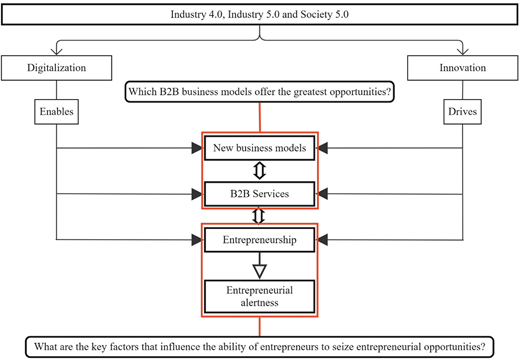
In summary, Figure 1 shows the key topics within the literature review section and RQs.

The main methodological approach used in this research is Q-methodology. This technique is considered a mixed-method approach as it comprises both qualitative and quantitative perspectives. The qualitative perspective is used to identify key topics, perspectives or statements about a theme that participants will later evaluate, while the quantitative one is used to objectify and get a valuation (Brown, 1993; Brown, 1980). In this method, participants (P-set) rank a series of predefined statements (Q-set) according to their individual perceptions, experience and judgment (McKeown and Thomas, 2013; Brown, 1993). Instead of correlating tests, Q-methodology correlates participants, identifying shared and differing viewpoints on the topic. This process is effective only when the statements are carefully selected to ensure representativeness (McKeown and Thomas, 2013; Watts and Stenner, 2005).

In addition, Q-methodology provides some advantages. It streamlines data collection and classification, requiring less time and fewer resources than other techniques (Dieteren et al., 2023; Van Exel and de Graaf, 2005). By evaluating all statements simultaneously while focusing on a single research question, participants can make real-time adjustments, eliminate order effects and enhance accuracy and generalizability (Dieteren et al., 2023; Van Exel and de Graaf, 2005; Watts and Stenner, 2005; McKeown and Thomas, 2013; Brown, 1993).

This research introduces a novel approach by not only applying Q-methodology but also incorporating in-depth interviews (Legard et al., 2003). While this is not a common practice, integrating in-depth interviews increases the rigor, robustness and transparency of the study. In addition, in-depth interviews allow for nuanced insights that cannot always be fully captured or summarized through structured methodologies or predefined statements, thereby addressing one of the potential limitations of Q-methodology (Dieteren et al., 2023; Dworkin, 2012). This methodological combination (known as mixed methodology) strengthens the study by enhancing robustness, confidence and analytical depth (Mingers, 2005), providing a more comprehensive perspective on the research problem (Mingers, 2011).

The justification for using these methods stems from the limitations of using a single approach. Quantitative techniques alone often lack the depth needed to explore complex phenomena comprehensively, potentially omitting critical variables or missing emergent variables during the research process (Pérez-Moure et al., 2024a). These risks become particularly pronounced when studying new business models, B2B markets and entrepreneurship, as these areas are continuously evolving. Conversely, qualitative methods alone may lack objectivity or fail to accurately represent reality due to sampling limitations, time constraints and analytical subjectivity (Minichiello et al., 2008). Thus, integrating qualitative and quantitative methods enables deeper exploration compared to purely quantitative techniques, while preserving greater objectivity and robustness than exclusively qualitative methods. In addition, Q-methodology is widely applied across various fields such as technological innovation, information systems and transportation (Dieteren et al., 2023; Athanasopoulou et al., 2019).

Furthermore, this research adopts both exploratory and descriptive approaches. While the primary objective is to identify impactful business models in the B2B sector and analyze key factors influencing entrepreneurial opportunity exploitation, the study also aims to offer descriptive insights. Given the complexity and breadth of the topic, relying solely on one methodological technique would be inadequate.

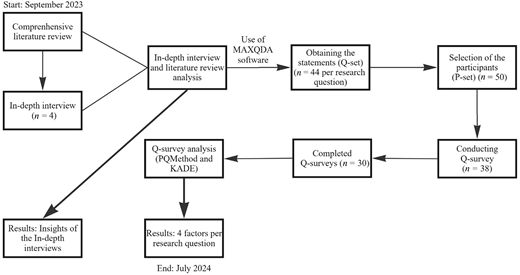
The data collection process took place between September 2023 and July 2024, encompassing both the in-depth interviews and Q-methodology evaluations. To ensure methodological rigor and replicability, this study follows the best practices outlined by Cabanelas et al. (2023) and builds upon previous research that has successfully applied Q-methodology, such as Athanasopoulou et al. (2019), Cairns (2012) and O’Donovan and Smith (2020). Given that this study addresses entrepreneurship and innovation in B2B services within a digitally intensive industry such as mobility – a broad topic that can be analyzed from multiple perspectives – and the complexity of Q-methodology, particular attention has been paid to methodological design. The methodological procedure is shown in Figure 2 and was performed as follows.

A comprehensive literature review and in-depth interviews were conducted to define the Q-set. Thus, an extensive literature review was conducted to identify the main topics and issues related to B2B services, entrepreneurship, business models and mobility. The findings from this review were then used to design in-depth interviews aimed at extracting the key concepts, clarifying ideas and highlighting aspects that might have been overlooked (Legard et al., 2003). This additional methodology step strengthens the reliability of the collected data and enhances its validity (Dworkin, 2012; Minichiello et al., 2008; Legard et al., 2003).

A total of four in-depth semistructured interviews were conducted with experts from the academic, business and public sectors (Table 1). It should be noted that the in-depth interviews are not the main methodology, but complementary. In addition, as this is considered a strategic industry, certain information and potential participants are subject to confidentiality constraints. The script, nonetheless, can be found in  Appendix 1.

MAXQDA is specialized software designed for qualitative data analysis. It allows researchers to import, transcribe and analyze qualitative sources such as in-depth interviews and academic papers. Through this process, it enables the generation of word frequency charts and the identification of key statements. In addition, the research team has prior experience with this software, ensuring rigorous and efficient analysis. The result was a total of 44 statements for each Q-survey ( Appendix 2). This number is considered suitable because, depending on the specificity of each one, the number can be higher or lower, but the recommendation for the Q-set is between 40 and 50 statements (Van Exel and de Graaf, 2005). Finally, the Q-set was assessed with various academics to refine its clarity and ensure that the statements aligned with the RQs. RQ1 and RQ2 are considered suitable because they are open, but they are also focused, brief, clear and related to the research topic and the context (McKeown and Thomas, 2013).

In Q-methodology, the sample is not selected randomly but rather in a logical and deliberate manner. This is because the P-set should encompass diverse perspectives and expertise, ensuring that participants have substantial background knowledge in the subject (Van Exel and de Graaf, 2005).

Following this, we contacted 50 potential participants via email. Of these, 43 responded to the email and 38 initiated the Q-survey. 30 participants completed the process, forming the final P-set (the list of participants, their nationalities and areas of knowledge are given in  Appendix 3). This represents a response rate of 60%. While some studies recommended between 40 and 50 participants (Van Exel and de Graaf, 2005; Brown, 1980), 30 is considered sufficient, given the challenge of recruiting highly relevant participants due to the novelty of the field. Participants also had to respond to the two research questions instead of one, which could have affected the response rate. Nevertheless, our sample size is comparable to other previous studies, and the response rate is even higher (Athanasopoulou et al., 2019; O’Donovan and Smith, 2020; McKeown and Thomas, 2013).

Half of the responses were collected in person (15 completed surveys), while the remaining half was collected online via Miro platform (the other remaining 15). In both cases, participants were required to rate, order and place the statements on a Likert scale ranging from −5/+5, where −5 indicated no opportunity/impact and +5 indicated major opportunity/impact. Participants were allowed to adjust their responses as many times as necessary. The purpose of the research and instruction were explained at the beginning of each individual session. In addition, participants were accompanied throughout the process in case they had any questions; but no direct intervention took place to avoid influencing their responses.

Due to the exploratory and multidisciplinary nature of this research, a group of academic experts was recruited from various fields, including entrepreneurship, B2B services and business models, all within the context of the digitally intensive and innovative mobility industry. Academics were selected instead of other actors because they possess a broader perspective and serve as a link between companies, government and society, granting them a comprehensive understanding of past, present and future dynamics. In addition, they do not have conflicts of interest and are not subject to external influences. Participants had to meet at least two of the following three criteria:

  1. Have published more than five scientific works in one or more of the fields covered in this research, index in JCR (Q1 or Q2) or ABS.

  2. Hold a position as a full professor or senior lecturer in a field related to this research.

  3. Have participated in an international research project related to one or more aspects of our study.

In addition, to mitigate cultural bias, the sample includes academics from different nationalities, including Spain, China, Mexico, France, Italy, Portugal, Canada, the USA and Germany. This international approach aims to enhance the generalizability of the results. Although nationality was not a selection criterion, priority was given to participants from countries where the mobility industry plays a significant role, given that this research focuses on it. This ensures that the findings are contextually relevant and representative of industry trends. All those criteria were based on previous research (Dieteren et al., 2023; O’Donovan and Smith, 2020; Athanasopoulou et al., 2019; Cairns, 2012) and best practices outlined by Cabanelas et al. (2023).

Although the objective of conducting the in-depth interviews was to obtain information that could qualify or complement the literature review, it also provided interesting findings.

4.1.1 Concept of opportunity

First, respondents were asked about the concept of opportunity, as it provided a logical structure for the interview. There was consensus among them that an opportunity represents a gap in the market for which an innovative solution could be developed – one that adds value, is economically viable and effectively meets demand. It was described as a transformational response that bridges what society wants with what it needs.

Second, regarding entrepreneurial motivation and the introduction of new businesses in B2B, several perspectives emerged. On the one hand, it was seen as an intrinsic motivation, driven by the entrepreneur’s desire for better working conditions, a source of income, personal challenges or dissatisfaction with the status quo. On the other hand, it was viewed as an extrinsic motivation, shaped by an environment in which public agents and businesses seek to generate returns – such as profits or patents – through entrepreneurial initiatives.

4.1.2 Business models and the role of servitization

Regarding business models and the impact of servitization, several key insights emerged. First, the trend toward servitization was seen as something that would “inevitably” continue to gain ground. Second, the most relevant business models were identified as those focused on the generation, processing and exchange of data and information, along with the services associated with that data. Disruptive or lesser-known business models were not mentioned (except for Edge computing), which was attributed to their still being at a very early stage of development. In the case of business models that are more relevant in the B2B sphere, respondents primarily referred to services linked to digital platforms, data and connectivity. In this context, they highlighted that technology-driven businesses are better positioned and are gaining relevance.

4.1.3 Digitalization and innovation in B2B firms

Regarding the state of digitalization in B2B firms, it is currently considered to be at a basic level, though it is recognized as an inescapable process of adaptation and innovation. For this transformation to occur, a comprehensive approach is required – one that involves continuous reinvention, linked to a shift in vision and even identity. Digitalization also presents certain drawbacks; it poses a threat to technologically backward firms, as distribution channels are evolving and it may initially lead to a loss of trust. Nevertheless, digitalization is a means rather than an end and accurately diagnosing its application will be fundamental. AI and computational technologies are particularly relevant in this context, yet respondents highlighted significant uncertainty in the market. Furthermore, technology serves as an enabler for entrepreneurship, as it facilitates the identification of new opportunities and allows services to achieve a broader reach.

4.1.4 Entrepreneurial alertness and entrepreneurship

Respondents were asked about entrepreneurial alertness, which was seen as an aspect that can be developed but is also partly linked to the inherent qualities of entrepreneurs. By nature, entrepreneurs must remain aware, continuously seeking new opportunities in the market and engaging in benchmarking. In other words, they must be able to develop competitive intelligence, though certain skills and predispositions may be innate and can be further enhanced through training. That said, respondents emphasized that these innate abilities are less important than the training itself. In addition to commonly recognized entrepreneurial traits, respondents highlighted aspects such as technological awareness, a sharp vision of their goals, future-oriented thinking and collective learning. Moreover, while entrepreneurial alertness was acknowledged as having a significant impact on the business world, some interviewees noted that it tends to be focused more on the present rather than on anticipating future needs and developments.

4.1.5 The role of cooperation and emerging challenges in B2B context

Regarding the importance of cooperation in entrepreneurship, there was consensus that, nowadays, there is no alternative. Most firms are compelled to collaborate to achieve their objectives, particularly in high-technology B2B settings. When asked about the role of public agents, opinions varied. Some viewed them as enablers, providing essential public funding, fiscal support and legislative frameworks. In contrast, entrepreneurs tend to see them as key players in fiscal and legislative matters but not in financial support.

Finally, the interviewees highlighted that entrepreneurs and companies are facing new challenges, such as an increasingly complex and intercultural business environment, along with heightened competition from highly skilled players. The intercultural and intersectoral environment was perceived as beneficial, as it helps identify new opportunities. In short, entrepreneurship or the introduction of new businesses is currently at an uncertain juncture due to the profound changes taking place.

4.2.1 Q-survey analysis

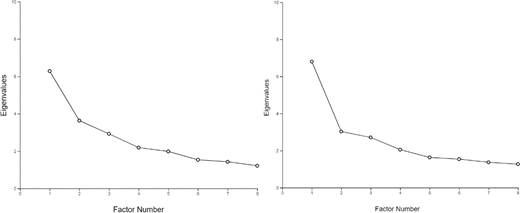
To analyze the responses, the PQMethod application was used as the primary tool for statistical analysis. In addition, KADE, a specialized Q-methodology software, was used to provide a more detailed and visually enhanced analysis of the data. The statements and responses were first processed in PQMethod, where a principal component analysis was conducted to identify patterns and perspectives. Then, KADE was used to further refine the interpretation and improve the visualization of the results. For both the first and second Q-surveys, all extracted factors had Eigenvalues greater than 1 (Figure 3). Out of the eight possible factors, only four were retained for each analysis. This decision was made because, beyond the fourth factor, the Eigenvalues drop below 2, meaning they account for less variance (Tefas and Pitas, 2011). Moreover, each factor represents a distinct perspective or pattern, resulting in a total of eight perspectives per research question. This would lead to a total of 16 perspectives, which would be impractical for result interpretation and analysis. Increasing the number of factors could also negatively impact the interpretability of the findings. Ultimately, considering the research objectives, retaining four factors is deemed appropriate for this study (Tefas and Pitas, 2011; Jolliffe, 2003).

After retaining the four factors, a varimax rotation was applied to enhance consistency and interpretability, ensuring that the extracted factors were distinct from one another and facilitating the identification of dominant patterns (Watts and Stenner, 2005). Once this step was completed, factor loadings were classified for a p-value < 0.05, achieving a reliability level of over 95% for all factors (Watts and Stenner, 2005). It should be noted that while the correlation between factors was not significant in the first question, it was significant for the second. As a result, each factor synthesizes perceptions and generates a new Q-sort summary for each perspective identified. Although the study included 30 participants, only 26 responses were incorporated into the perspectives of the first question. Given the high level of uncertainty in the field, the remaining four responses did not align with any of the extracted perspectives at the established significance level of p-value. Forcing their inclusion would have compromised the reliability of the findings. To classify the statements in the Q-sort summary per factor, the Z-scores were calculated. Z-scores are calculated using the formula Z = (X − μ)/σ where μ represents the mean and σ the standard deviation. Values between 1 and 2 are considered high impact, while values between −1 and −2 are considered low impact (Brown, 1980).

Subsection 4.2.2 presents the results for each question in a descriptive manner. The factors are identified with italicized titles. These results will be further analyzed and discussed in Section 5.

4.2.2 First question results: areas of opportunity

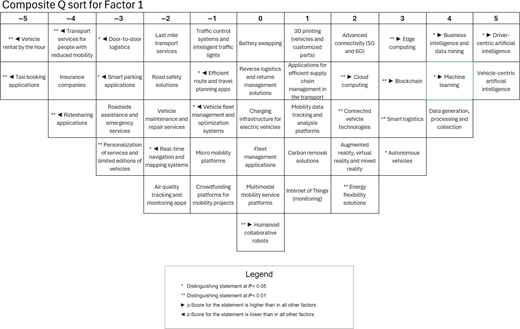
The first question deals with the areas that offer more opportunities in mobility. The resultant Q-sorts are reflected in  Appendix 4 and synthetized in Table 2 by factor. These results will be further analyzed and discussed in Section 5.

Perspective 1: Artificial Intelligence (see Appendix 4– Factor 1)

  • General overview and representation:

    • Includes perspectives from 12 participants, representing 40% of the total sample.

    • All elements related to AI received high scores.

  • Areas of higher opportunity:

    • Statements linked directly to AI such as driver AI (1.94) and vehicle AI (1.70) received the highest scores. As well as technologies that incorporate AI such as machine learning (1.41)

    • Technologies that process and generate data such as business intelligence (1.66), also received a high score.

  • Areas of neutral opportunity:

    • Sustainability-oriented business models and supply chain management-related business models were rated neutrally.

  • Areas of lower opportunity:

    • Shared mobility services such as taxi booking applications (−2.34) or vehicle rental (−1.65) received the lowest scores.

    • Additional service-related business models such as roadside assistance, emergency services or vehicle maintenance also received low scores.

Factor 1 shows that participants associate the highest opportunities with AI-based solutions and data-driven applications, reflecting a preference for automation and technological efficiency. While these results are consistent with Industry 4.0 and 5.0 principles, the relatively lower relevance of sustainability-oriented business models suggests that technological innovation is prioritized over sustainability integration.

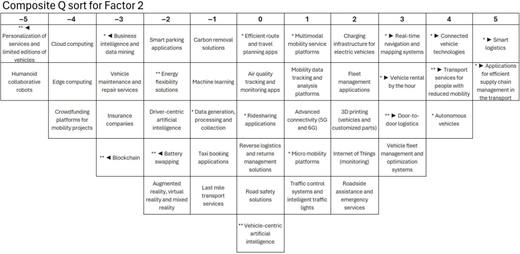
Perspective 2: Logistics-centered technologies (see Appendix 4– Factor 2)

  • General overview and representation:

    • Includes perspectives from six participants, representing 20% of the total sample.

    • Areas related to logistics and supply chain management received the highest scores.

  • Areas of higher opportunity:

    • Smart logistics (2.10) and applications for efficient supply chain management (1.52) received the highest scores.

    • Systems for vehicle fleet management and optimization as well as autonomous vehicles (1.40) and door-to-door logistics received high scores.

  • Areas of neutral opportunity:

    • Sustainability-oriented business models were rated neutrally, like Factor 1.

  • Areas of lower opportunity:

    • Humanoid collaborative robots (−2.20) and vehicle personalization, including limited editions (−2.00), received the lowest scores.

    • Alternative financing models, such as crowdfunding platforms for mobility projects (−1.42) and cloud-based solutions (−1.51), were also ranked lower.

Most of the high-scored statements align with key principles of Industry 4.0, mainly related to logistics optimization and supply chain efficiency. The low relevance assigned to humanoid robotics and vehicle personalization indicates that automation is perceived primarily as a driver of efficiency rather than for enhancing user experience or customization. Likewise, cloud computing and crowdfunding platforms were rated low, suggesting that participants perceive them as weak opportunities in logistics-related B2B services. Factor 2 represents a more traditional and infrastructure-based approach to innovation in the industry.

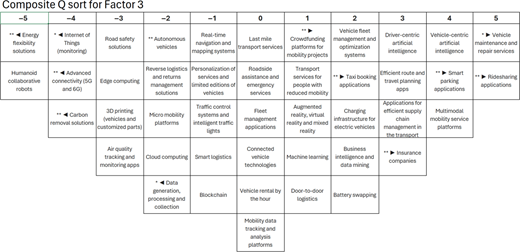
Perspective 3: Mobility as a service (see Appendix 4– Factor 3)

  • General overview and representation:

    • Includes perspectives from five participants, representing 16.67% of the total sample.

    • Direct mobility-related services received the highest scores.

  • Areas of higher opportunity:

    • Services directly linked to mobility such as vehicle maintenance (1.86) and ridesharing apps (1.79) received the highest scores.

    • Several other services also ranked close to the highest score, including Smart parking applications (1.61) and multimodal mobility platforms (1.61).

  • Areas of neutral opportunity:

    • Logistics, resource management and personalization services were rated neutrally.

  • Areas of lower opportunity:

    • Humanoid collaborative robots (−1.89), like factor 2, received the lowest score in this perspective.

    • Sustainability-oriented services and business models such as carbon removal solutions (−1.61) were also ranked low.

Participants in this factor identified the most promising opportunities within mobility servitization, particularly Mobility as a Service (MaaS). Collaboration and real-time information were considered essential enablers of these models. Battery swapping was viewed as a viable option, whereas energy flexibility solutions were rated lower, indicating a selective adoption of Industry 4.0 and 5.0 principles focused mainly on service-based innovation.

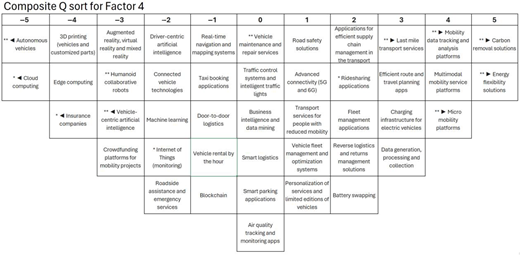
Perspective 4: “Green” business models (see Appendix 4– Factor 4)

  • General overview and representation:

    • Includes perspectives from five participants, representing 16.67% of the total sample.

    • The highest-rated statements were those linked to sustainability in numerous ways.

  • Areas of higher opportunity:

    • Carbon removal solutions (1.93) and energy flexibility solutions (1.84) received the highest scores.

    • In general terms, other services and business models related to a more sustainable resource management such as mobility data tracking (1.43) and electromobility were also ranked highly.

  • Areas of neutral opportunity:

    • In this case, MaaS-related statements were rated neutrally.

  • Areas of lower opportunity:

    • Cloud computing (−2.07) and autonomous vehicles (−2.06) received the lowest score in this perspective.

    • Edge computing was also ranked low, along with personalized services such as 3D printing (−1.43) and insurances (−1.99).

Participants in this factor prioritized sustainability-oriented business models, consistent with current Industry 5.0 and Society 5.0 trends. Lower scores for advanced computing, autonomous vehicles and personalized services indicate that efficiency and environmental considerations are valued over technology-driven differentiation in B2B contexts.

4.2.3 Second question results: entrepreneurship factors

Regarding the factors that condition the use of entrepreneurial opportunities, Table 3 reflects the results by factor, and  Appendix 5 includes the Q-survey results. These results will be further analyzed and discussed in Section 5.

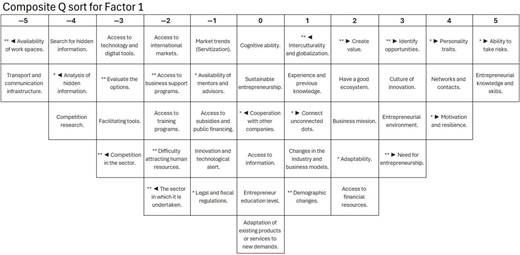
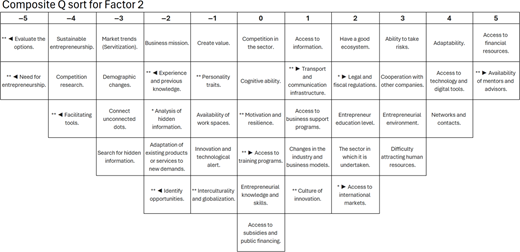
Perspective 1: Proactive entrepreneurship (see Appendix 5 – Factor 1)

  • General overview and representation:

    • Includes perspectives from ten participants, representing 33.33% of the total sample.

    • Closely associated with Factor 1 (AI).

  • Higher impact factors:

    • Statements related to personal traits and entrepreneurial skills received the highest scores.

    • Key personality traits and cognitive skills were prioritized, particularly risk-taking ability (1.81), entrepreneurial knowledge and skills (1.76) or motivation and resilience (1.48).

    • Some environmental factors such as culture of innovation also received high scores.

  • Neutral impact factors:

    • Statements related to the use of information and collaborative inputs for product or service development were rated neutrally.

  • Lower impact factors:

    • Factors related to resources received lower scores such as transport and communication infrastructure (−1.93) and Availability of workspaces (−1.25).

    • Information and analysis-related factors also ranked lower such as search for hidden information (−1.12) or analysis of hidden information (−1.25).

This factor highlights the importance of entrepreneurs’ own skills and knowledge in identifying and exploiting opportunities. Motivation, risk-taking and resilience were rated highest, suggesting that personal attributes are perceived as more critical than external resources. The role of an innovative culture was also acknowledged, though to a lesser extent.

Perspective 2: Resources and business resilience (see Appendix 5– Factor 2)

  • General overview and representation:

    • Includes perspectives from six participants, representing 20% of the total sample.

    • Focus on resource availability and external support as key enablers of entrepreneurship.

  • Higher impact factors:

    • Contextual and sector-specific elements were also highly rated such as access to financial resources (1.94), availability of mentors and advisors (1.79) and access to technologies (1.37) received the highest scores.

  • Neutral impact factors:

    • Statements linked to personal development and training such as individual capabilities and resilience were rated neutrally.

  • Lower impact factors:

    • Statements related to market analysis and information gathering such as evaluate the options (−1.94) received the lowest scores.

This factor emphasizes access to external resources, and particularly finance, training and technology as key enablers of entrepreneurship. Participants placed less emphasis on market analysis and information gathering, suggesting a reliance on tangible resources rather than individual capabilities for entrepreneurial success.

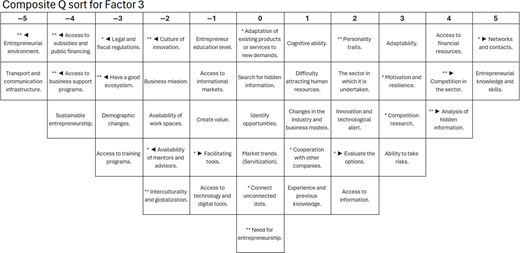
Perspective 3: Multidimensional entrepreneurship (see Appendix 5 – Factor 3)

  • General overview and representation:

    • Includes perspectives from nine participants, representing 30% of the total sample.

    • This is the most multifaceted perspective, incorporating elements from other factors, such as information processing, networks, entrepreneurial knowledge and financial resources.

  • Higher impact factors:

    • Analyzing and processing information was highly rated, including analysis of hidden information or competition research (1.32).

    • Entrepreneurial traits and skills (1.71) also received high scores.

    • Networks and contacts (2.30) were rated as highly relevant.

    • Access to financial resources (1.70) was also considered a key factor.

  • Neutral impact factors:

    • Statements related to opportunity recognition and analytical thinking such as identifying, connecting or uncovering new opportunities were rated neutrally.

  • Lower impact factors:

    • Environmental or institutional conditions received the lowest scores such as entrepreneurial environment (−1.47) or transport and communication infrastructure (−1.42).

This factor reflects a multidimensional view of entrepreneurship, combining elements such as networking, access to resources, information search and proactive behavior. No single aspect was dominant, indicating that entrepreneurial success is perceived as the result of multiple complementary factors rather than one prevailing determinant.

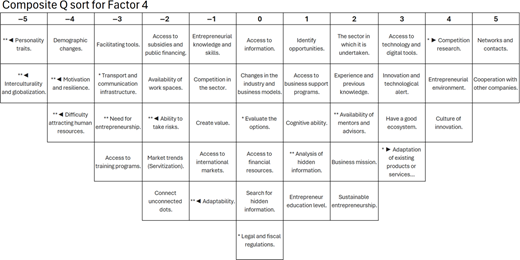
Perspective 4. Collaborative environment (see Appendix 5 – Factor 4)

  • General overview and representation:

    • Includes perspectives from five participants, representing 16.67% of the total sample.

    • Collaboration-related elements received the highest scores.

  • Higher impact factors:

    • Collaboration and networking were highly rated such as cooperation with other firms (1.72) or strong professional networks and contacts (1.59).

    • Contextual and sector-specific elements were also highly rated.

  • Neutral impact factors:

    • Statements related to structural conditions such as access to resources, regulatory factors and information were rated neutrally.

  • Lower impact factors:

    • Human and contextual aspects such as Interculturality and globalization (−2.09) or Difficulty attracting human resources (−1.88) received low scores.

This factor represents a collaborative entrepreneurial profile in which cooperation and strong networks are perceived as the main enablers of success. Rather than relying on personal traits or access to resources, participants emphasize the importance of ecosystem support and collective interaction within the business environment.

Regarding Industry 5.0, several authors have described the transition from Industry 4.0 to 5.0 as a linear process, where companies evolve from an efficiency-driven model (Industry 4.0) toward collaborative and sustainable strategies (Industry 5.0) (Bonamigo and Frech, 2021; Huang et al., 2022; Murtaza et al., 2024; Leng et al., 2022). Our findings suggest a coexistence of Industry 4.0 and 5.0, where companies adopt technologies from both models based on their strategic needs because automation- and efficiency-focused models continue to receive equally high relevance. This implies that companies remain in an early stage of this process, because business models aligned with Industry 5.0 principles such as sustainability, user-centric approaches and intersectoral cooperation are not predominant. In addition, Magni et al. (2023) and Deguchi et al. (2020) suggested that Industry 5.0 is expected to lead to a radical redesign of business models. In contrast, our findings indicate that this evolution may be more gradual, depending on market dynamics, industry and company characteristics.

Both paradigms coexist strategically rather than replacing one another. To explain this phenomenon, we propose the initial notion of “Modular Transition,” suggesting that some firms may selectively adopt technologies from both paradigms based on their market conditions and competitive needs. This flexible adoption challenges the assumption of a universal transition timeline and suggests that firms prioritize automation, AI and efficiency while gradually incorporating collaboration and sustainability as strategic conditions allow.

One of the aims of this research was to identify the most relevant or promising business models in the B2B context. Our research emphasizes the predominance of data-driven and AI-based business models, particularly AI-based driving, machine learning or business intelligence which were highly rated, maybe due to their strategic role in optimizing operations and decision-making processes. These results are consistent with Kowalkowski et al. (2024) who argued that data-driven business models hold greater relevance in B2B than B2C markets and with Pérez-Moure et al. (2024a) who highlighted that new business models should generate value within processes. This perspective may also explain why subscription-based business models were rated lower, contradicting Murtaza et al. (2024).

While AI or logistics optimization were identified as key areas, others such as cloud computing or blockchain were perceived as less relevant, as well as gamification, personalization, mixed reality or information visualization in contrast with De Jong et al. (2021), Venturini (2022) or Leng et al. (2022) who exposed that these technologies are essential enablers of digital transformation. Research has emphasized the significant role of digitalization in shaping business models and its impact on them (Pérez-Moure et al., 2024b; Rachinger et al., 2019; Bouwman et al., 2018). While we agree that digitalization is a key driver of business models, our research pointed out that not all the technologies and business models exert the same impact in B2B. Yet, business models’ adoption is driven not by their disruptive potential but by their immediate applicability and tangible impact. Despite this trend, our analysis revealed significant uncertainty in the development and adoption of new business models, as participant perspectives were misaligned, with four participants excluded from the final analysis.

Business models are continuously evolving, and our findings confirm their highly dynamic nature (Taipale-Erävala et al., 2020; Loureiro, 2018; Teece and Linden, 2017) largely driven by the increasing role of servitization and digitalization (Ruiz de la Torre and Sanchez, 2022; Rachinger et al., 2019; Kowalkowski et al., 2017; Rabetino et al., 2017). While servitization-driven business models (e.g. vehicle maintenance and repair services, applications for efficient supply chain management or multimodal mobility platforms) have been positively rated, others such as personalization-focused services [e.g. Personalization of services and limited editions of vehicles, Transport services for people with reduced mobility or 3D printing (vehicles and customized parts)] were perceived as limited relevance. These findings disagree with the assumption that servitization in B2B follows the same logic as in B2C, where customization is a key competitive differentiator (Kowalkowski et al., 2024; Wirtz and Kowalkowski, 2022; Bettiol et al., 2017) and the proposition that extreme personalization and XaaS will play an essential role in industrial contexts (Mourtzis and Angelopoulos, 2024). Instead, B2B firms prioritize efficiency- and reliability-oriented business models over hyperpersonalization. Decision-making in B2B contexts is largely rational and cost-driven, leading firms to favor scalable solutions that deliver measurable process improvements and operational efficiency. As a result, process optimization, automation and AI-driven adaptability are expected to shape the evolution of B2B services, with firms investing primarily in technologies that offer tangible, short-term value rather than uncertain, long-term benefits.

The growing importance of sustainability in new business models has been widely recognized (Mourtzis and Angelopoulos, 2024; Kowalkowski et al., 2024; Pérez-Moure et al., 2023), and different authors have positioned it as a core principle of Industry 5.0 (Murtaza et al.; Xu et al., 2021). Conversely, our findings suggest that sustainability-driven business models in B2B currently do not represent a major market opportunity. Business models such as charging infrastructure for electric vehicles, efficient route and travel planning apps or battery swapping were rated as low or neutral. This challenges the assertions that business models should be primarily oriented toward social welfare (Deguchi et al., 2020; Huang et al., 2022). Instead, B2B firms appear to prioritize business models that enhance competitiveness through efficiency, cost and revenues. Resource management solutions such as fleet management applications were positively evaluated, suggesting that sustainability is not irrelevant in B2B but selectively integrated. These findings partially align with the findings of Lampón et al. (2024a), who argued that in the digital transformation of supply chains, sustainability is not a determinant criterion. This finding suggests a more nuanced perspective of sustainability in B2B, showing that it is not an independent driver of transformation but rather an efficiency enabler. This insight suggests a shift from sustainability concept to a pragmatic business strategy, reinforcing that firms adopt sustainability selectively, not universally.

Finally, entrepreneurial alertness has been traditionally conceptualized as an individual’s capacity and process to identify opportunities, driven by a cognitive process that responds to environmental stimuli, connecting seemingly unrelated elements and processing relevant information (Baron, 2007; Valliere, 2013; Chavoushi et al., 2020). While this perspective remains relevant, our findings suggest that social networks (Sharma, 2019) and technological foresight are not merely complementary factors but fundamental drivers of alertness in digitally intensive B2B environments, as well as strategic abilities, intersectoral collaboration or collective learning. This contrasts with studies that prioritized individual opportunity recognition (Valliere, 2013) or short-term opportunity scanning (Lanivich et al., 2022). Based on our interviews, we argue for a systemic approach, incorporating short-, medium- and long-term analytical processes.

These findings align with the emergence of Society 5.0, where collaborative intelligence replaces isolated entrepreneurial action (Deguchi et al., 2020). This transition is closely tied to the redefinition of opportunity as a gap in the market for which a solution can be developed, adding value and being economically viable (Pidduck and Clark, 2024; Daniel et al., 2021; Ojala, 2016), but with a transformative nature that combines what society wants with what it needs. Furthermore, previous research has established a positive relationship between entrepreneurial alertness and innovation (Levasseur et al., 2022; Zhao et al., 2021), dynamic environment (Fellnhofer, 2022; Lew et al., 2023) and learning’s moderating effect on risk perception (Zhao et al., 2021). Our four identified perspectives – Proactive Entrepreneurship, Resources and Business Resilience, Multidimensional Entrepreneurship and Collaborative Environment – reinforce these relationships, indicating that in the current competitive and dynamic environment, entrepreneurs must adopt a proactive, multidisciplinary, collaborative and adaptive approach to sustain innovation and competitiveness.

Another key insight is the diminishing role of financial resources as the primary enabler of entrepreneurship. While traditional studies emphasized access to financial resources or funding (Shane, 2009), our results suggest that entrepreneurial success in digitally intensive B2B context is more dependent on technology, collaboration, knowledge exchange or abilities. Furthermore, entrepreneurial traits such as assuming risks, motivation or adaptability are now more relevant to entrepreneurial success instead of a sustainable long-term approach (Kim and Kim, 2021) or entrepreneurship through necessity (Dencker et al., 2021).

Finally, while digital entrepreneurship (Bogoslov and Lungu, 2020; Kraus et al., 2018) and service digitalization remain crucial for new business’ sustainability and profitability (Venkatesh et al., 2019; Sahut et al., 2021), previous studies have positioned blockchain (Chalmers et al., 2021b), AI (Chalmers et al., 2021a; Shepherd and Majchrzak, 2022), Big Data (Obschonka and Audretsch, 2020) or VR (Ben Saad and Choura, 2022) as entrepreneurship-facilitating technologies. Our interviews indicate that there is no single dominant enabling technology, except for AI, which ranked highest, followed by Big Data at a secondary level. This suggests that entrepreneurs must develop continuous awareness of emerging digital capabilities, leveraging technological advancements not as isolated tools but as integral components of strategic decision-making.

Therefore, our results indicate that network integration, collective intelligence and technological alertness are now equally critical in dynamic B2B environments, making a disruptive shift in how entrepreneurial alertness should be understood. We propose a redefinition of entrepreneurial alertness that can be increasingly understood as a broader process of identifying conventional commercial patterns or anticipating future trends but also about leveraging intersectoral networks to access knowledge and opportunities; adapting to technological foresight rather than reacting to existing gaps; and integrating strategic partnerships as a core component of entrepreneurial decision-making. This shifts the focus from an individual-driven process to a collaborative, digital and network-driven one.

This research presents several practical implications. The findings suggest that the most promising business models in B2B are those focus on AI, data management and resource optimization, with logistics standing out as key area. This highlights the need for firms to adopt new technologies that enhance operational efficiency. Companies should explore investments in AI, smart logistics, supply chain management applications, direct services, energy flexibility solutions and carbon removal solutions. Conversely, they should limit investments in business models such as hourly vehicle rentals, taxi reservation apps, vehicle personalization and limited editions or humanoid collaborative robots. In other words, firms should prioritize enhancing operational efficiency and value-chain integration over hyper-personalized services that may not align with B2B customer needs.

B2B firms may benefit from adopting a flexible approach aligned with the ideas of “Modular Transition” as a flexible business strategy, complemented by “Strategic Filtering,” to selectively integrate technologies from Industry 4.0 and 5.0 according to market conditions and strategic priorities. In practice, this means prioritizing technologies that optimize processes, logistics, efficiency and decision-making such as AI and data management over those with limited operational impact, such as blockchain, VR, gamification or cloud computing.

Digitalization should therefore be treated as a strategic resource rather than an end goal, adapted to each industry’s contingencies and emerging competences. In addition, authors have warned of the “hidden side” of digitalization (Gligor et al., 2021; Bamel et al., 2022), which may generate unrealistic expectations regarding its immediate benefits (Gligor et al., 2021; Bamel et al., 2022). Our findings reinforce the need to approach digital transformation pragmatically, as an enabler of strategic value rather than a universal solution.

Finally, managers should prepare their organizations to adapt continuously to evolving market and regulatory conditions, particularly regarding sustainability and AI. Developing compliance and intersectoral cooperation strategies can enhance flexibility and strengthen firms’ capacity to anticipate change and maintain competitiveness.

The results also indicate that entrepreneurs should internalize entrepreneurial alertness, adopting a mindset of a continuous innovation process, fostering creativity, collective learning and adaptability to respond efficiently to the evolving market demands. This means entrepreneurs should not only focus on identifying market gaps but also on building strategic partnerships and leveraging collective intelligence through digital platforms and professional networks. To this end, cooperation constitutes a cornerstone in an increasingly interconnected and complex environment. Firms and entrepreneurs should seek alliances to reach new markets and access services that they cannot provide independently.

Entrepreneurs should improve skills such as risk-taking, resilience, adaptability and competitive intelligence, which should be central elements of training programs. To enhance entrepreneurship and improve resources management, the findings suggest focus on risk management capabilities, entrepreneurial knowledge and skills development, access to mentors, participation in professional networks and collaboration within business ecosystems. Meanwhile, less emphasis should be placed on factors such as workspace availability, transport infrastructure or the level of internationalization of the market, as these are less influential in the success of B2B entrepreneurship. Finally, public institutions should play an indirect role in supporting entrepreneurship, primarily by facilitating legal and fiscal regulations rather than direct financial investment.

These transformations reshape the role of entrepreneurs and managers, demanding greater flexibility, adaptability and interdisciplinary expertise while maintaining the rational, efficiency-driven nature of B2B markets, which demands specialized skills. In addition, AI is set to influence new business models development, management and automation, posing a risk of overautomation if digitalization is misapplied as an end in itself. It may negatively impact B2B markets, particularly when user-centric technology adoption is overlooked.

Given the exploratory nature, this research presents some limitations. While the number of participants in the methodologies was sufficient for exploratory research, a larger sample size could enhance robustness. In addition, despite efforts to mitigate cultural bias, generalizability remains limited due to both the sample size and sector-specific focus (mobility). The study reflects the perspective of experienced academics with an international scope, but incorporating other actors would enrich future findings. Furthermore, digitally intensive B2B industries were the primary focus, meaning that results could vary in less digitalized industry. Finally, the research shares the inherent constraints of Q methodologies, requiring a manageable number of statements and posing potential comprehension challenges among participants.

Future research should further explore the coexistence of Industry 4.0 and Industry 5.0 as an evolving framework, analyzing how firms integrate both paradigms across different industries and organizational levels. Because the conceptual boundaries of Industry 5.0 are still being defined, future studies could investigate how enabling technologies, human–machine collaboration and value co-creation operate simultaneously under both paradigms. In addition, while this research identified Strategic Filtering as a process primarily focused on operational efficiency, subsequent studies could examine its strategic dimension and long-term implications for competitive advantage. The role of sustainability should also receive deeper attention, particularly in understanding how it can move beyond an efficiency enabler toward a source of innovation and differentiation in B2B contexts. Finally, the concept of Modular Transition introduced here offers a promising foundation for future empirical and conceptual research, enabling the analysis of how firms selectively adopt technologies and business models in response to shifting market and institutional dynamics.

Future research could also investigate the ethical and regulatory implications of AI-driven decision-making in B2B contexts. Extending this research beyond the mobility industry would provide broader insights into how digital entrepreneurship unfolds across diverse industries with different technological intensities. Moreover, incorporating quantitative and mixed-methods approaches could help validate and contrast the patterns identified here, strengthening the generalizability of the findings. Finally, further examination of AI’s influence on entrepreneurial behavior and strategic decision-making would contribute to a deeper understanding of how digital capabilities shape competitiveness and innovation in B2B markets.

Overall, this study highlights the evolving interplay between digitalization, entrepreneurship and business models in B2B environments. By introducing the concepts of ‘Modular Transition’ and ‘Strategic Filtering,’ it advances the understanding of how firms manage technological and organizational complexity during the transition from Industry 4.0 to Industry 5.0. These findings underline that digital transformation in B2B contexts is neither linear nor universal, but rather adaptive, selective and context dependent. The study contributes to bridging theory and practice by offering a comprehensive perspective on how firms can combine efficiency, collaboration and sustainability to build more resilient and competitive business models in the new industrial era. The most promising business models will be those capable of combining technological innovation with strategic flexibility, translating efficiency and sustainability into measurable competitive advantages such as AI and Big Data. Likewise, entrepreneurship in this new era will depend on cultivating technological alertness, collective intelligence and collaborative capabilities that enable firms to anticipate change and co-create value within increasingly dynamic ecosystems.

Ancillo
,
A.
and
Gavrila
,
S.G.
(
2023
), “
The impact of research and development on entrepreneurship, innovation, digitization and digital transformation
”,
Journal of Business Research
, Vol.
157
, p.
113566
, doi: .
Åström
,
J.
,
Reim
,
W.
and
Parida
,
V.
(
2022
), “
Value creation and value capture for AI business model innovation: a three-phase process framework
”,
Review of Managerial Science
, Vol.
16
No.
7
, pp.
2111
-
2133
, doi: .
Athanasopoulou
,
A.
,
de Reuver
,
M.
,
Nikou
,
S.
and
Bouwman
,
H.
(
2019
), “
What technology enabled services impact business models in the automotive industry? An exploratory study
”,
Futures
, Vol.
109
, pp.
73
-
83
, doi: .
Audretsch
,
D.
and
Keilbach
,
M.
(
2007
), “
The theory of knowledge spillover entrepreneurship
”,
Journal of Management Studies
, Vol.
44
No.
7
, pp.
1242
-
1254
, doi: .
Bamel
,
U.
,
Kumar
,
S.
,
Lim
,
W.M.
,
Bamel
,
N.
and
Meyer
,
N.
(
2022
), “
Managing the dark side of digitalization in the future of work: a fuzzy TISM approach
”,
Journal of Innovation & Knowledge
, Vol.
7
No.
4
, p.
100275
, doi: .
Baron
,
R.A.
(
2007
), “
Behavioral and cognitive factors in entrepreneurship: entrepreneurs as the active element in new venture creation
”,
Strategic Entrepreneurship Journal
, Vol.
1
Nos
1-2
, pp.
167
-
182
, doi: .
Ben Saad
,
S.
and
Choura
,
F.
(
2022
), “
Effectiveness of virtual reality technologies in digital entrepreneurship: a comparative study of two types of virtual agents
”,
Journal of Research in Marketing and Entrepreneurship
, Vol.
24
No.
1
, pp.
195
-
220
, doi: .
Ben Youssef
,
A.
,
Boubaker
,
S.
,
Dedaj
,
B.
and
Carabregu-Vokshi
,
M.
(
2021
), “
Digitalization of the economy and entrepreneurship intention
”,
Technological Forecasting and Social Change
, Vol.
164
, p.
120043
, doi: .
Berman
,
T.
,
Stuckler
,
D.
,
Schallmo
,
D.
and
Kraus
,
S.
(
2024
), “
Drivers and success factors of digital entrepreneurship: a systematic literature review and future research agenda
”,
Journal of Small Business Management
, Vol.
62
No.
5
, pp.
1
-
29
, doi: .
Bettiol
,
M.
,
Capestro
,
M.
and
Di Maria
,
E.
(
2017
), “
Industry 4.0: the strategic role of marketing
”,
Proceedings of the XIV Convegno Annuale SIM
,
Bergamo, Italy
, pp.
26
-
27
.
Bican
,
P.M.
and
Brem
,
A.
(
2020
), “
Digital business model, digital transformation, digital entrepreneurship: is there a sustainable ‘digital’?
”,
Sustainability
, Vol.
12
No.
13
, p.
5239
, doi: .
Bogoslov
,
A.
and
Lungu
,
E.
(
2020
), “
The relationship between entrepreneurship and digitalization – spotlight on the EU countries
”,
Studies in Business and Economics
, Vol.
15
No.
3
, pp.
5
-
15
, doi: .
Bonamigo
,
A.
and
Frech
,
C.G.
(
2021
), “
Industry 4.0 in services: challenges and opportunities for value co-creation
”,
Journal of Services Marketing
, Vol.
35
No.
4
, pp.
412
-
427
, doi: .
Bortoluzzi
,
G.
,
Chiarvesio
,
M.
,
Romanello
,
R.
,
Tabacco
,
R.
and
Veglio
,
V.
(
2022
), “
Servitisation and performance in the business-to-business context: the moderating role of Industry 4.0 technologies
”,
Journal of Manufacturing Technology Management
, Vol.
33
No.
9
, pp.
108
-
128
, doi: .
Bouwman
,
H.
,
Nikou
,
S.
,
Molina-Castillo
,
F.J.
and
de Reuver
,
M.
(
2018
), “
The impact of digitalization on business models
”,
Digital Policy, Regulation and Governance
, Vol.
20
No.
2
, pp.
105
-
124
, doi: .
Brown
,
S.R.
(
1980
), “
Political subjectivity: applications of Q methodology in political science
”,
Yale University Press, New Haven
.
Brown
,
S.
(
1993
), “
A primer on Q methodology
”,
Operant Subjectivity
, Vol.
16
Nos
3-4
, pp.
91
-
138
, doi: .
Cabanelas
,
P.
,
Parkhurst
,
G.
,
Thomopoulos
,
N.
and
Lampón
,
J.F.
(
2023
), “
A dynamic capability evaluation of emerging business models for new mobility
”,
Research in Transportation Business & Management
, Vol.
47
, p.
100964
, doi: .
Casadesus-Masanell
,
R.
and
Ricart
,
J.E.
(
2010
), “
From strategy to business models and onto tactics
”,
Long Range Planning
, Vol.
43
Nos
2-3
, pp.
195
-
215
, doi: .
Casanova
,
S.
,
Bakkali
,
C.
and
Tang
,
J.
(
2023
), “
Entrepreneurial alertness and entrepreneurial orientation: contributions to opportunity identification
”,
The International Journal of Entrepreneurship and Innovation
, doi: .
Casidy
,
R.
,
Nyadzayo
,
M.
and
Mohan
,
M.
(
2020
), “
Service innovation and adoption in industrial markets: an SME perspective
”,
Industrial Marketing Management
, Vol.
89
, pp.
157
-
170
, doi: .
Chalmers
,
D.
,
MacKenzie
,
N.G.
and
Carter
,
S.
(
2021a
), “
Artificial intelligence and entrepreneurship: implications for venture creation in the fourth industrial revolution
”,
Entrepreneurship Theory and Practice
, Vol.
45
No.
5
, pp.
1028
-
1053
, doi: .
Chalmers
,
D.
,
Matthews
,
R.
and
Hyslop
,
A.
(
2021b
), “
Blockchain as an external enabler of new venture ideas: digital entrepreneurs and the disintermediation of the global music industry
”,
Journal of Business Research
, Vol.
125
, pp.
577
-
591
, doi: .
Chavoushi
,
Z.
,
Hassannezhad
,
Z.
,
Mohammad
,
R.
,
Valliere
,
D.
,
Faghih
,
N.
,
Hejazi
,
R.
and
Dehkordi
,
A.M.
(
2020
), “
Entrepreneurial alertness: a systematic literature review
”,
Journal of Small Business & Entrepreneurship
, Vol.
33
No.
2
, pp.
123
-
152
, doi: .
Cairns
,
R.
(
2012
), “
Understanding science in conservation: a Q method approach on the Galápagos Islands
”,
Conservation and Society
, Vol.
10
No.
3
, pp.
217
-
231
, doi: .
Daniel
,
A.D.
,
Adeel
,
S.
and
Botelho
,
A.
(
2021
), “
Entrepreneurial alertness research: past and future
”,
Sage Open
, Vol.
11
No.
3
, p.
215824402110315
, doi: .
Dayan
,
M.
and
Ndubisi
,
N.O.
(
2020
), “
B2B service innovation and global industrial service management
”,
Industrial Marketing Management
, Vol.
89
, pp.
140
-
142
, doi: .
De Jong
,
A.
,
De Ruyter
,
K.
,
Keeling
,
D.I.
,
Polyakova
,
A.
and
Ringberg
,
T.
(
2021
), “
Key trends in business-to-business services marketing strategies: developing a practice-based research agenda
”,
Industrial Marketing Management
, Vol.
93
, pp.
1
-
9
, doi: .
Deguchi
,
A.
,
Hirai
,
C.
,
Matsuoka
,
H.
,
Nakano
,
T.
,
Oshima
,
K.
,
Tai
,
M.
and
Tani
,
S.
(
2020
), “
What is society 5.0?
”,
Society
, pp.
1
-
23
, doi: .
Del Giudice
,
M.
,
Scuotto
,
V.
and
Papa
,
A.
(
2023
),
Knowledge Management and AI in Society 5.0
,
Routledge
, doi: .
Dencker
,
Bacq
,
S.
,
Gruber
,
M.
and
Haas
,
M.
(
2021
), “
Reconceptualizing necessity entrepreneurship: a contextualized framework of entrepreneurial processes under the condition of basic needs
”,
Academy of Management Review
, Vol.
46
No.
1
, pp.
60
-
79
, doi: .
Dieteren
,
C.M.
,
Patty
,
N.J.
,
Reckers-Droog
,
V.T.
and
Van Exel
,
J.
(
2023
), “
Methodological choices in applications of Q methodology: a systematic literature review
”,
Social Sciences & Humanities Open
, Vol.
7
No.
1
, p.
100404
, doi: .
Dinh
,
T.L.
,
Vu
,
M.C.
and
Ayayi
,
A.G.
(
2018
), “
Towards a living lab for promoting the digital entrepreneurship process
”,
International Journal of Entrepreneurship
, Vol.
22
No.
1
,
available at:
Link to Towards a living lab for promoting the digital entrepreneurship processLink to a PDF of the cited article.
Dotzel
,
T.
and
Shankar
,
V.
(
2019
), “
The relative effects of business-to-business (vs. business-to-consumer) service innovations on firm value and firm risk: an empirical analysis
”,
Journal of Marketing
, Vol.
83
No.
5
, pp.
133
-
152
, doi: .
Dworkin
,
S.L.
(
2012
), “
Sample size policy for qualitative studies using in-depth interviews
”,
Archives of Sexual Behavior
, Vol.
41
No.
6
, pp.
1319
-
1320
, doi: .
Fellnhofer
,
K.
(
2022
), “
Entrepreneurial alertness toward responsible research and innovation: digital technology makes the psychological heart of entrepreneurship pound
”,
Technovation
, Vol.
118
, p.
102384
, doi: .
Ghazy
,
N.
,
Ghoneim
,
H.
and
Lang
,
G.
(
2022
), “
Entrepreneurship, productivity and digitalization: evidence from the EU
”,
Technology in Society
, Vol.
70
, p.
102052
, doi: .
Gligor
,
D.M.
,
Pillai
,
K.G.
and
Golgeci
,
I.
(
2021
), “
Theorizing the dark side of business-to-business relationships in the era of AI, big data, and blockchain
”,
Journal of Business Research
, Vol.
133
, pp.
79
-
88
, doi: .
Golovianko
,
M.
,
Terziyan
,
V.
,
Branytskyi
,
V.
and
Malyk
,
D.
(
2023
), “
Industry 4.0 vs. Industry 5.0: co-existence, transition, or a hybrid
”,
Procedia Computer Science
, Vol.
217
, pp.
102
-
113
, doi: .
Hermawati
,
W.
,
Febrianda
,
R.
,
Aminullah
,
E.
,
Ariyani
,
L.
,
Hidayat
,
A.S.
and
Fizzanty
,
T.
(
2024
), “
SME owners’ roles for mutual reinforcement of innovation and entrepreneurship in dealing with digital technologies: case studies of selected Indonesian SMEs
”,
Asian Journal of Technology Innovation
, Vol.
33
No.
2
, pp.
1
-
26
, doi: .
Huang
,
S.
,
Wang
,
B.
,
Li
,
X.
,
Zheng
,
P.
,
Mourtzis
,
D.
and
Wang
,
L.
(
2022
), “
Industry 5.0 and society 5.0—comparison, complementation and co-evolution
”,
Journal of Manufacturing Systems
, Vol.
64
, pp.
424
-
428
, doi: .
Ibarra
,
D.
,
Ganzarain
,
J.
and
Igartua
,
J.C.
(
2018
), “
Business model innovation through Industry 4.0: a review
”,
Procedia Manufacturing
, Vol.
22
, pp.
4
-
10
, doi: .
Jelinek
,
M.
and
Litterer
,
J.A.
(
1995
), “
Toward entrepreneurial organizations: meeting ambiguity with engagement
”,
Entrepreneurship Theory and Practice
, Vol.
19
No.
3
, pp.
137
-
168
, doi: .
Jolliffe
,
I.T.
(
2003
),
Principal Component Analysis
, (2nd ed.) ,
Springer-Verlag
,
New York, NY
.
Kaish
,
S.
and
Gilad
,
B.
(
1991
), “
Characteristics of opportunities search of entrepreneurs versus executives: sources, interests, general alertness
”,
Journal of Business Venturing
, Vol.
6
No.
1
, pp.
45
-
61
, doi: .
Kim
,
J.
and
Oh
,
I.
(
2022
), “
Adoption of emerging technologies and growth of manufacturing firms: the importance of technology types and corporate entrepreneurship
”,
Technology Analysis & Strategic Management
, Vol.
113
, doi: .
Kim
,
S.
and
Kim
,
A.
(
2021
), “
Going viral or growing like an oak tree? Towards sustainable local development through entrepreneurship
”,
Academy of Management Journal
, Vol.
65
No.
5
, pp.
1709
-
1746
, doi: .
Kirschbaum
,
M.A.
,
Barnett
,
T.
and
Cross
,
M.
(
2024
), “
Combining Q methodology and interviews using mixed methods integration: an exemplar study exploring over-the-counter codeine misuse in Australia
”,
International Journal of Social Research Methodology
, Vol.
28
No.
2
, pp.
1
-
15
, doi: .
Koroglu
,
O.
(
2023
),
AI and XR (AIXR) Marketing in Industry 5.0 or Society 5.0
,
Emerald Publishing Limited eBooks
, pp.
83
-
100
, doi: .
Kowalkowski
,
C.
,
Gebauer
,
H.
,
Kamp
,
B.
and
Parry
,
G.
(
2017
), “
Servitization and deservitization: overview, concepts, and definitions
”,
Industrial Marketing Management
, Vol.
60
, pp.
4
-
10
, doi: .
Kowalkowski
,
C.
,
Wirtz
,
J.
and
Ehret
,
M.
(
2024
), “
Digital service innovation in B2B markets
”,
Journal of Service Management
, Vol.
35
No.
2
, pp.
280
-
305
, doi: .
Kramer
,
V.
,
Krafft
,
M.
and
Storbacka
,
K.
(
2024
), “
A configurational approach to understanding relationship characteristics in differing levels of servitization
”,
Industrial Marketing Management
, Vol.
117
, pp.
42
-
65
, doi: .
Kraus
,
S.
,
Palmer
,
C.
,
Kailer
,
N.
,
Kallinger
,
F.L.
and
Spitzer
,
J.
(
2018
), “
Digital entrepreneurship
”,
International Journal of Entrepreneurial Behavior & Research
, Vol. ahead-of-print No.
ahead-of-print
, pp.
353
-
375
, doi: .
Kumar
,
R.
,
Kaur
,
S.
,
Erceg
,
Ž.
and
Mirović
,
I.
(
2023
), “
Industry 4.0 and its impact on entrepreneurial ecosystems: an examination of trends and key implications
”,
Journal of Organizations, Technology and Entrepreneurship
, Vol.
1
No.
1
, pp.
12
-
34
, doi: .
Lampón
,
J.F.
,
Carballo-Cruz
,
F.
and
Velando-Rodríguez
,
M.
(
2024a
), “
The irruption of autonomous and connected vehicle technologies and the repositioning of the periphery in the european automotive industry
”,
Kybernetes
, Vol.
54
No.
11
, doi: .
Lampón
,
J.F.
,
Pérez-Moure
,
H.
,
Carballo-Cruz
,
F.
and
Velando-Rodríguez
,
M.E.
(
2024b
), “
New mobility technologies and regional status in the automotive industry value chain: the case of Spain and Portugal
”,
Technology in Society
, Vol.
78
, p.
102624
, doi: .
Lanivich
,
S.E.
,
Smith
,
A.
,
Levasseur
,
L.
,
Pidduck
,
R.J.
,
Busenitz
,
L.
and
Tang
,
J.
(
2022
), “
Advancing entrepreneurial alertness: review, synthesis, and future research directions
”,
Journal of Business Research
, Vol.
139
, pp.
1165
-
1176
, doi: .
Lazić
,
A.
and
Jović
,
M.
(
2019
), “
Strategic digital transformation of organisations
”,
5th IPMA SENET Project Management Conference (SENET 2019)
.
Legard
,
R.
,
Keegan
,
J.
and
Ward
,
K.
(
2003
), “In-depth interviews”, Iin
Richie
,
J.
and
Lewis
,
J.
(Eds),
Qualitative Research Practice
,
Sage
,
London
, pp.
139
-
168
.
Leipziger
,
M.
,
Kanbach
,
D.K.
and
Kraus
,
S.
(
2024
), “
Business model transition and entrepreneurial small businesses: a systematic literature review
”,
Journal of Small Business and Enterprise Development
, Vol.
31
No.
3
, pp.
473
-
491
, doi: .
Leng
,
J.
,
Sha
,
W.
,
Wang
,
B.
,
Zheng
,
P.
,
Zhuang
,
C.
,
Liu
,
Q.
,
Wuest
,
T.
,
Mourtzis
,
D.
and
Wang
,
L.
(
2022
), “
Industry 5.0: prospect and retrospect
”,
Journal of Manufacturing Systems
, Vol.
65
, pp.
279
-
295
, doi: .
Leng
,
J.
,
Zhu
,
X.
,
Huang
,
Z.
,
Li
,
X.
,
Zheng
,
P.
,
Zhou
,
X.
,
Mourtzis
,
D.
,
Wang
,
B.
,
Qi
,
Q.
,
Shao
,
H.
,
Wan
,
J.
,
Chen
,
X.
,
Wang
,
L.
and
Liu
,
Q.
(
2024
), “
Unlocking the power of industrial artificial intelligence towards Industry 5.0: insights, pathways, and challenges
”,
Journal of Manufacturing Systems
, Vol.
73
, pp.
349
-
363
, doi: .
Lenger
,
A.
(
2019
), “
The rejection of qualitative research methods in economics
”,
Journal of Economic Issues
, Vol.
53
No.
4
, pp.
946
-
965
, doi: .
Leppänen
,
P.
,
George
,
G.
and
Alexy
,
O.
(
2023
), “
When do novel business models lead to high performance? A configurational approach to value drivers, competitive strategy, and firm environment
”,
Academy of Management Journal
, Vol.
66
No.
1
, pp.
164
-
194
.
Levasseur
,
L.
,
Tang
,
J.
,
Karami
,
M.
,
Busenitz
,
L.
and
Kacmar
,
K.M.
(
2022
), “
Increasing alertness to new opportunities: the influence of positive affect and implications for innovation
”,
Asia Pacific Journal of Management
, Vol.
39
No.
1
, pp.
27
-
49
, doi: .
Lew
,
Y.K.
,
Zahoor
,
N.
,
Donbesuur
,
F.
and
Khan
,
H.
(
2023
), “
Entrepreneurial alertness and business model innovation in dynamic markets: international performance implications for SMEs
”,
R&D Management
, Vol.
53
No.
2
, pp.
224
-
243
, doi: .
Li
,
C.
,
Murad
,
M.
,
Shahzad
,
F.
,
Khan
,
M.A.S.
,
Ashraf
,
S.F.
and
Dogbe
,
C.S.K.
(
2020
), “
Entrepreneurial passion to entrepreneurial behavior: role of entrepreneurial alertness, entrepreneurial self-efficacy and proactive personality
”,
Frontiers in Psychology
, Vol.
11
, doi: .
Liu
,
Y.
,
Guo
,
M.
,
Han
,
Z.
,
Gavurova
,
B.
,
Bresciani
,
S.
and
Wang
,
T.
(
2024
), “
Effects of digital orientation on organizational resilience: a dynamic capabilities perspective
”,
Journal Of Manufacturing Technology Management
, Vol.
35
No.
2
, pp.
268
-
290
, doi: .
Loureiro
,
A.
(
2018
), “
There is a fourth industrial revolution: the digital revolution
”,
Worldwide Hospitality and Tourism Themes
, Vol.
10
No.
6
, pp.
740
-
744
, doi: .
McKeown
,
B.
and
Thomas
,
D.
(
2013
),
Q Methodology
,
Sage publications
, Vol.
66
.
Magni
,
D.
,
Del Gaudio
,
G.
,
Papa
,
A.
and
Della Corte
,
V.
(
2023
), “
Digital humanism and artificial intelligence: the role of emotions beyond the human–machine interaction in society 5.0
”,
Journal of Management History
, Vol.
30
No.
2
, pp.
195
-
218
, doi: .
Medina
,
E.
,
Mazaira
,
A.
and
Alén
,
E.
(
2022
), “
Innovation in the broadcasters’ business model: a bibliometric and review approach
”,
European Research on Management and Business Economics
, Vol.
28
No.
3
, p.
100202
, doi: .
Minerbo
,
C.
and
Brito
,
L.A.L.
(
2022
), “
An integrated perspective of value creation and capture: a systematic literature review
”,
Journal of Business & Industrial Marketing
, Vol.
37
No.
4
, pp.
768
-
789
, doi: .
Mingers
,
J.
(
2005
), “
A critique of statistical modelling in management science from a critical realist perspective: its role within multimethodology
”,
Journal of the Operational Research Society
, Vol.
57
No.
2
, doi: .
Mingers
,
J.
(
2011
), “
Multimethodology
”,
Wiley Encyclopedia of Operations Research and Management Science
, doi: .
Minichiello
,
V.
,
Aroni
,
R.
, and
Hays
,
T.N.
(
2008
),
In-Depth Interviewing: Principles, Techniques, Analysis
,
Pearson Education
.
Mourtzis
,
D.
and
Angelopoulos
,
J.
(
2024
),
Challenges and Opportunities for the Design and Development of Intelligent, Sustainable and Resilient Personalized Product-Service Systems Towards Industry 5.0
,
Springer eBooks
, pp.
27
-
62
, doi: .
Murtaza
,
A.A.
,
Saher
,
A.
,
Zafar
,
M.H.
,
Moosavi
,
S.K.R.
,
Aftab
,
M.F.
and
Sanfilippo
,
F.
(
2024
), “
Paradigm shift for predictive maintenance and condition monitoring from industry 4.0 to industry 5.0: a systematic review, challenges and case study
”,
Results in Engineering
, p.
102935
, doi: .
Nambisan
,
S.
(
2017
), “
Digital entrepreneurship: toward a digital technology perspective of entrepreneurship
”,
Entrepreneurship Theory and Practice
, Vol.
41
No.
6
, pp.
1029
-
1055
, doi: .
Nasiri
,
M.
,
Saunila
,
M.
and
Ukko
,
J.
(
2022
), “
Digital orientation, digital maturity, and digital intensity: determinants of financial success in digital transformation settings
”,
International Journal of Operations & Production Management
, Vol.
42
No.
13
, pp.
274
-
298
, doi: .
Ndubisi
,
N.O.
,
Dayan
,
M.
,
Yeniaras
,
V.
and
Al-Hawari
,
M.
(
2020
), “
The effects of complementarity of knowledge and capabilities on joint innovation capabilities and service innovation: the role of competitive intensity and demand uncertainty
”,
Industrial Marketing Management
, Vol.
89
, pp.
196
-
208
, doi: .
Neneh
,
B.N.
(
2019
), “
From entrepreneurial alertness to entrepreneurial behavior: the role of trait competitiveness and proactive personality
”,
Personality and Individual Differences
, Vol.
138
, pp.
273
-
279
, doi: .
Obschonka
,
M.
and
Audretsch
,
D.B.
(
2020
), “
Artificial intelligence and big data in entrepreneurship: a new era has begun
”,
Small Business Economics
, Vol.
55
No.
3
, pp.
529
-
539
, doi: .
Obschonka
,
M.
,
Hakkarainen
,
K.
,
Lonka
,
K.
and
Salmela-Arco
,
K.
(
2017
), “
Entrepreneurship as a twenty-first century skill: entrepreneurial alertness and intention in the transition to adulthood
”,
Small Business Economics
, Vol.
48
No.
3
, pp.
487
-
501
, doi: .
O’Donovan
,
C.
and
Smith
,
A.
(
2020
), “
Technology and human capabilities in UK makerspaces
”,
Journal of Human Development and Capabilities
, Vol.
21
No.
1
, pp.
63
-
83
, doi: .
Ojala
,
A.
(
2016
), “
Business models and opportunity creation: how IT entrepreneurs create and develop business models under uncertainty
”,
Information Systems Journal
, Vol.
26
No.
5
, doi: .
Pérez-Moure
,
H.
,
Lampón
,
J.F.
and
Cabanelas
,
P.
(
2024a
), “
Mobility business models toward a digital tomorrow: challenges for automotive manufacturers
”,
Futures
, Vol.
156
, p.
103309
, doi: .
Pérez-Moure
,
H.
,
Lampón
,
J.F.
and
Cabanelas
,
P.
(
2024b
), “
Collective intelligence approach for new mobility
”, In
Advances in Business Information Systems and Analytics Book Series
, pp.
149
-
174
, doi: .
Pérez-Moure
,
H.
,
Lampón
,
J.F.
,
Velando-Rodriguez
,
M.
and
Rodríguez-Comesaña
,
L.
(
2023
), “
Revolutionizing the road: how sustainable, autonomous, and connected vehicles are changing digital mobility business models
”,
European Research on Management and Business Economics
, Vol.
29
No.
3
, p.
100230
, doi: .
Pidduck
,
R.J
,
Clark
and
D.
,
R.
(
2024
), “
Alert during what? Beyond the ‘Big O’ to a culturally-cognizant, process view of entrepreneurial alertness
”,
Asia Pacific Journal of Management
, Vol.
42
No.
1
, doi: .
Rabetino
,
R.
,
Kohtamäki
,
M.
and
Gebauer
,
H.
(
2017
), “
Strategy map of servitization
”,
International Journal of Production Economics
, Vol.
192
, doi: .
Rachinger
,
M.
,
Rauter
,
R.
,
Müller
,
C.
,
Vorraber
,
W.
and
Schirgi
,
E.
(
2019
), “
Digitalization and its influence on business model innovation
”,
Journal of Manufacturing Technology Management
, Vol.
30
No.
8
, pp.
1143
-
1160
, doi: .
Ritter
,
T.
and
Pedersen
,
L.C.
(
2020
), “
Digital transformation and its influence on value co-creation in the service industry
”,
Industrial Marketing Management
, Vol.
86
, pp.
180
-
190
, doi: .
Ruiz de la Torre
,
A.
and
Sanchez
,
D.
(
2022
), “
Evolution of servitization: new business model opportunities
”,
International Journal of Production Management and Engineering
, Vol.
10
No.
1
, pp.
77
-
90
, doi: .
Sahut
,
J.M.
,
Iandoli
,
L.
and
Teulon
,
F.
(
2021
), “
The age of digital entrepreneurship
”,
Small Business Economics
, Vol.
56
No.
3
, pp.
1159
-
1169
, doi: .
Sánchez-Gutiérrez
,
J.
,
Cabanelas
,
P.
,
Lampón
,
J.F.
and
González-Alvarado
,
T.E.
(
2019
), “
The impact on competitiveness of customer value creation through relationship capabilities and marketing innovation
”,
Journal of Business & Industrial Marketing
, Vol.
34
No.
3
, pp.
618
-
627
, doi: .
Shane
,
S.
(
2009
), “
Why encouraging more people to become entrepreneurs is bad public policy
”,
Small Business Economics
, Vol.
33
No.
2
, pp.
141
-
149
, doi: .
Sharma
,
L.
(
2019
), “
A systematic review of the concept of entrepreneurial alertness
”,
Journal of Entrepreneurship in Emerging Economies
, Vol.
11
No.
2
, pp.
217
-
233
, doi: .
Shepherd
,
D.A.
and
Majchrzak
,
A.
(
2022
), “
Machines augmenting entrepreneurs: opportunities (and threats) at the nexus of artificial intelligence and entrepreneurship
”,
Journal of Business Venturing
, Vol.
37
No.
4
, p.
106227
, doi: .
Singh
,
S.
,
Akbani
,
I.
and
Dhir
,
S.
(
2020
), “
Service innovation implementation: a systematic review and research agenda
”,
The Service Industries Journal
, Vol.
40
Nos.
7-8
, pp.
1
-
27
, doi: .
Smith
,
A.W.
,
Moghaddam
,
K.
and
Lanivich
,
S.E.
(
2019
), “
A set-theoretic investigation into the origins of creation and discovery opportunities
”,
Strategic Entrepreneurship Journal
, Vol.
13
No.
1
, pp.
75
-
92
, doi: .
Spiegel
,
O.
,
Abbassi
,
P.
,
Zylka
,
M.
,
Schlagwein
,
D.
,
Fischbach
,
K.
and
Schoder
,
D.
(
2016
), “
Business model development, founders’ social capital and the success of early stage internet start-ups: a mixed-method study
”,
Information Systems Journal
, Vol.
26
No.
5
, pp.
421
-
449
, doi: .
Taipale-Erävala
,
K.
,
Salmela
,
E.
and
Lampela
,
H.
(
2020
), “
Towards a new business model canvas for platform businesses in Two-Sided markets
”,
Journal of Business Models
, Vol.
8
No.
3
, pp.
107
-
125
.
Tang
,
J.
,
Kacmar
,
K.M.
and
Busenitz
,
L.
(
2012
), “
Entrepreneurial alertness in the pursuit of new opportunities
”,
Journal of Business Venturing
, Vol.
27
No.
1
, pp.
77
-
94
, doi: .
Tang
,
J.
,
Levasseur
,
L.
,
Karami
,
M.
and
Busenitz
,
L.
(
2021a
), “
Being alert to new opportunities: it is a matter of time
”,
Journal of Business Venturing Insights
, Vol.
15
, p.
e00232
, doi: .
Tang
,
J.
,
Zhang
,
S.X.
and
Lin
,
S.
(
2021b
), “
To reopen or not to reopen? How entrepreneurial alertness influences small business reopening after the COVID-19 lockdown
”,
Journal of Business Venturing Insights
, Vol.
16
, p.
e00275
, doi: .
Teece
,
D.J.
and
Linden
,
G.
(
2017
), “
Business models, value capture, and the digital enterprise
”,
Journal of Organization Design
, Vol.
6
No.
1
, doi: .
Tefas
,
A.
and
Pitas
,
I.
(
2011
), “Principal component analysis”,
Wilamowski
,
B.M.
and
Irwin
,
J. D.
(Eds),
Intelligent Systems
, (1st ed.) ,
CRC Press
.
Thurik
,
A.R.
,
Audretsch
,
D.B.
,
Block
,
J.H.
,
Burke
,
A.
,
Carree
,
M.A.
,
Dejardin
,
M.
,
Rietveld
,
C.A.
,
Sanders
,
M.
,
Stephan
,
U.
and
Wiklund
,
J.
(
2023
), “
The impact of entrepreneurship research on other academic fields
”,
Small Business Economics
, Vol.
62
No.
2
, doi: .
Valliere
,
D.
(
2013
), “
Towards a schematic theory of entrepreneurial alertness
”,
Journal of Business Venturing
, Vol.
28
No.
3
, pp.
430
-
442
, doi: .
Van Exel
,
J.
and
De Graaf
,
G.
(
2005
), “
Q methodology: a sneak preview
”,
available at:
Link to Q methodology: a sneak previewLink to the cited article.
Venkatesh
,
R.
,
Mathew
,
L.
and
Singhal
,
T.K.
(
2019
), “
Imperatives of business models and digital transformation for digital services providers
”,
International Journal of Business Data Communications and Networking
, Vol.
15
No.
1
, pp.
105
-
124
, doi: .
Venturini
,
F.
(
2022
), “
Intelligent technologies and productivity spillovers: evidence from the fourth industrial revolution
”,
Journal of Economic Behavior & Organization
, Vol.
194
, pp.
220
-
243
, doi: .
Watts
,
S.
and
Stenner
,
P.
(
2005
), “
Doing Q methodology: theory, method and interpretation
”,
Qualitative Research in Psychology
, Vol.
2
No.
1
, pp.
67
-
91
, doi: .
Wieland
,
D.A.
,
Ivens
,
B.S.
,
Kutschma
,
E.
and
Rauschnabel
,
P.A.
(
2024
), “
Augmented and virtual reality in managing B2B customer experiences
”,
Industrial Marketing Management
, Vol.
119
, pp.
193
-
205
, doi: .
Wirtz
,
B.W.
,
Pistoia
,
A.
,
Ullrich
,
S.
and
Göttel
,
V.
(
2016
), “
Business models: origin, development and future research perspectives
”,
Long Range Planning
, Vol.
49
No.
1
, pp.
36
-
54
, doi: .
Wirtz
,
J.
and
Kowalkowski
,
C.
(
2022
), “
Putting the ‘service’ into B2B marketing: key developments in service research and their relevance for B2B
”,
Journal of Business & Industrial Marketing
, Vol.
38
No.
2
, pp.
272
-
289
, doi: .
Xu
,
X.
,
Lu
,
Y.
,
Vogel-Heuser
,
B.
and
Wang
,
L.
(
2021
), “
Industry 4.0 and industry 5.0–inception, conception and perception
”,
Journal of Manufacturing Systems
, Vol.
61
, pp.
530
-
535
, doi: .
Zhao
,
W.
,
Yang
,
T.
,
Hughes
,
K.D.
and
Li
,
Y.
(
2021
), “
Entrepreneurial alertness and business model innovation: the role of entrepreneurial learning and risk perception
”,
International Entrepreneurship and Management Journal
, Vol.
17
No.
2
, pp.
839
-
864
, doi: .
Berman
,
S.J.
(
2012
), “
Digital transformation: opportunities to create new business models
”,
Strategy & Leadership
, Vol.
40
No.
2
, pp.
16
-
24
, doi: .
Foss
,
N.J.
and
Saebi
,
T.
(
2017
), “
Fifteen years of research on business model innovation: how far have we come, and where should we go?
”,
Journal of Management
, Vol.
43
No.
1
, doi: .
Srivastava
,
S.
,
Iyer
,
P.
,
Davari
,
A.
,
Williams
,
W.A.
, Jr
and
Parke
,
P.L.
(
2023
), “
How much customer collaboration is too much? Implications for user entrepreneurship and product performance
”,
Journal of Business & Industrial Marketing
, Vol.
39
No.
5
, pp.
919
-
932
, doi: .
Tsou
,
H.T.
and
Cheng
,
C.C.J.
(
2018
), “
How to enhance IT B2B service innovation? An integrated view of organizational mechanisms
”,
Journal of Business & Industrial Marketing
, Vol.
33
No.
7
, pp.
984
-
1000
, doi: .
Turienzo
,
J.
,
Cabanelas
,
P.
and
Lampón
,
J.F.
(
2023
), “
Business models in times of disruption: the connected and autonomous vehicles (uncertain) domino effect
”,
Journal of Business Research
, Vol.
156
, p.
113481
, doi: .
  1. How would you define opportunity from an entrepreneurial point of view?

  2. In recent years, services have gained weight in the economy, even in areas traditionally centered on the product. Do you believe this trend will continue?

  3. Among B2B services, which ones will have more potential in the mobility area in the future?

  4. What are the main development areas on which these services are based?

  5. Would you classify yourself as a creator of new services? And as a user?

  6. From your experience, what are the most promising areas for developing new business models?

  7. Which buttons need pressing to foster innovation and the creation of new services in the mobility area?

  8. How would you describe the current state of digitalization in B2B firms?

  9. From your experience, how is digitalization impacting B2B environments?

  10. What are the benefits of digitalization?

  11. What are the negative consequences?

  12. Which technologies do you believe are going to have most impact on business models in B2B service innovation?

  13. What are the motivations for entrepreneurship?

  14. How does technology influence innovative entrepreneurship?

  15. Do you have a competition monitoring system incorporated into your environment, or other strategies to monitor how the environment is evolving?

  16. Do you know the term “entrepreneurial alertness”? If not known, it is defined.

  17. Do you think entrepreneurial alertness is a process inherent to entrepreneurial spirit or can it be developed?

  18. There are six fundamental factors in entrepreneurial alertness: entrepreneurial atmosphere, social networks, personality traits, previous experience and knowledge, cognitive ability and information seeking. Can you think of any others?

  19. How can entrepreneurial alertness contribute to the innovation process in the increasingly digital B2B world?

  20. What importance do you think cooperation with other firms has in developing entrepreneurial alertness?

  21. Do you believe that entrepreneurial alertness influences all sectors equally?

  22. What importance do you think public agents have? What role do they play?

  23. What are the greatest challenges for entrepreneurs?

  24. How do you perceive training to develop entrepreneurial spirit and to provide professionals with the tools that can be used by them?

  25. Does the interculturality that characterizes the globalized world have a negative or positive effect within the concept of entrepreneurial alertness?

  26. Any final reflections on the challenges currently facing entrepreneurs.

  1. Cloud computing

  2. Edge computing

  3. Blockchain

  4. Internet of Things

  5. 3D printing (vehicles and customized parts)

  6. Smart logistics

  7. Vehicle rental by hour

  8. Transport services for people with reduced mobility

  9. Door-to-door logistics

  10. Last-mile transport services

  11. Micro mobility platforms

  12. Charging infrastructure for electric vehicles

  13. Battery swapping

  14. Autonomous vehicles

  15. Connected vehicle technologies

  16. Roadside assistance and emergency services

  17. Road safety solutions

  18. Real-time navigation and mapping systems

  19. Traffic control systems and intelligent traffic lights

  20. Augmented, virtual and mixed reality technologies

  21. Fleet management applications

  22. Smart parking applications

  23. Carsharing applications

  24. Taxi booking applications

  25. Air quality tracking and monitoring apps

  26. Efficient route and travel planning apps

  27. Crowdfunding platforms for mobility projects

  28. Carbon removal solutions

  29. Energy flexibility solutions

  30. Mobility data tracking and analysis platforms

  31. Data generation, processing and collection

  32. Business intelligence and data mining

  33. Reverse logistics and returns management solutions

  34. Vehicle maintenance and repair services

  35. Applications for efficient supply chain management in transport sector

  36. Vehicle fleet management and optimization systems

  37. Vehicle-centric artificial intelligence

  38. Driver-centric artificial intelligence

  39. Machine learning

  40. Insurance companies

  41. Advanced connectivity (5G and 6G)

  42. Humanoid collaborative robots

  43. Personalization of services and limited editions of vehicles

  44. Multimodal mobility service platforms

Which are the factors that condition the use of entrepreneurial opportunities?

  1. Search for hidden information

  2. Access to information

  3. Analysis of hidden information

  4. Competition research

  5. Connecting unconnected dots

  6. Evaluate options

  7. Identifying opportunities

  8. Create value

  9. Sustainable entrepreneurship

  10. Innovation and technological alerts

  11. Adaptation of existing products or services to new demands

  12. Business mission

  13. Facilitating tools

  14. Personality traits

  15. Experience and previous knowledge

  16. Cognitive ability

  17. Motivation and resilience

  18. Need for entrepreneurship

  19. Entrepreneurial knowledge and skills

  20. Adaptability

  21. Ability to take risks

  22. Access to business support programs

  23. Entrepreneur education level

  24. Access to financial resources

  25. Legal and fiscal regulations

  26. Availability of workspaces

  27. Availability of mentors and advisors

  28. Access to technology and digital tools

  29. Difficulty of attracting human resources

  30. Access to international markets

  31. Access to training programs

  32. Access to subsidies and public funding

  33. Transport and communication infrastructure

  34. Interculturality and globalization

  35. Having a good ecosystem

  36. The sector in which you are doing business

  37. Culture of innovation

  38. Cooperation with other companies

  39. Entrepreneurial environment

  40. Networks and contacts

  41. Demographic changes

  42. Market trends (servitization)

  43. Competition in the sector

  44. Changes in the industry and in business models


Published by Emerald Publishing Limited. This article is published under the Creative Commons Attribution (CC BY 4.0) licence. Anyone may reproduce, distribute, translate and create derivative works of this article (for both commercial and non-commercial purposes), subject to full attribution to the original publication and authors. The full terms of this licence may be seen at Link to the terms of the CC BY 4.0 licenceLink to the terms of the CC BY 4.0 licence.

Data & Figures

Figure 1
A conceptual framework linking digitalization and innovation to new B2B business models, entrepreneurship, and entrepreneurial alertness.The diagram is titled Industry 4.0, Industry 5.0 and Society 5.0. On the left, Digitalization is shown with the label Enables. On the right, Innovation is shown with the label Drives. A central question asks which B 2 B business models offer the greatest opportunities. In the centre, New business models and B 2 B Services are linked with a two way arrow. Below, Entrepreneurship is connected with a two way arrow to B 2 B Services and a downward arrow to Entrepreneurial alertness. A final question at the bottom asks what are the key factors that influence the ability of entrepreneurs to seize entrepreneurial opportunities. Arrows from Digitalization and Innovation point toward the central model components.

Key topics of literature review and research questions

Source: Authors’ own elaboration

Figure 1
A conceptual framework linking digitalization and innovation to new B2B business models, entrepreneurship, and entrepreneurial alertness.The diagram is titled Industry 4.0, Industry 5.0 and Society 5.0. On the left, Digitalization is shown with the label Enables. On the right, Innovation is shown with the label Drives. A central question asks which B 2 B business models offer the greatest opportunities. In the centre, New business models and B 2 B Services are linked with a two way arrow. Below, Entrepreneurship is connected with a two way arrow to B 2 B Services and a downward arrow to Entrepreneurial alertness. A final question at the bottom asks what are the key factors that influence the ability of entrepreneurs to seize entrepreneurial opportunities. Arrows from Digitalization and Innovation point toward the central model components.

Key topics of literature review and research questions

Source: Authors’ own elaboration

Close Figure 1
Figure 2
A research process flowchart from September 2023 to July 2024 outlining interviews, Q survey development, and factor analysis.The flowchart begins with Start: September 2023. A box labelled Comprehensive literature review leads to In depth interview, n equals 4. Both feed into In depth interview and literature review analysis. A note indicates use of M A X Q D A software. The next step is Obtaining the statements, Q set, n equals 44 per research question. This leads to Selection of the participants, P set, n equals 50. A downward arrow leads to Conducting Q survey, n equals 38. An arrow then leads to Completed Q surveys, n equals 30. This feeds into Q survey analysis, P Q Method and K A D E. A downward arrow leads to Results: 4 factors per research question. A separate arrow from the interview analysis leads to Results: Insights of the in-depth interviews. The process ends with End: July 2024.

Methodology steps

Source: Authors’ own elaboration

Figure 2
A research process flowchart from September 2023 to July 2024 outlining interviews, Q survey development, and factor analysis.The flowchart begins with Start: September 2023. A box labelled Comprehensive literature review leads to In depth interview, n equals 4. Both feed into In depth interview and literature review analysis. A note indicates use of M A X Q D A software. The next step is Obtaining the statements, Q set, n equals 44 per research question. This leads to Selection of the participants, P set, n equals 50. A downward arrow leads to Conducting Q survey, n equals 38. An arrow then leads to Completed Q surveys, n equals 30. This feeds into Q survey analysis, P Q Method and K A D E. A downward arrow leads to Results: 4 factors per research question. A separate arrow from the interview analysis leads to Results: Insights of the in-depth interviews. The process ends with End: July 2024.

Methodology steps

Source: Authors’ own elaboration

Close Figure 2
Figure 3
Two scree plots showing eigenvalues by factor number from 1 to 8 for separate analyses.The image shows two side by side scree plots. Each plot has the vertical axis labelled Eigenvalues ranging from 0 to 10 and the horizontal axis labelled Factor Number ranging from 0 to 8. In the left plot, eigenvalues decrease from approximately 6.3 at factor 1 to 3.6 at factor 2, 2.9 at factor 3, 2.2 at factor 4, 2.0 at factor 5, 1.5 at factor 6, 1.4 at factor 7, and 1.2 at factor 8. In the right plot, eigenvalues decrease from approximately 6.8 at factor 1 to 3.0 at factor 2, 2.7 at factor 3, 2.0 at factor 4, 1.6 at factor 5, 1.5 at factor 6, 1.4 at factor 7, and 1.3 at factor 8. Each plot shows a sharp decline after factor 1 followed by a gradual decrease.

Eigenvalues result by factor for the first Q survey (left) and second (right)

Source: Authors’ own elaboration

Figure 3
Two scree plots showing eigenvalues by factor number from 1 to 8 for separate analyses.The image shows two side by side scree plots. Each plot has the vertical axis labelled Eigenvalues ranging from 0 to 10 and the horizontal axis labelled Factor Number ranging from 0 to 8. In the left plot, eigenvalues decrease from approximately 6.3 at factor 1 to 3.6 at factor 2, 2.9 at factor 3, 2.2 at factor 4, 2.0 at factor 5, 1.5 at factor 6, 1.4 at factor 7, and 1.2 at factor 8. In the right plot, eigenvalues decrease from approximately 6.8 at factor 1 to 3.0 at factor 2, 2.7 at factor 3, 2.0 at factor 4, 1.6 at factor 5, 1.5 at factor 6, 1.4 at factor 7, and 1.3 at factor 8. Each plot shows a sharp decline after factor 1 followed by a gradual decrease.

Eigenvalues result by factor for the first Q survey (left) and second (right)

Source: Authors’ own elaboration

Close Figure 3
A composite Q sort for Factor 1 showing ranked statements from minus 5 to plus 5 with significance markers and a legend.The table is titled Composite Q sort for Factor 1. Columns are labelled from minus 5 to plus 5. Under minus 5 are Vehicle rental by the hour and Taxi booking applications. Under minus 4 are Transport services for people with reduced mobility, Insurance companies, and Ridesharing applications. Under minus 3 are Door to door logistics, Smart parking applications, Roadside assistance and emergency services, and Personalization of services and limited editions of vehicles. Under minus 2 are Last mile transport services, Road safety solutions, Vehicle maintenance and repair services, Real time navigation and mapping systems, and Air quality tracking and monitoring apps. Under minus 1 are Traffic control systems and intelligent traffic lights, Efficient route and travel planning apps, Vehicle fleet management and optimization systems, Micro mobility platforms, and Crowdfunding platforms for mobility projects. Under 0 are Battery swapping, Reverse logistics and returns management solutions, Charging infrastructure for electric vehicles, Fleet management applications, Multimodal mobility service platforms, and Humanoid collaborative robots. Under plus 1 are 3 D printing, vehicles and customized parts, Applications for efficient supply chain management in the transport, Mobility data tracking and analysis platforms, Carbon removal solutions, and Internet of Things, monitoring. Under plus 2 are Advanced connectivity, 5 G and 6 G, Cloud computing, Connected vehicle technologies, Augmented reality, virtual reality and mixed reality, and Energy flexibility solutions. Under plus 3 are Edge computing, Blockchain, and Smart logistics. Under plus 4 are Business intelligence and data mining, Machine learning, and Data generation, processing and collection. Under plus 5 are Driver centric artificial intelligence and Vehicle centric artificial intelligence. A legend explains that one asterisk indicates distinguishing statement at P less than 0.05, two asterisks indicate distinguishing statement at P less than 0.01, a right pointing triangle indicates the Z score for the statement is higher than in all other factors, and a left pointing triangle indicates the Z score for the statement is lower than in all other factors.


A composite Q sort for Factor 1 showing ranked statements from minus 5 to plus 5 with significance markers and a legend.The table is titled Composite Q sort for Factor 1. Columns are labelled from minus 5 to plus 5. Under minus 5 are Vehicle rental by the hour and Taxi booking applications. Under minus 4 are Transport services for people with reduced mobility, Insurance companies, and Ridesharing applications. Under minus 3 are Door to door logistics, Smart parking applications, Roadside assistance and emergency services, and Personalization of services and limited editions of vehicles. Under minus 2 are Last mile transport services, Road safety solutions, Vehicle maintenance and repair services, Real time navigation and mapping systems, and Air quality tracking and monitoring apps. Under minus 1 are Traffic control systems and intelligent traffic lights, Efficient route and travel planning apps, Vehicle fleet management and optimization systems, Micro mobility platforms, and Crowdfunding platforms for mobility projects. Under 0 are Battery swapping, Reverse logistics and returns management solutions, Charging infrastructure for electric vehicles, Fleet management applications, Multimodal mobility service platforms, and Humanoid collaborative robots. Under plus 1 are 3 D printing, vehicles and customized parts, Applications for efficient supply chain management in the transport, Mobility data tracking and analysis platforms, Carbon removal solutions, and Internet of Things, monitoring. Under plus 2 are Advanced connectivity, 5 G and 6 G, Cloud computing, Connected vehicle technologies, Augmented reality, virtual reality and mixed reality, and Energy flexibility solutions. Under plus 3 are Edge computing, Blockchain, and Smart logistics. Under plus 4 are Business intelligence and data mining, Machine learning, and Data generation, processing and collection. Under plus 5 are Driver centric artificial intelligence and Vehicle centric artificial intelligence. A legend explains that one asterisk indicates distinguishing statement at P less than 0.05, two asterisks indicate distinguishing statement at P less than 0.01, a right pointing triangle indicates the Z score for the statement is higher than in all other factors, and a left pointing triangle indicates the Z score for the statement is lower than in all other factors.


Close figure
A composite Q sort for Factor 2 showing ranked statements from minus 5 to plus 5 with significance markers.The table is titled Composite Q sort for Factor 2. Columns are labelled from minus 5 to plus 5. Under minus 5 are Personalization of services and limited editions of vehicles and Humanoid collaborative robots. Under minus 4 are Cloud computing, Edge computing, and Crowdfunding platforms for mobility projects. Under minus 3 are Business intelligence and data mining, Vehicle maintenance and repair services, and Insurance companies. Under minus 2 are Smart parking applications, Energy flexibility solutions, Driver centric artificial intelligence, and Battery swapping. Under minus 1 are Carbon removal solutions, Machine learning, Data generation, processing and collection, and Taxi booking applications. Under 0 are Efficient route and travel planning apps, Air quality tracking and monitoring apps, Ridesharing applications, Reverse logistics and returns management solutions, Road safety solutions, and Vehicle centric artificial intelligence. Under plus 1 are Multimodal mobility service platforms, Mobility data tracking and analysis platforms, Advanced connectivity, 5 G and 6 G, Micro mobility platforms, and Traffic control systems and intelligent traffic lights. Under plus 2 are Charging infrastructure for electric vehicles, Fleet management applications, 3 D printing, vehicles and customized parts, Internet of Things, monitoring, and Roadside assistance and emergency services. Under plus 3 are Real time navigation and mapping systems, Vehicle rental by the hour, Door to door logistics, and Vehicle fleet management and optimization systems. Under plus 4 are Connected vehicle technologies, Transport services for people with reduced mobility, and Autonomous vehicles. Under plus 5 are Smart logistics and Applications for efficient supply chain management in the transport. Asterisks and triangle symbols mark distinguishing statements and indicate whether Z scores are higher or lower than in other factors.


A composite Q sort for Factor 2 showing ranked statements from minus 5 to plus 5 with significance markers.The table is titled Composite Q sort for Factor 2. Columns are labelled from minus 5 to plus 5. Under minus 5 are Personalization of services and limited editions of vehicles and Humanoid collaborative robots. Under minus 4 are Cloud computing, Edge computing, and Crowdfunding platforms for mobility projects. Under minus 3 are Business intelligence and data mining, Vehicle maintenance and repair services, and Insurance companies. Under minus 2 are Smart parking applications, Energy flexibility solutions, Driver centric artificial intelligence, and Battery swapping. Under minus 1 are Carbon removal solutions, Machine learning, Data generation, processing and collection, and Taxi booking applications. Under 0 are Efficient route and travel planning apps, Air quality tracking and monitoring apps, Ridesharing applications, Reverse logistics and returns management solutions, Road safety solutions, and Vehicle centric artificial intelligence. Under plus 1 are Multimodal mobility service platforms, Mobility data tracking and analysis platforms, Advanced connectivity, 5 G and 6 G, Micro mobility platforms, and Traffic control systems and intelligent traffic lights. Under plus 2 are Charging infrastructure for electric vehicles, Fleet management applications, 3 D printing, vehicles and customized parts, Internet of Things, monitoring, and Roadside assistance and emergency services. Under plus 3 are Real time navigation and mapping systems, Vehicle rental by the hour, Door to door logistics, and Vehicle fleet management and optimization systems. Under plus 4 are Connected vehicle technologies, Transport services for people with reduced mobility, and Autonomous vehicles. Under plus 5 are Smart logistics and Applications for efficient supply chain management in the transport. Asterisks and triangle symbols mark distinguishing statements and indicate whether Z scores are higher or lower than in other factors.


Close figure
A composite Q sort for Factor 3 showing ranked statements from minus 5 to plus 5 with significance indicators.The table is titled Composite Q sort for Factor 3. Columns are labelled from minus 5 to plus 5. Under minus 5 are Energy flexibility solutions and Humanoid collaborative robots. Under minus 4 are Internet of Things, monitoring, Advanced connectivity, 5 G and 6 G, and Carbon removal solutions. Under minus 3 are Road safety solutions, Edge computing, 3 D printing, vehicles and customized parts, and Air quality tracking and monitoring apps. Under minus 2 are Autonomous vehicles, Reverse logistics and returns management solutions, Micro mobility platforms, Cloud computing, and Data generation, processing and collection. Under minus 1 are Real time navigation and mapping systems, Personalization of services and limited editions of vehicles, Traffic control systems and intelligent traffic lights, and Smart logistics. Under 0 are Last mile transport services, Roadside assistance and emergency services, Fleet management applications, Connected vehicle technologies, Vehicle rental by the hour, and Mobility data tracking and analysis platforms. Under plus 1 are Crowdfunding platforms for mobility projects, Transport services for people with reduced mobility, Augmented reality, virtual reality and mixed reality, and Machine learning. Under plus 2 are Vehicle fleet management and optimization systems, Taxi booking applications, Charging infrastructure for electric vehicles, and Business intelligence and data mining. Under plus 3 are Driver centric artificial intelligence, Efficient route and travel planning apps, Applications for efficient supply chain management in the transport, and Insurance companies. Under plus 4 are Vehicle centric artificial intelligence and Smart parking applications. Under plus 5 are Vehicle maintenance and repair services and Ridesharing applications. Asterisks and triangle symbols indicate distinguishing statements and whether Z scores are higher or lower than in other factors.


A composite Q sort for Factor 3 showing ranked statements from minus 5 to plus 5 with significance indicators.The table is titled Composite Q sort for Factor 3. Columns are labelled from minus 5 to plus 5. Under minus 5 are Energy flexibility solutions and Humanoid collaborative robots. Under minus 4 are Internet of Things, monitoring, Advanced connectivity, 5 G and 6 G, and Carbon removal solutions. Under minus 3 are Road safety solutions, Edge computing, 3 D printing, vehicles and customized parts, and Air quality tracking and monitoring apps. Under minus 2 are Autonomous vehicles, Reverse logistics and returns management solutions, Micro mobility platforms, Cloud computing, and Data generation, processing and collection. Under minus 1 are Real time navigation and mapping systems, Personalization of services and limited editions of vehicles, Traffic control systems and intelligent traffic lights, and Smart logistics. Under 0 are Last mile transport services, Roadside assistance and emergency services, Fleet management applications, Connected vehicle technologies, Vehicle rental by the hour, and Mobility data tracking and analysis platforms. Under plus 1 are Crowdfunding platforms for mobility projects, Transport services for people with reduced mobility, Augmented reality, virtual reality and mixed reality, and Machine learning. Under plus 2 are Vehicle fleet management and optimization systems, Taxi booking applications, Charging infrastructure for electric vehicles, and Business intelligence and data mining. Under plus 3 are Driver centric artificial intelligence, Efficient route and travel planning apps, Applications for efficient supply chain management in the transport, and Insurance companies. Under plus 4 are Vehicle centric artificial intelligence and Smart parking applications. Under plus 5 are Vehicle maintenance and repair services and Ridesharing applications. Asterisks and triangle symbols indicate distinguishing statements and whether Z scores are higher or lower than in other factors.


Close figure
Two scree plots showing eigenvalues by factor number from 1 to 8 for separate analyses.The image shows two side by side scree plots. Each plot has the vertical axis labelled Eigenvalues ranging from 0 to 10 and the horizontal axis labelled Factor Number ranging from 0 to 8. In the left plot, eigenvalues decrease from approximately 6.3 at factor 1 to 3.6 at factor 2, 2.9 at factor 3, 2.2 at factor 4, 2.0 at factor 5, 1.5 at factor 6, 1.4 at factor 7, and 1.2 at factor 8. In the right plot, eigenvalues decrease from approximately 6.8 at factor 1 to 3.0 at factor 2, 2.7 at factor 3, 2.0 at factor 4, 1.6 at factor 5, 1.5 at factor 6, 1.4 at factor 7, and 1.3 at factor 8. Each plot shows a sharp decline after factor 1 followed by a gradual decrease.


Two scree plots showing eigenvalues by factor number from 1 to 8 for separate analyses.The image shows two side by side scree plots. Each plot has the vertical axis labelled Eigenvalues ranging from 0 to 10 and the horizontal axis labelled Factor Number ranging from 0 to 8. In the left plot, eigenvalues decrease from approximately 6.3 at factor 1 to 3.6 at factor 2, 2.9 at factor 3, 2.2 at factor 4, 2.0 at factor 5, 1.5 at factor 6, 1.4 at factor 7, and 1.2 at factor 8. In the right plot, eigenvalues decrease from approximately 6.8 at factor 1 to 3.0 at factor 2, 2.7 at factor 3, 2.0 at factor 4, 1.6 at factor 5, 1.5 at factor 6, 1.4 at factor 7, and 1.3 at factor 8. Each plot shows a sharp decline after factor 1 followed by a gradual decrease.


Close figure
 A composite Q sort for Factor 1 showing ranked entrepreneurial opportunity statements from minus 5 to plus 5 with significance indicators.The table is titled Composite Q sort for Factor 1. Columns are labelled from minus 5 to plus 5. Under minus 5 are Availability of work spaces and Transport and communication infrastructure. Under minus 4 are Search for hidden information, Analysis of hidden information, and Competition research. Under minus 3 are Access to technology and digital tools, Evaluate the options, Facilitating tools, and Competition in the sector. Under minus 2 are Access to international markets, Access to business support programs, Access to training programs, Difficulty attracting human resources, and The sector in which it is undertaken. Under minus 1 are Market trends, Servitization, Availability of mentors and advisors, Access to subsidies and public financing, Innovation and technological alert, and Legal and fiscal regulations. Under 0 are Cognitive ability, Sustainable entrepreneurship, Cooperation with other companies, Access to information, Entrepreneur education level, and Adaptation of existing products or services to new demands. Under plus 1 are Interculturality and globalization, Experience and previous knowledge, Connect unconnected dots, Changes in the industry and business models, and Demographic changes. Under plus 2 are Create value, Have a good ecosystem, Business mission, Adaptability, and Access to financial resources. Under plus 3 are Identify opportunities, Culture of innovation, Entrepreneurial environment, and Need for entrepreneurship. Under plus 4 are Personality traits, Networks and contacts, and Motivation and resilience. Under plus 5 are Ability to take risks and Entrepreneurial knowledge and skills. Asterisks and triangle symbols indicate distinguishing statements and whether Z scores are higher or lower than in other factors.


 A composite Q sort for Factor 1 showing ranked entrepreneurial opportunity statements from minus 5 to plus 5 with significance indicators.The table is titled Composite Q sort for Factor 1. Columns are labelled from minus 5 to plus 5. Under minus 5 are Availability of work spaces and Transport and communication infrastructure. Under minus 4 are Search for hidden information, Analysis of hidden information, and Competition research. Under minus 3 are Access to technology and digital tools, Evaluate the options, Facilitating tools, and Competition in the sector. Under minus 2 are Access to international markets, Access to business support programs, Access to training programs, Difficulty attracting human resources, and The sector in which it is undertaken. Under minus 1 are Market trends, Servitization, Availability of mentors and advisors, Access to subsidies and public financing, Innovation and technological alert, and Legal and fiscal regulations. Under 0 are Cognitive ability, Sustainable entrepreneurship, Cooperation with other companies, Access to information, Entrepreneur education level, and Adaptation of existing products or services to new demands. Under plus 1 are Interculturality and globalization, Experience and previous knowledge, Connect unconnected dots, Changes in the industry and business models, and Demographic changes. Under plus 2 are Create value, Have a good ecosystem, Business mission, Adaptability, and Access to financial resources. Under plus 3 are Identify opportunities, Culture of innovation, Entrepreneurial environment, and Need for entrepreneurship. Under plus 4 are Personality traits, Networks and contacts, and Motivation and resilience. Under plus 5 are Ability to take risks and Entrepreneurial knowledge and skills. Asterisks and triangle symbols indicate distinguishing statements and whether Z scores are higher or lower than in other factors.


Close figure
A composite Q sort for Factor 2 showing ranked entrepreneurial opportunity statements from minus 5 to plus 5 with significance indicators.The table is titled Composite Q sort for Factor 2. Columns are labelled from minus 5 to plus 5. Under minus 5 are Evaluate the options and Need for entrepreneurship. Under minus 4 are Sustainable entrepreneurship, Competition research, and Facilitating tools. Under minus 3 are Market trends, Servitization, Demographic changes, Connect unconnected dots, and Search for hidden information. Under minus 2 are Business mission, Experience and previous knowledge, Analysis of hidden information, Adaptation of existing products or services to new demands, and Identify opportunities. Under minus 1 are Create value, Personality traits, Availability of work spaces, Innovation and technological alert, and Interculturality and globalization. Under 0 are Competition in the sector, Cognitive ability, Motivation and resilience, Access to training programs, Entrepreneurial knowledge and skills, and Access to subsidies and public financing. Under plus 1 are Access to information, Transport and communication infrastructure, Access to business support programs, Changes in the industry and business models, and Culture of innovation. Under plus 2 are Have a good ecosystem, Legal and fiscal regulations, Entrepreneur education level, The sector in which it is undertaken, and Access to international markets. Under plus 3 are Ability to take risks, Cooperation with other companies, Entrepreneurial environment, and Difficulty attracting human resources. Under plus 4 are Adaptability, Access to technology and digital tools, and Networks and contacts. Under plus 5 are Access to financial resources and Availability of mentors and advisors. Asterisks and triangle symbols indicate distinguishing statements and whether Z scores are higher or lower than in other factors.


A composite Q sort for Factor 2 showing ranked entrepreneurial opportunity statements from minus 5 to plus 5 with significance indicators.The table is titled Composite Q sort for Factor 2. Columns are labelled from minus 5 to plus 5. Under minus 5 are Evaluate the options and Need for entrepreneurship. Under minus 4 are Sustainable entrepreneurship, Competition research, and Facilitating tools. Under minus 3 are Market trends, Servitization, Demographic changes, Connect unconnected dots, and Search for hidden information. Under minus 2 are Business mission, Experience and previous knowledge, Analysis of hidden information, Adaptation of existing products or services to new demands, and Identify opportunities. Under minus 1 are Create value, Personality traits, Availability of work spaces, Innovation and technological alert, and Interculturality and globalization. Under 0 are Competition in the sector, Cognitive ability, Motivation and resilience, Access to training programs, Entrepreneurial knowledge and skills, and Access to subsidies and public financing. Under plus 1 are Access to information, Transport and communication infrastructure, Access to business support programs, Changes in the industry and business models, and Culture of innovation. Under plus 2 are Have a good ecosystem, Legal and fiscal regulations, Entrepreneur education level, The sector in which it is undertaken, and Access to international markets. Under plus 3 are Ability to take risks, Cooperation with other companies, Entrepreneurial environment, and Difficulty attracting human resources. Under plus 4 are Adaptability, Access to technology and digital tools, and Networks and contacts. Under plus 5 are Access to financial resources and Availability of mentors and advisors. Asterisks and triangle symbols indicate distinguishing statements and whether Z scores are higher or lower than in other factors.


Close figure
A composite Q sort for Factor 3 showing ranked entrepreneurial opportunity statements from minus 5 to plus 5 with significance indicators.The table is titled Composite Q sort for Factor 3. Columns are labelled from minus 5 to plus 5. Under minus 5 are Entrepreneurial environment and Transport and communication infrastructure. Under minus 4 are Access to subsidies and public financing, Access to business support programs, and Sustainable entrepreneurship. Under minus 3 are Legal and fiscal regulations, Have a good ecosystem, Demographic changes, and Access to training programs. Under minus 2 are Culture of innovation, Business mission, Availability of work spaces, Availability of mentors and advisors, and Interculturality and globalization. Under minus 1 are Entrepreneur education level, Access to international markets, Create value, Facilitating tools, and Access to technology and digital tools. Under 0 are Adaptation of existing products or services to new demands, Search for hidden information, Identify opportunities, Market trends, Servitization, Connect unconnected dots, and Need for entrepreneurship. Under plus 1 are Cognitive ability, Difficulty attracting human resources, Changes in the industry and business models, Cooperation with other companies, Experience and previous knowledge. Under plus 2 are Personality traits, The sector in which it is undertaken, Innovation and technological alert, Evaluate the options, and Access to information. Under plus 3 are Adaptability, Motivation and resilience, Competition research, and Ability to take risks. Under plus 4 are Access to financial resources, Competition in the sector, and Analysis of hidden information. Under plus 5 are Networks and contacts and Entrepreneurial knowledge and skills. Asterisks and triangle symbols indicate distinguishing statements and whether Z scores are higher or lower than in other factors.


A composite Q sort for Factor 3 showing ranked entrepreneurial opportunity statements from minus 5 to plus 5 with significance indicators.The table is titled Composite Q sort for Factor 3. Columns are labelled from minus 5 to plus 5. Under minus 5 are Entrepreneurial environment and Transport and communication infrastructure. Under minus 4 are Access to subsidies and public financing, Access to business support programs, and Sustainable entrepreneurship. Under minus 3 are Legal and fiscal regulations, Have a good ecosystem, Demographic changes, and Access to training programs. Under minus 2 are Culture of innovation, Business mission, Availability of work spaces, Availability of mentors and advisors, and Interculturality and globalization. Under minus 1 are Entrepreneur education level, Access to international markets, Create value, Facilitating tools, and Access to technology and digital tools. Under 0 are Adaptation of existing products or services to new demands, Search for hidden information, Identify opportunities, Market trends, Servitization, Connect unconnected dots, and Need for entrepreneurship. Under plus 1 are Cognitive ability, Difficulty attracting human resources, Changes in the industry and business models, Cooperation with other companies, Experience and previous knowledge. Under plus 2 are Personality traits, The sector in which it is undertaken, Innovation and technological alert, Evaluate the options, and Access to information. Under plus 3 are Adaptability, Motivation and resilience, Competition research, and Ability to take risks. Under plus 4 are Access to financial resources, Competition in the sector, and Analysis of hidden information. Under plus 5 are Networks and contacts and Entrepreneurial knowledge and skills. Asterisks and triangle symbols indicate distinguishing statements and whether Z scores are higher or lower than in other factors.


Close figure
A composite Q sort for Factor 4 showing ranked entrepreneurial opportunity statements from minus 5 to plus 5 with significance indicators.The table is titled Composite Q sort for Factor 4 and displays ranked statements across columns from minus 5 to plus 5. Under minus 5 are Personality traits and Interculturality and globalization. Under minus 4 are Demographic changes, Motivation and resilience, and Difficulty attracting human resources. Under minus 3 are Facilitating tools, Transport and communication infrastructure, Need for entrepreneurship, and Access to training programs. Under minus 2 are Access to subsidies and public financing, Availability of work spaces, Ability to take risks, Market trends, Servitization, and Connect unconnected dots. Under minus 1 are Entrepreneurial knowledge and skills, Competition in the sector, Create value, Access to international markets, and Adaptability. Under 0 are Access to information, Changes in the industry and business models, Evaluate the options, Access to financial resources, Search for hidden information, and Legal and fiscal regulations. Under plus 1 are Identify opportunities, Access to business support programs, Cognitive ability, Analysis of hidden information, and Entrepreneur education level. Under plus 2 are The sector in which it is undertaken, Experience and previous knowledge, Availability of mentors and advisors, Business mission, and Sustainable entrepreneurship. Under plus 3 are Access to technology and digital tools, Innovation and technological alert, Have a good ecosystem, and Adaptation of existing products or services to new demands. Under plus 4 are Competition research, Entrepreneurial environment, and Culture of innovation. Under plus 5 are Networks and contacts and Cooperation with other companies. Asterisks and triangular symbols indicate distinguishing statements and relative Z score direction.


A composite Q sort for Factor 4 showing ranked entrepreneurial opportunity statements from minus 5 to plus 5 with significance indicators.The table is titled Composite Q sort for Factor 4 and displays ranked statements across columns from minus 5 to plus 5. Under minus 5 are Personality traits and Interculturality and globalization. Under minus 4 are Demographic changes, Motivation and resilience, and Difficulty attracting human resources. Under minus 3 are Facilitating tools, Transport and communication infrastructure, Need for entrepreneurship, and Access to training programs. Under minus 2 are Access to subsidies and public financing, Availability of work spaces, Ability to take risks, Market trends, Servitization, and Connect unconnected dots. Under minus 1 are Entrepreneurial knowledge and skills, Competition in the sector, Create value, Access to international markets, and Adaptability. Under 0 are Access to information, Changes in the industry and business models, Evaluate the options, Access to financial resources, Search for hidden information, and Legal and fiscal regulations. Under plus 1 are Identify opportunities, Access to business support programs, Cognitive ability, Analysis of hidden information, and Entrepreneur education level. Under plus 2 are The sector in which it is undertaken, Experience and previous knowledge, Availability of mentors and advisors, Business mission, and Sustainable entrepreneurship. Under plus 3 are Access to technology and digital tools, Innovation and technological alert, Have a good ecosystem, and Adaptation of existing products or services to new demands. Under plus 4 are Competition research, Entrepreneurial environment, and Culture of innovation. Under plus 5 are Networks and contacts and Cooperation with other companies. Asterisks and triangular symbols indicate distinguishing statements and relative Z score direction.


Close figure
Table 1

Overview of in-depth interviews

InterviewTypePositionMain activityLength (min)
1EntrepreneurCEOTechnology50
2AcademicFull professorMobility33
3AcademicFull professorEntrepreneurship and marketing37
4Public institutionInternationalization & business development managerMobility41
Source(s): Authors’ own elaboration
Table 2

Areas of greater or lesser opportunity in the mobility B2B field

Factor 1: Artificial intelligenceFactor 2: Transport-centered technologiesFactor 3: Mobility as a serviceFactor 4: Green business models
Areas of higher opportunity
Driver-centric artificial intelligence (1.94)Smart logistics (2.10)Vehicle maintenance and repair services (1.86)Carbon removal solutions (1.93)
Vehicle-centric artificial intelligence (1.70)Applications for efficient supply chain management in the transport sector (1.52)Ridesharing applications (1.79)Energy flexibility solutions (1.84)
Business intelligence and data mining (1.66)Connected vehicle technologies (1.50)Smart parking applications (1.61)Mobility data tracking and analysis platforms (1.43)
Machine learning (1.41)Autonomous vehicles (1.40)Multimodal mobility service platforms (1.61)Micro mobility platforms (1.41)
Areas of neutral opportunity
Battery swapping (0.09)Efficient route and travel planning (0.11)Last mile transport services (0.09)Vehicle maintenance and repair services (0.08)
Reverse logistics and returns management solutions (0.06)Air quality tracking and monitoring apps (0.04)Fleet management applications (0.02)Traffic control systems and intelligent traffic lights (0.03)
Charging infrastructure for electric vehicles (−0.07)Ridesharing applications (0.02)Roadside assistance and emergency services (0.00)Smart logistics (−0.02)
Fleet management applications (−0.10)Reverse logistics and returns management solutions (−0.06)Vehicle rental by hour (−0.01)Smart parking applications (−0.03)
Areas of lower opportunity
Taxi booking applications (−2.34)Humanoid collaborative robots (−2.20)Humanoid collaborative robots (−1.89)Cloud computing (−2.07)
Vehicle rental by the hour (−1.65)Personalization of services and limited editions of vehicles (−2.00)Energy flexibility solutions (−1.64)Autonomous vehicle (−2.06)
Transport services for people with reduced mobility (−1.26)Cloud computing (−1.51)Carbon removal solutions (−1.61)Insurance companies (−1.99)
Ridesharing applications (−1.51)Crowdfunding platforms for mobility projects (−1.42)Internet of Things (−1.24)3D printing (vehicles and customized parts) (−1.43)
Source(s): Authors’ own elaboration
Table 3

Factors of entrepreneurship, ordered for greatest to least impact

Factor 1: Proactive entrepreneurshipFactor 2: Resources and business resilienceFactor 3: Cooperation and organizational strengthFactor 4: Collaborative environment
Higher impact factors
Ability to take risks (1.81)Access to financial resources (1.94)Networks and contacts (2.3)Networks and contacts (1.72)
Entrepreneurial knowledge and skills (1.76)Availability of mentors and advisors (1.79)Entrepreneurial knowledge and skills (1.71)Cooperation with other companies (1.59)
Personality traits (1.71)Adaptability (1.52)Access to financial resources (1.70)Competition research (1.46)
Motivation and resilience (1.48)Access to technology and digital tools (1.37)Competition in the sector (1.32)Entrepreneurial environment (1.34)
Neutral impact factors
Access to information (0.09)Cognitive ability (0.07)Search for hidden information (0.08)Access to information (0.04)
Adaptation of existing products or services to new demands (0.08)Motivation and resilience (0.03)Identify opportunities (0.04)Access to financial resources (0.01)
Entrepreneur education level (−0.01)Entrepreneurial knowledge and skills (0.00)Need for entrepreneurship (−0.03)Legal and fiscal regulations (−0.05)
Cooperation with other companies (−0.01)Access to training programs (−0.04)Connect unconnected dots (−0.07)Search for hidden information (−0.09)
Lower impact factors
Transport and communication infrastructure (−1.93)Need for entrepreneurship (−2.04)Transport and communication infrastructure (−1.62)Interculturality and globalization (−2.09)
Availability of workspaces (−1.92)Evaluate the options (−1.94)Entrepreneurial environment (−1.47)Personality traits (−2.00)
Analysis of hidden information (−1.25)Facilitating tools (−1.82)Sustainable entrepreneurship (−1.46)Difficulty attracting human resources (−1.88)
Search for hidden information (−1.12)Sustainable entrepreneurship (−1.49)Access to business support programs (−1.42)Motivation and resilience (−1.58)
Source(s): Authors’ own elaboration
Table A1

P-set characteristics

ParticipantNationalityExpertise
1SpanishMobility industry, global value chain
2SpanishB2B marketing, mobility industry, global value chain
3SpanishFamily business, entrepreneurship
4SpanishFamily business, entrepreneurship
5SpanishMobility industry, global value chain
6MexicanSmall and medium enterprise global integration
7SpanishMobility industry, global value chain
8SpanishMobility industry, global value chain
9SpanishMobility industry, global value chain
10SpanishCustomer marketing, legitimacy, social responsibility
11SpanishMobility industry, entrepreneurship, tourism
12SpanishMobility industry, entrepreneurship, innovation
13SpanishEmerging competitiveness, organization theory
14SpanishCostumer marketing, strategic management
15FrenchMobility industry, decarbonization
16GermanB2B Marketing, Entrepreneurship
17GermanMobility industry
18ChineseInnovation management, business model innovation, mobility industry
19North AmericanMobility industry, entrepreneurship, economics
20CanadianMobility industry, decarbonization
21SpanishHuman resources, strategic management
22SpanishLogistics, strategic management
23PortugueseInnovation management, industrial relations, technology
24ItalianMobility industry, sustainability
25SpanishMarketing, tourism, entrepreneurship
26PolishManufacturing transformation, mobility industry, research and development, politics
27FrenchIndustrial dynamics, economic geography, global value chains, global production networks
28ItalianInnovation policies, mobility industry, digital transition
29MexicanProductive development, competitivity, technological development, SMEs, entrepreneurship
30SpanishMobility industry, marketing B2B, entrepreneurship

Supplements

References

Ancillo
,
A.
and
Gavrila
,
S.G.
(
2023
), “
The impact of research and development on entrepreneurship, innovation, digitization and digital transformation
”,
Journal of Business Research
, Vol.
157
, p.
113566
, doi: .
Åström
,
J.
,
Reim
,
W.
and
Parida
,
V.
(
2022
), “
Value creation and value capture for AI business model innovation: a three-phase process framework
”,
Review of Managerial Science
, Vol.
16
No.
7
, pp.
2111
-
2133
, doi: .
Athanasopoulou
,
A.
,
de Reuver
,
M.
,
Nikou
,
S.
and
Bouwman
,
H.
(
2019
), “
What technology enabled services impact business models in the automotive industry? An exploratory study
”,
Futures
, Vol.
109
, pp.
73
-
83
, doi: .
Audretsch
,
D.
and
Keilbach
,
M.
(
2007
), “
The theory of knowledge spillover entrepreneurship
”,
Journal of Management Studies
, Vol.
44
No.
7
, pp.
1242
-
1254
, doi: .
Bamel
,
U.
,
Kumar
,
S.
,
Lim
,
W.M.
,
Bamel
,
N.
and
Meyer
,
N.
(
2022
), “
Managing the dark side of digitalization in the future of work: a fuzzy TISM approach
”,
Journal of Innovation & Knowledge
, Vol.
7
No.
4
, p.
100275
, doi: .
Baron
,
R.A.
(
2007
), “
Behavioral and cognitive factors in entrepreneurship: entrepreneurs as the active element in new venture creation
”,
Strategic Entrepreneurship Journal
, Vol.
1
Nos
1-2
, pp.
167
-
182
, doi: .
Ben Saad
,
S.
and
Choura
,
F.
(
2022
), “
Effectiveness of virtual reality technologies in digital entrepreneurship: a comparative study of two types of virtual agents
”,
Journal of Research in Marketing and Entrepreneurship
, Vol.
24
No.
1
, pp.
195
-
220
, doi: .
Ben Youssef
,
A.
,
Boubaker
,
S.
,
Dedaj
,
B.
and
Carabregu-Vokshi
,
M.
(
2021
), “
Digitalization of the economy and entrepreneurship intention
”,
Technological Forecasting and Social Change
, Vol.
164
, p.
120043
, doi: .
Berman
,
T.
,
Stuckler
,
D.
,
Schallmo
,
D.
and
Kraus
,
S.
(
2024
), “
Drivers and success factors of digital entrepreneurship: a systematic literature review and future research agenda
”,
Journal of Small Business Management
, Vol.
62
No.
5
, pp.
1
-
29
, doi: .
Bettiol
,
M.
,
Capestro
,
M.
and
Di Maria
,
E.
(
2017
), “
Industry 4.0: the strategic role of marketing
”,
Proceedings of the XIV Convegno Annuale SIM
,
Bergamo, Italy
, pp.
26
-
27
.
Bican
,
P.M.
and
Brem
,
A.
(
2020
), “
Digital business model, digital transformation, digital entrepreneurship: is there a sustainable ‘digital’?
”,
Sustainability
, Vol.
12
No.
13
, p.
5239
, doi: .
Bogoslov
,
A.
and
Lungu
,
E.
(
2020
), “
The relationship between entrepreneurship and digitalization – spotlight on the EU countries
”,
Studies in Business and Economics
, Vol.
15
No.
3
, pp.
5
-
15
, doi: .
Bonamigo
,
A.
and
Frech
,
C.G.
(
2021
), “
Industry 4.0 in services: challenges and opportunities for value co-creation
”,
Journal of Services Marketing
, Vol.
35
No.
4
, pp.
412
-
427
, doi: .
Bortoluzzi
,
G.
,
Chiarvesio
,
M.
,
Romanello
,
R.
,
Tabacco
,
R.
and
Veglio
,
V.
(
2022
), “
Servitisation and performance in the business-to-business context: the moderating role of Industry 4.0 technologies
”,
Journal of Manufacturing Technology Management
, Vol.
33
No.
9
, pp.
108
-
128
, doi: .
Bouwman
,
H.
,
Nikou
,
S.
,
Molina-Castillo
,
F.J.
and
de Reuver
,
M.
(
2018
), “
The impact of digitalization on business models
”,
Digital Policy, Regulation and Governance
, Vol.
20
No.
2
, pp.
105
-
124
, doi: .
Brown
,
S.R.
(
1980
), “
Political subjectivity: applications of Q methodology in political science
”,
Yale University Press, New Haven
.
Brown
,
S.
(
1993
), “
A primer on Q methodology
”,
Operant Subjectivity
, Vol.
16
Nos
3-4
, pp.
91
-
138
, doi: .
Cabanelas
,
P.
,
Parkhurst
,
G.
,
Thomopoulos
,
N.
and
Lampón
,
J.F.
(
2023
), “
A dynamic capability evaluation of emerging business models for new mobility
”,
Research in Transportation Business & Management
, Vol.
47
, p.
100964
, doi: .
Casadesus-Masanell
,
R.
and
Ricart
,
J.E.
(
2010
), “
From strategy to business models and onto tactics
”,
Long Range Planning
, Vol.
43
Nos
2-3
, pp.
195
-
215
, doi: .
Casanova
,
S.
,
Bakkali
,
C.
and
Tang
,
J.
(
2023
), “
Entrepreneurial alertness and entrepreneurial orientation: contributions to opportunity identification
”,
The International Journal of Entrepreneurship and Innovation
, doi: .
Casidy
,
R.
,
Nyadzayo
,
M.
and
Mohan
,
M.
(
2020
), “
Service innovation and adoption in industrial markets: an SME perspective
”,
Industrial Marketing Management
, Vol.
89
, pp.
157
-
170
, doi: .
Chalmers
,
D.
,
MacKenzie
,
N.G.
and
Carter
,
S.
(
2021a
), “
Artificial intelligence and entrepreneurship: implications for venture creation in the fourth industrial revolution
”,
Entrepreneurship Theory and Practice
, Vol.
45
No.
5
, pp.
1028
-
1053
, doi: .
Chalmers
,
D.
,
Matthews
,
R.
and
Hyslop
,
A.
(
2021b
), “
Blockchain as an external enabler of new venture ideas: digital entrepreneurs and the disintermediation of the global music industry
”,
Journal of Business Research
, Vol.
125
, pp.
577
-
591
, doi: .
Chavoushi
,
Z.
,
Hassannezhad
,
Z.
,
Mohammad
,
R.
,
Valliere
,
D.
,
Faghih
,
N.
,
Hejazi
,
R.
and
Dehkordi
,
A.M.
(
2020
), “
Entrepreneurial alertness: a systematic literature review
”,
Journal of Small Business & Entrepreneurship
, Vol.
33
No.
2
, pp.
123
-
152
, doi: .
Cairns
,
R.
(
2012
), “
Understanding science in conservation: a Q method approach on the Galápagos Islands
”,
Conservation and Society
, Vol.
10
No.
3
, pp.
217
-
231
, doi: .
Daniel
,
A.D.
,
Adeel
,
S.
and
Botelho
,
A.
(
2021
), “
Entrepreneurial alertness research: past and future
”,
Sage Open
, Vol.
11
No.
3
, p.
215824402110315
, doi: .
Dayan
,
M.
and
Ndubisi
,
N.O.
(
2020
), “
B2B service innovation and global industrial service management
”,
Industrial Marketing Management
, Vol.
89
, pp.
140
-
142
, doi: .
De Jong
,
A.
,
De Ruyter
,
K.
,
Keeling
,
D.I.
,
Polyakova
,
A.
and
Ringberg
,
T.
(
2021
), “
Key trends in business-to-business services marketing strategies: developing a practice-based research agenda
”,
Industrial Marketing Management
, Vol.
93
, pp.
1
-
9
, doi: .
Deguchi
,
A.
,
Hirai
,
C.
,
Matsuoka
,
H.
,
Nakano
,
T.
,
Oshima
,
K.
,
Tai
,
M.
and
Tani
,
S.
(
2020
), “
What is society 5.0?
”,
Society
, pp.
1
-
23
, doi: .
Del Giudice
,
M.
,
Scuotto
,
V.
and
Papa
,
A.
(
2023
),
Knowledge Management and AI in Society 5.0
,
Routledge
, doi: .
Dencker
,
Bacq
,
S.
,
Gruber
,
M.
and
Haas
,
M.
(
2021
), “
Reconceptualizing necessity entrepreneurship: a contextualized framework of entrepreneurial processes under the condition of basic needs
”,
Academy of Management Review
, Vol.
46
No.
1
, pp.
60
-
79
, doi: .
Dieteren
,
C.M.
,
Patty
,
N.J.
,
Reckers-Droog
,
V.T.
and
Van Exel
,
J.
(
2023
), “
Methodological choices in applications of Q methodology: a systematic literature review
”,
Social Sciences & Humanities Open
, Vol.
7
No.
1
, p.
100404
, doi: .
Dinh
,
T.L.
,
Vu
,
M.C.
and
Ayayi
,
A.G.
(
2018
), “
Towards a living lab for promoting the digital entrepreneurship process
”,
International Journal of Entrepreneurship
, Vol.
22
No.
1
,
available at:
Link to Towards a living lab for promoting the digital entrepreneurship processLink to a PDF of the cited article.
Dotzel
,
T.
and
Shankar
,
V.
(
2019
), “
The relative effects of business-to-business (vs. business-to-consumer) service innovations on firm value and firm risk: an empirical analysis
”,
Journal of Marketing
, Vol.
83
No.
5
, pp.
133
-
152
, doi: .
Dworkin
,
S.L.
(
2012
), “
Sample size policy for qualitative studies using in-depth interviews
”,
Archives of Sexual Behavior
, Vol.
41
No.
6
, pp.
1319
-
1320
, doi: .
Fellnhofer
,
K.
(
2022
), “
Entrepreneurial alertness toward responsible research and innovation: digital technology makes the psychological heart of entrepreneurship pound
”,
Technovation
, Vol.
118
, p.
102384
, doi: .
Ghazy
,
N.
,
Ghoneim
,
H.
and
Lang
,
G.
(
2022
), “
Entrepreneurship, productivity and digitalization: evidence from the EU
”,
Technology in Society
, Vol.
70
, p.
102052
, doi: .
Gligor
,
D.M.
,
Pillai
,
K.G.
and
Golgeci
,
I.
(
2021
), “
Theorizing the dark side of business-to-business relationships in the era of AI, big data, and blockchain
”,
Journal of Business Research
, Vol.
133
, pp.
79
-
88
, doi: .
Golovianko
,
M.
,
Terziyan
,
V.
,
Branytskyi
,
V.
and
Malyk
,
D.
(
2023
), “
Industry 4.0 vs. Industry 5.0: co-existence, transition, or a hybrid
”,
Procedia Computer Science
, Vol.
217
, pp.
102
-
113
, doi: .
Hermawati
,
W.
,
Febrianda
,
R.
,
Aminullah
,
E.
,
Ariyani
,
L.
,
Hidayat
,
A.S.
and
Fizzanty
,
T.
(
2024
), “
SME owners’ roles for mutual reinforcement of innovation and entrepreneurship in dealing with digital technologies: case studies of selected Indonesian SMEs
”,
Asian Journal of Technology Innovation
, Vol.
33
No.
2
, pp.
1
-
26
, doi: .
Huang
,
S.
,
Wang
,
B.
,
Li
,
X.
,
Zheng
,
P.
,
Mourtzis
,
D.
and
Wang
,
L.
(
2022
), “
Industry 5.0 and society 5.0—comparison, complementation and co-evolution
”,
Journal of Manufacturing Systems
, Vol.
64
, pp.
424
-
428
, doi: .
Ibarra
,
D.
,
Ganzarain
,
J.
and
Igartua
,
J.C.
(
2018
), “
Business model innovation through Industry 4.0: a review
”,
Procedia Manufacturing
, Vol.
22
, pp.
4
-
10
, doi: .
Jelinek
,
M.
and
Litterer
,
J.A.
(
1995
), “
Toward entrepreneurial organizations: meeting ambiguity with engagement
”,
Entrepreneurship Theory and Practice
, Vol.
19
No.
3
, pp.
137
-
168
, doi: .
Jolliffe
,
I.T.
(
2003
),
Principal Component Analysis
, (2nd ed.) ,
Springer-Verlag
,
New York, NY
.
Kaish
,
S.
and
Gilad
,
B.
(
1991
), “
Characteristics of opportunities search of entrepreneurs versus executives: sources, interests, general alertness
”,
Journal of Business Venturing
, Vol.
6
No.
1
, pp.
45
-
61
, doi: .
Kim
,
J.
and
Oh
,
I.
(
2022
), “
Adoption of emerging technologies and growth of manufacturing firms: the importance of technology types and corporate entrepreneurship
”,
Technology Analysis & Strategic Management
, Vol.
113
, doi: .
Kim
,
S.
and
Kim
,
A.
(
2021
), “
Going viral or growing like an oak tree? Towards sustainable local development through entrepreneurship
”,
Academy of Management Journal
, Vol.
65
No.
5
, pp.
1709
-
1746
, doi: .
Kirschbaum
,
M.A.
,
Barnett
,
T.
and
Cross
,
M.
(
2024
), “
Combining Q methodology and interviews using mixed methods integration: an exemplar study exploring over-the-counter codeine misuse in Australia
”,
International Journal of Social Research Methodology
, Vol.
28
No.
2
, pp.
1
-
15
, doi: .
Koroglu
,
O.
(
2023
),
AI and XR (AIXR) Marketing in Industry 5.0 or Society 5.0
,
Emerald Publishing Limited eBooks
, pp.
83
-
100
, doi: .
Kowalkowski
,
C.
,
Gebauer
,
H.
,
Kamp
,
B.
and
Parry
,
G.
(
2017
), “
Servitization and deservitization: overview, concepts, and definitions
”,
Industrial Marketing Management
, Vol.
60
, pp.
4
-
10
, doi: .
Kowalkowski
,
C.
,
Wirtz
,
J.
and
Ehret
,
M.
(
2024
), “
Digital service innovation in B2B markets
”,
Journal of Service Management
, Vol.
35
No.
2
, pp.
280
-
305
, doi: .
Kramer
,
V.
,
Krafft
,
M.
and
Storbacka
,
K.
(
2024
), “
A configurational approach to understanding relationship characteristics in differing levels of servitization
”,
Industrial Marketing Management
, Vol.
117
, pp.
42
-
65
, doi: .
Kraus
,
S.
,
Palmer
,
C.
,
Kailer
,
N.
,
Kallinger
,
F.L.
and
Spitzer
,
J.
(
2018
), “
Digital entrepreneurship
”,
International Journal of Entrepreneurial Behavior & Research
, Vol. ahead-of-print No.
ahead-of-print
, pp.
353
-
375
, doi: .
Kumar
,
R.
,
Kaur
,
S.
,
Erceg
,
Ž.
and
Mirović
,
I.
(
2023
), “
Industry 4.0 and its impact on entrepreneurial ecosystems: an examination of trends and key implications
”,
Journal of Organizations, Technology and Entrepreneurship
, Vol.
1
No.
1
, pp.
12
-
34
, doi: .
Lampón
,
J.F.
,
Carballo-Cruz
,
F.
and
Velando-Rodríguez
,
M.
(
2024a
), “
The irruption of autonomous and connected vehicle technologies and the repositioning of the periphery in the european automotive industry
”,
Kybernetes
, Vol.
54
No.
11
, doi: .
Lampón
,
J.F.
,
Pérez-Moure
,
H.
,
Carballo-Cruz
,
F.
and
Velando-Rodríguez
,
M.E.
(
2024b
), “
New mobility technologies and regional status in the automotive industry value chain: the case of Spain and Portugal
”,
Technology in Society
, Vol.
78
, p.
102624
, doi: .
Lanivich
,
S.E.
,
Smith
,
A.
,
Levasseur
,
L.
,
Pidduck
,
R.J.
,
Busenitz
,
L.
and
Tang
,
J.
(
2022
), “
Advancing entrepreneurial alertness: review, synthesis, and future research directions
”,
Journal of Business Research
, Vol.
139
, pp.
1165
-
1176
, doi: .
Lazić
,
A.
and
Jović
,
M.
(
2019
), “
Strategic digital transformation of organisations
”,
5th IPMA SENET Project Management Conference (SENET 2019)
.
Legard
,
R.
,
Keegan
,
J.
and
Ward
,
K.
(
2003
), “In-depth interviews”, Iin
Richie
,
J.
and
Lewis
,
J.
(Eds),
Qualitative Research Practice
,
Sage
,
London
, pp.
139
-
168
.
Leipziger
,
M.
,
Kanbach
,
D.K.
and
Kraus
,
S.
(
2024
), “
Business model transition and entrepreneurial small businesses: a systematic literature review
”,
Journal of Small Business and Enterprise Development
, Vol.
31
No.
3
, pp.
473
-
491
, doi: .
Leng
,
J.
,
Sha
,
W.
,
Wang
,
B.
,
Zheng
,
P.
,
Zhuang
,
C.
,
Liu
,
Q.
,
Wuest
,
T.
,
Mourtzis
,
D.
and
Wang
,
L.
(
2022
), “
Industry 5.0: prospect and retrospect
”,
Journal of Manufacturing Systems
, Vol.
65
, pp.
279
-
295
, doi: .
Leng
,
J.
,
Zhu
,
X.
,
Huang
,
Z.
,
Li
,
X.
,
Zheng
,
P.
,
Zhou
,
X.
,
Mourtzis
,
D.
,
Wang
,
B.
,
Qi
,
Q.
,
Shao
,
H.
,
Wan
,
J.
,
Chen
,
X.
,
Wang
,
L.
and
Liu
,
Q.
(
2024
), “
Unlocking the power of industrial artificial intelligence towards Industry 5.0: insights, pathways, and challenges
”,
Journal of Manufacturing Systems
, Vol.
73
, pp.
349
-
363
, doi: .
Lenger
,
A.
(
2019
), “
The rejection of qualitative research methods in economics
”,
Journal of Economic Issues
, Vol.
53
No.
4
, pp.
946
-
965
, doi: .
Leppänen
,
P.
,
George
,
G.
and
Alexy
,
O.
(
2023
), “
When do novel business models lead to high performance? A configurational approach to value drivers, competitive strategy, and firm environment
”,
Academy of Management Journal
, Vol.
66
No.
1
, pp.
164
-
194
.
Levasseur
,
L.
,
Tang
,
J.
,
Karami
,
M.
,
Busenitz
,
L.
and
Kacmar
,
K.M.
(
2022
), “
Increasing alertness to new opportunities: the influence of positive affect and implications for innovation
”,
Asia Pacific Journal of Management
, Vol.
39
No.
1
, pp.
27
-
49
, doi: .
Lew
,
Y.K.
,
Zahoor
,
N.
,
Donbesuur
,
F.
and
Khan
,
H.
(
2023
), “
Entrepreneurial alertness and business model innovation in dynamic markets: international performance implications for SMEs
”,
R&D Management
, Vol.
53
No.
2
, pp.
224
-
243
, doi: .
Li
,
C.
,
Murad
,
M.
,
Shahzad
,
F.
,
Khan
,
M.A.S.
,
Ashraf
,
S.F.
and
Dogbe
,
C.S.K.
(
2020
), “
Entrepreneurial passion to entrepreneurial behavior: role of entrepreneurial alertness, entrepreneurial self-efficacy and proactive personality
”,
Frontiers in Psychology
, Vol.
11
, doi: .
Liu
,
Y.
,
Guo
,
M.
,
Han
,
Z.
,
Gavurova
,
B.
,
Bresciani
,
S.
and
Wang
,
T.
(
2024
), “
Effects of digital orientation on organizational resilience: a dynamic capabilities perspective
”,
Journal Of Manufacturing Technology Management
, Vol.
35
No.
2
, pp.
268
-
290
, doi: .
Loureiro
,
A.
(
2018
), “
There is a fourth industrial revolution: the digital revolution
”,
Worldwide Hospitality and Tourism Themes
, Vol.
10
No.
6
, pp.
740
-
744
, doi: .
McKeown
,
B.
and
Thomas
,
D.
(
2013
),
Q Methodology
,
Sage publications
, Vol.
66
.
Magni
,
D.
,
Del Gaudio
,
G.
,
Papa
,
A.
and
Della Corte
,
V.
(
2023
), “
Digital humanism and artificial intelligence: the role of emotions beyond the human–machine interaction in society 5.0
”,
Journal of Management History
, Vol.
30
No.
2
, pp.
195
-
218
, doi: .
Medina
,
E.
,
Mazaira
,
A.
and
Alén
,
E.
(
2022
), “
Innovation in the broadcasters’ business model: a bibliometric and review approach
”,
European Research on Management and Business Economics
, Vol.
28
No.
3
, p.
100202
, doi: .
Minerbo
,
C.
and
Brito
,
L.A.L.
(
2022
), “
An integrated perspective of value creation and capture: a systematic literature review
”,
Journal of Business & Industrial Marketing
, Vol.
37
No.
4
, pp.
768
-
789
, doi: .
Mingers
,
J.
(
2005
), “
A critique of statistical modelling in management science from a critical realist perspective: its role within multimethodology
”,
Journal of the Operational Research Society
, Vol.
57
No.
2
, doi: .
Mingers
,
J.
(
2011
), “
Multimethodology
”,
Wiley Encyclopedia of Operations Research and Management Science
, doi: .
Minichiello
,
V.
,
Aroni
,
R.
, and
Hays
,
T.N.
(
2008
),
In-Depth Interviewing: Principles, Techniques, Analysis
,
Pearson Education
.
Mourtzis
,
D.
and
Angelopoulos
,
J.
(
2024
),
Challenges and Opportunities for the Design and Development of Intelligent, Sustainable and Resilient Personalized Product-Service Systems Towards Industry 5.0
,
Springer eBooks
, pp.
27
-
62
, doi: .
Murtaza
,
A.A.
,
Saher
,
A.
,
Zafar
,
M.H.
,
Moosavi
,
S.K.R.
,
Aftab
,
M.F.
and
Sanfilippo
,
F.
(
2024
), “
Paradigm shift for predictive maintenance and condition monitoring from industry 4.0 to industry 5.0: a systematic review, challenges and case study
”,
Results in Engineering
, p.
102935
, doi: .
Nambisan
,
S.
(
2017
), “
Digital entrepreneurship: toward a digital technology perspective of entrepreneurship
”,
Entrepreneurship Theory and Practice
, Vol.
41
No.
6
, pp.
1029
-
1055
, doi: .
Nasiri
,
M.
,
Saunila
,
M.
and
Ukko
,
J.
(
2022
), “
Digital orientation, digital maturity, and digital intensity: determinants of financial success in digital transformation settings
”,
International Journal of Operations & Production Management
, Vol.
42
No.
13
, pp.
274
-
298
, doi: .
Ndubisi
,
N.O.
,
Dayan
,
M.
,
Yeniaras
,
V.
and
Al-Hawari
,
M.
(
2020
), “
The effects of complementarity of knowledge and capabilities on joint innovation capabilities and service innovation: the role of competitive intensity and demand uncertainty
”,
Industrial Marketing Management
, Vol.
89
, pp.
196
-
208
, doi: .
Neneh
,
B.N.
(
2019
), “
From entrepreneurial alertness to entrepreneurial behavior: the role of trait competitiveness and proactive personality
”,
Personality and Individual Differences
, Vol.
138
, pp.
273
-
279
, doi: .
Obschonka
,
M.
and
Audretsch
,
D.B.
(
2020
), “
Artificial intelligence and big data in entrepreneurship: a new era has begun
”,
Small Business Economics
, Vol.
55
No.
3
, pp.
529
-
539
, doi: .
Obschonka
,
M.
,
Hakkarainen
,
K.
,
Lonka
,
K.
and
Salmela-Arco
,
K.
(
2017
), “
Entrepreneurship as a twenty-first century skill: entrepreneurial alertness and intention in the transition to adulthood
”,
Small Business Economics
, Vol.
48
No.
3
, pp.
487
-
501
, doi: .
O’Donovan
,
C.
and
Smith
,
A.
(
2020
), “
Technology and human capabilities in UK makerspaces
”,
Journal of Human Development and Capabilities
, Vol.
21
No.
1
, pp.
63
-
83
, doi: .
Ojala
,
A.
(
2016
), “
Business models and opportunity creation: how IT entrepreneurs create and develop business models under uncertainty
”,
Information Systems Journal
, Vol.
26
No.
5
, doi: .
Pérez-Moure
,
H.
,
Lampón
,
J.F.
and
Cabanelas
,
P.
(
2024a
), “
Mobility business models toward a digital tomorrow: challenges for automotive manufacturers
”,
Futures
, Vol.
156
, p.
103309
, doi: .
Pérez-Moure
,
H.
,
Lampón
,
J.F.
and
Cabanelas
,
P.
(
2024b
), “
Collective intelligence approach for new mobility
”, In
Advances in Business Information Systems and Analytics Book Series
, pp.
149
-
174
, doi: .
Pérez-Moure
,
H.
,
Lampón
,
J.F.
,
Velando-Rodriguez
,
M.
and
Rodríguez-Comesaña
,
L.
(
2023
), “
Revolutionizing the road: how sustainable, autonomous, and connected vehicles are changing digital mobility business models
”,
European Research on Management and Business Economics
, Vol.
29
No.
3
, p.
100230
, doi: .
Pidduck
,
R.J
,
Clark
and
D.
,
R.
(
2024
), “
Alert during what? Beyond the ‘Big O’ to a culturally-cognizant, process view of entrepreneurial alertness
”,
Asia Pacific Journal of Management
, Vol.
42
No.
1
, doi: .
Rabetino
,
R.
,
Kohtamäki
,
M.
and
Gebauer
,
H.
(
2017
), “
Strategy map of servitization
”,
International Journal of Production Economics
, Vol.
192
, doi: .
Rachinger
,
M.
,
Rauter
,
R.
,
Müller
,
C.
,
Vorraber
,
W.
and
Schirgi
,
E.
(
2019
), “
Digitalization and its influence on business model innovation
”,
Journal of Manufacturing Technology Management
, Vol.
30
No.
8
, pp.
1143
-
1160
, doi: .
Ritter
,
T.
and
Pedersen
,
L.C.
(
2020
), “
Digital transformation and its influence on value co-creation in the service industry
”,
Industrial Marketing Management
, Vol.
86
, pp.
180
-
190
, doi: .
Ruiz de la Torre
,
A.
and
Sanchez
,
D.
(
2022
), “
Evolution of servitization: new business model opportunities
”,
International Journal of Production Management and Engineering
, Vol.
10
No.
1
, pp.
77
-
90
, doi: .
Sahut
,
J.M.
,
Iandoli
,
L.
and
Teulon
,
F.
(
2021
), “
The age of digital entrepreneurship
”,
Small Business Economics
, Vol.
56
No.
3
, pp.
1159
-
1169
, doi: .
Sánchez-Gutiérrez
,
J.
,
Cabanelas
,
P.
,
Lampón
,
J.F.
and
González-Alvarado
,
T.E.
(
2019
), “
The impact on competitiveness of customer value creation through relationship capabilities and marketing innovation
”,
Journal of Business & Industrial Marketing
, Vol.
34
No.
3
, pp.
618
-
627
, doi: .
Shane
,
S.
(
2009
), “
Why encouraging more people to become entrepreneurs is bad public policy
”,
Small Business Economics
, Vol.
33
No.
2
, pp.
141
-
149
, doi: .
Sharma
,
L.
(
2019
), “
A systematic review of the concept of entrepreneurial alertness
”,
Journal of Entrepreneurship in Emerging Economies
, Vol.
11
No.
2
, pp.
217
-
233
, doi: .
Shepherd
,
D.A.
and
Majchrzak
,
A.
(
2022
), “
Machines augmenting entrepreneurs: opportunities (and threats) at the nexus of artificial intelligence and entrepreneurship
”,
Journal of Business Venturing
, Vol.
37
No.
4
, p.
106227
, doi: .
Singh
,
S.
,
Akbani
,
I.
and
Dhir
,
S.
(
2020
), “
Service innovation implementation: a systematic review and research agenda
”,
The Service Industries Journal
, Vol.
40
Nos.
7-8
, pp.
1
-
27
, doi: .
Smith
,
A.W.
,
Moghaddam
,
K.
and
Lanivich
,
S.E.
(
2019
), “
A set-theoretic investigation into the origins of creation and discovery opportunities
”,
Strategic Entrepreneurship Journal
, Vol.
13
No.
1
, pp.
75
-
92
, doi: .
Spiegel
,
O.
,
Abbassi
,
P.
,
Zylka
,
M.
,
Schlagwein
,
D.
,
Fischbach
,
K.
and
Schoder
,
D.
(
2016
), “
Business model development, founders’ social capital and the success of early stage internet start-ups: a mixed-method study
”,
Information Systems Journal
, Vol.
26
No.
5
, pp.
421
-
449
, doi: .
Taipale-Erävala
,
K.
,
Salmela
,
E.
and
Lampela
,
H.
(
2020
), “
Towards a new business model canvas for platform businesses in Two-Sided markets
”,
Journal of Business Models
, Vol.
8
No.
3
, pp.
107
-
125
.
Tang
,
J.
,
Kacmar
,
K.M.
and
Busenitz
,
L.
(
2012
), “
Entrepreneurial alertness in the pursuit of new opportunities
”,
Journal of Business Venturing
, Vol.
27
No.
1
, pp.
77
-
94
, doi: .
Tang
,
J.
,
Levasseur
,
L.
,
Karami
,
M.
and
Busenitz
,
L.
(
2021a
), “
Being alert to new opportunities: it is a matter of time
”,
Journal of Business Venturing Insights
, Vol.
15
, p.
e00232
, doi: .
Tang
,
J.
,
Zhang
,
S.X.
and
Lin
,
S.
(
2021b
), “
To reopen or not to reopen? How entrepreneurial alertness influences small business reopening after the COVID-19 lockdown
”,
Journal of Business Venturing Insights
, Vol.
16
, p.
e00275
, doi: .
Teece
,
D.J.
and
Linden
,
G.
(
2017
), “
Business models, value capture, and the digital enterprise
”,
Journal of Organization Design
, Vol.
6
No.
1
, doi: .
Tefas
,
A.
and
Pitas
,
I.
(
2011
), “Principal component analysis”,
Wilamowski
,
B.M.
and
Irwin
,
J. D.
(Eds),
Intelligent Systems
, (1st ed.) ,
CRC Press
.
Thurik
,
A.R.
,
Audretsch
,
D.B.
,
Block
,
J.H.
,
Burke
,
A.
,
Carree
,
M.A.
,
Dejardin
,
M.
,
Rietveld
,
C.A.
,
Sanders
,
M.
,
Stephan
,
U.
and
Wiklund
,
J.
(
2023
), “
The impact of entrepreneurship research on other academic fields
”,
Small Business Economics
, Vol.
62
No.
2
, doi: .
Valliere
,
D.
(
2013
), “
Towards a schematic theory of entrepreneurial alertness
”,
Journal of Business Venturing
, Vol.
28
No.
3
, pp.
430
-
442
, doi: .
Van Exel
,
J.
and
De Graaf
,
G.
(
2005
), “
Q methodology: a sneak preview
”,
available at:
Link to Q methodology: a sneak previewLink to the cited article.
Venkatesh
,
R.
,
Mathew
,
L.
and
Singhal
,
T.K.
(
2019
), “
Imperatives of business models and digital transformation for digital services providers
”,
International Journal of Business Data Communications and Networking
, Vol.
15
No.
1
, pp.
105
-
124
, doi: .
Venturini
,
F.
(
2022
), “
Intelligent technologies and productivity spillovers: evidence from the fourth industrial revolution
”,
Journal of Economic Behavior & Organization
, Vol.
194
, pp.
220
-
243
, doi: .
Watts
,
S.
and
Stenner
,
P.
(
2005
), “
Doing Q methodology: theory, method and interpretation
”,
Qualitative Research in Psychology
, Vol.
2
No.
1
, pp.
67
-
91
, doi: .
Wieland
,
D.A.
,
Ivens
,
B.S.
,
Kutschma
,
E.
and
Rauschnabel
,
P.A.
(
2024
), “
Augmented and virtual reality in managing B2B customer experiences
”,
Industrial Marketing Management
, Vol.
119
, pp.
193
-
205
, doi: .
Wirtz
,
B.W.
,
Pistoia
,
A.
,
Ullrich
,
S.
and
Göttel
,
V.
(
2016
), “
Business models: origin, development and future research perspectives
”,
Long Range Planning
, Vol.
49
No.
1
, pp.
36
-
54
, doi: .
Wirtz
,
J.
and
Kowalkowski
,
C.
(
2022
), “
Putting the ‘service’ into B2B marketing: key developments in service research and their relevance for B2B
”,
Journal of Business & Industrial Marketing
, Vol.
38
No.
2
, pp.
272
-
289
, doi: .
Xu
,
X.
,
Lu
,
Y.
,
Vogel-Heuser
,
B.
and
Wang
,
L.
(
2021
), “
Industry 4.0 and industry 5.0–inception, conception and perception
”,
Journal of Manufacturing Systems
, Vol.
61
, pp.
530
-
535
, doi: .
Zhao
,
W.
,
Yang
,
T.
,
Hughes
,
K.D.
and
Li
,
Y.
(
2021
), “
Entrepreneurial alertness and business model innovation: the role of entrepreneurial learning and risk perception
”,
International Entrepreneurship and Management Journal
, Vol.
17
No.
2
, pp.
839
-
864
, doi: .
Berman
,
S.J.
(
2012
), “
Digital transformation: opportunities to create new business models
”,
Strategy & Leadership
, Vol.
40
No.
2
, pp.
16
-
24
, doi: .
Foss
,
N.J.
and
Saebi
,
T.
(
2017
), “
Fifteen years of research on business model innovation: how far have we come, and where should we go?
”,
Journal of Management
, Vol.
43
No.
1
, doi: .
Srivastava
,
S.
,
Iyer
,
P.
,
Davari
,
A.
,
Williams
,
W.A.
, Jr
and
Parke
,
P.L.
(
2023
), “
How much customer collaboration is too much? Implications for user entrepreneurship and product performance
”,
Journal of Business & Industrial Marketing
, Vol.
39
No.
5
, pp.
919
-
932
, doi: .
Tsou
,
H.T.
and
Cheng
,
C.C.J.
(
2018
), “
How to enhance IT B2B service innovation? An integrated view of organizational mechanisms
”,
Journal of Business & Industrial Marketing
, Vol.
33
No.
7
, pp.
984
-
1000
, doi: .
Turienzo
,
J.
,
Cabanelas
,
P.
and
Lampón
,
J.F.
(
2023
), “
Business models in times of disruption: the connected and autonomous vehicles (uncertain) domino effect
”,
Journal of Business Research
, Vol.
156
, p.
113481
, doi: .

Languages

or Create an Account

Close subscription notice
Close access options