Skip to article sections
Purpose

The study investigates the perception of Northern Nigeria’s women toward addressing unemployment and enhancing microeconomic activities using the uniquely proposed Waqf microfinance model.

Design/methodology/approach

This quantitative study relies on analytical techniques using random and probability sampling strategies. Based on their geographical distribution and business sector diversity, the study selected 346 businesswomen and customers participating in local businesses in Northern Nigeria. Structural equation modeling (SEM) and confirmatory factor analysis (CFA) were used for the analyses.

Findings

The study indicates a strong relationship between Waqf microfinance and women’s empowerment in promoting women’s sustainable development. Therefore, the study suggests using Waqf microfinance frameworks towards an endowment to empower women’s microeconomic activities in Northern Nigeria. The findings also justify the direct and indirect effects of the relationship in promoting sustainable schemes for women’s empowerment in Nigeria. Further, it indicates the potential for a women’s empowerment scheme using Waqf’s microfinance based on SEM.

Practical implications

The study sheds light on the potential of Waqf microfinance as a tool for developing microeconomics through women’s empowerment in Northern Nigeria.

Originality/value

This study marks a significant milestone in the field. It is the first to explore the perception of Waqf microfinance as a viable choice for women’s empowerment.

Over the past 2 decades, poverty has emerged as a pressing concern due to its multidimensional and complex nature (Dankumo et al., 2023). Jaiyeola and Choga (2021) estimated that almost two-thirds of Nigerians live below the poverty line, indicating severe inequality and high levels of poverty in the country (Oyewunmi and Obayelu, 2023). In response, in recent years, the nation implemented several policies to combat poverty and inequality (Sisaye, 2021; Muhammad and Khalil, 2021; Le Quoc, 2024). For instance, the 1970s’ Operation Feed the Nation, the 1980s’ Green Revolution, the 1990s’ Family Economic Advancement Program, and the 2000s’ National Poverty Eradication Program have all suffered from corruption-related issues and program discontinuity. Similarly, the nation’s poverty indexes show extreme geographical variation (Muhammad and Salisu, 2019; Zhou et al., 2023). The northern region of Nigeria, which is dominated by Muslims, has far greater rates of poverty than other regions of the nation. The three Northern regions comprise nineteen (19) states, with an average poverty incidence of 75%, while the three Southern regions have an average poverty incidence of 35% (Memon, 2023). Poverty persists in these majority-Muslim areas despite Islam’s core precept of using social-finance institutions to combat inequality in the region. Given rising poverty and the existence of Islamic social finance initiatives and committed institutions, there should be no justification for such widespread deprivation. Furthermore, scholars and policymakers are confounded by the most recent findings in Islamic Social Finance on Waqf and Zakat potential in Nigeria. Muhammad and Salisu (2019) indicated that Zakat alone could generate revenues up to 2.08% of GDP — far exceeding the 1.4% GDP resource gap —and would be enough to eliminate USD 1.25 of poverty daily (Sharaf, 2022).

These institutions must be revisited to tap the considerable potential of existing systems, especially in a society where wealth and poverty coexist. Both government and private sectors have enormous capacity for collecting and distributing funds. Distributing Waqf income could enhance the socioeconomic status of community members. Even in modern non-Muslim countries, historical examples of Waqf in Muslim countries serve as benchmarks for trust and charitable services. In Nigeria, Waqf revenues support the construction of schools —both Islamic and Western education—mosques, and community centers for community benefits, yet many intended beneficiaries still suffer from hunger and unemployment (Le Quoc, 2024).

Waqf-based institutions can significantly reduce women’s unemployment (Alsaad et al., 2023). Globally, Waqf has been successfully applied to support women’s empowerment, social welfare, and economic development in numerous countries through humanitarian projects, especially in health and education (Amin et al., 2024; Khan et al., 2022). Partnering Waqf funds with microfinance institutions (MFIs) can strengthen project financing. Therefore, the Waqf model offers an opportunity to advance women’s empowerment, social welfare, and equitable economic growth in Northern Nigeria. This study examines whether Waqf-based microfinance effectively addresses women’s empowerment in Northern Nigeria.

Scholars have conducted numerous studies on traditional microfinance and women’s empowerment, most employing quantitative methods. However, the insights have been limited. This section reviews research specifically addressing Waqf-based microfinance and its impact on women’s empowerment.

Ascarya et al. (2023) examined the impact of Baitul Maal Wat Tamwil (BMT) on women’s empowerment using a qualitative approach. They found that BMTs were primarily established to counter predatory “loan sharks”. Although women constitute a key client group, the organizational vision of many BMTs does not explicitly address gender empowerment. Instead, these institutions tend to prioritize pragmatic business considerations over any concerted effort to redress gender imbalances among their clientele. Mohd Thas Thaker and Allah Pitchay (2018) explored expert opinions on Malaysia’s Integrated Cash Waqf Microfinance Investment (ICWME-I) model — assessing its suitability, feasibility, and market prospects. Their research revealed that the experts agreed that the ICWME-I model was suitable for providing financial services to small businesses (Md Razali et al., 2023). This finding, supported by Md Razali et al. (2023), indicated broad agreement among experts that the ICWME-I model is well suited to serving the needs of small businesses.

Islam (2021) attempted to validate a possible correlation between Islamic microfinance and women’s socioeconomic well-being and examined the outlook for Islamic microfinance programs in Bangladesh. The findings showed that increases in women’s income and resources improved their sense of financial independence and self-worth.

Ascarya et al. (2023) also integrated an Islamic microfinance model based on Waqf, using a combination of qualitative and quantitative methods. The findings indicated that the waqf fund might end riba, lessen poverty, and enhance human resource development; however, the success of project funding depends on having qualified personnel involved. Moreover, project financing emerged as an effective instrument for reducing poverty. Yusgiantoro et al. (2024) studied cash waqf for women’s empowerment and aimed to examine the possibility of waqf-based microfinance. Employing interviews and content analysis, the results showed that more than 50% of respondents believed that microfinance was the proper intervention to combat poverty.

In an exploratory study, Irhoumah et al. (2020) assessed the impact of microfinance on women’s empowerment in Egypt by focusing on factors such as self-efficacy, identity, decision-making, and learning. Data were collected through interviews with five participants in group lending and three participants in individual borrowing schemes. The findings revealed that conventional microfinance programs were generally less empowering.

The Nigerian government developed over 20 programs over 36 years to address community and societal challenges related to poverty, healthcare, and unemployment among youths and women, aiming to reduce poverty and promote economic growth. However, these initiatives largely failed to yield sustainable results, as the government continued to propose and allocate resources without achieving long-term impact. In 1986, during Babangida’s regime, several programs were introduced, including the Directorate for Food, Roads, and Rural Infrastructure (DFRRI), the Directorate of Employment for Unemployed Youths, and the National Commission for Nomadic Education. These initiatives aimed to support rural dwellers through feeder roads, water supply, road rehabilitation, and rural electrification, as well as to raise literacy levels among the nomadic group. However, these efforts were not sustained (Sharaf, 2022). In 1987, the Better Life Programme was launched to promote rural development programs, healthcare, and skill acquisition. In 1989, the People’s Bank of Nigeria (PBN) was created to provide loans and credit facilities to underprivileged individuals in both rural and urban areas. Between 1990 and 1992, the National Agriculture and Land Development Authority (NALDA) was introduced to support rural farmers with agricultural infrastructure (Muhammad and Khalil, 2021). After General Abacha succeeded General Ibrahim Babangida in 1994, the Family Support Program (FSP) was introduced to assist rural families, particularly in areas related to children’s healthcare and societal welfare. In 1997, the regime established the Community Action Programme for Poverty Alleviation (CAPPA) to support low-income families.

Under former President Olusegun Obasanjo’s administration, programs such as the Poverty Alleviation Programme (PAP) were introduced to address youth unemployment. In 2001, the National Poverty Eradication Programme (NAPEP) was formed to tackle poverty across all sectors of the economy. In 2004, the National Health Insurance Scheme (NHIS) was established to provide access to healthcare services, in line with the National Economic Empowerment and Development Strategy (NEEDS) (Ahuru, 2021). Under Umar Musa Yar’adua’s administration, a seven-point agenda was introduced, focusing on mass transportation, energy, power, food security, agriculture, wealth creation, land reform, employment, and quality education. In 2011, the Transformation Agenda and the Subsidy Reinvestment and Empowerment Program (SURE-P) aimed to create employment opportunities for youths and women (Ahuru, 2021). Under President Goodluck Jonathan, SURE-P and YouWin were further introduced in 2011 to empower Nigerian youths and provide grants to small business owners as part of a sustainable development scheme. However, these programs collapsed due to the absence of a sustainable funding strategy.

During President Muhammad Buhari’s administration (2016–2023), a social investment program was introduced to address poverty and hunger within Nigeria. The National Social Investment Program (NSIP) benefited many Nigerians (Gidigbi, 2023). The program included N-power, Conditional Cash Transfer (CCT), the Government Enterprise and Empowerment Program (GEEP), which targeted traders, artisans, farmers, and women, and the Home-Grown School Feeding Program (HGSF), designed to feed schoolchildren (Ge et al., 2023). However, none of these programs are currently active.

The theoretical framework highlights the feminist capacity approach, which promotes economic development through microfinancing institutions and emphasizes the role of the Waqf institution in promoting socio-economic conditions, empowering women, and enhancing community well-being (Kivalya and Caballero-Montes, 2024). Huq and Arenius (2024) developed a capacity approach focused on enhancing individual capacities and functioning. In this context, Waqf-based microfinancing serves as the linking mechanism between dependent and independent variables within Islamic social finance. The study identifies factors influencing women’s potential capabilities towards empowerment, particularly through achieving economic independence and reducing dependency (Muhammad and Al-Shaghdari, 2024). Additionally, Khan et al. (2022) indicated that the barriers women face in accessing resources and economic opportunities vary by region. There is no universally agreed-upon explanation for these disparities, which are often attributed to factors such as awareness, cultural norms, market accessibility, and government policy.

Sharma and Das (2021) used primary data from 3,000 women across 60 villages in East, West, South, North, and Central India to construct an integrated model for women’s empowerment in rural India. Through exploratory factor analysis, the study identified three primary dimensions of women’s empowerment: economic, social/human, and legal. As a result, a conceptual model highlighting important areas for development was created. The study emphasized the need for reforms that promote awareness, social freedom, access to utilities, and economic independence for rural women. A strong and supportive legal system is also needed to support women’s empowerment.

Empowering women is considered a critical first step toward their inclusion and integration into broader development efforts. Achieving economic independence is crucial to empowering women. Women who attain economic freedom are more likely to experience autonomy in other aspects of life. Cooperatives play a vital part in this process by enabling women to organize, improve their living standards, and gain financial independence. Over the past 2 decades, self-help groups (SHGs) have emerged as informal cooperatives that have been instrumental in women’s empowerment.

Kayongo et al. (2021) created a framework for women’s empowerment through cooperatives and analyzed real-world experiences to bolster the framework. The study concluded that economic independence gained through cooperative participation gives women control over resources and contributes significantly to their empowerment. The authors argued that economic modernity is closely tied to women’s empowerment. Similarly, Lwamba et al. (2022) established a framework and provided evidence supporting the claim that economic independence is a prerequisite for women’s empowerment and that cooperatives are a key facilitator.

H1.

There is a link between awareness and women’s empowerment.

Shenbei et al. (2023) stated that empowering women is crucial to national growth and prosperity, particularly through government policies that support NGOs. This study explored how non-governmental organizations (NGOs) contribute to women’s empowerment. Although women possess the creativity to launch their businesses, they often cannot take advantage of opportunities due to male domination, lack of education, and inadequate government support. Therefore, NGOs play a crucial role in empowering and educating women to earn a livelihood. Soemitra and Rahma (2022) argued that women can be empowered through entrepreneurship and venture creation, which is achievable with proper information and training. Motivated women who exhibit excellent leadership strive to reach their goals and build self-confidence. As this study suggests, government bodies and scholars should focus on improving existing policies rather than introducing new ones. NGOs and self-help groups (SHGs) should concentrate on generating short-term income through venture creation or entrepreneurial endeavors. Alsaad et al. (2023) indicated that women should be encouraged to socialize more and collaborate with friends and neighbors to expand their endeavors. Women need training in green manufacturing and in producing sustainable and environmentally friendly products to meet the growing demand for sustainable practices (He et al., 2023).

This study provides an overview and assessment of all the various factors influencing women’s empowerment in leadership positions. It also aims to present an effective model incorporating government policy as a driver for women’s empowerment (Oyewunmi and Obayelu, 2023).

H2.

There is a link between government policy and women’s empowerment.

Brice and Thorpe (2021) explored how human and non-human factors intra-act and converge across time and space to create the phenomena and paradoxes of women’s economic empowerment (WEE), adopting Karen Barad’s material-discursive feminism as a framework. The author explained how historically rooted and ongoing actor entanglements, discursive practices, tangible and intangible elements (such as documents, systems, and feedback loops), and marketing devices (such as commitments, metrics, narratives, human transparency, and myths) form the foundation of corporate-based WEE interventions. These insights are supported by studies involving Walmart and other WEE-affiliated companies, as well as historical analyses of WEE. By visualizing these intricate intra-activities, the study enhanced our understanding of WEE and broadened perspectives on agency and discourse. It also examined the implications of emerging visibilities and the role of discursive practices and actors, including the author, in these intra-activities (Steinfield, 2021).

H3.

There is a link between marketing forces and women’s empowerment.

As one of the primary methods for achieving women’s empowerment, international development agencies support self-employment as a way for women to gain access to resources (Vukovic et al., 2023). However, many self-employed individuals function more as unofficial laborers than successful entrepreneurs, which affects women’s empowerment and their control over resources. In the context of an emerging economy, this paper examines the connection between informal entrepreneurship and female empowerment (Huq et al., 2020). There is compelling evidence that informal entrepreneurship can significantly enhance women’s decision-making abilities, regarding resource allocation and time management. However, several institutional barriers to agency hinder empowerment, framing it as an individual and situational process rather than a collective one, leading to improvements in women’s social circumstances. This research provides a comprehensive understanding of the possibilities and opportunities that various forms of entrepreneurship offer to women, along with the strategies that may be used to leverage them (Thaddeus et al., 2022). Despite the challenges, Althalathini and Tlaiss (2023) argued that informal entrepreneurship can potentially increase female empowerment, mainly when non-economic factors such as societal, familial, and personal influences are considered. The authors examined informal entrepreneurship in developing nations and used empowerment as a metric to assess the feasibility and impact of this type of entrepreneurship from a gendered perspective (Ahmed and Hyndman-Rizk, 2020; Vukovic et al., 2023).

Huq et al. (2020) suggested that becoming entrepreneurs helps women fulfill both practical and strategic gender needs. However, women’s capacity to meet their strategic needs is often hindered by overemphasizing their pragmatic roles. Entrepreneurial activity can improve women’s well-being, boost their economic contribution, strengthen economic security, and enhance their investments in children, self-worth, value within their families, and overall household welfare. The study aimed to enhance our understanding of women, their familial relationships, and the challenges they face in balancing multiple roles. Research indicated that women own and operate only 7% of all commercial firms in Bangladesh, a strikingly low figure given their proportion in the population (Huq et al., 2020). For the nation to achieve sustainable economic growth, this disparity in women’s ownership, leadership, and empowerment must be addressed.

H4.

There is a link between entrepreneurship and women’s empowerment.

Microfinance credit is essential today because it enables individuals to launch businesses and establish a steady income stream. It also provides women with access to various employment options by granting them microcredit, which may eventually help them achieve financial independence in Pakistan. Microfinance credit plays a vital role in reducing poverty by enabling small business owners to expand their enterprises, generate income, improve their standard of living, and ultimately escape poverty (Hermawati et al., 2023). Microcredit funding has a significant influence on women’s empowerment and poverty reduction. The study’s findings highlighted the critical role of microfinance in empowering women and alleviating poverty. The results showed that MFIs apply various client segmentation techniques, focusing on total consumption, number of children, and income levels (Jasmi and Hassan, 2024). Surprisingly, compared to other MFIs, private MFIs were found to be serving poorer populations. Our findings demonstrate that MFIs prioritize total spending on consumption rather than total income. When granting loans, private MFIs focus on different lending activities than government-owned MFIs. According to the exploratory factor analysis, respondents associated empowerment closely with poverty alleviation (Muhammad and Salisu, 2019).

H5.

There is a link between poverty alleviation and women’s empowerment.

A field survey employing a quantitative method was conducted for this investigation. Respondents rated each item on a five-point Likert scale (1 = “strongly disagree” to 5 = “strongly agree”). To offset the risk of non-response, a large number of questionnaires were distributed; 150 were never returned, four were returned incomplete, and two were discarded because the respondents were male.

In total, 346 valid questionnaires were collected from female participants who were actively engaged in business activities. Reliability was assessed using Cronbach’s alpha, composite reliability, and average variance extraction (AVE). Data analysis and hypothesis testing were performed in SPSS and AMOS, including confirmatory factor analysis (CFA), measurement model, and structural equation modeling (SEM).

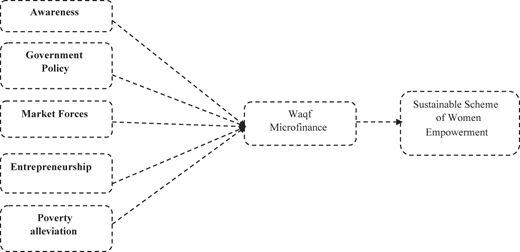
SEM was selected to assess the complex interrelationships among variables and to test both direct and indirect effects, thereby yielding more robust study outcomes as illustrates in the Figure 1 proposed model development.

Table 1 summarizes the study variables and their operational definitions. The awareness variable measures women’s understanding of their empowerment (Sharma and Das, 2021). Government policy captures the extent to which women’s issues are integrated into policy development and implementation (Sukmana, 2020). Market forces reflect how innovations — such as time-saving and health-related products —empower women (Al-Nasrallah, 2023). Entrepreneurship denotes women’s participation in business ventures as a key driver of economic empowerment and gender equality (Bagheri et al., 2023). The poverty alleviation variable addresses improvements in household living standards, health, and education (Ssennono et al., 2023). A Waqf microfinance endowment typically enhances women’s access to resources and opportunities by providing community services, while a sustainable women’s empowerment scheme ensures long-term economic and social progress (Mohd Thas Thanker and Allah Pitchay, 2018; Mayoux, 2020).

The respondents in this study, as shown in Table 2, were predominantly married women (60%), followed by single women (40%), and were largely within the low-to middle-income range ($4–$333.3). A significant percentage of the respondents were lower-income earners (40 and 45%). In terms of educational attainment, 23% had completed primary school, 40% had secondary education, 16.8% held diplomas or NCE qualifications, and 13.2% possessed university degrees. Regarding employment status, only 20% of respondents reported earning a monthly salary, while the remaining 80% were unemployed. Most of these unemployed respondents had low levels of formal education and lacked access to employment that provides regular income. The capital business capacity indicates the majority operated within minimal funds; 40–45% reported business capital below $100, indicating a generally low level of financial capacity for entrepreneurial activity (see Supplementary file for raw data).

Table 3 indicates that the dataset of all item constructs exhibits acceptable levels of normality. The assessment of skewness and kurtosis shows that all values fall within the range of ±2 and ± 9, respectively, aligning with established thresholds for normality. According to Brown (2006), skewness and kurtosis can be assessed using descriptive statistics and in the context of SEM, acceptable skewness values typically range within ±3, while kurtosis values fall within ±10.

As further shown in Table 3, which presents the results of the standardized factor loadings analysis, items with inadequate factor loadings are removed to improve model fit. In particular, MF5 is excluded due to a low factor loading of 0.488, which falls below the acceptable threshold of 0.5. Following the removal of poorly performing items, the model is retested to ensure a stable structure, resulting in 36 retained items.

To ensure construct validity and reliability, all variables undergo a comprehensive assessment. Cronbach’s alpha values demonstrate internal consistency for each construct, supporting the overall reliability of the measurement model. As shown in Table 3, Cronbach’s alpha values range from 0.704 to 0.861, confirming that each construct’s internal consistency is acceptable.

Table 4 indicates a goodness-of-fit index is reported in the results, with a p-value of 0.000. According to Bagozzi and Yi (1988), a preferred model should have a relative CMIN/df value below 5.0; in this study, the value is 2.513, which is considered acceptable. As suggested by Kline (2010), the GFI value of 0.936 is deemed valid, exceeding the minimum acceptable value of 0.8. Similarly, the AGFI value of 0.905 is acceptable, as values above 0.8 are considered adequate (Chau and Hu, 2001). Furthermore, the model demonstrates its ability to explain the variance and covariance of the survey data. Following the recommendations of Bagozzi and Yi (1988), Ho (2006), and Hair et al. (2017), the CFI, TLI, and IFI scores all surpass the 0.9 threshold —recording values of 0.965, 0.947, and 0.963, respectively. In addition, the Root Mean Square Error of Approximation (RMSEA) is 0.066, which falls below the 0.1 threshold, as suggested by Bagozzi and Yi (1988). These findings confirm that the model’s fit indices meet acceptable standards, as supported by several prior theories.

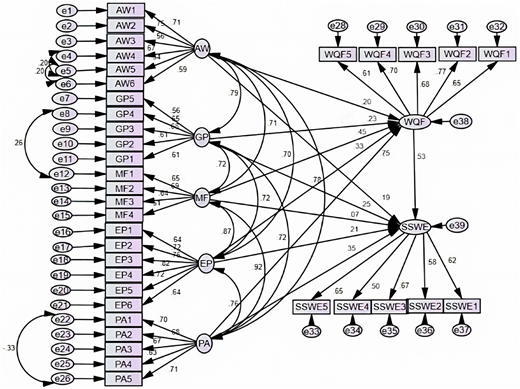
The constructs require validation in terms of convergent and discriminant validity. According to Hair et al. (2017), the AVE should be 0.5 or higher, and the discriminant values should range from 0.364 to 0.515. For discriminant validity to be achieved, the AVE must be greater than the squared correlation between constructs (see Figure 2).

As indicated in Table 5, the paths from AW, GP, MF, EP, and PA to Waqf (WQF) are statistically significant. Likewise, the paths from AW, GP, EP, and PA to SSWE are significant at p-values below 0.05. The direct and indirect effects of hypotheses H1, H2, H4, H5, H6, H7, H9, H10 and H11 are supported, while H3 is rejected. These findings are interpreted using the p-values and their respective critical values, confirming significance at the 5% level. Notably, awareness emerges as a strong predictor of SSWE.

Additionally, the mediation analysis reveals that Waqf (WQF) partially mediates the effects of AW, GP, EP, and PA on SSWE. Waqf fully mediates the effect of MF on SSWE. Therefore, all mediation hypotheses are supported and accepted (see Table 5).

The definitions of the variable’s activities are presented in Table 1, followed by the evaluation of the measurement and structural models. The normality of the data is assessed based on the skewness and kurtosis of each item used in the study constructs. The demographic profile of the respondents (women) is shown in Table 2. The factor loadings of the items that form each construct are reported in Table 3. According to Hair et al. (2017), factor loadings above 0.5 indicate that the measurement model demonstrates adequate construct validity. Construct reliability and validity are also assessed. The absolute measurement assessment confirms that all theoretical thresholds are satisfied (Hair et al., 2017); composite reliability exceeds 0.7 (Byrne, 2013); and Cronbach’s alpha values reported in Table 3 are above the threshold of 0.7 (Hair et al., 2017). Discriminant validity results in Table 4, based on AVE, are above 0.5 (Hair et al., 2017) and the square root of AVE exceeds the off-diagonal elements across rows and columns, all below the recommended threshold of 0.85 (Hair et al., 2017). Furthermore, Table 4 presents the measurement model fit indices, including GFI, AGFI, IFI, CFI, TLI, and RMSEA, as suggested by Byrne (2013).

Table 5 reports the hypothesis testing, including direct effects and mediation analysis. All hypotheses are supported except for H3, which is rejected. The mediation analysis shows partial mediation for all relationships, except for one —MF-WQF-SSWE —which demonstrates full mediation. The study verifies the relationship between Waqf microfinance and the Sustainable Scheme for Women’s Empowerment, focusing on variables such as AW, GP, MF, PA, and EN. In all cases, a positive correlation is observed between the direct effect and the mediating variables.

Moreover, promoting Waqf microfinance for various socioeconomic and cultural functions is crucial for microeconomics development and fostering sustainable women’s empowerment. The inability of state institutions to provide civic, policy-driven, or interest-based demands has severely disrupted societal balance. Therefore, it is necessary to establish a formal Waqf microfinance system, by creating dedicated institutions and regulatory frameworks to manage endowment and finance microbusinesses. Compared to individual endowments, Waqf institutions offer greater sustainability and effectiveness due to their perpetual nature and the profitability of endowed properties. The findings also confirm both the direct and indirect relationships and highlight the mediating role of Waqf microfinance in promoting sustainable empowerment schemes for women in Northern Nigeria (see the raw data in Supplementary file).

The study demonstrates how Waqf microfinance focuses on ethical and domestic funding sources that can reduce government expenditures on women’s empowerment women and significantly lower the cost of essential services at the state level. Five factors are found to strengthen the Sustainable Scheme for Women’s Empowerment and support its mediation through Waqf microfinance. This study further confirms that Waqf may serve as a viable funding source for advancing the Sustainable Scheme for Women’s Empowerment.

The concept can be applied in various world regions, particularly developing countries; however, the study is limited to Northern Nigeria. Future research may investigate how Waqf microfinance addresses the Sustainable Schemes for Women’s Empowerment. The study recommends using Waqf microfinance institutions to finance the sustainable scheme for the women’s empowerment sector.

Adenutsi
,
D.E.
(
2023
), “
Entrepreneurship, job creation, income empowerment and poverty reduction in low-income economies
”,
Theoretical Economics Letters
, Vol. 
13
No. 
6
, pp. 
1579
-
1598
, doi: .
Ahmed
,
R.
and
Hyndman-Rizk
,
N.
(
2020
), “
The higher education paradox: towards improving women’s empowerment, agency development and labour force participation in Bangladesh
”,
Gender and Education
, Vol. 
32
No. 
4
, pp. 
447
-
465
, doi: .
Ahuru
,
R.R.
(
2021
), “
The influence of women empowerment on maternal and childcare use in Nigeria
”,
International Journal of Healthcare Management
, Vol. 
14
No. 
3
, pp. 
690
-
699
, doi: .
Al-Nasrallah
,
W.
(
2023
), “
The decade long story of gender equality and female empowerment: a case study of corporate disclosures in Saudi Arabia
”,
Sustainability Accounting, Management and Policy Journal
, Vol. 
14
No. 
1
, pp. 
216
-
241
, doi: .
Alsaad
,
R.I.
,
Hamdan
,
A.
,
Binsaddig
,
R.
and
Kanan
,
M.A.
(
2023
), “
Empowerment sustainability perspectives for Bahraini women as entrepreneurs
”,
International Journal of Innovation Studies
, Vol. 
7
No. 
4
, pp. 
245
-
262
, doi: .
Althalathini
,
D.
and
Tlaiss
,
H.A.
(
2023
), “
Of resistance to patriarchy and occupation through a virtual bazaar: an institutional theory critique of the emancipatory potential of Palestinian women’s digital entrepreneurship
”,
Entrepreneurship and Regional Development
, Vol. 
35
Nos
9-10
, pp. 
956
-
978
, doi: .
Amin
,
H.
,
Panggi
,
F.
,
Shaikh
,
I.M.
and
Abduh
,
M.
(
2024
), “
Waqif preference of Waqf-based Qardhul Hassan financing in Malaysia using a Maqāṣid approach
”,
Journal of Islamic Accounting and Business Research
, Vol. 
16
No. 
6
, doi: .
Ascarya
,
A.
,
Sukmana
,
R.
,
Rahmawati
,
S.
and
Masrifah
,
A.R.
(
2023
), “
Developing cash waqf models for Baitul Maal wat Tamwil as integrated Islamic social and commercial microfinance
”,
Journal of Islamic Accounting and Business Research
, Vol. 
14
No. 
5
, pp. 
699
-
717
, doi: .
Bagheri
,
F.
,
Ghaderi
,
Z.
,
Abdi
,
N.
and
Hall
,
C.M.
(
2023
), “
Female entrepreneurship, creating shared value, and empowerment in tourism; the neutralizing effect of gender-based discrimination
”,
Current Issues in Tourism
, Vol. 
26
No. 
21
, pp. 
3465
-
3482
, doi: .
Bagozzi
,
R.P.
and
Yi
,
Y.
(
1988
), “
On the evaluation of structural equation models
”,
Journal of the Academy of Marketing Science
, Vol. 
16
No. 
1
, pp. 
74
-
94
, doi: .
Blanco-Gonzalez-Tejero
,
C.
and
Cano-Marin
,
E.
(
2023
), “
Empowerment of women’s entrepreneurship in family business through Twitter
”,
Journal of Family Business Management
, Vol. 
13
No. 
3
, pp. 
607
-
625
, doi: .
Brice
,
J.E.
and
Thorpe
,
H.
(
2021
), “
Toward more-than-human understandings of sport and the environment: a new materialist analysis of everyday fitness practices
”,
Frontiers in Sports and Active Living
, Vol. 
3
, 660935, doi: .
Brown
,
S.L.
(
2006
), “
Family structure transitions and adolescent well- being
”,
Demography
, Vol. 
43
No. 
3
, pp. 
447
-
461
, doi: .
Byrne
,
B.M.
(
2013
),
Structural Equation Modeling with Mplus: Basic Concepts, Applications, and Programming
,
Routledge
,
New York
.
Chau
,
P.Y.
and
Hu
,
P.J.H.
(
2001
), “
Information technology acceptance by individual professionals: a model comparison approach
”,
Decision Sciences
, Vol. 
32
No. 
4
, pp.
699
-
719
.
Dankumo
,
A.M.
,
Ishak
,
S.
,
Auta
,
Y.
and
Denthe
,
H.A.
(
2023
), “
Impact of public expenditure on poverty: role of governance
”,
Jurnal Ekonomi Malaysia
, Vol. 
57
No. 
1
, pp. 
113
-
126
, doi: .
Duan
,
M.
,
Li
,
L.
,
Liu
,
X.
,
Pei
,
J.
and
Song
,
H.
(
2023
), “
Turning awareness into behavior: meta-analysis of household residential life energy transition behavior from the dual perspective of internal driving forces and external inducing forces
”,
Energy
, Vol. 
279
, 128072, doi: .
Effendy
,
J.S.
and
Setyawan
,
I.R.
(
2023
), “
Determinant factors of infrastructure firm’s value in Indonesia stock exchange
”,
International Journal of Application on Economics and Business
, Vol. 
1
No. 
1
, pp. 
115
-
123
, doi: .
Ge
,
Y.
,
Hu
,
S.
,
Song
,
Y.
,
Zheng
,
H.
,
Liu
,
Y.
,
Ye
,
X.
,
Ma
,
T.
,
Liu
,
M.
and
Zhou
,
C.
(
2023
), “
Sustainable poverty reduction models for the coordinated development of the social economy and environment in China
”,
Science Bulletin
, Vol. 
68
No. 
19
, pp. 
2236
-
2246
, doi: .
Gidigbi
,
M.O.
(
2023
), “
Assessing the impact of poverty alleviation programs on poverty reduction in Nigeria: selected programs
”,
Poverty and Public Policy
, Vol. 
15
No. 
1
, pp. 
76
-
97
, doi: .
Hair
,
J.F.
 Jr
,
Matthews
,
L.M.
,
Matthews
,
R.L.
and
Sarstedt
,
M.
(
2017
), “
PLS-SEM or CB-SEM: updated guidelines on which method to use
”,
International Journal of Multivariate Data Analysis
, Vol. 
1
No. 
2
, pp. 
107
-
123
, doi: .
He
,
Z.
,
Kuai
,
L.
and
Wang
,
J.
(
2023
), “
Driving mechanism model of enterprise green strategy evolution under digital technology empowerment: a case study based on Zhejiang Enterprises
”,
Business Strategy and the Environment
, Vol. 
32
No. 
1
, pp. 
408
-
429
, doi: .
Hermawati
,
W.
,
Ririh
,
K.R.
,
Ariyani
,
L.
,
Helmi
,
R.L.
and
Rosaira
,
I.
(
2023
), “
Sustainable and green energy development to support women’s empowerment in rural areas of Indonesia: case of micro-hydro power implementation
”,
Energy for Sustainable Development
, Vol. 
73
, pp. 
218
-
231
, doi: .
Ho
,
Y.S.
(
2006
), “
Review of second-order models for adsorption systems
”,
Journal of Hazardous Materials
, Vol. 
136
No. 
3
, pp. 
681
-
689
, doi: .
Huq
,
A.
and
Arenius
,
P.
(
2024
), “
Women entrepreneurs’ negotiation of the work–family balance in patriarchal society
”,
Journal of Small Business Management
, pp.
1
-
32
, doi: .
Huq
,
A.
,
Tan
,
C.S.L.
and
Venugopal
,
V.
(
2020
), “
How do women entrepreneurs strategize growth? An investigation using the social feminist theory lens
”,
Journal of Small Business Management
, Vol. 
58
No. 
2
, pp.
259
-
287
.
Irhoumah
,
A.H.
,
Moh'd Ayedh
,
A.
and
Echchabi
,
A.
(
2020
), “
Determinants of microfinance factors affecting women’s empowerment: evidence from Egypt
”,
FWU Journal of Social Sciences
, Vol. 
14
No. 
4
, pp. 
1
-
11
, doi: .
Islam
,
M.S.
(
2021
), “
Role of Islamic microfinance in women’s empowerment: evidence from rural development scheme of Islami bank Bangladesh limited
”,
ISRA International Journal of Islamic Finance
, Vol. 
13
No. 
1
, pp. 
26
-
45
, doi: .
Jaiyeola
,
A.O.
and
Choga
,
I.
(
2021
), “
Assessment of poverty incidence in Northern Nigeria
”,
Journal of Poverty
, Vol. 
25
No. 
2
, pp. 
155
-
172
, doi: .
Jasmi
,
Z.S.
and
Hassan
,
N.
(
2024
), “
Inside microfinance matrix: microfinance institutions’ characteristics and women credit access
”,
International Journal of Economics and Financial Issues
, Vol. 
14
No. 
6
, pp. 
110
-
120
, doi: .
Kayongo
,
S.
,
Tom
,
M.
and
Mathiassen
,
L.
(
2021
), “
Organizing and orchestrating microfinance initiatives: a contextual inquiry
”,
International Journal of Social Economics
, Vol. 
48
No. 
2
, pp. 
221
-
239
, doi: .
Khan
,
S.T.
,
Bhat
,
M.A.
and
Sangmi
,
M.-U.
(
2022
), “
Can microfinance-backed entrepreneurship be a holistic empowerment tool for women? Empirical evidence from Kashmir Valley, India
”,
Journal of Business and Socio-Economic Development
, Vol. 
2
No. 
2
, pp. 
117
-
136
, doi: .
Kivalya
,
N.Y.I.
and
Caballero-Montes
,
T.
(
2024
), “
Understanding the dimensions of women entrepreneurs’ empowerment: a systematic review of the microfinance literature and avenues for research
”,
International Journal of Gender and Entrepreneurship
, Vol. 
16
No. 
2
, pp. 
197
-
226
, doi: .
Kline
,
R.B.
(
2010
), “
Promise and pitfalls of structural equation modeling in gifted research
”.
Le Quoc
,
D.
(
2024
), “
The relationship between digital financial inclusion, gender inequality, and economic growth: dynamics from financial development
”,
Journal of Business and Socio-economic Development
, Vol. 
4
, pp. 
4
-
388
, doi: .
Lwamba
,
E.
,
Shisler
,
S.
,
Ridlehoover
,
W.
,
Kupfer
,
M.
,
Tshabalala
,
N.
,
Nduku
,
P.
,
Langer
,
L.
,
Grant
,
S.
,
Sonnenfeld
,
A.
,
Anda
,
D.
,
Eyers
,
J.
and
Snilstveit
,
B.
(
2022
), “
Strengthening women’s empowerment and gender equality in fragile contexts towards peaceful and inclusive societies: a systematic review and meta‐analysis
”,
Campbell Systematic Reviews
, Vol. 
18
No. 
1
, e1214, doi: .
Mayoux
,
L.
(
2020
), “Women’s empowerment versus sustainability? Towards a new paradigm in micro- finance programmes”, in
Women and Credit
,
Routledge
, pp. 
245
-
269
.
Md Razali
,
N.H.
,
Yakob
,
R.
,
Bangaan Abdullah
,
M.H.S.
,
Shahimi
and
Baharin
,
R.
(
2023
), “
Penentu Kecekapan Institusi Wakaf
”,
Jurnal Ekonomi Malaysia
, Vol. 
57
No. 
2
, pp. 
181
-
199
, doi: .
Memon
,
M.H.
(
2023
), “
Poverty, gap and severity estimates for disaster prone rural areas of Pakistan
”,
Social Indicators Research
, Vol. 
166
No. 
3
, pp. 
645
-
663
, doi: .
Mohd Thas Thaker
,
M.A.B.
and
Allah Pitchay
,
A.
(
2018
), “
Developing waqf land through crowdfunding-waqf model (CWM): the case of Malaysia
”,
Journal of Islamic Accounting and Business Research
, Vol. 
9
No. 
3
, pp. 
448
-
456
, doi: .
Moreno
,
C.A.
(
2023
), “
Transport policy: empowering local community for poverty alleviation in a deprived neighborhood in Colombia
”,
Case Studies on Transport Policy
, Vol. 
13
, 101027, doi: .
Muhammad
,
T.
and
Al-Shaghdari
,
F.
(
2024
), “
Islamic social finance system: an alternative tool for tackling educational setbacks in Northern Nigeria
”,
Journal of Islamic Marketing
, Vol. 
15
No. 
11
, pp. 
3115
-
3136
, doi: .
Muhammad
,
T.
and
Khalil
,
Z.
(
2021
), “
The role of Islamic banks in tackling financial exclusion in North-East Nigeria
”,
Turkish Journal of Islamic Economics
, Vol. 
8
No. 
1
, pp. 
87
-
110
, doi: .
Muhammad
,
T.
and
Salisu
,
A.
(
2019
), “
Islamic Bank and economic growth in Nigeria and Malaysia similarities
”,
International Journal of Accounting
, Vol. 
4
No. 
22
, pp. 
10
-
22
.
Oyewunmi
,
O.F.
and
Obayelu
,
O.A.
(
2023
), “
Poverty status of rural households in Nigeria: a gendered perspective
”,
International Journal of Social Economics
, Vol. 
50
No. 
2
, pp. 
260
-
278
, doi: .
Pal
,
M.
and
Gupta
,
H.
(
2023
), “
Sustainable women empowerment at the bottom of the pyramid through credit access
”,
Equality, Diversity and Inclusion: An International Journal
, Vol. 
42
No. 
1
, pp. 
157
-
171
, doi: .
Panda
,
S.
,
Das
,
R.
,
Das
,
A.
,
Sharma
,
N.
and
Sharma
,
A.
(
2021
), “
A study to assess the knowledge and awareness among young doctors about emergency contraception
”,
Journal of Family Medicine and Primary Care
, Vol. 
10
No. 
6
, pp. 
2304
-
2312
, doi: .
Sharaf
,
M.F.
(
2022
), “
The asymmetric and threshold impact of external debt on economic growth: new evidence from Egypt
”,
Journal of Business and Socio-economic Development
, Vol. 
2
No. 
1
, pp. 
1
-
18
, doi: .
Sharma
,
E.
and
Das
,
S.
(
2021
), “
Integrated model for women empowerment in rural India
”,
Journal of International Development
, Vol. 
33
No. 
3
, pp. 
594
-
611
, doi: .
Shenbei
,
Z.
,
Ajaz
,
A.
,
Sarfraz
,
M.
and
Ahmed
,
N.
(
2023
), “
New insights into the rural development economies under the moderating role of gender equality and mediating role of rural women development
”,
Journal of Rural Studies
, Vol. 
104
, 103166, doi: .
Sisaye
,
S.
(
2021
), “
The influence of non-governmental organizations (NGOs) on the development of voluntary sustainability accounting reporting rules
”,
Journal of Business and Socio-economic Development
, Vol. 
1
No. 
1
, pp. 
5
-
23
, doi: .
Soemitra
,
A.
,
Kusmilawaty
and
Rahma
,
T.I.F.
(
2022
), “
The role of micro Waqf bank in women’s micro-empowerment through Islamic social finance: mixed-method evidence from Mawaridussalam Indonesia
”,
Economies
, Vol. 
10
No. 
7
, p.
157
, doi: .
Song
,
M.
(
2023
), “
Market competition and regulatory compliance in public, non-profit, and for-profit organizations
”,
Public Management Review
, Vol. 
25
No. 
10
, pp. 
1982
-
2002
, doi: .
Ssennono
,
V.F.
,
Ntayi
,
J.M.
,
Buyinza
,
F.
,
Wasswa
,
F.
,
Adaramola
,
M.S.
and
Aarakit
,
S.M.
(
2023
), “
Climatic shocks and multidimensional energy poverty in Ugandan households: does women empowerment play a moderating role?
”,
International Journal of Sustainable Energy
, Vol. 
42
No. 
1
, pp. 
103
-
127
, doi: .
Steinfield
,
L.A.
(
2021
), “
1, 2, 3, 4. I declare… empowerment? A material-discursive analysis of the marketisation, measurement and marketing of women’s economic empowerment
”,
Journal of Marketing Management
, Vol. 
37
Nos
3-4
, pp. 
320
-
356
, doi: .
Sukmana
,
R.
(
2020
), “
Critical assessment of Islamic endowment funds (Waqf) literature: lesson for government and future directions
”,
Heliyon
, Vol. 
6
No. 
10
, e05074, doi: .
Thaddeus
,
K.J.
,
Bih
,
D.
,
Nebong
,
N.M.
,
Ngong
,
C.A.
,
Mongo
,
E.A.
,
Akume
,
A.D.
and
Onwumere
,
J.U.J.
(
2022
), “
Female labour force participation rate and economic growth in sub-Saharan Africa: ‘a liability or an asset’
”,
Journal of Business and Socio-economic Development
, Vol. 
2
No. 
1
, pp. 
34
-
48
, doi: .
Vukovic
,
D.B.
,
Petrovic
,
M.
,
Maiti
,
M.
and
Vujko
,
A.
(
2023
), “
Tourism development, entrepreneurship and women’s empowerment–focus on Serbian countryside
”,
Journal of Tourism Futures
, Vol. 
9
No. 
3
, pp. 
417
-
437
, doi: .
Yusgiantoro
,
I.
,
Pamungkas
,
P.
and
Trinugroho
,
I.
(
2024
), “
The sustainability and performance of Bank Wakaf Mikro: waqf-based microfinance in Indonesia
”,
International Journal of Islamic and Middle Eastern Finance and Management
, Vol. 
17
No. 
1
, pp. 
86
-
101
, doi: .
Zhou
,
S.
,
Ayandibu
,
A.O.
,
Chimucheka
,
T.
and
Masuku
,
M.M.
(
2023
), “
Government social protection and households’ welfare during the Covid-19 pandemic in South Africa
”,
Journal of Business and Socio-economic Development
, Vol. 
3
No. 
4
, pp. 
308
-
321
, doi: .
Song
,
J.
and
Li
,
L.
(
2023
), “
Empowered in business or penalised in marriage: experiences of single female entrepreneurs in China
”,
Work, Employment and Society
, Vol. 
37
No. 
1
, pp. 
3
-
19
, doi: .

The supplementary material for this article can be found online.
Published in Journal of Business and Socio-economic Development. Published by Emerald Publishing Limited. This article is published under the Creative Commons Attribution (CC BY 4.0) licence. Anyone may reproduce, distribute, translate and create derivative works of this article (for both commercial and non-commercial purposes), subject to full attribution to the original publication and authors. The full terms of this licence may be seen at http://creativecommons.org/licences/by/4.0/legalcode

Supplementary data

Data & Figures

Figure 1

Model development. Source: Designed by authors

Figure 1

Model development. Source: Designed by authors

Close Figure 1
Figure 2

Measurement model. Source: The authors

Figure 2

Measurement model. Source: The authors

Close Figure 2
Table 1

Summary of the variables

Variables usedDefinitionNumber of itemsSources extracted
Awareness (AW)It refers to empowering women to make their own decisions, build self-confidence, and influence societal changes6Ssennono et al. (2023), Panda et al. (2021) 
Government policy (GP)It captures the government’s role in addressing issues that affect women and ensuring that women’s concerns are integrated into the development and implementation of all policies5Sukmana (2020), Effendy and Setyawan (2023), Alsaad et al. (2023) 
Market forces (MF)It represents how market innovations empower women in interconnected ways; particularly through time-saving and health-related improvements that disproportionately benefit them4Al-Nasrallah (2023), Duan et al. (2023), Song (2023) 
Entrepreneurship (EP)It highlights the importance of women’s entrepreneurship, as a pathway to economic empowerment and gender equality, aligned with SDG 55Bagheri et al. (2023), Adenutsi (2023), Blanco-Gonzalez-Tejero and Cano-Marin (2023) 
Poverty alleviation (PA)It addresses efforts to reduce household deprivation in terms of living standards, health, and education as key components of women’s empowerment5Ge et al. (2023), Adenutsi (2023), Moreno (2023) 
Waqf microfinance (WQ)It reflects how Waqf-based microfinance provides community-benefiting services that enhance women’s self-esteem and access to resources and opportunities5Amin et al. (2024), Islam (2021) 
Sustainable scheme for women empowerment (SSWE)It focuses on the long-term empowerment of women as a foundation for sustainable economic development and global progress5Pal and Gupta (2023), Mayoux (2020), Hermawati et al. (2023) 

Source(s): Designed by authors

Table 2

Profile of the respondents

DemographyFrequencyPercentage
Gender
Women346100%
Age
18–254814%
26–356920%
36–4513940%
46 – above9026%
Marriage status
Married20860%
Single13840%
Education
Primary8023%
Secondary13840%
Diploma/NCE5916.8%
Degree4513.2%
Masters – above247%
Employment
Government workers6920%
Unemployed27780%
Capital business capacity
6,000–60,000 ($4–$40)13840%
70,000–200,000 ($46–$100)15645%
201,000–500,000 ($133.3–$333.3)5215%

Source(s): Designed by authors

Table 3

Assessment of normality and standardized factor loadings


Source(s): Designed by authors

Table 4

Goodness of fit and discriminant validity

VariableModified modelAcceptable valueRecommended valueSource
X2/df2.513>0.5<3.0Bagozzi and Yi (1988) 
p-value0.000<0.0050.000Hair et al. (2017) 
GFI0.936>0.9>0.8Hair et al. (2017) 
AGFI0.905>0.9>0.8Chau and Hu (2001) 
IFI0.963>0.9>0.8Ho (2006) 
TLI0.947>0.9>0.8Hair et al. (2017) 
CFI0.965>0.9>0.8Hair et al. (2017) 
RMSEA0.066<0.05–0.08<0.1Bagozzi and Yi (1988) 
Variables(1)(2)(3)(4)(5)(6)(7)
AW0.407      
GP 0.386     
MF  0.388    
EN   0.515   
PA    0.461  
WQF     0.465 
SSWE      0.364

Source(s): Designed by authors

Table 5

Hypothesis analysis – direct and indirect effects of mediation

PathEstimateBetaCritical ratioP-valueDecision
AW → SSWE0.1950.0792.6710.01Accept (H1)
GP → SSWE0.2780.1122.4820.01Accept (H2)
MF → SSWE0.0700.060−0.1160.051Reject (H3)
EP → SSWE0.2100.0802.6250.01Accept (H4)
PA → SSWE0.3540.1202.9500.003Accept (H5)
AW → WQF0.2050.0395.2560.000Accept (H6)
GP → WQF0.2390.1002.3900.01Accept (H7)
MF → WQF0.4500.1503.0000.000Accept (H8)
EP → WQF0.3080.0813.8020.000Accept (H9)
PA → WQF0.5990.1733.4620.001Accept (H10)
WQF → SSWE0.6730.2243.0040.000Accept (H11)
Note(s): DV = Sustainable Scheme for Women Empowerment (SSWE), M = Waqf (WQF)
Variable IVDirect effect X → YIndirect effect X–M-YEffect mediationDegree of mediationResultResult
Awareness0.1950.205Sig: 0.000AW-WQF-SSWEPartialAccepted
Government policy0.2780.239Sig: 0.000GP-WQF-SSWEPartialAccepted
Market force0.0700.450Sig: 0.000MF-WQF-SSWEFullAccepted
Entrepreneur0.2100.308Sig: 0.000EP-WQF-SSWEPartialAccepted
Poverty alleviation0.6730.599Sig: 0.000PA-WQF-SSWEPartialAccepted

Note(s): *p < 0.05, **p < 0.01, ***p < 0.001

Source(s): Designed by authors

Supplements

Supplementary data

References

Adenutsi
,
D.E.
(
2023
), “
Entrepreneurship, job creation, income empowerment and poverty reduction in low-income economies
”,
Theoretical Economics Letters
, Vol. 
13
No. 
6
, pp. 
1579
-
1598
, doi: .
Ahmed
,
R.
and
Hyndman-Rizk
,
N.
(
2020
), “
The higher education paradox: towards improving women’s empowerment, agency development and labour force participation in Bangladesh
”,
Gender and Education
, Vol. 
32
No. 
4
, pp. 
447
-
465
, doi: .
Ahuru
,
R.R.
(
2021
), “
The influence of women empowerment on maternal and childcare use in Nigeria
”,
International Journal of Healthcare Management
, Vol. 
14
No. 
3
, pp. 
690
-
699
, doi: .
Al-Nasrallah
,
W.
(
2023
), “
The decade long story of gender equality and female empowerment: a case study of corporate disclosures in Saudi Arabia
”,
Sustainability Accounting, Management and Policy Journal
, Vol. 
14
No. 
1
, pp. 
216
-
241
, doi: .
Alsaad
,
R.I.
,
Hamdan
,
A.
,
Binsaddig
,
R.
and
Kanan
,
M.A.
(
2023
), “
Empowerment sustainability perspectives for Bahraini women as entrepreneurs
”,
International Journal of Innovation Studies
, Vol. 
7
No. 
4
, pp. 
245
-
262
, doi: .
Althalathini
,
D.
and
Tlaiss
,
H.A.
(
2023
), “
Of resistance to patriarchy and occupation through a virtual bazaar: an institutional theory critique of the emancipatory potential of Palestinian women’s digital entrepreneurship
”,
Entrepreneurship and Regional Development
, Vol. 
35
Nos
9-10
, pp. 
956
-
978
, doi: .
Amin
,
H.
,
Panggi
,
F.
,
Shaikh
,
I.M.
and
Abduh
,
M.
(
2024
), “
Waqif preference of Waqf-based Qardhul Hassan financing in Malaysia using a Maqāṣid approach
”,
Journal of Islamic Accounting and Business Research
, Vol. 
16
No. 
6
, doi: .
Ascarya
,
A.
,
Sukmana
,
R.
,
Rahmawati
,
S.
and
Masrifah
,
A.R.
(
2023
), “
Developing cash waqf models for Baitul Maal wat Tamwil as integrated Islamic social and commercial microfinance
”,
Journal of Islamic Accounting and Business Research
, Vol. 
14
No. 
5
, pp. 
699
-
717
, doi: .
Bagheri
,
F.
,
Ghaderi
,
Z.
,
Abdi
,
N.
and
Hall
,
C.M.
(
2023
), “
Female entrepreneurship, creating shared value, and empowerment in tourism; the neutralizing effect of gender-based discrimination
”,
Current Issues in Tourism
, Vol. 
26
No. 
21
, pp. 
3465
-
3482
, doi: .
Bagozzi
,
R.P.
and
Yi
,
Y.
(
1988
), “
On the evaluation of structural equation models
”,
Journal of the Academy of Marketing Science
, Vol. 
16
No. 
1
, pp. 
74
-
94
, doi: .
Blanco-Gonzalez-Tejero
,
C.
and
Cano-Marin
,
E.
(
2023
), “
Empowerment of women’s entrepreneurship in family business through Twitter
”,
Journal of Family Business Management
, Vol. 
13
No. 
3
, pp. 
607
-
625
, doi: .
Brice
,
J.E.
and
Thorpe
,
H.
(
2021
), “
Toward more-than-human understandings of sport and the environment: a new materialist analysis of everyday fitness practices
”,
Frontiers in Sports and Active Living
, Vol. 
3
, 660935, doi: .
Brown
,
S.L.
(
2006
), “
Family structure transitions and adolescent well- being
”,
Demography
, Vol. 
43
No. 
3
, pp. 
447
-
461
, doi: .
Byrne
,
B.M.
(
2013
),
Structural Equation Modeling with Mplus: Basic Concepts, Applications, and Programming
,
Routledge
,
New York
.
Chau
,
P.Y.
and
Hu
,
P.J.H.
(
2001
), “
Information technology acceptance by individual professionals: a model comparison approach
”,
Decision Sciences
, Vol. 
32
No. 
4
, pp.
699
-
719
.
Dankumo
,
A.M.
,
Ishak
,
S.
,
Auta
,
Y.
and
Denthe
,
H.A.
(
2023
), “
Impact of public expenditure on poverty: role of governance
”,
Jurnal Ekonomi Malaysia
, Vol. 
57
No. 
1
, pp. 
113
-
126
, doi: .
Duan
,
M.
,
Li
,
L.
,
Liu
,
X.
,
Pei
,
J.
and
Song
,
H.
(
2023
), “
Turning awareness into behavior: meta-analysis of household residential life energy transition behavior from the dual perspective of internal driving forces and external inducing forces
”,
Energy
, Vol. 
279
, 128072, doi: .
Effendy
,
J.S.
and
Setyawan
,
I.R.
(
2023
), “
Determinant factors of infrastructure firm’s value in Indonesia stock exchange
”,
International Journal of Application on Economics and Business
, Vol. 
1
No. 
1
, pp. 
115
-
123
, doi: .
Ge
,
Y.
,
Hu
,
S.
,
Song
,
Y.
,
Zheng
,
H.
,
Liu
,
Y.
,
Ye
,
X.
,
Ma
,
T.
,
Liu
,
M.
and
Zhou
,
C.
(
2023
), “
Sustainable poverty reduction models for the coordinated development of the social economy and environment in China
”,
Science Bulletin
, Vol. 
68
No. 
19
, pp. 
2236
-
2246
, doi: .
Gidigbi
,
M.O.
(
2023
), “
Assessing the impact of poverty alleviation programs on poverty reduction in Nigeria: selected programs
”,
Poverty and Public Policy
, Vol. 
15
No. 
1
, pp. 
76
-
97
, doi: .
Hair
,
J.F.
 Jr
,
Matthews
,
L.M.
,
Matthews
,
R.L.
and
Sarstedt
,
M.
(
2017
), “
PLS-SEM or CB-SEM: updated guidelines on which method to use
”,
International Journal of Multivariate Data Analysis
, Vol. 
1
No. 
2
, pp. 
107
-
123
, doi: .
He
,
Z.
,
Kuai
,
L.
and
Wang
,
J.
(
2023
), “
Driving mechanism model of enterprise green strategy evolution under digital technology empowerment: a case study based on Zhejiang Enterprises
”,
Business Strategy and the Environment
, Vol. 
32
No. 
1
, pp. 
408
-
429
, doi: .
Hermawati
,
W.
,
Ririh
,
K.R.
,
Ariyani
,
L.
,
Helmi
,
R.L.
and
Rosaira
,
I.
(
2023
), “
Sustainable and green energy development to support women’s empowerment in rural areas of Indonesia: case of micro-hydro power implementation
”,
Energy for Sustainable Development
, Vol. 
73
, pp. 
218
-
231
, doi: .
Ho
,
Y.S.
(
2006
), “
Review of second-order models for adsorption systems
”,
Journal of Hazardous Materials
, Vol. 
136
No. 
3
, pp. 
681
-
689
, doi: .
Huq
,
A.
and
Arenius
,
P.
(
2024
), “
Women entrepreneurs’ negotiation of the work–family balance in patriarchal society
”,
Journal of Small Business Management
, pp.
1
-
32
, doi: .
Huq
,
A.
,
Tan
,
C.S.L.
and
Venugopal
,
V.
(
2020
), “
How do women entrepreneurs strategize growth? An investigation using the social feminist theory lens
”,
Journal of Small Business Management
, Vol. 
58
No. 
2
, pp.
259
-
287
.
Irhoumah
,
A.H.
,
Moh'd Ayedh
,
A.
and
Echchabi
,
A.
(
2020
), “
Determinants of microfinance factors affecting women’s empowerment: evidence from Egypt
”,
FWU Journal of Social Sciences
, Vol. 
14
No. 
4
, pp. 
1
-
11
, doi: .
Islam
,
M.S.
(
2021
), “
Role of Islamic microfinance in women’s empowerment: evidence from rural development scheme of Islami bank Bangladesh limited
”,
ISRA International Journal of Islamic Finance
, Vol. 
13
No. 
1
, pp. 
26
-
45
, doi: .
Jaiyeola
,
A.O.
and
Choga
,
I.
(
2021
), “
Assessment of poverty incidence in Northern Nigeria
”,
Journal of Poverty
, Vol. 
25
No. 
2
, pp. 
155
-
172
, doi: .
Jasmi
,
Z.S.
and
Hassan
,
N.
(
2024
), “
Inside microfinance matrix: microfinance institutions’ characteristics and women credit access
”,
International Journal of Economics and Financial Issues
, Vol. 
14
No. 
6
, pp. 
110
-
120
, doi: .
Kayongo
,
S.
,
Tom
,
M.
and
Mathiassen
,
L.
(
2021
), “
Organizing and orchestrating microfinance initiatives: a contextual inquiry
”,
International Journal of Social Economics
, Vol. 
48
No. 
2
, pp. 
221
-
239
, doi: .
Khan
,
S.T.
,
Bhat
,
M.A.
and
Sangmi
,
M.-U.
(
2022
), “
Can microfinance-backed entrepreneurship be a holistic empowerment tool for women? Empirical evidence from Kashmir Valley, India
”,
Journal of Business and Socio-Economic Development
, Vol. 
2
No. 
2
, pp. 
117
-
136
, doi: .
Kivalya
,
N.Y.I.
and
Caballero-Montes
,
T.
(
2024
), “
Understanding the dimensions of women entrepreneurs’ empowerment: a systematic review of the microfinance literature and avenues for research
”,
International Journal of Gender and Entrepreneurship
, Vol. 
16
No. 
2
, pp. 
197
-
226
, doi: .
Kline
,
R.B.
(
2010
), “
Promise and pitfalls of structural equation modeling in gifted research
”.
Le Quoc
,
D.
(
2024
), “
The relationship between digital financial inclusion, gender inequality, and economic growth: dynamics from financial development
”,
Journal of Business and Socio-economic Development
, Vol. 
4
, pp. 
4
-
388
, doi: .
Lwamba
,
E.
,
Shisler
,
S.
,
Ridlehoover
,
W.
,
Kupfer
,
M.
,
Tshabalala
,
N.
,
Nduku
,
P.
,
Langer
,
L.
,
Grant
,
S.
,
Sonnenfeld
,
A.
,
Anda
,
D.
,
Eyers
,
J.
and
Snilstveit
,
B.
(
2022
), “
Strengthening women’s empowerment and gender equality in fragile contexts towards peaceful and inclusive societies: a systematic review and meta‐analysis
”,
Campbell Systematic Reviews
, Vol. 
18
No. 
1
, e1214, doi: .
Mayoux
,
L.
(
2020
), “Women’s empowerment versus sustainability? Towards a new paradigm in micro- finance programmes”, in
Women and Credit
,
Routledge
, pp. 
245
-
269
.
Md Razali
,
N.H.
,
Yakob
,
R.
,
Bangaan Abdullah
,
M.H.S.
,
Shahimi
and
Baharin
,
R.
(
2023
), “
Penentu Kecekapan Institusi Wakaf
”,
Jurnal Ekonomi Malaysia
, Vol. 
57
No. 
2
, pp. 
181
-
199
, doi: .
Memon
,
M.H.
(
2023
), “
Poverty, gap and severity estimates for disaster prone rural areas of Pakistan
”,
Social Indicators Research
, Vol. 
166
No. 
3
, pp. 
645
-
663
, doi: .
Mohd Thas Thaker
,
M.A.B.
and
Allah Pitchay
,
A.
(
2018
), “
Developing waqf land through crowdfunding-waqf model (CWM): the case of Malaysia
”,
Journal of Islamic Accounting and Business Research
, Vol. 
9
No. 
3
, pp. 
448
-
456
, doi: .
Moreno
,
C.A.
(
2023
), “
Transport policy: empowering local community for poverty alleviation in a deprived neighborhood in Colombia
”,
Case Studies on Transport Policy
, Vol. 
13
, 101027, doi: .
Muhammad
,
T.
and
Al-Shaghdari
,
F.
(
2024
), “
Islamic social finance system: an alternative tool for tackling educational setbacks in Northern Nigeria
”,
Journal of Islamic Marketing
, Vol. 
15
No. 
11
, pp. 
3115
-
3136
, doi: .
Muhammad
,
T.
and
Khalil
,
Z.
(
2021
), “
The role of Islamic banks in tackling financial exclusion in North-East Nigeria
”,
Turkish Journal of Islamic Economics
, Vol. 
8
No. 
1
, pp. 
87
-
110
, doi: .
Muhammad
,
T.
and
Salisu
,
A.
(
2019
), “
Islamic Bank and economic growth in Nigeria and Malaysia similarities
”,
International Journal of Accounting
, Vol. 
4
No. 
22
, pp. 
10
-
22
.
Oyewunmi
,
O.F.
and
Obayelu
,
O.A.
(
2023
), “
Poverty status of rural households in Nigeria: a gendered perspective
”,
International Journal of Social Economics
, Vol. 
50
No. 
2
, pp. 
260
-
278
, doi: .
Pal
,
M.
and
Gupta
,
H.
(
2023
), “
Sustainable women empowerment at the bottom of the pyramid through credit access
”,
Equality, Diversity and Inclusion: An International Journal
, Vol. 
42
No. 
1
, pp. 
157
-
171
, doi: .
Panda
,
S.
,
Das
,
R.
,
Das
,
A.
,
Sharma
,
N.
and
Sharma
,
A.
(
2021
), “
A study to assess the knowledge and awareness among young doctors about emergency contraception
”,
Journal of Family Medicine and Primary Care
, Vol. 
10
No. 
6
, pp. 
2304
-
2312
, doi: .
Sharaf
,
M.F.
(
2022
), “
The asymmetric and threshold impact of external debt on economic growth: new evidence from Egypt
”,
Journal of Business and Socio-economic Development
, Vol. 
2
No. 
1
, pp. 
1
-
18
, doi: .
Sharma
,
E.
and
Das
,
S.
(
2021
), “
Integrated model for women empowerment in rural India
”,
Journal of International Development
, Vol. 
33
No. 
3
, pp. 
594
-
611
, doi: .
Shenbei
,
Z.
,
Ajaz
,
A.
,
Sarfraz
,
M.
and
Ahmed
,
N.
(
2023
), “
New insights into the rural development economies under the moderating role of gender equality and mediating role of rural women development
”,
Journal of Rural Studies
, Vol. 
104
, 103166, doi: .
Sisaye
,
S.
(
2021
), “
The influence of non-governmental organizations (NGOs) on the development of voluntary sustainability accounting reporting rules
”,
Journal of Business and Socio-economic Development
, Vol. 
1
No. 
1
, pp. 
5
-
23
, doi: .
Soemitra
,
A.
,
Kusmilawaty
and
Rahma
,
T.I.F.
(
2022
), “
The role of micro Waqf bank in women’s micro-empowerment through Islamic social finance: mixed-method evidence from Mawaridussalam Indonesia
”,
Economies
, Vol. 
10
No. 
7
, p.
157
, doi: .
Song
,
M.
(
2023
), “
Market competition and regulatory compliance in public, non-profit, and for-profit organizations
”,
Public Management Review
, Vol. 
25
No. 
10
, pp. 
1982
-
2002
, doi: .
Ssennono
,
V.F.
,
Ntayi
,
J.M.
,
Buyinza
,
F.
,
Wasswa
,
F.
,
Adaramola
,
M.S.
and
Aarakit
,
S.M.
(
2023
), “
Climatic shocks and multidimensional energy poverty in Ugandan households: does women empowerment play a moderating role?
”,
International Journal of Sustainable Energy
, Vol. 
42
No. 
1
, pp. 
103
-
127
, doi: .
Steinfield
,
L.A.
(
2021
), “
1, 2, 3, 4. I declare… empowerment? A material-discursive analysis of the marketisation, measurement and marketing of women’s economic empowerment
”,
Journal of Marketing Management
, Vol. 
37
Nos
3-4
, pp. 
320
-
356
, doi: .
Sukmana
,
R.
(
2020
), “
Critical assessment of Islamic endowment funds (Waqf) literature: lesson for government and future directions
”,
Heliyon
, Vol. 
6
No. 
10
, e05074, doi: .
Thaddeus
,
K.J.
,
Bih
,
D.
,
Nebong
,
N.M.
,
Ngong
,
C.A.
,
Mongo
,
E.A.
,
Akume
,
A.D.
and
Onwumere
,
J.U.J.
(
2022
), “
Female labour force participation rate and economic growth in sub-Saharan Africa: ‘a liability or an asset’
”,
Journal of Business and Socio-economic Development
, Vol. 
2
No. 
1
, pp. 
34
-
48
, doi: .
Vukovic
,
D.B.
,
Petrovic
,
M.
,
Maiti
,
M.
and
Vujko
,
A.
(
2023
), “
Tourism development, entrepreneurship and women’s empowerment–focus on Serbian countryside
”,
Journal of Tourism Futures
, Vol. 
9
No. 
3
, pp. 
417
-
437
, doi: .
Yusgiantoro
,
I.
,
Pamungkas
,
P.
and
Trinugroho
,
I.
(
2024
), “
The sustainability and performance of Bank Wakaf Mikro: waqf-based microfinance in Indonesia
”,
International Journal of Islamic and Middle Eastern Finance and Management
, Vol. 
17
No. 
1
, pp. 
86
-
101
, doi: .
Zhou
,
S.
,
Ayandibu
,
A.O.
,
Chimucheka
,
T.
and
Masuku
,
M.M.
(
2023
), “
Government social protection and households’ welfare during the Covid-19 pandemic in South Africa
”,
Journal of Business and Socio-economic Development
, Vol. 
3
No. 
4
, pp. 
308
-
321
, doi: .
Song
,
J.
and
Li
,
L.
(
2023
), “
Empowered in business or penalised in marriage: experiences of single female entrepreneurs in China
”,
Work, Employment and Society
, Vol. 
37
No. 
1
, pp. 
3
-
19
, doi: .

Languages

or Create an Account

Close subscription notice
Close access options