This study aims to create a decision tree-based segmentation model to classify consumers in Palestine as smokers or non-smokers to design demarketing strategies and optimize policy interventions in a resource-scarce setting.
The study used a cross-sectional design with respondents recruited via social media through convenience sampling. The final sample was 700. The study used listwise deletion to address missing data. The researcher trained a decision tree classifier with a split of 70:30, Gini Impurity as the split criterion and minimum cost-complexity pruning to address overfitting. Model performance was assessed using accuracy, precision, recall and the F1 score.
The model classified demographic and policy exposure data. This included age, gender, social networks, exposure to anti-smoking policies and peer networks. The study found males of young age with peer networks were most likely to smoke. The model achieved classification with high performance. A high-scoring, young, separated male, socially networked, was identified as a target for demarketing and resource intervention.
The study assumes no causality. Deficiencies of the study include lack of evidence, self-based survey, one world and new variables. Future studies should aim to encompass more variables and greater timing.
Explanation of demarketing based on tobacco availability creates a challenge for peer smoking and socially influenced environments.
This is the first Palestinian research combining public health and machine learning (decision trees) to predict smoking behavior. It is among the first studies in unstable, lower-middle-income contexts and considers the socio-economic and political conditions of the West Bank. The study advocates behavior-specific, data-driven anti-tobacco policies. Industries use the marketing of smoking as a behavior that can be reduced using demarketing.
1. Introduction
Smoking is a leading epidemiological cause of disease and death and is the cause of almost every disease in the circulatory, respiratory and cancer illnesses (Chan et al., 2022). They are also the cause of socio-economic loss for countries. Although smoking barriers are put in place in countries, in some regions and particularly the Middle East, it is on the rise (El Dalatony et al., 2025; Monshi and Ibrahim, 2021). In Palestine, and in particular in the West Bank, the prevalence of smoking, and of exposure to secondhand smoke, are high (Salem et al., 2022). This calls for an effective public health intervention and an understanding of smoking behavior (Chwał et al., 2025).
Beyond the constraints of traditional epidemiology that examines socio-economic and psycho-social variables (Lakshmi et al., 2023; Zubair et al., 2022) is the use of advanced analytics that can be used to analyze the behavior of an individual through prediction (Chwał et al., 2025). The use of decision trees in public health can inform key behavioral predictors and support targeted and effective interventions (Nuha et al., 2025). However, the use of decision trees to predict smoking behavior among the Palestinian population is scant and thus creates an opportunity for research.
Methods for demarketing can reduce demand using marketing mix strategies alongside tobacco control initiatives. Elgaaied-Gambier et al. (2025) introduced a systematic strategy for demarketing. Salem and Ertz (2023) provide a framework of the four Ps – product, price, promotion and place – leading to consumption prevention. For instance, product demarketing showcases evidence of consumption detriments explain health impacts (Salem and Dalloul, 2024). Price mechanisms involve taxation and economic disincentives (Lawrence and Mekoth, 2023), while promotion consists of negative advertising and anti-smoking campaigns (Chauhan and Setia, 2016). The place variable involves systematic restrictions and control over the distribution of demarketing (Medway et al., 2010; Shiu et al., 2009). Fusing demarketing with advanced analytics enhances the effectiveness of public health programs.
Machine learning technology has been extensively deployed in tobacco control around the world (Pedersen, 2006; Davagdorj et al., 2019; Issabakhsh et al., 2023; Bickel et al., 2023). This research does not present a unique algorithm but, rather, suggests the use of decision tree technology in a different, contextualized and polycentric approach. This research is one of the pioneering studies for modeling and predicting smoking behavior in Palestine using demarketing strategies. The research focuses on innovative, interpretative modeling based on a low-resourced context.
This research strengthens the demarketing discipline by utilizing predictive analytics to reshape the four Ps into a framework of behavioral segmentation, thereby emphasizing the data-driven component. It further narrows the crucial gap that exists between prediction and intervention framework design, particularly in low-resourced contexts, such as Palestine, by offering insights on what technologies can be employed to design effective tobacco control initiatives.
This study constructs a decision tree to categorize smokers and non-smokers in Palestine to enhance and endorse strategic demarketing. It creates and tests a predictive model based on demographic and behavioral characteristics and determines its applicability to create interventions for product, price, promotion and place strategies.
This study is the first to use decision trees within this demographic and combine predictive analytics and demarketing strategies. It also aids in evidence-based, localized anti-tobacco regulations and offers a model that can be implemented within various low- to middle-income settings.
The rest of the paper is organized as follows. Part 2 explains the theoretical framework. The method is made clear in Part 3. Part 4 presents the study's findings, while Part 5 has a discussion.
2. Theoretical framework
This research combines data science, public health and marketing. From the marketing perspective, demarketing applies the marketing mix of the 4Ps (product, price, place and promotion) as tobacco control marketing measures to decrease consumption. The public health perspective on smoking is that it is a socially constructed risk behavior that is preventable. The public health perspective emphasizes the importance of the economic and regulatory frameworks that comprise the public health policy system. From the data science perspective, smoking behavior is predicted and modeled with the aid of clustering and decision-tree classification. In sum, these fields point to the marketing frameworks and data science approaches to understand smoking behavior in the Palestinian context with the given economic (Naveed and Ali, 2024; Aharon et al., 2025) conditions.
2.1 Demarketing theory
Demarketing is a marketing term introduced by Kotler and Levy (1971) and refers to marketing aimed at reducing rather than increasing consumption of a good or service, for the sake of public health, sustainability, or the social good. For the purposes of this research, “anti-tobacco demarketing” applies to the tobacco control field.
One of the demarketing goals is to modify the way tobacco products are perceived, to increase the difficulty of obtaining tobacco products, and to make the products less affordable, ultimately leading to demand reduction for tobacco products (White and Thomas, 2016; Hassan et al., 2009). Demarketing for the purposes of tobacco control is discussed outside the tobacco control field in sustainability and risk management as a response to social and environmental inequities (Lawrence and Mekoth, 2023; Louisot, 2024; Kotler, 2025; Elgaaied-Gambier et al., 2025).
Demarketing tobacco products is done through the marketing mix (4Ps: product, price, place and promotion) (Shiu et al., 2009). For example, increasing the price through taxation, restricting product access through retail regulations and reducing exposure through banning advertisements all decrease smoking prevalence (Inness et al., 2008).
In the West Bank and Palestinian context, using this model necessitates the observation of behavioral discrepancies between smokers and non-smokers. Determining the reaction of each target group toward the marketing mix would allow for personalized demarketing approaches, considering the state of the socio-economy and the legal framework. To achieve this, resources must be focused and a predictive, decision tree-based model would provide identifying profiles of smokers and non-smokers. In this paper, predictive analytics and demarketing theory are treated as interconnected, so demarketing predictive analytics theory is justified.
Although demarketing and technology have each been researched on their own in the field of smoking, there has been little to no cross-research in these two fields. Demarketing proves to be a promising strategy, but is devoid of targeting, while predictive analytics provide the ability to delineate, but lack practicality in designing a strategy or intervention. This has created a void in the market for the combination of behavioral forecasting and intervention mechanisms. This research, therefore, is an attempt at a predictive demarketing of smoking theory with decision tree modeling to provide a definite contour to smoking demarketing in areas where there is a shortage of resources.
2.2 Anti-tobacco demarketing strategies
Within the area of anti-tobacco demarketing strategies, empirical studies show that the prioritization of demarketing strategies would maximize efficiency, especially in public health settings that lack resources (Shirkhodaei et al., 2018).
2.2.1 Product in demarketing
Tackling the demand for tobacco products includes changing the consumer interpretation of products as health-conscious, economical and socially logical. Plain packaging, graphic health warnings and brand restrictions serve the purpose of decreasing tobacco product attractiveness and discouraging tobacco use initiation (White and Thomas, 2016; Hassan et al., 2009). These approaches amplify the effect of negative perceptions of product branding, damaging the product's brand perception and association. Public education campaigns support these approaches by increasing the consumption risk of tobacco and diminishing the social norm status of its use.
In demarketing, product-related methods aim at changing the symbolic interpretation of the product and the user's experience in such a way that product demarketing objectives are achieved (Elgaaied-Gambier et al., 2025). Namely, they focus on the social undesirability and personal negative connotation of tobacco, while brand loyalty is achieved with a focus on deconstructing the value the product offers. While graphic health warnings that are aimed at decreasing tobacco use and advertisements are effective at breaking the association and perception of tobacco, these warnings highlight the need for care and balanced product portrayal, especially with respect to other nicotine products (Ahmmad and Howlett, 2023).
Disparate levels of smoking frequency and behavior have prompted policymakers to create specific product-focused strategies. Decision trees, for example, create a combination of smoking typology and specific risk groups, thus allowing for differentiated approaches to prevent and guide cessation among various populations. Package and graphic health warning placement specific to the targeted smoking population has maximized the use of health resources, especially in the poor West Bank and the focus has been spread through legislative bandwidth, thereby preventing the product smoking tobacco.
2.2.2 Price in demarketing
Price provides tobacco products, especially cigarettes, to consumers easily, is the primary demarketing focus, and is recognized as one of the most effective tools. Inness et al. (2008) and Widikusyanto (2023) state that increased taxes on tobacco result in the likelihood and frequency of initiation and cessation of smoking, particularly among the economically less privileged groups, for whom demand and consumption for cigarettes are markedly inelastic.
In marketing, using higher prices can demarket a product by changing the cost–benefit trade-off to make the product less desirable to potential consumers (Lawrence and Mekoth, 2023). Higher prices as a marketing strategy can also affect the potential consumers' feelings towards the economic cost of smoking differently from the affordability of smoking, which is a key component of behavioral marketing.
Various socio-economic factors can influence different consumers' reactions towards price changes, including attitudes towards risk, level of financial knowledge, education and many others (Naveed and Ali, 2024; Ali et al., 2024). This contributes to the idea of differing price elasticity among market segments. Using decision tree analysis, more targeted fiscal tobacco control policies can be developed to show which price changes will have the greatest impact on which segments of the population, allowing for the creation of pricing policies from a more segmented control (Najafi and Costa, 2026). These policies help reduce smoking, especially among segments of the population engaged in smoking the most, while also reducing the harm done to the country in terms of lost revenues and increasing illicit trade.
2.2.3 Place in demarketing
Placing in tobacco demarketing can be defined as the limiting of the physical and social availability of the individual's tobacco product. In the control of tobacco literature concerning demand spatial reduction, it can be stated that they limit the density of retail outlets, control their age verification and further control the points of their sales (Shiu et al., 2009; White and Thomas, 2016). Research shows that the visibility and accessibility of these types of products have a denormalizing impact on the denormalization of smoking, especially for young and inexperienced users of tobacco.
By theory, in a place where denormalizing tobacco product, there is a high concentration of accessibility and in turn, purchasing convenience is reduced, habitual purchasing is disrupted and the environmental cues related to the need for smoking are weakened (Lawrence and Mekoth, 2023). This further correlates with the consumers' behavioral marketing theory, which sets accessibility in the context as a very important determinant of demand.
Here, advancing the purchasing locations and access pathways for smokers and non-smokers, decision tree analytics ensures optimal tobacco control deployment in the West Bank to meet the specific guidelines for reduced tobacco product availability. These methods allow management to provide a product that offers convenience and reduced restrictions through controls on product availability and demand. Economically, such place-based strategies improve the regulatory systems' operations, reduce enforcement costs and improve the time management systems for the implementation of striving resources to support the regulatory systems (Garcilazo and McCann, 2025).
2.2.4 Promotion in demarketing
With promotion in demarketing, pro-smoking messages are replaced with pro-anti-smoking messages. Primary strategies include advertising bans, counter-marketing and public health promotion-condensed promotion techniques. These are the best strategies for shifting smoking culture and social stigmas that accompany smoking (Hassan et al., 2009; Widikusyanto, 2023). These strategies aim not only to reduce demand, but also to polarize social acceptance and culture associated with smoking. From a theoretical perspective, promotion demarketing is intended to reshape smoking culture and reduce social acceptance through the promotion of a negative identity concerning smoking (Salem et al., 2022).
In the West Bank, the study of population segments allows for the identification of various responses to promotion. Predictive decision trees allow for the identification of the message characteristics that are predicted to result in the greatest change in behavior. This allows for a transition from mass communication to communication that is culturally and socially segmented promotion (Lawrence and Mekoth, 2023). From a managerial and economic perspective, the segmentation of smokers' promotion, promotion fatigue and promotion of target audiences in the most resource-constrained environments helps optimize communication. Effective public health communication is about communicating with the target audience, in this case smokers.
3. Methods
In this section, the research design and data that are used in predictive modeling of smoking status and demarketing of the smoking campaigns for Palestine are described. Techniques used to measure, validate and incorporate smoking status into the demarketing predictive models are also described.
3.1 Dataset
To analyze the prediction of smoking and non-smoking behavior for anti-tobacco demarketing strategies within the context of Palestine, a dataset was constructed. The data were acquired through the convenience sampling method from social media platforms, precisely the Facebook and WhatsApp groups, to target participants from the West Bank. Though this method was fast for data collection, it was not very accurate in sample representation.
The toolbox for data collection was a pre-structured questionnaire. This included a 4P demarketing framework, one's smoking status and demographic parameters. In Palestine, the researchers acquired the ethical clearance from the Institutional Review Board of the University College of Applied Sciences in the Gaza Strip; therefore, the researcher was able to guarantee the confidentiality and anonymity of data, and presumed the informed consent, which allowed voluntary participation.
The reliability was rated as acceptable (product, α = 0.82; price, α = 0.79; place, α = 0.81 and promotion, α = 0.77) within the bounds of it having 4P demarketing framework. To design a contextually relevant framework, a pilot study was carried out and the clarity for construct defined was quantitatively grounded upon the pre-structured questionnaires. The study was performed as a back-translation in the English, Arabic and English language to achieve construct validity and ensure the equivalence of meaning (Saunders et al., 2019).
The questionnaire was designed and collected through Google Forms with a strict focus on residents of the West Bank since the non-resident participants were filtered out from the data collection. The smoking status was self-reported, while the target variable of the decision tree model was smoking status, which was defined as “Do you currently smoke cigarettes? (Yes/No)”. To ensure the precision of geographic space, the West Bank respondents formed the final dataset. The sample was aligned with the smoking risk groups, which were particularly more concentrated in the young male populations (PCBS, 2022).
From the analysis of the respondents' demographics, 368 were 30 years of age or younger, 597 were male and 102 were female. Furthermore, 232 were public sector workers, 252 earned bachelor's degrees, 410 were married, and respondents showed income diversity. The gender disparity of the respondents may be attributed to Palestinian cultural norms in which the social acceptability of smoking differs by gender. Since smoking for males is socially accepted and for females is socially stigmatized, there is lower female smoking. Responding and reporting are higher for the male gender. The smoking prevalence is above 50% for adult men and under 10% for adult women, which is the largest gender disparity in the West Bank. This demographic skew could be attributed to social media sampling.
The construct of anti-tobacco demarketing in the study included 19 items and utilized a 5-point Likert scale from 1 = strongly disagree to 5 = strongly agree. The questionnaire consisted of four sections. The section for product included 6 items, price was 4 items, place was 5 items and promotion was 4 items. The items were adapted from studies by the authors Shadel et al. (2024), White and Thomas (2016), Chauhan and Setia (2016), Cho et al. (2024), Little et al. (2019), Combs et al. (2025), Yoon et al. (2025), Siersbaek et al. (2024) and Shiu et al. (2009).
3.2 Clustering procedure
Unsupervised machine learning was applied to segment respondents based on the 4Ps of demarketing and attitudes toward anti-tobacco measures, independent of smoking status. K-means clustering was used, with PCA applied for dimensionality reduction and visualization. The optimal number of clusters was determined using the Elbow method based on Within-Cluster Sum of Squares (WCSS). Cluster validation was conducted using smoking status as a reference, examining alignment between clusters and smoker/non-smoker groups. The decision tree model used smoking status as the target variable, while demographic and 4P variables were predictors. Analysis was performed in Google Colab using NumPy, Pandas, Scikit-learn, Matplotlib, Seaborn and SciPy.
3.3 Decision tree model development
Using demographic variables (age, gender, marital status, occupation, income, education) and 19 survey items related to the product-price-place-promotion demarketing constructs, a Decision Tree model was developed. The survey responses were divided into 70–30 for training and testing, with 5-fold cross-validation used to limit the overfitting of the model.
Model performance was assessed in terms of accuracy, precision, recall and F1-score. Gini Impurity was calculated to find optimal splits, with each split determining behavioral thresholds such as price sensitivity or control restrictions. These factors are assumed to be smoking behavior traits, aiding in the construction of control and demarketing strategies of greater utility than statistical outcomes.
3.4 Model validation and performance
Given the nature of the dataset, moderate predictive performance of the Decision Tree was noted, with an accuracy of 0.681. In the case of the smoker class, the Decision Tree achieved a precision of 0.711, a recall of 0.610 and an F1-score of 0.656, suggesting a fair tradeoff between classifying smokers and false positives. The Decision Tree also achieved a precision of 0.658, a recall of 0.752 and an F1-score of 0.702 for the case of the non-smoker class. This indicates the Decision Tree performed well in terms of identifying non-smoker behavior. The results, in general, suggest a fair performance of the Decision Tree in predicting smoking behavior in the dataset. For smoking behavior, the Decision Tree performed better than average, as it was able to differentiate the relevant behavioral and perceptual traits. The simple and interpretable nature of the Decision Tree strengthens its utility for behavioral segmentation. In this case, it was able to demark audiences and identify behavioral traits.
4. Results
This part presents the results of the combined cluster analysis and decision tree model. This analysis examines the assessment of both smoking and non-smoking behavior of Palestinians, with respect to anti-tobacco demarketing strategies. The analysis was conducted with respect to smoking status using the question, “Do you currently smoke cigarettes? (Yes/No)”. This is the target variable for K-means and PCA clustering, with the classified K-means and PCA clusters statistically validated against smoking behavior, not perceived behavior. Demographic variables (age and education) and survey-based variables were combined as smoking-related behavior predictors.
The decision tree model was used as the supervised classification model for the smoking status of everyone, using the recursive partitioning of predictor variables. This partitioning of predictor variables provided the basis for the model. The model established interpretive guides to the decision rules. Feature importance scores were used to establish the impact of each predictor on the classification of smoking behavior. The higher the score, the more impact the predictor had on the classification of smoking behavior. In combination, the results of the decision tree and clustering analysis provided behavioral and smoking-related insights into the smoking behavior of the target group.
4.1 Cluster determination
The Elbow method was used to determine the optimal number of clusters by calculating WCSS for k values varying from 1 through 7. The WCSS is defined as the sum of the squared distance of each point to the cluster centroid. Using the results of the Calinski–Harabasz and Silhouette methods, the optimal number of clusters was determined to be 2, which suggests that survey respondents could be grouped into two distinct segments.
To represent the clustering results, PCA was conducted on the 4P demarketing variables and K-means was performed on the 2D reduced space. From the analysis, two clusters emerged with 350 instances assigned to each. With projection using PCA, the space shows many behavioral groups, differentiated based on the response to smoking behavior.
To further corroborate the clusters, hierarchical K-means clustering was used, whereby two large clusters emerged and were verified using the K-means solution. Given the convergence of methods, the clustering solution has proven to be stable and consistent.
4.2 Demographic profiles of clusters
Two clusters were identified: smokers and non-smokers. Smokers were mainly male (268), younger (mostly ≤30) and more likely to be students (123) or unemployed (95), with lower income levels (majority ≤500 NIS). Many were also married (206), and smoking appeared across education levels, particularly among bachelor's degree holders and lower education groups. Non-smokers also had a male majority (329) but showed broader distribution across age, occupation and education. Many were students or public sector employees (55), with a relatively similar income distribution to smokers.
Overall, demographic differences between clusters were limited, suggesting smoking behavior is more strongly influenced by socioeconomic and behavioral interactions than simple demographics. This supports the use of machine learning approaches for modeling complex relationships. The findings align with Public Health literature linking smoking in Palestine to age, gender norms and socioeconomic status (PCBS, 2022), reinforcing the need for targeted anti-tobacco demarketing strategies focusing on young, low-income and predominantly male populations.
4.3 Violin plots
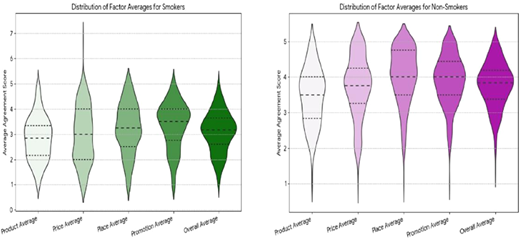
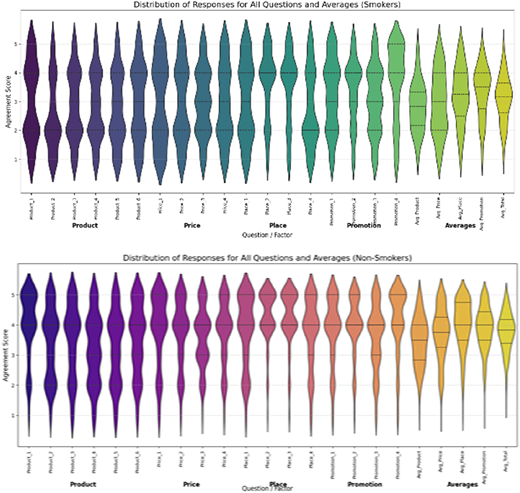
Figures 1 and 2 provide the violin plots for product, price, place and promotion, and each of the 4 behavioral factors of the demarketing framework and compare the two behavior clusters from K-means clustering and PCA. They reflect both the central tendency and variability of the data. Figure 2 addresses each cluster (smoker and non-smoker) to provide behavioral clarity. Each of the surveyed non-smokers scored between 3.5 and 4.0 on the scale, showing strong concentration of agreement on place and promotion, with higher medians. On the other hand, submerged smokers scored lower and showed a higher variance between each of the demarketing factors of price and promotion, apart from a higher agreement; therefore, lower sensitivity to marketing interventions and economics.
In general, the analysis recognizes different levels of central tendency and variance for each cluster, consistent with Mann–Whitney U and Levene's tests. It is hypothesized that the median response for non-smokers is more positive for restrictions on both the availability of tobacco and the exposure to marketing, whereas smokers are likely to have a median response at about 2.5–3.5, with a more widespread and more negative response of a greater extent. Higher variance among smokers in response to marketing has been shown with price and promotion. It is suggested that the marketing mix offers a spectrum of fiscal and communication-based responses to demarketing. All four factors were subject to Mann–Whitney U tests, which were strongly significant for the differences reported with p < 0.05, and greater variance for smokers than for non-smokers with Levene's tests. Dyad behavior separation shown in the violin was supported by these results.
Figure 1 provides evidence of the overall distribution for both clusters and the response distribution for the smoker cluster was provided in Figure 2, with the response distribution for the non-smoker cluster in Figure 2. Smokers are less consistent and more dispersed with their responses to both price and promotion than non-smokers. Responses are more consistent for non-smokers to the wider scope of the large de-marketing of the tobacco persuasion policies. Smokers require a more focused strategy, suggesting the need for a wider combination of approaches that are mutually supportive of price increases and an upper combination of approaches to price in the lower region of the combination.
4.4 Decision tree analysis
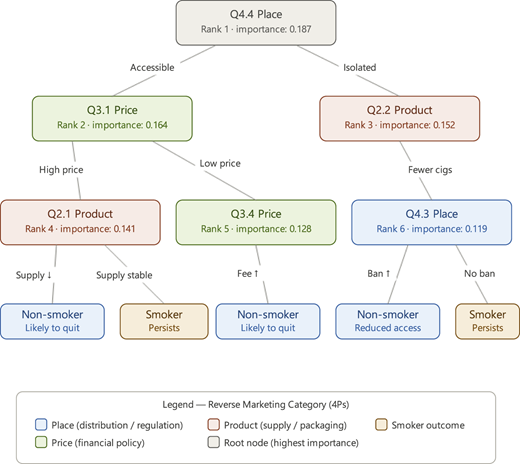
Using demographic and 4P demarketing variables, the Decision Tree model in Figure 3 categorizes smoking versus non-smoking in Palestine. Each split characterizes a behavioral or policy threshold. Each terminal node, validated against the smoking status of the respondents, represents a category and the number of samples in that category. The strongest predictors of smoking versus non-smoking behavior were the attitudinal and perceptual factors, especially the perceived health risk of smoking or the perceived social acceptability of smoking, along with the policy variables. The nature of the model provides interpretability for each node, with the risk and social norms perception and policy sensitivity regarded as the most important explanatory factors of smoking behavior.
Smokers were typically less concerned with health and more acceptance of smoking, while non-smokers held stronger anti-smoking attitudes. It was also recognized in the terminal nodes that younger males with smoking peers were more likely to be classified as smokers, while older males with stronger anti-smoking attitudes were classified as non-smokers. Although some variables like Q4.4 (placement of tobacco sales points in remote areas) were of lower importance (∼0.08), the overall results indicate the importance of the combined effects of social acceptance, health concerns and perceptions of regulation.
Being able to perform a behavioral study of smokers (post-intervention) and non-smokers (pre-intervention) was made easier by using both K-means (MK) and principal component analysis (PCA). Peer behavior was heightened by anti-tobacco policies (support) and demonstrated more by Male (young) smokers. In contrast, smokers demonstrated and were aligned more with policies of demarketing.
Q3.1 and Q3.4 (price), Q2.1 and Q2.2 (product) and Q4.2 and Q4.4 (place) are said to be the most important predictors that affect smoking behavior. Promotion of policies (Q5.1) was said to be seen as a distal variable in the marketing mix and behavioral segmentation was said to be more fully utilized in demarketing policies, especially in the Palestinian market.
From the data, the use of clustering can provide insight into different, naturally occurring, behavioral segments within the population. The decision tree (see Figure 3) explains the behavior of smoking and, in combination, these methods are able to change the segmentation analysis to a behavioral prediction model analysis.
5. Discussion
5.1 Discussion of findings
The outcomes from cluster analysis and decision trees present certain demographic and psychological features of smokers and non-smokers. Even though individual features are not informative by themselves, collectively, they can be correlated with some themes in the literature (e.g., peer influence, social modeling and risk perception) in the field of public health, and are in line with different studies (e.g. Mmari et al., 2024; Pitt et al., 2024) that focus on social and environmental influences, rather than demographic ones. The two-cluster approach shows that differences extend beyond the survey and more toward larger social and economic realities. This study shifts focus from high-income, highly regulated smoking markets, like the ones in the north of Europe, and towards the West Bank, where smoking, demographic and socio-economic instability, and especially social and economic gendered inequality, are of the essence.
The model does not show any individual predictors and smoking behavior causal relations, though we qualify the findings as descriptive and correlational. The combination of clustering with PCA and decision tree analysis, and validation with self-reported smoking status, results in empirically grounded findings that can guide the targeting of anti-tobacco demarketing interventions for young males, low-income groups and other most-at-risk populations, in terms of demographics and other attitudes. This is in line with segmentation in behavioral health research (Najafi et al., 2025), where the predictive segmentation approach is said to increase precision in targeting compared to broad interventions for the entire population.
Analysis of the violin plots reveals that Non-Smokers, in this study, show homogeneity in their support of anti-tobacco initiatives, illustrating a tobacco intervention requirement, whereas Smokers tend to be more heterogeneous in their support of tobacco interventions related to price and promotion, which supports the findings of Petričušić et al. (2025) and Leinberger- Jabari et al. (2024).
Results from the decision tree analysis point to risk and the social acceptability of smoking as important determinants. Pronounced peer pressure as a determinant of adolescent smoking aligns with the findings of Mmari et al. (2024). In addition to peer pressure, the factors (variables) of policy, such as the taxation of products, the control of the availability of products and bans on smoking, are important and complement the results of Pitt et al. (2024), which assert the high effectiveness of structural interventions.
Segmented analysis identified some groups of smokers who will be more resistant to the “one size fits all” approach. This shows that simple (standard) interventions, particularly those that are described as young and low-income, male smokers, need to be specific. This is in support of Najafi et al. (2025) and the need to be specific with profiles of smokers and to be specific with interventions. The value of the combination of clustering and decision tree analysis is the increased understanding and the ability to predict smoking.
The analysis, in summary, illustrates the world beyond demographic profiles and such social and attitudinal as well as the policy and regulatory components as determinants of smoking, among many other things. For all these reasons, the analysis supports a multivariate approach to designing and evaluating interventions in various contexts.
5.2 Theoretical implications
The combination of clustering and the decision tree (of the some or all) analytic framework or model of smoking, which is classified as risk, and the social acceptability of smoking and the control of smoking, contributes to the predictability of some social behaviors. This construct is valuable in that, through the control of smoking, the predictive analysis of some social behaviors is of high quality.
The combination (integration) of the two variables (demarketing theory and machine learning) shows an improvement in the modeling of public health using the control of smoking and the interaction between the regulatory and the control of smoking. This integrated model of predictive smoking, which incorporates the segmentation of smoking and the control of smoking, demonstrates a high level of originality.
5.3 Managerial implications
The study shows the importance of specialized tobacco control approaches specific to Palestine. Decision tree results point to predictors of sales restrictions (Q4.4), pricing (Q3.1), pack size (Q2.2) and limit promotion (Q5.1). The results also show that the young male smoking group is the most at-risk and needs interventions designed to consider the influence of their peers and the prevailing social conditions.
Considering the large number of low-income respondents, efforts to improve smoker group segmentation using pricing, access and visibility restrictions would be most beneficial. Non-smokers who support the introduction of place and promotion control restrictions may also be helped using counter advertisements. These methods reflect the recent national data estimating the prevalence of male smokers in the population of Palestine (PCBS, 2022).
5.4 Practical implications
The results of the study point to the need to come up with anti-tobacco strategies that consider the culture and socio-economic situation of the population in the West Bank. Given the low-income and young male social groups, who are at the bottom of the socio-economic ladder, smoking has become highly acceptable in social circles. Answers to Q4.2 to Q4.4 point to the need to reduce the number of registries in tobacco outlets and increase enforcement of the smoking ban by law in public and workplaces.
For participants in economically unstable conditions, the importance of affordability and the financial burden from smoking have become evident. With the pricing policies especially related to smoking, this may be especially the case.
The results of the practical outcomes of Violin show that most people support the promotion of access and control restrictions, while the smoking population is more sensitive to pricing and availability. Therefore, factors such as access control, pricing and behavioral or motivational pricing that are education- and communication-based may be especially relevant to the interruption. Additionally, it may be especially beneficial to influence the workforce and provide control strategies and add complementary core policies in management. Strategies to improve workforce control would also focus on post-early-stage well-being policies, but more focus would be required to collect the necessary data.
5.5 Policy implications
When designed at the local level, predictive modeling can complement a comprehensive design. These critical measures include (1) local control of outlet locations (Q4.4), (2) increased prices (Q3.1/Q3.2), (3) smaller pack sizes (Q2.2) and (4) the enforcement of smoking bans (Q4.3). These may be more important than demographic targeting policies.
Policies focused on location may also be the most cost-effective, while policies centered on price require a trade-off between the country's trading practices and enforcement economics. Controlled moderate pricing and high enforcement can be expected to most effectively reduce smoking, especially among the young.
The integration of policy measures related to pricing, the product, the place and promotion policy is also expected to create the most policy synergy. It is expected to be more effective to implement tobacco control policies in terms of (1) predictable short-term impacts and (2) predictive analytics – focused policies on high-risk segments in a society, especially young low-income males, than demographic targeting tobacco control policies in the order of greatest to least impact.
5.6 Limitations and further research
This study is limited. The sample is self-selective on social media, which gives a skewed distribution of young male participants and an underrepresentation of females and the rural population, with the male participants comprising more than 85% (597) of the total of 700 participants. In addition, the sample is more reflective of an urban population. Self-reporting is more predominant in females.
Nonetheless, clustering and decision tree analyses revealed the rationale for smoking among the population of the West Bank. More longitudinal and quasi-experimental studies are encouraged to provide more evidence of the impact and the change of the variable under study over time.
The predictive power of the models can be further improved by the introduction of decision impacts (e.g. social impacts and social influences/group dynamics, stress and risk) in addition to support. The improvement of prediction of the models can be achieved through the introduction of the 4 predictive modeling cycles, in addition to risk perception and motivation stress, etc. The improvement of models can also be achieved through an ensemble of decision trees and other instruments, including Random Forests and Gradient Boosting, including the recently developed predictive analytics models (e.g., XGBoost, etc.).
To improve external validity, researchers could use larger sample sizes, particularly including more diversity, and employing stratified sampling. Cluster validation could use the Davies-Bouldin index and the silhouette coefficient. Additionally, segmentation could be supplementary to more targeted demarketing strategies.
Author contributions
The first two authors contributed equally to the conception, design, analysis and writing of the manuscript and shared first authorship. The third author contributed as the second author, supporting methodological development and empirical analysis. The fourth author contributed as the third author, assisting with data collection, literature review and revisions. All authors read and approved the final version of the manuscript.