BRIEFING
Building the business case for best practice
The UK Construction Best Practice Programme was set up following the 1998 Egan report. Director Zara Lamont explains the background to the programme and the benefits it can bring to civil engineering businesses (page 148).

Constructing e-business

A recent survey indicates that half of all construction trading will be conducted electronically within 5 years. Ian Hamilton of Construction Industry Computing Association says e-construction portals are the key (page 149).
Whole-life costing – the new standard
The first part of new BS ISO standard on service-life planning has just been published. David Doran, who represents the ICE on the BSI steering committee, predicts it will make whole-life costing the rule rather than the exception (page 150).

European Parliament comes of age
The European Parliament – which makes fundamental decisions on matters such as the environment and public procurement – is 21 this year. ICE European affairs manager Diana Maxwell went to its new part-time home in Strasbourg (page 151).

MONITOR
Proceedings

The editor's choice of recently published papers, top 10 internet downloads for the last quarter, best papers published last year and details of the new Géotechnique CD (page 152).
Internet
News on websites of interest including the UK government's on-line register of consultants and contractors, a URL for dealing in steel, a CITE-complying e-construction portal and a web guide to on-line geospatial data (page 154).

Events
Details of all forthcoming events organized by ICE headquarters staff on behalf of ICE boards and associated societies (page 155).
PAPERS
Design and construction of the Øresund tunnel
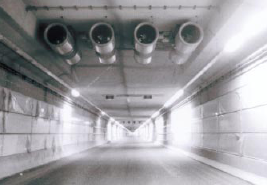
The 16km road-and-rail crossing of the Øresund Sea between Denmark and Sweden opened to traffic in July 2000. John Busby and Chris Marshall describes the design and construction of the 4.1 km long, immersed tube tunnel section – one of the largest in the world (page 157).
Benchmarking production processes in civil engineering
Benchmarking – comparing your performance with that of industry leaders – is a well-established process in the car industry for improving efficiency. Simon Lee and Andrew Graves explain that by analyzing ‘standard construction projects’ it can also be of great value in civil engineering (page 167).
New Civil Procedure Rules
The UK's new Civil Procedure Rules introduced in April 1999 should make it easier for businesses to resolve disputes with their clients and suppliers. Ian Rogers reviews the reforming legislation and how it is affecting the civil engineering industry (page 174).

Integrating design in the project process
The isolated, interdisciplinary and iterative nature of civil engineering design has always been a bit of an Achilles heel for the construction industry. Simon Austin, Andrew Baldwin, Baizhan Li and Paul Waskett introduce a new, government-funded technique to plan and control it (page 177).

Megalith mechanics
The Great Pyramid in Eqypt and Stonehenge in England were both built 5000 years ago from stones weighing up to 40 t. Dick Parry examines the techniques our forebears may have used and concludes that, contrary to general belief, the stones were probably rolled rather than dragged (page 183).

Briefing: Building the business case for best practice
The UK Construction Best Practice Programme was set up following the 1998 Egan report. Director Zara Lamont explains the background to the programme and the benefits it can bring to civil engineering businesses.
The UK Construction Best Practice Programme was developed to help deliver the radical improvements to the British construction industry that Sir John Egan called for in his 1998 report Rethinking Construction.
Sir John argued that all construction businesses should strive to monitor their work more closely and compare their performance with others. In line with this way of thinking the programme aims to help organizations learn how to improve their business performance, primarily by identifying current best practice procedures and providing a ‘signposting’ service.
The programme's principal purpose is to help enable organizations achieve greater efficiency via a continuous and flexible approach to change. This is achieved in a variety of ways. Firstly, it identifies, publicizes and supports the use and benefits of adopting improved business practices. It offers an initial point of contact for organizations wanting to improve, and facilitates links with others keen to share their experiences of best practice. It also provides comprehensive advice on services and products available within the arena of best practice.
Case studies help to share experiences
Tailored to meet the needs of most organizations – large or small, public or private – the programme can also advise on a range of subjects including benchmarking, supply chain management, sustainable construction, partnering and whole-life costs. Its stock of case studies enables organizations to share the benefits gained through implementation of best practice. For example, Partnering for multiple projects, examines the substantial cost and time savings achieved on £30 million worth of projects by Costain and its client Thames Water.
Another case study features London Underground Limited's and John Mowlem's ingenious beam system for making safe ageing covered ways over the Circle and District lines without affecting the buildings above. Kvaerner Cementation Foundations is also featured with its revolutionary railway embankment involving bored-pile walls and vegetated slopes, demonstrating how sustainable solutions can also be cheaper.
Organizing visits, workshops, IT support and clubs
In partnership with Inside UK Enterprise-Construction (IUKE), the programme also offer a unique series of one-day visits to companies already involved in best practice keen to share concepts and real-life experiences. Over 40 companies are currently registered as hosts including Symonds Group, Costain and Arup.
For those wishing to take a more active role, a variety of workshops examining subjects such as supply-chain management, value management and forms of contract are organized in partnership with the Construction Productivity Network.
More recently, the programme has also been instrumental in forming the IT in Construction Best Practice Programme. This aims to help construction firms understand how information technology can help run a business more efficiently, regardless of size or sector, and provides up-to-date information and impartial advice to those considering IT expansion.
A new addition to the programme is a commitment to set up over 30 regional best-practice clubs. Providing a local focus to help organizations improve their efficiency, quality and competitiveness, the clubs will be made up of approximately 20 people who meet locally to learn about and share best practice with each other.
The business benefits of taking part
Research has shown that organizations which improve their performance and processes can make savings of up to 30%, so a revitalized approach by the whole industry will benefit the purchasers of construction-related products and services and the industry as a whole.
Those committed to change will also benefit in other ways, by attracting better staff, suffering less absenteeism and growing repeat business. In the long-term these benefits could translate into better growth and improved profit levels.
At the Construction Best Practice Programme we don't claim to have all the answers, but we know that best practice is the way forward for the UK construction industry. The construction industry is changing – are you?
For further information please contact the helpdesk on 0845 605 55 56 or visit the web-site at www.cbpp.org.uk.
Briefing: Constructing e-business
A recent survey indicates that half of all construction trading will be conducted electronically within 5 years. Ian Hamilton of the Construction Industry Computing Association says e-construction portals are the key.
For some time electronic trading was restricted to closed trading communities. Car manufacturers and supermarket chains exploited it successfully as a way of improving their supply chain management and cutting the costs of buying and holding stock. In these cases one dominant partner was able to impose their wishes on their suppliers as a condition of continuing to do business together.
The internet has provided a global infrastructure that makes electronic trading open to all. Anyone with a credit card and internet access can buy books, plane tickets and clothes quite literally at the touch of a button or the click of a mouse. The ability to trade electronically arrived in advance of national and international legislation, agreement and rules to govern it. The UK government E-Commerce Act received the royal assent in May and an ‘office of the e-envoy’ has been established as part of the cabinet office to guide and encourage the country's adoption of e-commerce.
Defining e-business
For the purposes of debate a distinction is often made between e-commerce and e-business. E-commerce is taken to mean domestic or consumer trading and e-business the business transactions. A further variation is B-to-C (business-to-consumer) and B-to-B (business-to-business).
In civil engineering and building the exchange of digital data between different organizations is an everyday occurrence. Many of our leading firms have been transmitting computer-aided-design drawing files around the world for over 10 years. In general the ordinary telephone networks are ill suited for fast transmission of large quantities of digital data so regular users paid for permanently open higher-speed leased lines. The arrival of ISDN (integrated services digital network) and more recently ADSL (asymmetric digital subscriber loop) have made faster dial-up communications more readily available albeit at an extra cost and subject to regional availability.
Although the exchange of drawings as digital data is well established it seems to be taking longer to reach a similar situation with bills of quantities. A rough estimate suggests that only about 10% of bills of quantities are exchanged electronically. Given that there are now no significant technological barriers, the reasons for this lack of progress may be to do with the organizational boundaries being crossed and the nature of the information involved.
Survey reveals rapid growth is imminent
The current use of electronic commerce for business transactions as opposed to drawings or bills of quantities was the subject of a survey carried out by the UK Construction Industry Computing Association and Construction Products Association in March this year. The survey covered the supply side of the industry – manufacturers, merchants/distributors, consultants and contractors.
It found that the current use of e-commerce accounts for no more than 5% of all transactions. All groups expected this to double over the next 12 months and triple again in the following 3 years. Within 5 years it is expected that 50% of transactions will be carried out using e-commerce.
The survey figures compare well with a recent all-industry survey carried out by Pricewaterhouse - Coopers. This found that 80% of respondents said e-commerce currently accounted for less than 5% of their business and in 3 years time this is expected to rise to over 20%. The main advantages of e-commerce are seen as faster transaction time and reduced costs. Contractors saw the initial setup costs as the main disadvantage but manufacturers and distributors were more concerned about the possible lack of personal contact.
Battle of the e-construction portals looms
It is often said that construction is different from other industries. It certainly lacks major dominant players that made electronic trading possible for retail groups and automobile manufacturers. Our trading communities are open rather than closed.
For full-blown e-business any one company must be able to trade with a wide variety of other companies without having to set up individual arrangements each time a new supplier, partner or customer is required. One solution to this is the establishment of on-line business-to-business exchanges or ‘portals’ serving construction as an industry.
At present there are over a dozen contractor's portals being marketed in the UK. Some of these originated in North America whilst some are home grown. At least one (Mercadium) is from a consortium of product manufacturers and one of the latest (Arrideo) is a joint venture company set up by five of the UK's largest contractors, itself an alliance partner of a major UK, Scandinavian, German venture (AECventure). Most portals aim to act as real-time information exchanges and hosts for on-line project collaborations as well as electronic trading.
The costs of setting up these ventures is large. As yet there is no proven business model and the only certainty is that e-business is happening and will continue to grow offering benefits and rewards to those who get it right. It is recognized that each industry will have its own specific portals. Analysts predict that only three portals will succeed in any one industry. We wait with great interest to see who the winners will be.
For further information, the author can be contacted at ihamilton@cica.org.uk.
Briefing: Whole-life costing — the new standard
The first part of a new BS ISO standard on service-life planning has just been published. David Doran, who represents the ICE on the BSI steering committee, predicts it will make whole-life costing the rule rather than the exception.
Construction clients increasingly want to know what buildings or structures will cost to operate as well as to build. They also want the specified service life of the building to be delivered. The first part of a new British and international standard, just published, provides an overall framework for this to be addressed.
BS ISO 15686: Buildings and Constructed Assets - Service Life Planning - Part 1: General Principles requires the long-term performance and overall operating costs to be considered at the design stage, and enables the design to be assessed against a client's long-term needs.
The new standard will largely replace BS7543:1992 Guide to durability of buildings and building elements, products and components, which in turn replaced BSCP 3 Chapter 1X (1950). The latter, succinctly described durability as ‘the quality of maintaining a satisfactory appearance and satisfactory performance of required functions’. Since then the question of durability has been subsumed into the more general concept of ‘service life planning’, now adopted by ISO, which addresses the design of a structure or a building with a view to its operation through the whole of its operational life.
Controlling the costs of ownership
The new standard reflects the changing nature of construction. There is increasing use of factory production techniques to build sub-assemblies, or modules, or even whole buildings in factories. Economic pressure continuously drives prices down and there is also pressure for construction to deliver its products with less environmental impact and to become more sustainable. In short, construction has to deliver more with less. A major impetus for production of the new standard has been concern over industry's need to forecast and control the costs of ownership because a high proportion of the life-cycle cost of a structure may be set by the time it is complete.
There is an increasing need for buildings to be planned with a view to their whole life cycle. This needs to take account of the costs, impacts, performance and operation of the building throughout the whole of its planned service life. A recent DETR survey found that only 25% of clients use whole-life costing, in spite of the recognized benefits of such an approach. There is a need to provide tools that enable owners, operators, designers, assemblers and users of buildings to plan them for the whole of the service life.
‘Service-life planning’, the basis of the new standard, is a design process which seeks to ensure, as far as possible, that service life will equal or exceed design life, while seeking to optimize the whole-life costs of the project. Service-life planning aims to reduce the costs of building ownership. An assessment of how long each part of the building will last helps to decide the appropriate specification and detailing. When the service lives of the building and its parts are estimated, maintenance-planning and value-engineering techniques can be applied.
Service-life planning can be applied to both new and existing structures, although in existing buildings assessment of components and detailing will seek to identify the residual service life of items already installed. The selection of components and detailing will only apply to repairs and new work.
Standard being published in five parts
The new standard is currently being developed in five parts. Part 1 (drafted by the UK) deals with the general principles, issues and data needed to forecast service lives. It provides a methodology for forecasting the service life and estimating the timing of necessary maintenance and replacement of components. It thereby provides a means of comparing different building options. It also allows for checking that performance is not unacceptably reduced to meet budgetary constraints during design development. It can be used as a stand-alone document.
It is intended to be used by owners and users; design, construction, facilities management and maintenance teams; materials and component manufacturers which provide data on long-term performance of products; and valuers, insurers and technical auditors of constructed assets.
Further parts to the standard are in the pipeline. Part 2 will describe a generic methodology for testing the performance over time of components and assemblies to provide a service-life prediction. Part 3 (also drafted by the UK) describes the approach and procedure to be applied to pre-briefing, briefing design, construction and, where required, the life care-management and disposal of buildings and constructed assets to provide a reasonable assurance that the measures necessary to achieve performance over time will be implemented.
The drafts of Parts 2 and 3 are nearing completion and are available from BSI along with Part 1 as the Service life planning toolkit. This also includes the recently published Client's guide to whole life costing produced by the Construction Clients Forum.
Part 4 will provide guidance where life-cycle costing and/or whole-life assessment are to be explicitly included within service-life planning. Part 5 will deal with guidance on assessment of the life-cycle costs and maintenance planning of a building. These will not be available until late 2002 at the earliest.
When construction professionals require a methodology for developing whole-life cost models, BS ISO 15686 will provide it. There is still an enormous need for more information about the performance of products, components and materials to support whole-life costing but the existence and use of the standard will lead to increasing demands for realistic whole-life cost information.
For further information, the author can be contacted at david.doran@btinternet.com.
Briefing: European Parliament comes of age
The European Parliament – which makes fundamental decisions on matters such as the environment and public procurement – is 21 this year. ICE European affairs manager Diana Maxwell went to its new part-time home in Strasbourg.
The European Parliament affects the professional life of every ICE member through its decision-making or decision-sharing role in matters as diverse as environment, public procurement and free movement. Though it started life as the Common Assembly back in 1957, it was only in 1979 that the first direct elections took place, such that the millennium marks its real coming of age.
The parliament now has 626 members, only 33 fewer than the ‘mother of parliaments’ in Westminster. It is not intended that this number should ever swell beyond 700, even after eventual enlargement to include a possible 10 or more new member states.
A major difference with Westminster is that the European Parliament is obliged to be peripatetic. It was originally based in the traditionally disputed but now French territory of Strasbourg in order to heal any wounds between France and Germany. It subsequently gravitated to Brussels but, because a permanent move has been vetoed by at least one member state, it travels back to Strasbourg more than 10 times a year – accounting for some 20% of its annual budget.
Maturity may still be some way off but the parliament has important powers over EU legislation and budget. It has power to amend legislation through two readings and the right to adopt legislation in 15 areas of EU business, including the environment, research and the single market. The Amsterdam Treaty extended its role as co-legislator with EU member states through the Council of Ministers. In 1999 we were all made aware of parliament's power to censure the European Commission and force it to resign, and of its right to be consulted on appointments to the commission.
New chamber reflects political spectrum
The new parliament building in Strasbourg is located by the river in the European quarter alongside the Council of Europe and the European Court of Human Rights. They are all striking and diverse examples of modern architecture and are reached by a modern integrated transport system, of which Strasbourg is justifiably proud.
The main chamber is a hemisphere. Parliamentary groups sit together in sections ranging in practical and symbolic terms from the far left to the far right. Somewhere in the centre can be spotted a few British pro-Europe liberal democrat MEPs and somewhere behind them is a grouping of anti-European members. The anti-Europeans used to vote against everything as a matter of principle – but stopped this procedure when they realized they had accidentally voted against reform of the parliament, their very raison d'etre as parliamentarians.
Europe's rainbow configuration contrasts starkly with the confrontational seating arrangements of Westminster's two principal parties. From the circular gallery above, visitors can peer down at rows of MEPs in identical blue seats, each equipped with an electronic consul. This is not only for electronic voting (a show of hands suffices for votes where there is a very substantial majority), but also to ensure contact with the bank of interpreters seated in a row of booths located behind the chairman of the parliamentary session. Visitors too can tune in to hear what the parliamentarians have to say, translated into one of the EU's 11 official languages.
Like Westminster, a great deal of parliamentary work is carried out through some 20 standing committees and so it is no surprise to find the chamber very depleted. An interesting innovation is the time allowed to present the subject – for final reading the ‘rapporteur’ is allowed a maximum of 5 minutes to present his or her case, with less time allocated to opposition parties and other committee representatives. Time over-runs – one minute maximum — are clearly indicated in red lights on an electronic board overhead.
Observing water policy-making in action
My visit in September coincided with the final agreement on a directive on European water policy, an issue on which the ICE had presented its views via the European Council of Civil Engineers over 2 years ago and which it revisited last year when there was concern that grouting would be banned owing to the loose wording of a technical annex. The report on the conciliation procedure indicates that parliament has forced the council (representatives of each member state government) to agree to some compromises.
A ‘daughter directive’ may be expected on groundwater within the next 2 years, until which time member states should adopt national criteria. Good surface water and ground water quality should be attained within 15 rather than 16 years. However, member states negotiated an exception to the principle that water pricing should reflect cost-recovery of water services. Ireland, for example, does not charge households according to water and sewage volume but from taxation. Member states are now allowed to opt out if water pricing is not in accordance with established practice. Parliament failed to mention, however, that Ireland's funds for water come from road taxation.
For further information, the author can be contacted at diana.maxwell@ice.org.uk
Monitor
Proceedings: EDITOR'S CHOICE
Summaries of all Proceedings papers published since 1998 can be read free of charge at the ICE web site (www.ice.org.uk/jol). To subscribe to a specialist Proceedings journal call +44 (0)20 7655 2135 (members) or +44 (0)20 7665 2460 (non-members).
Prize winners
The following papers published in 1999 Proceedings journals have won ICE prizes this month.
Civil Engineering (CE)
Lines 2 and 3 of the Athens Metro, I V Leto and B Welburn, Vol. 132 No. 2/3 (Overseas Prize)
Construction of Cairo Metro Line 2, A Madkour, M A Hudson and A Bellarosa, Vol. 132 No. 2/3 (Overseas Prize)
Professor William John Macquorn Rankine, H B Sutherland, Vol. 132 No. 4 (George Stephenson Medal)
Arch bridge crossing the Brno-Vienna expressway, J Strasky and I Husty, Vol. 132 No. 4 (Webb Prize)
Privately financed infrastructure in the 21st century, A Merna and N J Smith, Vol. 132 No. 4 (Frederick Palmer Prize)
Project management of the Jubilee Line Extension, R W East and R F Mitchell, Vol. 132 No. 6 (Parkman Medal)
Design and construction of the Jubilee Line Extension tunnels,
H R Davies, Vol. 132 No. 6 (Coopers Hill War Memorial Prize)
Geotechnical Engineering (GE)
Tube sampling disturbance – forgotten truths and new perspectives,
C R I Clayton and A Siddique, Vol 137, No. 3 (Telford Prize)
An automated electrolevel deformation monitoring system for tunnels,
R H Bassett, J P Kimmance and C Rasmussen, Vol.137 No. 3 (Halcrow Prize – tunnels)
North Morecombe Terminal, Barrow: pile design for seismic conditions,
C A Raison, Vol.137 No. 3 (T K Hsieh Award)
Mechanical behaviour of landfill barrier systems,
L Edelmann, M Hertweck and P Amann, Vol.137 No. 4 (Telford Prize)
Municipal Engineer (ME)
MRFs and municipal waste – bold success or heroic failure?, C S Maltbaek, Vol.133 No. 1 (Telford Prize)
Dealing with operational problems in ex-section 24 sewers,
A Bratby, Vol.133 No. 1 (Incorporated Engineers and Technicians Award)
Regional Development Agencies – A voyage into the unknown, D Pigg, Vol.133 No. 3 (James Hill Prize)
The strengthening and refurbishment of Rochdale town centre bridges, P Clapham and A Rowe, Vol.133 No. 4 (Rees Jeffreys Award)
Structures and Buildings (SB)
Retractable roof structures, P E Kassabian, Z You and S Pellegrino, Vol.134 No. 1 (James Watt Medal)
Active aerofoil stabilization of cable-supported bridge decks,
D D A Piesold and J M Corney, Vol.134 No. 1 (Bill Curtin Medal)
Transport (T)
Road layout design standards and driver behaviour,
G Maycock, P Brocklebank and R Hall, Vol.135 No. 3 (Webb Prize)
Water Maritime and Energy (now Water and Maritime Engineering – WM)
The Mersey Estuary Pollution Alleviation Scheme: Liverpool interceptor sewers, G N Olsen, M F Danbury and B Leatherbarrow, Vol.136 No. 4 (Reed & Mallik Medal)
Predicting water quality in distribution systems using artificial neural networks, P J Skipworth, A J Saul and J Machell, Vol 136. No. 1 (Telford Prize)
Modelling a river channel with distant floodbanks, D A Ervine and A B MacLeod, Vol.136 No. 2 (Halcrow Prize – docks and harbours)
Inland shipping and the maritime link, D Hilling, Vol.136 No. 4 (Robert Alfred Carr Prize)
Reregulation of the Pergau hydroelectric power station, C J Grant, Vol.136 No. 4, (Halcrow Prize – hydroelectric)
Géotechnique 50 CD

All 20,000 pages published in the ICE's market-leading Géotechnique geotechnical research journal since its launch in 1948 are now available in a fully searchable format on CD. The five-disk set contains digitized versions of over 2300 refereed papers and technical notes and includes all annual Rankine lectures.
The CD set is available in two 25-year parts, covering 1948 to 1975 and 1976 to 1999 respectively. Both parts have abstracts and a fully searchable index of all published papers. Searches can be conducted by subject, author, abstract, key text word, paper type and date. The VAT-exclusive price to ICE members is just £125 for either part or £230 for both (the non-member prices are £650 and £1100).
Minimum system requirements are an IBM compatible PC, Pentium 166MHz processor or equivalent, 16MB RAM, Windows 95 and a 4x CD-ROM drive
For further information please contact the Customer Services Department at Thomas Telford, telephone +44 (0)20 7665 2464, email customerservices@thomastelford.com.
TOP 10 DOWN LOADS
All papers published in ICE Proceedings journals since1998 can be downloaded by subscribers from the ICE web site at www.ice.org.uk/jol. The following table shows the top 10 downloads in the quarter to 31 August 2000.
Call +44 (0)20 7665 2135 (members) or +44 (0)20 7665 2460 (non-members) to subscribe.
Internet
UK government register goes on-line
Constructionline, the UK government's register of over 9000 prequalified contractors and consultants, is now available over the internet. Around 800 public and private sector organizations currently use the Constructionline database including local authorities, housing associations, NHS trusts and universities as well as main contractors and consultants.
Previously access was only available by a direct dial-up, point-to-point connection from a dedicated PC. A web browser plug-in now enables the database to be accessed at http://193.130.99.1/NFuse by any PCs in a user's organisation with Citrix connection software installed. As well as enabling multiple connections, the new service should also be faster and cheaper.
In addition, at http://193.130.99.1 /constructionline/ contractors and consultants can now apply for registration over the internet by completing an electronic version of the application form. When registered, they can view their details on-line and check how many times they have been accessed and selected. The site is only available using Internet Explorer.
Created and owned by the Department of Environment, Transport and the Regions (DETR) two years ago, Constructionline is managed by Capita Group plc in a public/private partnership.
For further information please contact Constructionline's helpline on 0870 240 0152 or email construction-line@capitagroup.co.uk
Dealing in steel
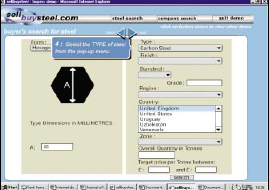
Sellbuysteel is a new business-to-business website which enables suppliers and purchasers of steel to find each other on a regional, national or global basis.
The site at www.sellbuysteel.com is a subscription-based service run by Sellbysector Limited in London, which claims to be independent of producers. Once the subscription fee is paid – £750 for buyers and £3000 minimum for suppliers – no commission is payable regardless of the number of transactions made.
A registered buyer specifies the steel he or she requires by form, dimensions, type, finish, standard, grade and overall weight and then requests quotations from registered suppliers in a specified region, country or world zone. The target price range per tonne can also be specified.
For further information please telephone +44 (0)20 7841 2787 or email info@sellbuysteel.com
Buildingwork.com
leads UK e-construction race
UK-based Causeway Technologies' £10 million e-construction portal at www.buildingwork.com currently claims to be the country's largest with a user base of 1000 medium to large construction companies and over 3500 smaller firms.
The Oracle-powered service— which also includes a news feed from Contract Journal— is based around four integrated e-business centres covering projects, procurement, resources and information.
It uses the systems integration standard developed by the ‘construction industry trading electronically’ (CITE) initiative, which should help to ensure problem-free data exchange between clients, consultants, contractors and suppliers.
For further information please call 087 0607 0192 or email info@buildingwork.com.
Need a map?
Ask a giraffe
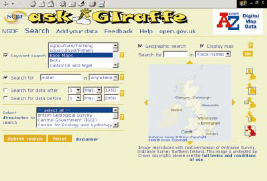
AskGiraffe is the new website of the UK's National Geospatial Data Framework, an Ordnance Survey-funded initiative which aims to collate all public and private geospatial data to create a UK standard geographic base. The first service available from the site at www.askgiraffe.org.uk is a data locator, which provides a catalogue of a wide range of UK public and private geospatial data currently available on the internet.
The catalogue is accessed by type of data — with headings ranging from agriculture to utilities—as well as keywords, date, source and location. It then provides details of all relevant products and/or datasets such as title, author, description, format, supplier and price.
For further information please contact programme coordinator Sallie Payne on 023 8079 2614, email sallie_payne@ngdf.org.uk
EVENTS
The following meetings, seminars and social events have been organized by ICE headquarters staff on behalf of ICE Boards and Associated Societies.All are free to attend unless indicated by (£). For full details please contact the organizer or visit the ICE web site at www.ice.org.uk.