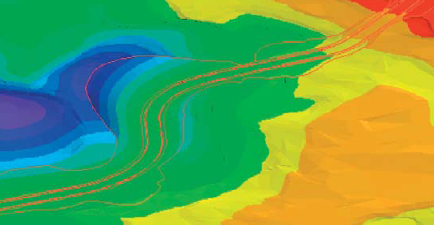
Civil engineering design is usually a slow and iterative process, often involving extensive changes to suit many stakeholders. Parametric three-dimensional model-based software could make things lot quicker, according to Jack Strongitharm of Autodesk.
According to Charles Darwin:‘It is not the strongest of the species that survive, nor the most intelligent, but the ones most responsive to change.’ Most of us show a reluctance to work in a different way unless we have to, but sometimes the case for change is so compelling it overcomes our natural resistance.
Perhaps civil engineering has reached this tipping point. Timescales are getting shorter, profit margins are diminishing, projects are becoming more collaborative and the need for public consultation and environmental considerations is increasingly paramount.
In short, there is a need for greater accountability and visibility. And everybody from the client to pressure groups has an opinion on your work—and each may cause you to tweak or re-think your original designs.
Maintaining design purity
What any civil engineering designer really wants is to be able to put a concept down as it occurs to them—but also to be able to change it quickly and easily when they think of new ideas and when other parties bring in new parameters. In other words, you may end up with a compromise, but you do not want the result to look like the proverbial camel. When the design is finalised you want to be able to feel you have realised your own ideas.
I have recently been involved with the newly formed, independent Autodesk civil solutions user group (ACSUG), which has attracted representatives from across the profession—from independent consultants to those working in local and central government. Many I have spoken to express a similar opinion.
‘Nowadays, everybody knows what technology can do and, in general, expectations are high,’ says Gordon Easson of WSP, chairman of ACSUG. ‘Clients now expect to be able to easily make revisions at any stage and civil engineers need the solutions to enable them to do this—without it being a major cost or time issue.’
Parametric 3D software
Most other disciplines within the architecture, engineering and construction sector are now familiar with parametric three-dimensional model-based design software and, for many, it is part of their mainstream processes. Until recently, civil engineering has been one of the last bastions of old design technologies.
However, new software released onto the market has changed this and now parametric model-based software is available. Parametric model-based software uses intelligent objects that recognise their form, fit and function in the real world.
For example, to a civil engineer, lines and curves represent an alignment that provides horizontal and vertical control for a road, railway or other corridor design.When those lines and curves are intelligent objects, the software understands the relationships between them and reacts accordingly when, say, a curve's radius becomes too small or a line's length becomes too short.
Changes easily made
Further, when an object is changed, all related objects and geometry data are updated automatically without the need for any manual intervention. As a consequence, engineers can change the design at any time and all dependent objects are automatically regenerated.
The main benefit is clear: users can save significant time in the redesign process.This is particularly valuable in the preliminary phases of route selection and cost estimation.The software provides a corridor model that can generate all necessary information for project drawings as well as quantity takeoffs. Evaluation of different alignment options takes just seconds, from design change to the updated model with drawings and quantities.
Software has matured so that it now does what it was always meant to do: enable users to design without having to become an IT expert in the process. I believe there has never been a better time for civil engineers to shed their natural caution.
FOR FURTHER INFORMATION CONTACT, Jack Strongitharm, TEL +44(0) 1252 456600, EMAIL jack.strongitharm@autodesk.co.uk WEB, www.autodesk.co.uk