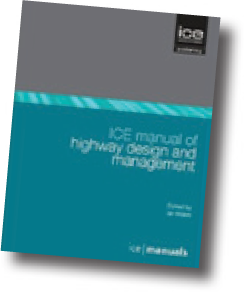
ICE manual of highway design and management
ICE manual of highway design and management is the latest in a series of manuals being published by ICE covering a range of topics from law, health and safety through to structural design.
The book is a collaborative effort from many highly qualified, eminent contributors and has been edited in a way to present each chapter in a similar format and style and make it very readable and informative. The contributors have backgrounds in highway authorities, design consultancies and academia. The editors have cleverly created a style which makes the manual consistent in both presentational and ‘voice’ terms.
Some areas of coverage are refreshing, for example the ‘politics and the public’ section and intelligent transport; another area, which is not usually covered in highway books, is the financial aspect and associated funding streams. There are seven clear sections which cover the financial and legal framework, transport planning, traffic engineering, highways design principles and practice, highway materials and recycling, maintenance planning and techniques, and asset management.
I found it a highly useful revision of knowledge that I have picked up piecemeal over a career in the highways sector. For graduate engineers starting in the profession it would be a wonderful manual to create a framework upon which they could then hang their own personal understanding as their careers develop. It is also an excellent resource for clients, contractors designers and academics, enabling them to consider the area in which they operate, within the context of the whole highway design and maintenance activity, and provides easy access to further reference sources. Many administrative support staff, politicians and the public would find it educational too.
In summary this is a brilliant reference book and I would urge employers to highlight its existence to engineers and non-engineers in their organisations and make it mandatory reading for those in the field of highways.
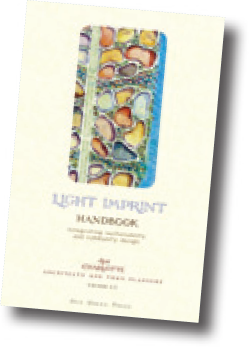
Light imprint handbook: integrating sustainability and community design
This is an outstanding and beautifully designed handbook by a team of architects and town planners of the ‘light imprint initiative’, promoting and developing a green approach to neighbourhood design. The team employs ‘new urbanism’ principles to create compact, walkable, mixed-use neighbourhoods. Its planning and development strategy emphasises sustainability, pedestrian-oriented design and increased environmental and infrastructural efficiency while reducing communities’ anticipated construction expenses.
The book lays out an array of light imprint tools, which cover paving, channelling, storage and filtration, and each is shown in the context of an actual new urban project. More than 60 techniques are described for paving streets and walkways, channelling and storing water and filtering surface runoff before release into the underground water table. All tools are useful in both new developments and existing communities.
This book is recommended to anyone wishing to develop a strategy for sustainability and pedestrian-oriented design in an economical way; anyone who wishes to reduce costs associated with conventional engineering practices; and anyone who cares about neighbourhoods, including planners, developers, architects, engineers, public officials, investors and community activists.
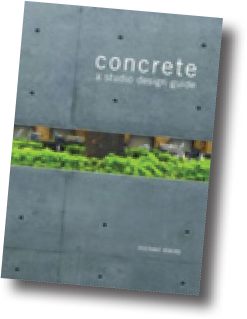
Concrete: a studio design guide
This book describes the physical directness, versatility, plasticity and expressiveness of concrete and how these qualities can contribute to successful design and construction of bridges, buildings and underground structures.
It explains concrete’s qualities in detail using images of and information from numerous buildings designed by well-known architects, and reveals how to create outstanding contemporary architecture using the material. It also covers production and placement of concrete, formwork, concrete types and mixes, and sizing and thickness of concrete members, as well as issues such as colour, surface finish, weathering, thermal insulation, energy efficiency, sustainability, life expectancy, alternative cements and recycling.
The book is a valuable reference for all involved in the design and construction of concrete structures including precast members. It is an excellent reference full of useful information for students, architects and engineers. It can also be a useful source of information for clients, consultants and contractors who need to understand the aesthetics, form, construction and sustainability of concrete structures.
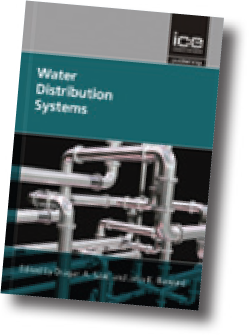
Water distribution systems
This edited volume, compiled by two leaders in the field, presents a comprehensive overview of the overarching principles and good practice required for the successful design of water distribution systems. Unlike many other water engineering books, this one does not try to cover everything, rather to provide a timely focus on the engineering of water distribution systems where environmental and sustainability requirements, new methods and increasing computer power have greatly increased the engineer’s capacity to design more efficient and robust systems.
The book not only addresses the fundamentals of design and management but also covers social, economic and environmental objectives. Although a couple of sub-sections within the book will only be relevant to those operating within the UK or EU regulatory framework, the vast majority will be relevant to engineers the world over.
Each chapter has been written by at least two leading figures in the field. One of the most innovative features is that each chapter is co-authored by an academic and a practitioner – thereby grounding theoretical concepts and advanced tools and techniques within everyday practicalities. The book provides sufficient technical depth to act as a reference book for experienced practitioners but is highly readable and would make an excellent investment for final-year civil engineering undergraduates and MS c students on water or environmental engineering courses.
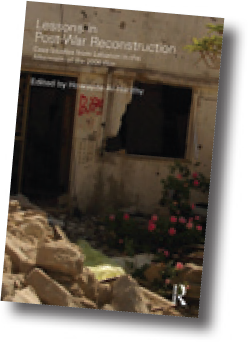
Lessons in post-war reconstruction: case studies from Lebanon in the aftermath of the 2006 war
This book presents real-life experience of the effects of blast and impact on properties and their reconstruction. The properties are in Southern Lebanon and were either destroyed or damaged following the Israeli attack in July 2006.
The book is a series of case studies, a collection of personal experiences and efforts made by a group of architects and planners (and one civil engineer) from the American University in Beirut, who came together after the war ended and formed the ‘Reconstruction Unit’. It becomes clear that the unit had noble and professional aims to achieve and yet it is equally clear that their successes were limited in number, although their influence was significant.
Though not an easy read the book does provide a unique view of the reconstruction of a region that is likely to suffer further conflict and what part construction professionals can and should play. Indeed the history of the region provides the inhabitants with the experience of reconstruction in the almost certain knowledge that it shall be destroyed again.
Cost–benefit analysis, a practical guide (2nd edition)
Cost–benefit analysis is often one of the most invaluable tools in decision-making, yet it is often inadequately understood by the practitioners who would most benefit from its use. This book is different in that it has been specifically written by a practising engineer with the sole aim of explaining, in a clear and straightforward way, how the technique can be applied in practice as well as its underlying rationale.
It explains all concepts and procedures in a common-sense way and from first principles, provides guidance on using computer software and avoiding the pitfalls, and gives advice on the presentation and reporting of analyses together with a checklist and examples showing how to inform and satisfy multiple audiences.
Applications in fields such as health, education, transport and water are described in detail, along with social, environmental and political aspects. It deals explicitly with probabilities and uncertainty, including Monte Carlo and multi-criterion decision analysis.
In summary, this is a very interesting book and can be considered a high-value breakthrough among the vast range of literature on subject.
Concrete-filled tubular members and connections
The book is an excellent text on concrete-filled tubular members and connections; it contains descriptions and explanation of the basic principles and summarises the research to date. In addition, it provides readers with guidance on the use of various design standards around the world (British, Eurocode, Australian and Chinese) and illustrates their use with worked examples.
The final chapter covers some new developments, for example pre-loads and the long-term effect on concrete-filled columns, self-compacting concrete-filled columns, concretefilled double-skin tubes, and fibre-reinforcedpolymer-wrapped concrete-filled columns.
The authors are experts in the field of concrete-filled tubular members and this book is an extremely useful text for any researchers working in this area.
Full versions of these reviews can be read in the supplementary data to the online version of these pages at www.civilengineering-ice.com.
NEW BOOKS
The ICE’s bookshop in London carries one of the most comprehensive ranges of civil engineering books in the world. New books received in the past three months are as follows.
Civil engineering specification for the water
industry (7th edition)
UK Water Industry Research£38·00
Concrete repair – a practical guide
Michael Grantham£70·00
Construction dispute resolution handbook
Robert Gaitskell £45·00
Construction practice
Brian Cooke £29·99
Construction quality management – principles and practice
Paul Watson and Tim Howarth £29·99
Field geophysics (4th edition)
John Milsom and Asger Eriksen £22·50
ICE manual of highway design and management
Ian Walsh (ed.) £150·00
Managing the professional practice: in the built environment
Hedley Smith £49·99
New aspects of quantity surveying practice
Duncan Cartlidge £29·99
Noise and vibration from road and rail
Trevor Lawrence, Julie Dakin, Paul Norris and Max Forni £60·00
Offshore geotechnical engineering
Mark Randolph and Susan Gourvenec £80·00
People and organizational management in construction (2nd edition)
Shamil Naoum £27·00
Portland cement (3rd edition)
Lesley Struble, Paul Livesey, Peter Del Strother and Gerry Bye£55·00
Steel detailers’ manual (3rd edition)
Alan Hayward, Frank Weare and Anthony Oakhill£69·99
Structural fire engineering
Tom Lennon £55·00
Successful professional reviews for civil engineers (3rd edition)
Mac Steels £25·00
The civil engineers
Hugh Ferguson and Mike Chrimes £30·00
Timber bridges
Christopher Mettem £75·00
The bookshop is in the ICE foyer, 1 Great George Street, London SW1P 3AA and is open from 9.30 am to 5.00 pm, Monday to Friday. Books can also be ordered by calling +44 20 7665 2019, emailing bookshop@ice.org.uk or by visiting www.ice.org.uk/bookshop.