1500011 UK sustainable drainage systems: past, present and future
By Richard Ashley, Louise Walker, Brian D’Arcy, Steve Wilson, Sue Illman, Paul Shaffer, Bridget Woods-Ballad and Phil Chatfield (August 2015)
Contribution by John Acton
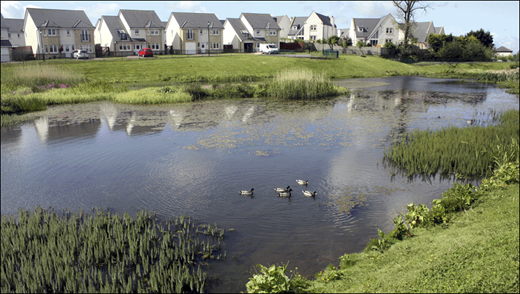
Ashley et al. (2015) point out that in England the use of sustainable drainage systems (Suds) is enshrined in the planning process rather than in a local authority approval body, which fails to address the issue of ownership and long-term maintenance. However, there is more trouble ahead. Development companies often apply for outline permission with detailed matters such as Suds reserved for later approval. The result can be that outline planning permission is granted, the principle of the development is therefore agreed, yet the drainage system has not been designed and its effectiveness, ownership and maintenance responsibility have not been settled. In the absence of an approval body, how can the public (maybe including residents downstream already subject to flooding) have confidence that practical and effective Suds can be installed, that there is a permanent owner to be contacted if anything goes wrong and that the necessary maintenance will be done?
Authors’ reply
The contributor’s point is valid – it emphasises the flaws in relying solely on planning to deliver Suds in England. Outline planning permission is likely to remain problematic for securing Suds.
Planners are being placed in an impossible position where they have to approve drainage matters without the resources to employ engineers to provide technical advice. Planners are also being asked to ensure that robust measures are in place for long-term maintenance – but have no guidance on the availability and suitability of different funding mechanisms (or how they can be enforced by way of the planning system).
New planning legislation in Wales reinforces the need for early engagement between developers and relevant stakeholders, such as water companies and others with an interest in drainage, such as Natural Resources Wales.
Reference
1400049 Reducing accidents between construction vehicles and cyclists
by Glen Davies and Hannah White (August 2015)
Contribution by Michael Robinson
Davies and White (2105) fail to address the other half of the issue: cyclists. They focus on the improvements that can be made by the construction industry and vehicle manufactures, which is laudable, but without proper education and policing of cyclists this will not solve the problem. If it is so serious a problem, which will only get worse with increased cycling numbers, then perhaps there is a need for compulsory testing and even licensing of cyclists in the capital.
Authors’ reply
Our paper focused on the work of ‘Construction logistics and cyclist safety’ (Clocs) programme, an industry-led response from the construction industry to reduce the risks posed by its vehicles to cyclists and other vulnerable road users.
Alongside Clocs, Transport for London (TfL) works closely with a wide range of stakeholders, engaging with the wider freight industry and with cycling lobby groups to help raise awareness of cycle safety. TfL takes a balanced approach, working with all road users to promote responsible behaviour through educational and enforcement initiatives.
For example, the ‘Exchanging places’ programme gives cyclists the opportunity to see the road from the driver’s seat of a heavy goods vehicle (HGV), highlighting the extensive blind spots that exist on HGVs. This is similar to the ‘Safe urban driving’ course for lorry drivers and is an opportunity to see the road from the other road user’s perspective. More than 14 000 participants have taken part in the programme to date.
TfL is also educating cyclists to be more aware of the risks they face, with cycle confidence training such as ‘Bikeability’ in schools available through most London boroughs, plus workplace cycling schemes. A cycle code of conduct is being developed for TfL’s cycle hire scheme too: a simple list of ‘dos and don’ts’ to help users cycle safely around London. All cycle hire bikes are also fitted with information warning of the danger of undertaking an HGV.
In addition, TfL funds policing teams that work with all road users, including ‘Operation safeway’, where officers are deployed at key junctions to enforce the law and give out road safety advice to motorists and cyclists.
Furthermore, TfL is investing in improving cycling infrastructure and developing new designs to improve cycle safety, including deeper advanced stop line boxes, marking cycle lanes through junctions and segregating cycle lanes.
Reference
1400068 The long-term response of rivers to engineering works and climate change
by Huib de Vriend (August 2015)
Contribution by Michael Thorn
de Vriend (2015) rightly reminds us that pre-electronic knowledge and understanding of the long-term development of rivers and their morphology can easily be forgotten or overlooked when trying to build computer models by simulating relatively small-scale and short-term processes. The long-term effects of engineering works or natural environmental changes in the controlling parameters, such as those described, can easily be demonstrated qualitatively on a seaside beach with a small stream running across it, using a child’s bucket and spade. The speed of morphological evolution is greatly increased, but the morphological timescale factor is indeterminate. The seminal literature (e.g. Henderson, 1966) suggests that the ‘sedimentation time’ is independent of the ‘hydraulic time’ and has to be determined empirically from model observations. It would be interesting to know whether the author can offer any insights into the determination of sedimentation timescales in scale-model reproductions of river evolution.
Author’s reply
In a reduced-scale model, time is generally accelerated. A hydrodynamic scale model giving a perfect representation of all aspects of the flow, however, can only have a scale of 1:1. So any reduced-scale model comes with concessions with respect to less important or less scale-dependent flow phenomena. This is even more so if the model bed consists of loose sediment, like in the beach experiment described by the contributor.
Yet one is not left totally in the dark concerning the morphological timescale in such a model. If the model covers only a small part of a river, for instance in the vicinity of a planned engineering works, this timescale can be derived directly from the sediment balance equation. It is proportional to the product of a typical longitudinal and a typical vertical dimension divided by the transport rate per unit width.
Let the scale factor of any quantity be defined as the value of that quantity in reality divided by its value in the model. So, if the horizontal dimensions in a model are reduced to 1/50 of those in reality, the horizontal scale factor is 50. The sediment balance equation directly shows that the timescale factor of the morphological changes must be proportional to the product of the scale factors of the horizontal and vertical dimensions, respectively, divided by the scale factor of the sediment transport rate. The latter can be derived from the transport formula, which relates the flow velocity to the sediment transport rate. Note that many hydrodynamic and morphological scale models are distorted – that is, the scale factors for the horizontal dimensions are different from those of the vertical ones.
If one considers a much longer part of the river, backwater effects play an important role in the morphological process. In that case, the timescale of the large-scale morphological evolution is given by the product of a typical longitudinal dimension squared and a typical depth value, divided by the product of the representative length scale of the backwater curve and the transport rate per unit width. If such a long river reach is put into a scale model, as has been done for various large Chinese rivers, the corresponding timescale factor can be elaborated to the same expression as above: the product of the scale factors of the horizontal and vertical dimensions, respectively, divided by the scale factor of the sediment transport.
In conclusion, the sedimentation time in a scale model does not need to be determined empirically, but is related to the hydraulic time by way of the flow velocity and the sediment transport formula.
References
1400062 Raffles City Chengdu, China: achieving a sunlight-influenced design
by Aaron Wang and Ye Hong (May 2015)
Contribution by Heather Rigby
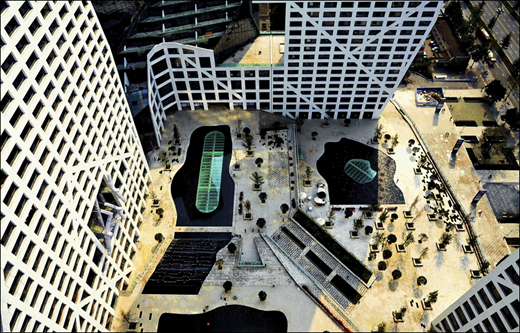
Wang and Ye (2015) describe how structural engineers worked closely with architects to admit sunlight to the interior of the Raffles City Chengdu project. I think it is joyous that at last common sense helps shape the combination of many minds and skills to maximise sunlight within high-density developments for the benefit of people who live and work within, and indeed without. The timing of the sun penetration is also important: it is definitely of most value in the afternoon and early evening in areas where people can relax, while it could possibly be more fleeting in the morning when workers tend to move around more. Winter sun is probably the most precious. Sunshine equals contentment and happiness, which is so important, especially in crowded areas. But if buildings are to be slanted and positioned to this end it means architects and engineers need to have more than a nodding acquaintance with each other.
Authors’ reply
Certainly the design and construction of modern integrated buildings of high plot ratio demand a greater integration of architectural design and engineering to meet performance targets within multiple constraints.
Constraints typically include small building footprint, obstruction from adjacent buildings and protection of surrounding utilities and infrastructure. Meanwhile, architects and engineers are also targeting higher levels of building performance − including reasonable levels of direct sunshine, natural ventilation, structural safety and building comfort. In order to meet them all it is essential to make the overall design and engineering process more integrated and interactive.
It definitely raises the bar for modern architects and engineers. But with help from modern digital design and engineering technology, the authors believe this is the future for municipal mixed-use buildings.