

The consulting engineers – the British consulting engineers who created the world’s infrastructure
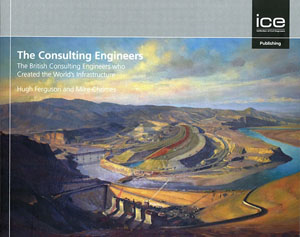
This book follows on from The civil engineers and The contractors to chart the history of British consulting engineers and partnerships through to today’s international companies. Readers are taken from the earliest beginnings of the profession through to its recognition in 1910 at the inaugural meeting of the Association of Consulting Engineers (almost 100 years later than the Institution of Civil Engineers).
Aimed at both historians and professionals, it covers rail and power before moving onto the two world wars – where it charts the massive increase in infrastructure building and demonstrates what manpower alone can achieve when at war and in peace time. Who knows what will happen post-Covid-19, but that would be a new chapter yet to be written.
The book explains iconic structures such as the bridge on the River Kwai, Sydney Opera House, London’s Thames Barrier and the Prince of Wales Bridge. This is then followed by historic information on famous consultants from the 1700s right up to the present day.
Once you delve into this historic volume you will see many familiar names, both past and present. I believe all readers will find it a thoroughly enjoyable book to dip into and immerse themselves in the history of consulting engineers, regardless of their own specialist area.
Blast effects on buildings (3rd ed.)
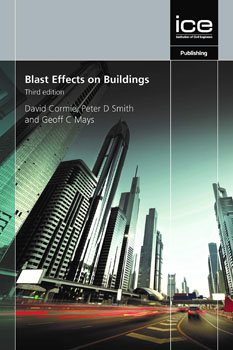
Cormie, Mays and Smith are internationally renowned experts in blast effects and protective structural design. First published in 1995, this key engineering reference book has been continuously improved and augmented with experience gained by the authors over the past 25 years.
The third edition now covers a comprehensive range of topics, from blast loading characterisation and derivation of blast loads for design purposes by different methods, to the design for blast loading of single structural elements made of different materials (steel, reinforced concrete, steel–concrete sandwich composite, masonry, glazing and framing) and of structures with methods of varying complexity (from single degree of freedom to detailed whole-building approaches). Vehicle-borne threats and hostile vehicle mitigation are also treated, vehicles being potential tools of a terrorist attack.
Important changes over the 2009 second edition include a new chapter dedicated to masonry, a revised and restructured chapter on design for operational resilience, new sections on ground shock and underwater explosions, and a discussion on the limitations of single-degree-of-freedom methods. This is without doubt the most complete edition yet.
Recycled aggregates: use in concrete
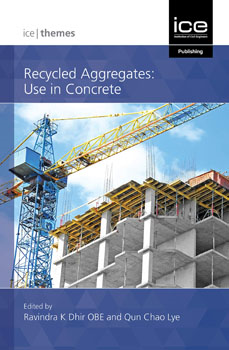
This book acknowledges that its topic is not a novel one. However, using recycled aggregates in concrete has become a part of the larger issue of social responsibility, which demands minimising corporate carbon dioxide footprints wherever possible. The world’s significant volume of masonry and concrete waste has drawn attention to the need to promote sustainability by networking between the producers of concrete and masonry waste and its potential users.
The book compiled a number of key design research efforts central to determining whether recycled aggregate is appropriate for different structural purposes. Selected papers by previous researchers are referenced to highlight the issues from engineering design perspectives. The authors give a commentary of opposing views on the development of concrete properties, the specification of recycled aggregate and the feasibility of using recycled aggregate in the mainstream construction industry.
The book benefits from a section that informs readers on the environmental importance of construction waste reduction and management. The authors encourage additional research and note future opportunities for associated research on the financial impact of procuring recycled ‘graded’ aggregate.
Contract management: core business competence
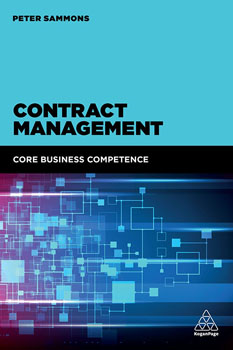
I was interested to review this book because for many years I have been focused on NEC contract management. It is always heathy to stand back from the specific and to consider the best-practice principles of contract management that should apply to all contracts.
I found the author’s approach both informative and well structured. Sensibly, he concentrates on analysis from both supplier and client perspectives. These are the parties to a contract and both carry risks which need to be recognised and understood.
We are all aware that successful contracts and contract management starts from a position of understanding the issues facing each other, and then compiling balanced contracts understood by both parties. This means that there are no unpleasant surprises, which tend to be the source of later contract management issues. The author includes several helpful tests to check that the basis of the contract is sound.
The book contains the principles for a contract management plan. Intelligently, it sticks to the principles and is not prescriptive about the format of this document, but rather focuses on what needs to be included to achieve the objective. The premise is positive and I also found it aligned well with contract management development programmes. The titles may vary a little, but the principles are all there.
My only observation, not a gripe, is that it refers to the NEC3 contract suite. As we are now 3 years into the world of NEC4, it might have been better to refer to the newer version. None of this detracts from the judgement that it is founded on good principles, which all professionals are well advised to remind themselves of.
The book is relevant whatever conditions of contract you are working with. I found it freed me from the standard approach I have followed out of habit and reminded me of what I needed to do and why it was important. So, full marks; I am going to read this book again at a little more leisurely pace to ensure I can fully learn and reinforce the learning.
Coastal management 2019: joining forces to shape our future coasts
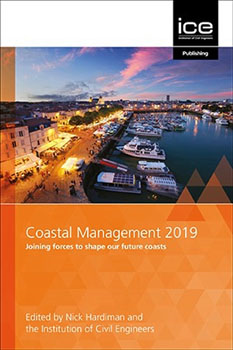
This book is a comprehensive collection of papers presented at the Institution of Civil Engineers’ ninth costal management conference at La Rochelle, France in 2019. What is really useful is the sheer diversity of papers – they are from a wide range of disciplines and countries. It is a truly international collection and, as a result, highly valuable.
I was impressed by how broad the references were for some of the papers, demonstrating that authors’ ideas were built on those of many others. I also found the debate about high prices for coastline living versus the social and economic inequalities that tend to exist in these areas particularly thought provoking.
For anyone dealing with coastal management, this is a good reference book to stimulate your thinking and broaden your understanding. It is just what we need to respond to the climate emergency and to innovate on solid foundations.
I also believe it will be a good professional development tool for all civil engineers working in the coast management sector. We must always remember our professional duty to maintain our professional development throughout our lives as professionals. This book will help you to do so.
The history of the theory of structures: searching for equilibrium (2nd ed.)
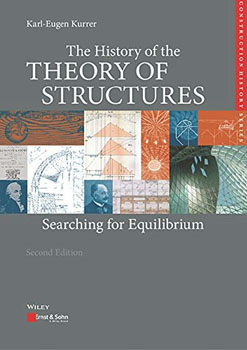
This is very much a must-have book for every aspiring civil or structural engineer aiming to understand the origin of their discipline and ultimately the profession.
With over 1200 pages, it is a very comprehensive historical study of the theory of structures by an engineer keen to share his passion for construction. It explains how our understanding of mechanics, mathematics, materials, design and more recently modern numerical engineering has evolved and shifted over the centuries.
There are brief biographies of over 260 key players: from Archimedes, whose work on volume and centre of gravity was so fundamental to the growth of mathematics in the sixteenth and seventeenth centuries, to the three pioneers of finite-element methods – Argyris, Clough and Zienkiewicz. These help to bring into perspective the socio-economic and human context in which the theory of structures evolved.
This book is beautifully illustrated and contains the right amount of equations and schematics to explain the theories and principles fundamental to the search for equilibrium. For a structural or civil engineer, this is a book to revisit time and time again over the years.
NEW BOOKS
The ICE Library maintains one of the most comprehensive collections of civil engineering books in the world, including all titles from ICE Publishing (shown in bold below). New books acquired in the past 3 months include the following (* indicates e-book only).
All books can be borrowed from the ICE Members’ Resource Hub on the second floor of 1 Great George Street, London, SW1P 3AA from 9.15 a.m. to 5.30 p.m., Monday to Friday (subject to Covid-19 restrictions). ICE members can access e-books online by going to www.ice.org.uk/knowledge-and-resources/ice-library/digital-resources and logging in using their MyICE email address and PIN. ICE Publishing titles can also be purchased from the ICE Members’ Resource Hub or ordered by calling +44 1235 465 577, emailing orders@icepublishing.com or by visiting www.icevirtuallibrary.com/content/books.


