Fully operational in August 2025, the £4.6 billion Thames Tideway Tunnel project is one of the largest and most complex civil engineering schemes in the world. The project is a deep-level collect, store and transfer tunnel system for combined sewer overflow control in London, UK, to improve the health of the tidal River Thames. This paper reports on the purpose of the scheme, an overview of technical solutions, the delivery model used and how the project was financed.
1. Introduction
The Thames Tideway Tunnel project is a unique and significant infrastructure project for London and the UK. It was among the first major UK projects to be delivered under the Planning Act 2008 as a Development Consent Order (DCO) (HMG, 2014), and the first project to be delivered under The Water Industry (Specified Infrastructure Projects) (English Undertakers) Regulations (SIPR) (HMG, 2013). Its conception was driven by the UK’s need to comply with the European Commission’s urban waste-water treatment directive (UWWTD) (EC, 1991) and, in 2025, began to substantially eliminate discharges of combined sewage into the tidal River Thames, which in a typical year could total around 39 million m3.
After 1991, the issue of combined sewage discharges into the tidal Thames was the subject of significant studies, most notably the Thames Tideway Strategic Study (TTSS), started in 2000 and completed in 2005 (Defra, 2005). In 2007, the UK government gave Thames Water the go-ahead to progress a storage and transfer tunnel solution. Thames Water then prepared the design of the scheme for planning and progressed the application for development consent in various stages of consultation and hearings, culminating in the DCO being granted in September 2014.
The project, while promoted by Thames Water, which will ultimately be the operator of the asset, was deemed too large and complex to be delivered by Thames Water as part of its business-as-usual infrastructure delivery. A special-purpose vehicle – termed the ‘infrastructure provider’ (IP) – was set up, independent of Thames Water, to be charged with the responsibility of delivering the project. Thames Water, having achieved the DCO, set the supply chain strategy and ran the procurement process for the contractors who would design and build the project in contract with the IP. In parallel, Thames Water procured the owners of the IP who provided significant equity to start up the IP and then acquired additional debt financing for the project.
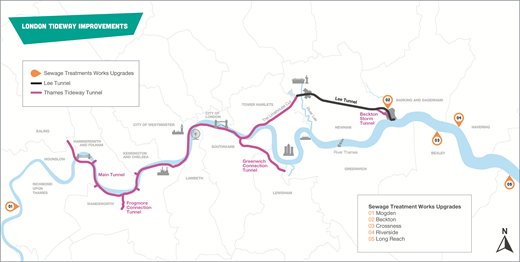
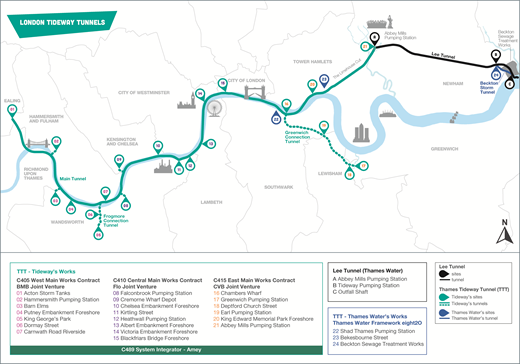
In August 2015, the new company – Bazalgette Tunnel Limited – came into being with its new ownership in place, with a licence from The Water Services Regulation Authority (Ofwat) and with a corporate organisation in place ready to deliver the project in partnership with Thames Water. Bazalgette Tunnel Limited, trading as Tideway, is the name of the IP. Construction commenced in 2016 and was substantially completed in 2024. System commissioning commenced in 2024, the tunnel was fully operational in August 2025 and 'operational handover' to Thames Water is planned in early 2026 (dependent on sufficient weather to complete storm testing). Tideway’s role was to deliver the majority of the Thames Tideway Tunnel’s works, with Thames Water delivering the remainder to create a London-wide system called the London Tideway Tunnels, which is the combination of the Thames Tideway Tunnel system and Thames Water’s existing Lee Tunnel (officially opened in 2016). The London Tideway Improvements also included Thames Water’s upgrades to five sewage treatment works (STWs) that discharge into the tidal Thames (Figure 1).
As a newly formed company, Tideway shaped its delivery approach in a bespoke fashion to suit the specific requirements of the project. With no previous or current competing projects, this created an environment to allow the project team to act in an innovative and transformational manner. The mission of the company was to clean up the River Thames, with the vision of also reconnecting Londoners to the River Thames.
2. The need for the project
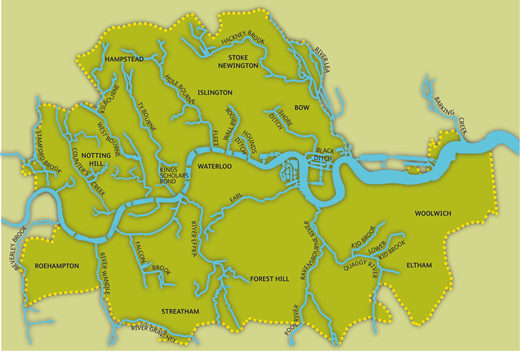
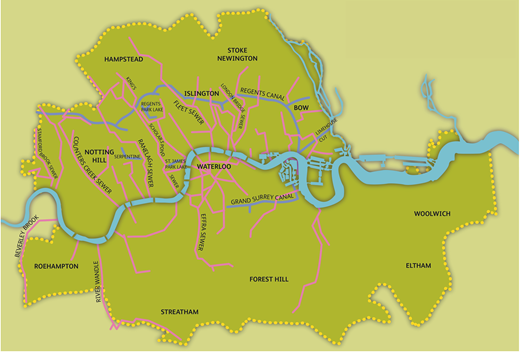
Figure 2 shows the tributaries to the tidal Thames, often referred to as London’s ‘lost rivers’. As London developed, more of these tributaries were culverted over. Figure 3 shows that, by 1856, these lost rivers had effectively become London’s sewerage system, all continuing to discharge into the Thames.
The Great Stink of 1858 was the tipping point when the pollution of the tidal Thames through central London had reached such an extent that the offensive stench from the river brought the parliament at Westminster to consider relocating. Parliament instructed Sir Joseph Bazalgette, the Chief Engineer of the Metropolitan Board of Works, to implement the design and construction of a new sewerage system for the city.
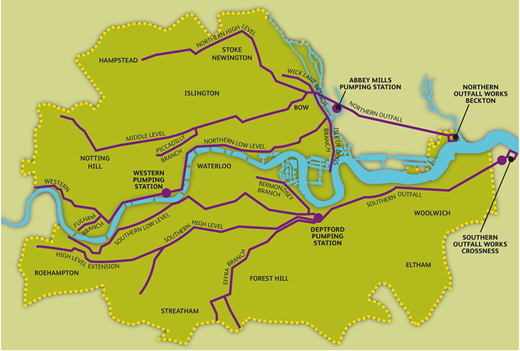
Sir Joseph Bazalgette constructed a series of west to east intercepting sewers both north and south of the river, as shown in Figure 4. These sewers intercepted flows from the existing sewers before they entered the river and conveyed those flows eastwards, where they were discharged into the tidal Thames far away from the populous centre of the city.
Much of today’s London sewerage system is predominantly a combined system where foul sewage and surface water runoff are collected by and conveyed in the same pipes, culverts and tunnels. At peak times, some of the sewer network operates near to its design capacity, which means that even modest rainfall can trigger spills of combined sewage into the river.
Bazalgette’s system incorporated combined sewer overflows (CSOs) that would relieve pressure on the system and allow sewage to discharge by gravity to the river when the capacity of the intercepting sewers was exceeded during periods of heavy rainfall. He also had the foresight to design a system with the capacity for twice the population of London that existed at the time of the scheme’s implementation. Bazalgette’s intercepting sewers, built 150 years ago, remain in excellent condition and continue to be the principal components of London’s present day sewerage system.
With an increasing population, higher water usage per capita and increased development leading to greater surface water runoff, there would be more frequent CSO spills if nothing was done.
Combined sewage discharges have a significant impact on the ecology of the river by reducing dissolved oxygen levels in the water. In extreme events this can result in the death of fish and other aquatic wildlife. Discharges can also cause fish and other aquatic life to be displaced by the pollution, reproductive cycles can also be damaged and migration patterns can be disrupted (Defra, 2015).
In addition, climate change predictions indicate future lower summer river flows and warmer water temperatures. This combination will adversely affect dissolved oxygen levels in the river. The warmer the water is, the less oxygen can be dissolved and the quicker organic matter in sewage will break down and consume the available oxygen, thereby increasing the threat to aquatic life in the river.
Combined sewage discharges also present health risks to recreational users of the tidal Thames. There is also the visual and amenity impact of sewage-derived litter entering the river, such as wet wipes, cotton buds, sanitary products and other ‘flushable’ items, including hypodermic needles. This derived litter travels up and down the river with the tide. In winter, when the river flow is highest, it takes about 1 month for non-biodegradable waste to get from the head of the estuary at Teddington to the sea; in the summer, when the river flow is lowest, it can take up to 3 months. It is in the summer months that combined sewage discharges have the biggest impact.
Following the Environment Agency’s classification of the 36 most polluting CSOs, the findings of the independent TTSS were published in 2005 (Defra, 2005). The TTSS concluded that combined sewage discharges should be intercepted by a tunnel that would transfer intercepted flows to treatment at Beckton STW or Crossness STW. Thames Water adopted the TTSS solution and commenced construction of the Lee Tunnel in 2010. This tunnel intercepted the worst polluting CSO at Abbey Mills Pumping Station on the River Lea and transferred intercepted flows to Beckton STW. In parallel, Thames Water also commenced with STW upgrades and led development plans for a tunnel to intercept the remaining CSOs on the tidal Thames – the Thames Tideway Tunnel.
The Department for Environment, Food and Rural Affairs (Defra) confirmed the government’s commitment to the Thames Tideway Tunnel in publishing
Creating a River Thames Fit for our Future in 2011 (updated in 2015 (Defra, 2015))
the National Policy Statement for Waste Water (Defra, 2012).
Prior to the UK’s exit from the EU, under EU law the UK was required (by the UWWTD) to have adequate systems in place for the collection and treatment of waste water to protect the environment. There were no specific standards or targets set in the UWWTD – it is up to the member states to demonstrate the measures they take adequately protect the environment and ensure that all urban waste water is collected and treated. The UWWTD acknowledges that pollution from overflows in combined systems may occur in exceptional circumstances (such as unusually heavy rainfall), but it requires member states to construct and maintain collecting systems using the best technical knowledge but not entailing excessive cost.
Given the magnitude of CSO spills into the tidal Thames, the European Commission referred the UK to the Court of Justice of the European Union (CJEU). In 2012 the CJEU found the UK to be in breach of its obligations under the UWWTD (CJEU, 2012). The CJEU noted that the UK was proposing the Thames Tideway Tunnel project as a solution to the problem and set the UK government a legal obligation to take the necessary measures to comply with the judgement of the CJEU. The European Commission could apply to the CJEU for a fines action if it was not satisfied with progress in implementing the solution. Such fines were likely to be very significant – of the order of £100 million per year (2014 prices) – until compliance was reached. Post-Brexit (an abbreviation of ‘Britain’ and ‘exit’, referring to the withdrawal process of the UK from the EU), the UK’s Urban Waste Water Treatment (England and Wales) Regulations 1994 (HMG, 1994) contain many of the UWWTD objectives.
3. Overview of project technical solution
The Thames Tideway Tunnel is the final phase of the London Tideway Improvement scheme (see Figure 1) originally proposed by the TTSS and further developed by Thames Water (Stride, 2019). The three phases were as follows.
Phase 1. In 2014, Thames Water upgraded five STWs (Beckton, Crossness, Riverside, Long Reach and Mogden).
Phase 2. In 2016, the Lee Tunnel, built by Thames Water, started to intercept the largest CSO at Abbey Mills Pumping Station. The Lee Tunnel is a 7.2 m dia., 7 km long tunnel that runs from Abbey Mills Pumping Station to Beckton STW.
Phase 3. The Thames Tideway Tunnel project controls 34 CSOs. Intercepted flows are transferred by a 25 km long main tunnel with associated connection tunnels to Beckton STW through the Lee Tunnel. The two systems form the London Tideway Tunnels, providing 1.6 million m3 of storage/transfer capacity.
The solution aligns with the principal aims of United Nations Sustainable Development Goal (UN SDG) 6: Clean water and sanitation (UN, 2015), seeking to ensure safe water sanitation for all, focusing on the sustainable management of water resources, waste water and ecosystems.
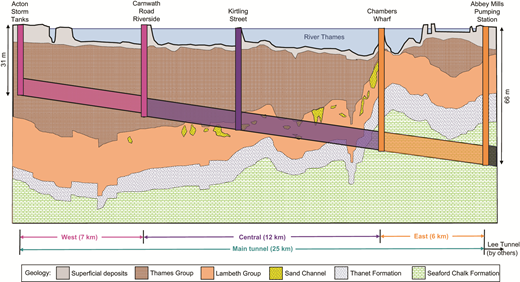
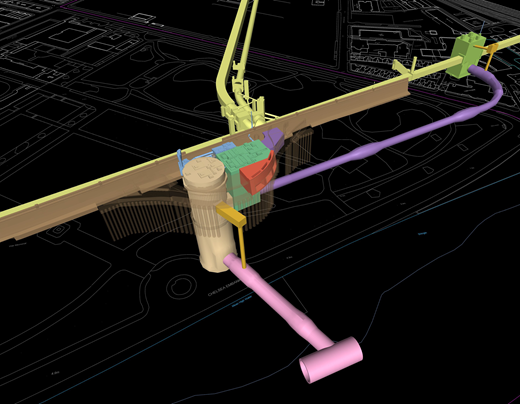
The combination of sewer network management and partial diversion of flows from combined sewers resulted in not all 34 CSOs needing to be intercepted or locally modified. There are 20 CSO interceptions/sewer connections connected to the tunnel system. Figure 5 shows the tunnel routes associated with the TTSS phase 3 works (Thames Tideway Tunnel) and their interface to phase 1 (STW) and phase 2 (Lee Tunnel) works. Figure 6 shows a section through the main tunnel, highlighting the west to east gravity fall, indicative shaft depths and the variable geology that influenced the selection of tunnel boring machines for the three delivery areas (west, central and east). Figure 7 shows a three-dimensional model isometric view illustrating a typical CSO interception, this example being at the Chelsea Embankment Foreshore site, which not only intercepts the Ranelagh CSO but also connects into Bazalgette’s Low Level One sewer (see Fricker et al. (2025), Lewis et al. (2025a) and Smith et al. (2025) in this issue).
4. The delivery model (SIPR 2013)
The Thames Tideway Tunnel is the first major UK project to use the government’s SIPR model to fund public infrastructure. These regulations allow the Secretary of State to ‘specify’ an infrastructure project that would normally be undertaken by a regulated water company to be undertaken by a separate licensed entity. The SIPR set out two tests that are required to be satisfied prior to the Secretary of State designating a project under the SIPR, namely size and complexity, and value for money.
The Secretary of State for Defra was of the opinion that the project was of such a size and complexity that it threatened Thames Water's ability to provide services for its customers and that specifying the project would result in better value for money than would be the case if the project was not specified.
Tideway operates under a licence granted by Ofwat, the economic regulator of the water sector in England and Wales. Ofwat regulates 32 companies in the water and sewerage sector, including Tideway. Among other things, Tideway’s licence sets out its principal duties and the building blocks of Tideway’s allowed revenue. In addition to the licence, Tideway is also subject to Ofwat guidance and other requirements. Tideway reports on its licence performance annually to its stakeholders, similar to other water companies, and also reports quarterly to a project-specific Thames Tideway Tunnel Liaison Committee consisting of Defra, Tideway and Thames Water, with the Environment Agency and Ofwat as observers.
One of the primary advantages of the SIPR is the potential ability to drive the lowest, most efficient weighted average cost of capital (WACC) compared with other procurement models. The WACC is effectively the cost of financing and encompasses both the cost of equity and debt that is required to compensate investors for the risks associated with their investment. This efficient WACC directly drives lower bills for customers. For example, the bill impact of the Thames Tideway Tunnel project following the licence award to Tideway fell from an estimated £70–80 per household customer to a maximum of £25 (2014/15 prices) (Ofwat, 2022). The model has been successful in attracting private investment, securing competitive financing capital and delivering value for money to customers for this essential upgrade to London’s sewerage network.
Tideway’s innovative delivery model for the project includes a bespoke regulatory framework, with a contingent Government Support Package (GSP), which recognises the unique nature of Tideway’s business. This framework provides a revenue stream during both the construction and operational periods. Revenues are billed and collected by Thames Water from its customers and passed to Tideway. The delivery model is being considered for other major projects both in the water sector and beyond.
The GSP consists of six core contract documents designed to support the project should exceptional, highly unlikely risks happen, which the private sector could not cover at an acceptable cost, if at all. The six core contract documents are as follows.
Supplemental compensation agreement – the government acts as last insurer of resort to provide contingent financial support, as allowed in the Water Industry Act 1991, where claims are in excess of the insurance policy limits or where insurance cover is unavailable.
Market disruption facility – access to government liquidity facility in case of disruption to capital markets.
Contingent equity support agreement – in the event of cost overruns above Threshold Outturn (a pre-determined cost threshold for construction, representing the maximum amount of capital expenditure that Tideway is obligated to fund through its own resources), the government can be required to provide equity financing to fund the shortfall.
Discontinuation agreement – compensation in the event government discontinues the project.
Special administration offer agreement – designed to manage risks for the project, potentially including government intervention if the project faces insolvency.
Shareholders’ direct agreement – agreement that governs the respective rights and obligations of the Secretary of State and the private sector shareholders in relation to the GSP.
The inclusion of the GSP was a key factor in limiting risk for the private sector investors in Tideway and a key element in enabling those investors to offer a lower WACC and hence a reduced bill impact for customers.
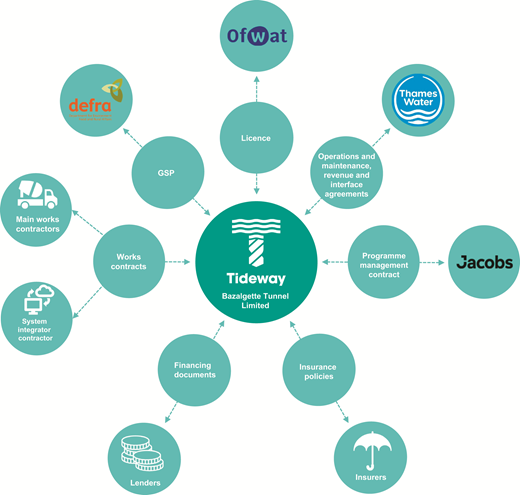
Tideway’s delivery model was underpinned by arrangements with different stakeholders. These arrangements were key to making Tideway’s risk profile similar to that of an established UK regulated water company. Figure 8 shows the model overview and relationship between the project stakeholders. The model accords with UN SDG 9: Industry, innovation and infrastructure, to build resilient infrastructure, promote inclusive and sustainable industrialisation, and foster innovation, ultimately supporting economic development and improving human well-being.
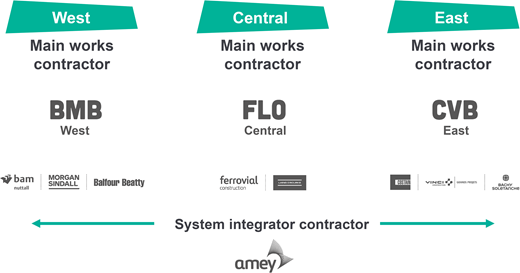
Tideway let four contracts for the detailed design and construction of the project to three main works contractors (west, central and east) and a system integrator contractor. Most design responsibility sat with these contractors, but Tideway retained responsibility for system-wide hydraulic, air and control aspects (Fricker et al., 2025). For the procurement and programme management of these four contracts, a professional services contract was let to Jacobs (Smith et al., 2025). The four contracts were let to the following contractors (Figure 9) (see Figure 5 for delivery areas).
West Main Works Contract C405 – joint venture of Bam Nuttall, Morgan Sindall and Balfour Beatty (BMB).
Central Main Works Contract C410 – joint venture of Ferrovial Construction and Laing O’Rourke (Flo).
East Main Works Contract C415 – joint venture of Costain, Vinci Construction Grands Projets and Bachy Soletanche (CVB).
System integrator contract C489 – Amey
An alliance (regulated by an Alliance Agreement) was created between Tideway, the three main works contractors, the system integrator contractor and Thames Water with the aim of ensuring co-operation between all delivery stakeholders.
For the Thames Tideway Tunnel, Thames Water was responsible for its initial concept design, obtaining the DCO, the initial procurement of the IP (Tideway)/main work contractors, procuring the required land and commencing enabling works before Tideway was fully established. During construction, Thames Water provided permits to the existing sewage network to enable the contractors to make over 13 000 sewer entries to carry out works connecting the existing sewer network to the Thames Tideway Tunnel. Thames Water also internally managed the design and operational interfaces to ensure compatibility with Thames Water’s existing systems. All these interfaces between internal Thames Water stakeholders and the project were managed by a dedicated team – the Tideway Integration Group.
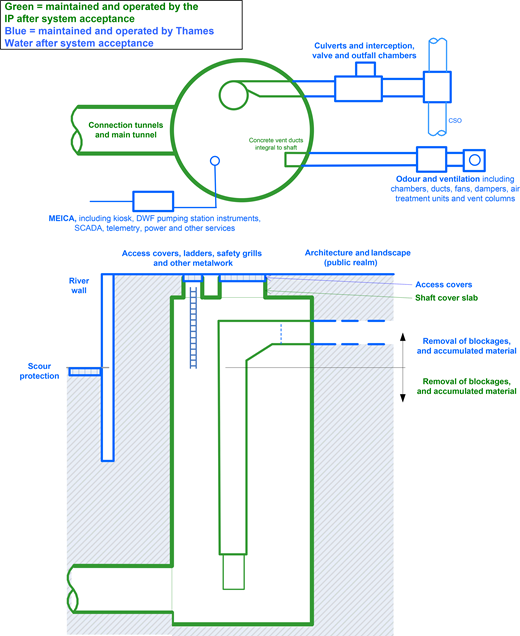
From the ‘operational handover’ date (scheduled for winter 2025–2026), Thames Water will be responsible for operating the London Tideway Tunnels system and the maintenance of the new public realm areas that Tideway created. After a system acceptance period of 18 months to 3 years (weather/storm dependent) to test for a number of storm scenarios, on the system acceptance date, Thames Water will also take ownership of the mechanical, electrical, instrumentation, control and automation (MEICA) assets, including the supervisory control and data acquisition (SCADA) system and near-surface assets (chambers and culverts) constructed by Tideway, leaving Tideway ownership and maintenance responsibility of the deep tunnels and shafts. Figure 10 illustrates the asset split between the parties.
The interface between Tideway and Thames water was governed by an Interface Agreement, which was one of the core suite of project documents. This agreement set out the various rights, responsibilities and obligations of the parties and set out approaches in keys areas such as health and safety, land, and accessing Thames Water sites and the sewer network. Formal reporting was monthly to an Interface Committee made up of two senior representatives from each party. The Interface Committee provides a forum for joint strategic discussion regarding the day to day execution of the project, including resolution of interface issues that arise during the design, construction, commissioning and acceptance of the Thames Tideway Tunnel.
Another key governing project document was the Liaison Agreement between the UK government, Tideway and Thames Water. Among other things, the agreement provided for the transfer of information that allowed the UK government to monitor the project’s progress and take early action if any issues arose. Governance and reporting were through the Liaison Committee. Mott McDonald was appointed as an independent technical assessor for the project, with a duty to review, evaluate, comment, verify and advise the members of the Liaison Committee and Ofwat on Tideway’s assessment of project costs, and engineering and other technical issues that arose as the project progressed.
5. The project company Bazalgette Tunnel Limited (Tideway) and delivery partners
Bazalgette Tunnel Limited was set up for the single purpose of ‘building the Thames Tideway Tunnel under the River Thames–creating a healthier environment for London by cleaning up the city’s greatest natural asset, now and for the foreseeable future’. This single purpose, together with a lack of incumbencies or competing business requirements, provided a unique opportunity to set the vision and the culture of the company and hence the project from day one, optimised efficient delivery of the UK water sector’s largest ever infrastructure project. It also gave an opportunity to leave a lasting legacy that raises the bar for the industry in meaningful ways, including in health, safety and well-being (HSW), and in setting new benchmarks for socially conscious project delivery.
The company’s vision was a simple one – reconnecting London with the River Thames – but effective in communicating what was achieved by
delivering a project that delivers a long-term environmental benefit of a cleaner healthier river
maximising use of the River Thames to transport materials, bringing jobs and skills back to the river and keeping lorries off the road
supporting local communities through employment and through partnerships with local organisations
creating high-quality new public spaces in and around the river.
During the setup phase of the company, the executives, senior leadership team, employees and shareholders all had input into what they wanted the company to achieve, how it would be delivered, what sort of company it would be to work for and what values would be applied to achieving the ambitions. This all contributed to the unique culture of Tideway, and it is this unique and positive culture that is probably the single most attributed item that has led to the success of the project by those who have worked on it or engaged with Tideway.
The foundations of the culture for delivering the vision and purpose are five Tideway values
safety
legacy
collaboration
respect
innovation.
These played an important part in delivering the project and achieving the greatest value, as detailed in the following.
5.1 Safety
An ethos of ‘do things safely or not at all’ was at the heart of the transformational approach to HSW. The target was for zero fatalities or serious injuries, off or on site. This was supported by setting new standards for HSW – this was the right thing to do for those involved, as well as improving productivity and reducing the chance of delays or stoppages. The scheme was known as ‘RightWay’ (Alder et al., 2022).
RightWay was about establishing a working environment that allowed individuals to plan ahead, to challenge, to continually strive to do things better and to reinforce a positive HSW culture through effective leadership. ‘RightStart’ reviews were conducted across the programme, before the start of any significant phase of construction, to ensure HSW had been adequately considered. These were undertaken in collaboration with the programme manager, the four contractors and Thames Water (as required for interfaces) to ensure appropriate input and assurance, and ensure that activities were planned effectively. Involving the contractors’ workforce in the RightStart process enabled those conducting the work to raise concerns and suggest alternative methods. It also ensured sufficient understanding of each task and the risks and mitigations that needed to be considered when performing it.
The Employer’s Project Induction Centre (EPIC) was a groundbreaking, innovative and interactive induction programme that Tideway established in 2015–2016. It has been widely recognised as industry leading, setting a new standard for employee inductions and winning multiple industry awards. EPIC was a mandatory, one-day immersive induction course, which used actors and a structured management training approach to help every individual understand what was to be achieved, to develop interpersonal skills and how to work together to make Thames Tideway Tunnel the safest and healthiest project yet. The focus was on ensuring workers understood they were empowered to speak up if they thought something was not right and their role in challenging unsafe behaviours or conditions observed on site. A crucial feature of EPIC was the senior management message – we do things safely or not all – delivered in person at every session by one of the most senior members of Tideway’s management team. To date, over 25 000 people have attended EPIC courses, including people working on the project, heavy goods vehicle drivers and marine crews who delivered materials to project sites, emergency response personnel and employees from other interested companies. This supported Tideway’s aim of being transformational and further improving health and safety in the wider construction industry.
Tideway’s culture focused on the importance of the way people treated each other and its stakeholders. Tideway always aimed to transform the way the industry operated to see a step change in the health and well-being of everyone involved in the project, whether that was through the focus on HSW in the workplace, volunteering with charity partners, collaborating with partners, engaging with residents or supporting people to develop skills and find employment.
5.2 Legacy
More than 150 years ago, Sir Joseph Bazalgette had the vision and determination to see through an ambitious plan to establish the sewerage network that has served London so well. At a time when cholera and other diseases were rampant, Bazalgette’s primary aim was to protect public health, but the legacy he left was much broader.
In 2015, Tideway took inspiration from Bazalgette with the construction of the tunnel system that now tackles what had been a growing problem of combined sewage flowing into the tidal Thames from the overstretched Victorian network. Creating a cleaner, healthier river was part of Tideway’s legacy – but it was far from the whole story. Tideway wanted to create a wider legacy for the capital and, in doing so, helped realise its vision to reconnect London with the River Thames.
Previous infrastructure projects have made great progress in leaving a lasting legacy, which provided the opportunity for Tideway to learn from them, to build on them and go further. Tideway’s ten legacy objectives (Tideway, 2017b), under the themes of environment, HSW, economy, people and place, are set out below. They support UN SDG 11: Sustainable cities and communities – to ensure that cities and human settlements are inclusive, safe, resilient, and sustainable (see Sage (2025) and Donnelly et al. (2025) in this issue).
Objective 1 – Protect and enhance the environment. By intercepting combined sewage flows before they enter the river and transferring them for treatment, the project has started to clean up the River Thames for future generations of Londoners.
Objective 2 – Raise standards and performance in HSW (covered in Section 5.1).
Objective 3 – Improved competitiveness and vitality for London. By providing a modernised upgrade to London’s sewerage network, the project has underpinned the capital’s general economic prosperity.
Objective 4 – Contribute to the rejuvenation of London’s river economy. By committing to using river transport, the project brought jobs and skills back to the river (see Spikesley and Donnelly (2025) in this issue).
Objective 5 – Improve the UK’s exportable knowledge base and encourage innovation. By building on the excellent work of other major infrastructure projects, this project has helped to create a springboard for the UK workforce and companies to become world-class. Not only were innovations shared with the industry so future projects may benefit, but Tideway helped create a new web-based forum, the Infrastructure Industry Innovation Platform (known as i3P). Tideway also promoted best practice by having delivered the principles of the construction industry’s Construction Supply Chain Payment Charter, also known as the Fair Payment Charter (DBEIS, 2016).
Objective 6 – Increase prosperity, local employment and workforce diversity. The project created significant opportunities that boosted local employment and prosperity within London.
Objective 7 – Inspire and upskill a new generation. In 2015, the UK was predicted to need 182 000 new engineers by 2022; the skills gap in the engineering and construction industry was clear. A key element of this commitment was the creation of apprenticeships. The contractors employed at least one apprentice for every 50 full-time on-site workers, which included a mix of intermediate, advanced and higher level apprenticeships.
Objective 8 – Greater well-being for all, improved health for river users. A primary benefit of the project was the dramatic reduction of untreated combined sewage entering the river. The quality of life for all in the capital has been enhanced by the increased opportunity for recreational use of the river.
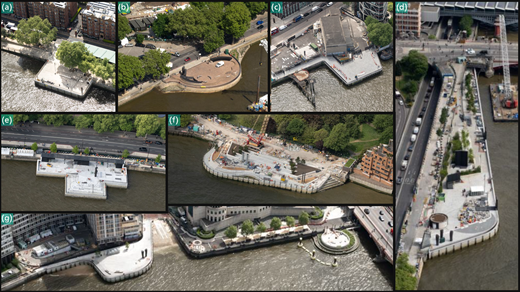
Objective 9 – Improved public realm. When Sir Joseph Bazalgette implemented his visionary overhaul of London’s sewerage system more than 150 years ago, transforming public health, he also changed the look and character of the river with the creation of the Chelsea, Victoria and Albert Embankments. Similarly, this project has created new areas of public realm to connect the capital’s residents and visitors with the river more closely than was previously possible. Fittingly, new public realm was created that adjoins the Chelsea Embankment (Figure 11(b)), Victoria Embankment (Figures 11(d) and 11(e)) and Albert Embankment (Figure 11(g)).
Objective 10 – More cohesive communities. Tideway was committed to being a responsible business and a good neighbour, and gave back to the surrounding communities. Not only were communities close to the sites engaged with but, to leave a lasting legacy, Tideway invested in the local community in partnership with residents and community groups.
6. Financing and cost to bill payers
In 2014, a consortium of investors successfully bid for the project licence to finance, build, maintain and operate the Thames Tideway Tunnel. Table 1 shows the original and current shareholdings of the consortium.
Tideway’s investors have extensive experience of investing in and managing a wide range of infrastructure assets in the UK and overseas. They have collectively invested £1.3 billion with close to half the total equity coming from UK investors, including many pension funds, giving three million UK pension holders an indirect stake in Tideway. The consortium's backing fulfils a key component of the National Infrastructure Plan (HM Treasury, 2014), designed to finance the development of UK infrastructure with the support of highly experienced private investors.
In addition to the risk capital invested by shareholders, Tideway has made significant progress in implementation of its financing strategy, raising £3.5 billion of external long-term debt as of October 2025. Tideway’s strategy for financing the Thames Tideway Tunnel was to utilise its committed equity first and subsequently to fund its activities from the debt proceeds.
For the period to 2030, Tideway revenues are calculated according to the framework set out in the project licence, which is primarily based on a percentage return (2.497%) on the regulatory value of the company (Regulatory Capital Value). From 2030, it is expected that Tideway will be regulated in line with the rest of the water industry by way of Ofwat’s 5-yearly regulatory review.
Prior to system acceptance, Tideway will not generate distributable profits and, as such, it will not be able to pay dividends to its shareholders. As a result, during construction, Tideway’s shareholders received a cash return on their investment through a combination of payments of interest on the loan and partial repayments of those loans. This mechanism was put in place during the IP equity procurement process run by Thames Water and overseen by Ofwat and the UK government, and was key to achieving the low cost of capital bid by Tideway’s shareholders. Ultimately, Thames Water’s customers benefit from the low cost of capital achieved through the procurement through a lower charge in their bills.
Tideway operated a sustainable financing strategy to align Tideway’s financing both with the long-term target of cleaning the river and with the significant environment, social and governance initiatives during construction. These are set out in Tideway’s legacy commitments (see Sage (2025) in this issue). The sustainable financing strategy is supported by the Sustainable Finance Framework (Tideway, 2023) which is aligned with
the International Capital Markets Association’s Green Bond Principles (ICMA, 2025)
the Green Loan Principles of the Loan Market Association (LMA) (LMA, 2025) and
the LMA’s Sustainability Linked Loan Principles (LMA, 2019).
Tideway’s sustainability reporting is aligned with the UN SDGs at target level. In 2023, S&P Global awarded Tideway a Dark Green rating, with an ‘Excellent’ governance score under their Shades of Green methodology. S&P Global Shades of Green rating methodology includes six shades that can be designated to activities, with a Dark Green rating awarded to activities that correspond to the long-term vision of a low-carbon climate-resilient future (S&P Global, 2024).
All bonds issued to date are green and are listed on the London Stock Exchange Sustainable Bond Market. In 2025, Tideway became the first corporate to issue a ‘blue bond’, a subset of green bonds, which denote specific investor benefits to seas and marine environments. Tideway’s total green debt issuance stands at £2157 million (18 green bonds totalling £1832 million and £325 million of green US private placements). Tideway has access to a revolving credit facility, which is structured as a sustainability-linked loan, including a rebate linked to a sustainability key performance indicator of meeting at least 85% of Tideway’s live legacy commitments. In 2023–2024, the savings from the rebate were used to support 36 London-based projects designed to ‘clean and green’ the city through the Our Space Award, delivered by Groundwork London (GL, 2024).
Thames Tideway Tunnel is the largest single asset in the water sector. An innovative procurement method, combined with a low interest rate investment environment, has contributed to significant cost savings for the project, substantially reducing the contributions expected from the end consumer.
Tideway’s cost estimate at completion is £4.6 billion, compared with the regulatory baseline of £3.5 billion. Tideway bears 40% of any overspend and customers bear 60% of that overspend. In 2015, at licence award, the intent of the regulator and the government was that the cost of the project per household bill would not exceed £25 per year (2014–2015 prices). Despite many challenges – not least a global pandemic – the impact on annual customer bills remains well within the original range. The GSP, a key feature of the model that enabled more favourable financing rates to be secured to the benefit of customers, has not been required to be called upon during construction of the project.
Tideway has been able to mitigate the impact of increased capital cost by maintaining a very competitive cost of capital through being an attractive, sustainable investment vehicle. This has enabled the bill impact to customers to be held within the original range.
7. Non-statutory compensation
A unique aspect of the Thames Tideway Tunnel project was the implementation of a ‘Non-statutory off-site mitigation and compensation policy’. The Thames Tideway Tunnel was a major construction project and it was recognised that some of its works would have an impact on local communities adjacent to sites, particularly those sites that involved 24-hour tunnelling operations and tidally influenced river logistics. This discretionary policy (albeit promoted and secured in the DCO) recognised that losses may be incurred that were outside the statutory compensation regime and there may be additional need for mitigating the localised effects of construction.
Construction techniques and equipment that minimised disruption were used throughout the project as a first line of mitigation, such as the placement of acoustic buildings over tunnel drive shafts that facilitated 24-hour construction operations (with planning and procedures that minimised deliveries outside of normal site hours). The DCO secured a Code of Construction Practice (Thames Water, 2014) that set out a series of measures and controls that were applied throughout construction to mitigate the potential impacts of site activities on the natural and historic environments, amenity, the HSW of local residents, road users and traffic flow, businesses and the public. However, it was recognised that some members of the local community may be more susceptible to the construction effects of dust, light interference and noise (e.g. shift workers, people working from home, people with medical conditions or other vulnerable people), who may therefore require additional support or mitigations.
Prior to commencing construction, the owners/occupiers of properties most likely to be affected by the construction works were identified and contacted to see if measures could be put in place to reduce disruption. In some cases, this included fitting secondary glazing to provide additional noise protection while construction work was being carried out. In a small number of special cases, it was more appropriate to discuss the option of temporary rehousing during certain periods.
The non-statutory policy established an Independent Compensation Panel (ICP) of experts drawn from a variety of disciplines, including noise and vibration, compensation, exceptional hardship, building surveying, engineering and medical matters. The ICP was funded by Tideway but operated independently and assessed all claims in confidence, equally and fairly using their experience, knowledge and the evidence presented to them.
The ICP assessed claims and their decisions were then implemented by Tideway. Mitigations awarded to claimants included secondary glazing, blackout blinds, air conditioning for properties, noise-cancelling headphones, office space for home workers, brief ‘respite’ stays away from the site during the noisy, more disruptive works or temporary rehousing.
An Independent Advisory Service was also set up to provide independent advice to those affected by the works. Services included advising on Tideway mitigation and compensation policies, the impacts of living above or near the tunnel route, questions about ground settlement and subsoil acquisition and the Exceptional Hardship Procedure (EHP). The EHP aided property owners and leasehold occupiers who were affected by the construction of the tunnel. The EHP helped with selling properties and the temporary use of business premises.
An Independent Complaints Commissioner was established to review complaints from residents dissatisfied with ICP decisions and assess whether the ICP had followed the correct process in assessing a claim made to it, and to investigate unresolved complaints to ascertain whether Tideway had met its commitments and complied with agreed policies and procedures.
The number of claims assessed over the life of the project was ∼1800, with the value of claims being ∼£6 million. Given the programme and cost impacts if tunnel drive sites could not operate continuously or specific activities were restricted, the case for investment in non-statutory schemes is compelling.
8. Conclusion
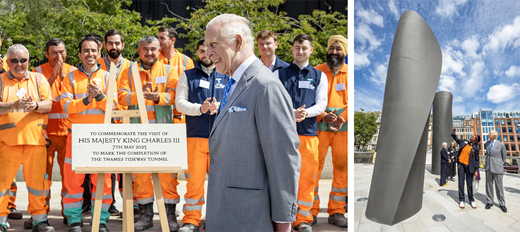
In May 2024, the main tunnel was physically connected to the existing Lee Tunnel (officially opened in 2016), thus forming the London Tideway Tunnels network with a combined capacity of 1.6 million m3 to protect the tidal Thames. Over the remainder of 2024 and early 2025, the 20 CSO/sewer connections were activated (i.e. connected to the tunnel system by way of the new interception structures). The tunnel system was fully activated ready for commissioning and the start of storm testing in February 2025 (see Lewis et al. (2025b) in this issue). With the Thames Tideway Tunnel receiving flows, Tideway was honoured to host His Majesty King Charles III on 7 May 2025 at the new public realm named Bazalgette Embankment (Figure 12).
Since start of operations in 2024, 9.3 million m3 of storm overflows has been captured and conveyed to STWs, which – without the project – would have discharged directly into the River Thames. The completion of the London Tideway Tunnels has reduced combined sewage discharges into the tidal Thames from the existing sewer network by 95%.
As of August 2025, the Thames Tideway Tunnel is fully operational protecting the tidal Thames, with storm testing progressing albeit challenged due to the unusually dry weather experienced in London during the year. Operational handover (i.e. full operational control of the asset and the public realm spaces transferred to Thames Water) is forecast for early 2026 (subject to suitable storms being experienced). Prior to this during commissioning/storm testing, Thames Water operate the tunnel as part of their network under the direction of Tideway.
After operational handover to Thames Water, a system acceptance period involving data collection will continue to validate longer term climate scenarios, a full tunnel shutdown will be undertaken by Tideway to inspect the tunnel and optimisation of control systems will be completed. For future tunnel inspections, Tideway is investing in the development of innovative technology including robots/drones and artificial intelligence systems to reduce the need for personnel to enter any of the tunnels. During the system acceptance period, Tideway will maintain all the assets until a maintenance handover to Thames Water at the system acceptance date in 2027.
On 9 September 2025 the project was honoured to welcome HRH The Princess Royal, the Secretary of State for Environment, Food and Rural Affairs Emma Reynolds MP, the Mayor of London Sir Sadiq Khan and the Deputy Mayor of London for Environment and Energy Mete Coban MBE to Bazalgette Embankment, the largest of seven new riverside public parks that the project has created in the River Thames. Marking substantial completion of the site, Her Royal Highness, The Princess Royal formally ‘switched on’ a giant 8m high artwork water feature to an audience of approximately 100 senior figures, many of whom played key roles in the project’s development over the past decade including individuals from Tideway’s shareholders, the project’s contractors, government, regulators, and members of the Bazalgette family, whose great-great-grandfather, Sir Joseph, engineered the sewage system London relies on today.
The following day the site hosted an event showcasing the Bazalgette Embankment to an audience of over 800 attendees consisting of current and former employees and members of the public. The event being a good test of the new 1.5-acre area before being fully opened to the public and a great example of the potential for using the space for public events. Many of Tideway’s public parks have now already opened – in Chelsea, Nine Elms, Vauxhall and Putney – with Bazalgette Embankment due to open to the public late 2025.
Finally, the project has been honoured to win many prestigious awards over the course of its construction, as a testament to the professionalism and dedication of the 25,000+ project team. However, in the year that the Guinness World Records celebrates its 70th anniversary the Thames Tideway Tunnel was named as the ‘longest tunnel under a river’ in the Guinness Book of Records 2026 edition (Guinness World Records Limited, 2025) a fitting footnote as the project’s construction phase reaches its substantial completion.
Acknowledgements
The authors would like to acknowledge the professionalism and dedication of the 25 000+ people who have worked on the project since its inception in 2000, across hundreds of companies within the supply chain, stakeholders and Thames Water and Tideway client organisations. It is the collective talent of these individuals that has delivered a truly world-class infrastructure project, continuing the legacy of Sir Joseph Bazalgette and reconnecting Londoners with the River Thames. Special thanks go to Tideway’s Cathal Cunningham (Head of Financial Control), Ingrid Lagerberg (Systems Engineering Lead), Lucy Webster (Director of External Affairs) and Simon Fricker (Head of Design Authority) for their contributions to this paper.